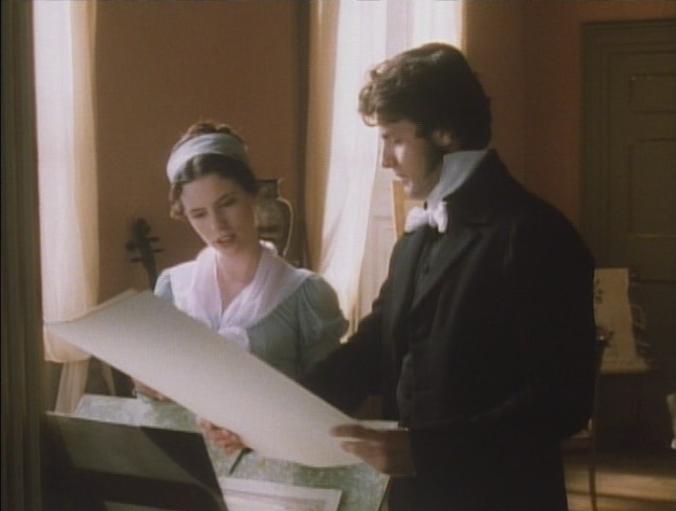
In Volume 1, Chapter 6, Emma paints a watercolor likeness of Miss Smith in an attempt to draw Mr. Elton closer to Miss Smith. In Mr. Elton’s mind, the painting sessions present him with an opportunity to spend more time with Emma and toady up to her. Recent Emma film adaptations have captured this scene wonderfully, as you can see from the images that accompany Jane Austen’s text.
Did you ever have your likeness taken, Harriet?” said she: “did you ever sit for your picture?”
Harriet was on the point of leaving the room, and only stopt to say, with a very interesting naïveté,
“Oh! dear, no, never.”
No sooner was she out of sight, than Emma exclaimed,
“What an exquisite possession a good picture of her would be! I would give any money for it. I almost long to attempt her likeness myself. You do not know it I dare say, but two or three years ago I had a great passion for taking likenesses, and attempted several of my friends, and was thought to have a tolerable eye in general. But from one cause or another, I gave it up in disgust. But really, I could almost venture, if Harriet would sit to me. It would be such a delight to have her picture!”
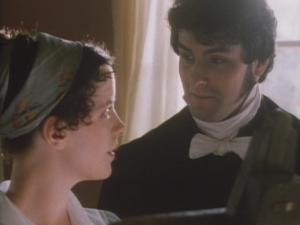
Mr. Elton entreats Miss Woodhouse to paint. Emma 1996 A&E
“Let me entreat you,” cried Mr. Elton; “it would indeed be a delight! Let me entreat you, Miss Woodhouse, to exercise so charming a talent in favour of your friend. I know what your drawings are. How could you suppose me ignorant? Is not this room rich in specimens of your landscapes and flowers; and has not Mrs. Weston some inimitable figure-pieces in her drawing-room, at Randalls?”
Yes, good man!—thought Emma—but what has all that to do with taking likenesses? You know nothing of drawing. Don’t pretend to be in raptures about mine. Keep your raptures for Harriet’s face. “Well, if you give me such kind encouragement, Mr. Elton, I believe I shall try what I can do. Harriet’s features are very delicate, which makes a likeness difficult; and yet there is a peculiarity in the shape of the eye and the lines about the mouth which one ought to catch.”
“Exactly so—The shape of the eye and the lines about the mouth—I have not a doubt of your success. Pray, pray attempt it. As you will do it, it will indeed, to use your own words, be an exquisite possession.”
“But I am afraid, Mr. Elton, Harriet will not like to sit. She thinks so little of her own beauty. Did not you observe her manner of answering me? How completely it meant, ‘why should my picture be drawn?'”
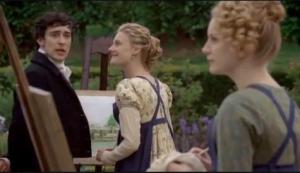
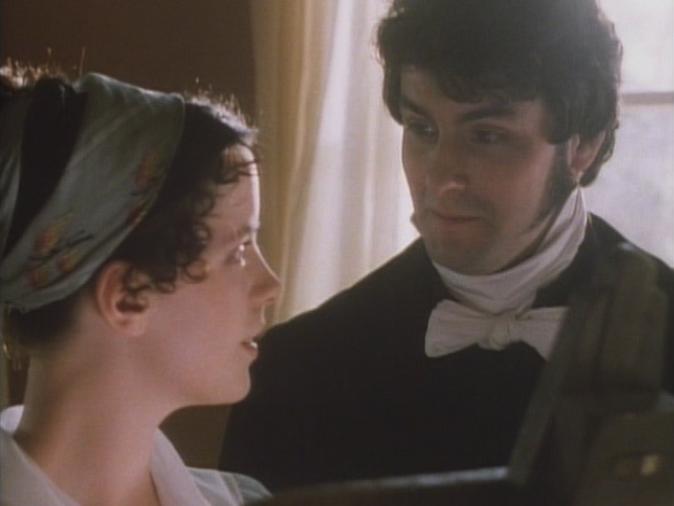
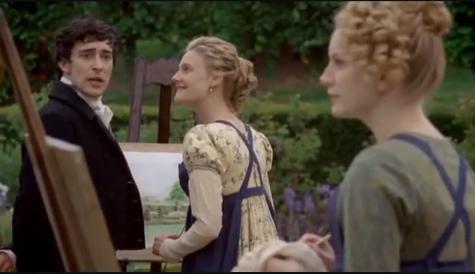
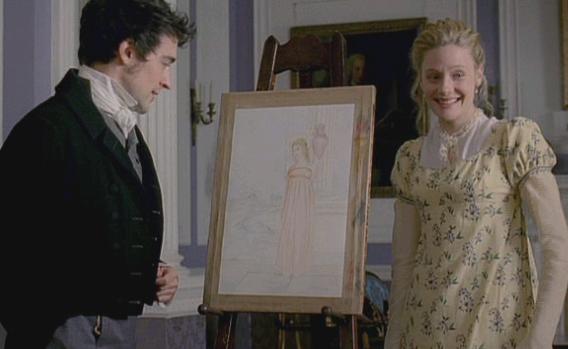
Mr. Elton (Blake Ritson) can envision Emma (Romola Garai) painting a portrait of Harriet (Louis Dylan). Emma 2009
“Oh! yes, I observed it, I assure you. It was not lost on me. But still I cannot imagine she would not be persuaded.”
Harriet was soon back again, and the proposal almost immediately made; and she had no scruples which could stand many minutes against the earnest pressing of both the others. Emma wished to go to work directly, and therefore produced the portfolio containing her various attempts at portraits, for not one of them had ever been finished, that they might decide together on the best size for Harriet. Her many beginnings were displayed. Miniatures, half-lengths, whole-lengths, pencil, crayon, and water-colours had been all tried in turn. She had always wanted to do everything, and had made more progress both in drawing and music than many might have done with so little labour as she would ever submit to. She played and sang;—and drew in almost every style; but steadiness had always been wanting; and in nothing had she approached the degree of excellence which she would have been glad to command, and ought not to have failed of. She was not much deceived as to her own skill either as an artist or a musician, but she was not unwilling to have others deceived, or sorry to know her reputation for accomplishment often higher than it deserved.
There was merit in every drawing—in the least finished, perhaps the most; her style was spirited; but had there been much less, or had there been ten times more, the delight and admiration of her two companions would have been the same. They were both in exstasies. A likeness pleases every body; and Miss Woodhouse’s performances must be capital.
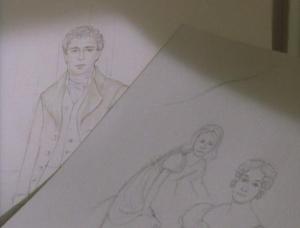
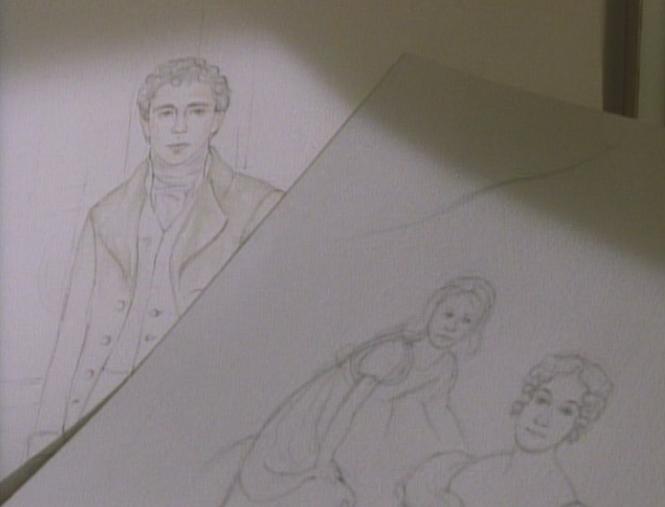
Emma's unfinished portraits of her family. Emma 1996 A&E
“No great variety of faces for you,” said Emma. “I had only my own family to study from. There is my father—another of my father—but the idea of sitting for his picture made him so nervous, that I could only take him by stealth; neither of them very like therefore. Mrs. Weston again, and again, and again, you see. Dear Mrs. Weston! always my kindest friend on every occasion. She would sit whenever I asked her. There is my sister; and really quite her own little elegant figure!—and the face not unlike. I should have made a good likeness of her, if she would have sat longer, but she was in such a hurry to have me draw her four children that she would not be quiet. Then, here come all my attempts at three of those four children;—there they are, Henry and John and Bella, from one end of the sheet to the other, and any one of them might do for any one of the rest. She was so eager to have them drawn that I could not refuse; but there is no making children of three or four years old stand still you know; nor can it be very easy to take any likeness of them, beyond the air and complexion, unless they are coarser featured than any of mama’s children ever were. Here is my sketch of the fourth, who was a baby. I took him, as he was sleeping on the sofa, and it is as strong a likeness of his cockade as you would wish to see. He had nestled down his head most conveniently. That’s very like. I am rather proud of little George. The corner of the sofa is very good. Then here is my last,”—unclosing a pretty sketch of a gentleman in small size, whole-length—”my last and my best—my brother, Mr. John Knightley. —This did not want much of being finished, when I put it away in a pet, and vowed I would never take another likeness. I could not help being provoked; for after all my pains, and when I had really made a very good likeness of it—(Mrs. Weston and I were quite agreed in thinking it very like)—only too handsome—too flattering—but that was a fault on the right side—after all this, came poor dear Isabella’s cold approbation of—”Yes, it was a little like—but to be sure it did not do him justice.” We had had a great deal of trouble in persuading him to sit at all. It was made a great favour of; and altogether it was more than I could bear; and so I never would finish it, to have it apologised over as an unfavourable likeness, to every morning visitor in Brunswick-square;—and, as I said, I did then forswear ever drawing anybody again. But for Harriet’s sake, or rather for my own, and as there are no husbands and wives in the case at present, I will break my resolution now.”
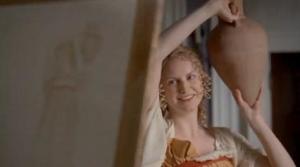
Harriet (Louise Dylan) responds to Mr. Elton's interest in her portrait. Emma 1996
Mr. Elton seemed very properly struck and delighted by the idea, and was repeating, “No husbands and wives in the case at present indeed, as you observe. Exactly so. No husbands and wives,” with so interesting a consciousness, that Emma began to consider whether she had not better leave them together at once. But as she wanted to be drawing, the declaration must wait a little longer.
She had soon fixed on the size and sort of portrait. It was to be a whole-length in water-colours, like Mr. John Knightley’s, and was destined, if she could please herself, to hold a very honourable station over the mantelpiece.
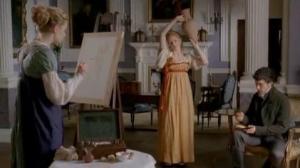
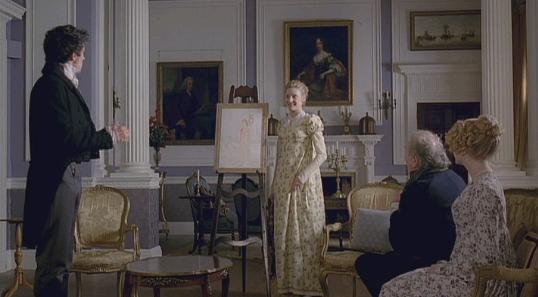
Keeping a pose for long for a portrait is difficult. Emma 2009
The sitting began; and Harriet, smiling and blushing, and afraid of not keeping her attitude and countenance, presented a very sweet mixture of youthful expression to the steady eyes of the artist. But there was no doing anything, with Mr. Elton fidgeting behind her and watching every touch. She gave him credit for stationing himself where he might gaze and gaze again without offence; but was really obliged to put an end to it, and request him to place himself elsewhere. It then occurred to her to employ him in reading.
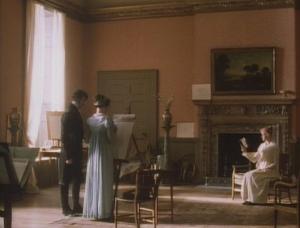
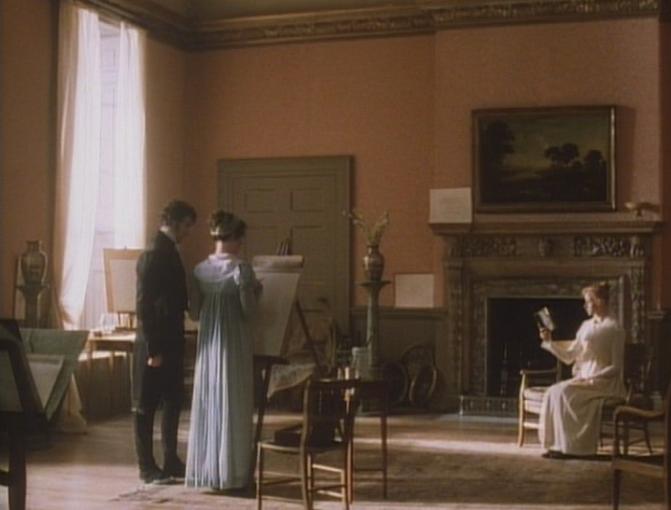
Mr. Elton oversees the process. Emma 1996 A&E
“If he would be so good as to read to them, it would be a kindness indeed! It would amuse away the difficulties of her part, and lessen the irksomeness of Miss Smith’s.”
Mr. Elton was only too happy. Harriet listened, and Emma drew in peace. She must allow him to be still frequently coming to look; any thing less would certainly have been too little in a lover; and he was ready at the smallest intermission of the pencil, to jump up and see the progress, and be charmed.—There was no being displeased with such an encourager, for his admiration made him discern a likeness almost before it was possible. She could not respect his eye, but his love and his complaisance were unexceptionable.
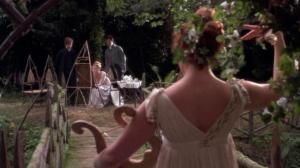
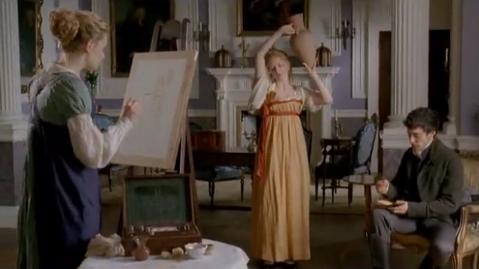
Emma paints Harriet, with Mr. Elton and Mr. Knightley looking on. Emma 1996
The sitting was altogether very satisfactory; she was quite enough pleased with the first day’s sketch to wish to go on. There was no want of likeness, she had been fortunate in the attitude, and as she meant to throw in a little improvement to the figure, to give a little more height, and considerably more elegance, she had great confidence of its being in every way a pretty drawing at last, and of its filling its destined place with credit to them both—a standing memorial of the beauty of one, the skill of the other, and the friendship of both; with as many other agreeable associations as Mr. Elton’s very promising attachment was likely to add.
Harriet was to sit again the next day; and Mr. Elton, just as he ought, entreated for the permission of attending and reading to them again.
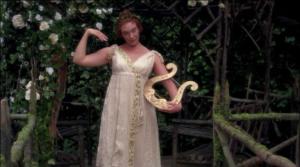
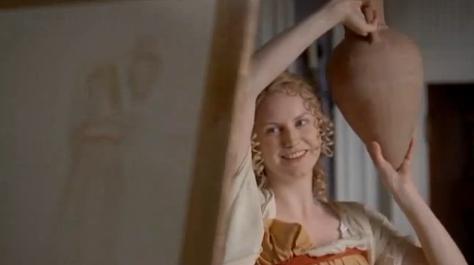
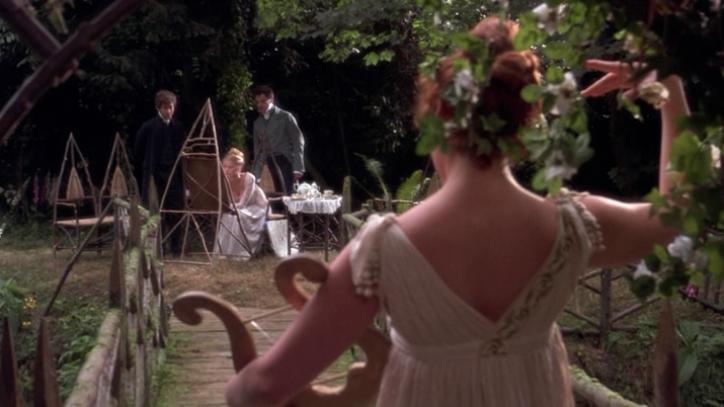
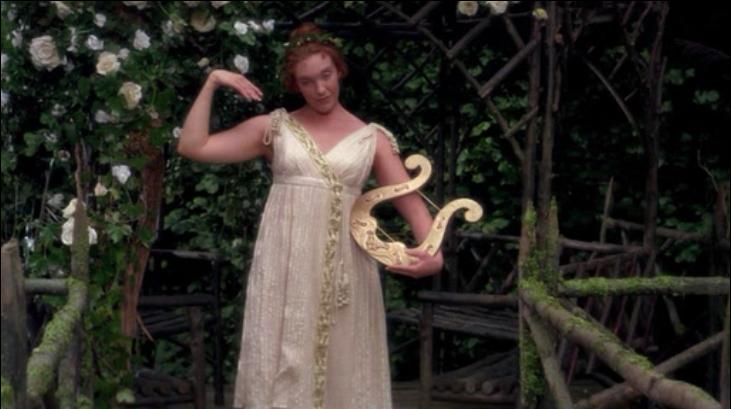
Miss Smith (Toni Collette) stands in a neoclassical pose. Emma 1996
“By all means. We shall be most happy to consider you as one of the party.”
The same civilities and courtesies, the same success and satisfaction, took place on the morrow, and accompanied the whole progress of the picture, which was rapid and happy. Every body who saw it was pleased, but Mr. Elton was in continual raptures, and defended it through every criticism.
“Miss Woodhouse has given her friend the only beauty she wanted,”—observed Mrs. Weston to him—not in the least suspecting that she was addressing a lover.—”The expression of the eye is most correct, but Miss Smith has not those eye-brows and eye-lashes. It is the fault of her face that she has them not.”
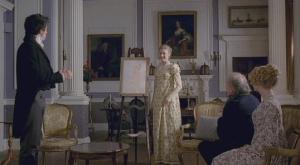
Mr. Elton applauds the unveiling of Emma's portrait. Emma 2009
“Do you think so?” replied he. “I cannot agree with you. It appears to me a most perfect resemblance in every feature. I never saw such a likeness in my life. We must allow for the effect of shade, you know.”

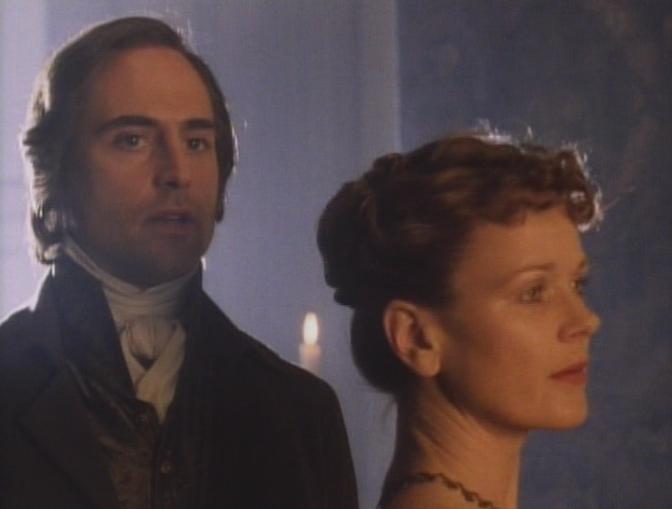
Mr. Knightley's (Mark Strong's) and Mrs. Weston's (Samantha Bond's) reactions. Emma 1995 A&E.
“You have made her too tall, Emma,” said Mr. Knightley.
Emma knew that she had, but would not own it, and Mr. Elton warmly added,
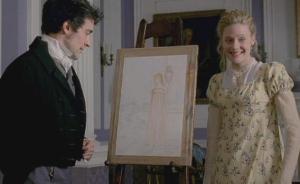
Mr. Elton's enthusiastic response continues unabated. Emma 2009
“Oh, no! certainly not too tall; not in the least too tall. Consider, she is sitting down—which naturally presents a different—which in short gives exactly the idea—and the proportions must be preserved, you know. Proportions, fore-shortening.—Oh, no! it gives one exactly the idea of such a height as Miss Smith’s. Exactly so indeed!”
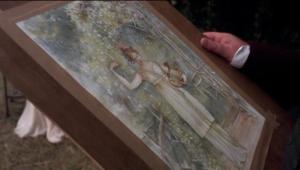
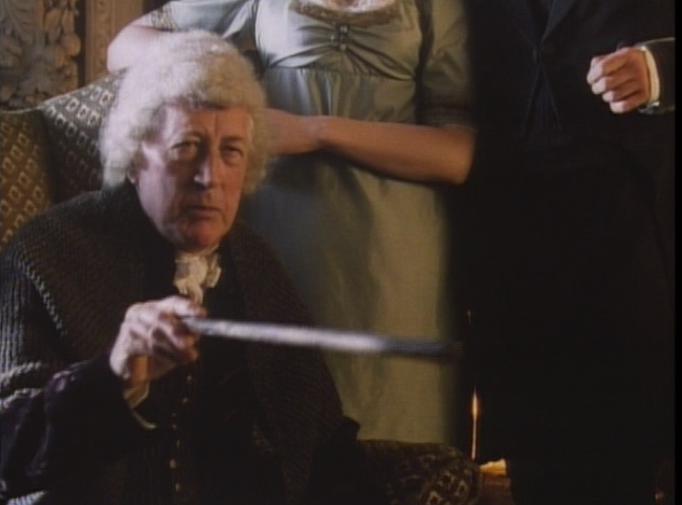
Mr. Woodhouse examines his daughter's effort. Emma 1996
“It is very pretty,” said Mr. Woodhouse. “So prettily done! Just as your drawings always are, my dear. I do not know any body who draws so well as you do. The only thing I do not thoroughly like is, that she seems to be sitting out of doors, with only a little shawl over her shoulders—and it makes one think she must catch cold.”
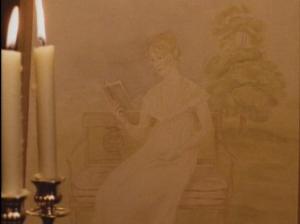
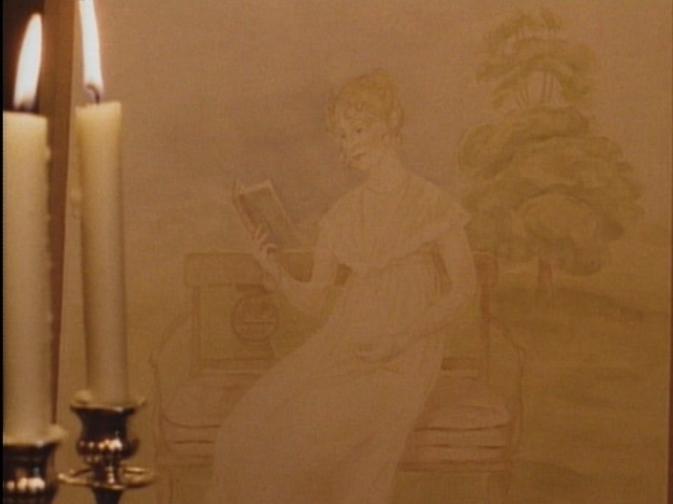
1996 A&E Emma's pale portrait of Harriet by candle light
“But, my dear papa, it is supposed to be summer; a warm day in summer. Look at the tree.”
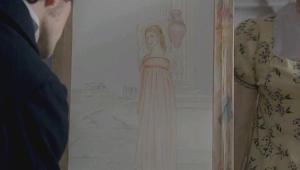
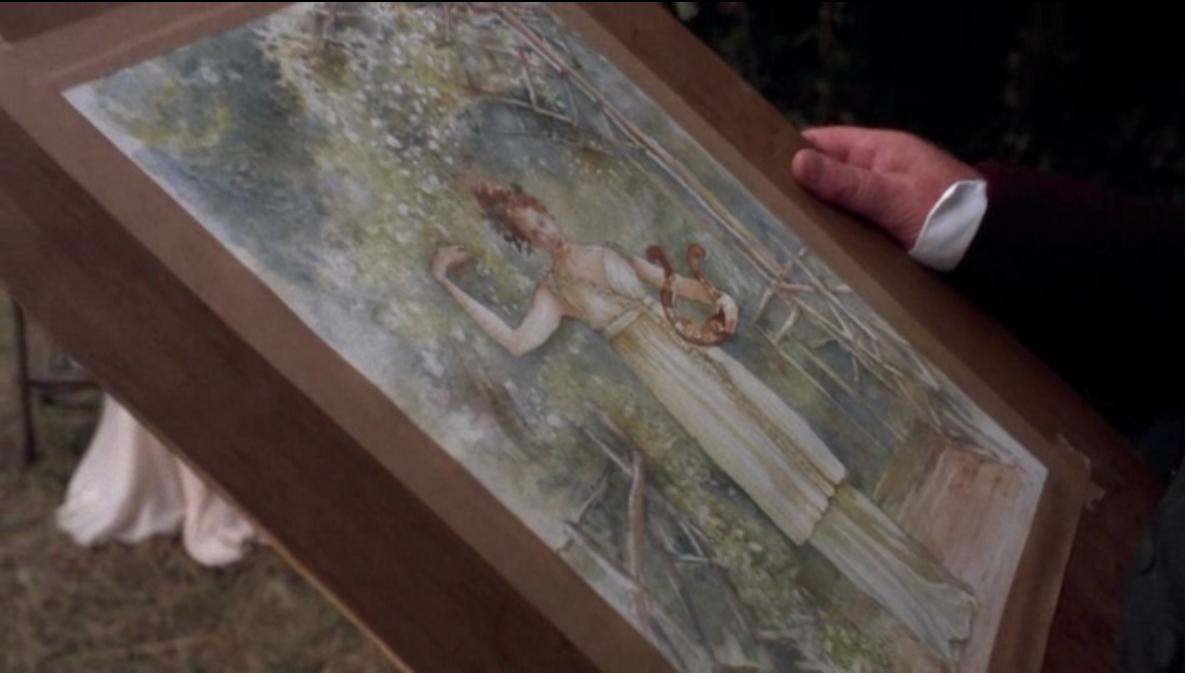
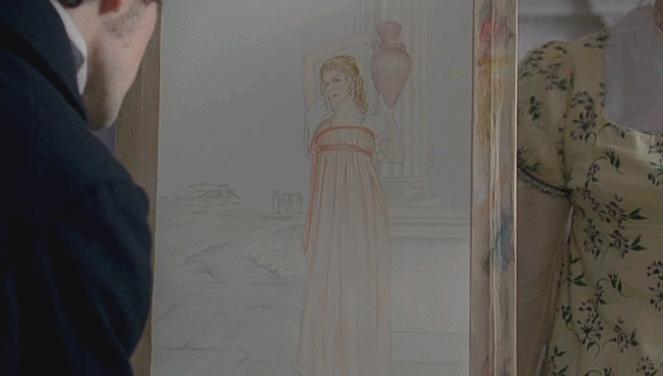
Closeup Emma 2009's painting of Harriet.
“But it is never safe to sit out of doors, my dear.”
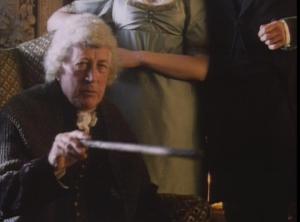
Mr. Woodhouse (Bernard Hepton) expresses concern for Harriet's warmth and comfort. Emma 1996 A&E
“You, sir, may say any thing,” cried Mr. Elton; “but I must confess that I regard it as a most happy thought, the placing of Miss Smith out of doors; and the tree is touched with such inimitable spirit! Any other situation would have been much less in character. The naïveté of Miss Smith’s manners—and altogether—Oh, it is most admirable! I cannot keep my eyes from it. I never saw such a likeness.”
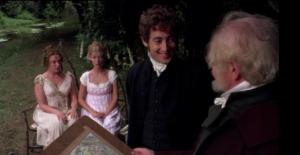
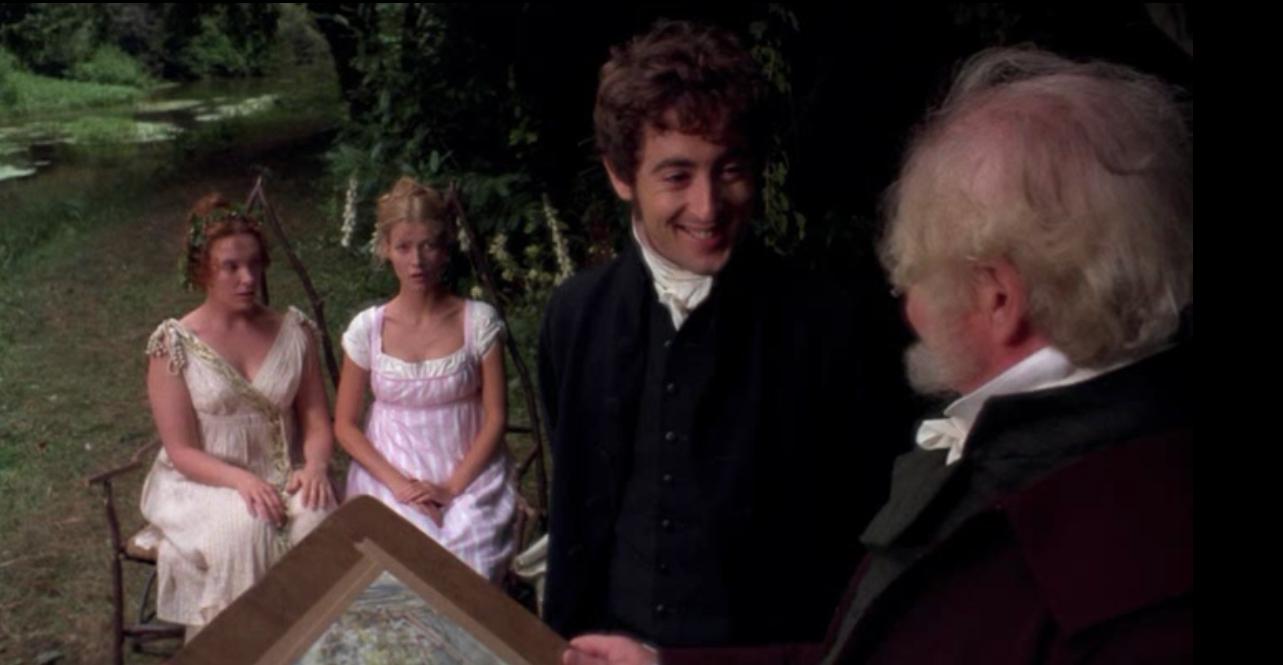
Mr. Elton (Alan Cumming) enthusiastically endorses the portrait and offers to take it to London to have it framed. Emma 1996
Mr. Elton expressed his extreme gratification by offering to ride to London in December to have the picture framed, leaving Emma with these happy but largely erroneous thoughts:








 Jane Austen's World