Copright @Jane Austen’s World. Written by Tony Grant, London Calling
Two of the greatest writers of the late 18th century and early 19th century were Jane Austen and William Wordsworth. We think we know Jane Austen’s primary influences and encouragement in her writing. They are found amongst the members of her family, the villages, towns and great houses she visited constantly near where she lived and the people she interacted with in those diverse places. She was a keen observer and knew them all intimately. Claire Tomalin in her biography, “Jane Austen, A life,” says that Jane wrote
“… tightly constructed stories that cover a short span of time…….Jane Austen also chose to write about small families.”
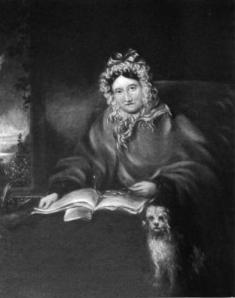
Dorothy Wordsworth
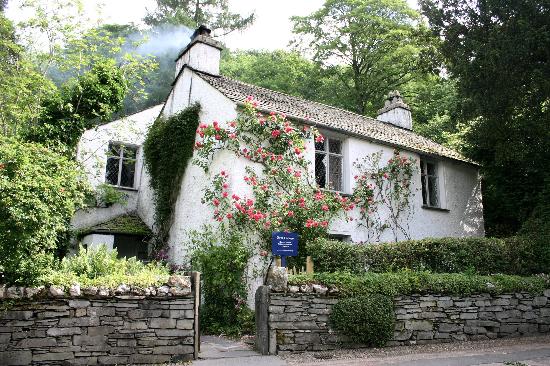
About, 250 miles north, there lived a young lady called Dorothy Wordsworth. She was a little older than Jane by five years. Dorothy’s brother was William Wordsworth and for a while they lived together in a tiny cottage they called Dove Cottage set in the wild and desolate scenery of The Lake District. Dorothy and William Wordsworth wrote about their emotional and intellectual response to nature and the landscape around them. While living at Dove Cottage in the Lake District, Dorothy was the muse, support, encourager and inspiration for her brother.

Dove Cottage, Grasmere. Image @Tony Grant
William often read Dorothy’s journal and drew inspiration for his poems from it.
We might ask why and how did these two writers have such different responses to the world about them?
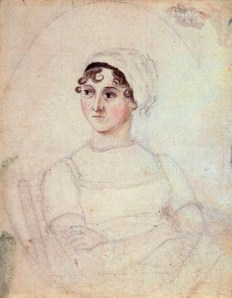
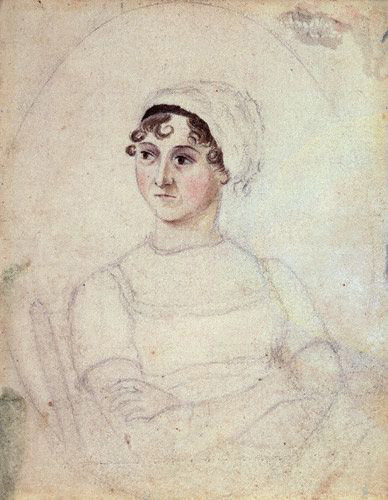
Jane Austen by Cassandra Austen
Jane was born into a lively and vibrant family of six brothers and one sister. It was a boisterous environment and aunts, uncles and neighbours were an additional group of relationships that were there, interested and ready to be involved with the new addition to the family. Family life was paramount in Jane’s existence from the start. All her senses were filled with it. Reading Gilbert Whites journals and letters makes us aware of the rich natural world all around her in her Hampshire village of Steventon, but although Jane would have been brought up in this natural environment, and she would have taken notice and interest in it, the life of family was the overriding power that carried her along. And so from an early start her environment filled her thoughts feelings and imagination. Claire Tomalin reminds us that,
“Not only was she one of eight, she lived with a perpetual awareness of a cousinage extending over many counties and even beyond England.”
Some examples of her writing show the intensity with which she was concerned with conversation and relationships as her primary focus. In Persuasion, the little Dorset coastal port of Lyme Regis plays a major role. In a letter to Cassandra written on Friday 14th, September, 1814, Jane says,
I called yesterday morning-( ought it not in strict propriety be termed yester – Morning?) on Miss Armstrong & was introduced to her father & mother. Like other young ladies she is considerably genteeler than her parents; Mrs Armstrong sat darning a pr of stockings the whole of my visit-.But I do not mention this at home , lest a warning should act as an example.-We afterwards walked on the Cobb; she is very conversable in a common way; I do perceive wit or genius- but she has Sense and some degree of Taste,& her manners are very engaging. She seems to like people too easily- she thought the Downes pleasant…”
In Persuasion, Jane writes about Anne Elliott, Captain Harville, Captain Wentworth,and Louisa Musgrove walking on the Cobb. The scenery is definitely noticed, but the main preoccupation is conversation and social interaction;
“but as they drew near The Cobb there was such a general wish to walk along it once more, all were so inclined…”
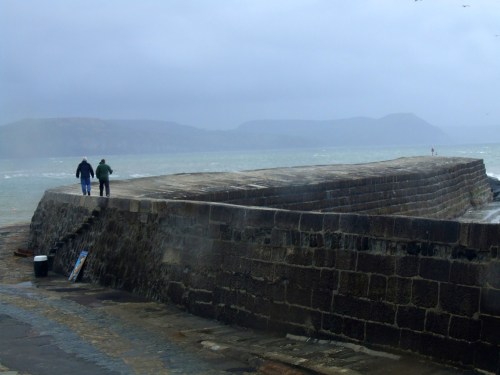
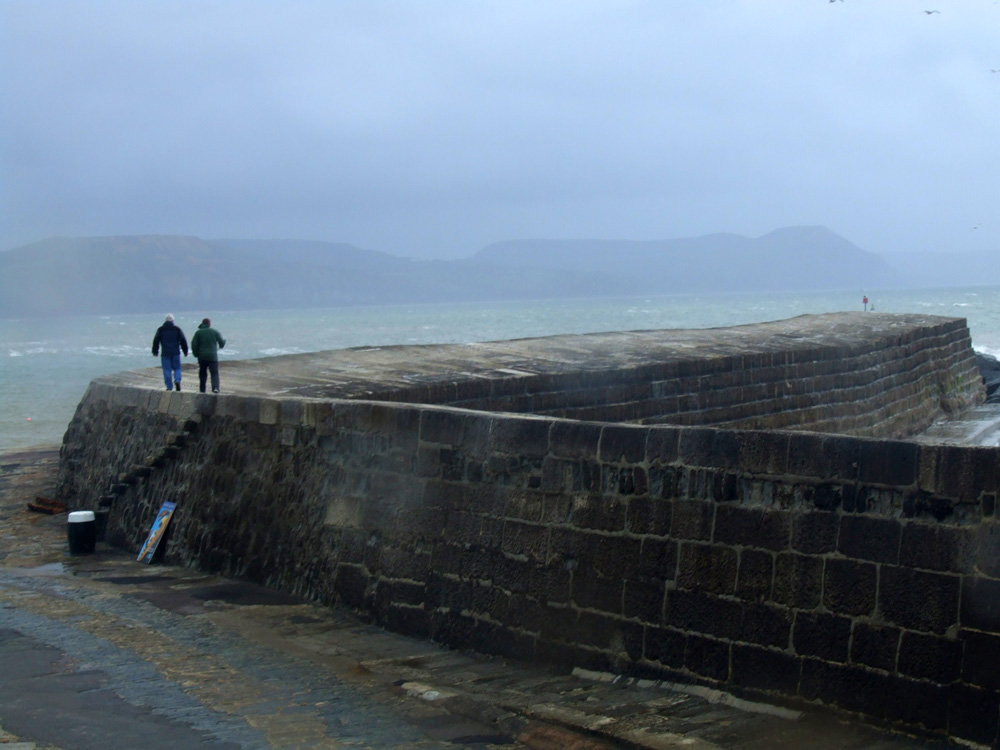
The Cobb at Lyme with Grannies Teeth. Image @Tony Grant
At this point they did not know how this walk along the Cobb would affect their whole situation, but the pull of this great physical presence was important and drew them to it as a social group conversing and interacting, their relationships developing. In both Jane’s letters above to Cassandra, and in this extract from Persuasion, it’s the relationships that are paramount. The Cobb is the setting for both. We can see in these two extracts how relationships play their part in Jane’s real life and Jane’s fictional life. Her own world is the inspiration for her fictional world.
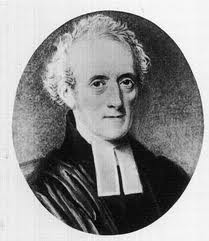
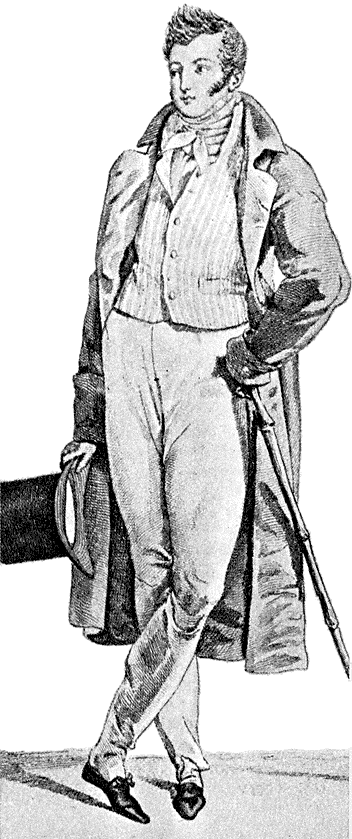
Henry Austen
Her family must have helped and encouraged her. Claire Tomalin writes,
Jane Austen managed the day-to-day routines of a novelist with an efficiency and discipline worthy of her naval brothers. The famous account of her working habits, given by her nephew, credits her with almost miraculous powers in stopping and starting under interruption.(her nephews account describes how she would stop and hide her small pieces of paper under a blotter at the slightest interruption and she used the sound of a creaking door as people entered the house to signal to her.)The picture is admirable, exasperating, painful and can only be half true………..there must have been times when the other inhabitants of the cottage protected her silence with something more than the creaking door……encouragement and practical help came from Henry….. Henry’s army connections may have helped to make the deal with
( Egerton the publisher) and Henry and Eliza’s money paid for the printing.”

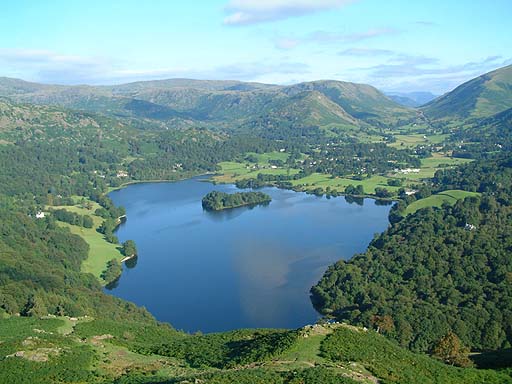
Grasmere Lake
Just over two hundred and fifty miles north of Steventon, in the County of Cumbria, also know as the Lake District, during the same period of time, lived Dorothy and William Wordsworth. They lived in various houses but the most famous is a small cottage, called Dove Cottage at Grasmere, next to Grasmere Lake. It is surrounded by the steep hills and small mountains and streams of the Lake District, the Scafell Pikes, and Dungeon Ghyll. The sights and sounds they lived with were those of tumbling water as it dropped down mountain falls, the hiss of fast-moving mountain streams, and the wild rugged terrain of the Lake District’s fells, crags, tarns, and ghylls.

William Wordsworth, Benjamin Robert Haydon. Image @National Portrait Gallery
Like Jane, William was born into a large family (on the 7th April, 1770). He was the second of five children born to John Wordsworth and Ann Cookson in a large house in the centre of Cockermouth, his father being the legal representative for James Lowther, the 1st Earl of Lonsdale. At the bottom of the garden was a wild stream and this is one of the first things that attracted William’s attention. Dorothy his younger sister was born a year later. She was to become his mentor and supporter throughout her life. Their brothers did well in life as indeed Jane’s brothers did. John Wordsworth became a naval captain but was lost at sea in 1805, the youngest, Christopher became master of Trinity College Cambridge. William himself went to St John’s College Cambridge and achieved his bachelor degree in 1791. Richard became a lawyer. None of the children in the family got close to their father who remained distant to them. Williams’ father did, however, encourage William to read poetry and William, similar to Jane at the Steventon Rectory, had access to his father’s extensive library.
To illustrate the influences and the type of encouragement that William drew on to write his poetry, the time that Dorothy and he lived at Dove Cottage is a prime period to focus on.
Dorothy kept a journal covering the years they spent together at Dove Cottage. She opens the journal in the year 1800. It is May 14th, a Wednesday.
“I resolve to write a journal of the time till William and John return and I set about keeping my resolve, because I will not quarrel with myself, and because I shall give William pleasure by it when he comes home again.”
This start to her journal gives us an insight into her total dedication towards her brother. It is written for William’s pleasure, not hers. She was a selfless soul. William, and indeed their friend and poet Coleridge, who also came to live in the lake District, often referred to Dorothy’s journal. It is almost as though William used his sister’s writing to affirm his own responses and feelings about nature.
Here is an extract that shows how William’s poems and Dorothy’s journal are connected. Dorothy would have written this first of course. It is written beautifully and with passion. It shows her connection to nature.
April 15th 1801
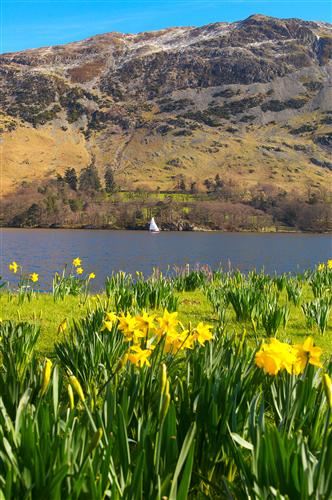
“ When we were in the woods beyond Gowbarrow Park we saw a few daffodils close to the waterside. We fancied that the lake had floated the seeds ashore, and that the little colony had so sprung up. But as we went along there were more and yet more; and at last under the boughs of the trees, we saw that there was a long belt of them along the shore, about the breadth of a country turnpike road. I never saw daffodils so beautiful. They grew among the mossy stones about and about them; some rested their heads upon these stones as on a pillow for weariness; and the rest tossed and reeled and danced, and seemed as if they verily laughed with the wind, that blew upon them over the lake; they looked so gay, ever glancing, ever changing.”

Lake District daffodils
Remember that William and Dorothy were together on this walk and saw the same sight. Soon after this entry William wrote this. It is the second verse of, The Daffodils;
Continuous as the stars that shine
And twinkle on the Milky Way,
They stretched in never ending line
Along the margin of a bay
Ten thousand saw I at a glance
Tossing their heads in sprightly dance”
It appears apparent that Dorothy’s words are used by William. “Tossed”, “danced”, repeat Dorothy’s imagery. He is relying on Dorothy’s emotional response as much as his own. They were very close as brother and sister and would have talked about their feelings of the event. But William’s heightened emotional response in this poem is the same as Dorothy’s.
It worked both ways. Williams’s poetry informed Dorothy’s emotional response too. On Monday may 26th, 1800, Mary writes;
I walked toward Rydal, and turned aside at my favourite field. The air and the lake were still……I could distinguish objects, the woods trees and houses. Two or three different kinds of birds sang at intervals on the opposite shore. I sate til I could hardly drag myself away. I grew so sad. “When pleasant thoughts,”……
Here Dorothy begins to quote a poem William had written two years earlier in 1798
I heard a thousand blended notes,
While in a grove I sate reclined,
In that sweet mood when pleasant thoughts
Bring sad thoughts to the mind.”
She is virtually re-enacting the poem. And of course Dorothy’s journal may well have informed Williams writing of the poem in the first place.
It is easy to see William Wordworths poems, in a quick superficial reading, as merely nice emotional descriptions of nature. Of course they are far more than that. Dorothy herself in her journal warns us that when reading William’s poems, to “look deep.”
In this article I wanted to show the different influences of two of the greatest writers of the late eighteenth century and early nineteenth century. It was not meant to be an analysis of their writing. However, to be fair to William Wordsworth it should be pointed out that his poems must be read carefully and a few times over. You begin to notice his emotional attachment to nature – he calls it his soul “linking” with the spirit of the natural world. It is ultimately about man’s connection with nature and being able to communicate with it, empathise with it, and know that you are part of it. Wordsworth warns,
“And much it grieved my heart to think
What man has made of man.”
This sounds very modern and apt for our own times.
Jane Austen and William Wordsworth appear to be two very different writers, but I think placing them together shows that one is deeply concerned with the interrelationships of families and small communities and the other is deeply concerned about man’s relationship with nature. The themes and focus of Jane Austen’s and William Wordsworth’s writing were opposite, but they were closely connected too. Both writers wrote about what affected and concerned them as human beings. They show the human response to two different aspects of the world we live in and that we all share. It is interesting to note that Wordsworth obviously related and socialised with people and that Jane obviously noticed and interacted with the natural world about her in Hampshire, but both had a different emotional and intellectual responses to the world they inhabited rooted in their own personal experiences.
References:
Austen J. ( first published 1818) `(1998) Persuasion ; Penguin Classics
Clark C. (ed) (1986) Home At Grasmere : extracts from the journal of Dorothy Wordsworth ( written between 1800 and 1803) and from the poems of William Wordsworth: Penguin Classics
Le Faye D. (1995) Jane Austen’s letters (New Edition): Oxford University Press
Tomlin C. (2000) Jane Austen A Life: Penguin Books

















 Jane Austen's World