Feeds:
Posts
Comments

young-girl-of-spirit-constance-hillIn December 1859, Florence Nightingale wrote this letter of recommendation to Parthenope Verney:

My dear [Parthenope Verney]

It occurred to me after writing yesterday if you are going to set up a needlewoman under the housekeeper, Mary Jenkins, Bathwoman, Dr. W. Johnson’s, Great Malvern, has a niece, living at Oxford, a first-rate needlewoman, eldest girl of a very large family, who wants or wanted a place. If she is at all like my good old friend, her aunt, she would be a very valuable servant. Perhaps her needlework would be almost too good for your place. I believe she is a qualified “young lady’s maid,” though when I heard of her, she had never been “out,” i.e., in service. Perhaps she has a place. I think it answers very well in a large house to have as much as possible done at home, as little as possible “put out.”

This domestic job as needlewoman – mending, embroidering, making clothes – sounds benign compared to the custom of the Regency and Victorian eras to overwork seamstresses. While plying the needle was a common domestic activity (Jane Austen was known to possess a particular talent in this direction), working class seamstresses were appallingly overworked and underpaid, especially during the heyday of the Industrial Revolution. Many women toiled for long hours in poor lighting conditions, with some going blind from their employment. An apprentice seamstress in a milliner’s shop worked under slightly better conditions, but during the Season when demand for new and fashionable dresses was high, these women would also be pressed to work into the wee hours of the night to complete an order.

The above illustration of Jane Austen sewing comes from Jane Austen: Her Homes and Her Friends by Constance Hill. In Chapter XX, Constance makes the following observation about Jane Austen’s skill as a needlewoman:

Her needlework was exquisite. We have seen a muslin scarf embroidered by her in satin-stitch, and have held in our hands a tiny housewife of fairy-like proportions, which Jane worked at the age of sixteen as a gift for a friend. It consists of a narrow strip of flowered silk, embroidered at the back, which measures four inches by one and a quarter, and is furnished with minikin needles and fine thread. At one end there is a tiny pocket, containing a slip of paper upon which are some verses in diminutive handwriting with the date “Jany. 1792.” The little housewife, when rolled up, is tied with narrow ribbon. “Having been never used and carefully preserved, it is as fresh and bright as when it was first made.

For more on this topic, click on my other post The Life of a Seamstress.

Biblical passages in workhouses reminded the poor of how lucky they were.

Biblical passages in workhouses reminded the poor how lucky they were.

There’s nothing romantic about PBS Masterpiece Classic’s excellent 2008 adaptation of Charles Dickens’ classic, Oliver Twist. Those of us who hold warm and fuzzy memories of the musical –  Oliver! – should put those singing and dancing images out of our minds. This film version depicts the seamy side of Victorian England that Dickens intended – purists will like it for staying true to the author’s gritty vision, and dislike it for the many changes in the plot, as with the character of Rose Maylie.

Oliver lost his mother within hours of his birth and began a twisted start.

Oliver lost his mother within hours of his birth and began a twisted start.

Oliver’s twisted start began not unlike the many orphans of unmarried mothers for whom charity was the only way to survive. In 1848, reformer Lord Ashley referred to the more than thirty thousand children living on the streets as, “naked, filthy, roaming, lawless, and deserted children.” They had no recourse but to live in workhouses, large industrial factories that needed a labor force.
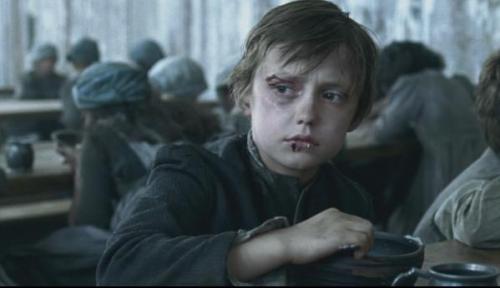
Badly treated workhouse boy.

Badly treated workhouse boy.

Back in the mid-19th century workhouses were no better than concentration camps. Conditions were made purposefully harsh to discourage the destitute from asking for help. Those unlucky enough to qualify were given just enough calories to stay alive for the harsh labor they were forced to perform breaking stones or picking oakum*. In addition to the brutal conditions, parents were separated from their children, and wives were separated from their husbands to prevent more breeding.

William Miller as Oliver Twist

William Miller as Oliver Twist

In 1834 the average age of death for a person in industrial cities like Leeds and Manchester was nineteen. Almost 1/3 of children had lost at least one parent by the age of 15. The odds that a young child would be orphaned was around 8%.**  Such was the world that Charles Dickens grew up in. The child of a debtor and forced into labor in a workhouse at the age of 12, he managed to escape a life of relentless poverty to become one of the most popular and successful authors of his time.

The Board of Guardians eat lavishly while showing Oliver no compassion.

The Board of Guardians eat lavishly while showing Oliver no compassion.

Oliver Twist experienced the horrors of the workhouse from birth. Formerly known as almshouses, these places were supervised by a Board of Guardians, local officials whose aim was to keep the poor out of the way of the middle and upper classes. As in the movie, they treated the poor with complete disdain.

Noah (Adam Gillen) taunts Oliver.

Noah (Adam Gillen) taunts Oliver.

Class was relative. Noah Claypole, who made coffins for Mr. Sowerberry, felt superior to Oliver because he had parents while Oliver did not, and Noah taunted him mercilessly.

Oliver's view of the Sowerberrys, Mr. Bumble, Noah, and Charlotte just before his hair raising escape from the undertaker's establishment.

Oliver's view of the Sowerberrys, Mr. Bumble, Noah, and Charlotte just before his hair raising escape from the undertaker

The workhouse was administered by unpaid bureaucrats, headed by the Beadle, an elected official. These civil servants treated workhouse residents with scorn and cruelty, reminding them with Biblical passages how lucky they were (“Blessed are the poor…”). The workhouse staff received a somewhat better class of lodging and food for their efforts. – Down and Out in Victorian London
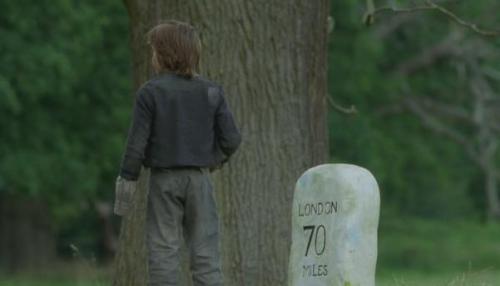
After his escape, Oliver walks to London 70 miles away.

After his escape, Oliver walks to London 70 miles away.

During his journey he spots a carriage that carries the mysterious Mr. Monk, who is searching for him.

During his journey he spots a carriage that carries the mysterious Mr. Monk, who is searching for him.

London streets are filled with noise and the clatter of carriages.

London streets are filled with noise and the clatter of carriages.

The lanes are narrow and crowded.
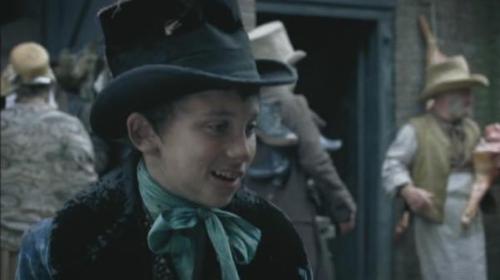
The lanes are narrow and crowded.

Oliver meets his first friendly Londoner, the Artful Dodger (Adam Arnold)

Oliver meetshis first friendly Londoner, the Artful Dodger (Adam Arnold)

For an orphan like Oliver or a woman without family or husband like Nancy, Victorian London was as equally harsh an environment as the workhouse. Newly arrived in town, the Artful Dodger is the only friendly face Oliver sees.
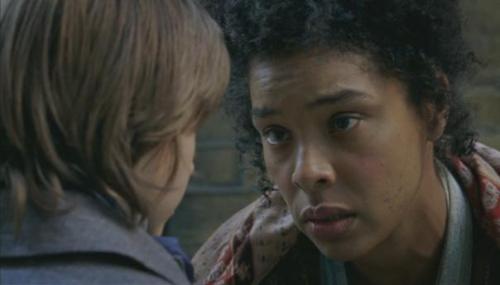
Sophie Okonedo as Nancy

Sophie Okonedo as Nancy

Nancy, a thief and prostitute, had worked for Fagin since the age of 12. She’s one of the few conflicted characters in Dickens’ plot, someone who is neither totally evil, like Sikes or Fagin, or totally good, like Oliver or Rose. Talented actress Sophie Okonedo plays Nancy – the prostitute and thief with a heart of gold – without sentimentality. Although Nancy was a white woman in the novel, black servants were common in Britain, and it’s not a far stretch to imagine that illegitimate mulatto offspring would be forced to make their own way in the world.
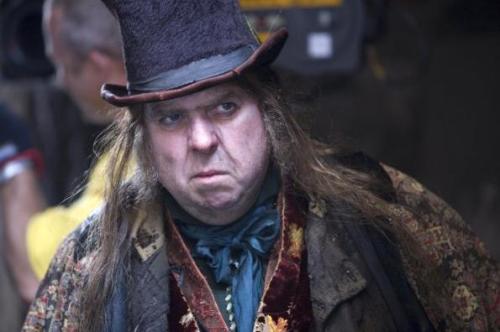
Fagin (Timothy Spall) might seem like a nicer character than the Beadle, but he represents oppression of a different kind.

Fagin (Timothy Spall) might seem like a nicer character than the Beadle, but he represents oppression of a different kind.

Fagin, played with relish by Timothy Spall, trained his boys as pickpockets in “foul’d and frosty dens, where vice is closely packed and lacks the room to turn.”  Bill Sikes – evil and completely merciless as written by Dickens and played by Tom Hardy – was probably a product of the London slums or workhouse.

As described by Dickens, Bill Sikes (Tom Hardy) was a violent man and dog beater who terrorized those around him.

As described by Dickens, Bill Sikes (Tom Hardy) was a violent man and dog beater who terrorized those around him.

The scene in which young Oliver was sentenced to the gallows was entirely believable. Punishments were uneven and unbelievably harsh. Children as young as twelve were sentenced to death or sent to the penal colony in Australia for minor crimes like pickpocketing, stealing a penny’s worth of paint, or being found in the company of gypsies.

Oliver walks 70 miles to London.

Oliver walks 70 miles to London.

The director of the film, Coky Giedroyc, takes advantage of setting and color to depict Oliver’s world. The workhouse is bleak and gray and the cinematic colors remains so when Oliver works for Mr. Sowerberry, the undertaker. The only bucolic scene is shot during Oliver’s long journey on foot to London, and even then it rains more often than not. London looks and feels crowded and claustrophobic as Oliver walks to the East End. When he enters Fagin’s den, surrounded by colorfully clad boys and stolen scarves, his world brightens, though it remains hemmed in.

Food and colorful scarves in Fagin's lair.

Food and colorful scarves in Fagin's lair.

Oliver wakes up in Mr. Brownlow’s house after being rescued from the gallows and his world brightens even more. Light floods over him and Rose and Mrs. Bedwin as they tenderly take care of him. This bright interlude in which Oliver gets a glimpse of another world is short lived. Before long he is plucked away from his sanctuary by Sikes and Fagin, who fear the young boy might reveal their names, location, and criminal operations.
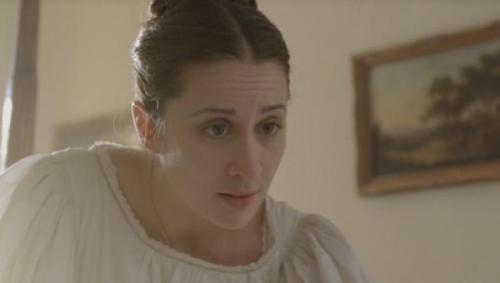
Oliver mistakenly thinks he's died when he wakes up and sees Rose's gentle but concerned face.

Oliver mistakenly thinks he's died when he wakes up and sees Rose's (Morven Christie) gentle but concerned face.

Written as a serialized novel, Oliver Twist is filled with colorful characters, unsuspected plot twists, and suspense, which translate well into film. The result is a remarkably modern plot that has the feel of a detective story.

The Artful Dodger is always on the make.

The Artful Dodger is always on the make.

Everyone was discussing Oliver Twist, from the newly crowned teenage Queen Victoria (who said she disapproved of the novel for younger readers, but read on herself anyway) to Prime Minister Lord Melbourne (“…all about workhouses and coffin makers and pickpockets… I don’t like that low and debasing view of mankind”) to those who could never afford to buy the novel whole, but who could readily identify with the reality it described. All England found itself caught up in the tale of the lonely and mysterious orphan at the mercy of the parish welfare system. – The Rise of the Killer Serial
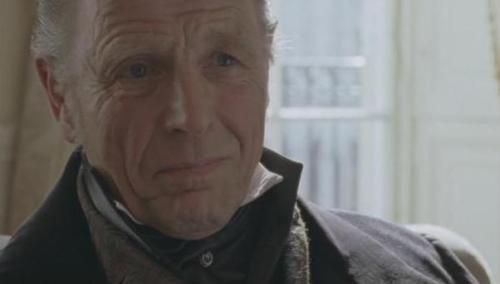
Mr. Brownlow (Edward Fox).

Mr. Brownlow (Edward Fox).

Mr. Brownlow, whose pocket was picked by the Artful Dodger, turns out to be Oliver’s grandfather. He gives Oliver shelter in his home after testifying on the boy’s behalf and saving him from the gallows. Only the reader/viewer knows early on about this coincidence. Rose Maylie is now Mr. Brownlow’s ward and lives with him – a plot change Dickensian purists will dislike. Edward, his grandson and Oliver’s half brother, walks a fine line between pretending concern over finding out what happened to Agnes, Oliver’s mother, and ordering his brother’s murder. Julian Rhind-Tutt plays Edward (Mr. Monk) with just the right amount of sleaziness, especially when courting Rose.

"We will find Agnes," the double talking Edward (Julian Rhind-Tutt) assures his grandfather.

"We will find Agnes," the double talking Edward (Julian Rhind-Tutt) assures his grandfather.

The first week’s episode ends with two shots fired in the dark and Oliver’s outcry. In Dickens’s tale, Rose Maylie lived in the mansion that Sikes was about to rob. Had this adaptation been more faithful to the book’s plot, she would have found Oliver and nursed him back to health, but Bill Sikes carries the wounded boy back to London instead, where Nancy nurses him. The tale ends with Oliver reunited with Mr. Brownlow and Rose; Nancy, Bill Sikes, and Fagin dead; Mr. Brumble marrying Mrs. Corney; and Edmund disgraced and disinherited.

Young William Miller, like all the Olivers before him, looks angelic. I found it strange, however, that despite being raised in the workhouse with the likes of Mr. Brumble and Mrs. Corney, his accent is so refined. And where did he learn his exquisite manners? Would nature truly be so triumphant over nurture in such a hard scrabble world? I think not, but this is not this production’s only failing.

Mrs. Corny tries to blackmail Monks.

Mrs. Corny tries to blackmail Monks.

While Mr. Brumble and Mrs. Corney do marry, as in the film, their tale does not end at the altar. They squander their ill gotten gains and wind up in the workhouse without hope of leaving and experiencing the same lack of compassion that they had meeted out.
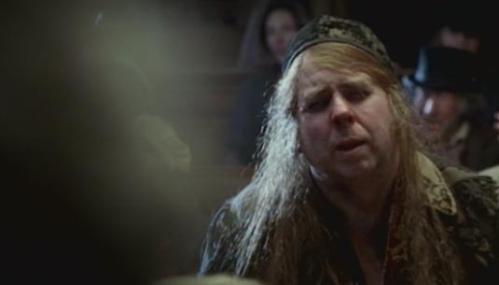
Fagin guilty on all counts

Fagin guilty on all counts

In the book Edward teams up with Fagin – a sinister character as Dickens describes him and without a hint of the lovable traits depicted by Timothy Spall – to hunt after Oliver. In Dickens’ plot, Edward (Mr. Monks) is not cast out without a penny. After receiving half his inheritance from Mr. Brownlow, who hopes he will redeem himself, Edward travels to America, where he squanders his fortune and dies destitute in prison. Seeing him grovel in the film just did not seem quite in character and I found the scene  distasteful and discordant.
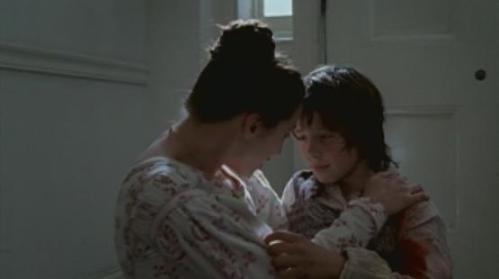
Oliver Returns

Oliver Returns

While the second half of this tale was much darker than the first installment, which was grim enough, the film’s pacing had me sitting on the edge of my seat towards the end. Fagin’s death was swift and merciless, and the deft visual touch of the Artful Dodger walking away with Bill Sikes’ dog showed how quickly life moves on. Before Fagin lay cold in his grave, his position had been replaced by one of the boys and his passing went largely unnoticed, except for the crowd. Such hanging scenes were common back then, and vendors sold food and drink as if the crowd was attending an entertainment, which in a strange way they were.  As for Sikes, in the book he dies in a gristly accident running from an angry mob. Death by his own hand seemed just a bit too merciful an ending for a merciless and inhumane man.

If you missed the second installment of this adaptation, click here to view it online. The video will be available on PBS’s site from Feb 23 – March 1.

More Links:

excessively-diverted1Catherine Delors, blog editrix of one of my favorite blogs Versailles and More and author of Mistress of the Revolution, and Jane Odiwe, editrix of the excellent Jane Austen Sequels and author of Lydia Bennet’s Journal, have tagged Jane Austen’s World along with a bevy of other excessively diverting blogs. Thank you, Catherine and Jane! You both made my week. Looking at the nominees, I see that my blog has joined an august company.  I am to pick seven other blogs, a tough choice as there are so many worthy sites. I’ll follow my predilection for history and choose sites that are as obsessed with uncovering delicious details of the past as I am.
For those who were nominated, these are the rules: Recipients, please claim your award by copying the HTML code of the Excessively Diverting Blog Award badge, posting it on your blog, listing the name of the person who nominated you, and linking to their blog. Then nominate seven other blogs that you feel meet or exceed the standards set forth. Nominees may place the Excessively Diverting badge in their side bar and enjoy the appreciation of their fellow blogger for recognition of their talent.

  • Edwardian Promenade: Beautiful to view, fascinating to read, this blog’s author concentrates on only this fascinating era. Who knew that so many interesting events occurred in such a short time span?
  • Tea at Trianon: This fabulous blog covers a variety of subjects. Stop by for a visit and see what I mean.
  • Nineteen Teen: This blog annotates the regency era with fascinating and informative posts on being a teen in the 19th century.
  • Writing With Style: This stylish blog’s post concentrate more on writing than history. One never knows which topic the author chooses to cover.
  • Prima La Musica: This blog is all about Mozart. How divine. Even better, it is celebrating its 10th year anniversary. Now that’s what I call success!
  • Scandalous Women: Oooh, la la! Women of the past might have had few legal rights, but a number of them managed to live adventurous lives. Do visit this well researched blog and read about eye-popping scandals of the past.

To view the other nominated sites, visit these posts at Jane Austen Today and Austenprose.

What is the aim of this award you ask yourself? Why, just this: To acknowledge writing excellence in the spirit of Jane Austen’s genius in amusing and delighting readers with her irony, humor, wit, and talent for keen observation. Recipients will uphold the highest standards in the art of the sparkling banter, witty repartee, and gentle reprove. This award was created by the blogging team of Jane Austen Today to acknowledge superior writing over the Internet and promote Jane Austen’s brilliance.

51x0umcieql_sl500_

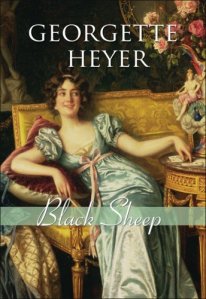
Inquiring readers, This Georgette Heyer novel, written in her mature years and recently reissued by Sourcebooks, will help you wile away the winter doldrums. Her scintillating dialogue is at its best in Black Sheep, as this snippet of conversation between Abigail Wendover and Miles Caverleigh reveals:

“Yes, that’s it. I’m his Uncle Miles.”

” Oh!” she uttered, staring at him in the liveliest astonishment. “You can’t mean that you are the one who …” She broke off in some confusion, and added hurriedly. “The one who went to India!”

He laughed. “Yes, I’m the black sheep of the family!”

She blushed, but said,”I wasn’t going to say that!”

“Weren’t you? Why not? You won’t hurt my feelings!”

“I wouldn’t be so uncivil! And if it comes to black sheep … !”

“Once you become entangled with Calverleighs, it’s bound to,” he said. “We came to England with the Conqueror, you know. It’s my belief that our ancestor was one of the thatch-gallows he brought with him.”

My thoughts about this novel are: Run, don’t walk to your nearest Sourcebooks online bookstore to purchase Black Sheep by Georgette Heyer. I’ve been raving about this book to friends who are interested in reading their first GH regency novel, and we have selected it for our next book club meeting (along with Lady of Quality). While GH uses all the usual convoluted plot elements and character types in this book that we have come to associate with her, there is a mature quality to the hero and heroine that I found especially attractive. At this point you might be muttering: Vic’s liked every Georgette Heyer novel she’s reviewed, so why should I believe her? To be fair there are GH novels that I don’t like as much as others, such as Friday’s Child, which was GH’s personal favorite, or The Convenient Marriage in which a 17 year old’s marriage to her 34 year-old husband is fraught with misunderstandings of her own naïve making.

In this book, Miles Caverleigh – the Black Sheep – returns from his exile to India several decades older and wiser, and, much, much richer. He feels so comfortable in his skin that the reader cannot help but admire his indifference to those for whom surface appearance matters. Miles dresses quite plainly and carelessly for a GH hero, and his social graces leave something to be desired, but his humor brings a warm twinkle to his eyes that Abigail, our heroine, cannot ignore. At the most inconvenient times, and much to her chagrin, he induces her to giggle. Even more, he appeals to Abby’s intellectual and practical side. Instead of wooing her with a flurry of pretty but empty compliments, he courts her with honest and well thought-out observations.

At 28, Abigail is a bit long in the tooth, but she is not without admirers. Pretty, stylish, and comfortably off, she feels no pressing need to marry. She lives with her older spinster sister in Bath, where the two are regarded as fixtures of Bath society. When Abigail is away on an extended family visit, a Fortune Hunter in the form of Miles’s nephew steps in to woo Abby’s 17 year old niece, Fanny. Rich, innocent, and not yet OUT, young Fanny is completely swept off her silly innocent feet by the debonair and handsome ne’er do well, Stacy Caverleigh. This cad is just days away from losing his ancestral lands and MUST marry an heiress to forestall foreclosure. An engagement announcement would keep him solvent until he gets his finely manicured hands on Fanny’s fortune. Abby returns to Bath to find this villain well entrenched in Fanny’s affections. Knowing she must tread carefully with her infatuated niece, she implores Miles to help her get rid of his nephew, but Miles refuses to interfere in an affair that is none of his business. Besides, he’s never met this nephew, who sounds like just the sort of person Miles despises.

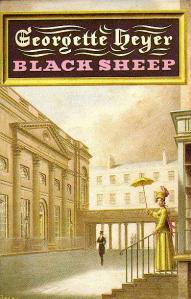
Barbosa cover of Black Sheep

Barbosa cover of Black Sheep

The plot sways between Mile’s disinterest in his nephew’s actions and Abby’s determination to separate Fanny from the blackguard. Black Sheep’s characters are richly drawn and exhibit more depth than the usual GH regency romance. Even Fanny, young and immature as she is, operates in more than one dimension. Her first foray into romance is believable for one so young, and one feels that she will learn much from her puppy love experience to grow into a wiser, more mature woman. Like Marianne Dashwood in Sense and Sensibility, Fanny falls ill, causing her suitor to react in a most ungentlemanlike manner. His actions cause Fanny’s eyes to open to the WAYS of fortune hunters.

Georgette worked hard on perfecting her plots and it shows in this novel. Oh, there are some missteps. I found Abby’s sister Selina more irritating than interesting, even though her fashion sense is impeccable. Still, such a degree of silliness at her advanced age is a bit unbelievable. The older brother James is as self-important, selfish, and self-obsessed a prig as Robert Ferrars ever was, but given my overall enjoyment of this masterful book, my quibbles with these characters are minor.

The book’s ending provides a perfect solution to a choice Abigail is forced to make: She is so accustomed to assuming responsibility for those around her, that she’s forgotten what it’s like to have someone take a major decision out of her hands. Frankly, I never saw those last few pages of plot coming!

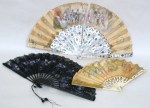
19th-century-fansOut of three regency fans, I give this book four. You may order it at Sourcebooks, a publishing company that features the Georgette Heyer books reviewed below. In addition, click on this link to look for new Georgette Heyer novels coming out in spring 2009.
My Other Georgette Heyer Reviews Sit Below

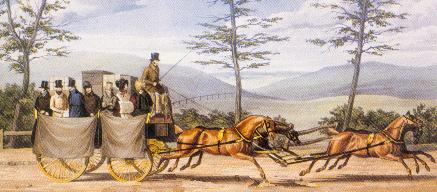
Bianconi Coach

Bianconi Coach

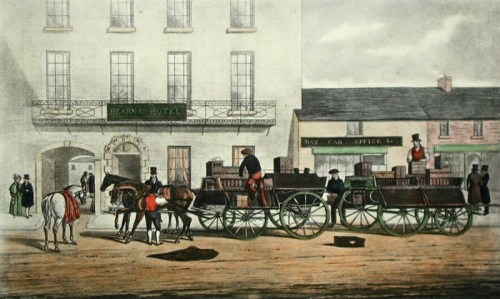
Have you ever heard of Charles Bianconi? The Irish probably have: Bianconi revolutionized public transport in Ireland in the early 19th century. An immigrant in 1802 from Costa Masnaga, Italy, he founded a network of coaching routes  that covered Ireland from Belfast to Cork from a terminus that began at the Hearn Hotel in County Tipperary on July 6th in 1815. The first Bianconi carriage was a two-wheel horse drawn cart that carried three or four passengers.  The new venture, known as the  Bianconi Coach Service for private passengers,  made the 30-year-old immigrant the ” King” of the Irish roads.

Charles Bianconi

Charles Bianconi

Bianconi quickly expanded his fleet  to 900 horses and  67 coaches.

Travel on one of these “Bians” as they were to become known, cost one-penny farthing a mile. Such demand was there for his transport that over the next 30 years a huge network of communications were established, with Clonmel, Co Tipperary as its hub. Huge employment was also now created from this growing transport business. The year 1833 saw the “long car” go into production from his coach building premises in Clonmel which enabled him to carry up to twenty passengers, plus cargo and mail deliveries for both  British and Irish Post Offices. Here in Thurles, his depot was situated in O`Shea`s Hotel which today trades as McLoughneys, a ladies clothing boutique. The stables where he fed and changed his horses between journeys still exists, relatively unchanged, to this very day and  are situated at the rear of Ryan’s Jewellers shop, Liberty Square, Thurles, Co. Tipperary.The advent of railway in 1834 brought home to Bianconi the realisation that his coaching business had now only a limited future. He immediately began to buy shares in the different rail lines as they were being built. He began to sell his coaches and long carts to his employees who had worked for him. – Thurles Information

Bianconi Coaches in front of the Hearn Inn

Bianconi Coaches in front of the Hearn Hotel