Feeds:
Posts
Comments

Auld Lange Syne: Old Long Ago

Robert Burns, Auld Lang Syne

Robert Burns, Auld Lang Syne

Midwinter celebrations  have been celebrated in England since ancient times. In Scotland one such celebration was known as Hogmanay; in England it was called New Year’s Eve. The Gregorian calendar marks December 31st as the last day of the year, but New Year’s Day was not always celebrated on January 1st. In Anglo-Saxon England the year started on the 25th of December. The day has also been celebrated  on March 1st, March 25th, and September 24th, depending on which calendar was used. As early as the 17th century,when the legal year began on March 25th,  Samuel Pepys would write about the passing of the old year on December 31st, eighty years before England moved the start of the year to January 1st.

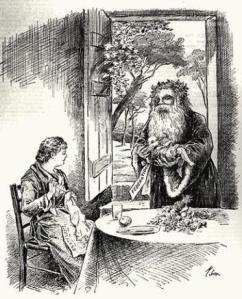
Father time

Father time

Today we sing  Auld Lang Syne at the stroke of midnight. Commonly thought to be written in the 1700s by the poet Robert Burns, who was inspired by earlier renditions, the song was published after his death in 1796. According to the BBC article, Have Old Connections Been Forgot? BBC news story, the song is “now thought that the tune to match the words was part of the overture for Rosina, an obscure operetta written in 1783 by Englishman William Shield, who was born in Swalwell, Gateshead in 1748.” The words Auld Lang Syne literally mean “old long ago,” or “the good old days.”

Since the days of the Romans, the passage of time has been associated with the god Saturn, who is the inspiration of Old Father Time.  Read my other post about New Year’s Eve at this link.

Have a safe and happy New Year’s Celebration!

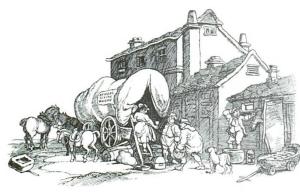
By the end of the 18th century, travel by stage coach was becoming more common in England, especially for the middle and upper classes. Many outlying towns still had no coach services except for those that originated from London, but if one could reach a town or inn that lay along a stage-coach route (by carrier’s wagon, for example) then one could travel to London from any part of the country. People could also opt to travel by Kendal flying wagon, as illustrated below. Travel by stage-coach would have been similar to taking public transportation today, with inns and hostelries taking the place of hotels, motels, and restaurants. A changeover of a team of horses, or feeding them or watering them, would have been the equivalent of filling a tank with gas.

Kendall Flying Wagon, after Rowlandson

Kendal Flying Wagon, after Rowlandson

Dates and times of travel were clearly advertised, including the rates, which were 4 pence or 5 pence for a seat inside the coach, and 2 pence and 3 pence for sitting outside. These costs were prohibitive for the poor, who generally earned a shilling a week (12 pence). A seat outside the coach exposed a traveler to variable weather conditions and hazards, and it was not unusual for passengers to fall off a lurching coach or to be struck by a flying object.

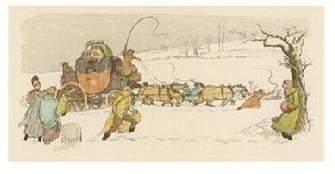
Horses in snow, with passengers alighted and trunks removed

Horses in snow, with passengers alighted to lighten the load

Long distance travel during this time was still a novelty, since the majority of the populace (around 90%) rarely traveled from their place of birth. Most English roads were in poor shape, rutted in good conditions and a muddy quagmire after heavy rains. In addition, people were accustomed to walking long distances, and it was not unusual for laborers to walk 6 miles to work.* The working class would not have chosen to pay for expensive transportation when two sturdy legs could carry them just as well. (Although I imagine a free ride on a friend’s wagon was always welcome.) As with public travel today, passengers could be seated alongside anybody – a considerate traveling companion, someone they instinctively disliked, or a person from a different class or station.

Macadamized roads were just beginning to be introduced during this period and their crushed stone surfaces allowed for greater speed and heavier loads to be carried. Travel time was reduced with these road improvements and with coach modifications, thus a good coach could go as fast as 6.4 miles per hour. This was at the expense of the horses, who lasted only an average of three years pulling heavy loads in all kinds of weather conditions and terrains. Royal Mail coaches went even faster than ordinary coaches, reaching speeds of up to 9 miles per hour, but these elite coaches represented only about 11% of the total coach mileage at its height. Below is a 1754 advertisement for the Edinburgh Stage Coach. Setting out on Tuesday in summer, the coach reached London in ten days. In winter, the journey would take 12 days.  Ultimately, after road and coach improvements and before more efficient trains replaced coach travel as the preferred mode of transportation, the 400 mile trip between London and Edinburgh had been reduced to 40 hours, including all stops and relays (Harper Book of Facts).


Stage-coach and Mail in Days of Yore A Picturesque History of the Coaching Age … By Charles George Harper

The Tavern Meal

Inquiring reader: This year I will endeavor to illuminate the lives of regency gentlemen when they are away from their families in a way that (I humbly hope) will add to your enjoyment of reading novels and histories set in this era.

During the late Georgian or early Regency era, restaurants were still a French concept. When not dining at home, an English gentlemen ordered meals in clubs, taverns, coffee houses, or inns. In 1798, a traveler named John Byrne wrote:
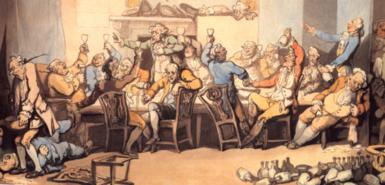
Rowlandson's depiction of a tavern meal

Rowlandson's depiction of a tavern meal

A London gentleman steps into a coffeehouse, orders venison and turtle, in the instant; and (if known) a delicious bottle of port or claret: upon a clean cloth, without form, he dines at the moment of his appetite and walks away at the moment, he is satisfied; neither opportuned by civilities, or harrass’d by freedoms; he labours not under obligation, he has not submitted to ridicule, or offended from a want of high breeding.”

These institutions were not always so genteel as described in the above passage. Englishmen had been meeting  in clubs and taverns as far back as the age of King Charles II, when the men congregated to discuss political matters. Groups with similar political affiliations (Jacobeans, for example) would assemble in an atmosphere of drinking and conviviality that often turned boisterous and prompted the 17th century poet Ben Johnson to draw up the rules for guidance entitled Rules for the Tavern Academy; or, Laws for the Beaux-Esprits. A reporter of The New York Times wrote in 1879:

These convivial assemblies give an appearance of licentiousness to this period which in strictness does not belong to it. It must be remembered that domestic entertainments were at that time rare; the accommodation of private houses was ill-adapted for the purposes of social meeting; and there only remained taverns and ordinairies for such meetings to be held. Long after the period we refer to we hear of the eminent characters of the day meeting at pastry cooks’, coffee-houses, and taverns. Addisson tells us that most all the celebrated clubs of his day were founded upon eating and drinking, which are points, he says, wherein most men agree, in which the learned and illiterate, the dull and the airy, and the philosopher and the buffoon, can all of them bear a part. He then refers to the “Kit-Cat,” the “Beef steak,” and “October” clubs, whose names imply that neither of them would be averse to eating and drinking. The Kit-Cat was founded in 1700, and was held at the house of one Christopher Kat, a pastry-cook, renowned for his mutton pies. Another club, held at the King’s Head, in Pall Mall, arrogantly called itself “The World,” of which Lord Stanhope (afterward Lord Chesterfield,) Lord Herbert, and other leading men of the day were members, and at which epigrams were scratched on the glasses by each member after dinner. Once, when Dr. Young was invited to the club, he excused himself from conforming to this custom because he had no diamond. Lord Stanhope lent him his, and he immediately wrote: “Accept a miracle instead of wit: See two dull lines, with Stanhope’s pencil writ.” – Some Old London Clubs. Origin of the Social Organizations of the Present Day; From the London Globe, The New York Time, January 12, 1879

One of the most famous and popular taverns in the 18th century was Pontack’s Tavern:

After the destruction of the White Bear Tavern in the Great Fire of 1666 the proximity of the site for all purposes of business induced M. Pontack, the son of the President of Bordeaux, owner of a famous claret district, to establish a tavern with all the novelties of French cookery, with his father’s head as a sign, whence it was popularly called Pontack’s Head. The dinners were from four or five shillings a head to a guinea, or what sum you pleased. Swift frequented the tavern and writes to Stella: ‘Pontack told us although his wine was so good he sold it cheaper than others; he took but seven shillings a flask. Art not these pretty rates?

The Fellows of the Royal Society dined at Pontack’s until 1746 when they removed to the Devil Tavern. There is a Token of the White Bear in the Deaufoy Collection, and Mr Burn tells us from Metamorphoses of the Town, a rare tract, 1731, of Pontack’s “guinea ordinary,” “ragout of fatted snails,” and “chickens not two hours from the shell.”  In January 1735, Mrs Susannah Austin who lately kept Pontack’s and had acquired a considerable fortune, was married to William Pepys banker, in Lombard street. Clubs and Club Life in London With Anecdotes of Its Famous Coffee Houses, Hostelries, and Taverns, from the Seventeenth Century to the Present Time, By John Timbs

With time, taverns and inns began to offer more than a mere room for meeting, drinking, and dining, and the difference between an ordinary alehouse and a respectable inn became less apparent. New functions were added, such as overnight lodging, and an increasing number of leisure activities for the community began to be offered: music and dance assemblies (like those in Meryton and Highbury in Jane Austen’s novels), plays, and sports generated as much, if not more income, than food or ale.  As their functions increased, these establishments were renovated and became increasingly spacious and well-fitted.  Some coffee houses, which often consisted of nothing more than a large room open to the public in a private house, began to “offer accommodation for men, horses, and coaches, along with ‘as good wine (and at as cheap a rate) as can be had in London.’ It was not unusual for coffeehouses to take in lodgers in order to supplement their income.”* In such a case, the line between a public establishment and private house began to blur, especially for female lodgers who might encounter the proprietor’s son or a strange man in the hallway at a most inconvenient time.
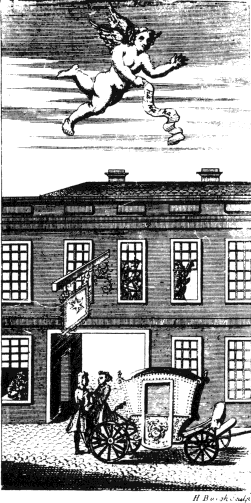
image-project-gutenberg

By 1800, the men’s clubs in Pall Mall, such as White’s, a former chocolate house, oozed exclusivity.  Whether they attracted the working classes or the aristocracy, clubs, taverns, inns, and coffee houses remained largely male enclaves. While women often stayed in inns, taverns, and in coffee houses as lodgers (preferably with a family member or chaperone), they would not meet there to socialize. Indeed, a woman who frequented these public establishments gained a certain ‘reputation.’ “A ‘whore’ was not necessarily a prostitute pure and simple, but a woman who was thought to have violated communal standards of sexual propriety. A sure-fire way of breaking these codes and thus gaining a reputation for immodesty was by frequenting public houses such as taverns, alehouses, or coffeehouses.”*

Sources:
First Christmas Card, 1843

First Christmas Card, 1843

Jane Austen would not have recognized this Christmas card,  for it was commissioned by Henry Cole in 1843, 26 years after her death and the same year that Charles Dickens wrote A Christmas Carol. (The British Postal Museum and Archive). Artist John Calcott Horsely designed the card, which shows the poor being fed  and clothed on either side of a classic triptych arrangement. The center of the card depicts a group of people celebrating Christmas and holding up a toast in celebration, including children, which set up a hue and cry with the Temperance Society. The card is about the size of a regular postcard. Prior to 1843 the upper classes would send each other signed calling cards at Christmas, but Coles’s decorative paper Christmas greeting became rapidly popular, and by 1860 Christmas cards had become widespread.

At the time he commissioned the card, Henry Cole worked in the Public Records Office of London. A busy man, he had been a Captain in the Dragoon Guards, was involved in the introduction of the penny post, helped organise the Great Exhibition in 1851 and was a founder of the Victoria & Albert Museum. In 1843, his schedule was such that he had no time to write to every member of his family and all his friends at Christmas, and so he commissioned JC Horsley to design a card he could send out. Cole had over 1,000 of the cards printed by Joseph Cundell (see the lithographic proof below.)  After Cole sent his cards to friends and family, he sold the rest via the post.

Proof of the first Christmas card

Proof of the first Christmas card

At 6d (sixpence) each, these hand-painted cards were considered a luxury item.  Since the average weekly wage at the time was around a shilling, such a frivolous purchase was unavailable to the working classes.  The cards were sold from a shop on 12 Old Bond Street, and few of the original cards remain today – about a dozen to twenty in all – depending on the source. One example sold in December, 2005 for £8,500.

Centuries earlier the first Christmas card had most likely been made in Germany, but the Cole Horsley card marks the true commercial Christmas card. After this time (1860’s), Christmas cards were produced by the same publishers that created Valentine’s cards. Coupled with the introduction of a cheap and regular post, the habit of sending these cards by all classes of society took off. An original version of the card can be viewed at the V&A museum.

More about the first Christmas Card

From my blog to your computer –

have a fabulous holiday season! – Vic

Win a copy of a Jane Austen audio book!

A gentle reminder to readers that the Jane Austen birthday celebration contest is still open for seven unabridged copies of Jane Austen’s novels by Naxos AudioBooks until December 31st. Just leave a comment answering why you love reading or viewing Jane Austen, and seven lucky Janeites will be the winners of these wonderful audio books. What a great way to start the New Year!

Follow this link to the original post on my other blog, Jane Austen Today, and leave a comment today!