Feeds:
Posts
Comments

sickDuring Jane Austen’s time, the woman of the house was in charge of making and dispensing simple medical remedies for common complaints, such as a cold, headache, or a rash. Recipes for herbal remedies were handed down from mother to daughter. A young girl’s education included knowledge about herbal properties, growing vital herbs in the kitchen garden, and maintaining a book of recipes for simple common cures. (Eighteenth Century Remedies and Receipts.) Recipes were available in the common cookbooks of the era, such as Eliza Smith’s The Compleat Housewife and Hanna Glasse’s The Art of Cookery Made Plain and Easy. People drank hot wine made from the berries of the elderberry tree to ease cold and flu symptoms; made cold lozenges (see the Hannah Glasse “recipe” below); and concocted soothing syrups and herbal tea infusions.

The following instructions for a method of a cure (making cold tablets) were printed in the 15th edition of The Compleat Housewife or, Accomplish’d Gentlewoman’s Companion, a 1753 cookbook compiled by Eliza Smith and published in London. (Official Site of Colonial Williamsburg)

Take pearls, crab’s-eyes, red coral, white amber, burnt hartshorn, and oriental bezoar, of each half an ounce; the black tips of crabs-claws three ounces; make all into a paste, with a jelly of vipers, and roll it into little balls, which dry and keep for use.
herbs

The recipe for cold lozenges by Hannah Glasse uses more commonly known ingredients. (The Art of Cookery Made Plain and Easy, p. 385.)

Take two pounds of common white loaf-sugar, beat it well in a mortar, dissolve six ounces of Spanish liquorice in a little water; one ounce of gum-arabic dissolved likewise; add thereto a little oil of anise-seed; mix them well to a proper consistence, and cut them into small lozenges; let them lie in a band-box on the top of an oven a considerable time to dry, shaking the box sometimes. – Home Remedies, PDF doc

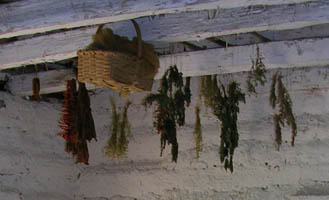
Herbs in the kitchen garden at Lissadell, Ireland

Herbs in the kitchen garden at Lissadell, Ireland

Listed below are the ways an herbal remedy can be prepared (from The Claude Moore Colonial Farm at Turkey Run):

An infusion: A liquid made by soaking an herb – usually its dried leaves or flowers – in liquid. An herbal tea is really an infusion.
A decoction: A liquid made by boiling an herb.
A poultice: A soft, moist mass of bread, meal, herbs, etc. applied to the body.
A plaister: A solid or semi solid remedy, spread on cloth or leather and applied to the body.
An electuary: Powder dried herb and mix with three times as much honey.
An oil: Fresh or dried herb is soaked in oil to extract the essences of the herb. Usually applied externally.
An ointment: Fresh or dried herb is soaked in lard to extract the essences of the herb, then mixed with beeswax and turpentine. Applied externally.

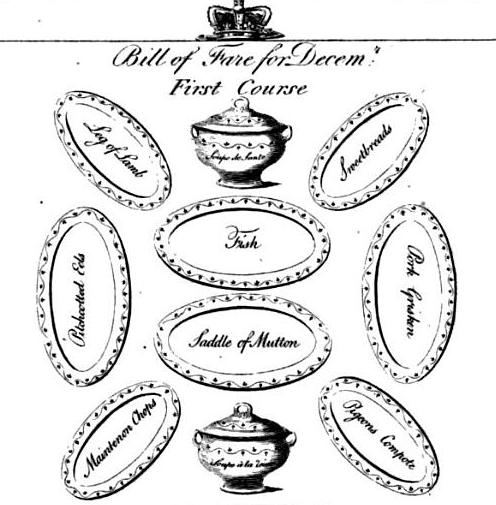
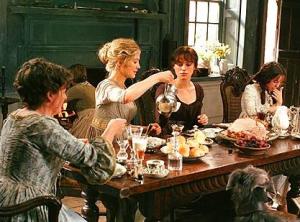
A Regency Meal in December

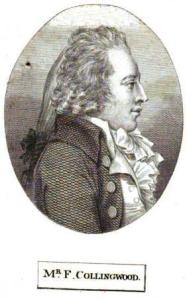
By the end of the eighteenth century, fashionable gentlemen began to dine with regularity in large taverns. As tavern food gained in popularity, the chefs who cooked the fare began to publish their own cookbooks.  These new culinary stars claim not to have learned their trade in a private household, but through methodical study as an apprentice.* The Universal Cook: And City and Country Housekeeper (1792) was written by John Francis Collingwood and John Woollams, the two principal cooks at The Crown and Anchor Tavern in the Strand. In their cookbook, which had the distinction of also being printed in French*, the two chefs discuss the meats, produce, and fruits that were in season. The foods listed below were common for the month of December:
banquet
MEATS
Beef, Mutton, Veal, Pork, House-Lamb, and Doe Venison.

POULTRY
Geese, Chickens, Wild Ducks, Turkeys, Pullets, Pigeons, Capons, Fowls, Hares, Rabbits. Woodcocks, Snipes, Larks, Teals, Widgeons, Dottrels, Partridges, and Pheasants.

First course

First course

FISH
Turbot, Gurnets, Smelts, Cod, Gudgeon, Eels, Sturgeon, Dorees, Codlings, Soles, Cockles, Mussels, Holobets, Bearbet, Carp, and Oysters.

VEGETABLES
Cabbages, Savoys, Potatoes, Skirrets, Garlick, Rocombole, Brocoli, purple and white; Scorzonera, Salfifie, Celery, Endive, Carrots, Leeks, Beets, Parsnips, Turnips, Lettuces, Cresses, All sorts of small Sallad, Onions, Shalots, Cardoons, Forced Asparagus, Spinach, Parsley, Thyme, and  All sorts of Pot Herbs.

FRUIT
Apples, Pears, Medlars, Services, Chesnuts, Hazle Nuts, Grapes, and Walnuts. The Universal Cook And City and Country Housekeeper By Francis Collingwood, John Woollams

Second course

Second course

Preparing the kitchen garden in December

Collingwood and Woollams also devoted a chapter of their cookbook to the kitchen garden. In December there were few plants that continued to grow, so much of their advice is spent on digging the soil in trenches and preparing it for spring sowing; as well as saving cauliflower, broccoli, and artichokes from hard frost.

mr-collingwoodmr-woollams

DUNGING and digging the ground is the principal business to be done in the kitchen garden this month and laying it in ridges to enrich for sowing and planting after Christmas with some principal and early crops for the ensuing spring and summer Dress your artichoke beds by first cutting down any remaining Items …Pay diligent attention to your asparagus hotbeds to keep up the heat of the beds by linings of hot dung and to admit air in mild days… Take up your red rooted beet on a dry day and let them be placed in sand and under cover for use in case of hard frosts… In all moderate weather give air to your cauliflowers in frames  The Universal Cook And City and Country Housekeeper By Francis Collingwood, John Woollams

The Universal Cook’s Bill of Fare for December describes a two-course meal consisting of 16 dishes and two soups. I’ve listed two recipes from the Second Course that use methods and ingredients that are still common:

diningroom-2005Ragout of Celery (From the Universal Cook)
To ragoo Celery, CUT the white part of the celery into lengths and boil it till it is tender. Then fry and drain it, flour it and put to it some rich gravy, a very little red wine, salt, pepper, nutmeg and catchup. Give it a boil and then send it up to table. The Universal Cook And City and Country Housekeeper By Francis Collingwood, John Woollams

*All Manners of Food, Stephen Mennell, p. 99

Other posts about Regency food on this blog:

This link to All Edges Gilt features a Johann Zoffanny illustration of Jane Austen based on a disputed painting, the Rice portrait by Ozias Humphry. Zoffanny’s fronticepiece is found in a 1906 publication of Sense and Sensibility. In Johann’s clumsy drawing, Jane’s head is too large and her feet are too small. The rest of the proportions are close enough.

Humphry’s portrait famously failed to sell at a Christie’s auction in New York in April, 2007.

A Regency Christmas Tree

christmas-tree1Fact: Queen Charlotte introduced the Christmas tree to England. Recently I read in Yahoo answers.com that the Christmas tree was introduced to England by Prince Albert, Queen Victoria’s consort. The majority of the readers had “voted” that this must be so. Wrong. While he and Queen Victoria popularized the custom, they did not start the tradition.


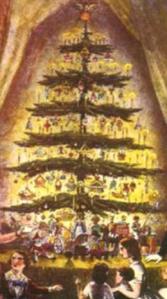
In 1800, Queen Charlotte, the German-born wife of King George III and mother of the Prince Regent, placed a decorated yew tree in Queen’s Lodge, Windsor for the children of leading families. She had also arranged a ‘pyramid of toys upon the table’ to hand out as gifts.  Dr. John Watkins, the Queen’s biographer, wrote the following description:

In the middle of the room stood an immense tub with a yew tree placed in it, from the branches of which hung bunches of sweetmeats, almonds, and raisins in papers, fruits and toys, most tastefully arranged, and the whole illuminated by small wax candles. After the company had walked around and admired the tree, each child obtained a portion of the sweets which it bore together with a toy and then all returned home, quite delighted. – Windsor Castle and the Christmas Tree

Another contemporary writer penned this observation:

A fir tree, about as high again as any of us, lighted all over with small tapers, several little wax dolls among the branches in different places, and strings of almonds and raisins alternately tied from one to the other, with skipping ropes for the boys, and each bigger girl had muslin for a frock, a muslin handkerchief, and a fan, and a sash, all prettily done up in a handkerchief, and a pretty necklace and earrings besides.

More about Christmas traditions during the regency era:

On this site:

On other sites:

Born December 16, 1775

WIN one of six Jane Austen NAXOS books on tape by leaving a comment on Jane Austen Today. Click on the link for an opportunity to win a high quality audio book.

Also win a two-pack of Jane Austen note cards and Christmas cards on Austenblog.