Feeds:
Posts
Comments

The Conqueror by Georgette Heyer has arrived just in time for the holidays. This historical saga of William, Duke of Normandy, who defeated the Saxons in The Battle of Hastings in 1066, is told vividly, accurately, and with mastery by an author who was able to do her research using the rare resources in the London Library.* The story covers William from his infancy until his victory. Although this book is mostly historical, it wouldn’t be a Georgette Heyer novel without some romance. The proud Matilda, daughter of Count Baldwin of Flanders, balks at her betrothal to the baseborn William, which sets up an interesting tension:

Layout 1

The Lady Matilda rose slowly to her feet, and made a reverence to her father. Speaking in a cool, very audible voice, and with her hands clasped demurely together, she said, picking her words: “My liege and father, I thank you for your care of me. If it be your will that I should wed again be sure that I know my duty towards you, and will show myself obedient to your commands as befits my honour and yours.” She paused. Watching her close, Raoul saw the smile lift the corners of her mouth, and was prepared for the worst. Veiling her eyes she said: “Yet let me beseech you, beau sire, that you will bestow my hand upon one whose birth can match with mine, and not, for the sake of our honour, permit the blood of a daughter of Flanders to mingle with that of one who is basely descended from a race of burghers.” She ended as coolly as she had begun, and making a second reverence went back to her stool and sat down, looking at her hands.

A stricken silence hung heavily over the company. There were startled looks, and men wondered how the Norman envoys would stomach this insult. Montogoméri flushed, and took a step forward. “Rood of God, is this to be our answer?” he demanded.

Raoul intervened, addressing himself to Count Baldwin. “Lord Count, I dare not take such an answer back to my master,” he said gravely. Surveying the Count’s shocked face he came to the conclusion that the discourteous reply had been prepared without his knowledge. Curbing Montogoméri with a frown, he said: “My lord, I await Flander’s reply to my master’s proposals.”

Count Baldwin availed himself of the loophole gratefully. He rose to his feet, and made the best of a bad business. “Messires,” he said, “Flanders is sensible of honour done her, and if she is obliged to bestow our daughter in marriage on the Duke of Normandy, were it not for the repugnance the Lady Matilda feels towards a second marriage.” So he began, and went on at length, smoothing away the insult. The envoys withdrew, one thoughtful, the other smouldering with indignation. What Count Baldwin said to his daughter is not known, but it is certain he sent for Raoul de Harcourt late that evening and was closeted with him alone for a full hour.

As with Simon the Coldheart, Georgette employs a more old-fashioned writing style for this early era in both language and detail. This makes the book harder to read than her regencies, but also more realistic in tone. She also writes the tale through Raoul de Harcourt’s eyes, a fictional character, so that we never quite get into William’s mind or understand his motives.  However, for those who cannot get enough of historical biographies, this newly reissued Georgette Heyer history is a must read! Order the book at Amazon or at Sourcebooks.

Other Georgette Heyer Reviews Sit Below

These Georgette Heyer books, available this holiday season, will be reviewed on this blog and Jane Austen’s World through mid-December: Cotillion, Simon the Coldheart, The Reluctant Widow, Faro’s Daughter, and The Conqueror.

Cotillion, Simon the Coldheart, The Reluctant Widow, Faro's Daugher, and The Conqueror

*The Private World of Georgette Heyer, Jane Aiken Hodge, The Bodley Head, Ltd, London, 1984.

Little Green Street

Little Green Street
Little Green Street

Little Green Street is in danger. This narrow, cobblestone street is the only intact Georgian street left in London. It survived the London blitz in World War Two, but will be hard pressed to survive a contractor’s plan to flood the street (more a lane or pedestrian path) for four years with lorries carrying building supplies to and debris from a landlocked site. (View A Walk Up Little Green Street below to see how the lives of residents will be affected.)
littlegreenstreet1fh8
Most of us have come to associate Georgian architecture with the great or exceptional houses that are shown in tv and movie adaptations of classic novels, or visits to Great Britain. The majority of people lived in humbler dwellings. Second “rate” houses were built by merchants, for example, and were no more than 500-900 sq ft in size. These houses, small by modern standards, would have been termed “large”. The most important rooms would have been given the largest windows. On Green Street, “eight of the homes are bow-fronted and were originally shops, selling goods such as ribbon and coffee. The street’s name also has historical connotations, as Highgate Road was once called Green Street. Historian Gillian Tindall, whose best-selling book The Fields Beneath chronicles the growth of Kentish Town, has called the plans ridiculous. She said: “They cannot be allowed to rip this street up. It is important as a ‘survival’ of historic homes – there is nowhere else like it.”-Camden New Journal

Generally speaking,  the preservation of grand buildings and palaces is guarded more zealously by zoning laws than the humbler homes of the middle and merchant classes. To jeopardize an historic street for the sake of “progress” strikes me as supreme folly and short sightedness, especially when this is the ONLY remaining street in London that is truly all Georgian.

Save Little Green Street

A Walk Up Little Green Street

Seen Over the Ether

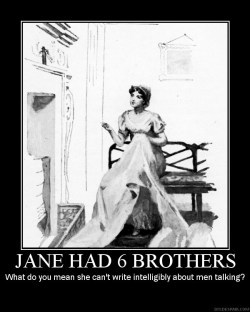
jane-austen-7-males2

At Steventon Rectory, Jane lived in a house with five brothers (the 6th lived elsewhere), a father, and his male student boarders. As an author she chose not to write scenes showing men talking. In my opinion, this doesn’t necessarily mean she knew little about the way men spoke or thought. Unless the rectory was well carpeted and insulated, she must have overheard any number of conversations between her brothers, or her father and other males. Yet there is a perception that Jane did not know enough about  men talking in private to write about the topic. Ian MacKean observes: “The men may well have discussed politics, but not with the women, and Jane Austen never writes scenes with only men present, for the simple reason that she could never have witnessed such a scene herself.” While Mr. MacKean might be correct in his first observation, how can he know that Jane could NEVER have witnessed two men talking politics? Jane lived in a household where reading and conversation were encouraged, and where the family gathered together to entertain each other and read to each other. MacKean’s conclusion, which is echoed by others from multiple sources, makes little sense to me. I am not a scholar, but I cannot imagine that Jane was never alone in a room with two or more men, and that they always limited their conversation while this lively, talented, and opinionated woman was present. Steventon Rectory was crowded, and I imagine at times it was impossible for Jane to find a private spot with so many people (translate males) in the house.

In this passage in Emma, Jane writes the rarest of scenes: that of two brothers talking about their land holdings. They are the Knightleys to be more specific. This manly dialogue is an unusual occurrence in Jane’s novels, so enjoy.

The brothers talked of their own concerns and pursuits, but principally of those of the elder, whose temper was by much the most communicative, and who was always the greater talker. As a magistrate, he had generally some point of law to consult John about, or, at least, some curious anecdote to give; and as a farmer, as keeping in hand the home-farm at Donwell, he had to tell what every field was to bear next year, and to give all such local information as could not fail of being interesting to a brother whose home it had equally been the longest part of his life, and whose attachments were strong. The plan of a drain, the change of a fence, the felling of a tree, and the destination of every acre for wheat, turnips, or spring corn, was entered into with as much equality of interest by John, as his cooler manners rendered possible; and if his willing brother ever left him any thing to inquire about, his inquiries even approached a tone of eagerness.

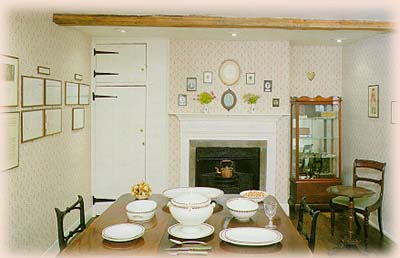
Jane Austen’s novels centered around topics she knew best: hearth, home, neighborhood, and family. The following excerpts offer glimpses of the houses that Jane Austen described in her novels. Accompanying photos illustrate the interior of Chawton, a home in which Jane’s talents as a writer thrived. In Jane Austen’s Idea of a Home , S. M. ABDUL KHALEQUE discusses the difference between Jane’s ideal of a warm and loving home and the architectural characteristics of an impressive ancestral house:

Chawton House Dining Parlor

Chawton House Dining Parlor

In Mansfield Park, Austen makes it clear that physical facilities become useless if moral values are not properly cultivated. Although the houses like Rosings, Sotherton Court, and Northanger Abbey are spacious and magnificent, these are not worthy of consideration as homes. In contrast, the small-sized house of the Harvilles in Persuasion is a home because it exemplifies orderliness as well as other virtues, and the members of the family are always full of life and spirit in their house. Similarly, the Crofts turn their rented house—Kellynch Hall—into a home, a feat that Sir Walter, the owner of the estate, failed to perform; hence, his departure for Bath. What Jane Austen suggests is that physical facilities will be charming only when there is a correspondence between outward beauty and the inner life. Pemberley unites these qualities, and that precisely is the reason why it is a home, whereas some of the great houses are not.

This excerpt from Sense and Sensibility, Chapter 5, demonstrates that the John Dashwoods consider furniture to be symbols of possessions and wealth, not items to be cherished in their home:

Jane's Bedroom at Chawton

Jane's Bedroom

Mr. John Dashwood told his mother again and again how exceedingly sorry he was that she had taken a house at such a distance from Norland as to prevent his being of any service to her in removing her furniture. He really felt conscientiously vexed on the occasion; for the very exertion to which he had limited the performance of his promise to his father was by this arrangement rendered impracticable.– The furniture was all sent around by water. It chiefly consisted of household linen, plate, china, and books, with a handsome pianoforte of Marianne’s. Mrs. John Dashwood saw the packages depart with a sigh: she could not help feeling it hard that as Mrs. Dashwood’s income would be so trifling in comparison with their own, she should have any handsome article of furniture.

Contrast the above description with Lizzy Bennet’s first visit to Pemberley. As she wanders through the stately rooms of Mr. Darcy’s house, Elizabeth is struck as much by the mansion’s magnificence as by its attraction as a home:

The rooms were lofty and handsome, and their furniture suitable to the fortune of its proprietor; but Elizabeth saw, with admiration of his taste, that it was neither gaudy nor uselessly fine; with less of splendour, and more real elegance, than the furniture of Rosings. “And of this place,” thought she, “I might have been mistress! With these rooms I might now have been familiarly acquainted! Instead of viewing them as a stranger, I might have rejoiced in them as my own, and welcomed to them as visitors my uncle and aunt.”

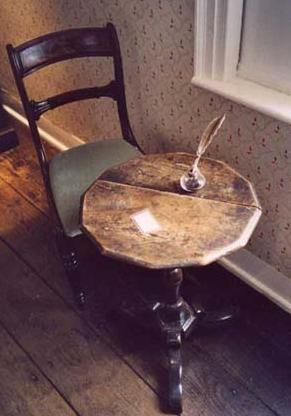
Jane's writing desk at Chawton.

Jane's writing desk.

Expectations loomed large for poor Catherine Morland when she received an invitation to visit Northanger Abbey. She hoped to finally get to see, feel, and experience a romantic and mouldering house like those described in her Gothic novels! Imagine her let-down when she accompanied General Tilney on a tour of the Abbey and realized he had modernized its grand yet comfortable rooms:

They set forward; and, with a grandeur of air, a dignified step, which caught the eye, but could not shake the doubts of the well-read Catherine, he led the way across the hall, through the common drawing-room and one useless antechamber, into a room magnificent both in size and furniture–the real drawing-room, used only with company of consequence. It was very noble–very grand–very charming!–was all that Catherine had to say, for her indiscriminating eye scarcely discerned the colour of the satin; and all minuteness of praise, all praise that had much meaning, was supplied by the general: the costliness or elegance of any room’s fitting-up could be nothing to her; she cared for no furniture of a more modern date than the fifteenth century. When the general had satisfied his own curiosity, in a close examination of every well-known ornament, they proceeded into the library, an apartment, in its way, of equal magnificence, exhibiting a collection of books, on which an humble man might have looked with pride.

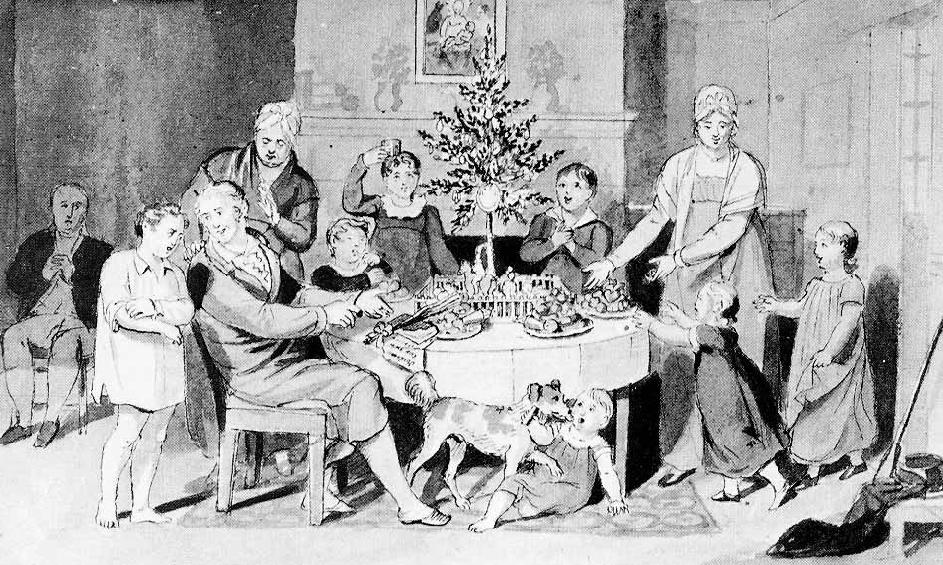
Contrast Catherine’s disappointment with this cozy Christmas scene in Persuasion with two of the Harville children visiting Uppercross as Louisa recovers from her fall in Lyme Regis.

Republic of Pemberley

Christmas Celebration. Image: Republic of Pemberley

Immediately surrounding Mrs. Musgrove were the little Harvilles, whom she was sedulously guarding from the tyranny of the two children from the Cottage, expressly arrived to amuse them. On one side was a table occupied by some chattering girls, cutting up silk and gold paper; and on the other were tressels and trays, bending under the weight of brawn and cold pies, where riotous boys were holding high revel; the whole completed by a roaring Christmas fire, which seemed determined to be heard, in spite of all the noise of the others. Charles and Mary also came in, of course, during their visit, and Mr. Musgrove made a point of paying his respects to Lady Russell, and sat down close to her for ten minutes, talking with a very raised voice, but from the clamour of the children on his knees, generally in vain. It was a fine family-piece.

To read more about this topic, click on these additional Links: