Feeds:
Posts
Comments

Standing, looking west across the Surrey countryside to the wooded ridge of hills in the distance, a line of trees mark the horizon. A sunny, hot day, blue skies with some clouds, small patches of white high above us,. Marilyn, Abi, Emily and myself stand two hundred and twenty four meters above sea level. Patches of fields lined with thick hedges of trees and shrubs spread out before us. Box, yew, beech, ash and oak populate the landscape gathered in woods or spread out in small copses on this hill top. Looking out over this scenery, I make out the distant markings of a football pitch. To one side is another field with a cricket square neatly and closely mowed in the middle of it, a wooden pavilion at one side of the field.
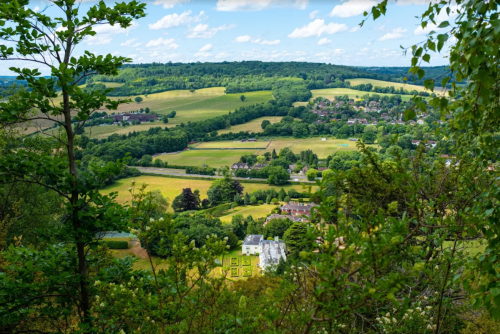
Image of a view of Burford.

Image of a view of Burford. Image courtesy of Tony Grant.

Below, almost looking straight down, a white 18th century mansion is surrounded by lawns and a pattern of four knot gardens are at the rear of the house. Although high up here there is no breeze and the trees are still and the air is warm. A few insects and butterflies move through the air nearby. Other people, families and partners and single walkers move at a distance across the chalk grassland steeply sloping down towards Burford Bridge that crosses the River Mole winding its way past the bottom of the hill. The A24, the Dorking bypass, hums with traffic. I catch glimpses of the red clay tiled roofs of flint cottages , through the canopy of trees, that make up the village of Mickleham to the north. Dorking is to the south. Great Bookham is due west and Leatherhead is unseen to the north west. The chatter of children as they race down the steep slope of Burford Spur I hear nearby but their sounds get fainter as they race away. The sun warms my skin, pleasantly.
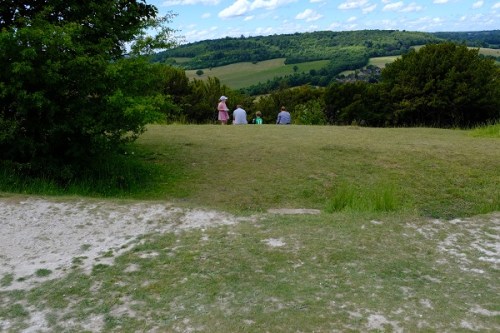
Image of Burford spur

Image of Burford Spur, courtesy of Tony Grant

We walk on down Burford Spur before turning back. I am now required to step upwards, leaning forward, and push hard on thigh and calf muscles to make my way back up to the top of this very steep slope. I parked my car near the old fort at the National Trust car park.
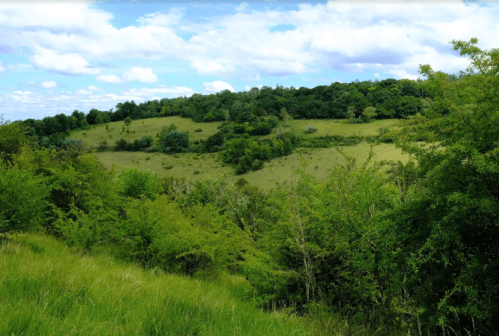
On top of Box Hill. Image courtesy of Tony Grant

On top of Box Hill. Image courtesy of Tony Grant

I decided to pick up a piece of flint to take home. Stones make a place. One stone is a piece of that place. This piece of flint was still embedded in the firm ground and some kicking and pulling and pushing with my hands were needed to prise it loose. I take stones home from places . A piece of smooth granite from a beach in Cornwall, some sandstone from a cliff face in Dorset, a piece of shale from the isle of White and now this piece of flint from the top of Box Hill in Surrey.

The Box Hill Picnic: Emma
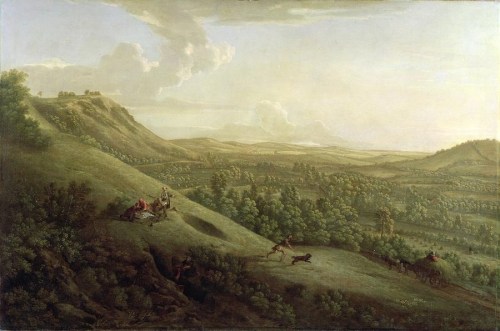
Image of A view of Boxhill, Surrey (with Dorking in the distance), George Lambert, 1733, Wikimedia Commons, Public Domain image.

A view of Boxhill, Surrey (with Dorking in the distance), George Lambert, 1733, Wikimedia Commons, Public Domain image.

Things did not go quite as planned or as wished. The Sucklings were unable to come. Mrs Elton was disappointed, her plans thwarted but the trip to Box Hill was to go ahead.

Emma thought she would like to go to Box Hill too, separately from Mrs Elton’s expedition of course. She didn’t want to miss out on what others might experience. Her party should be simple and unpretentious compared to that of Mrs Eltons. Mr Weston decided other plans and suggested to Emma and Mrs Elton combining the two parties. Mrs Elton agreed and Emma felt forced to very reluctantly agree.

Mr Weston directed everybody on the day. His wife, Mrs Weston, was to stay with Mr Woodhouse to keep him company. Emma and Harriet were to go in one carriage. Miss Bates and Jane Fairfax, were to go with Mr and Mrs Elton and the gentlemen, Mr Knightley, Frank Churchill and Mr Weston on horse back.
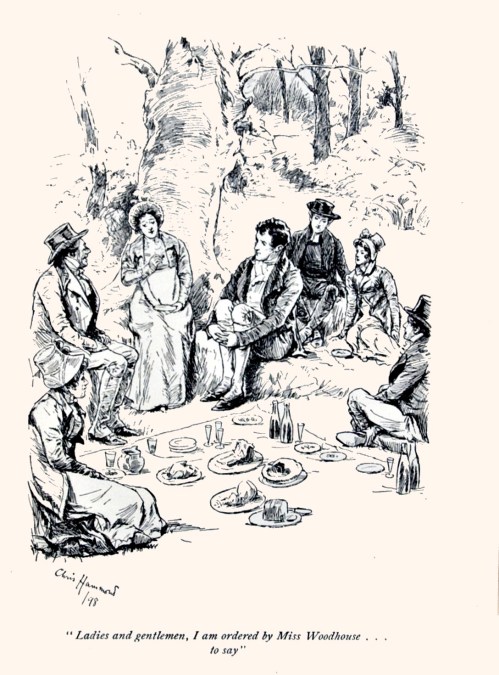
Chris Hammond illustration of the picnic on Box Hill in Jane Austen’s Emma. Image in the public domain.

All admired the views on arrival. But there was a

deficiency.. languor.. a want of spirts and a lack of unison.”

They all separated too much into parties. Frank Churchill was silent and stupid, looking without seeing.

Frank eventually turned his attention to Emma and overtly carried on a most blatant flirtation, an act that Emma, perhaps to her surprise, doesn’t enjoy. It is all an obvious act. She feels his falsehood. Frank Churchill proceeds to upset Emma and the whole party by requesting they all reveal what they are thinking about. This makes the general mood worse. We can guess at their true thoughts. Emma is rightly afraid to hear their honest opinions. She feels the unease and disquiet created by this whole venture.He changes the request, asking each to say

one thing clever or two things moderately clever or three things dull.”

Miss Bates volunteers, perhaps to fill the unwanted silence and apprehension, suggesting she can say three things dull. Emma quips that she would find it difficult to limit the number to

only three at once.”

Miss Bates takes the hint and is mortified. Mr Weston provides a conundrum based on Emma’s name. Finally as they depart Mr Knightley takes Emma aside and points out the hurt she has caused her lifelong acquaintance and family friend, Miss Bates.

It was badly done indeed.”

The party to Box Hill is certainly not a success. Everything goes wrong. Mr and Mrs Elton walk off , Frank Churchill has his mind on other things, Emma feels uncomfortable under his feigned flirtations, she up sets Miss Bates and Mr Knighltley is angered by Emmas behaviour.This is the point in the novel when Emma has her naivity in human interactions and her immaturity laid bare. We all have to confront ourselves before we can change and develop. Emma is confronted by her own shortcomings. It is the beginning of self awareness and the need to be remorseful. A painful journey for Emma. This chapter is only is only six pages long in my edition but the human traits that it reveals are numerous,and the importance to the arc of the plot and the final outcomes is pivotal. Officiousness, immaturity, pride, selfishness, naivity, anger, cunning, secrecy, deceit, remorse and forgiveness. ”It was badly done indeed.” But, in another way, it was, well done.

A piece of flint:

The flint is heavy, about two kilogrammes in weight, nine centimetres long and about five centimetres wide.There are sharp angular edges where some of the flint has been broken off. Bluey black glassy hard faces are revealed. The stone is mostly covered in a thin white hard calcareous rind like the rind covering a cheese, enveloping most of its smooth surface. Hollows and rounded lumps push up beneath its white ,”skin,” like the shapes of bones lieing beneath its surface, finger bones, wrist joints, protruding heels, knuckle bones. A little bit of crumbling chalk, the substance it has been torn from, hides in a hollow on one side.
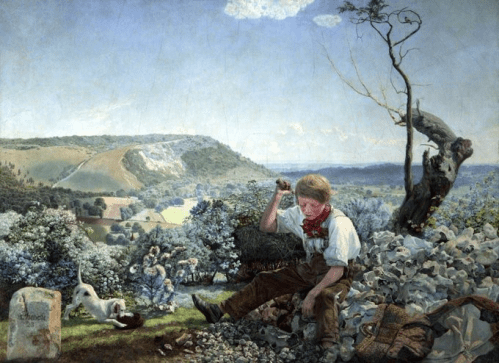
Image of The Stonebreaker by John Brett, exhibited 1858, Wikimedia Commons

The Stonebreaker by John Brett, exhibited 1858, Wikimedia Commons

Chalk was formed during the cretaceous period some 145 to 66 million years ago. It was formed under marine conditions from the gradual accumulation of minute calcite shells shed from micro-organisms called coccolithophores  A white muddy layer was formed on the sea bed. The same earth movements , the violent shifting of the earths plates, that formed the Alps formed these downlands in Southern England rippling and folding the earths surface. That soft white sediment of calcite shells hardened and formed the chalk. Within the chalk, creatures such as sponges and other organisms created pockets which, molecule by molecule by molecule were replaced by flint as water and minerals from the chalk seeped into the spaces.

Flint has been used for many things over the millennia. Axes, knives and arrow heads, used by the hunter gatherers that roamed this land over ten thousand years ago, were made from flint. It has been used in rural buildings. Today we can see many cottages and farm buildings located around Box Hill with layers of flint embedded in the surface of their walls. Some village churches are made from flint. The Romans built coastal forts from flint. It is a very durable material. Flint was used to create the spark that ignited the gunpowder on the ignition pans of flintlock muskets. It was used in the eighteenth century to strike against a piece of steel to create sparks to light fires with. We can say about, a cold callous person, that they have, “a heart of flint.”

Image of Box Hill flint found by Tony Grant. Image permission of Tony Grant

Image of Box Hill flint found by Tony Grant. Image courtesy of Tony Grant

Here is my piece of flint from the top of Box Hill in Surrey , from the very location, at the top of Burford Spur with Mickleham to the north and Dorking to the south where Emma Woodhouse and the gentle people of Highbury gathered for a picnic.
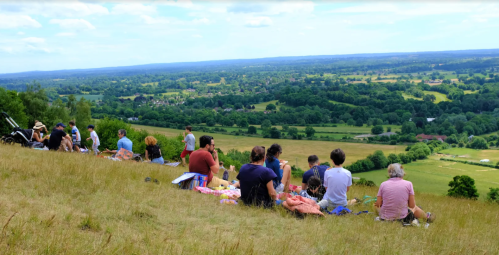
Tony Grant and family on top of Box Hill. Image courtesy of Tony Grant.

All this on a hill of chalk downland in the centre of Surrey on a hot summers day.

 

Excited readers,

ChattyFeet, a cool, funky sock gift site, now features Jane Austoe socks! No, we are not kidding. Our Jane, who loved to walk, has joined the foot pantheon of other great writers: William Shakes-Feet, George Toe-Well, Virginia Wool, Ernestoe Hemingway, and Marcel Proustoe. (Artists like Vincent Van Toe and Frida Callus are also featured.)

Update: We have three winners–Denise, Mea, and Mary! I will contact you regarding your addresses. Thank you all for participating.

Image of Austoe socks

Jane Austoes!

These brilliant hysterical, er, historical, socks are available for purchase. Literature Sock Gift Sets are also offered to those who cannot exist without reading great books and who love novel ideas.

ChattyFeet-Sock-Collections

ChattyFeet Gift Sets. Note the Literature Gift Set in the top left corner!

To help your summer doldrums disappear with laughter, ChattyFeet will give away three pairs of Jane Austoe socks to three lucky G.B. or U.S. winners of this contest! Simply finish the blanks in one of the following sentences and leave it as a comment on this blog. Be outrageous. Be creative! Make readers smile. And then twirl with delight as you anticipate receiving your very own pair of Jane Austoes.

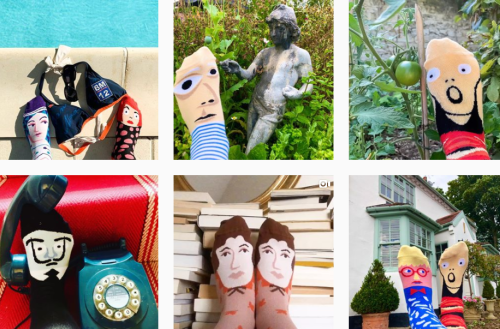
Six instagram images of people wearing Chatty Feet socks in the community

These instagram images might inspire you to enter the contest!

Q 1: Wearing my Jane Austoe socks will _____________ because __________.

or

Q 2: While wearing my Jane Austoe socks I’ll _____________ and will feel _______________.

The contest ends at midnight, August 22, EST USA time. Winners from the U.S. and G.B. will be drawn by random number generator.

More About Socks: A short history of knitting in Austen’s time and through today

In 1589, the first mechanical knitting machine was invented near Nottingham by William Lee of Calverton. As the stocking frame was refined, the knitting cottage industry dwindled in Britain. The Victoria and Albert Museum (V&A) website offers a short history on hand knitting which includes an image of a pair of Regency socks in their collection. Also view an image of a stocking frame in 1751 at this link in The British Museum.

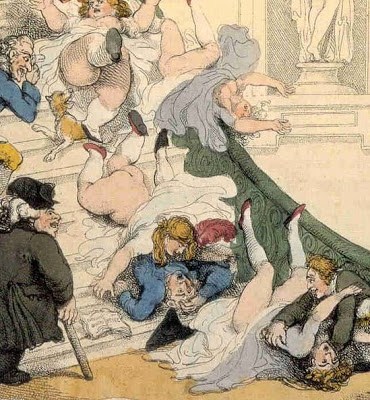
Women in the late 18th century and during the Regency era wore stockings held up by garters, but generally did not wear underwear. I find the detail in this cartoon by Rowlandson (Exhibition Stare Case) particularly funny and revealing!

Closeup image of the Exhibition Stare Case by Thomas Rowlandson.

Closeup of Exhibition Stare Case. Image is in the public domain, Metropolitan Museum of Art collection. 

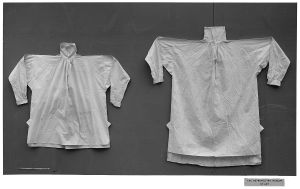
Interestingly, as machines took over the business of making stockings wholesale, genteel ladies continued to knit them. How else were they expected to spend their time? Ladies could not work or own property, and, with a few exceptions, were dependent on their male relatives to oversee every legal aspect of their lives. Days were long and boring for those who had nothing but time on their hands, and so “hand-knitting mainly became the domain of wealthier ladies,” – V&A. When not writing or overseeing household duties, Jane Austen occupied herself with sewing (view her needle case, and the quilt she sewed with her sister in these links). In her letters, Austen discussed sewing men’s shirts for her brothers–in Regency times, these shirts were made by female relatives and not purchased in a tailor shop. View two examples below from the Metropolitan Museum of Art.)

Public domain images from The Metropolitan Museum of Art of two early 19th century British men's shirts.

Public domain images from The Metropolitan Museum of Art of two early 19th century British men’s shirts.

Knitting remained part of the education of Yorkshire’s poor in the late 18th- and early 19th centuries.

for poorer members of society, [knitting]was taught in orphanages and poor houses. The first recorded knitting schools had been established in Lincoln, Leicester and York in the late 16th century and hand-knitting for income continued in Yorkshire until well into the 19th century. The Ackworth Quaker School in Yorkshire was established in 1779 for girls and boys “not in affluence”. According to records, its female pupils knitted 339 stockings in 1821 alone.” – V&A

To view a knitting instruction book, which was the first publication of its kind, visit The National Society’s Instructions on Needlework and Knitting, 1838, England. Museum no. T.307&A-1979. © Victoria and Albert Museum, London.

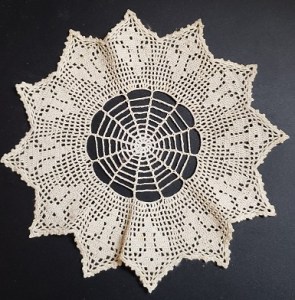
A woman’s duties in the house remained largely unchanged until the early 20th century, when my great grandmother and great aunts and their daughters (solid middle class Dutch burger women) knitted and darned stockings for their menfolk and for soldiers during WWI and WWII. They crocheted the most intricate doilies for arm rests and neck rests on plush sofas and chairs. Long after their deaths, when I went through their sewing baskets, I beheld and assortment of wood balls and finials for darning stockings and tatting pointed lace doilies. Thick wool socks were reused until they literally fell apart.

Image of a small hand-made doily.

A small doily Tante Dina made for my dresser in the 1960s.

My Dutch mom’s sewing basket held different colors of wool scraps, and some of my favorite memories were of watching her at night darning a big hole in my wool stocking. These female skills were considered so essential through late mid-century Holland (and in the U.K., as described in The history of handknitting, The V&A Museum), that I learned to knit, sew, embroider, and crochet during my first 3 years of school in Den Haag. My brother was given no such instruction.

I assure you that ChattyFeet’s socks will need no darning, but they will keep your feet warm, pretty, and smart. I encourage you, fair reader, to enter the contest by leaving a comment at the bottom of this post, using one of the two questions listed at the top as a prompt. Remember that the contest ends on August 22nd. And do visit the ChattyFeet website! It is so much fun.

Find more information about Regency underdrawers on this blog: Ladies Underdrawers in Regency Times

Inquiring readers,

I’m pleased to formally announce my new Jane Austen’s World (JAW) partners, who will help me oversee this blog. Regular readers are already acquainted with the contributions of Tony Grant, Rachel Dodge, and Brenda Cox. This month, I have formalized our association, inviting them to join me in contributing to a blog that has become too big for one person to manage. Thankfully, all three have agreed to come on board.

To celebrate this change, formal introductions are in order!

About Tony Grant, Contributor to JAW Since 2010

Inquiring readers, if you type Tony Grant into this blog’s search bar you’ll discover page upon page of his varied contributions to JAW, which include his breath taking photographs of Great Britain. Tony lives in London and has acted as a tour guide all over the South of England and London. Without him, I could not have kept this blog going during my father’s final illness from 2012 to 2014. Lately, he and I have been Zooming regularly with Deb Barnum of Jane Austen in Vermont. We three Austen-teers have become virtual bosom buddies.

Tony Grant is a retired teacher and writes a blog called London Calling. He has been writing articles about subjects that interest him for many years. Tony also writes articles about the world of Jane Austen. He has been published in the Jane Austen Society of Australia magazine, The Chronical, the Jane Austen in Vermont blog and in Jane Austen’s World. Tony is a literacy mentor for the Jane Austen Foundation that was founded by Jane Austen’s 5th great niece Caroline Knight. He is also a judge for the foundation’s short story writing competition and takes part in charity walks to raise money for the foundation’s literacy work in Africa, India and Australia.

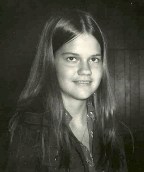
Image of Tony Grant in 1978

Tony Grant in 1978

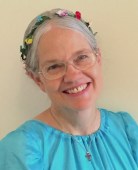
Image of Tony Grant in 2020

Tony Grant in 2020

Tony is a volunteer at The Museum of The Home in Shoreditch, north of the City of London. He takes tours of the 18th century almshouses and supports the curators in researching new exhibitions.

Tony became a qualified teacher in 1974. He obtained a Batchelor of Arts Honours degree in English literature from the Open University and a Masters degree in Museums and Galleries in Education from the Institute of Education UCL.

He has been married to Marilyn, a fellow teacher, for 38 years. They have four children: Sam, Alice, Emily and Abigail and one granddaughter, Emma.

So how did Tony get interested in Jane Austen? He was born and brought up in Southampton. His grandmother often took him into town as a youngster. They would go to the Tudor House Museum. Tony has always loved museums. As they walked through Castle Square she invariably said, as they passed the Juniper Berry pub, ”That’s the site of the house where Jane Austen lived.” – Tony

About Rachel Dodge, Contributor to JAW Since 2017

Rachel is another savior of this blog. Around the time that my mother became ill and when my work commitments increased significantly, Rachel noticed an alarming drop in JAW blog posts. She introduced herself and asked if she could submit posts. Upon reading the quality of her writing, I encouraged her to submit anything she wanted as often as she could. Much to my delight, Rachel took me up on the offer! Rachel is super busy these days overseeing online courses and teaching her children from home. I’m amazed that she finds time to write for JAW and work on a second book!

Rachel Dodge, Versailles, 1998

Recent image of Rachel Dodge, Serbourne Park

Recent image of Rachel Dodge, Sherbourne Park

Rachel Dodge teaches college writing classes and Jane Austen seminars, speaks at libraries, teas, and book clubs, and is the author of Praying with Jane: 31 Days Through the Prayers of Jane Austen (2018) and The Anne of Green Gables Devotional: A Chapter-by-Chapter Companion for Kindred Spirits (2020).

Rachel is a graduate of the University of Southern California (B.A. in English and public relations) and California State University, Sacramento (M.A. in English literature). She wrote her master’s thesis on Jane Austen’s Pride and Prejudice and won the 2005 Dominic J. Bazzanella Literary Award for her paper on Elizabeth Bennet. She was the featured speaker at the Sacramento Library’s How Austentatious! series, the Notable Books series, and the 2014 Jane Austen Birthday Tea. Rachel’s writing has been featured in Jane Austen’s World, Jane Austen’s Regency World magazine, Jane Austen in Vermont, and others. You can visit her at www.racheldodge.com

Rachel’s a great supporter of Jane Austen’s House Museum (JAHM), the Chawton House Library, and the Jane Austen Centre in Bath. She’s visited numerous Austen historic sites on research trips. Her favorite trip so far: When she had the great honor of signing copies of Praying with Jane at Jane Austen’s House! – Rachel

About Brenda Cox, Contributor to JAW Since 2019 

Rachel Dodge introduced me to Brenda at the JASNA GMA in Williamsburg last October. By then, Brenda had written a number of articles for JAW. Her style is as clear and lovely as Rachel’s, and their articles elevated my blog to another level. Brenda travels extensively and is at present busy packing for yet another trip. She still found time to send her bio. Brenda’s educational and employment background puts my erratic bio to shame, and so I feel triply blessed to include her contributions along with Rachel’s and Tony’s.

Image of Brenda Cox in High School

Brenda Cox in High School

Recent image of Brenda Cox

Recent image of Brenda Cox

Brenda S. Cox has loved Jane Austen for many years. She is fascinated by the history of Austen’s time and the nuances of Austen’s books. Brenda has been doing extensive research in two areas: the church of Austen’s day, and science of Austen’s day. She would love to answer any questions you have about those topics. Brenda presented at JASNA’s AGM (national meeting) last year, and has had articles published in Persuasions On-Line. Her current project, nearing completion, is a book entitled Fashionable Goodness: Christianity in Jane Austen’s England. You can visit her at her blog, “Faith, Science, Joy, and Jane Austen,” and on Facebook.

Brenda loves learning, and appreciated the privilege of homeschooling her four children (now all adults) because she got to learn so much along with them. She also enjoys cross-stitching, and reading a wide range of books. She travels and works overseas, and values the beautiful variety of cultures and languages. She has a bachelor’s degree in chemical engineering, a master’s in applied linguistics, and now spends much of her time writing. She looks forward to interacting with you all! – Brenda

About Vic Sanborn, JAW Founder and Administrator Since 2007

Please note: the three previous bios are written properly in the third person. Since I have never been regarded as proper (Jane would have a field day with that!), I wrote mine in the familiar “Me, Myself, and I.”

In my largely abandoned Twitter account I present myself as a Dutch character in a Jane Austen novel. That phrase describes me to a tee—a bit cheeky but reverential towards Jane Austen’s awesome talent. I was born in Jakarta Indonesia to Dutch colonial parents, lived in Den Haag, The Netherlands for six years, and emigrated to the U.S. at nine years of age with my family. As my parents said when we landed in vibrant, bustling New York city – we’ve finally found our home! When I was 14 years old, I received The Complete Novels of Jane Austen (a modern library giant edition) for Christmas, and thus my lifelong love affair with Austen began.

Image of Vic Sanborn in St. Thomas, 1973

Vic Sanborn in St. Thomas, 1973

Recent image of Vic Sanborn

Recent image of Vic Sanborn

I am neither a scholar nor an academic. Rather, I describe myself as a jack-“ess” of all trades. My degrees in biology and art history, and minor in English literature attest to that claim. I also attended the Maryland Institute College of Art during summer months and evenings to study painting and drawing. My employment history is equally all over the map, having worked as an EKG technician on weekends during college; as a technician in Johns Hopkins and Harvard Research labs; as a watercolor artist who showed her increasingly larger works in local galleries and statewide exhibits; as a community relations/outreach director for a nonprofit literacy organization; as a VISTA (Volunteer in Service to America) to coordinate a two-year consortium of Baptist Churches interested in starting adult literacy projects in disadvantaged neighborhoods; and as a literacy specialist for a statewide, university-based professional development organization that provided training to adult education and literacy program staff and teachers. My one constant was my love for Austen. I started Jane Austen’s World thirteen years ago—my longest ongoing “work” commitment—that is still going strong (thanks to JAW’s many readers and new blog partners).

I am particularly grateful to Margaret Sullivan (Austenblog), whose mention of my blog in 2007 drove visitors to JAW, and Laurel Ann Nattress (Austenprose), who invited me to join her in writing for PBS Masterpiece during the 2009 Jane Austen season. That association put both our blogs on the map. We have been e-friends ever since. (BTW, both L.A. and MAGS are also published book authors.)

I genuinely enjoy the company of Janeites and the people I’ve met through this blog and my association with JASNA local groups. Mostly, I love getting to know Austen better through study, research, and reading. The most interesting world in my mind is the one that contains anything Jane Austen! Join me for more Austen-related information on my Pinterest site and Facebook group at Jane Austen and Her Regency World. – Vic

So, gentle readers, please send a virtual clapping of hands and kudos to my new compatriots! I am excited about the next phase for JAW. To skew Bette Davis’s famous line, “Hang on to your seat belts, it’s going to be a fabulous ride!”

Inquiring readers, This fascinating post written by author Clyve Rose explains to film viewers who have not read Emma the short, confusing scene shown in Autumn de Wilde’s 2020 film adaptation of Austen’s novel. Ms. Rose reviews the history of Gipsies or Gypsies in Regency England and Europe in general, and provides insights into why this nomadic group was shunned and feared.

Painting of a young gypsy woman by Karlis Teodors Huns, 1870.

Public domain image of a young Gypsy woman with a tambourine, painted by Kārlis Teodors Hūns, 1870. Wikimedia Commons.

In Chapter 39 of Austen’s Emma, we come upon a curious incident. Miss Harriet Smith (the pretty and ‘natural daughter’ of no-one-yet-knows), out walking with a companion, is accosted by a ‘group of gypsies’. This incident is curious for many readers, and for many reasons.

For modern readers who may not understand the fear and attendant danger of such an episode, it is worth remembering that merely associating with “such a set of people” was judged to be a crime in Regency England. From the 1500s onwards the Crown made several attempts to rid their green and pleasant land of these ‘other’ residents, including deporting them to the colonies and attempting to legislate them out of all existence. By Austen’s time, any conversation or ‘consorting’ with ‘gypsies’ was considered a criminal act for which one could be incarcerated — or worse. A case in 1782 saw a fourteen year old girl hanged for such acquaintance, on the orders of the local magistrate.

That Harriet Smith speaks to the ‘gypsies’, offers them money, and then pleads with them would have been enough to see her in trouble with the law. While the local Highbury magistrate (our hero, Mr Knightley) would be unlikely to order Harriet hanged (I doubt even Austen could redeem a hero who sentences his heroine’s ‘particular friend’ to the gallows), Miss Smith still, technically, commits a crime in this scene. Leaving aside the impact this moment has on the romantic machinations of Emma and her friends, it affords us a rare glimpse into a Regency England that is not often represented in contemporary works.

Austen’s England is a very specific place. A place inhabited only by the English themselves. It is very interesting that one of the few glimpses her readers ever receive of the scaffolding behind this construct, is in the novel where her heroine is labelled by the author herself as ‘an imaginist’ – because, of course, the ideal of a homogenous England is pure imagination: Especially as the empire was at its height at the time, both from a cultural and a mercantile perspective.

There are hints of a similar façade – and Austen’s awareness that this is a façade – in Mansfield Park as well. Sir Thomas Bertram’s references to the slave trade in Jamaica, and its importance as the mainstay of his wealth, is touched upon. He even suggests introducing some of his ‘stock’ at Mansfield Park, but this is not taken seriously. What happens in Jamaica must stay in Jamaica. England is only for the English, Sir Thomas!

The British Empire once spanned a quarter of the known world, but at no point were the native-born residents of these colonies truly deemed to be ‘English’. These antipodeans were not, after all, actually resident in England itself. At least, not most of them. What if the ‘non-English’ people were not ‘out there’ in the colonies? What if they did, in fact, live in England right alongside the Bertrams, the Woodhouses, the Knightleys – and even the Bennets?

Which brings me to the Romany of England: Their position in these narratives is unique; almost as unusual as their place in Regency England – because of course they had one. They lived, loved, and mattered in the same geographic spaces as Emma Woodhouse and Harriet Smith.

The fact is, this ‘England-only-for-the-English’ was peopled by another culture entirely. England was, and is, a shared land. Two cultures, so vastly different in so many ways, coexisted for centuries, and rarely peacefully. The English Romany were as present and alive and wonderfully romantic as the Regency English. Coming from a mostly oral tradition, Romany stories from that time are rarely found in print but that they were there, and experienced this period, and undoubtedly have stories to tell about it – is visible even in the work of authors determined to showcase only their ‘own England’ to their ‘own’ readers.

Austen’s England has the backing of every powerful institution of her day. In terms of crafting the dominant narrative, the English are able to draw on the Crown, the Military, the Law, and of course the Church, which played such a vital part in the lives and lovers of Regency England. Even Heaven sides with the English in Austen’s world view. Her father, let’s not forget, was a clergyman. In the incident ascribed above, Austen does not specifically accuse the ‘gypsies’ of being heathens, but they are clearly depicted as ‘other’; outside the town limits of Highbury itself and dark, terrifying, criminal, and dangerous. They certainly do not ‘fit’ in Austen’s England, and are quite unsatisfyingly removed from Emma’s tale as soon as they have served their rather meagre narrative purpose: “The Gypsies did not wait for the operations of justice: they took themselves off in a hurry.”

Or rather, the author moved them quickly off her bleached white pages and out of ‘her’ England – despite the truth that there were non-English people present in Austen’s England; other voices with their own perspectives and their own stories worth telling, and worth writing. Contemporary Regency writers can not erase these different voices from their tales, because these real people existed all around them, finding their way into these ‘English-only’ narratives with the same kind of side-eye once given to the Irishman and the Scot. The cultural difference between these latter still-European folk and the Romany is, however, far greater – which may account for the fact that their treatment at the hands of English Regency writers seems to have been far worse.

It is difficult to be born into a place that never allows you to become a part of it without a fight, a plea, an effort to assimilate and cut away the parts of you that discomfit the powerful dominant culture all around you. It is more than difficult; it is painful and damaging. The very term ‘marginalisation’ is an admission of the lack of narrative ‘space’ allotted to the voices fiction has chosen to leave unloved, and unnoticed.

The term ‘marginal’ itself bothers me. It is almost (but not quite) a pejorative, which is why I place it in single quotes. I have here done the same with the term ‘gypsy’. I am aware that neither term is universally regarded as harmful. Debates rage all over this, on may fronts. I am only one writer; one voice among many and I have no answers. That there is ongoing debate however, is encouraging.

For myself, born into a marginalised culture with a mostly oral tradition, the ‘minor’ incident in Emma stands out. After all, my own tribe has quite a bit in common with the Romany. There was once a link made between the Romany of Europe and the Lost Tribes of Israel. It turned out to be incorrect, but the placement of ‘other’ in an otherwise ‘native’ land is a context embedded into my lived experience every day – and that’s quite apart from the grim reality shared in the concentration camps of Europe during World War II; a shared history I am sure not even an imaginist like Austen – or Emma – could envisage. Its very surreality is what allows deniability to play so plausibly in the minds of those focused on the façade, rather than any kind of ‘real’ history.

Real history is profoundly unromantic – and yet, somehow, we still try. There is beauty in stories, in narratives of the tales about long-ago lovers and their imagined worlds. There is much solace to be found in story – I love re-reading Austen (although Emma is not my favourite of her works), but in between the wonder of her words, I find myself reading for traces. Traces of others who were there – and whose stories deserve to be told.

Image of Clyve Rose. Permission of her publicist Andrea Kiliany Thatcher, taken by photographer Kira, www.artphotobykira.com.au

Image of Clyve Rose. Permission of her publicist Andrea Kiliany Thatcher, taken by photographer Kira, http://www.artphotobykira.com.au

About Clyve Rose:

Clyve Rose has been writing historical romance fiction for the best part of two decades. Her newest work, Always a Princess, published by Boroughs Publishing Group, debuts this September. She works in the historical romance, fantasy, and speculative fiction genres. She also creates literary novels under an alternative pen name. In between her devotion to fiction writing, Clyve researches various mythologies and historical periods, often basing her characters on actual historical personalities.​

One of her novels was longlisted for a Hachette Development Award for Fiction while her paranormal short story, The One Below, won the Passionate Ink (RWA) award for best Speculative Fiction Short.

​Visit her online at:

Connect with Clyve Rose at ClyveRose.com and Instagram.com/ClyveRose, in which she writes “Clyve Rose is an award-winning Regency Romance author. New Regency release out on 8 Sept. 2020.”

Till this moment, I never knew myself.”–Elizabeth Bennet in Pride and Prejudice, quoted in 30-Day Journey with Jane Austen.

In these days of stress and anxiety, do you long for a few minutes of peaceful reflection each day? Take a 30-Day Journey With Jane Austen. Jane is an excellent travel companion!

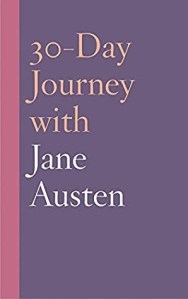
Cover of the book 30-day Journey with Jane Austen by Natasha Duquette

30-day Journey with Jane Austen by Natasha Duquette

Natasha Duquette has chosen thirty profound passages from Jane Austen. Most are from Austen’s novels; the last three are from her prayers.

Each daily passage is followed by an explanation, putting the passage in context and sometimes including connections to Austen’s life. Then a Reflection section connects the passage to our lives, giving us thoughts to chew on for that day.

The brief chapters in this book encouraged and inspired me each morning.

Highlights

Here are a few highlights that I appreciated:

Some reflections focus on our own hearts. On Day Two, Elinor Dashwood considers how “extravagance and vanity” have made Willoughby “cold-hearted and selfish” (Sense and Sensibility). Duquette points out that the Austen family themselves had to live economically, unlike some of Austen’s characters.

Natasha Duquette tells us that Elinor “realizes unthinking habits of luxury have led Willoughby to waste the valuable gifts placed in his hands. . . . Wasteful choices can interfere with true joy in our lives.”

The section concludes, “Focus on practices that build positive attachments to God, to human beings, and to other gifts in your life, rather than to material possessions. Think about how you might steward your resources wisely, hold them lightly, and express gratitude for them joyfully.”

A good reminder to live each day with thankfulness for what we have. We can experience joy today, whatever our circumstances, rather than wait for joy from what we might get in the future.

The Dashwoods teach us about peace as well as joy. On Day Three, volatile Marianne Dashwood “resolves to form habits that can lead to health and peace.” She intends to enjoy nature, reading, music, and her sister’s companionship. Could you find health and peace today in any of those ways?

Practical Suggestions

Some lessons are concrete. On Day Seven, Elizabeth Bennet reflects on Darcy’s letter as she walks for two hours. Duquette points out, “The classical philosopher Aristotle believed reason was sharpened by walking. Austen agreed.”

Image of Elizabeth and Darcy: After Elizabeth receives Darcy's letter, she walks alone for two hours to consider what the truth is. C. E. Brock illustration of Pride and Prejudice, public domain.

After Elizabeth receives Darcy’s letter, she walks alone for two hours to consider what the truth is. C. E. Brock illustration of Pride and Prejudice, public domain.

The Reflection section adds, “Such walking grounds us in reality. Often an answer to a problem will crystallize not as we are sitting statically before a computer screen but as we are physically moving somehow.” Duquette encourages us to “Reconsider a problem or challenging situation in your life as you exercise.”

Even in days of isolation, we need ways to exercise our bodies and give ourselves time to think. I walk up and down the hall of my small apartment for thirty minutes each day, thinking and praying. Others of you may have the opportunity to walk outside, as Elizabeth Bennet did, enjoying the outdoors as you consider whatever comes to mind.

Encouragement for Relationships

Day 10 is about our relationships. In Mansfield Park, Edmund finds his little cousin Fanny crying. He asks persistent questions and listens well, to console her. He then takes her outside, where she can be comforted by the beauties of nature. Duquette explains, “Edmund’s care for Fanny is pastoral, foreshadowing his eventual call into life as an Anglican priest.”

Jane Austen was sent away from home to study with Mrs. Cawley when she was only seven. So she knew how Fanny felt.

Duquette encourages us to notice people who are sad, and “then make time and space to listen to their story in a peaceful environment. You may be surprised at the effectiveness of such gentle attention.” Such deep connections, whether virtual or in person, can encourage you both.


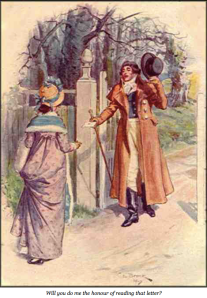
Image of Edmund’s small kindnesses to Fanny Price made a big difference to Fanny. C. E. Brock illustration of Mansfield Park, public domain.

Edmund’s small kindnesses to Fanny Price made a big difference to Fanny. C. E. Brock illustration of Mansfield Park, public domain.

Spiritual Reflections

On Day 15, we think a bit about our mortality. Tom Bertram of Mansfield Park faced death, and because of that he became a better person. Duquette says, “Anglicans in Austen’s day would pray for a good death as part of their liturgy on a Sunday morning.” She encourages us to think about death, not fearfully, but to put our lives in perspective. We might consider, as Tom did, whether we are living for others as well as for ourselves.

The last three days, based on Austen’s prayers, focus more on our relationship with God. Day 30 encourages us to examine our own hearts, and look for ways to “reflect the infinite love of God to a hurting world deeply in need of mercy and grace.”

The 30-Day Journey Series: “Our Greatest Spiritual Thinkers”

30 Day Journey with Jane Austen is the newest addition to the 30-Day Journey series by Fortress Press. The publisher says:

“Enrich each day with wisdom from our greatest spiritual thinkers. Through brief daily readings and reflections, the 30-Day Journey series invites readers to be inspired and transformed. By devoting a moment to meaningful reflection and spiritual growth, readers will find deeper understanding of themselves and the world, one day at a time.”

I’m delighted, though a little surprised, to see Jane Austen join our “greatest spiritual thinkers”! The others in the series are Julian of Norwich, Dorothy Day (Catholic social activist), Martin Luther King, Jr., Dietrich Bonhoeffer, St. Hildegard of Bingen, and Emily Dickinson. Quite a varied lineup of thinkers.

I recommend 30-Day Journey With Jane Austen as a peaceful, encouraging way to begin each day. It will help you to reflect more deeply on important truths and how they might affect your life.

Links about the book:

About the blog post author:

Brenda S. Cox writes on “Faith, Science, Joy, and Jane Austen” at brendascox.wordpress.com .

About Natasha Duquette:  For those who would like to know more about the author of 30-Day Journey With Jane Austen:

Dr. Natasha Duquette, Academic Dean and Professor of Literature, Our Lady Seat of Wisdom College, B.A., University of Alberta, M.A., University of Toronto, Ph.D., Queen’s University

Dr. Natasha Duquette is author of 30-Day Journey with Jane Austen (Fortress Press, 2020) and is currently serving as editor-in-chief for The Palgrave Encyclopedia of Romantic-Era Women’s Writing (Palgrave MacMillan), which is a collaborative project involving writers based in universities around the globe. She is also author of Veiled Intent (Pickwick, 2016), co-editor of Jane Austen and the Arts: Elegance, Propriety, and Harmony (Lehigh University Press, 2013), and editor of Sublimer Aspects: Interfaces between Literature, Aesthetics, and Theology (Cambridge Scholars Publishing, 2007). For the Chawton House Library series, she produced the first annotated, scholarly edition of Helen Maria Williams’s Julia, a novel interspersed with poetical pieces (Routledge, 2009).

Her articles have appeared in the journals PersuasionsPersuasions On-Line, English Studies in CanadaChristianity and LiteratureNotes and QueriesMosaic, and Women’s Writing. She has contributed essays to multiple collections, including Through a Glass Darkly: Suffering, the Sacred, and the Sublime in Literature and Theory (Wilfred Laurier University Press, 2010) and Art and Artifact in Austen (University of Virginia Press, 2020). Her research has been supported by fellowships from SSHRC, Chawton House, and Gladstone’s Library.

Dr. Duquette enjoys teaching courses on eighteenth-century satire, aesthetics, Jane Austen, African literature, and Indigenous writers of North America. Before coming to Our Lady Seat of Wisdom College, she taught full-time at the Royal Military College of Canada, Biola University in Southern California, and Tyndale University in Toronto, where she also served as Associate Dean of undergraduate studies for four years.