Feeds:
Posts
Comments

I’ve just discovered the beneficial qualities of chamomile tea. This was quite by accident. I suspect I might be developing an allergy to food, specifically tomatoes or onions or spicy foods containing these ingredients. I only know that for weeks I’ve been subjected to frequent stomach and intestinal upsets and so I began to search for tried and true methods of relief. As a Janeite I asked: “What would Jane have done?”

Women during the Georgian era, including the Austen women, made their own medicinal remedies for all sorts of ailments. Many recipes were handed down in the family over the generations, others were acquired in Cookery Books.
chamomile2

Thumbnail image from Cup & Leaf

One common easy-to-make remedy for an assortment of ills was herbal tea or tisane. I looked up information online, found teas that aided digestion, then checked my tea shelf and found four of the suggested herbal teas for indigestion: chamomile tea, green tea, ginger tea, and hibiscus tea. (There are more.)

I chose the chamomile as being a likely candidate, for I like the taste. After a few days my indigestion largely calmed down. According to the Dictionary of 18th Century Herb Usage from Chadds Ford Historical Society,

Chamomile [is] infused as a tea for indigestion, gas, and stomach aches. Also used as a strewing herb and insect repellent.” Link to  Dictionary of 18th Century Herb Usage PDF doc

In European records, medicinal use of Chamomile was practiced for centuries.

Ancient physicians prescribed herbal teas regularly to aid in digestion and help relieve symptoms of the common cold and flu. Before the advent of cold medicines and antibiotics, herbal teas were often the only way to treat illnesses.” – Greek Mountain Tea, Chamomile, and Fennel

Chamomile tea is commonly infused from a plant known as Matricaria recutita. The tea is made from the dried flower, not the stems and leaves. The brew is delicate and yellowish and has a lovely floral or fruity aroma. It is often flavored with mint leaves or shaved fresh ginger, but I like it plain. Three cups a day did the trick.
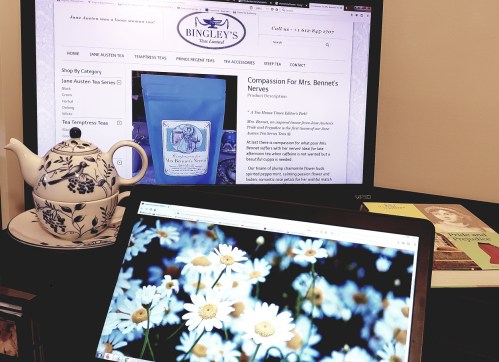
Image of Bingleys teas, chamomile flowers, and favorite teapot/cup

A product description for “Compassion for Mrs. Bennet’s Nerves” on Bingley’s Teas can be seen on my large monitor screen. Chamomile flowers screenshot sits on my laptop (love my standing desk). Sitting on the top ledge are my favorite tea pot/cup and an annotated edition of Pride and Prejudice (I recommend the DK Illustrated Classic edition for newcomers to the Jane Austen oeuvre, like my sister-in-law). Image by Vic Sanborn.

The tea’s success in reducing my symptoms prompted me to research 18th century recipes. So far I’ve had no success, but that means nothing (there should be references that a dedicated researcher would find). I also looked up to see if Jane Austen mentioned the brew in her letters, but found no references. Still, the flower, which looks like a daisy, is common in Europe and easy to grow in an herb garden. One cannot help but surmise that Mrs. Austen and her two daughters knew exactly how to make a cuppa with freshly harvested chamomile flowers.

Cropped illustration of Mrs. Bennet by Hugh Thompson

Hugh Thompson illustration

While I could not find references to Jane’s having made chamomile tea (its properties, aside from soothing intestinal ailments include reducing anxiety, tension, and headaches and promoting sleep), I did find this delightful product description by Bingley’s Teas for a modern tea named “Compassion for Mrs. Bennet’s Nerves.”  

At last there is compassion for what poor Mrs. Bennet suffers with her nerves! A tisane of chamomile, peppermint, passion flower, rosehips, and lavender, sooth the most agitated of moments in a delicious cup. We recommend a touch of local honey for added bliss!”

As for chamomile tea’s efficacy,

The National Institutes of Health funded a study at the University of Pennsylvania on people with generalized anxiety disorder where the anxiety interferes with their lives. Chamomile was shown to to have promising results in reducing the participants’ anxiety.” – The Tea Maestro

Sources:

  • Greek Mountain Tea, Chamomile, and Fennel, October 4, 2016, The National Herald, click on this link. 
  • Introduction to chamomile, PDF document from abc.herbalgram.org. Click on this link.
  • Tea Time at Reverie: Compassion For Mrs. Bennet’s Nerves Herbal Tea from Bingley’s Teas, pA bibliophile’s Reverie. Click on this link.
  • The Health Benefits of Chamomile Tea, The Tea Maestro. Click on this link.
  • How to Make Chamomile Tea: 5 Recipes From Simple Tea to a Hot Toddy, Cup & Leaf. Click on this link.
  • Chamomile: A herbal medicine of the past with bright future, Janmejai K Srivastava, Eswar Shankar,and Sanjay Gupta, U.S. National Library of Medicine, National Institutes of Health, 11-1-2010. Click on this link.
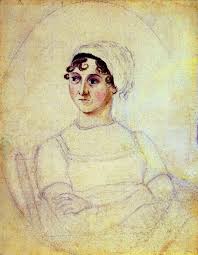
 

I’m sure most of Jane Austen’s fans have already heard of a remarkable purchase from eBay – a treasure trove of photographs of Jane Austen’s nieces and nephews. The album was assembled by Lord George Augusta Hill who “married two of Austen’s nieces, both daughters of her older brother Edward.” – The Telegraph.

I have previously viewed photographs of Austen’s brothers and her friend, Martha Lloyd in their advanced age and often wondered what Jane Austen truly looked like. She died a decade before the first photograph was ever taken.

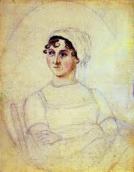
Jane Austen portrait by Cassandra Austen at the National Portrait Gallery

Jane Austen portrait by Cassandra Austen, National Portrait Gallery

The reason for my curiosity is that only one authenticated watercolor portrait of her (painted from life by her sister Cassandra) exists. There are other portraits purported to be of Jane, but their provenance is not 100% certain. Even Austen’s famous silhouette, used on many websites and in publications, might or might not be of her. The original was tucked in the back of an 1814 edition of Mansfield Park, Volume 2, and inscribed with “L’aimable Jane.”

“As her biographer, R.W. Chapman, said ‘Who would insert, in a copy of Mansfield Park, a portrait of any other Jane than its author?’” – National Portrait Gallery

At best, this statement and the placement of the silhouette is circumstantial proof of the image’s authenticity.

Sadly, modern readers can never view a photographic image of Jane Austen, but we can, due to this photographic find, see one of her favorite niece. Fanny Austen Knight. Fanny was born in 1793, when Jane was 17. Cassandra Austen painted a watercolor of a lovely Fanny when she must have been in her teens.


This slideshow requires JavaScript.

The photo is of a mature Fanny, now Lady Knatchbull, wearing stodgy Victorian garb. Fanny lived a long and privileged life, having married a wealthy baronet. She bore him nine children and lived until the age of 88.

Jane was, by all accounts, a pretty and vivacious girl when she was on the “marriage mart.” We think of her as a country spinster wearing a variety of hand-sewn caps, but her lively intelligence shone through her sparking eyes and bright complexion.

For years I’ve been struck by how closely many people resemble their ancestors, even generations down the line. Anna Chancellor, who played Caroline Bingley in 1995’s Pride and Prejudice, is an Austen descendant who can trace her lineage maternally to Edward Austen Knight of Chawton, the very same Edward who offered Chawton Cottage rent free to his mother and two sisters. Jane is Anna’s eight-times great aunt.

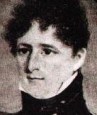
Francis "Frank" Austen, brother

Francis Austen,  brother

Jane Austen portrait by Cassandra Austen at the National Portrait Gallery

Jane Austen

Anna Chancellor as Caroline Bingley, 1995

Anna Chancellor, descendant


These images of Jane, Francis, and Anna show a marked familial similarity in dark, piercing eyes, set of mouth and jaw, and hair color. I often look at Anna’s photos and imagine how Jane would have aged. (Nicely.)

I can’t wait until this album is examined by experts and curated for a future exhibition. Let’s hope this will be sooner rather than later.

Sources:

Lost photographs of Jane Austen’s nieces discovered on eBay reveal how author foretold their lives in plots of her novels, Helena Horton, 11 January 2019 News, The Telegraph. Click on this link.

Possibly Jane Austen, Overview Extended Catalogue Entry, National Portrait Gallery. Click on this link.

In Jane Austen’s Own Words: Advice to Fanny Knight About Love, Jane Austen’s World, March 27, 2009. Click on this link.

Jane Austen: A Family Photo Album, Tony Grant, London Calling. Click on this link to read more about the photographs, view another photo of Fanny Knatchbull and read excerpts from Jane’s letters.

Dear Readers,

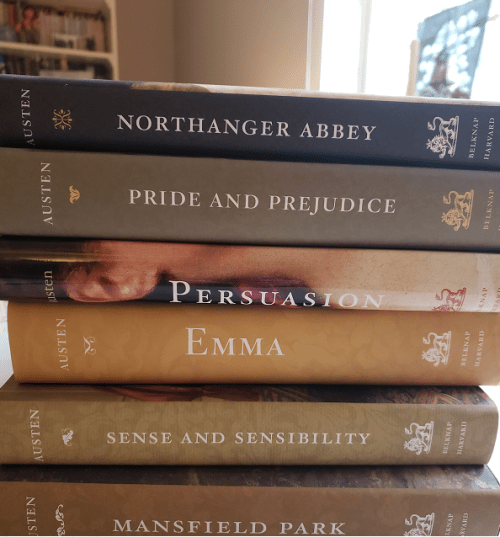
Happy New Year! I hope your holiday season was as fabulous and unforgettable as mine. One of my favorite holiday gifts was a gift certificate from Barnes & Noble, which helped me to complete all six annotations by Harvard University Press of Jane Austen’s best known novels. I quickly purchased Northanger Abbey, which I’ve been perusing since receiving it a few days ago.

Image of the covers of Northanger Abbey (front) and Emma (back) by Jane Austen and published by Harvard University Press.
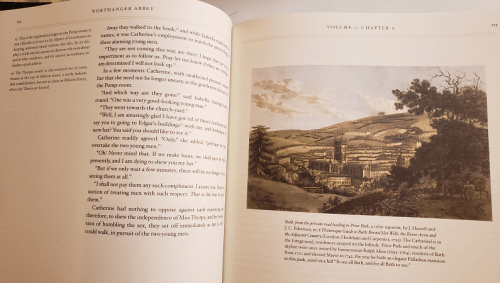
Susan J. Wolfson, professor in the Department of English at Princeton University, edited this edition, which has an extensive 60-page introduction. The book’s format follows the five other annotations – Pride and Prejudice, Sense and Sensibility, Mansfield Park, Emma, and Persuasion – with Jane Austen’s text in the center and the annotated commentary placed on the far right on uneven pages or far left on even pages.  Descriptive images of Bath, a poste chaise, or fashions of the day provide a visual punch to this annotation, as do the well-chosen images in the other books.

Image of Pages 112 and 113 with Jane Austen's text, annotations, and an image of Bath from a private road leading to Prior Park.

Two-page spread of pages 112 & 113 of Northanger Abbey, annotated edition.

For readers who were lucky enough to receive gift cards for books, I cannot recommend these gorgeous hard-cover books enough.

Image of a stack of Jane Austen's six novels, annotated editions by Harvard University Press.

More on the topic:

  • The Jane Austen Annotated Editions: Harvard University Press (includes information about all six editions)
  • This blog’s reviews of the Harvard University Press’s annotated editions of Jane Austen’s Novels: Click here


Jane Austen’s Christmas Day at Godmersham Park, her brother’s estate in the English countryside of Kent, was a merry one. As described by Claire Tomalin in Jane Austen: A Life , “Christmas was celebrated with carols, card games, blindman’s bluff, battledore, bullet pudding and dancing.”

Austen herself described the gaiety and revelry of Christmas in Persuasion, Chapter 14:

On one side was a table occupied by some chattering girls, cutting up silk and gold paper; and on the other were trestles and trays, bending under the weight of brawn and cold pies, where riotous boys were holding high revel; the whole completed by a roaring Christmas fire, which seemed determined to be heard in spite of the noise of the others.”

The games mentioned by Tomalin in her excellent biography of Austen included Hunt the Slipper, which, when played by children, would be fun and boisterous, and when played by adults at a country house gathering could have a naughty connotation, as in the 1802 image in the Hunt the Slipper: A Story, (Peabody Essex Museum).

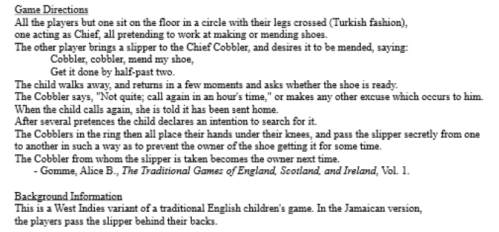
Game directions for Hunt the Slipper

Hunt the Slipper game directions. (Hunt the Slipper, The American Folk Song Collection,  Kodaly Center, Holy Names University.

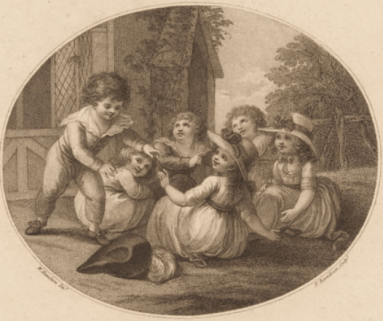
Image of Hunt the Slipper by Francesco Bartolozzi, 1787, Pushkin Museum of Fine Arts (GMII): Image in the public domain. Wikimedia

Francesco Bartolozzi, 1787, Pushkin Museum of Fine Arts (GMII): Image in the public domain. Wikimedia

Hunt the Slipper reminds me of musical chairs, only the slipper is passed secretly to the players until the song ends. This simple but fun song/game is still played today. You can view the “Hunt the Slipper” image by Kate Greenaway,  who lived in the last half of the 19th century, then read the 2008 description of the game in The Guardian at this link: click here. The rules over the centuries are remarkably similar.

In her book, Claire Tomalin mentioned a second song and game that the Austen family (and other families of the era) played called “Oranges and Lemons.” References to this traditional song and nursery rhyme appeared as early as the 17th century.

The first published record of Oranges and Lemons dates back to 1744 in Tommy Thumb’s Pretty Song Book, although it’s fair to assume it had been in circulation for some time before then. There is a reference to a square dance with the same name in a 1665 publication…– What is London’s Oranges and Lemons rhyme all about? by Benjamin Till, People Features, London, BBC Home, 13 November, 2014

Till discusses the many meanings of this song. In short, London’s churches, which are located in distinct districts within the city, are identified with certain trades.

References to “pancakes and fritters”, “kettles and pans” and “brick bats and tiles” tell us of bakers, coppersmiths and builders in areas around St Peter Upon Cornhill, St Anne’s and St Giles, Cripplegate respectively.” — Till, BBC Home

A version of the song can be heard on YouTube.

Many versions of this song exist, which makes one wonder which lyrics Jane Austen and her family sang. This is one version:

“Oranges and Lemons”

Two Sticks and Apple,
Ring ye Bells at Whitechapple,
Old Father Bald Pate,
Ring ye Bells Aldgate,
Maids in White Aprons,
Ring ye Bells a St. Catherines,
Oranges and Lemmons,
Ring ye bells at St. Clemens,
When will you pay me,
Ring ye Bells at ye Old Bailey,
When I am Rich,
Ring ye Bells at Fleetditch,
When will that be,
Ring ye Bells at Stepney,
When I am Old,
Ring ye Bells at Pauls

Here is another version, date unknown by me:

Gay go up and gay go down,
To ring the bells of London town.

Oranges and lemons,
Say the bells of St. Clements.

Bull’s eyes and targets,
Say the bells of St. Margret’s.

Brickbats and tiles,
Say the bells of St. Giles’.

Halfpence and farthings,
Say the bells of St. Martin’s.

Pancakes and fritters,
Say the bells of St. Peter’s.

Two sticks and an apple,
Say the bells of Whitechapel.

Pokers and tongs,
Say the bells of St. John’s.

Kettles and pans,
Say the bells of St. Ann’s.

Old Father Baldpate,
Say the slow bells of Aldgate.

You owe me ten shillings,
Say the bells of St. Helen’s.

When will you pay me?
Say the bells of Old Bailey.

When I grow rich,
Say the bells of Shoreditch.

Pray when will that be?
Say the bells of Stepney.

I do not know,
Says the great bell of Bow.

Here comes a candle to light you to bed,
Here comes a chopper to chop off your head.

Chop chop chop chop
The last man’s dead!

This YouTube video of Oranges and Lemons from Gresham College performs the earliest known version of the song by Catherine King. The illustration of the dance for “Oranges and Lemons,” which is copyright free, is by Agnes Rose Bouvier (1842 – 1892).

One can imagine how much fun Aunts Jane and Cassandra must have had singing these popular songs while dancing and playing the games during the Christmas season with their nieces and nephews and the family in general.

As I end this post, Christmas day has nearly come to an end. I wish you all a happy holiday season and New Year’s celebration. May you all find joy, dear readers, in the gifts and love of your family, faith, and friends.

Sources:

Tomalin, Claire, 1999. Jane Austen: A Life. New York, Random House, First Vintage Books Edition.

What is London’s Oranges and Lemons rhyme all about? by Benjamin Till, People Features, London, BBC Home, 13 November, 2014

Other Christmas Posts on this Blog:

Click on this link for posts related to the topic

Games Regency People Play: Blind Man’s Bluff

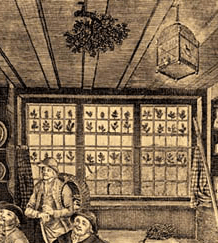
Detail of sprigs of ivy in window, Bowles and Carver print, London. Circa 1775

Sprigs of ivy in window panes and a bough of mistletoe overhead. Detail of a Bowles and Carver print, London. Circa 1775

On Christmas Eve the children laid out the traditional holly branches on the window ledges…” Jane Austen: A Life, Claire Tomalin, p. 4.

Christmas decorations during the Regency era were relatively simple compared to today’s standards, or even Victorian standards, when Christmas trees and wrapped packages made major appearances in common households.

Evergreen plants that bore fruit in the winter season, such as holly, mistletoe, rosemary, bay, laurel, box, yew, and fir have been popular British holiday decorations for centuries. Their meaning as symbols of everlasting life is derived from pagan days (Sciencing). It is uncertain when these evergreens began to be used as Christmas decorations, but carols mentioning the holly and ivy appeared before the 15th century. In addition to the holly and ivy, this early 17th century carol describes Christmas customs that are still popular.

[A Christmas Carol, by George Wither. From his “Juvenilia,” first printed in 1622.]

So, now is come our joyfulst feast;
Let every man be jolly;
Each room with ivy leaves is drest,
And every post with holly.
Though some churls at our mirth repine,
Round your foreheads garlands twine;
‘Drown sorrow in a cup of wine,
And let us all be merry.
Now, all our neighbours’ chimnies smoke,
And Christmas blocks are burning;
Their ovens they with bak’d meats choke,
And all their spits are turning.
Without the door let sorrow lye;
And if for cold it hap to die,
We’ll bury’t in a Christmas pie,
And ever more be merry.


In Susan Drury’s 1985 study of  “Customs and Beliefs Associated with Christmas Evergreens: A Preliminary Survey,” the tradition of putting up and taking down evergreen Christmas decorations varied across England. Observing the superstitions of a particular region (and the strict rules for their length of stay), decorations were put up on either Christmas Eve or on Christmas day.  Some regions dictated that decorations be taken down on Twelfth Night, or the 12th day of Christmas, while others recorded that they should remain up until Candlemas Eve on February 2, or the 40th day of Christmas. To make matters more complicated, the manner of disposing the evergreens differed according to local superstitions. “In Cornwall, as probably in Devon, evergreens would appear to have been hung on Christmas Eve… On Twelfth Day every piece of evergreen had to be removed, because it was believed that for every leaf left a ghost would be seen in the house in the ensuing year.”


We all know of Jane Austen’s years in Bath, Somerset. Drury mentions that in this region no holly or mistletoe “was to be hung up before Christmas eve,” which gives us an idea of when the Austen’s purchased evergreens (for they were now city dwellers) to festoon their house. Drury’s passage for Somerset is somewhat confusing in the disposal of evergreens, for she jumps from Somerset to South Somerset to the customs of local churches, which all differ. She writes that “The importance of Christmas evergreen decorations in England is shown by the strict rules regarding their length of stay and the care taken in disposing of them when they were removed from the walls, a process which varies between and often within each county.”

In closing, Robert Herrick describes the best time of the year for the disposal of a variety evergreens throughout the calendar year in this poem…

CEREMONIES FOR CANDLEMAS EVE

Down with the rosemary and bays,
Down with the misletoe;
Instead of holly, now up-raise
The greener box, for show.

The holly hitherto did sway;
Let box now domineer,
Until the dancing Easter-day,
Or Easter’s eve appear.

Then youthful box, which now hath grace
Your houses to renew,
Grown old, surrender must his place
Unto the crisped yew.

When yew is out, then birch comes in,
And many flowers beside,
Both of a fresh and fragrant kin,
To honour Whitsuntide.

Green rushes then, and sweetest bents,
With cooler oaken boughs,
Come in for comely ornaments,
To re-adorn the house.
Thus times do shift; each thing his turn does hold;
New things succeed, as former things grow old.

Sources:

Tomalin, Claire, 1999. Jane Austen: A Life. New York, Random House, First Vintage Books Edition.

Specimens of Old Christmas Carols: Selected from Manuscripts and Printed Books, Volume 4, London: Printed for the Percy Society. By T. Richards, for the Executors of the late C. Richards, 100, St. Martin’s Lane. 1841.
 

Customs and Beliefs Associated with Christmas Evergreens: A Preliminary Survey, Susan Dury. Folklore, Vol. 98, No.2 (1987), pp. 194-199. Published by Taylor & Francis, Ltd. on behalf of Folklore Enterprises, Ltd. Accessed 09-12-2018 at https://ww.jstor.org/stable/1259980

“Ceremony Upon Candlemas Eve,” Hesperides, or, The works both humane & divine of Robert Herrick, Esq.  London: Printed for John Williams and Francis Eglesfield, 1648.

Christmas in Prints, Michael Olmert, 2008, Colonial Williamsburg

Other Christmas Posts on this Blog:

Click on this link for posts related to the topic

Another Interesting Blog Post About Christmas

But Surely Christmas in England Didn’t Exist Until Dickens Invented It? Austenonly