Feeds:
Posts
Comments

Posts Tagged ‘Crossing Sweepers’

Ah, the novels of Jane Austen! In my teenaged mind they conjured up romantic tales, white muslin dresses, perfectly coiffed and finely dressed gentlemen, ballroom dancing, visits to Bath, and carriage rides through gentle rolling hills.

Early Austen films from the late 1930s to the 1970s BBC television series, concentrated on immaculate clothes and manners. The people in Austen’s plots lived graceful and beautiful lives. Although she added comic and/or mean characters who helped to make her plots memorable.

But, as I reread Austen’s novels throughout my adulthood, I realized she cared deeply about the plight of the poor and mentioned them frequently in her novels. Emma Woodhouse and Anne Elliott carried baskets of food to the less fortunate. Genteel families put together gift baskets for those who struggled during the holidays. Mrs Smith, Anne Elliott’s friend, lived in an undesirable neighborhood in Bath, and was so penurious that she depended on the kindness of others to survive and made trinkets to supplement her meager income. 

The environmental conditions of life in London and nearby cities from 1775, the year of Austen’s birth, through 1817, the year of her death was not mentioned in her wonderful books. But she must have known of the pervasive poverty in England, and especially about the pollution that was recorded in detail by people who lived in those times. Their records reveal that not everything during these years was a bed of roses.

In fact, the reality of life in Georgian London at the start of the 18th century was stark for a majority of the people, especially the poor.

The city was…a very dangerous and unhealthy place. Overcrowding, poor sanitation, and disease led to more people dying each year than being born. With contaminated drinking water, the streets acting as open sewers, and the choking atmosphere, diseases such as cholera, smallpox, and tuberculosis were widespread.” Georgian London 1714 – 1837

St. Paul’s Cathedral, from St. Martin’s-le-Grand Thomas Girtin British 1795–96, Public Domain image, Met Museum.

By 1800, the population had risen to the extent that London was probably the first city in the world with over 1,000,000 citizens. However the average life expectancy across London was still only 30 while in rural England it had risen to over 40.” Georgian London 1714 – 1837

In regard to this last statement, Austen, who died at the age of 41, barely attained the rural ‘over 40” life expectancy. Whereas her immediate family lived longer lives: father 75 yrs, mother 87 yrs, sister 72 yrs: and brothers Edward, 75 yrs, James, 54 yrs, and Francis, 91 yrs. Yet so many poor factory workers or individuals who lived in dire poverty in tenements and suffered from poor nutrition did not survive beyond the age of 30. The poorest died in their 20’s.

An old article in an old online site from the Republic of Pemberley, which has since been updated, discusses Some downsides of Regency London. (long), which includes the environmental conditions caused by pollution before and during Austen’s birth. 

Air pollution: Soot, Fog, and Smog
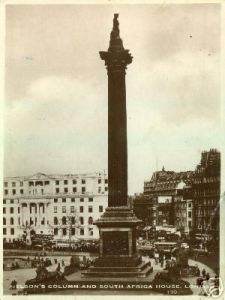
Nelson’s column, blackened. *3 link below

Coal was the primary source for heating and cooking in houses and shops during the 18th & 19th centuries. London and the industrial cities north of London used coal as their primary resource. Major cities produced so much soot that it spread everywhere. Even the spa city of Bath was affected.  
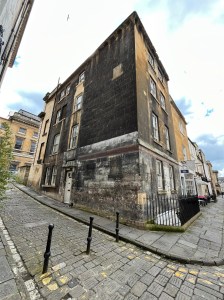
11 Trim Street, Bath, sooty. This building has not been cleaned to show the effects of soot.

Fog and smog were also the main results. In 1817 Sir Richard Phillips described the smoke of London spreading twenty or thirty miles from the metropolis and killing or blighting vegetation. He goes on to say:

“Other phenomena are produced by its union with fogs, rendering them nearly opaque and putting out the light of the sun; it blackens the mud of the streets by its deposits of tar, while the unctuous mixture renders the foot-pavement slippery; and it produces a solemn gloom whenever a sudden change of wind returns over the town the volume that was previously on its passage into the country.” ( “A Morning’s Walk from London to Kew” (page 11) Sir Richard Phillips, 1817. Googlebooks text is online.)

Keeping clothes clean for long was nearly impossible in a city filled with chimneys. Considering the pervasive smoke and soot, one wonders how long delicate white muslin gowns or white shirts would stay clean. One would walk around the city for a few hours, only to find that those garments looked grubby. Wealthy individuals could afford to change their clothes frequently to look respectable, but the working and lower classes did not have such a luxury. Unlike the rich, they could not pay laundresses to wash their clothes frequently. 

The consummate Georgian dandy was Beau Brummel, whose first biographer, Captain William Jesse, quoted Brummel as saying about the maintenance of his clothes: “No perfumes, but very fine linen, plenty of it, and country washing.” In other words, those with the means sent their laundry to country villages for a thorough washing.
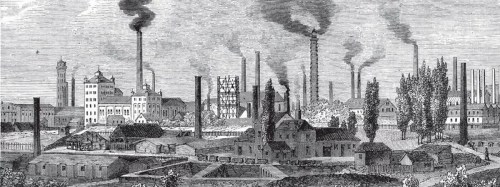
Effects of chimneys during the Industrial Revolution

A more serious effect of all those coal fires in towns and cities, like London and Bath, was smog. 

“…unpleasant, choking smog spoilt food, smutted linen and buildings and suffocated vegetation. It also suffocated the citizens. As early as 1610 a surveyor complained that the chimneys proliferating in the country ‘raise so many duskie clouds in the ayre [which] … hinder the heat and light from the Sunne from earthly creatures” (Hubbub: Filth, Noise, and Stench in England, 1600-1770, Emily Cockayne, p. 209, Yale University Press, 2007) Hubbub is also available for free on the Internet Archive

An EPA Journal article written by by David Urbinato in 1994 mentions the following:

“Smog in London predates Shakespeare by four centuries. Until the 12th century, most Londoners burned wood for fuel. But as the city grew and the forests shrank, wood became scarce and increasingly expensive. Large deposits of “sea-coal” off the northeast coast provided a cheap alternative. Soon, Londoners were burning the soft, bituminous coal to heat their homes and fuel their factories. Sea-coal was plentiful, but it didn’t burn efficiently. A lot of its energy was spent making smoke, not heat. Coal smoke drifting through thousands of London chimneys combined with clean natural fog to make smog. If the weather conditions were right, it would last for days.”

Animal pollution:

In the late 18th century and throughout the 19th century, London was filled with horse manure and urine from the thousands of horses that pulled Hansom cabs and other vehicles. The manure and urine, along with the carcasses of dead horses, polluted the city with the stench and poisoned water, which threatened the health of its residents. 

Manure produced:

In London, 50,000 horses produced 570,000 kilograms of manure and 57,000 liters of urine each day. Horses, it was calculated, produced 15–35 pounds of manure per day each.

“Each horse also produced around 2 pints of urine per day and to make things worse, the average life expectancy for a working horse was only around 3 years. Horse carcasses therefore also had to be removed from the streets. The bodies were often left to putrefy so the corpses could be more easily sawn into pieces for removal.” The streets of London were beginning to poison its people.” –   The Great Horse Manure Crisis of 1894: Historic UK  

One should also take into account the number of oxen, mules and donkeys used for hauling. Big dogs pulling carts did their business in the streets as well. Add the drovers who came from all parts of the Kingdom driving livestock to market: the problem of cleaning the streets of effluvium and stench became an almost impossible fight. 

“During Jane Austen’s time and into the earliest days of the twentieth century, crossing sweepers made a living sweeping pedestrian crossings, stoops, and sidewalks of horse manure and litter” – Jane Austen’s World, 2007. 
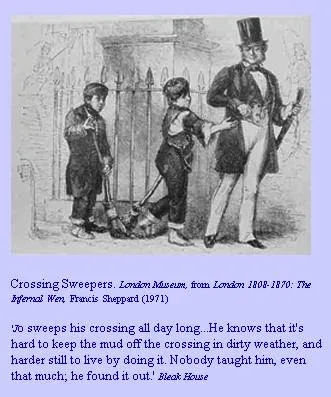
Crossing Sweepers

With all that manure, crossing sweepers were essential for moving dirt and droppings out of the way. This link to the article explains how vital poor males were for keeping the crossings clear for pedestrians. 

Smithfield Market:

“Between 1740 and 1750 the average yearly sales at Smithfield were reported to be around 74,000 cattle and 570,000 sheep.[43] By the middle of the 19th century, in the course of a single year 220,000 head of cattle and 1,500,000 sheep would be “violently forced into an area of five acres, in the very heart of London, through its narrowest and most crowded thoroughfares”.[44] The volume of cattle driven daily to Smithfield started to raise major concerns. – Wikipedia
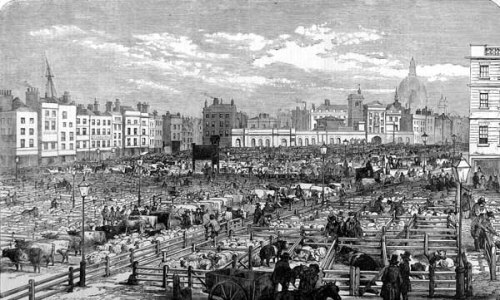
Smithfield,Last day of Old Smithfield, 1855

It is hard to imagine the noise from bellowing cattle and bleating sheep, the immeasurable amount of excrement and urine deposited as they walked along narrow lanes, the smells from the droppings and their effect on the populace in terms of the unhygienic streets. 

“Of all the horrid abominations with which London has been cursed, there is not one that can come up to that disgusting place, West Smithfield Market, for cruelty, filth, effluvia, pestilence, impiety, horrid language, danger, disgusting and shuddering sights, and every obnoxious item that can be imagined…” Maslen, Thomas (1843). Suggestions for the Improvement of Our Towns and Houses. London: Smith, Elder & Co. p. 16.

Sewage & Dirty, Fetid Water:

“Most buildings were not connected  to the various rudimentary urban subterranean sewerage schemes developing in the seventeenth and eighteenth centuries. Waste water combined with surface rainwater in street gutters known as kennels [street gutters].” (p 195, Hubbub)

Wide roads had gutters on either side, narrow roads had a gutter running down the center. The water in these gutters ran into ditches then into streams, which fed into faster waters, like the Thames, which carried most of the dirty watery waste that came from a combination of households, plus manufacturing wastes that included soap, which bubbled. The gutters needed to be kept free from blockages, if they were not, then the streets flooded or street puddles stagnated. Citizens, often tasked to  keep the gutters clean outside their doors, cast rotting fruit and vegetables, dung, and human waste that also blocked the flow of water.  (Hubbub, p 195-197)

When the waste was unblocked, it entered the gutters and then was dispensed into streams and rivers that turned into polluted the water.

“Matt Bramble gives his impression of the quality of liquid to be obtained from the Thames: ‘If I would drink water, I must quaff maukish content of an open aqueduct, exposed to all manner of defilement; or swallow that which comes from the river Thames, impregnated with all the filth of London and Westminster – Human excrement is the least offensive part of the concrete, which is composed of all the drugs, minerals, and poisons, used in mechanics and manufacture, enriched with the putrefying carcases of beasts and men; and mixed with the scouring of all the wash-tubs, kennels, and common sewers, within the bills of mortality.” (p 111, SATIRE IN THE EXPEDITION OF HUMPHRY CLINKER BY TOBIAS SMOLLETT, 1771)

Night Soilmen:
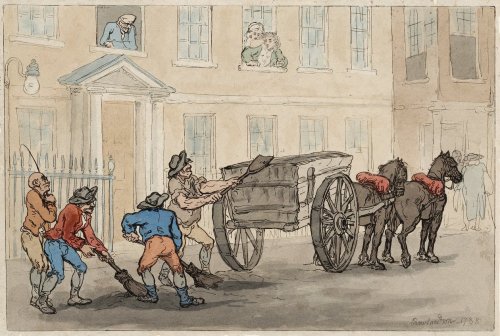
Thomas Rowlandson, Collecting the Night Soil, pub 1788

“In cities, neighboring privies were placed side by side in yards and drained into a common cesspool located under an alley that ran between the row of cottages or townhouses. In rich to middle class households, nightsoilmen would be paid to cart the waste away when the household was sleeping. This service was quite expensive, and quite often neglected in poorer districts where the lower classes could not (and landlords would not) hire these men until the cesspools were filled to overflowing.” (Privies and Waterclosets, written by  David J. Eveleigh, A Jane Austen’s World Review, 2010)

Austen visited her brother, Henry in London three times — to his addresses on Sloan St in 1811 & 1813, and Henrietta St in 1814. While she situated many of her characters living in or visiting London, in her novels she did not mention the horrors of the slaughters that occurred in Smithfield Market, the sounds of fearful animals, their horrific deaths, and their blood running in the streets as their carcasses were dismembered, not to mention the stench. 

These events did not play a part in her plots, which had an undercurrent of dark moments as well. We must assume that Austen knew more about London’s pollution, its filthy air, and rutted roads covered with excrement. She simply chose to use only the moments she needed to drive her stories forward. Her two last novels had serious undertones. One wonders that, had she lived longer, if the darker edges of Georgian life would have crept deeper into her plots.

Additional Links:

Yorkshire, Air Pollution. Stone cleaned on the right


Read Full Post »

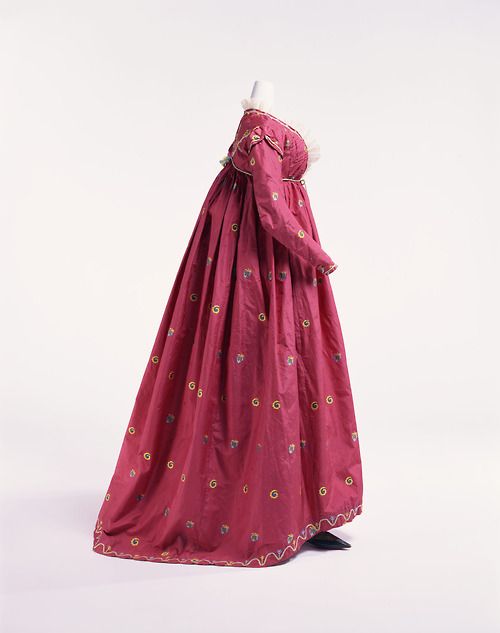
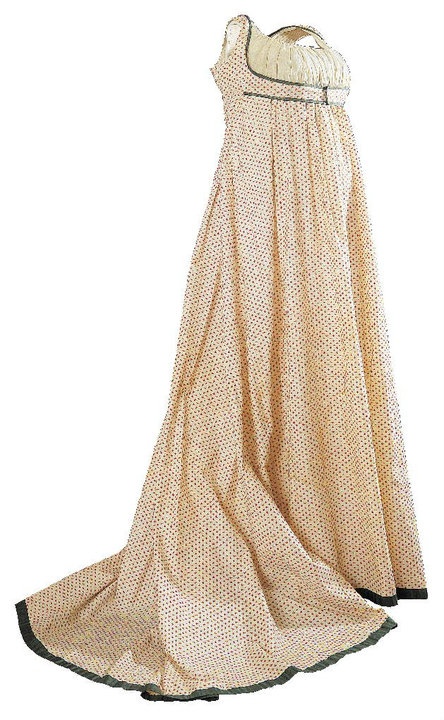
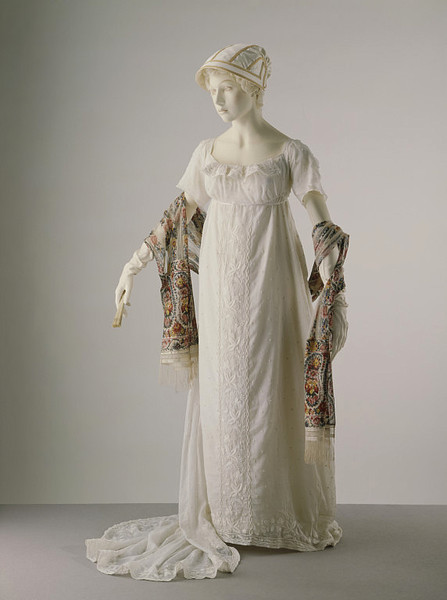
During the late 18th century, early 19th century, trains on gowns were de rigueur. I chose to show the two gowns below, since the styles were popular when Jane Austen was a teenager (first image) and wrote the first editions of Northanger Abbey, Sense and Sensibility, and Pride and Prejudice (second and third images).

1785-90 Sheer embroidered cotton muslin lined with pink silk taffeta - Galliera

Sheer embroidered cotton muslin, lined with pink silk taffeta, 1785-1790. Galliera

Silk Dress 1795 The Kyoto Costume Institute

Silk Dress, Kyoto Costume Institute, 1795

Robe ayant appartenu, 1797

Robe ayant appartenu, 1797

As Regency styles evolved and the 19th century  progressed, trains were worn largely on evening dresses.


1805-1810 French evening dress, V&A museum

1805-1810 French evening dress, V&A museum

I have often wondered how delicate muslin gowns survived the harsh laundering that was required to remove stains made from dusty floors and muddy pathways. Even the grandest ladies wearing the most expensive dresses promenaded on gravel walkways or shopped along city or village streets. How did they manage to keep their hems clean in an era when paved roads and sidewalks were almost impossible to find?

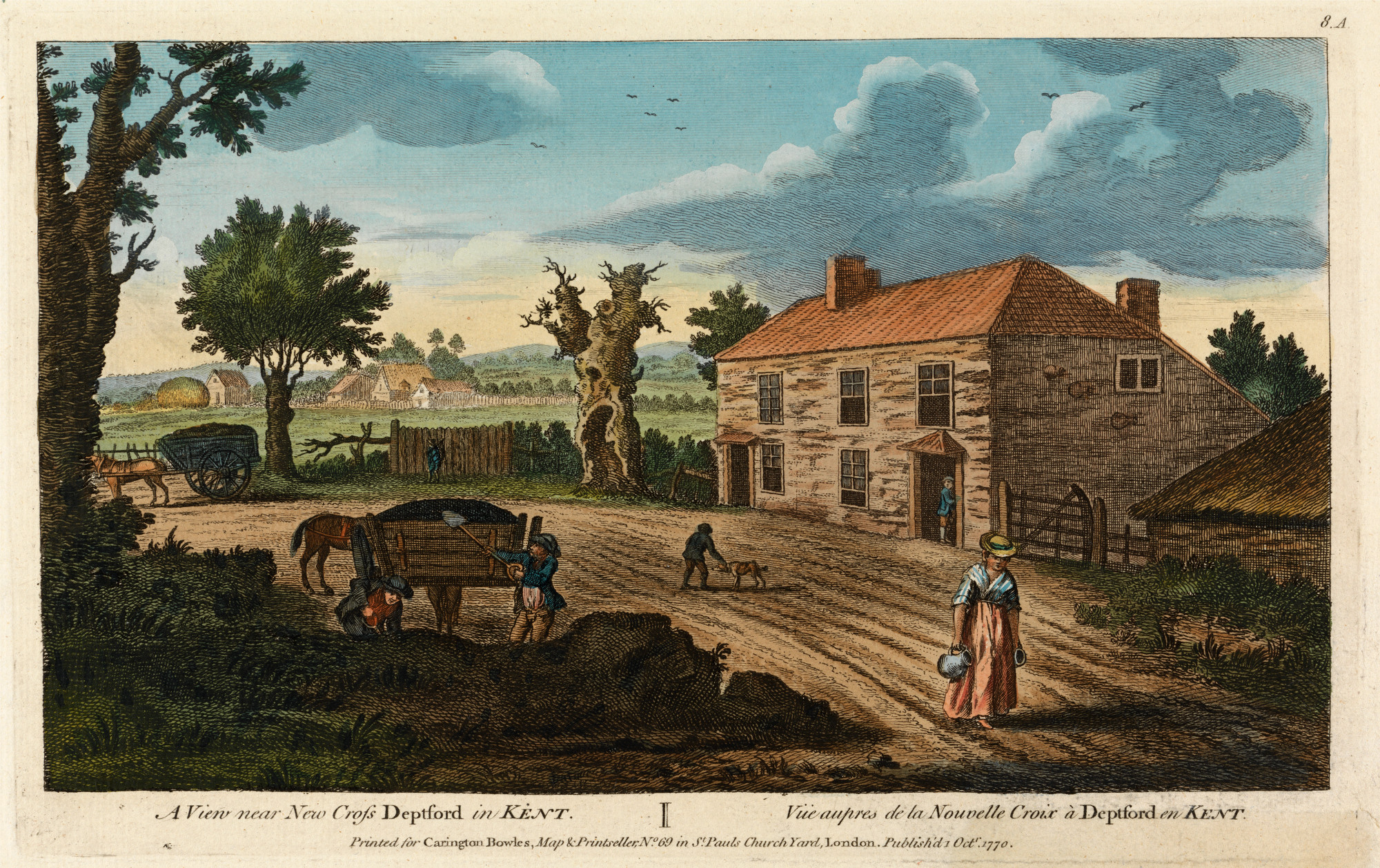
Dirt road, a view near New Cross Deptford in Kent, 1770. artist unknown Yale University, Mellon Collection.

Dirt road, a view near New Cross Deptford in Kent, 1770. artist unknown Yale University, Mellon Collection.

Until macadam roads became widespread, roads across most of Great Britain remained unpaved. Village roads were especially notorious for becoming muddy quagmires during rainy days. The deep ruts in this village scene, illustrated just five years before Jane Austen’s birth, say it all.

Detail

Detail of  the road in New Cross Deptford

Dresses worn by working class women stopped at or above the ankles, and for good reason! These women wore sturdy leather shoes that could withstand the dirt.

recto

Paul Sandby drawing of two vendors, 18th c.

City streets were barely better than country roads. While sidewalks protected dress hems, roads were still made of dirt. People tossed out garbage from their windows, and horse droppings made crossings all but impassible for pedestrians.

Dirt road_St. George, Bloomsbury

Dirt road, detail of St. George, Bloomsbury

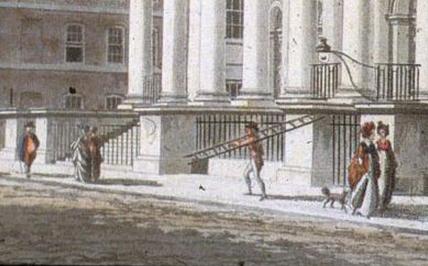
Crossing sweepers were stationed along major intersections, sweeping a clearing for anyone willing to give a tip. Not only did horses pull carriages and wagons, but drovers led animals to market through village and city streets. The stench from their droppings must have been unbelievable.

street sweeper and wheeled plank Vernet_street_print

This enterprising street sweeper places a wheeled plank at strategic points to help pedestrians cross dirty roads. Print by Carle Vernet.


With time, machines began to replace manual labor, as this unhappy street sweeper notes.

By 1829, machines began to replace manual labor, as this unhappy street sweeper notes in “The Scavenger’s Lamentation.” Observe the piles of horse and animal dung left behind.

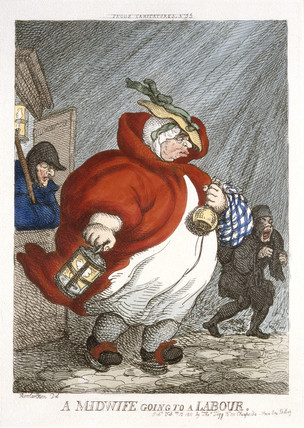
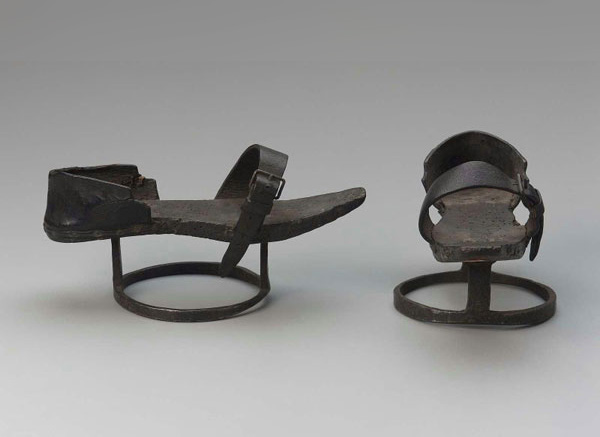
Jane Austen mentioned wearing pattens when she lived in Steventon. These devices elevated shoes above the dirt, but by the turn of the 19th century, pattens were no longer considered fashionable and were largely worn by the working classes, such as the midwife below.

Rowlandson, Midwife going to a labour.

Rowlandson. AMidwife Going to a Labour.


early 19th century pattens. Museum of Fine Art, Boston

early 19th century pattens. Museum of Fine Art, Boston

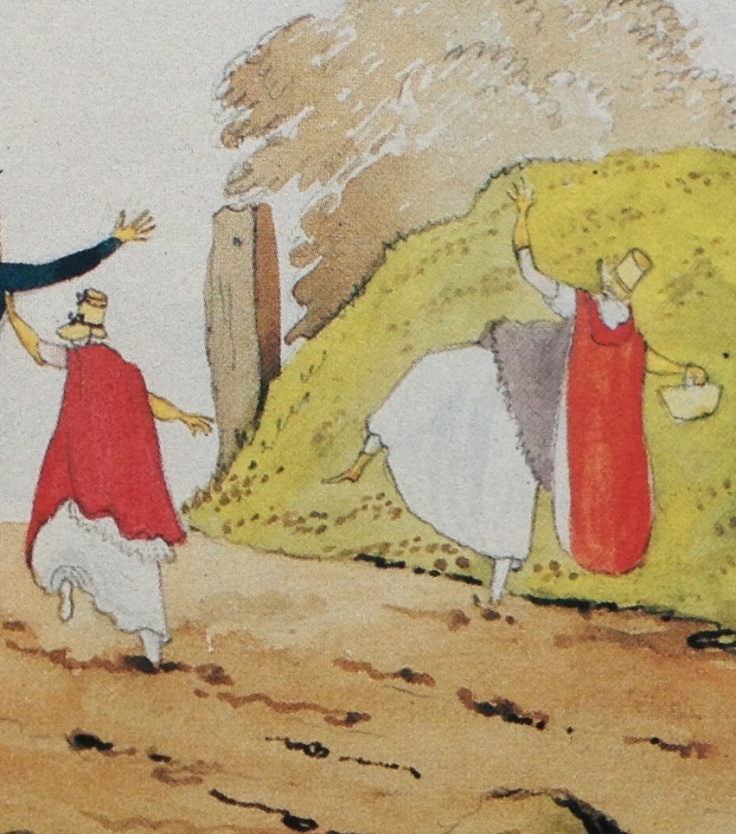
I always view contemporary images for clues. Diana Sperling created some wonderful watercolours around the topic. In this painting, you can see how the trains of the dresses have somehow been hitched up in the back, especially with the first and third women.

dirt road_hazards of walking sperling

Hazards of walking, by Diana Sperling

After Elizabeth Bennet walks to Netherfield to visit her sick sister, Jane, Mrs. Hurst and Mrs. Bingley speak disparagingly about the state of her dress:

“She has nothing, in short, to recommend her, but being an excellent walker. I shall never forget her appearance this morning. She really looked almost wild.”

“She did indeed, Louisa. I could hardly keep my countenance. Very nonsensical to come at all! Why must she be scampering about the country, because her sister had a cold? Her hair, so untidy, so blowsy!”

“Yes, and her petticoat; I hope you saw her petticoat, six inches deep in mud, I am absolutely certain; and the gown which had been let down to hide it, not doing its office.” – Pride and Prejudice, Chapter 8

Bingley’s citified and nouveau riche sisters were horrified at Elizabeth’s lack of decorum. To them, appearances are more important than sisterly devotion. One imagines that they would not have ventured out until the sun had dried the mud and they could be assured of a carriage. From the image below, one can readily see why Elizabeth’s hems were in such sad shape after her long walk in fields made wet by heavy rain.

Dirt roads

One wonders how helpful pattens were when dirt roads became quagmires. Although she was young when she painted these watercolours, Diana Sperling demonstrates a decided sense of humor in her paintings.

In Northanger Abbey, Isabella and Catherine became quickly inseparable, even calling each other by their first names in an age when only intimate friends and family could be on such terms.

They called each other by their Christian name, were always arm in arm when they walked, pinned up each other’s train for the dance, and were not to be divided in the set; and if a rainy morning deprived them of other enjoyments, they were still resolute in meeting in defiance of wet and dirt, and shut themselves up, to read novels together. 

They pinned up the trains of each others’ evening gowns to prevent tripping, but also staining, I suspect.  (It must be noted that guests changed from their street shoes to dancing slippers before entering a ballroom, which probably reduced the amount of dirt trailed inside.) Nothing could stop the girls from seeing each other, not even “dirt” or muddy streets.

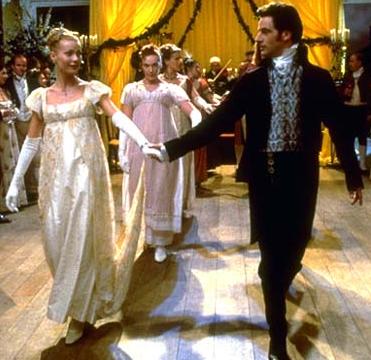
There were many ways to protect trains. In this film still, Gwynneth Paltrow’s Emma hitches her train on a loop over her wrist.

Note the train in this image of the 1996 version of Emma

Note the train in this image of the 1996 version of Emma

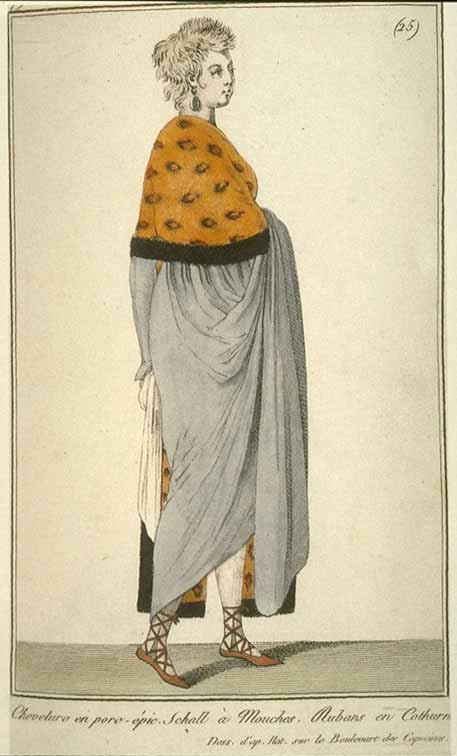
These French images from the late 18th century provide the best evidence in how ladies would protect their delicate dresses out of doors. While we assume that ladies did not expose their ankles to the public (they certainly did not in the Victorian era, but the Regency was a different time), the illustrations point out the practical habit of hitching a train over one’s arm.

corte de pelo a la victima

This French fashionista with her short, pert hair cut, reveals her roman style slippers as she promenades with her train carried over her arm.

Les Merveilleuses, by carle vernet

While this 1797 satiric image by Carle Vernet is making fun of fashionistas, one can surmise that the habit of carrying long skirts over the fore arm was widespread.

Wind and open windows swept dirt and dust continually into houses and visitors trod in dirt. No wonder maids needed to sweep floors daily!

Regardless of the efforts to keep streets, sidewalks, and floors clean, one wonders about the condition of the hems on women’s garments. Clothes were expensive before the advent of mass-produced cloth and were carefully recycled, even by the well-off.

Laundresses took an enormous amount of effort to keep clothes clean. One can only assume that the majority of women wore clothes with stained hems, and that only the rich could afford the expense of keeping their clothes looking spotless. Eleanor Tilney wore only white gowns, which told contemporary readers more about her economic status than pages of explanations ever could. In Mansfield Park, Mrs. Norris frowned on maidservants wearing white gowns. These white clothes were not only above their stations, but they would require an enormous amount of time spent on maintenance.

Also on this blog: Trains on Dresses


Read Full Post »

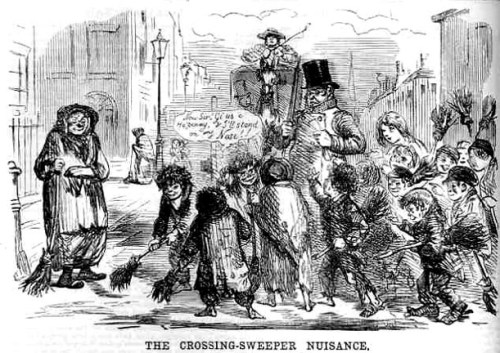
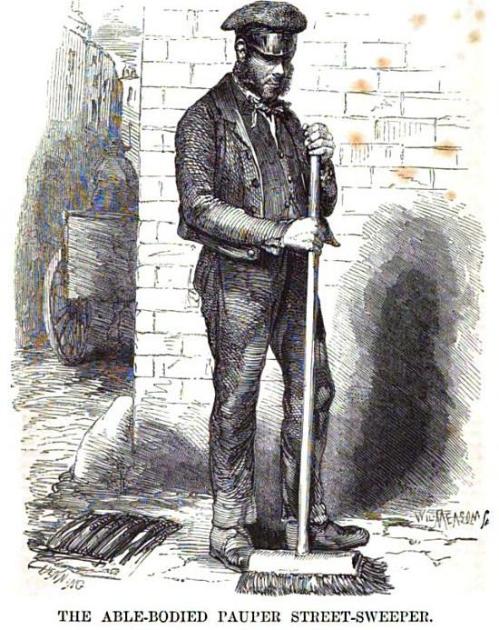
When horses drew every imaginable wagon in London, crossing sweepers were a common sight. In some areas of town they were regarded a nuisance, for often young boys would pester a pedestrian and sweep a clear path whether that person wanted their help or not. The practice of using crossing sweepers to clean the streets of horse manure, dust, and clinging mud lasted into the early 20th century. In the mid-19th century, Henry Mayhew chronicled the lives of working people in a series of volumes entitled London Labour and the London Poor. Mayhew described a system of cleaning streets, introduced by Charles Cochrane in 1843, that instituted a more orderly system than crossing sweepers, and in which former paupers were hired so that they could support themselves.

Crossing Sweepers, 1856

Crossing Sweepers, 1856

The first demonstration or display of the street orderly system took place in Regent street between the Quadrant and the Regent circus and in Oxford street between Vert street and Charles street The streets were thoroughly swept in the morning and then each man or boy provided with a hand broom and dust pan removed any dirt as soon as it was deposited The demonstration was pronounced highly successful and the system effective in the opinion of eighteen influential inhabitants of the locality who acted as a committee and who publicly and with the authority of their names testified their conviction that the most efficient means of keeping streets clean and more especially great thoroughfares was to prevent the accumulation of dirt by removing the manure within a few minutes after it has been deposited by the passing cattle the same having hitherto remained during several days. – London Labour and the London Poor, p. 259

street sweeper

The groups of orderlies not only swept the street and removed dirt in a particular area of London (500 linear yards of a busy street, 2,000 yards of a quieter section, and 9 men in a busy intersection, like Cheapside), but they also acted as “the watchman of house property shop goods, the guardian of reticule,s pocket books, purses and watch pockets, the experienced observer and detector of pickpockets … more, he is always at hand to render assistance to both equestrian and pedestrian.” The report concluded that the street-orderly system would keep the streets of London and Westminster clean in a most satisfactory way. In return, the street-orderlies would earn a wage of 12s. Although this was a lower living wage than other workmen earned, the money lifted them out of their lives of squalor.

The system did not entirely replace the crossing sweepers, many of whom were depicted in caricatures as hounding pedestrians for services rendered. Read my article on Crossing Sweepers at this link.

Read Full Post »

…dirt accumulated faster than all measures to contain it: Cattle were still driven through the streets to and from Smithfield Market until the mid-nineteenth century and horse-drawn vehicles added to the labours of the sweepers stationed at street crossings. Smoke from brick kilns and thousands of sea coal fires polluted the air. In 1813 Henry Austen’s new home above his offices at No. 10 Henrietta Street appeared to Jane to be ‘all dirt & confusion.’ – Jane Austen in Context, Edited by Janet Todd, p 207-208

During Jane Austen’s time and into the earliest days of the twentieth century, crossing sweepers made a living sweeping pedestrian crossings, stoops, and sidewalks of horse manure and litter. Before motorized transport, London boasted over 100,000 horses traversing its streets daily, each one eating a fibrous diet. The crossing sweeper’s job was to shovel the muck, keeping the streets clean for ladies whose long dresses and delicate slippers might get soiled and for gentlemen in their fine raiments.


During “Boney’s” time of terror (Napoleonic Wars), the job of crossing sweeper was often strenuous, and it was said that crossing sweepers could build up a considerable fortune to dig a “channel of viscous mud, a foot deep, through which, so late as the time when George the Third was king, the carts and carriages had literally to plough their way.” In those days, the crossing sweeper had to dig trenches to allow carriages and pedestrians to pass through poorly maintained and muddy roads. As the roads improved, so did the lot of the crossing sweeper, who earned less and less for a job that was to become relatively easier. A good crossing sweeper in an excellent location could still earn a decent living, however. – Chambers, Edinburgh Journal, No. 437, Volume 17, New Series, May 15, 1852

Henry Mayhew described the advantages of this lowly occupation for the London poor:

  • 1st, the smallness of the capital required in order to commence the business;
  • 2ndly, the excuse the apparent occupation it affords for soliciting gratuities without being considered in the light of a street-beggar;
  • And 3rdly, the benefits arising from being constantly seen in the same place, and thus exciting the sympathy of the neighbouring householders, till small weekly allowances or “pensions” are obtained. – Henry Mayhew, London Labour and the London Poor: Volume 2, Crossing-Sweepers

According to the Leeds Industrial Museum, “Children often had more than one way to make money. When it was dry and the streets were not muddy the crossing sweepers, for instance, would do occasional work like catching and opening cabs for people. In the evening they would go outside theatres and operas and tumble for money. Girls mixed ballade singing or lace selling.”

At one time there were so many crossing sweepers that a pedestrian was accosted for money on every stoop and corner, and it would cost a pretty penny to walk from one end of town to another. In 1881, Richard Rowe wrote in London Streets:

IF anyone wants to realize, as the phrase goes, the little army of crossing-sweepers we have in London, let him take a walk – say for a mile or two – on a muddy day, and give a penny to every one who touches hat, makes a bob, as if shutting up like a spy-glass, or trots after him, trailing broom in one hand, and tugging at tangled forelock with the other. I remember when it would have cost anyone, disposed to give in this way, between a shilling and eighteen- pence to walk from the Archway Tavern, Highgate Hill, to Highbury Cock and back. For anyone of a squeezable temperament, therefore, it was decidedly cheaper to take the bus. It is simply as a statistical experiment, just for once in a way, that I recommend this penny-giving. It would be a great misfortune if all crossing-sweepers had pennies given them indiscriminately. I would not make a clean sweep of the sweepers, but I should like to see their ranks thinned considerably – viz., by the elimination of the adults who are able, and the young who might be trained to do something better than what, in the most favourable instances, is little better than a make-believe of work, as a pretext for begging, either directly or by suggestion.


Crossing sweepers worked diligently on both sides of the Atlantic Ocean. In 1882, a New York matron lamented in a letter to the editor of the New York Times about a new regulation that prevented crossing sweepers from working (double click on the image to read it) :

To read more about this fascinating topic, click on the following links:

Click here for an interesting backlink to this post.

Read Full Post »