Feeds:
Posts
Comments

Posts Tagged ‘Regency Fashion’

Inquiring Readers,

In the age of increasing AI domination, it has become easier to find quick facts about Jane Austen and the age in which she lived on the internet. Yet, as many of us have learned, AI scrapes information willy nilly from online sites, regardless of whether those facts are accurate or not. At first I was caught flat-footed. Not being a JA scholar, but a devoted reader about her life, I sadly used some of those wrong facts, but I learned quickly. I now have some tricks up my sleeve – I study original sources from the memories of scholars and family members who knew her personally or lived during her age, as well as from the people who survived her and recalled their memories of her well into their old age. I also purchase books from Austen renowned scholars and academics (but a few of their books will be listed in another post.)

I found out-of-print books in antique book stores in England, Boston, New York – whichever city I visited or lived in. But these treasures could be quite expensive. I discovered Thrift Books and ABE Books online, which sell histories and biographies also out-of-print for an affordable price. Better yet, I discovered The Internet Archive and Project Gutenberg years ago. They’re akin to searching libraries and their catalogues of precious books on your computer. 

I found Project Gutenberg first. When I began JAW, I could print any chapters I needed for research, or cut and paste quotes for my blog posts. At the time, this service was around 38 years old. It’s a rather old-fashioned site for today, but extremely useful nevertheless. Better yet, all their books are copyright free!

The Internet Archive (IA) is another online site in which most books, newspapers, and videos can be “borrowed” for free once you sign in. Once you borrow the book, you can return to it at a later time to continue your research. IA resides on a later platform, so it might be more appealing to younger users.

Below are some books easily accessed online. A few choices echo the precious books I purchased for my library. Enjoy!!!

About Project Gutenberg

https://www.gutenberg.org/about/

Project Gutenberg is an online library of more than 75,000 free eBooks.

Michael Hart, founder of Project Gutenberg, invented eBooks in 1971 and his memory continues to inspire the creation of eBooks and related content today.

Since then, thousands of volunteers have digitized and diligently proofread the world’s literature. The entire Project Gutenberg collection is yours to enjoy.

All Project Gutenberg eBooks are completely free and always will be.

PG documents can be printed, or one can easily copy and paste sections. 


The Books: Jane Austen 

Memoir of Jane Austen by James Edward Austen-Leigh, 1871 edition

https://www.gutenberg.org/files/17797/17797-h/17797-h.htm

About this book…

[This] Memoir of my Aunt, Jane Austen, has been received with more favour than I had ventured to expect… [In this Second] Edition, the narrative is somewhat enlarged, and a few more letters are added; with a short specimen of her childish stories.  The cancelled chapter of ‘Persuasion’ is given, in compliance with wishes both publicly and privately expressed.  A fragment of a story entitled ‘The Watsons’ is printed; and extracts are given from a novel which she had begun a few months before her death; but the chief addition is a short tale never before published, called ‘Lady Susan.’ – J. E. Austen-Leigh
Jane Austen, Her Life and Letters: A Family Record, by William Austen-Leigh and Richard Arthur Austen-Leigh (RA A-L), 1913.

https://www.gutenberg.org/ebooks/22536

About this book…

The Memoir [by JE Austen-Leigh] must always remain the one firsthand account of her, resting on the authority of a nephew who knew her intimately and that of his two sisters. We could not compete with its vivid personal recollections; and the last thing we should wish to do, even were it possible, would be to supersede it. We believe, however, that it needs to be supplemented, not only because so much additional material has been brought to light since its publication, but also because the account given of their aunt by her nephew and nieces could be given only from their own point of view, while the incidents and characters fall into a somewhat different perspective if the whole is seen from a greater distance. Their knowledge of their aunt was during the last portion of her life, and they knew her best of all in her last year, when her health was failing and she was living in much seclusion; and they were not likely to be the recipients of her inmost confidences on the events and sentiments of her youth.- W A-L and RA A-L
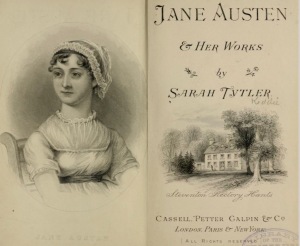
Jane Austen and Her Works by Sarah Tytler, 1880

This book was …

“Written by Scottish novelist, Henrietta Keddie, who wrote under the pseudonym Sarah Tytler. Keddie was known for her depictions of domestic realism within her work, becoming very popular with women.

This work is a study of Jane Austen and her writings, with chapters on the life of Jane Austen and her novels, as well as extracts from some of her most famous works. This includes chapters of Pride and Prejudice, Northanger Abbey, Emma, Sense and Sensibility and Persuasion.- Rooke Books (First Edition – £675.00)“ https://www.rookebooks.com/1880-jane-austen-and-her-works

The book is also available on the Internet Archive: https://archive.org/details/janeaustenherwor00tytlrich/page/n9/mode/2up


About the Internet Archive

https://archive.org/about/ 

The Internet Archive, a 501(c)(3) non-profit, is building a digital library of Internet sites and other cultural artifacts in digital form. Like a paper library, we provide free access to researchers, historians, scholars, people with print disabilities, and the general public. Our mission is to provide Universal Access to All Knowledge.

Today our archive contains:

916 billion web pages

49 million books and texts

13 million audio recordings (including 268,000 live concerts)

10 million videos (including 3 million Television News programs)

5 million images

1 million software programs

Anyone with a free account can upload media to the Internet Archive. We work with thousands of partners globally to save copies of their work into special collections.


Jane Austen

The Jane Austen Companion, by J. David Grey, Managing Editor; A. Walton Litz, and Brian Southam, Consulting Editors; H. Abigail Bok, 1986, New York: Macmillan.

https://archive.org/details/janeaustencompan00grey
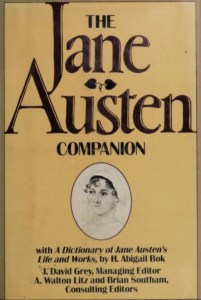
This Book’s Introduction…

…”we have aimed at an encyclopedic book that will be of value to both the specialist and the general reader…individual essays, which appear in alphabetical order, cover a great variety of subjects: the life of Jane Austen and her family; the manners and literary tastes of her time; the composition of her fictions and their critical histories; the language and form of the novels; and many more…subjects that may strike some readers as arcane or antiquarian [are] “Characterization” and “Servants,” “Romanticism” and “Auction Sales,” “Education and “Gardens.” are all topics that will be of interest to many readers…This volume speaks with the many voices of Jane Austen’s contemporary voices.


Jane Austen: her biographies and biographers – or, ‘‘Conversations minutely repeated.’  Deirdre Le Faye, Jane Austen Society, Report for 2007

https://archive.org/stream/austencollreport_2007/AustenReport%202007_djvu.txt

About this talk…

This is an edited version of a talk given first at University College, London, on 15 

November 2003, and then again to the Bath and Bristol Group on 29 April 2006

…The only sources of contemporary written information about Jane Austen that we have…are primarily her own letters – but these were not published till many years after her death, and even then only emerged gradually from 1870 up to the second half of the twentieth century.

Secondly, there are letters and pocketbooks originating in an outer circle of relatives and friends; some of the former were published by R.A. Austen-Leigh in Austen Papers, but many more remain as yet unpublished. These, and especially the pocketbooks. can be useful for giving precise dates regarding Jane’s daily life, but by their very nature do not give any information about her opinions or her character. 

Thirdly, her novels give some biographical information, but this has to be 

identified in conjunction with reading her letters. For example, we know from her letters that she did not visit Northamptonshire before writing Mansfield Park, but relied upon Henry to provide her with local information, and we know that it was her visit to Lyme Regis which gave her the background for chapters 11 and 12 in Persuasion.  

So fourthly and finally, we are left with oral tradition, the dredged-up memories, most of them surfacing only many years later, of the conversations that her family and friends had with and about Jane. Such memories originate with her siblings and their children, and are based on personal knowledge; they circulated within the family between 1820-70, and were then passed on to later generations, some still as oral tradition, others in the form of memoirs and reminiscences written down in the late nineteenth or early twentieth centuries. These unique anecdotes are widely scattered in different books or manuscripts, and like pieces of a jigsaw have to be found and slotted into place before the picture is complete.

Memoir of Jane Austen, Audio from LibriVox, script written by James Edward Austen-Leigh. No reader listed.

https://archive.org/details/memoir_jane_austen_0805_librivox

Please read the book’s description in the Project Gutenberg section above.
Jane Austen’s sailor brothers: being the adventures of Sir Francis Austen … and … Charles Austen; by Hubback, J. H. (John Henry), b. 1844; Hubback, Edith C. (Edith Charlotte), 1876 – Publication date 1906, London, J. Lane, New York, J. Lane company

https://archive.org/details/janeaustenssailo00hubbrich/page/n13/mode/2up
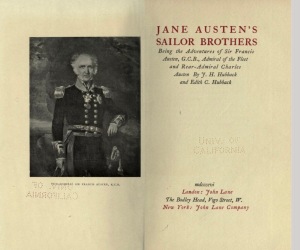
In this book…

My daughter and I have made free use of the Letters of Jane Austen published in 1884, by the late Lord Brabourne, and wish to acknowledge with gratitude the kind permission to quote these letters, given to us by their present possessor. In a letter of 1813, she speaks of two nephews who ” amuse themselves very comfortably in the evening by netting ; they are each about a rabbit-net, and sit as deedily to it, side by side, as any two Uncle Franks could do.” In his octogenarian days Sir Francis was still much interested in this same occupation of netting, to protect his Morello cherries or currants. It was, in fact, only laid aside long after his grandsons had been taught to carry it on. – cherries or currants. 

– John H. Hubback, 1905 (John was the great-nephew of Jane Austen through his wife, Catherine’s side. She was the daughter of Sir Francis William Austen, JA’s sailor brother.)


Jane Austen, A Biography, by Elizabeth Jenkins, 1949. The Universal Library, Grosset & Dunlap, NY.

https://archive.org/details/janeausten0000eliz_w9e7

This book is…

The first full-length study by someone who was not a collateral descendant of the Austens was written by Elizabeth Jenkins in 1938… Miss Jenkins was the first to properly use Chapman’s edition of the letters, and was also allowed by RAA (Richard Arthur Austen-Leigh) to see other unpublished family papers. This work was well-balanced, very readable, as accurate in its facts as was then possible, and placed Jane Austen clearly against the background of her times; it consequently remained the definitive biography for fifty years.   


Georgian/Regency England

The Prince of Pleasure and His Regency 1811-20, by J.B. Priestley, 1969.

https://archive.org/details/princeofpleasure0000jbpr

Description in this book by the author…

With a pair of wild spendthrifts like Fox and Sheridan keeping him company night after night, the young Prince was not likely to imitate his father’s frugal habits. He was soon in debt and he never really got out of it. Yet for this his father, the careful George III, is at least as much to blame…The King had been unwise in first keeping his son, a full-blooded, high-spirited youth, so close to a dull and cheese-paring Court. He had been even more unwise when he had allowed the Prince of Wales his independence and his own establishment at Carlton House.- Priestly, p 24
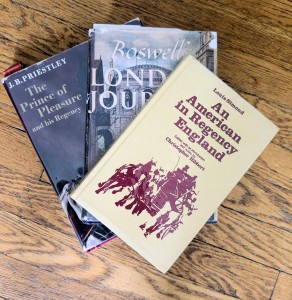
 

An American in Regency England: The Journal of a Tour in 1810-1811, by Louis Simond, edited with an introduction and notes by Christopher Hibbert. The History Book Club, London 1968.

https://archive.org/details/americaninregenc0000loui

In this book:

The journal…while it adds little new to our knowledge of Regency England…deserves to  be recognized as one of the most evocative portraits of Britain and the British to have been drawn by a foreigner during the years of the Napoleonic Wars. – Hibbert, Introduction

April 29–We have seen Mrs Siddons [55 yrs old)] again in the Gamester, and she was much greater than on the first day. Perfect simplicity, deep sensibility, her despair in the last scene, mute and calm, had a prodigious effect. There was not a dry eye in the house…Simond, 1810.


A Visitor’s Guide to Georgian England, by Monica Hall, 2017. Pen & Sword.

https://archive.org/details/visitorsguidetog0000hall/mode/2up
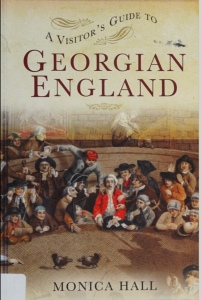
In this Book…

Monica Hall creatively awakens this bygone era, filling the pages with all aspects of daily life within the period, calling upon diaries, illustrations, letters, poetry, prose, 18th century laws and archives. This detailed account intimately explores the ever changing lives of those who lived through Britains imperial prowess, the birth of modern capitalism, the reverence of the industrial revolution and the upheaval of great political reform and class division. – Front description

Above all, the Georgian were optimistic risk-takers. They had to be, as there was no other way to live. They often did dangerous work in which the risk of tetanus or sepsis from wounds was ever present. The Industrial Revolution was underway, bringing both investment and employment opportunities – and the risk of losing money. Sanitation and drinking water was dubious to say the least, especially in towns and cities, and medical help were equally haphazard. Childbirth was still both inevitable and dangerous. But, most importantly, the Empire-builders were on the move. – Hall, Chapter 1, P 1.


Travel in England from pilgrim and pack-horse to light car and plane, by Thomas Burke, 1886-1945, first published 1942.

https://archive.org/details/travelinenglandf0000burk/page/n7/mode/2up

In this book: Chapters III & IV of this book are pertinent to the Georgian Era. 

Chapter III: Georgian Journeys https://archive.org/details/travelinenglandf0000burk/page/94/mode/1up?q=Georgian+Journeys

In a ‘Tour Through the South of England (1791)’  Edward Daniel Clarke went with a friend…”and they took with them, as valet, the local barber–a sort of Partridge [small or insignificant man]. Travel was something new to the barber. He had never been fifty miles from his own door and every incident of the journey filled him with alarms. London frightened him, and Portsmouth with its sailors bewildered him. He had never stayed at an inn, and the hurry and confusion of a large inn almost caused a nervous breakdown. He was always bowing to the waiters, and stepping aside from them and colliding with the kitchen boys, and being kicked by one and pushed by the other, so that he was constantly running to his employer for protection. – Georgian Journeys, Ch 3, p 82.

Costumes in Context: The Regency, by Jennifer Ruby, 1989

https://archive.org/details/regencycostumein00jenn/page/n3/mode/2up
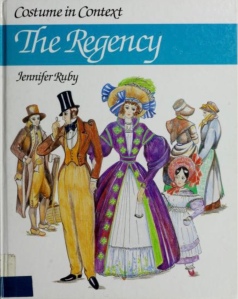
This book…

…Traces the major fashion developments of the period, comparing the clothing of the well-to-do with that of less fortunate classes…

Each book in this series is built round a fictitious family. By following the various members, sometimes over several  generations…you will be able to see the major fashion developments of the period and compare the clothing and lifestyles of people from all walks of life…

Major social changes are mentioned in each period and you will see how clothing is adapted as people’s needs and attitudes change…

Many of the drawings in [this] book have been taken from contemporary paintings.


This is another take on fashions during the regency era on IA:

Costume Reference 5: The Regency, by Marion Sichel, 1977.

https://archive.org/details/regencycostumere00mari/mode/2up

This book has better drawings and sketches, but does not include costumes year by year that represent all the classes.
Read Full Post »

“We are to have a tiny party here tonight; I hate tiny parties–they force one into constant exertion.” — Jane Austen to Cassandra, May 21, 1801,  while visiting her Aunt Jane and Uncle James Leigh-Perrot in Bath

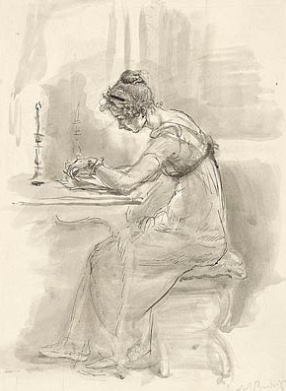
Drawing of a Regency woman writing a letter

Image by Isabelle Bishop, from the Morgan Library Exhibit of Life, Work, and Legacy of Jane Austen.

Inquiring readers, 

Tomorrow it will be December, a time for parties, celebrations, family gatherings, and Christmas activities, mostly  in Christian regions. During Austen’s time, people associated this period with the religious calendar, as well as with pagan traditions observed since ancient times. Celebrations during Austen’s life began on Dec 6th, St. Nicholas Day, and lasted until January 6th, or 12th night — the Feast of the Epiphany. 

Since 2009, this blog has posted many articles about British Christmas and New Year’s traditions, with food, dress, and customs during the Regency era and before. Austen described holiday festivities in her novels, and balls, such as the one at Netherfield Park, but none of her personal descriptions are as detailed as those mentioned in this letter to Cassandra, which tells of a large musical party that her brother Henry and sister-in-law, Eliza, held in their house in London ( 64 Sloane Street) on 25th April, 1811.

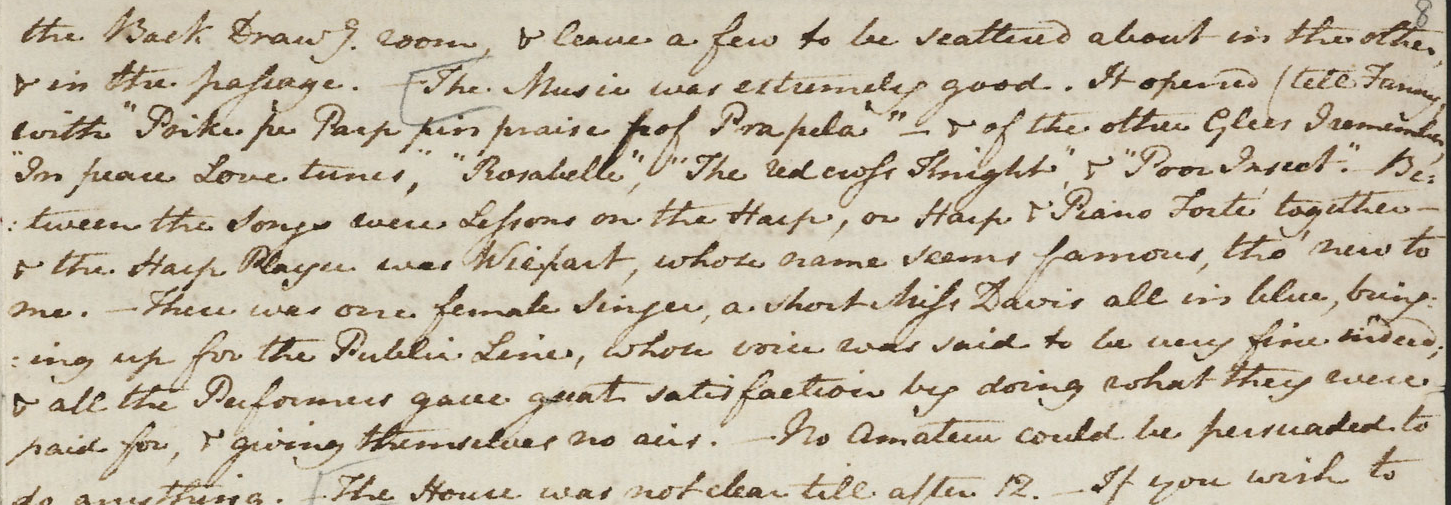
snip of the letter

Detail of Austen’s letter to Cassandra. Image: British Library Online.

The reason for Austen’s visit was to work on proofs for Sense and Sensibility, her first published novel. I chose this letter because musical parties and get-togethers were given frequently, regardless of the time of year. The songs, decorations, and fashions might have changed with the seasons, but Austen’s description of this large party, the musicians, and the guests must have seemed quite familiar to her contemporaries, despite her spare details.

NOTE: I’ve related only the details of the party in the letter. Read the full transcript at this link to The British Library.

The Letter 

  1. To Cassandra Austen (# From Deirdre Le Faye’s Fourth Edition of Jane Austen’s Letters)

Thursday, 25, April 1811

Sloane St Thursday April 25

Before the party:

My dearest Cassandra

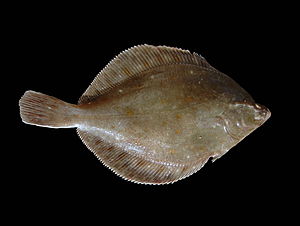
… Our party went off extremely well. There were many solicitudes, alarms, and vexations, beforehand, of course, but at last everything was quite right. The rooms were dressed up with flowers, &c., and looked very pretty. A glass for the mantlepiece was lent by the man who is making their own. Mr. Egerton and Mr. Walter came at half-past five, and the festivities began with a pair of very fine soals. 

(Soals is an obsolete spelling for sole, a flat fish. Hannah Glasse described a recipe for Fricasee of Soles made with lemon soles or a larger, thicker plaice fish, which fed more people.)

In this passage, Jane described the usual hustle and bustle before a grand party that we all have felt in our own lives. In this letter, she provided more details for her sister than in her novels for her readers.)

Mr Egerton is the publisher who brought out Jane’s first novel, “Sense and Sensibility”.)

Events leading up to the party:

Yes, Mr. Walter — for he postponed his leaving London on purpose — which did not give much pleasure at the time, any more than the circumstance from which it rose — his calling on Sunday and being asked by Henry to take the family dinner on that day, which he did; but it is all smoothed over now, and she likes him very well.”

(This sentence is somewhat enigmatic. Why would his postponement not give him much pleasure? How was the situation smoothed over? Mollands.net says this about Mr. Walter: [He] must have been related to Jane through her grandmother (Rebecca Hampson), who married first, Dr. Walter; secondly, William Austen. Mr. Ronald Dunning wrote a post about  Rebecca Hampson for this blog just a week ago. 

As the festivities began:

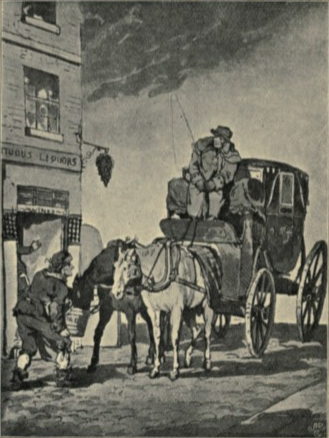
At half-past seven arrived the musicians in two hackney coaches, and by eight the lordly company began to appear. Among the earliest were George and Mary Cooke*, and I spent the greater part of the evening very pleasantly with them. The drawing-room being soon hotter than we liked, we placed ourselves in the connecting passage, which was comparatively cool, and gave us all the advantage of the music at a pleasant distance, as well as that of the first view of every new comer.”

Black and white drawing of a Hackney Coach drawn by two horses

Hackney Coach, ca 1800

(Two hackney coaches carried 6 people per coach, so we may surmise that at least 12 musicians arrived with their  instruments. 

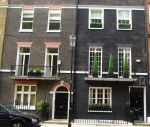
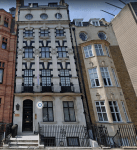
Houses in town were listed as 1st, 2nd, 3rd & 4th rate, fourth being the largest and first being the smallest. Henry’s house, located on 64 Sloane Street, is today unrecognizable from its Georgian size and façade. At the time he and Eliza rented the house, it was a 3rd rate house (3 windows wide), worth between £ 350 and £ 850 with from 500 – 900 square feet of floor space.) Because Henry was a successful banker during this time and Eliza had considerable means of her own, we can surmise that the house they rented was most likely on the larger side of 500 – 900 square feet of floor space.

Austen comments on a few acquaintances:

I was quite surrounded by acquaintances, especially gentlemen; and what with Mr. Hampson, Mr.Seymour, Mr. W. Knatchbull, Mr. Guillemarde, Mr. Cure, a Captain Simpson, brother to the Captain Simpson, besides Mr. Walter and Mr. Egerton, in addition to the Cookes, and Miss Beckford, and Miss Middleton, I had quite as much upon my hands as I could do. Poor Miss B. has been suffering again from her old complaint, and looks thinner than ever. She certainly goes to Cheltenham the beginning of June. We were all delight and cordiality of course. Miss M. seems very happy, but has not beauty enough to figure in London.”

This slideshow requires JavaScript.

(Fashion: While Austen did not describe the clothes worn by guests, Cassandra would have easily envisioned what people wore. Jane had a limited yearly budget for personal items. At a party held on Christmas, 1811, she would have refurbished a previously worn evening gown, from 1810 or before. The 1811 evening dresses had narrower skirts, mostly without trains, and hems cut at or above ankle length. Eliza de Fuillide, a woman of rank and fortune, would have worn the latest fashion. Henry Austen was quite prosperous when he rented the house at 64 Sloane Street and therefore was able to spare no expense in hosting this party.

Although Jane hated tiny parties because they required constant exertion, this musical party seemed to require as much of her attention as the former. Her wit was on full display in this letter.  Miss M., sadly, has not sufficient funds nor the looks to attract a possible husband, unlike Jane Bennet in “Pride and Prejudice” or Cassandra Austen, as described by Lucy Worsley in “Jane Austen at Home.”

Many of the people mentioned by Jane are identified by Deidre Le Faye. Find their descriptions at the end of this article.**

Cheltenham, whose famous mineral waters were founded in 1716,  was prominent during the Georgian era. (Christy Somers noted a short article by Carolyn S. Greet, in Jane Austen Reports for 2003, “Jane and Cassandra in Cheltenham. Diana Birchall wrote: 

“In the spring of 1816 Jane and Cassandra paid a visit to Cheltenham, primarily for the sake of Jane’s health. Other members of the family had previously visited the little town, including James and his wife Mary, as Jane had mentioned in a letter of 1813. Cheltenham was then in its fashionable heyday, with its attractions being both therapeutic and social. It was still small and rustic compared with Bath, and all the buildings were still grouped along the single mile-long High Street. It was not lit with gas until 1818, and had a single set of Assembly Rooms, theatre, libraries, shops, and lodging houses. There is a description of the saline wells, which people drank from in the morning, for a laxative effect.- Reveries Under the sign of Austen

Numbers Attending the Party:

Including everybody we were sixty-six — which was considerably more than Eliza had expected, and quite enough to fill the back drawing-room and leave a few to be scattered about in the other and in the passage.”

Jane had mentioned standing in the connecting passage, which was cooler than the two drawing rooms. The image below might be a facsimile of Henry’s and Eliza’s first floor, which typically consisted of two rooms for entertaining guests. One was larger than the other. A passageway connected the stairs to the two rooms. 

The first floor:

“It was held on the first floor in the octagonal rear salon and the front drawing room. Jane told Cassandra that she spent most of the time talking to friends in ‘…the connecting Passage, which was comparatively cool, & gave us all the advantage of the Music at a pleasant distance, as well as that of the first view of every new comer.’ There were glee singers, a harpist and floral decorations” – Walking Jane Austen’s London. Louise Allen, Bloomsbury Publishing10 Jul 2013 .

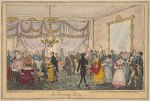
None of the above images showed fashions even close to those worn in 1811. Formal menswear had not changed much, however, and the illustrations do give us an idea of how these parties were held.

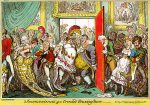
Sixty-six people in a Regency London townhouse would have presented quite a squeeze. Even on a cold day in December, the rooms, with candles burning in chandeliers and candelabras, and heat rising from the kitchen in the basement, would have already been hot. In April, when this letter was written, the heat would have been substantial. The large group of guests would have intensified the heat even more. We do not know if the 66 guests included the musicians and singer. As Cruikshank’s images showed, card tables were set up, a common practice that Jane does not mention. One wonders if they were set up on the ground floor, near the dining room, and the floor just above the kitchen. This level would also have been easier for older people to reach. One can only conjecture about these arrangements.

Deirdre Le Faye mentions Winnifred Watson’s description of the interior of 64 Sloane Street, but the few remaining copies of her small out of print booklet, “Jane Austen in London,” are above my budget (one was listed at over $260) and so I could not read it. London townhouses built after the great London fire followed strict guidelines in both design and materials. Henry and Eliza at this juncture in their lives could probably afford a 3rd rate house with a larger square footage of floor space, perhaps even 900 sq. feet. 

Using Jane’s description, and Deirdre Le Faye’s mention of this house, I found this image and quickly drew the other one very badly.

The Music:

The music was extremely good. It opened (tell Fanny) with “Poike de Parp pirs praise pof Prapela”; and of the other glees I remember, “In peace love tunes,” “Rosabelle,” “The Red Cross Knight,” and “Poor Insect.” Between the songs were lessons on the harp, or harp and pianoforte together; and the harp-player was Wiepart, whose name seems famous, though new to me. There was one female singer, a short Miss Davis, all in blue, bringing up for the public line, whose voice was said to be very fine indeed; and all the performers gave great satisfaction by doing what they were paid for, and giving themselves no airs. No amateur could be persuaded to do anything. “

This image of Regency guests listening to musicians sits on the Alamy website. Since I have not purchased it, please click on the  link to view it: https://www.alamy.com/thomas-rowlandson-a-little-evening-music-georgian-cartoon-of-a-fashionable-image9616736.html 

(Interestingly, the phrase “Poike de Parp pirs praise pof Prapela” was a special language that Jane used with her niece Fanny by placing a ‘p’ in front of every word. The only one I could decipher was Harp for Parp. https://bit.ly/3o8Nb97, Jane Austen, Her Contemporaries and Herself: An Essay in Criticism, By Walter Herries Pollock, 1899, Google Books.

Mollands.net adds:  Jane and her niece Fanny seem to have invented a language of their own–the chief point of which was to use a ‘p’ wherever possible. Thus the piece of music alluded to was ‘Strike the harp in praise of Bragela.’)

Miss Davis was a professional singer in London. Jane mentions that no amateur stepped up to play after listening to these fine players and singer.

About musicians during this time: 

“Amateur orchestras in city taverns or in gentlemen’s clubs competed with the professional concerts that began to sprout up in public places. (- The Rage for Music, Simon McVeigh) Local musicians would be hired for assembly balls in small towns. Musicians with a more professional background would be enlisted to play at more stylish events, like the Netherfield Ball. The lady asked to lead a set would choose the music and the steps, and relay her request to the Master of Ceremonies. “  https://janeaustensworld.com/2010/07/12/jane-austen-and-music/

Cities like London or Bath provided steady incomes for musicians. In order to make ends meet, those living in rural areas traveled from town to town to the different public assemblies or parties.

Glees

Glees were quite popular at this time. Jane mentioned glee songs in Mansfield Park. “Fanny Price was the only one of Austen’s heroines who never receives any musical training at all.” Fanny was unsuccessful in enticing Edmund to go outside to look at the stars. As soon as he hears singing, he says to her, “We will stay till this is finished, Fanny.” She was mortified.

Austen also mentioned glees in this letter to Cassandra, which during her time were songs for men’s voices in three or more parts, usually unaccompanied, popular especially c. 1750–1830. These songs, by the way, were nothing like the productions created for the TV series, Glee, which ran from 2009-2015. I found one glee recording on YouTube: Reginald Spofforth- 18th Century Glee Club: L’ape E La Serpe, from Vanguard Classics. 

In Peace Love Tunes the Shepherds Reed, the glee was meant for three voices, with words supplied by Walter Scott. Instrumentals were accompaniments for Piano Forte & Harp, or two performers on one Piano Forte. This glee was written by J. Atwood

This Rosabella score by John Wall Calcotte (1766-1821) in this link is for a cappella (originally). Piano accompaniment was added later by William Horsley. The lyrics were by Walter Scott.

The Red Cross Knight was written by Callcott, 1797. Also written by Callcott is the Poor Insect, a refrain from “The May Fly.”

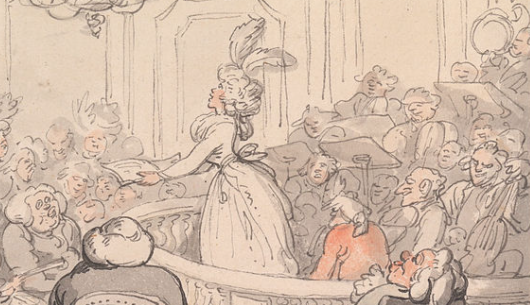
Comforts of Bath-The Concert-Rowlandson-Google Art Project-Wikimedia Commons

Detail: The Concert, The Comforts of Bath, Thomas Rowlandson, 1798. Wikimedia Commons

At Party’s End:

The house was not clear till after twelve.” 

This party lasted a little over four hours. London had street lights that guided guests back to their lodgings and houses. In country houses, parties, which were scheduled under the light of the full moon, often lasted until the wee early hours. After a party at a country house, Jane would often spend the night as a guest at a friend’s house, at times with her dear friend Martha Lloyd if she could manage it. 

The following day:

Her party is mentioned in this morning’s paper.”  

“…in the Morning Post of 25 April, which must have been very gratifying, even if the newspaper spelled her name wrong: ‘Mrs H Austin had a musical party at her house in Sloane-street.” – http://what-when-how.com/Tutorial/topic-673689/London-A-Tour-Guide-for-Modern-Traveller-10.html  “Travel Reference In-Depth Information, Walk 1: Sloane Street to Kensington, A Tour Guide for the Modern Traveler.”

The guests:

* Cooke family of Great Bookham. Rev. George Cooke and his unmarried sister Mary. Their father, Rev. Samuel Cooke was Jane’s godfather. 

**

  • Mr. George Hampson was a baronet who chose not to use his title. He is one of Jane’s cousins through her relationship to her grandmother, Rebecca Hampson, whose second husband was William Austen.
  • Mr. William Seymour, Henry Austen’s friend and a lawyer, who, it was speculated, might have considered proposing to Jane, but he didn’t.
  • M. Wyndham Knatchbull, merchant in London, or Reverend Doctor Wyndham Knatchbull, the eldest son of Sir Edward Knatchbull, 8th Baronet. 
  • Mr. Guillemarde is probably John Lewis Guillemarde, who lived in London
  • Mr. Capel Cure, who lived in London. His father, George, had first married Elizabeth Hampson, daughter of Sir George Hampson, but she died childless. Capel is the son of George Cure’s second wife.
  • Captain John Simpson, brother of Captain Robert Simpson. 
  • Mr. Thomas Egerton, Austen’s first publisher. He brought out S&S, P&P, and the first edition of Mansfield Park. His presence at the party, and Jane’s purpose for visiting Henry and Eliza to complete work on Sense & Sensibility connects his attendance at the party in a marvelous way.
  • Miss Maria Beckford, unmarried, lived with the Middleton family as hostess for her brother-in-law, John Middleton. When in London for the season Miss Beckford lived at 17 Welbeck Street. (Le Faye, p 495)
  • Miss Middleford. No explanation by Ms. Le Faye.)

Additional sources:

Characteristics of the Georgian Townhouse , June 3, 2009 , Jane Austen’s World, Vic

Jane Austen’s Letters, 4th Edition, Deirdre Le Faye, 2011, Oxford University Press. 

Jane Austen’s visit to Sloane Street , Kleurijk Jane Austen, 9-2014

Jane Austen, Her Contemporaries and Herself: Walter Herries Pollock · 1899 – Explanation of “Poike de Parp pirs praise pof Prapela”

Georgian Terrace Houses, April 27, 2021, Random Bits of Fascination.com, Georgian Townhomes

Thank you, Tony Grant, for contributing the 3 current photographs of Hans Place (2) and of 64 Sloane Street (1).

Read Full Post »

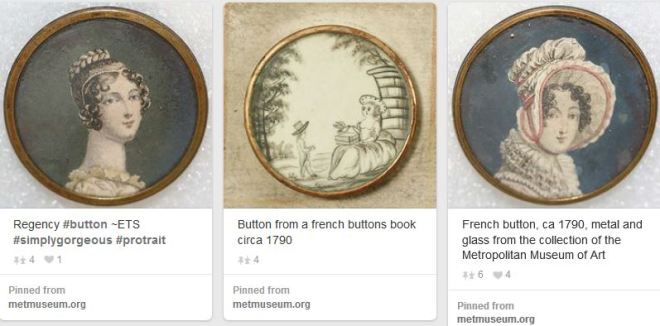
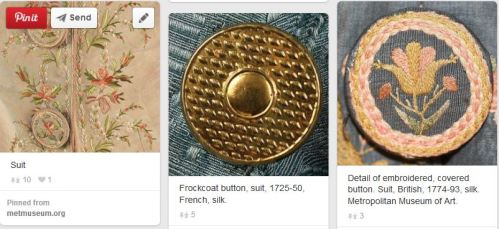
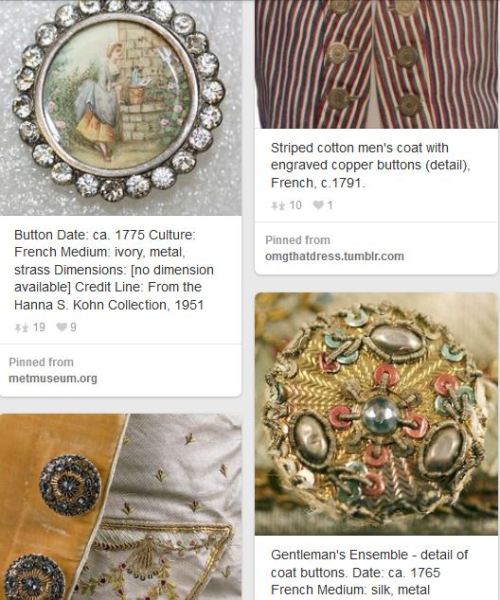
For a few years I have been collecting images of beautiful hand-crafted 18th century buttons on my Pinterest board: Buttons, Georgian Style. The buttons, as you can see from the collection, are tiny works of art. Some feature scenes or portraits, others are embroidered or worked metal.

Buttons from the collection at the Metropolitan Museum of Art.

Buttons from the collection at the Metropolitan Museum of Art.

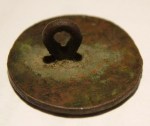
Button with shank

Button with shank

The history of buttons is fascinating. The earliest discovered button was made 5,000 years ago from a curved shell. It served a decorative function and fit into a loop, such as for a heavy robe or flowing garments. By the middle ages, the wealthy began to wear buttons that helped to fit their clothes more tightly around the body. Unlike today’s buttons, many of which are punctured with holes, most buttons back then were made with shanks, which gave button-makers leeway to decorate button faces with artistry and imagination.

Buttons for men's coats

Buttons for men’s coats

The first button-makers guild was formed in France in 1250. Only the very wealthy – kings and nobility – could wear buttons then. They were such a valuable commodity that one could pay off a debt with a single button. Ladies could detach their sleeves with laces or bows or buttons. These sleeves could be washed separately from their garments, exchanged with other outfits, or even given to a lover as a token. During the Renaissance, luxurious buttons indicated social status. King Francis I ordered buttons from his jeweler; Henry VII met his future wife, Anne of Cleves, wearing bejeweled buttons.

more buttons

As an aside, ladies wore their buttons on the left to make it easier for their maids to dress them. Men usually dressed themselves and thus their buttons were placed on the right. Button decoration, of course, changed with the taste of the time, from the renaissance to the baroque, to rococo, and neoclassic. By the mid-18th century, the more prosperous middle class merchants advertised their new status wearing elaborate and expensive buttons.

Steel Buttons

In a period when ladies were piling towers of greased and powdered hair on their heads, men were adorning themselves with immense cut steel buttons and shoe buckles. One exquisite thus decorated gives a lady a Coup de Bouton which has the same effect as a mild sunstroke Plate XXVI, Social Caricature in the Eighteenth Century, George Paston, 1902, Google eBook

The variety of buttons made in the 18th century was staggering. They were crafted with ceramics, enamel, fabric, metal, repoussé or hammered metal, horn, bone, tortoise, gemstone, glass, ivory, papier mache, wood, iridescent white oyster, conch,  and materials under glass, such as fabric paint, feathers, paper collage or decoupage, etc. Dandies in the Georgian era resembled colorful peacocks, dazzling onlookers, as the caricature above points out. Beau Brummel’s influence on male fashion subdued such bright fripperies.

buttons met museum2

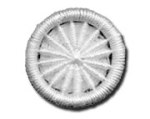
Buttons also took on many forms, like those that were hollowed-out for smugglers to carry contraband for transporting jewels .The poor fashioned their own buttons from bone, horns, shell, or wood. Dorset buttons, which resembled tiny wheels, were made by binding linen yarn or cheap woolen yarn over a disc.

dorset_button

Dorset button image from the Dorset Guide. Dorset Guide.

There was quite a cottage industry for Dorset buttons at this time. Work was scarce in that region in the mid-18th century, but there were some women who made buttons from home. This was a primary industry in Dorset for over a century. Women workers, often the sole breadwinners of the family, averaged 2 shillings a day for making 6 or 7 dozen buttons, which provided more preferable conditions for making money than laboring on a farm. Tracey Chevalier wrote a novel, Burning Bright, which was about Philip Astley and his amphitheatre. In it she featured a girl from Dorset who made buttons for a living – fascinating.

Interestingly, these beautiful buttons on my Pinterest page were worn by males. It wasn’t until the mid-19th century that women’s clothes began to feature buttons again. During the Georgian and Regency periods women’s clothes were pulled together and kept in place by laces, pins, sashes, and bows.

Links:

Read Full Post »

Detachable, or false sleeves were common during the Regency era. They were basted to the armholes of a gown for easy removal.  Before 1810, both the permanent and detachable sleeves were often made of similar fabrics. After 1810, however, they could be made from different materials. Two different kinds of removable sleeves were made: undersleeves and oversleeves.

1810 portrait of a lady

Portrait of a lady by Henri François Mulard, ca. 1810 white dress, undersleeves, lace, blue and white sash and fichu, shawl, fawn gloves, coral beads, and hair comb.

This sumptuous painting of a lady wearing the most fashionable dress and accessories shows how the undersleeves add warmth to a gown that could best be described as thin and ethereal. The undersleeves are made of the same soft cotton as the overdress with its short, puffy sleeves.

undersleeve 1810 national trust

Undersleeve, net, lace and mother-of-pearl, English, ca. 1810. Killerton House, National Trust Inventory nr. 1363159.2

These lacy undersleeves did not provide much warmth, but certainly added drama to a dress. I imagine they could be worn under a number of short sleeve garments.

detachable sleeve early 19th c mfa

Early 19th c. American detachable sleeves. MFA Boston.

This dress, made of red violet silk figured weave, had silk and cotton linings, silk piping, and was closed with a metal hook and eye. Museum of Fine Arts Boston.

dress with detachable sleeves

Detachable sleeves made this dress quite suitable for spring, summer, and early fall.

Opnamedatum: 2013-04-16

This dress, ca. 1810 – ca. 1815, look like it has detachable sleeves made from the same fabric. Rijksmuseum.

The English ivory silk evening dress below has sheer, detachable oversleeves. Circa 1820. Kent State University Museum. While the undersleeves look more practical and serviceable, these oversleeves are breathtakingly gorgeous.

bodice detail Kent State u

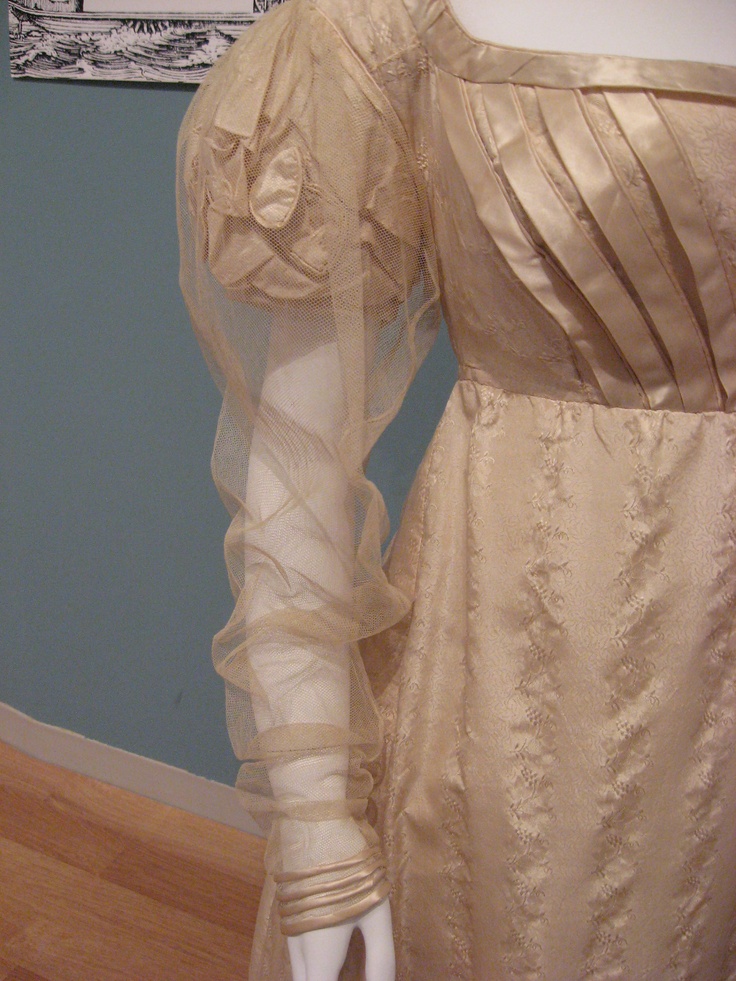
Regency ball gowns with net overlays became quite popular after 1810. The bodice detail of the 1820s evening gown below shows the exquisite sheer detachable oversleeve, which reveals the detailed puffed sleeve below.

closeup gauze sleeve

closeup 1gauze oversleeve

Detail of the net oversleeve. It is a miracle that such good examples of these delicate gowns have survived. (Kent State Museum)

Also on this site:


Read Full Post »

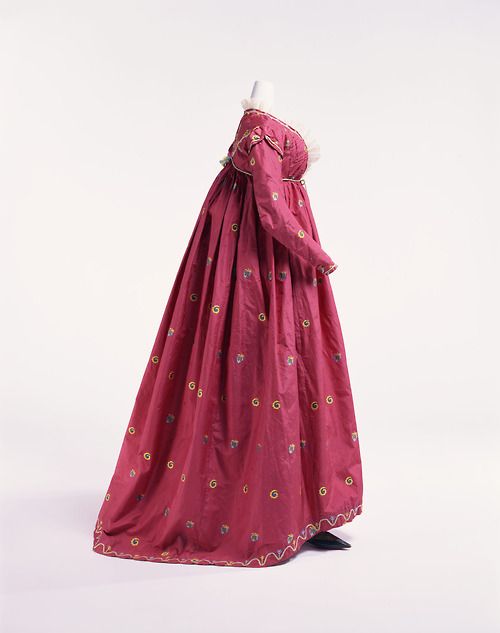
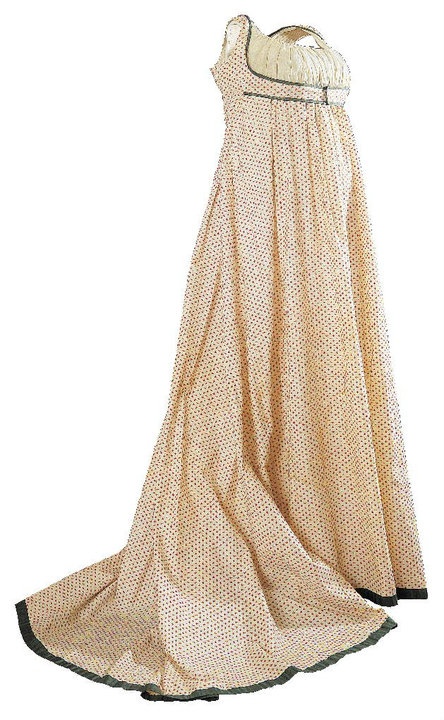
During the late 18th century, early 19th century, trains on gowns were de rigueur. I chose to show the two gowns below, since the styles were popular when Jane Austen was a teenager (first image) and wrote the first editions of Northanger Abbey, Sense and Sensibility, and Pride and Prejudice (second and third images).

1785-90 Sheer embroidered cotton muslin lined with pink silk taffeta - Galliera

Sheer embroidered cotton muslin, lined with pink silk taffeta, 1785-1790. Galliera

Silk Dress 1795 The Kyoto Costume Institute

Silk Dress, Kyoto Costume Institute, 1795

Robe ayant appartenu, 1797

Robe ayant appartenu, 1797

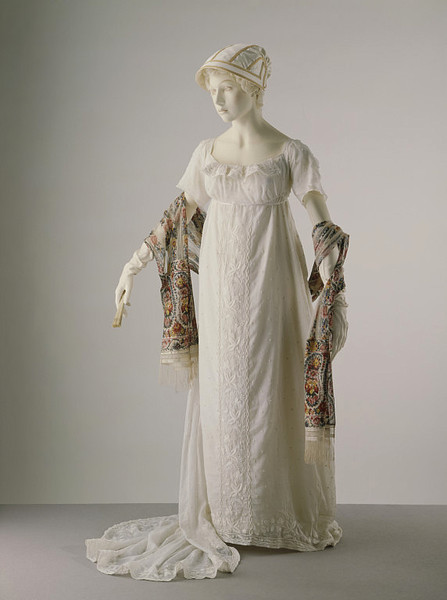
As Regency styles evolved and the 19th century  progressed, trains were worn largely on evening dresses.


1805-1810 French evening dress, V&A museum

1805-1810 French evening dress, V&A museum

I have often wondered how delicate muslin gowns survived the harsh laundering that was required to remove stains made from dusty floors and muddy pathways. Even the grandest ladies wearing the most expensive dresses promenaded on gravel walkways or shopped along city or village streets. How did they manage to keep their hems clean in an era when paved roads and sidewalks were almost impossible to find?

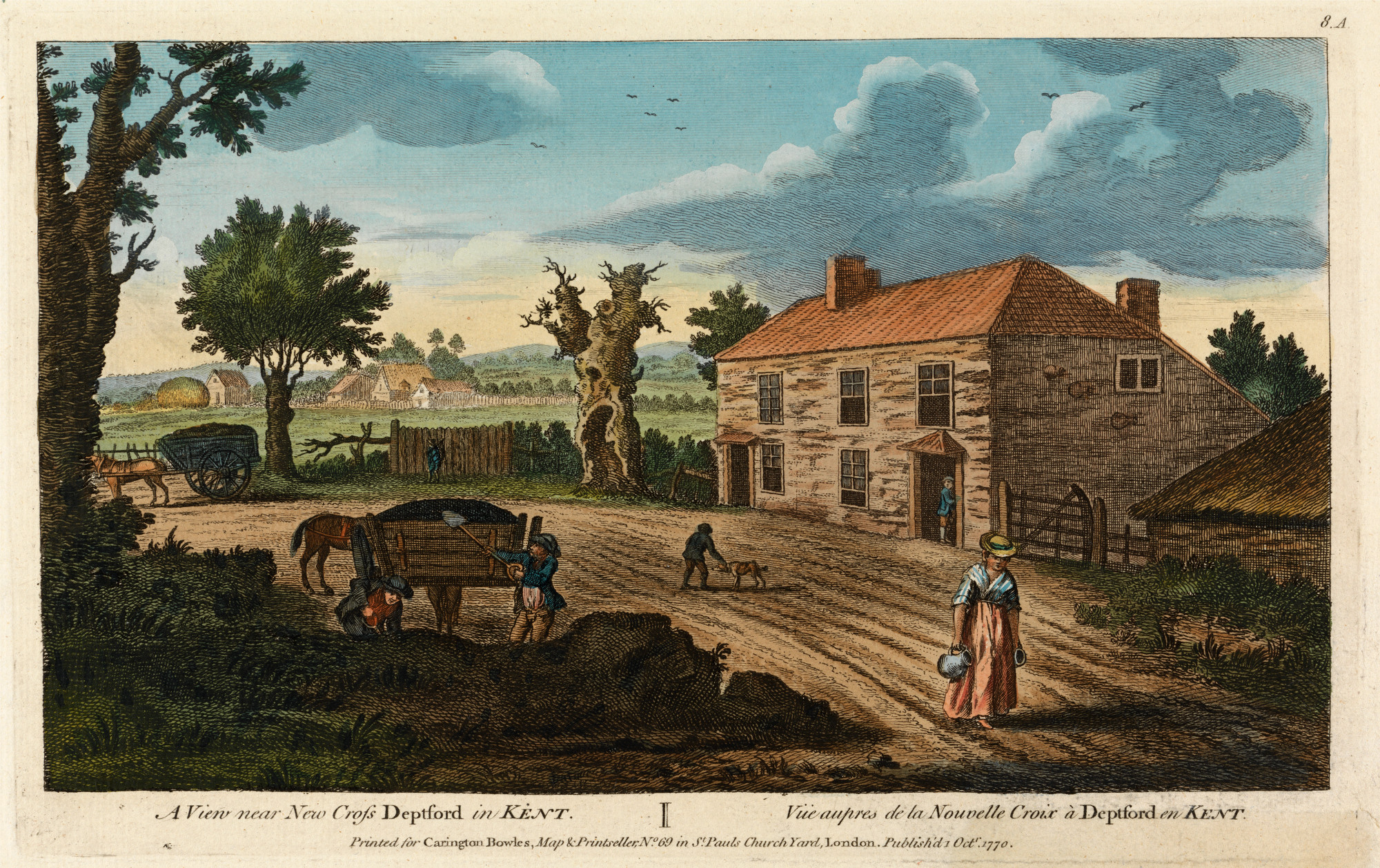
Dirt road, a view near New Cross Deptford in Kent, 1770. artist unknown Yale University, Mellon Collection.

Dirt road, a view near New Cross Deptford in Kent, 1770. artist unknown Yale University, Mellon Collection.

Until macadam roads became widespread, roads across most of Great Britain remained unpaved. Village roads were especially notorious for becoming muddy quagmires during rainy days. The deep ruts in this village scene, illustrated just five years before Jane Austen’s birth, say it all.

Detail

Detail of  the road in New Cross Deptford

Dresses worn by working class women stopped at or above the ankles, and for good reason! These women wore sturdy leather shoes that could withstand the dirt.

recto

Paul Sandby drawing of two vendors, 18th c.

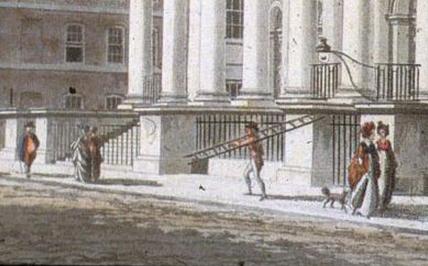
City streets were barely better than country roads. While sidewalks protected dress hems, roads were still made of dirt. People tossed out garbage from their windows, and horse droppings made crossings all but impassible for pedestrians.

Dirt road_St. George, Bloomsbury

Dirt road, detail of St. George, Bloomsbury

Crossing sweepers were stationed along major intersections, sweeping a clearing for anyone willing to give a tip. Not only did horses pull carriages and wagons, but drovers led animals to market through village and city streets. The stench from their droppings must have been unbelievable.

street sweeper and wheeled plank Vernet_street_print

This enterprising street sweeper places a wheeled plank at strategic points to help pedestrians cross dirty roads. Print by Carle Vernet.


With time, machines began to replace manual labor, as this unhappy street sweeper notes.

By 1829, machines began to replace manual labor, as this unhappy street sweeper notes in “The Scavenger’s Lamentation.” Observe the piles of horse and animal dung left behind.

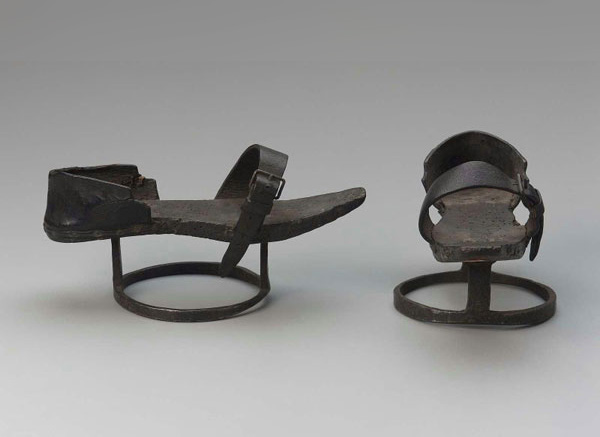
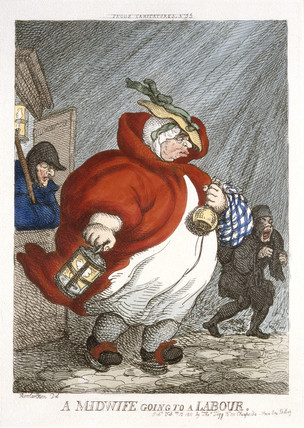
Jane Austen mentioned wearing pattens when she lived in Steventon. These devices elevated shoes above the dirt, but by the turn of the 19th century, pattens were no longer considered fashionable and were largely worn by the working classes, such as the midwife below.

Rowlandson, Midwife going to a labour.

Rowlandson. AMidwife Going to a Labour.


early 19th century pattens. Museum of Fine Art, Boston

early 19th century pattens. Museum of Fine Art, Boston
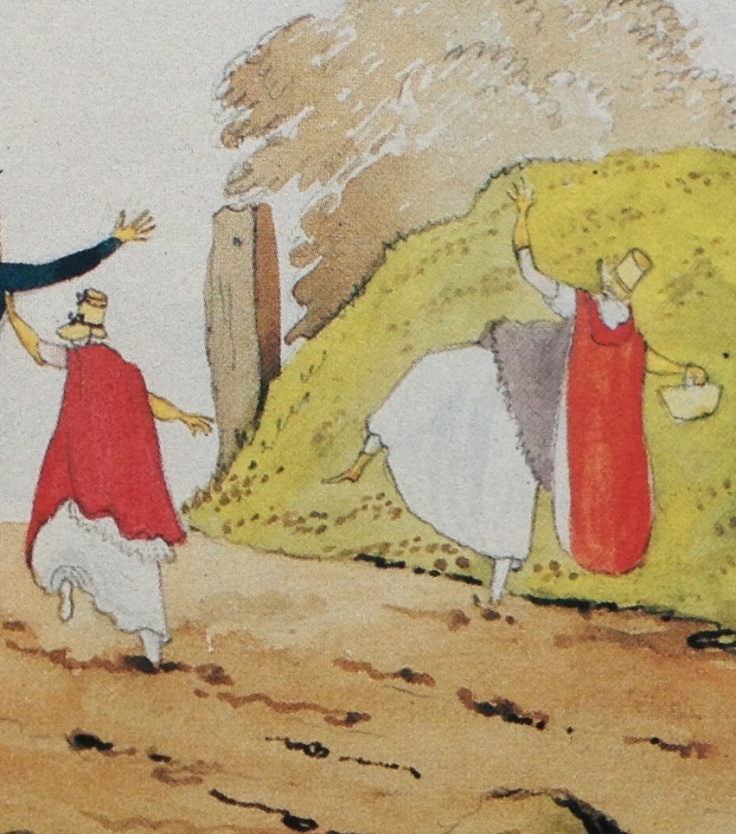
I always view contemporary images for clues. Diana Sperling created some wonderful watercolours around the topic. In this painting, you can see how the trains of the dresses have somehow been hitched up in the back, especially with the first and third women.

dirt road_hazards of walking sperling

Hazards of walking, by Diana Sperling

After Elizabeth Bennet walks to Netherfield to visit her sick sister, Jane, Mrs. Hurst and Mrs. Bingley speak disparagingly about the state of her dress:

“She has nothing, in short, to recommend her, but being an excellent walker. I shall never forget her appearance this morning. She really looked almost wild.”

“She did indeed, Louisa. I could hardly keep my countenance. Very nonsensical to come at all! Why must she be scampering about the country, because her sister had a cold? Her hair, so untidy, so blowsy!”

“Yes, and her petticoat; I hope you saw her petticoat, six inches deep in mud, I am absolutely certain; and the gown which had been let down to hide it, not doing its office.” – Pride and Prejudice, Chapter 8

Bingley’s citified and nouveau riche sisters were horrified at Elizabeth’s lack of decorum. To them, appearances are more important than sisterly devotion. One imagines that they would not have ventured out until the sun had dried the mud and they could be assured of a carriage. From the image below, one can readily see why Elizabeth’s hems were in such sad shape after her long walk in fields made wet by heavy rain.

Dirt roads

One wonders how helpful pattens were when dirt roads became quagmires. Although she was young when she painted these watercolours, Diana Sperling demonstrates a decided sense of humor in her paintings.

In Northanger Abbey, Isabella and Catherine became quickly inseparable, even calling each other by their first names in an age when only intimate friends and family could be on such terms.

They called each other by their Christian name, were always arm in arm when they walked, pinned up each other’s train for the dance, and were not to be divided in the set; and if a rainy morning deprived them of other enjoyments, they were still resolute in meeting in defiance of wet and dirt, and shut themselves up, to read novels together. 

They pinned up the trains of each others’ evening gowns to prevent tripping, but also staining, I suspect.  (It must be noted that guests changed from their street shoes to dancing slippers before entering a ballroom, which probably reduced the amount of dirt trailed inside.) Nothing could stop the girls from seeing each other, not even “dirt” or muddy streets.

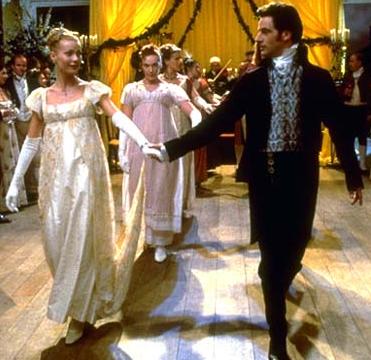
There were many ways to protect trains. In this film still, Gwynneth Paltrow’s Emma hitches her train on a loop over her wrist.

Note the train in this image of the 1996 version of Emma

Note the train in this image of the 1996 version of Emma

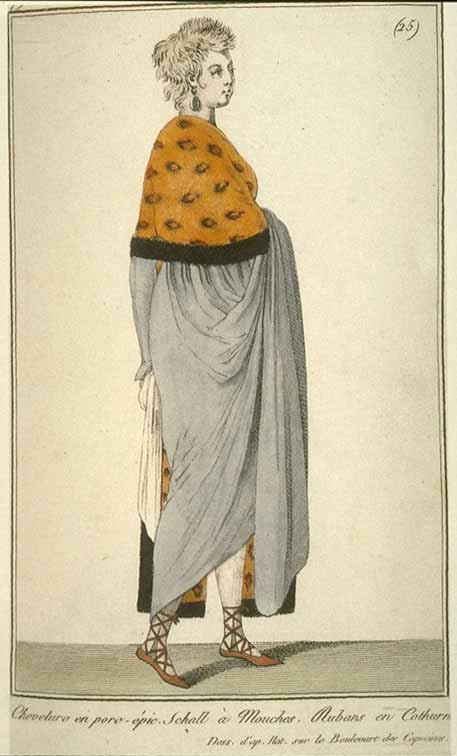
These French images from the late 18th century provide the best evidence in how ladies would protect their delicate dresses out of doors. While we assume that ladies did not expose their ankles to the public (they certainly did not in the Victorian era, but the Regency was a different time), the illustrations point out the practical habit of hitching a train over one’s arm.

corte de pelo a la victima

This French fashionista with her short, pert hair cut, reveals her roman style slippers as she promenades with her train carried over her arm.

Les Merveilleuses, by carle vernet

While this 1797 satiric image by Carle Vernet is making fun of fashionistas, one can surmise that the habit of carrying long skirts over the fore arm was widespread.

Wind and open windows swept dirt and dust continually into houses and visitors trod in dirt. No wonder maids needed to sweep floors daily!

Regardless of the efforts to keep streets, sidewalks, and floors clean, one wonders about the condition of the hems on women’s garments. Clothes were expensive before the advent of mass-produced cloth and were carefully recycled, even by the well-off.

Laundresses took an enormous amount of effort to keep clothes clean. One can only assume that the majority of women wore clothes with stained hems, and that only the rich could afford the expense of keeping their clothes looking spotless. Eleanor Tilney wore only white gowns, which told contemporary readers more about her economic status than pages of explanations ever could. In Mansfield Park, Mrs. Norris frowned on maidservants wearing white gowns. These white clothes were not only above their stations, but they would require an enormous amount of time spent on maintenance.

Also on this blog: Trains on Dresses


Read Full Post »

Older Posts »