Feeds:
Posts
Comments

Posts Tagged ‘Regency Fashion’

Dressing in a 1790s round gown is a short 23 second clip.

This video of getting into an 1805 gown has been around longer, but is worth revisiting. Koshkacat has a fabulous site. In this video one can see why a maid’s (or a relative’s) help is required.

At the bottom of this web page by Wm Booth Draper, you will see the sort of straight pins that were used to close gowns.

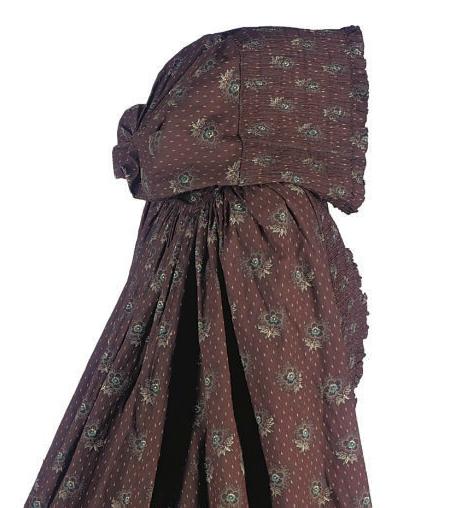
This chocolate brown chintz cloak from 1790 has a cream and turquoise floral print. The hood and edges are deeply pleated, and the entire garment is lined in cream flannel with a scarlet floral print and a tan print cotton. Images@Christie’s.

Read Full Post »

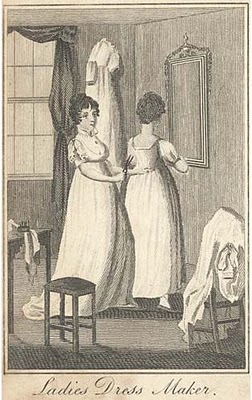
Gentle readers: Today I present to you this chapter about The Dress Maker in its entirety from a book in the public domain, Book of English Trades, and library of the useful arts, published in 1818.

THE LADIES’ DRESS-MAKER.

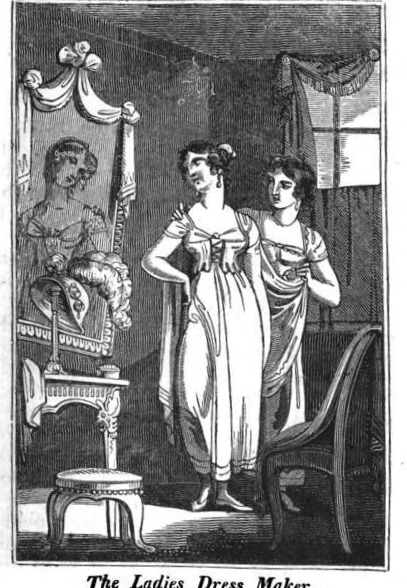
Image from the book: "The plate represents the Dress-Maker taking the pattern off from* a lady, by means of a piece of paper or cloth: the pattern, if taken in cloth, becomes afterwards the lining of the dress."

Under this head we shall include not only the business of a Mantua Maker, but also of a Milliner: for, although in London these two parts of in fact the same trade, are frequently separate, they are not always so, and in the country they are very commonly united.

The history of dress would be as voluminous as the history of mankind: dress is a thing subject to almost daily fluctuation, so that a history of the ladies’ dresses in England, for merely half a dozen years, would furnish matter for a bulky volume; we shall therefore not attempt it, but merely observe that the best, and, perhaps, the only excuse for such continual change in the empire of dress, is the opportunity which that change offers of employment to those persons who would otherwise have no immediate claim upon the rich and opulent; and thus, what would be retained in their coffers, is now scattered in a variety of ways amongst the community in the purchase of luxurious dress, and in the alterations which fashion is continually introducing.

In the Milliner, taste and fancy are required; with a quickness in discerning, imitating, and improving upon various fashions,which are perpetually changing among the higher circles.

  • Silks and Satins, of various sorts, are much used in this business; which were formerly imported into this country, but now are manufactured ia great perfection in Spitalfields and its neighbourhood.
  • Gauze is a very thin, slight, transparent kind of stuff, woven sometimes of silk, and sometimes only of thread.
  • Crape is a very light, transparent stuff; in some respects like gauze: but it is made of raw silk, gummed and twisted on the mill, and woven without crossing. It is used for mourning, and is now a very fashionable article in court-dresses.
  • Spangles are small, thin, round leaves of metal, pierced in the middle, which are sewed on as ornaments to dress.
  • Artificial Flowers are made, sometimes, of very fine coloured paper, sometimes of the inside linings upon which the silk worm spins its silk, but principally of cambric, which is a kind of linen made of flax, and was first manufactured at Cambray in France, whence its name.
  • Ribbands used by the Milliners are woven: of these there are different sorts, distinguished by different names; as, the China, the sarcenet, and the satin.
  • Muffs and fur tippets are sold by the Milliner; but the manufacture of them from the skin, is a distinct business.
  • Velvet is also used by Milliners, and is now much in fashion: it is a sort of stuff, or silk; the nap of which is formed of part of the threads of the warp, which the workman puts on a channeled ruler, and then cuts, by drawing a sharp steel tool along the channel of the ruler, to the end of the warp.
  • Muslin is a fine sort of cloth, wholly made of cotton, so named from the circumstance of having a downy nap on its surface, resembling moss, which in French is called mousse.

Dress Maker

The Ladies’ Dress-Maker’s customers are not always easily pleased; they frequently expect more from their dress than it is capable of giving. “Dress,” says Mr. Addison, ” is grown of universal use in the conduct of life. Civilities and respect are only paid to appearance. It is a varnish that gives a lustre to every action, that introduces us into all polite assemblies, and the only certain method of making most of the youth of our nation conspicuous: hence, Milton asserts of the fair sex,

-Of outward form
Elaborate, of in ward, less exact.’

“A lady of genius will give a genteel air to her whole dress, by a well fancied suit of knots, as a judicious writer gives a spirit to a whole sentence, by a single expression.”

The Dress-Maker must be an expert anatomist; and must, if judiciously chosen, have a name of French termination; she must know how to hide all defects in the proportions of the body, and must be able to mould the shape by the stays, that, while she corrects the body, she may not interfere with the pleasures of the palate.

The business of a Ladies’ Dress-Maker and Milliner, when conducted upon a large scale and in a fashionable situation, is very profitable ; but the mere work-women do not get any thing at all adequate to their labour. They are frequently obliged to sit up very late, and the recompense for extra work is, in general, a poor remuneration for the time spent.

More on the topic on this blog:

Read Full Post »

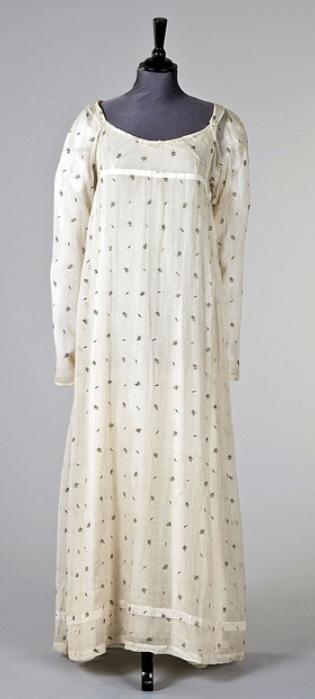
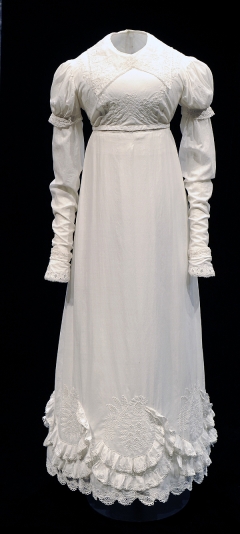
We’ve all come to associate Regency women’s fashion with delicate white muslin fabrics – sprigged muslin, spotted muslin,  checked and striped muslin, and embroidered muslin. Henry Tilney, the hero in Northanger Abbey, was well-acquainted with muslins through his sister, who wore only white.

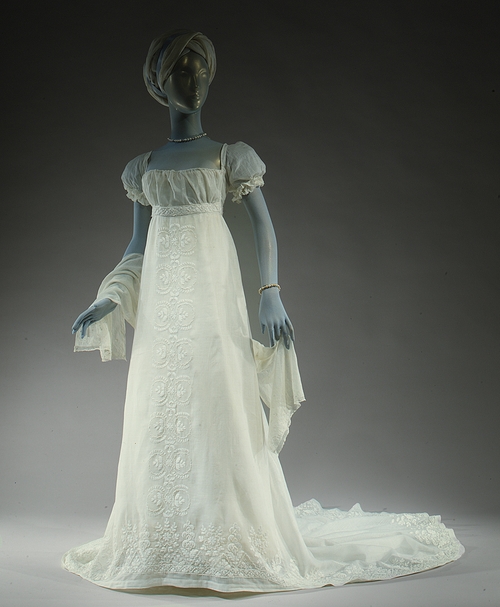
Sheer white muslin gown with whitework embroidery. Image @Vintage Textile

In the 17th century and until the late 18th century, England imported muslin, a thin cotton material, from India.  The British East India Company traded in Indian cotton, silk fabrics, and Dacca (Dhaka or modern-day Bangladesh) muslins. Muslins from Bengal, Bihar and Orissa were also imported. The delicate cloth, which first originated in the Middle East in the 9th century, was perfect for clothing and curtains in hot, arid countries. – Muslin: Encyclopedia Britannica
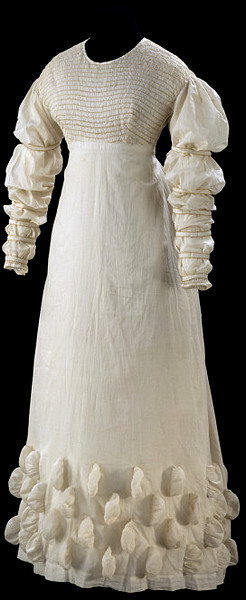
Muslin gown, 1816

Muslin was a finely woven light cotton fabric in plain weave without a pattern, and had identical warp and weft threads. The fabric selection is quite flexible, coming in a wide variety of weights and widths. It accepts dyes and paints so successfully that today it is often used for theatrical backdrops and photographic portraits. One observation must be made: muslins of the past were made of much finer, more delicate weave than today’s muslins. –  How Is Muslin Fabric Made?

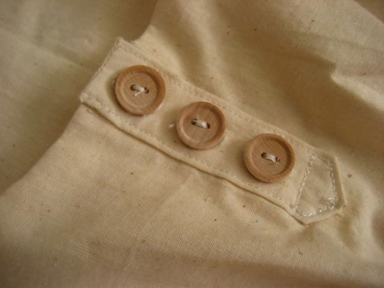
Buttons on a modern muslin fabric

Muslin gown circa 1815, Bath museum

An important feature of muslin fabrics is its ability to drape. Regency fashions were based on robes and garments from antiquity. The ability to drape and maneuver the fabric on the figure was an important feature of this cloth. Today, designers use muslin as a test garment for cutting and draping a design before creating the final dress from more expensive fabrics.

Another excellent feature of muslin is its ability to take dye, paints, and embroidery. The cloth accepted many patterns, motifs and designs that made it versatile and unique. Textile as Art

Plus the white fabric was a mark of gentility. White was difficult to keep clean or required constant cleaning. It was one thing for an aristocratic lady like Eleanor Tilney to wear white, but another for a maid to presume to wear such a high maintenance garment. Mrs Norris, that awful woman from Mansfield Park, approved of Mrs. Rushworth’s housekeeper’s action of turning away two housemaids for wearing white gowns.
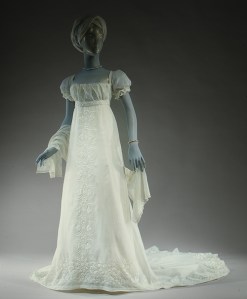
Muslin evening dress. Image @Metropolitan Museum of Art

Embroidery transformed the simple white muslin gown into works of art. Whitework embroidery was particularly striking, but colored threads could be equally beautiful. The draping quality of the cloth lent itself well to columnar-shaped empire waist gowns.

Indian sprigged muslin gown, 1800. Image@Kelly Taylor Auctions Trouvais

Muslin was imported from the Far East for centuries. Then the weavers in west Scotland, who were proficient in spinning fine cottons such as linen, cambric, and lawn, began to pay attention to weaving a finer, more delicate cloth.
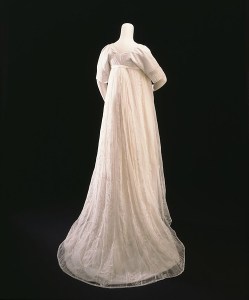
Sheer muslin gown, 1800. Image @Victoria & Albert Museum

Muslins, therefore (plain for the most part in Glasgow, and fancy ornamented in Paisley),were among the earliest and principal cotton fabrics produced on the looms of the west of Scotland. About the year 1780 James Monteith, the father of Henry Monteith, the founder of the great printworks at Barrowfield, and of the spinning and weaving mills at Blantyre, warped a muslin web, the first attempted in Scotland; and he set himself resolutely to try to imitate or excel the famous products of Dacca and other Indian muslin-producing centres. As the yarn which could then be produced was not fine enough for his purposes, he procured a quantity of “bird-nest” Indian yarn, “and employed James Dalziel to weave a 6-4th 12” book with a handshuttle, for which he paid him 2Id. per ell for weaving;. It is worthy of remark that the same kind of web is now wrought at 2|d. per ell The second web was wove with a-fly shuttle, which was the second used in Scotland. The Indian yarn was so difficult to wind that Christian Gray, wife of Robert Dougall, bellman, got 6s. 0 J. for winding each pound of it. When the web was finished Mr Monteith ordered a dress of it to be embroidered with gold, which had presented to Her Majesty Queen Charlotte.”1

1817 Muslin day dress. Image @Bowes Museum

Once fairly established, the muslin trade and various other cotton manufactures developed with extraordinary rapidity, and diverged into a great variety of products which were disposed of through equally numerous channels. Among the earliest staples, along with plain book muslins, came mulls, jacconets or nainsooks, and checked and striped muslins. Ginghams and pullicats formed an early and very important trade with the West Indian market, as well as for home consumption. These articles for a long period afforded the chief employment to the hand-loom weavers in the numerous villages around Glasgow and throughout the west of Scotland. The weaving of sprigged or spotted muslins and lappets was subsequently introduced, the latter not having been commenced till 1814. Although the weaving of ordinary grey calico for bleaching or printing purposes has always held .and still retains an important place among Glasgow cotton manufactures, it has never been a peculiar feature of the cotton industry; and the very extensive bleaching and print-works of the locality have always been supplied with a proportion of their material from the great cotton manufacturing districts of Lancashire. – p 501, The Encyclopaedia Britannica: a dictionary of arts, sciences, and general literature, Volume 6, Thomas Spencer Bayne, 1888.
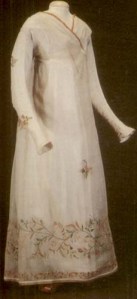
Embroidered muslin round gown, 1795. Image @Cathy Decker

More on the topic:

Read Full Post »

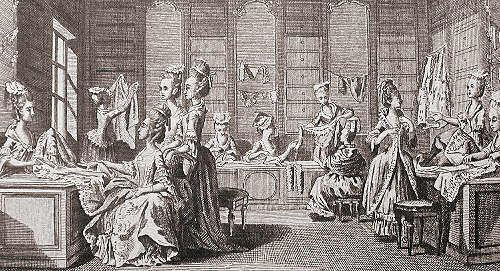
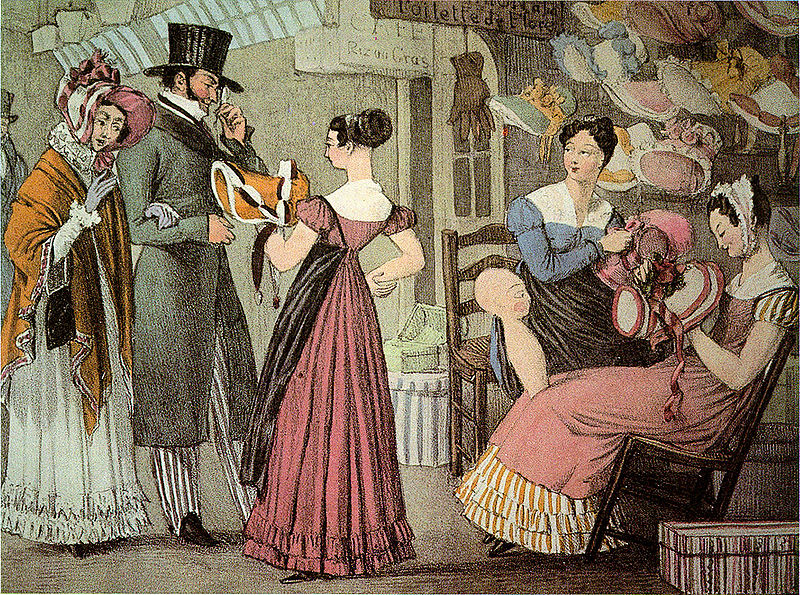
Early milliner shops were like our department stores, selling all manner of fashionable items. The image of a milliner shop in Paris shows the costumes we have come to associate with the era of Marie Antoinette. After the French Revolution, fashions changes drastically, for the French citizenry did not want to be reminded of the recent bloodshed or the ancient Regime. The rage in fashion was an imitation of the classical dress worn by the Greeks and Romans.

Dressmaker shop, 1775

The end of the 18th century witnessed a signal change in the style of women’s dress. The gown no longer consisted of two dresses, an under and an outer one. The formal styles which had prevailed throughout the century and brought into use stiff materials such as solid damasks, velvets, satins, and silks, were replaced by the fashion of the short-waisted clinging gown made of muslin and soft silk. This “Empire” mode characterized the dress of the first quarter of the 19th century. – The Encyclopedia Americana, Frederick Converse Beach, George Edwin Rines, 1902,  “costume”

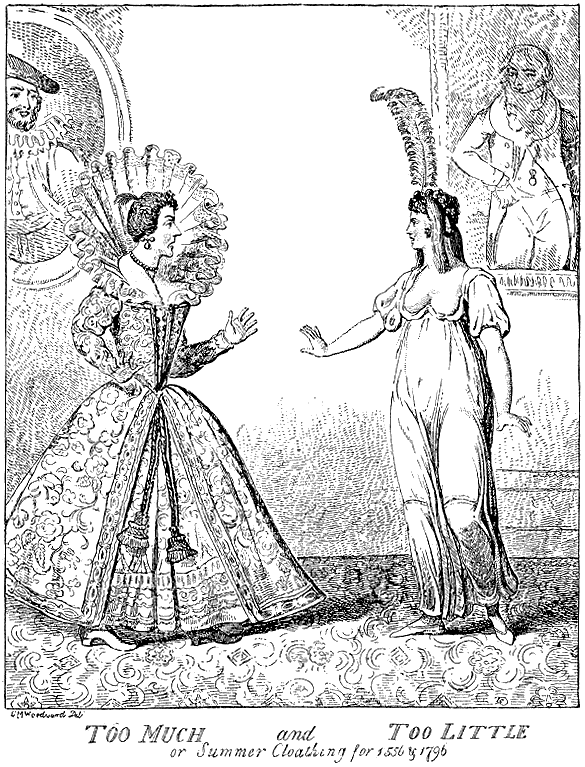
Too Much and Too Little, or Summer Cloathing for 1556 & 1796

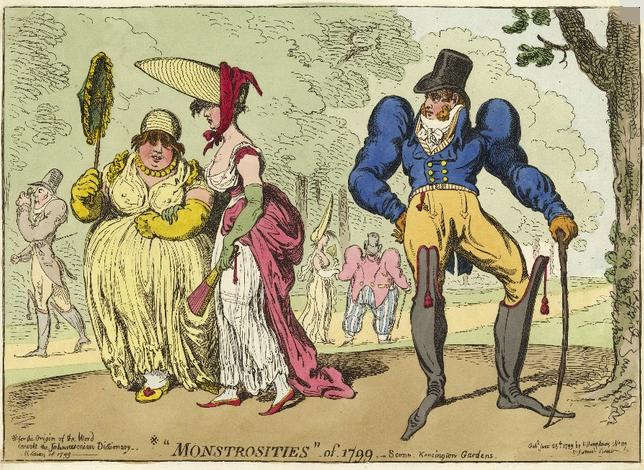
Parisians dressed in the new fashions were known as the “incroyables” (men) and the “merveilleuses,” (women.) These fashions were not at first admired and generally regarded as hideous. Caricaturists had a heyday making fun of these freaks of Fashion. British fashionistas shortly followed suit, as the cartoon by Gillray attests.

Monstrosities of 1799, Kensington Gardens, Gillray

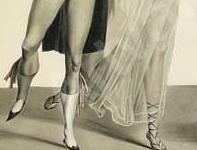
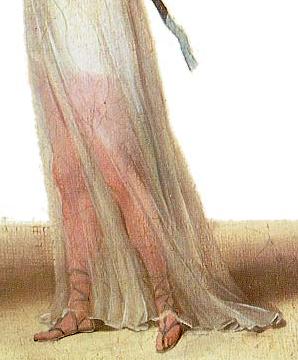
Macaronis turned into dandies, and gently bred ladies wore clothes so thin and diaphanous, that the shape of their legs showed clearly through the skirts. The muslin disease (catching a serious cold or pneumonia) lasted for as long as fashionable young women wore thin muslin dresses with bare necks and arms in damp and drafty buildings.

Merveilleuse et Incroyable. The close up of the dress reveals how sheer the fabrics were.

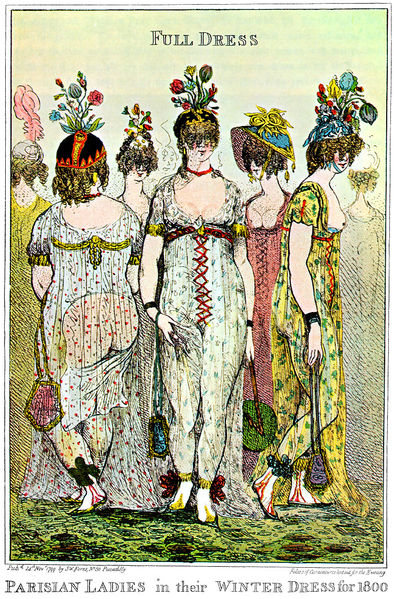
In some instances, nothing was left to the imagination. In the satirical image below by Isaac Cruikshank, the ladies are shown wearing next to nothing. Satire took many forms in the late 18th century. The Lady’s Monthly Museum featured a dialogue between a lady visiting Paris and a man milliner. His answer is hilarious.

Caricature by Isaac Cruikshank

Dialogue Between a Lady and A Man Milliner at Paris

“Citizen, I am just come to town: –pray, have the goodness to inform me how I must appear, to be in the fashion.”
“Madame, ’tis done in a moment; in two minutes I shall equip you in the first style. –Have the goodness to take off that bonnet.”
“Well.”
“Off that petticoat.”
“There it is.”
“Away with these pockets.”
“There they go.”
“Throw off that handkerchief.”
“’Tis done.”
“Away with that corset and sleeves.”
“Will that do?”
“Yes, Madame, you are now in the fashion. ‘Tis an easy matter, you see.–To be dressed in the fashion, you have only to undress.” – The Lady’s Monthly Museum, February 01, 1801, pg. 126.

Definition of a man milliner: A man who makes or deals in millinery, that occupation having been at one time predominantly performed by women; hence, contemptuously, a man who is busied with trifling occupations or embellishments.

Louis-Léopold Boilly painted a gown so sheer that without a petticoat, her short chemise is easily visible under the delicate muslin.

The days of the Revolution (1789 – 1799) brought in simple fashions. Corsets were discarded, the waist became short and the skirt clinging, and cheap materials were used. During the Directoire, the women adapted the classic style, borrowing from both Greek and Roman fashions. These costumes were scanty, and frequently were split up the sides. The dresses were often transparent and worn without chemises. The gentlemen of this fantastic period were styled “Incroyables,” “Unimaginables”; the ladies, “Merveilleuses” and “Impossibles.”  The men wore an exaggerated copy of what had been previously called the English fashion.- Costume design and illustration,  Ethel Traphagen, 1918,  p 120.

Millinery shop in Paris, 1822

A milliner could carry possibly a thousand different goods, becoming the forerunner of the modern department store. At this point, the term “milliner” was tied to the Latin word “mille,” meaning thousand.

The 18th Century milliner might have offered a thousand goods but all shared the quality of being fashionable accessories. Wares could include shoes, jewelry, table service, clocks, hosiery, fabrics, shirts, aprons, cloaks, caps, hats, muffs and mitts. – The Millinery Shop, Colonial Williamsburg

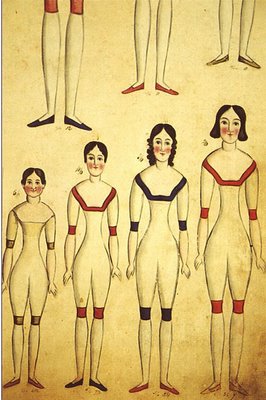
Milliner doll catalog, 1820s. These dolls were dressed in the fashion of the day. Look at the above image for a sample size of a doll. Image @Christine LeFever: Dolls and Fancywork

More on the topic:

Read Full Post »
Mansfield Park, Brock. Image @Austenprose

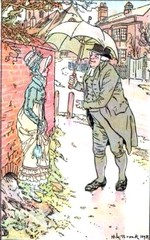
During the 17th century, ladies used parasols for protection from the sun. A century later they were using oiled umbrellas as protection from the rain as well. By the early 19th century, the design of the umbrella had improved and its use had become widespread. After Maria’s marriage, Fanny Price was overtaken by a heavy shower close to the Parsonage and sought shelter under an oak. When the Grants spotted her, they sent out a servant, but Fanny was reluctant to come in:

A civil servant she had withstood but when Dr Grant himself went out with an umbrella there was nothing to be done but to be very much ashamed and to get into the house as fast as possible; and to poor Miss Crawford, who had just been contemplating the dismal rain in a very desponding state of mind, sighing over the ruin of all her plans of exercise for that morning, and of every chance of seeing a single creature beyond themselves for the next twenty four hours, the sound of a little bustle at the front door and the sight of Miss Price dripping with wet in the vestibule was delightful. – Jane Austen, Mansfield Park

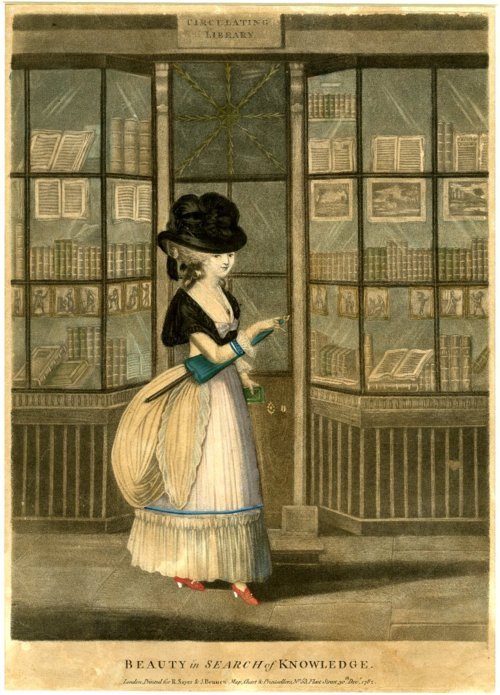
Beauty in search of knowledge, 1782. This 18th century woman carries an early version of an umbrella. These models were heavy and cumbersome. Image @Harry Elkins Widener Collection, Harvard College

A century before Mansfield Park was published (1814) men did not use umbrellas, which were regarded as women’s accessories:

A young man who borrowed one from a coffee house in a downpour in 1709 was excoriated as effeminate in a newspaper. It would have been a cumbersome model, ill-suited to being carried around. Similar heavy umbrellas were kept in churches to protect the parson during burial services. – A Brief History of the Umbrella 

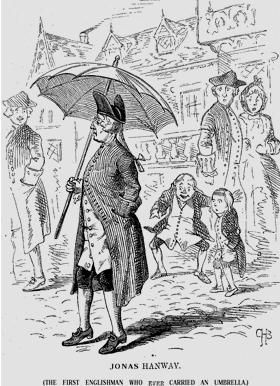
Yet the following passage from Notes and queries, Volume 54, William White (Oxford University Press, 1876,  p. 202), suggests that men began to use umbrellas earlier than Jonas Hanway, who braved ridicule from street urchins and hackney coachmen, who regarded the use of the umbrella as a threat to their livelihood:

1745 – Paid for umbrella, box and carriage.
It is not stated for whose use this was intended; most probably for the minister when officiating at funerals. This is a remarkable entry, as the introduction of umbrellas into England is attributed to a much later period. The employment of the umbrella in the streets London is said to have been by Jonas Hanway, who died in 1786; but the following passage from the Trivia of Gay, who died in 1732, shows it was in use at a much earlier period

Good housewives Defended by th’ umbrella’s oily shed,
Safe through the wet on clinking pattens tread.”

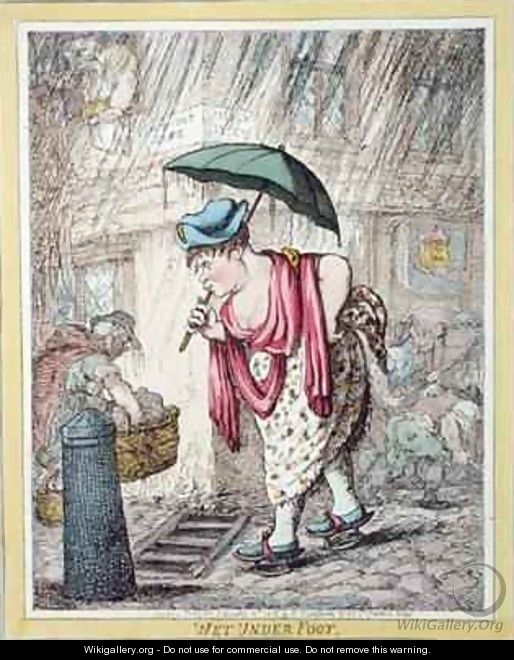
Wet under foot, James Gillray. Image @Wikigallery. The woman is wearing "clinking" pattens as well as carrying an umbrella.

In 1893, Georgiana Hill wrote this descriptive history of the umbrella in England:

Umbrellas were a recent fashion in the earlier part of the century. During the first ten years of George the Third’s reign, the only umbrellas in use were large carriage umbrellas, which required an attendant to hold them. In the country they were hardly known at all. The philanthropist, Jonas Hanway, in 1756, boldly unfurled an umbrella in the streets of London, being the first man who ventured upon such an innovation. Surely Hanway deserves to be held in grateful remembrance by the male sex for this spirited effort towards the emancipation of his brethren from the thraldom of custom. He was jeered and ridiculed by the populace, but was not to be laughed into giving up the sheltering oilskin. About twenty years later, a valiant footman named John Macdonald began to use a silk umbrella, which he had brought from Spain. The boys shouted after him: “Frenchman, why don’t you get a coach?” but he grasped his umbrella more firmly and went on his way, and in some three months time he was able to use it without exciting remark. Miss J. Gay Trivia Hutton, writing in 1779 from Derbyshire, says: “Mrs Greaves lent us their umbrella, and servant to carry it.” Miss Hutton’s brother was the person to use an umbrella in Birmingham, a Frenchman being the first.

Jonas Hanway. Image @Wikipedia. This caricature depicts how long early umbrella handles were.

The town beau, when he first carried an umbrella, was caricatured in the prints as the rain-beau holding a tiny parasol over his head. A gentleman once borrowed an umbrella from the mistress of a coffee- house in Cornhill, and after the following satirical advertisement in The Female Tatler: “The young gentleman belonging to the Custom house, that for fear of rain borrowed the umbrella from Will’s Coffee house in Cornhill, of the mistress, is hereby advertised to be dry from head to foot on the like occasion he shall be welcome to the maid’s pattens.”

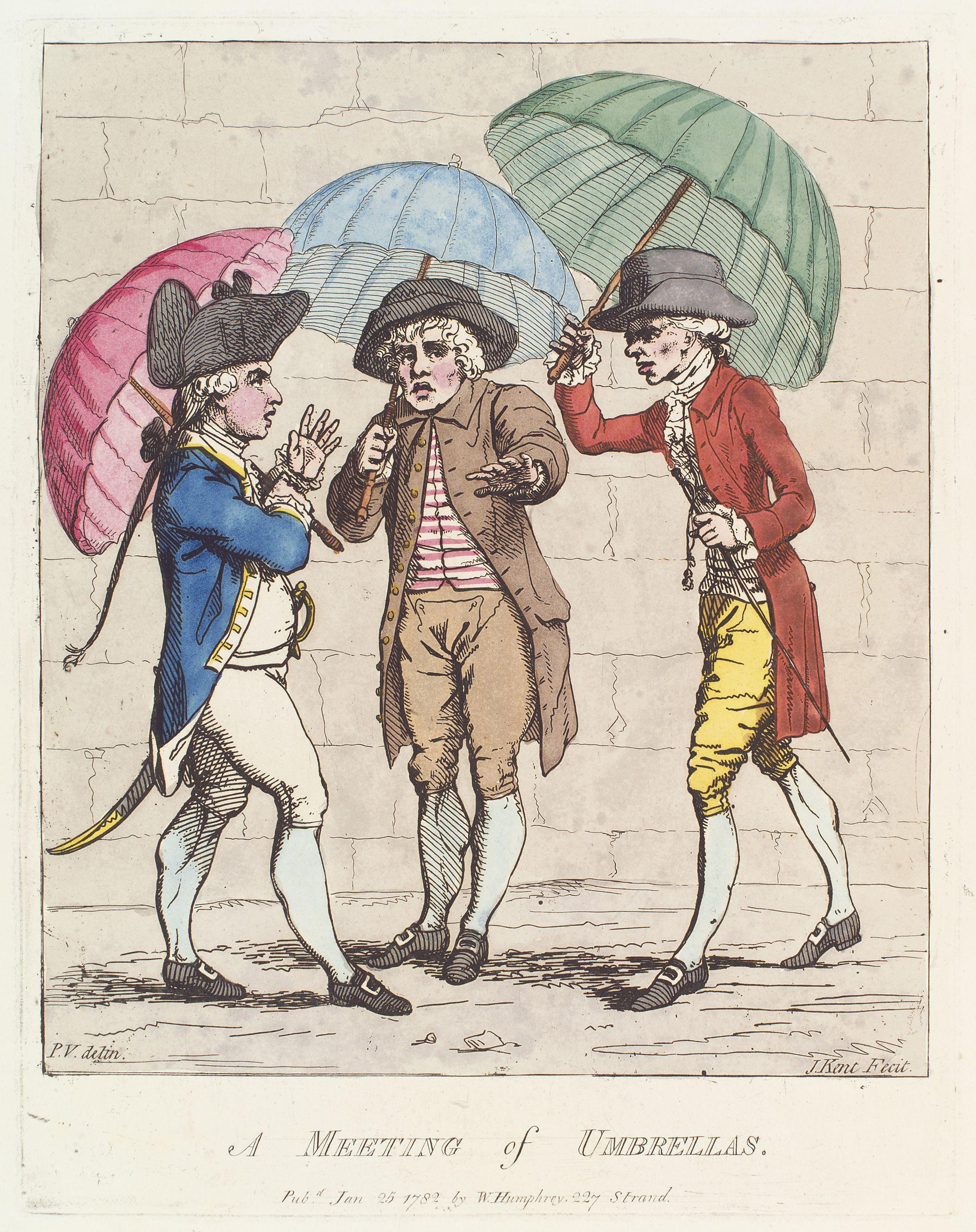
A meeting of umbrellas, James Gillray, 1782. By now, men used umbrellas as a matter of course.

An illustration of the want of umbrellas afforded in one of the caricatures of the period, showing a respectable citizen’s family from Vauxhall in a downpour of rain – the old gentleman with a handkerchief tied over his head to save his wig, and his wife’s cardinal on his to protect his best coat, while the wife herself and her daughters are tripping along in gowns turned up round their waists, and their heads enveloped in coloured handkerchiefs. In 1797 there was one umbrella in all Cambridge, and that was kept at a shop, and let out like a sedan chair ,by the hour. In London women carried umbrellas before men had taken to them, but the first umbrellas were heavy awkward machines made of oilskin or taffeta. Still, in spite of their cumbrous character, women who had to trudge along the streets on rainy days rejoiced in their shelter. With cloak and umbrella, they were able to face the dripping roofs and waterspouts, which were as much to be avoided as the rain. To the fashionable lady. who only walked in fine weather, the one important consideration was the parasol, but it was otherwise with the thrifty citizeness. Great must have been the relief and saving of clothes when the new invention came into use:

Good housewives all the winter’s rage despise,
Defended by the riding hood’s disguise;
Or underneath the umbrella’s oily shade,
Safe through the wet on clinking pattens tread.
Let Persian dames the umbrella’s ribs display,
To guard their beauties from the sunny ray;
Or sweating slaves support the shady load,
When Eastern monarchs show their state abroad;
Britain in winter only knows its aid,
To guard from chilling showers the walking maid.”
– J Gay Trivia

– A history of English dress from the Saxon period to the present day, Volume 1, By Georgiana Hill , 1893, p. 173-74.

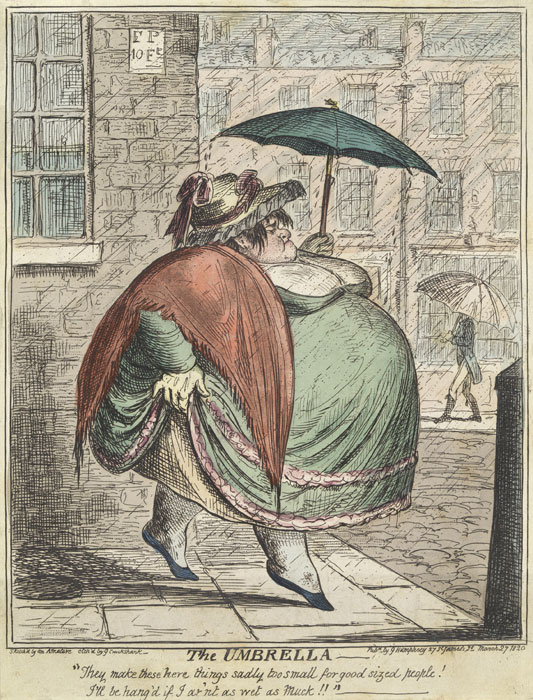
The Umbrella, 1820. This cartoon depicts how little protection these early umbrellas afforded. Cruikshank exaggerates the woman's size to demonstrate the point. Image @Art Tattler

Early umbrellas were heavy and cumbersome to use:

Early umbrellas were made of oiled silk with heavy wooden frames which made them difficult to open or close when wet. Whalebone (baleen) was also used but this still made the article heavy. It wasn’t until 1852 that Samuel Fox invented the steel ribbed umbrella claiming that he was using up stocks bought for making corsets. This made umbrellas much lighter and more portable. – Come rain or shine: historic umbrellas and parasols 

More on the topic:

Read Full Post »

« Newer Posts - Older Posts »