Feeds:
Posts
Comments

Posts Tagged ‘Thomas Rowlandson’

Inquiring readers: We readers of Jane Austen’s novels, letters, and stories, as well as of the history of the Georgian/Regency era in England, are fairly knowledgeable about the modes of travel for the upper classes and rising middle classes – from grand carriages to fast paced curricles to the humbler donkey cart that the Austen women drove from Chawton to the nearby village of Alton (1.6 miles away). A majority of these vehicles (except perhaps for the donkey cart) were beyond the means of most of the working classes, as well as the poor. (Just one horse cost an average of £500 per year to maintain. Even Rev Austen used his horse for a variety of jobs: to visit his parishes, post letters in town, and for farm work.). So how did humbler citizens travel? What modes of transportation were affordable and available to them? 

Chawton to Alton. Google map

On Foot:

If memory serves me well (from an article I read 20 years ago), most villagers in Austen’s day moved around within an 18 mile radius (plus/minus) from where they lived. In a 2022 article (1), author Wade H. Mann discussed the distances and time people took to reach Point A to Point B. To paraphrase him, walking was the way most people used to travel, especially the poor, servants, and working people. Mann’s distances and times provide a quick perspective. For his extrapolations, he used the information he gleaned about the Bennet family in Pride and Prejudice, their walks to the village of Meryton, and the distance of Longbourn to London. In short order, he discussed:

  • Lydia’s walks to Meryton nearly every day. (Distance: 1 mile each way.) One can assume that servants who worked for the Bennets also walked those distances, if not farther, to and from their homes every morning and evening after their shifts were over. One can also imagine servants, be they male or female, being sent on frequent missions of 1 mile or more throughout the day to obtain food or medicines, and to receive packages, or deliver letters with information for merchants and notes of appreciation or invitation to close neighbors.

    (c) Dover Collections, Supplied by Art UK

  • Elizabeth’s walk of three miles to visit Jane at Netherfield Park over wet fields was easy for her strong, athletic body. She would not have been “intimidated by a six-mile [round trip] walk.” If this was the case for a gentle woman of her status, one can imagine that male or female servants and field laborers would think nothing of walking six miles one way to work. 
  • In this bucolic image of a country road in Kent, painted in 1845 by William Richard Waters, three women are shown along a dirt road. (The village is located in the far horizon.) The woman on the left is probably a servant. From their dress, the two sitting females are gentle women taking a break. Although this painting was created past Austen’s day, rural villages were still relatively unchanged. With the advent of railroads and macadam roads, long distance travel became easier for those who could afford it, but long walks were still a part of daily life during the 19th century.


Distances in Regency  England


As mentioned before, the distance between Longbourn, where the Bennets lived, and Netherfield Park, which Mr Bingley rented, was only three miles. 

On a good surface, almost everyone walks 3 to 3.5 miles per hour; ordinary people can walk 10 to 24 miles per day. Twenty-four miles is the exact distance from Longbourn to Gracechurch Street [London], so even on foot, it’s only a hard day’s walk.” (1)


According to today’s estimates, the distance from London to Bath is approximately 115 miles (plus minus 30 miles depending on the roads one travels and which fields they chose to cross). Given the above estimate, and that, depending on their age and physical ability to walk from 10 to 24 miles per day, this journey would take a walker anywhere from 11½  to 4.8 days. In our fast-paced world, such a long time would be unacceptable. 250 years ago it was not. Travelers also minded their pocketbooks in terms of their budgets for lodging. Some might even need to find employment along the way.

London to Bath, google maps

Road surfaces and weather conditions mattered

If you’ve ever walked along a dirt path in a large park, you might have stumbled across fallen limbs and trees, climbed up and down steep paths, and treaded carefully over rocky surfaces, etc. Road conditions in and around most of England’s rural villages were abysmal until the early 19th century. Macadamized roads, with their crushed stone surfaces were constructed in 1815, just 2 years before Austen’s death. During most of her life, she would have largely known the miseries of walking along and riding on dirt roads that turned into muddy quagmires on rainy days. 

Rains were frequent in this island country. Roads became so rutted that they were almost impassable in certain areas, where mud slowed horse drawn coaches and carriages, which forced riders and people to take down luggage and packages, and push the vehicles, or to walk to nearby shelters and villages. Mrs Hurst Dancing, a book that features Diana Sperling’s charming watercolours of her life during this time, shows how weather affected her family’s everyday lives.

This image shows the challenges of a muddy road with deep wagon tracks by a family embarked on an eleven mile walk. Seeing how these gentle folks struggled on an excursion of their choice, we can imagine the challenges many servants faced walking to their place of employment, having no other option. 

A walk of 11 miles in deep mud, Mrs Hurst Dancing (2), P. 60 (Image, Vic Sanborn)

Walking to Dinner at a Neighbor’s House, Mrs Hurst Dancing (2) P38. (Image: The Jane Austen Centre)

Effects of weather 

Frequent rains were not the only problem. Cold winters and deep snow provided unique challenges during the years known as The Little Ice Age (1811-20), when winters were harsher than normal. People who embarked on walking long distances needed to plan their routes in advance, which included knowing the condition of the roads (often through word of mouth or by previous experiences) and which villages could offer affordable shelters. Many itinerant laborers would have no problem sleeping in a farmer’s barn on a soft bed of hay in exchange for work. 

Snow and ice made travel extremely difficult and was often avoided unless absolutely necessary. People would hunker down indoors and wait for the snow to clear before embarking on long journeys, as conditions could change rapidly. (My favorite Emma incident is when Mr Woodhouse, dining at the Weston’s house, INSISTED on leaving a dinner party immediately at the first signs of snowflakes. The Woodhouse party left, even though dinner had barely begun. Mr Woodhouse feared being stuck in snow. Austen knew her comedic settings well, but she was also knowledgeable about the realities of travel in her time.)

Detail of a Mail Coach in a snow drift with a Coachman leaving to seek assistance, James Pollard. To view the full painting and to read a complete description of the situation, click on this link to Artware Fine Art.

Itinerant laborers and sales people

Towns and villages were largely isolated. In cosmopolitan centers, like London, residents received the latest news almost as fast as Regency travel allowed. Thus cities and major metropolitan centers had more access to most of the benefits that a well informed society offered.

Villagers were often the last to know about the latest news about fashion, music, and dance. Enter the itinerant wanderers, the purveyors of knowledge and of all things current, albeit months past the time that the citizens of Paris and London knew about them. 

Those with special talents profited the most from their peripatetic lives. A musician could offer entertainment with the latest popular ditties or teach lessons on an instrument, such as a piano forte or violin. A dance master might teach the latest steps from ‘The Continent’ that a young lady and gentleman should know.
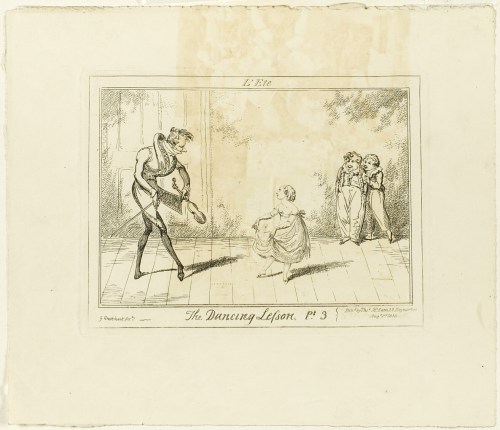
The Dancing Lesson, Pt 3, George Cruikshank, 1825. The Art Institute of Chicago, image in the public domain.

The dancing master in the above image, was employed to teach children the steps and dance moves of the latest dances.

Talented and professional individuals – music teachers, dance instructors, tutors and the like –  often had their services enlisted beforehand, and likely travelled by stage coach or on horseback to their destinations. They would stay in a nearby village or with the family that employed them for the duration of their contract before moving on.

Other people with various skills travelled between cities and towns either looking for work, or to sell their wares. They sold items as varied as kitchen equipment in town squares or brightly colored ribbons at county fairs. Some individuals crossed the English Channel, carrying fashion books and paper dolls* to inform the populace about the latest changes in fashions. I imagine farriers and blacksmiths were in hight demand, since horses were vital. Others offered seasonal labor in exchange for a meal or a place to sleep. Some were beggars or vagabonds who scrounged for any scraps.

The sad fact was that in a land of plenty, land enclosures took away the common fields from villagers by fencing off the shared, common lands, which were vital to rural folks by providing grazing land for livestock, and offering legal ways to gather firewood or hunt game. The impact of enclosures on commoners was enormous, as their independence was taken away. Many left their villages and homes, looking for work in cities and elsewhere, making their situation worse than before. 

Beggar in early 19th C. London, John Thomas Smith, Spitalfields Life.His broom indicates that he might have been a street sweeper.

Itinerants also cadged free rides from friendly farmers and workers, or hitched a ride to the next town. They might take a seat in the back of a humble cart for a few miles, and then continue their walk. Again, a workman/woman might offer their menial services in return for a favor. 

Below are images of a variety of itinerant travellers. The first was created by the incomparable Thomas Rowlandson, of whom I am an enormous admirer.


Aerostation out at Elbows ~

or the Itinerant Aeronaut

Behold an Hero comely tall and fair!

His only Food. Phlogisticated Air!

Now on the Wings of Mighty Winds he rides!

Now torn thro’ Hedges!–Dashed in Oceans tides!


Now drooping roams about from Town to Town

Collecting Pence t’inflate his poor balloon,

Pity the Wight and something to him give,

To purchase Gas to keep his Frame alive. ~

The above copyright free image by Thomas Rowlandson is called Aerostation out at Elbows, or The Itinerant Aeronaut, 1785, Met Museum. The poem below the image is about Vincent Lunardi, an Italian balloonist, whose successful balloon ride was of short duration. Sadly he died in poverty.

Wandering musicians during the Georgian era were also known as gleemen. 

Detail of street musicians in London surrounded by a crowd, Thomas Rowlandson.

A ballad singer
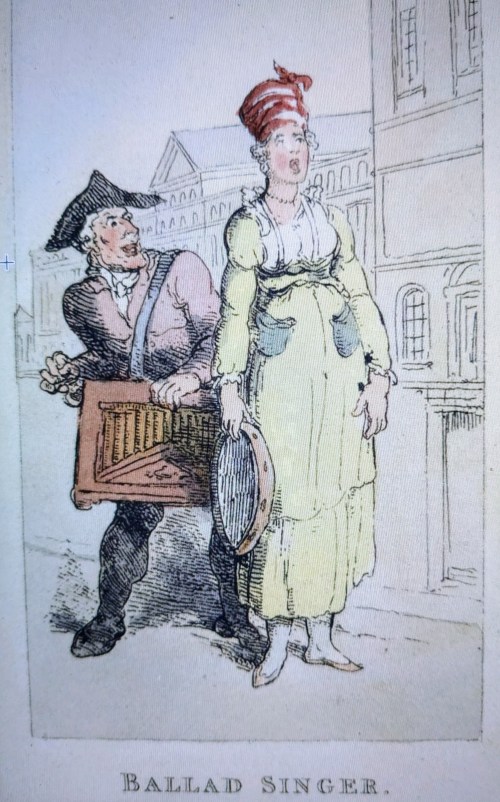
A Ballad Singer, Thomas Rowlandson, 1820, from Characteristic Sketches of the Lower Orders, British Library

Wagons and carts for the common folk 

Unlike the fancy carriages and equipages of the well heeled, conveyances for the lower classes were ordinary wagons, rough hewn carts, drays, wheelbarrows, wagonettes, pushcarts, donkey or pony carts, and the like. 

This link to a Thomas Rowlandson image of country carts (1810) shows ordinary country folk setting out on a journey. These are a few details of that image:

Setting out behind the covered wagon

Loading the wagon

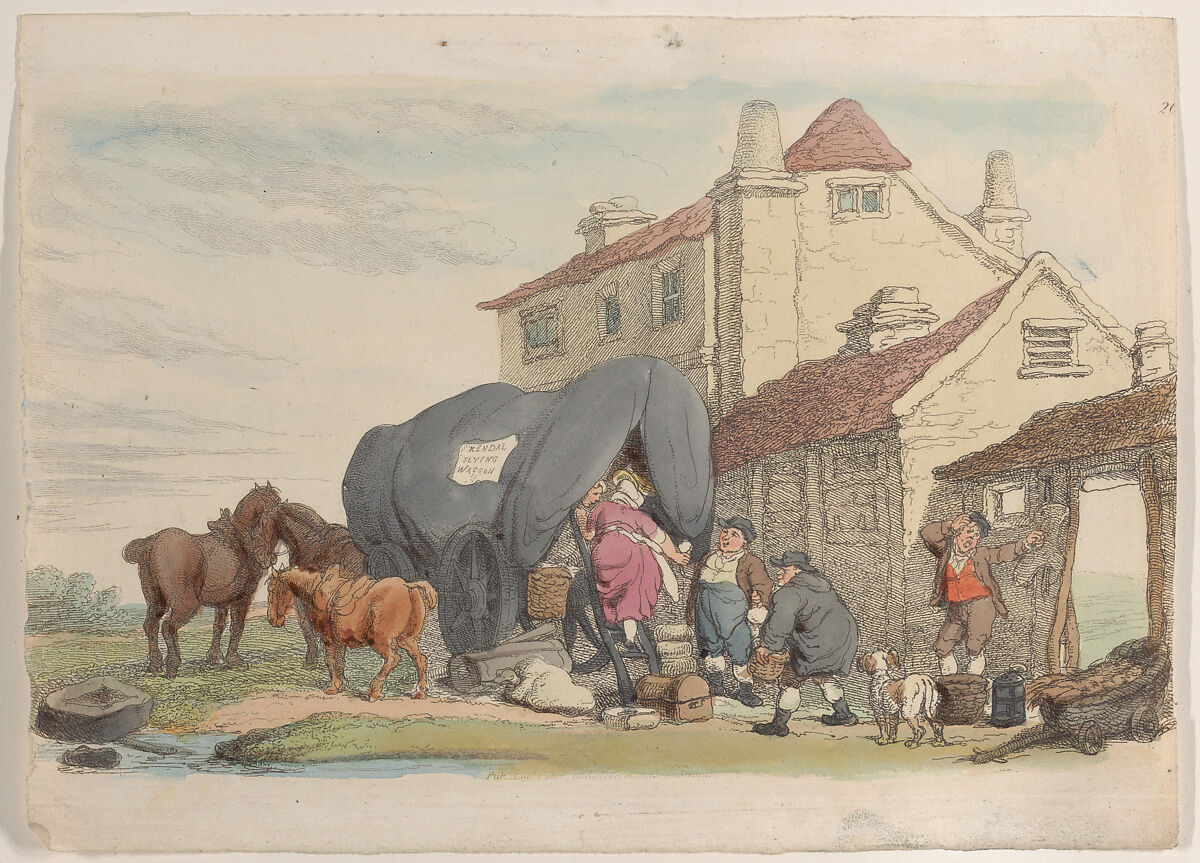
Larger covered wagons were also used for longer distances. This wagon, to my way of thinking, is the poor man’s stage coach.

Rowlandson, Flying Wagon, 1816, MET Museum, public domain

In Mr. Rowlandson’s England, Robert Southey described the laboriously slow progress of a flying wagon:

The English mode of travelling is excellently adapted for every thing, except for seeing the country…We met a stage-waggon, the vehicle in which baggage is transported, I could not imagine what this could be; a huge carriage upon four wheels of prodigious breadth, very wide and very long, and arched over with a cloth like a bower, at a considerable height: this monstrous machine was drawn by six large horses, whose neck-bells were heard far off as they approached; the carrier walked beside them, with a long whip upon his shoulder…these waggons are day and night upon their way, and are oddly enough called flying waggons, though of all machines they travel the slowest, slower than even a travelling funeral.” – P 23    

Thomas Rowlandson, Country Folk Leaving for the Town, 1818

Take a peek inside this link to Meisterdrucke.us of Thomas Rowlandson’s cartoon ‘Depicting Country Folk Leaving for the Town’. It’s a joyous event, with all the people setting off to…where? A country fair perhaps? The procession is obviously as slow as the Flying Wagon, for many people are walking in pairs and carrying baskets (Food for personal consumption? Produce or goods for sale or barter?).

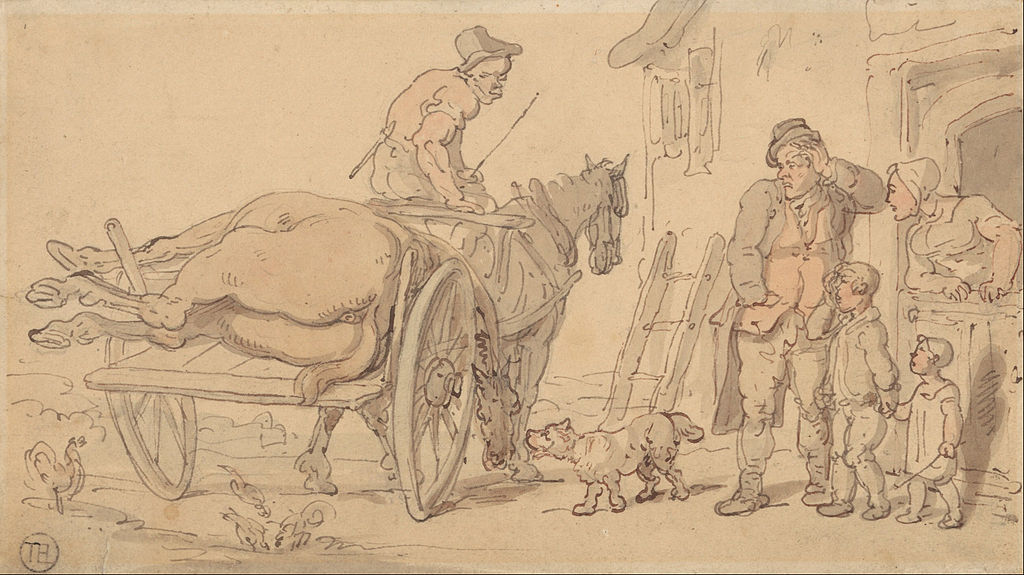
Lastly, this image by Rowlandson of a cart carrying a dead horse to the knacker is sad in several respects. Not only has the family lost a valuable animal, but, looking at the faces of the parents, much of their livelihood as well. One can’t imagine that they can afford to purchase another horse any time soon.
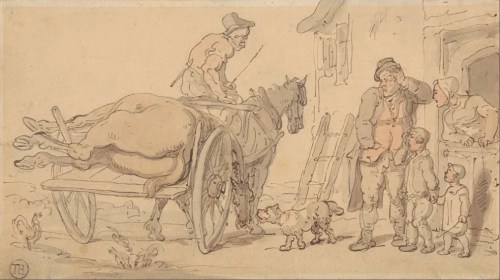
A Dead Horse on a Knacker’s Cart, Thomas Rowlandson, Undated, Yale Center for British Art, Public Domain

Bricklayers Arms, an image by Thomas Rowlandson, sums up the variety of wagons and methods of transportation.
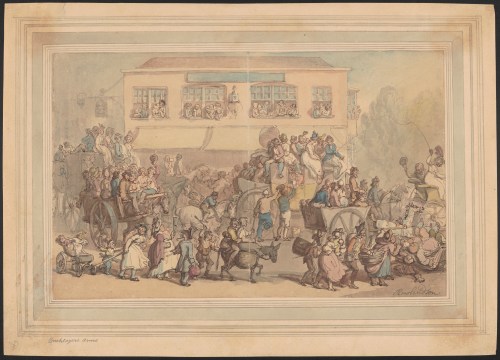
Stage Coaches

These coaches were unattainable for the very poor, but the working classes could afford an uncomfortable spot on an exposed space ‘up top’. 

A Laden Stage Coach Outside a Posting Inn

Thomas Rowlandson, Stage Coach, 1787, Met Museum, Public Domain

Given the road conditions, ‘up top’ could be a dangerous choice, as one of the images below shows. Newspaper clippings of the time mentioned the deaths of passengers thrown violently to the ground when a stage coach was involved in an accident.
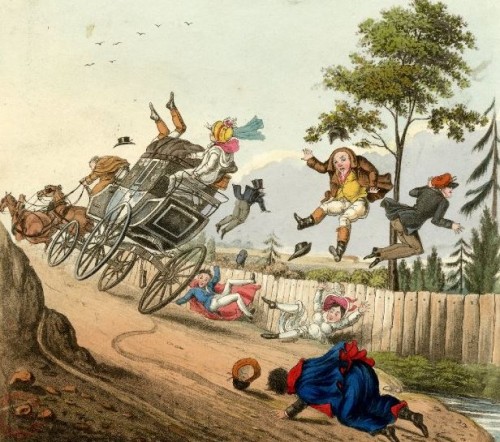
Stage Coach Perils, Donna Hatch, Coach Travel in Regency England: Stage and Mail Coaches

Should everything go right on the journey, and the coach stops at a coaching inn, the unfortunate individuals ‘up top’ are then …”directed to the kitchen with the pedestrians, gypsies, itinerant labourers and soldiers. Do not expect help getting off the eight foot high coach; if you were a lady, you would not be on top in the first place, would you?” A Guide to the Georgian Coaching Inn

Transportation across water

Travellers faced many impediments as they progressed along rural roads, a major one being water. While larger cities and towns provided bridges, most villages surrounded by country lanes did not have this luxury. Passage over small streams was possible – large rocks were frequently placed at comfortable intervals to make walking easier. 

Methods of transportation across a wide and deeper stream or river included a ferry, or a pulley and rope system to tow a wood platform from one bank to the other. (3) 
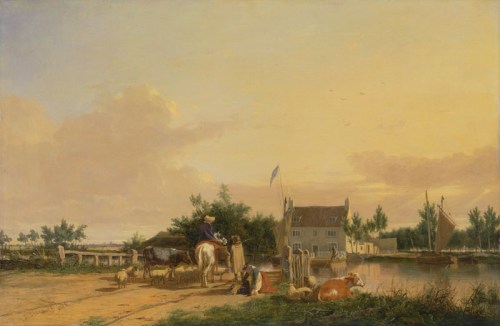
This painting by Joseph Stannard dates from 1826 and shows The Ferry House Inn from the opposite riverbank. Crossing the Yare – Buckenham Ferry
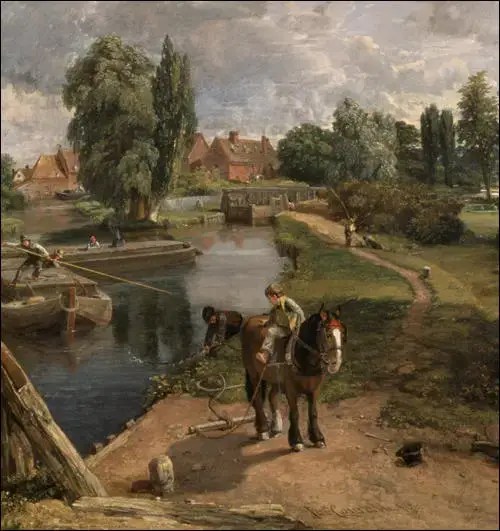
John Constable, Ferry Crossing, River at East Bergholt in Essex, 1817

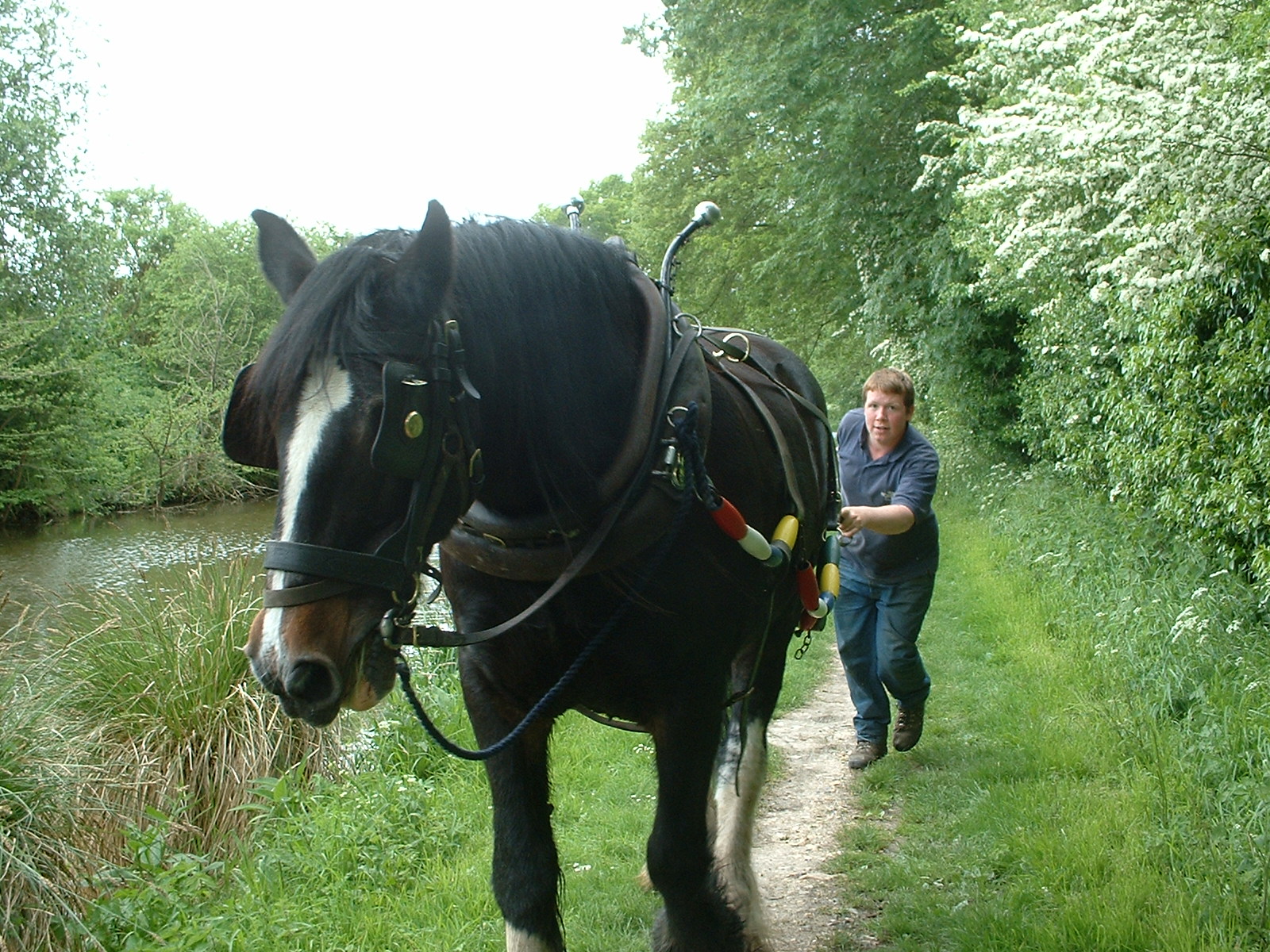
Barges pulled by horses and mules along towpaths provided inner- and inter-city travel along a system of interconnected canals, which sped the movement of people and goods. 

“A horse, towing a boat with a rope from the towpath, could pull fifty times as much cargo as it could pull in a cart or wagon on roads. In the early days of the Canal Age, from about 1740, all boats and barges were towed by horse, mule, hinny, pony or sometimes a pair of donkeys.” Wikipedia, Horse-drawn boat

As mentioned, ferries, canal boats, and barges carried heavier loads. These boats also provided accessibility and affordability to a variety of people from different classes.

Sources:

(1) Distance and Time In Regency England, By Wade H. Mann, author of A Most Excellent Understanding, Q&Q Publishing, Jun 8, 2022

(2) Mrs Hurst Dancing, To find more images by Diana Sperling, click on this page to the Jane Austen Centre. 

(3) Ferrymen and water men: Water Transportation and Moving in Regency England

Not quite related to this topic, but equally as fascinating are:

Read Full Post »

Reviewed by Brenda S. Cox

“I have seen nobody in London yet with such a long chin as Dr Syntax” (Jane Austen, March 2, 1814).

I just finished reading, cover to cover, a brand-new book which is over 200 years old. The Tour of Doctor Syntax in Search of the Picturesque, by William Combe, is a classic which Jane Austen herself enjoyed. But it’s out in a new edition, with wonderful illustrations, explanations, and comments.

A fun new annotated version of The Tour of Doctor Syntax, including parallels with Jane Austen’s novels!

The story in verse was first published from 1809-1811 as a series in Ackermann’s Poetical Magazine. Ackermann had a series of prints by the great caricaturist Thomas Rowlandson. They featured a country clergyman with a long pointed chin and a tall white wig traveling through the countryside. Ackermann gave Combe the illustrations for each issue of the magazine, and Combe wrote a section of the story to go with them. He didn’t know ahead of time what the pictures would be for the next issue, but somehow he came up with a coherent story. One interesting facet is that Rowlandson apparently intended to satirize the clergy, but Combe made Syntax into a good, learned man, a little silly, but lovable.

A book version came out in 1812. Dr. Syntax was wildly popular and stayed in print, with multiple printings and editions, well into the 1800s.

This new version of The Tour of Doctor Syntax was edited and annotated by an advanced high school class and their professor, Dr. Ben Wiebracht. Ben actually discovered Dr. Syntax through one of my posts right here at Jane Austen’s World. Recognizing its potential for his class on “Jane Austen and Her World,” he asked Vic Sanborn, owner and primary writer of this website, and myself, to share with his class. Vic owns some lovely Rowlandson prints. We both loved connecting with such bright and interested students, who asked knowledgeable questions.

The Book

They’ve done a brilliant job with the book. It starts with a biography of William Combe and the history of the book itself. Combe’s challenges as a writer in Austen’s age were fascinating to me, as a writer myself. A clear introduction explains “the picturesque,” which is mentioned in Austen’s novels. Parallel to the text are straightforward explanations of difficult terms and phrases. That makes them easy to quickly reference. A glossary in the back gives terms previously defined.

The best part, for me, are comments pointing out parallels with Jane Austen’s work. I can’t even begin to list these, but there are many great insights. Some are about the clergy in Austen’s work, since Syntax is an underpaid country curate like Charles Hayter of Persuasion. Many comments have to do with the “picturesque,” “improvement” and country estates ranging from Sotherton to Pemberley. Others relate to the class system, Gothic novels, and other topics.

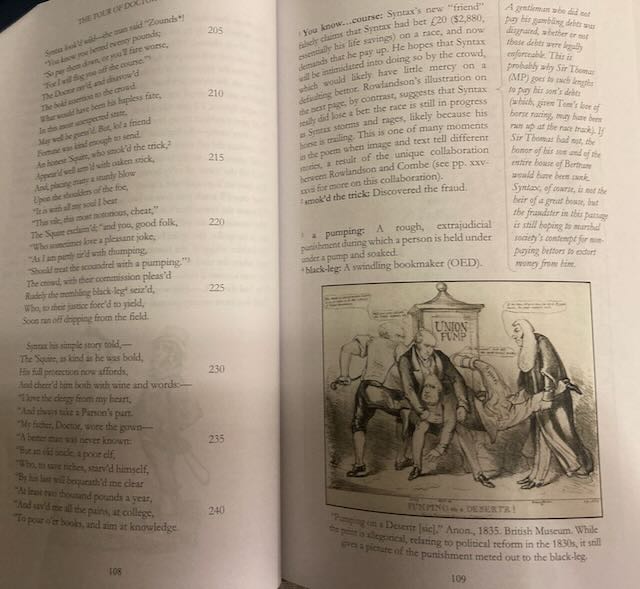
The full text of the poem/story is opposite explanations, comments, and illustrations, making them easy to access. The Tour of Doctor Syntax, 2024.
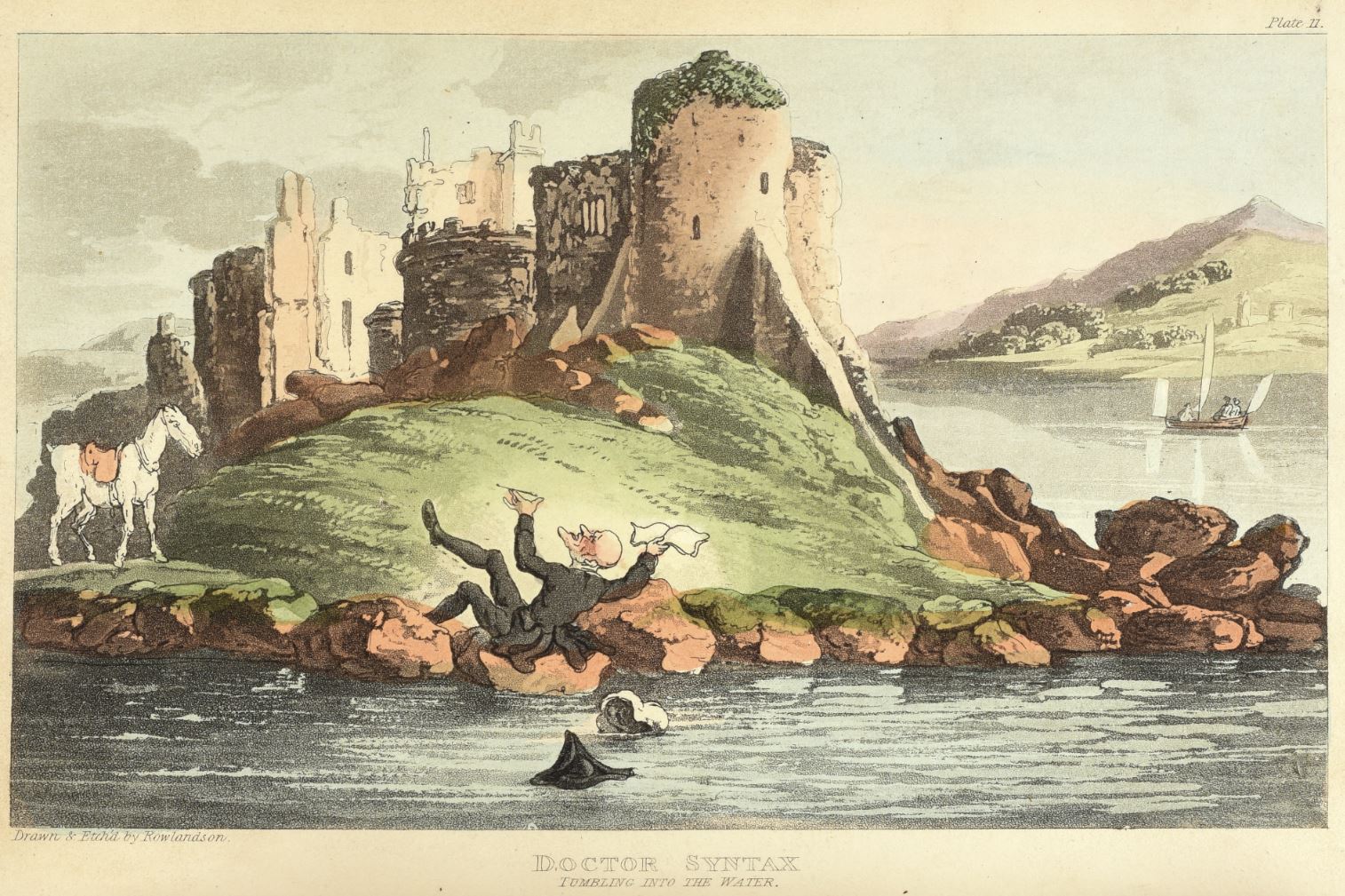
“Doctor Syntax Tumbling into the Lake,” by Thomas Rowlandson. One of the lovely full-page illustrations for this new version of The Tour of Doctor Syntax.
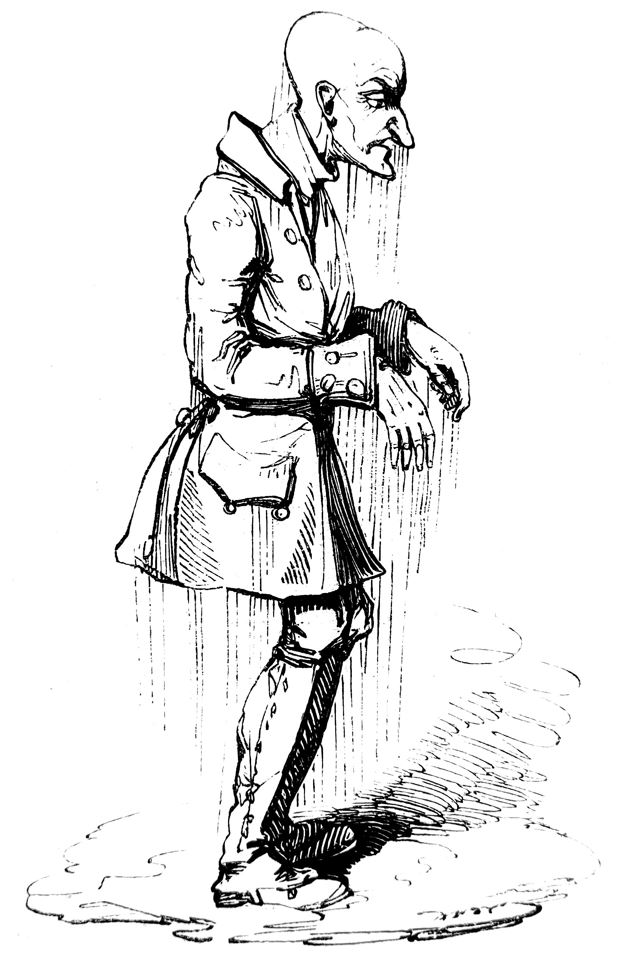
Victorian illustration, 1838, of the same scene, by Alfred Crowquill. The Tour of Doctor Syntax includes both the Rowlandson and Crowquill illustrations.

I also loved the illustrations. The editors chose the best versions they could find of each of the full-page, hand-colored pictures by Rowlandson that were the basis of the book. They added illustrations from a later Victorian version, as well as other entertaining and illuminating cartoons and pictures from the time.

Interview with the Editor

I’ll let Dr. Wiebracht himself tell you more about how this book came about.

Ben, please tell me about your class that produced this book.

The class is called “Jane Austen and Her World” and it’s designed for advanced juniors and seniors. The goal is to see Austen’s novels not as sealed-off masterpieces, floating in a historical vacuum, but as windows into her world. Most class days, our Austen reading is accompanied by shorter texts designed to create a sense of context and show how Austen was in conversation with her contemporaries. For instance:

  • We pair Austen’s account of Bath in Northanger Abbey with a number of late 18th-c. satires of Bath, 18th-c. dance music, and illustrations of the city by Rowlandson and others.
  • We pair Catherine’s pseudo-Gothic adventures in Vol. II with excerpts from The Monk, The Castle of Otranto, and The Mysteries of Udolpho.
  • We pair the private theatricals in Mansfield Park with a viewing of a performance of Lover’s Vows, as well as specimens of anti-theatrical criticism from the period, including a satire on private theatricals by Jane’s brothers!
  • We pair the discussion of landscape gardening in Mansfield Park with images from Humphry Repton’s famous “red books” showing “before and after” estate grounds.

The idea is to understand Austen in a deeper way by developing the practice of “reading outward.” And we incorporate that principle in our work for the class. Instead of the usual school essays, students work with me to create a critical edition of a neglected text from Austen’s time, with annotations and other resources that draw connections between the text and Austen’s life and work.

The class enrolled 16 students (the maximum). They hailed from all over the country and world: Japan, China, and many different U.S. states. This was my first time teaching the course, though I developed the core ideas in an Austen unit for a previous course. In the future, I will probably teach the course every three years. The book project in particular is a heavy lift, and I’m not capable of it every year!           

How did you end up studying Dr. Syntax along with Jane Austen?

I have to back up a bit here. In the course of an Austen unit for a previous class, students and I had created a critical edition of a long-forgotten 1795 poem called Bath: An Adumbration in Rhyme. We used that book to launch a new series called “Forgotten Contemporaries of Jane Austen.” Its goals are:

  • to recover neglected but valuable texts from Austen’s time, and
  • to trace new connections between Austen and her contemporaries.

As I was preparing my Austen class, I settled on Doctor Syntax (first brought to my attention in JAW by one of your articles!) for three reasons.

  • First, the poem had undeniable literary-historical importance – one of the all-out bestsellers of the Regency. A critical edition, I thought, was long overdue.
  • Second, many of its themes – from the plight of poor clergy to the “picturesque” – were major concerns of Austen’s novels, too.
  • Finally, the poem was simply a really good read. Combe’s verses are light, fun, and at times even touching, and Rowlandson’s accompanying illustrations are some of his best work. In every way, the poem deserved to be revived!

What do you hope readers will gain from the book?

There are a lot of things I hope people take away! One would be a deeper appreciation of just how engaged Austen was in the debates and issues of her day. Sometimes Austen is talked about as something of a provincial writer, sealed off from the wider Regency world, modestly toiling away on her “pictures of domestic life in country villages,” as she once put it. But when we keep in mind just how much of a smash hit Doctor Syntax was, and when we consider the many, many parallels between this work and Austen’s novels, which our edition lays out in detail, then we see Austen differently. She now starts looking like a very savvy writer, who understood what the major issues of the day were, what readers were interested in. To be sure, she stuck to her convictions and drew on her own experience and observations, but she did so in a way designed to appeal to a broad, national readership.

I’m also excited for people to meet this poet William Combe, who had one of the most interesting lives of any Regency writer. He was a remarkable literary talent. He doesn’t fit the mold of the “Romantic poet,” which is one reason he might be overlooked. Instead he offers a light, generous humor that shows us that Regency poetry wasn’t all about Byronic heroes and Wordsworthian dreamers. There was a sociable, comic side to the poetry of the period. Combe represents that comic side particularly well.

Finally, I would love it if this book inspired other teacher-scholars to undertake collaborative research with their students – especially at the upper-high-school level. There are so many benefits. For students, it’s a more rewarding and enjoyable approach to literary scholarship than the usual school essays. For teachers, it’s a welcome relief from the role of “judge/grader” – instead you get to teach through co-creation, as is done in most trades through the apprenticeship model. And for the reading public, there’s the benefit of the work produced! I am convinced that student involvement, with the right guidance and leadership from the teacher, leads to better scholarship. It certainly has in my experience.

By the way, while we don’t offer a Kindle edition, we do offer a free etext in the form of a downloadable PDF on our website. We decided from the beginning to be an open-access publisher, in part to make it easier for teachers with low-income students to assign our books. The best way to use the e-text is to enable the 2-page view in your pdf reader – that way the text and notes are neatly parallel, as in the physical book. The etext can also be used as a supplement to the physical book – for instance if you want to do a text search for a particular word.

How did you and the students share the work on this project?

Each student was responsible to annotate one of the poem’s 26 cantos, about ten pages of text. I did the other ten cantos myself. Students also had one or more additional responsibilities, which included:

  • Researching aspects of Combe’s life
  • Researching Gilpin and the picturesque
  • Compiling chronologies
  • Drawing maps
  • Designing the cover
  • Editing the text according to scholarly standards

My job was twofold. First, I offered regular feedback on work in progress, helping students learn how to navigate library databases, write good, concise annotations, etc. I also did the parts of the book that were a bit beyond the reach of high-school students, even excellent ones, which all the students who worked on this book were! For example, I wrote most of the introductory materials, as well as some of the trickier annotations. I helped with the final prose, too, to ensure continuity of voice. That doesn’t mean, though, that the best stuff is mine. Many of the best, most insightful annotations in the book are entirely by students, and every one of my students has some of their own writing, their own voice in the final book – which was a major priority for me. And just as students benefited from my feedback, I benefitted from theirs. They fully earned their editor credits in the final book.

Final Thoughts

Dr. Wiebracht and his class did an amazing job. I highly recommend this book, which is available on Amazon and from Jane Austen Books at a discount. I have not yet read the earlier book in the series, Bath: An Adumbration in Rhyme, but now I want to get hold of that and read it, too!

If you’re at the JASNA AGM this month, you can hear Ben and some of his students speak, and get them to sign your copy of the book. (Unfortunately I’m speaking in a slot opposite theirs, as well as other excellent speakers at that time, so you’ll have to choose! It’s always challenging.) Their talk is also available in the virtual version of the AGM.

The price is very reasonable for a book with color illustrations. I hope you’ll get a chance to enjoy and learn from this lovely book!

Read Full Post »

Inquiring readers,

I recently moved and, like Jane, left a home I loved. When I purchased my current slice of paradise, I found my perfect place. In addition, my new neighborhood suits my personality. Echoes of Jane Austen in Chawton Cottage!

Rachel Dodge, who writes splendid articles for this blog, wrote a wonderful post last year about moving entitled Jane Austen’s Tips on Moving House. I cannot improve on her article. I can,  however, discuss the various 18th C. methods by which the English moved their possessions – large or small. 

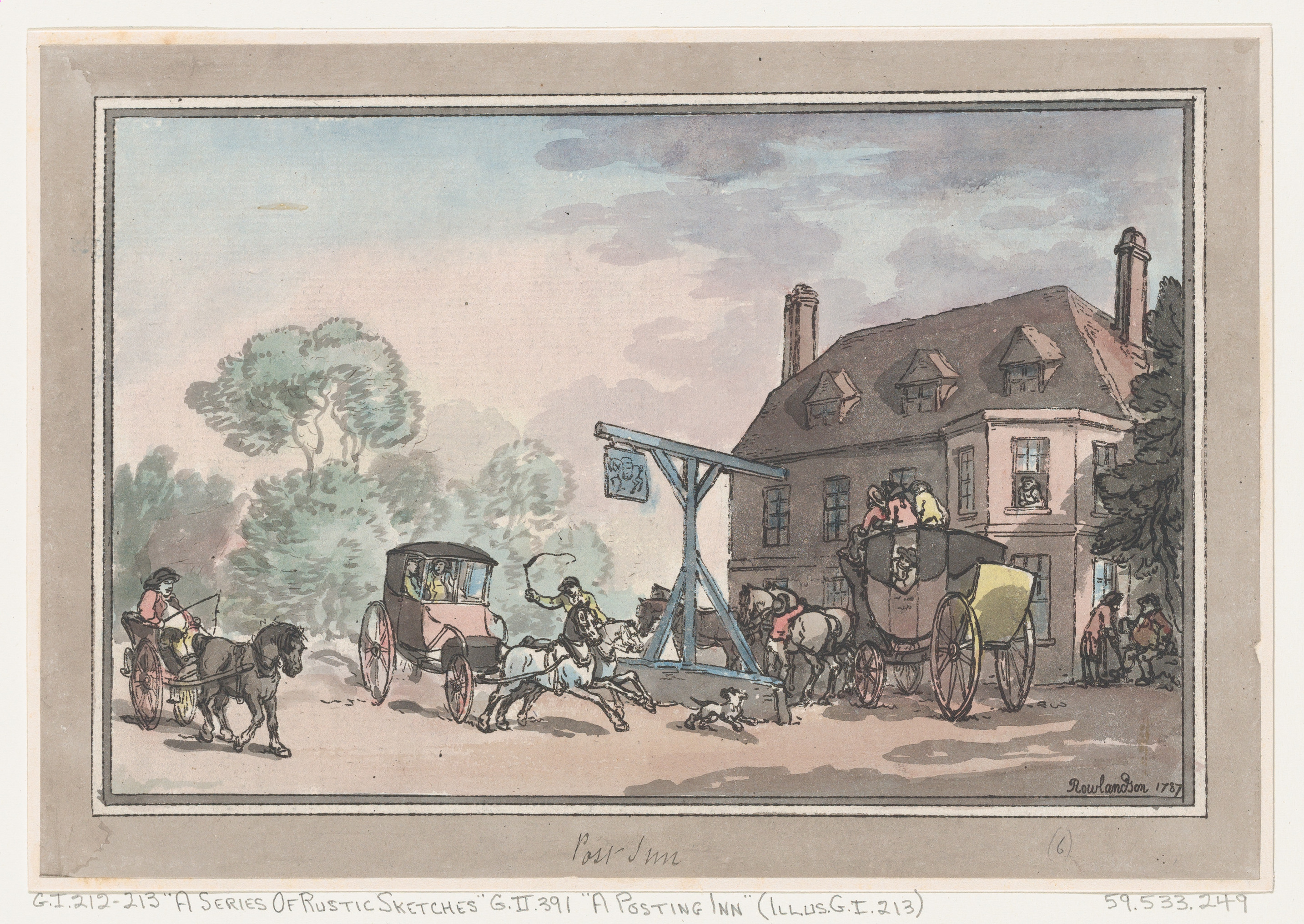
A Posting Inn Rowlandson

Thomas Rowlandson: A Posting Inn, 1787, Met Museum, public domain image

This  print shows three vehicles beside an inn – two moving, one parked:

  1. The parked vehicle is a public coach laden with passengers and drawn by four horses. The animals are being switched out for a fresh team, which, depending on the size, weight, and speed of the coach occurs every 6 – 12 hours. Switches slowed the journey’s progress and provided passengers with an opportunity to disembark and look to their personal needs. Some might choose to spend the night or enjoy a meal at the inn, much like Lydia, Kitty, Jane and Elizabeth.

“…in Hertfordshire; and, as they drew near the appointed inn where Mr. Bennet’s carriage was to meet them, they quickly perceived, in token of the coachman’s punctuality, both Kitty and Lydia looking out of a dining-room up stairs. These two girls had been above an hour in the place, happily employed in visiting an opposite milliner, watching the sentinel on guard, and dressing a salad and cucumber.” – Pride and Prejudice, Chapter 13

After welcoming their sisters, the girls triumphantly displayed a table set out with such cold meat as an inn larder usually offers, exclaiming, “Is not this nice? Is not this an agreeable surprise?” Elizabeth and Jane remained calm and collected, and murmured approval in the appropriate way. Silently Lizzie (and we readers) thought Lydia and Kitty the silliest of chits.

The Dashwood women took a public coach out of necessity after vacating Norland Park with just enough funds to live as gentlewomen in a cottage provided generously by Mrs Jenkins, a relative stranger to them.

seeing-barton-cottage

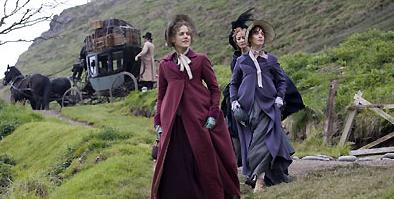
The above image depicts the Dashwood women leaving the carriage and seeing Barton Cottage for the first time. Notice the luggage strapped on top of the conveyance. Their furniture, cutlery, tableware, linens and the like would most likely be delivered in a humble wagon by a male servant before or after the move. Servants were often sent ahead of time to ready the new dwelling or they might travel at the same time in a different carriage or wagon. 

Passengers sitting inside a crowded carriage carried their possessions on their laps or between their feet, especially those unfortunate enough to sit in the middle. Those sitting on top were subject to the elements, come rain or snow.

2. In the center of the print is a post chaise that is often a private carriage. It could seat from two to three passengers and was guided by a postillion astride one of two or four horses. A trunk placed in the front of the carriage and behind the horses was just big enough to carry personal effects. This private carriage was more expensive to hire than a public coach, for the vehicle’s speed was highly prized, especially by couples who eloped to Gretna Green.

3. The vehicle to the left is a humble cart pulled by a pony or donkey. Austen’s donkey carriage, also known as a donkey cart, looks elegant in comparison. (See image in link.) After a cold spell in January of 1817, Jane wrote:

‘our Donkeys are necessarily having so long a run of luxurious idleness that I suppose we shall find that they have forgotten much of their Education when we use them again.’

Austen used the vehicle for local shopping runs to Alton. The vehicle depicted by Rowlandson provided little space for purchased goods. These carts were serviceable for moving a few possessions to a location not far away and for individuals who could make frequent back and forth trips. Austen drove her cart at the breakneck speed of 4 mph in her travels to Alton, a trip that took 20 minutes one way.  

Along the road:

Before the railroads were built, beasts of burden were the “engines” used for transport on land and along man-made canals. They included horses, oxen, mules, and donkeys. Small carts were often pulled by goats or large dogs. As mentioned before, all needed food, water, shelter, and rest, an expense that poor owners could barely afford. Animals who did not receive these basic necessities, lived shortened lives. Often a beast of burden’s reward after years of service was either a trip to the knacker after it died or to a farmer to labor until they dropped from exhaustion. 

Thomas_Rowlandson_-_A_Dead_Horse_on_a_Knacker's_Cart_-_Google_Art_Project

A Dead Horse on a Knacker’s Cart. Thomas Rowlandson, Wikipedia

Even with the help of beasts of burden, moving heavy furniture and a large quantity of personal possessions was no small feat. The pace of travel was slow and often laborious. Before roads were macadamized in the early 19th century, they were in poor condition. After heavy rains, deep ruts and mud slowed vehicles down. Winter snow and ice presented additional hazards. Animals as well as passengers and drivers suffered the most in these harsh elements. 

Working animals’ lives were even more drastically reduced from their exertions of pulling heavy wagons and over loaded carriages. Mail coaches during Austen’s day were the fastest means of land transportation. A faster speed was achieved by driving the horses at top speed and changing the teams every 12 to 15 miles or about every 2 hours. These horses, urged to attain maximum speed at whatever cost, had drastically shortened working lives and lifespans.

The images below show the challenges of moving heavy wagons in snow and mud. Click on the images to enlarge.

The liverpool mail near St Albans – Robert Havell (click the link to see image, which is copyrighted. Horses are stopped with its leader fallen.)

Types of vehicles and those who used them:

Travel for the upper classes:

Income determined the conveyance in which an individual or family moved and how many household goods could be transported over a certain distance. Aristocrats and rich landowners, like Mr Darcy, experienced few impediments. The rising middle classes could also choose more comfortable and efficient means of travel. One can imagine that Mr Bingley arrived at a fully furnished Netherfield Park, having sent trusted representatives and servants ahead of time to see to the details of moving personal belongings, and hiring competent locals to perform additional labor. Keep in mind that the upper crust travelled in style, while servants, aside from valets and ladies maids, accompanied their masters’ possessions in less desirable transportation.

  • For more visual references regarding carriages for the upper classes, Deborah Barnum of Jane Austen in Vermont offers valuable posts on the topic. Click on this link: IV of a series.  

Landless gentry and aspiring social climbers make do with less elegant equipages: 

Mrs Elton, a ridiculous character in Austen’s splendid novel, Emma, assumes that her social position in Highbury is equal to Emma’s. Austen has fun with the character, who utters one absurd opinion after another. She piggy backs onto her sister’s wealth by bragging about that woman’s elegant carriage, while expressing a desire to Mr Knightley to have a donkey. He wryly suggests that she could borrow Mrs Cole’s animal, implying she could save herself the money. In reality, the Eltons must make do with what they have.

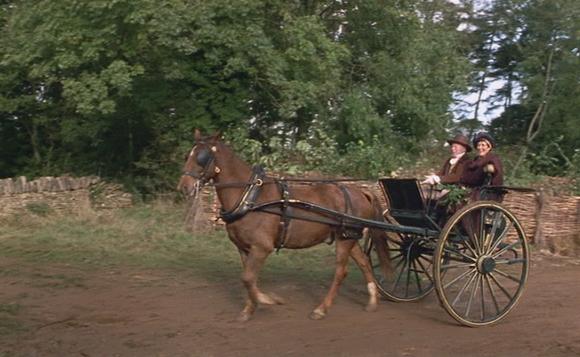
crofts curricle

Crofts arrive in a gig, Persuasion 1995. Gigs were not associated with the rich, and the Crofts drove theirs for local excursions only.

“She and her husband are provided with an unexceptionable carriage and horses that suffice for their needs, though of course they cannot be compared with her wealthy sister’s equipage, a barouche-landau….” – Diana Birchall quote in writer Sarah Elmsley‘s splendid blog.

Mr Elton, a mere vicar, served parishioners at a lower social scale than Rev Austen. While Elton received a salary and a rent-free a house, he received no tithes, which limited his income and necessitated his finding a wife with resources. He overstepped his ambition by wooing Emma Woodhouse, but settled for Augusta Elton, whose connections are murky. His marriage to Augusta increased the readers’ enjoyment of the couple’s absurdities.

Austen’s father, Rev George Austen, enjoyed an income from a variety of sources, including a 10% tithe from parishioners from two parishes who could afford to pay the amount. He also oversaw a glebe land, which he farmed. This combined income should have served him well, but his large family necessitated that he and Mrs Austen run a boy’s boarding school for profit inside Steventon Rectory. When George retired, his son James inherited his living and the house the family once occupied, but Rev Austen retained the income from the tithes of the parishes he once served. When he died, this income ceased, plunging the Austen women into financial difficulties, which resulted in their continual quest to find more affordable lodgings — until Edward Austen Knight offered Chawton Cottage to them. This last move resulted in Jane Austen’s glorious creative period in which she published five novels during her lifetime.

Rev Austen and his family moved to Bath in 1801, with only the possessions that would fit into their new home. He no longer had his extensive library or the use of a horse and carriage. The family’s many servants were reduced to a cook, manservant, and one or two maids, depending on the family’s needs. Like other families in their economic situation, they used hired carriages, such as hackney coaches, or public coaches to reach destinations beyond walking distance. During the family’s move to Bath, the goods and possessions they could not physically take with them were most likely transported by a manservant in a wagon.

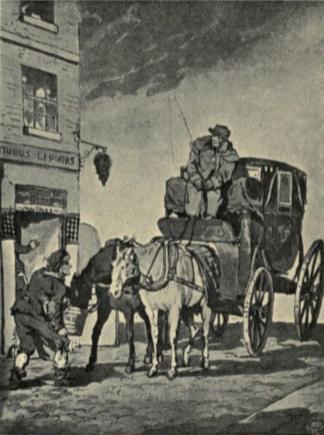
Hackney Coach 1800

Hackney Coach 1800

The 60-mile journey from Steventon to Bath took one day. A rest for the horses at an inn or hotel like the Petty France was a necessity. The following quote from Dean Cantrell describes Catherine Morland’s journey from Bath to Northanger Abbey. The Austen family must have also shared the same feelings: 

“Both carriages stop at Petty France, exactly half the thirty-mile distance from Bath to the General’s Abbey.  Catherine laments “the tediousness of a two hours’ bait” that permits “nothing to be done but to eat without being hungry, and loiter about without any thing to see” (NA, 156).  She clearly understands that it is the chaise with its “heavy and troublesome business” that requires a two-hour halt for the horses to be fed and refreshed…Fifteen miles from Bath, Petty France would have been a likely coach stop in 1801 and 1806 for Jane Austen.” – Yes, There is a Petty France, Dean Cantrell, Persuasions, 1987

Screen Shot 2023-10-28 at 8.45.13 AM

Petty France Hotel

A sixty mile journey must have been exhausting in a public conveyance. View more images of public transportation in this Jane Austen in Vermont, post number III

People from humbler walks of life and their forms of transport:

Three Rowlandson images of a flying wagon speak volumes on how people with modest means traveled and transported their goods in wagons that look remarkably like the Conestoga wagons colonists drove across America. 

A flying wagon Rowlandson

Rowlandson, Flying Wagon, MET Museum, public domain, 1816

This Kendal Flying Machine, a wagon, is parked outside of an inn. A woman climbs up a ladder into the wagon. Three men stand at right. In Mr. Rowlandson’s England, Robert Southey described the laboriously slow progress of a flying wagon:

The English mode of travelling is excellently adapted for every thing, except for seeing the country…We met a stage-waggon, the vehicle in which baggage is transported, I could not imagine what this could be; a huge carriage upon four wheels of prodigious breadth, very wide and very long, and arched over with a cloth like a bower, at a considerable height: this monstrous machine was drawn by six large horses, whose neck-bells were heard far off as they approached; the carrier walked beside them, with a long whip upon his shoulder…these waggons are day and night upon their way, and are oddly enough called flying waggons, though of all machines they travel the slowest, slower than even a travelling funeral.” – P 23   


From Southey’s description and depiction of the flying wagon in the first Rowlandson image, one can see the differences in size and the numbers of people and the size of the loads each of these wagons could carry. Rowlandson’s first image of a flying waggon depicted a much smaller vehicle than the one shown in the rendering on P 23, which was drawn by six horses.

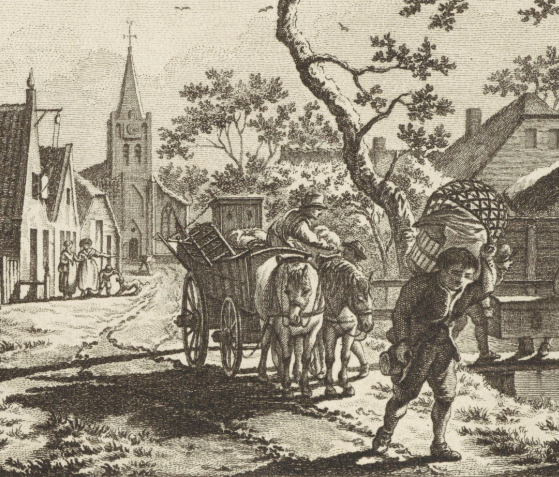
The detail below of an 1806 Dutch etching from The Rijksmuseum shows a cart laden with furniture moving through a small village. A man walking in front seems to be carrying baskets with items inside.

Screen Shot 2023-10-28 at 9.23.25 PM

As in the illustration above, affordable modes of transportation of two- or four-wheel uncovered wagons, were used by humbler people who could afford them. Examples are included in the slide show below. Notice that some images are current, since the mode of moving goods among the poor has changed little over the centuries. 

This slideshow requires JavaScript.

pack_horses

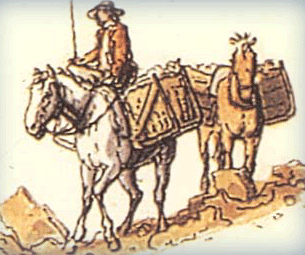
Detail of pack horses.

Very poor or itinerants who moved from place to place often walked, carried their personal goods in sacks, pushed them in wheelbarrows or hand carts, rode pack horses, or caught a ride by a kind stranger.

Rivers and inland waterways:

Overland transportation was not the only route people took to move to a new location. England’s streams and rivers had long been a fast, efficient means of travel.

Steam locomotives arrived 3 years before Jane Austen’s death. Before this time, transport via inland waterways and rivers provided a more comfortable and, in many instances, a faster way to move items. Ferries took people and wagons across river crossings.

A surge in canals building occurred in England in the second half of the 18th century, and by the mid-19th century these canals helped the expansion of the English Industrial Revolution. In Jane Austen’s day, most developers still struggled to make a profit building canals. Once they were introduced to connect city to city and routes within cities, these canals became an important source of transporting goods within England and were more profitable.

Horse_Drawing_Barge_on_the_Kennet_and_Avon_Canal

Horse drawing from a towpath on the Kennet and Avon Canal, England, Wikipedia

“A horse, towing a boat with a rope from the towpath, could pull fifty times as much cargo as it could pull in a cart or wagon on roads. In the early days of the Canal Age, from about 1740, all boats and barges were towed by horse, mule, hinny, pony or sometimes a pair of donkeys.” Wikipedia, Horse-drawn boat

Importantly, ferries, canal boats, and barges carried heavier loads: they also provided accessibility and affordability to a variety of people from different classes. 

Seaside ports:

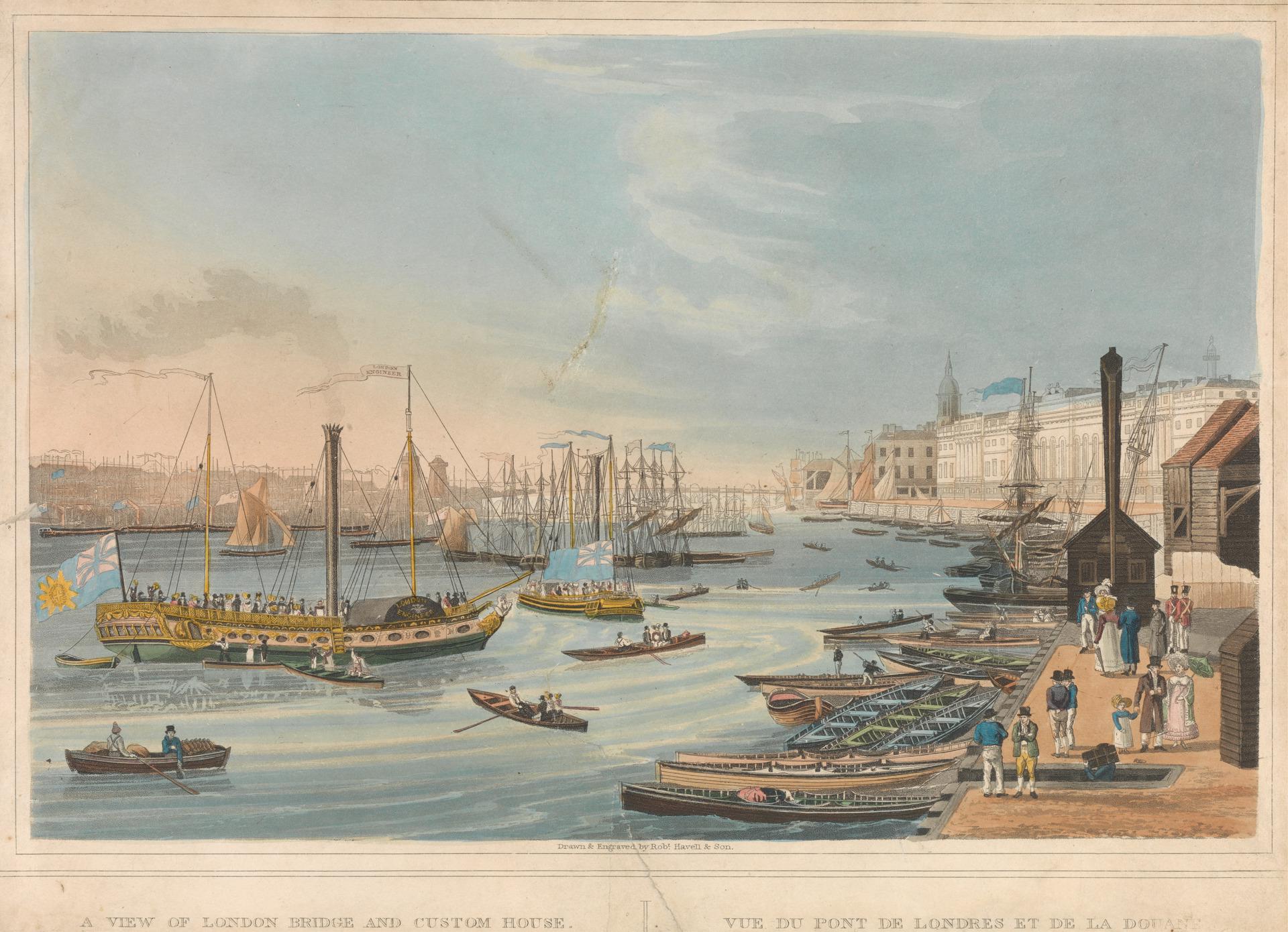
Another popular means of transportation in England, an island nation, was via ships that sailed along and around its coastlines to various coastal ports and into major cities. 

Havell, A View of London Bridge and Custom House_-_B1977.14.18472_-_Yale_Center_for_British_Art

A View of London Bridge and Custom House, Robert Havell, Sr., Yale Center for British Art

Additional information on the topic:

Read Full Post »

by Brenda S. Cox

“This is quite the season indeed for friendly meetings. At Christmas every body invites their friends about them, and people think little of even the worst weather.”–Mr. Elton, Emma

I hope you are all enjoying the holidays. In Austen’s novels, Christmas is a time for parties and for family and friend to gather, just like today. It was also a day for attending church (see Emma ch. 16 and Mansfield Park ch. 23), after weeks of Advent when prayers focused on the coming of Christ. For more on the prayers and readings that Austen would have prayed and read for Advent and Christmas, see my post Advent with Jane Austen. You can also find many posts at this site (and others) on Christmas customs in Jane Austen’s England.

I recently gave a presentation on “Satirical Cartoons and Jane Austen’s Church of England” at JASNA’s Annual General Meeting (you can read it in this month’s Persuasions On-Line, or, if you are a JASNA member, you can watch it in the AGM on Demand).  Today I’d like to share a few cartoons about Christmas in Austen’s England. (I didn’t find many; perhaps Christmas was not a popular subject for caricatures.)

Triumphal Procession

Let’s start with this wild one.

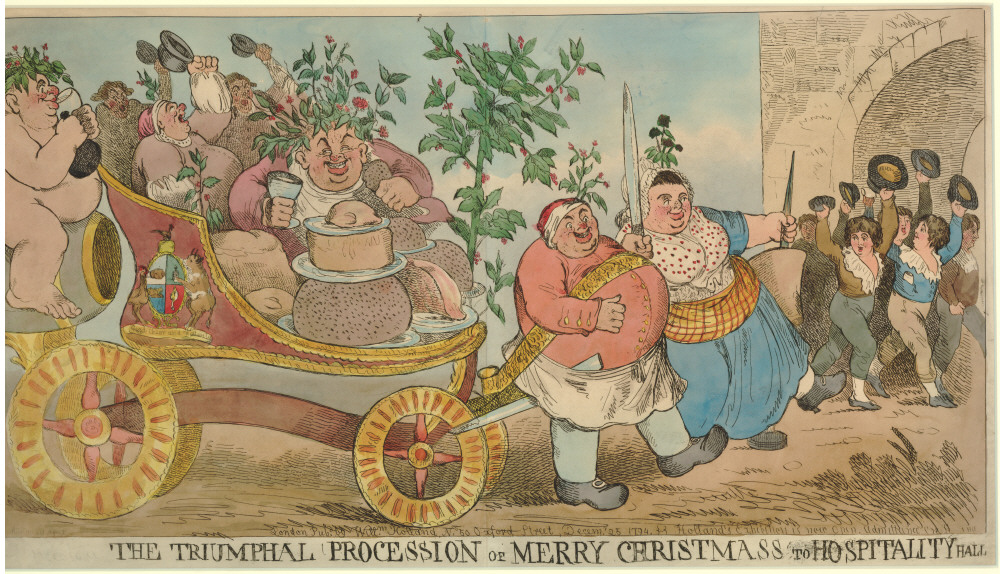
The Triumphal Procession of Merry Christmas to Hospitality Hall, Richard Newton, 1794.
© Trustees of the British Museum (CC BY-NC-SA 4.0) via wikimedia

In an earlier post about the Clerical Alphabet cartoon, I wrote about Richard Newton, a prolific young artist of the time. Newton drew the above cartoon in 1794, satirizing the general gluttony and drunkenness associated with Christmas. In The Triumphal Procession of Merry Christmas to Hospitality Hall, men on a carriage feast on large pieces of meat while behind them a naked man sits on a barrel, probably of wine or another alcoholic beverage.

Academics at Christmas

Christmas Academicks, Playing a Rubber of Whist, Thomas Rowlandson, 1803.
Public domain via the Metropolitan Museum of Art.

University professors have a much more restrained celebration, though still not a devout one. Thomas Rowlandson’s The Christmas Academicks Playing a Rubber of Whist (1803) shows four academics playing cards, while a fifth stands nearby and a servant brings drinks. All are clergymen, probably fellows (professors or tutors) at the University of Oxford or Cambridge, who would be single clergymen. (Jane Austen’s father was a fellow at Oxford until he married.) As in many satirical cartoons of the time, the clergymen are pictured as overweight and self-indulgent. They are gambling and drinking, not in church. 

Farmer Giles’s Establishment, Christmas day, 1800, by William Heath, 1830
Courtesy of The Lewis Walpole Library, Yale University

Farmer Giles: Christmas Through the Years

Some years later, in 1830, William Heath drew a series on Christmas as a political satire. It begins with a delightful version of an 1800 country Christmas, such as the Musgroves or Westons might have enjoyed in Austen’s novels.

Farmer Giles was a symbol of the unsophisticated country farmer. Here he feasts with his joyful family at Christmastime. As we see in Austen’s novels, Christmas was a time for parties and feasts. Greenery decorates the fireplace and the wife is slicing plum pudding. Farmer Giles is apparently prosperous and he becomes more so.

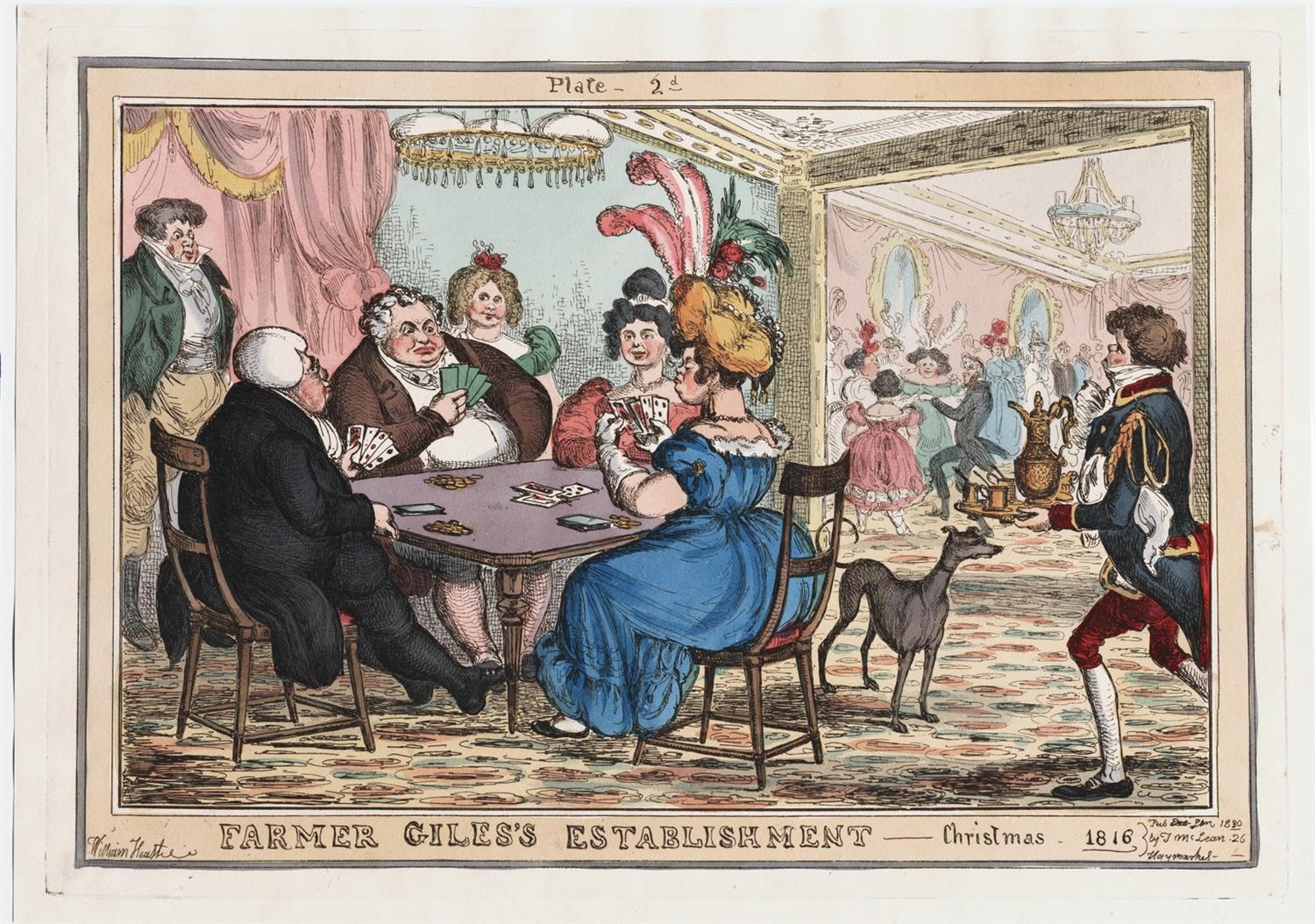
Farmer Giles’s Establishment Christmas 1816 by William Heath, 1830
Courtesy of The Lewis Walpole Library, Yale University

By 1816, the farmer has done well and moved up into fashionable society. This Christmas he and his wife are playing cards (gambling) while guests dance in the ballroom. However, they look much less happy than in the first print. The children are grown now, and looking on. The farmer’s hand appears to be bandaged for the gout, from overeating and excessive drinking.

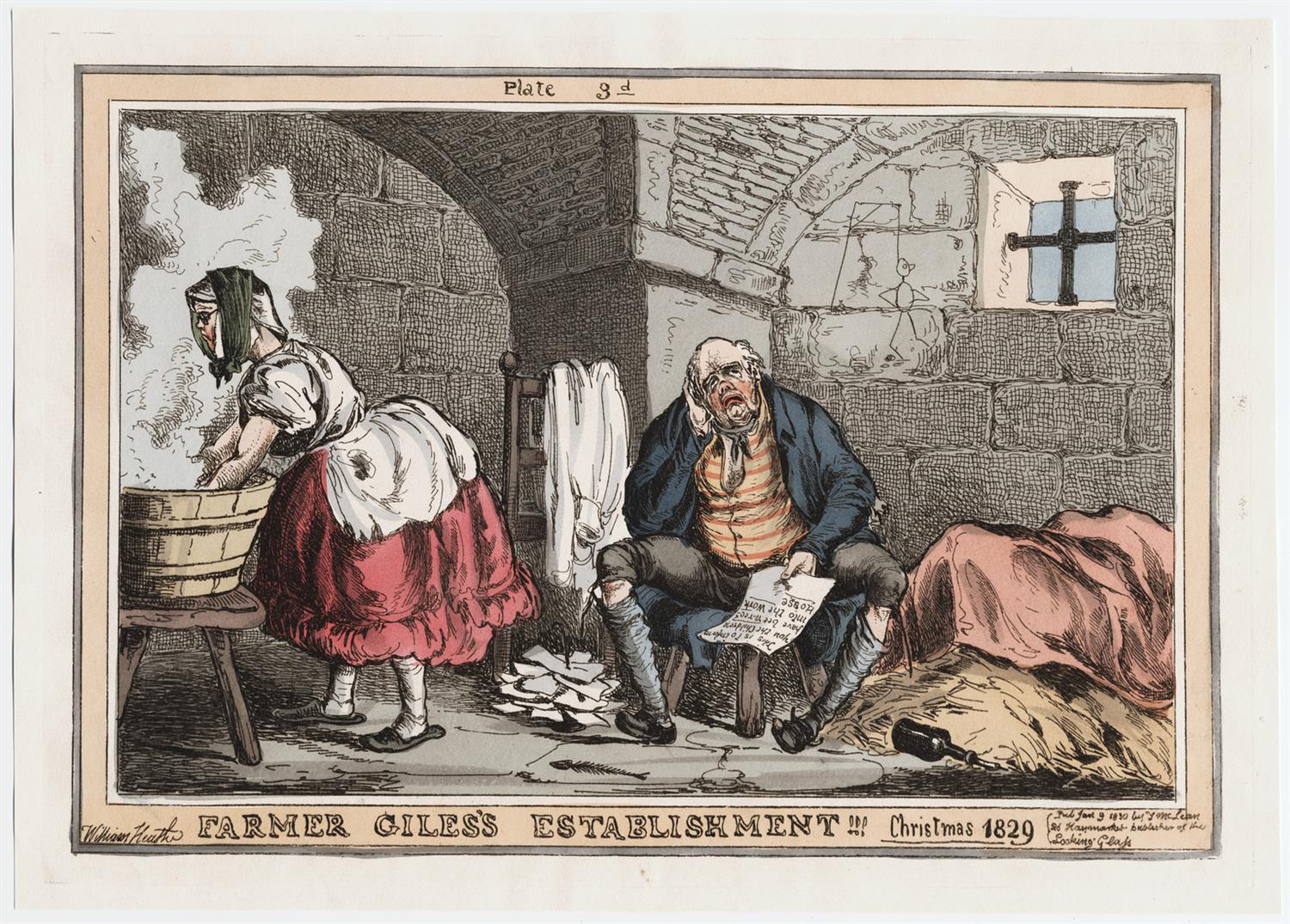
Farmer Giles’s Establishment!!! Christmas 1829 by by William Heath, 1830
Courtesy of The Lewis Walpole Library, Yale University

Their financial prosperity doesn’t last, though. The agricultural economy crashed.

In the third plate, Farmer Giles’ Establishment!!! Christmas 1829, the farmer is in a debtors’ cell. He holds a paper saying his children have been sent to the work house. His wife is doing laundry in a tub.

So this series becomes political satire, criticizing the government for its policies which led to an agricultural depression. A very sad Christmas.

The Merry Musgroves

But let’s return to Austen’s happier times. 

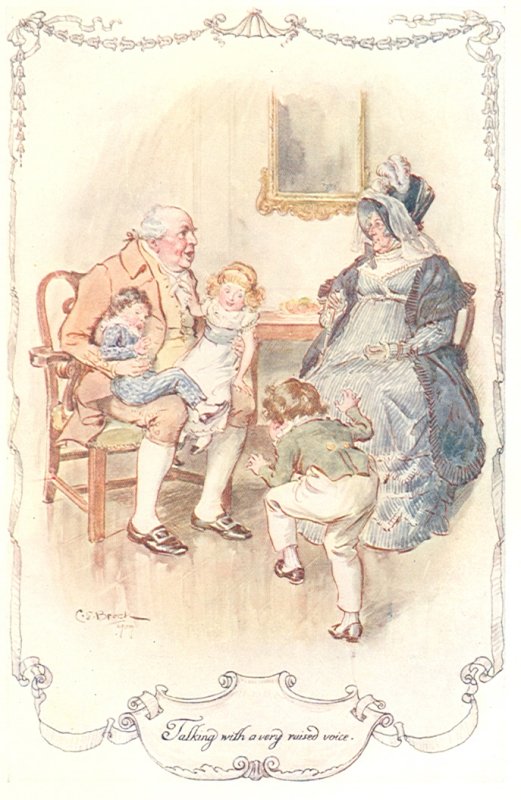
The Musgroves and children at Christmas
C.E. Brock, Persuasion, Volume 2, chapter 2

As Austen describes Christmas at the Musgroves, in Persuasion:

On one side was a table, occupied by some chattering girls, cutting up silk and gold paper; and on the other were tressels and trays, bending under the weight of brawn and cold pies, where riotous boys were holding high revel; the whole completed by a roaring Christmas fire, which seemed determined to be heard, in spite of all the noise of the others. . . .

Anne, judging from her own temperament, would have deemed such a domestic hurricane a bad restorative of the nerves, which Louisa’s illness must have so greatly shaken; but Mrs. Musgrove, . . . concluded a short recapitulation of what she had suffered herself, by observing, with a happy glance round the room, that after all she had gone through, nothing was so likely to do her good as a little quiet cheerfulness at home. . .

“I hope I shall remember, in future,” said Lady Russell, as soon as they were reseated in the carriage, “not to call at Uppercross in the Christmas holidays.”

Every body has their taste in noises as well as in other matters . . .

I hope this Christmas is just to your taste! Many blessings to you in the New Year.

Brenda S. Cox writes on Faith, Science, Joy, and Jane Austen. She is currently working on a book entitled Fashionable Goodness: Faith in Jane Austen’s England.


For more on satirical cartoons in Jane Austen’s England, see:

Satirical Cartoons and Jane Austen’s Church of England

The Stereotype of the Self-Indulgent Clergyman: Rowlandson’s Parsonage 

The Clerical Alphabet: Problems in Austen’s Church of England 

Keeping Within Compass  Mike Rendell also shows and discusses many other fascinating cartoons from Austen’s era on this blog, but be aware that many are risque. I am indebted to Mike for posting on the Newton Clerical Alphabet cartoon that got me started looking at cartoons and the clergy.
 

For more on Christmas in Austen’s England, see:

Party Like the Musgroves, by Rachel Dodge, to have your own party like the Musgroves did in the passage above!

Christmas Georgian Style 

Archive for Regency Christmas Traditions (various posts on this site)

Christmas Traditions (various posts from various sites)

More Regency Christmas Traditions (and scenes and stories, various posts from Maria Grace’s site) 

Joy to the World: Psalms, Hymns, and Christmas Carols in Austen’s England

Regency Christmas Carols

Handel’s Messiah in Jane Austen’s England 

Advent with Jane Austen: Now, and Not Yet 

Georgian Christmas Pie Recipes

Regency Christmas Songs and Games

A Jane Austen Christmas: Regency Christmas Traditions, book by Maria Grace

Christmas in Jane Austen’s Time

Jane Austen’s Christmas

. . . and much more!

Read Full Post »

Inquiring readers: In early October, Prof Elaine Chalus, Historian of 18-19C British gender, politics & society, sent a link to eight sessions of the Bath 250, A Virtual Conference, The 250th Anniversary of the New Assembly Rooms of Bath, given on 29t & 30th September 2021. I have listened to only a few of the presentations and hope to listen to many more before the two weeks are over. The presentation that resonated the most with me so far was of  Stephen Pool’s discussion of the sedan chairmen. I hope my synopsis accurately summarizes his main points.

____________________

After the French Revolution that promoted new ideas about equality, Bath sedan chairmen signed a declaration of fidelity to the King of England and the Constitution. They numbered 326. Interestingly, as a group the general public considered them to be rude and their language offensive, making their support of the King all the more interesting. In their defense, Steve Pool states:

“They worked in all weather. The worse the weather, the more likely they were to be called upon, from morning to night. In standing rain, the chairs became wet, inside and out”

Often, when the weather became intolerable (wind, snow, rain), many chairmen were nowhere to be found, and customers who sought their services were forced to walk towards their destinations through the elements.

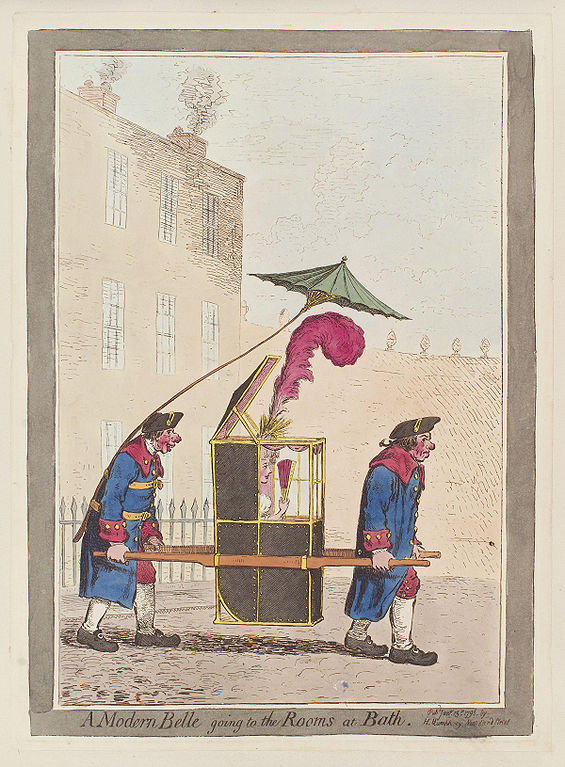
Sedan chairmen’s manners were considered by many customers to be insolent in public situations. The fashionable crowd often  considered them rude and grating. Cartoonists especially loved to capture these exchanges. Today we should not confuse these Georgian caricatures as objective or realistic observations. (Unfortunately, I could not find the many images in the public domain in Steve Pool’s presentation, except for this one.) 

A modern belle going to the Rooms at Bath-Gillray

A modern belle going to the rooms at Bath, James Gillray, 1796. Wikimedia Commons. The chairmen are drawn as rough, unhappy, and loutish. The belle is tender and refined. Notice the traditional Bath chairmen outfits.

Rules and regulations by the magistrates regarding the conduct of chairmen give us an insight into the difficulty they encountered in making a decent living. 

  1. Chairmen were required to apply for a license each winter to operate.
  2. Their clothes and combination of colors were strictly enforced. 
  3. Work began at 6 AM and lasted until midnight.
  4. The number of stands were enforced with the permits restricted for each site. If the maximum number of permits was reached, the chairmen would have to find another stand in another part of town.
  5. Only two places in Bath permitted an unregulated and unranked number of chairs: at the upper and lower assembly rooms, and occasionally “at the theater on play night or outside the Guildhall after an entertainment.” (Interestingly, the magistrates made sure that the stands connected the lower town with the newer uptown.)

Costs for licenses and stands were high for a 12-month period. In addition, complaints about the chairmen’s conduct were heard twice a week by the magistrates at lunchtime. Serious offenses included carrying customers without a license (40 shillings) to standing at a stand that was already full (10-20 shillings.)

When one considers that in 1739  chairmen charged only 1 shilling for any journey between 500 yards and a mile, and only 6 pence within city walls, and that this charge did not change for most of the century, one can understand why the chairmen began to object against the rigid, unchanging pricing system.

One other consideration is the customer’s behavior. Anstey, in his poeticals in The New Bath Guide 1780, described this incident in verse:

THIS Morning, dear Mother, as soon as ’twas light,

I was wak’d by a Noise that astonish’d me quite,
For in Tabitha’s Chamber I heard such a Clatter,
I could not conceive what the Deuce was the Matter:
And, would you believe it ? I went up and found her
In a Blanket, with two lusty Fellows around her
Who both seem’d a going to carry her off in
A little black Box just the Size of a Coffin;

Pray tell me, says I, what ye’re doing of there ?’
Why, Master, ’tis hard to be bilk’d of our Fare,
And so we were thrusting her into a Chair:
We don’t see no Reason for using us so,

For she bad us come hither, and now she Won’t go ;
We’ve earn’d all the Fare, for we both came and knock’d her
Up, as soon as ’twas light, by Advice of the Doctor:
And this is a Job that we often go a’ter
For Ladies that choose to go into the Water.”

Can anyone blame the chairmen for their gruff, forward, and insistent manners? The constant tugs of war among the magistrates, workers, and those of the Quality and rising middle classes who required their services, created many conflicts. The magistrates set down precise distances and costs, which were published in Bath Guides. When the city grew outside of traditional boundaries, the chairmens’ grievances for wanting an increase in fares for lengthier trips, and for the steep uphill treks to Landsdowne, north of the city, fell on deaf ears. 

Comforts of Bath Rowlandson Met museum

Rowland, Comforts of Bath, Plate 12. Notice the bath chair on the left. This hill in front of the Royal Crescent, was a favorite setting for the caricaturist to show the challenges of the sick and aging in getting around Bath’s hilly terrain. Public Domain image. Met Museum.

Steve Pool’s discussion included the chairmen’s rebellion, in which they refused to pay for licenses or carrying anyone to their destinations. In 1794, the magistrates included a higher scale of charges. They ended the discussion by stating that “This sweeping industrial relations victory was made possible through democratic reform societies, Mason trades unionism, and a measure of the chairman’s collective industrial strength.”

As a contemporary listener, I compare today’s low wage workers, whose minimum wages have not changed for two decades, with the chairmen in Bath’s past. The Bath chairmen revolted; today’s minimum workers are revolting as well. History’s past has turned full circle and is still relevant today in terms of liberty and equality!

Only a few more days remain for readers to view the Bath 250 Virtual Conference (see link in the introduction), which, in the 5 workshops I’ve viewed, has been filled with new information. 

Sources:

Eighteenth-Century Poetry Archive: Anstey, Christopher, 1724-1805. The new Bath guide: or, memoirs of the B-r-d family. In a series of poetical epistles. [London]: Sold by J. Dodsley; J. Wilson & J. Fell; and J. Almon, London; W. Frederick, at Bath; W. Jackson, at Oxford; T. Fletcher & F. Hodson, at Cambridge; W. Smith, at Dublin; and the booksellers of Bristol, York, and Edinburgh, 1766

Bath: An Adumbration in Rhyme, by John Matthews. A Critical Edition for Readers of Jane Austen. Series Editor: Ben Wiebracht. A book review on Jane Austen’s World blog.

Thomas Rowlandson, Comforts of Bath, Plate 12, Publisher: S. W. Fores (London), January 6, 1798. Public Domain image, Met Museum.

Read Full Post »

Older Posts »