Feeds:
Posts
Comments

Archive for 2011

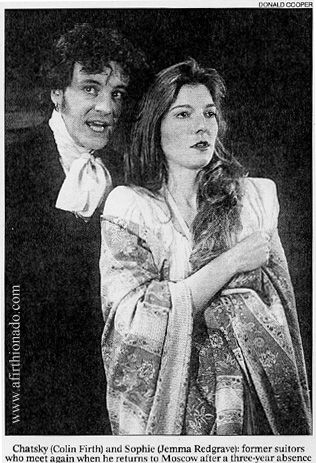
In 1993 Colin Firth starred opposite Jemma Redgrave (Lady Betram, Mansfield Park) in Chatsky, in which the hero of the play tells the truth and is mistaken for a lunatic.  It is amazing to see the images from that play,  for, since it is set during Regency times, Colin in full costume could easily be mistaken as Mr. Darcy, a role he would play two years later. Jemma played Lady Bertram in 2007′s Mansfield Park. Although the part was written against type (at the end of the film, Lady Bertram energetically unites Fanny with Edmund), her portrayal of that indolent lady was fresh and memorable.

Image @The AFirthionado Archive

To see more pictures of Chatsky and to read about the play, go to: The AFirthionado

Colin in 1993. Image @The AFirthionado Archive

Colin in 1995

Read Full Post »

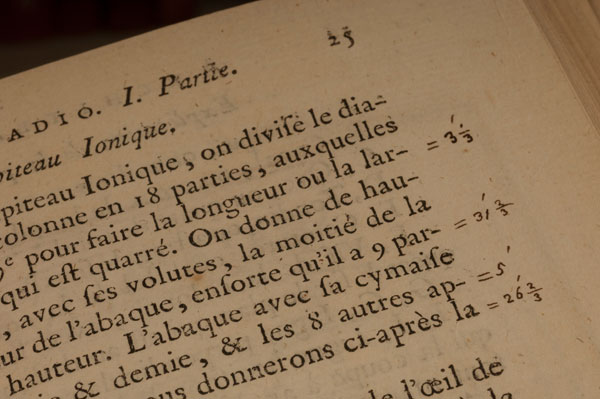
Jefferson's neat notations in the margin of "Architecture de Palladio. Image @Washington University Libraries, Department of Special Collections

Most of us have written in the margins of books, especially in our own textbooks when cramming for an exam or writing a paper, but how many of us write notes in expensive hardcovers that we treasure? These days writing inside books is heavily discouraged and frowned upon, but it was once a common practice, one that has pleased many a historian and bibliophile. Imagine coming across a dusty old book at a yard sale and finding the notes and scribblings of a famous person inside of it. Imagine the joy you would feel to come across such a connection!

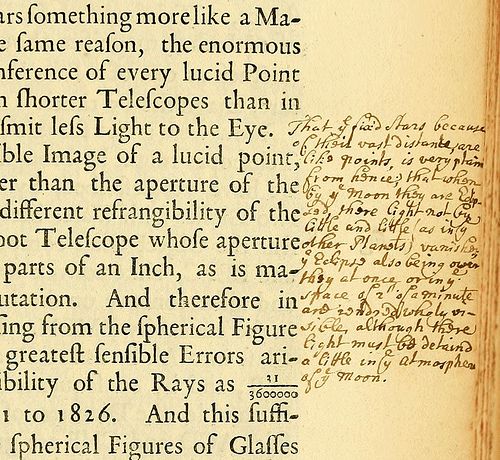
Sir Isaac Newton's marginalia

Marginalia, or the practice of writing in books, has a rich literary tradition. Samuel Taylor Coleridge’s friends lent their books to him on purpose hoping that he would write along their margins. Chances were that he did, for he was a prolific margin writer. Mark Twain often made comments, giving his opinions or hotly debating with the book’s author.  Other practitioners of margin writing were William Blake, Charles Darwin, and Thomas Jefferson. Even Jane Austen joined this select group, scribbling in her copy of Oliver Goldsmith’s book about her favorite poet, William Cowper (pronounced Cooper.)

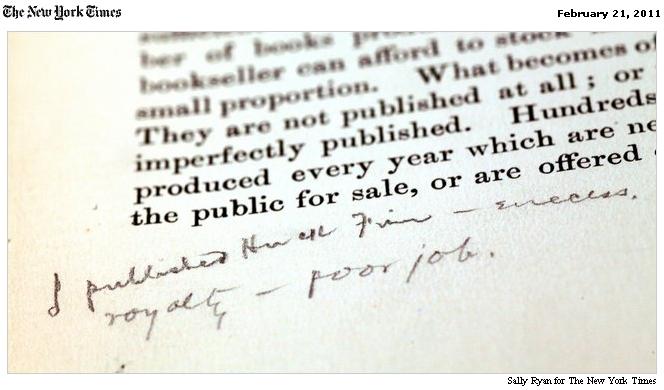
Mark Twain's annotation of his publication of Huckleberry Fin. Image @New York Times

In Persuasions Online, Jane Austen scholar Edith Lank writes about her copy of the two-volume Lord Barbourne edition of Jane Austen’s letters, which she found at a sale. This books is filled with

detailed genealogies, marginal comments, explanations and family gossip…The first were Fanny Caroline Lefroy and her sister Mrs. Louisa Lefroy Bellas, both daughters of Jane Austen’s neice (sic) Anna Austen Lefroy. The sisters annotated the book in careful nineteenth-century script and printing.” – List of Annotations in the Bellas Copy of Lord Brabourne’s Letters of Jane Austen

Thomas Jefferson’s scribblings were as elegant and refined as his mind. He sold his book collection to the Library of Congress in 1815, and kept a personal collection of books that he built upon until his death. Those books revealed that he often corrected typographical errors.

Thomas Jefferson's neat handwriting in Greek on a note inside his book.

Marginal scribblings provided a window into the minds of its writers, for they offered an insight into what they thought and revealed personal aspects of their characters. My scribblings in college texts were boring, for they merely summarized the most important points I needed to recall. I rarely left a personal thought in the margins or wrote inside my own books, although I dog eared favorite passages or left scraps of paper between pages that I wanted to reread.

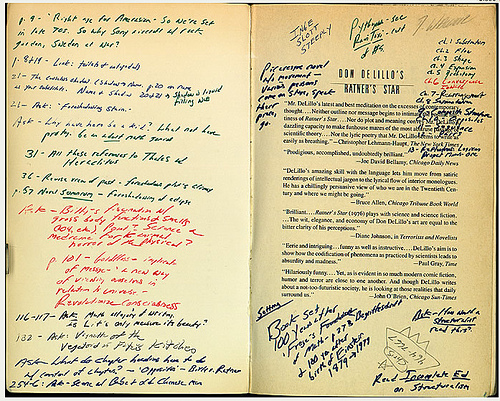
Wild scribblings

The author of an article in the New York Times feared that the advent of eBooks would end the art of marginalia, but the following passage partially assuages that fear. I say partially because part of the charm of marginalia is to see the author’s hand and his/her choice of writing implement, which is something Kindle does not yet offer (who knows what the future will hold?):

Annotations in a Kindle

When I received a Kindle as a gift earlier this year, my habits of marginalia soared to new heights. It became extremely easy to highlight passages and add notes, which are then situated in the text I’m reading but also pulled together into my Kindle account on Amazon where I can, for instance, share them with students in a course, fellow members of a book discussion group, family, and friends…even, in theory, with enemies. I’ll rebut and rebuke them with my rapier marginalia. It’s even possible to add a marginal note on a Kindle and then tweet it.-The margins of MarginaliaBooks From Thomas Jefferson’s Personal Library Rediscovered

Do you write inside books? What’s your opinion about about this literary tradition? And do you think Kindle will rekindle it?

More on the Topic

Read Full Post »

I am at a conference for the rest of the week. Workshops begin at 8:30 AM. Working backwards, this means I must be up by 5 AM to get washed and dressed, eat breakfast, drive to the training site, set up the workshop room, and be ready to greet participants (without a bleary eye) by 8:15 AM.

Upon reading my statements, early morning risers will think, “What’s so strange about that?” But for those of us who were meant to keep Regency hours, this schedule is akin to torture. I would much have preferred Jane Austen’s hours.

How the English during the Regency era spent their mornings depended on their status. The schedule of the modern day trainer or worker is, in fact, one that a servant in the 19th century would have kept, rising at dawn to haul and boil water, stoke the fires, and get the house in shape before the gentry arose. Unlike  19th century  servants, modern day folks generally eat breakfast before the workday begins. Servants, who had been toiling for at least 3-4 hours making the house ready for the day and tending to the family’s needs, would not break their fast until after the family’s breakfast dishes had been cleared and rinsed.
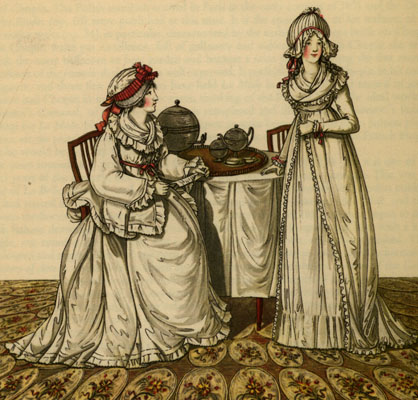
Ladies in their morning gowns at breakfast. Heideloff, 1794. Image @Fashion Gallery

Mrs. Bennet or Mr. Knightley, both country gentlemen, would rise earlier than their city counterparts, who kept later more fashionable hours. Upon rising at 7 AM, Jane Austen, for example, would not immediately sit down to breakfast. She would write letters or practice on the piano, walk in the garden to pick flowers, or even go into the village to run a short errand before sitting down with her family at 9 AM to partake of a simple breakfast consisting of rolls, breads, butter, preserves, and tea or a pot of hot chocolate. If she were on vacation or at the seaside, she might take a leisurely stroll to the beach or point of interest before partaking of the morning meal at an inn.

Mr. Darcy and Miss Bingley interrupted at breakfast, Pride and Prejudice 2005

Lady Bertram, whose day revolved around pleasing herself, would in all likelihood arise from her bed much later than Jane and remain in her dressing room with her maid until she was suitably dressed. Before breakfast, she would also consult with her housekeeper about the household plans for the day, giving her instructions to relay to the cook about the day’s meals. She might write letters in her boudoir and emerge in her morning gown and cap to eat breakfast with her family, or perhaps have it sent to her rooms on a tray.

Sir Thomas Bertram or Mr. Knightley would also delay breakfast. They might consult with their bailiffs, or check out a new horse at the stable before consuming their morning meal. General Tilney stuck to a strict schedule and had the family eat breakfast at nine. The Middletons, whose house was always filled with guests, ate breakfast at Barton Park around 10 AM. Some families sat down together, while others strolled in during a certain set time, say between 10 and 11 AM let’s say, to help themselves from dishes placed on a sideboard. One imagines that the Tilneys observed the former practice, whereas Mr. Bingley and the Middletons allowed people to wander into the breakfast room at their own pleasure. Edward Austen Knight, Jane’s rich brother, had breakfast served at 10 AM, and expected the entire family to be at the table.

By 11:30 AM, breakfast service was generally over. Town times were much different, and meals were served at a later, more fashionable hour. Often the very fashionable would stick to those hours even when in the country. Lizzie Bennet walked 3 miles to Netherfield Park after breakfast to be with her sick sister, Jane, only to encounter Mr. Bingley’s town guests just sitting down to breakfast over an hour later.
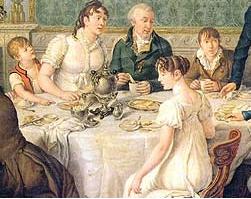
Regency family eating a meal together

The Regency definition of morning differed vastly from ours. Visiting hours were kept at set times. A family might receive visitors on Tuesdays and Thursdays, for example, or on Wednesday, between 11 AM to 3 PM. These hours were considered morning hours. When Anne Elliot arrived at Uppercross Cottage at 1:00 PM, she considered the time to be early in the morning.

Regency ladies wore morning gowns when they were at home. If a lady had no plans to go visiting or receive visitors, and simply stayed at home, she would wear her morning gown well past the hour of three, not bothering to change until dinner, when she was expected to dress more formally. Morning gowns could be made of simple dimity gowns covered by a pinafore if the lady, like Elinor Dashwood or Cassandra Austen at Chawton Cottage, was working in the kitchen or garden, or the gown could be made of finer stuff, like a delicate muslin. Ladies in morning gowns could be seen by family and guests, but they would never dare set foot in public while wearing one.

I must admit to liking Regency hours. On the weekends or on vacations, I rise late and will lounge for hours in my study/dressing room, reading or writing for my blog while sipping coffee. I’ll throw on some clothes and walk my dog Cody, and afterwards will make breakfast. I’ll then hang around the house in my ratty lounge wear, doing a little of this and a little of that, before donning more respectable garments to receive visitors, go out and shop, or visit with friends and family. If I am home all day, I’ll stay in my frayed jeans and tee shirt.

Would that my daily schedule resembled my weekend schedule! But, alas, I must work to earn my dog’s kibbles. The clock tells me I must get dressed now and be out of the door in half an hour. The powers that be decreed that our work day starts anywhere between 7 and 9 AM (even earlier for many). Obviously, considering those hours, our bosses view us more as servants than as revered guests.

I, for one, was meant to be a lady of leisure. Perhaps I shall be reincarnated as one?

More on the topic:

Sources:
Wilson, Kim. Tea With Jane Austen. Frances Lincoln LTD, ISBN: 9780711231894
Le Faye, Deirdre. Jane Austen: The World of her novels, Frances Lincoldn LTD, ISBN: 9780711222786

Read Full Post »
Today almost everywhere we turn we are inundated with ads over television and radio, in film theatres, on billboards and our computers, and magazines and store fronts. We simply cannot escape the messages put out by individuals and businesses trying to get us to buy their products and services.

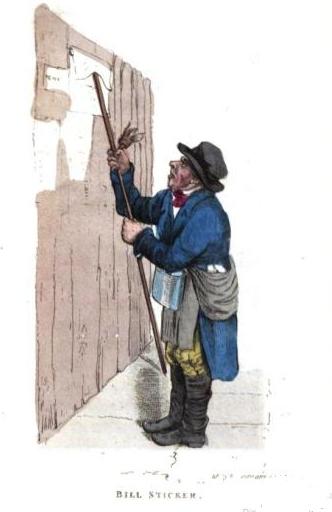
W. H. Pyne, Bill sticker

The situation was the same in Jane Austen’s day. When shoppers walked to a shopping area in a city the streets would be indundated with shop signs, hired walkers wearing advertising boards, and hawkers. Advertising merchants dealt in trades that are both familiar and unfamiliar to us today: silversmiths, coal dealers, shoemakers, scum boilers, boarding houses, brewers, tavern keepers, silk merchants, coffee houses, cabinet makers, bakers, mattress makers, curriers and dealers in grindery, warper, hair dressers, woollen drapers and dealers in trimmings, victuallers, livery stable keepers, grocers, music sellers, linen drapers, beer sellers, dealer in rags, tripeman, tobacconist – well, the list goes on.

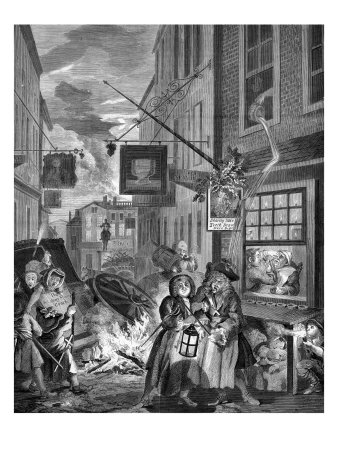
This is a raucous street scene in London at night in which the shop signs hanging over the pedestrians seem almost ominous. (Notice the slop being poured out of the window!)

There were leaflets, handbills, posters on bricks walls and glass windows seemingly almost everywhere, and advertisements in newspapers … and of course the inevitable street criers.

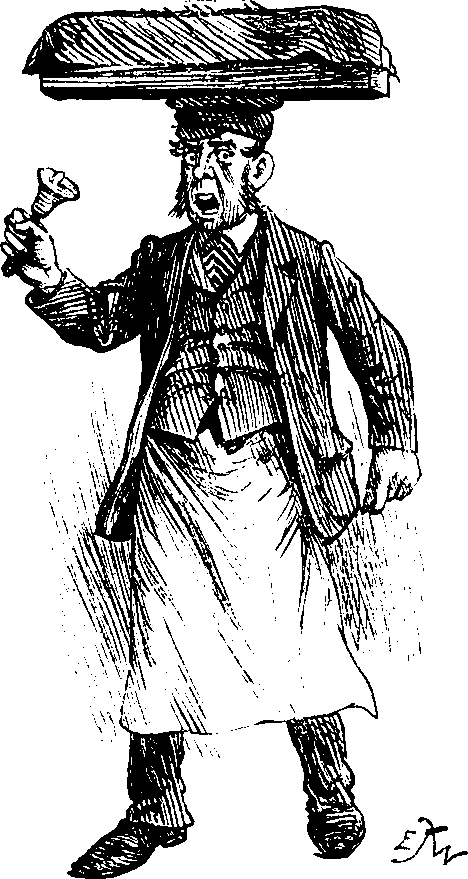
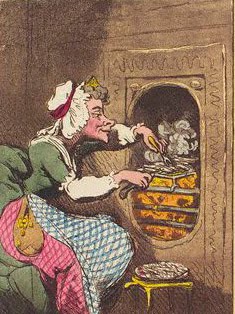
The bell and cry of the muffin man

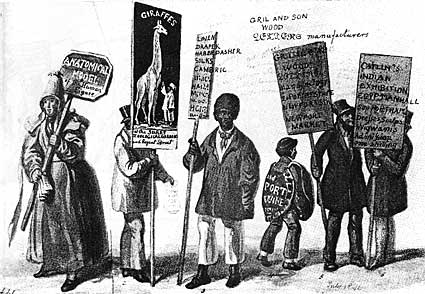
Bill stickers, or external paper hangers plastered blank walls, empty shops and wooden hoards and fences with advertisement bills. But these activities were taxed. And thus enterprising merchants turned to mobile advertising and paid people to wear sandwich boards and hand carry placards. – London Street Advertising

Walking billboards in the 18th century. The young boy is wearing a sandwich board!

Extensive improvements on the printing press meant that newspapers and printed products could be churned out swiftly and more efficiently than before. Bills and posters were printed speedily and cheaply. There were frequent misspelling of words, and if more than one color was used, a frequent misplaced overlay of one color over the other. Printed ads and posters were designed to promote an event or sale, and were meant to be discarded. Bills plastered on walls and fences would soon be covered over by newer announcements.

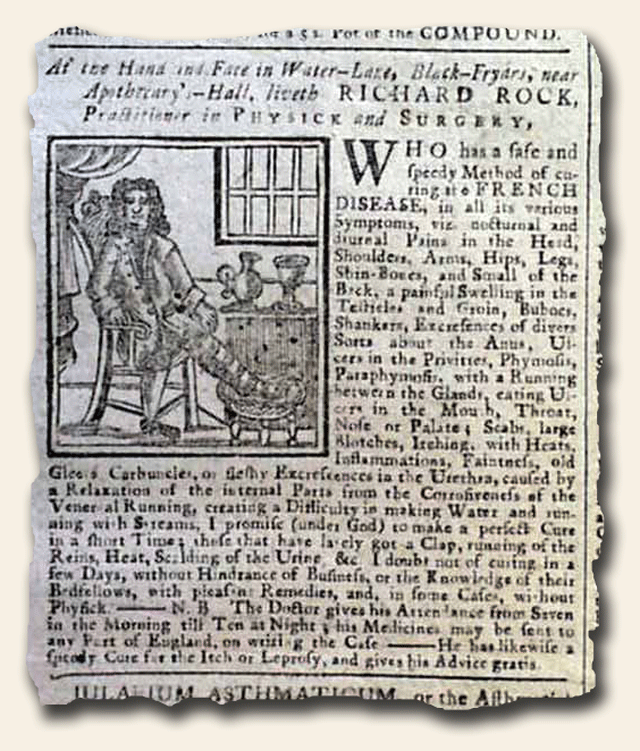
The apothecary's newspaper advertisement mentioned all the diseases he can cure

Newspapers and advertisers focused on products that appealed to a mass market. They generally targeted themselves to the middle and upper-middle classes. By the mid-eighteenth century, the variety of ads began to increase. Ladies’ fashions as well as silver, brass, and copper items became subjects of advertisements.” – Place an Advertisement

Shop bill from the frock shop. Image @The Works of William Hogarth, 1821

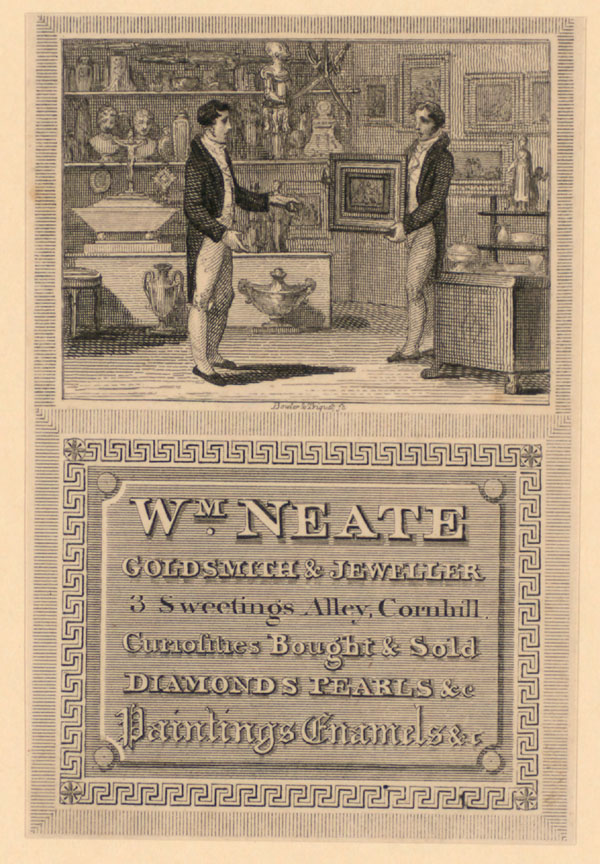
Trade cards were another way that merchants informed the public about their wares. These cards came with a combination of image and text, which provided information about the location, goods and services of an establishment or business. – Eighteenth Century Centre

Wm. Neate goldsmith & jeweller trading card. Image @Bodleian Library

More on the topic:

Read Full Post »
A heatwave has us hiding inside air-conditioned rooms this week. As I gazed at a hideously yellow sky and glowering orange sun last evening, I wondered how people survived 100 degree plus days 200 years ago? They mostly suffered, I imagine! But there were ways they could deal with extreme heat.

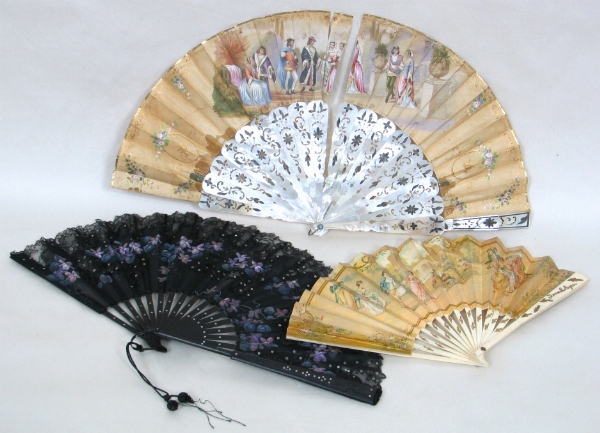
Regency fans could be beautiful or plain. All served to move air and cool the user.

Ceilings were higher, so the heated air had a place to rise, and walls were thicker, which kept rooms and basements cooler for longer. Hand held fans were popular, and one source I found said that gentlemen would sport them as well. The rich had mechanisms in the tropics whereby ceiling fans were rotated by strings and pulled by slaves or servants.

Carnfunnock ice house

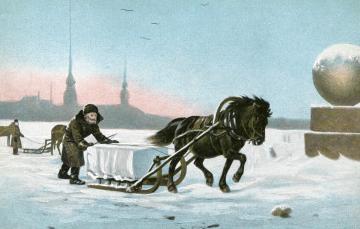
Big blocks of glacier ice or blocks of ice cut from frozen rivers were hauled up river by ship into the countryside, covered in straw and burlap, and stored in ice houses that were dug into hillsides or were largely underground.

Cutting and hauling river ice. This image is from St. Petersburg, Russia, but the custom of cutting and transporting ice was widespread.

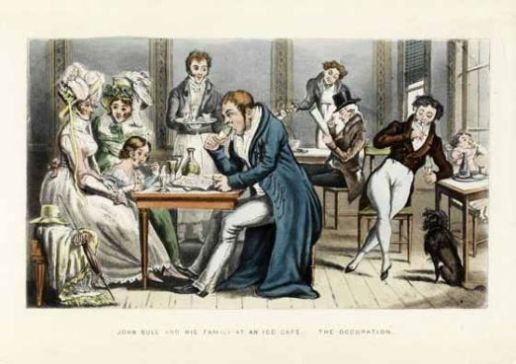
Ice cream was available to those who could afford it in such places a Gunther’s or made at home by the cook.

John Bull and his family at an ice cafe, 1815. Image@Newcastle University

The rich would move back to their country estates for the summer, escaping the stifling heat (and smells) in the city, but ordinary people had to adjust. This morning it was announced that over 2 dozen deaths had been attributed to this latest heatwave, which covers 2/3 of the U.S. I wonder back then how many people died from the effects of such extreme weather?

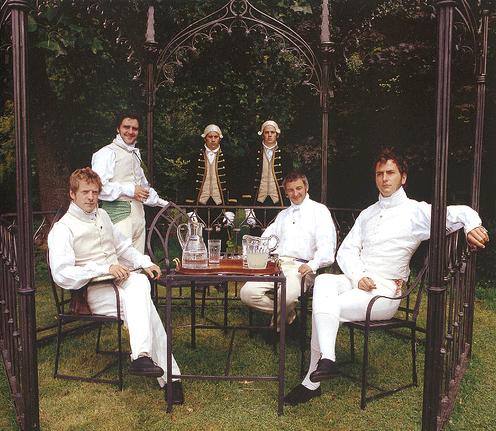
Regency gentlemen at a country house. Note that they are wearing light clothes without jackets. Sitting under a gazebo, they have pitchers of water at hand. One must pity the footmen in full uniform and wig! Image@Regency House Party

Read Full Post »
« Newer Posts - Older Posts »