Feeds:
Posts
Comments

Archive for August, 2011

Jane Austen’s mother, Cassandra’s

features were aristocratic; her hair was dark and her eyes an unusual tint of grey. She had an instinctive tendency to depreciate her own appearance; it was her elder sister Jane, she always insisted, who was the beauty of the family. But Cassandra did admit to a certain vanity concerning her fine patrician blade of a nose.” – Jane Austen, a family record by Deirdre Le Faye, William Austen-Leigh

However, by 1782, when her daughter Jane was only 7 years old, she was described as having lost several foreteeth, which made her look old.
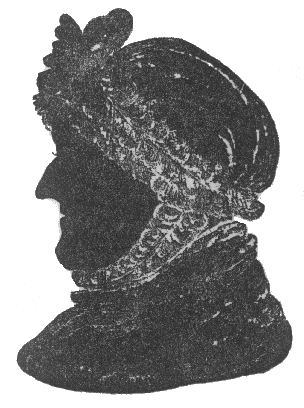
Cassandra Leigh Austen, Jane Austen's mother, with her patrician nose and missing foreteeth

Modern dentistry was still in its infancy when Cassandra Austen gave birth to her eight children. While the wealthy could afford dentists, rural folks still depended on the village blacksmith, who only knew how to pull teeth. Market fairs sold tinctures, toothpowders and abrasive dentifrices.

Lucy Baggott, of Wychwood Books, says: ‘It was not uncommon for the local farrier to draw teeth to relieve toothache of those in desperate pain, for then the blacksmith in many rural communities doubled as a tooth drawer. ‘There were many dubious practices adopted: hot coals, string, forceps, and pliers to name a few. Children were lured to sacrifice their teeth for the supposed benefit of the wealthy in exchange for only a few shillings. One print reads: “Most money given for live teeth”. – Dental Quackery Captured in Print
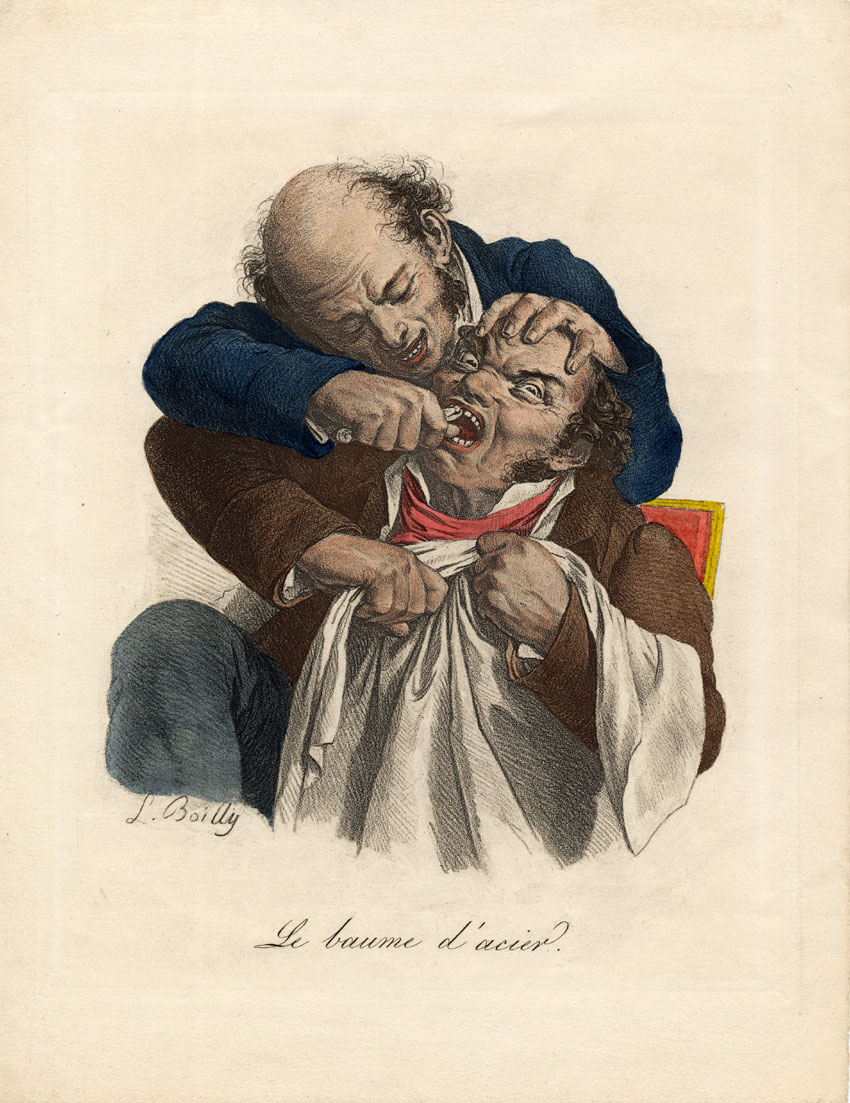
Louis-Leopold Boilly (1761-1845), Dentist Teeth Patient, 1827

We do know this: tooth extraction was painful and a most unpleasant affair before the age of ether and anesthetics.

In two letters to Cassandra, on Wednesday 15 & Thursday 16 September 1813, Jane [Austen] describes in some detail accompanying her young nieces Lizzy, Marianne and Fanny, on a visit to the London dentist Mr Spence. It was, she relates, ‘a sad business, and cost us many tears’. They attended Mr Spence twice on the Wednesday, and to their consternation had to return on the following day for yet another ‘disagreeable hour’ . Mr Spence remonstrates strongly over Lizzy’s teeth, cleaning and filing them and filling the ‘very sad hole’ between two of the front ones. But it is Marianne who suffers most: she is obliged to have two teeth extracted to make room for others to grow. – The Poor Girls and Their Teeth, A Visit to the Dentist, JASA

Tooth maintenance and dental hygiene were not a new concept. The aristocrats suffered more cavities, for they could afford sweets and foods that would eat into enamel, but they did use tooth powders, tooth picks, and toothbrushes to keep their teeth clean.

The ancient Chinese made toothbrushes with bristles from the necks of cold climate pigs. French dentists were the first Europeans to promote the use of toothbrushes in the seventeenth and early eighteenth centuries. William Addis of Clerkenwald, England, created the first mass-produced toothbrush. Toothpaste: modern toothpastes were developed in the 1800s. In 1824, a dentist named Peabody was the first person to add soap to toothpaste. John Harris first added chalk as an ingredient to toothpaste in the 1850s.- History of Dentistry

Isaac Cruikshank

The caption to the above cartoon states: Dentist. 18th century caricature of a fat dentist with his struggling, overweight female patient. The patient is begging the dentist not to pluck her teeth out like he would the feathers of a pigeon. People who eat large amounts of sugary food are often both overweight and suffer from dental decay. Image drawn in 1797 by British artist Isaac Cruikshank (1756-1811). – Science Photo Library

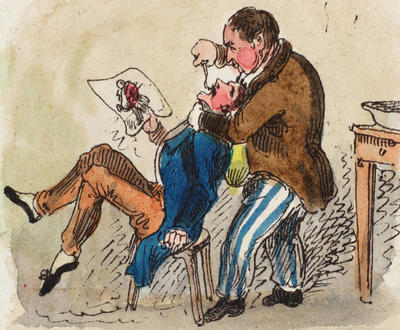
Tooth Extraction, William Henry Bunbury, mid-18th century

Extractions were by forceps or commonly keys, rather like a door key…When rotated it gripped the tooth tightly. This extracted the tooth – and usually gum and bone with it…Sometimes the jaws were also broken during an extraction by untrained people.”- BBC
A timeline of dentistry in the 18th and 19th centuries:

1780 – William Addis manufactured the first modern toothbrush. 1789 – Frenchman Nicolas Dubois de Chemant receives the first patent for porcelain teeth. 1790 – John Greenwood, one of George Washington’s dentists, constructs the first known dental foot engine. He adapts his mother’s foot treadle spinning wheel to rotate a drill. 1790 – Josiah Flagg, a prominent American dentist, constructs the first chair made specifically for dental patients. To a wooden Windsor chair, Flagg attaches an adjustable headrest, plus an arm extension to hold instruments. 19th Century 1801 – Richard C. Skinner writes the Treatise on the Human Teeth, the first dental book published in America. 1820 – Claudius Ash established his dental manufacturing company in London. 1825 – Samuel Stockton begins commercial manufacture of porcelain teeth. His S.S. White Dental Manufacturing Company establishes and dominates the dental supply market throughout the 19th century. – Nambibian Dental Association

Annotation of the above cartoon by Thomas Rowlandson:

This print is by Thomas Rowlandson (1756-1827) and is dated 1787. It is a satirical comment upon the real practice of rich gentlemen and ladies of the 18th century paying for teeth to be pulled from poor children and transplanted in their gums. The dentist present is portrayed as a quack. There are even two quacking ducks on the placard advertising his fake credentials. He is busy pulling teeth from the mouth of a poor young chimney sweep. Covered in soot and exhausted, he slumps in a chair. Meanwhile the dentist’s assistant transplants a tooth into a fashionably dressed young lady’s mouth. Two children can be seen leaving the room clutching their faces and obviously in pain from having their teeth extracted. As people lost most of their teeth by age 21 due to gum disease, teeth transplants were popular for some time in England although they rarely worked. – Wellcome Images

Thomas Rowlandson – A French dentist showing a specimen of his artificial teeth and false palates Coloured engraving 1811 Image @ Rowlandson, Wellcome Library

Dentures did exist:

Perhaps the most famous false-toothed American was the first president, George Washington. Popular history gave Mr. Washington wooden teeth, though this was not the case. In fact, wooden teeth are impossible; the corrosive effects of saliva would have turned them into mushy pulp before long. As a matter of fact, the first president’s false teeth came from a variety of sources, including teeth extracted from human and animal corpses. – A Short History of Dentistry

Carved ivory upper denture, late 18th century. Image @Skinner Auctioneers

As always, the upper classes had the upper hand:

The upper classes could afford a greater range of treatments, including artificial teeth (highly sought after by the sugar- consuming wealthy). Ivory dentures were popular into the 18th century, and were made from natural materials including walrus, elephant or hippopotamus ivory. Human teeth or ‘Waterloo teeth’ -sourced from battlefields or graveyards- were riveted into the base. These ill fitting and uncomfortable ivory dentures were replaced by porcelain dentures, introduced in the 1790’s. These were not successful due to their bright colours, and tendency to crack.Before the 1800’s, the practice of dentistry was still a long way from achieving professional status. This was to change in the 19th century – the most significant period in the history of dentistry to date. By 1800 there were still relatively few ‘dentists’ practicing the profession. By the middle of the 19th century the number of practicing dentists had increased markedly, although there was no legal or professional control to prevent malpractice and incompetence. Pressure for reform of the profession increased. – Thomas Rowlandson, “Transplanting Teeth (c.1790) [Engraving],” in Children and Youth in History, Item #164, http://chnm.gmu.edu/cyh/primary-sources/164 (accessed August 10, 2011). Annotated by Lynda Payne

More on This Topic:

Read Full Post »

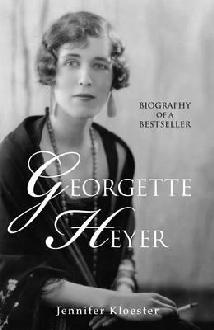
I have reviewed many Georgette Heyer novels for this blog. Here are some images of the author over the years. She had a strong handsome face. Not pretty, but full of character.

Georgette Heyer in 1923 at 21. She had already written her first book.

Looking rather modish

Wearing a rather severe look

The author at her son's wedding

Georgette in 1970, four years before her death

Read this review in the Guardian UK of her latest biography by Jennifer Kloester.
Also, Happy Birthday, Georgette Heyer!

Georgette Heyer

Read Full Post »

Whenever a reader asks: Which of the Georgette Heyer books ranks among your favorites? Venetia invariably springs from my lips. Mind you, I had not read this book for decades, but I savored its memory. In recent years I began to question my younger self, for while I loved rereading The Grand Sophy last year, I didn’t find it quite as splendid as the 24-year-old Vic had. As I grew older, other GH books made their first appearance on my favorites list, such as The Quiet Gentleman and The Reluctant Widow.

When Sourcebooks sent me a review copy of Venetia I did not choose it for my first critique, for I did not want to spoil my youthful impression. Once I began reading the book, I discovered that the 25-year-old heroine of Undershaw in Yorkshire captivated me all over again.

Amongst the pick of the debutantes at Almack’s she must have attracted attention; in the more restricted society in which she dwelt she was a nonpareil. It was not only the size and brilliance of her eyes which excited admiration, or the glory of her shining guinea-gold hair, or even the enchanting arch of her pretty mouth: there was something very taking in her face which owed nothing to the excellence of her features: an expression of sweetness, a sparkle of irrepressible fun, an unusually open look, quite devoid of self-consciousness.”

Venetia Lanyon is no ordinary heroine. Like Jane Austen’s Emma, she has largely led a protected life, thanks to her reclusive father, and allowed to go only to the dance assemblies in York and as far as the seaside town of Scarborough. Although she might not have been given a Season in London, Venetia is smart, lively, and resourceful. After her father’s death and in her elder brother’s absence, she runs the estate and makes all the important decisions overseeing the house, servants, herself and her young brother, Aubrey.

Waiting for her brother Conway’s return (he is a soldier), Venetia fends off two local suitors, the priggish Edward Yardley, who is as dull as a post, and ardent Oswald Denny, who, too dazzled by Venetia’s unselfconscious beauty and overly influenced by Lord Byron’s romanticism, is unable to recognize that he is much too young for her. Venetia lives a sedate life in her back country neighborhood, whose denizens are all respectable and predictable, except for one – Lord Damerel, a rake and ne’er-do-well, and a blight upon Undershaw’s spotless reputation.

“His family was an old and a distinguished one, but the present holder of the title was considered by the respectable to be the neighborhood’s only blot. It was almost a social solecism to mention his name in polite company.”

Venetia’s uneventful life unexpectedly changes when she encounters Damerel as she picks blackberries on his lands while wearing an old and rumpled gown.

“He was a stranger, but his voice and his habit proclaimed his condition, and it did not take her more than a very few moments to guess that she must be confronting the Wicked Baron. She regarded him with candid interest, unconsciously affording him an excellent view of her enchanting countenance.”

Mistaking her for a trespassing servant maid, he kisses her. And so the fun begins, for we are still at the very start of the novel.

Which brings me to the hero. As a young woman, I preferred dark brooding heroes like Damerel – men whose vices, dissipations and disappointments turn them into cynics; men whose good qualities are awakened by spectacular women like Venetia, men who on the surface are all wrong for the heroine. And so in Damerel I found my perfect unforgettable hero. Now, in my more advanced age (ahem), I find that I am still enamored of him.

Several qualities make Venetia stand head and shoulders above most of GH’s other novels. The plot is intelligent and complex and gets better and better with each page, continually taking us in unexpected directions. In fact, there were three twists that threw me for a loop and that kept this love story fresh and alive until the last page.

Several minor characters stand out from the ordinary. I could read an entire book about Aubrey, Venetia’s physically disabled but fiercely independent and brilliant brother who likes books more than people. Then there’s Mrs. Scorrier, an unforgettable vulgar character in the mode of a Mrs. Elton. Presumptuous, overbearing, and encroaching, she promises to overset Venetia’s and Aubrey’s well ordered lives (and those of the servants). Then there’s the matter of a little mystery, for as the book progressed I kept asking myself, when will we meet Venetia’s brother Conway? So much of the plot revolves around his absence and his anticipated return, that I was keen to meet him.

I am one of the GH readers who luxuriates in her use of Regency cant, and Venetia offers this language in spades:

She made the shocking discovery that he was a member of the dandy-set – indeed the pinkest of Pinks, a swell of the first stare! Not having the least guess that the old lady holds every Bond Street beau in the utmost abhorrence, the silly pigeon rigged himself out as fine as fivepence, and trotted round to Grosvenor Square looking precise to a pin: Inexpressibles of the most delicate shade of primrose, coat by Stulz, Hessians by Hoby, hat – the Bang-up – by Baxter, neckcloth – the Oriental, which is remarkable for its height – by himself.”

There are readers, I found to my surprise, who are put off by Ms. Heyer’s cant (Ten reasons why I can’t read Georgette Heyer) and who could care less about her historical accuracy. This novel is not for them, for it is filled with colorful antiquated language and wonderful tidbits about the Regency era that I found fascinating but that will turn them away.

I rate Venetia five out of five teacups

Did I like Venetia? No, I loved it, and I hope you will too. I give it five out of five Regency tea cups.

Order the book here
ISBN: 9781402238840

Other Georgette Heyer Reviews on this blog:

Read Full Post »

The script in Thomas Rowlandson’s 1810 cartoon states:

“Ah! My old Friend I wish you had called
at some more convenient time but this is washing
day — I have nothing to give you but cold Fish, cold Tripe
& cold potatoes — you smell soap suds a mile!
Ah Jack, Jack you don’t know these Comforts!
you are a Bachelor!”

In Rowlandson’s image, two well fed men are seen smiling. The host is apologetic, for his guest will not get anything but cold collations, probably leftovers from the previous day. His wife and maid are seen toiling over a bucket, their hands probably raw and red from the effects of harsh lye soap. Neither of them will have the time to look to his comforts or make a hot meal, which is why he is apologizing to his unexpected guest. Since laundering was not considered man’s work, he had to “suffer” the lack of his wife’s and servant’s attentions until the wash was done.

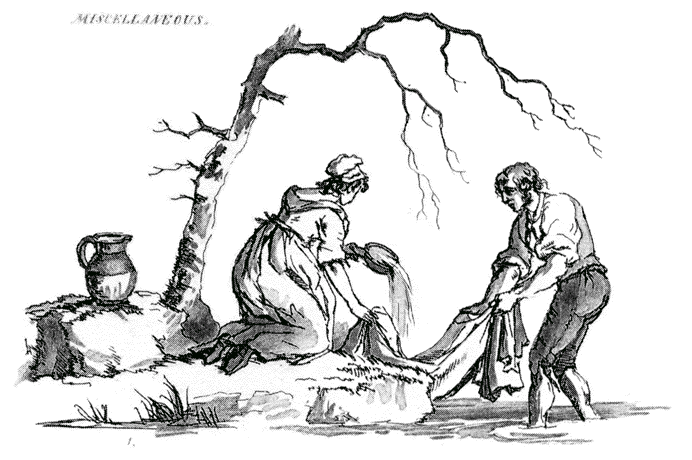
Doing the wash in a stream, 1806

First Boyle all the Cloaths with soap, and then wash them..” – John Harrower, indentured servant, writing to his wife (June 14, 1774)

Doing the wash in the Regency era was no small task, and housewives had to set aside two days to perform this dreaded duty, for it meant hauling water, boiling the cottons and linens, washing them with pungent lye soap, which burnt the skin, rinsing the clothes in clean water, which meant hauling more water from the well or a nearby stream, twisting the cloths to remove as much water as possible, hanging the clothes to dry, and then praying that rain would stay away long enough for the sun to perform its duty as a dryer. If one had to do laundry in a town or city, one had to pray that coal soot would not drift upon the clean clothes in a cramped back yard before they dried.

The Victorian scullery in a fine household included a copper for boiling water, a wringer, press, and ironing board.

Doing laundry was so enormous an undertaking, that unless the household were of a great size and boasted many servants, the mistress of the house and her daughters would frequently pitch in with the servants. There were chemises to be laundered, bed and table linens, towels, shirts, muslin dresses, handkerchiefs, socks, and the like. First the clothes would have to be treated for stains, the muslins and silks most delicately. After the wash had dried, ironing would commence, another laborious task.

Drying damp clothes over chair backs in front of a fireplace. Elizabeth Bennet and Mrs. Gardiner at the Lambton Inn, Pride and Prejudice, 1980

Chemises and shirts, which were worn next to the skin, were purposefully made with sturdier cloth so that these inner garments could withstand rougher treatment and more frequent washing. People tended to own more under garments for this reason. Outer clothes were subject to less frequent laundering because they were made of finer stuff, though one must wonder at the cleanliness of trailing hems, the edges of collars and sleeves, and armpits in the days before daily baths became popular, when air conditioning was just a distant dream, and when sweat must have stained clothes in a most visible manner. Is it no wonder that a majority of the Regency fashions that have survived to this day belonged to the rich, who probably wore their fashionable outfits once or twice before purchasing others?

 For more on the topic:

Read Full Post »

« Newer Posts