• Home
  • Audio/Podcasts
  • Austensites
  • AV/E-Texts
  • History
  • JA Novels & Bio
  • Links
  • Original Sources/19th C. Texts
  • Social Customs During the Regency
  • Teacher/Student
  • Writer/Literature Resources

Jane Austen's World

This Jane Austen blog brings Jane Austen, her novels, and the Regency Period alive through food, dress, social customs, and other 19th C. historical details related to this topic.

Feeds:
Posts
Comments
« Exhibition at the British Museum: The Horse from Arabia to Royal Ascot Royal Patron: HM Queen Elizabeth II
A Regency Gentleman’s Wardrobe: Thomas Coutts, Banker »

Aquatic Theatre, Sadler’s Wells: Early 19th Century

June 28, 2012 by Vic

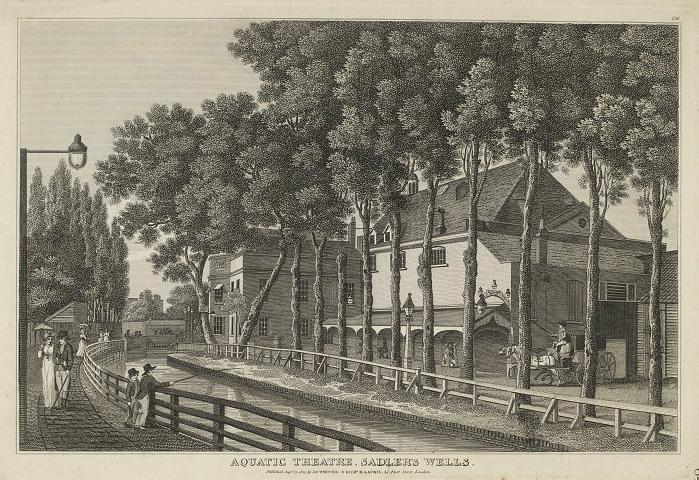
Sadler’s Wells Aquatic Theatre, 1813. copyright The V&A Museum. Click on image to view details.

Sadler’s Wells was a performing arts area located in Clerkenwell in the outskirts of London. Named after Richard Sadler, who opened a musick house there in the late 17th century, the region boasted well water thought to have medicinal qualities.

Sadler was prompted to claim that drinking the water from the wells would be effective against “dropsy, jaundice, scurvy, green sickness and other distempers to which females are liable – ulcers, fits of the mother, virgin’s fever and hypochondriacal distemper.” -Wikipedia

Six theatres have stood at this site since Sadler built his first theatre. A second theatre,  Sadler’s Wells, was constructed in 1765, which attracted summer theatre goers (the Theatre Royal offered performances only in the fall and winter.)

Interior of the theatre in 1810. One can see the water-filled tank on the stage.

In the early 19th century, Sadler’s Wells began to offer aquatic spectacles. The construction of a large tank (90x24x3 ft)  in 1804 by Charles Dibdin covered the entire area of the stage. It was flooded with water that was pumped from the nearby New River at the cost of 30 pounds per annum. This renovation allowed for the theatre to be used for naval melodramas, a popular theme, one imagines, in the days of the Napoleonic Wars and tales of Admiral Nelson’s heroism. The Siege of Gilbraltar, an ambitious spectacle, deployed 117 model ships created by the Woolwich Dockyard shipwrights and riggers, who used a scale of one inch to a foot in exact imitation of the slightest details, including the rigging. Children were cast as drowning Spanish sailors, and could be seen struggling in the waves.
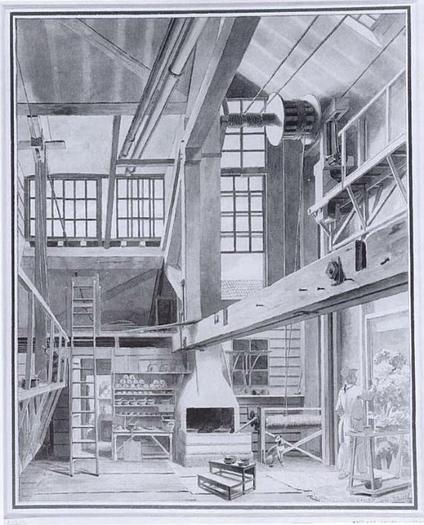
Scenic artist at work, 1790. Image @British Museum

A beautiful drop scene that filled up all the area of the proscenium showed the English fleet drawn up in battle against France and Spain. The enormous painting was used to entertain the audience during a delay while preparations were made behind stage. In order to alleviate 20 minutes of boredom between scenes, the stage slowly rose to nearly the roof of the theatre in full view. A second water tank was built on the theatre’s roof to simulate waterfalls. (With the lack of temperature control in the 19th century and windows in the main area, one can imagine that the theatre’s interior developed a powerful moldy smell in the heat of summer!)

Audience watching a play at Drury Lane, Rowlandson, 1785

The behavior of the theatre goers at Sadler’s Wells left much to be desired. As early as 1711 it was observed that members of the audience were publicly drunk, and their behavior boorish and loutish. Karl Philipp Moritz, a German traveler in England in 1782, described in his travel diary the audience in a typical British play house. Not only was the crowd rowdy between scenes and before the performance (making a “noise and uproar”), but there was a constant pelting of orange peels, for oranges were “tolerably cheap”.

Besides this perpetual pelting from the gallery, which renders and English play-house so uncomfortable, there is no end to their calling out and knocking with their sticks till the curtain is drawn up…I sometimes heard, too, the people in the lower or middle gallery quarrelling with those of the upper one. Behind me, in the pit, sat a young fop, who, in order to display his costly stone buckles with the utmost brilliancy, continually put his foot on my bench, and even sometimes upon my coat. – Karl Philipp Moritz
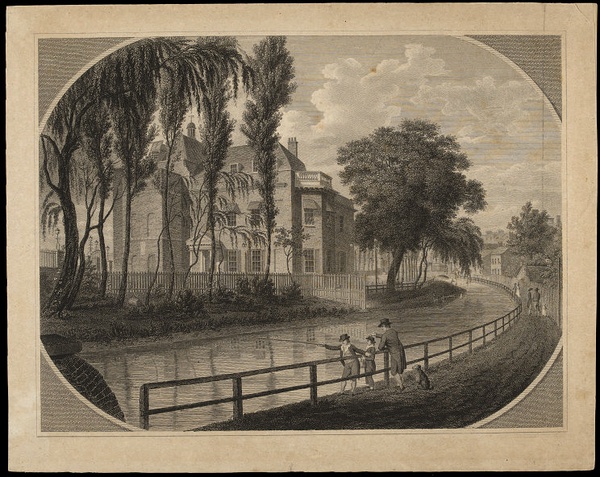
Another view of the theatre. Fishing seems to have been a popular pasttime as well.

If the Sadler’s Wells theatre audience had a particularly rowdy reputation compared to theatres in central London, one can only imagine how truly awful the experience was. The theatre slowly lost its lustre during the first half of the 19th century, for it was located in the rural outskirts of London. Without street lights and an organized police force, travel at night was dangerous, and patrons of the theatre were provided escorts as they traveled back to central London.

 Pinero’s play Trelawny of the ‘Wells’ (1898), portrays Sadler’s Wells as outmoded by the new fashion for realism. The theatre declined until, by 1875, plans to turn it into a bath house were proposed and, for a while, the new craze of roller skating was catered to, as the theatre was converted into a roller-skating rink and later a prize fight arena. The theatre was condemned as a dangerous structure in 1878. – Wikipedia
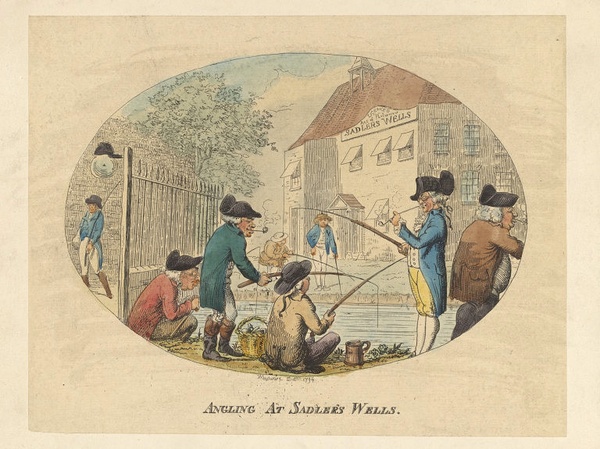
Anglers at Sadler’s Wells.


Share with others:

  • Click to email a link to a friend (Opens in new window) Email
  • Click to print (Opens in new window) Print
  • Click to share on Facebook (Opens in new window) Facebook
  • Click to share on Reddit (Opens in new window) Reddit
  • Click to share on X (Opens in new window) X
  • Click to share on Pinterest (Opens in new window) Pinterest
  • Click to share on Tumblr (Opens in new window) Tumblr
  • Click to share on LinkedIn (Opens in new window) LinkedIn
Like Loading...

Related

Posted in 19th Century England, Georgian London, Jane Austen's World, Regency Customs, Regency Life, Regency society | Tagged aquatic theatre, Charles Dibdin, Georgian entertainment, Karl Philipp Moritz, Richard Sadler, Sadler's Wells Theatre | 6 Comments

6 Responses

  1. on June 28, 2012 at 11:18 G.Fisher's avatar G.Fisher

    Always enjoy this site. as an ex pat it warms ‘the cockles o’ me heart’. Was there a connection between Charles Dickens and Sadler’s Wells?
    Thank you.
    Regards,
    Gloria B. Fisher


    • on June 28, 2012 at 22:27 Vic's avatar Vic

      Gloria: I do not know, although I suspect Dickens knew the entirety of London theatricals well, especially about the young boys who pretended to drown during the “spectacles.”


  2. on June 28, 2012 at 11:53 Nilakshi Roy's avatar Nilakshi Roy

    Makes one feel infinitely sad to read about such a novel and popular entertainment spot to have been wiped out for lack of modernization! there are so many in our own world, like the big , once grand movie theatres in Mumbai (India) which are running empty in the face of multiplexes.


    • on June 28, 2012 at 22:26 Vic's avatar Vic

      Roy, Six theatres were built on the site. While the one that I described sadly was wiped out, as you said, three others were erected to take its place. Nt information stopped in the 19th Century. Please read the information in this link to assuage your concerns: http://www.sadlerswells.com/?page=complete-history


  3. on June 28, 2012 at 19:39 LordBeariOfBow's avatar LordBeariOfBow

    I saw my first opera at Sadler’s Wells in the late 1940’s it was Rimsky-Korsakov’s The Snow Maiden, and it was the first production of it in England for “yonks” (an Australian term meaning for so long the origin is forgotten); about the only thing I can recall about that opera was the Dance of the Tumblers, absolutely thrilling: And my uncle and I were seated 2 rows back from the Kings nephew the Earl of Harewood, which impressed this young man of some 13 years, at the time.

    Love these illustrations they are delightful


    • on June 28, 2012 at 22:29 Vic's avatar Vic

      Thank you so much for your memories and for leaving your thoughts, Lord Beari of Bow.


Comments are closed.

  • Enter your email address to subscribe to this blog and receive notifications of new posts by email.

    Join 7,248 other subscribers
  • 2025 AGM in Baltimore

  • Items of Interest

  • Blog Stats

    • 18,377,098 hits
  • Follow Jane Austen's World on WordPress.com
  • RECOMMENDED BOOKS AND RESOURCES

  • Fashionable Goodness: Christianity in Jane Austen's England is now available! By JAW contributor Brenda S. Cox. See Review. Available from Amazon and Jane Austen Books.
  • We also recommend JAW contributor Rachel Dodge's devotionals based on Jane Austen's prayers and classic literature. Reviews:
    Praying With Jane: 31 Days Through the Prayers of Jane Austen
    The Anne of Green Gables DevotionalThe Little Women Devotional
    The Secret Garden Devotional
  • The Tour of Doctor Syntax. Edited by Ben Wiebracht. Read the review of the book at this link. Click to order the book on Amazon US or Amazon UK or Jane Austen Books
  • FREE Student Membership to JASNA

    Available through December 31st, 2025. Click on image for details, and share this poster with other teachers and students!

  • The Obituary of Charlotte Collins by Andrew Capes

    Click on image to read the story.

  • Comments

    “My idea of good company…is the company of clever, well-informed people, who have a great deal of conversation.” – Jane Austen, Persuasion


    Gentle readers: Please feel free to post your comments and continue the conversation! Due to SPAM, we will no longer accept comments on posts after 30 days of publication. In some instances, links will be removed from comments as well.

  • Administrators and Contributors

    Vic Sanborn, founder of this blog, is supported by a team of talented and knowledgeable writers about Jane Austen and the Regency era. They are:

    • Brenda Cox
    • Rachel Dodge and
    • Tony Grant, who now contributes his photos from London and England

    Click on their names to enter their own blogs.

    In addition, we thank the many experts and authors who frequently contribute their posts and opinions, and who continue to do so freely or at our request.

  • Pin It!

    Follow Me on Pinterest
  • Top Posts

    • Highclere Castle Floor Plan: The Real Downton Abbey
      Highclere Castle Floor Plan: The Real Downton Abbey
    • Cassandra Writes About Jane Austen's Death, July 18, 1817
      Cassandra Writes About Jane Austen's Death, July 18, 1817
    • Exploring Jane Austen's Prayers
      Exploring Jane Austen's Prayers
    • Regency Fashion: Men's Breeches, Pantaloons, and Trousers
      Regency Fashion: Men's Breeches, Pantaloons, and Trousers
    • Regency Hygiene: The Bourdaloue
      Regency Hygiene: The Bourdaloue
    • Dancing at the Netherfield Ball: Pride and Prejudice
      Dancing at the Netherfield Ball: Pride and Prejudice
    • Social Customs During the Regency
      Social Customs During the Regency
    • Jane Austen’s Christmases
      Jane Austen’s Christmases
    • Jane Austen Annotated Editions from Harvard University Press
      Jane Austen Annotated Editions from Harvard University Press
    • Pictorial History of Regency Hairstyles
      Pictorial History of Regency Hairstyles
  • Recent Posts

    • Coming Soon: Birthday Tales for Jane Austen’s 250th
    • Book Review: The Austens, by Sarah Emsley
    • Praying with Jane Audiobook with Amanda Root
    • Book Review: The Worlds of Jane Austen: The Influences and Inspiration Behind the Novels
    • Books Purchased at the 2025 AGM in Baltimore
  • Links to Jane Austen Blogs

    Click here to enter the page. Topics include Regency fashion, historic foods, Jane Austen societies, British sites, related topics. Click on image.

  • May we suggest?

  • Unknown's avatarHello, my name is Vic and I live in Maryland, USA. I have adored Jane Austen almost all of my life. I am a proud lifetime member of the Jane Austen Society of North America. This blog is a personal blog written and edited by me and my team. We do not accept any form of cash advertising, sponsorship, or paid topic insertions. However, we do accept and keep books and CDs to review.

    If you would like to share a new site, or point out an error, please email us. (Yes, we are fallible. We'll own up to our mistakes and will make the corrections with a polite smile on our faces.) Write us at

    gmailbw

    Thank you for visiting this blog. Your comments and suggestions are most welcome.

  • Project Gutenberg: eBook of Stage-coach and Mail in Days of Yore, Volume 2 (of 2), by Charles G. Harper

    STAGE-COACH AND MAIL IN DAYS OF YORE: A PICTURESQUE HISTORY
    OF THE COACHING AGE, VOL. II, By CHARLES G. HARPER. 1903. Click on this link.


  • Top Posts & Pages

    • Highclere Castle Floor Plan: The Real Downton Abbey
    • Cassandra Writes About Jane Austen's Death, July 18, 1817
    • Exploring Jane Austen's Prayers
    • Regency Fashion: Men's Breeches, Pantaloons, and Trousers
    • Regency Hygiene: The Bourdaloue
    • Dancing at the Netherfield Ball: Pride and Prejudice
    • Social Customs During the Regency
    • Jane Austen’s Christmases
    • Jane Austen Annotated Editions from Harvard University Press
    • Pictorial History of Regency Hairstyles
  • Tour Chawton Cottage on YouTube

  • Disclaimer: Our team makes no profit from this blog. We may receive books (physical or digitized) for review purposes.

  • Copyright Statement: © Jane Austen's World blog, 2009-2024. Unauthorized use and/or duplication of this material without express and written permission from this blog’s author and/or owners is strictly prohibited. Excerpts and links may be used, provided that full and clear credit is given to Jane Austen's World with appropriate and specific direction to the original content.

Blog at WordPress.com.

WPThemes.


  • Reblog
  • Subscribe Subscribed
    • Jane Austen's World
    • Join 7,248 other subscribers
    • Already have a WordPress.com account? Log in now.
    • Jane Austen's World
    • Subscribe Subscribed
    • Sign up
    • Log in
    • Copy shortlink
    • Report this content
    • View post in Reader
    • Manage subscriptions
    • Collapse this bar
 

Loading Comments...
 

    %d
