This Jane Austen blog brings Jane Austen, her novels, and the Regency Period alive through food, dress, social customs, and other 19th C. historical details related to this topic.
Below are links to a BBC documentary called “ELEGANCE AND DECADENCE – The Age of the Regency”. The documentary is hosted by historian Dr. Lucy Worsley, author of the 2011 book, “If Walls Could Talk, An Intimate History of the Home”.
“ELEGANCE AND DECADENCE – The Age of the Regency”
Here are the links to the documentary hosted by Dr. Worsley:
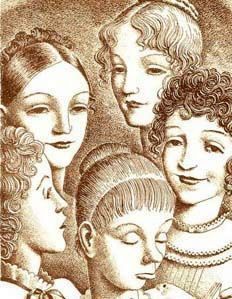
Sewell, The Bennet sisters. The photos do not capture the detail of each image.
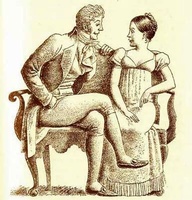
This year we celebrate all things Pride and Prejudice in honor of the novel’s 200 year anniversary. Just recently, Ruby Lane sold a rare, out of print, limited 1940 edition of Pride and Prejudice, illustrated by Helen Sewell, an illustrator of mainly children’s books. People today still recognize the original drawings she created for the Laura Ingalls Wilder Little House books.
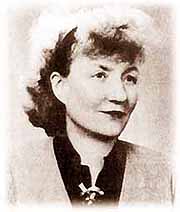
Helen Sewell
About Helen Sewell
Sewell was born June 27, 1896 at Mare Island Navy Yard, California. Her family moved to Guam shortly afterward, where her father, William Elbridge Sewell, served as Governor.
Education
Sewell wanted to be an artist since the age of eight. At 12 years old, she began attending Pratt Institute’s Saturday classes and by 16 years of age was enrolled there full time. This was in place of completing high school. At Pratt, she studied classes with Alexander Archipenko, who was the underlying influence for her broken-cylinder figures.
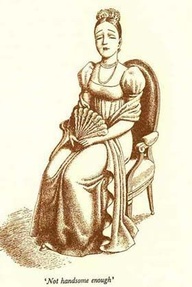
“Not handsome enough”
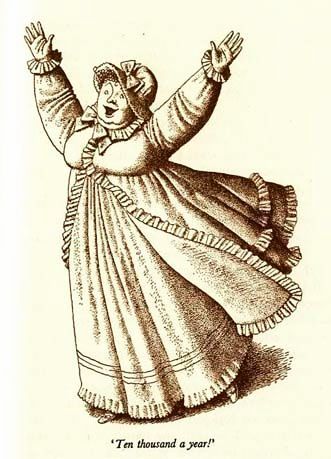
Mrs. Bennet
Sewell began her long career working on Christmas and greeting cards; her first illustrated publication was in 1923. She primarily illustrated children’s books by Laura Ingalls Wilder, Elizabeth Coatsworth, Eleanor Farjeon, and Frances Clarke Sayer. As with Pride and Prejudice and a 1957 edition of Sense and Sensibility, Sewell also created drawings for a small number of adult publications.
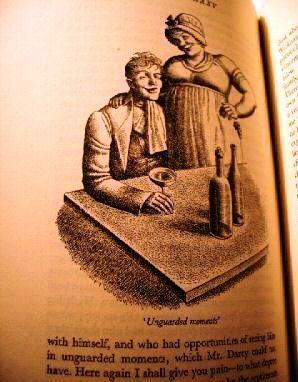
Unguarded moments shows the full page illustration
Sewell’s style included a simple use of color, which at times eliminated black all together, and her use of the white paper. Her line drawings were in imitation of 19th century steel engravings. She died in 1957 at the age of 61.
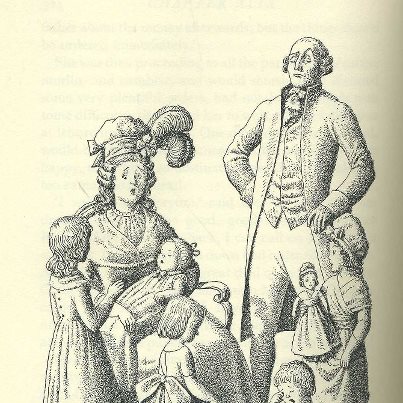
Illustration of the Gardiners on page 324
About the Limited 1940 edition of Pride and Prejudice
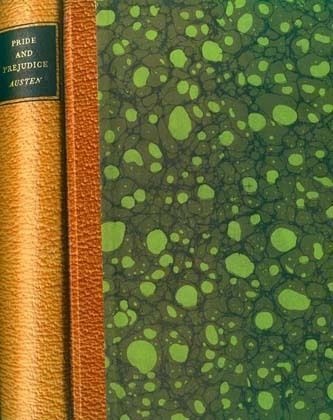
The image at right is of a hardcover, green marbled slipcase. Quarter binding, green marbled board cover, with brown faux leather spine. Heritage edition illustrations are signed by the illustrator. (The commercial issue would have fewer illustrations for the ordinary book buyer.) It is said that photographic images do the drawings no justice, for they are quite detailed when seen in person.
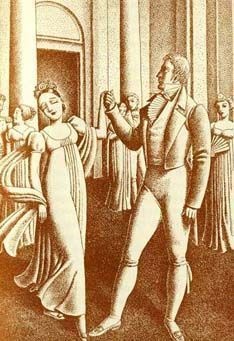
Darcy and Elizabeth dancing
This limited edition book sold for $74 at Ruby Lane. I would gladly have paid more. Other limited edition books are selling for as much as $900 per copy. (Click on images for a larger view.)
WARNING! SPOILER ALERT in the body of this review and comments of the Downton Abbey Finale of Season Three. If you have not seen the last installment, please view the 7th episode online at this link. I deliberately kept the incriminating images at the back of this post. Readers who comment can leave their honest assessments, for the 4th season will not be aired in the U.K. until next fall.
What did you think? Did Julian Fellowes leave us with a cliffhanger or a major downer? How will this latest catastrophic development change Season 4 and the actions of major characters? I must admit to some RELIEF that the 3rd season of Downton Abbey has finally ended. I’ve not been on such a roller coaster ride since I last visited our local amusement park, one minute loving the story lines and the next minute loathing certain plot developments. One thing is for certain, the popularity of DA is here to stay as long as Julian Fellowes continues to provide us with such lively and unpredictable entertainment. And, now, my rather cryptic thoughts on Downton Abbey Season Three, Episode Seven:
An excuse for a change of scenery means a road trip to Scotland. This episode was divided between Downton Abbey with the servants and Duneagle Castle in Scotland with the Crawley family. Lord Grantham described the annual visit to the Highlands as the highlight of his year. (The war and Sybil’s death had prevented the Crawleys from visiting in previous seasons.) Viewers now understand why Lady Rose made her appearance in the last episode, for her family are close to the Crawleys. This segueway to the Highlands is a means to get Rose to Downton Abbey – as a replacement for Sybil? One shudders.
Mrs. Patmore’s pasties entice a Lothario
No sooner had Mr. Tufton the new shopkeeper, smelled the enticing aroma of Mrs. Patmore’s cooking and sampled a few of her dishes than his mind was made up – he would woo her until she was installed as his wife/personal cook in his kitchen.
Mrs. Patmore , flattered by his not so subtle attentions, simpers like a 16-year-old girl at all the testosterone aimed her way. She purchases a pretty new blouse for her date with the first man to pay court to her in decades and cheers him on in the rope pulling contest (which the men of Downton win.)
Upon seeing Mrs. Patmore all gussied up for the day, Mr. Tufton comes on as strong as a jack hammer: “I hope you don’t mind if I say so Mrs Patmore, but in that blouse you look like you stepped off the pages of Vogue”. This doesn’t fool Mrs. Hughes one bit. “You are free with your compliments,” she observes. And he replies tellingly: “I love to be in love Mrs Hughes. I’ll not deny it. Any time, any place, I love to be in love!”
But Mrs. Hughes wasn’t born yesterday. Tufton’s not so subtle moves on other women at the fair doesn’t escape her knowing gaze.
Like a true friend Mrs Hughes summons the cook to her quarters and reveals the unpleasant truth. Instead of stomping out of the housekeeper’s quarters, Mrs. Patmore giggles, saying: “It was the cookin’ he was after and not me. I never felt such relief in my life. The more he said about how he liked his beef roasted, his eggs fried, and his pancakes flipped, then the more I wanted out and get away.”
It is side stories like this one, filled with colorful characters, comedy, and a glimpse of the life of ordinary mortals, that elevate Downton Abbey from the mundane to the fabulous.
Love is All Around You
Romance is in the air for a number of Downton’s inhabitants. Bates and his Anna kiss by a babbling brook and she learns the reel for him.
Dr. Clarkson reaches the inevitable conclusion – that Isobel Crawley would make a perfect wife. Isobel likes their platonic friendship and discourages the doc from declaring himself. But after this episode’s awful ending, one can conclude that Isobel will need the doctor’s substantial shoulders and his considerable support to get over Matthew’s sudden demise.
Thomas sacrifices his pretty face to save Jimmy’s after the Downton men win a tug of war. If that isn’t love, what is?
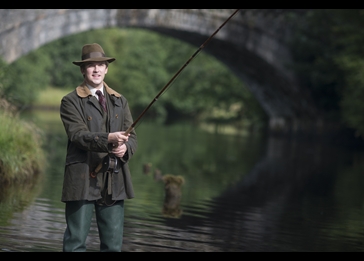
Michael Gregson and Edith: “He’s brought his pencils and his rods what’s wrong with that?
This is the most improbable subplot in the season finale. Michael Gregson, fishing rod in hand, rushes to Scotland and finagles an invitation to Duneagle. His motive? To convince the Crawleys that he’s a decent chap despite his batty wife in the belfry.
It’s a good thing that Edie has low self-esteem or else she would have been spooked off him from the beginning. The family is not very receptive. Michael wants them to get to know him – the real him – so that the Crawleys can see that he’s the perfect man for Edie, with just one teensy little flaw.
This subplot had more in common with One Life to Live than Downton Abbey. Our Edie deserves better.
Michael: I thought if they knew me, if they came to like me, they might find it easier to be on my side. My basic fact is that I am in love with you. Really and truly. Cross my heart and hope to die.
Edith: And I want to be in yours. But this visit of yours is so creepy, I can’t see a happy ending.
Nothing stops Michael. Having made a tepid impression on Robert and Mary, who refuses to open her eyes, he makes a move on Matthew.
But his appeal to Matthew’s sense of romance doesn’t get very far (the dialogue is priceless; how can one make fun of it?):
Michael: Does the law expect me to have no life at all until I die? Would Lord Grantham?
Matthew: You can’t expect that he would want you to involve his own daughter, what when all you have to offer her is a job as your own mistress.
Michael: No, I love her. I’m offering my love.
Matthew: You’ve been misled by our surroundings. We’re not in a novel by Walter Scott.
Edith will not be put off when Michael tries to say his goodbyes, saying, “It’s odd. If you’d asked me before tonight how I felt about you I’m not sure what I would have answered, but now I’m absolutely sure, and this is NOT our last evening.” Ah, our rebellious Edith. Will she live in sin with this man? Set fire to the asylum in which his wife is housed? Carry on as usual and be dangled on a string for life? This improbable plot twist is not what we had hoped for Edith. These scenes seemed so contrived. I do hope that Julian Fellowes gets this relationship back on track in Season 4, for it had such an interesting start.
Edna and Tom
The title should actually read “A Brazen Maid Sets Her Sights on Tom.”
Tom, the new estate manager, lives in limbo. His position is much like that of a governess – he belongs nowhere, not with the servants and not with the family. Case in point, when the Crawleys dash off to Scotland, Tom remains behind, eating alone and thinking of his dead wife, Sybil, who is missed by one and all. Leaving Tom alone to supervise the estate worries Violet:
Violet: Do you think it is wise to leave him here unsupervised?
Cora: What do you mean?
Violet: Well I know he’s housebroken, more or less, but I don’t want freedom to go to his head.
Isobel: I’ll keep an eye on him.
But the one keeping her eye on him is Edna, the new maid.
After the Crawleys leave for Scotland, Branson is seen walking, eating, and sleeping alone in the house in scenes reminiscent of Jack Nicholson several months into winter in The Shining. Edna pops up wherever he goes – at the pub, in a room, in the hallway – smart, fresh, and pretty. Each time she hones in on Branson like a heat-seeking missile.
For a supervised maid, Edna seems to have a lot of free time to stalk Branson without a reprimand. While Branson’s intrigued, he is a male after all, Edna cannot make him forget his misery over Sybil’s death. When Mrs Hughes cautions him about getting involved with the help, he blurts out his misery.
Like a mother hen, Mrs. Hughes, who gets better with each season, comforts Branson and fires Edna, who is obviously not cut out of maid-of-all work cloth.
A Tale of Two Marriages: Shrimpie and Susan vs Robert and Cora
We don’t really care about Shrimpie and Susan, the Marquess and Marchioness of Flintshire, who have an awful marriage, but we do care about Cora and Robert. If the earl and his countess needed proof that their marriage was on solid footing, then Shrimpie and Susan, who have tired of each other over the years, provide it.
The marquess and his marchioness are stuck with each other, despite the absence of passion and lack of mutual respect. Worse, Shrimpie has squandered his inheritance by following the traditional route of estate management, which bankrupted him. He praises Robert for his modern thinking and for making smart choices. Robert is more grateful than ever for Matthew’s good sense.
Shrimpie’s solution out of his financial predicament is to take a post in Bombay, where he and Susan will live in couples hell, and leave Rose with the Crawleys for her coming out.
The contrast between the two aristocratic couples couldn’t be greater. While Susan and her husband quarrel over every minor detail, the earl begins to appreciate what he has. He gives his Cora a passionate kiss and recognizes Matthew’s part in his success. “Downton will survive because of Matthew’s vision and now I give thanks for him.” Even if many of us didn’t know ahead of time that Matthew was about to meet his Maker, these sentences act like sign posts: Matthew’s gonna die. Matthew’s gonna die.
Matthew and Mary
The dialogue between Mary and Matthew hinted of a less than happy ending because they have never been so happy before. She’s soft and amorous. He simply can’t resist patting her on her bump and giving her compliments left and right. They coo and ooh and ah all over each other…
… so that their love talk is beyond sugary. Mary to Matthew: “You think me nice, but nobody else does. What makes you sure I am? Matthew: “Because I’ve seen you naked.” The dialogue makes even the most clueless viewer wonder – What’s going on? Why the chemistry all of a sudden?
At eight months pregnant, Mary feels safe traveling to Scotland, but makes a mistake in joining the picnic. “I was stupid to go”, she says later, “we were shaken about like dice in a cup.” Which, as everyone knows, is code for early labor.
After Mary’s twinges start, she rushes back to Yorkshire to have her baby, telling Matthew he can join her later with the rest of the Crawley gang.
Alone and about to give birth prematurely, Mary confesses: “I feel I’m only half myself without him.”
The doomsday clock is ticking more loudly.
Matthew arrives to view his son and heir. “My darling, how are you really?” he asks. “Tired and pretty relieved. Just think, we’ve done our duty. Downton is safe. We have an heir, and as soon as I get out of bed we can work on the spare.”
Tick tock tick tock.
Matthew is giddy with delight holding his little chap and waxing eloquently about teaching his son cricket and estate maintenance.
And now we hear the dialogue that seals the doom deal:
Mary: “I hope I’m allowed to be your Mary Crawley for all eternity.
Matthew: “You’ll be my Mary always because mine is the true Mary.
Mary: “Ever wonder how happy you have made me?”
Matthew: “Right now I want to tell you that I fall more in love with you every day that passes.”
It’s a wonder that lightning doesn’t come out of the blue and strike him then and there.
Mary asks for a decent kiss before sending her beloved away to collect her family. Life couldn’t be more perfect for our happy couple. But this is Downton Abbey and no one is allowed to remain blissfully happy for long.
Matthew’s Death
Sybil’s death scene lasted 10-15 minutes, giving viewers time to prepare for her unhappy end. But with Matthew’s the viewers were robbed.
One moment he is rejoicing in the birth of his heir, the next moment he is dead in some roadside ditch. End of episode. End of the season. PBS immediately switches to a fund appeal to capitalize on their stupified viewers. I felt cheated.
The camera lingers on the shocking scene for a few micro seconds before cutting to the Crawley’s drawing-room, where the family placidly awaits Matthew’s arrival.
As he lies dying in the road, Violet says appropriately: “We don’t always get our just desserts.” Which is exactly how the viewers are starting to feel.
Mary, who is happily expecting the arrival of her family, says of her husband: “Tell Mr Matthew he must wait his turn, he’s seen the baby and they haven’t.”
I wonder if that statement will come back to haunt her! Two major characters killed off this season. Life in Downton Abbey land is unfair!
Please vote in the poll or leave your considered thoughts about this episode and the third season. Will you return to view Season 4?
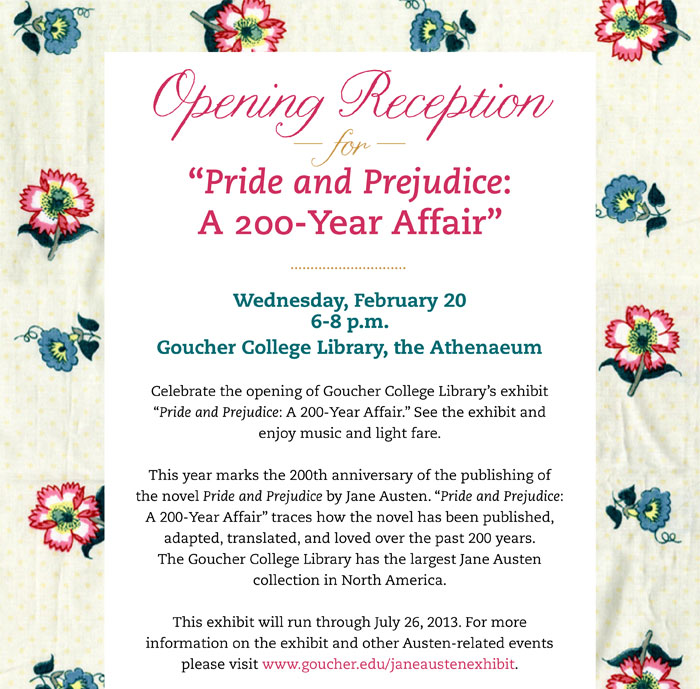
Gentle readers, If you live near the Baltimore area, this exhibit might interest you.
Since it was first published in 1813, Pride and Prejudice by Jane Austen has charmed generation after generation. The exhibition Pride and Prejudice: a 200 Year Affair celebrates one of the most popular and beloved novels of our time. A colorful visual history reflects how Pride and Prejudice has been published, adapted, translated, and loved over the last 200 years. It features the first edition published on January 28, 1813 as well as, rare and illustrated editions, and collectibles. Goucher College has the largest collection on Jane Austen and her times in North America.
The Goucher College Special Collections and Archives is home to our Jane Austen collection, but also collections spanning the early printing age to the Modern era. Our closed stacks house rows of first edition books, rare publications, and historical ephemera. We are open to the public Monday-Friday from 10 a.m. to 4 p.m. While we generally accommodate the needs of our student body and faculty in their research, we also have visitors from around the world for academic research as well as recreational visits.
Is chivalry alive and well? Good question. I venture to guess that a large number of Jane Austen’s readers subscribe to the traditional hero as embodied in Mr. Darcy, Mr. Knightley, Colonel Brandon, and Captain Wentworth, all admirable men, who despite some flaws, are wont to treat a lady with respect and come to her rescue out of a sense of duty, or from good breeding or a besotted heart.
Just in time for Valentine’s day comes Queendom.com’s tudy on gender roles in courtship behavior, which reveals that while most courtship conventions have changed, some age-old romance rituals are still going strong. Pulling up on a white horse isn’t necessary for the modern woman, but some chivalry is still a heart-melting must. (Inquiring readers, I have ventured to put my own spin (in blue) on this contribution from lona Jerabek, Ph.D.)
Some men hurtled, on horseback, with a giant stick in their hands. Emperor Shah Jahan built The Taj Mahal as a final resting place for his most beloved wife. Both Cleopatra and Juliet refused to live in a world where they couldn’t be with the one they loved. Thankfully, courtship conventions and romantic gestures need not be this extreme. According to Queendom’s data, most men and women take a modern approach to dating, but a little chivalry can still go a long way.
Jane Austen’s rules of courtship vs modern times
Collecting data from 950 men and 1621 women, Queendom’s research on gender roles and courtship reveals that:
77% of men and 70% of women feel that a date can be initiated by either gender. In fact, 65% of the women have either asked a man out on a date, or would be willing to do so. (This would be a big faux pas in Jane Austen’s book, for a gently bred lady would NEVER make the first move, lest she be thought forward. There were those who had powers of persuasion through beauty and words, like May Crawford, or who took advantage of a man during a moment of weakness and, like that rat terrier, Lucy Steele, never let go. Others, like Marianne Dashwood, ignored society’s strictures, but all in all, a young lady of good breeding would hesitate to step out of the bounds of propriety and bring shame upon her family by acting upon her impulses and brazenly ask a man to pay court. Her actions would be much more subtle than that.)
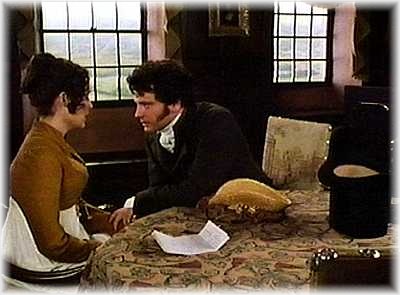
Mr. Darcy listens to Elizabeth about Lydia’s predicament, then quietly goes about rectifying the situation and helping Lydia out of a scrape. A true romantic hero.
67% of men and 60% of women believe that chivalry is important (e.g. opening doors, pulling out chair, etc.). (This number would have been 100% in Jane’s day. A man who failed to follow the rules of propriety, like John Thorpe, would instantly be regarded as deplorable and wouldn’t stand a chance.)
60% of women still like to be wined and dined, at least in the initial stages of dating. (Courtship was much more constrained, with the virginal girl guarded like hawks by her chaperons and family. After her coming out, a woman would NEVER be seen alone in her swain’s company. The only time they could touch or talk at length was during the set of a dance. They could never dine alone in an inn, for instance, without damaging her reputation. As for drinking wine, a gently bred girl might be given a glass of watered down elderberry or orange wine, but nothing that would make her tipsy and lose control.)
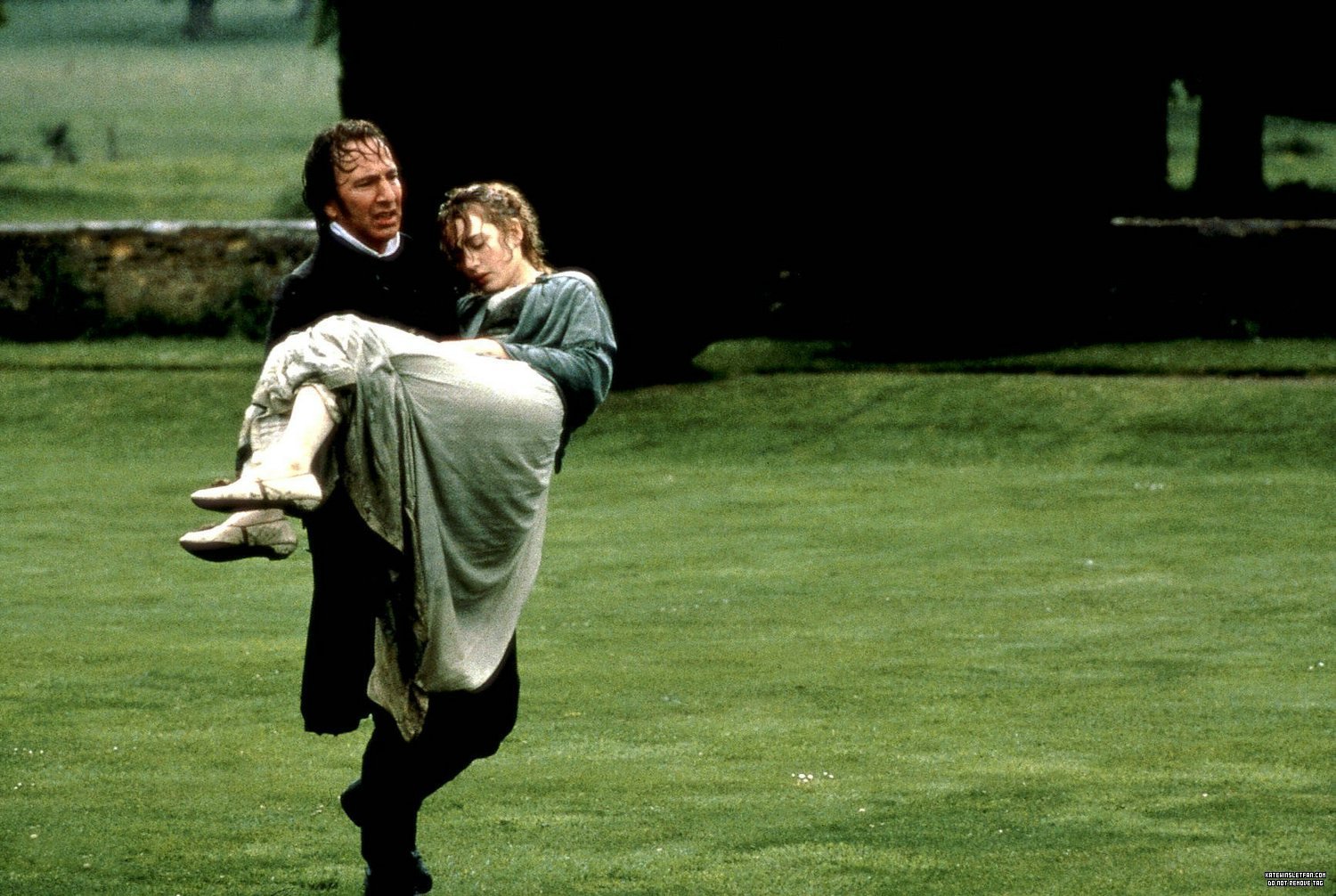
At first blush it is Willoughby who seems heroic, but it is the quieter Colonel Brandon who rescues Marianne from her untidy tendencies.
26% of men want to be the one who controls how the relationship plays out (i.e. how many dates they should have, how fast the relationship moves, when to meet each other’s family). 39% of men would prefer to let the woman control the direction of the relationship, 35% prefer it to be a mutual decision. For women, 27% want to be in full control, 31% prefer to let men decide; 43% prefer it to be mutual. (Back in the Regency era a wily woman could manipulate the situation behind the scenes, like Charlotte Lucas, in order to snare her man, but most, like Jane Bennet, were passive and took their cues from their suitor’s actions or family’s wishes. A Regency miss who takes control of her courtship or acts in a hasty and willful manner was regarded a hoyden, as with Lydia Bennet and Maria Rushworth, two stupid girls who were the instruments of their own undoing.)
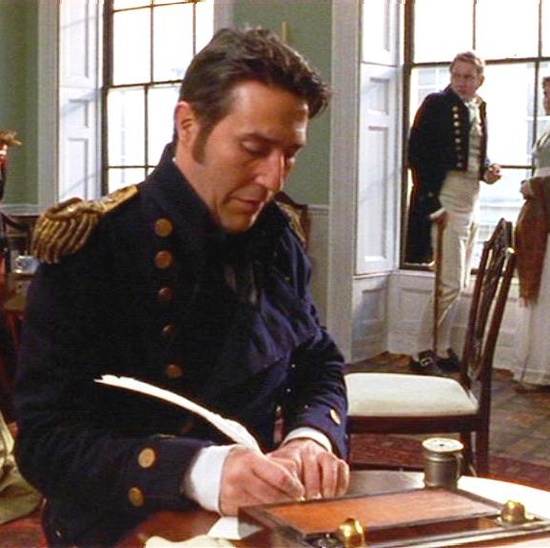
Anne yearned. Anne desired. But she could do nothing. It wasn’t until Captain Wentworth took pen in hand and wrote his swoon-worthy letter that he opened up the way to their blissful romantic reunion.
When it comes to popping the question, 66% of men and 65% of women think it’s fine for the woman to do the asking. (Not in Jane Austen’s day, when men were obligated to do the asking. A women’s sole power, that of choice, was exercised before marriage. It was up to her instinct and good judgment to refuse a cad or accept a good man for a husband. Heaven forbid if love clouded her good sense. Unless she was an aristocrat, the family would accede to her wishes, for once she married, she would have no rights and lose control of her money, land, and children. Thus a young woman (girls in many instances) had to be smart about her choice of mate or rely on wise council. Unfortunately for Miss Anne Elliot, her wise council, Mrs. Russel, turned out to be wrong and poor Anne had to wait eight long years before she could marry Captain Wentworth and find happiness in his arms.)
Wickham, a handsome fortune hunter
In terms of who pays for the first date (a long-standing debate), 47% of men feel that the man should pay; 24% feel that the bill should be split; 29% stated that whoever initiated the date should pay. On the women’s side, 31% feel the man should pay, another 31% feel that the bill should be split, and 38% indicated that whoever initiated the date should pay. (Now this is a tricky one, for in Regency times many a fortune hunter was able to inveigle an invitation to dinner or a party for which others paid, including his intended’s family. There were some bachelors who traveled from house to house and, aside from their personal expenses, never parted with a penny. The woman might not literally dig into her reticule to pay for the cad’s board and food, but in the instance of a fortune hunter, he most likely did not foot the bill either, except for a trinket or two with which to woo his heiress.)
Snooty Elizabeth Elliot lost her chance to bag a man
And that old “play-hard-to-get” theory? Still just a theory. Only 19% of men and 28% of women believe that a woman should be mysterious and play hard to get for the first few dates. (Elizabeth Elliot played hard to get and where did that get her? At 29 she’s staring spinsterhood in the face. Good old Charlotte Lucas took the horse by the reigns and saddled her man, albeit a fairly defective one. Mr. Collins had a house and a job, which was all that Charlotte wanted or needed. She encouraged him to garden, while spending her days alone in her private parlor.)
“Women no longer need to play the more submissive, demure role – and it’s nice to see that both genders support this progress,” states Dr. Ilona Jerabek, president of PsychTests. “This doesn’t mean that men are off the hook and don’t need to put an effort into romance anymore. The modern woman still likes romance, but it’s now a shared endeavor, with both genders putting an effort into the relationship. What fascinated us most about this study was that younger men and women had somewhat more traditional courtship views than older age groups.” (It is obvious from the following statistics that attitudes towards chivalry and courtship have changed drastically in 200 years. Imagine a young and spirited woman like Elizabeth Bennet adopting any of the following modern attitudes!:)
Age differences in courtship perceptions: surprising results
Queendom’s age comparisons reveal several interesting differences:
28% of men under 30 and 22% of men over 30 feel that the man should plan most of the dates.
60% of men under 30 and 76% of men over 30 feel that a woman should be able to propose to a man.
20% of men under 30 and 13% of men over 30 said that they would feel threatened by a woman who took control of what they did on the first date.
26% of men under 30 and 14% of men over 30 believe that it should be the man who asks the woman out, not vice versa.
51% of men under 30 and 39% of men over 30 believe stated that the man should pay for the first date.
66% of women under 30 and 71% of women over 30 have either asked a man out or would consider doing it.
64% of women under 30 and 72% of women over 30 think it’s ok to be the one to ask a man to marry them.
The modern way vs Jane Austen’s way of beguiling your beloved
Forget the dozen roses. Buy one, wrapped with a ribbon. (200 years ago: Give her a posy of fresh wild flowers that you picked in a field.)
Marianne draws Willoughby’s silhouette in the drawing room
Show up at your partner’s workplace and whisk him or her away for lunch. (200 years ago: Sit in the drawing room with your intended and let her wind her wool skein over your hands or suggest that you draw his silhouette.)
Place a love note in your partner’s lunch bag or on the bathroom mirror. (200 years ago: sing a duet at the pianoforte and make sure that the bench is a tad small.)
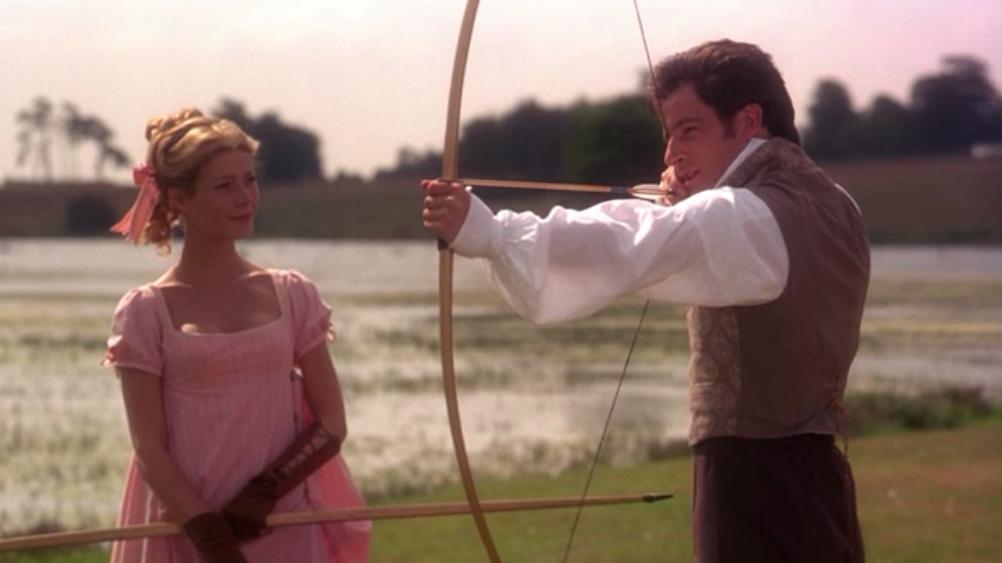
Archery as sport and a means of courtship
Grab a blanket, a bottle of wine, and drive out to a place where you can see the stars. (200 years ago: arrange a walking party with your sisters and cousins and ask him to tag along. Have the servants grab the blankets and wine, and drive you to your location.)
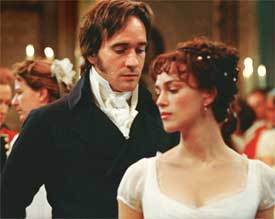
Darcy and Elizabeth
Slow dance in your living room. (200 years ago: Make sure to solicit her hand for the supper dance, wherein you shall spend another pleasurable hour in her company.)
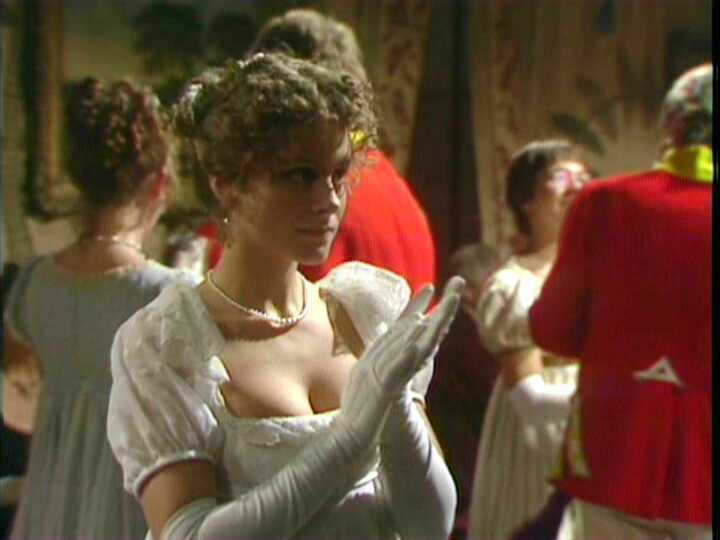
Elizabeth Bennet, 1980
Avoid embarrassing lingerie no-nos. Take him to a lingerie store and show him all the naughty things you like. (200 years ago: drop your handkerchief near your exposed ankle for him to retrieve, or make sure that your loveliest eye-catching locket nestles snugly between your well-exposed breasts. )
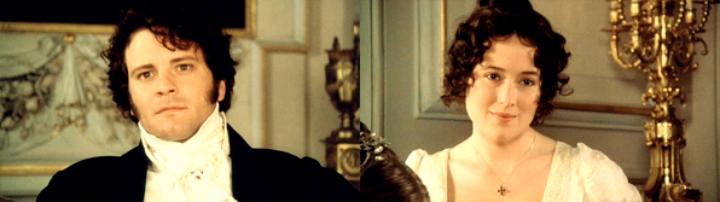
Darcy and Elizabeth make goo goo eyes at each other across the room
Meet at a local hang-out and pretend you’re two strangers flirting with each other. (200 years ago: make goo goo eyes at each other in the drawing room while others play a musical instrument, or pretend that you don’t like each other and trade bantering insults.)
Build a little bonfire in your backyard and make chocolate Smores. (200 years ago: engage in a game of archery and set out an al fresco tea.)
Get tango or salsa lessons together. (200 years ago: ask the music master to visit the village to teach the latest dances.)
As you can see, gentle readers, while the rules of romance have changed over the years, the game remains the same! What would Jane Austen have thought of today’s courtship rules, I wonder?
Queendom.com , a subsidiary of PsychTests AIM Inc. , is a site that creates an interactive venue for self-exploration with a healthy dose of fun. PsychTests AIM Inc. originally appeared on the internet scene in 1996, providing psychological assessment products and services to human resource personnel, therapists, academics, researchers and a host of other professionals around the world.
Fashionable Goodness: Christianity in Jane Austen's England is now available! By JAW contributor Brenda S. Cox. See Review. Available from Amazon and Jane Austen Books.
Available through December 31st, 2025. Click on image for details, and share this poster with other teachers and students!
The Obituary of Charlotte Collins by Andrew Capes
Click on image to read the story.
Comments
“My idea of good company…is the company of clever, well-informed people, who have a great deal of conversation.” – Jane Austen, Persuasion
Gentle readers: Please feel free to post your comments and continue the conversation! Due to SPAM, we will no longer accept comments on posts after 30 days of publication. In some instances, links will be removed from comments as well.
Administrators and Contributors
Vic Sanborn, founder of this blog, is supported by a team of talented and knowledgeable writers about Jane Austen and the Regency era. They are:
Tony Grant, who now contributes his photos from London and England
Click on their names to enter their own blogs.
In addition, we thank the many experts and authors who frequently contribute their posts and opinions, and who continue to do so freely or at our request.
Click here to enter the page. Topics include Regency fashion, historic foods, Jane Austen societies, British sites, related topics. Click on image.
May we suggest?
Hello, my name is Vic and I live in Maryland, USA. I have adored Jane Austen almost all of my life. I am a proud lifetime member of the Jane Austen Society of North America. This blog is a personal blog written and edited by me and my team. We do not accept any form of cash advertising, sponsorship, or paid topic insertions. However, we do accept and keep books and CDs to review.
If you would like to share a new site, or point out an error, please email us. (Yes, we are fallible. We'll own up to our mistakes and will make the corrections with a polite smile on our faces.) Write us at
Thank you for visiting this blog. Your comments and suggestions are most welcome.
Project Gutenberg: eBook of Stage-coach and Mail in Days of Yore, Volume 2 (of 2), by Charles G. Harper
STAGE-COACH AND MAIL IN DAYS OF YORE: A PICTURESQUE HISTORY
OF THE COACHING AGE, VOL. II, By CHARLES G. HARPER. 1903. Click on this link.













 Jane Austen's World