Feeds:
Posts
Comments

Archive for 2021

george austen

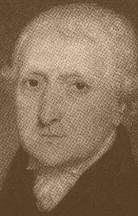
George Austen, Jane Austen’s father

Very little has been known about George Austen’s mother, Rebecca Hampson; what had been on record consisted of not much more than vital events, and some of their dates. That she was the daughter of Sir George Hampson of Gloucester, a doctor of physick and a baronet, is established fact, as is her first marriage to William Walter, with whom she had a son William Hampson; and after William Walter’s death, her marriage to William Austen, and the births of their four children. Her birth date had been extrapolated from the age stated on her grave in Tonbridge, erroneously as it turns out. Until S. G. Hale’s fortuitous discovery of her marriage to William Austen in registers of clandestine marriages, discussed later in this article, we didn’t know details of either of her marriages.

Although I cannot report the discovery of any letters towards constructing a biography, nor of any portraits, the indexing projects of genealogical companies such as Ancestry.com have revealed information which better focuses our curiosity about Rebecca and her two husbands. However, the first previously unrecognised fact predates online research by many years. Austen biographies had not mentioned the name of Rebecca’s mother, but The Complete Baronetage, published in 1902,1 states that George Hampson married Mary Coghill, daughter of John Coghill of Bletchingdon in Oxfordshire. The Coghills were a long-established Yorkshire family, until Mary’s grandfather Sir Thomas settled his branch at Bletchingdon. It is from that village, just north of the city of Oxford, that the first new facts emerge. 

George (not yet Sir George) Hampson and his wife Mary had their seven children baptised in the parish church, St Giles. Presumably they lived there; the fifty miles between the city of Gloucester and Bletchingdon would have been a dangerous distance over which to carry a newly born child, for the sake of baptism. Rebecca was baptised on 17 September 1693. The entry is unusually detailed, naming her godparents: John and Mrs Coghill (presumably her maternal grandparents), and Mrs Knapp (her maternal aunt Elizabeth, née Coghill). The stone slab in St Peter and St Paul’s, Tonbridge, recording her death in 1733, states that she was then 36; she was 39.

Dunning-800px-Allan_Ramsay_-_Queen_Charlotte_1744-1818_with_her_Two_Eldest_Sons_-_Google_Art_Project

Nothing is known of Rebecca’s childhood, nor of the date on which her father relocated the family to Gloucester. Now we have to fill gaps with assumptions. William Jarvis and Gilbert Hoole established, as they wrote in their article in the Annual Report of 1985,3 that her first husband William Walter, another doctor of physick, came from Tonbridge. He may have gone to Gloucester as an assistant to George Hampson, but we don’t know. We must assume that William and Rebecca married, but a search through the parish registers of St Michael’s, and St John’s, the two parishes with which the family are known to have been associated, has not provided any evidence; nor has Ancestry, so far, suggested another parish.

Now the new discoveries become more interesting. The couple had not one child, William Hampson Walter, but three. There is an entry in the parish register of St Owen’s, Hereford, for the baptism on 11 August, 1719, of Leonora, daughter of William Walter and his wife Rebecca.4 Although there is no corroborating evidence to confirm that it was this couple I am confident, because of the date and the combination of names. Hereford is not too far from Gloucester; William may, perhaps, have been seconded there for a time.

There must be significance in the choice of the name Leonora for Rebecca’s first and last daughters, but I have not found a precedent within her family. Another researcher has reported, although without evidence, that Leonora was buried on 19 November of the same year. She certainly did not appear in any later records. The date of her baptism in August 1719 provides a benchmark for the date of William and Rebecca’s marriage – one would expect that to have taken place by the end of 1718.

Their second child, William Hampson Walter, was baptised back at St Michael’s, Gloucester, on 31 August 1721. He survived into his late seventies, and is well documented, so I won’t dwell on him

The third Walter child was a boy named St George, who was baptised at St John the Baptist, Gloucester, on 25 June, 1723. The next record is, sadly, for his burial at Tonbridge on 29 September, 1725. George was the name of both Rebecca’s and William’s fathers, and she used it again in naming George Austen. This register entry shows that William and Rebecca were in Tonbridge during the year before his death. It had been thought that Rebecca did not visit the town till after that event, probably to look into the leasehold properties that he had held there.


Dunning-Image 2 St George's baptism 1723

dunning-Image 3 St George's burial 1725-1

Rebecca married again some nineteen months later, to another William – William Austen.

We do not know how they met, but we can guess. William Austen’s brother-in-law George Hooper, the husband of his sister Elizabeth, represented the fifth generation in a family of Tonbridge attorneys. George Hooper was well known to William Walter, who nominated him in his will as one of the two trustees. It would have been natural for the Walters to visit the Hoopers on their 1725 visit, where they may have encountered William Austen. Within the close-knit circle of Tonbridge gentry, there must have been other opportunities to meet. 

Stephen Hale, a member of the Society of Genealogists and of the Jane Austen Society, was the best-qualified person to recognise the significance of an entry for 13 January, 1727/8, in the registers of Clandestine Marriages in the Liberty of the Fleet, for William Austen of Tonbridge, Surgeon, and Rebecca Walter, also of Tonbridge.7 The Liberty of the Fleet was an area on the western edge of the City of London, surrounding the Fleet Prison for debtors, which was largely free of ecclesiastical oversight. There were many ‘marrying houses,’ where indebted clergymen could earn money to pay for their keep and ultimate release; however the specific locations of clandestine marriages were seldom noted in the registers. It is estimated that over 300,000 marriages took place there between 1720 and 1754. For many couples, it was simply a matter of convenience – they may both have come to London from distant parishes, and could marry quickly on the purchase of a licence. For others, they were definitely clandestine.

Why did William and Rebecca marry secretly, away from Tonbridge? No doubt they anticipated opposition from family and society. The couple’s age difference was greater than had been assumed – Rebecca was 34 and William 27. Fathers contributed property or finance on the first marriage of offspring, but not normally to a subsequent union; besides that, Sir George Hampson’s death had preceded William Walter’s by some twenty months. By remarrying, Rebecca sacrificed her half-share in her first husband’s property to their son. Whatever wealth William Austen had at his young age accumulated, and whatever status Rebecca had as the daughter of a baronet, their position in society was going to be precarious.

It is clear from a letter written by William’s aunt, Mary Tilden (née Weller), that he felt awkward. In the Annual Report of 2009 Mark Ballard, a Kent County archivist, transcribed some lines from her letter of 4 April 1728, written to her brother Edward Weller. They are worth repeating: 

In your last you hinted … you thought there was now nothing of Cous. Will Austen’s amour which I then wonder’d at, but I suppose my Brother [Robert] has told you what reason we have to think he is now married. I think he acts very foolishly in not declaring it and living as if it was so. I find him close & sullen if anything is mention’d to him of it tho I believe he’d have us think he is married. I said something to him a day or so ago and he answer’d me very ruff and unrespectfull. I found he was tutchd when I said the widow I believ’d was not that sincere person he believed.8

Mary’s misgivings concerning William’s behaviour are understandable, but we don’t know why she was suspicious of Rebecca. It appears that this first marriage of William’s was a love match and that Rebecca was prepared to sacrifice financial security for the emotional comforts of partnership. The couple wanted to be united despite the possibility of insecurity. What security they did gain was short-lived; Rebecca died only five years later, on 6 February 1732/3, shortly after the birth of the second Leonora. William died on 7 December, 1737. The eldest of their surviving children, Philadelphia, was nearly eight years of age; George, Jane Austen’s father, was six; and Leonora, nearing four. 

The new records presented here are only markers of events; we still know very little about the lives and characters of Rebecca and her two Williams. I began this article saying that this new evidence better focuses our curiosity; it leaves us wishing for more.

About the author:

Ronald Dunning

Ronald Dunning, Author

Ronald Dunning is the creator of Ancestry.com: The Jane Austen Page ” which is undergoing an update as his research continues. He learned through his grandmother that her family was in some way related to Jane Austen. After moving from Canada to England in 1972, he pursued this intriguing information and discovered that Frank Austen [Jane’s brother] was her great-great-grandfather. Find more information in Deb Barnum’s 2012 interview with Mr. Dunning for Jane Austen in Vermont, An Interview with Ron Dunning on his Jane Austen Genealogy ~ The New and Improved Jane Austen Family Tree!

Also, click on this link to Sir Thomas More and Jane Austen  on this blog by Ronald Dunning.

Notes

. The Complete Baronetage, ed. G. E. Cokayne, pub. William Pollard & Co. Ltd., Exeter, 1902. Vol.2, p.177

  1. With the permission of the Oxfordshire History Centre. St Giles, Bletchingdon, parish registers. Ref. PAR36/1/R1/2.
  2. Annual Report, 1985: ‘William Walter – An Investigation by Gilbert Hoole and William Jarvis’
  3. Ancestry.com. St Owen’s, Hereford;  Family History Library Film Number 1041600
  4. Gloucestershire Archives. St John the Baptist, Gloucester, parish registers. Ref. P154/9 in 1/5
  5. With the permission of the Kent History and Library Centre, ref. P371/1/A/4
  6. Annual Report for 2010, p.79, ‘Jane Austen’s Grandparents: William and Rebecca Austen.’  The marriage was listed in at least three registers of Clandestine Marriages, held at The National Archives in Kew: RG7/67, RG7/85, and RG7/403.
  7. Annual Report for 2009, p.71, ‘Jane Austen’s Family in the Centre for Kentish Studies, Maidstone;’ Mark Ballard and Alison Cresswell. Kent History and Library Centre, ref.  KHLC U1000-18 C1-12

Read Full Post »

A Review by Brenda S. Cox

“I was all in a fright for fear your sister should ask us for the huswifes she had gave us a day or two before”—Anne Steele, Sense and Sensibility, chapter 38

Christmas Ideas

I just finished a fall design, perfect for November. It adorns a “housewife”  (or “huswife”) sewing organizer I’ll give as a Christmas gift. If, like me, you enjoy sewing gifts for people, Jane Austen Embroidery will give you great ideas and patterns. Or, if you want something for a Jane Austen fan, or for someone who enjoys sewing and embroidery, the book itself would be a great gift for them!

Jane Austen Embroidery

Jane Austen Embroidery: Regency Patterns Reimagined for Modern Stitchers, by Jennie Batchelor and Alison Larkin, is a gorgeous book. With glossy pages full of beautiful photos, it’s a delight to read. I have done cross-stitch for many years, and dabbled in other kinds of embroidery, so I enjoyed learning more about stitching in Austen’s England.

Jane Austen Embroidery by Jennie Batchelor and Alison Larkin gives fascinating views of embroidery in Austen’s life and times, and projects for modern stitchers based on patterns of Austen’s time.

The book begins with an introduction exploring “Embroidery in Jane Austen’s Britain.” We learn about Austen’s enjoyment of needlework (which was often just called “work,” in her novels and elsewhere). Some of her contemporaries, including Mary Wollstonecraft, complained that it was drudgery and meaningless work. However, Austen’s letters show that she enjoyed style and had fun fashioning trimmings and garments.

The Lady’s Magazine

The Lady’s Magazine (1770-1832) is the source for the designs in the book. The authors explore the magazine’s history. It covered politics, science, cosmetics, essays, travel writing, poetry, serialized novels, music, and much more. According to Jane Austen Embroidery, The Lady’s Magazine balanced “traditionally feminine and intellectual accomplishments,” encouraging women to take up “the pen, as well as the needle.” Austen did both!

Embroidery patterns in the magazine were usually removed for use. It took the authors five years to track down sixty issues which still had intact patterns.

Readers of the magazine used the patterns with their own choices of colors, sizes, materials, and applications. Jenny Batchelor and Alison Larkin have adapted the patterns to modern materials and uses. They give detailed instructions.

The Lady’s Magazine covered many topics, ranging from politics to cosmetics. It encouraged women to take up the pen as well as the needle. Embroidery patterns were supplied regularly. Lady’s Magazine, August, 1770, public domain via Wikipedia

Overview of Jane Austen Embroidery

Seventeen pages explain in clear detail your options for tools, fabrics, thread, transferring the patterns to fabric, framing, working the stitches, and finishing your projects. I read this all the way through; even experienced stitchers will find helpful ideas here.

Three main sections make up the book: “Embroidered Clothes: Dressed to Impress,” “Embroidered Accessories: How Do You Like My Trimming?”, and “Embroidery for the Home: A ‘Nest of Comforts.” Each begins with an extensive discussion of uses of embroidery in Austen’s England aas well as references in her novels and letters.  For example, the authors say that in Northanger Abbey, when Henry Tilney was telling Catherine what she might write in her journal, he was complimenting her in an indirect way. He said that she “appeared to much advantage” in her “sprigged muslin robe with blue trimmings.” Sprigs were flowers or sprays of flowers, hand embroidered or printed onto the fabric.

Sewing Projects

Each section offers five projects with detailed instructions. Projects are marked “Beginner,” “Intermediate,” and “Advanced.” I didn’t notice this until I had already bought the material for an “Advanced” project, but I decided to go with it anyway!

For Beginners, in the first section the book offers a “simple sprig pattern” of two flowers on a stem, and a beaded pencil case with a swirling design from a gown pattern. Intermediate stitchers might sew a sequined evening clutch purse, embroidered from a waistcoat pattern, or an apron with an intricate “fireflower” pattern. Advanced stitchers can try  a “housewife” sewing organizer decorated with an autumn pattern.

Later sections offer a napkin set, cell phone pouch, tablet sleeve, reticule or jewelry pouch, muslin shawl, tea box top, work bag, cushion, sewing set, and tablecloth. All are lovely.

The Regency-Style Reticule or Jewelry Pouch, embroidered and beaded in bronze and gold, would add a lovely accessory to any Regency gown. Jane Austen Embroidery

The book tended to go a little freely between Austen’s time and modern times, so I wasn’t always sure whether techniques, materials, and designs were modern or traditional. But I was usually able to figure it out. Also I would have liked a few more pictures of embroidered items of Austen’s time; these were discussed but few were shown. Though I suppose more pictures would have added to the expense of the book, and it’s not too difficult to find pictures online.

The projects that interest me most were items actually used in Austen’s time: the housewife, reticule, shawl, tea box top, work bag, and sewing set. But modern stitchers might enjoy making things they can use daily, like a cell phone pouch or a tablet sleeve. There are plenty of options!

“Workbags were essential items for every needlewoman in the eighteenth and nineteenth centuries” (p. 126). This Beginner-level project is a “glittering gold and green work bag.” Jane Austen Embroidery

The Housewife (Huswife or Hussif)

To really try this book out, I decided to make the Harvest Housewife. A “housewife”—pronounced “hussif”—was “a folded, rolled purse-like object with internal compartments for carrying needles and needlework accessories” (66). It could also be used for carrying coins, letters, and other items. Miss Bates finds a letter under her housewife or huswif in Emma.

The housewife, huswife, or hussif was a sewing kit. Jane Austen made one for her sister-in-law and wrote a poem to go with it. This is the project in the book. Jane Austen Embroidery

We also know that Jane Austen made a housewife for her friend Mary Lloyd, which Jane’s nephew James-Edward Austen-Leigh described in his Memoir of Jane Austen.

He wrote:

“Her needlework both plain and ornamental was excellent, and might almost have put a sewing machine to shame. She was considered especially great in satin stitch. She spent much time in these occupations, and some of her merriest talk was over clothes which she and her companions were making, sometimes for themselves, and sometimes for the poor.

There still remains a curious specimen of her needlework made for a sister-in-law, my mother. In a very small bag is deposited a little rolled up housewife, furnished with minikin needles and fine thread. In the housewife is a tiny pocket, and in the pocket is enclosed a slip of paper, on which, written as with a crow quill, are these lines:  

‘This little bag, I hope, will prove

To be not vainly made;

For should you thread and needles want,

It will afford you aid.  

‘And, as we are about to part,

‘T will serve another end:

For, when you look upon this bag,

You’ll recollect your friend.’ 

“It is the kind of article that some benevolent fairy might be supposed to give as a reward to a diligent little girl. The whole is of flowered silk, and having been never used and carefully preserved, it is as fresh and bright as when it was first made seventy years ago; and shows that the same hand which painted so exquisitely with the pen could work as delicately with the needle.”

As far as I can find out, that housewife is no longer around; at least, I could not find pictures of it. The Jane Austen House Museum does have a little needle case, made of cardstock and felt, which Jane Austen made for her niece; that would be fun to try to recreate.

The Georgian Sewing Set includes a needle case, scissors case, and pincushion. The embroidery designs are from patterns for decorating shoes. Jane Austen Embroidery

My Project

The housewife was definitely an advanced project. Putting together all the pockets and attachments inside was complicated. I asked Alison for a photo of the finished product to help me out, which she cheerfully supplied (see my blog). In the end, however, I made my own modifications to it, so it would hold cross-stich supplies. That was fun and worked well.

The samples in the book are beautifully hand-sewn with silk fabric and threads. However, my money and time are limited, so I decided to use cheaper fabric, DMC thread, and a sewing machine. I spent less than $20. The book lists substitute colors for those who want to use DMC or Anchor thread instead of silks.

I was very pleased with the results. For details, see my post on my blog. My experience shows that you do not need to be an expert stitcher, or spend a lot of money, to make beautiful projects with this book.

My “housewife,” made with inexpensive materials, opened out. See my blog for more detail.

Next I may make an easier project, for myself.

Check this book out if you love sewing and love Jane Austen. Or, give it to your friends who do.

Happy sewing!

Jane Austen Embroidery by Jennie Batchelor and Alison Larkin is published by Dover Publications in the US and Canada, and by Pavilion Books in the UK.

Photographs from the book are by Penny Wincer; used by permission.

You can find Jennie’s fascinating talk on “Crafting with Jane Austen” at Jane Austen & Co. (Go down to the Staying Home with Jane Austen series, then click through the videos listed horizontally below that until you get to “Crafting with Jane Austen.”)

Jennie Batchelor’s website also links to other talks she has given.

Alison Larkin’s website includes blog posts on Georgian embroidery and lovely images

See also my post on Making a Housewife Sewing Organizer.

Read Full Post »

Last month, I wrote about Pin Money, or allowances, in Jane Austen’s life and novels. This time, I’m looking more closely at the importance of money in a genteel woman’s life and how it plays out in Austen’s novels.

Money is one obvious way parents could put limits on their children and keep them under control. This happened to both sexes for various reasons in Jane Austen’s time, but it carried even more weight for a woman because there were also financial consequences that came with marriage once she left her father’s home, even if she came from a wealthy family.

At that time in England, husbands had complete control over the finances of their wives. Without an adequate personal budget to spend as she liked, a wife had to go to her husband to ask for money to buy anything and everything she might need. Without a set allowance, wives could find themselves in a very difficult or unhappy position. This is one of many reasons why the marriage settlement (or prenuptial agreement) was so crucial because it was one way fathers could make sure their daughters (and grandchildren) were taken care of financially.

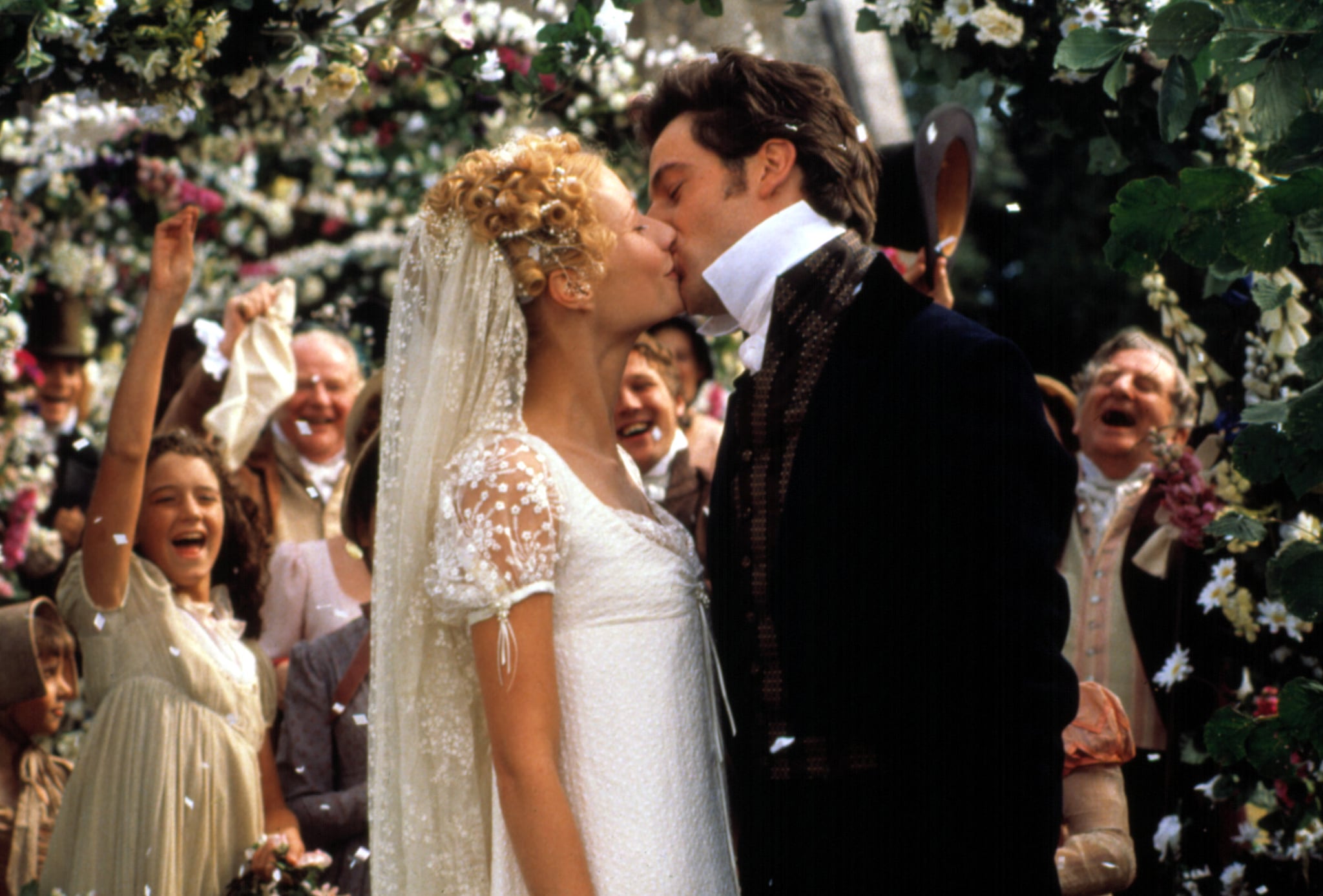
Gwyneth Paltrow in Emma, 1996.

Marriage Settlements

A young woman from a wealthy family would obviously qualify for better marriage terms than a young woman with very little. Her father could leverage what his daughter brought to the marriage for a highly favorable marriage settlement, allowing for her to have the pin money she needed, portions for her children, and a widow’s pension in the event that her husband died. Young women who did not bring as much to the marriage would have a smaller personal budget or, in some cases, no personal budget whatsoever.

In Daniel Pool’s What Jane Austen Ate and What Charles Dickens Knew, he writes, “Typically the bride’s family would have their lawyers negotiate with the husband’s lawyers, to get the husband to agree to grant her ‘pin money,’ which was a small personal annual allowance while he lived, a hefty chunk of property or money to support her after he died, and ‘portions’ of money for their children. All this would be written up in the ‘marriage settlement’ by the lawyers before anybody walked down any aisles.”

In JASNA’s Persuasions, you can read all about The Marriage Law of Jane Austen’s World. (For more on marriage settlements and marriage law in the Regency Era, please see the resources at the end of this article.)

Marriage Settlement, Mills College Library Heller Rare Book Room, Special Collections. Photo by Rachel Dodge, 2019.

Money Matters in Jane Austen’s Novels

In each of Austen’s novels, we find intriguing scenes that relate to women and personal money. Each of these examples shows us just how important it was for a woman to have her own money and the problems (and dangers) that could arise if she did not have any money or ran out of money, especially if she was away from home:

Fanny Price’s £10

In Fanny’s case in Mansfield Park, Sir Thomas supplies her with money before she leaves for her journey to visit her family in Portsmouth:

It had very early occurred to her that a small sum of money might, perhaps, restore peace for ever on the sore subject of the silver knife, canvassed as it now was continually, and the riches which she was in possession of herself, her uncle having given her £10 at parting, made her as able as she was willing to be generous.

Mansfield Park, Jane Austen

Harriet Smith’s Purse

In Emma, we see evidence of Harriet Smith’s allowance, which comes in handy when she meets the “trampers” on the road:

More and more frightened, she immediately promised them money, and taking out her purse, gave them a shilling, and begged them not to want more, or to use her ill.

Emma, Jane Austen
“The terror … was then their own portion.” Illustration by C.E. Brock.

Lydia and Kitty Bennet’s Mismanagement

In Pride and Prejudice, Lydia and Kitty spend their pin money money at the shops and must borrow money from Elizabeth and Jane when they surprise them for a meal at the inn in Hertfordshire:

“And we mean to treat you all,” added Lydia, “but you must lend us the money, for we have just spent ours at the shop out there.” Then, showing her purchases—“Look here, I have bought this bonnet. I do not think it is very pretty; but I thought I might as well buy it as not. I shall pull it to pieces as soon as I get home, and see if I can make it up any better.”

Lydia Bennet, Pride and Prejudice

Nancy Steele’s Fright

In Sense and Sensibility, we find this intriguing passage about the Steele sisters and personal money when Nancy Steele must go to Mrs. Jennings for money after Lucy borrows all of Nancy’s money and marries Robert Ferrars:

Not a soul suspected anything of the matter, not even Nancy, who, poor soul! came crying to me the day after, in a great fright for fear of Mrs. Ferrars, as well as not knowing how to get to Plymouth; for Lucy it seems borrowed all her money before she went off to be married, on purpose we suppose to make a show with, and poor Nancy had not seven shillings in the world…

Mrs. Jennings, Sense and Sensibility
Lucy Steele (Anna Madeley) and Anne, or “Nancy,” Steele (Daisy Haggardand), Sense and Sensibility, 2008.

Catherine Morland’s Borrowed Fare

In Northanger Abbey, money becomes quite important in a crucial moment. First, money is mentioned when Catherine Morland goes to Bath. Her parents send her with money for her personal expenses and ask her to keep account of her spending:

I beg, Catherine, you will always wrap yourself up very warm about the throat, when you come from the rooms at night; and I wish you would try to keep some account of the money you spend; I will give you this little book on purpose.”

Mrs. Morland, Northanger Abbey

Money is mentioned again when Catherine is suddenly and unexpectedly sent home from Northanger Abbey. While she is in Bath, she is under the care of her hosts, the Allens, who would, of course, pay for many of her expenses while she is under their roof and their protection. However, once she goes to Northanger, she is essentially under the care and protection of General Tilney. When he sends her home abruptly, he does not provide the funds necessary for her journey home, leaving her in a very precarious and even dangerous situation. This was a terrible oversight on his part. Thankfully, Eleanor is able to provide the funds, which we may assume is from her own personal allowance:

It had occurred to her that after so long an absence from home, Catherine might not be provided with money enough for the expenses of her journey, and, upon suggesting it to her with most affectionate offers of accommodation, it proved to be exactly the case.

Catherine had never thought on the subject till that moment, but, upon examining her purse, was convinced that but for this kindness of her friend, she might have been turned from the house without even the means of getting home; and the distress in which she must have been thereby involved filling the minds of both, scarcely another word was said by either during the time of their remaining together.

Northanger Abbey, Jane Austen

Catherine makes it home safely and repays the money to Eleanor by mail with only a short note: “The money therefore which Eleanor had advanced was enclosed with little more than grateful thanks, and the thousand good wishes of a most affectionate heart.”

The Morlands, a very practical bunch, decide after a bit that it all ended well in the end, but even they cannot understand such a “breach of conduct” on General Tilney’s part:

They were far from being an irritable race; far from any quickness in catching, or bitterness in resenting, affronts: but here, when the whole was unfolded, was an insult not to be overlooked, nor, for the first half hour, to be easily pardoned.

Mr. and Mrs. Morland could not but feel … that, in forcing her on such a measure, General Tilney had acted neither honourably nor feelingly—neither as a gentleman nor as a parent. Why he had done it, what could have provoked him to such a breach of hospitality . . . was a matter which they were at least as far from divining as Catherine herself…

Northanger Abbey, Jane Austen
Felicity Jones as Catherine Morland, Northanger Abbey, 2007.

Mrs. Smith’s Recovered Property

In Persuasion, we turn our attention to the widowed Mrs. Smith, whose husband had badly mismanaged their finances: “She was a widow and poor. Her husband had been extravagant; and at his death, about two years before, had left his affairs dreadfully involved.” In this situation, it is not just Mrs. Smith’s personal finances that are at stake, but her finances at large. Here, we see Captain Wentworth use his influence to work on her behalf and help improve her financial circumstances. At the end of the novel, we read this:

[Mrs. Smith] was their earliest visitor in their settled life; and Captain Wentworth, by putting her in the way of recovering her husband’s property in the West Indies, by writing for her, acting for her, and seeing her through all the petty difficulties of the case with the activity and exertion of a fearless man and a determined friend, fully requited the services which she had rendered, or ever meant to render, to his wife.

Persuasion, Jane Austen

When we look at the parents, guardians, husbands, and friends in the examples above, it’s clear that Austen uses money matters (just as she uses so many other clever devices) to point to character and propriety. We could go through each novel and study each of the male and female characters and surmise quite a bit about their personalities just from the way they each manage money.

It’s clear that the characters in Austen’s books who provide well for their wives, children, and friends–and those who are generous and charitable with their money–are the characters we should admire and respect. Conversely, those who handle their money poorly–and those who manipulate and use and abuse others for financial gain or for personal control–are the characters we should distrust and, in some cases, even despise. In Austen’s novels, money matters.


RACHEL DODGE teaches college English classes, gives talks at libraries, teas, and book clubs, and writes for Jane Austen’s World blog and Jane Austen’s Regency World magazine. She is the bestselling author of The Anne of Green Gables Devotional: A Chapter-By-Chapter Companion for Kindred Spirits and Praying with Jane: 31 Days Through the Prayers of Jane Austen. Her newest book The Little Women Devotional is now available for pre-order and releases December 2021. You can visit Rachel online at www.RachelDodge.com.


Links About Marriage and Marriage Settlements:

Read Full Post »

Inquiring readers: In early October, Prof Elaine Chalus, Historian of 18-19C British gender, politics & society, sent a link to eight sessions of the Bath 250, A Virtual Conference, The 250th Anniversary of the New Assembly Rooms of Bath, given on 29th & 30th September 2021. My first recap was of Professor Steve Poole’s presentation about Bath’s sedan chairmen.  

This second summation is of Rachel Bynoth’s discussion, entitled “The Marriage Market Reassessed: Female Emotional Experiences of Eighteenth-Century Bath Through Letters,” and focuses on the relationship between Bess Canning and her mother Mehitable (Hitty) Canning, the wife of Stratford Canning. (See a short synopsis of the family tree and their history at the end of the recap). Bynoth’s discussion also touched on another mother and daughter, whose letter exchanges are not discussed in this post.

About the Marriage Mart

Most of us who know about the 18th-19th century habits and rituals of courtship in Bath have acquired our awareness from reading  history books, articles, and blogs, as well as contemporary works of fiction. Unlike academics, however, most of us haven’t spent years seeking original sources and hunting dusty books in far corners of libraries and second-hand bookstores.  Conferences, such as ‘Bath 250’, present research from those sources. Bynoth’s primary approach to her topic are two key words in her title – emotional experiences. Through their letters, Bynoth follows both Bess’s experience as she attends the parties and balls and avails herself of Bath’s social life, and her mother’s increasing anxiety about her eventual success at attracting a husband during a time of England’s involvement in the Revolutionary War and Napoleonic Wars, when men were in short supply.

Canning-118

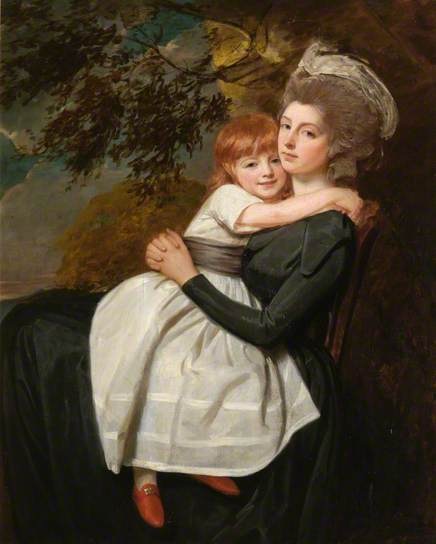
Mrs Stratford Canning with her daughter Elizabeth, by George Romney, National Trust for Scotland, Fyvie Castle

In Bynoth’s workshop discussion, she first mentions 16-year-old Bess Canning’s letter to her mother in her first social season in 1792. (Jane Austen was 17 at this time. She wrote Susan/Northanger Abbey at 23-24 years of age, after her first visit to Bath in 1797.)

Hitty replies to Bess:

“I am much pleased with your daily occupations + am glad you are improving your knowledge of housekeeping – it is a very necessary Qualification, for all young Women, but especially such as have small Fortunes – I trust in God my dear Bess with a little care and management; we shall all do very well – but we must act with great Circumspection, for many eyes are upon us + all our actions will be well scrutinized.” – quote from a slide by Rachel Bynoth in her presentation. – Rachel Bynoth

One senses the mother’s love in this missive. Nevertheless, Bynoth points out an underlying anxious tone in their future correspondence, for Hitty, a widow, and separated from her daughter in Bath, must rely on the Leighs, Bess’s chaperones, to supervise her according to her standards. The Leighs understood their responsibilities perfectly. In comparison to the Allens (Northanger Abbey), Bess’s real life chaperones “procured a partner for Bess for almost every ball, thus allowing her to dance.” – Smith, Rachel, “Proceedings of the History of Bath Research Group”, No. 5, 2016-17, pp.27-28.

It was important to Hitty that Bess was perceived as fashionable and erudite, ie. grammatically correct in letters. Her husband, Stratford Canning had died in 1787, five years before her daughter’s debut into society.  One can only imagine a widow’s anxiety for her daughter, especially one with five children to raise. Her letter to Bess commented 

“upon her grammar and spelling frequently. Hitty also criticised her daughter’s attention to her letter-writing, stating that she needed to pay more attention to her form and language in order to improve and insisted that their frequent correspondence would aid her development. This repetition of writing … [came] out of Hitty’s desire for her daughter to avoid the stereotype: that women could not spell or correctly apply the rules of grammar. This was especially important as Hitty moved in upper class circles: her intimate friend was Mrs Sheridan who was close friends with the Devonshire House set. Bess’s actions as a connected young woman would be commented upon and Bess’s trips to Bath in 1792/3 and 1798 highlighted this.” – Rachel Smith, Proceedings 

Mother and daughter corresponded regularly when apart, often every two days, and thus Hitty’s influence on her daughter kept Bess mindful and respectful of her mama’s wishes.

“Hitty’s letters to Bess in Bath show the importance of communication in order to fit in with fashionable society. Hitty’s letter, which asks Bess to report whether she had combed the powder out of her hair, tells one in real terms, how the powder tax affected people as well as demonstrates Hitty’s continuing societal education. This comment, and Bess’s subsequent reply detailing that she now had ‘red’ locks, also proves the significance of the ‘see and been seen’ aspect of society, where Bess would be judged as unfashionable with powdered hair.” – Rachel Smith, Proceedings

One can imagine the pressure Bess must have felt from her mother. At this time in 1792/93, Bess was a young lady new to the conventions of the marriage mart. According to Bynoth, her initial letters to her mother were optimistic and enthusiastic, and not without a little chagrin at Hitty’s attempt to micromanage her from afar. When she wrote about her concern about her progress, Bess, now 17, replied referring to a Bath newspaper account, 

“You may … fully satisfy your curiosity and [it] will convince you that my beauty, elegance, grace and uncommon wit is not to be surpassed.” – Bynoth

This answer should remind today’s readers of the cheeky and testy retorts any teenage girl would send her parents when enjoying the sights and sounds of a resort town. While her parent was becoming increasingly anxious, Bess still held hope in finding a beau.

By 1798, when Bess was 22 years of age and still seeking a husband in Bath, she no longer had all the time in the world by Georgian standards to attract a husband. Recall that Jane Austen visited Bath for the first time in 1797, when she was of a similar age. The author’s descriptions of Bath in NA, written shortly after her experiences, help us to understand the social whirl that both Bess and Jane experienced and the anxiety they must have felt in not satisfying family expectations. 

During this time, suitable men had come in even shorter supply due to the wars and so the ladies and their mammas were bound to be even more disappointed at the lack of suitors. 

“During these wars the shortage of men of marriageable age became particularly acute by the 19th century. Those that were eligible were often overseas, continuing the fights. This made finding a marriage partner even more anxiety inducing and harder.” – Bynoth

One can imagine the pressure on both the mother and the daughter. As her mother hyperventilated in print, Bess attempted to assuage her worries in another letter:

“… pray feel no anxieties about me. Mrs Leigh considers of everything for me & takes as much care & looks after me just as if I were her own. I make no doubt all will go on exactly as you could wish … Do not suffer the least apprehension about my dress & so forth … I must make Hay while the Sun shines if possible & I would have you to know I never looked half so well.“ – Bynoth 

The squeeze was on. While Hitty became increasingly anxious, Bess remained optimistic, but as time passed she too began to notice the lack of suitors. 

Scarcity of Suitors

As Bess’s stay lengthened, she wrote in a more somber tone:

“the girls ought to all pray for peace there. T’ill that much desired blessing arrives, it is in vain for them to crop and dress and go to public places … on hearing of the terrible scarcity of Beaus at Bath.”

Bess then wrote to her mother that the social gatherings consisted of more women and no men, and expressed her boredom and anxiety. For want of something better to do she was forced to “flirt a little with Lady Marianne’s son.”

While Hitty still seemed to feel more anxiety than Bess about her prospects for the future, her daughter expressed an interesting phrase: “Not that I wish to be melancholic, just now.”

Bynoth’s summarizing statement about Bess Canning’s situation sums it up perfectly: 

“Concerning finding a suitable husband or just securing a match, it seems to be less actually trying to find a suitable husband than trying to find a husband at all.”

Conclusion:

After seven more years, Bess did indeed find a beau suited to her station and, we hope, her mother’s wishes for a happy future. She married George Henry Barnett of Glympton Park  on 14th December 1805. This short biographical sketch places her squarely in an advantageous economical position as a wife:

“Despite occasional difficulties caused by wars and the business cycle, two generations of banking, together with other business directorships and socially advantageous marriages (his wife was a first cousin of George Canning, briefly the Prime Minister in 1827), made George Henry Barnett a wealthy man, worth £120,000 at his death in 1871. Both his surviving sons, Henry Barnett (1815-96) and Charles George Barnett (1816-96) followed him into the bank, and remained partners until its final absorption into Lloyds in 1884.” – Landed Families of Britain and Ireland

One assumes Bess achieved her destiny as a wife and mother in Hitty’s eyes. May we all hope she found peace and happiness in the marriage and as a mother as well. Bess died in 1838 at 61, while George Henry died to a ripe and elderly age in 1871. 

Additional links:

Read Full Post »

By Brenda S. Cox

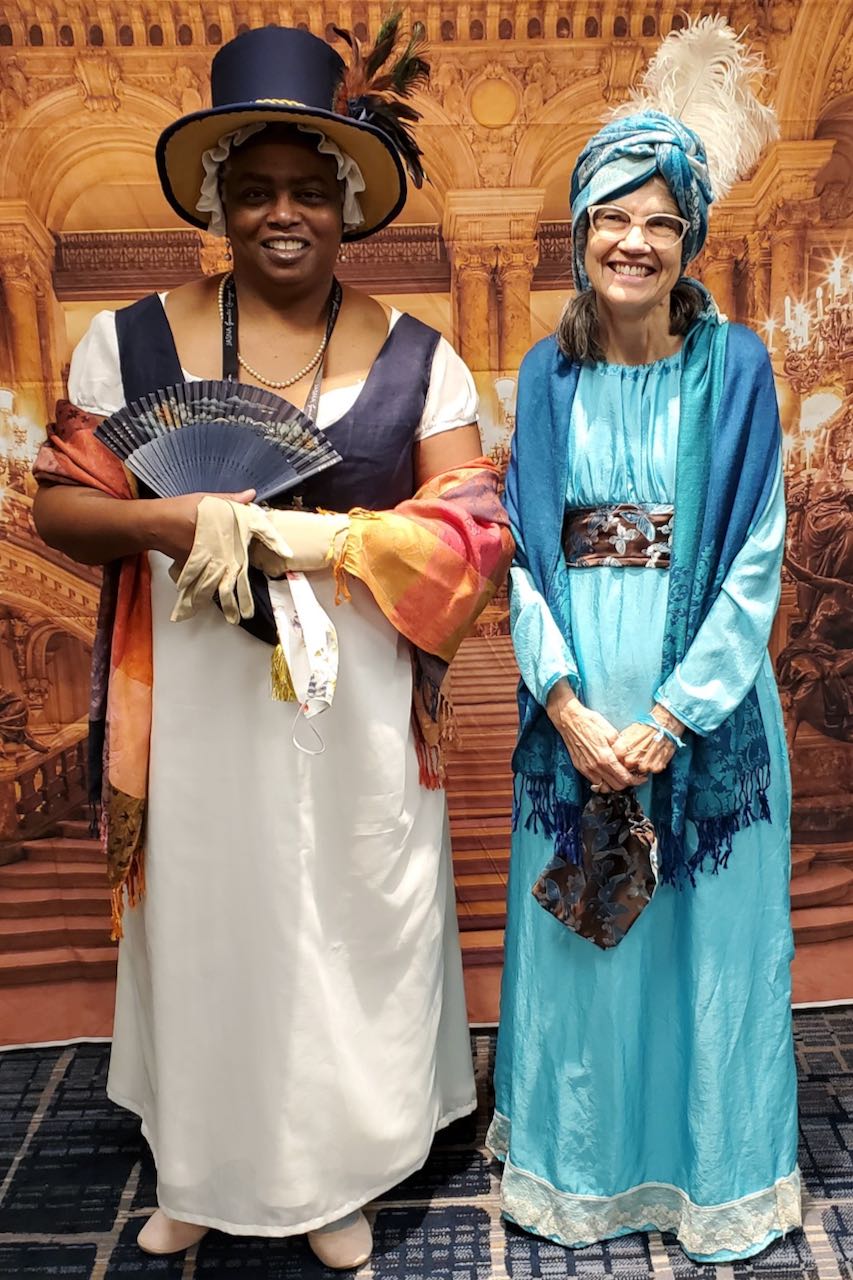
We got to enjoy “Jane Austen in the Arts” at the 2021 Jane Austen Society of North America (JASNA) Annual General Meeting (AGM). Over 500 participants gathered in Chicago last weekend to learn, enjoy each other’s company, and have fun!

The crowd was smaller than usual, and covid precautions were taken. Europeans weren’t able to come, though we had a few brave Canadians join us. It was a delight to be back together in person. Most regional JASNA groups are only now re-starting in-person meetings after many months of gathering only on Zoom. (If you didn’t know about JASNA, check it out; you will likely find a group near you.)

The Jane Austen Society of North America recently held their Annual General Meeting in Chicago.

So what does Austen have to do with the arts, you might wonder? We learned both about the arts during Austen’s time, and artistic adaptations of Austen today. Here are some of the topics we discussed.

Plenary Sessions

  • Gillian Dow told us about theatre and Austen’s dialogue.
  • Devoney Looser compared Jane and Cassandra’s inspiring one another through writing and art with Jane and Anna Maria Porter, sister-novelists writing at the same time.
  • Desmond Shawe-Taylor explained the Prince Regent’s enjoyment of art, especially the Dutch and Flemish painters popular at the time.
  • Maestro Stephen Alltop and Soprano Josefien Stoppelenburg gave us a concert of some of Jane Austen’s favorite music. One of the highlights of the weekend for me was their hilarious interpretation of “The Battle of Prague,” with Josefien’s farcical dramatization: shooting, riding an imaginary horse, “suffering” from wounds, and ducking cannonballs. (And, Maestro Alltop introduced the piece with a wonderful reading from Mark Twain’s Innocents Abroad about it, which started us laughing and we didn’t really stop!)

Special Interests

Participants chose from a rich palette of special interest sessions and breakout sessions, addressing all of these arts:

  • Music of the time, and the music used in Austen movies
  • Fashion
  • Painting
  • Sketching
  • Drama
  • Elocution
  • Dance
  • Embroidery
  • Costume Design
  • Graphic Novels and Comics
  • Cooking
  • Art Appreciation
  • Collecting Art
  • Adaptations of Austen
  • Satirical Cartoons
  • And even making videos for Tik Tok!
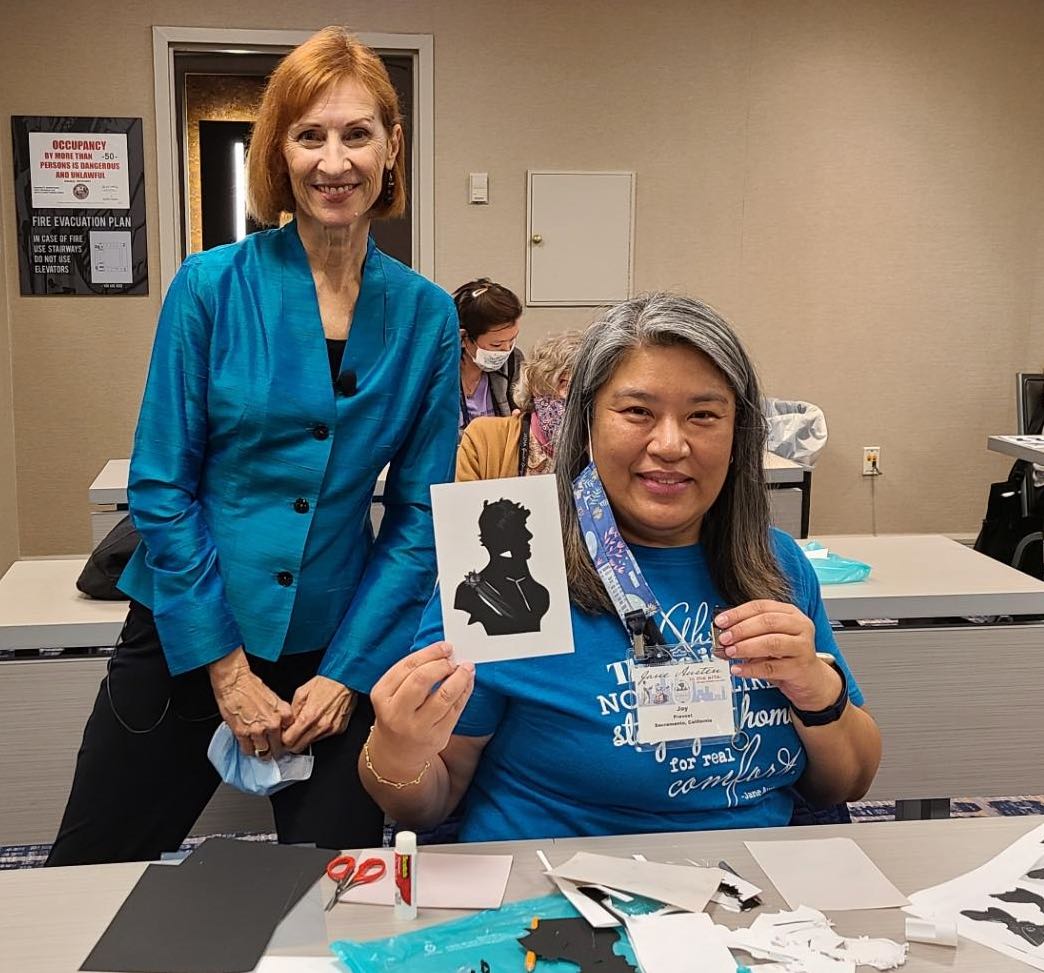
Joy Refuerzo Provost shows the silhouette she cut of the Prince Regent. Cassidy J. Alexander, standing next to her, is a professional silhouette artist and historian who taught the workshop at the AGM.

Tours and Workshops

For those who came a day early or stayed late, tours were offered of Frank Lloyd Wright’s architecture, Chicago movies, and more. Workshops, organized by Lori Mulligan Davis, let participants try their hands (and feet) at:

  • Calligraphy
  • Making Feather Headpieces
  • Watercolors
  • Silhouettes, and of course
  • English Country Dance

Entertainment

Besides all these fascinating learning opportunities, I loved the two main events.

  • Chicago’s Ghostlight Ensemble performed a captivating reading of A. A. Milne’s play, Miss Elizabeth Bennet: A Play from Pride and Prejudice. Bennet stole the show, with many hilarious lines. The play more or less followed the plot of Pride and Prejudice, but with some fun new twists thrown in.
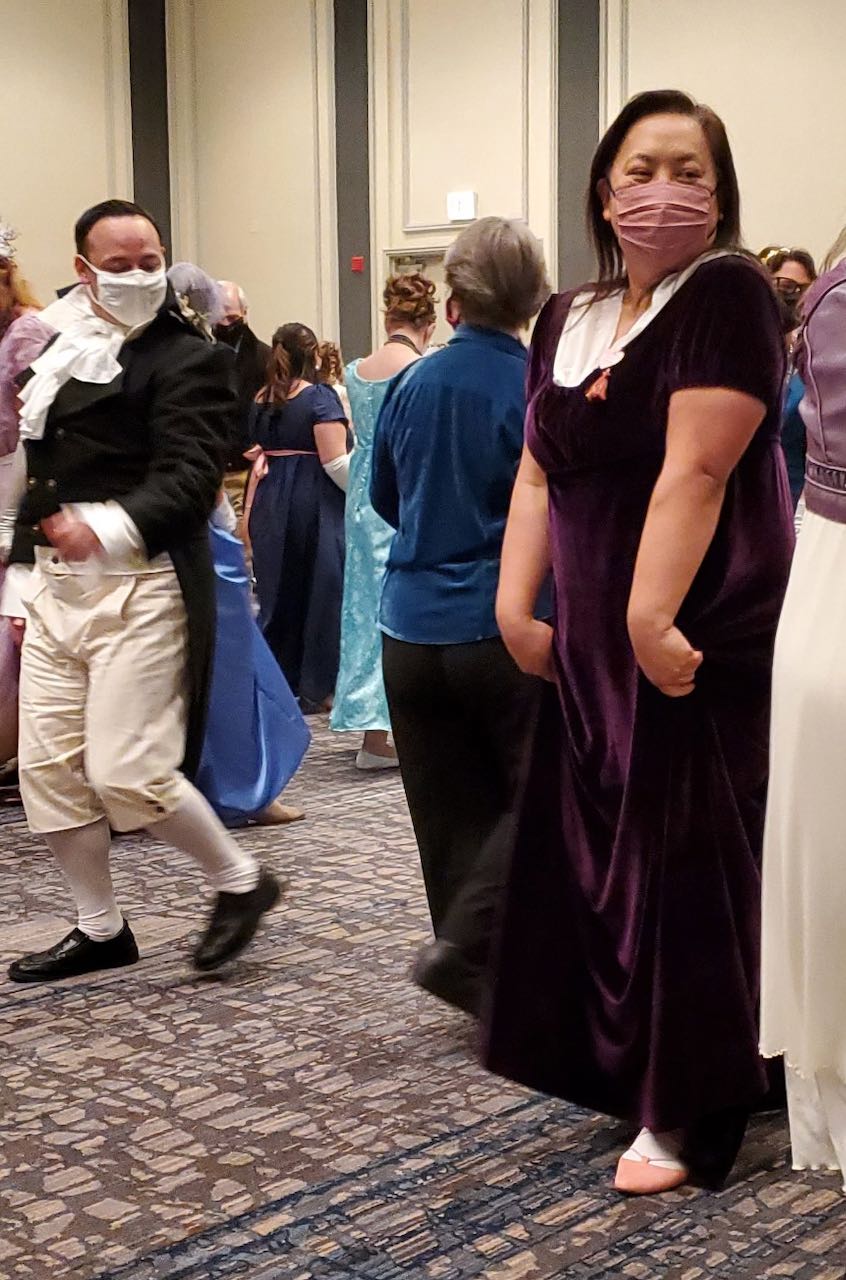
  • And of course, the Ball, following a banquet. So fun to be back dancing again, even with masks on! Callers Tom and Toni Tumbusch led the four long lines of dancers through two easy dances, to get the newbies comfortable, then brought us through the complex dance from the 1995 movie of Pride and Prejudice. This was loosely based on the dance “Mr. Beveridge’s Maggot”—maggot meant a favorite, not a worm! The caller explained that choreographers totally revised that dance so that it would look good on film and give Darcy plenty of chances to give Elizabeth “smoldering” looks! The changes did make it harder to dance, but we did it. And the last dance was the slower Duke of Kent’s Waltz. It didn’t actually include waltzing, though it was in ¾ time.
  • Those who didn’t want to dance could play whist or join a trivia tournament.
Renata Dennis, chair of the Diversity (JEDI) Committee, and Brenda S. Cox, dressed for the banquet and ball at the AGM.

Diversity

JASNA has been making great efforts to make Austen more accessible to a wide variety of people, including younger audiences and audiences from various backgrounds. The JASNA Equity, Diversity, and Inclusion Committee (fondly called the JEDI Committee) includes nine committed Janeites from a variety of backgrounds. I asked the JEDI chair, Renata Dennis, what she saw as the highlights of this AGM.

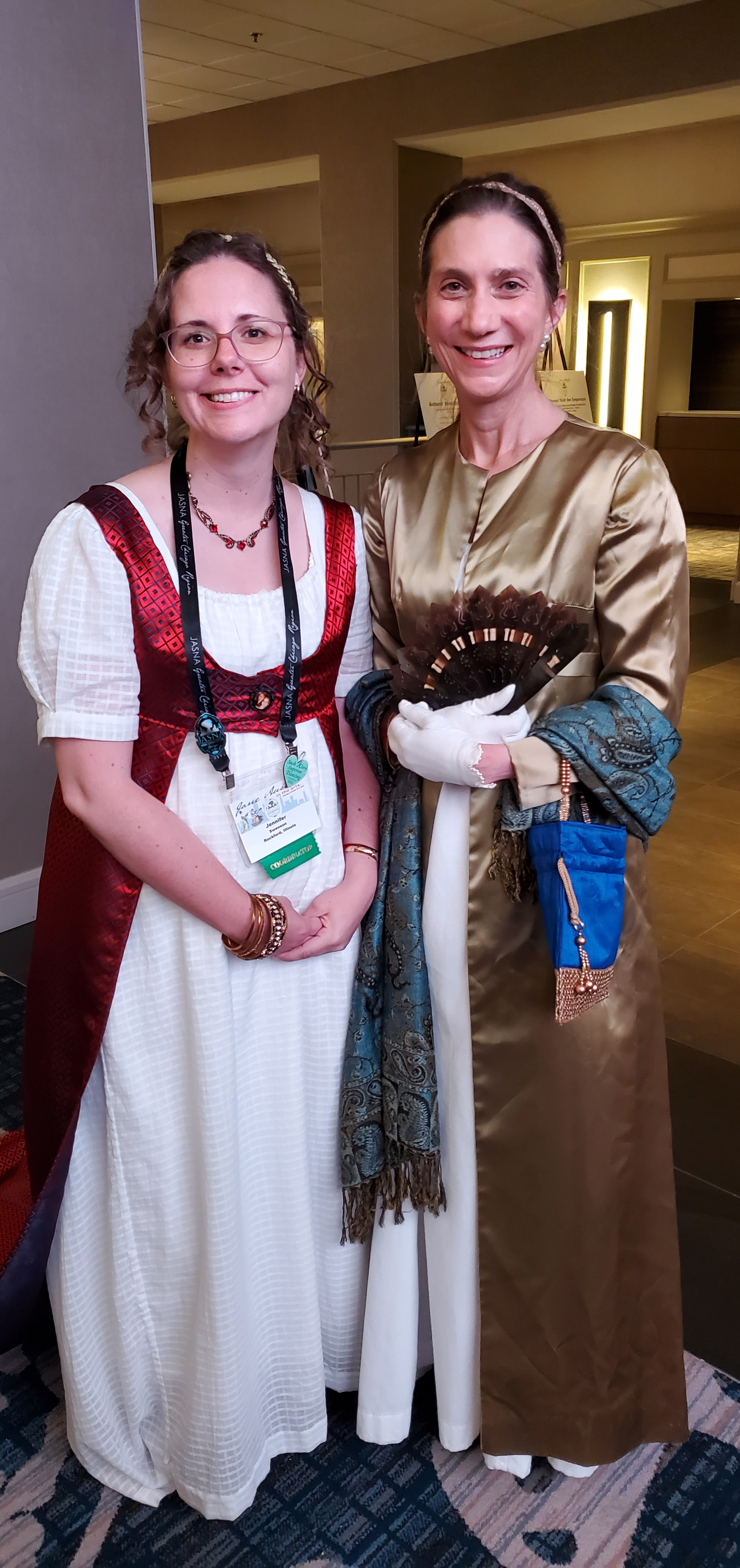
Renata sends kudos to the amazing AGM organizers, Kristen Miller Zohn and Jennifer Swenson, for making a point of including topics related to Jane Austen and diversity.

Kristen Miller Zohn and Jennifer Swenson, organizers of the 2021 AGM

Some examples Renata appreciated:

  • Johann S. Buis and Lisa Brown shared about musicians of color including George Polgreen Bridgetower, Ignatius Sancho and others, with samples of their work.
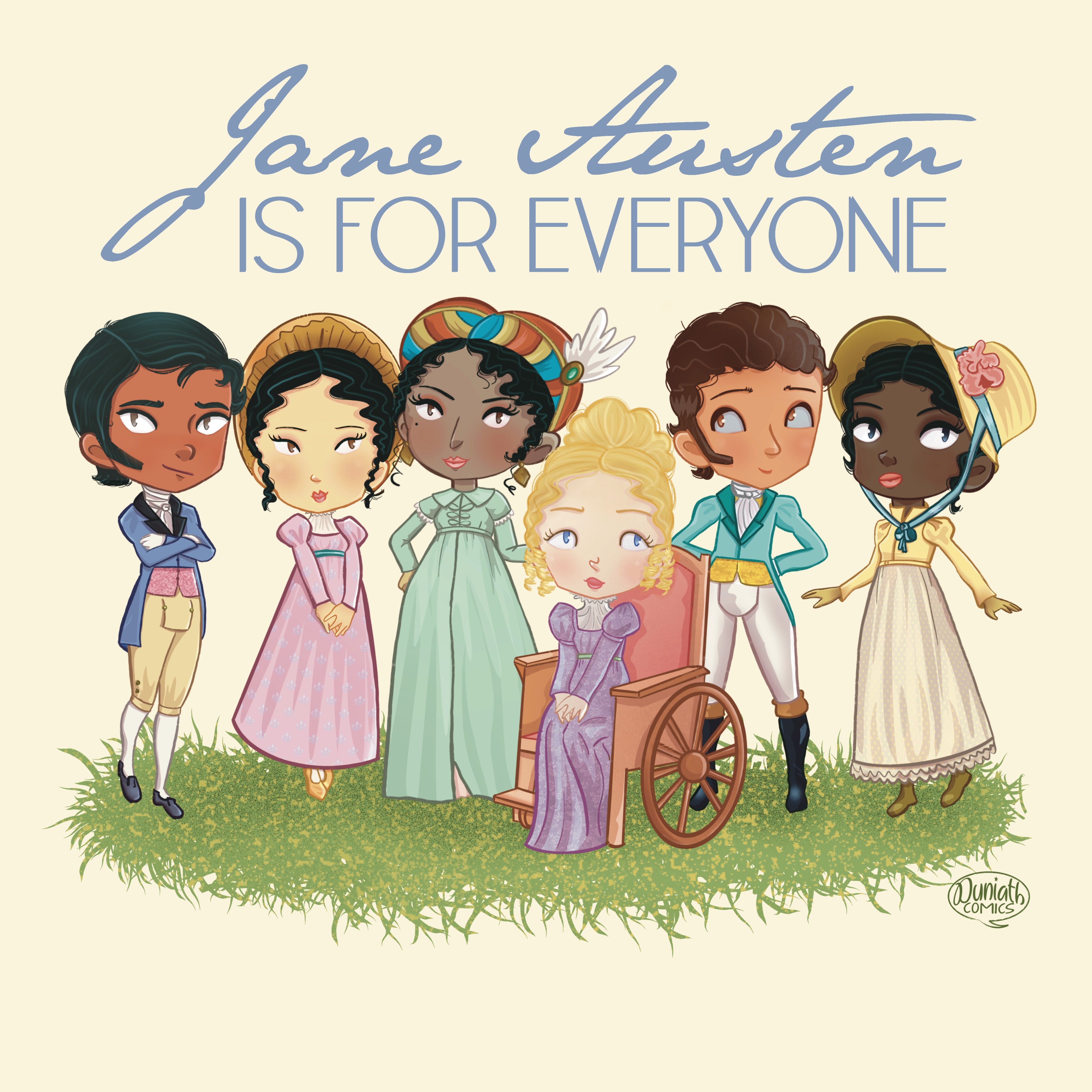
  • Georgie Castilla, an artist from Mexico, gave a fascinating presentation on Austen adaptations in comics, manga, and graphic novels. I was surprised to learn that while comic adaptations of other classics have been around for a long time, the first Austen comics appeared only recently. Georgie also pointed out that in cartoon adaptations, the characters can easily be shown as from diverse backgrounds. I bought one of his t-shirts, which proclaims “Austen is For Everyone,” and shows a variety of people in Regency clothes. 
  • Lena Ruth Yasutake talked about ways to introduce “new, younger, and more diverse audiences” to Austen through drama, education, and costume.
  • Devoney Looser talked about Charles Austen’s connections to suppressing slavery. She encouraged us to not fear addressing difficult topics of the Austens’ connections to slavery. The issues are complex, with many gray areas, but well-worth exploring in depth.

A recent issue of Persuasions On-Line also focuses on Jane Austen and Diversity.

Dancing at the Ball. Georgie Castilla and Sheila Hwang, members of the JEDI Committee.

Shopping

What else? Of course we also got to shop! Jane Austen Books offered their usual incredible selection of books, magazines, and other goodies, including a book signing with authors who spoke at the AGM. Other vendors sold clothing, accessories, socks, the Wisconsin region’s lovely Austen calendars, and other fun stuff.

This image by Georgie Castilla premiered at the AGM, featured on t-shirts, mugs, stickers, and tote bags. Items are available from Cassandra’s Closet.

Want to join in?

JASNA will be offering recordings of many of the sessions for those who didn’t make it to the AGM, for a fee. (My own talk on “Satirical Cartoons and Jane Austen’s Church of England” will be included.) I suspect that, like the AGM, the recordings will just be available to JASNA members, but I encourage you to join. The organization provides wonderful resources as well as great friends to network with.

And, you might want to start saving up for the next AGM, which will be held Sept. 30-Oct. 2, 2022 in Victoria, BC, Canada. I hear it’s a gorgeous place. The theme is “Sense and Sensibility in the City of Gardens.” I’m looking forward to it!

SPECIAL NOTE: IF YOU WANT TO JOIN JASNA, DO IT THIS WEEK! FEES WILL INCREASE ON NOVEMBER 1. INDIVIDUAL MEMBERSHIPS, NOW $30 PER YEAR, WILL INCREASE TO $45 PER YEAR ON NOV. 1.

Brenda S. Cox blogs on Faith, Science, Joy, and Jane Austen

Photos ©Brenda S. Cox, 2021, unless otherwise noted.

Read Full Post »

« Newer Posts - Older Posts »