By Brenda S. Cox
“Our dear Father has closed his virtuous & happy life, in a death almost as free from suffering as his Children could have wished. . . . We have lost an excellent Father. . . . His tenderness as a Father, who can do justice to? . . . the Corpse . . . preserves the sweet, benevolent smile which always distinguished him.”—Jane Austen to her brother Frank, Jan. 21 and 22, 1805.
George Austen, known for his “bright & hopeful disposition,” “mildness and gentleness of temper,” and “steadiness of principle” (religious principle). (Le Faye, Family Record, 4.)

Jane Austen was very attached to her father, George Austen. He was born, grew up, went to school, and worked for a time in Tonbridge. In April we “visited” the Horsmonden church, where George’s ancestors lived and died. Tonbridge, Horsmonden, and Godmersham are all in the county of Kent, southeast of London. (Hampshire, where Jane Austen mostly lived, is southwest of London.)
Tonbridge Church of St. Peter and St. Paul
George Austen grew up worshiping at the Tonbridge Parish Church. The church is dedicated to St. Peter and St. Paul, two followers of Jesus who spread the gospel during New Testament times.

Tonbridge Church of St. Peter and St. Paul, where George Austen worshiped when he was growing up. He also served there for a time after graduating from Oxford.

Tonbridge church tower. Built in the thirteenth century, top section added in the fifteenth century. In 1774, eight new bells were added to the tower, transported by barge from London.

Chancel of the Tonbridge church. The chancel is the area around the main altar of a church. It is usually centered in front of the nave. However, in this church, the chancel is set to the left of the center. During Christ’s crucifixion on the cross, His head fell to one side, at an angle. The architect represented that in the layout of the church.

Nave of the Tonbridge church, looking toward the entrance. The nave is the central area of a church, where the congregation sits for worship services. The vaulted arches draw the eyes up toward heaven, to help worshipers focus on God. (From the church website.)
George Austen’s Family
Jane’s great-grandfather John Austen IV of Horsmonden married Elizabeth Weller from Tonbridge in 1693. When John died eleven years later, Elizabeth, a strong and capable woman, paid her husband’s debts by selling her furniture and renting out her house. She got a job as housekeeper to a schoolmaster in Sevenoaks. This enabled her to send five of her sons to grammar school for free, opening doors for them to work in various professions. She is buried in the Tonbridge church.

Chapel in the Tonbridge church with a memorial to an Elizabeth Weller who donated to the church and died in 1677. She was related to Elizabeth Weller Austen, Jane’s resilient great-grandmother.
John and Elizabeth’s son Francis Austen (Francis II, 1698-1791) became a prosperous attorney in Sevenoaks and married twice, both wealthy women. Jane visited her great-uncle Francis in 1788 when she was twelve.

Memorials in the Tonbridge church to Jane Austen’s grandfather William Austen and her father’s cousin Henry Austen. The darker one reads, “Also William Austen, Surgeon, died 1737 Aged 36.”
Francis’s brother William Austen (1701-1737) became a surgeon and settled in Tonbridge, where he is buried in the north aisle of the church. He was Jane Austen’s grandfather. He and his first wife had four children: a baby who died in infancy, Philadelphia (mother of Jane’s cousin Eliza), George, and Leonora. William Austen married again but neglected to alter his will. When he died, his home and possessions went to his second wife, who did not care for his children. Other relatives took them in.

In the foyer of the Tonbridge church, various original items related to Jane Austen’s family and the church are displayed. Visitors can see the marriage register listing George Austen’s parents; the birth register listing George Austen; a prayer book and Bible from the time; letters from Austen relatives, and more.
Tonbridge School

In this Tonbridge School register from 1742, George Austen is listed in the 8th form, and his cousin Henry Austen is listed in the first form. [For American readers: a “form” is similar to a “grade.” However, these are reversed, as Henry Austen is the eldest and in the final class (#1), while George is in the youngest class, at age 11.]
Francis also paid for George’s cousin Henry (1726-1807) to attend. Henry was the son of Francis’s younger brother Thomas, an apothecary living in Tonbridge. (Sorry this is complicated; names were repeated over and over again in families!) Both Henry and George became clergymen.

Memorials at Tonbridge church to the Austens, to headmaster James Cawthorn who helped and encouraged George Austen, and to George Hooper, son of George’s Aunt Betty whom he lived with while going to school.
The headmaster at Tonbridge School was James Cawthorn who helped George get a scholarship to Oxford, reserved for “a poor scholar of Tunbridge parish and school.” This also provided a fellowship after he graduated, and a second scholarship to help maintain him as a fellow. Cawthorne employed him at the Tonbridge School as “Second Master,” or “Usher,” providing him with a home and a respected position.
(Tonbridge School is still thriving. It is now a large elite institution, with about 800 students. British people call it a public school while Americans would call a private school. When George Austen attended, it was a small local school, with 40-90 students.)
Other Connections
George Austen later resigned this post at Tonbridge School and returned to Oxford as Assistant Chaplain and Proctor. He was known as “the handsome proctor.” When he married Cassandra Leigh, he lost his fellowship (not available to married clergy) but gained the rectory at Steventon, where Jane was born and grew up.

Memorial at Tonbridge church to Vicesimus Knox, also buried there. A later headmaster of Tonbridge School, Knox compiled Elegant Extracts in Prose, a book that George Austen recommended to his son Frank. Jane owned a copy, and it is mentioned in Emma.
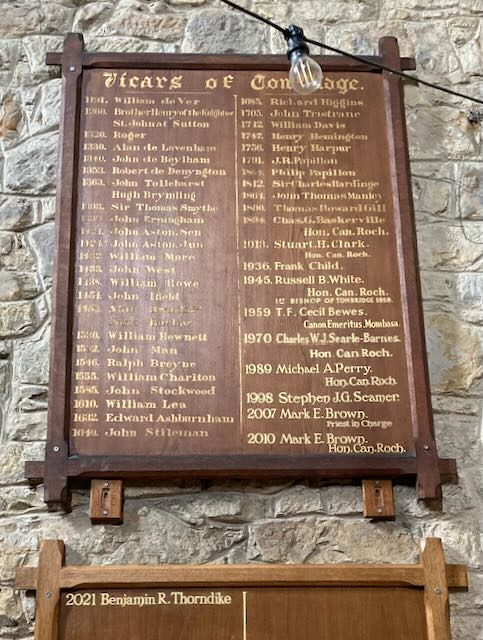
In this listing of Vicars of Tonbridge, Philip Papillon is listed for 1804-1812. He later became rector of Chawton.
Austen mentions Rev. Papillon, rector of Chawton, in several letters. Jane’s brother Henry had wanted that living, and their brother Edward offered Papillon £1200 to give it up. However, Papillon refused the money and moved into the Chawton rectory in 1802, rebuilding it “at too much expense.”
Jane jokes in 1809, when her relatives were speculating about her marrying the new single rector:
“I am very much obliged to Mrs. Knight for such a proof of the interest she takes in me, and she may depend upon it that I will marry Mr. Papillon, whatever may be his reluctance or my own. I owe her much more than such a trifling sacrifice.”
Papillon, by the way, owned a copy of Sense and Sensibility.
(Confused about rectors and vicars? A rector got all the tithes, a vicar only got part of the tithes. Each parish traditionally had either a rector or a vicar. Chawton had rectors, Tonbridge had vicars. See “Rectors and Vicars in Jane Austen.” The modern Anglican church uses the terms differently.)
Tonbridge and Tunbridge Wells
Tonbridge and Tunbridge Wells are separate towns, about five miles apart. “Ton” is a Saxon word for “ten,” and it has been speculated that ten Saxon families settled near a bridge and the town was called Tonbridge. It was close to Canterbury, the first place in Kent to have a Christian church (in the sixth century).
The Tonbrige church likely stands on the site of an early Saxon preaching place. A Norman castle was built in the town in the eleventh century and the church was built soon after. (George’s cousin, Revd. Henry Austen, married Mary Hooker, whose family owned the castle.)

In the 1700s, the church was a central part of the town. The town fire engine was kept on the church porch from 1747. These two fire hooks remain—they were fastened to horses and used to pull burning thatch from roofs.
Royal Tunbridge Wells was built much later, in the 1600s. A well was discovered there with water believed to have healing properties. It became a spa town, then a resort town visited by wealthy people. In 1909, the name “Royal” was added by King Edward VII. It is still a prosperous town that attracts tourists.
Tonbridge Church Today


Tonbridge Parish Church is a vibrant, thriving, evangelical church. About 150 people attend their Sunday morning services, a smaller group in the evenings. They also host weddings, concerts, and community events.
They offer meetings on Sundays and weekdays for families, children, adults, and seniors, as well as home groups meeting at various times. The Tonbridge church also runs courses for those looking into the Christian faith. They are connected with three nearby congregations (St. Andrew, St. Philip, and St. Saviour).
The Tonbridge church is a fascinating mixture of old and new. They seamlessly integrate memorials of the past with modern worship and outreach, including a professional-looking magazine.
They welcome visitors!
All photos in this post ©Brenda S. Cox, 2026.
Brenda S. Cox is the author of Fashionable Goodness: Christianity in Jane Austen’s England. She also blogs at Faith, Science, Joy, and Jane Austen.
More on Tonbridge Church
For a literary walk of Tonbridge showing highlights related to Jane Austen and her family, see Jane Austen & Tonbridge: A Circular Walk. (An audio version is mentioned but does not seem to be currently available.)
This history of Tonbridge parish includes a clear summary of church history in England.
Jane Austen’s Family and Tonbridge by Margaret Wilson
Jane Austen and Tonbridge is a concise booklet available from the church; main source for this post.
Monuments at the Tonbridge church
Architecture and Archaeology of Tonbridge church
Other Austen Family Churches
Adlestrop and the Leigh Family
Great Bookham and Austen’s Godfather, Rev. Samuel Cooke
Hamstall Ridware and Austen’s First Cousin, Edward Cooper
St. Paul’s Covent Garden (with links to other churches mentioned in Austen’s writings)
Stoneleigh Abbey Chapel and Mansfield Park
More Austen Family Churches
Winchester Cathedral and Jane Austen
St. Peter’s Hurstbourne Tarrant (the Lloyds’ church)