It’s well-established that Jane Austen’s family and friends played an important role in her writing life, and we know that she enjoyed a vibrant social life. She was a keen observer of human nature, as evidenced in her letters and novels. It’s intriguing to consider how the people in her life may have inspired her writing.
Austen’s novels reveal how deeply familiar she was with relationships, personalities, and social dynamics. They center on people and relationships, and in each of her novels, she situates her heroine within a specific sphere of her home life, family of origin, and social circle—either in a country “neighborhood” or in a town (or both)—but always within the context of a carefully curated group of friends, family members, and acquaintances.
In a letter to her niece Anna Austen, Jane wrote:
You are now collecting your people delightfully, getting them exactly into such a spot as is the delight of my life. Three or four families in a country village is the very thing to work on, and I hope you will do a great deal more, and make full use of them while they are so very favourably arranged. (Austen, Letter to Anna Austen, 9 Sept. 1814)
It’s clear that Austen truly enjoyed writing about a collection of families in a neighborhood village. In this series, I’ll explore how Austen’s own family, friends, and neighbors, or “village,” may have influenced the way the characters in her novels lived and socialized.
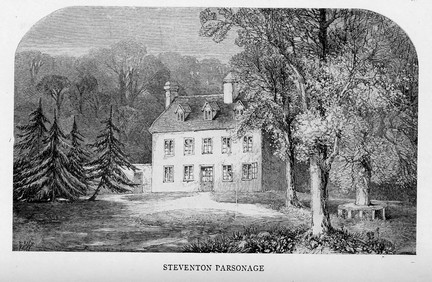
Steventon Rectory, Public Domain, Wikipedia
Rectory Life
Let’s start with Steventon Rectory, where Austen grew up. The people within that household formed her first village and family of origin. From birth through her mid-twenties, Jane lived at the Rectory, a crowded, cheerful parsonage in Hampshire, England, with her mother, father, sister, and brothers, and often several boarders. One can imagine the hustle and bustle of that home, especially when her brothers were home and her father’s pupils were boarding. (Hussain)
The home of Austen’s childhood and adolescence was full of activity and people. In this full, lively environment, young Jane was probably never alone for long, and there was plenty to keep her entertained and occupied. As her nephew James Edward Austen-Leigh later wrote in A Memoir of Jane Austen, Steventon was “the cradle of her genius,” the place where Austen’s imagination first flourished in the midst of a large, affectionate family and busy household. (Austen-Leigh)

The old rectory site where the parsonage once stood.
A Lively Home
Growing up in a home filled with literature and learning must have shaped Jane Austen in countless ways. Rev. Austen encouraged his children to read widely, and the family library contained an array of books—from history and theology to poetry, essays, novels, sermons, and plays (Rev. Austen’s Bookcase).
But the Austen home offered more than books for Austen. It is described as a place of lively conversation, spirited debate, dramatic performances, music, games, and the clamor of daily life (“Jane Austen: A Life”). With brothers returning from school and university, boarding pupils from different families, neighboring clergy and gentry dropping in for dinner, and parish life unfolding all around her, Jane was surrounded by an endless supply of personalities to observe. Long before she began writing Pride and Prejudice or Emma, her bright mind was absorbing the way people spoke, behaved, loved, argued, grieved, and (occasionally) embarrassed themselves.

Regency family eating a meal together.
First Audience
Thus, even though Austen grew up in a small village in the countryside, she did not grow up reading and writing in a vacuum. She was never alone in her creative endeavors, in isolation, writing for herself—and her writing shows it. Her early writing is rife with comedic moments and hilarious, even ridiculous language, and it’s clear she wrote to entertain.
The people around Jane didn’t simply provide material for observation; they also provided her with an audience. Austen had a built-in audience in her home and community during those formative, Steventon years. Her work was enjoyed by her friends and family members, and within that safe, supportive circle, she could play with language and rhetoric, try out various characters and voices, and test her humor and wit on a safe and accessible audience. Best of all, her home audience was enthusiastic and supportive, and it’s clear that her writing talent flourished in that arena. (“Jane Austen: A Life”)

“Volume the First: Facsimile Display.”
Juvenile Dedications
Austen’s Juvenilia provides additional proof that she wrote for her family and friends, as evidenced by the dedications she wrote for her stories.
In “Love and Freindship” (sic), she wrote: “Deceived in Freindship and Betrayed in Love,” which she dedicated to her cousin Eliza de Feuillide (Austen, “Love and Freindship”). In “The Beautifull Cassandra,” Austen dedicated the story to “Miss Austen,” understood to be her older sister, Cassandra, and addressed to her with a playful compliment: “You are a Phoenix. Your taste is refined, your Sentiments are noble, & your Virtues innumerable” (Austen, “The Beautifull Cassandra”). And “Evelyn” was dedicated to “Miss Mary Lloyd” (Austen, “Evelyn”).
As we know, Austen’s early stories weren’t simply private exercises; they were written within the circle of people Jane knew and loved. Writing for that audience provided her with an opportunity to practice her writing skills and observe people’s responses to her writing. She honed those skills to perfection over the years, but much of her early talent started at home.

“Volume the First: Page I.”
Future Novels
During her years at Steventon, Austen began working on the early versions of several novels that would eventually become some of her most beloved works. She was only about nineteen when she began “Elinor and Marianne,” the early version of Sense and Sensibility, and about twenty when she wrote “First Impressions,” which would become Pride and Prejudice. By her early twenties, she had also written “Susan,” the early version of Northanger Abbey.
Before Jane Austen left Steventon at age twenty-five, she had already moved beyond writing entertaining stories for her family and friends and was developing the novels that would eventually launch her literary career. Austen’s early years at Steventon surely helped produced her incredible talent.

Road to St. Nicholas Church, Steventon. Photo @ Rachel Dodge.
Jane Austen’s Village
Austen’s first audience was her inner circle. But the world of Steventon extended beyond the Rectory, especially as Austen grew older. The families who lived nearby formed another kind of community—one that provided Jane with friendships, social gatherings, conversations, and relationships that would remain important throughout her life.
In my next article in this series, we’ll step outside the Rectory and meet some of the neighbors and friends who populated Jane’s Steventon world. From the Digweeds to the Lefroys, these families were more than simply people Jane knew; many became enduring parts of her life. They help give us an even richer glimpse into the world from which Austen drew her understanding of people and relationships.
Rachel Dodge teaches writing classes, speaks at libraries, teas, and conferences, and writes for Jane Austen’s World. She is the bestselling, award-winning author of The Anne of Green Gables Devotional, Praying with Jane: 31 Days Through the Prayers of Jane Austen, the Praying with Jane Audiobook with actress Amanda Root, and other classics-based devotional books. Her newest release, A Christmas Carol Devotional, is now available for pre-order! Visit Rachel online at www.RachelDodge.com.
Works Cited
Austen, Jane. “The Beautifull Cassandra.” Jane Austen’s House, Jane Austen’s House Museum, https://janeaustens.house/teenage-writings/the-beautifull-cassandra/. Accessed 6 Aug. 2026.
Austen, Jane. “Evelyn.” Jane Austen Fiction Manuscripts: Volume the Third, Jane Austen’s Fiction Manuscripts, University of Oxford, https://janeausten.ac.uk/edition/ms/VolThirdHeadNote.html. Accessed 4 Aug. 2026.
Austen, Jane. “Love and Freindship.” Jane Austen: Juvenilia, jausten.it, https://www.jausten.it/jajuv201.html. Accessed 6 Aug. 2026.
Austen, Jane. Letter to Anna Austen, 9 Sept. 1814. Jane Austen’s House, Jane Austen’s House Museum, https://janeaustens.house/articles/nanowrimo/. Accessed 7 Aug. 2026.
Austen-Leigh, James Edward. A Memoir of Jane Austen. 1871. Project Gutenberg, https://www.gutenberg.org/ebooks/17797. Accessed 8 Aug. 2026.
Hussain, Azar. “The Boys at Steventon: Mr. Austen’s Students 1773–1796.” Persuasions On-Line, vol. 44, no. 1, 2023, Jane Austen Society of North America, https://jasna.org/publications-2/persuasions-online/volume-44-no-1/hussain-2/. Accessed 5 Aug. 2026.
“Jane Austen: A Life.” Jane Austen’s House, Jane Austen’s House Museum, https://janeaustens.house/jane-austen/jane-austen-a-life/. Accessed 5 Aug. 2026.
“Rev. Austen’s Bookcase.” Jane Austen’s House, Jane Austen’s House Museum, https://janeaustens.house/object/the-rev-george-austens-bookcase/. Accessed 6 Aug. 2026.
“Volume the First: Front Board.” Jane Austen Fiction Manuscripts, University of Oxford and King’s College London, https://janeausten.ac.uk/facsimile/blvolfirst/Front_(left)_board.html. Accessed 8 Aug. 2026.
“Volume the First: Page I.” Jane Austen Fiction Manuscripts, University of Oxford and King’s College London, https://janeausten.ac.uk/facsimile/blvolfirst/i.html. Accessed 8 Aug. 2026.




Rachel, Thank you for yet another great article.
I am always fascinated when wondering about relationships between Austen family members, and have found many of my literature students have shared my interest and how these might have influenced her writing and the development of the wonderful characters in her books. Adult students often express enormous interest in the lives and careers of Jane’s siblings.
I teach English literature in adult education and Jane Austen is one of my greatest passions!
Looking forward to your next article.
Best wishes,
Margaret