Feeds:
Posts
Comments

Archive for the ‘19th Century England’ Category

From the first page, William Holland had me hooked with his diary. His daily notations are not erudite. He does not wax eloquently about politics, philosophy, religion, or science, but with observations like these, who cares? Our parson has a way of planting us right in the middle of his little village:

Friday November 1 [1799]  The Clerk in the yard wheeling dung and Robert [Holland’s servant] looking about him and moving like  a snail. The Clerk cleared the liney and fetched three bushells more of pease for the sow. One of the Miss Chesters died yesterday, quite young, not ill above ten days. Poor girl her state of probation was soon over.

Then there are these short gems:

Wednesday November 6   Little Lewis the Apothecary came to me, rubbing his hands and moving his retreating chin in and out of his stock — attentive bur rather avaricious, mean and trifling.”

“Saturday November 9  Mr Robert has been wearing my spurs — now I have found out the method to get his horse on. Tis a difficult thing to get a servant worth anything. His slowness and laziness and want of method puts me out of patience. When the year is out he must go.”

Our country parson isn’t loquacious. Anita N writes about him on an online forum: “Apparently not the most charming man–but honest in his political and social views, and detailed about his daily life. That’s what I want to read: life sketches, muck, vitriol and common views of the time.”

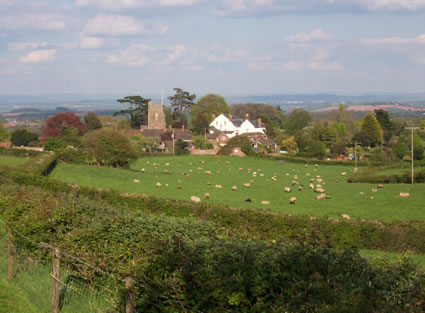
Our parson lived in Over Stowey in  Somerset. Even today the village is described as having “no commercial centre because there is virtually no commerce – not a pub, post office or shop” – only farms lying in the outer districts of the village. There are few area descriptions in Holland’s observations, since his purpose is to focus on the people he encounters each day. From what I have read so far, his diaries simply record the mundane events in his life. He is not a particularly good writer, and his usage of punctuation is minimal at best.

View of Over Stowey. Image @The Quantock Online Community

Holland held the opinions of an old-fashioned High Church Tory. The following definition serves well enough for readers who do not much about Tories:

Tories conceive of sovereignty as residing in rulers and view “the people” as subjects whose duty is to obey. Tories are thus identified with a system of hereditary power–exercised especially by monarchs and the established Church. – Historical Outline of Restoration and 18th Century British Literature

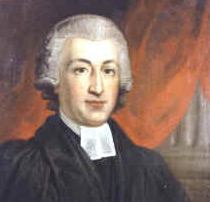
James Woodforde, 1740-1803, an amiable country clergyman, also wrote a diary. His is the image of a typical country parson of his day. Image @History Today.

Our country parson despised Democrats and took many swipes at them. One imagines that he must have shuddered at the very thought of Thomas Paine, the epitome of a Democrat and a radical, if ever there was one. Paine was against:

kingcraft, lordcraft and priestcraft. An original thinker far ahead of his time, he sought to redress poverty (seemingly endemic in advanced European societies) through an interventionist programme of welfare redistribution, including old-age pensions, marriage allowances and maternity benefits. – Thomas Paine, Citizen of the World, BBC History

In the Diaries’ opening observation on Wednesday October 23, 1799, our parson writes:

Saw that Democratic hoyden Mrs Coleridge who looked so like a friskey girl or something worse that I was not surprised that a Democratic Libertine should choose her for a wife. The husband gone to London suddenly, no one here can tell why. Met the patron of democrats, Mr Thos Poole who smiled and chatted a little. He was on his gray mare, Satan himself cannot be more false and hypocritical. “

Yet Holland was a compassionate man. He is constantly worried about the poor.

Thursday November 7   Still more rain, where will it end? The Poor, the Poor, how are they to live this winter? we must do all we can to assist and Providence will do the rest.

This series of observations about a mad man gives one a good sense of how a village takes care of its own:

Thursday December 5   The madman in the Poorhouse outrageous. Farmer Morle’s behaviour is absolutely scandalous but I’ll make him know his duty e’er long. The man is chained and lies on straw, shocking situation. Alas poor human nature how many afflictions art thou liable to.

Saturday December 7  Went to the Messrs Riches this evening about the man in the Workhouse, both determined to join in sending him to the Mad House in Bristol be the expence what it will. Says Master James ‘Mr Holland I reckon it be a bad business, he is a very bad fellow, there is something more in it than madness.’ Mr James thinks, in my opinion, that he is possessed by the Devil or bewitched.”

The parson then thinks about calling on the Vestry about the madman, but puts this off.

Monday December 9 Were alarmed with an account of the madman in the Workhouse having got loose and threatening everyone around with destruction. We procured two men to sit up with him and secure him from doing mischief till morning.

Holland writes that the madmen is quiet for two days, then he raves again. It seems that he uses the terms Poorhouse and Workhouse interchangeably. Finally, the men in the village decide what to do with the mad man:

Monday December 16 Went to Mr Ruscomb Poole at Marsh Mill to consult about the pauper in the Workhouse. Farmer Morle and Mr Lewis came in the evening and we went to the Poorhouse, examined the man, he had a fit at the time. We do not think him properly insane to be an object for a Madhouse. We shall try some other Methods.

Rev. Holland describes the days leading up to Christmas, including a little impromptu dance party that his daughter holds for her friends. There are 18 more years to read. Although this is not a review of the book, per se, I highly recommend it. I found my copy in a second-hand shop on Amazon. All I can say is that our Somerset Parson makes the early 19th century come alive from a male perspective. Between the diary of William Holland and Jane Austen’s letters, one gains a good sense of how different the life of a country woman is from that of a country parson. Next on my book wish list: The Diary of James Woodforde. I understand that this man loved his food.

More on the topic:

Read Full Post »

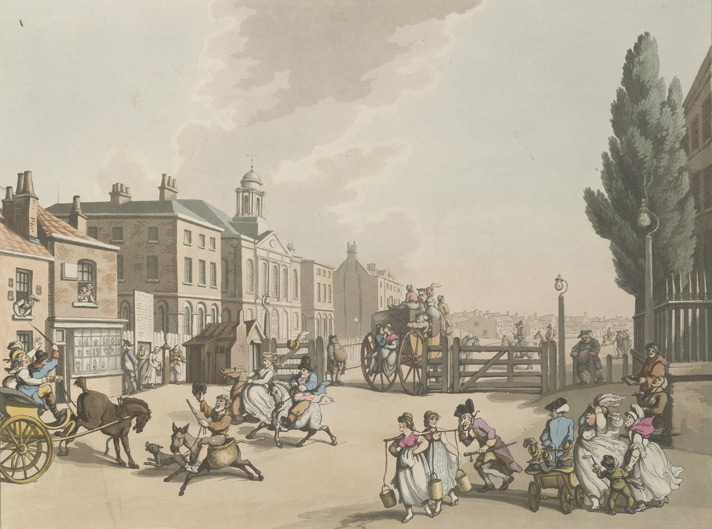
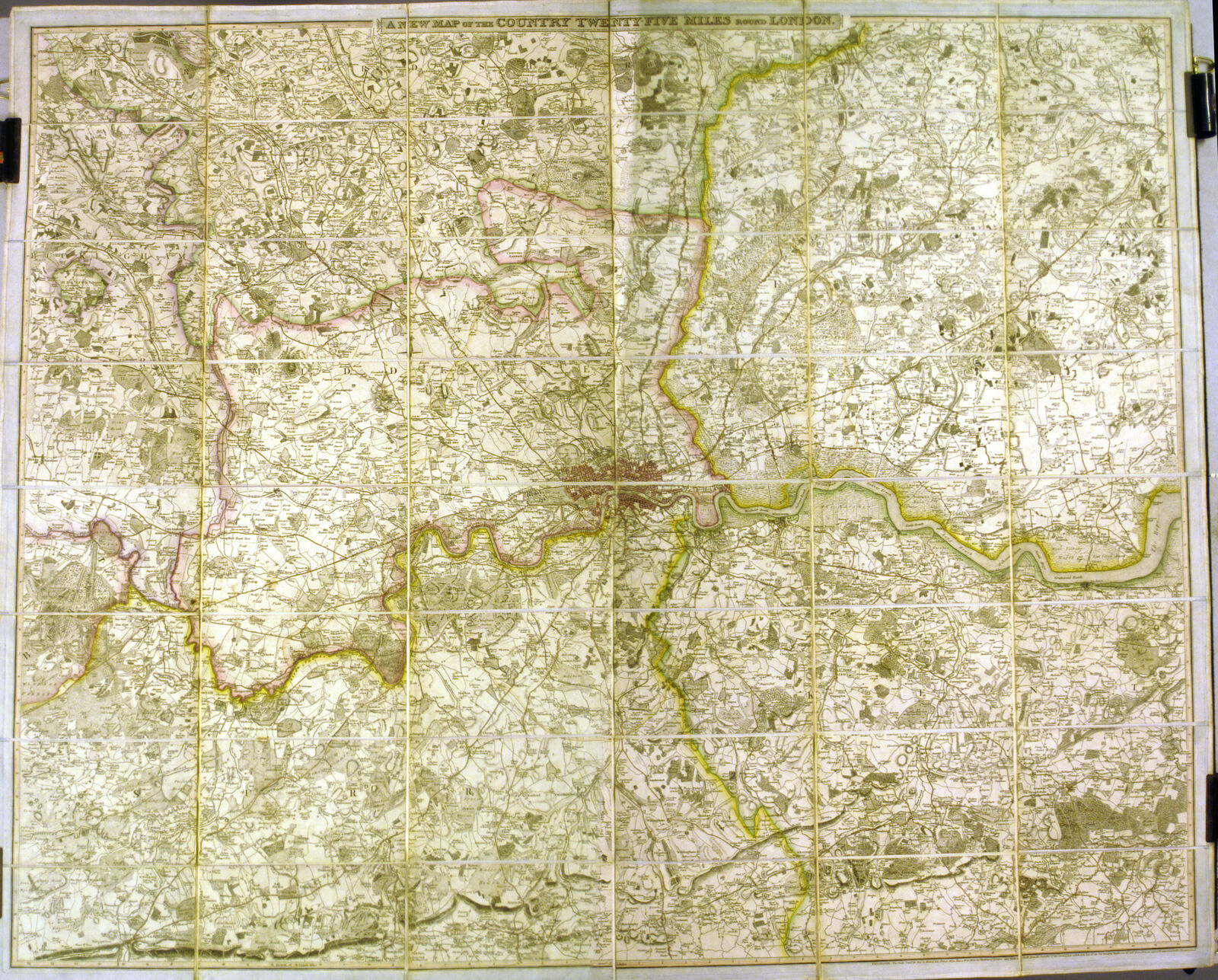
Inquiring readers, I had read about the closeness of rural areas near London during Jane Austen’s day. This image of Tottenham Court Road from the 1812 edition of Ackermann’s Repository shows the countryside beyond the toll gate. One imagines that Jane Austen was accustomed to such vistas when she visited her brother Henry in London. One moment she would be traveling through the countryside, the next moment she would be entering a teeming metropolis (Click here to see map):

In the first years of the eighteenth century, pastures and open meadows began by Bloomsbury Square and Queens Square; the buildings of Lincoln’s Inn, Leicester Square and Covent Garden were surrounded by fields, while acres of pasture and meadow still survived in the northern and eastern suburbs outside the walls. Wigmore Row and Henrietta Street led directly into fields, while Brick Lane stopped abruptly in meadows.“World’s End” beside Stepney Green was a thoroughly rural spot, while Hyde Park was essentially part of the open countryside pressing upon the western areas of the city. Camden Town was well-known for its “rural lanes, hedgeside roads and lovely fields”where Londoners sought “quietude and fresh air.” – Extract from “LONDON The Biography”, by Peter Ackroyd. Published by Vintage, 2001


The contemporary description of this view of St.James Chapel is telling:

The edifice selected for the subject of our view in the metropolis, for the present number, is the chapel of ease, situated near the turnpike in Tottenham-court-road, belonging to the church of St. James, Piccadilly. It was erected after a design of the celebrated architect, Mr. James Wyatt.

The contiguous parsonage-house on one side, and a school on the other, together with the plantations in the area between the front railing and the buildings, give great additional consequence to the appearance of the whole…

The vicinity of this chapel has recently witnessed one of those transformations of fields into houses, produced in every direction around the metropolis as if by the effect of enchantment. A prodigious street has just sprung up on the left-hand side, in continuation of Tottenham-court-road; and thus London has proceeded another good stage in its progress to Kentish Town. – St. James Chapel, Tottenham Court Road, 1812, Ackermann’s Repository

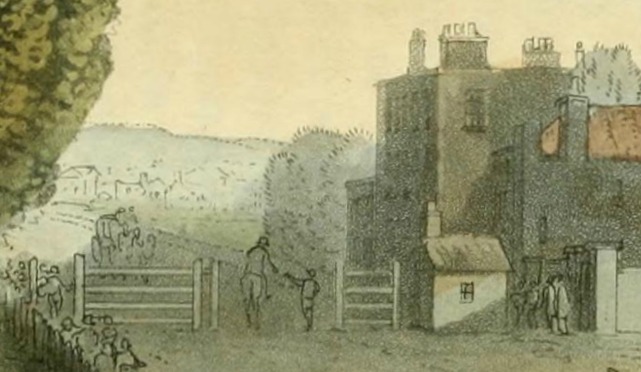
Detail of the turnpike. The toll keeper is collecting money from a man on horseback. Notice the small toll house, and the rural scene beyond.

The great age of toll gates and turnpikes was the 18th Century. In the latter part of the previous century, turnpikes were established and run by trusts. They could only be set up through Acts of Parliament, the first of which was passed in 1663. The idea was that the trusts would take over responsibility from parishes to maintain major trunk roads. They would collect the tolls, manage the finances and fulfil their obligation to use those funds to maintain the roads – Toll gates and turnpikes, London Historian’s Blog

Entrance, Tottenham Court turnpike by Rowlandson. Image @ Europeana

Rowlandson’s image shows another view of the turnpike. Pedestrians continued without hindrance via the side openings (except for the obese man, who seems to be stuck), but people on horseback and vehicles slowed to pay a toll in the gated center. Note Rowlandson’s detail of an old lecherous man ogling the two milk maids.

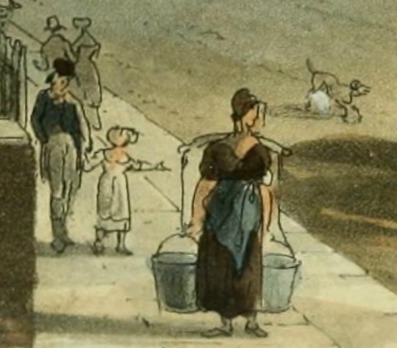
One milkmaid recorded her daily route and the results are astonishing: 19 miles.  Milkmaids are famous for their pretty skin, and this was largely because many of them had acquired immunity to smallpox through milking duties.  As milk delivery was a daily occurrence, many milkmaids ran slates for their customers, proving they were to some extent both literate and numerate, and also hard enough to call in a debt. – The Cries of Georgian London

Milk maids provided fresh drinks to customers. This one has just passed through the toll gate and has a long day's walk and work ahead of her.

“The cry of ‘Milk’ or the rattle of the milk-pail, will never cease to be heard in our streets. There can be no reservoirs of milk, no pipes through which it flows into the houses. The more extensive the great capital becomes, the more active must be the individual exertion to carry about this article of food. The old cry was ‘Any milk here !’ and it was sometimes mingled with the sound of ‘Fresh cheese and cream;’ and it then passed into ‘Milk, maids below;’ and it was then shortened into ‘Milk below;’ and was finally corrupted into ‘Mio’ which some wag interpreted into mieau—demi-eau—half water.”  – Buying Bread and Milk in 18th and 19th Century London, Susannah Ives

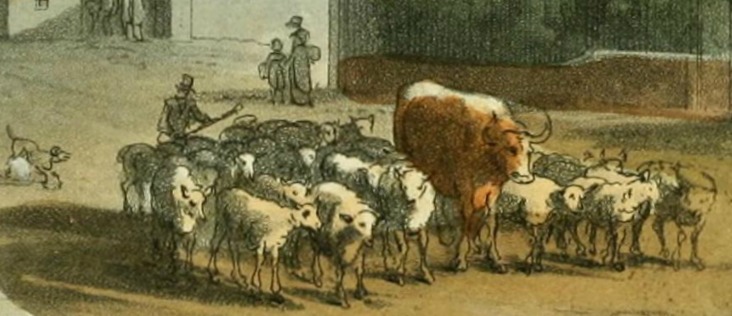
Detail of cattle being driven to market. One imagine that the streets were filled with dung and the smells of the animals, most of whom must have been frightened of the big city's sights and sounds.

This detail of sheep and an oxen being driven through the streets to market was a common sight. The people in this great metropolis had to be fed. In just a few hours these hapless animals will find themselves in the noisy, tumultuous, and bewildering environment of Smithfield Market, for instance. Without refrigeration, their meat would be sold, consumed or prepared within hours of their slaughter.

Cattle were driven through the streets until the mid 19th century. In an article for Household Words in March 1851 Dickens, with characteristic sarcasm, describes the environmental impact of having live cattle markets and slaughterhouses in the city:

“In half a quarter of a mile`s length of Whitechapel, at one time, there shall be six hundred newly slaughtered oxen hanging up, and seven hundred sheep but, the more the merrier proof of prosperity. Hard by Snow Hill and Warwick Lane, you shall see the little children, inured to sights of brutality from their birth, trotting along the alleys, mingled with troops of horribly busy pigs, up to their ankles in blood but it makes the young rascals hardy.” – Dickens’ London

Read Full Post »

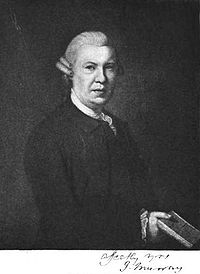
Inquiring readers:  Once again, Tony Grant, who lives in London, has written his unique insights about historical events in that great city. This week he concentrates on John Murray, the publisher of four of Jane Austen’s six completed novels. Tony’s contributions to this blog are unique in that he includes his photographs of modern London and mingles them with more traditional illustrations. Read Tony’s blog, London Calling, at this link.

Image @Wikimedia Commons

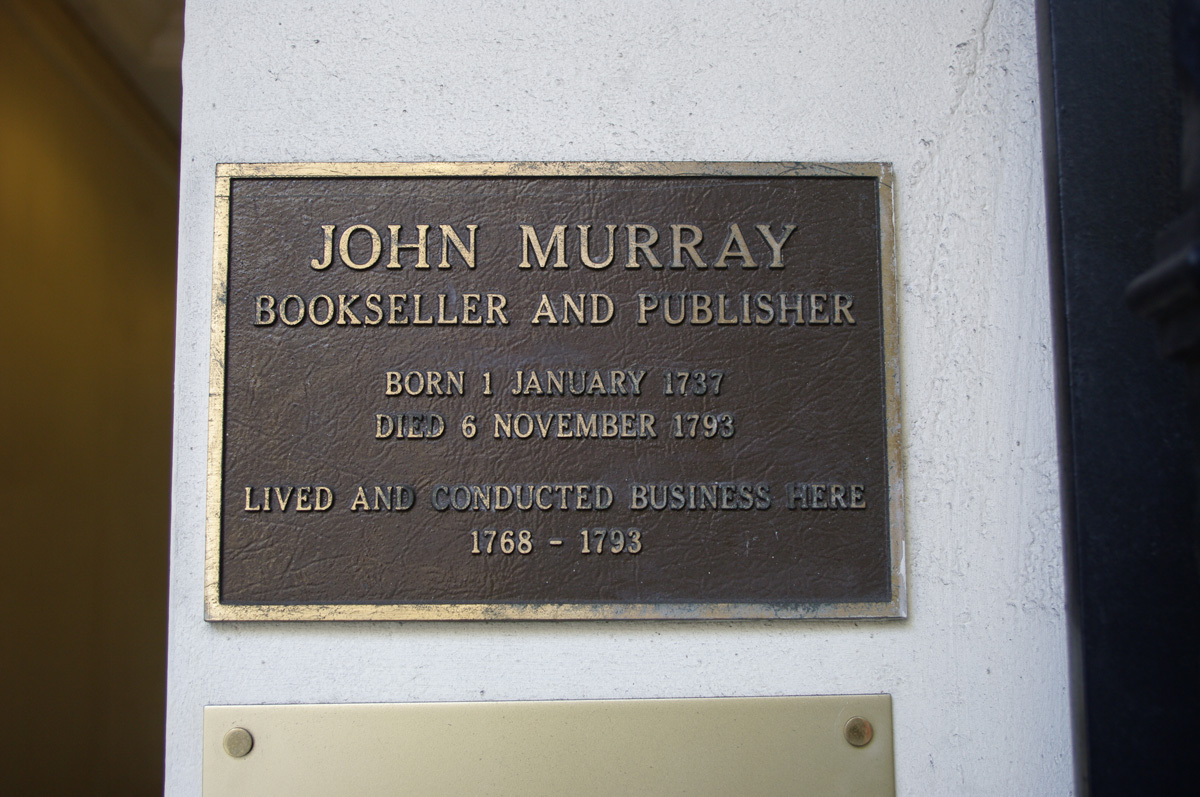
John Murray
Bookseller and Publisher
Born 1st January 1737
Died 6th November 1793
Lived and conducted business here.
1768 – 1793

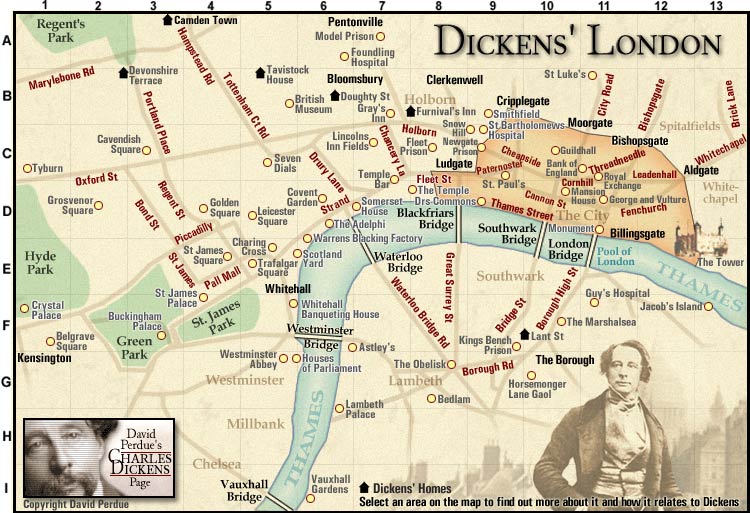
On Tuesday 13th March, my son Sam and I had a day out in central London. My brother Michael, who lives in Grenaa on Jutland, is over here with thirty students. Michael teaches mathematics in a further education college in Grenaa. He has lived in Denmark for over thirty years. A couple of weeks ago he phoned me and asked if I could do a Dickens tour of London for his students. On Tuesday Sam and I walked the route I will take Michael’s students. A Dickens walk is difficult. There are so many places in London that have strong links with Dickens.

Image @Wiki Spaces. Click on site.

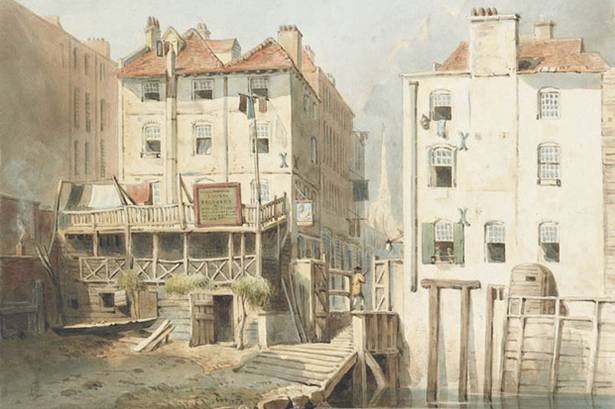
It is more about what to leave out than what to include. Connecting them all in a walk that will take just over an hour would be impossible. I looked carefully at a map of London to see what places could be linked most appropriately. I think I have chosen a rout that includes many of the main sites connected with Dickens working life in London. I have decided to begin at Hungerford Bridge the site of Hungerford Steps and Warren’s Blacking Factory where Charles Dickens worked as a young child sticking labels on bottles of black polish.

The Blacking Factory where Dickens worked. Image @The Mirror. Click here to see more.

The walk will be along The Strand, past The Adelphi Theatre, to Wellington Street, the Lyric Theatre and then on to Covent Garden before walking on to The Old Curiosity Shop, Lincolns Inn , Chancery Lane, Holborn High Street, past Grays Inn and finally ending at 48 Doughty Street, one of the houses Dicken’s lived in and now The Dickens Museum. Sam and I felt very pleased with ourselves. The walk flowed nicely, punctuated with plenty of Dicken’s sites and the timing was about right. We retraced ours steps, this time continuing down Chancery Lane to the Strand and turning left until we got to Ye Olde Cheshire Cheese, in Fleet Street.

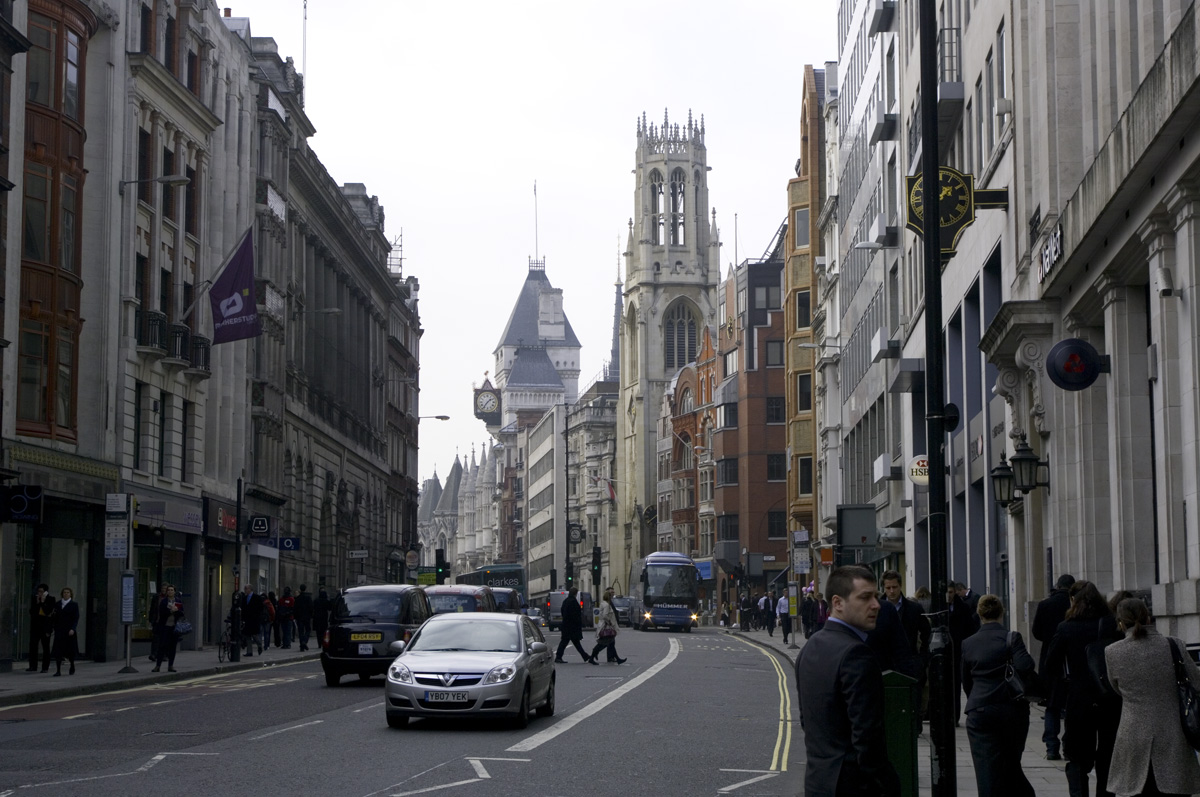
Fleet Street and The Royal Courts of Justice. Image @Tony Grant

Dickens, some of his characters and many other writers and famous people have graced these premises. After a pub lunch in the cellared depths of this ancient establishment we tracked back along Fleet Street towards The Royal Courts of Justice. I just happened to glimpse a small plaque attached to a pillar to one side of a narrow alleyway leading to a small courtyard behind. It read:

Image @Tony Grant

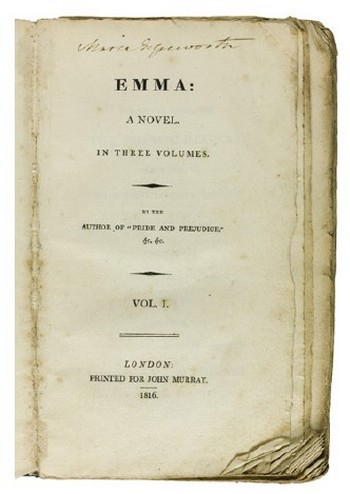
I stopped in my tracks. I thought this must be Jane Austen’s publisher. However the dates did not tally. Jane’s first novel, published by John Murray, was Emma in 1815, long after the final date of death on the plaque. I took photographs of the plaque and courtyard at the end of the alleyway and pictures of Fleet Street, running along outside. When I got home I researched John Murray and found the John Murray publishing firm website.

THIS IS A SHORT HISTORY OF THE PUBLISHING FIRM OF JOHN MURRAY.

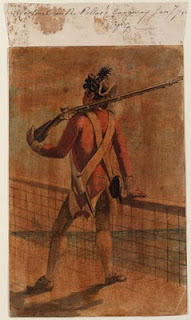
The first John Murray, who lived from 1737 to 1793, started his working life as a Lieutenant in the Marines. Life as a marine officer in the 18th century was spent on board naval men of war and consisted of travelling the world to defend the British Empire. It wasn’t a particularly well paid or thought of profession. In Mansfield Park , Fanny’s mother, Frances , the younger Ward sister,

British marine, 1775. Image @Mock Attack

…….married, in the common phrase, to disoblige her family, and by fixing on a Lieutenant of Marines, without education, fortune, or connections, did it very thoroughly.”

John Murray must have had a natural inclination towards business and when he acquired a publishing and bookselling business in Fleet Street in 1768 he made it into a successful business now passed down through the generations. The fact that he acquired a publishing business must mean that it was left to him, perhaps in a will. As a lieutenant of marines it is doubtful he would have had the finances to buy it and it seems a strange choice of business for somebody with his background. He must have acquired it through inheritance and an accident of fate.

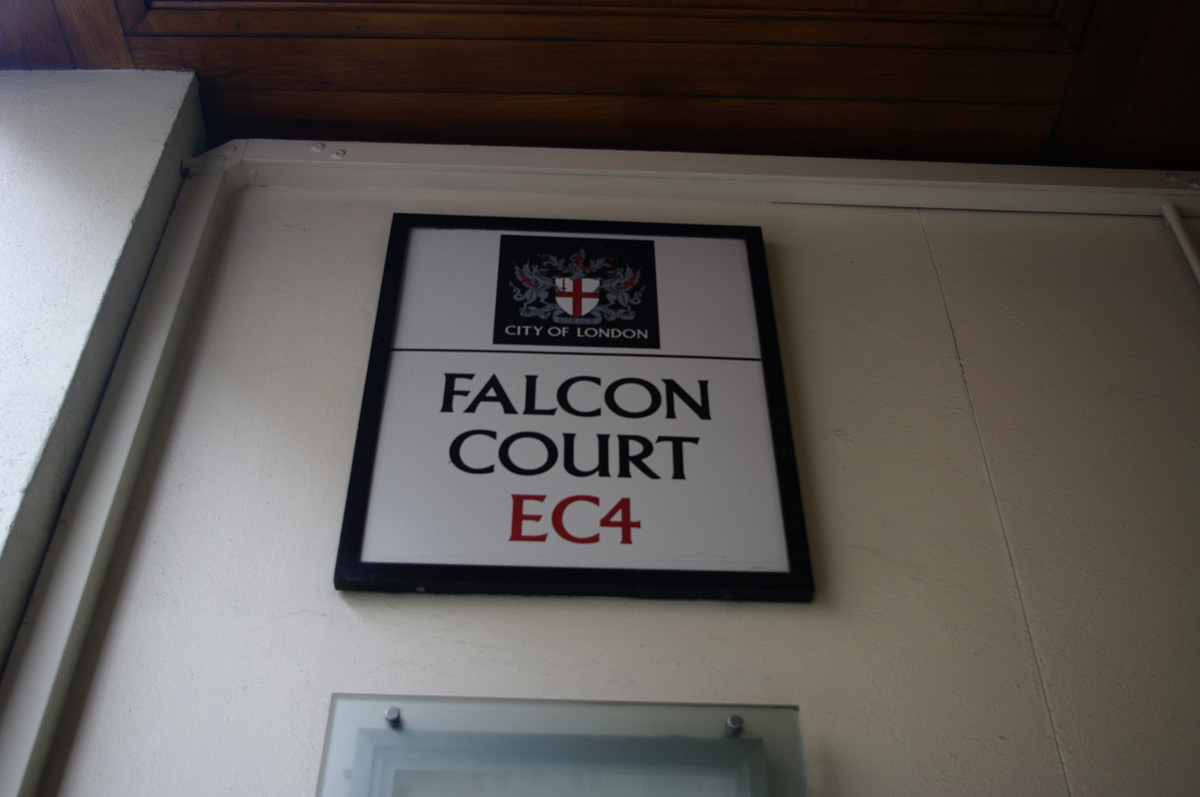
The John Murray office was in Falcon Court. Image @Tony Grant

As an indication of his business acumen he was one of the first publishers to actually consider the quality of the writing he published. He also used his many contacts to help sell large quantities of his books. He was a canny businessman though and hedged his bets by also selling game, which would have included deer, pheasants and rabbits; the produce of country sports. He had a go at selling paste jewels and lottery tickets too.

John Murray (or MacMurray, as the name was originally spelt), having bought the stock and goodwill of William Sandley, who had turned banker, began at the ‘Falcon,’ otherwise No. 32 Fleet Street, that remarkable and prosperous career which has culminated in the great publishing house of Murray. In Smiles’ book on the Murrays will be found an exhaustive account of the inception, by Lieutenant MacMurray, of this great firm. – Fleet Street and the Press

Image @Tony Grant

He was astute enough to go with what was most profitable. Books worked for him though. I suppose if the selling of game, he was virtually a butcher as well as a bookseller, paste jewellery or the selling of lottery tickets had provided more income for him the publishing side may well have not contiued and Jane would not have had her publisher in the next John Murray but may well have been buying venison from him instead.

Image @Tony Grant

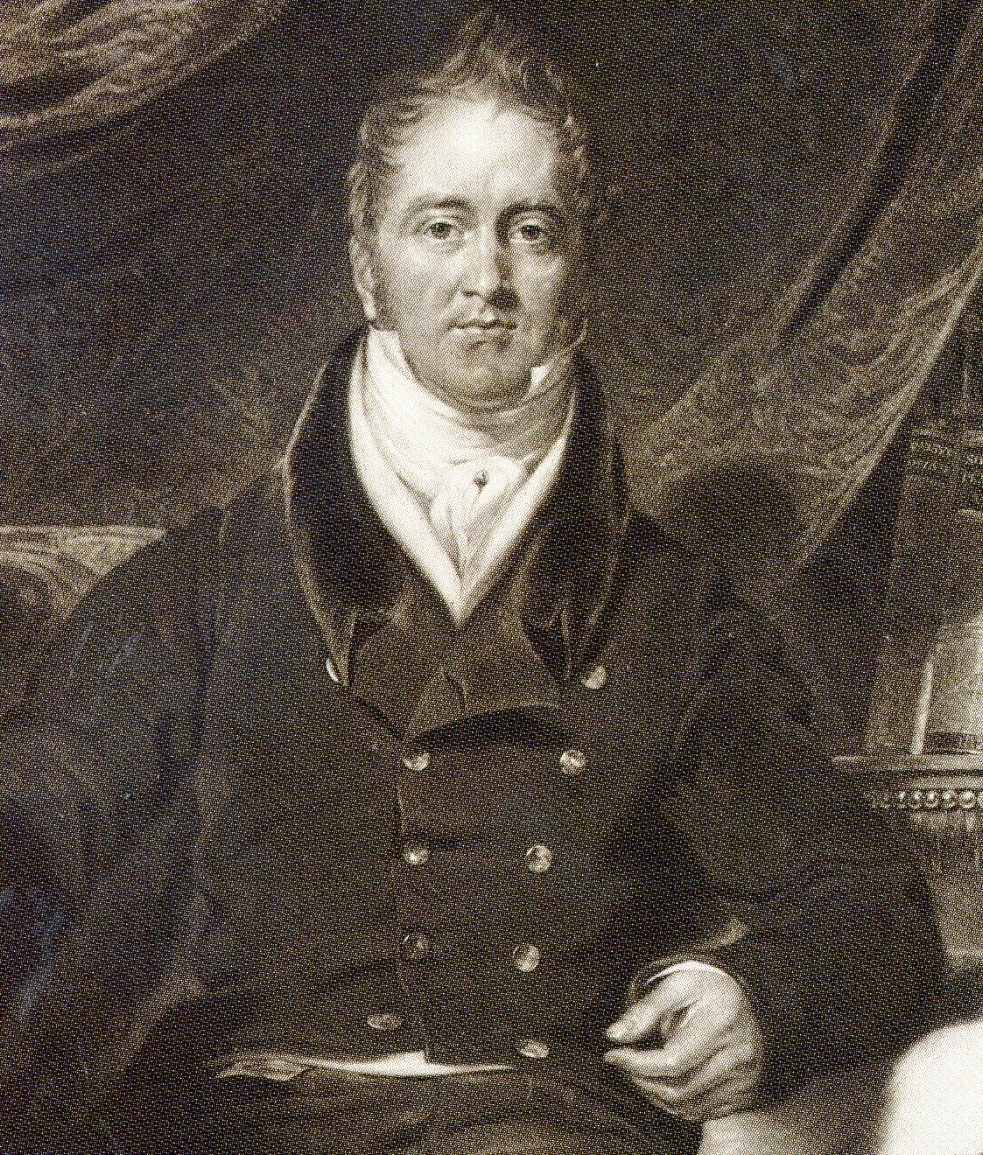
John Murray II. Image @Austenonly. (Published with permission from Julie Wakefield.)

John Murray’s son John Murray II began to develop the business. He was successful at signing Walter Scott who helped him, among others, such as the secretaries of the admiralty, John Wilson Croker and Sir John Barrow and writers such as Robert Southey and Charles Lamb to publish The Quarterly Review. This journal continued until 1967. In 2007 it was revived. The concept behind it is

to draw upon a wide range of opinions to provide counter-intuitive writing for people who like to think, and to enhance literary, philosophical and political debate.”

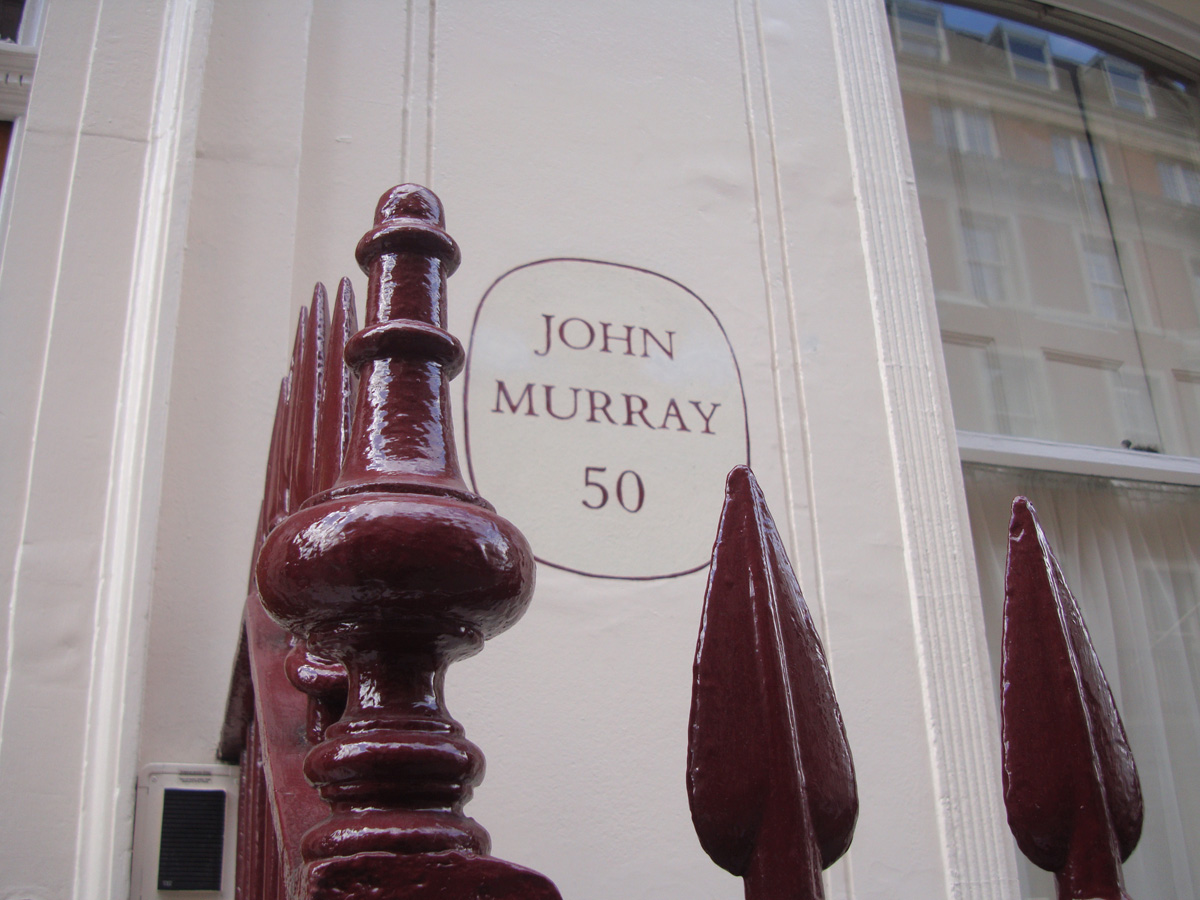
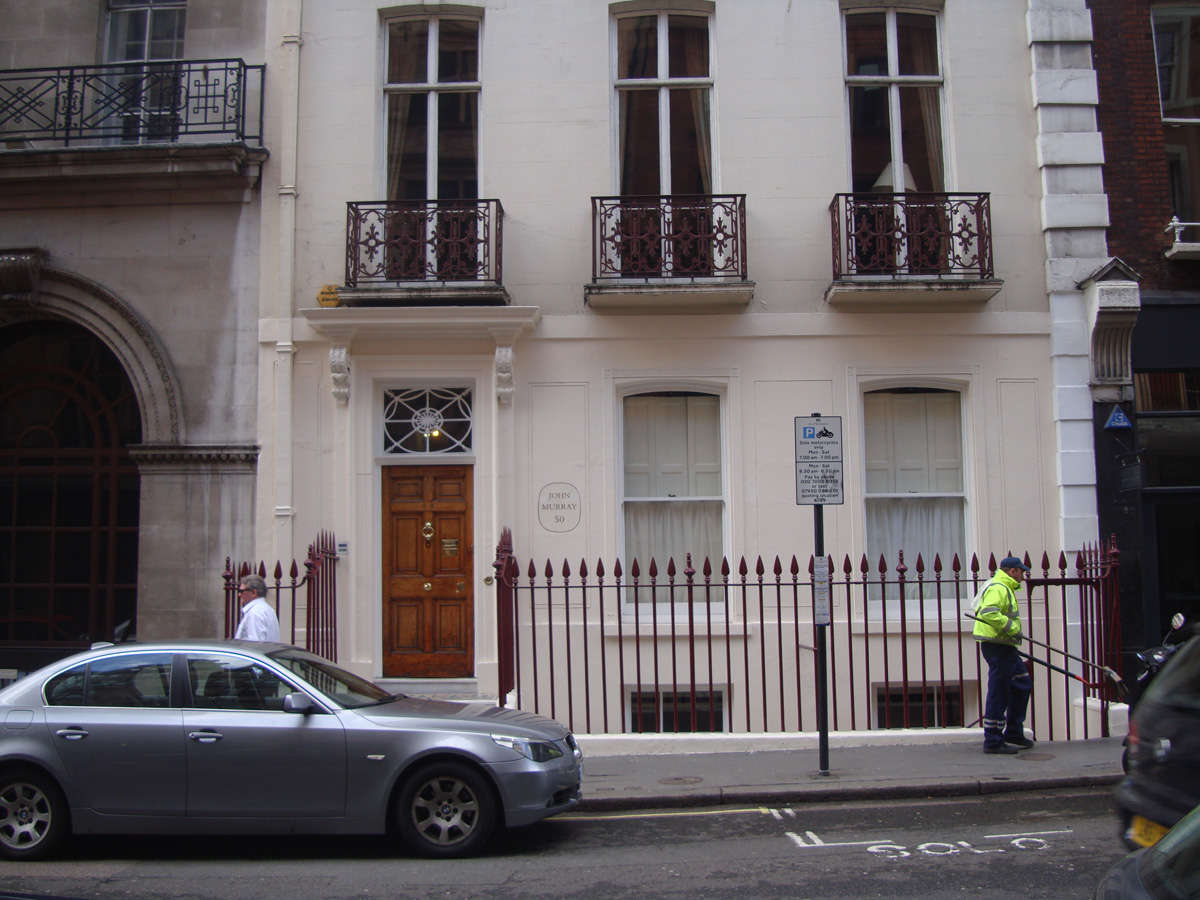
50 Albemarle Street. Image @Tony Grant

In it’s early years it tried to counter social reforms. It was rather conservative in it’s views but it did back the abolition of slavery although advocating a slow approach to the process.

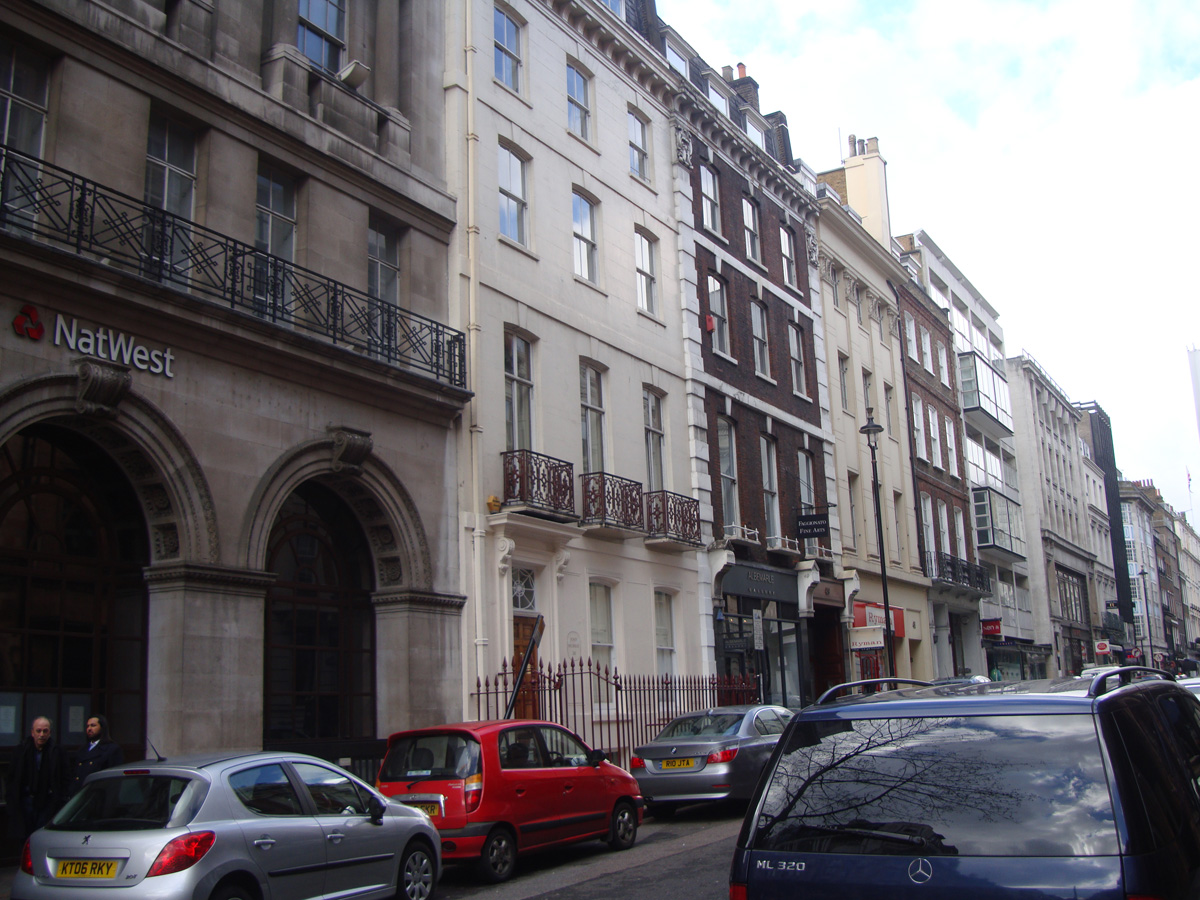
50 Albemarle Street. Image @Tony Grant

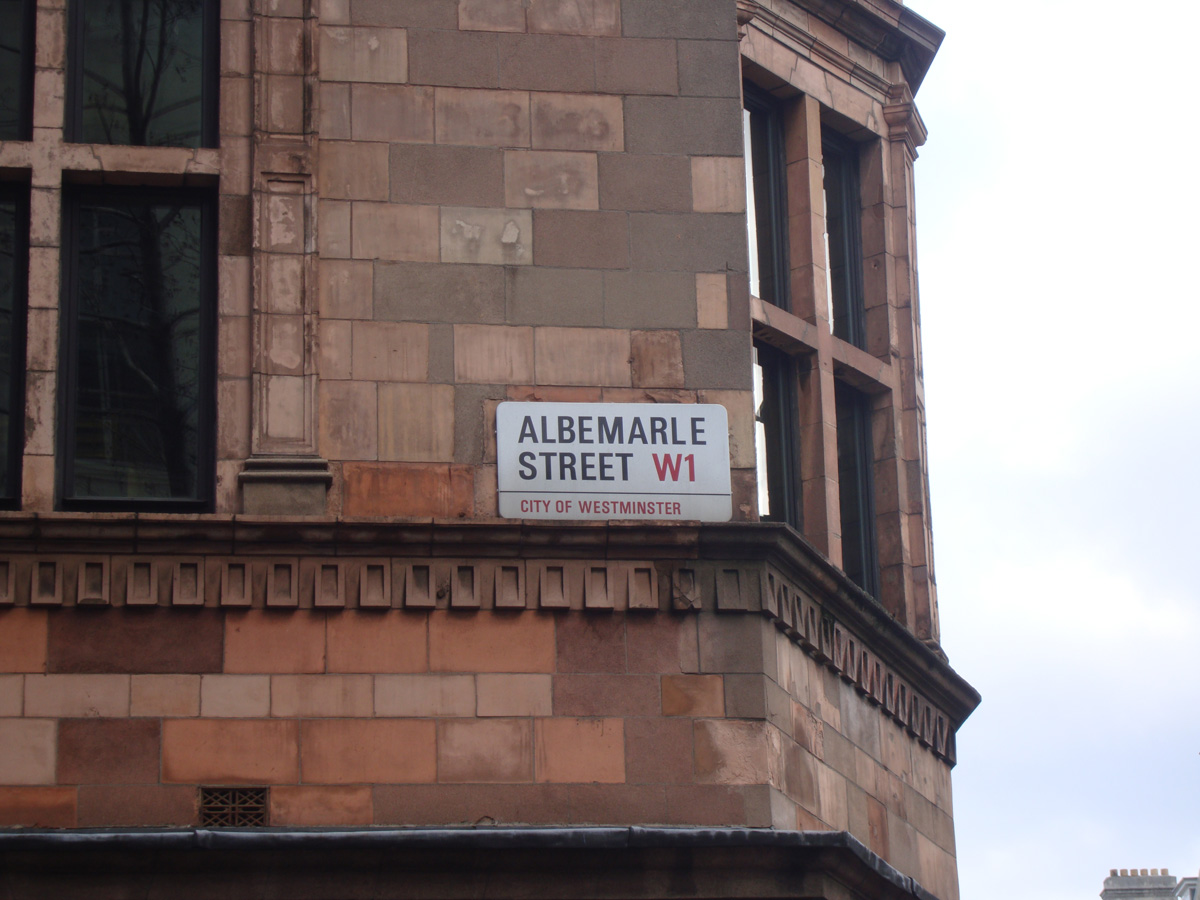
In 1812, John Murray II published Childe Harold by Byron and it was a great success. This gave Murray the confidence to mortgage some of his copyrights and purchase 50 Albemarle Street, which has remained the home of the publishing firm for the last two hundred years.

Albemarle Street. Image @Tony Grant

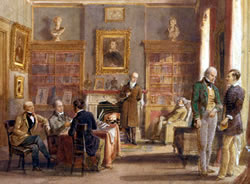
John Murray drawing room. Image @Playwright in the cages

The drawing room in Albemarle Street has been the meeting place for some of the most famous writers in English history. By 1815, and after the Battle of Waterloo, everybody wanted to be published by John Murray. It seems therefore that Henry Austen, Jane’s banker brother, must have had no little influence in obtaining Murray as his sister’s publisher. She was an unknown country girl. Why should he take her on? On the other hand he might have had great literary sense and was in the habit of reading unsolicited scripts.

Jane Austen's brother, Henry.

Jane herself was very business like with John Murray. She wrote to him on Monday 11th December 1815 from Hans Place, Henry’s house in London:

Dear Sir,

As I find that Emma is advertised for publication as early as Saturday next, I think it best to lose no time in settling all that remains to be settled on the subject, & adopt this method of doing so, as involving the smallest tax on your time.

In the first place, I beg you to understand that I leave the terms on which the Trade should be supplied with the work, entirely to your judgement entreating you to be guided in every such arrangement by your own experience of what is most likely to clear off the Edition rapidly, I shall be satisfied with whatever you feel to be the best.-“

She appears to be quite the pragmatist. It is significant to note that Murray would publish four of her six completed novels: Emma and Mansfield Park while she was alive, and Persuasion and Northanger Abbey after her death.

Image @Austenprose. Click on link to read post.

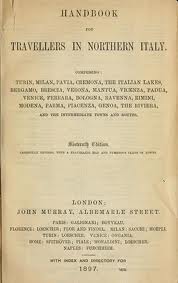
In the nineteenth century, the John Murray firm began publishing a series of travel books called the Murray Handbooks, which were authored by many of the great explorers of the time. The men included Sir John Franklin, who, in 1847, died exploring the North West Passage. He had also spent many years mapping the coast line of Canada. Murray also published David Livingstone, the explorer of the heart of Africa; Sir John Barrow, who wrote about South Africa; Heinrich Schlieman, the excavator and discoverer of Troy; and Isabella Bird, who visited north America and the pacific Islands. Her trips were financed by her father to help her counteract depression and backache. Both symptoms were cured in her travels: John Murray published “The Englishwoman in America,” and “Six Months in The Sandwich Islands,” both written by her about her travels.

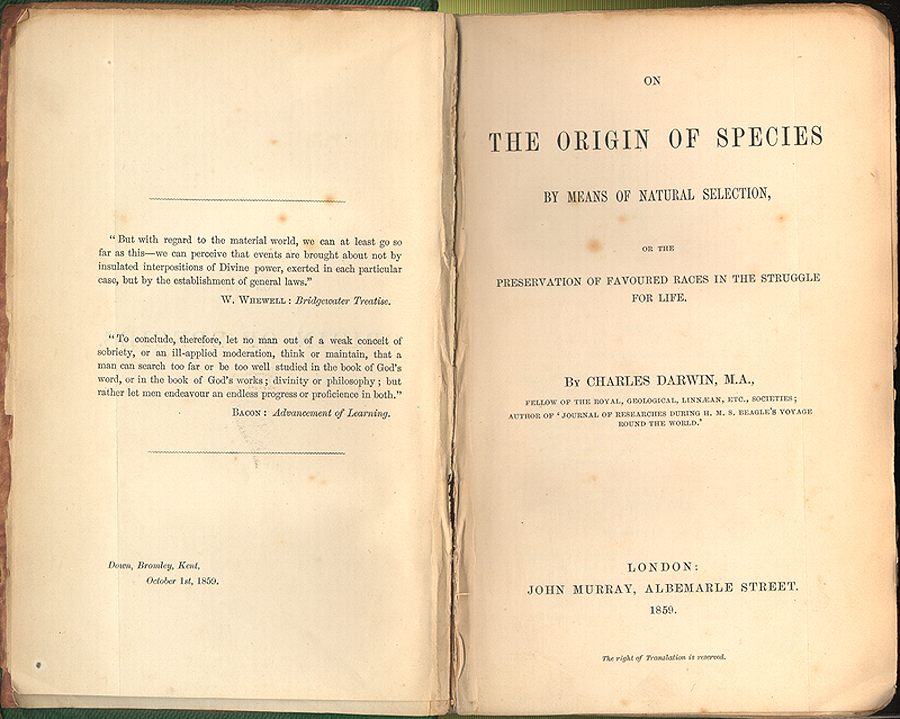
Scientists and inventors chose to be published through John Murray. They included Charles Babbage, Malthus and Lyell who wrote in 1830 “Principles of Geology,” which later inspired Charles Darwin. In 1859, the firm published Charles Darwin’s The Origin of Species, and Samuel Smiles’ Self Help.

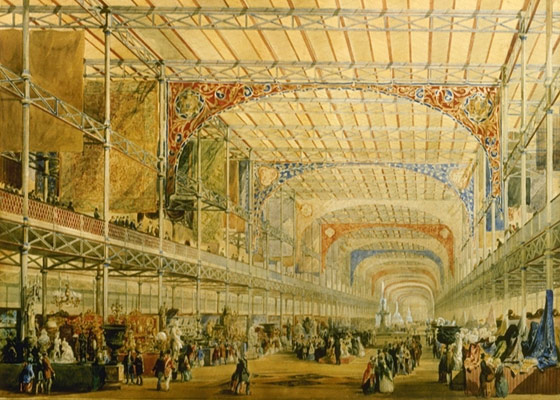
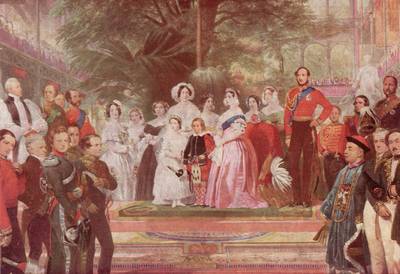
John Murray III was one of the official publishers of the Great Exhibition held in Hyde park in 1851. This exhibition promoted the industrial, economic, and military might of the Empire, although all nations were invited to contribute exhibits.

Great Exhibition

The proceeds form the exhibition were later used to create, The Albert Hall, The Science Museum, The Natural History Museum, and The Victoria and Albert museum. This area of London today is still called “Albertropolis,” because Prince Albert, Queen Victoria’s husband, sponsored The Great Exhibition and the forming of the Kensington Museums. John Murray faced some opposition from some quarters when he published Queen Victoria’s letters after she died.

Prince Albert and Queen Victoria announce the opening of the Great Exhibition. Image @Getty Images.

In 1917 John Murray bought the rival publisher Smith Elder, and so added Sir Arthur Conan Doyle to their list.

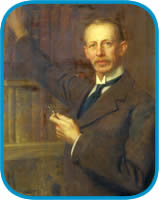
John Murray, IV. Image @John Murray Archive

In the 1930’s John Murray IV entered the firm and built up an impressive list of twentieth century writers including John Betjamin, Osbert Lancaster and Freya Stark amongst others.

In 2002 John Murray was sold to Hodder Headline, which in turn became part of Hachette UK. The company continues to publish and prosper continuing with new ideas and new authors in all fields.

As a footnote, if there is anybody reading this thinking that they would like to be published by John Murray they have a note on their website:

Submissions

Owing to the amount of time devoted to assessing solicited or commissioned work John Murray is no longer able to accept any unsolicited manuscripts or synopses, or to enter into any correspondence about them. The best way to go about getting published is to find a literary agent, who can give you advice about your work and who will know the best publishers for the kind of book you are writing.

You can find a list of literary agents in the Writers’ and Artists’ Yearbook, published by A&C Black, or in The Writer’s Handbook or From Pitch to Publication by Carole Blake, both published by Pan.

Read Full Post »

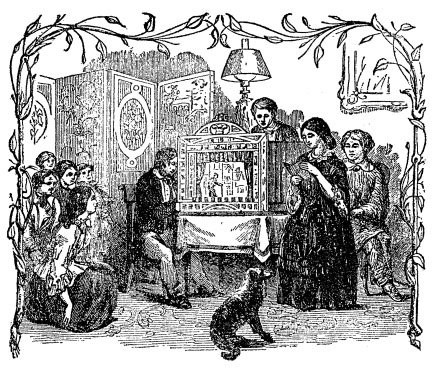
It is hard to imagine what entertainment was like in the days before the 21st century, yet people have always devised ways to spend their leisure time in pleasant company doing amusing things. In the evening, Jane Austen and her family spent many hours entertaining each other. One popular form of entertainment that the older Austen siblings would have known about was the Toy Theatre, or a juvenile form of miniature theater.

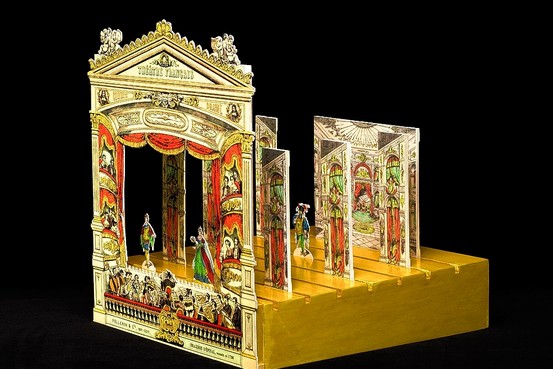
Toy Theatre. Image @Tea at Triannon

This entertainment appeared in the early 1800s, and coincided with the popularity of theater and the rise of the print trade. One can imagine that Aunt Jane was well aware of toy theatres when she spent time with her nephews, for this new toy largely attracted boys.

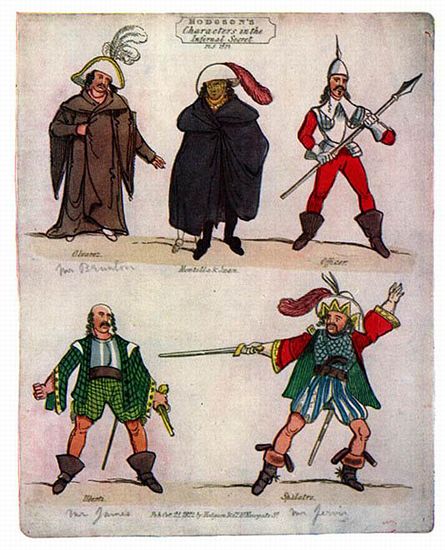
By 1811 William West of London was printing sheets of stage characters for purchasers to colour, paste on cardboard and cut out, though others treasured them as individual portraits. Single prints in black ink on white paper were called “penny plains” while those with color added by the seller were the “twopence coloured.” West’s first subject was Joseph Grimaldi in “Mother Goose,” a role that brought him fame and lifelong success on the stage. – NYPL Digital Gallery

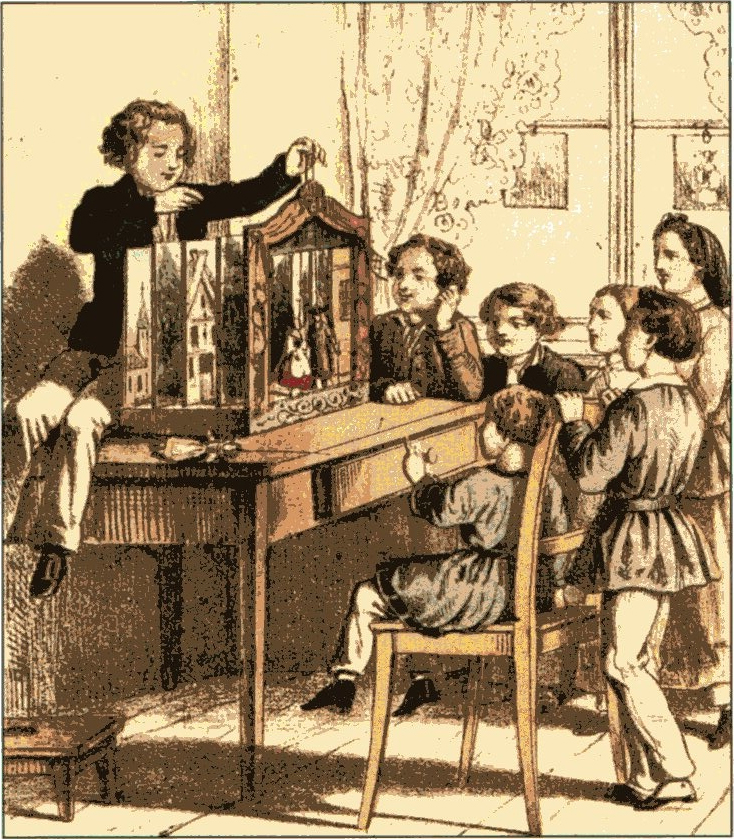
Miniature theaters became fashionable all over Europe, and their tiny elaborate sets mimicked the grand theaters of London, Paris and other world stages. The sets remained popular throughout the 19th century and into the early 20th century, offering children an opportunity to exercise their imaginations and their acting chops. Some children, I imagine, concentrated on honing their acting skills, while others probably enjoyed their roles as directors or scene designers more. New plays were published in the first half of the 19th century.

After the 1860’s no new plays were published but much of the old repertoire was kept in print by a dwindling number of theatrical print publishers and the tradition continued unbroken until 1944 when Miss Louisa Pollock,shut up her father’s famous shop in Hoxton for ever and sold the contents as a going concern. – Toy Theatre Gallery: History

From Mansfield Park the reader gains a sense of how seriously family theatricals were regarded. In the novel, the men were definitely in control of the enterprise, with the women acquiescing to their direction (the only exception being Fanny). While Jane Austen described a real play, Lover’s Vows, with large, almost life-like sets in Sir Thomas Bertram’s study, wood toy theatres that sat on a tabletop would be taken equally seriously. The children must have spent hours preparing for a performance, arranging sets, learning lines, and dressing and moving their characters before they felt comfortable opening a new play in front of an indulgent and forgiving family.

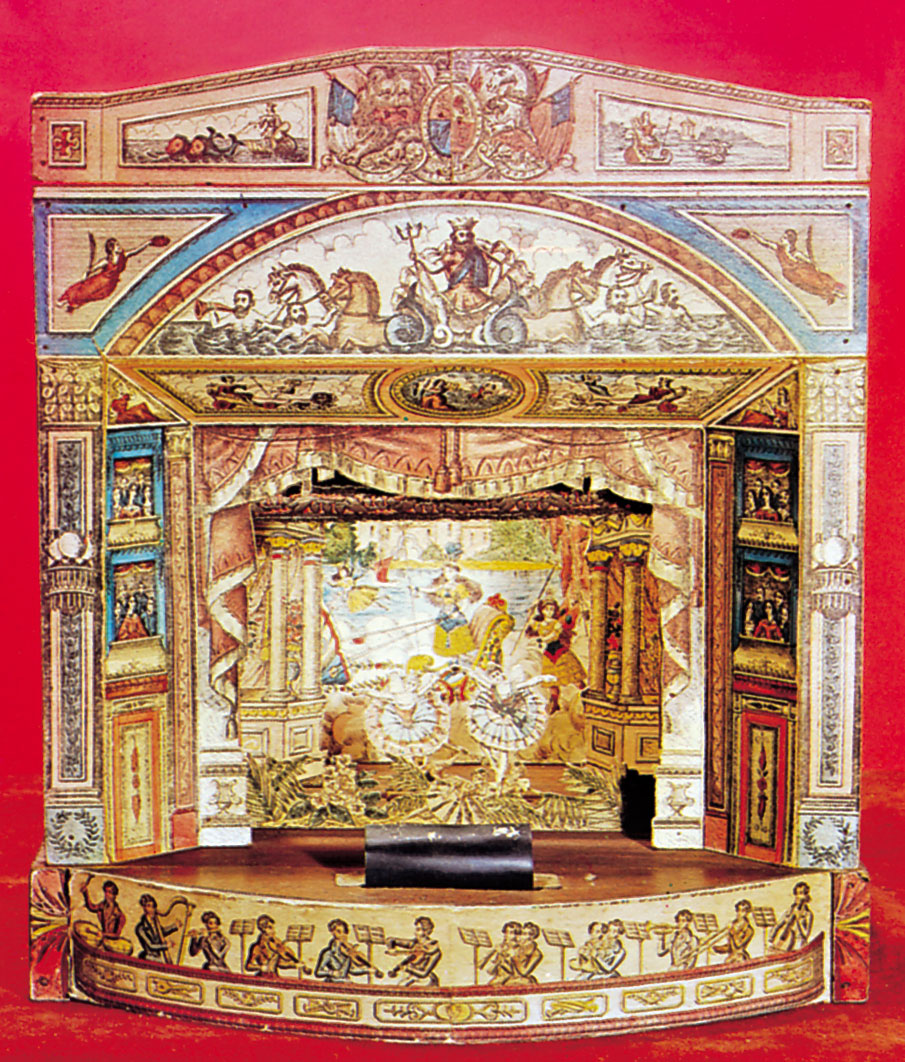
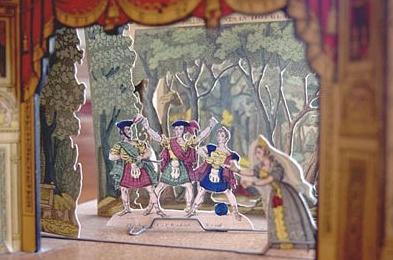
English Toy Theatre, 1850. Pollock's Museum. Image @Brittanica

Created from printed paper glued to cardboard and then mounted on wooden frames, these theaters could be quite intricate in design. They offered a proscenium, scenery, cut-out characters with codified attitudes and gestures, and a booklet that contained stage and scene directions and dialogue for the actors. Almost all of them depict an orchestra: The clothes worn by the musicians give a good indication of when the theatre was designed.

Early toy theatre prints were made from engraved copper plates, the engravings often from sketches made at the theatre on the night. Sets, costumes, and even the actors’ likenesses were copied, and could often be recognised. – Miniature Theatre: Curator’s Choice

Image @Victoriana

The plays were not necessarily derived from children’s stories: They were adapted from operas, melodramas, history, novels, and pantomimes. Works from Shakespeare, Cervantes, Mozart, and Beethoven were included. Hans Christian Anderson was also an inspiration.

Children could choose “Three-Fingered Jack, the Terror of Jamaica” or “Hamlet” or another of the nearly 300 “juvenile dramas” printed in England between 1811 and 1860. – Dramas to Cut, Color, and Produce

The involvement of publishers was enormous, but Pollock’s toy theatres were probably the most famous in Great Britain.

England had over 50 publishers, Germany 54, Spain 14, France 13, Denmark 10, Austria 9, and the United States 5. All of these versions to some degree were derived from the ability to mass produce the printed image, initially from engraved copper plates, followed by color lithography in the mid-19th century. – A Child’s View: 19th Century Paper Theaters

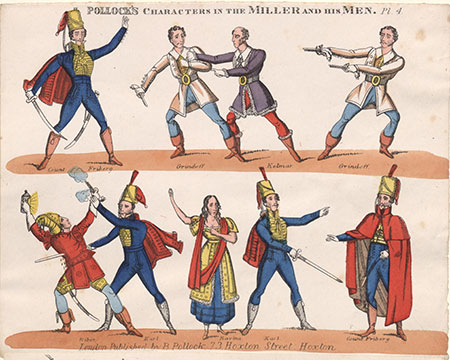
Many printed sheets of cut- out characters survive to this day, both colored and in black and white.

In 1811 William West produces a sheet of the principal characters from the first production on the London stage of ‘Mother Goose’, with Joseph Grimaldi in one of his most celebrated roles of Clown. The popularity of this role led to the publication of sets of sheets of characters, scenery and props, also elaborate prosceniums, the designs based on those of popular London theatres. Books of words, abridged versions of the most popular melodramas and pantomimes to be seen on the London stage.

From this time the popularity of the toy theatre, also known as the ‘Juvenile Drama’, saw the rapid growth in the number of publishers producing versions of plays, with the drawings for the engravings made by such leading artists as Georg e Cruickshank and William Blake. The legacy of the 19th century toy theatre is that of the most complete documentation of the costumes, scenery, and the performance style of the actors of the London Theatres of the period. – The World Through Wooden Eyes: A Penny Plain and Two Pence Coloured

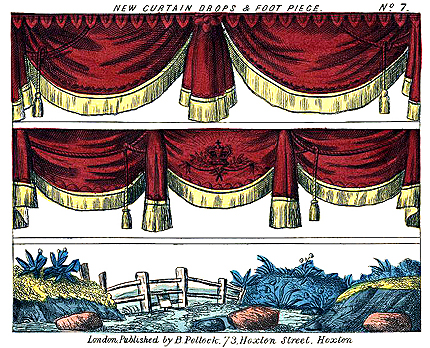
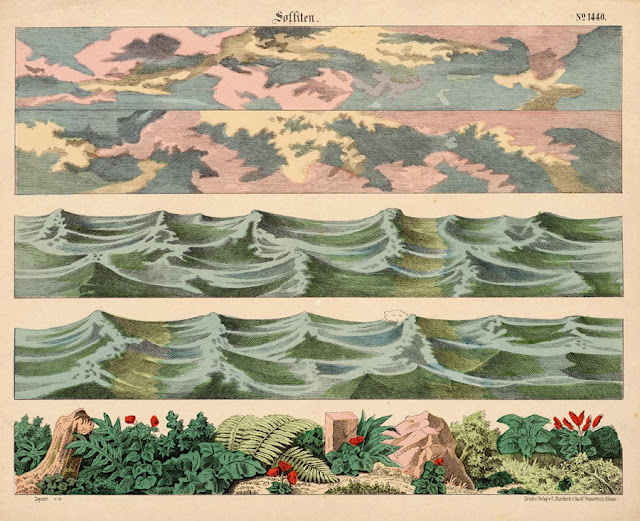
Paper backdrops image @Birds of Ohio

These backdrops for miniature theaters on Birds of Ohio show how much detail the sets provided.

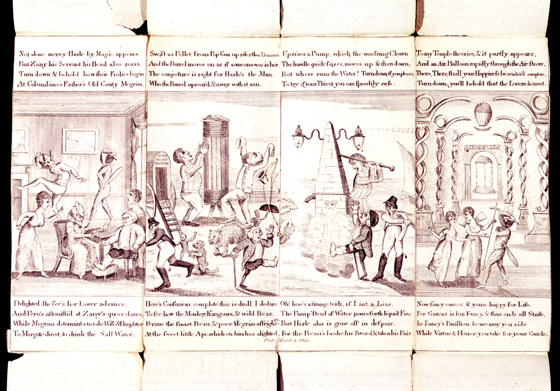
Below is a very rare example from the V&A shows a souvenir from a play  first performed at the Theatre Royal, Covent Garden  in 1800 called Harlequin’s Tour or the Dominion of  Fancy. While the souvenir survives, the dialogue for the play does not.

Souvenir, 1800. Image @Victoria & Albert Museum

In a June 2011 The Telegraph article, Sir Roy Strong, former director of the V&A museum and National Portrait Gallery, recalls his toy theatre with great affection:

Image @The Telegraph

This toy theatre … reminds me of one enormously happy period of my childhood. It was given to me after the war and purchased at Benjamin Pollock’s Toyshop, originally in the East End of London [now in Covent Garden]. I played with all the cut–out cardboard figures and scenery, and still have all my toy theatre plays, which are 19th–century dramas, romances and pantomimes. The theatre sits in the archive room and I love it. It’s been with me everywhere.

More on the topic:

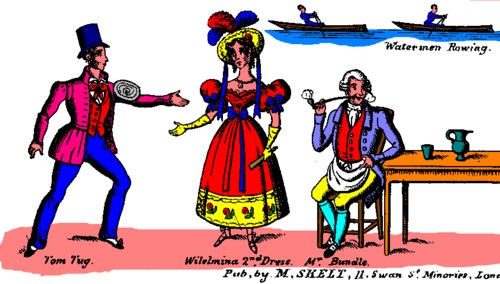
Modern characters for The Waterman.

Read Full Post »

Oak cask for making vinegar. Image @Taste of Croatia

Vinegar has had a long and noble history of uses for mankind. Since ancient times it has been used as a preservative. Delicate fruits and berries were ripe for such a short season that vinegar, with its acetic acid content, was used to to preserve them. (Blackberry vinegar recipe)

Add sugar and water, to the mixture and one had created a tart and pleasing beverage. Mix it with alcohol, and this sweet concoction became a tasty mixer! Vinegar Cocktails Are Making the Rounds 

As vinegar is so necessary an article in a family, and one on which so great a profit is made, a barrel or two might always be kept preparing, according to what suited.” – A new system of domestic cookery: formed upon principles of economy, and adapted to the use of private families (Google eBook), Maria Eliza Ketelby Rundell, Printed by Norris & Sawyer, 1808.
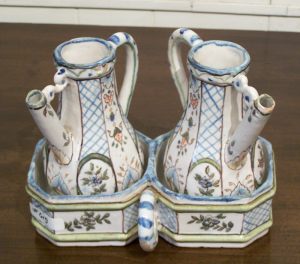
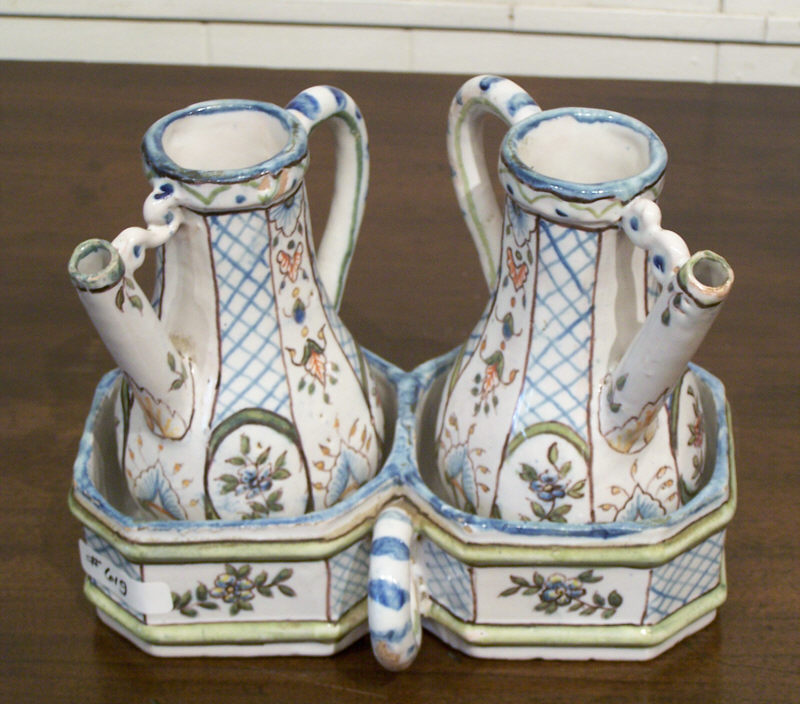
18th century French faience oil and vinegar set

Vinegar is made from many sources: grapes, apples, sugar cane, or malted barley or oats.

In foods it is used for its antibacterial properties, as an acidity stabiliser, diluting colourings, as a flavouring agent and for inhibiting mould growth in bread. In brewing it is used to reduce excess losses of carbohydrate from the germinated barley and to compensate for production variations, so producing a consistent quality beer.

It can be found in beer, bread, cheese, chutney, horseradish cream, pickles, salad cream, brown sauce, fruit sauce, mint sauce and jelly and tinned baby food, sardines and tomatoes.” – La Leva di Archimede

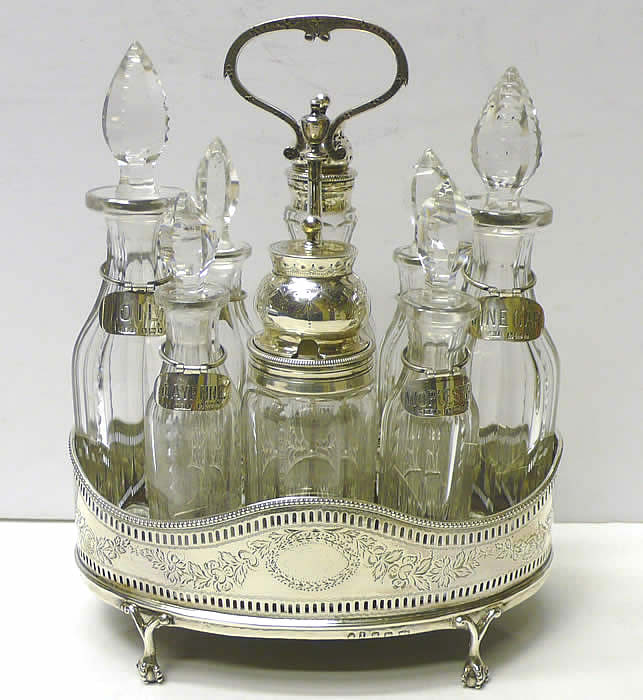
George III condiment set, silver 1782 Sheffield

Herbs, fruits and spices have long been added to vinegar for flavor, and recipes for infused vinegars were handed down for generations. ‘Sugars of lead,’ a sweet tasting substance, was made by pouring vinegar over lead. This liquid would be used to sweeten harsh cider, but as every self-respecting 21st century reader knows, this substance was quite poisonous. One can only conclude that sugars of lead must have been quite deadly to Europeans addicted to drinking cider. – Enzyme facts, vinegar history 

Recipes for vinegar are found as early as the 17th century. In the Delightes for Ladies (1602), Sir Hugh Plats offers this recipe for distilling and purifying vinegar. Notice his caution of the use of lead.

How to distill wine vinegar or good Aligar that it may be both cleare and sharpe

I Know it is an usuall manner among the Novices of our time to put a quart or two of good vinegar into an ordinay leaden stil, and so to distill it as they doe all other waters. But this way I do utterly dislike, both for that heere is no separation made at all, and also because I feare that the Vinegar doth carry an ill touch with it, either fro the leaden botto or the pewter head or both. And therefore I could wish rather that the same were distilledin a large bodie of glasse with a head or receiver, the same beeing placed in sand or ashes. Note that the best part of the vinegar is the middle part that ariseth, for the first is fainte and phlegmatick, and the last will taste of adustion, because it groweth heavie toward the latter end, and must be urged up with a great fire, and therefore you must now and then taste of that which commeth both in the beginning & towardes the latter end, that you may receive the best by it selfe.
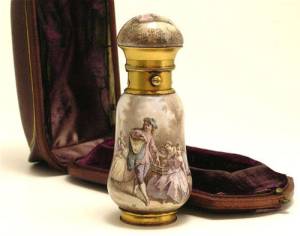
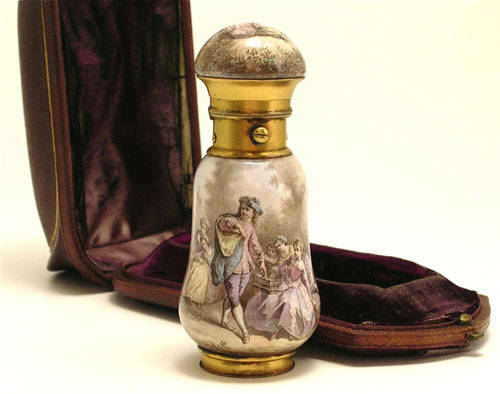
18th C. French vinaigrette bottle

Aromatic vinegar in the minds of 17th-19th century users had many medicinal purposes for preventing infections and megrims (headaches), reviving a fainting person, and covering bad odors. It was used to treat dropsy, croup, stomach aches, as well as sore throats. Vinegar teas were consumed by diabetics, and the liquid was used to heal wounds and fight infections. (Bragg, Health Information.) Vinegar was also a well-known cleaning agent and furniture polish, although it was not recommended for polishing marble, since the acid would eat into the smooth surface, leaving it pockmarked over time.

Vinegar was considered an indispensable item in the 18th century for arousing a fainting person or masking foul odors. When the sponge was soaked only in vinegar, its original use, it could help prevent the wearer from fainting. A person stepping outside a crowded London street might carry aromatic soaked sponges to hold close to the nose to mask the odor of raw sewage and rotting garbage.
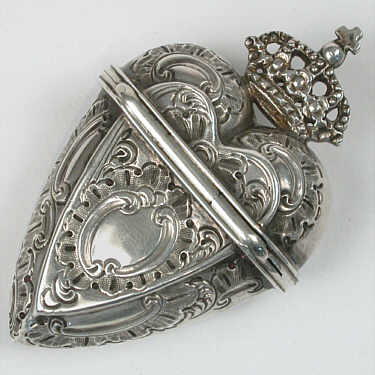
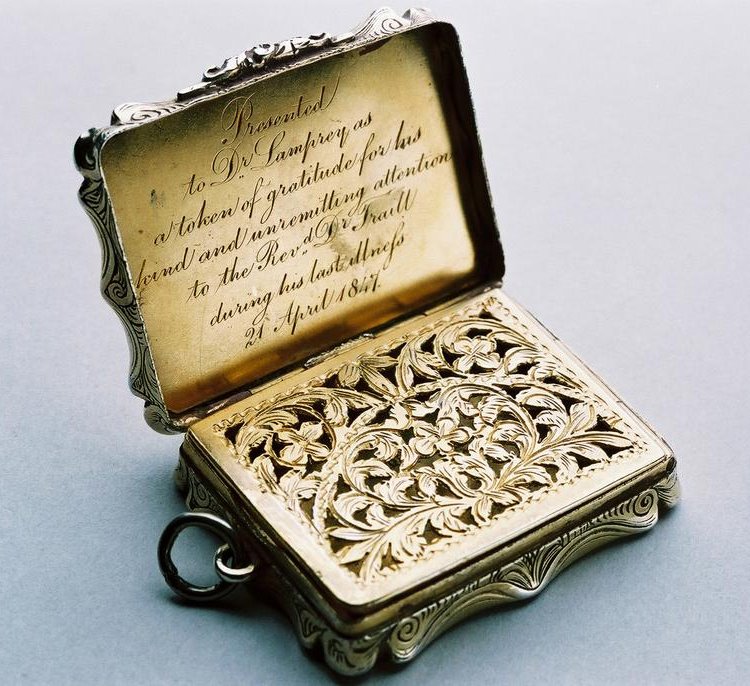
19th c. Victorian silver vinaigrette

In the early 19th century, there wasn’t garbage men that carted away the trash. People threw the stuff out the window. Slop pails went out the window in the 18th century. And when you left your house, you would encounter odors that made you just choke. So they invented a device called the vinaigrette. And it was a box or a little trinket carried to revive oneself if one felt faint.

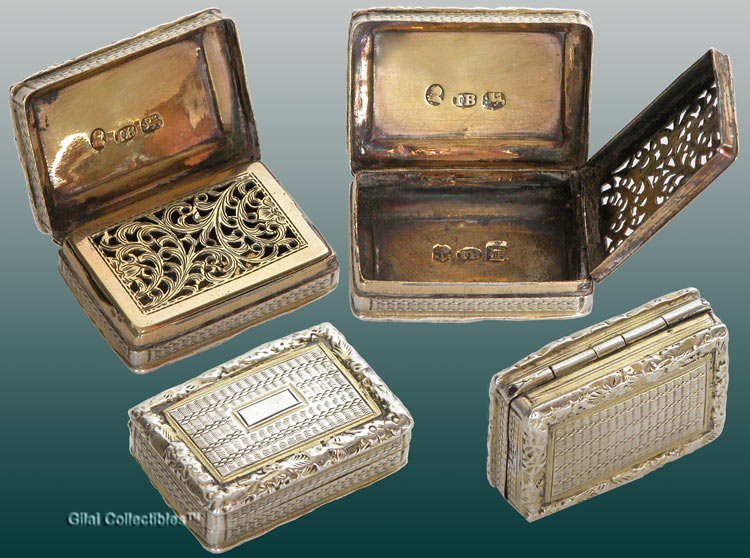
So now they can’t breathe, they go outside, they smell the rotten garbage and the sewage, and they think they’re going to faint. They opened up their vinaigrette, which they held in their hand, and inside is a gold-pierced grill with beautiful decoration. But underneath the grill is a sponge. They would soak that sponge in an aromatic solution, sort of a mixture of perfume and ammonia, like smelling salts.” – Barry Weber, Antiques Road Show 
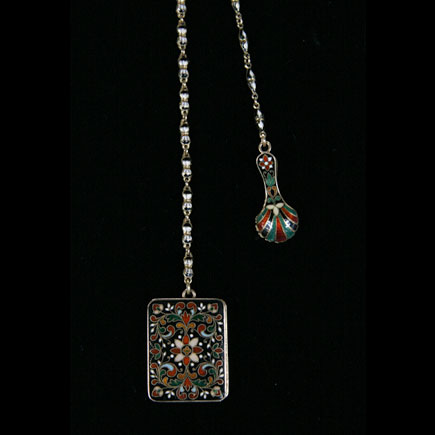
Vinaigrette and train holder. Image @Antiques Road Show

That was the concept of the vinaigrette. But the other end of this, you seldom see these all together. This is called a train holder. And this is shaped like a shell. When you squeeze it, it opens. The train was the long part of the ball gown. And they didn’t want it to drag in the dirt and be soiled. So they would hook the train holder onto the edge of the train, and then they would hold the vinaigrette in their hand, and this kept the train from dragging behind them.” Barry Weber, Antiques Road Show 

Vinaigrettes were small decorative containers that held the vinegar-soaked sponges. The inside of the vinaigrette would be gilded to protect the silver from staining.

Used by both men and women, vinaigrettes were suspended from chatelaines, placed in pockets, hung from long chains, bracelets or finger rings. Often designed in the shape of a rectangular box, the more spectacular vinaigrettes took on the look of a vase of flowers, a purse, an urn, almost any contemporary theme. Made from multicolored gold or silver and sometimes silver-gilt, many were decorated with Italian mosaics, mother-of-pearl or other gem materials. – Antique Jewelry University
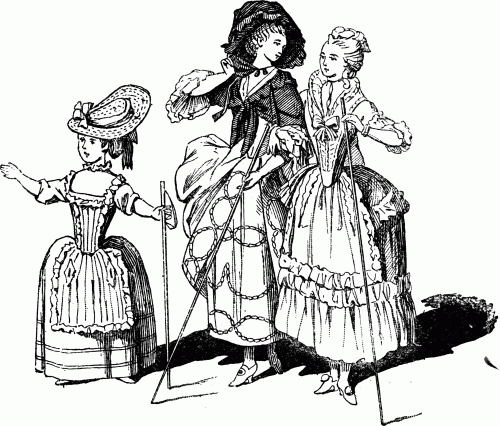
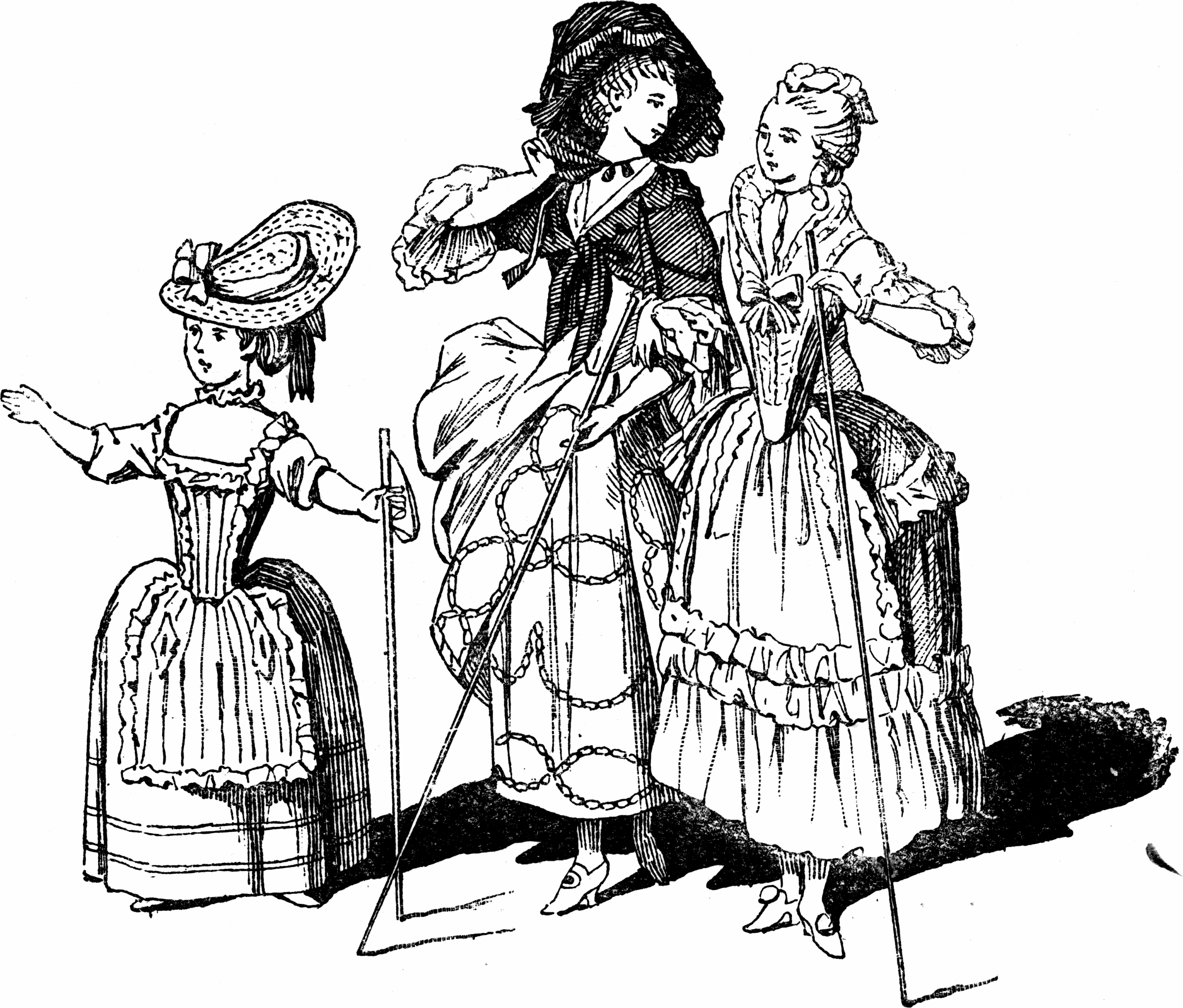
18th century French ladies carrying canes

The soaked sponges were also carried in a compartment in the head of walking canes.

…many ladies of the 18th and 19th centuries carried a “vinaigrette” cane to protect them from a variety of ailments. Throughout history, vinegar has been heralded for its medicinal qualities. A sponge soaked in the healing liquid was placed in a small container with holes in it on the handle of the cane. Should a lady’s tight corset cause her to faint or should she encounter someone with a dreaded illness, her vinaigrette tucked into her cane was close at hand to protect her.” – Collecting Antique Walking Sticks or Canes 

Vinaigrette, Nathaniel Mills. Image @Leopard Antiques

Often spices such as cinnamon, lavender, roses, or orange were added to sweeten the smell.

The vinaigrette was a most necessary adjunct to the toilette in the late eighteenth and early nineteenth centuries, when it was considered the correct thing for a lady to show symptoms of fainting on occasion. The little boxes with a grating inside—through which the essence contained in a saturated sponge could be inhaled— are of all sorts and conditions. Some are quite plain, others have delicately chased or monogrammed tops, or views engraved on the lids; others, again, are of fantastic shapes. The vinaigrette was the descendant of the old pomander, and the forerunner of the midVictorian smelling bottle; but whereas the vinaigrette is accessible to the most modest purse for a very small sum, the real old genuine pomander is very scarce indeed, and it means a lot of money to come by one at all. The pomander was round, and often of china, and contained a wonderfully strong-smelling ball, compounded of spices and pungent scents which could hardly fail to bring round the most upset of ladies. – Byways of Collecting, 1908, Ethel Deane, Pp 170-172.

The small containers known as vinaigrettes were actually an English invention. The French called them “boite de perfum”. They came in many shapes and sizes, and eventually became decorative items that lovers exchanged as tokens of affection. (Limoges Boxes: A Complete Guide)
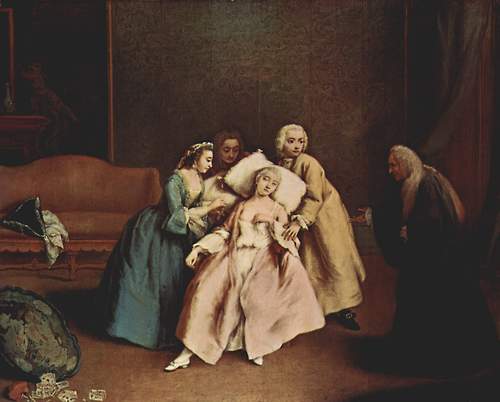
The vapours from a vinaigrette caused the person to inhale sharply and then breathe more rapidly. Restoratives carried different names and were made from various recipes, not just with vinegar: In addition to vinaigrettes, there are smelling-salts, hartshorn, and Hungary water or lavender water. Ladies prone to fainting would also keep a bottle of laudanum nearby. Laudanum, a painkiller, was an alcoholic herbal preparation that containing approximately 10% powdered opium. Smelling-salts were an infusion made with ammonium carbonate and alcohol and scented with lemon or lavender oil. Hartshorn (aqueous ammonia)was made from carbonate of ammonia distilled from the shaved or powdered horns of a male deer. Hartshorn and smelling salts or sal volatile could be mixed with water and drunk as a restorative. Hungary water was a perfumed restorative made with distilled water and sweet-smelling herbs and flowers. This was dabbed on the skin of a person suffering from “nerves.”- Jennifer Kloester, Georgette Heyer’s Regency World, 157-58

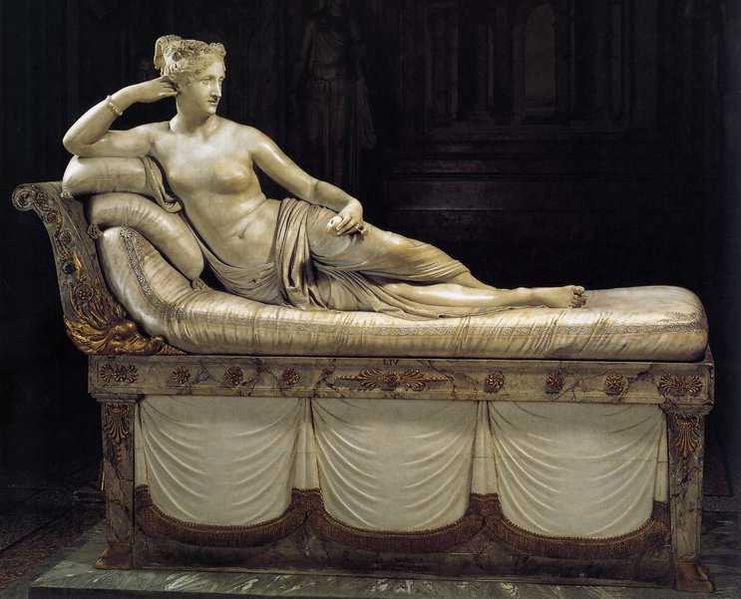
Pauline Bonaparte transformed into a goddes of antiquity on her day couch. Neoclassical statue by Canova, 1805-1808, @ Borghese Gallery

And so we finally come to the fainting couch or a chaise longue, or a reclining chair with a long seat that supported the legs of the fainting person. These couches were placed in drawing rooms and dressing rooms, and were used for relaxation as well.
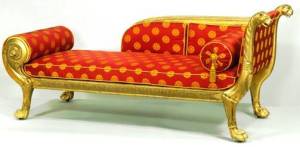
Early 19th century Recamier day bed. Image @Victoria & Albert Museum

This post will not go into the myriad reasons why women of this era fainted with such regularity. Tightly laced corsets certainly had something to do with the condition, but with so few rights and options open to them in their life’s choices, one cannot blame women of that time for reacting to the child-like treatment their husbands and fathers accorded them with fits, vapours, nerves, and fainting spells.
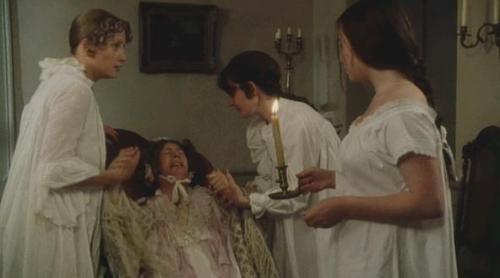
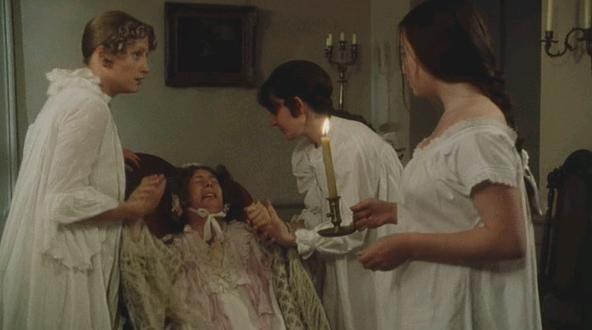
The Bennet family is well acquainted with Mrs. Bennet's nerves. Pride and Prejudice 1995

A character like Mrs. Bennet, who had her origins in Jane Austen’s real life observations, did not have many opportunities for maturing or turning into a well-educated and sensible woman. Mr. Bennet had given up on her and her childish behavior was enabled by her caring daughters and siblings.
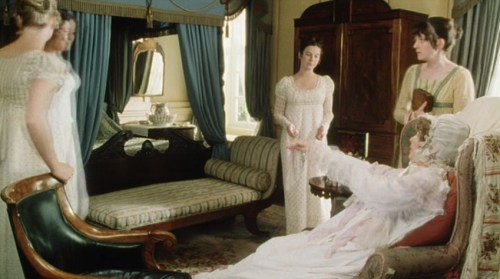
Scene from 1995 Pride and Prejudice. Mrs. Bennet is overcome from the thought of Lydia's elopement. Note that she is not using the day bed but has a chair propped under her feet.

Vinegar had many other uses:

A recipe for black dye

Let one pound of chopped logwood remain all night in one gallon of vinegar. Then boil them, and put in a piece of copperas, as large as a hen’s egg. Wet the articles in warm water, and put them in the dye, boiling and stirring them for fifteen minutes. Dry them, then wet them in warm water, and dip them again. Repeat the process, till the articles are black enough. Wash them in suds, and rinse them till the water comes off clear. Iron nails, boiled in vinegar, make a black dye, which is good for restoring rusty black silks. – A Treatise on domestic economy for the use of young ladies at home and at school, by Catharine Esther Beecher, 1849, p. 299-303

For whitening scorched articles of  clothing

Scorched articles can often be whitened again by laying them in the sun wet with suds. Where this does not answer, put a pound of white soap in a gallon of milk and boil the article in it. Another method is to chop and extract the juice from two onions and boil this with half a pint of vinegar, an ounce of white soap, and two ounces of fuller’s earth. Spread this when cool on the scorched part, and when dry, wash it off in fair water. Mildew may be removed by dipping the article in sour buttermilk, laying it in the sun, and after it is white, rinsing it in fair water. Soap and chalk are also good, also soap and starch, adding half as much salt as there is starch, together with the juice of a lemon. Stains in linen can often be removed by rubbing on soft soap, then putting on a starch paste, and drying in the sun, renewing it several times. Wash off all the soap and starch in cold fair water. – A Treatise on domestic economy for the use of young ladies at home and at school, by Catharine Esther Beecher, 1849  p 296.

Reviving a person overcome with fumes:

In case of stupefaction from the fumes of charcoal or from entering a well, limekiln, or coal mine, expose the person to cold air; lying on his back, dash cold water on the head and breast, and rub the body with spirits of camphor vinegar or Cologne water. Apply mustard paste to the pit of the stomach, and use friction on the hands feet and whole length of the back bone. Give some acid drink, and when the person revives, place him in a warm bed in fresh air. Be prompt and persevering. – A Treatise on domestic economy for the use of young ladies at home and at school, by Catharine Esther Beecher, 1849 p. 243.

This late 19th century poem by Edith Willis Linn talks nostalgically about vinaigrettes as a thing of the past. At this time, lovers gave each other these small decorative items as tokens of affection:

AN OLD VINAIGRETTE – Poem by  Edith Willis Linn, C. W. Moulton, 1892.

LITTLE gleaming box of silver

Wrought in flowery design;

Drifted down the silent ages

To this humble hand of mine;

From the days of kingly France,

From the days of minuet dance,

From the days of stately graces,

Powdered hair and painted faces;

Bring a shining thread of story

To this all-prosaic hour;

From those castles proud and olden,

Those salons of wit and power.

You have known the love and woe

Of fair dames of long ago;

Round you like a love-tale wreathing

Is the perfume of their breathing.

Silent! Not a word to give me!

See, I raise your flowery lid;

Whisper in your heart my secret

Knowing you will keep it hid.

An Old Vinaigrette.

One more life now leaves its trace;

One more love has lent its grace;

Keep it sacred down the ages

On your shining silver pages.

Now my imprint I have given

Though you never bear my name:

Graven with your silver roses

Are all lives of praise or blame.

All things that we touch or wear

Must the spirit’s impress bear.

Every hand that ever won you

Left a fadeless mark upon you.

Love and hate and jealous passion,—

All I feel have been your own;

Shall my life not breathe about you

Purer love than you have known?

Nobler grows this life with years,

Grander grow earth’s hopes and fears;

May the traces of my living

Make this heirloom worthier giving.

Whence and Whither.

Read Full Post »
« Newer Posts - Older Posts »