Feeds:
Posts
Comments

Archive for the ‘Anglican Church’ Category

By Brenda S. Cox

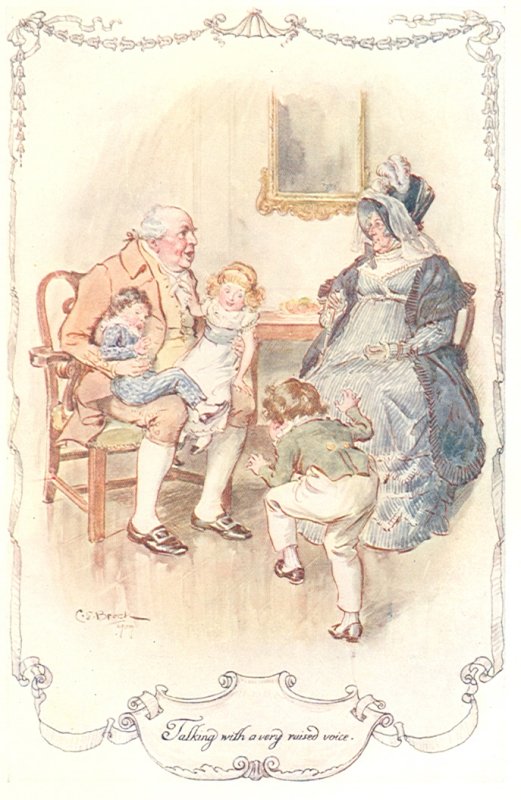
“Immediately surrounding Mrs. Musgrove were the little Harvilles, whom she was sedulously guarding from the tyranny of the two children from the Cottage, expressly arrived to amuse them. On one side was a table, occupied by some chattering girls, cutting up silk and gold paper; and on the other were tressels and trays, bending under the weight of brawn and cold pies, where riotous boys were holding high revel; the whole completed by a roaring Christmas fire, which seemed determined to be heard, in spite of all the noise of the others. . . .

Mrs. Musgrove . . . observ[ed] with a happy glance round the room, that after all she had gone through, nothing was so likely to do her good as a little quiet cheerfulness at home. . . .

” ‘I hope I shall remember, in future,’ said Lady Russell, as soon as they were reseated in the carriage, ‘not to call at Uppercross in the Christmas holidays.’ Every body has their taste in noises as well as in other matters . . .”—Persuasion, Vol. 2, chapter 2

The Musgrove family at Christmas

Jane Austen gives us only brief glimpses of Christmas in her world. Here Mrs. Musgrove and Lady Russell think very differently about what makes a pleasant Christmas. The Musgrove family are enjoying crafts, food, a Christmas fire, and children having fun and making noise.

Family and Friends

At Christmas, people gathered with friends and family, as we still do today. In Northanger Abbey, Catherine’s brother James met Isabella Thorpe when he went to spend the Christmas holidays with Isabella’s brother. In Pride and Prejudice, Elizabeth invites the Gardiners to join her and Darcy at Pemberley for Christmas. In Sense and Sensibility, Charlotte Palmer asks the Dashwood sisters to join her at Cleveland for Christmas.

In Emma, Emma’s sister and her husband come to visit for the holidays with their children. They are busy with friends during the mornings, and Mr. Weston insists that they dine with him one eventful evening.

Mr. Elton, at least, enjoys the occasion, saying:

“This is quite the season indeed for friendly meetings. At Christmas every body invites their friends about them, and people think little of even the worst weather. I was snowed up at a friend’s house once for a week. Nothing could be pleasanter. I went for only one night, and could not get away till that very day se’nnight.”—Emma, chapter 13

Mr. Elton drinks too much and proposes to Emma, who rejects him. She is therefore very glad on Christmas day to see

“a very great deal of snow on the ground. . . .The weather was most favourable for her; though Christmas Day, she could not go to church.”—Emma, chapter 16

The snow could be dangerous. And certainly Mr. Woodhouse would find it so.

Church on Christmas Day

The clear implication, though, is that Emma would naturally have gone to church on Christmas day. Churches generally had a good turn-out on Christmas. Communion was generally offered that day (one of only three or four times a year when country churches would offer Communion, also called the Lord’s Supper). Henry Crawford in Mansfield Park assumes that Edmund Bertram will only need to preach on the major holidays when many people attended church:

“A sermon at Christmas and Easter, I suppose, will be the sum total of sacrifice.”— Mansfield Park, chapter 23

Edmund, of course, plans to live in his parish and lead services and preach there every Sunday, not just on holidays.

For each church holiday, the Book of Common Prayer, handbook of the Church of England, prescribed specific prayers and Bible readings that would be the same every year. The “collect” prayer from the 1790 Book of Common Prayer for “the Nativity of our Lord, or the birth day of CHRIST, commonly called Christmas-day” is:

“Almighty God, who hast given us thy only begotten Son to take our nature upon him, and as at this time to be born of a pure Virgin; grant that we being regenerate, and made thy children by adoption and grace, may daily be renewed by thy Holy Spirit, through the same our Lord Jesus Christ, who liveth and reigneth with thee and the same Spirit, ever one God, world without end. Amen.

Bible readings for the day were from the first chapter of the book of Hebrews and the first chapter of the book of John, both about the coming of Christ.

In a recent talk by Rachel and Andrew Knowles on “A Regency Christmas,” they pointed out that Christmas day, and the whole Christmas season, was a popular time for weddings in the churches. So perhaps that was Austen’s little joke, having Mr. Elton propose right before Christmas! Babies were also christened on that day, and Christmas was a time for ordaining new clergymen. Edmund Bertram goes to Peterborough for ordination during Christmas week. When he delays his return, Mary Crawford thinks he may be staying for “Christmas gaieties.”

Christmas Gaieties

Miss Bingley uses the same term when she writes to Jane Bennet:

“I sincerely hope your Christmas in Hertfordshire may abound in the gaieties which that season generally brings, and that your beaux will be so numerous as to prevent your feeling the loss of the three of whom we shall deprive you.”—Pride and Prejudice, chapter 21

What did those gaieties involve?

Customs that were consistent across the country were gathering with family and friends, eating a special meal, and giving gifts and money to the poor. Austen mentions a few additional traditions.

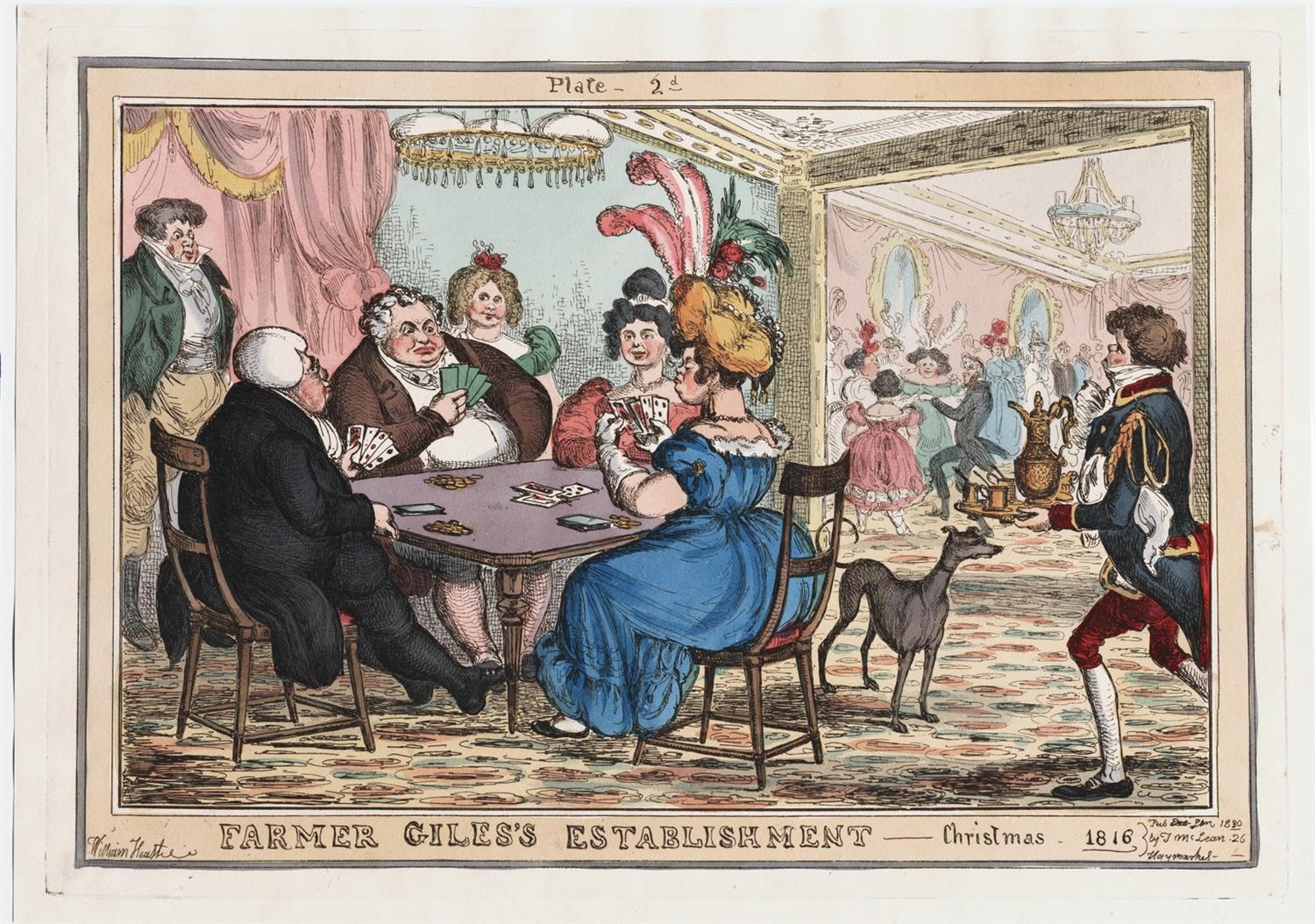
Regency Christmas celebrations usually involved a special meal with family and friends.
Farmer Giles’s Establishment, Christmas day, 1800, by William Heath, 1830. Courtesy of The Lewis Walpole Library, Yale University

Gifts

Christmas was a time for charity, for giving gifts to the poor and to those in service occupations, like the local butcher. These gifts of money were called “Christmas boxes.” According to the Knowles’s research, newspapers even published lists of what certain wealthy people were giving to the poor at Christmas. 

In families, it appears that gifts were given mainly to children. I found only one mention in Austen:

“On the following Monday, Mrs. Bennet had the pleasure of receiving her brother and his wife, who came as usual to spend the Christmas at Longbourn. . . . The first part of Mrs. Gardiner’s business on her arrival was to distribute her presents and describe the newest fashions. . . . The Gardiners stayed a week at Longbourn; and what with the Phillipses, the Lucases, and the officers, there was not a day without its engagement. Mrs. Bennet had so carefully provided for the entertainment of her brother and sister, that they did not once sit down to a family dinner.”—Pride and Prejudice, chapter 25

It’s not clear if Mrs. Gardiner brought gifts for everyone because it was Christmas, or if she was just bringing gifts because she was coming from London to the country on a visit.

Games

Many played games at Christmastime. Jane Austen wrote in a letter to Cassandra from Portsmouth, on Jan. 17, 1809 about a change in the fashions for Christmas games:

“I have just received some verses in an unknown hand, and am desired to forward them to my nephew Edward at Godmersham:

Alas! poor Brag, thou boastful game! What now avails thine empty name?

Where now thy more distinguished fame? My day is o’er, and thine the same,

For thou, like me, art thrown aside At Godmersham, this Christmas tide;

And now across the table wide Each game save brag or spec. is tried.

Such is the mild ejaculation Of tender-hearted speculation.”

Card games and dancing were popular Christmas activities.
Farmer Giles’s Establishment Christmas 1816 by William Heath, 1830. Courtesy of The Lewis Walpole Library, Yale University

Dancing

Austen’s characters dance at Christmastime. Sir Thomas Bertram holds a ball for Fanny Price during the Christmas holidays. Sir John Middleton hosts a Christmas dance, followed by a hunt the next morning:

“‘He [Willoughby] is as good a sort of fellow, I believe, as ever lived,’ repeated Sir John. ‘I remember last Christmas at a little hop at the park, he danced from eight o’clock till four, without once sitting down.’

“‘Did he indeed?’ cried Marianne with sparkling eyes, ‘and with elegance, with spirit?’

“‘Yes; and he was up again at eight to ride to covert.’”—Sense and Sensibility, chapter 9

Other Christmas Traditions

According to the Knowles, Christmas customs were different between city and country, and between various areas of the country. In some areas old customs like the Yule log and decorating with greenery were dying out, in other areas they were still going strong.

Whatever traditions your family keeps during this holiday season, may you experience much joy and deep peace.


If you want to find out more about specific Christmas customs in Austen’s England, check out any of these posts:

Regency Christmas Celebrations answers many questions about Christmas in Austen’s time, and links to posts on Father Christmas and on Christmas trees

Christmas Carols  and Christmas Carols of Yore 

Regency Christmas Tree (with links to other Christmas articles) 

Robin Redbreast 

Christmas Cartoons  

Christmas Pie 

Christmas Plum Pudding 

Christmas Games and Songs 

Christmas Evergreen Decorations  and Decorating with Holly 

Read Full Post »

Reviewed by Brenda S. Cox

“I have seen nobody in London yet with such a long chin as Dr Syntax” (Jane Austen, March 2, 1814).

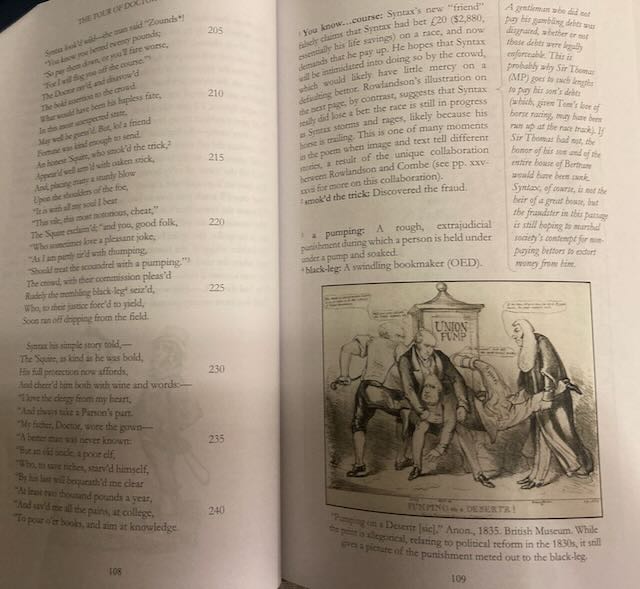
I just finished reading, cover to cover, a brand-new book which is over 200 years old. The Tour of Doctor Syntax in Search of the Picturesque, by William Combe, is a classic which Jane Austen herself enjoyed. But it’s out in a new edition, with wonderful illustrations, explanations, and comments.

A fun new annotated version of The Tour of Doctor Syntax, including parallels with Jane Austen’s novels!

The story in verse was first published from 1809-1811 as a series in Ackermann’s Poetical Magazine. Ackermann had a series of prints by the great caricaturist Thomas Rowlandson. They featured a country clergyman with a long pointed chin and a tall white wig traveling through the countryside. Ackermann gave Combe the illustrations for each issue of the magazine, and Combe wrote a section of the story to go with them. He didn’t know ahead of time what the pictures would be for the next issue, but somehow he came up with a coherent story. One interesting facet is that Rowlandson apparently intended to satirize the clergy, but Combe made Syntax into a good, learned man, a little silly, but lovable.

A book version came out in 1812. Dr. Syntax was wildly popular and stayed in print, with multiple printings and editions, well into the 1800s.

This new version of The Tour of Doctor Syntax was edited and annotated by an advanced high school class and their professor, Dr. Ben Wiebracht. Ben actually discovered Dr. Syntax through one of my posts right here at Jane Austen’s World. Recognizing its potential for his class on “Jane Austen and Her World,” he asked Vic Sanborn, owner and primary writer of this website, and myself, to share with his class. Vic owns some lovely Rowlandson prints. We both loved connecting with such bright and interested students, who asked knowledgeable questions.

The Book

They’ve done a brilliant job with the book. It starts with a biography of William Combe and the history of the book itself. Combe’s challenges as a writer in Austen’s age were fascinating to me, as a writer myself. A clear introduction explains “the picturesque,” which is mentioned in Austen’s novels. Parallel to the text are straightforward explanations of difficult terms and phrases. That makes them easy to quickly reference. A glossary in the back gives terms previously defined.

The best part, for me, are comments pointing out parallels with Jane Austen’s work. I can’t even begin to list these, but there are many great insights. Some are about the clergy in Austen’s work, since Syntax is an underpaid country curate like Charles Hayter of Persuasion. Many comments have to do with the “picturesque,” “improvement” and country estates ranging from Sotherton to Pemberley. Others relate to the class system, Gothic novels, and other topics.

The full text of the poem/story is opposite explanations, comments, and illustrations, making them easy to access. The Tour of Doctor Syntax, 2024.
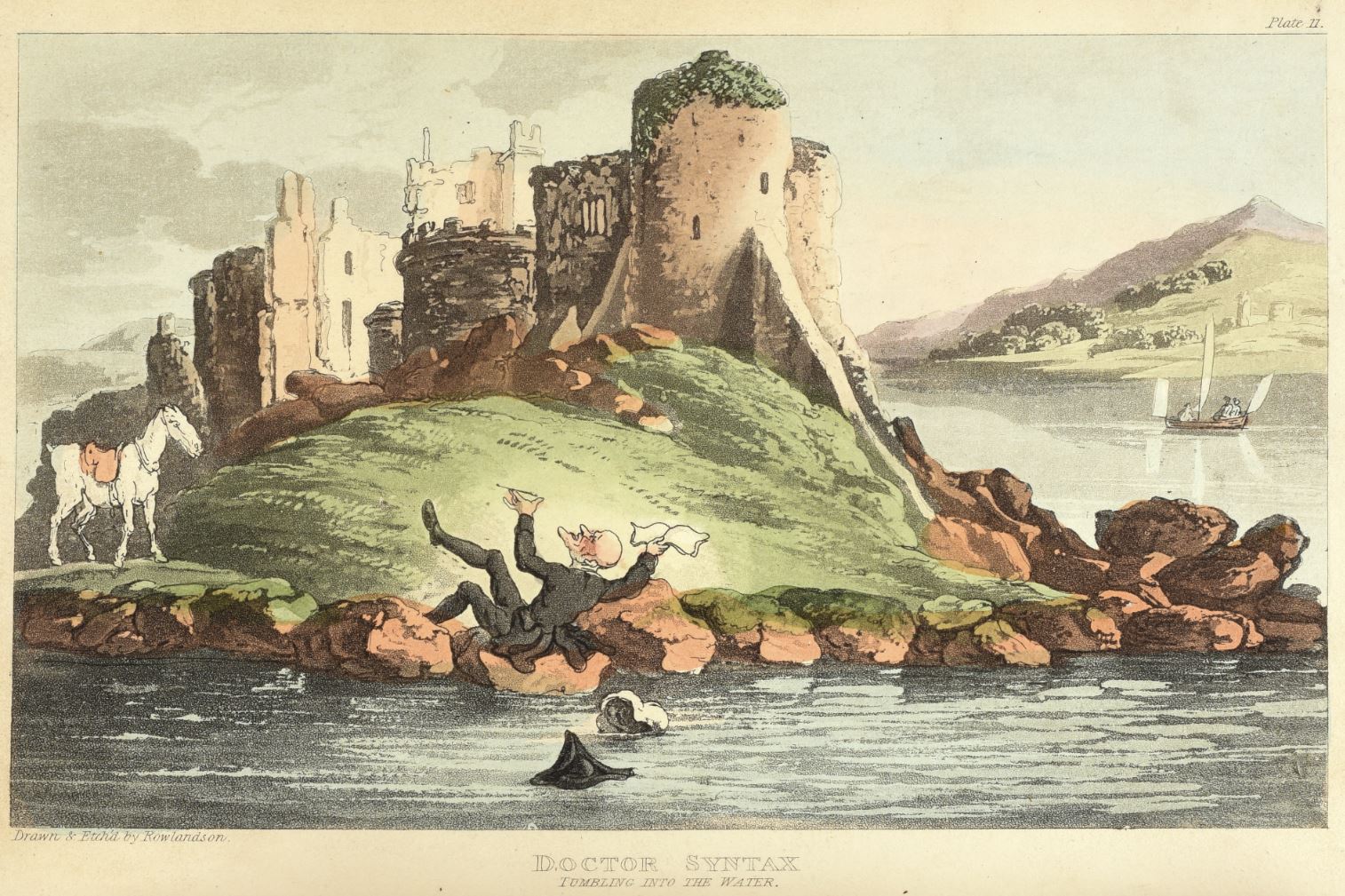
“Doctor Syntax Tumbling into the Lake,” by Thomas Rowlandson. One of the lovely full-page illustrations for this new version of The Tour of Doctor Syntax.
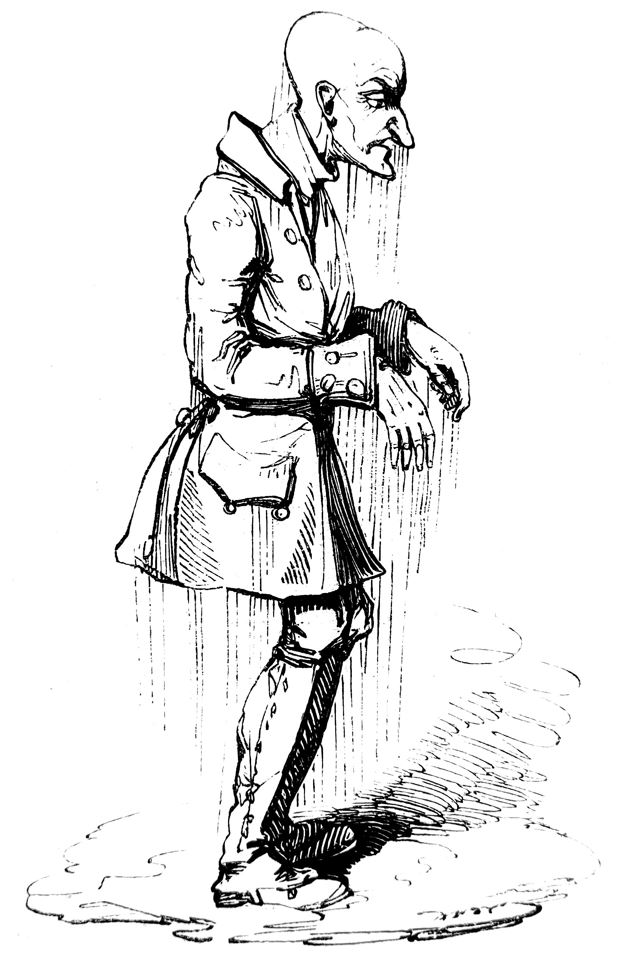
Victorian illustration, 1838, of the same scene, by Alfred Crowquill. The Tour of Doctor Syntax includes both the Rowlandson and Crowquill illustrations.

I also loved the illustrations. The editors chose the best versions they could find of each of the full-page, hand-colored pictures by Rowlandson that were the basis of the book. They added illustrations from a later Victorian version, as well as other entertaining and illuminating cartoons and pictures from the time.

Interview with the Editor

I’ll let Dr. Wiebracht himself tell you more about how this book came about.

Ben, please tell me about your class that produced this book.

The class is called “Jane Austen and Her World” and it’s designed for advanced juniors and seniors. The goal is to see Austen’s novels not as sealed-off masterpieces, floating in a historical vacuum, but as windows into her world. Most class days, our Austen reading is accompanied by shorter texts designed to create a sense of context and show how Austen was in conversation with her contemporaries. For instance:

  • We pair Austen’s account of Bath in Northanger Abbey with a number of late 18th-c. satires of Bath, 18th-c. dance music, and illustrations of the city by Rowlandson and others.
  • We pair Catherine’s pseudo-Gothic adventures in Vol. II with excerpts from The Monk, The Castle of Otranto, and The Mysteries of Udolpho.
  • We pair the private theatricals in Mansfield Park with a viewing of a performance of Lover’s Vows, as well as specimens of anti-theatrical criticism from the period, including a satire on private theatricals by Jane’s brothers!

  • We pair the discussion of landscape gardening in Mansfield Park with images from Humphry Repton’s famous “red books” showing “before and after” estate grounds.

The idea is to understand Austen in a deeper way by developing the practice of “reading outward.” And we incorporate that principle in our work for the class. Instead of the usual school essays, students work with me to create a critical edition of a neglected text from Austen’s time, with annotations and other resources that draw connections between the text and Austen’s life and work.

The class enrolled 16 students (the maximum). They hailed from all over the country and world: Japan, China, and many different U.S. states. This was my first time teaching the course, though I developed the core ideas in an Austen unit for a previous course. In the future, I will probably teach the course every three years. The book project in particular is a heavy lift, and I’m not capable of it every year!           

How did you end up studying Dr. Syntax along with Jane Austen?

I have to back up a bit here. In the course of an Austen unit for a previous class, students and I had created a critical edition of a long-forgotten 1795 poem called Bath: An Adumbration in Rhyme. We used that book to launch a new series called “Forgotten Contemporaries of Jane Austen.” Its goals are:

  • to recover neglected but valuable texts from Austen’s time, and
  • to trace new connections between Austen and her contemporaries.

As I was preparing my Austen class, I settled on Doctor Syntax (first brought to my attention in JAW by one of your articles!) for three reasons.

  • First, the poem had undeniable literary-historical importance – one of the all-out bestsellers of the Regency. A critical edition, I thought, was long overdue.
  • Second, many of its themes – from the plight of poor clergy to the “picturesque” – were major concerns of Austen’s novels, too.
  • Finally, the poem was simply a really good read. Combe’s verses are light, fun, and at times even touching, and Rowlandson’s accompanying illustrations are some of his best work. In every way, the poem deserved to be revived!

What do you hope readers will gain from the book?

There are a lot of things I hope people take away! One would be a deeper appreciation of just how engaged Austen was in the debates and issues of her day. Sometimes Austen is talked about as something of a provincial writer, sealed off from the wider Regency world, modestly toiling away on her “pictures of domestic life in country villages,” as she once put it. But when we keep in mind just how much of a smash hit Doctor Syntax was, and when we consider the many, many parallels between this work and Austen’s novels, which our edition lays out in detail, then we see Austen differently. She now starts looking like a very savvy writer, who understood what the major issues of the day were, what readers were interested in. To be sure, she stuck to her convictions and drew on her own experience and observations, but she did so in a way designed to appeal to a broad, national readership.

I’m also excited for people to meet this poet William Combe, who had one of the most interesting lives of any Regency writer. He was a remarkable literary talent. He doesn’t fit the mold of the “Romantic poet,” which is one reason he might be overlooked. Instead he offers a light, generous humor that shows us that Regency poetry wasn’t all about Byronic heroes and Wordsworthian dreamers. There was a sociable, comic side to the poetry of the period. Combe represents that comic side particularly well.

Finally, I would love it if this book inspired other teacher-scholars to undertake collaborative research with their students – especially at the upper-high-school level. There are so many benefits. For students, it’s a more rewarding and enjoyable approach to literary scholarship than the usual school essays. For teachers, it’s a welcome relief from the role of “judge/grader” – instead you get to teach through co-creation, as is done in most trades through the apprenticeship model. And for the reading public, there’s the benefit of the work produced! I am convinced that student involvement, with the right guidance and leadership from the teacher, leads to better scholarship. It certainly has in my experience.

By the way, while we don’t offer a Kindle edition, we do offer a free etext in the form of a downloadable PDF on our website. We decided from the beginning to be an open-access publisher, in part to make it easier for teachers with low-income students to assign our books. The best way to use the e-text is to enable the 2-page view in your pdf reader – that way the text and notes are neatly parallel, as in the physical book. The etext can also be used as a supplement to the physical book – for instance if you want to do a text search for a particular word.

How did you and the students share the work on this project?

Each student was responsible to annotate one of the poem’s 26 cantos, about ten pages of text. I did the other ten cantos myself. Students also had one or more additional responsibilities, which included:

  • Researching aspects of Combe’s life
  • Researching Gilpin and the picturesque
  • Compiling chronologies
  • Drawing maps
  • Designing the cover
  • Editing the text according to scholarly standards

My job was twofold. First, I offered regular feedback on work in progress, helping students learn how to navigate library databases, write good, concise annotations, etc. I also did the parts of the book that were a bit beyond the reach of high-school students, even excellent ones, which all the students who worked on this book were! For example, I wrote most of the introductory materials, as well as some of the trickier annotations. I helped with the final prose, too, to ensure continuity of voice. That doesn’t mean, though, that the best stuff is mine. Many of the best, most insightful annotations in the book are entirely by students, and every one of my students has some of their own writing, their own voice in the final book – which was a major priority for me. And just as students benefited from my feedback, I benefitted from theirs. They fully earned their editor credits in the final book.

Final Thoughts

Dr. Wiebracht and his class did an amazing job. I highly recommend this book, which is available on Amazon and from Jane Austen Books at a discount. I have not yet read the earlier book in the series, Bath: An Adumbration in Rhyme, but now I want to get hold of that and read it, too!

If you’re at the JASNA AGM this month, you can hear Ben and some of his students speak, and get them to sign your copy of the book. (Unfortunately I’m speaking in a slot opposite theirs, as well as other excellent speakers at that time, so you’ll have to choose! It’s always challenging.) Their talk is also available in the virtual version of the AGM.

The price is very reasonable for a book with color illustrations. I hope you’ll get a chance to enjoy and learn from this lovely book!

Read Full Post »

By Brenda S. Cox

“Netherfield is taken by a young man of large fortune from the north of England . . . he is to take possession before Michaelmas.” –Pride and Prejudice, chapter 1

“People did say you [Mr. Bingley] meant to quit the place entirely at Michaelmas . . .” –Pride and Prejudice, chapter 53

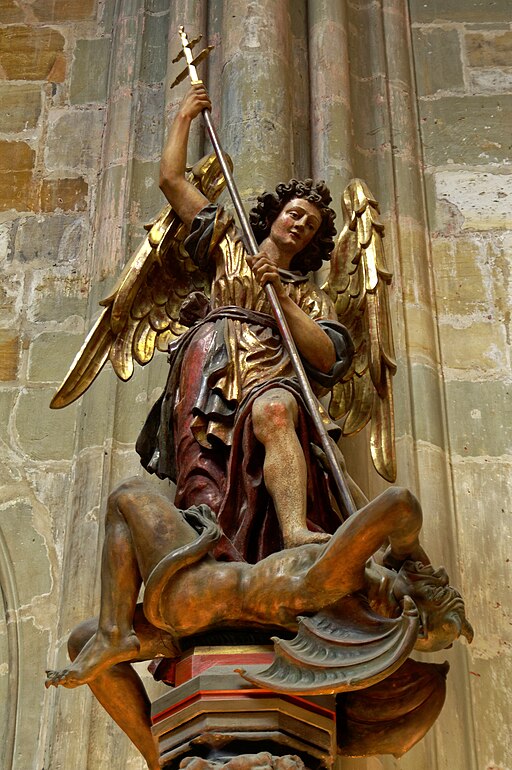
Today, September 29, is Michaelmas (pronounced MICK-ul-muss). In the church calendar, for Catholics and for Anglicans like Austen, this is a “holy day” (from which we get our word holiday). It commemorates St. Michael, the archangel.

Sculpture of the Archangel Michael defeating the devil, from St. Vitus Cathedral, Prague.
Photo by Jakub Hałun, CC BY-SA 4.0

Sometimes other angels are also commemorated on this day: “St. Michael and All Angels,” or specifically Michael, Gabriel and Rafael, the three angels mentioned by name in the Bible. The word “saint,” from Latin “sanctus,” means “holy one,” so the holy angels of heaven can be considered saints.

“Michaelmas” means the mass of Michael, as “Christmas” means the mass of Christ. Mass is the Catholic version of what Anglicans call the Lord’s Supper or Holy Communion, the ceremony where Christians eat unleavened bread and drink wine together to remember Christ’s suffering and death on the cross.

On the Calendar

In earlier times, the church and community were closely intertwined. Church holidays gave the year rhythm and consistency. Judicial, financial, and academic schedules came to revolve around four “quarter days” of the year. For England, these were Lady Day, Midsummer Day, Michaelmas, and Christmas.

March 25, Lady Day: Austen mentions this in her letters as the day when an allowance of money was to begin for her brother James, and as a day when someone was moving houses. In the church, it was the Feast of the Annunciation, when the angel Gabriel announced to the Virgin Mary (the “Lady”) that she would have a child, Jesus.

June 24, Midsummer Day: In Emma, Jane Fairfax is supposed to leave at Midsummer, though she gets delayed. The Box Hill picnic takes place at “almost Midsummer.” Midsummer is capitalized, so it means a specific date. On this date, the church celebrates the birth of John the Baptist, who prepared the way for Jesus’s coming.

Sept. 29, Michaelmas Day is mentioned in all of Austen’s novels except Northanger Abbey as a date when things happen. Mrs. Jennings thinks Colonel Brandon will be married by Michaelmas. Mr. Bingley is to take possession of Netherfield at Michaelmas, and rumor has it he will leave by the next Michaelmas. In Mansfield Park, Mrs. Norris has been doctoring the coachman for rheumatism from Michaelmas through the winter, and Henry Crawford expects to have a small home nearby at Michaelmas, obviously hoping he and Fanny will be married by then. In Emma, Harriet Smith is amazed that Mr. Elton could be in love with her, since she hardly knew him at Michaelmas. It is probably November when she says this. The Crofts take possession of Kellynch Hall at Michaelmas, and Anne tells her father that Mary has been in “good looks” since Michaelmas. In Sanditon, Lady Denham brings Clara Brereton from London at Michaelmas.

Dec. 25, Christmas Day. In Austen’s novels and shorter works, she mentions Christmas 41 times and Easter 18 times by my count. They often serve to mark dates and times of year.

(For some purposes, Epiphany (Jan. 6) was a quarter day instead of Christmas, and Easter instead of Lady Day. But Midsummer and Michaelmas were still the other quarter days.)

Around these four quarterly dates, rents and payments came due, leases of lands and houses (like Netherfield) began and ended, servants were hired, and local courts held “quarter sessions.”

The academic year also revolved around church dates. The fall term at both Oxford and Cambridge is called Michaelmas term. I was surprised when I was at Cambridge two weeks ago, in mid-September, that the colleges were not yet in session. Then I realized it was not  yet Michaelmas. This year’s fall term starts just after Michaelmas, on Oct. 8. 

In the Church

The Book of Common Prayer (BCP), which gives daily worship services for the Church of England, includes a calendar of saints’ days. By Austen’s time, special services for most of those days were not commonly held in country parishes unless they fell on a Sunday. Christmas Day, though, was celebrated with a church service. In Emma, the weather keeps Emma from going to church on Christmas.

For each saint’s day, the BCP gives relevant Bible readings and a collect (pronounced KAH-lect) prayer for that day. Austen was likely very familiar with these, hearing them every year. For Michaelmas, the clergyman could choose from these readings about angels:

Revelation 12:7-12. “War in heaven”; “Michael and his angels fought against the dragons” [the demons]. Satan is cast out of heaven, but those who believe in Christ “overcame him by the blood of the Lamb, and by the word of their testimony; and they loved not their lives unto the death.” Many depictions of Michael show him defeating Satan, sometimes in the form of a dragon.

Matthew 18:1-10. Jesus says not to despise children, for “their angels do always behold the face of my Father who is in heaven.”

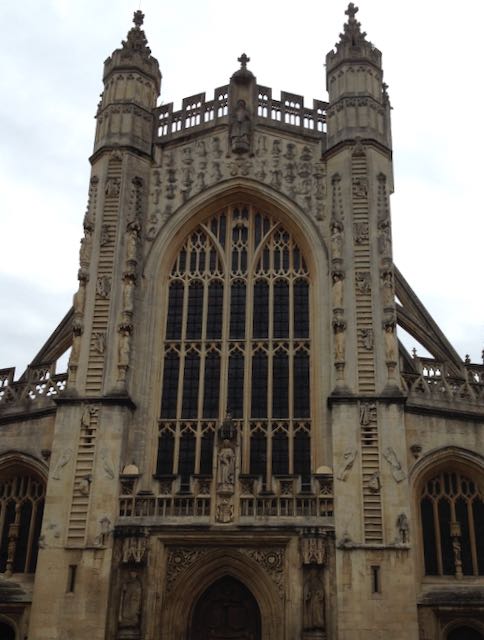
Genesis 32. Jacob wrestles with an angel. This is the same Jacob who earlier saw a vision of a ladder to heaven, with angels going up and down it. The front of Bath Abbey, which Jane Austen must have seen many times, pictures that ladder.

Angels going up and down the ladder to heaven, on the front of Bath Abbey. Photo © Brenda S. Cox, 2024.

Daniel 10:4-14. An angel sent to Daniel was delayed by the prince of Persia, apparently a demon, until the archangel Michael, “one of the chief princes,” came to help him. The angel looked like a man “clothed in linen, whose loins were girded with fine gold of Uphaz: his body also was like the beryl [a gem, possibly an emerald], and his face as the appearance of lightning, and his eyes as lamps of fire, and his arms and his feet like in colour to polished brass, and the voice of his words like the voice of a multitude” (Daniel 10:5-6). This angel doesn’t sound much like today’s usual pictures of angels!

Acts 12:5-18 An angel rescues the apostle Peter from prison.

Revelation 14:14-20 Angels pour out God’s wrath and judgment on the earth.

The Collect prayer read on Michaelmas requests the help of angels for those on earth:

“O everlasting God, who hast ordained and constituted the services of Angels and men in a wonderful order: Mercifully grant that, as thy holy Angels always do thee service in heaven, so by thy appointment they may succour and defend us on earth; through Jesus Christ our Lord. Amen.”

Nowadays most Anglican churches use the more modern Book of Common Worship, but a traditional BCP service might still use this prayer and some of these Bible passages.

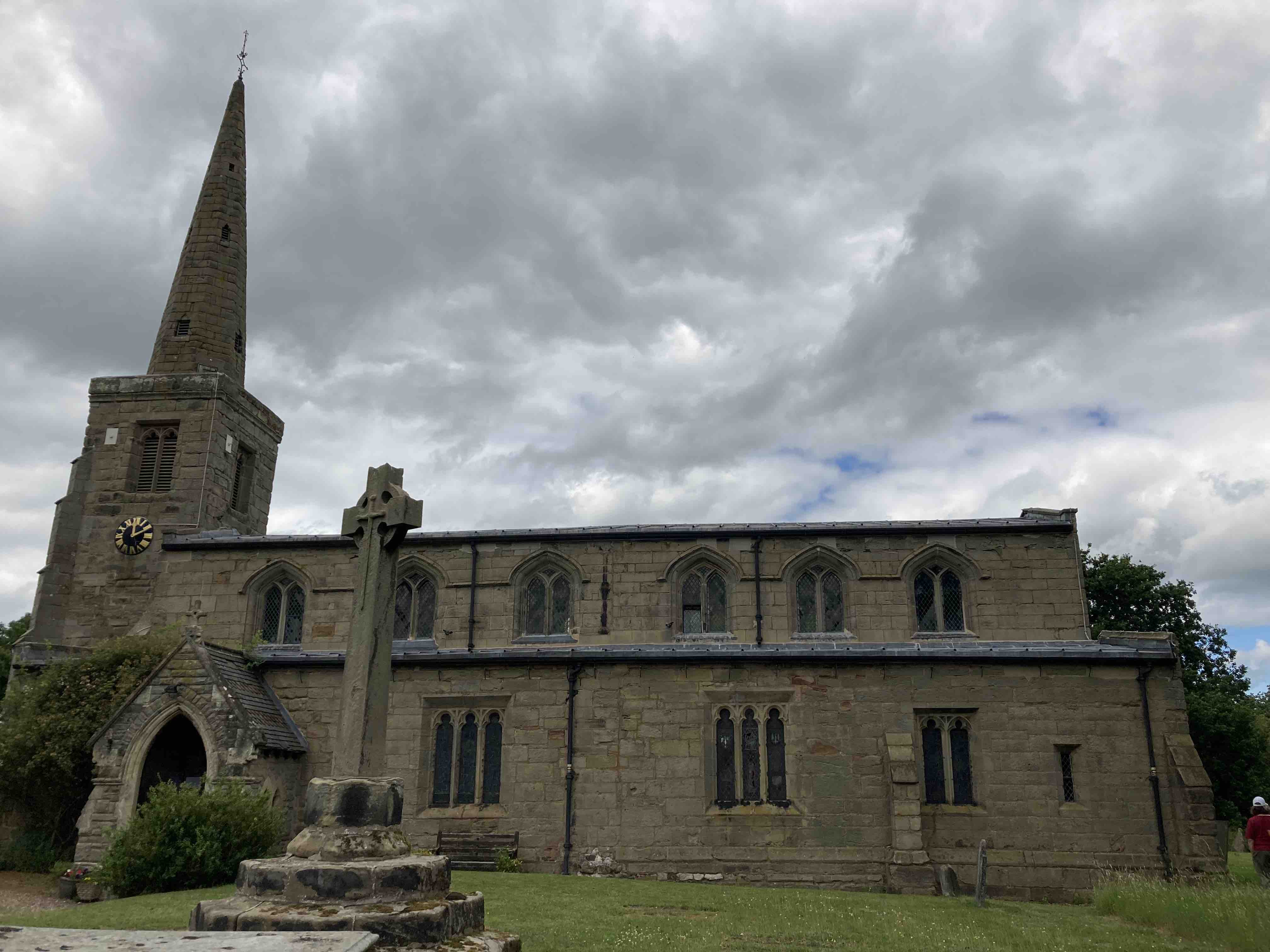
Church of St. Michael and All Angels, Hamstall Ridware, where Austen’s first cousin, Edward Cooper, served. Many English parish churches are named for St. Michael.
Photo © Brenda S. Cox, 2023

The church of Austen’s first cousin, Edward Cooper, in Hamstall Ridware, is named after St. Michael and All Angels. Their service this Sunday will be a celebration of Harvest (the British equivalent of America’s Thanksgiving) as well as a “patronal festival,” since it is the day of St. Michael, patron saint of the church. The clergyman, Revd. Jeremy Brading, told me, “The aim of these occasions [patronal festivals] is to celebrate the life of the local church on the occasion of its saint’s day. The celebration is for all that has gone previously, thanking God for his work through the local church. [Just] as important, is praying to God for his leadership and guidance for the future, that the local church might serve him faithfully.”

In Popular Culture

While Michaelmas is not much celebrated in today’s Anglican church, it was a great religious feast day in the Middle Ages, and traditions grew up around it. Michaelmas comes at the end of the harvest and the change of the season. A few old English traditions:

Eating goose and doing good: If you ate goose on Michaelmas, it was supposed to protect you from financial need for the next year. One writer says, “On Michaelmas, families spend the day doing good, dancing, singing, and at the end of the day, sharing a feast of freshly baked bread, roast goose stuffed with potatoes, veggies, and herbs.”

Picking blackberries: According to legend, when the Archangel Michael, with his flaming sword, cast the devil out of heaven, the devil landed in a thorny patch of blackberries. He was so angry that he spat on the blackberries and even urinated on them to make them unfit to eat. Thus blackberries picked after Michaelmas are considered inedible. Since Michaelmas originally fell in what is now mid-October, until the calendar changed (from Julian to Gregorian), that was pretty much the end of blackberry season.

A European Michaelmas daisy, aster amellus.
Photo by Björn S…, CC BY-SA 2.0

Michaelmas daisies: An old rhyme says,

The Michaelmas daisy, among dead weeds,

Blooms for St Michael’s valorous deeds.

And seems the last of flowers that stood,

Till the feast of St Simon and St Jude.’

Michaelmas daisies are asters, star-shaped flowers in lilac, blue, pink, or white. The peak of their bloom is around Michaelmas, though many are still blooming at the feast of St. Simon and St. Jude on Oct. 28.

Lawless Hour: An odd custom from Worcestershire: “In Kidderminster the Monday after Michaelmas had Lawless Hour between 12 pm and 1 pm, in between the old constable stepping down and the new one taking office. This led to an hour when people couldn’t be arrested, so groups would fight by throwing cabbage stalks and other fruit and vegetables at each other. The authorities mostly turned a blind eye, but by the mid 19th century this practice ended as it was considerate inappropriate.” Other local areas have their own Michaelmas traditions

We don’t know what Michaelmas traditions Jane Austen kept. But she did mention Michaelmas 15 times in her fiction, and now you know what it meant. Happy Michaelmas to you all!

Read Full Post »

by Brenda S. Cox

“I dread the idea of going to Bookham as much as you can do”—Jan. 9, 1799

“My scheme is to take Bookham in my way home for a few days . . . I have a most kind repetition of Mrs. Cooke’s two or three dozen invitations, with the offer of meeting me anywhere” –Nov. 3, 1813

We’ve been looking at some of Jane’s mother’s Leigh family. The Austens also corresponded regularly with the Cooke family in Great Bookham, who are often mentioned in Jane’s letters. Mrs. Cooke was Jane’s mother’s cousin. Her name was the same as Jane’s mother’s: Cassandra Leigh. She was the daughter of Jane’s uncle Theophilus Leigh, master of Balliol College at Oxford.

This cousin’s husband, Rev. Samuel Cooke, was Jane’s godfather. He was the vicar of St. Nicolas’, Great Bookham. He was also rector of Cottisford, Oxon, about 80 miles away, but he and his family lived in Great Bookham.

Godparents play an important role in Anglican families.They promise to pray for the child’s salvation, faith, and obedience, and, at the child’s baptism, they renounce the devil on the child’s behalf. A girl has one godfather and two godmothers.

Memorial plaque in St. Nicolas’ Church, Great Bookham, to Jane Austen’s godfather, Rev. Samuel Cooke, “formerly fellow of Baliol College Oxford, and for fifty-two years the resident and respected vicar of this parish. He died March 29th, 1820, in the eightieth year of his age. Guided by a spirit of piety and benevolence and by an inflexible sense of duty, which sought not the honour that cometh of man, he ran his long course in peace and content; and closed it in an humble trust on that blessed hope, ‘Enter thou into the joy of thy Lord.'”
The Incumbents (vicars, then rectors) of the Great Bookham church lists Samuel Cooke from 1769 to 1820.

Jane Austen visited the Cookes in Great Bookham, which is between Chawton and London, a number of times. We don’t know why she did not want to go there in 1799, but she visited from May 14 to June 2.

St. Nicolas’ Church, Great Bookham, externally still much as it was when Jane Austen visited there. See this image by JMW Turner.

Great Bookham in Austen’s Novels

Jane made good use of her visit. In 1801, she started writing The Watsons. Its setting in “Stanton” was apparently based on West Humble (now Westhumble), a town near Great Bookham. It is three miles from Dorking, which Austen calls “the town of D. in Surrey.” Betchworth Castle is nearby, so it may be the basis for Osborne Castle in the novel.

After probably visiting several more times, in the summer of 1814, Austen decided to visit the Cookes again. On June 14, she wrote,

“The only Letter to day is from Mrs. Cooke to me. They . . . want me to come to them according to my promise.—And after considering everything, I have resolved on going. . . . In addition to their standing claims on me, they admire Mansfield Park exceedingly. Mr. Cooke says ‘it is the most sensible Novel he ever read’—and the manner in which I treat the Clergy, delights them very much.—Altogether I must go–& I want you [Cassandra] to join me there . . .”

One commentator (Chapman) says the Cookes may have had Evangelical leanings and appreciated Mansfield Park’s protest against lax views of the duties of the clergy. Evangelical or not, Edmund Bertram of Mansfield Park does present a very high view of the clergy. He says, for example:

“I cannot call that situation [of clergyman] nothing which has the charge of all that is of the first importance to mankind, individually or collectively considered, temporally and eternally, which has the guardianship of religion and morals, and consequently of the manners which result from their influence. No one here can call the office nothing. . . . it will, I believe, be everywhere found, that as the clergy are, or are not what they ought to be, so are the rest of the nation.”

Jane Austen apparently based Highbury in Emma on Great Bookham or the adjacent town of Leatherhead.

When Jane Austen visited in 1814, she was in the midst of writing Emma. She later told her nephew that Leatherhead, next to Great Bookham, was the model for Highbury. Box Hill, where Emma and her friends picnic, is nearby, and Great Bookham had an Old Crown Inn similar to the one in Highbury. (It was, however, demolished in 1930). There was also a Randalls Park, and other features similar to Highbury.

View from Box Hill, where Emma and her friends picnic in Emma. (Tony Grant points out that this wonderful view is not from the exact spot where they held their picnic. “Frank Churchill, when he gets up to to proclaim to the world, says that Dorking is to his left and Mickleham to his right. That can only mean the picnic took place on the Burford Spur of Box Hill.” You can find photos of other views in his posts linked below.)

Box Hill

Box Hill is still a beautiful spot for picnics, hiking, walking, and cycling. The current rector of Great Bookham, Alan Jenkins, kindly took us to visit there. It includes a cycling trail. In the 2012 Olympics, cyclists made nine laps on this trail as part of their route.

The Vicarage

The Cookes’ parsonage, where Jane Austen stayed, was a large one. (A maid working there was named Elizabeth Bennet, by the way.) They had at least six children, but only three survived to adulthood. Their daughter Mary, who apparently did not marry, was a good friend of Jane’s, mentioned in her letters. Their son Theophilus Leigh Cooke (1778-1846) became a clergyman, a fellow of Magdalen College at Oxford, and holder of three church livings. His brother George Leigh Cooke (1779-1853) combined religion and science. He was a fellow of Corpus Christi College and earned a bachelor of divinity (a graduate degree). He also became a professor of Natural Philosophy (science) at Oxford, a keeper of the archives, and published an edition of Newton’s Principia Mathematica. Austen’s nephew, James-Edward Austen-Leigh wrote in his Memoir that George was “an impressive preacher of earnest and awakening sermons,” which, in the jargon of the time, implies that he was an Evangelical. Jane mentions in one of her letters that George “was very kind & talked sense to me every now & then” (Apr. 21, 1805).

Until 1869, Great Bookham had vicars, not rectors, so the parsonage was called a vicarage. The patron of the parish (a person who changed over the years), took part of the tithes and the rest went to the vicar, along with income from the glebe farmland belonging to the living. It is speculated that some of the excommunications in the Vestry Books were for non-payment of tithes (from 1800: Great Bookham at the Time of Jane Austen).

The parsonage was removed in 1961. For early pictures, see here. The parish now has a rector; the term no longer refers to tithes. His rectory is a modern building.

St. Nicolas’ Church, Great Bookham, History

Jane Austen must have worshiped in this church, where her godfather was the vicar, a number of times on her visits to Great Bookham.

When Austen visited, the church was full of box pews with walls around them. Some were three feet high, some were four feet high. The box pews were replaced by regular pews in 1885.

This wooden gate was added to side of the Great Bookham church in 1914. In Austen’s time, there was an external staircase here to an upper room, where Sunday school was held. Sunday schools, run by Christians of all denominations across England, educated the poor and enabled them to build better lives.
The church tower of St. Nicolas’ Great Bookham dates back to the 1100s. The clock in it was not there when Austen visited. Some years ago, the tower was in danger of falling down. The whole village got behind the project of fixing it, and raised even more than the large sum necessary to save the tower.
The chancel of the Great Bookham church was built in the 1300s, though when Jane Austen saw it, it did not have stained glass.

Other Literary Connections at Great Bookham

Great Bookham has a number of literary connections, some of which Jane Austen would have known about.

Cassandra Cooke, Jane Austen’s mother’s cousin, published her novel, Battleridge: An Historical Tale founded on facts, in 1799, by “a lady of quality.” Austen mentions it in her letters. Available on archive.org in two volumes.
Fanny Burney, one of Jane Austen’s favorite authors, lived here at the Hermitage with her husband, General Alexandre D’Arblay. Their son was baptized in the nearby Great Bookham church in 1795.

Fanny Burney wrote of the Cookes, “the father is worthy, the mother is good, so deserving, so liberal and so infinitely kind, that the world certainly does not abound with people to compare them with. The eldest son is a remarkably pleasing young man. The young seems sulky, as the sister is haughty.” She also wrote of Rev. Cooke, “Our vicar is a very worthy man and goodish—though by no means a marvellously rapid preacher.”

She also wrote to her father, Dr. Burney, “Mr. Cooke tells me he longs for nothing so much as a conversation with you on the subject of Parish Psalm singing—he complains that the Methodists run away with the regular congregation from their superiority in vocal devotion.” The Methodists, led by John and Charles Wesley, had been leading a revival in the church. They attracted people with lively hymns. Country churches were mostly singing psalms, often quite poorly, at this time, though hymns were beginning to be introduced into some churches.

Old and new: St. Nicolas’ pipe organ today. In 1800, the Great Bookham church only had a barrel organ that could play ten tunes. It accompanied their choir of Singers who sang from the West Gallery (balcony) of the church. So their music was probably better than that of many country churches at the time, which often had no musical instruments. This photo shows a memorial tomb/statue that Austen would have seen. The pulpit would have been higher, however, to be seen over the box pews. The blue bulletin board is modern, showing charities the church supports.

Playwright and politician Richard Sheridan (1751-1816), who wrote The Rivals and School for Scandal, owned several manors in the area around Great Bookham.

Later, teenaged C. S. Lewis lived in Great Bookham from 1914-1917, being educated by a private tutor, William T. Kirkpatrick.

St. Nicolas’ Church, Great Bookham, Today

St. Nicolas’ is a very active church, larger than the others we have “visited” so far. I was told the parish includes eleven to twelve thousand people. The electoral role of St. Nicolas’ lists about 250 members, and around 140 attend on Sundays. Three other ministers and five staff members assist the rector in serving the church. The church holds services every Sunday, Communion on Thursdays and Sundays, and several weekly prayer meetings. Members also meet in housegroups.

This board welcomes people to St. Nicolas’, Great Bookham, and advertises concerts and other community events held at the church.

The area also includes Baptist, Catholic, and United Reformed churches, and St. Nicolas’ cooperates with them on projects like Alpha Courses, designed to address people’s questions about Christian faith.

A few years ago, the church removed the Victorian pews and substituted chairs. This gives them the flexibility to hold various kinds of services and to host community events.

Religious education and daily worship are required to be offered in British government schools (student participation is optional). The rector, Alan Jenkins, provides some of this in local schools, briefly sharing a Bible story, prayer, and sometimes a song. School groups also come into the church for harvest or Easter services, with programs organized by the teachers.

Prayer stations around the church offer ideas for personal prayer.
An interesting aside for you: St. Nicolas’ Great Bookham has many lovely stained glass windows today, though there were none when Jane Austen visited. This one honors St. George, patron saint of England; St. Michael, who in the Bible defeats the great dragon, the devil; and St. Martin using his sword to cut his cloak in half in order to give half to a beggar in winter. These windows, with military images, are dedicated to Guy Cuthbert Dawnay, a soldier and Conservative politician. A large cross dedicated to Dawnay in the churchyard says he “was killed by a buffalo while on a hunting expedition in Masailand, E. Africa,” Feb. 28, 1889. Both have verses from Isaiah 60:19-20 about the Lord being his everlasting light.
On the day we visited the Great Bookham church, the central kneeling cushion at the altar commemorated Jane Austen’s connection with the church.

I hope you are enjoying learning about Jane Austen’s churches along with me. There is so much history at these old churches, as well as continuing community life and worship today.

All photos copyright Brenda S. Cox, 2024.

Brenda S. Cox is the author of Fashionable Goodness: Christianity in Jane Austen’s England. She also blogs at Faith, Science, Joy, and Jane Austen.

Sources

1800: Great Bookham at the Time of Jane Austen, Fanny Burney, and R. B. Sheridan, published by the Parochial Council of St. Nicolas Great Bookham (booklet available at the church, funded by JASNA)

The Original of Highbury,” Jane Austen Society Collected Reports II:60,

Church of St. Nicolas, official list entry

St. Nicolas, Great Bookham website and The History of the Building

Special thanks to Tony Grant for telling me that Box Hill was near Great Bookham, and to Rev. Alan Jenkins for taking us up to Box Hill!

Further Exploration

Jane Austen and Great Bookham, by Tony Grant

Box Hill in Jane Austen’s Emma, by Tony Grant (includes the geology, history, and literary connections of Box Hill)

Jane Austen’s Surrey, by Tony Grant (includes views Emma might have seen on her picnic)

Emma Woodhouse’s Surrey, by Tony Grant (includes views Emma might have seen on her picnic)

Other Churches Connected to Jane Austen

Steventon

Chawton

Hamstall Ridware and Austen’s cousin Edward Cooper

Adlestrop Church and the Leigh Family

Stoneleigh Abbey Chapel

Read Full Post »

By Brenda S. Cox

“Yesterday came a letter to my mother from Edward Cooper to announce, not the birth of a child, but of a living; for Mrs. Leigh has begged his acceptance of the Rectory of Hamstall-Ridware in Staffordshire, vacant by Mr. Johnson’s death. We collect from his letter that he means to reside there, in which he shows his wisdom. Staffordshire is a good way off . . .”—Jane Austen to Cassandra, Jan. 21, 1799

In 1806, Jane Austen and her family made a trip to visit their relatives in the north. They spent five weeks with her first cousin Edward Cooper, rector of Hamstall Ridware (whom I wrote about earlier). They stayed in his rectory, and must have attended the adjacent Church of St. Michael and All Angels and heard Edward Cooper preach there. The church is still much as Austen knew it, inside and out.

The Church of St. Michael and All Angels, Hamstall Ridware, where Jane Austen visited for several weeks in 1806. Photo © Brenda S. Cox, 2023

Hamstall Ridware History

Hamstall Ridware means “homestead,” or “place of the house,” by the “river ford.” It is on the River Blithe. The first word is Anglo-Saxon, the second is Celtic, indicating that the two people groups may have both been living in the area at the time it was named. Three other towns with the name Ridware (Pipe Ridware, Hill Ridware, and Mavesyn Ridware) are nearby.

The de Ridware family were the medieval “lords of the manor” for the area. The church was built, in the Norman style, around 1120 A.D, and expanded in the 14th and 15th centuries.

In the 1370s, the de Ridwares had no male heir, so the land passed to the Cotton family. A Cotton family tomb, from the time of King Henry VIII, still stands in the church. Each shield on the sides commemorates one of the children of John and Joanna Cotton. Half of each shield is their family crest, an eagle on a blue background. For the sons, the other half represents their profession. For the daughters, the other half shows the shield of their husband’s family.

This tomb from the time of King Henry VIII represents all the children of the Cotton family, the lords of the manor at the time. Photo © Brenda S. Cox, 2023

In the 1500s, the Cottons had no male heir, so the manor, Hamstall Hall, and the lands, passed to Sir Anthony Fitzherbert, the husband of the eldest daughter. 

In 1601 the estate went to Sir Thomas Leigh of Stoneleigh, one of Jane Austen’s forebears. This early stained glass window, incorporating 14th century glass, commemorates all these patrons of the Hamstall Ridware church. Each family would have owned the advowson for the Hamstall Ridware church, the right to choose the rector of the church when the previous one died.

Stained glass window in Hamstall Ridware church. This window shows coats of arms of the families who have owned the manor and land of Hamstall Ridware: the de Ridwares of Hamstall on the upper right, the Cotton de Ridwares on the upper left, the Fitzherberts on the lower left, and the Leighs on the lower right. Alice Cotton, wife of Richard Cotton, appears near the top of the middle panel. Photo © Brenda S. Cox, 2023

The Leighs’ main home was at Stoneleigh Abbey (which we’ll “visit” later). The Hon. Mary Leigh of Stoneleigh Abbey was patroness of Hamstall Ridware in 1799.  When the previous rector, Mr. Johnson, died, she gave the living to her relative Edward Cooper. Before that he had been a curate, an assistant or substitute clergyman, probably with a low salary, at Harpsden. Jane and her family had visited the Coopers at Harpsden in August and September of 1799, before the Coopers moved to Hamstall Ridware in October. Edward invited them to visit Hamstall Ridware in 1801, but Jane said in a letter that they preferred to go to the seaside that summer. However, five years later, the Austens did make a long trip to visit their Leigh relations at Adlestrop, then accompanied their cousin, Rev. Thomas Leigh, who had just inherited Stoneleigh Abbey, to the abbey. From Stoneleigh they went to Hamstall Ridware, 38 miles away.

During this time, it’s possible that Jane may have seen the play Lover’s Vows, an important part of Mansfield Park. It was advertised in a village called Cheadle about an hour’s carriage ride away (Gaye King, “Visiting”).

Unfortunately, during Jane’s visit, Edward’s eight children came down with whooping cough, and Jane got it a few weeks later, after she got home (Letters, Jan. 7, 1807).

Displays in the church commemorate Jane Austen, her visit to Hamstall Ridware, the history of the church, and the Leigh family’s connections to the area. Photo © Brenda S. Cox, 2023
The church history board gives fascinating tidbits. For example, the parish register for 1715 lists the death of rector Thomas Allestree, M.A., and the induction of a new rector, Gorstelowe Monck, A.M. (same as M.A., Master of Arts); 7 baptisms (presumably of babies); 5 marriages including two to widows, and two others by license, both with one spouse from another parish; 7 burials, including Rev. Allestree (age 77) in July, his widow in December, and two babies buried shortly after their baptisms. An adjacent news article about Rev. Allestree says he wrote and memorized 500 sermons, and preached them a total of 5,000 times! Photo © Brenda S. Cox, 2023

The Rectory

The rectory (or parsonage, the house provided for the rector of the parish) where the Austens stayed is now a private home. It is now difficult to see even from the outside, but this photo shows the building before a gate was built.

The Hamstall Ridware rectory, before gates were installed. Jane Austen and her family stayed here for five weeks in 1806 with Jane’s cousin Edward Cooper. Photo © Jack Barber, 2017, used by permission.

It has been speculated that this rectory was the pattern for the Delaford rectory, where Edward and Elinor Ferrars settle in Sense and Sensibility. The layout of the Delaford estate, with “stew-ponds” (fish ponds), “a very pretty canal” (perhaps suggested by the nearby river), and “great garden walls,” also corresponds to some features of the Leighs’ estate at Hamstall Ridware.

Gaye King wrote,

“Edward had found the rectory quite large enough to accommodate his growing family. Like the fictional parsonage at Delaford it had ‘five sitting-rooms on the ground floor, and … could make up fifteen beds’ (292). So the young rector could look forward to maintaining the tradition of liberal hospitality such as that he had enjoyed at the Steventon parsonage. When Jane Austen, together with her mother and sister, did eventually spend those five weeks at Hamstall Ridware in 1806 Edward and Caroline had eight children. There were also, living in at the rectory, two maids and a governess, yet there was still ample accommodation for the guests.”

(I have since noticed that the five sitting rooms and fifteen beds were characteristics of the manor house where Col. Brandon lived, not of the parsonage! And I doubt a country parsonage would have so many sitting rooms.)

However, relatives who visited wrote that it was “a beautifully situated parsonage house on a considerable eminence, back’d with fine woods, seen at a distance from the road to this happy village,” and that the church “was a very neat old Spire Building of stone, having two side Ailes [sic] Chancel &c. and makes a magnificent appearance as a Village Church” (quoted in Deirdre Le Faye, Jane Austen: A Family Record, 157).

The Church of St. Michael and All Angels, Hamstall Ridware

The Church of St. Michael and All Angels, Hamstall Ridware, where Jane Austen’s cousin Edward Cooper was rector from 1799-1833. Photo © Brenda S. Cox, 2023

The church is large, seating 200 people, almost three times the size of Jane’s church at Steventon (which seats about 75). It has a long central aisle leading to the chancel, where the altar sits, and two side aisles. Lining both sides is a clerestory, high walls with a series of windows which let in natural light.

Central aisle of the Hamstall Ridware church. Photo courtesy of Hamstall Ridware PCC, used by permission.
Unusually, the upper section of the church has clerestory windows down the whole length of the church, lighting up the whole interior. The aisle roofs are “moulded ridge pieces and tie beams.” Photo courtesy of Hamstall Ridware PCC, used by permission.
Late 15th century chapel screen on a side aisle. Photo © Brenda S. Cox, 2023

Like many churches in England before the Reformation, this church once had a rood screen separating the chancel from the nave. This was a barrier between the chancel, where the clergy celebrated mass at the altar, and the lay people worshiping in the nave. It was usually topped by a cross; the Anglo-Saxon word for cross is rood. Some churches also had a rood loft, above the screen, from which a choir would sing parts of the service. Many rood screens and lofts were destroyed during or after the Reformation, to symbolize people’s more direct access to God.

A few steps, which once led to the rood loft, still remain in one wall. Two paintings from the rood screen are now behind the main altar in a reredos (reer-ih-dahss is one pronunciation). This means a decorative panel behind the altar. These paintings are from the late 15th century, by an unknown accomplished artist, probably local.

The reredos behind the altar includes two 15th century paintings from the rood screen of the church, which was destroyed during the Reformation. The one on the left is apparently unique in England. It shows times when Christ’s blood was shed: “the circumcision, the agony in the garden, the scourging, the crown of thorns and the crucifixion,” according to the church booklet. “The right-hand panel shows the procession of the cross with St. Mary Magdalene kneeling in front of it. Both panels have been heavily scratched and scored. This was probably done at the time of the Civil War [1642-1651], when everything that had Roman Catholic associations was defaced.” Photo © Brenda S. Cox, 2023

Memorials to the Cooper Family

Edward Cooper and his family left their mark on the church. The memorial to Edward Cooper says:

In a vault near this spot, are deposited the remains of the Rev. EDWARD COOPER, who, for upwards of 30 years was rector of this parish, and for many years of the adjoining parish of Yoxall also: in both which places, (as a faithful minister of Christ, and endeared to all his parishioners,) he discharged, with unremitting zeal, the duties of his sacred office.

He was the only son of the Rev. Edward Cooper, L.L.D. vicar of Sonning Berks, &c. and prebendary of Bath and Wells; and of Jane his wife, grandaughter of Theophilus Leigh, Esq., of Addlestrop, in the county of Gloucester,

He was formerly fellow of All-Souls’ College, Oxford, as was his father also.

He departed this life, the 26th day of February, 1833, in the 63rd year of his age.

“He being dead yet speaketh”

Within the same vault also repose the remains of CAROLINE ISABELLA, his widow, only daughter of Philip Lybbe Powys, Esq. of Hardwick House in the county of Oxford,

She died on the 28th day of August, 1838, in the 63rd year of her age.

This tablet is erected by their eight surviving children, as a tribute of grateful affection, and respect, to the memory of their deeply lamented, and much beloved parents.

Memorial in Hamstall Ridware church to Edward Cooper, rector. Photo © Brenda S. Cox, 2023

As the memorial notes, Edward was also rector of a neighboring parish, Yoxall (from 1809). Like George Austen, he needed the income from two small parishes and was able to serve them both since they were close. Rev. Thomas Gisborne, another Evangelical minister, was from Yoxall. He wrote a book that Cassandra and Jane both liked, An Enquiry into the Duties of the Female Sex (letter of Aug. 30, 1805). Perhaps Edward had recommended it to them. Though we have no record of it, it’s possible Jane could have met Gisborne during her visit. He was a friend of Edward’s, and he and Henry Austen were the godfathers of one of Edward’s sons. Gisborne was also involved with Wilberforce in fighting the slave trade. (Gaye King, “Cousin” article)

On another wall is a memorial to Edward’s son and grandson. His youngest son Warren died in 1844, age 39, and Warren’s son, Edward-Warren, died as an infant in 1840.

Hamstall Ridware memorial to Edward Cooper’s son and grandson. Photo © Brenda S. Cox, 2023

Outside, under a large cross, are the graves of Edward’s third son, Rev. H. C. Cooper, vicar of Barton-under-Needwood (5.6 miles away), who died in 1876, “in the 76th year of his age.” Also Edward’s second daughter, Cassandra Louisa, who died in 1880, “in the 84th year of her age.” The final inscription reads, “Looking for the mercy of our Lord Jesus Christ unto eternal life. Jude, v. 21”

Another side memorializes Frederic Leigh Cooper, born 1801, died 1885. This was Edward’s fifth child

This cross identifies the burial site of several of Edward Cooper’s children in the Hamstall Ridware church burial ground. Photo © Brenda S. Cox, 2023
Side view of cross with inscription to another son. Photo © Brenda S. Cox, 2023

Glebe

Green fields surround the church. Most churches in England had glebe land, farmland that provided income for the clergyman. In 1978, all glebe land was transferred to the dioceses, who administer it now. (A diocese is a group of church parishes overseen by a bishop.) Some modern locations in England still retain the name glebe. Hamstall Ridware is part of the Diocese of Lichfield, and I was told the diocese still receives income from grazing on glebe lands nearby. Glebe income today is used to pay clergy salaries and other expenses.

The Hamstall Ridware church is in the midst of green fields, some of which still provide income to the Church of England today. Photo © Brenda S. Cox, 2023

The Church Today

The Hamstall Ridware church is now part of a benefice including four parishes with one rector. In 1831, the population of the parish was 443. In 2011 it was 313.

Hamstall Hall, previous home of the Leigh family, is now mostly in ruins. But, according to the church booklet, the current Lord Leigh is still “a patron of the United Benefice of King’s Bromley, the Ridwares, and Yoxall jointly with the Bishop of Lichfield and the Dean and Chapter of Lichfield Cathedral.” (In other words, they jointly choose/approve the clergymen for the churches of the benefice.) 

Like Chawton and Steventon, Sunday services are held at the Hamstall Ridware church weekly, usually with only ten or so faithful parishioners attending. The church is large, seating 200 people, but it has little heating, and only a chemical toilet outside. However, they do get big crowds for Harvest, Christmas, and other special services, as well as lectures and concerts. And many visitors come to the church, which is open in the daytime, though apparently the door can be tricky to open.

The Church of St. Michael and All Angels is well worth a visit for Jane Austen enthusiasts. It is just over an hour’s drive, by car, from Stoneleigh Abbey. The Samuel Johnson Birthplace Museum in Lichfield is on the way.

The people of the church created a tapestry depicting Hamstall Ridware through 900 years of history. Jane Austen’s face is prominent on the right side. Photo © Brenda S. Cox, 2023

For Further Exploration

This post from the Ridware Historic Society includes diary entries from Edward’s mother-in-law, during her visits to the family at Hamstall Ridware, as well as more information about the town and its people.

The church website gives some history and a schedule of services.

The historic listing tells more details of the church’s architecture.

A video showing many aspects of the church

Booklet on the church (a slightly older version than the one I used for this article)  

Photos on Flickr of Hamstall Hall, Hamstall Ridware church and Yoxall church  

Gaye King “Jane Austen’s Staffordshire Cousin: Edward Cooper and His Circle,” Persuasions 1993

Gaye King, “Visiting Edward Cooper,” Persuasions 1987

Donald Greene article, “Hamstall Ridware: A Neglected Austen Setting,” Persuasions 1985 

Posts on other Jane Austen Family Churches

Steventon

Chawton

Adlestrop and the Leigh Family

Stoneleigh Abbey Chapel

Great Bookham and Austen’s godfather, Rev. Samuel Cooke

Ashe and Jane’s Friend Mrs. Lefroy 

Deane

Brenda S. Cox is the author of Fashionable Goodness: Christianity in Jane Austen’s England. She also blogs at Faith, Science, Joy, and Jane Austen.

Read Full Post »

« Newer Posts - Older Posts »