This Jane Austen blog brings Jane Austen, her novels, and the Regency Period alive through food, dress, social customs, and other 19th C. historical details related to this topic.
For those of you who might not normally attend a JASNA AGM, we encourage you to consider attending in 2025 for the 250th anniversary of Jane Austen’s life and works. It promises to be a banner year at the AGM, with special speakers, workshops, and events. Here are the details we know so far:
Dates: October 10-12, 2025 Host City: Baltimore, MD Theme: Austen at 250: “No check to my Genius from beginning to end”
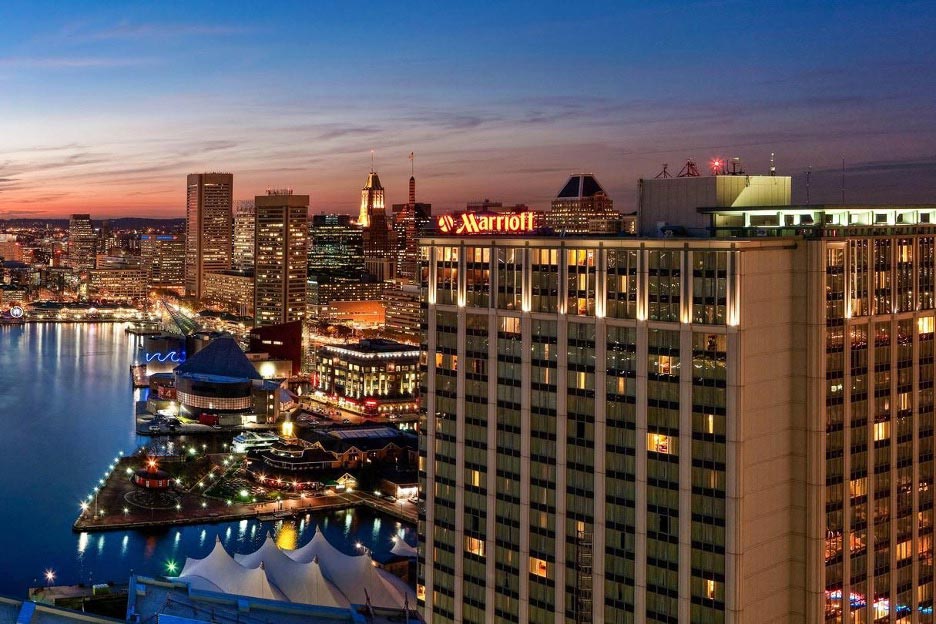
The beautiful host hotel, the Baltimore Marriott Waterfront, is situated on the water, in the Harbor East neighborhood of Baltimore:
Details
The AGM web site provides all of the pertinent information you need to start planning your trip:
“2025 will be a milestone year as we celebrate the 250th anniversary of Jane Austen’s birth, with Baltimore welcoming JASNA back for its first AGM since 1980. We are planning a diverse and unique celebration of her life and literary genius, as well as an opportunity for attendees to connect with the rich history of Maryland and ‘Charm City.’ Attendees must find themselves agreeing that ‘a very strange [Janeite] it must be, who does not see charms in the immediate environs of [Baltimore], to make him wish to know it better.’
“Austen at 250 will be the culminating event focusing on Jane Austen and her work, which she once characterized as “little bit (two inches) of Ivory” but that has endured for centuries. Baltimore will be a salute to her legacy, timelessness, relevance, and enduring genius through an exploration of:
Literary genius
Published and unpublished works
Surviving letters
Innovation in writing technique
Milestones of her life
Education and daily life
Family and friends
“Join your fellow Janeites friends at this once-in-a-lifetime celebration!”
Call for Papers
For those interested in applying to speak at the AGM during one of the breakout sessions, the Call for Papers has been posted. The deadline for submissions is November 30, 2024. Here is a snippet of the Call for Papers:
The AGM theme is: Austen at 250: “No check to my Genius from beginning to end”
“While commemorations of this anniversary will begin in 2024, the 2025 AGM will be the culminating event focusing on Jane Austen and her writing, which she once characterized as the ‘little bit (two inches wide) of ivory on which I work with so fine a brush,’ but which has endured for centuries. The 2024 Cleveland AGM leads off with her origin story and a focus on the literary, political, and cultural influences while the Baltimore conference will conclude with an examination of her life and her novels, juvenilia, and surviving letters.
“Our theme, drawn from Austen’s own words in a letter to her sister Cassandra, highlights her innovation, wit, realism, and irony. Proposals on all aspects of Jane Austen—her life, times, and writing—are welcome. We will focus primarily on the essence of Austen—the milestones of her life, interactions with family and friends, writing development, and the revelations in her letters. Specific areas to explore include, but are not limited to:
Important events in Austen’s life
Places or relationships
Real life reimagined in her fiction
Her writing process and her evolution as a writer
The importance and expression of particular themes
Publication goals and experiences
Psychological aspects
Change or consistency
The nature of genius and evidence of it in Austen’s work
“This multifaceted and unique celebration will offer opportunities to explore Austen’s enduring genius. A successful proposal will convey the speaker’s ability to engage and educate conference audiences in a 30- to 40-minute presentation.”
You can read more about the guidelines and application process HERE.
Meet Me in Baltimore
Every AGM is unique, but we expect that the 2025 AGM will include an incredible lineup of events and speakers. Have you attended an AGM in the past? If so, which one(s)? What is your favorite part of an AGM?
We hope many of our JAW friends will attend next year’s AGM. Vic, Brenda, and Rachel have all attended in past years if you have any questions!
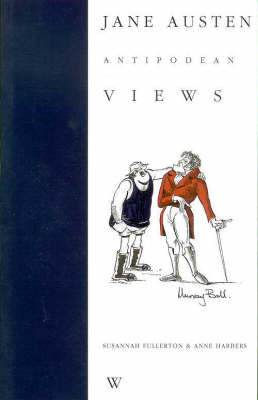
“In 1775, Cassandra Austen gave birth to her second daughter whom she named Jane. The same year Captain James Cook was made a Fellow of the Royal Society, in recognition of his achievements in reaching Botany Bay, claiming New South Wales for the British Government and landing on the islands of New Zealand. Cassandra and George Austen, gazing fondly at their new baby, could never have dreamed that one day their little girl’s name would be familiar and admired in those new British territories on the other side of the world.”—Jane Austen: Antipodean Views, by Susannah Fullerton and Anne Harbers Amazon UK link
Antipodean Views goes on to tell us that Jane Austen certainly knew about Australia. Her brother mentioned Botany Bay in one of his published articles, and her aunt almost got transported there when she was accused of theft. The Exeter Exchange in London had a kangaroo, which Jane’s sister Cassandra probably saw. Austen never mentions Australia in her novels, but many “down under” love Jane today.
Jane Austen: Antipodean Views, by Susannah Fullerton and Anne Harbers, quotes many Australians and New Zealanders telling why they love Jane Austen (or don’t).
When Susannah Fullerton, president of the Jane Austen Society of Australia, invited me to come speak to the JASA in Sydney, I thought, “It’s just too far!” From where I live in the eastern United States, it is quite a distance. Traveling from Atlanta to Sydney takes at least 20 hours, and can be more than 40 hours, depending on stops and layovers. The time change is 14 hours. (So noon on Monday in Atlanta is 2 AM on Tuesday in Sydney.) You cross the international dateline both going and coming back, so you lose a day going, and get it back when you return. So it’s a big commitment to go that far.
I met Susannah at the 2022 AGM in Victoria, Canada, where she gave a wonderful talk on “The Many Duels of Sense and Sensibility,” even after she had traveled halfway around the world. (My favorite part was her discussion of Elinor and Lucy’s verbal duels.) Susannah also leads literary tours, taking groups from Australia (and elsewhere) to England, Europe, and North America. So I thought if she could do all that travel and still talk coherently, I could attempt it as well. I decided to take this wonderful opportunity to see a new part of the world.
Jane Austen enthusiasts down under are part of a network of Janeites stretching around the world. The JASNA (US and Canada) website lists Jane Austen Societies in the U.K., Australia (including groups in Adelaide and Melbourne as well as the main JASA), Argentina, Austria, Brazil, Chile, the Czech Republic, Denmark, India, Italy, Japan, Mexico, the Netherlands, New Zealand, Pakistan, and Spain. That list touches on five of the seven continents. (Any Jane Austen societies in Africa or Antarctica? Or other countries not listed here? Tell us!)
On my recent trip, I got to meet with delightful Jane Austen lovers in both Australia and New Zealand. It was complicated coordinating with all their schedules. But in the end I had opportunities to share my talk, “Why Mr Collins?: The Church and Clergy in Jane Austen’s Novels,” with enthusiastic groups in five cities.
My husband and I started in Melbourne, where Dr. Alida Sewell and her husband kindly hosted us in their home for a week, giving us a chance to start getting over jetlag. Alida edits the bimonthly Newsletter of the Jane Austen Society of Melbourne, which includes book reviews and Austen-related news from around the world. Alida and I got in contact when she reviewed my book, Fashionable Goodness: Christianity in Jane Austen’s England, back in February of 2023, and she also encouraged me to visit.
The Jane Austen Society of Melbourne was founded more than thirty years ago, in 1993. On the day I spoke to the Melbourne group, we had a lovely lunch with the committee members before I got to share with 25 or so participants about Mr. Collins. After a lively discussion, some members took home signed copies of my book.
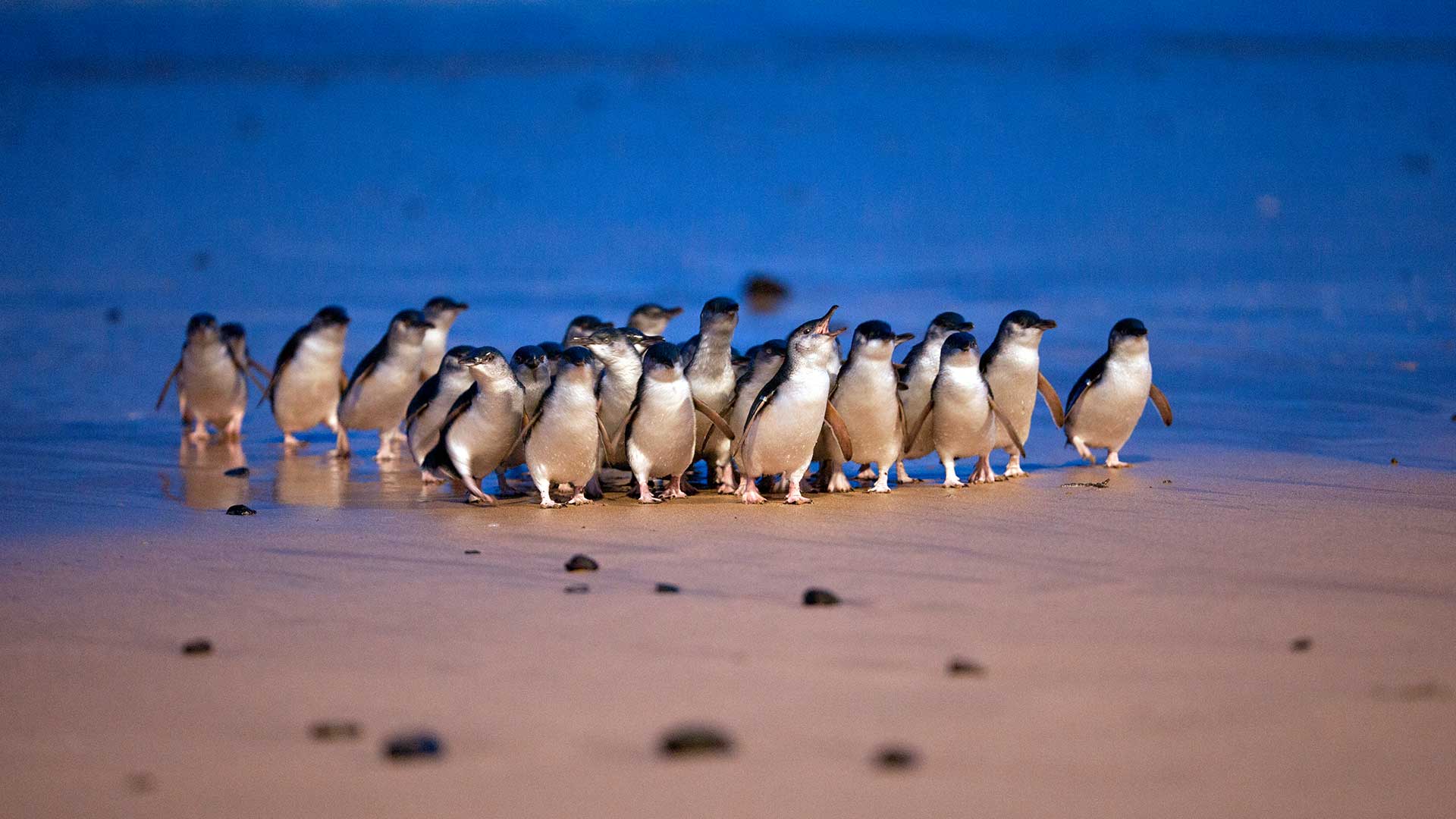
In every place we visited, my husband I went to see some of the unique wildlife of the country. Near Melbourne, we had the delightful experience of seeing hundreds of little penguins, blue and white penguins only 16 inches tall, waddling in from the sea in the evening. Alida also took us to the Moonlit Animal Sanctuary, where we could pet wallabies and kangaroos. We also met gorgeous Australian birds like the pink cockatoo, with its sunset colored crest , and the well-camouflaged tawny frogmouth.
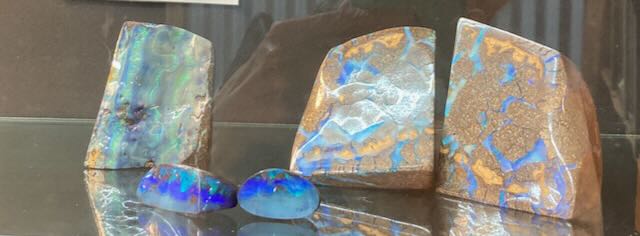
From Melbourne we headed to Brisbane, where Barbara O’Rourke, a member of the local Jane Austen Society committee, generously ferried us around. I got to pet a koala bear at the Lone Pine Koala Sanctuary. We also saw lovely opals, the national gemstone of Australia, at the Brisbane Opal Museum. Australia still produces 95% of the world’s precious opals.
I spoke to around 70 keen Janeites in Brisbane, and got to order extra books for them beyond the ones I had brought to sell (as I also did in Sydney and Wellington later on! I loved their enthusiasm). This is the twenty-second year of the Brisbane group, which has around a hundred members total. A committee of seven people lead them, each of those seven “doing what they do best,” so that all roles are covered.
At meetings the Brisbane branch of the Jane Austen Society of Australia offers a Regency Fair table. I saw a wide range of interesting-looking materials there. Members bring in Austen-related books and magazines they are finished reading. These are offered for sale at a low, nominal price, which goes to benefit the Society. Books may be donated back later, making it similar to a rotating library, but without anyone needing to keep track of loans and returns. Conversations often start up around the table, giving members opportunities to interact. I love this idea: recycling, networking, and giving everyone a chance to learn and enjoy more of Jane Austen!
The next week we visited friends on the “Sunshine Coast” north of Brisbane, enjoying more birds and wildlife, as well as a ginger factory where we learned about the production of ginger and honey.
Travels in Australia: Sydney and Southern Highlands
Finally we made it to Sydney, where the Taronga Zoo gave us a fantastic final look at Australia’s very special animals and birds, ranging from platypus and potoroo to giant emus and bright honeyeaters.
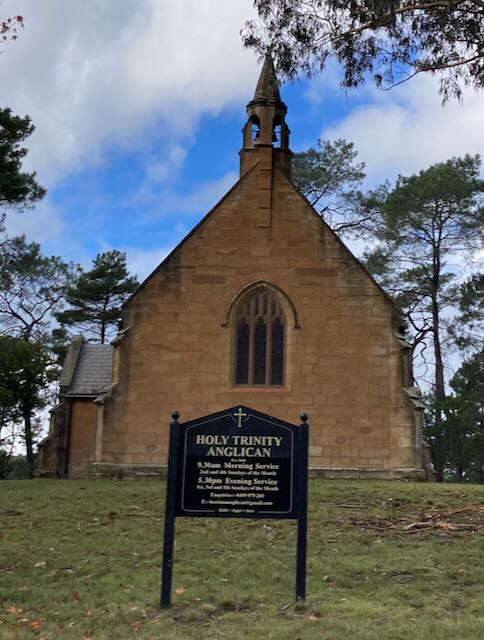
From Sydney, Susannah Fullerton took us out to the Southern Highlands, where we saw a bit of Australia’s frontier culture, then met with another keen group of about twenty Janeites for lunch and my talk.
Jane Austen Society of Australia Day Conference on Jane Austen and the Church
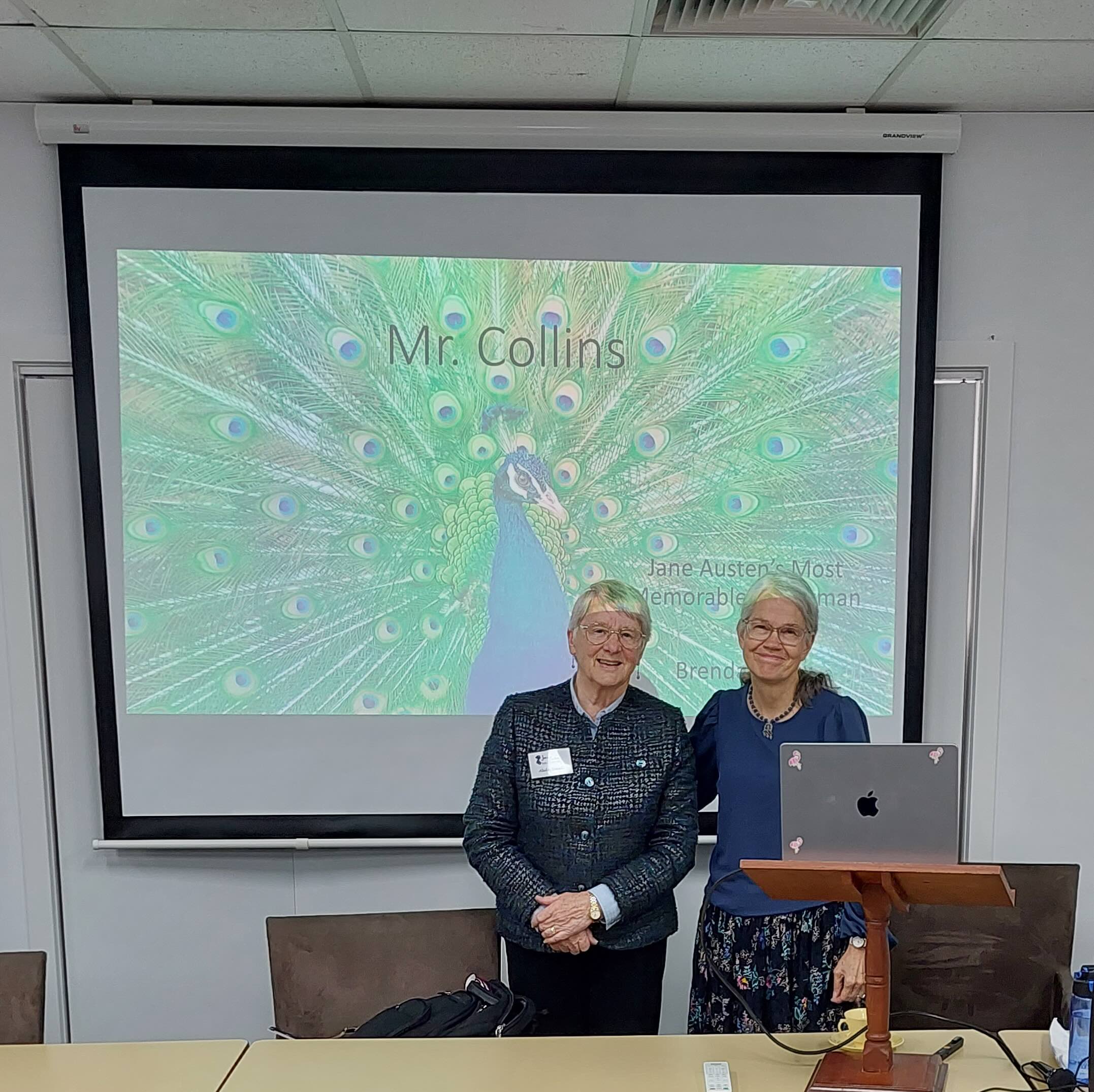
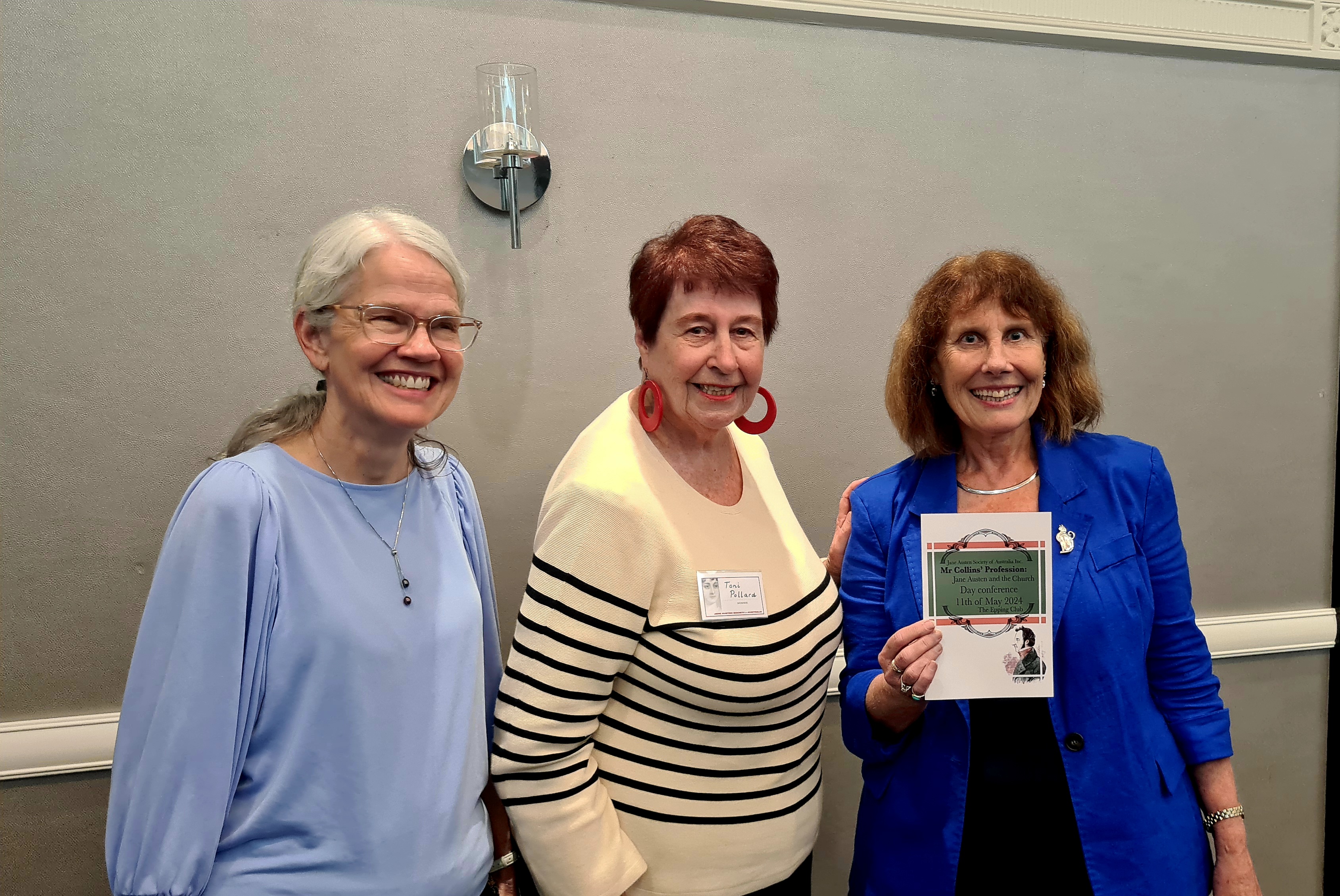
That Saturday the JASA hosted an all-day conference on “Mr. Collins’ Profession: Jane Austen and the Church.” We began with my talk on Mr. Collins, which explores why Austen, a devout Anglican Christian, chose to portray Mr. Collins as she did, and what his life and challenges were as a clergyman at this time. Then we got to hear about other aspects of the church in Austen’s time, from excellent speakers.
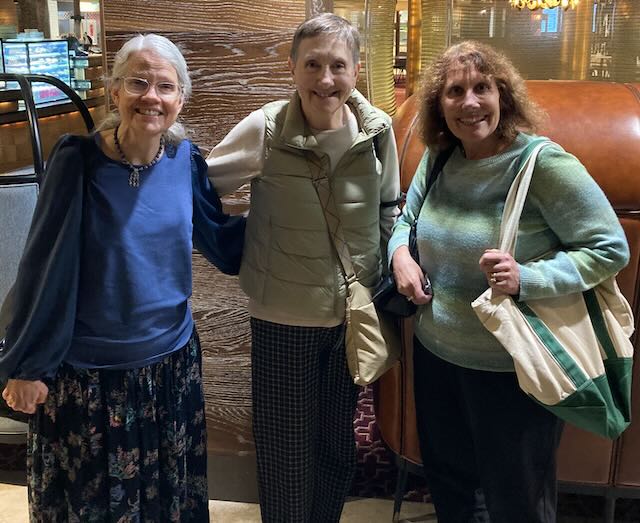
Brenda S. Cox (speaker), Toni Pollard, and Susannah Fullerton (president), holding the conference brochure, at the JASA conference on Jane Austen and the Church, Photo courtesy of JASA
Anne Harbers, writer and art historian, showed us images of clergy from the time, and explained what those images show us. One that fascinated me was Rev. Humphry Gainsborough, the artist Gainsborough’s brother. He was the pastor of an Independent Chapel as well as an engineer and inventor. You may have one of his inventions on your front door—a lock with a chain, that allows the door to be partially opened. Rev. Gainsborough invented that type of lock for the gate of his parsonage in Henley, England.
Roslyn Russell then told us about sermons and devotional literature in Austen’s novels, contrasting her perspective with later authors Anthony Trollope and Barbara Pym. I especially enjoyed meeting Roslyn since I enjoyed her novel, Maria Returns: Barbados to Mansfield Park, which gives Maria Bertram her own happy ending.
We got even deeper with Scott Stephens’ fascinating talk, “‘How could you be so unfeeling?’: Moral Encounter and its Counterfeits in Jane Austen’s Later Fiction.” He talked about moral encounters, and where deep ones occur in Austen’s novels (for example, on the tops of hills, or in letters), and where shallow counterfeits occur (such as in Bath).
I had the privilege of finishing off a great day by giving a brief talk on “‘Her Parish and Her Poultry’: The Lives of Clergymen’s Wives in Austen’s World.” We explored the similarities and differences between the lives of clergymen’s wives and of gentry wives in the English countryside of Austen’s time.
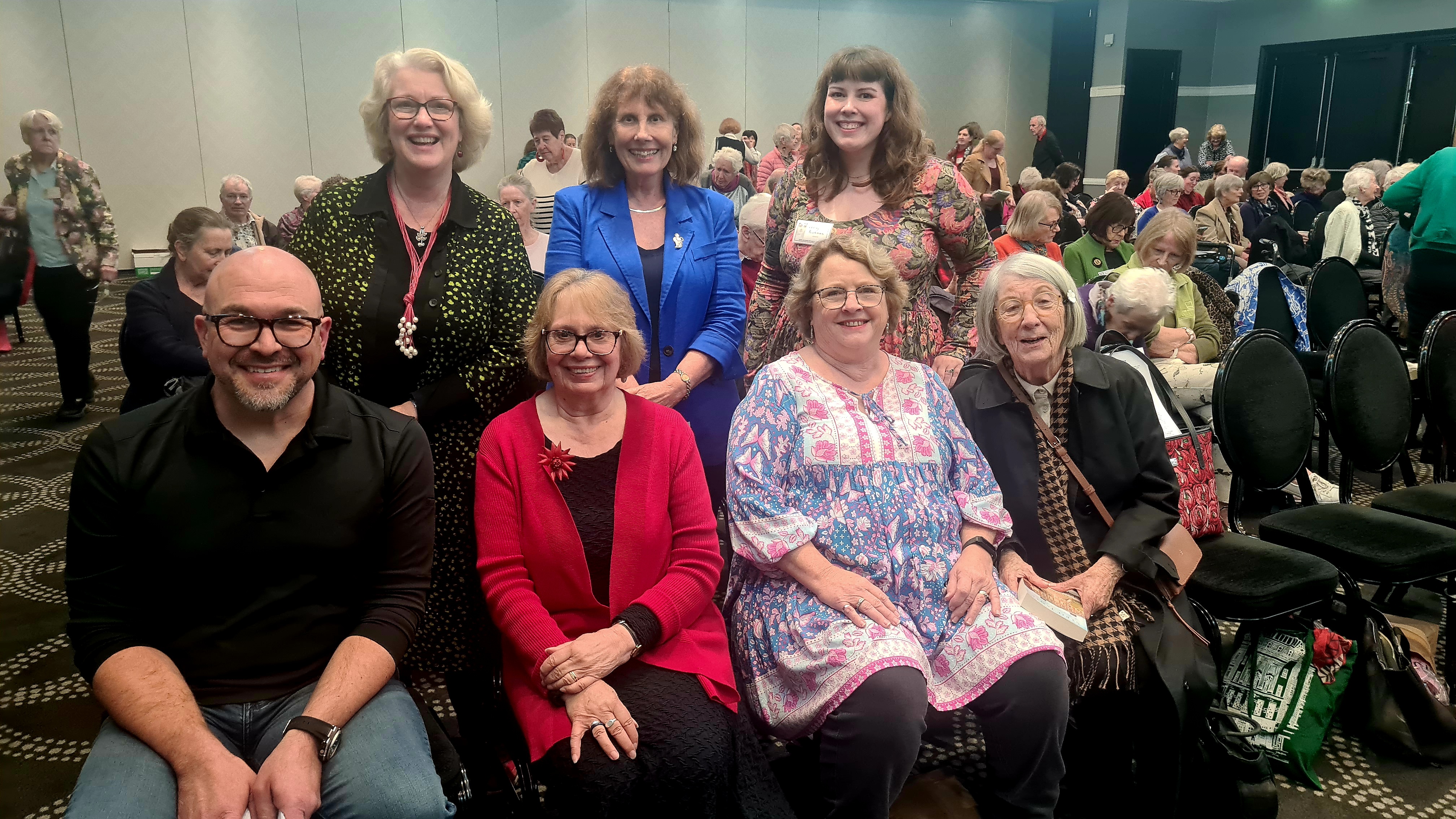
At the JASA Day Conference on Jane Austen and the Church: L-R Back Row: Anne Harbers (speaker), Susannah Fullerton (JASA President), Lesley Rickman (graphic artist who designed the program and other JASA material) Front Row: Scott Stephens (ABC Australia Journalist and speaker), Dr Roslyn Russell (speaker), Cheryl Hill (JASA Membership Secretary & AV operator), Dr Ruth Wilson (JASA Patron and author of The Jane Austen Remedy). Photo courtesy of JASA.
The Jane Austen Society of Australia, founded in 1989, has over 500 members. Its regular meetings (not AGMs) are the largest of any Jane Austen Society in the world, averaging around 130 people per meeting. Participants at the Day Conference came from Sydney (where the meeting was held), Melbourne, Canberra, Queensland, and all over New South Wales.
JASA publishes a yearly Chronicle of news and reports, twice-yearly newsheets called Practicalities, and a yearly journal of scholarly papers called Sensibilities. This year’s Sensibilities will include articles based on the talks at the Day Conference, among others. I look forward to reading them, since there’s so much more I could glean!
On Sunday we got to see a bit of Sydney, worshiping at lovely St. Andrew’s Anglican Cathedral, founded in 1819, soon after Austen’s death. Building on its long history, the church seems to be vibrant and lively today. Placards around the church gave summaries of the Christian message in many languages, for this multicultural city.
After lunch and birdwatching in the park, we visited the Hyde Park Barracks, which originally held transported convicts, then women immigrants. The museum gave us impressions of some of Australia’s tumultuous history, including the tragic impact on Aboriginal communities.
Travels in New Zealand: Wellington and Beyond
The next day we flew to New Zealand, which is not as close as one might imagine! We saw yellow-eyed penguins, a blue whale, and royal albatrosses in Dunedin, a city with a Scottish flavor on New Zealand’s South Island. On the North Island we visited hobbit homes in Hobbiton (definitely a highlight of the trip); saw amazing geothermal formations and baby kiwis in Rotorua, and toured a Maori village; and marveled at a cave full of glowworms in Waitomo.
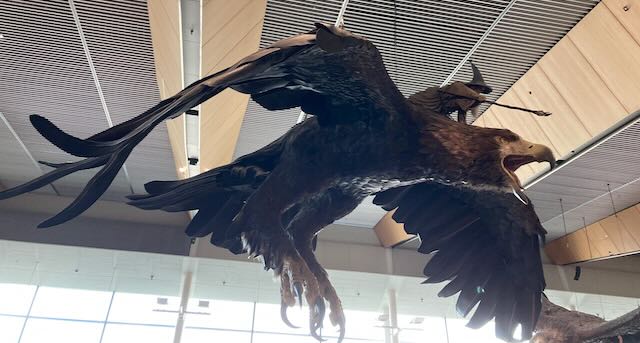
Our Jane Austen encounter was in Wellington, New Zealand. We could see Wellington’s literary and cultural associations immediately. The airport has statues of Gandalf on an eagle, a dragon, and a Doctor Who police box! Frances Duncan, who founded and runs the Jane Austen Society of New Zealand, met us at the airport with Sian Farr, who kindly hosted us in her home and showed us some sights.
In Wellington, an eager group of Janeites met with me to discuss Mr. Collins, Jane Austen, and the church. We had a delicious tea, and afterwards they asked great questions. Frances Duncan started the Jane Austen Society of Aotearoa New Zealand just ten years ago, and it has been growing. About 25 people attended the meeting. I hope it spreads to many corners of the beautiful country of New Zealand, across the mountains and along the sea. Contact Frances through their website if you want to start up a Jane Austen group elsewhere in the country.
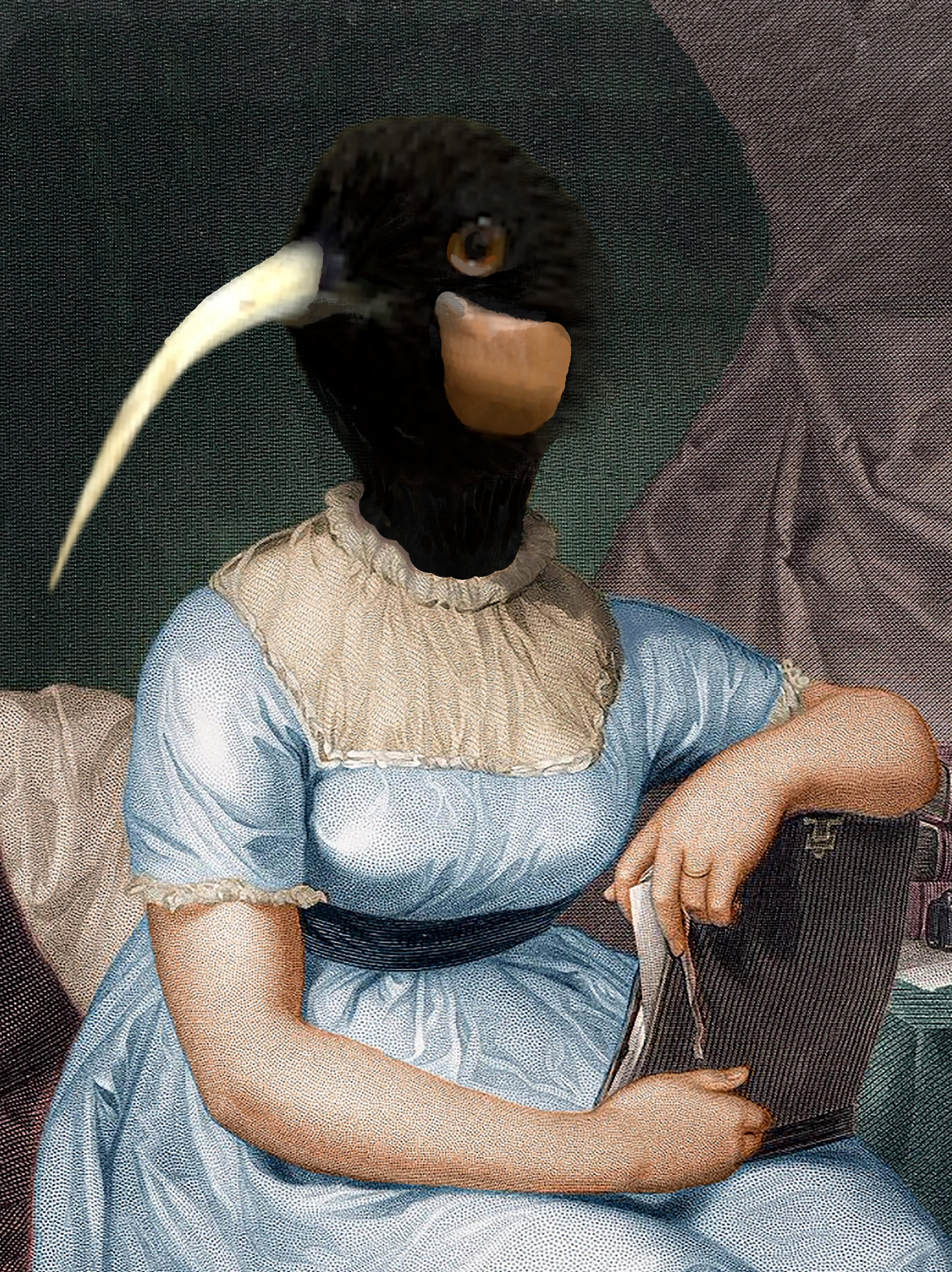
The Jane Austen Society of Aotearoa New Zealand sells humorous merchandise, including this picture of Jane Austen as a huia, a now-extinct New Zealand songbird, described as the bird with the most beautiful song. It was hunted for its feathers, a symbol of leadership and power. They chose it since it is an easily recognizable symbol of New Zealand, and it is extinct—as is Austen. A bit of kiwi humor, says Frances Duncan. Photo courtesy of Frances Duncan
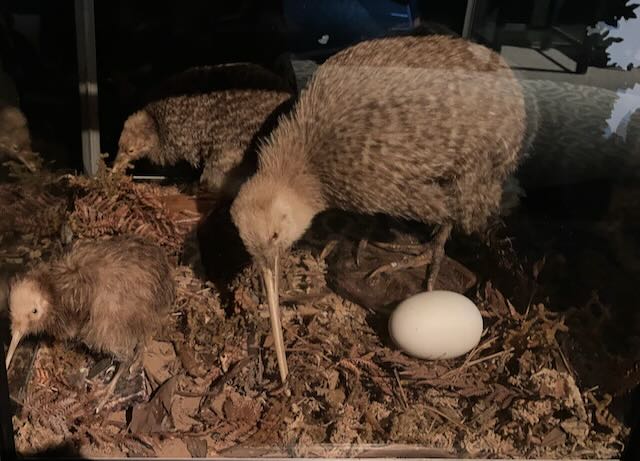
We enjoyed many of the fascinating birds of New Zealand. My favorite place in Wellington was Zealandia. This nature preserve in the city has specially designed fences to keep out the many non-native predators which have decimated the country’s unique native birds. Now kiwi and other birds are thriving in the preserve and surrounding areas.
I was impressed by the extensive environmental efforts in both Australia and New Zealand, and the strides they are making toward preserving their incomparable native creatures.
What would Jane Austen have thought about bird and animal conservation, if she lived today? We don’t know, of course. But she does mention animals in her novels, and, as a country clergyman’s daughter, she essentially lived on a farm. Her brother James wrote a poem praising clergyman Gilbert White, who lived near Chawton. White is considered the father of modern ecology because of his book, The Natural History of Selborne.
So I’d like to think Jane Austen would have enjoyed a journey like ours, enjoying the natural world. And I hope our great discussions of her novels and the church in her world would have met her approval as well! I certainly loved meeting so many wonderful people who love Jane Austen as I do.
One highlight of our trip was visiting Hobbiton in New Zealand. For an account of that visit, and lots of great photos, see JRR Tolkien’s Hobbiton, in New Zealand.
Are you a Janeite living “down under”? Tell us where you live, and how you celebrate Jane Austen! And if you are looking for kindred spirits, contact the JASA to find other regional groups.
As spring turns to summer on our month-by-month exploration of Jane Austen’s life, letters, and novels, we turn our attention to June in Jane Austen’s world. If you’re new to the series, you can find previous articles in this “A Year in Jane Austen’s World” series here: January, February, March, April, and May.
Last month, we enjoyed the beauty of springtime coming to Chawton, along with the beautiful blooms of May. Let’s take a look at our monthly view of Chawton House Gardens. Many visitors will come tour the gardens over the next few months to enjoy the garden walks, see the house, and perhaps stay for tea.
June is the time of year when England turns into a beautiful garden of scenic greenery, lush fields, and lovely flowers. Hampshire is one of the prettiest places you can visit. I’ve been to Hampshire in the spring and early summer several times, and I highly recommend a summer trip if the opportunity ever presents itself. It’s also time for berries!
“Yesterday I had the agreable (sic) surprise of finding several scarlet strawberries quite ripe;- had you been at home, this would have been a pleasure lost. There are more Gooseberries & fewer Currants than I thought at first.- We must buy currants for our Wine.-” (Jane Austen writing to Cassandra from Chawton Cottage in June 1811)
Here is Jane Austen’s House Museum and the roses that frame the front door this time of year:
We have several letters from June to explore. After the “season” ended, many rich families left London and went to the countryside or Bath. Jane and her family frequently traveled to visit family members or friends for longer visits during the summer months.
2 June 1799 (Queen’s Square, Bath):
Edward’s health: “What must I tell you of Edward? Truth or falsehood? I will try the former, and you may choose for yourself another time. He was better yesterday than he had been for two or three days before,—about as well as while he was at Steventon. He drinks at the Hetling Pump, is to bathe to-morrow, and try electricity on Tuesday. He proposed the latter himself to Dr. Fellowes, who made no objection to it, but I fancy we are all unanimous in expecting no advantage from it. At present I have no great notion of our staying here beyond the month.”
Visits with friends: “I spent Friday evening with the Mapletons, and was obliged to submit to being pleased in spite of my inclination. We took a very charming walk from six to eight up Beacon Hill, and across some fields, to the village of Charlecombe, which is sweetly situated in a little green valley, as a village with such a name ought to be. Marianne is sensible and intelligent; and even Jane, considering how fair she is, is not unpleasant. We had a Miss North and a Mr. Gould of our party; the latter walked home with me after tea. He is a very young man, just entered Oxford, wears spectacles, and has heard that ‘Evelina’ was written by Dr. Johnson.”
Outings: “There is to be a grand gala on Tuesday evening in Sydney Gardens, a concert, with illuminations and fireworks. To the latter Elizabeth and I look forward with pleasure, and even the concert will have more than its usual charm for me, as the gardens are large enough for me to get pretty well beyond the reach of its sound. In the morning Lady Willoughby is to present the colors to some corps, or Yeomanry, or other, in the Crescent, and that such festivities may have a proper commencement, we think of going to….”
11 June 1799 (Queen Square, Bath):
Taking the waters: “Edward has been pretty well for this last week, and as the waters have never disagreed with him in any respect, we are inclined to hope that he will derive advantage from them in the end. Everybody encourages us in this expectation, for they all say that the effect of the waters cannot be negative, and many are the instances in which their benefit is felt afterwards more than on the spot.”
Thoughts on “First Impressions”: “I would not let Martha read ‘First Impressions’ again upon any account, and am very glad that I did not leave it in your power. She is very cunning, but I saw through her design; she means to publish it from memory, and one more perusal must enable her to do it.”
Public Domain Image.
15 June 1808 (Godmersham)
Details of their journey: “Which of all my important nothings shall I tell you first? At half after seven yesterday morning Henry saw us into our own carriage, and we drove away from the Bath Hotel; which, by the by, had been found most uncomfortable quarters,—very dirty, very noisy, and very ill-provided. James began his journey by the coach at five. Our first eight miles were hot; Deptford Hill brought to my mind our hot journey into Kent fourteen years ago; but after Blackheath we suffered nothing, and as the day advanced it grew quite cool.
A rest for breakfast: “At Dartford, which we reached within the two hours and three-quarters, we went to the Bull, the same inn at which we breakfasted in that said journey, and on the present occasion had about the same bad butter. At half-past ten we were again off, and, travelling on without any adventure reached Sittingbourne by three. Daniel was watching for us at the door of the George, and I was acknowledged very kindly by Mr. and Mrs. Marshall, to the latter of whom I devoted my conversation, while Mary went out to buy some gloves. A few minutes, of course, did for Sittingbourne; and so off we drove, drove, drove, and by six o’clock were at Godmersham.”
Godmersham Park
25 April 1811 (Sloane St.)
Possible publishing date for Sense and Sensibility: “No, indeed, I am never too busy to think of S. and S. I can no more forget it than a mother can forget her sucking child; and I am much obliged to you for your inquiries. I have had two sheets to correct, but the last only brings us to Willoughby’s first appearance. Mrs. K. regrets in the most flattering manner that she must wait till May, but I have scarcely a hope of its being out in June. Henry does not neglect it; he has hurried the printer, and says he will see him again to-day. It will not stand still during his absence, it will be sent to Eliza.”
6 June 1811 (Chawton)
New set of dishes: “On Monday I had the pleasure of receiving, unpacking, and approving our Wedgwood ware. It all came very safely, and upon the whole is a good match, though I think they might have allowed us rather larger leaves, especially in such a year of fine foliage as this. One is apt to suppose that the woods about Birmingham must be blighted. There was no bill with the goods, but that shall not screen them from being paid. I mean to ask Martha to settle the account. It will be quite in her way, for she is just now sending my mother a breakfast-set from the same place. I hope it will come by the wagon to-morrow; it is certainly what we want, and I long to know what it is like, and as I am sure Martha has great pleasure in making the present, I will not have any regret. We have considerable dealings with the wagons at present: a hamper of port and brandy from Southampton is now in the kitchen.”
Wedgwood Queensware, c. 1790. Image @Christies
13 June 1814 (Chawton)
Thoughts on Mansfield Park from Mr. and Mrs. Cooke: “In addition to their standing claims on me they admire “Mansfield Park” exceedingly. Mr. Cooke says “it is the most sensible novel he ever read,” and the manner in which I treat the clergy delights them very much. Altogether, I must go, and I want you to join me there when your visit in Henrietta St. is over. Put this into your capacious head.”
23 June 1814 (Chawton):
Travels and plans: “I certainly do not wish that Henry should think again of getting me to town. I would rather return straight from Bookham; but if he really does propose it, I cannot say No to what will be so kindly intended. It could be but for a few days, however, as my mother would be quite disappointed by my exceeding the fortnight which I now talk of as the outside—at least, we could not both remain longer away comfortably.”
Friends go to Clifton: “Instead of Bath the Deans Dundases have taken a house at Clifton—Richmond Terrace—and she is as glad of the change as even you and I should be, or almost. She will now be able to go on from Berks and visit them without any fears from heat.”
23 June 1816 (Chawton)
Bits of news: “My dear Anna,—Cassy desires her best thanks for the book. She was quite delighted to see it. I do not know when I have seen her so much struck by anybody’s kindness as on this occasion. Her sensibility seems to be opening to the perception of great actions. These gloves having appeared on the pianoforte ever since you were here on Friday, we imagine they must be yours. Mrs. Digweed returned yesterday through all the afternoon’s rain, and was of course wet through; but in speaking of it she never once said “it was beyond everything,” which I am sure it must have been. Your mamma means to ride to Speen Hill to-morrow to see the Mrs. Hulberts, who are both very indifferent. By all accounts they really are breaking now,—not so stout as the old jackass.”
Rolinda Sharples’ Clifton Assembly Room (1817).
June in Jane Austen’s Novels
Pride and Prejudice
Lady Catherine to Elizabeth: “Oh, your father, of course, may spare you, if your mother can. Daughters are never of so much consequence to a father. And if you will stay another month complete, it will be in my power to take one of you as far as London, for I am going there early in June, for a week; and as Dawson does not object to the barouche-box, there will be very good room for one of you—and, indeed, if the weather should happen to be cool, I should not object to taking you both, as you are neither of you large.”
June at Longbourn after Lydia’s departure: After the first fortnight or three weeks of [Lydia’s] absence, health, good-humour, and cheerfulness began to reappear at Longbourn. Everything wore a happier aspect. The families who had been in town for the winter came back again, and summer finery and summer engagements arose. Mrs. Bennet was restored to her usual querulous serenity; and by the middle of June Kitty was so much recovered as to be able to enter Meryton without tears…
Lydia born in June: “Well,” cried her mother, “it is all very right; who should do it but her own uncle? If he had not had a family of his own, I and my children must have had all his money, you know; and it is the first time we have ever had anything from him except a few presents. Well! I am so happy. In a short time, I shall have a daughter married. Mrs. Wickham! How well it sounds! And she was only sixteen last June. My dear Jane, I am in such a flutter, that I am sure I can’t write; so I will dictate, and you write for me. We will settle with your father about the money afterwards; but the things should be ordered immediately.”
Happy Lydia and Unhappy Mr. Wickham
Mansfield Park
Edmund’s letter to Fanny: “I have sometimes thought of going to London again after Easter, and sometimes resolved on doing nothing till she returns to Mansfield. Even now, she speaks with pleasure of being in Mansfield in June; but June is at a great distance, and I believe I shall write to her. I have nearly determined on explaining myself by letter. To be at an early certainty is a material object. My present state is miserably irksome.”
Emma
Happenings in Highbury: “In this state of schemes, and hopes, and connivance, June opened upon Hartfield. To Highbury in general it brought no material change. The Eltons were still talking of a visit from the Sucklings, and of the use to be made of their barouche-landau; and Jane Fairfax was still at her grandmother’s; and as the return of the Campbells from Ireland was again delayed, and August, instead of Midsummer, fixed for it, she was likely to remain there full two months longer, provided at least she were able to defeat Mrs. Elton’s activity in her service, and save herself from being hurried into a delightful situation against her will.”
An outing delayed: “It was now the middle of June, and the weather fine; and Mrs. Elton was growing impatient to name the day, and settle with Mr. Weston as to pigeon-pies and cold lamb, when a lame carriage-horse threw every thing into sad uncertainty. It might be weeks, it might be only a few days, before the horse were useable; but no preparations could be ventured on, and it was all melancholy stagnation. Mrs. Elton’s resources were inadequate to such an attack.”
Mr. Knightley offers his strawberry fields: “You had better explore to Donwell,” replied Mr. Knightley. “That may be done without horses. Come, and eat my strawberries. They are ripening fast.”
Mr. and Mrs. Elton involved in everyone’s lives.
Persuasion
Elizabeth Elliot born: “Walter Elliot, born March 1, 1760, married, July 15, 1784, Elizabeth, daughter of James Stevenson, Esq. of South Park, in the county of Gloucester, by which lady (who died 1800) he has issue Elizabeth, born June 1, 1785; Anne, born August 9, 1787; a still-born son, November 5, 1789; Mary, born November 20, 1791.”
A June sorrow: “And I am sure,” cried Mary, warmly, “it was a very little to his credit, if he did. Miss Harville only died last June. Such a heart is very little worth having; is it, Lady Russell? I am sure you will agree with me.”
June Dates of Importance
This brings us now to several important June dates that relate to Jane and her family:
Family News:
8 June 1771: Henry Thomas Austen (Jane’s brother) born at Steventon.
23 June 1779: Charles Austen (Jane’s brother) born at Steventon.
18 June 1805: James Austen’s daughter, Caroline, born.
Historic Dates:
18 June 1812: The United States declares war on Great Britain (War of 1812).
18 June 1815: The Duke of Wellington defeats Napoleon at the Battle of Waterloo.
Writing:
3 June 1793: Jane Austen most likely writes the last item of her juvenilia.
June 1799: Austen most likely finishes Susan (Northanger Abbey).
Sorrows:
I’m happy to report that I found no major sorrows for the Austen family in the month of June throughout Austen’s lifetime.
This concludes our June ramble through Jane Austen’s life, letters, and works. There is always something fascinating to explore! Next month, we’ll discover all the important dates and events from July in Jane Austen’s World. Until then, you might join the Jane Austen’s House Museum virtual book club! You can click here for more: https://janeaustens.house/visit/whats-on/.
As spring turns to summer on our month-by-month exploration of Jane Austen’s life, letters, and novels, we turn our attention to May in Jane Austen’s world. If you’re just jumping on the bus, you can find previous articles in this “A Year in Jane Austen’s World” series here: January, February, March, and April.
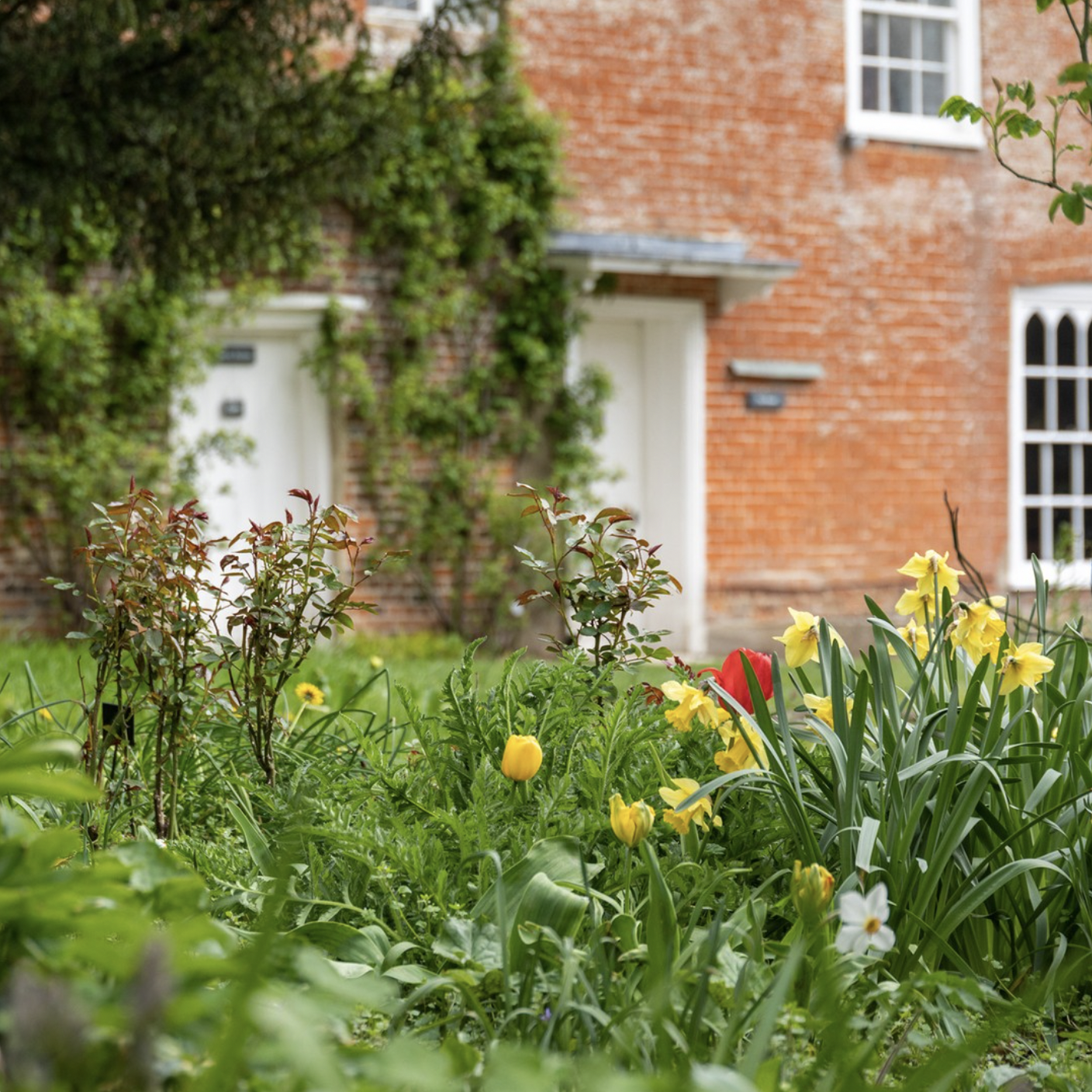
During last month’s April showers in England, we dreamed of May flowers…and the Hampshire countryside certainly is showing some May flower power. First up, our monthly view of Chawton House Gardens. It certainly is bursting with color!
May is the time of year when the sun shines more regularly and everything bursts into bloom. Summer is close at hand, which means the temperatures are starting to warm up a bit, but frequent rain helps keep the gardens cool and watered. Austen had this to say in May 1811 in a letter to Cassandra:
The chickens are all alive and fit for the table, but we save them for something grand. Some of the flower seeds are coming up very well, but your mignonette makes a wretched appearance. Miss Benn has been equally unlucky as to hers. She had seed from four different people, and none of it comes up. Our young piony (sic) at the foot of the fir-tree has just blown and looks very handsome, and the whole of the shrubbery border will soon be very gay with pinks and sweet-williams, in addition to the columbines already in bloom. The syringas, too, are coming out. We are likely to have a great crop of Orleans plums, but not many greengages—on the standard scarcely any, three or four dozen, perhaps, against the wall. (Chawton, Wednesday May 29, 1811)
Here is a glimpse of Jane Austen’s House Museum and its blooms this month.
We have several letters from May to peruse. Interestingly, several are written from Bath. In an interesting article entitled “A Brief History of Jane Austen in Bath” on VisitBath.com, we read this about Jane Austen:
While many assume that Jane’s connection with Bath began when she moved to 4 Sydney Place in 1801 after her father’s retirement, the Austen family’s history with the City actually dates back further. Jane’s parents were married at St Swithin’s Church in 1764, and Jane herself visited in 1797 and 1799, lodging with her mother and sister-in-law at 13 Queen Square in 1799 while her brother took the waters for his health. Before moving into Sydney Place, she also stayed with her aunt and uncle, the Leigh-Perrots, at No.1 The Paragon. These short visits had a lasting impact on the young Jane Austen, inspiring her to write Northanger Abbey about Catherine Morland’s first visit to Bath and her “eager delight” at all it offered. (VisitBath.com)
May 17, 1799 (Queen’s Square):
Jane’s thoughts on the house: “We are exceedingly pleased with the house; the rooms are quite as large as we expected. Mrs. Bromley is a fat woman in mourning, and a little black kitten runs about the staircase. Elizabeth has the apartment within the drawing-room; she wanted my mother to have it, but as there was no bed in the inner one, and the stairs are so much easier of ascent, or my mother so much stronger than in Paragon as not to regard the double flight, it is settled for us to be above, where we have two very nice-sized rooms, with dirty quilts and everything comfortable. I have the outward and larger apartment, as I ought to have; which is quite as large as our bedroom at home, and my mother’s is not materially less. The beds are both as large as any at Steventon, and I have a very nice chest of drawers and a closet full of shelves — so full indeed that there is nothing else in it, and it should therefore be called a cupboard rather than a closet, I suppose.”
Happy and content, despite a delay with her trunk: “I find no difficulty in closing my eyes. I like our situation very much; it is far more cheerful than Paragon, and the prospect from the drawing-room window, at which I now write, is rather picturesque, as it commands a prospective view of the left side of Brock Street, broken by three Lombardy poplars in the garden of the last house in Queen’s Parade.”
The Royal Crescent in Spring (Photo Courtesy of VisitBath.com).
May 1801 (Paragon):
May 5 (their journey): “I have the pleasure of writing from my own room up two pair of stairs, with everything very comfortable about me. Our journey here was perfectly free from accident or event; we changed horses at the end of every stage, and paid at almost every turn-pike. We had charming weather, hardly any dust, and were exceedingly agreeable, as we did not speak above once in three miles. Between Luggershall and Everley we made our grand meal, and then with admiring astonishment perceived in what a magnificent manner our support had been provided for. We could not with the utmost exertion consume above the twentieth part of the beef. The cucumber will, I believe, be a very acceptable present, as my uncle talks of having inquired the price of one lately, when he was told a shilling.
Food prices: “I am not without hopes of tempting Mrs. Lloyd to settle in Bath; meat is only 8d. per pound, butter 12d., and cheese 9 1/2 d. You must carefully conceal from her, however, the exorbitant price of fish: a salmon has been sold at 2s. 9d. per pound the whole fish. The Duchess of York’s removal is expected to make that article more reasonable — and till it really appears so, say nothing about salmon.”
New bonnets: “My mother has ordered a new bonnet, and so have I; both white strip, trimmed with white ribbon. I find my straw bonnet looking very much like other people’s, and quite as smart. Bonnets of cambric muslin on the plan of Lady Bridges’ are a good deal worn, and some of them are very pretty; but I shall defer one of that sort till your arrival.”
The Paragon from Travelpod
May 12 (a ball): “In the evening, I hope you honoured my toilette and ball with a thought; I dressed myself as well as I could, and had all my finery much admired at home. By nine o’clock my uncle, aunt, and I entered the rooms, and linked Miss Winstone on to us. Before tea it was rather a dull affair; but then the before tea did not last long, for there was only one dance, danced by four couple. Think of four couple, surrounded by about an hundred people, dancing in the Upper Rooms at Bath. After tea we cheered up; the breaking up of private parties sent some scores more to the ball, and though it was shockingly and inhumanly thin for this place, there were people enough, I suppose, to have made five or six very pretty Basingstoke assemblies.”
The sale of their belongings: “I thank you for your Sunday’s letter, it is very long and very agreeable. I fancy you know many more particulars of our sale than we do; we have heard the price of nothing but the cows, bacon, hay, hops, tables, and my father’s chest of drawers and study table. Mary is more minute in her account of their own gains than in ours; probably being better informed in them. I will attend to Mrs. Lloyd’s commission and to her abhorrence of musk when I write again.”
Fancy Ball at the Upper Rooms, Bath, Thomas Rowlandson
May 21 – the search for apartments continues: “Our views on G. P. Buildings seem all at an end; the observation of the damps still remaining in the offices of an house which has been only vacated a week, with reports of discontented families and putrid fevers, has given the coup de grace. We have now nothing in view. When you arrive, we will at least have the pleasure of examining some of these putrefying houses again; they are so very desirable in size and situation, that there is some satisfaction in spending ten minutes within them.”
Walking with Mrs. Chamberlayne: “It would have amused you to see our progress. We went up by Sion Hill, and returned across the fields. In climbing a hill Mrs. Chamberlayne is very capital; I could with difficulty keep pace with her, yet would not flinch for the world. On plain ground I was quite her equal. And so we posted away under a fine hot sun, she without any parasol or any shade to her hat, stopping for nothing, and crossing the churchyard at Weston with as much expedition as if we were afraid of being buried alive. After seeing what she is equal to, I cannot help feeling a regard for her. As to agreeableness, she is much like other people.”
On a small party: “We are to have a tiny party here to-night. I hate tiny parties, they force one into constant exertion. Miss Edwards and her father, Mrs. Busby and her nephew, Mr. Maitland, and Mrs. Lillingstone are to be the whole; and I am prevented from setting my black cap at Mr. Maitland by his having a wife and ten children.”
Panorama of Bath from Beechen Cliff, 1824, Harvey Wood
Jane wrote several other “May letters” from Chawton (1811) and Sloane Street (1813):
May 29, 1811 (Chawton):
Springtime storms: “Mrs. Terry, Mary, and Robert, with my aunt Harding and her daughter, came from Dummer for a day and a night,—all very agreeable and very much delighted with the new house and with Chawton in general. We sat upstairs, and had thunder and lightning as usual. I never knew such a spring for thunderstorms as it has been. Thank God! we have had no bad ones here. I thought myself in luck to have my uncomfortable feelings shared by the mistress of the house, as that procured blinds and candles. It had been excessively hot the whole day.”
Improvements: “The chimneys at the Great House are done. Mr. Prowting has opened a gravel-pit, very conveniently for my mother, just at the mouth of the approach to his house; but it looks a little as if he meant to catch all his company. Tolerable gravel.”
May 20, 1813 (Sloane Street):
Travels: “We left Guildford at twenty minutes before twelve (I hope somebody cares for these minutiæ), and were at Esher in about two hours more. I was very much pleased with the country in general. Between Guildford and Ripley I thought it particularly pretty, also about Painshill; and from a Mr. Spicer’s grounds at Esher, which we walked into before dinner, the views were beautiful. I cannot say what we did not see, but I should think there could not be a wood, or a meadow, or palace, or remarkable spot in England that was not spread out before us on one side or other.”
Settling in: “I fancy it was about half-past six when we reached this house,—a twelve hours’ business, and the horses did not appear more than reasonably tired. I was very tired too, and glad to get to bed early, but am quite well to-day. I am very snug in the front drawing-room all to myself, and would not say “thank you” for any company but you. The quietness of it does me good.”
May 24, 1813 (Sloane Street):
On visiting an exhibition and finding the Mrs. Bingley’s (Jane Bennet’s) likeness and looking for Mrs. Darcy’s (Elizabeth Bennet’s) likeness: “…to my great amusement, Henry and I went to the exhibition in Spring Gardens. It is not thought a good collection, but I was very well pleased, particularly (pray tell Fanny) with a small portrait of Mrs. Bingley, excessively like her. I went in hopes of seeing one of her sister, but there was no Mrs. Darcy. Perhaps, however, I may find her in the great exhibition, which we shall go to if we have time. I have no chance of her in the collection of Sir Joshua Reynolds’s paintings, which is now showing in Pall Mall, and which we are also to visit. Mrs. Bingley’s is exactly herself,—size, shaped face, features, and sweetness; there never was a greater likeness. She is dressed in a white gown, with green ornaments, which convinces me of what I had always supposed, that green was a favorite color with her. I dare say Mrs. D. will be in yellow.”
Later that evening, on searching for Mrs. D (Elizabeth Bennet): “We have been both to the exhibition and Sir J. Reynolds’s, and I am disappointed, for there was nothing like Mrs. D. at either. I can only imagine that Mr. D. prizes any picture of her too much to like it should be exposed to the public eye. I can imagine he would have that sort of feeling,—that mixture of love, pride, and delicacy.”
Jane Bennet, Pride and Prejudice (1995).
May in Jane Austen’s Novels
May isn’t mentioned too terribly much in Austen’s novels, but it is a special point of interest and conversation in Emma because of the timing of Frank Churchill’s visit and the timing of the ball:
Emma
Frank’s visit: “Emma heard that Frank wrote in the highest spirits of this arrangement, and seemed most fully to appreciate the blessing of having two months before him of such near neighbourhood to many dear friends—for the house was taken for May and June. She was told that now he wrote with the greatest confidence of being often with them, almost as often as he could even wish.”
Mr. Weston’s joy: “Mr. Weston’s own happiness was indisputable. He was quite delighted. It was the very circumstance he could have wished for. Now, it would be really having Frank in their neighbourhood. What were nine miles to a young man?—An hour’s ride. He would be always coming over.“
A ball: “Mr. Weston’s ball was to be a real thing. A very few to-morrows stood between the young people of Highbury and happiness.”
May is better for everything: “Mr. Woodhouse was resigned. The time of year lightened the evil to him. May was better for every thing than February.”
Evening fire in May: “The whole party walked about, and looked, and praised again; and then, having nothing else to do, formed a sort of half-circle round the fire, to observe in their various modes, till other subjects were started, that, though May, a fire in the evening was still very pleasant.“
Anya Taylor-Joy (left) as “Emma Woodhouse” and Callum Turner (right) as “Frank Churchilll.” (2020). Credit : Focus Features.
May Dates of Importance
This brings us now to several important May dates that relate to Jane and her family:
Family News:
May 1801: Austen family leaves Steventon and settles in Bath. Mrs. Austen and Jane travel via Ibthorpe. James Austen and his family take resident at Steventon rectory.
May 1807: Captain Charles Austen marries Fanny Palmer in Bermuda.
Historic Dates:
18 May 1804: Napoleon crowns himself emperor of France.
Writing:
May 1814: Mansfield Park published anonymously, “By the Author of ‘Sense & Sensibility,’ and ‘Pride & Prejudice.’
Sorrows:
24 May 1817: Jane leaves Chawton and moves with Cassandra to Winchester, for medical treatment.
On this day in 1817, Jane Austen left this house for the final time. She went to stay in Winchester, closer to her doctor, where she died two months later, on 18 July. -Jane Austen’s House Museum
I hope you’re enjoying our journey through each month of the year in Jane Austen’s world. It is a joy to look through this lens into Austen’s life and letters. We’ll continue our exploration and find out what happened in June in next month’s installment, June in Jane Austen’s World!
As we continue our month-by-month journey through Jane Austen’s novels, letters, and lifetime, we find ourselves in the lovely month of April! If you’re just jumping on the bus, you can find previous articles in my “A Year in Jane Austen’s World” series here: January, February, and March.
Let’s see what we find as we explore April in Jane Austen’s World! First up, our monthly view of Chawton House and Gardens, where the tulips are beginning to bloom!
April is when everything starts to come back to life and bloom in Hampshire. The trees boast new leaves, the roads and lanes are lined with green, and flowers and trees are in blossom. The weather ranges from cloudy to partly cloudy to partly sunny to rainy.
Why talk about the flowers and the weather? Because it’s fun to picture some of the details about Hampshire that Austen loved and that we can still enjoy today!
The badness of the weather disconcerted an excellent plan of mine,—that of calling on Miss Beckford again; but from the middle of the day it rained incessantly.
Letter to Cassandra, Sloane St., Thursday (April 18, 1811)
Your lilacs are in leaf, ours are in bloom. The horse-chestnuts are quite out, and the elms almost. I had a pleasant walk in Kensington Gardens on Sunday with Henry, Mr. Smith, and Mr. Tilson; everything was fresh and beautiful.
Letter to Cassandra, Sloane St., Thursday (April 25, 1811)
Here is a glimpse of Jane Austen’s House Museum this month. The garden is looking absolutely lovely already!
We have two letters from April 1811 when Jane was staying with her brother in Sloane Street in London. The following are a few excerpts of special interest:
Her spring shopping purchases: “I am sorry to tell you that I am getting very extravagant, and spending all my money, and, what is worse for you, I have been spending yours too; for in a linendraper’s shop to which I went for checked muslin, and for which I was obliged to give seven shillings a yard, I was tempted by a pretty-coloured muslin, and bought ten yards of it on the chance of your liking it; but, at the same time, if it should not suit you, you must not think yourself at all obliged to take it; it is only 3s. 6d. per yard, and I should not in the least mind keeping the whole. In texture it is just what we prefer, but its resemblance to green crewels, I must own, is not great, for the pattern is a small red spot. And now I believe I have done all my commissions except Wedgwood.”
More walking and shopping: “I liked my walk very much; it was shorter than I had expected, and the weather was delightful. We set off immediately after breakfast, and must have reached Grafton House by half-past 11; but when we entered the shop the whole counter was thronged, and we waited full half an hour before we could be attended to. When we were served, however, I was very well satisfied with my purchases — my bugle trimming at 2s. 4d. and three pair silk stockings for a little less than 12s. a pair.”
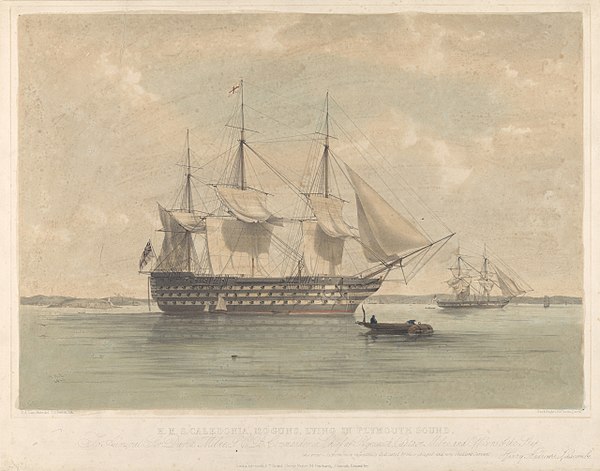
News about their brothers and their careers in the Navy: “Frank is superseded in the ‘Caledonia.’ Henry brought us this news yesterday from Mr. Daysh, and he heard at the same time that Charles may be in England in the course of a month. Sir Edward Pollen succeeds Lord Gambier in his command, and some captain of his succeeds Frank; and I believe the order is already gone out. Henry means to inquire farther to-day. He wrote to Mary on the occasion. This is something to think of. Henry is convinced that he will have the offer of something else, but does not think it will be at all incumbent on him to accept it; and then follows, what will he do? and where will he live?”
The HMS Caledonia was a 120-gun first-rate ship of the line of the Royal Navy, launched on 25 June 1808 at Plymouth. Wikipedia.
Austen’s progress with and thoughts about Sense and Sensibility: “No, indeed, I am never too busy to think of S. and S. I can no more forget it than a mother can forget her sucking child; and I am much obliged to you for your inquiries. I have had two sheets to correct, but the last only brings us to Willoughby’s first appearance. Mrs. K. regrets in the most flattering manner that she must wait till May, but I have scarcely a hope of its being out in June. Henry does not neglect it; he has hurried the printer, and says he will see him again to-day. It will not stand still during his absence, it will be sent to Eliza.”
Plenty of wonderful details about a party hosted by Henry and Eliza: “Including everybody we were sixty-six — which was considerably more than Eliza had expected, and quite enough to fill the back drawing-room and leave a few to be scattered about in the other and in the passage.”
“The music was extremely good. It opened (tell Fanny) with ‘Poike de Parp pirs praise pof Prapela’; and of the other glees I remember, ‘In peace love tunes,’ ‘Rosabelle,’ ‘The Red Cross Knight,’ and ‘Poor Insect.’ Between the songs were lessons on the harp, or harp and pianoforte together; and the harp-player was Wiepart, whose name seems famous, though new to me. There was one female singer, a short Miss Davis, all in blue, bringing up for the public line, whose voice was said to be very fine indeed; and all the performers gave great satisfaction by doing what they were paid for, and giving themselves no airs. No amateur could be persuaded to do anything.”
“The house was not clear till after twelve. If you wish to hear more of it, you must put your questions, but I seem rather to have exhausted than spared the subject.”
The following are a collection of interesting details and scenes that occur in (or refer to) the month of April in Austen’s novels. Springtime appears to be a good time for travel, walking, and riding as the weather slowly improves:
Sense and Sensibility
The Palmers, Mrs. Jennings, and the Dashwood sisters leave London for Cleveland in April (for the Easter holidays): “Very early in April, and tolerably early in the day, the two parties from Hanover Square and Berkeley Street set out from their respective homes, to meet, by appointment, on the road. For the convenience of Charlotte and her child, they were to be more than two days on their journey, and Mr. Palmer, travelling more expeditiously with Colonel Brandon, was to join them at Cleveland soon after their arrival.”
Pride and Prejudice
Darcy proposes again and refers to his first April proposal to Elizabeth Bennet (he surely remembers that date VERY well): “You are too generous to trifle with me. If your feelings are still what they were last April, tell me so at once. My affections and wishes are unchanged; but one word from you will silence me on this subject for ever.”
Mansfield Park
Fanny is left without fitting exercise: “[The Miss Bertrams] took their cheerful rides in the fine mornings of April and May; and Fanny either sat at home the whole day with one aunt, or walked beyond her strength at the instigation of the other: Lady Bertram holding exercise to be as unnecessary for everybody as it was unpleasant to herself; and Mrs. Norris, who was walking all day, thinking everybody ought to walk as much.”
Sir Thomas’s letter home: “[Sir Thomas] wrote in April, and had strong hopes of settling everything to his entire satisfaction, and leaving Antigua before the end of the summer.”
Fanny Price in Portsmouth: “The end of April was coming on; it would soon be almost three months, instead of two, that she had been absent from them all, and that her days had been passing in a state of penance, which she loved them too well to hope they would thoroughly understand; and who could yet say when there might be leisure to think of or fetch her?”
Fanny’s thoughts on springtime in the countryside versus the congested town: “It was sad to Fanny to lose all the pleasures of spring. She had not known before what pleasures she had to lose in passing March and April in a town. She had not known before how much the beginnings and progress of vegetation had delighted her. What animation, both of body and mind, she had derived from watching the advance of that season which cannot, in spite of its capriciousness, be unlovely, and seeing its increasing beauties from the earliest flowers in the warmest divisions of her aunt’s garden, to the opening of leaves of her uncle’s plantations, and the glory of his woods. To be losing such pleasures was no trifle; to be losing them, because she was in the midst of closeness and noise, to have confinement, bad air, bad smells, substituted for liberty, freshness, fragrance, and verdure, was infinitely worse: but even these incitements to regret were feeble, compared with what arose from the conviction of being missed by her best friends, and the longing to be useful to those who were wanting her!
Northanger Abbey
Isabella writes a “very unexpected letter” to Catherine.
Emma
Mrs. Elton pressures Jane to find a position as a governess very soon so that she doesn’t miss her chance: “But, my dear child, the time is drawing near; here is April, and June, or say even July, is very near, with such business to accomplish before us. Your inexperience really amuses me! A situation such as you deserve, and your friends would require for you, is no everyday occurrence, is not obtained at a moment’s notice; indeed, indeed, we must begin inquiring directly.”
For the introverts among us: “John Knightley only was in mute astonishment.—That a man (Mr. Weston) who might have spent his evening quietly at home after a day of business in London, should set off again, and walk half a mile to another man’s house, for the sake of being in mixed company till bed-time, of finishing his day in the efforts of civility and the noise of numbers, was a circumstance to strike him deeply. A man who had been in motion since eight o’clock in the morning, and might now have been still, who had been long talking, and might have been silent, who had been in more than one crowd, and might have been alone!—Such a man, to quit the tranquillity and independence of his own fireside, and on the evening of a cold sleety April day rush out again into the world!“
Mrs. Elton and Jane Fairfax in Emma (1996).
April Dates of Importance
This brings us now to several dates that would have been important to Austen personally and to the Austen family as a whole:
Family News:
26 April 1764: Rev. George Austen marries Cassandra Leigh.
23 April 1774: Francis (Frank) Austen (Jane’s brother) born at Steventon.
April 1786: Francis Austen enters the Royal Naval Academy at Portsmouth
15 April 1793: James Austen’s first child, Anna, is born.
Historic Dates:
19 April 1775: The Battle of Lexington marks the start of America’s Revolutionary War.
Writing:
April 1811: Austen continues to correct proofs of Sense and Sensibility. She anticipates its publication date.
Sorrows:
22 April 1813: Eliza de Feuillide (Austen’s cousin and, later, sister-in-law) ill. Jane Austen goes to her bedside in London to help attend to her.
25 April 1813: Eliza de Feuillide dies.
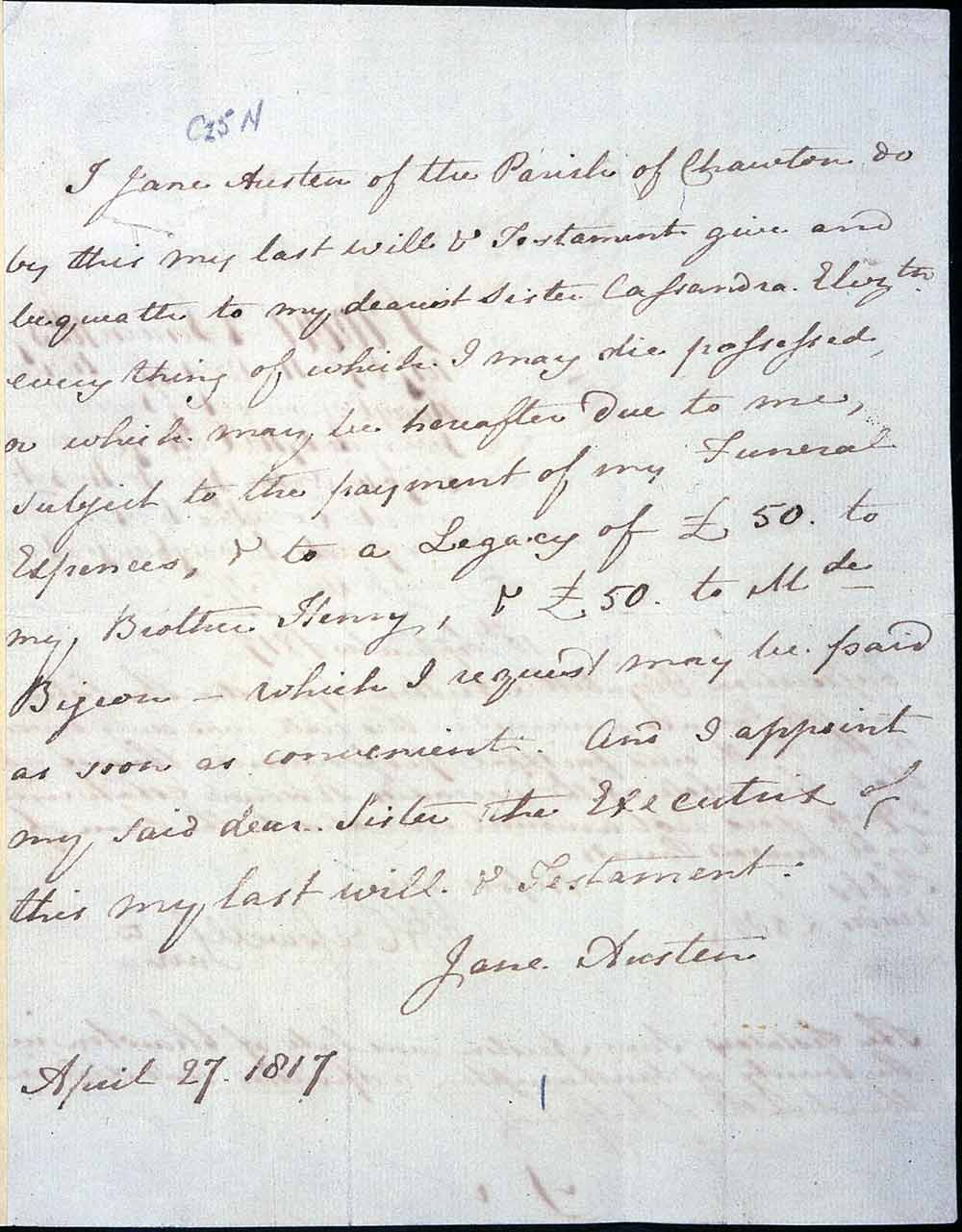
27 April 1817: Austen drafts her will:
“I Jane Austen of the Parish of Chawton do by this my last Will & Testament give and bequeath to my dearest Sister Cassandra Elizth everything of which I may die possessed, or which may be hereafter due to me, subject to the payment of my Funeral Expences, & to a Legacy of £50. to my Brother Henry, & £50. to Mde Bigeon–which I request may be paid as soon as convenient. And I appoint my said dear Sister the Executrix of this my last Will & Testament.”
As we continue through the year, one of the highlights for me has been surveying the photos of the gardens at Chawton House and Jane Austen’s House each month and seeing the changes therein. I hope these April showers will bring many beautiful May flowers next month as we continue our tour of Hampshire in the spring with May in Jane Austen’s World!
Fashionable Goodness: Christianity in Jane Austen's England is now available! By JAW contributor Brenda S. Cox. See Review. Available from Amazon and Jane Austen Books.
Available through December 31st, 2025. Click on image for details, and share this poster with other teachers and students!
The Obituary of Charlotte Collins by Andrew Capes
Click on image to read the story.
Comments
“My idea of good company…is the company of clever, well-informed people, who have a great deal of conversation.” – Jane Austen, Persuasion
Gentle readers: Please feel free to post your comments and continue the conversation! Due to SPAM, we will no longer accept comments on posts after 30 days of publication. In some instances, links will be removed from comments as well.
Administrators and Contributors
Vic Sanborn, founder of this blog, is supported by a team of talented and knowledgeable writers about Jane Austen and the Regency era. They are:
Tony Grant, who now contributes his photos from London and England
Click on their names to enter their own blogs.
In addition, we thank the many experts and authors who frequently contribute their posts and opinions, and who continue to do so freely or at our request.
Click here to enter the page. Topics include Regency fashion, historic foods, Jane Austen societies, British sites, related topics. Click on image.
May we suggest?
Hello, my name is Vic and I live in Maryland, USA. I have adored Jane Austen almost all of my life. I am a proud lifetime member of the Jane Austen Society of North America. This blog is a personal blog written and edited by me and my team. We do not accept any form of cash advertising, sponsorship, or paid topic insertions. However, we do accept and keep books and CDs to review.
If you would like to share a new site, or point out an error, please email us. (Yes, we are fallible. We'll own up to our mistakes and will make the corrections with a polite smile on our faces.) Write us at
Thank you for visiting this blog. Your comments and suggestions are most welcome.
Project Gutenberg: eBook of Stage-coach and Mail in Days of Yore, Volume 2 (of 2), by Charles G. Harper
STAGE-COACH AND MAIL IN DAYS OF YORE: A PICTURESQUE HISTORY
OF THE COACHING AGE, VOL. II, By CHARLES G. HARPER. 1903. Click on this link.













 Jane Austen's World