Feeds:
Posts
Comments

Archive for the ‘Biography’ Category

Interviewed by Brenda S. Cox

“As soon as he can light upon a bishop, he will be ordained. I wonder what curacy he will get!”–Anne Steele, about Edward Ferrars in Sense and Sensibility.

A few days ago, I told you about a fascinating new book on Henry Austen. The author is a retired Church of England bishop, living in Farnham, where Henry Austen served as perpetual curate of the parish church. (A perpetual curate was a curate, substituting for the rector or vicar holding the living of that church. “Perpetual” meant that he could not be fired; he could keep his job for life, just as a rector or vicar did. However, his salary was still only a portion of the tithes that supported the main, absentee clergyman.)

I asked the Right Reverend Dr. Christopher Herbert, who is now a Visiting Professor of Christian Ethics at Surrey University, about his journey in writing this book.

Jane Austen’s Favourite Brother, Henry, was written by an Anglican bishop, Christopher Herbert

Jane Austen’s World: Rev. Herbert, what led you to write Jane Austen’s Favourite Brother, Henry?  How did you get interested in Henry Austen?

Rev. Herbert: In retirement I live in Farnham, Surrey, only a few miles from Chawton. I am the Patron of the Farnham Castle Trust; Farnham Castle was once one of the major homes/palaces of the Bishops of Winchester. At a Trustees’ meeting, discussing how to attract more visitors to the Castle and Farnham, I wondered if there might be some connection with Chawton and Jane Austen. The other Trustees did not know of any, but a friend pointed out an article in the Farnham Herald mentioning a man called Henry Austen christening a baby in the parish church of St Andrew’s. [JAW: This story opens Herbert’s book.]

I followed this up, checking the Parish Registers at the Surrey History Centre, and found many signatures in Henry’s hand—and of course, he was Jane’s brother. I was fascinated. Who was he? How did he become a Perpetual Curate in Farnham? What was his story?

At that point, all that I had were his dates of birth and death, and a few insights from Wikipedia. I had no intention of writing a book about him, but the more I researched his life, the more intriguing Henry became. By the way, my book’s publication in the 250th Anniversary Year was pure chance. I had no idea that was coming up when I raised my initial question!

JAW: How long did it take you to research and write the book?  What were some of the most interesting sources you found?

I took well over two years to research and write the book. That might seem a short period of time. However, in my earlier work as a diocesan bishop, with over 400 churches in my diocese, plus membership of the House of Lords and other national and international responsibilities, I was accustomed to working very rapidly to fulfil all my duties. I also read for [pursued/studied for] an MPhil [Master of Philosophy] and a PhD in Medieval Art History at the University of Leicester whilst I was a bishop, and again, had been able to read and digest and write rapidly. So, I had some of the requisite research skills, and I loved the research process—that joy of discovering new and unexpected jewels.

My most useful primary sources were obtained from the Hampshire County Record Office where I was able to trawl through a great deal of original material, plus similar material such as the Parish Registers of St Andrew’s, Farnham, at the Surrey History Centre.

For secondary sources, I read biographies of Jane Austen by people such as Claire Tomalin, and David Cecil, and accessed the huge online resources of JASNA, etc. I was helped greatly by the staff at Jane Austen’s House, Chawton, and, of course, re-read all of Jane’s novels, plus the utterly invaluable edited version of Jane’s letters by Deirdre Le Faye and invaluable and scholarly papers by people such as yourself [Brenda Cox], John Avery Jones, et al.

Of course, as is often and frustratingly the case, after my book had been published, I came across some more primary material at Winchester College. The researcher’s life, as you know, is littered with ‘if onlys’. [I encouraged him to find a place online to publish his further research.]

Amongst the most interesting material were the Parish Registers of Bentley and Farnham. Those gave me enlightening insights about the lives of Henry and his parishioners.

JAW: What did you learn about Henry that interested you the most?

Apart from my obvious personal affinity with Henry as a clergyman, it was his time as a dealer in Army Commissions, a Banker, and a Tax Collector which I loved researching. I am not an economic historian and so my research in this area was very challenging. I would need to re-train in economic history to begin to fully understand every detail. This was the most difficult part to write, trying to get my head around the economic and financial landscape within which Henry worked.

Beneath all the top-layer elements of his life, I enjoyed delving beneath the wealthy surface and speculating on Henry’s motivations and methods of work. Walking the streets of London and investigating where he lived during this phase of his life was hugely enjoyable.

Following Henry through his banking downfall and his approach to his bishop to discuss the possibility of ordination required a great deal of ‘inner work’ on my part  to comprehend how and why that happened. I have interviewed hundreds of ordinands in my life. It was fascinating trying to get into the mindset of Henry’s bishop, Bishop Brownlow North, who lived in very different times to my own. Like Henry, Bishop North worked with different cultural assumptions than ours. It is such a challenge to try to stretch one’s sympathetic imagination into another era.

By contrast, and bathetically*, it was the fact of Henry having almost 1,000 bottles of wine in his cellars which sticks in my mind!
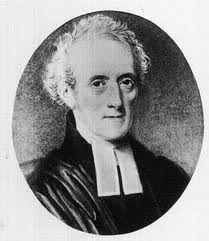
Henry Austen as a Clergyman later in life. Public domain via wikimedia.

JAW: What was something interesting you learned about Jane Austen herself in writing the book?

Oddly, it was spending time exploring Steventon and realising how isolated the Rectory and the village were in the late 18th and early 19th centuries. I had, of course, been to Jane Austen’s House in Chawton a number of times, but in my mind’s eye I had imagined Steventon as a quintessential English Village: village green, church, a few farmsteads, a pub, and even, perhaps, a game of cricket. That idea was completely shattered when I visited Steventon. The cultural life inside the Rectory must have been a great contrast to the isolated, scattered cottages of the poor inhabitants of the village. 

My understanding of the life of Cassandra Austen (Leigh) [Jane’s mother] grew as I thought of her coping with her own children plus the students boarding with them—all that food, oversight of the washing of bedding and getting it dry, all that hullabaloo inside the house during term-time. When did she have a moment to herself?  I began to wonder, as Jane watched her mother, how much Jane recognised the sheer logistical task her mother undertook to keep the ship happy, afloat and moving in the right direction.

This was the most fun part of the book to write, showing the inside of Steventon Rectory with all the liveliness and learning of Jane, Henry, and their siblings.

And, of course, Jane’s letters are an absolute delight. If only there were more…if only…

JAW: If you were able to meet Henry Austen personally, what do you think you would like about him? What would you want to ask him? What parts of his character might you find difficult or less pleasant?

I would enjoy his sense of humour, his generosity towards, and affection for, Jane, and his affection for Liza [his wife Eliza] and her son, Hastings. Not being a risk taker myself, I would love to hear about his own understanding of the nature of financial risk and entrepreneurship. When did he see the storm clouds brewing? Was ordination always at the back of his mind? Was it a kind of attempt to ‘give back’ to society, having enjoyed and then lost the fruits of worldly success?

I would find his undoubted attraction to the aristocratic level of society difficult, but I fully recognise that it was the 18th/early 19th century way. And when he was Perpetual Curate, I suspect I would have found his lack of awareness of the Farnham Workhouse very difficult. However, in fairness, I must add that it might simply be lack of evidence which leads me to suppose that he was not at his best with the poor and impoverished. So much information has been lost. I could be entirely wrong. 

JAW: Why do you think he was Jane’s favourite Brother?

I will say the idea for the title of the book was not mine, it was my publisher’s, but I am entirely happy with it. Why was Henry Jane’s favourite? He was obviously very close to her and looked to her for help whenever he hit a difficult or tragic patch in his life. They shared the same sense of humour, the same love of the quirks of society, the same interest in humanity. And it was Henry who went out of his way to ensure that her books were published. Besides, who but a favourite brother would actually volunteer to read Proofs!?

JAW: What would you like to tell potential readers about your book?

I hope that if they love Jane Austen, my book will reveal some lesser-known aspects of Regency society which might enhance their understanding of Jane and her novels. In brief, context really matters. But, most importantly of all, if my book leads to people reading or re-reading Jane, my hopes will have been more than fulfilled.

JAW: Thanks very much, Christopher! I loved Jane Austen’s Favourite Brother, Henry, and I think our readers will also.

Jane Austen’s Favourite Brother, Henry, by Christopher Herbert, is now available from the publisher, Pen & Sword, and from Amazon in the US and in the UK in hardcover. The Kindle version will be released September 30, 2025.

You can find out more about Dr. Herbert at https://en.wikipedia.org/wiki/Christopher_Herbert and https://www.chpublishing.co.uk/authors/christopher-herbert Since those lists of accomplishments, he has also been involved in the Royal Hospital for Neurodisability in London and the Lyme Resource Centre, a charity based in Scotland raising awareness of the growing incidence of Lyme disease and co-infections in Scotland and elsewhere in the UK.

*I looked up bathetic. It means “producing an unintentional effect of anticlimax.” Nice word!

Brenda S. Cox is the author of Fashionable Goodness: Christianity in Jane Austen’s England. She also blogs at Faith, Science, Joy, and Jane Austen.

Read Full Post »

Book Review by Brenda S. Cox

“I had a letter from him [Henry], in which he desired to hear from me very soon—His to me was most affectionate and kind, as well as entertaining;—but there is no merit in that, he cannot help being amusing.”—Jane to Cassandra, April 8, 1805

“Henry at White’s! Oh, what a Henry!”—Jane to Cassandra, June 23, 1814 (when Henry attended an exclusive high class gathering celebrating Napoleon’s defeat)

Jane Austen’s Favourite Brother, Henry, by Christopher Herbert, gives an in-depth view of Henry Austen’s life, beliefs, and connections with Jane and her novels.

What a Henry

Henry Austen was apparently a lot of fun, and Jane loved her brother dearly. He was also quite versatile. At various times he was:

  • an Oxford student who produced a periodical called The Loiterer with his brother James,
  • paymaster and adjutant in the Oxford Militia,
  • army agent,
  • banker (of a bank that eventually failed),
  • receiver general of taxes,
  • Jane Austen’s own literary agent,
  • clergyman of several parishes,
  • chaplain of the British Embassy in Berlin, and
  • husband of Eliza de Feuillide and later of Eleanor Jackson (niece of Rev. Papillon of Chawton).

Christopher Herbert, in his fascinating new book, Jane Austen’s Favourite Brother, Henry, explores Henry Austen’s life through all these changes.

Culture and Current Events

I loved that Herbert gives lots of cultural details in going through Henry’s life. For example, in the chapter on Henry’s birth, we learn about childbirth practices at the time. During pregnancy, his mother Cassandra Austen, rather than buying special maternity clothes as we do today, would have widened her stomacher, used aprons to cover gaps in clothing, and loosened side lacings. A “churching” service would celebrate her survival of the very dangerous process of giving birth. Philadelphia Hancock, her sister-in-law, may have been there to help the mother before, during, and after the delivery.

The author speculates on what the children growing up in the the rectory may have read, who taught them to read and write, and where they obtained their books.

Current events and ideas are woven in alongside stories of Henry and Jane growing up. The balloon ascent of 1784 is described by quoting a magazine article of the time. We hear about battles, steam power, improvements and enclosures, and the Wesleyan revival which began at Oxford. We see how the ideas of contemporary writers such as John Locke, focusing on reason in understanding God and society, may have affected Jane Austen’s ideas of church and clergy in Mansfield Park, as well as her prayers.

Henry Austen as a Clergyman later in his life. Public domain via wikimedia.

Work and Money

An in-depth discussion explains Henry’s various jobs and what they involved. We see how his bank throve, launching Henry into upper ranks of society, and then failed. The author obviously did quite extensive research to dig this all up, and it was interesting to learn, for example, what exactly an army agent was. (For me, there was a little too much detail, since I’m not interested in finance; however, other readers may find this the most illuminating part!) It seems Henry had some financial dealings which were at least ill-advised, and possibly questionable.

Henry as Clergyman

After his bank failed, Henry reverted to earlier plans and was ordained as a clergyman. In Henry’s one extant sermon, he attacks pride and prejudices. Herbert says Henry is encouraging his congregation toward giving Catholics political rights, a major issue of that time. (See also “Sermons by Jane Austen’s Family.”) Herbert explores what Henry may have believed, also drawing from statements in Mansfield Park.

He also points out that Henry’s pastoral workload was much greater than that of Mr. Elton or other Austen clergymen. In one year, Henry performed 149 christenings, 34 weddings, and 105 funerals! All for very little income. He also had to deal with a new workhouse and other issues related to the poor of his parishes. Henry’s journey as a clergyman, his income and how he spent it, are further explored, as well as his anti-slavery work.

Jane Austen’s Novels

The author skillfully connects concepts to passages in Austen’s novels.  He also explains Henry’s role in getting her novels published. He concludes that there are still some questions about Henry’s life. But we do know that:

“without Henry’s determined and passionate commitment in getting Jane’s novels published, our lives, and the life of the world, would be so much the poorer.”

Amen!

On Thursday I will post an interview with the author, who is uniquely qualified to write this book. He is a former bishop of the Church of England, now living in Farnham where Henry Austen served as perpetual curate in the parish church. Farnham Palace, where the Right Revd. Dr. Herbert is a patron, was a home of the Bishops of Winchester.

I recommend this book to anyone who wants to learn more about Austen’s family and her world.

Jane Austen’s Favourite Brother, Henry, by Christopher Herbert, is now available from the publisher, Pen & Sword, and from Amazon in the US and in the UK in hardcover. The Kindle version will be released September 30, 2025.

Brenda S. Cox is the author of Fashionable Goodness: Christianity in Jane Austen’s England. She also blogs at Faith, Science, Joy, and Jane Austen.
Read Full Post »

A Book Review by Brenda S. Cox

“Marianne’s ‘excess of sensibility’ almost destroys her reputation, her health and her happiness, wihle Elinor’s more guarded behaviour is rewarded. But that is fiction; what of real life?”—Prologue to Jane and Dorothy, by Marian Veevers

Jane and Dorothy: A True Tale of Sense and Sensibility, The Lives of Jane Austen and Dorothy Wordsworth, by Marian Veevers. The lovely cover attracted my attention as I perused a library book table focused on Jane Austen.

I had read a review of this book some time ago and suggested it to a literary friend, who said there was no connection between Jane Austen and Dorothy Wordsworth, sister of poet William Wordsworth. But I decided to check out the book and find out how the author connects them. I’m glad I did, as it was a fascinating read.

Jane and Dorothy, by Marian Veevers, explores two parallel lives, Jane Austen’s and Dorothy Wordsworth’s. Veevers works for the Wordsworth Trust.

Jane Austen and Dorothy Wordsworth

Jane and Dorothy follows the lives of two women, living at approximately the same time, who never met. Parallel, never intersecting, similar in some ways and contrasting in others. Connections with Austen’s novels are intertwined in their stories. Jane (1775-1817) is compared to Elinor Dashwood, with strong feelings controlled by reason and religion. Dorothy (1771-1855) is more like Marianne, focusing on her emotions. In one teenage letter to a friend who was sympathizing with her misery, Dorothy wrote, “You cannot think how I like the idea of being called poor Dorothy . . . I could cry whenever I think of it.”

Both were writers. Jane Austen, of course, had four novels published during her lifetime, two more shortly after her death, and her Juvenilia and letters published years later.

Dorothy Wordsworth wrote journals, mostly about her ramblings in nature with her brother, who became a famous poet of Romanticism.  William Wordsworth used his sister’s journals as inspiration and a source of details for his poetry. His discussions and experiences with her also inspired him. A few of Dorothy’s own poems were published during her lifetime, but her journals and her travel narrative of a trip to Scotland were only published after her death.

Both Jane and Dorothy were dependent on their brothers later in their lives. Austen and her mother and sister were financially supported by her brothers after her father’s death, and her brother Edward provided Chawton Cottage where she wrote and rewrote her novels.

Dorothy lost her parents early in life and lived with various relatives as a poor relation, similar to Austen’s Fanny Price, until she threw in her lot with her brother William. Dorothy loved William passionately. (The author discusses rumors of sexual involvement and concludes that the rumors were false.) Dorothy devoted the rest of her life to her brother and, eventually, to his wife and children. Their financial situation was much harder than the Austens’, but they survived.

It was interesting to see the similar social and financial restrictions that society placed on both Jane and Dorothy, particularly as unmarried women, and to see how Jane’s life might have played out differently in other circumstances.

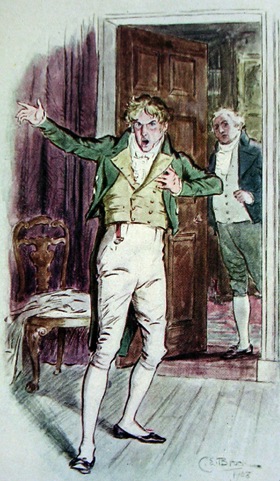
Yates ranting in Mansfield Park. Did Austen love home theatricals, or hate them? Or did she simply see their dangers?
C.E. Brock, public domain.

Austen and Drama

Having read so much about Jane Austen, I wasn’t expecting new insights into her life from this book. However, I found several. I’ll give just one example, from pages 47-50 of Jane and Dorothy.

Veevers discusses Austen’s attitude toward amateur home theatricals in Mansfield Park. Many have commented on the fact that Austen’s family performed such plays when she was growing up, and that she couldn’t really have thought they were wrong. Perhaps it was just the specific circumstances at Mansfield Park that made it wrong, or her attitude had changed due to the growing Evangelical disapproval of drama, or she was attributing disapproval to Fanny and Edmund.

However, Veevers speculates that, first, Jane may not have participated herself in those plays when she was growing up. She says the only evidence we have for that is Jane’s cousin, Phylly Walters, who wrote that “all the young folks” were participating in a performance in 1787—that is rather vague. Or Jane may have participated without enjoying it.

While Austen’s family approved of amateur theatricals, we don’t have to assume that she herself agreed. Instead, those experiences of plays in the Steventon barn may have shown Jane “the dark underbelly” of such practices. Veevers says any “modern-day member of an amateur dramatics company” would recognize these issues. She continues,

“Jane Austen gives an unflinching insider’s view of everything that is worst about amateur acting, from the concealed, but overwhelming self-interest of Julia and Maria Bertram who each hope to have the best part in the play ‘pressed on her by the rest,’ to the self-indulgent over-rehearsal of favourite scenes by some actors, and the insidious, self-gratifying criticisms of others’ performances—‘Mr Yates was in general thought to rant dreadfully . . . Mr Yates was disappointed in Henry Crawford . . .’” etc., etc. “There can be no doubt that this detailed understanding . . . came from real observation. It would seem that brother James’s annual productions in the Steventon barn were riven by jealousy, bad-feeling and unkindness.”—Jane and Dorothy, p. 49

Veevers goes on to speculate that Jane’s opinions may have been influenced by her dear friend Anne Lefroy. Mrs. Lefroy was a clergyman’s wife who apparently disapproved of amateur theatricals, politely declining to participate when a friend invited her. (Also, I would add, it appears those Steventon theatricals were an opportunity for flirtation between Jane’s still-married cousin Eliza and two of her brothers, so perhaps Henry Crawford and Maria Bertram’s fictitious flirtation also had a basis in past experience.)

I don’t think I personally agree with the idea that Austen disapproved of such theatricals, though. Austen certainly enjoyed the professional theatre, “good hardened real acting,” as Edmund Bertram called it, distinguishing that from amateur performances. Austen did, though, write several short, comic plays as a teenager, which may have been acted by her family. On a visit to Godmersham, she and Cassandra acted—most likely by reading aloud— a couple of plays with their nieces and nephews. (The Spoilt Child and Innocence Rewarded, according to Fanny Knight’s diary). Of course, that would have been on a much more limited scale than the play at Mansfield Park, with presumably less objectionable plays.

Whether Austen objected to amateur dramatics in general is questionable, but certainly she had seen enough to very realistically show the pitfalls of such productions in Mansfield Park. So I appreciated this insight from Jane and Dorothy.

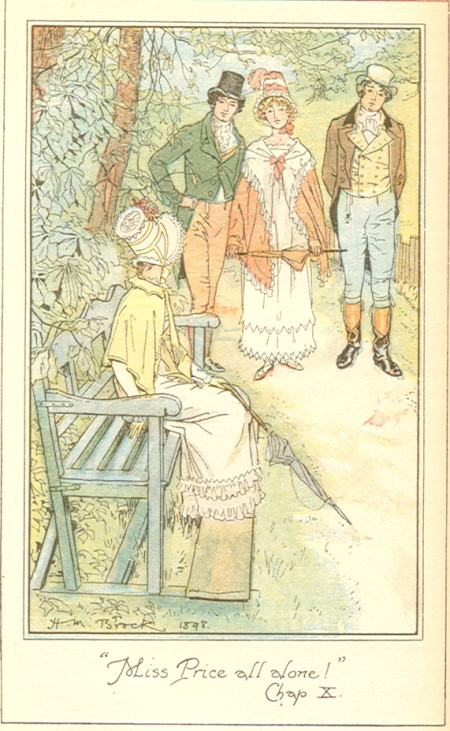
Fanny Price loves nature, like both Jane Austen and Dorothy Wordsworth. Both Jane and Dorothy, like Fanny, experienced being marginalized by wealthier relatives.
H.M. Brock, public domain.

Spinsterhood

The book extensively explores attitudes toward “old maids” in Austen’s society. It’s easy to forget that Austen herself probably experienced prejudices against unmarried women. She certainly sometimes felt herself a poor relation at her wealthy brother’s Godmersham estate. She often lacked autonomy: her living situations and travels were dictated by her parents or brothers. Perhaps those feelings helped her create Fanny Price, dependent and marginalized.

Jane and Dorothy points out many illuminating parallels between Sense and Sensibility and Mansfield Park. Fanny is much like Marianne, with strong feelings. However Austen, when she was a more mature writer, made Fanny spiritually stronger, more nuanced, and with greater depth.

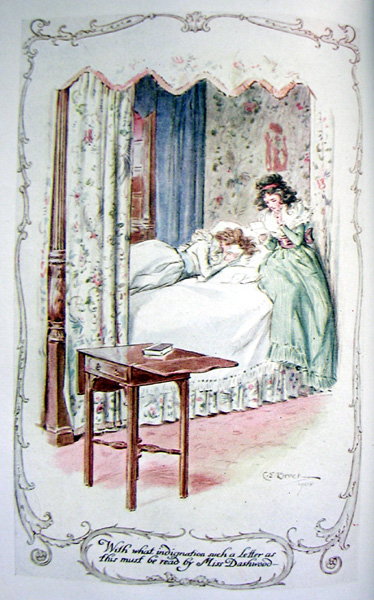
Marianne Dashwood gives way to her feelings and nearly dies. Fanny Price turns to religion and reason to keep her feelings under control, as Marianne determines to do at the end of Sense and Sensibility.
C.E. Brock, public domain.

End of Life

Dorothy lived much longer than Jane. Sadly, though, Dorothy’s last twenty years were spent with “her mind completely broken.” She had given her life to taking care of her family; that same family gave her loving care for those long years. It’s been speculated that she may have had some kind of dementia, or possibly severe depression. (She suffered, in fact, similarly to William Cowper in his final years. Cowper’s poetry, by the way, impacted both women.)

Of course we all wish that Jane had lived longer and written more. However, thinking of the many ways a spinster (like Miss Bates, for example, or Dorothy Wordsworth) might end up in Austen’s world, perhaps Jane’s earlier demise from an unknown disease was not the worst possible ending for her. The recent book and series Miss Austen also imagines long-lived Cassandra suffering late in her life.

As Veevers concludes,

“Jane and Dorothy were two unmarried, childless women who had failed to fulfil the destiny that their society prescribed for their sex. But they neither drooped nor withered as [1838 writer] Carlisle expected, nor developed the chagrin and peevishness which Dr. Gregory [1774] believed inseparable from their condition. Instead they forged their own meanings from their lives. . . . Jane and Dorothy were not simply products of their time. They made choices in their lives, and it was those choices which defined them.”

I found it fascinating to trace the choices of these two parallel lives, and the resulting joys and sorrows, during the same time in history. Well-written, easy to read, and compelling, Jane and Dorothy  is worth reading for anyone who wants to get deeper into “Jane Austen’s World.”


Brenda S. Cox is the author of Fashionable Goodness: Christianity in Jane Austen’s England. She also blogs at Faith, Science, Joy, and Jane Austen.
Read Full Post »

By Brenda S. Cox

“What are young men to rocks and mountains?”—Pride and Prejudice

Rocks and mountains recur in the story of Lady Hester Stanhope, though the mountains she climbed were much farther away than Derbyshire. We all know that women of Jane Austen’s England faced many restrictions. Austen herself published her books as “a lady” rather than under her own name, to avoid any stigma for stepping outside of the box that society prescribed for her.

Yet some women did step out of that box, some of them very far outside the box! Those in the upper classes with enough money could afford to be “eccentric” and go their own ways. (Some in the middle and lower classes did the same, especially if they were widows, but that’s another story.)

Lady Hester Stanhope

One of the most famous, or infamous, of these trailblazing women was Lady Hester Stanhope, Middle Eastern traveler and pioneer archaeologist. Chawton House hosted a talk entitled “Lady Hester Stanhope: Trowelblazer or Iconoclast?” on Feb. 16. 

Lady Hester was born only a few months after Jane Austen, in March of 1776. She was the oldest child of an earl. In 1803 she moved into the home of her uncle, William Pitt the Younger, prime minister of England. She acted as his hostess and private secretary. When he died in 1806, the British government granted Hester a pension of £1200 a year, at Pitt’s request. After several romantic disappointments, she became disillusioned with England. She went overseas in 1810 and never returned to England. She was almost 34.

Shipwrecked on Rhodes

Starting out on a Grand Tour of Europe, she was shipwrecked on the island of Rhodes, losing all her possessions and money. She wrote,


Unable to make the land, I got ashore, not on an island, but a bare rock which stuck up in the sea, and remained thirty hours without food or water. It becoming calmer the second night, I once more put to sea, and fortunately landed upon the island of Rhodes, but above three days’ journey from the town, travelling at the rate of eight hours a day over mountains and dreadful rocks. Could the fashionables I once associated with believe that I could have sufficient composure of mind to have given my orders as distinctly and as positively as if I had been sitting in the midst of them, and that I slept for many hours very sound on the bare rock, covered with a pelisse, and was in a sweet sleep the second night, when I was awoke by the men, who seemed to dread that, as it was becoming calmer, and the wind changing (which would bring the sea in another direction), that we might be washed off the rock before morning. So away I went, putting my faith in that God who has never quite forsaken me in all my various misfortunes. The next place I slept in was a mill, upon sacks of corn; after that, in a hut, where I turned out a poor ass to make more room, and congratulated myself on having a bed of straw. When I arrived (after a day of tremendous fatigue) at a tolerable village, I found myself too ill to proceed the next day, and was fortunate enough to make the acquaintance of a kind-hearted, hospitable Greek gentleman, whom misfortune had sent into obscurity, and he insisted upon keeping me in his house till I was recovered. 

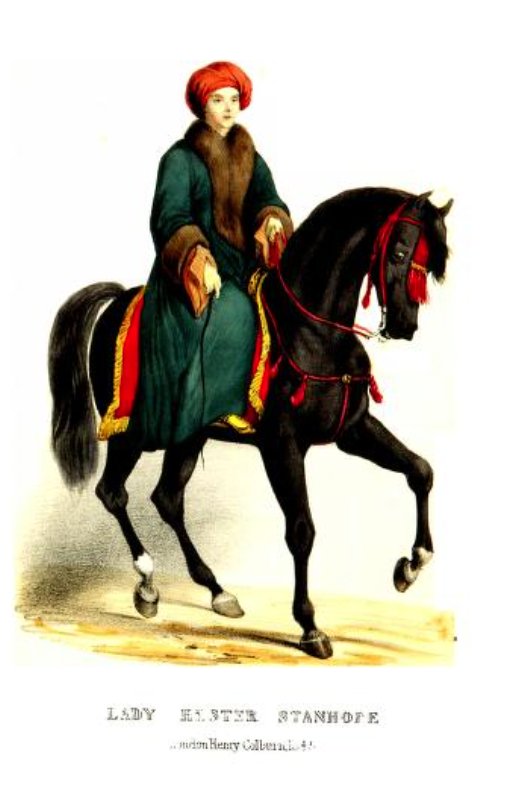
At this point she adopted the Turkish dress of the Ottoman Empire. She explains why she chose men’s clothing:

. . . Everything I possessed I have lost; had I attempted to have saved anything, others would have done the same, and the boat would have been sunk. To collect clothes in this part of the world to dress as an Englishwoman would be next to impossible; at least, it would cost me two years’ income. To dress as a Turkish woman would not do, because I must not be seen to speak to a man; therefore I have nothing left for it but to dress as a Turk — not like the Turks you are in the habit of seeing in England, but as an Asiatic Turk in a travelling dress — just a sort of silk and cotton shirt; next a striped silk and cotton waistcoat; over that another with sleeves, and over that a cloth short jacket without sleeves or half-sleeves, beautifully worked in coloured twist, a large pair of breeches, and Turkish boots, a sash into which goes a brace of pistols, a knife, and a sort of short sword, a belt for powder and shot made of variegated leather, which goes over the shoulder, the pouches the same, and a turban of several colours, put on in a particular way with a large bunch of natural flowers on one side. This is the dress of the common Asiatic; the great men are covered with gold and embroidery, and nothing can be more splendid and becoming than their dress. (Life and Letters of Lady Hester Stanhope, 116-117)

The clothes sound quite sumptuous, and she seems to have enjoyed them! As a foreign woman, and a woman in men’s clothing, Lady Hester occupied an unusual place in Ottoman society. She could be treated as more or less an “honorary man,” relating to local men in ways that local women could not.

Lady Hester Stanhope wearing Turkish men’s clothing. Frontispiece, Memoirs of the Lady Hester Stanhope, Vol. 1 (London: Henry Colburn, 1846).

Egypt to Palmyra

Lady Hester traveled deeper into the Middle East. She wasn’t much impressed with the wonders of Egypt. She refused to enter the Great Pyramid and complained of “an inconceivable number of fleas.” Many English tourists visited Egypt, and she wanted to do something more impressive.

Because of her background with Pitt in politics, and her connections, she was able to get permission from the Ottoman Pasha to go to Palmyra, an ancient city in the Syrian desert. When she reached it with her Beduin caravan after six days of travel, they “crowned” her “Queen of the Desert,” after the ancient Queen Zenobia.

During her travels, Lady Hester constantly racked up debts, and wrote back to the English government asking for money. They sometimes ended up paying because of her high connections.

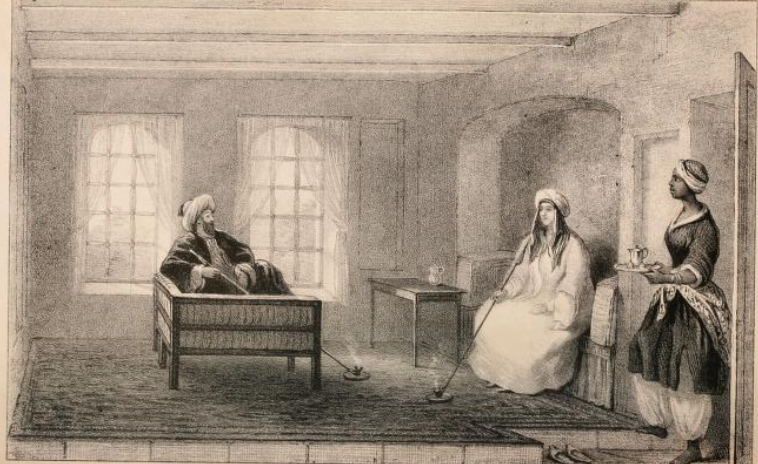
Lady Hester Stanhope smoking a Turkish pipe. Frontispiece, Memoirs of the Lady Hester Stanhope, Vol. 2 (London: Henry Colburn, 1845).

Archaeologist; Searching for Treasure

Emma Yandle, curator of the Chawton House exhibition on “Trailblazers: Women Travel Writers,” went on to discuss Lady Hester Stanhope’s somewhat questionable contributions to archaeology. Lady Hester was arguably the first Westerner given official permission to excavate an ancient site; certainly she was the first woman to do so.

Lady Hester somehow obtained a manuscript, purportedly written by a monk, describing the location of immense hoards of buried treasure (three million gold coins!) in the ancient cities of Ashkelon, Awgy (near Jaffa), and Sidon. She got permission and safe conduct letters from the Ottoman government to excavate at Ashkelon. She promised the Ottoman government all the treasure she would find. She asked the British government to pay for the excavations, simply for the honor it would bring to England and to herself.

Excavations began in April of 1815. Lady Hester was the visionary, nominally in charge. Actually, though, her personal physician, Dr. Charles Meryon, directed the excavations and kept the records. They found no gold coins.

They did, however, find one archaeological treasure. It appeared to be a Roman statue, somewhat mutilated. According to a later biography, this made Lady Hester Stanhope “the first person who ever intentionally excavated an ancient artifact in the ‘Holy Land.’”

However, Lady Hester feared that if the Ottoman ruler heard about this, he would believe that she was excavating treasures to send back to her native England. She had promised she would not do that. (Many others of the time were plundering the various countries they colonized.) So—she destroyed the statue! She had it smashed and thrown into the sea. A very strange decision.

We still have drawings and a description of the statue, but that’s all. A much later archaeological expedition, in 1921, found what were apparently the missing pieces of that statue.

The records of the expedition, however, gave a lot of historical information. The layers of history that were uncovered were recorded: a Roman temple at the lowest layer, above it a church, and over that a mosque. (This was confirmed by the later expedition.) They also recorded the locations of any artifacts found. This was a new procedure. Other diggings at the time simply took whatever they could find and shipped it off to museums or private collections, with no details of location or depth. So Lady Hester’s excavation did blaze new trails for archaeology.

End of Life

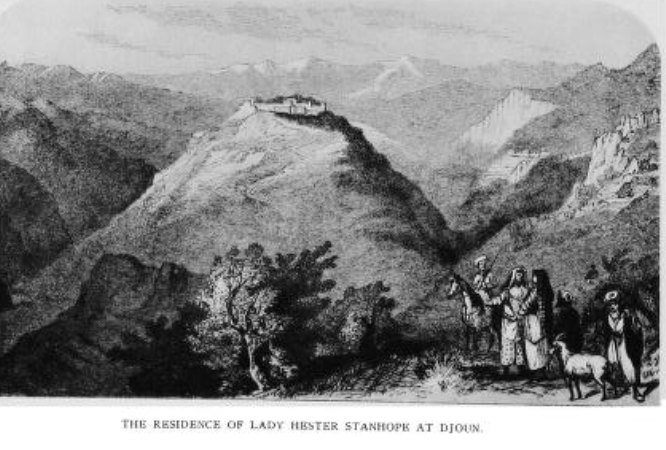
Lady Hester Stanhope later settled on a mountaintop among the Druze people of Lebanon, near Sidon. She became disastrously involved in Middle Eastern conflicts, and went deeper and deeper into debt. She died, penniless and alone, in 1839.

The Residence of Lady Hester Stanhope at Djoun. Frontispiece, The Life and Letters of Lady Hester Stanhope, by her niece the Duchess of Cleveland (London: John Murray, 1914).

Dr. Meryon, who had accompanied her on many of her travels, wrote her memoirs in 1845-6, romanticizing her story.

Paul Pattison, at English Heritage, summarizes Lady Hester Stanhope’s life: 

She was always a wilful aristocrat, who wanted to govern her life and the lives of others – indeed believed it was her position in life to do so – and on occasions she was overbearing and unkind. But she was also vivacious, daring, sharp-witted, charismatic, benevolent, and brave to the point of recklessness. 

Above all, she rejected society conventions and the restrictions of life for a woman in Europe, embracing the unexpected opportunity to be her own mistress within an Eastern culture that excluded women from public life. That alone sets her apart as a pioneer and an extraordinary human being.

As far as I’ve been able to discover, Jane Austen never mentioned Hester Stanhope in her letters. She may have known of some of her exploits, however. Both were trailblazers: Jane, quietly, from her home; and Hester, flamboyantly, in exotic places.


Resources about Lady Hester Stanhope

Memoirs of the Lady Hester Stanhope; the sequel, Travels of Lady Hester Stanhope; and Life and Letters of Lady Hester Stanhope, are available on archive.org

Lady Hester, Queen of the East, by Lorna Gibb

Star of the Morning: The Extraordinary Life of Lady Hester Stanhope, by Kirsten Ellis


Brenda S. Cox is the author of Fashionable Goodness: Christianity in Jane Austen’s England. She also writes for Faith, Science, Joy, and Jane Austen.
 

Read Full Post »

By Brenda S. Cox

“I like first Cousins to be first Cousins, & interested about each other.”—Jane Austen, letter to Anna Lefroy, Nov. 29, 1814

Austen’s First Cousins

Jane Austen was closely connected to her three first cousins: Eliza, Edward, and Jane. (She had additional cousins from her father’s half-brother, William Hampson Walter, though she doesn’t seem to have been as close to them.)

Eliza: Her father’s sister Philadelphia had one daughter, lively Eliza Hancock de Feuillide. Eliza, whose first husband was guillotined in the French Revolution, later married Jane’s brother Henry.

Jane: Jane’s mother’s sister (also named Jane) married a clergyman, the Reverend Dr. Edward Cooper. They had two children, Edward and another Jane. That Jane, Jane Leigh Cooper, went away to school for a time with Jane and Cassandra Austen. Her letter home from Southampton told their parents that the girls were seriously ill with typhus. Mrs. Austen and Mrs. Cooper came and took them home. The girls all survived, but, sadly, Mrs. Cooper caught the illness and died. Jane and Edward Cooper spent a lot of time with the Austen family. Jane was even married at Steventon, to a naval captain, Captain Williams, who was later knighted. Charles Austen served under him in the Navy. Tragically, Jane Cooper, by then called Lady Williams, died in a carriage accident in 1798.

Edward: Edward Cooper, Jane Cooper’s brother, became a clergyman like his father. He is mentioned frequently in Jane Austen’s letters. In her first two existing letters (Jan. 9 and 14, 1796), she talks about his visit to Steventon with his young son and daughter.

Edward Cooper, Clergyman

Many of Jane Austen’s friends and relatives were clergymen (estimated at over a hundred, including of course her father and two of her brothers). She held strong opinions on church livings. When Edward got his living, she wrote (Jan. 21, 1799):

Yesterday came a letter to my mother from Edward Cooper to announce, not the birth of a child, but of a living; for Mrs. Leigh [a relative, the Hon. Mary Leigh, of Stoneleigh] has begged his acceptance of the Rectory of Hamstall-Ridware in Staffordshire, vacant by Mr. Johnson’s death. We collect from his letter that he means to reside there, in which he shows his wisdom.

Staffordshire is a good way off [about 140 miles]; so we shall see nothing more of them till, some fifteen years hence, the Miss Coopers are presented to us, fine, jolly, handsome, ignorant girls. The living is valued at £140 a year, but perhaps it may be improvable. How will they be able to convey the furniture of the dressing-room so far in safety?

Our first cousins seem all dropping off very fast. One is incorporated into the family [Eliza de Feuillide], another dies [Jane Cooper, Lady Williams], and a third [Edward Cooper] goes into Staffordshire.  [Brackets added.]

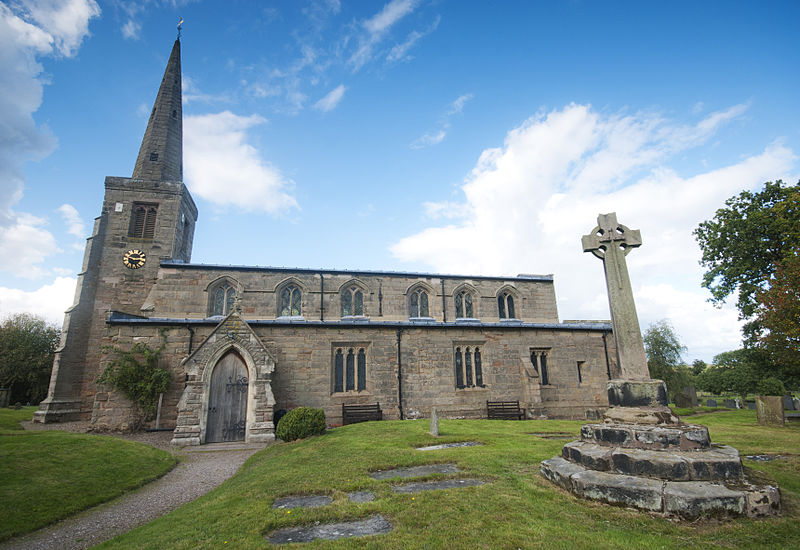
Church of St. Michael and All Angels, Hamstall Ridware, where Jane Austen’s cousin Edward Cooper served as rector.
Bs0u10e01, CC BY-SA 3.0 via Wikimedia Commons

Jane commented that Edward intended “to reside” at his living, which showed “his wisdom.” At this time, many clergy hired curates to serve their livings rather than residing in them and doing the work themselves. In Mansfield Park, Sir Thomas Bertram makes a strong statement about residing at one’s living:

“A parish has wants and claims which can be known only by a clergyman constantly resident, and which no proxy can be capable of satisfying to the same extent. Edmund might, in the common phrase, do the duty of Thornton, that is, he might read prayers and preach, without giving up Mansfield Park: he might ride over every Sunday, to a house nominally inhabited, and go through divine service; he might be the clergyman of Thornton Lacey every seventh day, for three or four hours, if that would content him. But it will not. He knows that human nature needs more lessons than a weekly sermon can convey; and that if he does not live among his parishioners, and prove himself, by constant attention, their well-wisher and friend, he does very little either for their good or his own.”–Mansfield Park, ch. 25

Austen also mentioned that Edward might be able to “improve” his living. That means he might increase his income by negotiating for higher tithe payments from the farmers or leasing extra farmland, as Austen’s father did. Edward Ferrars’s living in Sense and Sensibility is also “capable of improvement” (ch. 39). Cooper added to his income later by becoming rector of nearby Yoxall (much like George Austen, who served two adjacent parishes).

In 1801 Austen said Edward wrote to her after his wife Caroline had a baby.

I have heard twice from Edward on the occasion, & his letters have each been exactly what they ought to be–chearful & amusing.–He dares not write otherwise to me, but perhaps he might be obliged to purge himself from the guilt of writing Nonsense by filling his shoes with whole pease for a week afterwards.–Mrs. G. [Mrs. Girle, Caroline Cooper’s grandmother] has left him £100–his Wife and son £500 each. (Jan. 21, 1801)

It appears that while Jane thought of Edward as too serious, he was willing to write “Nonsense” to her.

Later that month, Edward invited the Austens to come visit his family at the parsonage in Hamstall Ridware. However, Jane says, “at present we greatly prefer the sea to all our relations” (Jan. 25, 1801). Her family had already visited Edward in 1799, when he was a curate at Harpsden. The Austens did visit the Coopers at Hamstall Ridware for five weeks in the summer of 1806, after going to Stoneleigh Abbey. 

Interior of Edward Cooper’s Hamstall Ridware church;
John Salmon via Wikimedia commons CC BY-SA 2.0

Jane seemed to have trouble keeping track of Edward’s children. Some of them died quite young. In 1811 she wrote, “It was a mistake of mine, my dear Cassandra, to talk of a tenth child at Hamstall. I had forgot there were but eight already” (May 29).

In 1808, when Jane’s sister-in-law, Elizabeth Knight, died, Jane wrote, “I have written to Edward Cooper, & hope he will not send one of his Letters of cruel comfort to my poor Brother” (Oct. 15). We don’t know what sort of “cruel comfort” Edward had written in the past. The one still-existing letter from Edward to Jane was written in 1817 and sounds heartfelt and kind. His friend and neighbor John Gisborne wrote that Edward was a great comfort to him in his son’s final illness. But perhaps Edward had taken the opportunity to preach some of his Evangelical ideas in a letter, and Jane and her family did not agree.

Edward Cooper believed and preached an Evangelical interpretation of the Bible. Many of his sermons were published in books, which were reprinted and read for many years, in a long series of editions. So even if Jane didn’t care much for them, others did!

Next month in Part 2, we’ll look at what Edward’s Evangelical ideas were, what Jane Austen thought of his sermons, and why.

Brenda S. Cox writes on Faith, Science, Joy, and Jane Austen. She has written a book called Fashionable Goodness: Faith in Jane Austen’s England, which she hopes will be available by the end of this year.
For Further Reading

Edward Cooper: Jane Austen’s Evangelical Cousin, Part 2

Visiting Edward Cooper,” Gaye King, Persuasions 1987

Hamstall Ridware: A Neglected Austen Setting,” Donald Greene, Persuasions 1985 (Includes a photo of the rectory where Jane and her family visited Edward and his family)

Come and Visit Edward Cooper, Jane Austen’s Evangelical Cousin,” Jane Austen House Museum blog, Sept. 17, 2012 (includes Edward Cooper’s portrait)

Edward Cooper’s letter to Jane April 6, 1817 (article also includes commentary on the letter) 

Jane Austen in the Midlands,” scroll down for a section on Cooper.

Other Sources

Deirdre Le Faye, Jane Austen: A Family Record, 2nd ed.

Deirdre Le Faye, ed., Jane Austen’s Letters, 4th ed.

Laura Dabundo, Jane Austen: A Companion

Irene Collins, “Displeasing Pictures of Clergymen,” Persuasions 18 (1996): 110. Collins says Austen’s correspondence refers to at least 90 clergymen, and her biographers could add many more. 

Irene Collins, Jane Austen and the Clergy

John Gisborne and his daughter E. N. A., Brief Memoir of the Life of John Gisborne, Esq., to which are added, Extracts from his Diary (London: Whittaker, 1852), 114-115, 128, 227. 

Read Full Post »

Older Posts »