Feeds:
Posts
Comments

Archive for the ‘Books Jane Austen Read’ Category

by Brenda S. Cox

“There must have been many precious hours of silence during which the pen was busy at the little mahogany writing-desk, (This mahogany desk, which has done good service to the public, is now in the possession of my sister, Miss Austen) while Fanny Price, or Emma Woodhouse, or Anne Elliott was growing into beauty and interest.”–A Memoir of Jane Austen by James Edward Austen-Leigh, her nephew
Welcome page to the website “Jane Austen’s Desk”

Wouldn’t you love to explore Jane Austen’s desk and room? Inger Brodey, Sarah Walton, and their amazing team at the Jane Austen Collaborative are recreating Jane’s desk and room for us to visit virtually.

While the website is still a beta version, I found lots of great information there. The plan is for it to become a “portal” linking to many Austen resources.

The site opens with a view of a room loosely based on the drawing room of Jane Austen’s House in Chawton

Jane Austen’s Desk

When you visit the room, you might want to start at the desk itself—Jane’s travel desk sits on a table. You’ll see manuscripts of several of the novels, which you can open and enjoy in early editions. Commentary tells more about the novel and the edition, with direct links to interesting sections like “Darcy’s list of desirable female accomplishments” and “Fanny asking about the slave trade.”

Nearby are newspapers, one of the most fun links. Several contemporary papers are included. You can hone in on a number of interesting articles, ranging from her brother Edward’s selling part of Stoneleigh Abbey, to reports of her brother Frank’s naval exploits, to the story of a swindler who pretended to be a rich person’s housekeeper!
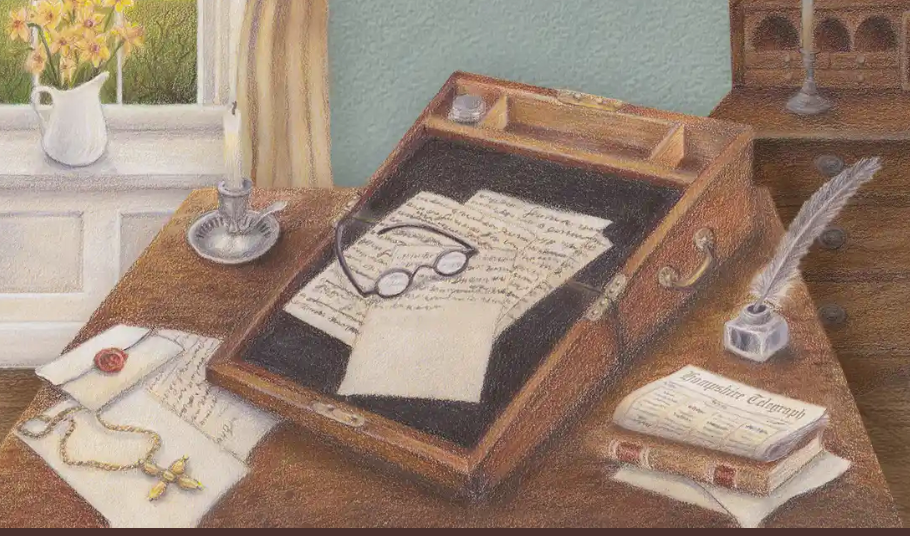
Jane Austen’s travel desk (the real one is owned by the British Library). The manuscripts on the desk, the newspapers next to it, and the cross, take you to various resources.

The Bookshelf

Click on the bookshelves in Rev. Austen’s bureau-bookcase , and you’ll see some books mentioned in Austen’s writings. I expect this will be expanded later. But for now, you can read from several authors Austen said she was “in love with”—Thomas Clarkson (on abolition), Sir Charles Pasley (on the military), and James and Horatio Smith (verse parodies). We also have a book that Fanny Price was reading, George Macartney on the British Embassy to China.

For each, you will find an easy-to-read early version of the book; clear commentary; pictures; and links to relevant passages in the novels and letters. Two also link to related articles. A great start if you want to explore these books connected to Austen!

Catalogs on the ledge of the bookcase open up to records of the Alton Book Society that Austen enjoyed. You’ll find lists of members, rules, and lists of the books that the members, including Austen, traded around. This gives us another peek into Austen’s life and reading.
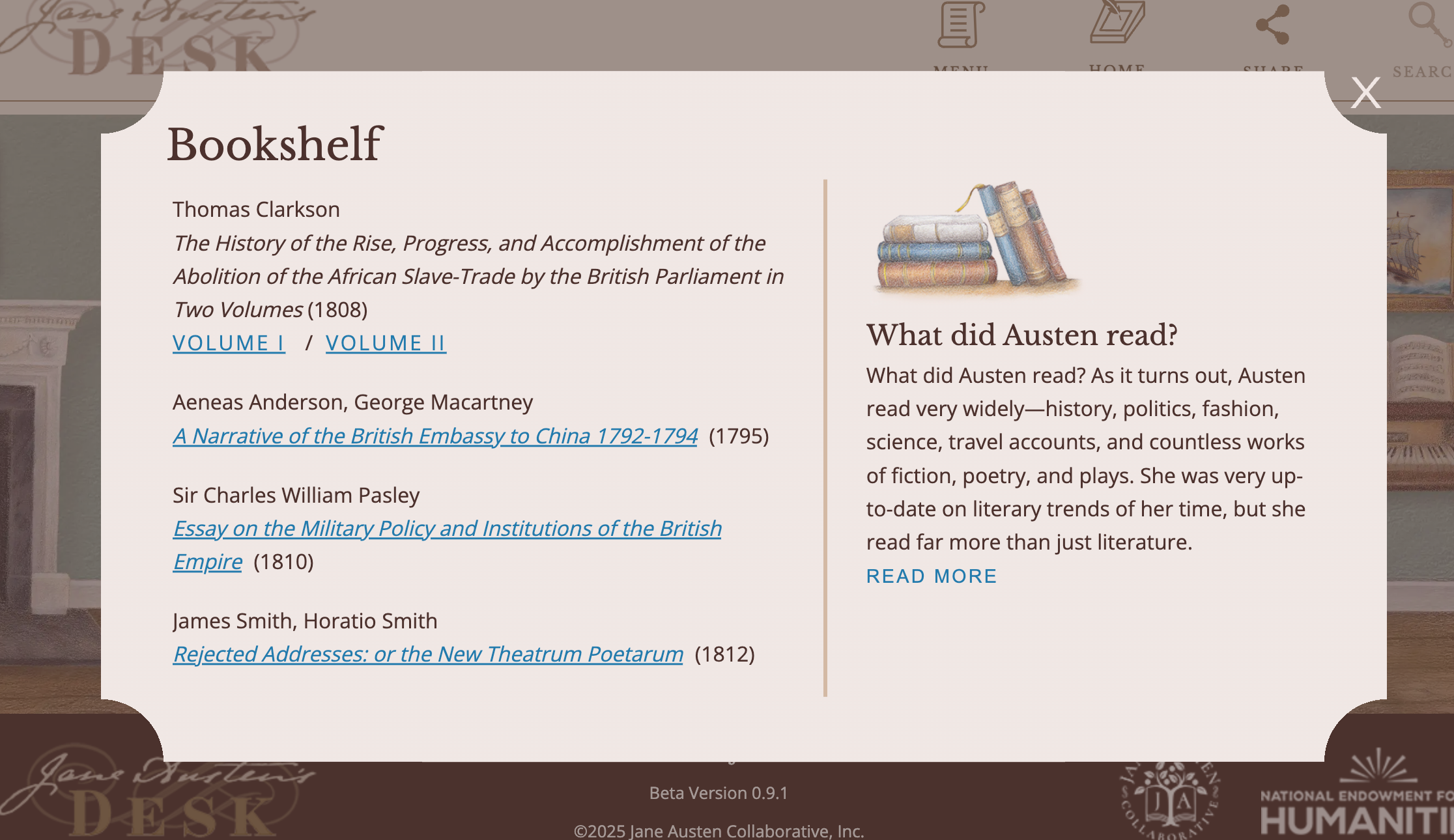
The Bookshelf takes you to some books Austen read.

Travels

A pianoforte stands next to the bookcase. It will eventually be connected to Austen’s music.

Above the pianoforte, click on the portrait of a ship on the sea. You go to a globe, where you can follow the travels of Austen’s family.
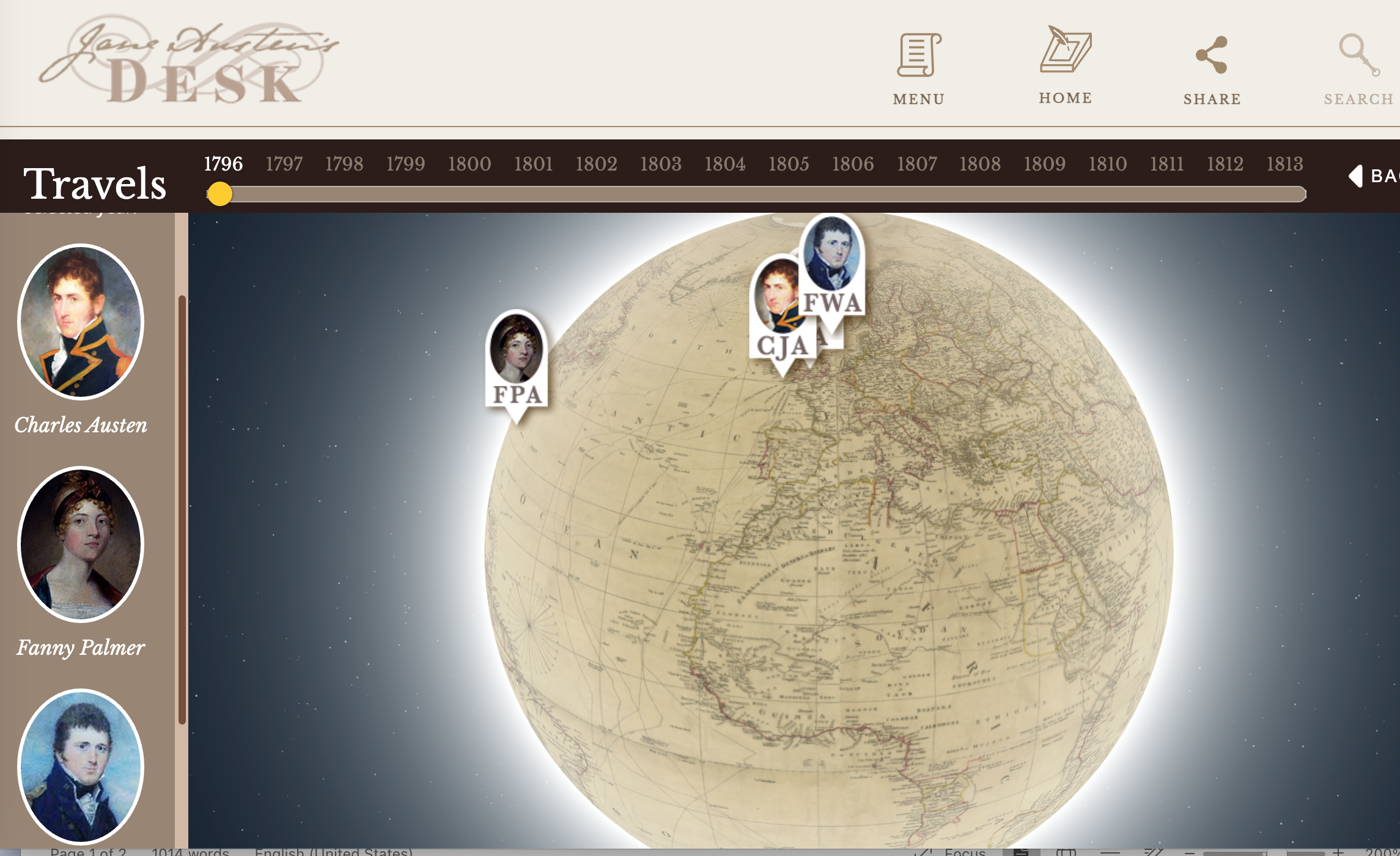
Jane Austen’s Desk, travel section. You can trace the positions of Frank and Charles Austen, Charles’s wife Fanny Palmer, and Jane Austen herself, year by year. You can also read stories about Frank and Charles’s experiences at sea.

Silhouettes on the wall connect you to Jane Austen’s family tree. If you click on the orange “i”, you get more information about each person. The plus buttons reveal more generations.

Many of these features include audio commentary as well as written commentary. For example, Lizzie Dunford of Jane Austen’s House tells us about the topaz crosses Charles brought back for his sisters.

There are great possibilities for future additions.

An Interview with Inger Brodey

Inger Brodey, who runs the Jane Austen Summer Program, tells us more about the project:

JAW: Inger, what gave you the idea for doing this website?

Inger: I was interested in Austen’s own creative process, and also in countering the myth that she was not well informed in the science and politics of her day. I found a kindred spirit in Sarah Walton, who was a grad student when we started. In the 1990s, both Sarah and I had been enchanted by JK Rowling’s website with clickable, magical elements on her desk to interact with. 

JAW: How is the website being funded?

Inger: We have received two rounds of funding from the National Endowment for the Humanities, and have applied for more. We intend to create a GoFundMe or Kickstarter campaign to seek private funding to support specific new developments, such as the learning games we have in mind. 

JAW: What are some parts you are excited about adding in the future?

Inger: The current setting is Spring 1813, while [Jane Austen] is writing Mansfield Park. Eventually we hope to add additional settings: for example, Summer or Winter 1814, when she was composing Emma; or Autumn, 1815, when Persuasion was in process. 

JAW: What are some parts that you and your team are finding challenging?

Inger: Well, it all takes much more time to create than one would imagine. We have a great team of programmers and designers, including the wonderful Harriet Wu who has drawn the site by hand. We constantly try to find the sweet spot where we can appeal to both scholars and the general public, and to all ages. Just as with our Jane Austen Summer Program, we also focus on providing tools for educators who wish to bring Jane Austen into the classroom. 

JAW: What other ideas do you have for expansion in the future?

Inger: As you can see on the site, there are many objects with potential to “animate” in the future. We are collaborating with Laura Klein to add music to the piano, Jennie Batchelor for sewing, and have plans for links to weather and agricultural information (via the scene out the window), tea culture (via the kettle), letter writing (via a folded letter), and many more. 

We applied for a grant to develop a state-of-the-art platform for navigating, reading, notating, and analyzing Austen’s novels, including the potential for crowd-sourced editions. 

As long as we can continue to find funding, I think this will be a lifelong project—there is so much potential to grow!

JAW: Thanks, Inger, we look forward to that!

The Desk, the Summer Program, and Online Talks

Gentle readers, I recommend you explore Jane Austen’s Desk. The website has not yet been configured for mobile phones, so you’ll need to access it on your computer or tablet.

When you’ve finished exploring, go back to the main page and take a survey, to possibly win a prize. The survey takes some thought and time, but you will get to give input for what you’d like to see in the future at this very helpful site.

The same Jane Austen Collaborative who created Jane Austen’s Desk also runs the Jane Austen Summer Program. This year it will be held June 19-22, 2025, in North Carolina. The theme is “Sensibility and Domesticity,” exploring “topics including medicine, birth, and domestic arts in Regency England and colonial North Carolina.” They will “focus on Austen’s first published novel, Sense and Sensibility—considering the birth of her career as a published writer as well as taking a transatlantic look at the world into which she was born.” I’m signed up, and would love to see some of you there!

Of course, even if you can’t get to North Carolina, you can always enjoy Jane Austen & Co.’s great offerings online. They are currently exploring Music in the Regency; I enjoyed a recent talk on Women & Musical Education in the Regency Era, by Kathryn Libin. Get on their mailing list for announcements of upcoming events.

They generously provide free access to recordings of their previous talks, on topics including “Austen and the Brontes,” “The Many Flavors of Jane Austen,” “Everyday Science in the Regency,” “Reading with Jane Austen,” “Asia and the Regency,” “Race and the Regency,” and “Staying Home with Jane Austen.” Something for everyone, it seems to me.

So much Jane Austen to enjoy!

Brenda S. Cox is the author of Fashionable Goodness: Christianity in Jane Austen’s England. She also blogs at Faith, Science, Joy, and Jane Austen.

Read Full Post »

In honor of our year-long celebration of 250 years of Jane Austen’s life and novels, I have compiled a list of new books you can add to your personal library each month. My selection this month is a much-anticipated book by Rebecca Romney, rare book specialist, titled Jane Austen’s Bookshelf: A Rare Book Collector’s Quest to Find the Women Writers Who Shaped a Legend.

Romney’s new book provides Janeites with a brand-new perspective on the female authors Jane Austen would have read during her lifetime. The very fact that Romney is a rare book specialist caught my eye! While many of the authors she highlights are known to us, this book takes a deeper look at their works and the reasons why their novels are unknown to the general public.

Release Date: February 18, 2025
Pre-order: HERE

Book Description

From rare book dealer and guest star of the hit show Pawn Stars Rebecca Romney comes a page-turning literary adventure that introduces readers to the women writers who inspired Jane Austen—and investigates why their books have disappeared from our shelves.

Long before she was a rare book dealer, Rebecca Romney was a devoted reader of Jane Austen. She loved that Austen’s books took the lives of women seriously, explored relationships with wit and confidence, and always, allowed for the possibility of a happy ending. She read and reread them, often wishing Austen wrote just one more.

But Austen wasn’t a lone genius. She wrote at a time of great experimentation for women writers—and clues about those women, and the exceptional books they wrote, are sprinkled like breadcrumbs throughout Austen’s work. Every character in Northanger Abbey who isn’t a boor sings the praises of Ann Radcliffe. The play that causes such a stir in Mansfield Park is a real one by the playwright Elizabeth Inchbald. In fact, the phrase “pride and prejudice” came from Frances Burney’s second novel Cecilia. The women that populated Jane Austen’s bookshelf profoundly influenced her work; Austen looked up to them, passionately discussed their books with her friends, and used an appreciation of their books as a litmus test for whether someone had good taste. So where had these women gone? Why hadn’t Romney—despite her training—ever read them? Or, in some cases, even heard of them? And why were they no longer embraced as part of the wider literary canon?

Jane Austen’s Bookshelf investigates the disappearance of Austen’s heroes—women writers who were erased from the Western canon—to reveal who they were, what they meant to Austen, and how they were forgotten. Each chapter profiles a different writer including Frances Burney, Ann Radcliffe, Charlotte Lennox, Charlotte Smith, Hannah More, Elizabeth Inchbald, Hester Lynch Thrale Piozzi, and Maria Edgeworth—and recounts Romney’s experience reading them, finding rare copies of their works, and drawing on connections between their words and Austen’s. Romney collects the once-famed works of these forgotten writers, physically recreating Austen’s bookshelf and making a convincing case for why these books should be placed back on the to-be-read pile of all book lovers today. Jane Austen’s Bookshelf will encourage you to look beyond assigned reading lists, question who decides what belongs there, and build your very own collection of favorite novels.

About the Author

Rebecca Romney is a rare book dealer and the cofounder of Type Punch Matrix, a rare book company based in Washington, DC. She is the rare books specialist on the HISTORY Channel’s show Pawn Stars, and the cofounder of the Honey & Wax Book Collecting Prize. She is a generalist rare book dealer, handling works in all fields, from first editions of Jane Austen to science fiction paperbacks. Romney is the author of Printer’s Error: Irreverent Stories from Book History (with JP Romney)and The Romance Novel in English: A Survey in Rare Books, 1769­–1999. Her work as a bookseller or writer has been featured in The New York Times, The Atlantic, Forbes, Variety, The Paris Review, and more. In 2019, she was featured in the documentary on the rare book trade, The Booksellers. She is on the Board of the Antiquarian Booksellers’ Association of America (ABAA) and the faculty of the Antiquarian Book Seminar (CABS-Minnesota).

Expertise In Rare Books

Rebecca Romney has been in the rare book trade since 2007, when she was hired by Bauman Rare Books for their new location in Las Vegas. In 2010, she became manager of that gallery. She eventually moved to Philadelphia to manage the central operations of the firm, where she also handled the acquisition of libraries and oversaw catalogue production. After a stint at the Brooklyn-based Honey & Wax Booksellers (where she co-founded a book collecting prize), she founded her own rare book firm, Type Punch Matrix.

Rebecca is on the board of the Antiquarian Booksellers Association of America (ABAA), the Council of the Bibliographical Society of America (BSA), and on the board and faculty of the Antiquarian Book Seminars. She is a member of the Grolier Club, the Association Internationale de Bibliophilie (AIB), the American Antiquarian Society (AAS), and the Baker Street Irregulars (BSI).

January New Release

While you’re waiting for Rebecca’s new book to arrive, if you’re looking for something brand-new for January, look no further!

Canterbury Classics released a refreshed Word Cloud Classics edition of Pride and Prejudice just last week. Featuring colorful sprayed edges and a heat-burnished cover with foil stamping, this edition of Pride and Prejudice is a stylish addition to your bookshelves!

Jane Austen Must-Reads for 2025

This is just the start of a wonderful journey. Many authors and publishers are coming out with new projects this year to celebrate Jane Austen’s 250th year. I am excited to explore all the options, learn a lot more about Austen, and expand my library this year. If I could attend some of the events in England this year, I would, but until then, I’ll live vicariously through online events and new books! What are you looking forward to most during this year-long celebration?


RACHEL DODGE teaches college English classes, speaks at libraries, teas, and conferences, and writes for Jane Austen’s World blog. She is the bestselling author of The Anne of Green Gables DevotionalThe Little Women Devotional, The Secret Garden Devotional, and Praying with Jane: 31 Days Through the Prayers of Jane Austen. A true kindred spirit at heart, Rachel loves books, bonnets, and ballgowns! You can visit her online at www.RachelDodge.com or on Instagram @KindredSpiritBooks.

Read Full Post »

Reviewed by Brenda S. Cox

“I have seen nobody in London yet with such a long chin as Dr Syntax” (Jane Austen, March 2, 1814).

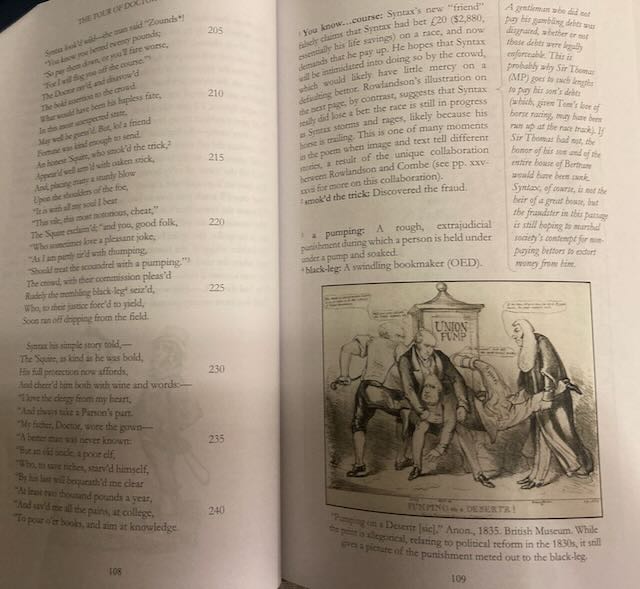
I just finished reading, cover to cover, a brand-new book which is over 200 years old. The Tour of Doctor Syntax in Search of the Picturesque, by William Combe, is a classic which Jane Austen herself enjoyed. But it’s out in a new edition, with wonderful illustrations, explanations, and comments.

A fun new annotated version of The Tour of Doctor Syntax, including parallels with Jane Austen’s novels!

The story in verse was first published from 1809-1811 as a series in Ackermann’s Poetical Magazine. Ackermann had a series of prints by the great caricaturist Thomas Rowlandson. They featured a country clergyman with a long pointed chin and a tall white wig traveling through the countryside. Ackermann gave Combe the illustrations for each issue of the magazine, and Combe wrote a section of the story to go with them. He didn’t know ahead of time what the pictures would be for the next issue, but somehow he came up with a coherent story. One interesting facet is that Rowlandson apparently intended to satirize the clergy, but Combe made Syntax into a good, learned man, a little silly, but lovable.

A book version came out in 1812. Dr. Syntax was wildly popular and stayed in print, with multiple printings and editions, well into the 1800s.

This new version of The Tour of Doctor Syntax was edited and annotated by an advanced high school class and their professor, Dr. Ben Wiebracht. Ben actually discovered Dr. Syntax through one of my posts right here at Jane Austen’s World. Recognizing its potential for his class on “Jane Austen and Her World,” he asked Vic Sanborn, owner and primary writer of this website, and myself, to share with his class. Vic owns some lovely Rowlandson prints. We both loved connecting with such bright and interested students, who asked knowledgeable questions.

The Book

They’ve done a brilliant job with the book. It starts with a biography of William Combe and the history of the book itself. Combe’s challenges as a writer in Austen’s age were fascinating to me, as a writer myself. A clear introduction explains “the picturesque,” which is mentioned in Austen’s novels. Parallel to the text are straightforward explanations of difficult terms and phrases. That makes them easy to quickly reference. A glossary in the back gives terms previously defined.

The best part, for me, are comments pointing out parallels with Jane Austen’s work. I can’t even begin to list these, but there are many great insights. Some are about the clergy in Austen’s work, since Syntax is an underpaid country curate like Charles Hayter of Persuasion. Many comments have to do with the “picturesque,” “improvement” and country estates ranging from Sotherton to Pemberley. Others relate to the class system, Gothic novels, and other topics.

The full text of the poem/story is opposite explanations, comments, and illustrations, making them easy to access. The Tour of Doctor Syntax, 2024.
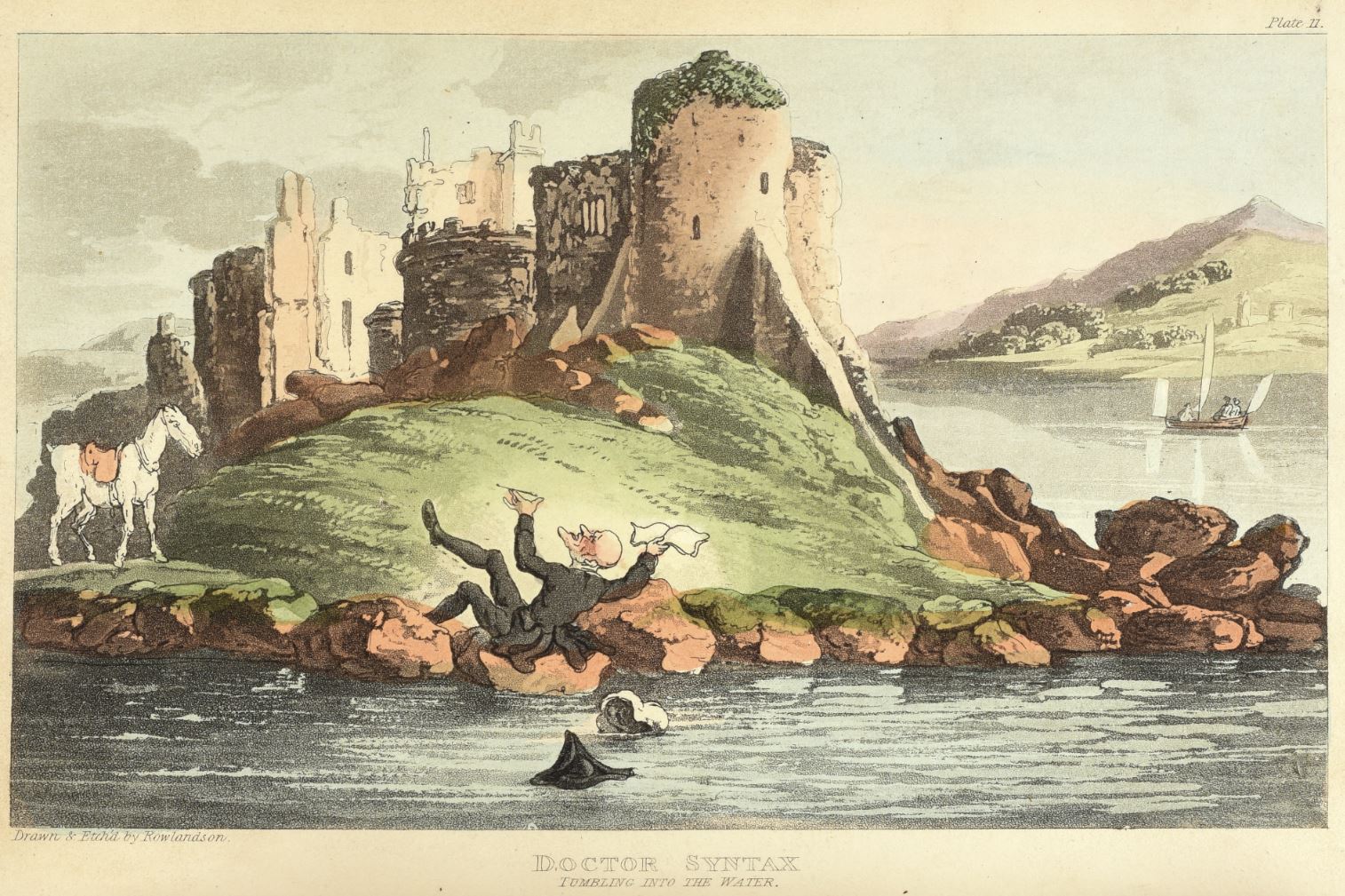
“Doctor Syntax Tumbling into the Lake,” by Thomas Rowlandson. One of the lovely full-page illustrations for this new version of The Tour of Doctor Syntax.
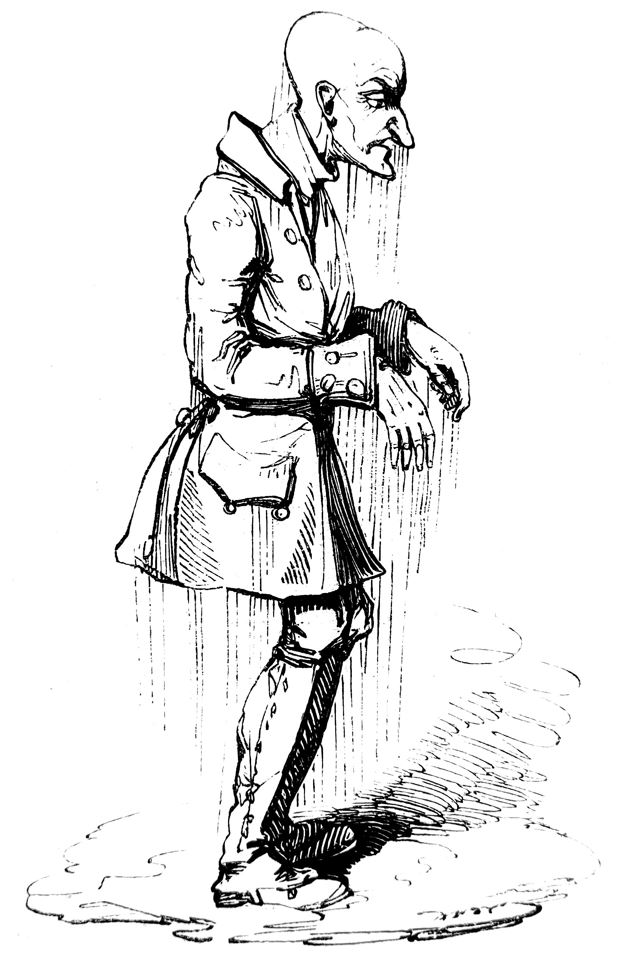
Victorian illustration, 1838, of the same scene, by Alfred Crowquill. The Tour of Doctor Syntax includes both the Rowlandson and Crowquill illustrations.

I also loved the illustrations. The editors chose the best versions they could find of each of the full-page, hand-colored pictures by Rowlandson that were the basis of the book. They added illustrations from a later Victorian version, as well as other entertaining and illuminating cartoons and pictures from the time.

Interview with the Editor

I’ll let Dr. Wiebracht himself tell you more about how this book came about.

Ben, please tell me about your class that produced this book.

The class is called “Jane Austen and Her World” and it’s designed for advanced juniors and seniors. The goal is to see Austen’s novels not as sealed-off masterpieces, floating in a historical vacuum, but as windows into her world. Most class days, our Austen reading is accompanied by shorter texts designed to create a sense of context and show how Austen was in conversation with her contemporaries. For instance:

  • We pair Austen’s account of Bath in Northanger Abbey with a number of late 18th-c. satires of Bath, 18th-c. dance music, and illustrations of the city by Rowlandson and others.
  • We pair Catherine’s pseudo-Gothic adventures in Vol. II with excerpts from The Monk, The Castle of Otranto, and The Mysteries of Udolpho.
  • We pair the private theatricals in Mansfield Park with a viewing of a performance of Lover’s Vows, as well as specimens of anti-theatrical criticism from the period, including a satire on private theatricals by Jane’s brothers!
  • We pair the discussion of landscape gardening in Mansfield Park with images from Humphry Repton’s famous “red books” showing “before and after” estate grounds.

The idea is to understand Austen in a deeper way by developing the practice of “reading outward.” And we incorporate that principle in our work for the class. Instead of the usual school essays, students work with me to create a critical edition of a neglected text from Austen’s time, with annotations and other resources that draw connections between the text and Austen’s life and work.

The class enrolled 16 students (the maximum). They hailed from all over the country and world: Japan, China, and many different U.S. states. This was my first time teaching the course, though I developed the core ideas in an Austen unit for a previous course. In the future, I will probably teach the course every three years. The book project in particular is a heavy lift, and I’m not capable of it every year!           

How did you end up studying Dr. Syntax along with Jane Austen?

I have to back up a bit here. In the course of an Austen unit for a previous class, students and I had created a critical edition of a long-forgotten 1795 poem called Bath: An Adumbration in Rhyme. We used that book to launch a new series called “Forgotten Contemporaries of Jane Austen.” Its goals are:

  • to recover neglected but valuable texts from Austen’s time, and
  • to trace new connections between Austen and her contemporaries.

As I was preparing my Austen class, I settled on Doctor Syntax (first brought to my attention in JAW by one of your articles!) for three reasons.

  • First, the poem had undeniable literary-historical importance – one of the all-out bestsellers of the Regency. A critical edition, I thought, was long overdue.
  • Second, many of its themes – from the plight of poor clergy to the “picturesque” – were major concerns of Austen’s novels, too.
  • Finally, the poem was simply a really good read. Combe’s verses are light, fun, and at times even touching, and Rowlandson’s accompanying illustrations are some of his best work. In every way, the poem deserved to be revived!

What do you hope readers will gain from the book?

There are a lot of things I hope people take away! One would be a deeper appreciation of just how engaged Austen was in the debates and issues of her day. Sometimes Austen is talked about as something of a provincial writer, sealed off from the wider Regency world, modestly toiling away on her “pictures of domestic life in country villages,” as she once put it. But when we keep in mind just how much of a smash hit Doctor Syntax was, and when we consider the many, many parallels between this work and Austen’s novels, which our edition lays out in detail, then we see Austen differently. She now starts looking like a very savvy writer, who understood what the major issues of the day were, what readers were interested in. To be sure, she stuck to her convictions and drew on her own experience and observations, but she did so in a way designed to appeal to a broad, national readership.

I’m also excited for people to meet this poet William Combe, who had one of the most interesting lives of any Regency writer. He was a remarkable literary talent. He doesn’t fit the mold of the “Romantic poet,” which is one reason he might be overlooked. Instead he offers a light, generous humor that shows us that Regency poetry wasn’t all about Byronic heroes and Wordsworthian dreamers. There was a sociable, comic side to the poetry of the period. Combe represents that comic side particularly well.

Finally, I would love it if this book inspired other teacher-scholars to undertake collaborative research with their students – especially at the upper-high-school level. There are so many benefits. For students, it’s a more rewarding and enjoyable approach to literary scholarship than the usual school essays. For teachers, it’s a welcome relief from the role of “judge/grader” – instead you get to teach through co-creation, as is done in most trades through the apprenticeship model. And for the reading public, there’s the benefit of the work produced! I am convinced that student involvement, with the right guidance and leadership from the teacher, leads to better scholarship. It certainly has in my experience.

By the way, while we don’t offer a Kindle edition, we do offer a free etext in the form of a downloadable PDF on our website. We decided from the beginning to be an open-access publisher, in part to make it easier for teachers with low-income students to assign our books. The best way to use the e-text is to enable the 2-page view in your pdf reader – that way the text and notes are neatly parallel, as in the physical book. The etext can also be used as a supplement to the physical book – for instance if you want to do a text search for a particular word.

How did you and the students share the work on this project?

Each student was responsible to annotate one of the poem’s 26 cantos, about ten pages of text. I did the other ten cantos myself. Students also had one or more additional responsibilities, which included:

  • Researching aspects of Combe’s life
  • Researching Gilpin and the picturesque
  • Compiling chronologies
  • Drawing maps
  • Designing the cover
  • Editing the text according to scholarly standards

My job was twofold. First, I offered regular feedback on work in progress, helping students learn how to navigate library databases, write good, concise annotations, etc. I also did the parts of the book that were a bit beyond the reach of high-school students, even excellent ones, which all the students who worked on this book were! For example, I wrote most of the introductory materials, as well as some of the trickier annotations. I helped with the final prose, too, to ensure continuity of voice. That doesn’t mean, though, that the best stuff is mine. Many of the best, most insightful annotations in the book are entirely by students, and every one of my students has some of their own writing, their own voice in the final book – which was a major priority for me. And just as students benefited from my feedback, I benefitted from theirs. They fully earned their editor credits in the final book.

Final Thoughts

Dr. Wiebracht and his class did an amazing job. I highly recommend this book, which is available on Amazon and from Jane Austen Books at a discount. I have not yet read the earlier book in the series, Bath: An Adumbration in Rhyme, but now I want to get hold of that and read it, too!

If you’re at the JASNA AGM this month, you can hear Ben and some of his students speak, and get them to sign your copy of the book. (Unfortunately I’m speaking in a slot opposite theirs, as well as other excellent speakers at that time, so you’ll have to choose! It’s always challenging.) Their talk is also available in the virtual version of the AGM.

The price is very reasonable for a book with color illustrations. I hope you’ll get a chance to enjoy and learn from this lovely book!

Read Full Post »

by Brenda S. Cox

“I have seen nobody in London yet with such a long chin as Dr Syntax”—Jane Austen, Letters, to Cassandra, March 2-3, 1814. (p. 267 in LeFaye’s 4th edition)

Frontispiece, The Tour of Doctor Syntax in Search of the Picturesque (1812), by William Combe and Thomas Rowlandson. Notice the chin! All of these images: Thomas Rowlandson, Public domain, via Wikimedia Commons

Jane Austen and her sister apparently enjoyed the adventures of Dr. Syntax, hero of a series of popular illustrated books. Usually, the text of a book is written, then the illustrator adds pictures. However, Dr. Syntax was created the other way around.

One of the most popular cartoonists of the day, Thomas Rowlandson, drew a series of pictures of Dr. Syntax on a journey “in search of the picturesque.” A publisher commissioned William Combe to write the text of the story, in narrative poetry, and the text and pictures were published together.

Austen could only have been familiar with the first book, published in 1812, Dr. Syntax: In Search of the Picturesque. In 1820 and 1821 sequels were published, The Second Tour of Dr. Syntax: In Search of Consolation, and The Third Tour of Dr. Syntax: In Search of a Wife.

Encyclopedia Britannica tells us, “All the Dr. Syntax books satirize the many 18th- and early 19th-century writers whose ‘Tours,’ ‘Travels,’ and ‘Journeys’ were vehicles for sententious moralizing, uninspired raptures, and sentimental accounts of amorous adventures.”  Satire: right up Austen’s alley!

I’ve read the first Dr. Syntax book and it’s a delight. You can find it on archive.org. (Which, by the way, is a great source for many old books.)

Doctor Syntax Tumbling into the Water. One of Dr. Syntax’s many adventures: Trying to get a good view, in order to sketch a castle, he falls into mucky water (Canto IX).

Dr. Syntax is a downtrodden, overlooked country curate, like Charles Hayter in Persuasion. Hayter, though, has connections to move him up in the church hierarchy. Poor Dr. Syntax does not. As a curate, he performs all the duties of a rector (like Mr. Collins and Henry Tilney) or a vicar (like Mr. Elton), but receives only a small portion of the income from the parish. An absentee rector elsewhere gets most of the money. On the first page, we see his responsibilities:

Of Church-preferment he had none,

Nay, all his hope of that was gone:

He felt that he content must be

With drudging in a Curacy,

Indeed, on ev’ry Sabbath-day,

Through eight long miles he took his way,

To preach, to grumble, and to pray;

To cheer the good, to warn the sinner,

And, if he got it,–eat a dinner:

To bury these, to christen those,

And marry such fond folks as chose

To change the tenor of their life,

And risk the matrimonial strife.

His income from these “weekly journeys” is only thirty pounds a year. (To get an idea of what this means, Mrs. Jennings thinks Edward Ferrars and his wife will have to live on a curacy of fifty pounds a year. She says, “Lord help ‘em! How poor they will be!”) Syntax complains that “that thankless parent, Mother Church” has overlooked his learning, giving jobs, as rectors and deans, to “fools.” The curate “feeds the flock, while others eat, the mutton’s nice, delicious meat.” Those others take the tithe income, while the curate serves the people of his parish.

Dr. Syntax also runs a school, to supplement his income, just as Jane Austen’s father did. Syntax laments rising expenses, though, saying the boys “delighted less in books than meat.” Even birch wood, used for caning disobedient boys, had gotten so expensive that often “To save the rod, he spar’d the child.” He did not punish them because he couldn’t afford to. (This is an inversion of the biblical advice in Proverbs 13:24, saying those who love their children will discipline them. It is often summarized as “spare the rod and spoil the child.”)

Dr. Syntax, Setting out on His Tour of the Lakes. His wife calls out “Good luck!” as his horse Grizzle awaits. The church that gives him a minimal income as a country curate is in the background (Canto I).

However, Dr. Syntax has a brilliant idea. He will go on a trip in search of the picturesque, drawing what he sees, and then write a book, making a lot of money–he hopes. His wife, dreaming of “silks and muslins fine,” happily sends him off on his faithful nag Grizzle.

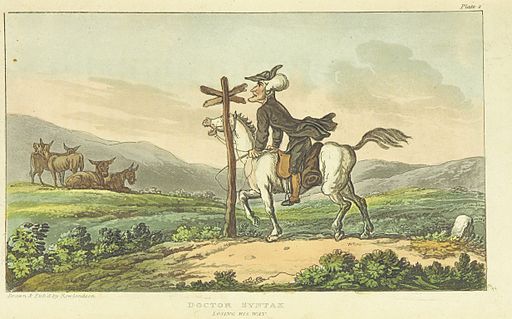
Dreaming of “future treasure,” he finds himself lost on an empty plain, with only a defaced, useless signpost. However, he sits down to draw a picture of it, totally revising the landscape to make it look “picturesque.” He says, “I’ll do as other sketchers do, Put anything into the view.” He is proud that finally he has “made a Landscape of a Post.”

Dr. Syntax, Losing His Way. He finds a post from which to create a landscape picture of the “picturesque.”

The book parodies the “picturesque,” just as Austen parodied it in Sense and Sensibility. Edward Ferrars says,

I like a fine prospect, but not on picturesque principles. I do not like crooked, twisted, blasted trees. I admire them much more if they are tall, straight, and flourishing. I do not like ruined, tattered cottages. I am not fond of nettles or thistles, or heath blossoms. I have more pleasure in a snug farm-house than a watch-tower,—and a troop of tidy, happy villages please me better than the finest banditti in the world.

Marianne, of course, is shocked.

Dr. Syntax, Stop’t by Highwaymen (Canto II). They leave him tied to a tree. Fortunately, his wife has sewn most of his money into his coat so they don’t get it.

Dr. Syntax, after creating his picturesque scene of a post, is attacked by robbers and tied to a tree—the first of his many adventures. Two passing women (whom he compares to Don Quixote’s Dulcinea) free him and give him a meal. While his horse roams, a jokester cuts off half its tail and ears, making it “a fit sight for country-fair.”

At an inn, Dr. Syntax copies down quotes from books (to use in his own book), while a dog runs off with half his breakfast. He has kissed the maid (by her invitation), but her jealous boyfriend pours boiling water into his shoes.

His adventures continue. He makes new friends along the way, one of which gives him a church living in the end. He draws many pictures, writes his story, and his book is published.

Dr. Syntax, Taking Possession of His Living. A friend met on his travels provides the connection he needs to get a good church living.

At the end, Syntax, now appreciated and with a good position,

“enjoy’d his hours of learned ease;

Nor did he fail to preach and pray,

To brighter worlds to point the way . . .

Thus the good Parson, Horse, and Wife,

Led a most comfortable life.”

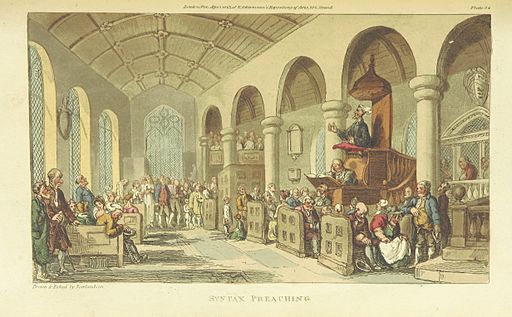
Dr. Syntax Preaching. Doctor Syntax gets the opportunity to show off his skills along the way.

I can imagine Jane Austen reading this book, laughing at the absurdities of Dr. Syntax’s trials and tribulations. She may have enjoyed, as I did, his more serious poetical sermon about man being “born to trouble,” which prepares us for “better worlds and brighter skies” (Canto XXI). The satirical language throughout the book is great fun. And she probably appreciated the delightful Rowlandson illustrations. You will find many entertaining passages in the book, if you get a chance to read it.

Dr. Syntax’s long, sharp chin certainly made an impression on Austen, so that she even looked for someone with such a chin in London!

Brenda S. Cox blogs on Faith, Science, Joy, and Jane Austen. She spoke on “Satirical Cartoons and Jane Austen’s Church of England” at the 2021 JASNA AGM. 

Read Full Post »

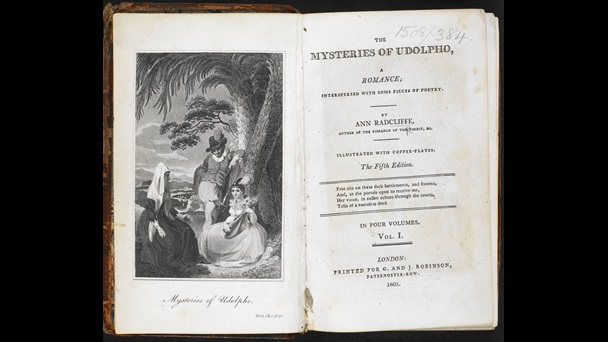
In Austen’s youth, sentimental romances and sensational Gothic novels full of dramatized heroines, dark towers and dungeons, and dangerous male villains became popular. These included novels like Charlotte Smith’s Emmeline (1788), which some believe is echoed in Austen’s early writings, and Ann Radcliffe’s The Mysteries of Udolpho (1794), which Austen later referenced in Northanger Abbey in its famous discussion of novels.

The Mysteries of Udolpho (1794) by Ann Radcliffe. Image: British Library.

These sensationalized novels were widely scorned by polite society and considered indecent because they were thought to promote sinful thoughts and immoral behavior. Lord Francis Jeffrey is quoted as saying the following about British fiction during the mid to late eighteenth century:

A greater mass of trash and rubbish never disgraced the press of any country than the ordinary novels that filled and supported the circulating library down nearly to the time of Miss Edgeworth’s first appearance… There had been Miss Burney’s Evelina and Cecilia…But the staple of our novel market was beyond imagination despicable, and had consequently sunk and degraded the whole department of literature of which it had usurped the name.

Lord Francis Jeffrey, Essays, 1853.

Indeed, much of the British literary world agreed. Samuel Johnson commented on the moral obligation of fiction writers to instruct the minds of young readers: “These books are written chiefly to the young, the ignorant, and the idle, to whom they serve as lectures of conduct, and introductions into life” (Johnson, Rambler No. 4).

Are They All Horrid?

So just what were these novels – this “greater mass of trash and rubbish” – that were so degrading to the public? In Northanger Abbey, Isabella Thorpe—a character we quickly learn is not the best guide or role model for any young person—lists them right out for us!

Isabella: “Dear creature! how much I am obliged to you; and when you have finished Udolpho, we will read The Italian together; and I have made out a list of ten or twelve more of the same kind for you.”

Catherine: “Have you, indeed! How glad I am! — What are they all?”

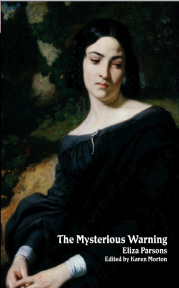
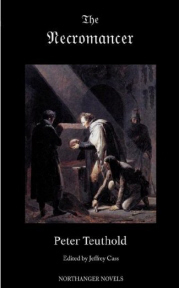
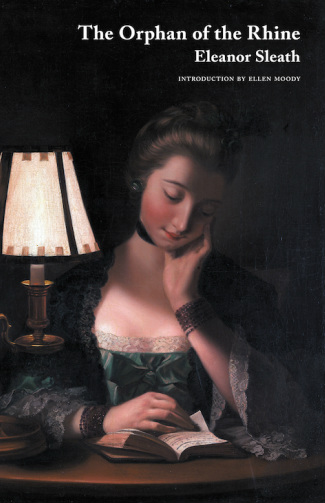
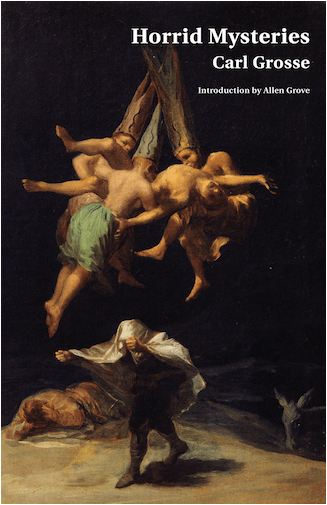
Isabella: “I will read you their names directly; here they are, in my pocket-book. Castle of Wolfenbach, Clermont, Mysterious Warnings, Necromancer of the Black Forest, Midnight Bell, Orphan of the Rhine, and Horrid Mysteries. Those will last us some time.”

Catherine: “Yes, pretty well; but are they all horrid, are you sure they are all horrid?”

Isabella: “Yes, quite sure; for a particular friend of mine, a Miss Andrews, a sweet girl, one of the sweetest creatures in the world, has read every one of them.”

Northanger Abbey, Jane Austen
Catherine Morland (Felicity Jones), Northanger Abbey, 2007.

Yes, that’s right. Austen gives us, her readers, the exact names of these “horrid” novels that we should definitely read avoid. But what exactly made the books on Isabella’s must-read list so deliciously “horrid”? Let’s find out!

Each of these books is now widely available online as e-texts, on e-readers, and even in print. Thanks to publishers such as Valencourt Books, we have access to these “scandalous” novels, giving them—and their genre—a proper place in the literary canon (and allowing us to more fully understand Austen’s work on Northanger Abbey).

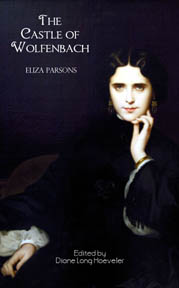
The Castle of Wolfenbach (1793) by Eliza Parsons

The Castle of Wolfenbach by Eliza Parsons (1793) is the novel that has been printed and reprinted the most, as it is now considered an important literary work from Austen’s day and a “highly readable” Gothic novel of its time.

No longer to be regarded as a footnote to the literary history of Jane Austen’s Northanger septet, Eliza Parsons’s Castle of Wolfenbach (1793) now secures its proper place as both a work of historical importance and a highly readable Gothic novel in its own right with this fine edition. Diane Long Hoeveler’s thoughtful introduction opens new perspectives on Parsons’s achievement in the field of what might be called “international” Gothic in her creation of an “ideologically bifurcated female Gothic, part liberal and part conservative” in its political outlook. This new edition both supplants earlier editions of this pivotal Gothic and tells us much about how the Gothic novel evolved in the late 1790s as an historical reflector of the fears, beliefs, and prejudices of  a revolutionary, yet reactionary, era.

-Frederick S. Frank, Professor Emeritus of English, Allegheny College, and author of The First Gothics, Valancourtbooks.com

Book Description: Matilda Weimar flees her lecherous and incestuous uncle and seeks refuge in the ancient Castle of Wolfenbach. Among the castle’s abandoned chambers, Matilda will discover the horrifying mystery of the missing Countess of Wolfenbach. But when her uncle tracks her down, can she escape his despicable intentions?

A sampling of covers for The Castle of Wolfenbach.

One of the seven “horrid novels” named in Jane Austen’s Northanger AbbeyThe Castle of Wolfenbach is perhaps the most important of the early Gothic novels, predating both The Mysteries of Udolpho and The Monk.

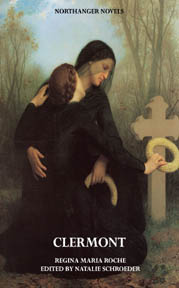
Clermont (1798) by Regina Maria Roche

Book Description: Clermont is the story of Madeline, a porcelain doll of a Gothic heroine, who lives in seclusion from society with her father, Clermont, whose past is shrouded in mystery. One stormy night, their solitude is interrupted by a benighted traveller, a Countess who turns out to be a friend from Clermont’s past.

Madeline goes to live with the Countess to receive her education, but her new idyllic life soon turns into a shocking nightmare. Ruffians attack the gentle Countess, and Madeline is assaulted in a gloomy crypt. And to make matters worse, a sinister stranger appears, threatening to reveal the bloody truth of Clermont’s past unless Madeline marries him. Can she avoid the snares of her wily pursuers, solve the mystery of her father’s past, and win the love of her dear De Sevignie?

The Mysterious Warning (1796) by Eliza Parsons

Book Description: The good old Count Renaud is dead, and his will makes the degenerate Rhodophil his heir, disinheriting his other son Ferdinand, who has married against his father’s wishes. Rhodophil promises to share his new riches with his younger brother and his wife Claudina, but Ferdinand hears a mysterious voice from beyond the grave, warning him to flee his brother and his wife to save himself from sin and death!

Ferdinand obeys the supernatural warning and sets out to find fortune and adventure. In the course of his quest he will encounter a recluse in a ruined castle with a horrible secret, find himself captured and imprisoned by the Turkish army, and encounter one of Gothic literature’s most depraved female characters, the monstrous Fatima. And if he survives all these dangers, Ferdinand must return to Renaud Castle to solve the mystery of the ghostly voice and uncover the terrible truth about his wife and his brother!

The Necromancer; or, The Tale of the Black Forest (1794) by Lawrence Flammenberg

Book Description: “The hurricane was howling, the hailstones beating against windows, the hoarse croaking of the raven bidding adieu to autumn, and the weather-cock’s dismal creaking joined with the mournful dirge of the solitary owl…”

The Necromancer consists of a series of interconnected stories, all centering on the enigmatic figure of Volkert the Necromancer. Filled with murder, ghosts, and dark magic, and featuring a delirious and dizzying plot that almost defies comprehension, The Necromancer is one of the strangest horror novels ever written.

One of the earliest Gothic bestsellers, The Necromancer was first published in 1794, and after more than two centuries still retains the power to thrill and fascinate readers.

The Orphan of the Rhine (1798) by Eleanor Sleath

Book Description: Seduced and betrayed by a rake, Julie de Rubine lives in seclusion with her infant son, Enrîco. One day, their calm retirement is interrupted by the Marchese de Montferrat, who promises to provide for Julie and her son if she agrees to care for an unfortunate orphan, Laurette, whose origin is shrouded in mystery. Under the assumed name of Madame Chamont, Julie raises the two children, whose youthful friendship eventually blossoms into love.

As Laurette matures, she resolves to learn the identity of her real parents. Her only clues are a painted miniature of a beautiful lady and the whisperings of a sinister monk, who warns her to avoid the Marchese de Montferrat. But when Julie is kidnapped by banditti and Laurette is taken to the gloomy castle of the lascivious Marchese, will she be able to uncover the truth and marry her beloved Enrîco, or will she fall victim to the lustful Montferrat?

The rarest of the seven “horrid novels,” Eleanor Sleath’s The Orphan of the Rhine (1798) is indebted to Ann Radcliffe’s The Mysteries of Udolpho (1794) and Regina Maria Roche’s The Children of the Abbey (1796) but possesses a charm and fascination all its own. 

Horrid Mysteries (1796) by Carl Grosse

Book description: A bizarre work whose labyrinthine plot defies summary, Horrid Mysteries (1796) recounts the experiences of Don Carlos and his friend, the Marquis of G******, who become entangled in the web of a secret society bent on world domination. As the heroes flee from place to place across Europe, the agents of this dark confederacy, seemingly possessed of supernatural powers, are always at their heels—and death lies around every corner!

Unavailable for nearly 50 years, this unabashedly lurid Gothic novel written by an enigmatic German who styled himself the “Marquis of Grosse” and “Marquis of Pharnusia” returns to print at last as the seventh and final reissue in Valancourt’s series of the rare Gothic novels mentioned in Jane Austen’s Northanger Abbey.

Gothic Novels and Jane Austen

For more on this topic, our own Tony Grant has also written about Austen’s influences and her work on Northanger Abbey in his article, Netley Abbey and the Gothic. In his article, Tony also references an article by John Mullan on the fascinating topic of Gothic literature that is well worth your time: The Origins of the Gothic.

In his Rambler No. 4, Johnson said that the “task” of “present writers” is to write books that “serve as lectures of conduct, and introductions into life” so that “nothing indecent” should be set in front of the eyes of young men and women.

As sensational, Gothic novels were being written, other authors were at the same time attempting to raise the bar and write novels that were both entertaining and instructive. Many of the books in each of these genres are novels with which Austen herself was familiar or, in many cases, would have read. Next month, I’ll be talking about didactic fiction—writing that was meant to provide positive role models and good morals—and the influence it had on Austen’s writing.


RACHEL DODGE teaches college English classes, gives talks at libraries, teas, and book clubs, and writes for Jane Austen’s World blog and Jane Austen’s Regency World magazine. She is the bestselling author of The Anne of Green Gables Devotional: A Chapter-By-Chapter Companion for Kindred Spirits and Praying with Jane: 31 Days Through the Prayers of Jane Austen. Her newest book The Little Women Devotional is now available. You can visit Rachel online at www.RachelDodge.com.

Read Full Post »