Feeds:
Posts
Comments

Archive for the ‘Fashions’ Category

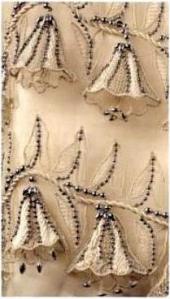
Embroidered bells on Princess Charlotte's court gown.

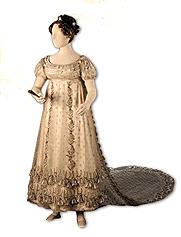
Several years ago I featured Princess Charlotte’s bellflower court dress, a sumptuous creation that must have taken a boatload of seamstresses untold hours of work to complete. I had the privilege of viewing this fragile dress when it was on exhibit at the Museum of London, and I often wondered how the bell flowers (which were worked with silver thread and tiny glass beads) were made.

The court dress, 1814. Image @Museum of London

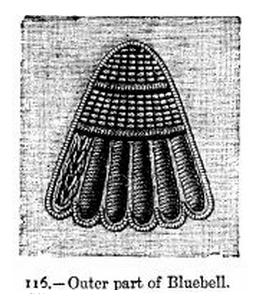
Mrs. Beeton’s Book of Needlework (1870) provides a glimpse. Although the illustrations are rough compared to the royal example, one begins to understand how time consuming this needlework was for the women who labored long hours in poor lighting conditions.  The book describes the process for bluebells, which were embroidered in a raised satin stitch. The pieces were worked separately, then half of the embroidered piece was sewn onto an outlined embroidered shape on the fine fabric. This shape represented the inner part of the flower.

Bluebell embroidered work.

The first two illustrations from Beeton’s book show 1) the complete bluebell and 2) the inner part of the flower with the overcast outline.

The flat outer part of the bluebell. This piece is fastened onto the outline.

The second illustration shows the raised outer part as a flat piece. This second embroidered piece was fastened in a three dimensional way onto the overcast outline. Then the excess material was carefully cut away without damaging the underlying fabric. (This job must have been tougher and more delicate with Princess Charlotte’s gauzy net dress.)

I recall clearly seeing that some of the bellflowers had been torn away or were missing – and wondered if someone had stepped on Princess Charlotte’s train, or if she had snagged the hem on something.

Read Full Post »

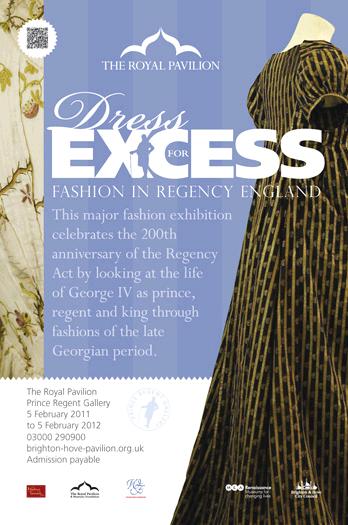
Dress for Excess: Fashion in Regency England, opened on February 5 and will run for a full year. The cost of the exhibition is free for those who purchase tickets to see the Royal Pavilion & Museums at Brighton.

The fashions look at the life of George IV as Prince, Regent and King through the clothes of the late Georgian period and how they have influenced fashions today. The king’s silk and velvet coronation robe, trimmed in ermine and over 16 feet in length, will be on public display for the first time in 30 years. Other clothes in the exhibition include a dandy’s costume, military uniform worn at the Battle of Waterloo, and neoclassical influenced silk and muslin gowns.

The costumes are displayed in rooms in the Royal Pavilion. The links below feature a number of beautiful examples in the exhibition. Lucky is the person who plans to visit Brighton within this calendar year!

Read Full Post »

She lost her pattens in the muck
& Roger in his mind
Considered her misfortune luck
To show her he was kind
He over hitops fetched it out
& cleaned it for her foot…
From the Middle Period Poems of John Clare (1820s)

It is commonly acknowledged that country roads in the day of Jane Austen became muddy and rutted in heavy rains, and therefore nearly impassable. In cities and towns, streets required constant sweeping of horse dung and dirt by street sweepers. Ladies wearing long white gowns and soft satin or kid slippers were constantly dodging dirt, protecting their hems from wet grass, and finding ways to walk on roads and cobblestones whose condition were poor at best.

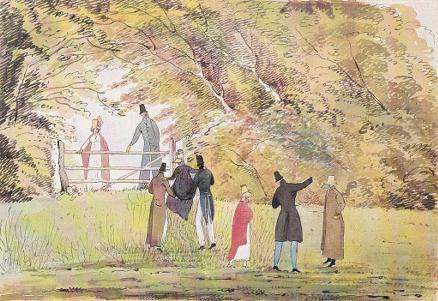
Diana Sperling's watercolor of a walk to a neighbor's house in mud

Diana Sperling painted her delightful watercolor sketches between 1812 and 1823. In two of the paintings, she shows precisely how difficult it was for ladies (and gents) to walk over poorly maintained roads – or no roads at all! One imagines that Jane Austen and her family, who were country gentry like the Sperlings, encountered similar difficulties when walking.

Charles Sperling conveys a lady over wet grass, by Diana Sperling.

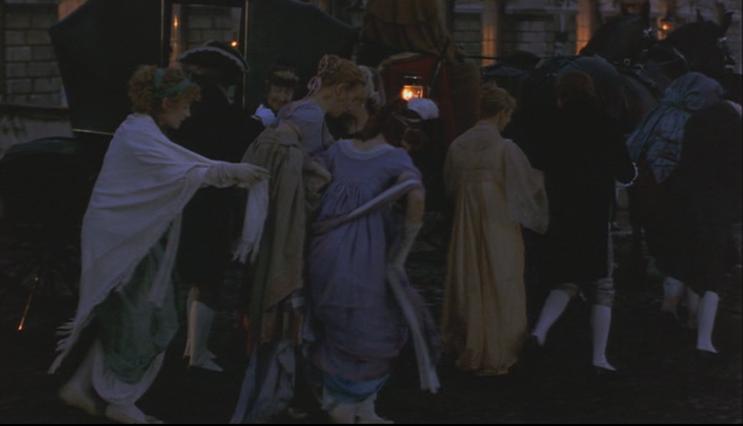
In Ang Lee’s Sense and Sensibility, one can see Marianne in particular holding up her skirts and daintily traipsing over a London street as the party walks from their carriage to the Dashwood’s ball in London. I found this scene particularly interesting, for this is one of the few films that depict how difficult it was for ladies to keep their garments clean as they walked down London’s streets. Regency women must have collectively heaved a sigh of relief when hemlines became fashionably short.
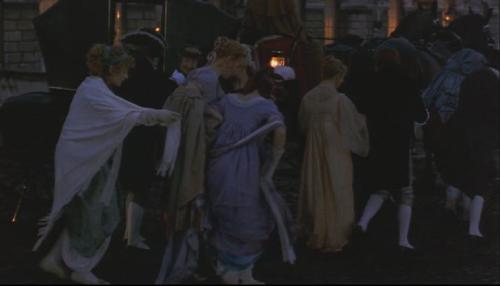
 

Marianne Dashwood (Kate Winslet) holds up her skirt, shawl, and reticule as she walks gingerly towards the ball.
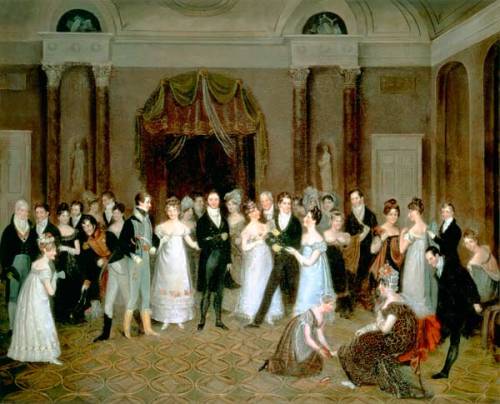


In Rolinda Sharples' Clifton Assembly Room (1817), one can see the lady on the lower right changing her slippers in the cloak room.

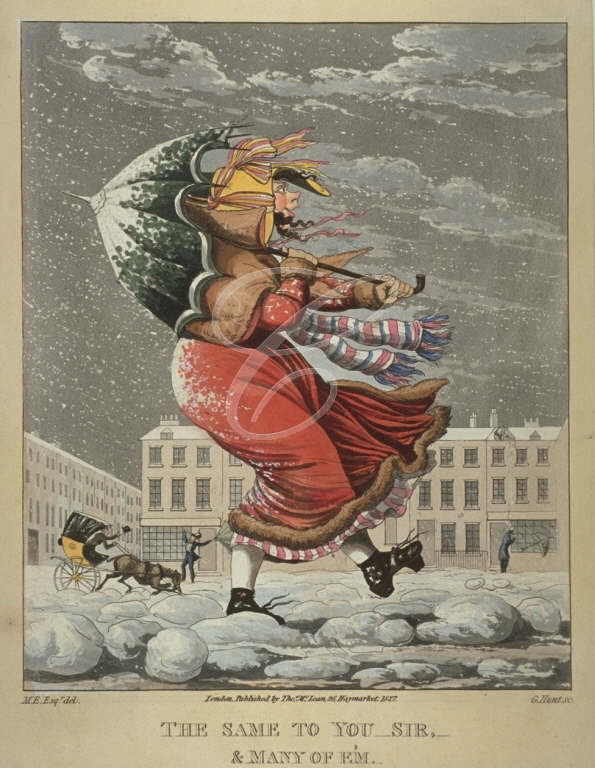
The problem of keeping one’s feet and skirts clean was solved by wearing pattens, although this practice was rapidly fading in the early 19th century.
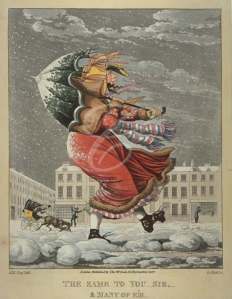
 

Lady wearing pattens in snow. Image @City of London

In A Memoir of Jane Austen, her James Edward Austen Leigh wrote about his aunts Cassandra and Jane:

The other peculiarity was that when the roads were dirty the sisters took long walks in pattens. This defence against wet and dirt is now seldom seen. The few that remain are banished from good society and employed only in menial work…

As an illustration of the purposes which a patten was intended to serve, I add the following epigram written by Jane Austen’s uncle Mr Leigh Perrot, on reading in a newspaper of the marriage of Captain Foote to Miss Patten

Through the rough paths of life,

with a patten your guard,

May you safely and pleasantly jog,

May the knot never slip,

nor the ring press too hard,

Nor the Foot find the Patten a clog.

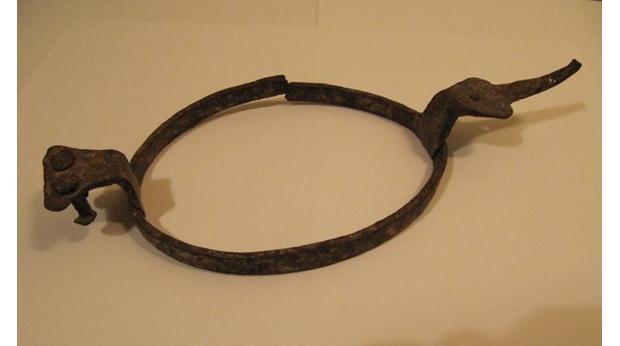
18th century fragment, iron shoe patten

A patten was an oval shoe iron that was riveted to a piece of wood and then strapped to the underside of a shoe. This unwieldy and loud contraption served to raise the shoe out of the mud or a dirty street.  Even a clean street would sully the hems of delicate white muslin gowns, and thus ladies would commonly wear pattens. However, these contraptions were loud. As Jane Austen described in Persuasion:

“When Lady Russell, not long afterwards, was entering Bath on a wet afternoon, and driving through the long course of streets from the Old Bridge to Camden Place, amidst the dash of other carriages, the heavy rumble of carts and drays, the bawling of newsmen, muffin-men, and milk-men, and the ceaseless clink of pattens, she made no complaint..”
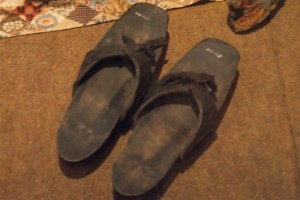
Early 19th century pattens

Pattens had been banned from churches for some time. As early as 1390, the Diocese of York forbade clergy from wearing pattens and clogs in both church and in processions, considering them to be indecorous: “contra honestatem ecclesiae”*. An 18th century notice in St Margaret Pattens, the Guild Church of the Worshipful Company of Pattenmakers, requested that ladies remove their pattens on entering; other English churches had similar signs, and in one case, provided a board with pegs for ladies to hang them on. One surmises that churches banned the use of pattens because of their loud clatter on stone floors.
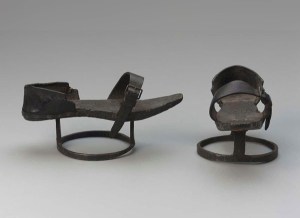
Early 19th century pattens. Image @Museum of Fine Arts, Boston

Constance Hill, who with her sister followed in the footsteps of Jane Austen a century after Jane’s death, described the noise of these raised iron clogs:

It is true that in bad weather ladies could walk for a short distance in pattens, which were foot-clogs supported upon an iron ring that raised the wearer a couple of inches from the ground. But these were clumsy contrivances. The rings made a clinking noise on any hard surface, and there is a notice in the vestibule of an old church in Bath, stating that “it is requested by the church-wardens that no persons walk in this church with pattens on.” – Constance Hill, Jane Austen: Her Homes and Her Friends

Pattens were clumsy platforms that raised the shoe a few inches from the ground. The most common patten after the 17th century was made from a  flat metal ring which made contact with the ground. The ring was then attached to a metal plate nailed into the wooden sole. By the 18th and 19th centuries, men’s shoes had thicker soles and the wealthier gentlemen tended to wear riding boots, and thus pattens were worn only by women and working-class men in outdoor occupations.  Soon, pattens were abandoned by ladies as well, and only the lower classes wore them as they went about their duties.
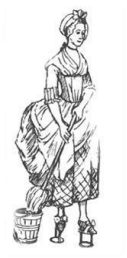
Pattens worn by a maid, 1773

There were three main types of pattens: one with a wooden ‘platform’ sole raised from the ground by either with wooden wedges or iron stands. The second variant had a flat wooden sole often hinged. The third type had a flat sole made from stacked layers of leather.*
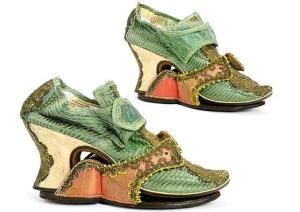
18th century silk shoes protected by pattens. Image @Wall Street Journal

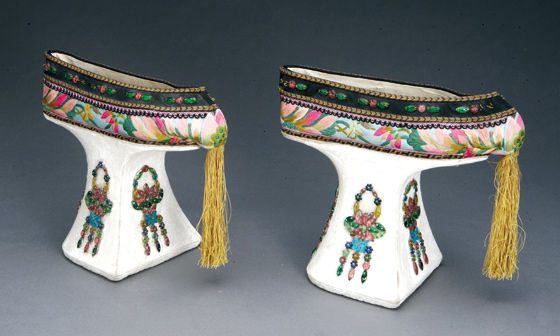
One can imagine the sad state of paths and roads the world over, which necessitated the use of such clumsy footwear in England, America, Turkey, and China, to name a few countries.

Late 19th century Chinese porcelain patten shoes

Images of pattens over the centuries:

Read Full Post »

Downton Abbey, presented on PBS Masterpiece classic this month, is one of the most expensively produced mini-series for television next to Brideshead Revisited. The sets and costumes are lavish, and the viewer can readily see that everything possible has been done to recreate the Edwardian world.

But even huge budgets have their limits, for creating new costumes for every character in the production would have been prohibitive. The website, Recycled Movie Costumes, and an article in the Daily Mail point to a few outfits that were worn in other productions.  This custom is common, and has been pointed out on this blog before in Recycled Fashions in Emma 2009.  Around 2/3 of the costumes used in Downton Abbey were used before, but only a few have been expressly identified so far.

The dress worn by Laura Michael (Lady Edith) was also used in A Room With a View, 2007. At left is Elizabeth McGovern as the Countess

Elaine Cassidy in A Room With a View, 2007

Compare the necklace worn by Michelle Dockery as Lady Mary to ...

...Monica Belluci's in Brotherhood of Wolves


Lady Mary (Michelle Dockerey, between Maggie Smith and Laura Michaels) wears the same dress as ...

... Radha Mitchell in Finding Neverland

You can look for Regency costumes that have been recycled in this link. The Daily Mail mentioned that one certain brown dress has been used in seven productions in the past 15 years, including Pride and Prejudice and Little Dorrit. I wonder which one it is?

As you watch Downton Abbey tonight, perhaps you can spot a few recycled outfits on your own and inform Recycled Films of your find. Learn more about the series on PBS Masterpiece Classic.

More posts about Downton Abbey on this site:

Read Full Post »

Copyright @Jane Austen’s World

Looking at the images in this post, one can only imagine how difficult it was for a woman in full evening dress (or court dress) to move around. Between taking care of her shawl, reticule, dance card, and fan, she had to walk upright and sedately so that her head feathers did not topple over after an abrupt movement or caught fire under chandeliers ablaze with candles.

1794-95 Court Dress

Examining the above image, one can readily see that these costumes were designed for high-ceilinged rooms that were opened by high double doors.

A lady's wig catches fire. Thomas Rowlandson. Image @Yale University

In this dramatic image, Thomas Rowlandson catches a moment of real danger both for the lady whose wig (and feathers) caught fire, and for the guests, who might have been trapped in a house fire, for water to put out flames was not easily obtained.  In the late 18th century The London Times reported on several more incidents in which ladies found ways to accommodate their head feathers, or in which the feathers (and mother nature) got the best of them.

Lady Godina's Rout

At all elegant Assemblies there is a room set apart for the lady visitants to put their feathers on, as it is impossible to wear them in any carriage with a top to it. The lustres are also removed upon this account, and the doors are carried up to the height of the ceiling. A well-dressed Lady who nods with dexterity can give a friend a little tap upon the shoulder across the room without incommoding the dancers. The Ladies feathers are now generally carried in the sword case at the back of the carriage.  – Times,  Dec 29, 1795.

Tippies of Newton, 1796 caricature by Richard Newton. Image @Wikimedia Commons

A young lady only ten feet high was overset in one of the late gales of wind in Portland Place, and the upper mast of her feather blown upon Hampstead Hill.  “The maroon fever has been succeeded by a very odd kind of light-headedness, which the physicians call ptereo mania, or feather folly.” The Ladies now wear feathers exactly of their own length, so that a woman of fashion is twice as long upon her feet as in her bed. –  Times, Dec 30, 1795.

1796, High Change in Bond Street, Gillray

We saw a feather in Drury Lane Theatre yesterday evening that cost ten guinea. We should have thought the whole goose not worth the money.  – Times, Jan 6, 1796.

A Modern Belle Going to the Rooms at Bath, James Gillray, 1796. Image @Wikimedia Commons

Here is a contrivance by which A Modern Belle going to the Rooms or Balls can go fully dressed with her feathers fixed. There is to be seen in Gt Queen Street a Coach upon a new construction. The Ladies set in this well and see between the spokes of the wheels. With this contrivance the fair proprietor is able to go quite dressed to her visits, her feathers being only a yard and a half high. –  Times, Jan 22, 1796.

Vis a vis Ladies Coop, 1776

The Times described predicaments regarding head feathers that were not new. Note how twenty years before, both high wigs AND feathers were accommodated. And, indeed, feathers, whether made from ostrich, emu, goose, or peacock, remained popular as a head dress for years to come.

The headdress, while always including a veil, also required feathers as part of it, although, the number and size of the feathers varied with the Monarchy. At the time of Queen Charlotte, young ladies wore one single towering ostrich feather, but through the years, the number of feathers required increased. By the Edwardian Era, the widespread use of feathers to decorate hats and bonnets began the passage of laws that restricted using certain types of bird’s feathers.*

Queen Victoria hated small feathers, so orders were issued that Her Majesty wanted to see the feathers as the young lady approached. Later in Queen Victoria’s reign, as well as in the court of Edward VII, the mandated headdress was three feathers arranged in a Prince of Wales plume–that is, the center feather was higher than the two on each side of it–and it was worn slightly on the left side of the head. Tiaras were worn by married women, and it was extremely difficult to keep the feathers in place, especially during the curtsy.

More on the topic:

Read Full Post »

« Newer Posts - Older Posts »