Feeds:
Posts
Comments

Archive for the ‘Georgian Life’ Category

Inquiring readers, Tony Grant from London Calling has contributed yet another wonderful article. Inspired by my visit to Williamsburg a few weeks ago, he decided to research some of the buildings in more depth.

The Sir Christopher Wren building at the William and Mary College in Virginia is the oldest academic building in the United States. It was built between 1695 and 1700. However its origins began long before that and a long and tortuous path was followed before the construction of the college could be  begun.
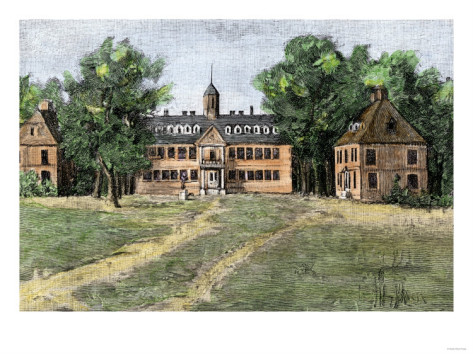
1700s view of William & Mary college with Wren building. @All Posters. Click on image to go to the site.

1700s view of William & Mary college with Wren building. @All Posters. Click on image to go to the site.

In 1618 The Virginia Company of London ordered the construction of a university at Henrico, a few miles south of the present day city of Richmond. By 1619 Sir Edwyn Sandys the treasurer of The Virginia Company reported that £1,500 had been collected and also that every bishop in England had been asked to collect money from their parishioners for the construction of the university. In July 1619, workmen were sent  from England to construct the university. In 1622 an Indian uprising destroyed Henrico. In 1624 Virginia became a Royal Colony and the licence of The Virginia Company was revoked. This removed the charter allowing the building of the university. In 1661 The General Assembly authorised the purchase of land for the building of a college. Nothing happened until 1690 when the Church of England clergy in Virginia put forward propositions for the construction of a college. The reverend James Blair was sent to England in 1691 to petition the new King and Queen, Willam and Mary, to grant a charter to establish a college. The King provided £1,985 14s 10d for the construction of a college to be named William and Mary. There was also a 1d tax placed on all tobacco sold to other countries apart from Britain to raise money. In 1693 a tract of land was purchased for £170 from Captain Thomas Ballard. In May 1694 The Royal College of Arms, which is situated beside St Paul’s Cathedral in the City of London, created a coat of arms for the college. In 1695 the first bricks were laid of the foundation of the college.
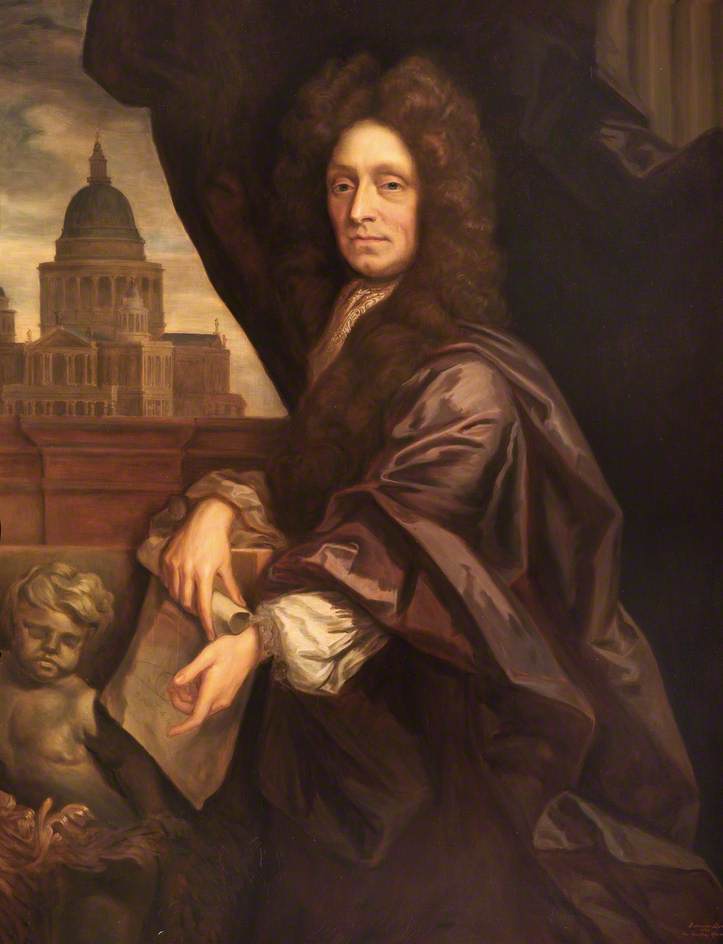
Sir Christopher Wren

Sir Christopher Wren

This original building of the college is thought to have been designed by Sir Christopher Wren. There is no documentary evidence to prove this but there are some arguments in favour of Wren being the architect. Wren was the King’s chief architect and William and Mary authorised the construction of the college. The Church of England used Wren as their chief architect in London and it was the Church of England ministers in Virginia who instigated the building of the college. Wren was also responsible for many other important buildings throughout Britain. Wren was the architect who virtually rebuilt London after the Great Fire in 1666.
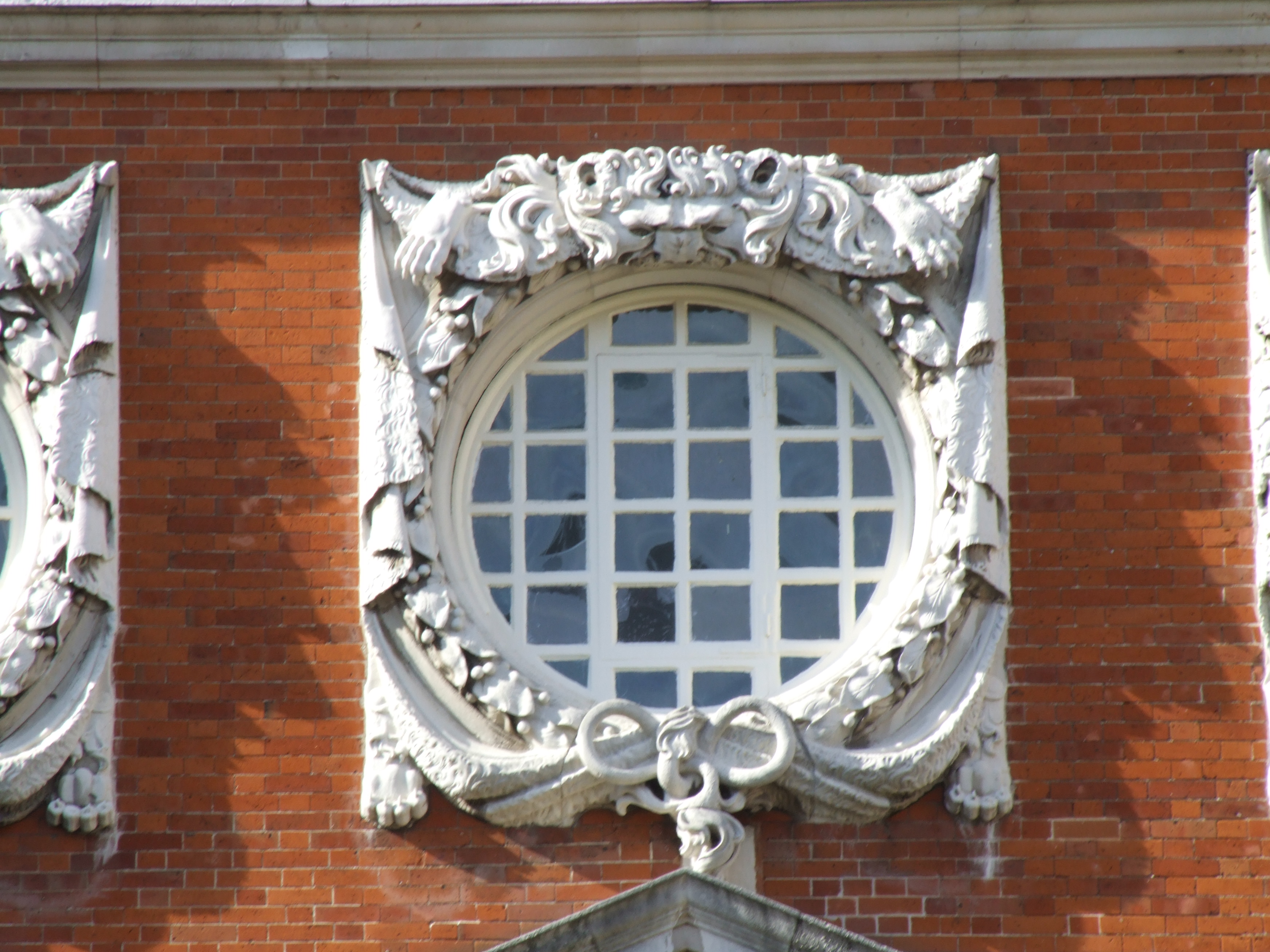
Detail of a Wren window

Detail of a Wren window

Sir Christopher Wren was a scientist and mathematician and became one of England’s most famous architects. He was responsible for designing and building over fifty London churches and he was the builder of St Paul’s cathedral in the city. He was born on October 20th 1632 in East Knoyle, a village in Wiltshire in Southern England. His father was the local rector. His father later moved to Windsor and Christopher went to Westminster School, situated next to Westminster Abbey and then went on to Oxford University. He had a talent for mathematics and also inventing things. In 1657 Wren was appointed as the professor of astronomy at Gresham College in London and four years later he became the professor of astronomy at Oxford.

he Royal College of Arms next to St Pauls where the coat of arms for William and Mary College was created. Image @Tony Grant

The Royal College of Arms next to St Pauls where the coat of arms for the College of William and Mary was created. Image @Tony Grant

In 1662 he was one of the founding members of The Royal Society along with other great mathematicians and scientists. From his interest in physics and mathematics he developed an interest in architecture. In 1664 and 1665 he was commissioned to build the Sheldonian Theatre in Oxford and also the chapel of Pembroke College Cambridge. Architecture then became his main interest. He visited Paris and became interested in the baroque style. In 1666 The Great Fire of London destroyed much of the old city. This provided a great opportunity for Wren. He drew up designs for a grand new city. However, many of his ideas did not come to fruition because the owners of different parcels of land, in the city, did not want to sell. Wren was able, though, to design fifty-one churches and St Paul’s Cathedral.
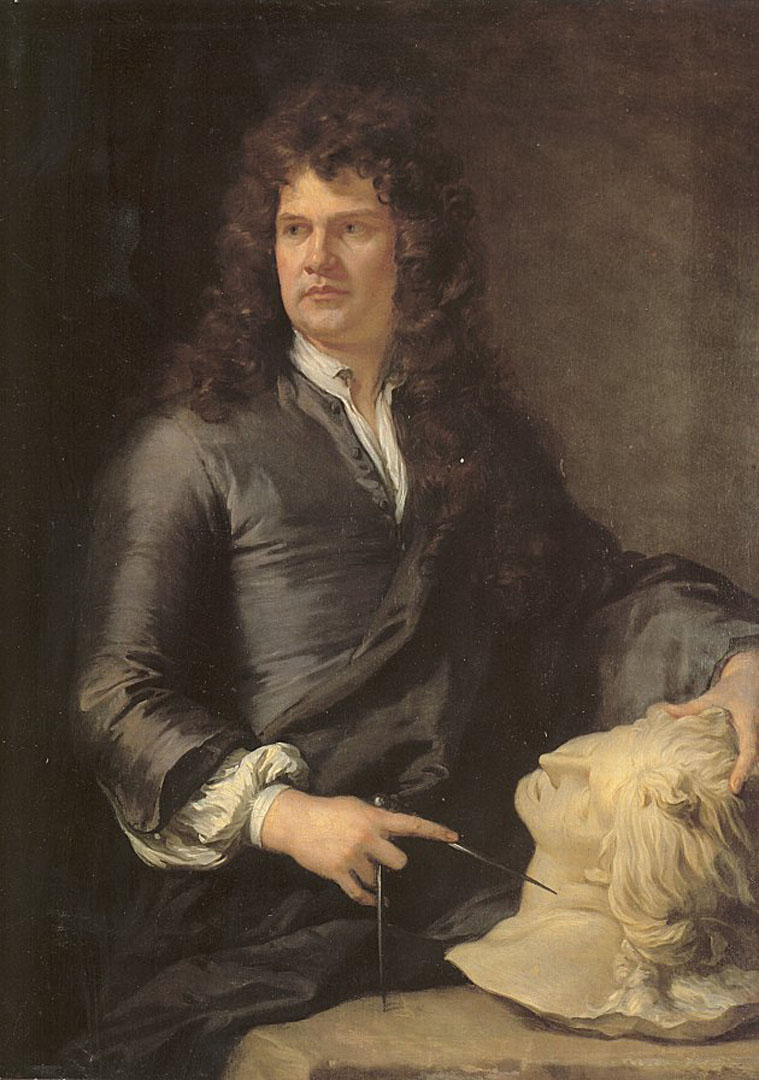
Grinling Gibbons

Grinling Gibbons

Returning to the possibility of Wren designing the William and Mary College in Virginia, it is interesting to compare Wren’s known buildings with the college to see what similarities in style there might be. I referred to the efforts to raise the finances to build the college and maybe there was a difficulty here. When you compare what Wren built here in England with William and Mary College there are many discrepancies. William and Mary College looks to be a very downmarket version of Wren’s classic buildings.
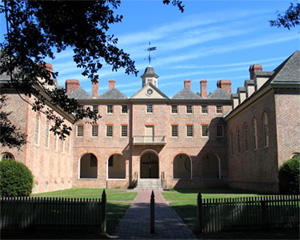
Wren Building. @William & Mary's website. Click on image to see the source.

Wren Building. @William & Mary’s website. Click on image to see the source.

There are some similarities in design and proportion though. Whoever did design William and Mary College could at least have had Wren as an inspiration. Wren worked closely with designers such as Grindling Gibbons, the wood carver and John Groves, the plasterer.
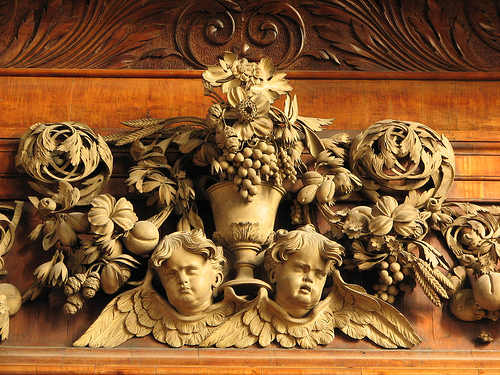
Carving design by Grinling Gibbons

Carving design by Grinling Gibbons

They both created the most ornate ceilings, wood panelling and facia stone carvings on Wrens buildings. These people were the most prominent and influential designers of their day. They would have charged a premium price for their talents and skills.From the pictures of William and Mary College these features are not present.
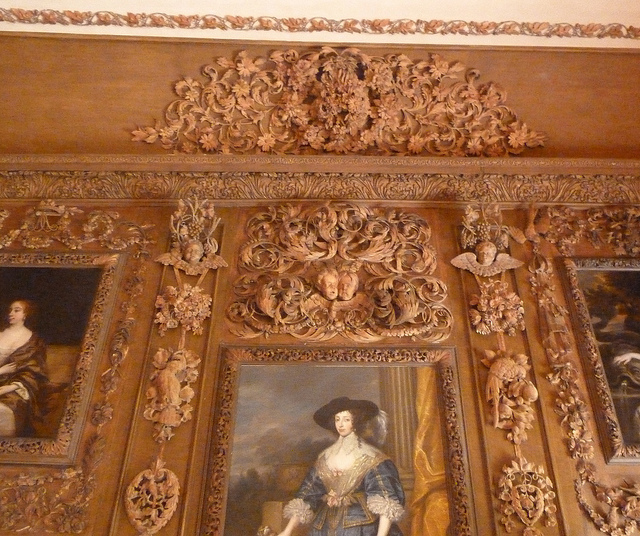
Details of wood work by Grinling Gibbons

Details of wood work by Grinling Gibbons

William and Mary, who the college is named after, provide an insight into the turbulent history after the even more turbulent times of the English Civil War.

William Henry Stuart was born on November 14th 1650 in the Hague in the Netherlands. He was the son of William II of Orange. In 1672 William was appointed Stadholder(chief magistrate)and captain general of the Dutch forces  to resist a French invasion of the Netherlands. In 1677 he married his cousin Mary, the eldest daughter of James, Duke of York who became James II of England. It was a diplomatic and politically inspired marriage intending to repair the rift between England and the Netherlands after the Anglo Dutch Wars. James II was a very unpopular monarch, not least because he was a catholic. The English Parliament tried to oppose James and wanted to reduce his powers. They secretly invited William and Mary to come to England and rule as joint monarchs. William landed at Torbay on 5th November 1688, a very nice Devon coastal resort these days, with an army of 14,000 troops. With local support this increased to 20,000 men. They advanced on London. This was called the Glorious Revolution. James fled to France and William and Mary were crowned as William III and Mary II. Parliament then passed the Bill of Rights which prevented a catholic taking the throne again and parliament also limited the powers of the monarch.
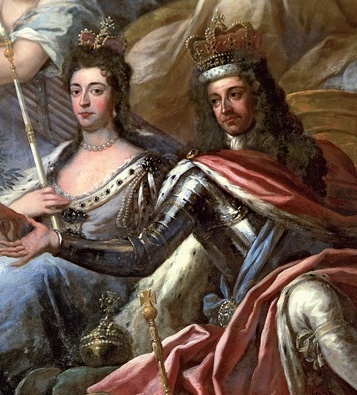
William and Mary

William and Mary

William and Mary did not like each other. William had a dour personality. He was asthmatic, twelve years older and several inches shorter than Mary and he was a homosexual by nature.
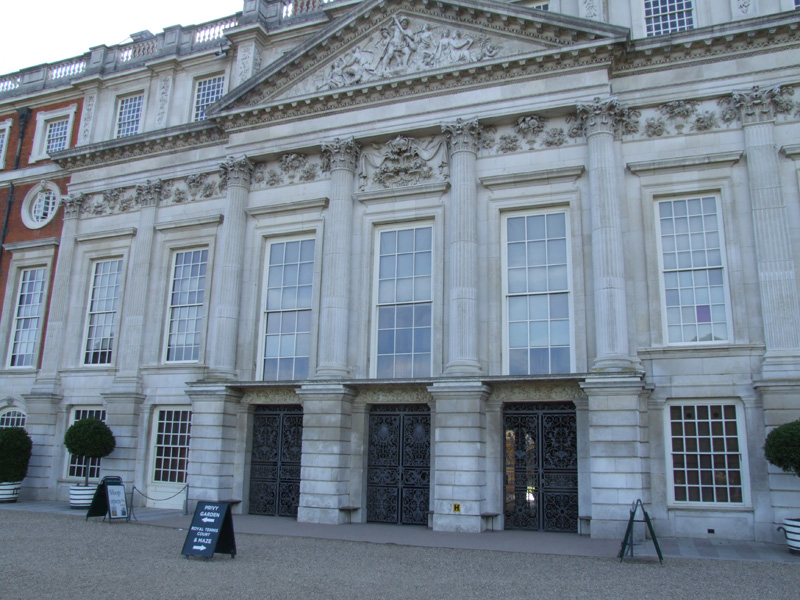
Sir Christopher Wren's addition to Hampton Court

Christopher Wren facade

If ever you visit Hampton Court you can walk around the 17th century part of the palace behind the old Tudor part which was designed and built by Sir Christopher Wren as a present for William and Mary. It was  also intended as an enticement to bring William to England as our monarch. William and Mary liked Hampton Court and spent a lot of time there.

Visitors today can process through all the rooms of state. A palace was designed to a specific plan. The first rooms you enter were waiting rooms. Ambassadors from other countries would wait until ushered into the next set of rooms to have an audience with the King. Rooms following on from that would be for the Kings own ministers. Following on to the next set of rooms, the greatest of the aristocracy and personal friends of the King would be admitted. As you process through the rooms further only the monarchs most intimate friends, advisors and family would be permitted.
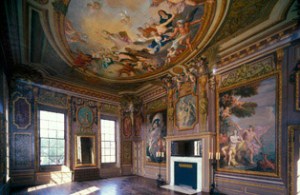
Baroque interior of the King's apartments, Hampton Court. Click on image for source.

Baroque interior of the King’s apartments, Hampton Court. Click on image for source.

Finally you reach the Kings own personal rooms and, lastly, after all the grand state rooms, a small bedroom, lavishly decorated but very small, almost a closet, the kings own sleeping chamber. It is interesting to note that the room above the king’s bedroom was the room of his own personal manservant who was the only one who had access to the King in the night. His manservant could enter by way of a narrow staircase, which apparently, he often did. We can only surmise!
Read Full Post »

Inquiring readers, Every once in a while a writer from another website contributes an article that is custom made for this blog.  Jennifer Vishnevsky, a writer for TopDentists.com, writes about false teeth and dentistry in an era when anesthetics were not yet available.

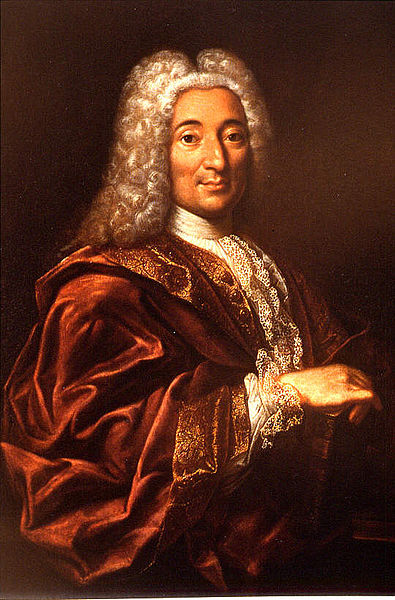
Pierre Fauchard. Image @Wikimedia

Pierre Fauchard. Image @Wikimedia

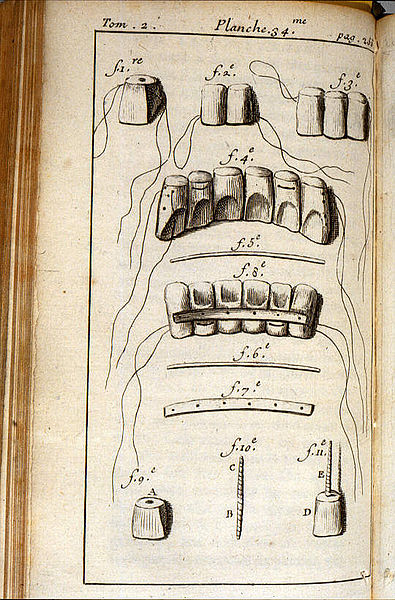
The 18th Century was a major time for advances in dentistry. It is believed that the French physician Pierre Fauchard started dentistry science as we know it today. In 1723, Fauchard published “The Surgeon Dentist, a Treatise on Teeth.” His book was the first to describe a comprehensive system for caring and treating the teeth. Thus, he is considered the father of modern dentistry. Fauchard was responsible for many developments, including the introduction of dental fillings and the use of dental prosthesis.

In 1760, John Baker, the earliest medically-trained dentist to practice in America, emigrated from England and set up practice. In the same decade, Paul Revere placed advertisements in a Boston newspaper offering his services as a dentist.

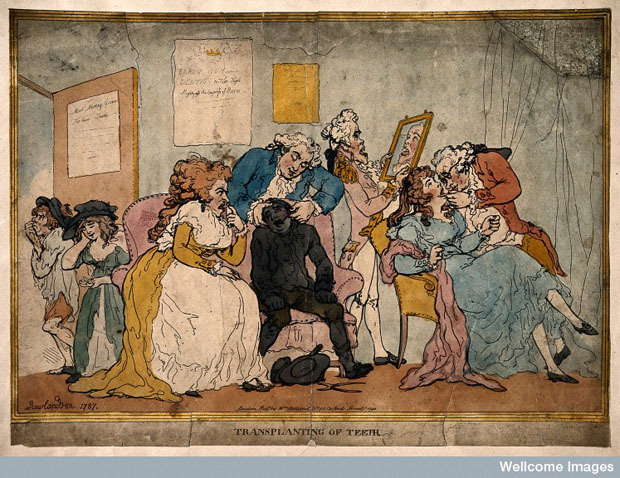
This print is by Thomas Rowlandson (1756-1827) and is dated 1787. It is a satirical comment upon the real practice of rich gentlemen and ladies of the 18th century paying for teeth to be pulled from poor children and transplanted in their gums. Image @Children and Youth in History

This print is by Thomas Rowlandson (1756-1827) and is dated 1787. It is a satirical comment upon the real practice of rich gentlemen and ladies of the 18th century paying for teeth to be pulled from poor children and transplanted in their gums. Image @Children and Youth in History

In 1790, the first dental foot engine was built by John Greenwood, son of Isaac Greenwood and one of George Washington’s dentists. It was made from an adapted foot-powered spinning wheel. This was also the year that the first specialized dental chair was invented by Josiah Flagg, who made a wooden Windsor chair with a headrest attached.

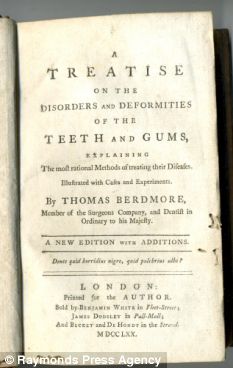
Even those treated by the best dentists were in for an agonizing time. “A Treatise on the Deformities and Disorders of the Teeth and Gums” was written in 1770 by Thomas Berdmore, who was considered to be an outstanding dentist in England. “Pass gold wire from the neighbouring teeth on either side, in such a manner as to press upon what stands out of the line.” The alternative, Berdmore suggested, was to ‘break the teeth into order by means of a strong pair of crooked pliers.”

Fauchard, procedure for teeth restoration. Image @Wikimedia

Fauchard, procedure for teeth restoration. Image @Wikimedia

For those who could afford it, the European diet grew sweeter during the 18th Century as the use of sugar became more widespread. This exposure to sugar meant more instances of tooth decay. These dietary changes were a major factor in the development of dentures. Dentists began to experiment with ivory in order to create a better foundation for dentures. Due to advances in technology, dentists could also add gold springs and plates to the new dentures. False teeth were a novelty that was mostly unheard of in earlier centuries. Previously, problematic teeth were pulled but almost never replaced. Ivory dentures were popular in the 1700s, made from natural materials including walrus, elephant, or hippopotamus. For the wealthy, human teeth were high in demand as the preferred material for the creation of dentures. However, the teeth used in 18th Century dentures eventually rotted. There was a high demand for teeth that were deemed healthy, such as from criminals.

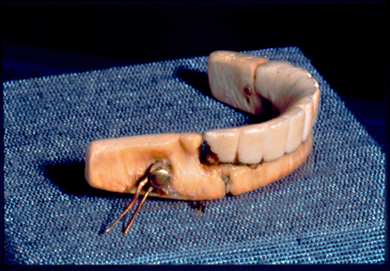
George Washington's dentures. Image @Samuel D. Harris National Museum of Dentistry, Baltimore

George Washington’s dentures. Image @Samuel D. Harris National Museum of Dentistry, Baltimore

One of the most famous early denture wearers was the first U.S. President George Washington. Washington began losing his teeth in his 20s, probably due to a combination of frequent illness and treatment with a medication called calomel that damaged the enamel of the teeth. Contrary to popular belief, however, Washington’s dentures were not made of wood. Washington sported some of the highest quality false teeth of the time, consisting of a denture plate made of carved hippopotamus ivory into which human teeth (along with parts of both horse and donkey teeth) were fitted. He had several other pairs of dentures during his presidency, none of which included wood in their construction.

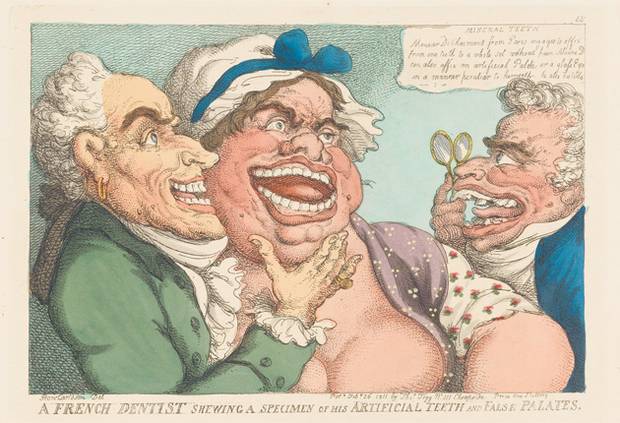
A French Dentist Showing a Specimen of His Artificial Teeth and His False Palates, Thomas Rowlandson, 1811. Image @The Independent

A French Dentist Showing a Specimen of His Artificial Teeth and His False Palates, Thomas Rowlandson, 1811. Image @The Independent

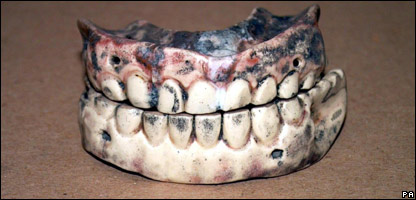
18th century porcelain dentures Image @CBBC

18th century porcelain dentures Image @CBBC

Full or even partial dentures were properly developed only during the course of the 18th Century. Dentists became better at making them fit, coming up with stronger adhesives to keep the teeth attached to them and designing them so as to prevent them from flying out of their patients’ mouths. By the late 18th century, there were yet more developments. Around 1774, Alexis Duchâteau crafted the first porcelain dentures. But these were prone to chip and also tended to appear too white to be convincing. Porcelain shaped teeth were placed onto gold plates. These were the first dentures that look similar to modern dentures. They were very white in color, but could be made in different shades.

Guest contributor Jennifer Vishnevsky is a writer for TopDentists.com, an Everyday Health website on dental health, as well as a freelancer for other lifestyle media sites.

Read Full Post »

The week of Christmas and the new year has been traditionally a time for joy and celebration. In Jane Austen’s day, the decorations and celebrations weren’t quite so over-the-top commercial as they are today. Mistletoe, holly, and evergreen boughs decorated the halls, while roaring fires warmed hearth and home. Fine foods were prepared for friends and family at holiday gatherings, and gift giving was considered optional and not mandatory.

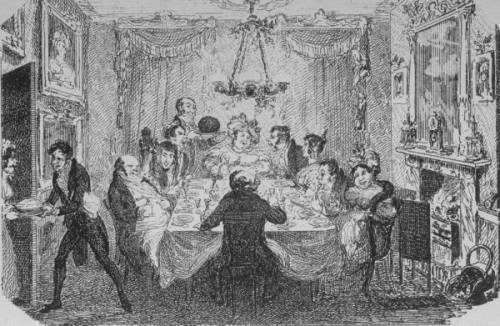
Cruikshank image. Holiday dinner party. Image @LIFE magazine.

Cruikshank image. Holiday dinner party. Image @LIFE magazine.

In her letters, Jane mentioned making wine. She was also  known to imbibe a glass or two, as did many Regency ladies. One can imagine that she heartily enjoyed a glass of homemade wine during long winter evenings. A Regency household in the country was akin to a cottage factory, processing freshly picked fruits and vegetables in summer and fall for consumption during the winter months.

Elderberry bushes, native to both Europe (Sambucus nigra)  and North America (Sambucus canadensis), ripened in August and September. The American elderberry can be found growing in old fields and meadows. The European elderberry blooms earlier than its American counterpart, with some sporting pink flowers. By Christmas, the first flasks of elderberry wine could be served at the table.  Some elder wines (depending on their strength) were ripened until spring. (Edible Landscaping)

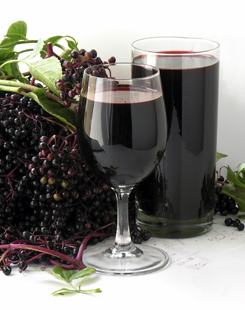
Elderberry wine has a rich red color.

Elderberry wine has a rich red color.

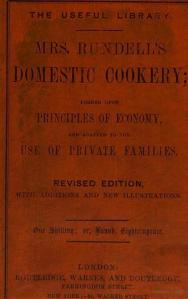
Mrs. Maria Eliza Ketelby Rundell’s elder wine recipe, written over two hundred years ago, reflects how housewives made the wine back then, using ingredients and kitchen supplies that were readily available. In 1806, John Murray (who published Emma, a second edition of Mansfield Park, Persuasion and Northanger Abbey)  published  A New System of Domestic Cookery: Founded up Principles of Economy; and Adapted to the Use of Private Families. Rundell’s cookbook became wildly popular in the first half of the 19th century in both England and America. One imagines that the Austen women were well aware of its existence.

Mrs. Rundell

Mrs. Rundell

According to Mrs. Rundell:

English wines would be found particularly useful, now foreign are so high priced, and though sugar is dear, they may be made at a quarter of the expense. If carefully made, and kept three or four year,s a proportionable strength being given, they would answer the purpose of foreign wines for health, and cause a very considerable reduction in the expenditure.”

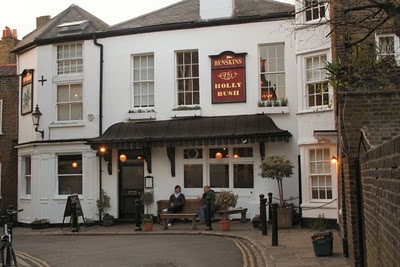
Holly Bush Inn, where Mrs. Rundell, it is speculated, wrote her recipes.

Holly Bush Inn, where Mrs. Rundell, it is speculated, wrote her recipes. Image @Persephone books (Link below)

Rundell’s book of recipes went through dozens of editions in Britain and the United States, where it was published in 1807. The following recipe for Elder Wine comes from the Google eBook 1857 edition:

Rundell Domestic Cookery

Elder Wine.

To every quart of berries put two quarts of water, boil half an hour, run the liquor, and break the fruit through a hair sieve; then to every quart of juice put three quarters of a pound of Lisbon sugar, coarse but not the very coarsest. Boil the whole a quarter of an hour with some Jamaica peppers, gingers, and a few cloves. Pour it into a tub, and when of a proper warmth, into the barrel, with toast and yeast to work, which there is more difficulty to make it do than most other liquors. When it ceases to hiss, put a quart of brandy to eight gallons, and stop up. Bottle in the spring or at Christmas. The liquor must be in a warm place to make it work.

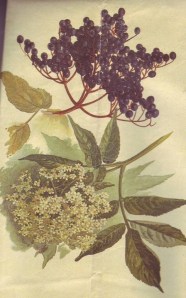
Elder berries and elder flowers. Public domain image

Elder berries and elder flowers. Public domain image

While Rundell’s recipe seems simple, some terms require explanation. In those days, sugar was classified according to place of origin, such as Brazil, or entrepot, a place of entry without excise duties, such as Lisbon. (Richard Bradley, 1736) Prospect book glossary.

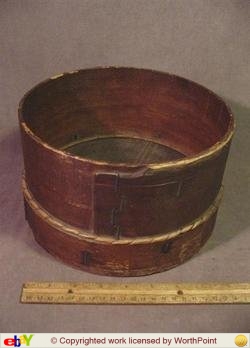
19th c. hair sieve

19th c. hair sieve

Image of Hair Sieve at Worth Point

The hair sieve mentioned by Rundell was most likely made with coarse horse hair, as shown in the above image. The mesh is quite fine. Sugar was an expensive commodity (Jane Austen was in charge of the tea and sugar stores in Chawton cottage, keeping the keys, no doubt, to the locked containers), but as previously explained, making your own wine provided a cost saving measure. The High Price of Sugar.

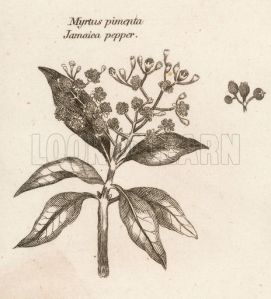
Jamaica peppers are generally known today as allspice. The peppers are larger than peppercorns and were gathered from Jamaica pepper trees. The “toast and yeast” mentioned in the recipe most likely meant bread yeast. Elder wine ferments particularly well in oak casks.

Jamaica pepper

Jamaica pepper

One can only guess what Mrs. Rundell’s elder wine, which was fortified with brandy, tasted like – strong, sweet, alcoholic, and fruity. The clusters of berries, dark purple when ripe, had many uses:

Elderberry bushes … [have] a long history of use for food, drink and medicinal purposes. Elderberry pie, jam and jelly, tarts, flavored drinks, and of course wine are a few of its better known uses.

Elderberry wine has a unique flavor that changes considerably over time. When too few berries are used, the wine is thin and unlikely to improve. When too many berries are used, the tannins and other flavor constituents may overpower the palate and require dilution, blending or prolonged aging to mellow. Between these extremes are wines that often offer exceptional enjoyment. – Winemaker Magazine

It seems that the berries had to be processed as quickly as possible after picking. There were times, I imagine, that the Austen women were busy working alongside their servants in the kitchen, processing foods, canning and pickling, and making wines and ales from recently harvested produce.

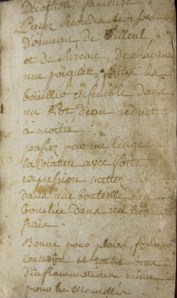
Another “job” that the Regency housewife assumed was that of nurse. Recipes for cough lozenges and simple medicinals made from herbs and plants were passed down through the generations. Elder berries were known to have many medicinal benefits:

Recipe for a "Decoction fameuse," which contains elderberry (among other ingredients). Image @MCRS Rare Book Blog

Recipe for a “Decoction fameuse,” which contains elderberry (among other ingredients). Image @MCRS Rare Book Blog

Recent research shows that elder builds up the immune system and directly inhibits the influenza virus. Elder contains an enzyme that smoothes the spikes on the outside of the virus, which the virus uses to pierce through cell walls. Elderberries have also been recommended in cases of bronchitis, sore throat, coughs, asthma, colds and constipation.” – The Health Benefits of Elderberry Wine

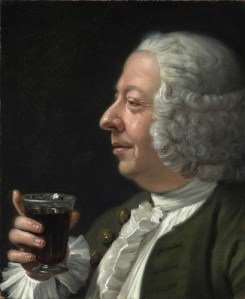
18th century red wine drinker, Franz Laktanz Graf Von Firmian

18th century red wine drinker taking his “medicine”, Franz Laktanz Graf Von Firmian

What better way to soothe one’s respiratory condition than with a nice glass of elder wine!
Ma(i)sonry Maisonry - Vintage 18th Century Wine Bottles - 1stdibs

This article from KansasCity.com, “Elderberry wine as a medicinal: A recent USDA reaction,” shows how ridiculous current U.S. health laws can be on the use of medication:

Federal authorities have seized bottles and drums of elderberry juice concentrate from a Kansas winery, contending that the company’s claims of its benefits for treating various diseases make the product a drug.

…”Products with unapproved disease claims are dangerous because they may cause consumers to delay or avoid legitimate treatments, Dara Corrigan, the FDA’s associate commissioner for regulatory affairs, said in a news release. “The FDA is committed to protecting consumers from unapproved products on the market.”

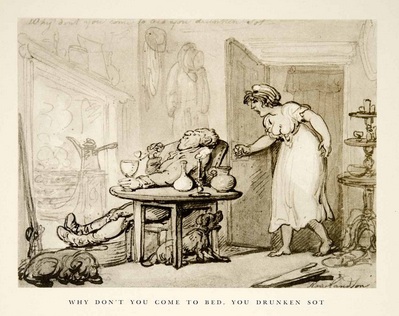
Aquatint, Rowlandson. Image @Amazon

Aquatone, Thomas Rowlandson. Image @Amazon

Wine was reserved not only for medicinal purposes or family gatherings, but for daily consumption. Bumpers of wine, or a tankard or cup filled to the brim, were common quantities.  The Georgians were notorious drinkers, for alcohol was safer than unboiled water and contaminated city or town wells.

London society of the Georgian period was renowned for its heavy consumption of alcohol. Poor people tended to drink beer or gin, but a wider range of alcoholic drinks was available to the rich. These included wines such as French claret; fortified wines such as sherry, port or Madeira; and spirits such as brandy and rum. It is noted in the text that Mr Stryver and Sydney Carton have wine, brandy, rum, sugar and lemons with which to concoct their punch.

During the Georgian period, beer might be drunk from pewter tankards, and other drinks, from glass goblets or tumblers.- Bookdrum

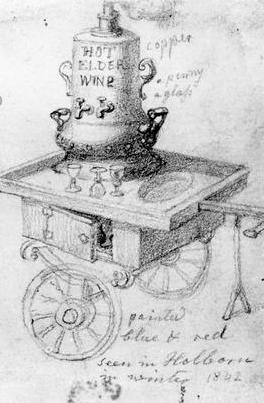
Detail, Elder Win Stand in Holborne, by George Scharff, 1842

Detail, Elder Wine Stand in Holborne in Winter, by George Scharff, 1842

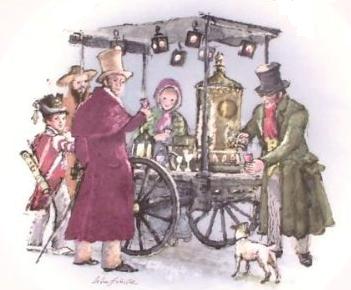
In winter, elder wine heated in coppers was sold for a penny per wine glass from portable wood stands that contained glassware. (See image above.) This tradition lasted at least through the Victorian era, as attested by the modern Wedgewood scene below.

More About the Topic

Wedgewood. Victorian scene of an elder wine stand

Wedgewood. Victorian scene of an elder wine stand

Read Full Post »

Whenever I stay with my family in north Baltimore, I visit Hampton National Historic Site to walk along its extensive grounds. Construction on Hampton Hall began after 1783 and continued well into the 1800s. The Ridgely family once owned 25,000 acres of land, as well as a number of commercial, industrial, and agricultural interests that allowed them to live well and entertain lavishly. They were able to serve ice cream in July with stored ice, an expensive and time-consuming commodity in 19th century America and Great Britain.

Hampton Mansion. The ice house sits at the right (not visible in this image.) Image @vsanborn

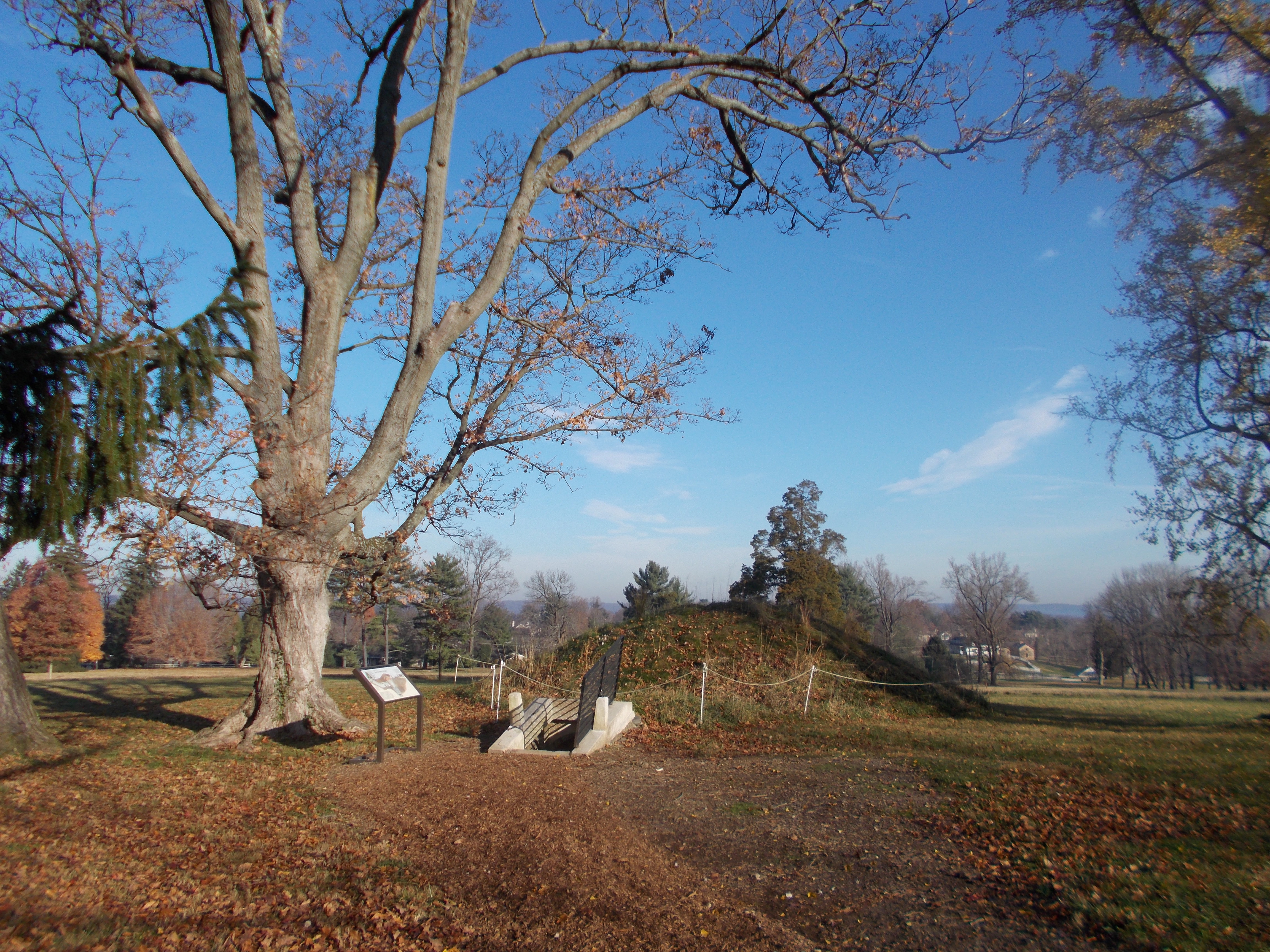
Hampton Mansion’s ice house is located near the circular drive and in front of what once was the laundry. From a distance it resembles a grassy knoll.

Ice House at Hampton NHS. Image @vsanborn

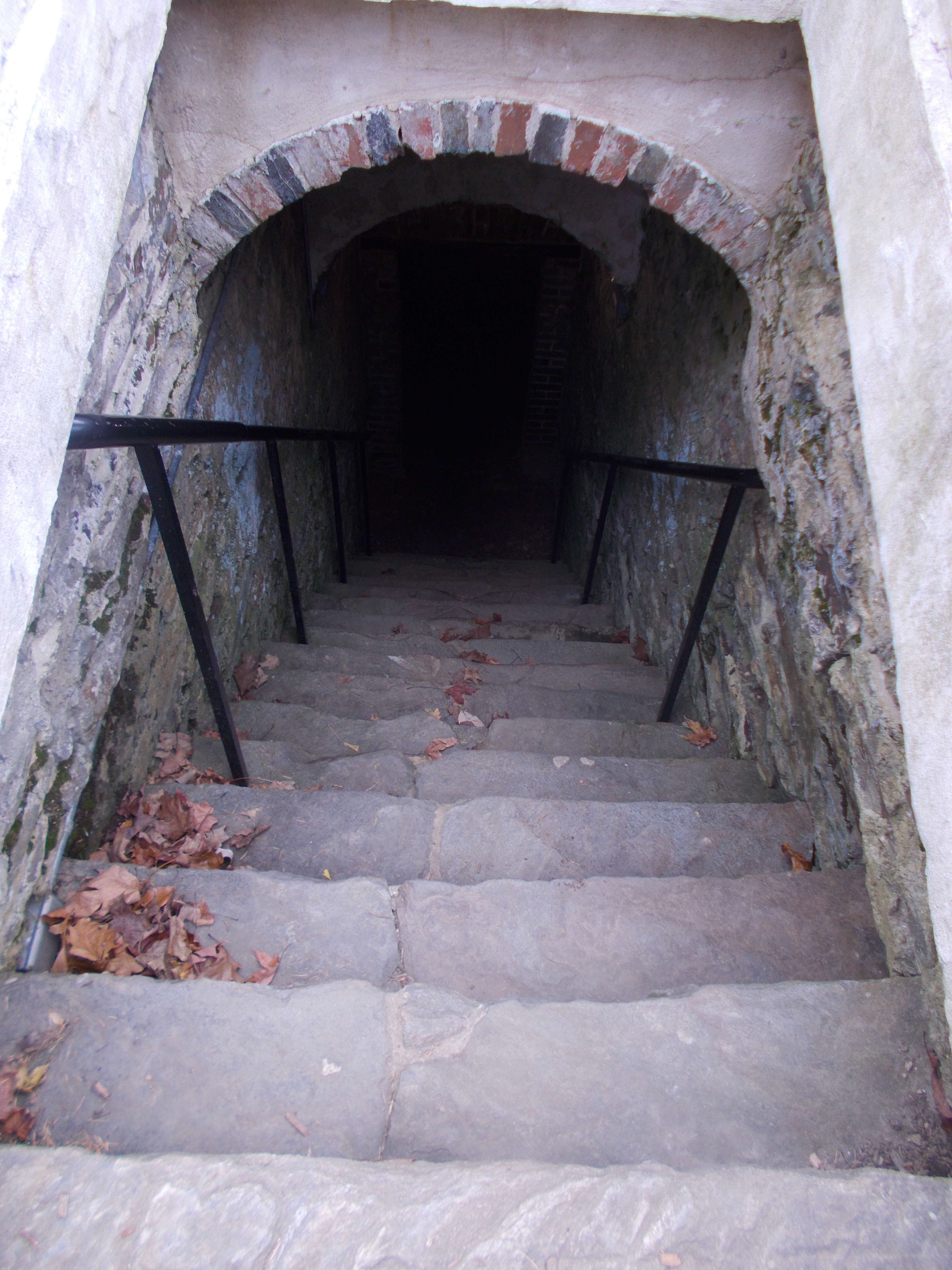
Ice House entrance. Image @vsanborn

The entrance is open to visitors. I clambered down the steep stairs with Alan, a park ranger who kindly guided me down the dark pit.

Image @National Park Service

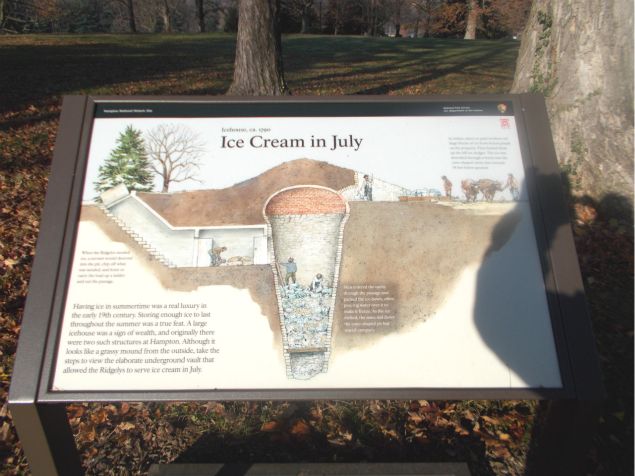
In winter, slaves or paid workers cut large blocks of ice from frozen ponds on the property. They handed them up the hill on sledges. The ice was shovelled through a hatch into the cone-shaped cavity that extends 34 feet below ground.” – Text, National Park Service

Steep stairs down the ice house. Image @vsanborn

Men entered the cavity through the passage and packed the ice down, often pouring water over it to make it freeze. As the ice melted the mass slid down the cone-shaped pit but stayed compact.” –  Text, National Park Service

When the Ridgelys needed ice, a servant would descend into the pit, chip off what was needed, and hoist or carry the load up a ladder and out the passage.” – Text, National Park Service

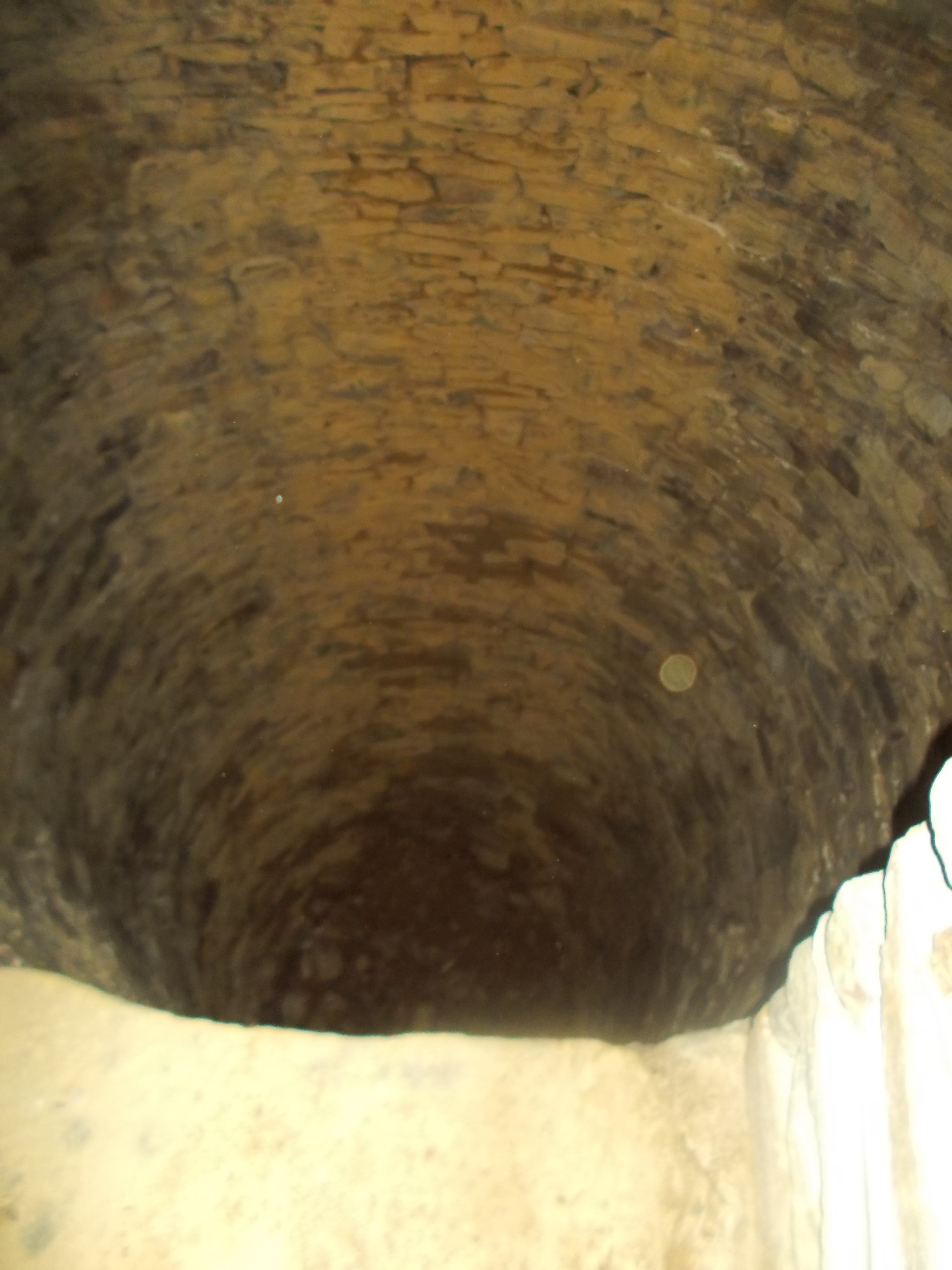
Cone shaped cavity, 34 feet deep. Image @vsanborn

At the top right oxen can be seen hauling ice to the ice house. A man is dropping big blocks of frozen ice down a hole. One presumes that no one is standing in the pit below. Image @vsanborn

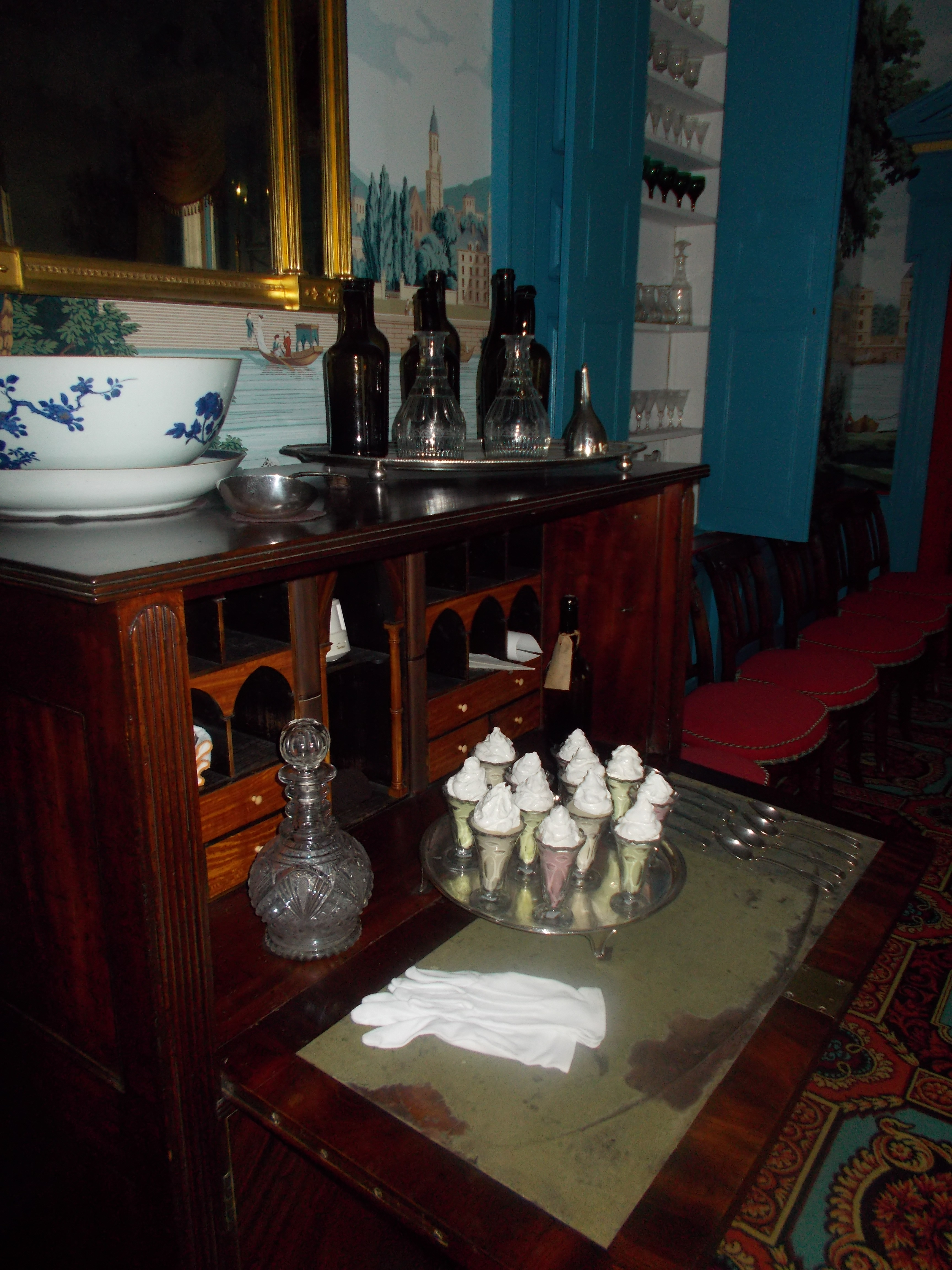
“Ice” on the sideboard in Hampton Mansion’s dining room. Image @vsanborn

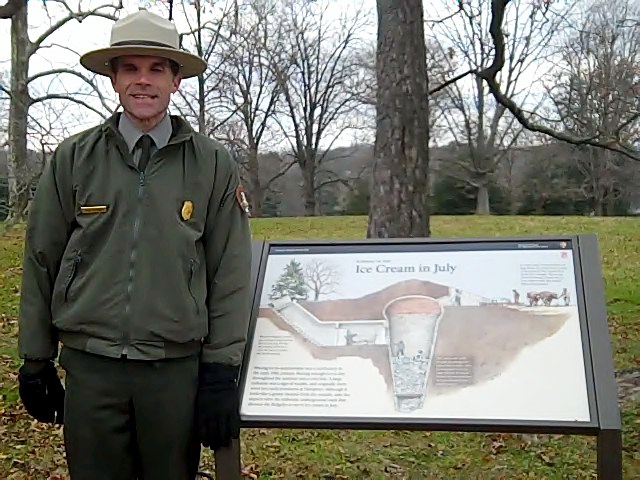
Alan, my guide into the ice house

More on the topic:

Read Full Post »

Dr. Syntax Visits a Boarding School for Young Ladies

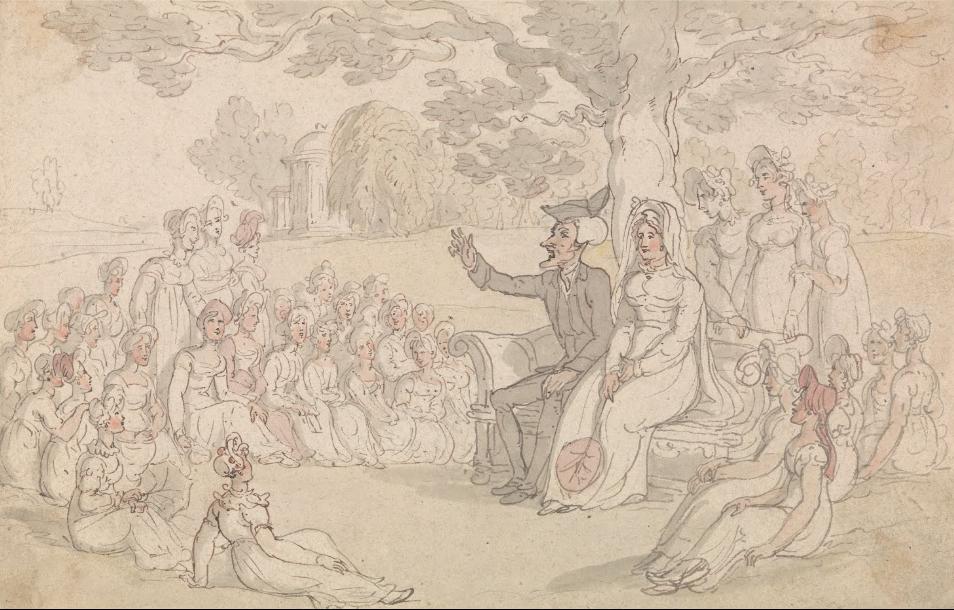
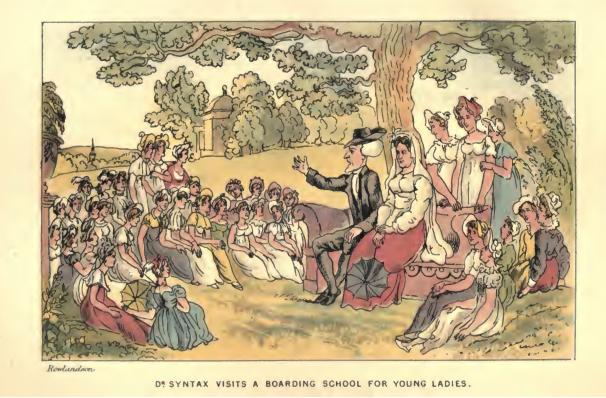
One of the most unexpected (and wonderful) finds in the Emporium at the 2012 JASNA meeting in NYC were the four Rowlandson prints that I purchased. One, entitled “Dr. Syntax Visits a Boarding School for Young Ladies” is charming. I included a number of images I found online to accompany this post. Except for the composition, t is remarkable how strikingly different each looks. My print resembles none of the ones displayed here – it is slightly yellowed and delicately colored, but the colors are neither bright nor faded. I can’t wait to frame it.

Dr syntax visits a boarding school for young ladies,1821. This image from the Yale Center of British Art is much paler than mine, in which the headmistress’s skirt is colored red and the young ladies in the foreground wear colored dresses.

This 190+ year old hand-colored aquatint came from The Tour of Doctor Syntax, published by Ackermann’s Repository in London from 1812-1821. Dr. Syntax, a British clergyman, sits under a tree next to a stern looking Lady Governess, who addresses the young pupils arrayed around them. The scene accompanies text in The Second Tour of Dr. Syntax, In Search of Consolation. The illustration reveals how Rowlandson works, outlining the figures with a reed pen and then delicately washing certain areas of the print with color. His pen and inks were then etched by a professional engraver, an artist in his own right. The impressions were then hand colored.

Rowlandson’s Prints

Rowlandson was prolific. Art historians deem his earlier works to be more artistic and carefully observed. As his reputation spread, he began to produce his designs in haste and the quality of his art began to suffer. His caricatures became predictable and in some instances overly exaggerated, but he never lost the facility with which he handled his pen.

In this series, Rowlandson created the illustrations first. Writer James Combe then wrote the narrative that accompanies the images. “This series is one of the best parodies of the more traditional narratives on journeys to different parts of England featuring more “serious” landscape illustrations and prose.” ( Prints from The Tours of Dr. Syntax, Prints With a Past.)

This print is similar to the one I purchased, but slightly more colorful. Image from Dr. Syntax’s Three Tours at Internet Archive, Cornell University Library

Doctor Syntax talks to the Young Ladies at Boarding School

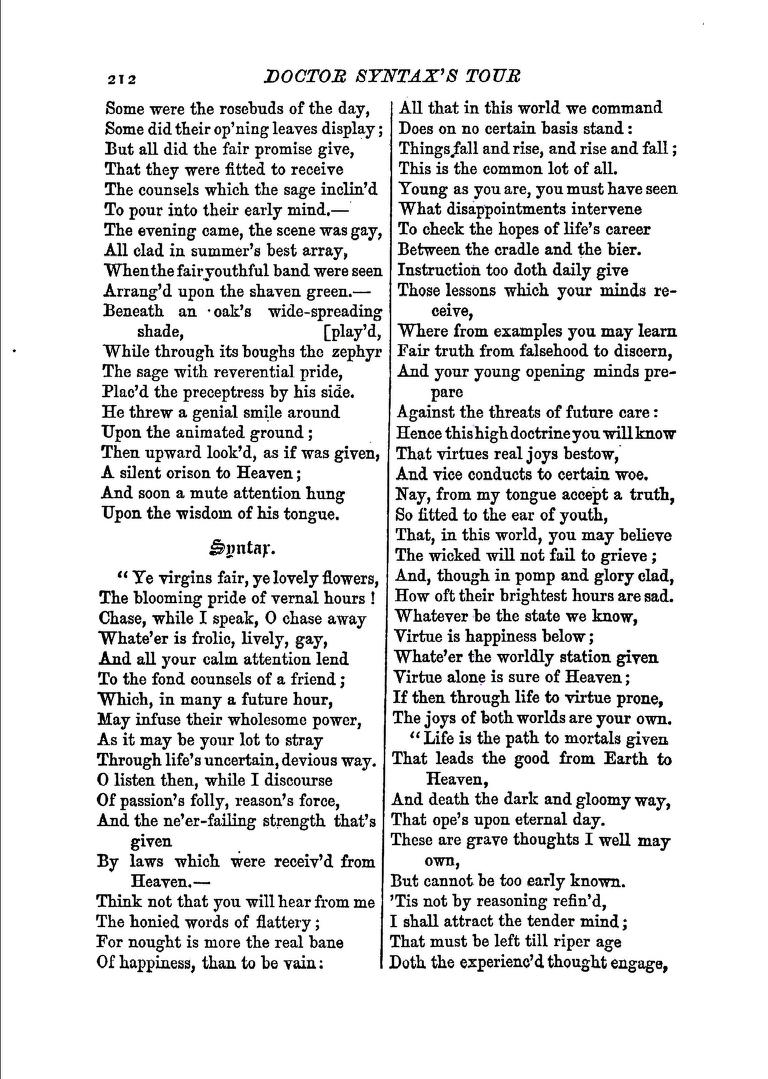
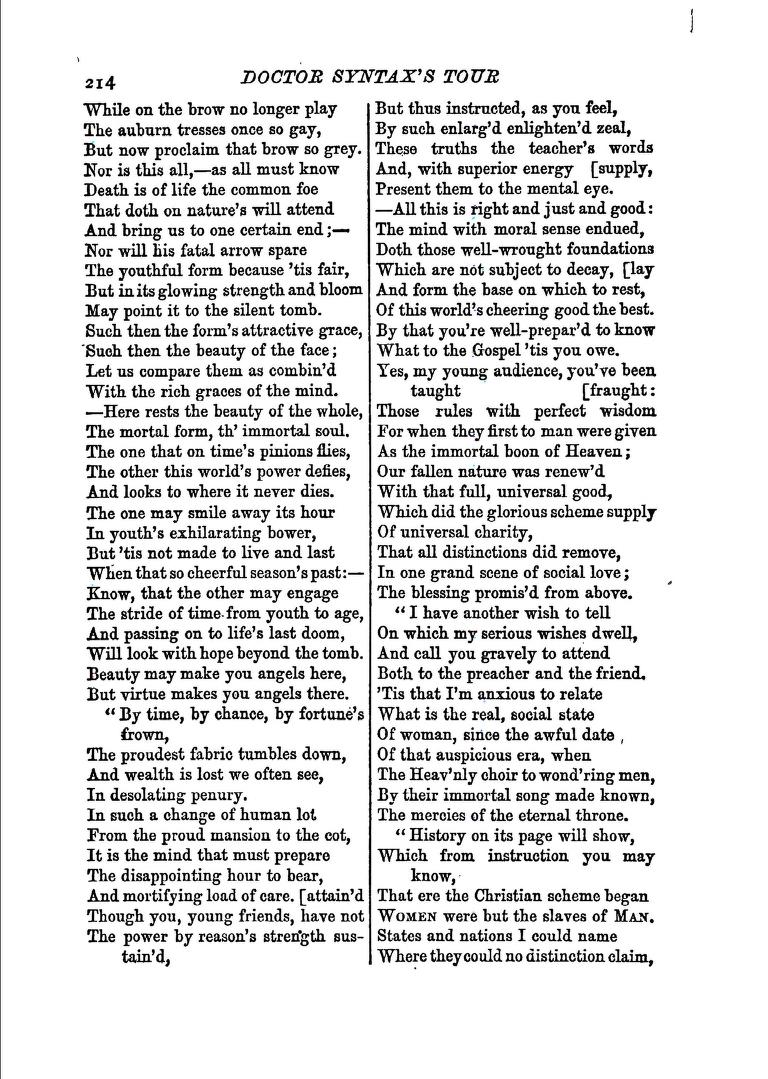
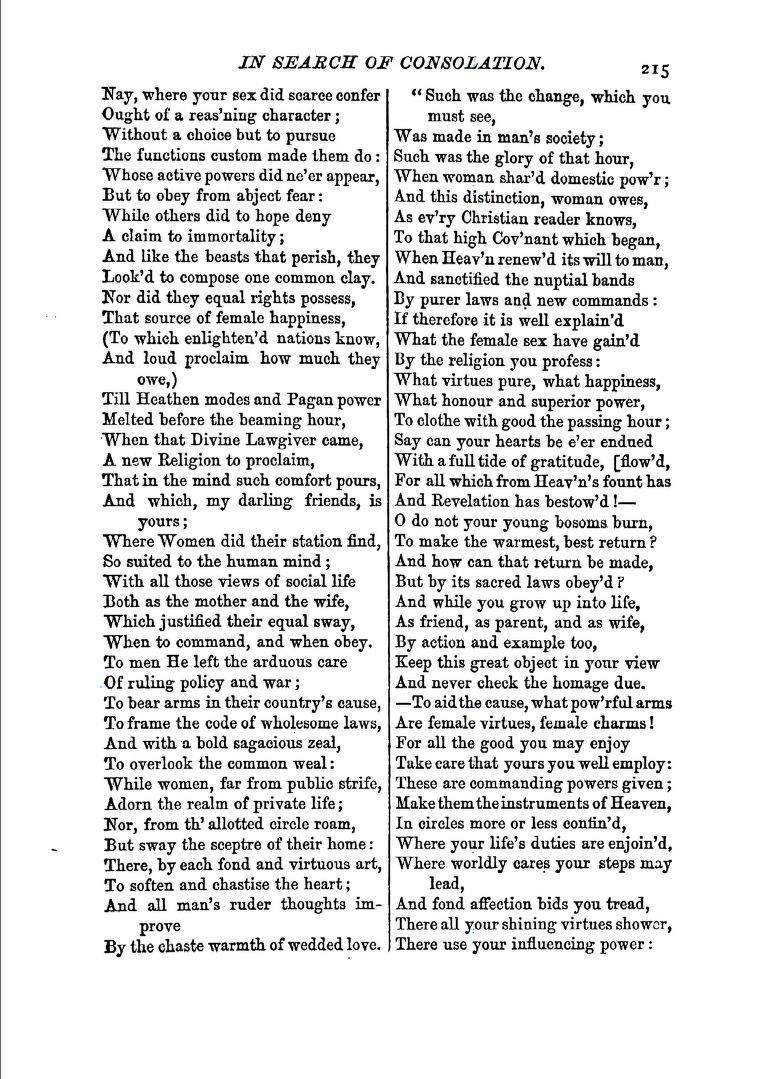
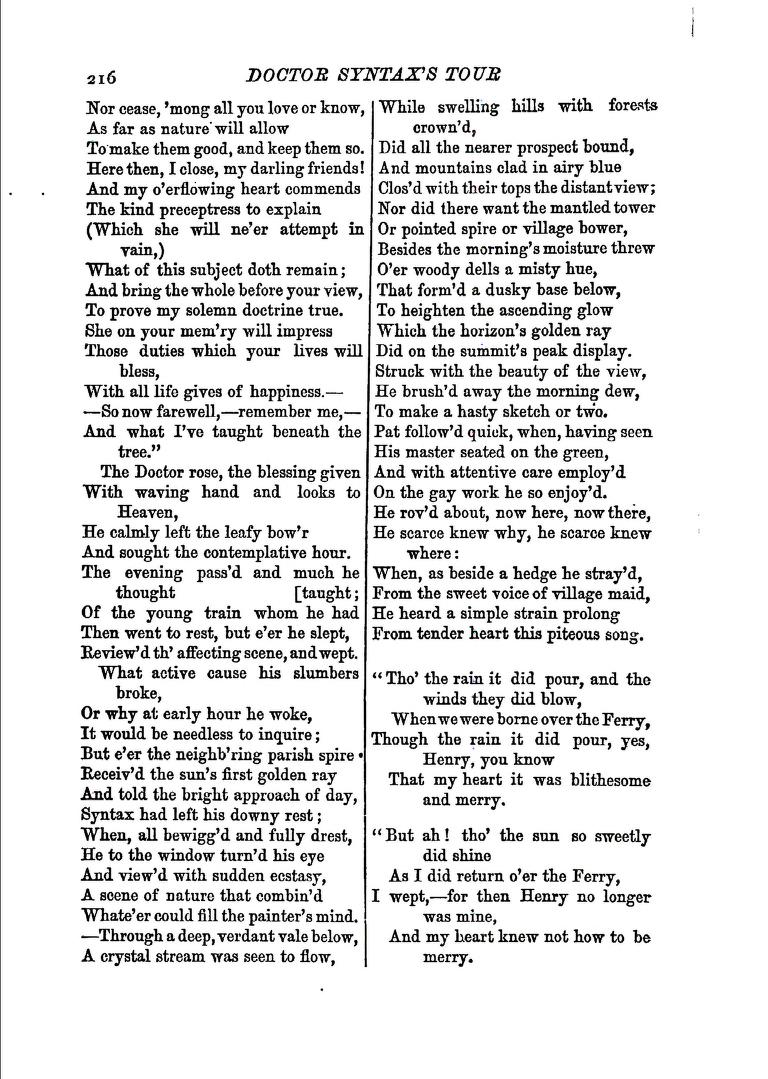
Below sits the text (in verse) that accompanied this image, in which Dr. Syntax expounds on his listeners’ youth and character, and how they can learn from good example:

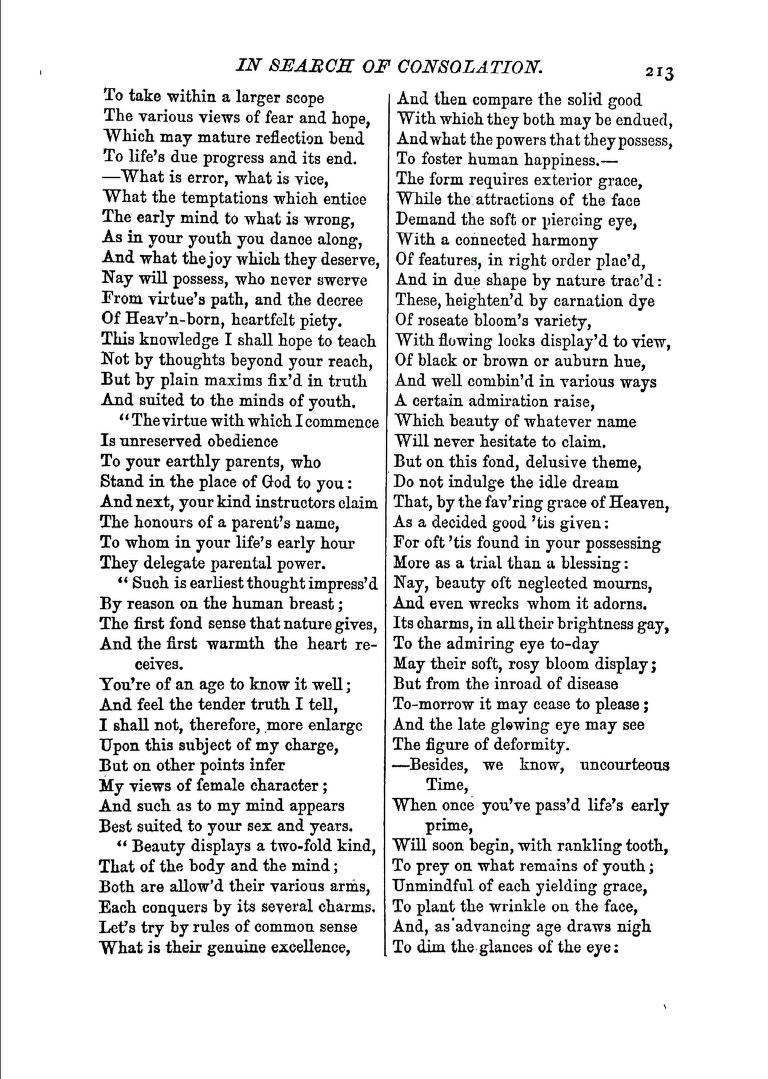
In the following page, Dr. Syntax exhorts his young charges to never swerve from virtue’s path and to take care of their good looks, for “flowing looks display’d to view, of black or brown or auburn hue, and well combin’d in various ways, a certain admiration raise…”:

Dr. Syntax does not want for words. In fact, he is a bit of a windbag. How those girls could sit enraptured during this speech is a marvel to me. In this section the rich graces of the mind hold the beauty of the whole, the mortal form, th’ immortal soul.

I wonder if Dr. Syntax even drew breath! In this section the good doctor reinforces the concept that a woman’s place is in the home, overseeing the family and household.

The Doctor says his goodbye, admonishing the listeners to pay attention the kind preceptress, who “will explain what of this subject doth remain, and bring the whole before your view, to prove my solemn doctrine true.”

Sources: 

Books:

  • Dr. Syntax’s Three Tours Doctor Syntax’s three tours in search of the picturesque, consolation, and a wife. By William Combe. The original ed., complete and unabridged, with the life and adventures of the author, now first written, by John Camden Hotten. Eighty full page illustrations drawn and coloured after the originals by T. Rowlandson. Published 1868 by J. C. Hotten in London . Library of Congress, PR3359.C5 D6 1868

Other posts about the JASNA NYC 2012

Read Full Post »

« Newer Posts - Older Posts »