This Jane Austen blog brings Jane Austen, her novels, and the Regency Period alive through food, dress, social customs, and other 19th C. historical details related to this topic.
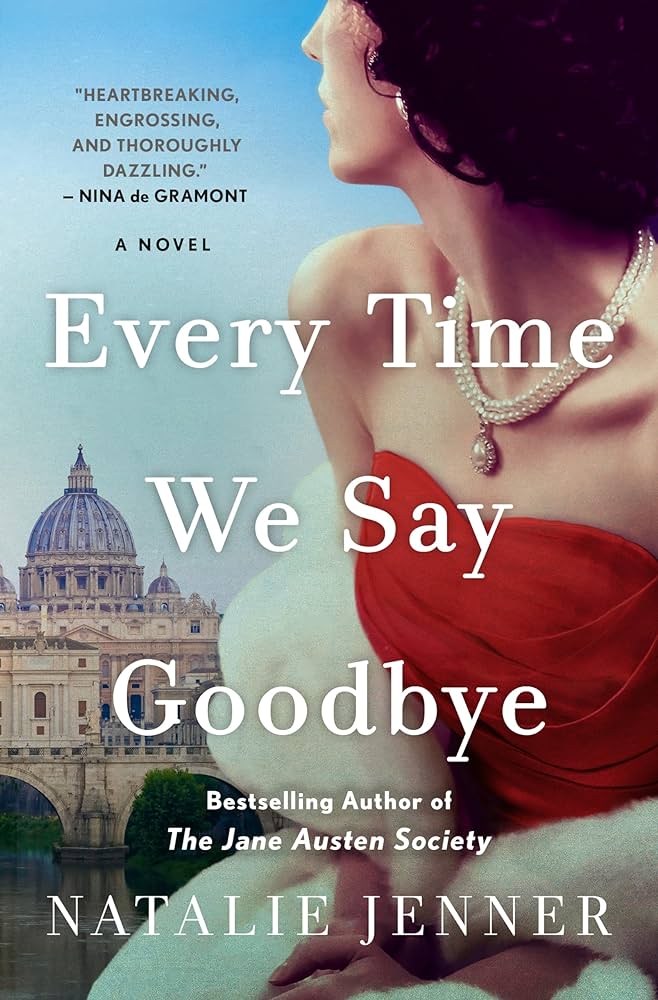
For those looking for a glamorous, post-WW2, historical fiction novel for spring and summer, I have great news for you! Natalie Jenner, the bestselling author of The Jane Austen Society and Bloomsbury Girls, is back with a new novel called Every Time We Say Goodbye!
If you fell in love with Jenner’s writing, storylines, and characters when you read her first two novels, then add this third installment to your TBR list. Though Jenner’s books can be read as stand-alone stories, they each tie to the others.
This time, we follow actress and playwright Vivien Lowry, one of the original (fictional) members of the Jane Austen Society, to 1950s, post-war Italy to pursue her film career.
Book Details
The bestselling author of The Jane Austen Society and Bloomsbury Girls returns with a brilliant novel of love and art, of grief and memory, of confronting the past and facing the future.
In 1955, Vivien Lowry is facing the greatest challenge of her life. Her latest play, the only female-authored play on the London stage that season, has opened in the West End to rapturous applause from the audience. The reviewers, however, are not as impressed as the playgoers and their savage notices not only shut down the play but ruin Lowry’s last chance for a dramatic career.
With her future in London not looking bright, at the suggestion of her friend, Peggy Guggenheim, Vivien takes a job in as a script doctor on a major film shooting in Rome’s Cinecitta Studios. There she finds a vibrant movie making scene filled with rising stars, acclaimed directors, and famous actors in a country that is torn between its past and its potentially bright future, between the liberation of the post-war cinema and the restrictions of the Catholic Church that permeates the very soul of Italy.
As Vivien tries to forge a new future for herself, she also must face the long-buried truth of the recent World War and the mystery of what really happened to her deceased fiancé. Every Time We Say Goodbye is a brilliant exploration of trauma and tragedy, hope and renewal, filled with dazzling characters both real and imaginary, from the incomparable author who charmed the world with her novelsThe Jane Austen Society and Bloomsbury Girls.
Audiobook
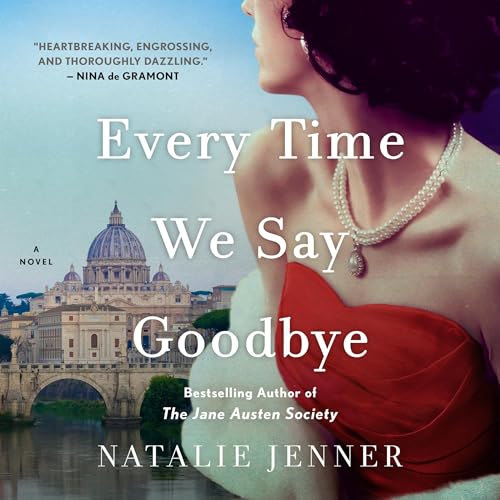
If you prefer listening to your historical fiction, BAFTA Award-winning actress Juliet Aubrey has narrated the audiobook of Every Time We Say Goodbye.
“Aubrey won the BAFTA for her performance as the quintessential Dorothea Brooke in the BBC’s 1994 production of Middlemarch and has appeared in dozens of television, film, stage, and radio programs over her impressive career, most recently winning the BBC Audio Drama Award for Best Actress in 2022. Aubrey has a voice full of dusky cadence, emotion, and subtlety, and brings to the audiobook a mastery of dialect and intonation.”
I highly recommend listening to this one! I’ve been listening, and I love the play between the English, American, and Italian accents. You can listen to an excerpt from the audiobook for Every Time We Say Goodbye here:
Every Time We Say Goodbye releases May 14, 2024. You can purchase the book online or in any of your local retail bookshops. If you’d like a hardcover copy, the details are below:
One of Bookbub’s Best Historical Fiction Books for Spring! One of the CBC’s Most Anticipated Canadian Novels this Spring!
“Jenner provides an insightful view into Italy’s postwar reckoning, and she imbues the novel’s many celebrity cameos – including actresses Sophia Loren and Gina Lollobrigida―with authentic flair. Jenner’s fans will love this.” ―Publishers Weekly
“With warmth and compassion…lush descriptions, vivid period detail, and fascinating personalities, Jenner’s cinematic narrative is shot through with both pain and hope.” ―Shelf Awareness
About the Author
NATALIE JENNER is the author of the international bestseller The Jane Austen Society and Bloomsbury Girls. A Goodreads Choice Award runner-up for historical fiction and finalist for best debut novel, The Jane Austen Society was a USA Today and #1 national bestseller, and has been sold for translation in twenty countries.
Born in England and raised in Canada, Natalie has been a corporate lawyer, career coach and, most recently, an independent bookstore owner in Oakville, Ontario, where she lives with her family and two rescue dogs. Visit her website for more.
Jane Austen News from Natalie
Finally, it’s my great joy to announce that Natalie has a 4th upcoming novel slated for 2025, tentatively titled Austen at Sea, just in time for Jane Austen’s 250th celebration!
This new novel, once again about Austen’s fans, is set in 1865 Boston and Hampshire. Here’s a brief introduction:
“In Austen at Sea, Henrietta and Charlotte Stevenson, the only children of a widowed Massachusetts supreme court judge, are desperate to experience freedom of any kind, at a time when young unmarried women are kept largely at home. Striking up a correspondence with Jane Austen’s last surviving sibling, ninety-one-year-old retired admiral Sir Francis Austen, the two sisters invite themselves to visit and end up sneaking on board the S. S. China, a transatlantic mail packet steamship heading to Portsmouth.”
“Your letter to Adlestrop may perhaps bring you information from the spot . . .”–Jane Austen writing to her sister Cassandra about a relative in Adlestrop they loved, Elizabeth Leigh, who was very ill. Jan. 10, 1809
I’ve just finished a fascinating little book, Jane Austen & Adlestrop: Her Other Family, by Victoria Huxley. Huxley tells the stories of Austen’s Leigh relatives alongside frequent quotes from Austen’s works as well as other contemporary sources. I highly recommend this book, but I’ll share some highlights.
We know Jane Austen didn’t take her characters or situations directly from life. And yet, for every author, the experiences we have and hear about, and the people we know and know of, are all grist for the mill. They come together in new shapes and forms as we write. Jane Austen was close to her Leigh relatives, so it’s not surprising their lives fed into her novels in various ways.
The Leigh Family
Jane’s mother Cassandra Leigh Austen was from an old family descended from a Lord Mayor of London, Sir Thomas Leigh (1498-1571). During Sir Thomas’s lifetime, King Henry VIII dissolved the monasteries, making much land available for purchase. Sir Thomas invested widely. When he died, he owned extensive lands in four counties plus London.
His eldest son, Rowland, inherited Adlestrop and the lands around it in Gloucestershire (north of Oxford). His second son, Thomas, inherited Stoneleigh, Hamstall Ridware, and other estates in Staffordshire (north of Gloucestershire). The Adlestrop line remained country squires, while the Stoneleigh line gained a peerage by supporting Charles I in the English Civil War. They became far wealthier than the Adlestrop Leighs. By Jane Austen’s time, the Stoneleigh estate was worth around £17,000 a year, more than the income of wealthy Mr. Rushworth (£13,000) or Mr. Darcy (£10,000)!
I won’t inflict the whole family tree on you, as they repeated the same names over and over. Some of their favorite names were Thomas, Theophilus, James, Cassandra, and Mary. Cassandra Leigh Austen’s father was Rev. Thomas Leigh (1696-1764), and her mother’s maiden name was Jane Walker. Cassandra Leigh also had a sister named Jane, a sister-in-law named Jane, and, our favorite, a daughter named Jane (plus a daughter named Cassandra, and two first cousins named Cassandra). Jane Walker brought the Perrot family’s wealth into the family. [In the following, whenever I say “Cassandra Leigh” or “Cassandra Leigh Austen,” I mean our Jane Austen’s mother, not her sister.]
Adlestrop is now best known for a poem written in 1914 by Edward Thomas, who died three years later in World War I. His train stopped there briefly, and the poem describes the natural beauties of the area, the “willows, willow-herb, and grass” and a blackbird singing. Adlestrop is still a small, rural town, as it was in Austen’s time.
The squire of the manor, Adlestrop Park, during Jane’s lifetime was James Henry Leigh, who inherited in 1774, when he was only nine years old. His uncle, Rev. Thomas Leigh, was his guardian and the rector of Adlestrop at that time. He was Cassandra Leigh’s first cousin. Rev. Thomas lived with his wife Mary and his unmarried sister Elizabeth, who was the godmother of Jane’s sister Cassandra.
Apparently Cassandra Leigh was closer to Rev. Thomas than to James Henry. On their visits, the Austens always stayed in the rectory, not in the great house. They would certainly have attended the Adlestrop church, where Rev. Thomas preached. Jane Austen first visited Adlestrop in 1794, when she was 19. She visited again five years later, in 1799, and then in 1806, when she was 31. Throughout the years, the Austen and Leigh families kept in touch through letters.
Many of Cassandra Leigh’s relatives were clergymen*, including her father, an uncle, two cousins, a brother-in-law, and a nephew. Leigh family members were patrons of various church livings connected with their extensive properties, and bestowed those livings on relatives, as was customary. In Austen’s novels, for example, both Henry Tilney and Edmund Bertram receive livings from their fathers. Livings might also be given by more distant relations. The Honorable Mary Leigh, for example, gave Edward Cooper (Jane Austen’s cousin) his living at Hamstall Ridware in Staffordshire.
In 1806, the last member of the Stoneleigh branch of the Leigh family, the Honorable Mary Leigh, died, and Rev. Thomas Leigh, inherited. Mrs. Austen [Cassandra Leigh, who was Rev. Thomas’s first cousin], with her daughters Jane and Cassandra, were visiting Rev. Thomas at the time, and they traveled with him to take possession of Stoneleigh. The Abbey made a strong impression on Jane and her family. Mrs. Austen wrote letters describing its wonders.
When Rev. Leigh inherited Stoneleigh Abbey, he gave a settlement to another claimant*, Jane’s uncle, James Leigh-Perrot (Cassandra Leigh’s brother). The understanding was that rich Mr. Leigh-Perrot would share this settlement with the needy Austens and Coopers. However, he did not. Jane attributed this lack of generosity to Mrs. Leigh-Perrot; perhaps she was caricatured as selfish Fanny Dashwood of Sense and Sensibility. You can find more details in “Jane Austen’s Leigh Family: Stories behind the Stories.”
When James Leigh-Perrot died, he left almost everything to his wife. Eventually, when Mrs. Leigh-Perrot died in 1836, some of her estate went to Jane’s nephew, James’s son James Edward. He had to take the name Leigh, becoming James Edward Austen-Leigh.
Next month I’ll post more pictures of Stoneleigh Abbey and talk about its possible parallels with Sotherton and Northanger Abbey in Austen’s novels.
“Improvements” of land and property often meant providing more “picturesque,” more “natural” views, according to the ideas promoted by Gilpin at the time. In Mansfield Park, Mr. Rushworth wants to get the well-known expert, Humphry Repton, to improve his estate. Henry Crawford has already improved his own estate, and he advises Edmund Bertram on improving his parsonage. In Sense and Sensibility, Mrs. Dashwood talks often of making improvements to Barton Cottage, but she never has the funds for it. John and Fanny Dashwood do spend their money making improvements to Norland, which Elinor and Marianne don’t think much of. Mr. Collins makes improvements to his parsonage. Elizabeth is impressed that the Darcys have shown good taste in improving Pemberley, inside and out.
Austen more strongly commends personal “improvement,” though, improvement in mind, in manners, in education.
Austen would have known first-hand about Repton and his improvements from her cousins in Adlestrop and Stoneleigh. Rev. Thomas Leigh and his nephew employed Repton to make improvements to the manor, rectory, and surrounding lands of Adlestrop. Records show payments to Repton between 1798 and 1812.
Rev. Leigh “improved” his parsonage at Adlestrop by moving his front door to another side of the house, so the principal rooms would face the pretty valley. He also destroyed “a dirty farmyard and house which came within a few yards of the Windows.” Similarly, in Mansfield Park, Henry Crawford tells Edmund Bertram that he must improve his parsonage: “The farmyard must be cleared away entirely, and planted up to shut out the blacksmith’s shop. The house must be turned to front the east instead of the north—the entrance and principal rooms, I mean, must be on that side, where the view is really very pretty.” He also recommends combining gardens, changing a stream, and moving a road.
Rev. Thomas Leigh enclosed neighbouring land (with permission), adding it to his church living, and created a small lake from some flooded ground. As Huxley says, “Now he had a ‘Pleasure Ground’ to rival his brother’s” (at the Adlestrop estate). He moved roads and paths, as Mr. Knightley is planning to do in Emma. Jane Austen would have seen these improvements first hand during her visits. Sometimes she might have felt, like Mary Crawford, that all was “dirt and confusion, without a gravel walk to step on, or a bench fit for use” because of all the changes in process. However, as Mr. Collins did for his visitors, no doubt Rev. Leigh proudly took the Austen family on a thorough tour of his parsonage and its gardens, pointing out with pride all the improvements he was making.
In 1799, some land was exchanged between the church and the manor. In return, James Henry paid to build and fence a better church road and enclose the churchyard with a stone wall. In 1800, Repton was hired to unite the gardens of the rectory and Adlestrop Park, to improve the views. Dr. Grant in Mansfield Park also extends a wall and makes a plantation “to shut out the churchyard,” improving the view from the parsonage.
Austen would have heard about Repton’s later “improvements” in Stoneleigh Abbey’s grounds, which Thomas Leigh set about once he moved in. Repton’s “Red Book,” showing the suggested improvements, is still in existence. You can see a video of it here. Not all of Repton’s recommendations were followed, but some were.
The Leighs and Persuasion
Two other stories from the Leigh family are echoed in Persuasion. At one point, the Adlestrop family was deep in debt and needed to “retrench” in order not to lose the estate. They rented out the manor and moved to Holland for some years, until their finances were in order. Sir Walter and his family, of course, only moved to Bath; we wonder if they will ever make it back to Kellynch!
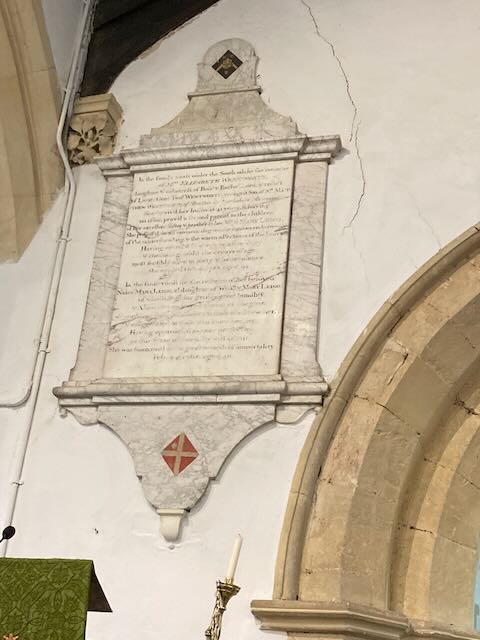
The Leighs also had an aunt who fell in love with an army officer. The family disapproved because of his lack of money. She married him secretly before he went off to war. When he returned as–guess who? Captain Wentworth!– she finally got her family’s approval. Elizabeth Wentworth and her Captain became wealthy and were benefactors to their Leigh relatives. The largest marble tablet in the Adlestrop church, just behind the pulpit, memorializes Elizabeth Wentworth.
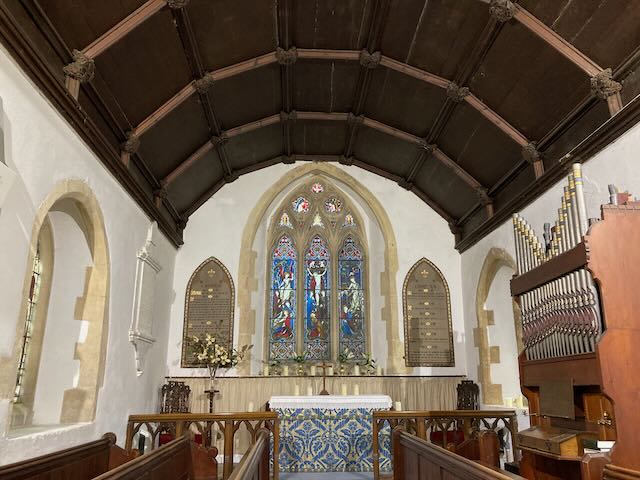
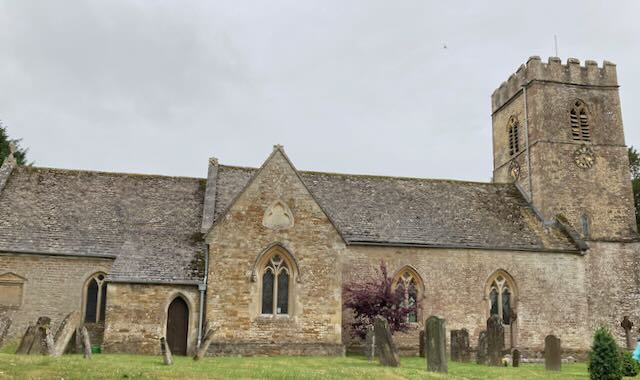
The church, St. Mary Magdalene, at Adlestrop is well worth a visit. The church dates from the thirteenth century, though much of it was rebuilt in the 1750s. In the Victorian period, the window traceries were replaced, and stained glass windows and a clock added. The church is one of seven in the Evenlode Vale Benefice. Services are usually held at St. Mary Magdalene twice a month. Like other country churches, a handful of the faithful attend regular services, while larger crowds come to special services at Harvest and Christmas. We don’t know about attendance numbers in Austen’s time. Supposedly, by 1851, “‘all parishioners without exception‘ attended church at least once a week” (Huxley, 201).
The rectory where Jane and her family stayed is now called Adlestrop House, and, along with Adlestrop Park, still belongs to the Leigh family. Both are very close to the church, but are not open to the public. The lands were originally monastic lands owned by Evesham Abbey.
The Old Schoolhouse opposite the church was built after Austen’s time. However, Austen probably saw the earlier charity school, supported by donations from the Leigh family and other local gentry. In 1803, sixteen children learned reading, knitting, and other marketable skills at that “school of industry.” By 1818 there was a day school for boys and another for girls. A Sunday school attended by 52 children was supported by a bequest from Rev. Thomas Leigh (Huxley, 203). (Sunday schools taught reading and other basic skills to working-class children, who were only free on Sundays.)
The last chapter of Jane Austen & Adlestrop takes readers on a tour of Adlestrop today, still a sleepy country village, but with history around every corner.
Adlestrop Park, the manor, etching in 1818, from Historic England.
* Claimants for the Stoneleigh Abbey estate (this is complicated, sorry! You can find a chart of these relationships in Jane Austen & Adlestrop, by Victoria Huxley, or in Jane Austen and the Clergy, by Irene Collins):
Theophilus Leigh (died 1724), of the Adlestrop Leighs (great-great grandson of the Lord Mayor), had 14 children.
Theophilus’s oldest son, William, had a son named James (who died in 1774). James had one son (Theophilus’s grandson), James Henry (1765-1823). William’s second son was Rev. Thomas Leigh (1734-1813), rector of Adlestrop, who had no children.
Theophilus’s next surviving son, Dr. Theophilus Leigh (died 1785), was a clergyman and Master of Balliol at Oxford. He had no sons who survived childhood. One of his daughters married Rev. Thomas Leigh of Adlestrop, and another married Rev. Samuel Cooke, Jane Austen’s godfather.
Theophilus’s next son, also Rev. Thomas Leigh (died 1764), was Cassandra Leigh Austen’s father. He had a son, James Leigh-Perrot (1735-1817), just a year younger than Rev. Thomas Leigh of Adlestrop. James had added “Perrot” to his last name to get an inheritance from his wife’s family.
So in 1806, the closest living male heirs were Rev. Thomas Leigh of Adlestrop, who inherited the estate, then he passed it to his nephew James Henry Leigh. They gave money to James Leigh-Perrot, the third claimant, to pay off his claim.
“What are young men to rocks and mountains?”—Pride and Prejudice
Rocks and mountains recur in the story of Lady Hester Stanhope, though the mountains she climbed were much farther away than Derbyshire. We all know that women of Jane Austen’s England faced many restrictions. Austen herself published her books as “a lady” rather than under her own name, to avoid any stigma for stepping outside of the box that society prescribed for her.
Yet some women did step out of that box, some of them very far outside the box! Those in the upper classes with enough money could afford to be “eccentric” and go their own ways. (Some in the middle and lower classes did the same, especially if they were widows, but that’s another story.)
Lady Hester Stanhope
One of the most famous, or infamous, of these trailblazing women was Lady Hester Stanhope, Middle Eastern traveler and pioneer archaeologist. Chawton House hosted a talk entitled “Lady Hester Stanhope: Trowelblazer or Iconoclast?” on Feb. 16.
Lady Hester was born only a few months after Jane Austen, in March of 1776. She was the oldest child of an earl. In 1803 she moved into the home of her uncle, William Pitt the Younger, prime minister of England. She acted as his hostess and private secretary. When he died in 1806, the British government granted Hester a pension of £1200 a year, at Pitt’s request. After several romantic disappointments, she became disillusioned with England. She went overseas in 1810 and never returned to England. She was almost 34.
Shipwrecked on Rhodes
Starting out on a Grand Tour of Europe, she was shipwrecked on the island of Rhodes, losing all her possessions and money. She wrote,
Unable to make the land, I got ashore, not on an island, but a bare rock which stuck up in the sea, and remained thirty hours without food or water. It becoming calmer the second night, I once more put to sea, and fortunately landed upon the island of Rhodes, but above three days’ journey from the town, travelling at the rate of eight hours a day over mountains and dreadful rocks. Could the fashionables I once associated with believe that I could have sufficient composure of mind to have given my orders as distinctly and as positively as if I had been sitting in the midst of them, and that I slept for many hours very sound on the bare rock, covered with a pelisse, and was in a sweet sleep the second night, when I was awoke by the men, who seemed to dread that, as it was becoming calmer, and the wind changing (which would bring the sea in another direction), that we might be washed off the rock before morning. So away I went, putting my faith in that God who has never quite forsaken me in all my various misfortunes. The next place I slept in was a mill, upon sacks of corn; after that, in a hut, where I turned out a poor ass to make more room, and congratulated myself on having a bed of straw. When I arrived (after a day of tremendous fatigue) at a tolerable village, I found myself too ill to proceed the next day, and was fortunate enough to make the acquaintance of a kind-hearted, hospitable Greek gentleman, whom misfortune had sent into obscurity, and he insisted upon keeping me in his house till I was recovered.
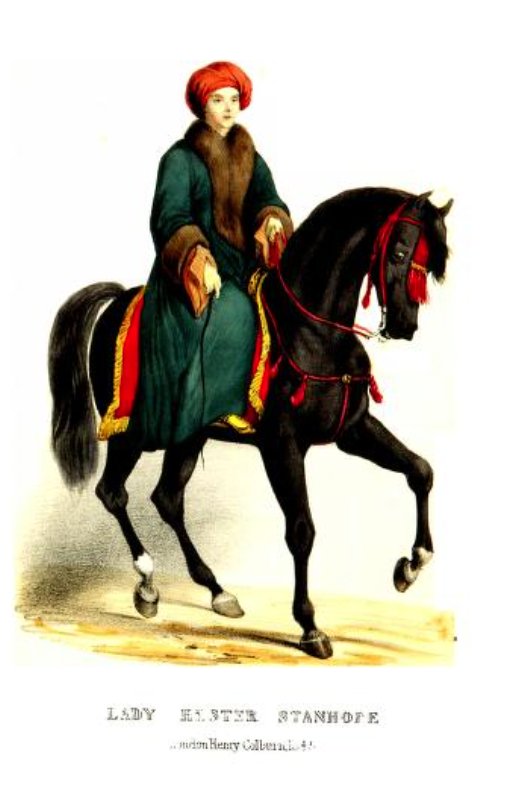
At this point she adopted the Turkish dress of the Ottoman Empire. She explains why she chose men’s clothing:
. . . Everything I possessed I have lost; had I attempted to have saved anything, others would have done the same, and the boat would have been sunk. To collect clothes in this part of the world to dress as an Englishwoman would be next to impossible; at least, it would cost me two years’ income. To dress as a Turkish woman would not do, because I must not be seen to speak to a man; therefore I have nothing left for it but to dress as a Turk — not like the Turks you are in the habit of seeing in England, but as an Asiatic Turk in a travelling dress — just a sort of silk and cotton shirt; next a striped silk and cotton waistcoat; over that another with sleeves, and over that a cloth short jacket without sleeves or half-sleeves, beautifully worked in coloured twist, a large pair of breeches, and Turkish boots, a sash into which goes a brace of pistols, a knife, and a sort of short sword, a belt for powder and shot made of variegated leather, which goes over the shoulder, the pouches the same, and a turban of several colours, put on in a particular way with a large bunch of natural flowers on one side. This is the dress of the common Asiatic; the great men are covered with gold and embroidery, and nothing can be more splendid and becoming than their dress. (Life and Letters of Lady Hester Stanhope, 116-117)
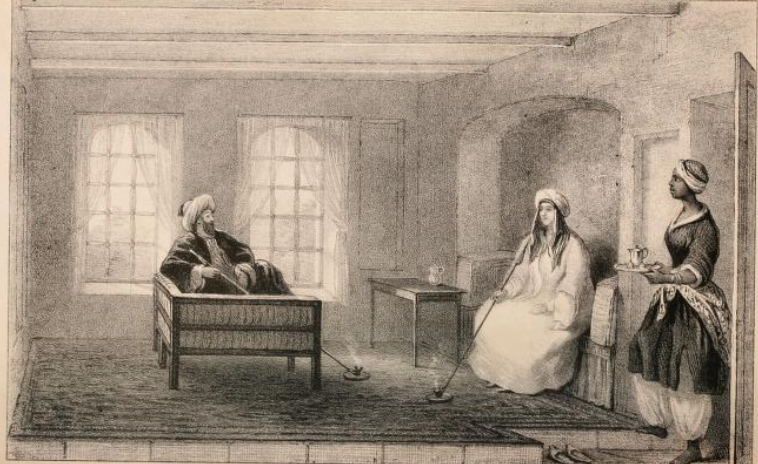
The clothes sound quite sumptuous, and she seems to have enjoyed them! As a foreign woman, and a woman in men’s clothing, Lady Hester occupied an unusual place in Ottoman society. She could be treated as more or less an “honorary man,” relating to local men in ways that local women could not.
Lady Hester Stanhope wearing Turkish men’s clothing. Frontispiece, Memoirs of the Lady Hester Stanhope, Vol. 1 (London: Henry Colburn, 1846).
Egypt to Palmyra
Lady Hester traveled deeper into the Middle East. She wasn’t much impressed with the wonders of Egypt. She refused to enter the Great Pyramid and complained of “an inconceivable number of fleas.” Many English tourists visited Egypt, and she wanted to do something more impressive.
Because of her background with Pitt in politics, and her connections, she was able to get permission from the Ottoman Pasha to go to Palmyra, an ancient city in the Syrian desert. When she reached it with her Beduin caravan after six days of travel, they “crowned” her “Queen of the Desert,” after the ancient Queen Zenobia.
During her travels, Lady Hester constantly racked up debts, and wrote back to the English government asking for money. They sometimes ended up paying because of her high connections.
Emma Yandle, curator of the Chawton House exhibition on “Trailblazers: Women Travel Writers,” went on to discuss Lady Hester Stanhope’s somewhat questionable contributions to archaeology. Lady Hester was arguably the first Westerner given official permission to excavate an ancient site; certainly she was the first woman to do so.
Lady Hester somehow obtained a manuscript, purportedly written by a monk, describing the location of immense hoards of buried treasure (three million gold coins!) in the ancient cities of Ashkelon, Awgy (near Jaffa), and Sidon. She got permission and safe conduct letters from the Ottoman government to excavate at Ashkelon. She promised the Ottoman government all the treasure she would find. She asked the British government to pay for the excavations, simply for the honor it would bring to England and to herself.
Excavations began in April of 1815. Lady Hester was the visionary, nominally in charge. Actually, though, her personal physician, Dr. Charles Meryon, directed the excavations and kept the records. They found no gold coins.
They did, however, find one archaeological treasure. It appeared to be a Roman statue, somewhat mutilated. According to a later biography, this made Lady Hester Stanhope “the first person who ever intentionally excavated an ancient artifact in the ‘Holy Land.’”
However, Lady Hester feared that if the Ottoman ruler heard about this, he would believe that she was excavating treasures to send back to her native England. She had promised she would not do that. (Many others of the time were plundering the various countries they colonized.) So—she destroyed the statue! She had it smashed and thrown into the sea. A very strange decision.
We still have drawings and a description of the statue, but that’s all. A much later archaeological expedition, in 1921, found what were apparently the missing pieces of that statue.
The records of the expedition, however, gave a lot of historical information. The layers of history that were uncovered were recorded: a Roman temple at the lowest layer, above it a church, and over that a mosque. (This was confirmed by the later expedition.) They also recorded the locations of any artifacts found. This was a new procedure. Other diggings at the time simply took whatever they could find and shipped it off to museums or private collections, with no details of location or depth. So Lady Hester’s excavation did blaze new trails for archaeology.
End of Life
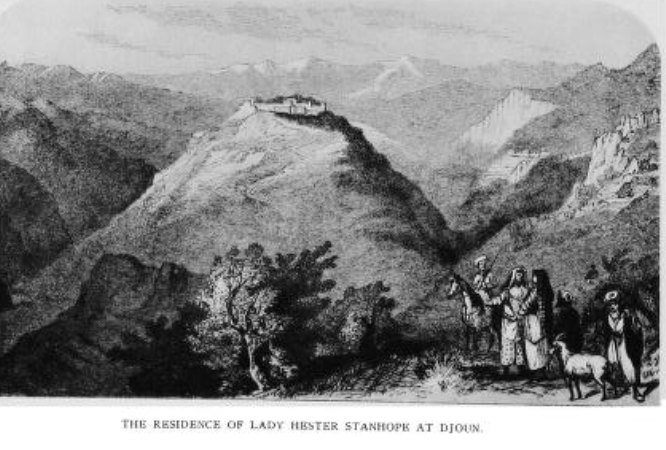
Lady Hester Stanhope later settled on a mountaintop among the Druze people of Lebanon, near Sidon. She became disastrously involved in Middle Eastern conflicts, and went deeper and deeper into debt. She died, penniless and alone, in 1839.
She was always a wilful aristocrat, who wanted to govern her life and the lives of others – indeed believed it was her position in life to do so – and on occasions she was overbearing and unkind. But she was also vivacious, daring, sharp-witted, charismatic, benevolent, and brave to the point of recklessness.
Above all, she rejected society conventions and the restrictions of life for a woman in Europe, embracing the unexpected opportunity to be her own mistress within an Eastern culture that excluded women from public life. That alone sets her apart as a pioneer and an extraordinary human being.
As far as I’ve been able to discover, Jane Austen never mentioned Hester Stanhope in her letters. She may have known of some of her exploits, however. Both were trailblazers: Jane, quietly, from her home; and Hester, flamboyantly, in exotic places.
Resources about Lady Hester Stanhope
Memoirs of the Lady Hester Stanhope; the sequel, Travels of Lady Hester Stanhope; and Life and Letters of Lady Hester Stanhope, are available on archive.org.
Lady Hester, Queen of the East, by Lorna Gibb
Star of the Morning: The Extraordinary Life of Lady Hester Stanhope, by Kirsten Ellis
Gentle Readers, This review discusses an historical novel based on one of Jane Austen’s least admired characters, Mary Bennet. Katherine Cowley manages to keep my interest in the growth of Mary in her self-confidence and talents.
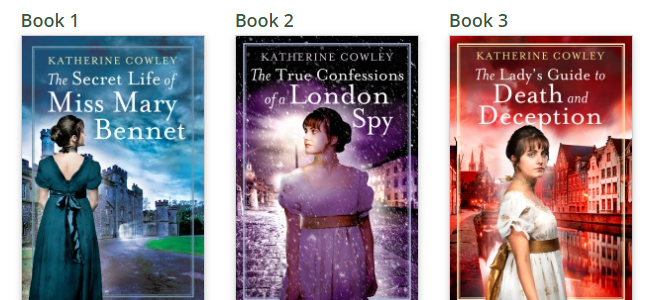
The Lady’s Guide to Death and Deception is Katherine Cowley’s third installment of a series of five books based on Mr and Mrs Bennet’s middle daughter. Cowley, in her three published novels, has captured Mary’s qualities and mannerisms, as well as her vulnerability and insecurities. In three novels Mary’s been transformed from a character living in the shadows of her vivacious sisters to a woman with the daring and tenacity of a spy. The background of the three novels is the Napoleonic Wars.
In the first novel, The Secret Life of Miss Mary Bennet, we met Mary sitting by her father’s deathbed alone at night. During this sad time, she anticipated a life of silent misery under the rule of her widowed mother. In the early hours someone knocks on the door. Enter Lady Trafford and her nephew Mr Withrow. Claiming to be a distant relation, she invites Mary to visit her in a castle along the shores of the Sussex Coast. Lady Trafford sees a silent strength in Mary and recognizes her isolation from her family, and her patience, and accurate observations. After a time as her guest, she invites Mary to become a spy and promises to train her.
Author Katherine Cowley astutely endears the reader to Austen’s Mary, while pointing out the skills that this middle sister learned as she lived in her sisters’ shadows, for Mary’s strength as a spy lies in her natural state of invisibility. She’s a nobody. Anonymous and unnoticed. Therefore, she’s the perfect spy. She’s also a stickler for keeping copious and accurate notes.
Oh, Mary’s still self-deprecating and annoyingly awkward, but these traits are familiar to the Austen reader. Her transformation as a double agent and her release from dependency on her family as an unmarried female makes sense. (Read my review of the novel in this link.)
In book two of the series, entitled The True Confessions of a London Spy, Mary travels to London to ostensibly visit the Darcys, who are residing in their splendid London townhouse. We see this couple through Mary’s eyes. Better yet, her younger sister Kitty is visiting as well, as is Darcy’s sister, Georgiana. Cowley’s descriptions of Mary’s interactions and perceptions with her relatives and acquaintances are developed in a satisfying way.
In True Confessions Mary must wend her way to follow Mr Darcy’s strict rules for single female visitors to his house and the freedom she needs to spy on an assortment of gentlemen, one of whom is suspected of murder. The author writes a fascinating account of our revisit with a beloved Austen couple along with Mary’s growing self-awareness and as a spy. Better yet, Mary receives her first proposal! In this novel the reader discovers that while Mary does not regard herself as particularly beautiful or interesting, some men found her fascinating. Cowley threads many historical details in this tale, while keeping the spotlight on our spy heroine.
Book Three takes us to The Lady’s Guide to Death and Deception, one of five novels she’s contracted to write for Tule Publishing. The third installment about Mary’s journey as a spy does not disappoint. In this book, she and the spy team of Lady Tafford and Mr Whitford are shipped off to Brussels, a city that plays an important part in the events prior to the battle of Waterloo. Mary’s honed her spy skills. She’s learned to shoot a pistol and has improved her disguises in a variety of roles and accents.
Cowley weaves fiction and history together in a way that satisfies both my love for historical novels and romance. Her Mary Bennet is written with great respect towards Austen’s character.
As a wide-eyed and bushy tailed 20-something and in love with Jane Austen’s novels, I was aghast to learn she had written only six. In desperation to find another Austen, I turned to Georgette Heyer’s Regency romances. My flat mate and I DEVOURED them. Now, in my (ahem) more mature age, I appreciate Heyer’s historical novels more than her light comedies.
Heyer’s An Infamous Army and The Spanish Bride are considered to be so historically accurate that few find fault with her research. Cowley’s writing style is her own; like Heyer she weaves a romance and a mystery into an account of the weeks prior to Waterloo. The Book Tour’s media kit succinctly states:
Life changes once again for British spy Miss Mary Bennet when Napoleon Bonaparte escapes from the Isle of Elba. Mary quickly departs England for Brussels, the city where the Allied forces prepare for war against the French. But shortly after her arrival, one of the Duke of Wellington’s best officers is murdered, an event which threatens to break the delicate alliance between the Allies.
Investigating the murder forces Mary into precarious levels of espionage, role-playing, and deception with her new partner, Mr. Withrow-the nephew and heir of her prominent sponsor, and the spy with whom she’s often at odds. Together, they court danger and discovery as they play dual roles gathering intelligence for the British. But soon Mary realizes that her growing feelings towards Mr. Withrow put her heart in as much danger as her life. And then there’s another murder.
Mary will need to unmask the murderer before more people are killed, but can she do so and remain hidden in the background?”
While Cowley is spare in her descriptions, she offers more details than Austen. She includes important characters like Sir Arthur Wellesley, the 1st Duke of Wellington, Prussian General Blücher and William of Orange (later King William II of The Netherlands), who at the time of Waterloo was a Lieutenant-General. All interact with Mary in her various guises. I found Cowley’s details of Brussels with its many canals and the Duchess of Richmond’s famous ball satisfying. She did not dwell overly long on the battle, but gave it enough pages to recount its horrors, just as she provided more than an amuse-bouche to Mary’s budding romance.
This slideshow requires JavaScript.
One last observation for purists: At the end of the book, Cowley acknowledges that for the sake of her plot she changed some historical facts. She lists them and mentions why the changes were made. Of Cowley’s three novels, I found this one the most satisfying and look forward to reading the remaining two Mary Bennet adventures.
Author Bio
Author Catherine Cowley
Katherine Cowley read Pride and Prejudice for the first time when she was ten years old, which started a lifelong obsession with Jane Austen. Her debut novel, The Secret Life of Miss Mary Bennet, was nominated for the Mary Higgins Clark Award. Her Mary Bennet spy series continues with the novels The True Confessions of a London Spy and The Lady’s Guide to Death and Deception. Katherine loves history, chocolate, traveling, and playing the piano, and she has taught writing classes at Western Michigan University.
One bookshop. Fifty-one rules. Three women who break them all.
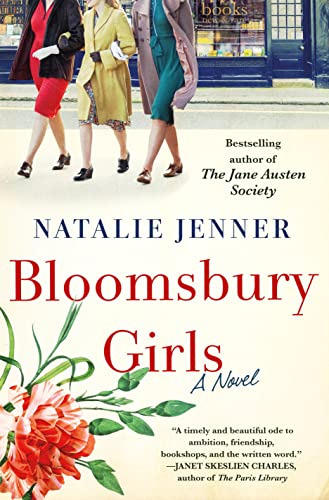
Natalie Jenner, the internationally bestselling author of The Jane Austen Society, has gifted us with her newest book, Bloomsbury Girls, just in time for summer! It’s a compelling and heartwarming story of a century-old bookstore and three women determined to find their way in a fast-changing world.
Book Description:
Bloomsbury Books is an old-fashioned new and rare book store that has persisted and resisted change for a hundred years, run by men and guided by the general manager’s unbreakable fifty-one rules. But in 1950, the world is changing, especially the world of books and publishing, and at Bloomsbury Books, the girls in the shop have plans:
Vivien Lowry: Single since her aristocratic fiance was killed in action during World War II, the brilliant and stylish Vivien has a long list of grievances–most of them well justified and the biggest of which is Alec McDonough, the Head of Fiction.
Grace Perkins: Married with two sons, she’s been working to support the family following her husband’s breakdown in the aftermath of the war. Torn between duty to her family and dreams of her own.
Evie Stone: In the first class of female students from Cambridge permitted to earn a degree, Evie was denied an academic position in favor of her less accomplished male rival. Now she’s working at Bloomsbury Books while she plans to remake her own future.
As they interact with various literary figures of the time–Daphne Du Maurier, Ellen Doubleday, Sonia Blair (widow of George Orwell), Samuel Beckett, Peggy Guggenheim, and others–these three women with their complex web of relationships, goals and dreams are all working to plot out a future that is richer and more rewarding than anything society will allow.
Bloomsbury Girls is the perfect read for those of us who love a story that’s set in a bookstore and is filled with books and bookish people. As I began to read, it first reminded me of 84, Charing Cross Road by Helene Hanff, a slim volume that is forever memorable for most of us who have read it and/or seen the film. I enjoy books where the setting (the house, the shop, the city) is so special and memorable that it becomes like another character in the reader’s mind. In Jenner’s novel, Bloomsbury Books itself is a very much alive and poignant character–and one I enjoyed immensely.
Beyond the setting and the great bibliophile feels the book provides, Jenner has done an exquisite job of weaving together a beautiful cast of characters and their individual stories. There is depth and complexity to each character, each couple, each department head, each story arc.
Finally, the storylines surrounding the three lead female characters are delightfully drawn. I found myself intrigued by each one, enjoying their individual stories as well as the bigger plot at hand. When they begin to work together and their stories begin to tie together and intertwine, it’s intriguing and delightful. The things they accomplish when they link arms is truly inspiring.
Overall, this is a fun, summery read filled with all the good things I love most. I hope you’ll stop in and visit Bloomsbury Books. Though it may seem like an ordinary British bookstore at first glance, there is so much more going on behind the scenes than meets the eye.
Audiobook
If you have a long car trip ahead, or if you prefer to listen to your books while you work, the audio versionof this book promises to be incredible. Acclaimed actor and narrator Juliet Stevenson, CBE, narrated the audiobook for Bloomsbury Girls, with a performance that has been called “vocal virtuosity.”
Stevenson is best known for her roles in Emma, Truly, Madly, Deeply, Bend it Like Beckham, Mona Lisa Smile, Being Julia, and Infamous. She is also the BAFTA-nominated and Olivier Award-winning star of many Royal Shakespeare Company and National Theatre productions. Regarded as one of the finest audiobook narrators working today, Stevenson’s other recent narrations include Julian Fellowes’ Belgravia and the collected works of Jane Austen and Daphne du Maurier.
NATALIE JENNER is the author of the instant international bestseller The Jane Austen Society and Bloomsbury Girls. A Goodreads Choice Award runner-up for historical fiction and finalist for best debut novel, The Jane Austen Society was a USA Today and #1 national bestseller, and has been sold for translation in twenty countries. Born in England and raised in Canada, Natalie has been a corporate lawyer, career coach and, most recently, an independent bookstore owner in Oakville, Ontario, where she lives with her family and two rescue dogs. Visit her website to learn more.
Fashionable Goodness: Christianity in Jane Austen's England is now available! By JAW contributor Brenda S. Cox. See Review. Available from Amazon and Jane Austen Books.
Available through December 31st, 2025. Click on image for details, and share this poster with other teachers and students!
The Obituary of Charlotte Collins by Andrew Capes
Click on image to read the story.
Comments
“My idea of good company…is the company of clever, well-informed people, who have a great deal of conversation.” – Jane Austen, Persuasion
Gentle readers: Please feel free to post your comments and continue the conversation! Due to SPAM, we will no longer accept comments on posts after 30 days of publication. In some instances, links will be removed from comments as well.
Administrators and Contributors
Vic Sanborn, founder of this blog, is supported by a team of talented and knowledgeable writers about Jane Austen and the Regency era. They are:
Tony Grant, who now contributes his photos from London and England
Click on their names to enter their own blogs.
In addition, we thank the many experts and authors who frequently contribute their posts and opinions, and who continue to do so freely or at our request.
Click here to enter the page. Topics include Regency fashion, historic foods, Jane Austen societies, British sites, related topics. Click on image.
May we suggest?
Hello, my name is Vic and I live in Maryland, USA. I have adored Jane Austen almost all of my life. I am a proud lifetime member of the Jane Austen Society of North America. This blog is a personal blog written and edited by me and my team. We do not accept any form of cash advertising, sponsorship, or paid topic insertions. However, we do accept and keep books and CDs to review.
If you would like to share a new site, or point out an error, please email us. (Yes, we are fallible. We'll own up to our mistakes and will make the corrections with a polite smile on our faces.) Write us at
Thank you for visiting this blog. Your comments and suggestions are most welcome.
Project Gutenberg: eBook of Stage-coach and Mail in Days of Yore, Volume 2 (of 2), by Charles G. Harper
STAGE-COACH AND MAIL IN DAYS OF YORE: A PICTURESQUE HISTORY
OF THE COACHING AGE, VOL. II, By CHARLES G. HARPER. 1903. Click on this link.
















 Jane Austen's World