Feeds:
Posts
Comments

Archive for the ‘Jane Austen Novels’ Category

Gentle readers: Penguin English Library is holding an Austen/Brontë smackdown on its Facebook page, with Jane Austen’s World and Christine from Bronte Blog providing the ammunition for discussion. An edited version of my smackdown sits on Facebook, the full version sits on this blog. I have added Christine’s edited defense of Charlotte Brontë below my defense of Jane. Do go over to Penguin’s Facebook page and leave your comment! You will have the chance of winning a Penguin library canvas bag! Enjoy.
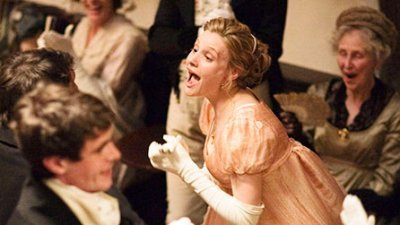
Romola Garai as Emma dancing a country dance at the local assembly hall.

Vic’s Unedited Take:

I’ve been asked to participate in a smackdown, pitting Jane Austen, whose best-selling novel starts with the most memorable opening line in literature – “It is a truth universally acknowledged…” – against Charlotte Brontë, who begins Jane Eyre with a sentence that barely qualifies as a decent Facebook entry: “There was no possibility of taking a walk that day”. Good lord. GO Team Austen!

I love smart and funny women who are quick with their tongues. If our dowdy spinster from Hampshire suddenly found herself at the Algonquin Round Table in post-World War One New York city, she would have jumped into the fray and easily held her own against such rapier wits as Dorothy Parker, Harold Ross, Edna Ferber and Harpo Marx. Charlotte Brontë would have sat slack-jawed amongst such august company, waiting for a lull in the conversation before daring to venture her opinion. Had Mark Twain materialized in front of Miss Austen and threatened to personally beat her skull in with her own shin-bone, she would have swiftly retorted, “Why I now fully understand, Mr. Twain, why Mrs. Hall of Sherbourn was brought to bed of a dead child, some weeks before she expected. T’was owing to a fright — I suppose she happened unawares to look at YOU.” Austen had teeth. No wonder Pride and Prejudice was chosen for the first Zombie mash-up!

A number of Brontë fans have accused Austen of writing sterile romance novel claptrap, which means that those poor souls don’t get Austen’s ironic take on life with its underlying passions at all. Can you imagine one of Brontë’s overwrought characters coming up with the cool line that Mary Crawford uttered in Mansfield Park? “Certainly, my home at my uncle’s brought me acquainted with a circle of admirals. Of Rears, and Vices, I saw enough. Now, do not be suspecting me of a pun, I entreat.” I had been of legal drinking age for a number of years before I understood exactly what rears and vices meant!

Brontë supporters think Jane’s novels lack passion and give us no sense of the greater society in which she lived. Let’s debunk that myth, shall we? Willoughby got a girl pregnant, enticed Marianne to behave like a hoyden, then cynically married an heiress for money. Wickham attempted to seduce an underage heiress, then ran off with a lusty, empty-headed 16-year-old virgin with no intention of marrying her. Lucy Steele was a sadistic, mean, and spiteful little bitch. Mrs. Norris was a verbal abuser who could have taught Lucy a thing or two in the nasty department. Fanny Price’s mother married for love, and look where that got her – barefoot, too many times pregnant, and living like a slattern in a hovel. John Thorpe was a douche-bag, plain and simple, as was William Elliott. Then there were the silly ministers, and the neglectful husbands, like Mr. Bennet and Mr. Palmer. Last but not least, Jane handed the dreaded specter of poverty to Mrs. and Miss Bates, and Mrs. Smith, whose cheerful demeanor belied her desperate state. Interwoven through Austen’s novels are her sparkling wit and clear observations of the human character. We are treated to strong heroines like Lizzie Bennet and Anne Elliot, and to alpha males like Mr. Darcy and Colonel Brandon, who, as men of few words, sprang into selfless action when heroism was required.
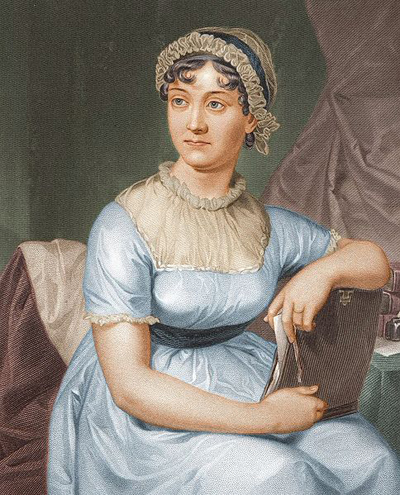
Idealized romanticized image of Jane Austen.

What does Charlotte Brontë offer us? That metrosexual cold fish, St. John Rivers. And then there’s Rochester, Mr. Sturm und Drang. He was a closet whiner and complainer, I’ll warrant, who, while holding all the power cards, forced poor plain Miss Eyre to listen to his incessant self-serving monologues. I bet he wandered around his cold stone house dragging the proverbial ball and chain in the form of the hidden insane wife, and wearing an expression that shouted to all but the blind: “Woe is me. Oh, woe is pitiful, loveless me.” As my dear friend, Lady Anne, told me, “Even Austen’s bad boys are more plausible than Brontë’s heroes.”

Where Mr. Darcy took his medicine with only a minor facial tick when Lizzie dressed him down after refusing his proposal, Rochester emoted suffering morning, noon, and night. Misery must have oozed out of his pores. Those obvious ploys for sympathy worked on me when I was 14 years old, but now that I am slightly longer in the tooth I am attracted to more mentally stable men, like Mr. Darcy. Oh, don’t get me wrong, I know that Darcy’s a cool and reserved character, and a bit of a prig. Taming him would be a REAL challenge, one that Elizabeth Bennet took on with relish. Whatever you think of him, there’s no denying that Darcy’s passion for Lizzy simmered and sizzled throughout Pride and Prejudice. Austen’s writing style might be spare and cerebral, but the chemistry between her heroes and heroines leaps off the pages and keeps us enthralled.
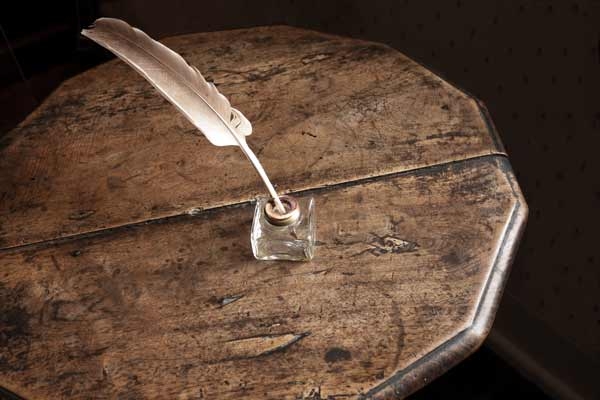
Jane Austen’s writing desk

In closing (and here my imagination has taken over), one suspects that after their wedding, our young and virile Mr. Darcy gave Lizzie some extremely satisfying romps in bed, followed by a repeat performance or two, whereas poor Mr. Rochester – well, let’s face it – he was OLD, and his physical health was compromised by that pesky though fortuitous fire. (Deux ex machina, anyone?) My guess is that, after observing his manly duty with Mrs. Rochester, he most likely gave her a peck on the cheek before rolling to the other side of the bed and instantly falling asleep. As her husband snored contentedly, a frustrated (but romantically inclined) Jane was frequently left to lie in the dark and think of England.

Christine’s edited version: 

‘In Austen, sex is just a kiss on the hand. In the Brontës, everything happens’. So says a newspaper clipping kept at the Brontë Parsonage Museum Library. After hearing that, the Brontës would get a twinkle in their eyes that would belie their quieter, Northern-lasses-from-a-parsonage appearance.
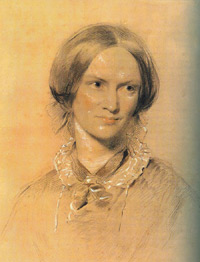
Charlotte Bronte

Charlotte herself, after reading Emma pronounced ”the passions are perfectly unknown to her, she rejects even a speaking acquaintance with that stormy Sisterhood; even to the Feelings she vouchsafes no more than an occasional graceful but distant recognition; too frequent converse with them would ruffle the smooth elegance of her progress.”

Which she corroborated after reading Pride and Prejudice: “An accurate daguerrotyped portrait of a commonplace face; a carefully fenced, highly cultivated garden, with neat borders and delicate flowers; but no glance of a bright vivid physiognomy, no open country, no fresh air, no blue hill, no bonny beck. I should hardly like to live with her ladies and gentlemen, in their elegant but confined houses”.

It’s an easy choice: either you like opening a book and gazing at a quiet and ever-green meadow, nice and lovely but always nice and lovely, sometimes too nice and too lovely or you like opening a book and looking at an ever-changing moor, sometimes bleak, sometimes radiantly in bloom, never predictable, always engaging. If you choose the latter, remember that being Team Brontë is more than a mere liking. As another newspaper said (as early as 1916): “Miss Austen and Thackeray have admirers; Charlotte Brontë has worshippers”.
Read Full Post »

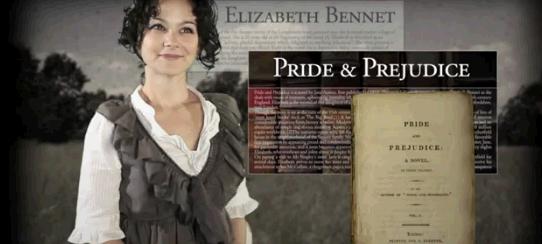
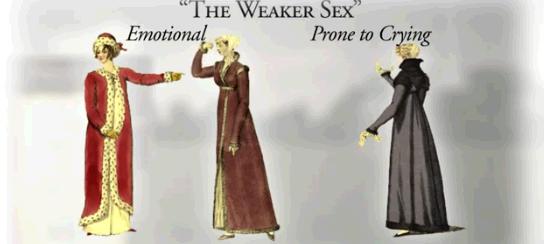
Inquiring readers, Josh Kurz, an independent filmmaker, just finished a piece for the Chemical Heritage Foundation, A Distillations Explainer about tears. This funny yet educational two-minute segment features Elizabeth Bennet. Thanks, Josh, for pointing me to your video.

There is evidence to suggest that crying relieves stress. While Elizabeth Bennet is not some namby pamby miss, she does produce three kinds of tears: Basal tears, reflex tears, and emotional tears with added proteins. This short video will explain all three.

Elizabeth Bennet played by Carla Rosati. Brought to us by “Distillations: We Tell the Story of Chemistry”. Directed by Josh Kurz.

If women cry from emotion, it is to their benefit!

Read Full Post »

“there seem to be very few, in the style of a Novel, that you can read with safety, and yet fewer that you can read with advantage.”- Sermons to Young Women, James Fordyce, 1766

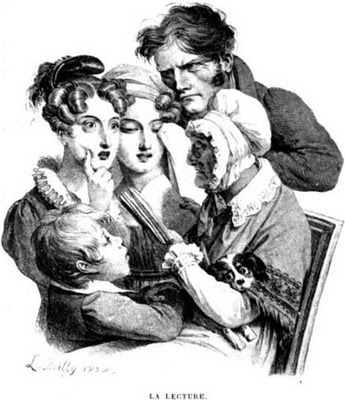
It’s no secret that Jane Austen’s family were novel readers during an age when such books were considered frivolous and not worthy of reading. (Writing a novel was considered an even worse offense!) Enter Jane Austen and Pride and Prejudice. In her delightful book, Jane created a satiric scene in which Mr. Collins confirmed Mr. Bennet’s opinion of his young cousin’s foolishness. After he enjoyed the younger man’s inanity for a while, Mr. Bennet proposed that Mr. Collins read to the group. The girls chose a novel, of which Mr. Collins disapproved:

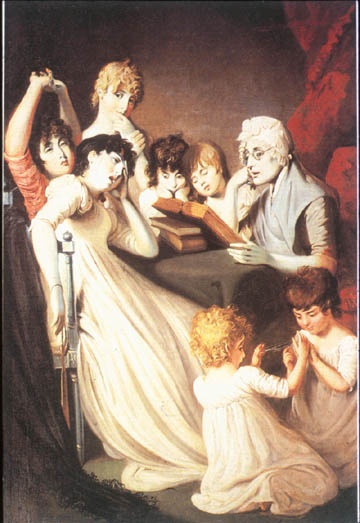
John Opie, "A Moral Homily"

John Opie, “A Moral Homily”

Mr. Bennet’s expectations [regarding Mr. Collins] were fully answered. His cousin was as absurd as he had hoped, and he listened to him with the keenest enjoyment, maintaining at the same time the most resolute composure of countenance, and, except in an occasional glance at Elizabeth, requiring no partner in his pleasure.

By tea-time, however, the dose had been enough, and Mr. Bennet was glad to take his guest into the drawingroom again, and, when tea was over, glad to invite him to read aloud to the ladies. Mr. Collins readily assented, and a book was produced; but on beholding it (for everything announced it to be from a circulating library), he started back, and begging pardon, protested that he never read novels. Kitty stared at him, and Lydia exclaimed.—Other books were produced, and after some deliberation he chose Fordyce’s Sermons. Lydia gaped as he opened the volume, and before he had, with very monotonous solemnity, read three pages, she interrupted him with—

“Do you know, mamma, that my uncle Philips talks of turning away Richard; and if he does, Colonel Forster will hire him. My aunt told me so herself on Saturday. I shall walk to Meryton to-morrow to hear more about it, and to ask when Mr. Denny comes back from town.”

Lydia was bid by her two eldest sisters to hold her tongue; but Mr. Collins, much offended, laid aside his book, and said—

“I have often observed how little young ladies are interested by books of a serious stamp, though written solely for their benefit. It amazes me, I confess;—for, certainly, there can be nothing so advantageous to them as instruction. But I will no longer importune my young cousin.”

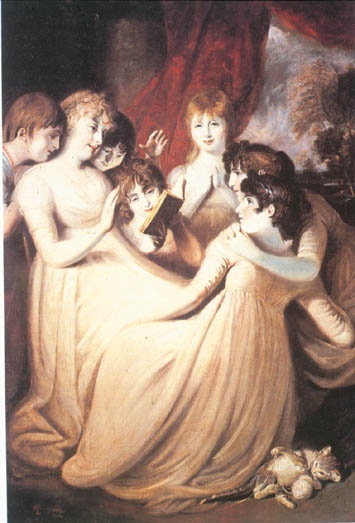
John Opie, “A Tale of Romance”

One cannot but help enjoy the irony of the situation. During his lifetime, Dr Fordyce was considered an excellent orator and his sermons were much appreciated, but by the time Jane Austen began to write her novels his luster had dimmed and novel reading was becoming more acceptable. These wonderful paintings by John Opie represent both sides of the sermon/novel story. In the first painting the governess is reading boring homilies to her charges in the hope of educating them. She is completely unaware of their expressions. One girl yawns, another can barely keep her eyes open, and a third looks pensively at the viewer as if to say, “Can you believe this?” Two of the youngest children entertain each other by playing cat’s cradle, and the girl sitting nearest the reader is about to fall asleep. What a wonderful tableau! One can imagine that the Bennets must have looked much like this ensemble before Lydia blurted out her question.

The second painting depicts the delight that the ensemble takes in listening to a tale of romance. They are all engaged and smiling and hanging onto every word from the reader. A kitten is left to play with a wool ball by itself.

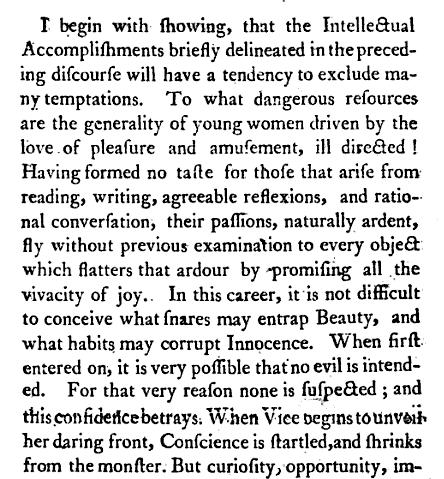
Jane Austen employed words to create an ironic tone; John Opie used images. Both used their respective mediums to make a memorable point. Today, Dr. Fordyce’s sermons are largely forgotten. The following excerpt from Sermon VIII, Volume 2 demonstrates why he was considered dull and stodgy even 200 years ago:

Sermons to Young Women, Volume 2, James Fordyce, 1767. You can download the volume as an ebook at this link.

Read Full Post »

Portrait of Maria Edgeworth by John Downman (1807). Is it just wishful thinking on my part or does Jane Austen somewhat resemble this pretty, genteel author?

I’m sure others have been struck by this paragraph from Pride and Prejudice (see quote below), and wondered if perhaps it gives us a clue about how Cassandra was able to locate the many letters from Jane that she would destroy, for the majority of those that survived are innocuous and mundane. They reveal very little about the author’s observations and feelings about her family and friends, politics, and religion.

Cassandra, who outlived Jane by 26 years, kept her sister’s letters to reread during her lifetime. This gave her enough time to decide what to do with them. She burned most of Jane’s letters shortly before her death, redistributing the remaining few among friends and family.

Of the approximately 160 letters that survive from Jane, 95 were written to Cassandra. None of the letters Jane wrote to her parents survive, and very few to her brothers (none to Henry, her favorite brother). To be fair to Cassandra, who has been vilified by many for burning so many of Jane’s letters, it was the custom in those days to destroy such casual correspondence (much like we delete emails today).

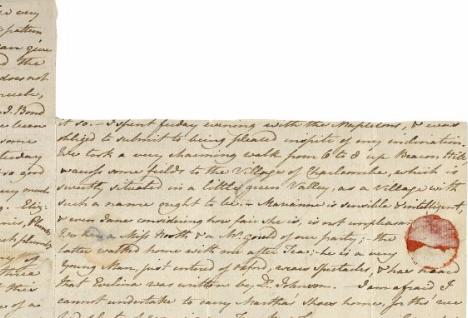
A portion of Jane’s letter has been cut out. Image@Morgan Library

When they read their missives out loud to the family, the Austen sisters had a habit of censoring each other’s letters and leaving out sections that were meant to remain private.  Jane might have given us a clue in Pride and Prejudice on how Cassandra was able to go through thousands of letters and locate information that she was unwilling to pass down for posterity. In some instances Cassandra cut out the offending sentence, but generally she destroyed the entire letter. How did she know where to cut out only one sentence or passage?

This scene, in which Lydia has joined Colonel and Mrs. Foster in Brighton, gives us a clue:

When Lydia went away she promised to write very often and very minutely to her mother and Kitty, but her letters were always long expected and always very short. Those to her mother contained little else than that they were just returned from the library, where such and such officers had attended them, and where she had seen such beautiful ornaments as made her quite wild; that she had a new gown or a new parasol, which she would have described more fully, but was obliged to leave off in a violent hurry, as Mrs Forster called her and they were going to the camp; and from her correspondence with her sister there was still less to be learned, for her letters to Kitty, though rather longer, were much too full of lines under the words to be made public.

Reading out loud

Note how Kitty could not reveal the words and sentences that Lydia had underscored with lines, even to the family. Did Jane use such a system with Cassandra to keep her private thoughts only for her sister?  I’m curious to know.

Read Full Post »

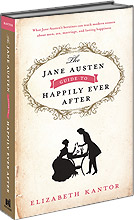
In The Jane Austen Guide to Happily Ever After, Elizabeth Kantor asks in a section about “Taking Relationships Seriously”: Can we have Jane Austen-style elegance, dignity, and happy love only with no cost to modern freedom and equality? The answer is an unqualified yes if, like Austen’s heroines, we approach romance with a rational balance to sex and love and work hard on all our relationships, not just the romantic ones. The Guide is filled with clear-eyed information and advice gleaned from Jane Austen’s novels. Sprinkled throughout the book are selected tips for Janeites. They include:
  • Don’t wait to pursue happiness in love until “some time or other” in the future.
  • If you think about “settling” — think again.
  • The very highest standards for yourself are perfectly compatible with the highest degree of respect and compassion for other people — in fact, they tend to go together.
  • In Jane Austen (and in life), when it comes to human beings, past performance is an excellent predictor of future results.
  • You are the only person you have a right to control.
There are many more kernels of truth in The Guide. Case studies of major male characters, like John Willoughby,  examine their commitment phobias, and close scrutiny of Jane’s clear-eyed heroines reveals how they get love exactly right. The pursuit of rational and permanent happiness is what sets Jane Austen heroines apart. Regard the conversation in Pride and Prejudice between Elizabeth Bennet and her sister Jane about Mr. Bingley’s sisters:

Jane: “You persist, then, in supposing his sisters influence him?”

Elizabeth: “Yes, in conjunction with his friend.”

“I cannot believe it. Why should they try to influence him? They can only wish his happiness; and if he is attached to me, no other woman can secure it.”

“Your first position is false. They may wish many things besides his happiness; they may wish his increase of wealth and consequence; they may wish him to marry a girl who has all the importance of money, great connections and pride.”

With this example, the author points out that Jane Austen’s heroines don’t get an automatic win in love. They have to negotiate their way through competing desires to earn their happiness. Austen creates heroines who are able to do this, but she also shows us women who fail. These women don’t find happiness, for they were looking for love in all the wrong places and for other qualities besides those that would make them happy in love. Thinking about young and impulsive Lydia Bennet, the reader instantly recognizes that she stands no chance of finding happiness with Mr. Wickham after the excitement of their marriage dies down and their money runs out.
Jane Austen’s heroines don’t settle, like Charlotte Lucas  did with Mr. Collins. Fanny Price, who many readers find boring, remains steadfast in her convictions about Mr. Crawford, despite a great deal of pressure from family and friends. Cynical Mary Crawford was in the market for a man with status and money, which is why she first set her sights on Tom Bertram. When Tom leaves with his father for the West Indies, Mary falls for his younger brother Edmund’s charm and sincerity, but the worldly Mary remains blind to the values that Edmund truly cares about, and she is even flippant in her observations about his desires to become a clergyman. While Edmund was willing to overlook many of her faults, in the end their values were too different for their relationship to work. As Elizabeth Kantor observes:
Jane Austen didn’t think we could make it all better by becoming cynics about love – by trying to isolate sex with all its complications from our serious hopes for our lives because we’ve given up on the bliss love promises. She wouldn’t see the point of trying to limit romance to a recreation, instead of a chance for ‘permanent happiness.’
This book is packed with similar discussions that had me thinking about Jane Austen’s novels in a new light. The chapter titles are very descriptive: “He Had No Intentions at All: How to Recognize Men Who Are ‘Just Not That into You'”  or “Don’t Fall for a False Idea of Love.” At the end of each chapter you will find a series of callouts: “Adopt an Austen Attitude;” What Would Jane Do?” and “If we REALLY Want to Bring Back Jane Austen …

If you are tempted to pick up a copy of The Jane Austen Guide to Happily Ever After one thing is for certain – you will gain a new perspective on how to approach modern romance from the advice from one of the world’s most famous regency spinsters.  I give the book 4 1/2 out of five regency teacups. For a sneak peek, go to Amazon and   read the introduction.

About the author: Elizabeth Kantor is the author of The Politically Incorrect Guide to English and American Literature and an editor for Regnery Publishing. She earned her Ph.D. in English from the University of North Carolina at Chapel Hill and an M.A. in philosophy from the Catholic University of America. She is an avid Jane Austen fan.

Order the book at Amazon.
Hardcover: 304 pages
Publisher: Regnery Publishing (April 2, 2012)
Language: English
ISBN-10: 1596987847
ISBN-13: 978-1596987845

Read Full Post »

« Newer Posts - Older Posts »