Feeds:
Posts
Comments

Archive for the ‘jane austen’ Category

Great landed estates were symbols of the owner’s wealth and status in British society. Everything was put on grand display – from the exquisite architecture of the house itself to the furniture, jewels, silver plate, servants, books, carriages, horses, deer, game, forests, fields, and splendid grounds and gardens.
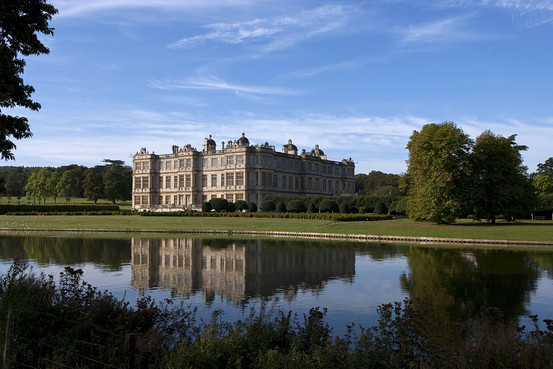
Longleat House in Wiltshire Image @www.longleat.co.uk

A fine estate certainly elevated a man in a lady’s estimation. Take this passage in Mansfield Park, written from Mary Crawford’s point of view:

Tom Bertram must have been thought pleasant, indeed, at any rate; he was the sort of young man to be generally liked, his agreeableness was of the kind to be oftener found agreeable than some endowments of a higher stamp, for he had easy manners, excellent spirits, a large acquaintance, and a great deal to say; and the reversion of Mansfield Park, and a baronetcy, did no harm to all this. Miss Crawford soon felt that he and his situation might do. She looked about her with due consideration,and found almost everything in his favour, a park, a real park, five miles round, a spacious modern-built house, so well placed and well screened as to deserve to be in any collection of engravings of gentlemen’s seats in the kingdom, and wanting only to be completely new furnished—pleasant sisters, a quiet mother, and an agreeable man himself—with the advantage of being tied up from much gaming at present, by a promise to his father, and of being Sir Thomas hereafter. ” – Mansfield Park, Jane Austen

(It is to Mary’s credit that, after this consideration, she prefered Edmund, the younger son, until she discovered that he intended to become a man of the cloth, and even then she did not give him up so easily.)

Visitors arriving at a landed estate took a circuitous route to the house along winding paths that were designed to show the grounds to their best advantage. They would pass through wooded areas and open fields, past lakes and rivers and herds of deer or cattle, and through a controlled wilderness area.

“The idea with Brownian landscapes is that you effectively go round them,” explains Mowl. “When [Capability] Brown did his landscape designs they would always have drives in them. They were an essential part of what he would do.” – The English Landscape Garden
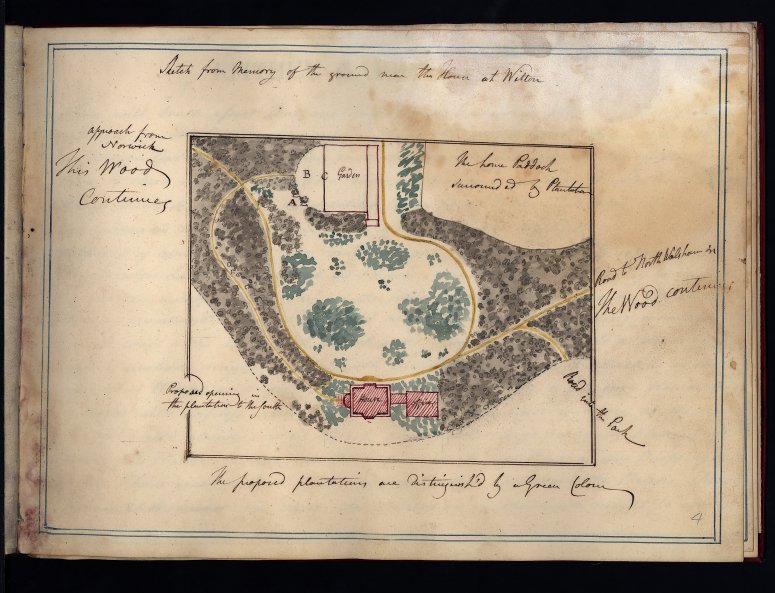
Witton approach from Norwich, 1801, Humphrey Repton Red Book. Image @University of Florida Rare Book Collection

Groundskeepers of extensive parks that featured winding drives and a variety of formal and ornamental gardens employed several means of keeping grass under control. Grazing sheep and cattle represented the first lines of defense. These herds were allowed to roam over vast expanses of land. Eighteenth-century romantic sensibility required that nothing as obviously artificial as a visible fence be allowed to contain them.
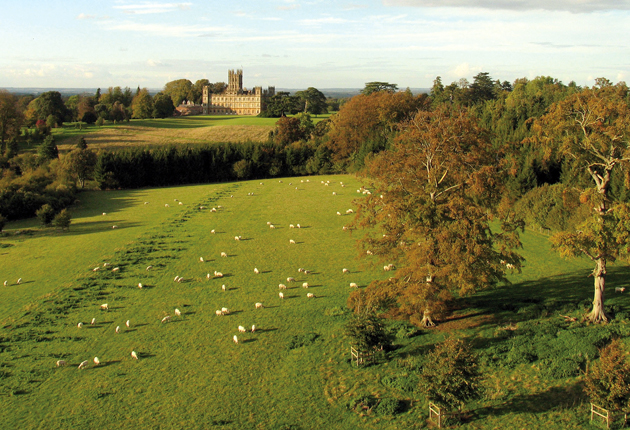
Highclere Castle is surrounded by park land designed by Capability Brown. Grazing sheep in the foreground.

A landscape feature called a Ha-Ha prevented grazing herds from coming too close to the house. The Ha-Ha, which consisted of a deep trench abutting a wall and which was hidden from casual view even at a short distance, allowed for the naturalistic features of romantic landscape gardening to take hold.
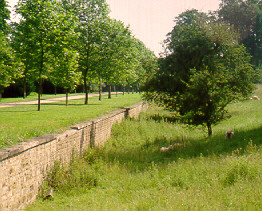
The Ha-Ha prevented grazing animals from crossing from one area of the estate to another. Image © John D. Tatter, Birmingham-Southern College

A Ha-Ha was so named because, as the myth goes, this landscape feature was so well hidden that an unsuspecting visitor would blurt out “ha-ha!” before falling into the trench.  This cross section shows how the system worked.

The trenches of a Ha-Ha could sometimes be 8 feet deep.The primary view is from the right and the barrier created by the ha-ha becomes invisible from that direction and sometimes from both directions, unless close to the trench. Image @Wikipedia

Not all Ha-Ha’s prevented deer, sheep, or cattle from grazing up to the front of the house (though considering their droppings, one would thinks that this would be highly preferred.) At Petworth, the Ha-Ha was placed at the side of the house.
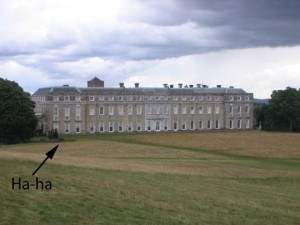
Petworth with Ha-Ha on the side of the house. Image @The English Landscape Garden

Built at the edge of a pleasure grounds surrounding a house, the ha-aha made a virtually invisible barrier that kept the cows and sheep in their pastures yet allowed uninterrupted views from house into park of from park into distant countryside. It meant that pleasure grounds, park and landscape could seamlessly become one. It is probably French in origin. Charles Bridgeman is generally credited with it’s introduction, but the first remnants of a ha-ha had already been installed at Levens Hall in Cumbria in 1689. – Architessica: Gardens and Landscapes

The transitional area between the formal gardens and the large park surrounding the house was known as the wilderness. This area was as meticulously planned as the other areas of the estate, but here the plantings were more irregular and included native plants and trees; gravel walkways; a pond, lake or river or all three; waterfalls; lawns that resembled meadows; and areas where the vistas were framed to deliberately look natural. If cottages and villages were required to be moved to achieve this picturesque effect, then so be it. The master’s will was done.
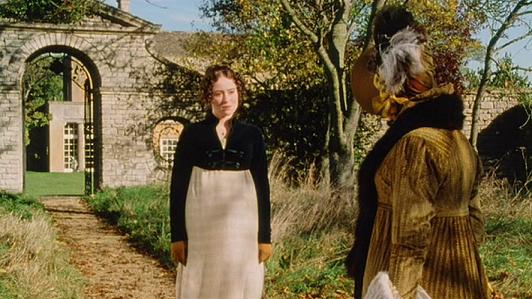
In Pride and Prejudice 1995, Elizabeth Bennet and Lady Catherine de Bourgh conduct their heated discussion in Longbourn’s “wilderness”. No grazing required here.

These wilderness areas were unique to topography and region, for each estate was uniquely different.

Nature in Herefordshire is not like nature in Lancashire and the garden style that tries to emulate the same form everywhere (particularly
one imported from another country entirely) is destroying what Pope had called the genius loci.” – (Wildness in the English Garden Tradition: A Reassessment of the Picturesque from Environmental Philosophy Author(s): Isis Brook Reviewed work(s): Source: Ethics and the Environment, Vol. 13, No. 1 (Spring, 2008), pp. 105-119)

This plan of Paca Garden in Annapolis, MD, shows the formal gardens separated from the park by a wilderness area with pond, bridge, and follies. Image (a) Creating a Period Garden

Walking along a wilderness provided one with an endless variety of aesthetic experiences. Paths wended their way through woods that opened up to vistas. Large trees provided shelter for a bench or revealed moss growing on gnarly roots. Rivers, ponds, follies, and bridges provided natural sources of visual patterns. They were pleasant places to visit:

 A ‘pleasant place’ is supposed to be naturally crafted. It’s a balance between two opposites: wanting to cultivate the land and letting it grow freely.  However landscapers and architects finally accomplish this goal, the product always ends up being a beautiful oxymoron. – Landscape as Amenity
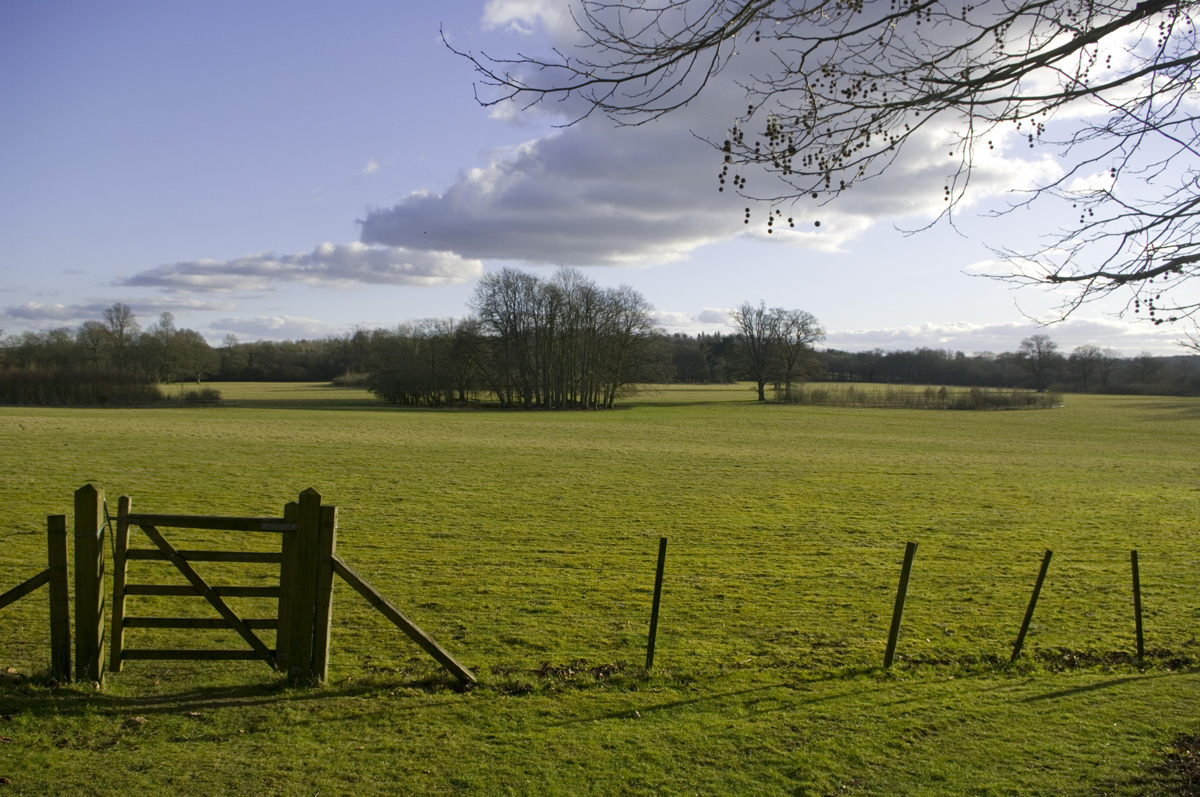
Chawton House grounds. One of the vistas from a gravel path. Image @Tony Grant

The exercise of walking along a wilderness ground was both visually and physically stimulating. These wilderness areas took years to design and arrange, with large trees moved from one area to another, buildings demolished or transported, and hillsides lowered or raised to “improve” the view.
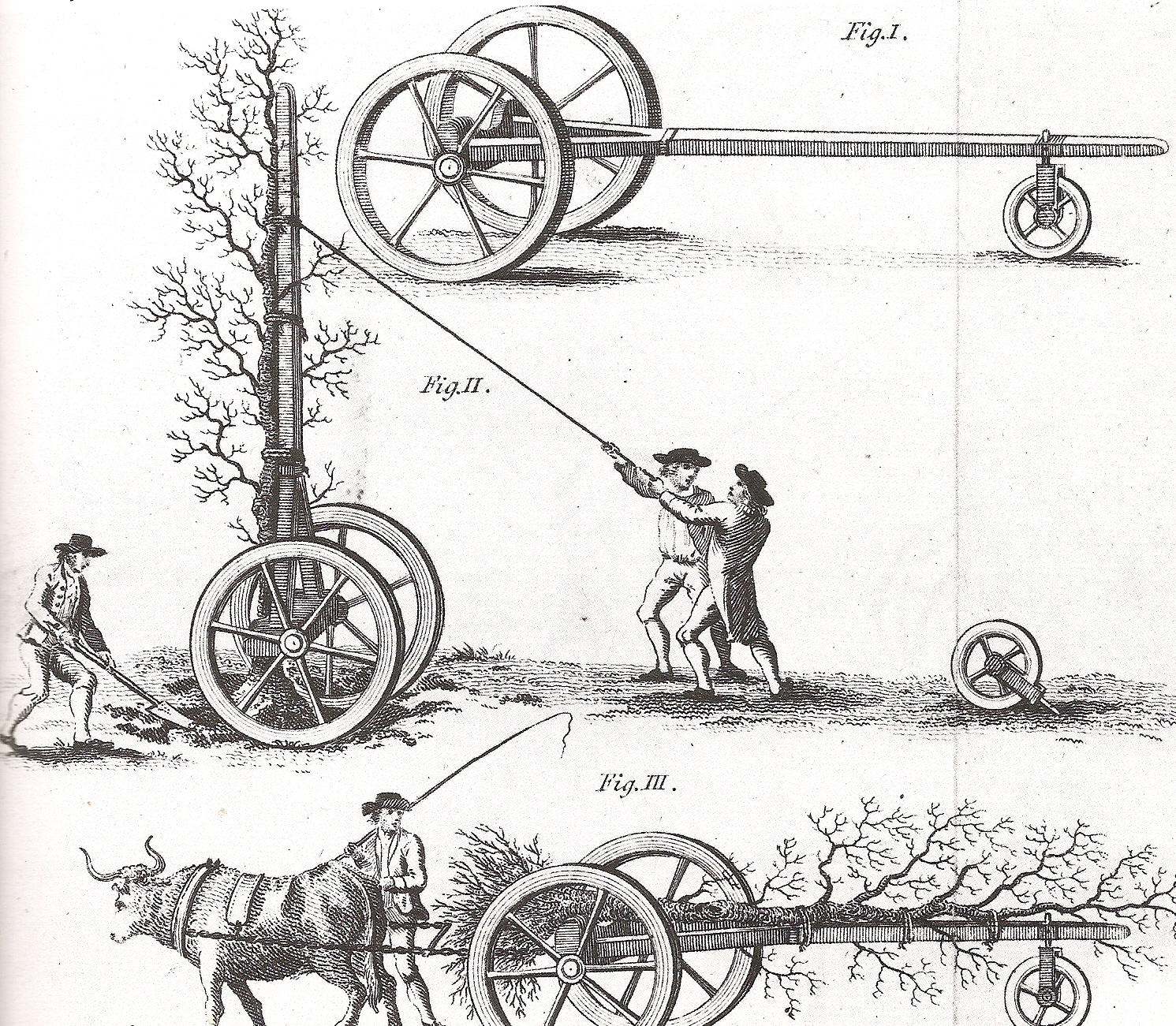
Moving a full grown tree into place, Hayes, 1794

Such improvements, as they were generally known, required meticulous planning and strenuous effort. Master landscape gardeners like Lancelot “Capability” Brown and  Humphry Repton became household names. Jane Austen knew about such efforts and their resulting changes:

Mr. Rushworth, however, though not usually a great talker, had still more to say on the subject next his heart. “Smith has not much above a hundred acres altogether, in his grounds, which is little enough, and makes it more surprising that the place can have been so improved. Now, at Sotherton, we have a good seven hundred, without reckoning the water meadows; so that I think, if so much could be done at Compton, we need not despair. There have been two or three fine old trees cut down that grew too near the house, and it opens the prospect amazingly, which makes me think that Repton, or anybody of that sort, would certainly have the avenue at Sotherton down; the avenue that leads from the west front to the top of the hill, you know,” turning to Miss Bertram particularly as he spoke. But Miss Bertram thought it most becoming to reply—

“The avenue! Oh! I do not recollect it. I really know very little of Sotherton.”

Fanny, who was sitting on the other side of Edmund, exactly opposite Miss Crawford, and who had been attentively listening, now looked at him, and said, in a low voice—

“Cut down an avenue! What a pity! Does it not make you think of Cowper ?’ Ye fallen avenues, once more I mourn your fate unmerited.'”

He smiled as he answered, ” I am afraid the avenue stands a bad chance, Fanny.”

“I should like to see Sotherton before it is cut down, to see the place as it is now, in its old state , but I do not suppose I shall.” – Mansfield Park, Jane Austen
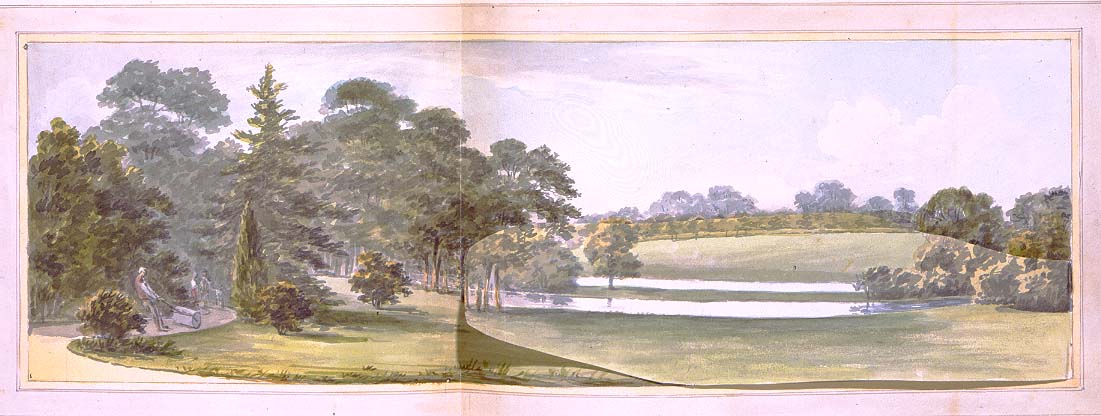
Sir Humphrey Repton, Whiton (Before) Image @British Architecture

Sir Humphry Repton left a valuable legacy with his Red Books. It was his habit to sketch before and after landscapes for his customers and present the drawings to them bound in red covers. His improvements for Whiton are subtle but important. Two parallel streams have been turned into a serpentine lake with a waterfall at one end. The distant fields provide a focal point with artfully arranged trees. If you look closely at the gravel path on the left, you can spy a gardener.
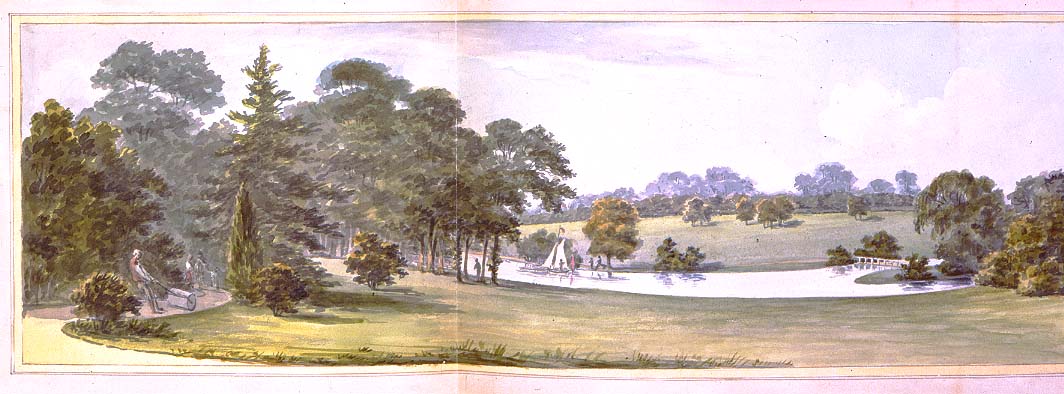
Sir Humphrey Repton, Whiton (After). Image @British Architecture

The samples below of Ferney Hall from The Morgan Library and Museum show the before and after drawing of an improved vista in which, using Jane Austen’s words, ” a prospect was opened”.
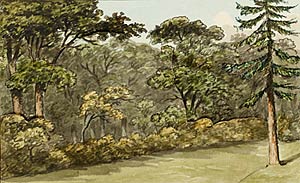
Ferney Hall by Repton. Image @The Morgan Library

The after image provides a glimpse of a folly. Instead of acting as a barrier, the woods give way to the scene, which provides a pleasant stopping point for the wanderer to sit and view. While such scenes looked natural, they were not.
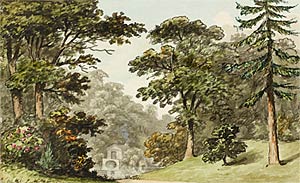
Ferney Hall, After, by Repton. Image @The Morgan Library

Though visually the wild and the domestic were one is the same, “these were carefully managed scenes, designed to look natural, but actually contrived on a vast scale” – Landscape as Amenity

The wilderness was designed some distance from the house. Approaching closer, the visitor would see a more formal arrangement of fountains and shrubbery and mazes and flower gardens.
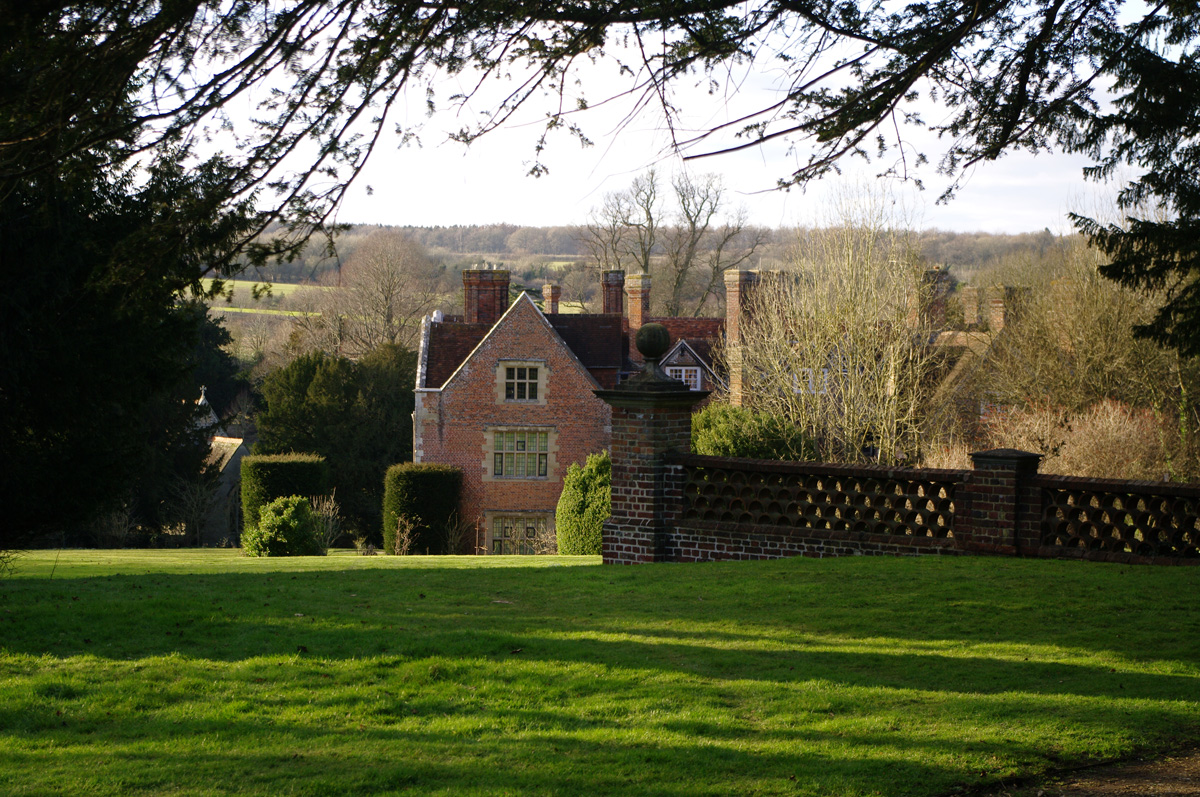
Chawton House: View from the wilderness towards the house and more formal plantings. Image @Tony Grant

The gentlemen who had these gardens designed for them had all been on the Grand Tour and learned the classics,” says Timothy Mowl of the University of Bristol. “It was part of their make-up and they wanted to display their taste and learning within gardens.” – The English Landscape Garden
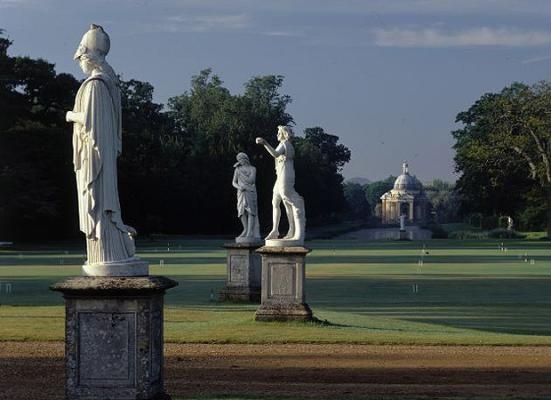
Wrest Park, Bedfordshire. Image @The Telegraph UK

Landscape designs informed the process of maintaining the grounds. Large estates employed many gardeners to keep cricket and croquet fields in pristine condition, cultivate the ornamental and kitchen gardens, and oversee the orchards and hot houses. The question is: How did they do it?
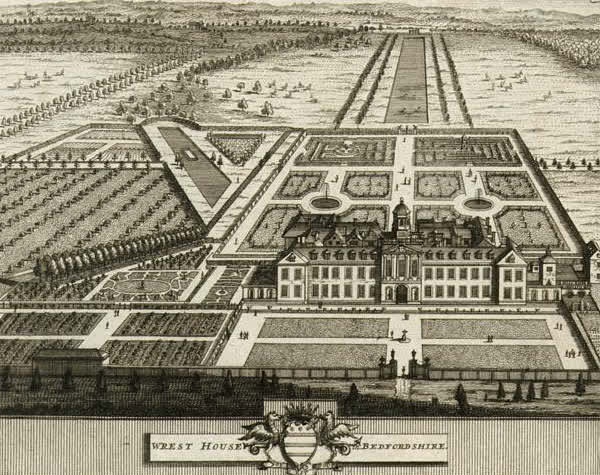
Extensive gardens surrounding Wrest House in Bedfordshire. Wrest Park Gardens are spread over 150 acres (607,000 m²) near Silsoe, Bedfordshire, and were originally laid out in the early 18th century, probably by George London and Henry Wise for Henry Grey, 1st Duke of Kent, then modified by Capability Brown in a more informal landscape style, without sacrificing the parterres. Image from The Leisure Guide

As mentioned before, the first line of defense was allowing herds of sheep and cattle to graze. However, their by-products left something to be desired. (If anyone has ever walked through a cow pasture, they will know what I mean.)
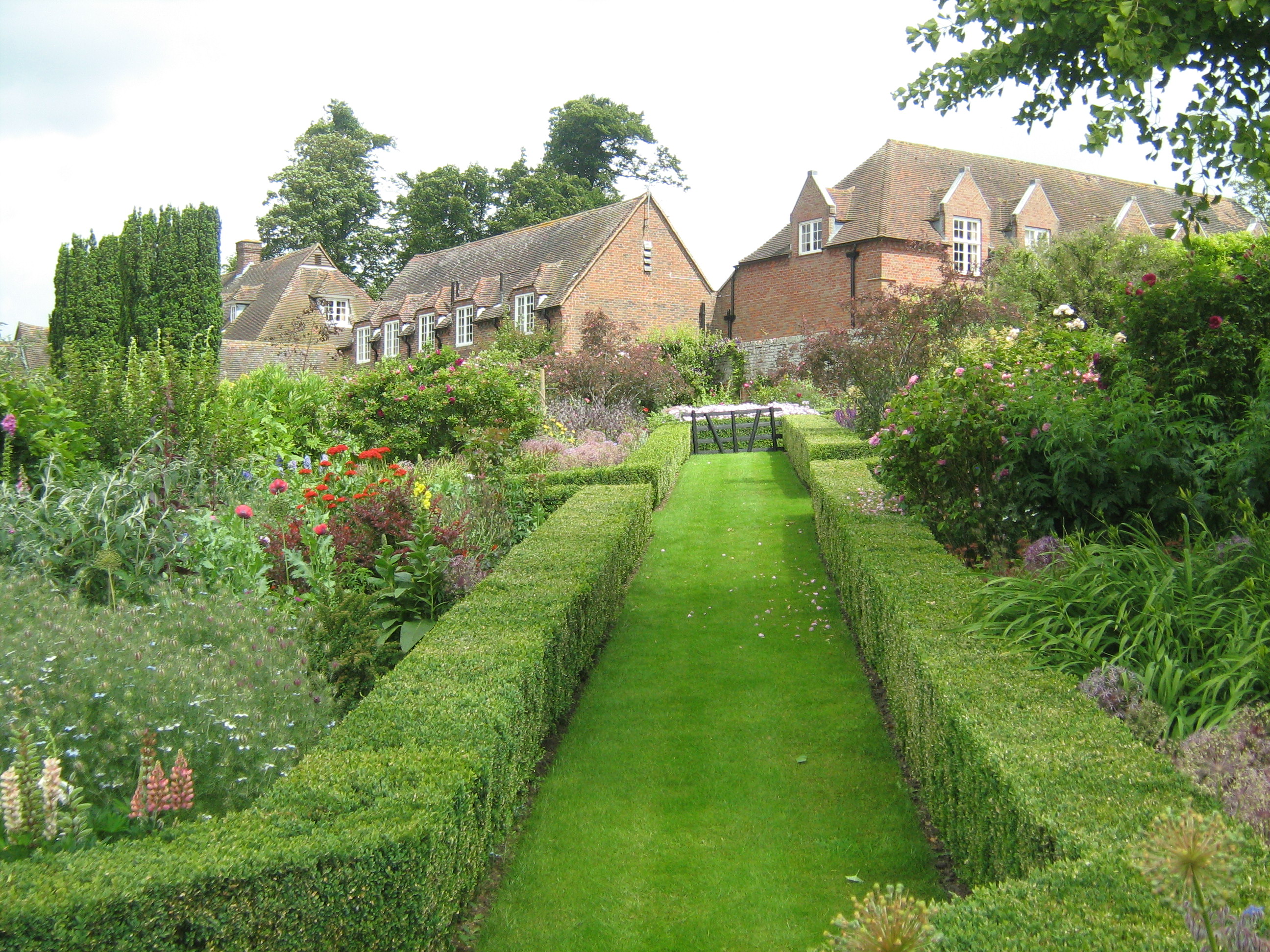
English Garden at Leeds: Artfully contrived to look both contained and natural. Image @Landscape Into Land

Lawn mowing and ornamental landscaping held no particular interest to 99% of the people who lived during the Georgian era. Cottagers and town dwellers maintained small plots of vegetable gardens and laborers worked in the fields, using scythes to cut wheat and grain for their employers.
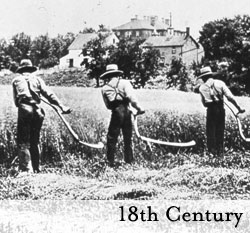
18th century method for harvesting grain with scythes. Image @Our Ohio

The laborers wielding scythes in the above image provide a clue to how grass was clipped – using a smooth, well-rehearsed motion, they worked in teams to cover large areas of ground. Their labor was cheap and they followed a system that included working in the morning when the ground was still damp.

Mowing Clover, late 19th c., by Arthur Verey

To prepare the lawn for scything, a gardener would:

“pole” the lawn first (swishing a long whippy stick across the grass to remove wormcasts) and … roll the ground to firm it and set the blades of grass in a uniform direction.” – Notes and Queries, The Guardian UK
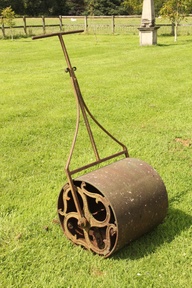
19th Century Coalbrookdale Roller. Rolling the lawn tamped down the grass and seed, and promoted growth and strong roots. Image @jardinique.co.uk

The secret to maintaining a close-cropped lawn was to trim it frequently, about once a week. Lawn edges were best trimmed with sheep shearing clippers.
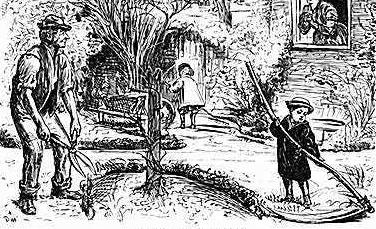
This gardening family is using shears, a rake, and a scythe in their cottage garden.

The grass was kept free of daisies with an instrument named a daisy grubber, which is the long-handled instrument with angled pick in the image below. Daisy grubbers are still sold today, as they apparently do the job well.
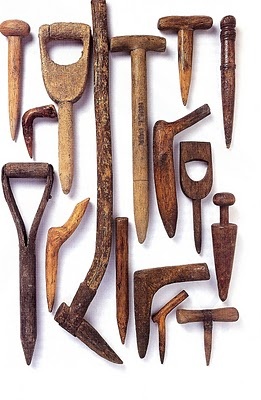
Dibbles and daisy grubber. Image @Garden History -Tools the Dibble

Dibbles were used to dig holes in the ground to plant seeds or bulbs, pry up roots, or jab weeds out between bricks and stone.
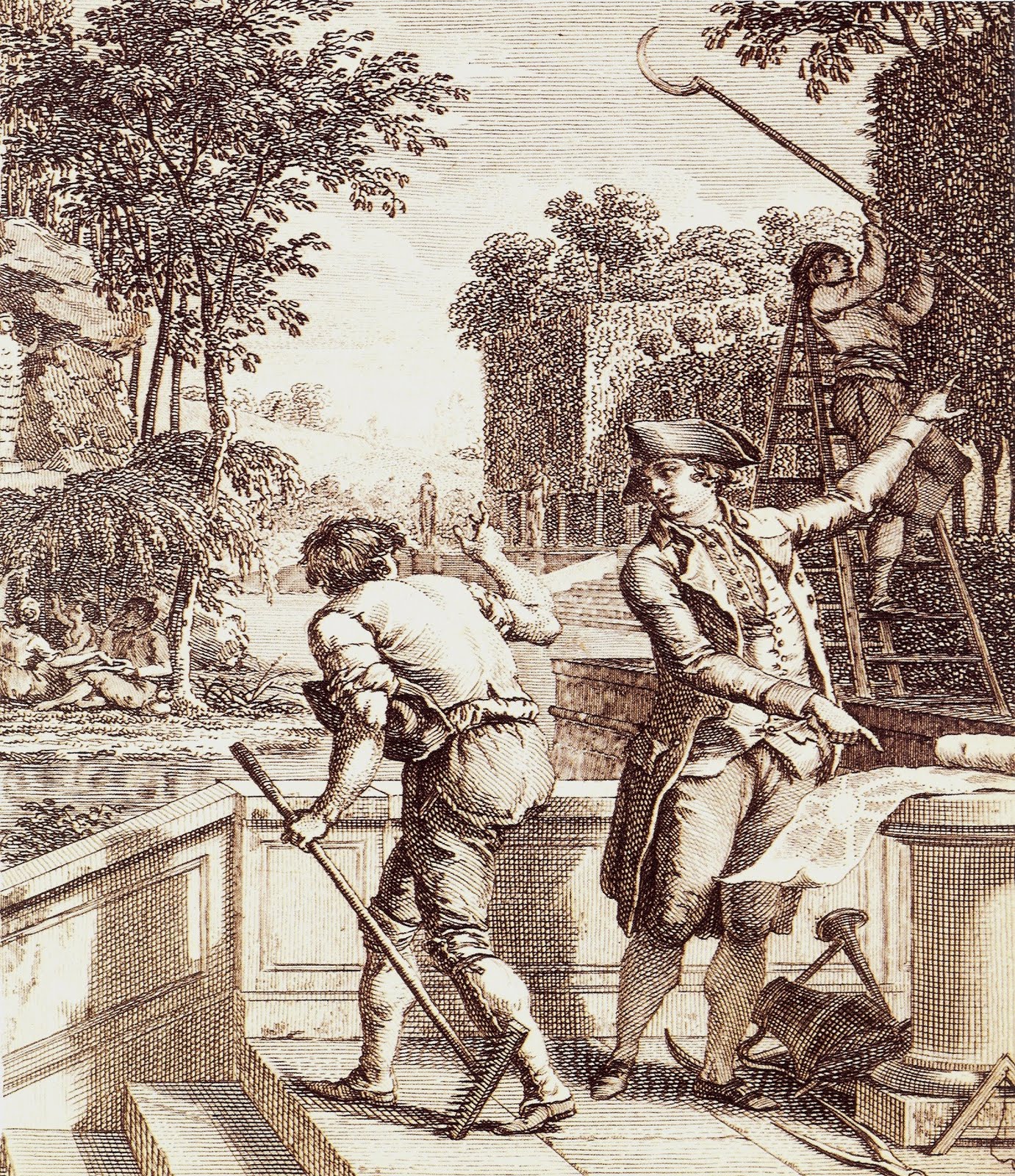
18th century gardener taking direction from a landscape designer. Note the man pruning the tree.

Even with these instruments, maintaining these large gardens took intensive labor. One can just imagine how much work was involved in protecting tender plants from insects and marauders, early frosts, and dry spells; and forcing exotic fruits and vegetables to grow out of season in hot houses.
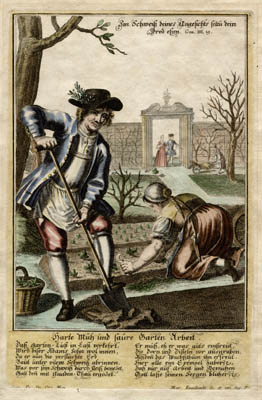
Engelbrecht. 18th century German print of gardening – planting.

While improvements were made over the course of the 19th century, some customs remained the same:

“rich people used to show their wealth by the size of their bedding-plant list: 10,000 plants for a squire; 20,000 for a baronet; 30,000 for an earl and 50,000 for a duke. ” – Ernest Fields, Life in the Victorian Country House by Pamela Horn, p. 75.
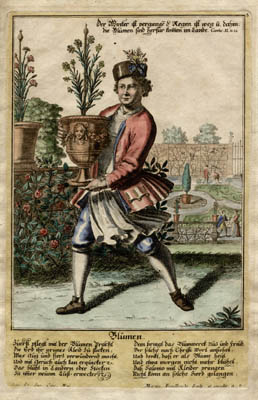
Engelbrecht’s plate of an 18th century gardener working with flowers

Landed owners showed off their wealth through a variety of means, including the number of servants they employed.
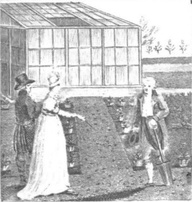
Master and mistress in discussion with the head gardener

It was not unusual for a great estate to employ 60 – 100 gardeners. There was the full-time staff, consisting of a master gardener, who had begun his apprenticeship as a boy, and his assistants.
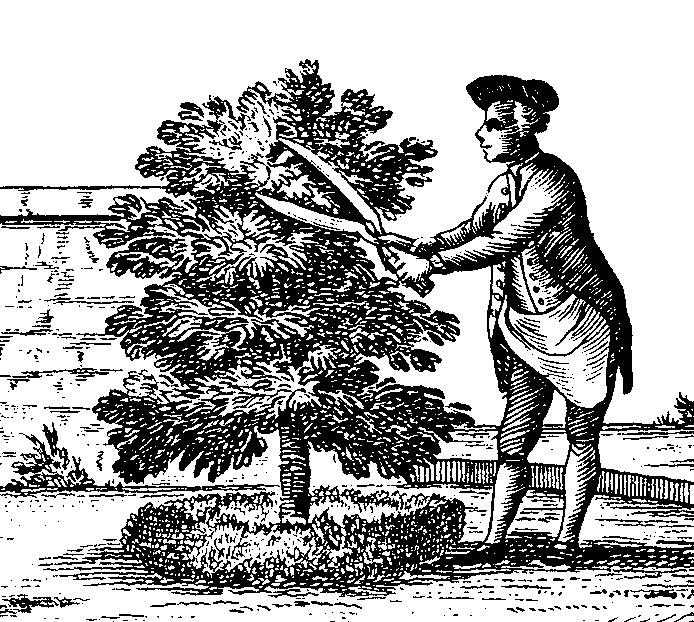
Pruning

Scottish gardeners were preferred, as it was thought that they had received the best training. Unmarried apprentice gardeners moved from estate to estate in order to gain experience and be promoted.
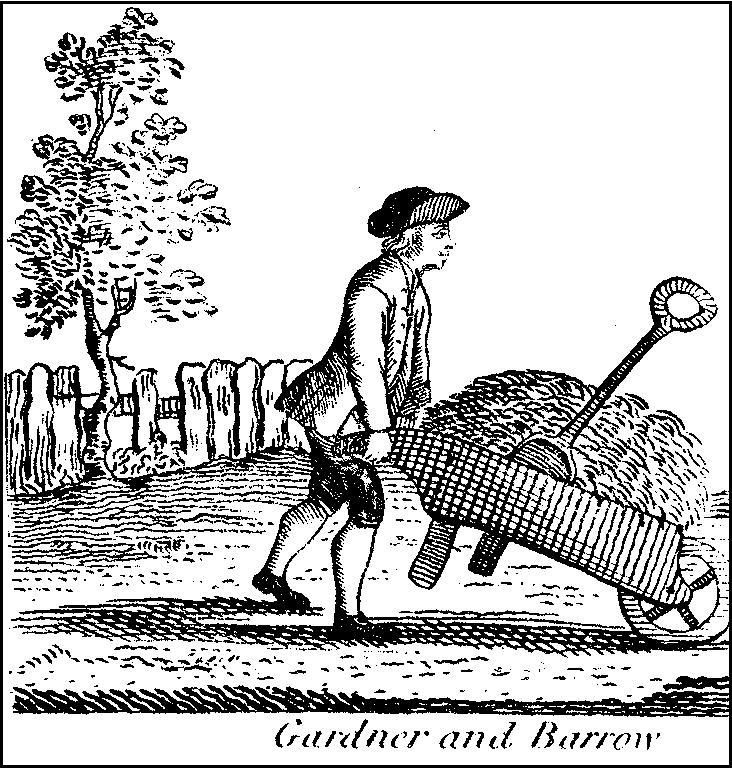
Dungbarrow

Junior staff worked long hours, around 60 hours a week, for, in addition to their gardening duties, they had to maintain the temperatures in glassed-in conservatories and meticulously care for archery, cricket, bowling and croquet lawns.
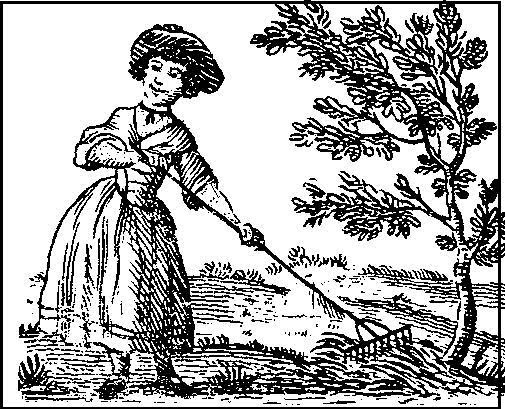
Woman using a rake

The master gardener hired local labor seasonally to help during peak times, so the number of laborers fluctuated.
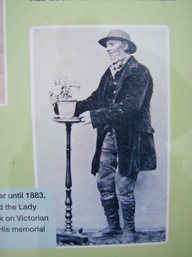
The head gardener at the Thornham estate in Sussex at the end of the 19th century. Image by kitchen915
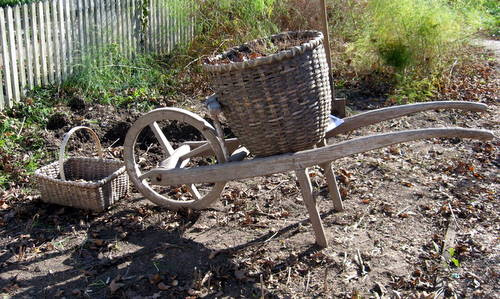
18th century garden cart and basket

With improvements in gardening equipment, including the invention of the lawn mower in 1830 by Edwin Beard Budding, machines began to take over the hard work of the scythe men.
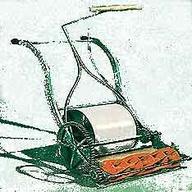
First lawnmower invented by Edwin Beard Budding. Image @The Chronicle of Andrew Jackson, Wikispaces

I imagined a Regency gentleman pushing one in his regalia, and found this wonderful advertisement. After Budding’s initial invention, a variety of lawn mowers were invented, each improving on the other.

Mowing a lawn in 1832. Credit: Ann Ronan Picture Library / Heritage Images

Needless to say, large areas of lawn needed a more efficient method of keeping the grasses trimmed. As the 19th century progressed, horses were employed to pull large lawn mowing machines.
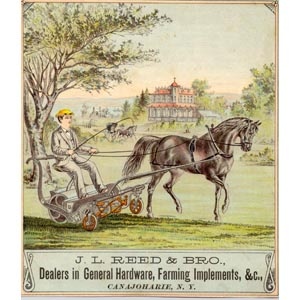
Horse pulling a lawn mower. Image @The Cultural Landscape Foundation

They wore special leather over shoes to protect fragile lawns, such as those shown in the image below.
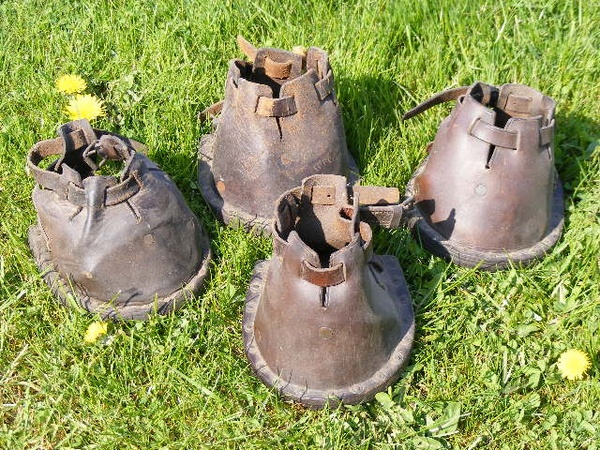
This short video on YouTube demonstrates how 18th century gardeners dealt with sudden cold snaps.

More on the topic:

Read Full Post »

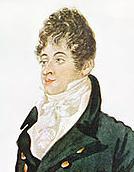
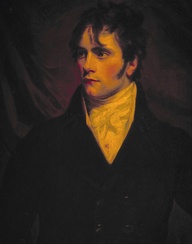
Men of fashion began to wear short and more natural hair at the end of the 18th century, sporting cropped curls and long sideburns in a classical manner much like  Grecian warriors and Roman senators. Before this period, a balding Louis XIII had made powdered wigs popular at the French court and consequently throughout Europe. The often elaborate and expensive gray wigs lent an air of wisdom and authority to their wearers.

William Pitt the Younger – Attributed to Thomas Gainsborough (c. 1804)
Prime Minister 1783 – 1801; Chancellor of the Exchequer 1804 – 1806

A scarcity of flour in 1795, combined with William Pitt’s attempt to raise revenue through a hair powder tax, brought the fashion for wigs and powder to a screeching halt. Men protested and a new more natural hair style became fashionable.

The 5th Duke of Bedford. Image @ Wikipedia

The Bedford Crop was a style of hair favored by the Duke of Bedford, who, in protest to the tax, abandoned his wigs in favor of a short cropped and unpowdered hairstyle. He challenged his friends to do the same.  His natural looking crop was parted on the side with a dab of hair wax.Wikipedia)

Pitt eventually reduced this unpopular tax on hair powder, which never quite generated the revenue he predicted, but by then it was too late. Gentlemen had discovered the comforts of going au naturel, and by 1812, few men still wore wigs. There were some holdovers – older men, military officers, and those in conservative professions such as lawyers, judges, physicians, and some servants for the very rich (footmen and coachmen) retained their wigs and powder. Formal court dress also still required powdered hair.

Beau Brummel’s Brutus hair style in 1805. Notice how it is brushed forward and volumized on top of his head.

By and large men took their cue from classical Greek and Roman art. The romantic movement also influenced a natural, unpretentious aesthetic. A dry disordered look that used very few artificial products began to rule.  Beau Brummel’s influence cannot be discounted. His own grooming included shorter hair and a clean-shaven face. Every morning he examined his face in a dentist mirror and plucked any remaining stray hairs with tweezers. By 1813, almost all Regency men sported both long or short sideburns; they rarely wore mustaches or beards.

In Pride and Prejudice 1995, Colin Firth as Mr. Darcy wore his hair somewhat longer than the Bedford Crop and affected a slightly unruly hairdo, probably known as the Brutus.  (I confess I never liked Firth’s hairstyle for Mr. Darcy.)

Colin Firth as Mr. Darcy. His rather long, wild hairstyle now makes sense to me.

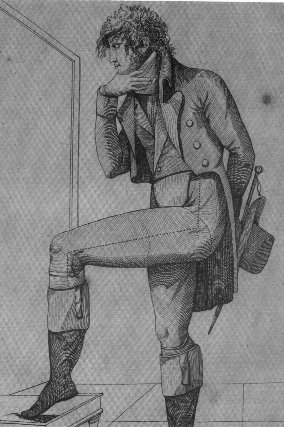
Upon seeing the following images, I can now see why the film’s hair stylist settled on this slightly wild do for Mr. Darcy, which seems to be a compromise between a severe clipped hair style and the stylish “frightened owl” hairdo below.

Young man by an unknown artist, c. 1800, from the book The Tie. Image @Jessamyn’s Regency Costume Companion

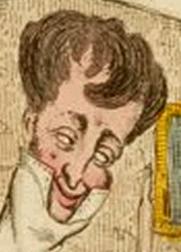
The  “frightened owl” hairstyle was achieved through infrequent hair washing (as infrequently as every few months) and the use of hair wax, which helped to create the wild and unruly volume.

The models for Regency men’s hairstyles: Caesar, Titus, and Brutus

Popular styles in the late 18th century were the Caesar, Titus, and Brutus. The Coup au Vent was short at the back and worn long over the eyes at the front.

Caesar cut. You can almost see the laurel leaves on his head with this brushed forward Caesar cut. Portrait of an unnamed man, ca. 1810-20

The Cherubin, like the Bedford Crop, sported short curls all over (the Caesar was clipped even closer.)

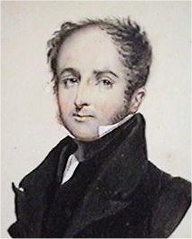
Bernier by Ingres, 1800. You can see the all over cropped unruly look. The sideburns in all these images are long, but the men are clean shaven.

The Classically influenced Titus was cropped short everywhere but at the front with curls combed forward onto the forehead to resemble the Roman Emperor Titus.

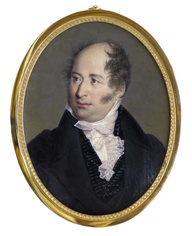
Balding men benefited from the close cropped, forward brushed styles. c.1815. Louis Francois Aubry. Monsieur Rivio Baritone in Paris Opera. Image courtesy of A Private Portrait Miniature Collection. (Update:) Mr. Phillips, who oversees the blog, lists the date of the portrait as 1840.

The more severe Brutus was even more clopped than the Titus. One of the most popular hair styles of the day, though, was the Brutus, a disheveled style that Beau Brummell and his followers wore.

John Opie’s 1802 portrait of Edmund Lenthal Swifte shows a few artfully arranged locks over the forehead.

These hairstyles  took a great deal of time and patience to achieve. Men used an oil or pomade made of bear fat to achieve a natural “tamed” wildness. (Scented pomades were called Pomade de Nerole and Pomade de Graffa.)  Since hair was rarely washed, night caps were worn to prevent soiling pillows and doilies protected the backs of chairs.

The height on top with the artfully arranged curls take precedence in this hairstyle. Friedrich Wilhelm Schelling, 1801.

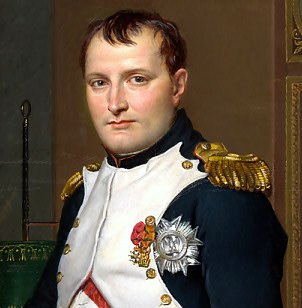
Napoloeon Bonaparte’s classic Caesar cut sported  longer locks down the forehead.

This dandy sports a Titus.

Arnauld de Beaufort ca 1818 (by Pierre Paul pPrud’hon). His hair is noticeably brushed forward, lending his features a saturnine look.

Regency hairstyles gave men a natural, romanticized look. (Portrait of an Artist by Unknown Artist) is part of the collection of the Michele and Donald D’Amour Museum of Fine Arts, Springfield, Massachusetts.

Gericault’s 1816 self-portrait shows a wildly romantic and unruly hairstyle.

Additional Information:

Please note: All green links in this post are WordPress Ads.

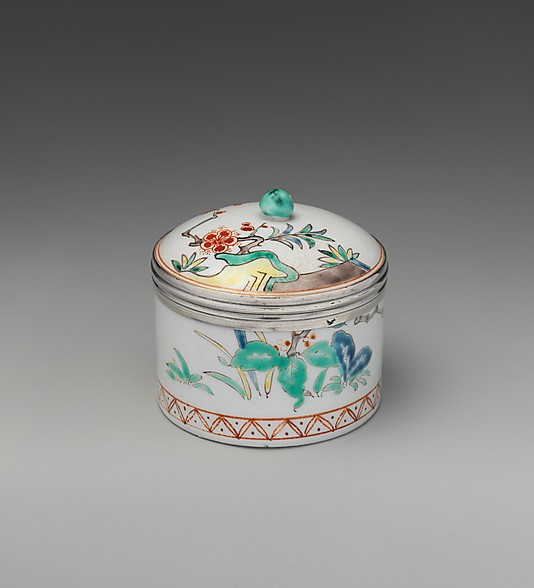
Covered porcelain pomade pot. Mid 18th Century. Image@Metropolitan Museum of Art

Read Full Post »

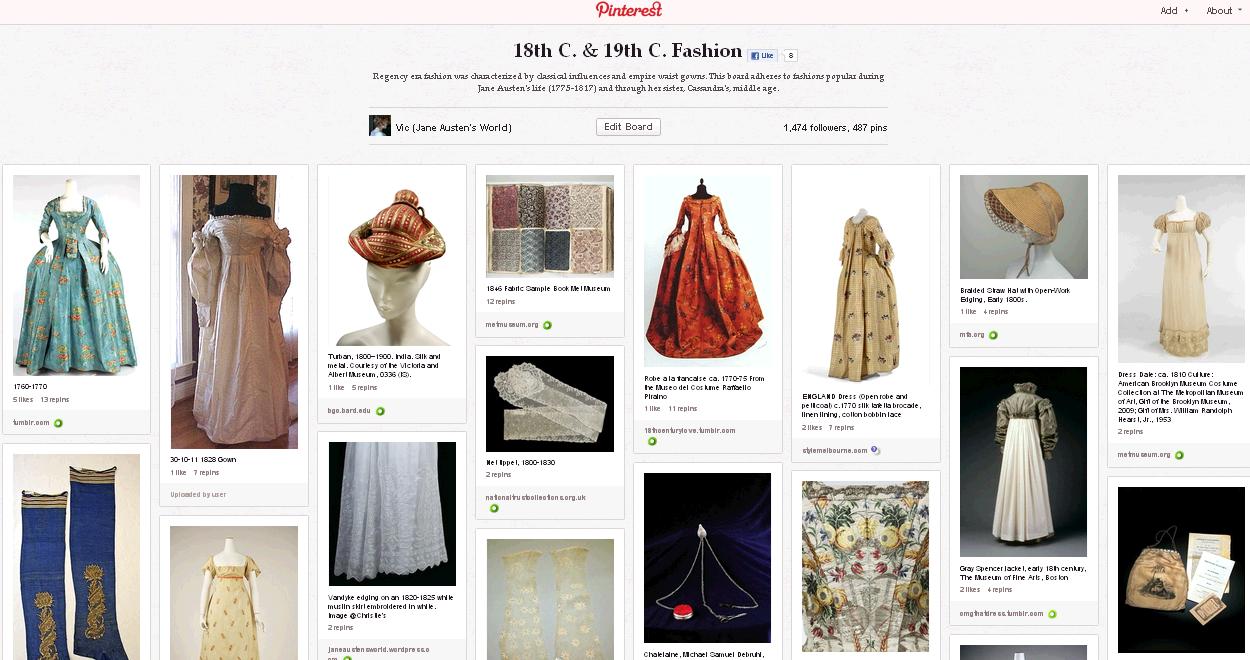
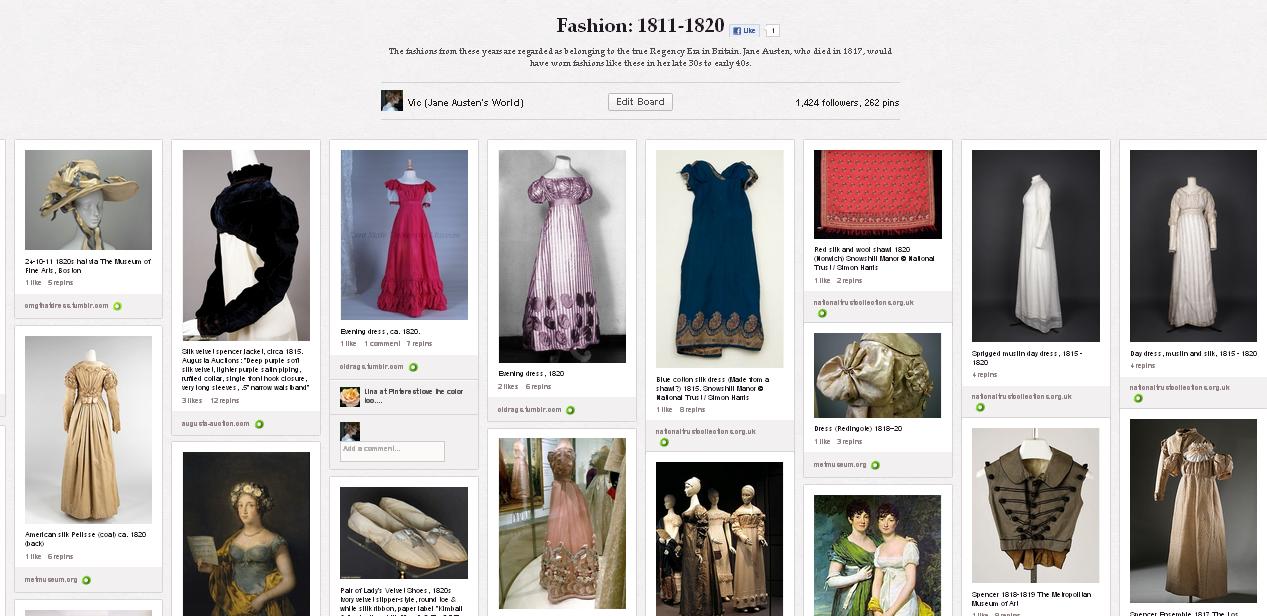
I’ve become a Pinterest addict. I can’t help it. I have always collected images for my blogs from a variety of sources, including museums, other bloggers, and historical websites. When I can, I provide attribution. Pinterest allows me to share interesting images in an easy and public forum. Just look at my fashion Pins. I have divided them into the following categories: 18th and 19th century fashions. Click here to see the full 18th and 19th century fashion board.

1775-1799: Click here to see the full board.

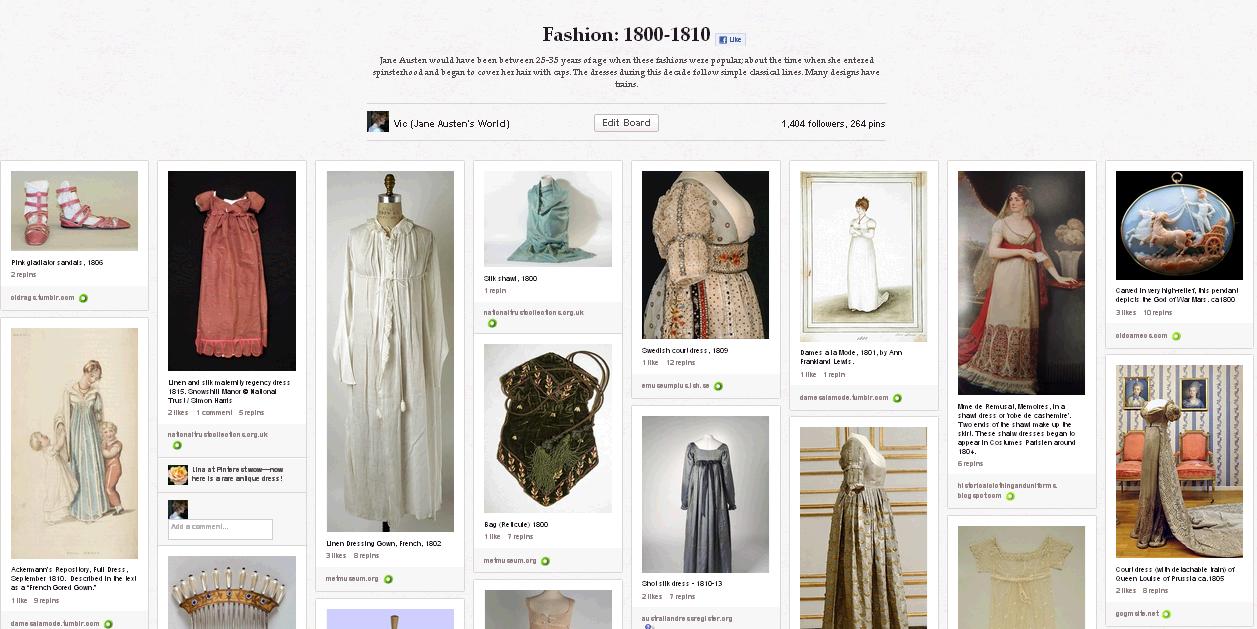
1800-1810: Click here to see the full board.

1811-1820: Click here to see the full board.

1821-1830: Click here to see the full board.

Regency Dandy: Click here to see the full board.

I love how I can file my images in logical Pinterest Boards, such as the ones you see above. I’d been collecting images for my private files, but now I can easily share them. Other bloggers have discovered this social media as well, sharing their unique pins (images) with others. I am thinking in particular of Two Nerdy History Girls, Austen Only, Evangeline Holland from Edwardian Promenade, and Heather Carroll from Marie Antoinette’s Gossip Guide

Pinterest is supposed to represent one’s personal interests. My fashion boards, especially, represent my POV. I like to mix up portraits, accessories, costumes, and fashion plates, so that the viewer gains a sense of what a lady’s (or dandy’s) wardrobe might look like in a particular time frame. I often think hard about the combination, making sure to provide a mix. In a few months, I plan to subdivide my boards, to provide a story about fashion or architecture, from which a student of Jane Austen’s World can take away a unique story.

I do have one major beef. While most people repin my images here and there, there are individuals who will repin hundreds of my images in one sitting. Mind you, it has taken me months to assemble the boards that represent my interests. To see one pinner simply appropriate more than 20 images in one sitting burns me up.

If you decide to join Pinterest, enjoy yourself! I do encourage you to follow Pinterest etiquette, however. In all things ask yourself: What would Jane Austen do? Join Vic’s Pinterest account at this link: http://pinterest.com/janeaustenworld/

Please note: Green links in this post are WordPress Ads.

Read Full Post »

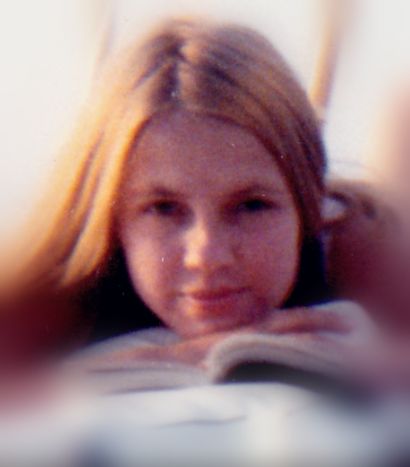
Vic at 22 on a sailboat, reading a Georgette Heyer novel. Look at those chubby Dutch cheeks!

I stumbled upon Georgette Heyer during a golden time of my life after college graduation when I had three precious free months before I began school again. Bursting with youthful energy, I didn’t know what to do with my time. And so I hit the books, but this time for pleasure. In those days, I could gobble up a book a day if I was so inclined, and I sped through Jane Eyre. Wuthering Heights. Tess of the d’Urbervilles. Rebecca. Father and Sons, by Ivan Turgenev, one of my favorite authors, and Pride and Prejudice (for the second time in my life). That last novel with its sparkling wit and clear view of village life seemed like a breath of fresh air after the heightened emotions of the Victorian authors.

To me, Mr. Bennet was the image of my father, whose wry statements always made me pause before I could figure out if he was making sport of me, himself, or some other unwitting target. Mrs. Bennet reminded me of my crazy Dutch grandmothers – both of whom were slightly hysterical and VERY demanding. I read Pride and Prejudice twice that summer (and began a tradition of reading it every summer for the next twenty years). Greedily I reached for more Jane Austen novels until there were none left. I railed against the illness that carried Jane off before she could produce enough novels to assuage my addiction. Where to turn?

The library, of course.

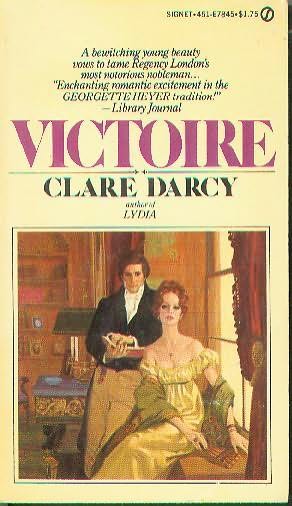
I looked up Regency novels and found … Clare Darcy. Ok, I thought. I’ll give her a try and picked up a copy of Victoire, a most logical choice given my given name, and read the book in one long sitting. How to state it nicely: Clare Darcy is to Jane Austen what a sputtering candle is to the sun at high noon.

My quest was not over.

My apartment roommie, also a Janeite, discovered the Flashman novels by George MacDonald Fraser. She LOVED them. But budding little feminist me wanted books written by humorous females, not a man with no interest in the goings on of small town families and their courtship rituals, and silly clergy, and strong heroines who were able to learn a thing or two. And so I continued my search.

One day I found a Barbara Cartland novel. Hahahahahahahaha! Tossing aside her cheesy book about a 16-year-old-heroine with a heart-shaped face, I wondered if I could charge her for wasting my precious life.

I continued my search.

And there it was. On the bottom shelf at the library. Arabella. It was a pathetic excuse of a book – dog-eared, blemished, and torn partially in the spine. I read the front cover – Arabella by Georgette Heyer – then sat on the floor and began to read. Witty words leapt from the pages. I laughed with delight. Before long I checked out the book and proceeded to read it in one long sitting. My roommie, who had started her new job two weeks after college, came home from work to find me engrossed. “I found a new author,” I said, telling her she could read the book when I was done. I gave it to her that night.

We were both instantly hooked on Georgette Heyer.

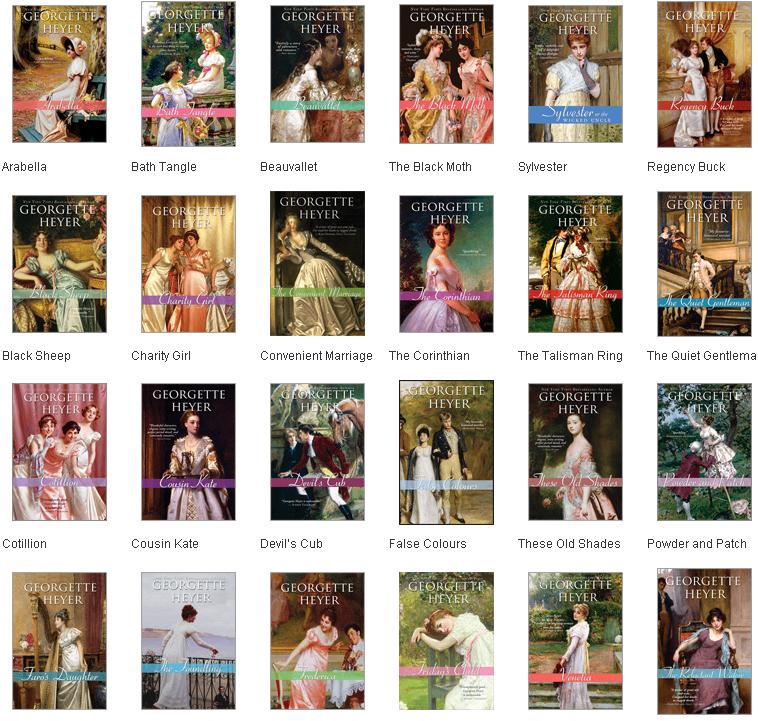
I returned to the library and checked out all the Georgette Heyers I could find. My roommie and I fell in love with Arabella, but we became die-hard fans when we encountered Venetia, The Grand Sophie, Sylvester, and Frederica. By summer’s end we had read ALL the GHs we could lay our hands on, even the mysteries and histories. (Thankfully, Georgette was prolific.)

My roommie and I were two young and hopeless romantics. We loved the glittering, detailed descriptions of the characters, the clothes they wore from expensive shops, and the houses, towns, and cities they inhabited. We learned about Regency London and the manners and mores of the Ton. Georgette Heyer characters spoke in cant, and thus we affected British accents and used cant-speech at every opportunity. Our boyfriends, while a bit mystified, played along, even debating which weapon was more effective in a fight – the epee or the sword.

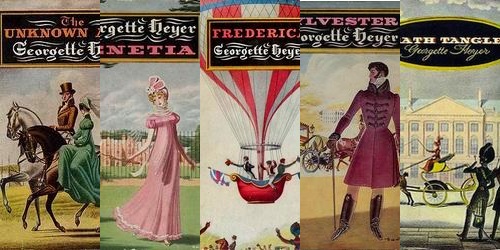
Vintage GHs

But then life intruded and my intense love affair with Georgette Heyer had to take a back seat. I returned to school and began to read academic books again. I left my obsession behind, except for my yearly date with Pride and Prejudice.

Flash forward a number of decades when Sourcebooks began to republish Georgette Heyer novels. Once more I began to read them regularly, only this time I reviewed them as well.  I discovered that my tastes had changed and that I was more attracted to other novels like The Reluctant Widow and The Convenient Marriage. I never reread Arabella, for I did not want to revisit my first love only to discover that she had flaws.

I savor my memory of first discovering Georgette Heyer and thank Sourcebooks for the opportunity to relive that Golden Summer. I keep about 10 GH books on my Nook and Kindle (yes, I have both) so I am not ever very far from one of my favorite authors. If you are intrigued, all of GH s novels are available at Sourcebook’s Discover a New Love Website at http://www.discoveranewlove.com.

WIN A FREE BOOK! Those who leave a comment, have an opportunity to win a Georgette Heyer novel! Just let me know why you love to read Regency romances and/or Jane Austen! Contest ends on August 16th, (Contest ended!)which is Georgette Heyer’s 110th Birthday! Happy Birthday, GH, and thanks for the memories. Congratulations winners, Jan and Ginger, chosen through Random Number Generator! Thank you all for making a comment!

More on the topic: 

Read Full Post »

Gentle readers, frequent contributor Tony Grant has recently returned from visiting the Lake Country with his friend, Clive. (Visit his blog, London Calling, where he shares his experiences and wonderful images.) While there he was reminded of Wordsworth’s poem about Tintern Abbey and sent in his thoughts. Thank you, Tony, for making poetry come alive!

“Lines composed a few miles above Tintern Abbey, on Revisiting the Banks of the Wye during a Tour, July 13, : 1798”

Wye Valley

This rather ungainly title is the precursor to a poem by William Wordsworth written in 1798, as the title shows, which lays out his philosophy about his understanding of the world and the effect it has on him.

First of all the title tells us about a revisiting of the Wye Valley. Wordsworth may well have been using the guide book written by William Gilpin about the Wye and Tintern Abbey. Gilpin was a fellow lover of nature, who was also born in Cumberland and The Lakes. In this poem Wordsworth is revisiting, recalling, adjusting his memory of a place and adding to the strength of its power over him.

Once again

Do I behold these steep and lofty cliffs,

That on a wild secluded scene impress

Thoughts of more deep seclusion; and connect

The landscape with the quiet of the sky.”

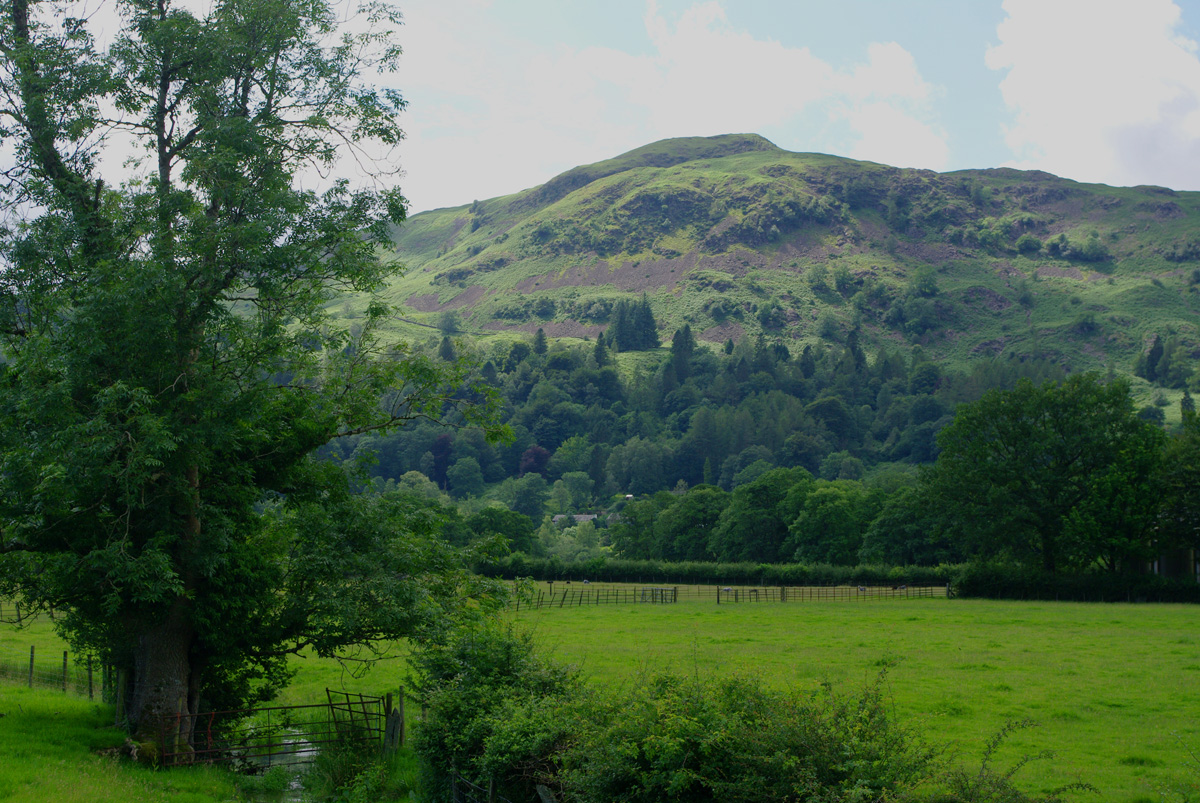
The Lakes. Image @Tony Grant

Wordsworth emphasises seclusion such as a hermit might experience.. This aloneness is an important aspect of this poem. When we meditate we find a secluded tranquil spot to be alone in.

The use of his senses is paramount to this process.

again I hear

These waters, rolling from their mountain-springs

With a soft inland murmur.”

And also,

Once again I see

These hedgerows, hardly hedgerows, little lines

Of sportive wood run wild; these pastoral farms,

Green to the very door; and wreaths of smoke

Sent up,”

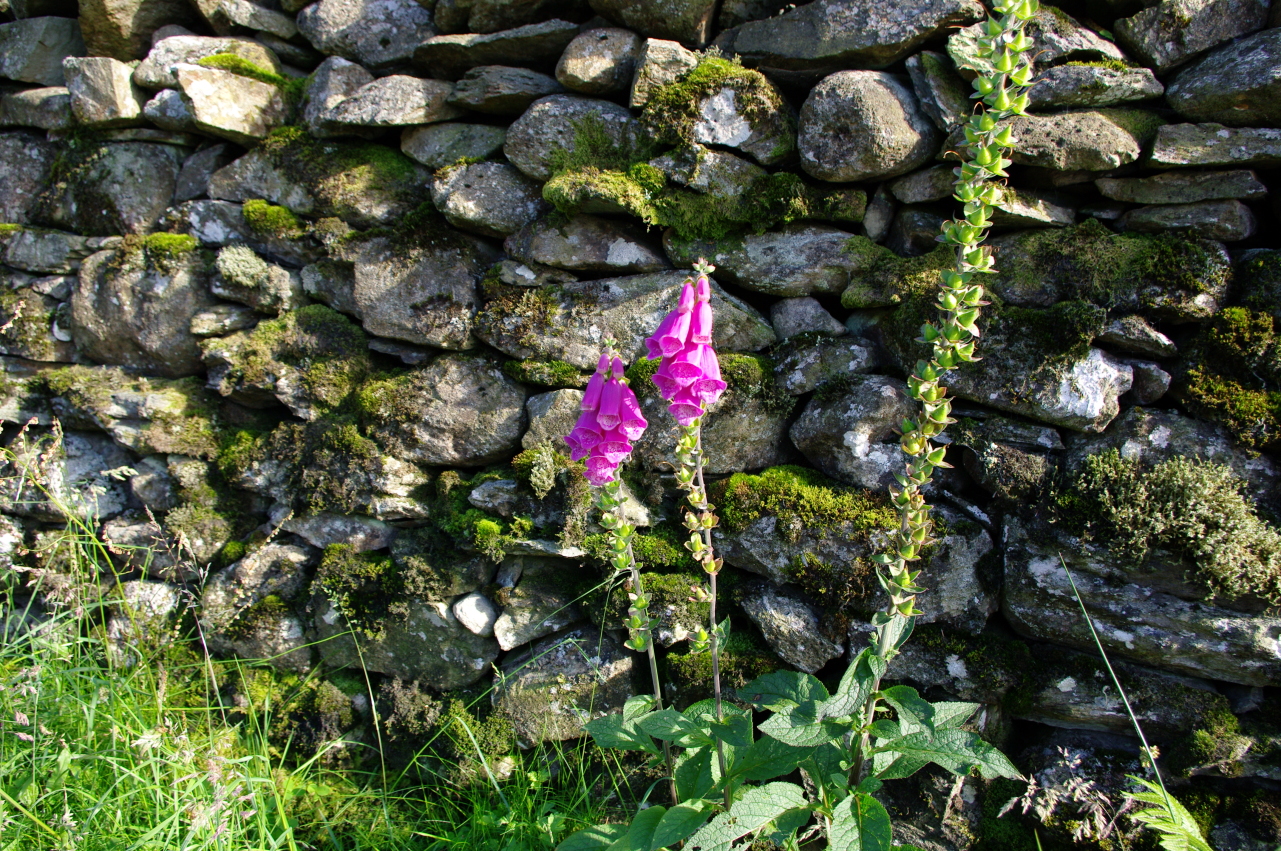
Foxgloves and dry stone wall. Image @Tony Grant.

Sound and sight come together to make an impression on his mind and feelings. But these are not short lived impressions. They have a deep and profound effect.

“oft, in lonely rooms, and ‘mid the din

Of towns and cities, I have owed to them,

In hours of weariness, sensations sweet,

Felt in the blood, and felt along the heart;

And passing even into my purer mind,

With tranquil restoration: -feelings too

Of unremembered pleasure; such, perhaps,

As have no slight or trivial influence.”

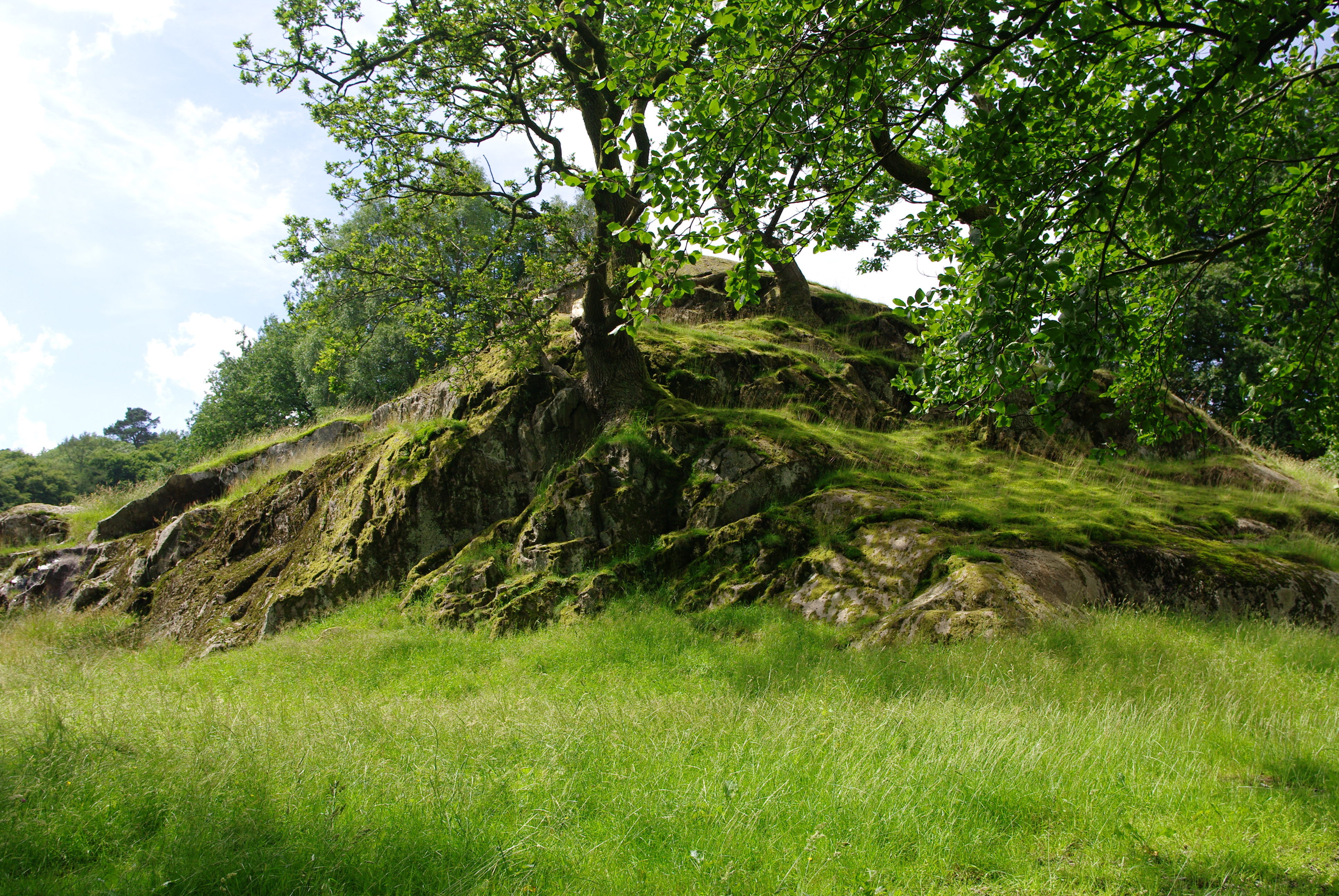
Rocky outcrop, image @Tony Grant

Wordsworth is saying that remembering the sensations that nature has had on him can be recalled, relived at other times and in other places and help him overcome things such as weariness and other detrimental sensations.

how oft –

In darkness and amid the many shapes

Of joyless daylight; when the fretful stir

Unprofitable, and the fever of the world,

Have hung upon the beatings of my heart –

How oft, in spirit, have I turned to thee,

Tintern Abbey

Memory, imagination, recalling good sensations, becomes a sort of force that Wordsworth can use. He describes it as being “felt in the blood” and “along the heart. “ These sound strange phrases to us. We might describe these experiences as affecting us deeply or having a psychological influence or even providing a spiritual experience.

Methods of meditation use memory and imagination in this way. Athletes and sportspeople use this method too. We are experiencing the Olympics at this moment. Athletes have described how they use imagination to help them perform to the best of their ability. A white water canoeist was interviewed yesterday morning and asked how she prepares for such a hazardous descent and how is she able to get the timing of her turns just right. She answered that she imagines the descent through the rough and tumbling waters again and again, living in her imagination every move, paddle stroke and turn she is going to make.

Wordsworth gives even more importance to the powers of nature when he says these experiences have an effect ,

On the best portion of a good man’s life,

His little, nameless, unremembered, acts

Of kindness and of love.”

He is saying our experience of nature has an actual effect on the way behave.

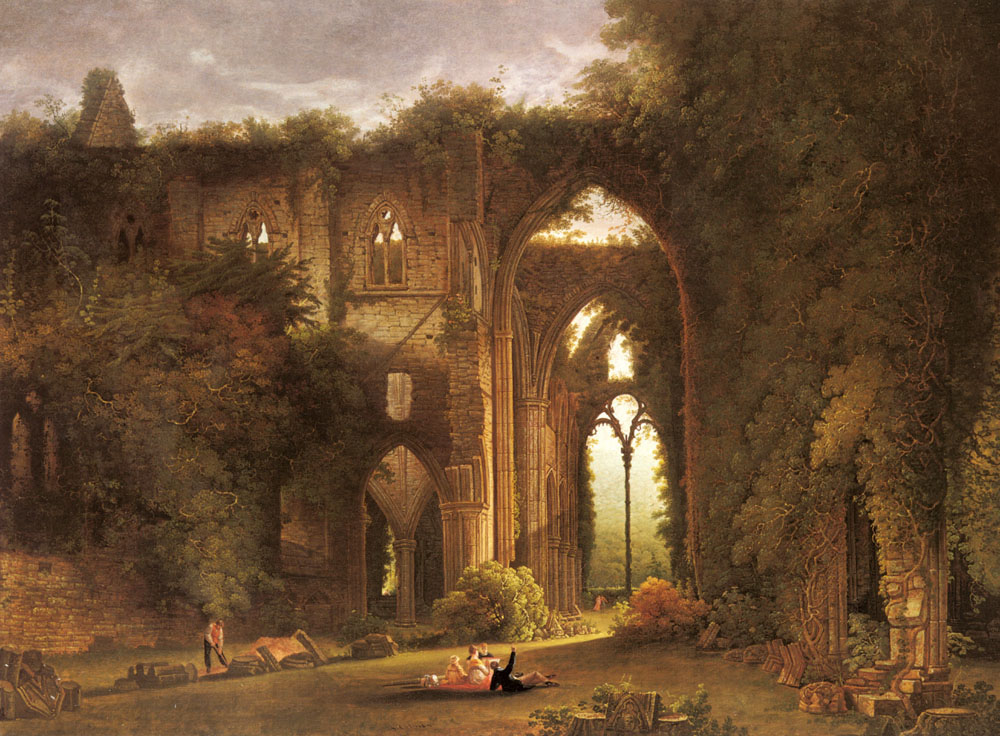
The chancel crossingot Tintern Abbey looking towards the east window, JWM Turner, 17942

Wordsworth takes his ideas to an even higher almost mystical religious level when he says,

that blessed mood,

In which the burthen of the mystery,

In which the heavy and the weary weight

Of all this unintelligible world,

Is lightened: -that serene and blessed mood,

In which the affections gently lead us on –

Until, the breath of this corporeal frame

And even the motion of our human blood

Almost suspended, we are laid asleep

In body, and become a living soul;”

The effects last into the afterlife and affect our experience of heaven. This is serious stuff. Wordsworth is completely taken with this concept.

Banks of the Wye

Towards the end of the poem it becomes a letter, almost a love letter, to his sister Dorothy, who he sees as his soul mate. He includes her in his understanding of what he experiences,

all which we behold

Is full of blessings.”

What is interesting to consider is that in this poem Wordsworth describes how he uses his experience of nature through his senses to lighten and bring joy and spiritual pleasure to himself at other times. This revisit to the Wye Valley five years after his first visit appears to be an attempt to strengthen his experiences of nature and to replenish and strengthen his memories so he can use a stronger dose, so to speak, of his experiences in future. This begs the question , does Wordsworths poem, help the reader of the poem along this path of spiritual experience in anyway or is he just telling the reader, you must go and experience nature yourself to gain these effects?

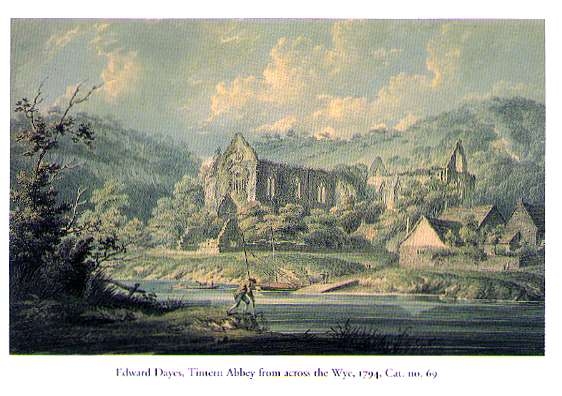
Edward Dayes, Tintern Abbey from across the Wye 1795.

What the poem does for me is help me recall my own experiences of places that gave me pleasurable experiences through my senses. Wordsworth in his poem is triggering our memory of good things too. He suggests we find a secluded place ourselves, remember, imagine and discover our own benefits. Nature can provide a healing process,

when thy mind

Shall be a mansion for all lovely forms,

Thy memory be as a dwelling place

For all sweet sounds and harmonies; oh! then,

If solitude, or fear, or pain, or grief,

Should be thy portion, with what healing thoughts

Of tender joy wilt thou remember me,”

There is something ageless in Wordsworth’s theory which is the theory of Romanticism. It makes me think of Karma and the Buddhist approach to meditation.

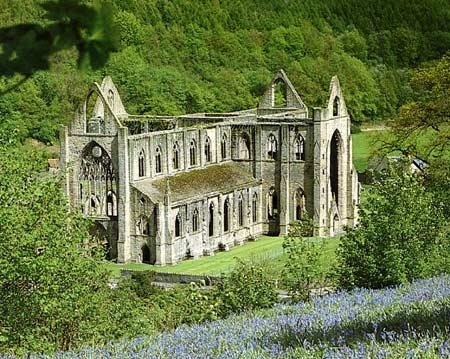
Tintern Abbey. Postcard photo courtesy of Paradoxplace.com.

As an addenda to the William Gilpin (1724-1804) reference above: Wordsworth may have used Gilpin’s guide book in the Wye Valley. Gilpin also was an advocate of experiencing nature and drawing benefits from it , it’s hues and colours and it’s natural arrangement He wasn’t averse, however, to making suggestions about its arrangement. He might suggest in his writing the removal or addition of a tree or even the roughing up and creation of a more crumbling effect of Tintern Abbey to create a better aesthetic affect. It is suggested that Jane Austen made fun of this in Northanger Abbey.

More on the topic:
Read Full Post »

« Newer Posts - Older Posts »