Feeds:
Posts
Comments

Archive for the ‘jane austen’ Category

This image of a bourdaloue might be somewhat confusing to the uninitiated. Could this small and elegant vessel be a gravy boat? Or a blood-letting container?
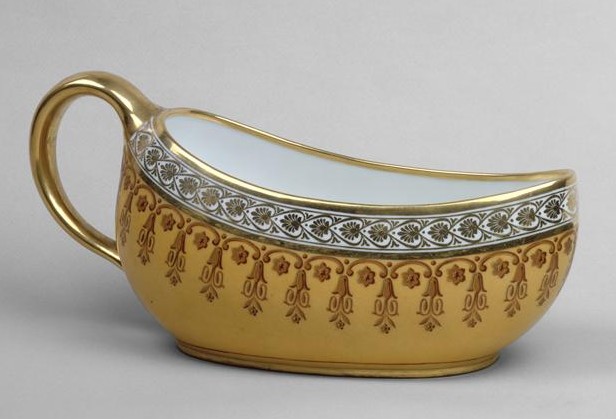
Sevres bourdaloue, 1831.

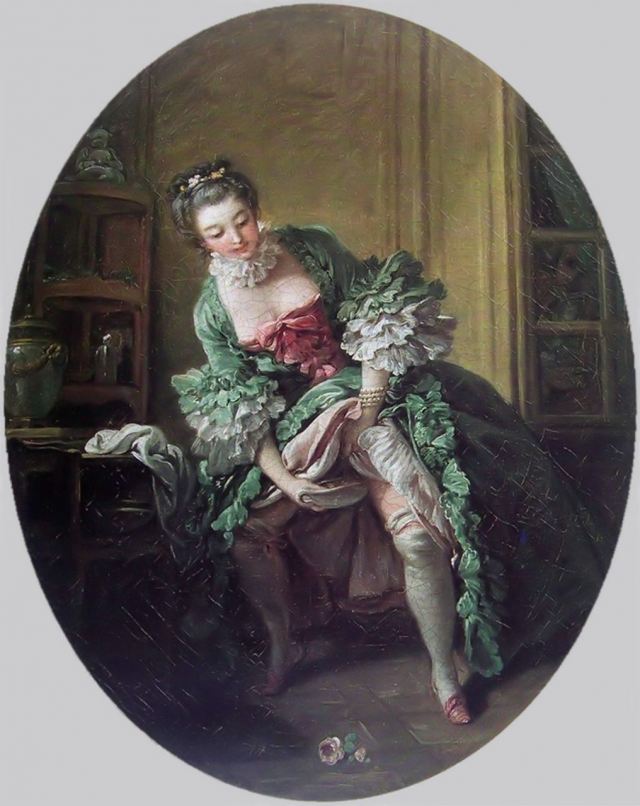
This image by Francois Boucher says it all. A fully dressed lady is relieving herself into an object called the bourdaloue or bourdalou, careful not to soil her skirts. Her maid, no doubt, stands nearby, waiting to receive the small chamber pot in order to empty it. The lady (or woman of ill repute) is in a public place – a theatre or tavern, perhaps – but certainly not a church. Wherever she is, the place has no public toilet. And so she must relieve herself standing up, taking care not to soil her skirt and petticoats.
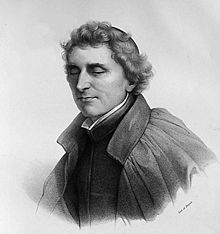
Louis Bourdaloue. Image @Wikimedia Commons

According to legend, the name of this porta potty comes from  Louis Bourdaloue (1632-1704), one of Louis XIVs Jesuit priests. His oratorical skills were reputedly so accomplished that people felt they could not miss a single word of his sermons. It is said that women sat through his masses with a bourdaloue placed under their dresses, whose skirts were held out by panniers. Since the priest’s  sermons were somewhat longwinded, the chances that ladies would need to relieve themselves were almost certain.  As a rule, churches and theatres had no toilets, and there were no breaks given during sermons. Ergo these portable urinals, which were ergonomically designed to accommodate the female body.

The vessel was oblong, rectangular, or oval in shape. A slightly raised lip at one end and a handle at the other allowed the woman to relieve herself from a squatting or standing position. The edges curved inward to avoid hurting her tenderest parts.

Sevres bourdaloue, with medallion depicting a scene from Watteau, blue lapis and framed in gold leaf. 1892.

It is a little hard to distinguish truth from fiction, so I am a bit skeptical about this apocryphal tale. Were the priest’s sermons in the early 18th century so truly awe-inspiring that a lady would squat in her pew, however discreetly, to relieve herself in front of her family and other parishioners so as not to miss a word?

In truth it was her maid who brought the vessel in, for bourdaloues were compact and came with a cover. When a lady had to relieve herself she would, I imagine, retreat discreetly to a private corner of a tall pew or to a back or side room in the church. Her maid would then hand the vessel over to her mistress, who took care not to spill any liquid on her skirts. When the lady was finished, she would hand the bourdaloue to her maid to empty its contents.  When attending a play or opera at the theatre, I imagine she would again retreat to a darker more private corner of the box to urinate.

A PAIR OF SEVRES BOURDALOUES (POTS DE CHAMBRE OVALE) CIRCA 1776,

Designed only for women, these bourdalous are quite beautiful. Made of faience or porcelain, they are decorated with flowers or painted scenes. Many are gilded. The portable pots, or coach pots as they were known in England, could be decorated inside as well.  They were quite small and compact, designed for travel, which made it easy to carry them and pack them for coach trips. They were also taken to long banquets, where ladies would scurry behind curtains when they needed to go.
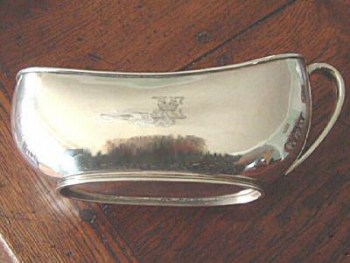
Bourdalou made in France c. 1840. It has an engraved crest and a leather case to contain it. The silver bourdalou is a small urinary receptacle for female use, of compressed eliptical shape and generally made of porcelaine or earthenware, but also made occasionally of silver. Its front end has an incurved rim and, usually, stands on a simple foot ring with a simple loop handle. Also known as a coach pot in England.

Bourdaloues were used throughout the 18th and for most of the 19th century. As water closets began to be built inside homes and buildings, the use of these chamber pots began to be reduced dramatically.

Plain bourdaloue made of creamware. The shape is quite elegant.

Gentlemen had it a little easier, although this satiric French cartoon, which I have shown before, depicts the disgust that Frenchmen felt towards Englishmen who freely pissed in a pot in the dining room. In this instance, the man misses the chamber pot and hits the floor. There seems to be a lack of modesty among these men, which largely holds true today.
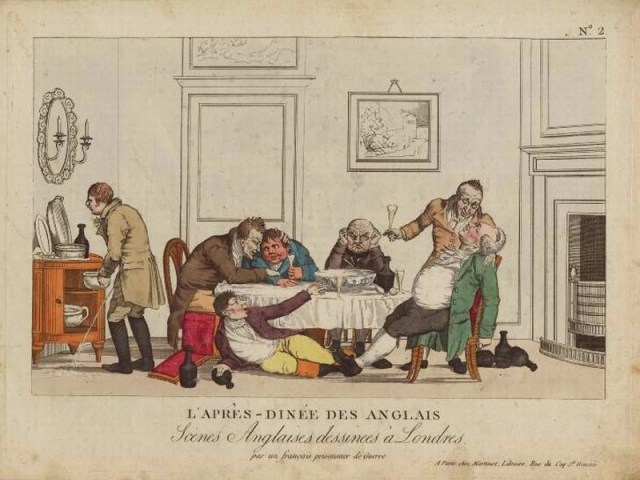
c1816, from Fitzwilliam Museum.

Modesty is also lacking in this cartoon of ladies relieving themselves inside a public restroom at Vauxhall Gardens. Four are arrayed on a long latrine against the wall. One lady is refreshing her make up and another is tightening her garter. If such scenes were common for upper class women in public spaces, perhaps many felt no modesty relieving themselves in church as well.
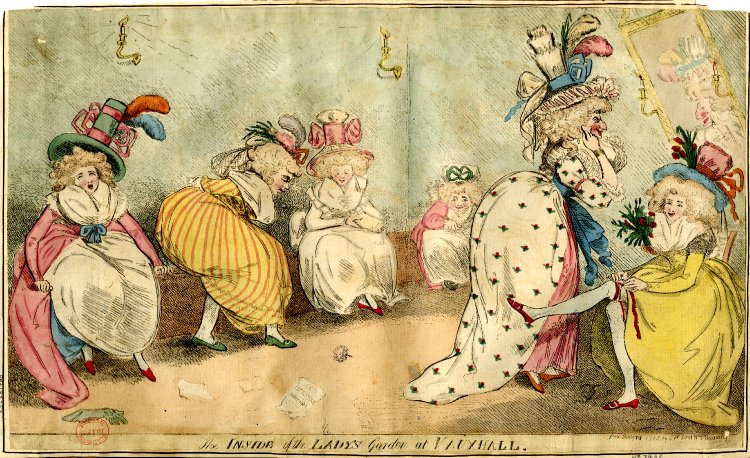
The Inside of the Lady’s Garden at Vauxhall, 1788 by SW Fores. Image @British Library. The interior of a ladies’ cloak-room. Against the wall on two sides of the room is a bench forming a latrine on which four fashionably dressed ladies are seated. On the right a woman in profile to the right, resembling Lady Archer, applies paint to her cheeks before a mirror lit by two candles. A young woman seated beside her on the extreme right ties up her garter.
Read Full Post »

“there seem to be very few, in the style of a Novel, that you can read with safety, and yet fewer that you can read with advantage.”- Sermons to Young Women, James Fordyce, 1766

It’s no secret that Jane Austen’s family were novel readers during an age when such books were considered frivolous and not worthy of reading. (Writing a novel was considered an even worse offense!) Enter Jane Austen and Pride and Prejudice. In her delightful book, Jane created a satiric scene in which Mr. Collins confirmed Mr. Bennet’s opinion of his young cousin’s foolishness. After he enjoyed the younger man’s inanity for a while, Mr. Bennet proposed that Mr. Collins read to the group. The girls chose a novel, of which Mr. Collins disapproved:

John Opie, "A Moral Homily"

John Opie, “A Moral Homily”

Mr. Bennet’s expectations [regarding Mr. Collins] were fully answered. His cousin was as absurd as he had hoped, and he listened to him with the keenest enjoyment, maintaining at the same time the most resolute composure of countenance, and, except in an occasional glance at Elizabeth, requiring no partner in his pleasure.

By tea-time, however, the dose had been enough, and Mr. Bennet was glad to take his guest into the drawingroom again, and, when tea was over, glad to invite him to read aloud to the ladies. Mr. Collins readily assented, and a book was produced; but on beholding it (for everything announced it to be from a circulating library), he started back, and begging pardon, protested that he never read novels. Kitty stared at him, and Lydia exclaimed.—Other books were produced, and after some deliberation he chose Fordyce’s Sermons. Lydia gaped as he opened the volume, and before he had, with very monotonous solemnity, read three pages, she interrupted him with—

“Do you know, mamma, that my uncle Philips talks of turning away Richard; and if he does, Colonel Forster will hire him. My aunt told me so herself on Saturday. I shall walk to Meryton to-morrow to hear more about it, and to ask when Mr. Denny comes back from town.”

Lydia was bid by her two eldest sisters to hold her tongue; but Mr. Collins, much offended, laid aside his book, and said—

“I have often observed how little young ladies are interested by books of a serious stamp, though written solely for their benefit. It amazes me, I confess;—for, certainly, there can be nothing so advantageous to them as instruction. But I will no longer importune my young cousin.”

John Opie, “A Tale of Romance”

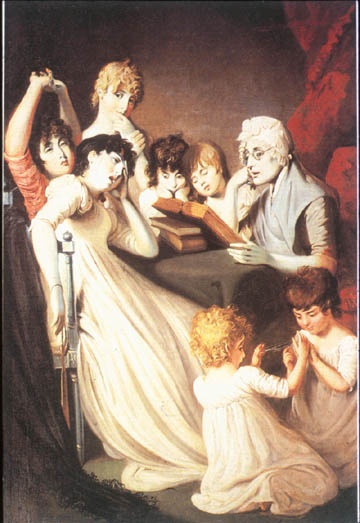
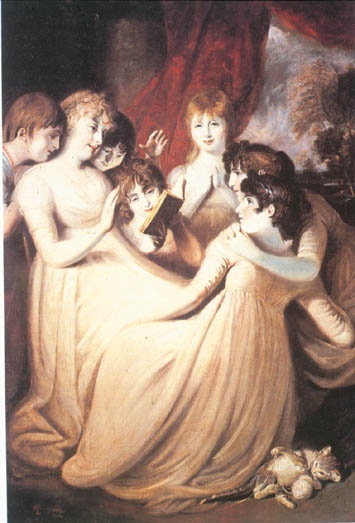
One cannot but help enjoy the irony of the situation. During his lifetime, Dr Fordyce was considered an excellent orator and his sermons were much appreciated, but by the time Jane Austen began to write her novels his luster had dimmed and novel reading was becoming more acceptable. These wonderful paintings by John Opie represent both sides of the sermon/novel story. In the first painting the governess is reading boring homilies to her charges in the hope of educating them. She is completely unaware of their expressions. One girl yawns, another can barely keep her eyes open, and a third looks pensively at the viewer as if to say, “Can you believe this?” Two of the youngest children entertain each other by playing cat’s cradle, and the girl sitting nearest the reader is about to fall asleep. What a wonderful tableau! One can imagine that the Bennets must have looked much like this ensemble before Lydia blurted out her question.

The second painting depicts the delight that the ensemble takes in listening to a tale of romance. They are all engaged and smiling and hanging onto every word from the reader. A kitten is left to play with a wool ball by itself.

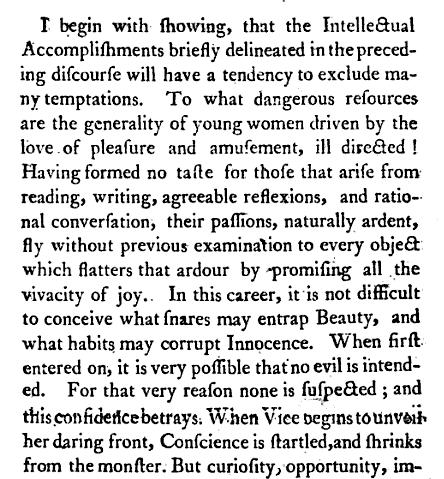
Jane Austen employed words to create an ironic tone; John Opie used images. Both used their respective mediums to make a memorable point. Today, Dr. Fordyce’s sermons are largely forgotten. The following excerpt from Sermon VIII, Volume 2 demonstrates why he was considered dull and stodgy even 200 years ago:

Sermons to Young Women, Volume 2, James Fordyce, 1767. You can download the volume as an ebook at this link.

Read Full Post »

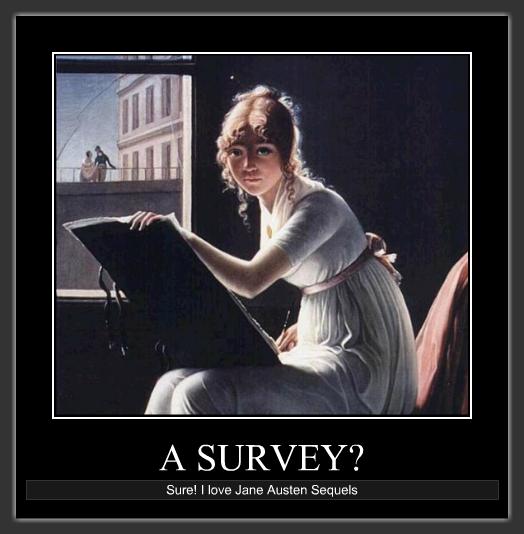
A Request from a Graduate Student: Hello Fellow Jane Austen Readers! Have you ever read a published sequel to a Jane Austen novel? Are you a fan of Jane Austen sequels?

My name is Cliff Bryant, and I am a graduate student at Virginia Tech, conducting a research project on readers of published sequels of Jane Austen?s novels. I want to find out how readers came to read the sequels, and whether or not you like them.

If you are interested in participating in my study, just click on the link, and take the survey. It will take less than 10 minutes, and I will release the results in a few weeks, so you can check back and see how you compare to other Jane Austen sequel fans. (Feel free to contact me with questions at cliffbryant@vt.edu.)

(Just to be clear, I am talking about actual published sequels to the novels, not web fan fiction, or mash-ups like Pride and Prejudice and Zombies – though maybe that will be my next project!).

If you choose to participate, thanks so much! Just click the link, review the consent information, then take the survey!

Thanks!

(LINK – https://survey.vt.edu/survey/entry.jsp?id=1339705453120)

Read Full Post »

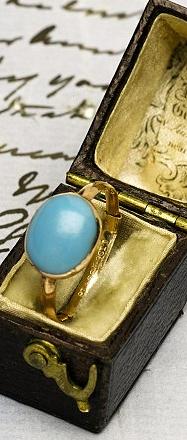
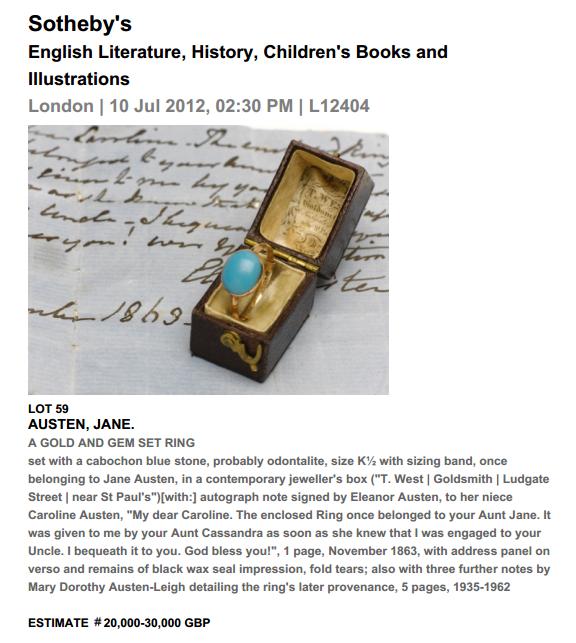
I am jumping a bit late on the Jane Austen bandwagon with news of this ring. Coverage by Austen Authors and Austenonly is quite detailed and interesting, and I have very little to add to their information other than to offer the text of the PDF document put out by Sotheby’s. The ring, as well as original editions of Jane’s books, will be auctioned on July 10th.

I will say that this cabochon ring is lovely and made of a semi-precious stone, which makes sense, considering Jane’s economic situation. Amazingly, no one knew of this possession until quite recently, when it came time to be sold. The £30,000 price tag will be realized quickly, no doubt, and the number of people who will bid on this rare item will push the price well past its original estimate. Does anyone want to bet for how much this ring will eventually go? Let’s hope it will find a home in a British museum.

PROVENANCE
Jane Austen (1775-1817); her sister Cassandra (1773-1845); given in 1820 to her sister-in-law Eleanor Austen (née Jackson), second wife of Rev. Henry Thomas Austen (d. 1864); given in 1863 to her niece Caroline Mary Craven Austen (1805-1880, the daughter of Rev. James Austen); her niece Mary A. Austen-Leigh (perhaps first to her mother Emma Austen-Leigh, née Smith); her niece Mary Dorothy Austen-Leigh; given to her sister Winifred Jenkyns on 27 March 1962; thence by descent

LITERATURE
W. Midgley, ‘The Revd. Henry and Mrs Eleanor Austen’, Collected Reports of the Jane Austen Society: 1976-85 (1989), 86-91

CATALOGUE NOTE
An intimate personal possession of Jane Austen’s, hitherto unknown to scholars, that has remained with the author’s descendants until the present day. The stone is probably Odontalite, a form of fossilised dentine that has been heated to give it a distinctive blue colour, which came into fashion in the early 19th Century as a substitute for turquoise. It is an attractive but simply designed piece, befitting not only its owner’s modest income but also what is known of her taste in jewellery. Fanny Price, the heroine of Mansfield Park, is given a gold chain by her cousin Edmund “in all the niceness of jewellers packing”, with the comment that when making his choice “I consulted the simplicity of your taste” – in contrast to the more elaborately decorated chain that she had been given by Mary Crawford. Similar sentiments are found in one of Austen’s letters when she informed her sister Cassandra that “I have bought your locket … it is neat and plain, set in gold” (24 May 1813).

On Jane’s death her jewellery, along with other personal possessions, passed to Cassandra, and she appears to have given a number of pieces as mementos. After Jane’s death Cassandra wrote to Fanny Knight that Jane had left “one of her gold chains” to Fanny’s god-daughter Louisa (29 July 1817), and she appears to have given the best-known piece of jewellery known to have belonged to her sister, the topaz cross given to her by her brother Charles in 1801 (see her letter to Cassandra, 26 May 1801), to their mutual friend Martha Lloyd.

Three years after Jane’s death, Cassandra gave the ring to Eleanor Jackson, on hearing the news that she was about to marry her brother Rev. Henry Thomas Austen. Henry had been Jane’s favourite brother and was closely involved in getting her novels into print. He lived locally to Cassandra and was by this time a clergyman (curate of Chawton from 1816, appointed perpetual curate of nearby Bentley in 1824), having previously gone bankrupt as a banker. Eleanor, his second wife, was the niece of the rector of Chawton, Rev. Papillon, and seems to have been known to the Austen family for many years.

Eleanor kept the ring for many years, bequeathing it to her niece Caroline shortly before her death. Caroline’s brother, James-Edward Austen-Leigh, wrote A Memoir of Jane Austen, and Caroline herself assisted this project by committing her own childhood memories of her aunt to paper, for her brother’s use. Caroline never married and the ring passed in turn to James-Edward’s daughter Mary, at which point it passed beyond the generation who had personal memories of Jane.

Click here for the PDF document

Also for sale:

Pride and Prejudice, Edgerton, 1813

Read Full Post »

Some books are so useful they are hard to pass up. Several months ago, I received the Kindle edition of Behind Jane Austen’s Door by Jennifer Forest, author of the delightful Jane Austen’s Sewing Box. Behind Jane Austen’s Door takes you on a tour of a Regency house, room by room – the entrance hall, drawing room, dining room, breakfast room, dressing room, bedroom, and kitchen – to
explore the challenges and lives of Jane Austen’s women. Included is an appendix that provides a quick overview of the Regency era.

More accessible in tone and organization than the excellent Behind Closed Doors by Amanda Vickery and If Walls Could Talk by Lucy Worsley, which cover similar but more comprehensive territory, this book can be used as a quick reference by people who want immediate access to the purposes and functions of the rooms in a Georgian household. What distinguishes this book is its close association to Jane Austen and her novels (much like Jennifer Kloestler’s book, Georgette Heyer’s Regency World, is associated with that author).

In these large houses [such as Pemberley], the women didn’t need to use the drawing room during the day. There were other rooms for use; they had their own office and other smaller parlors. The drawing rooms, and yes there could be more than one drawing room, in these big houses were just for receiving the morning visitors and for evening entertainment.

One gains close glimpses of a rich family as well as one of more modest means, such as the household that Jane Austen’s mother oversaw.

She works with the cook in preparing menus, sourcing food and caring for the vegetables, dairy and chickens. On washing day, she and her daughters work alongside the servants to get all the laundry completed: it was just so time consuming in the days before washing machines! A gentlewoman had to monitor the budget, find supplies and pay the bills for all those expenses, including the tea and wine. 

While much of the territory that Jennifer covered seemed familiar, it is arranged in such a pleasant and easy to use format that new authors to the Jane Austen genre or Regency romance will find it very useful, especially Jane Austen fans.

Jane Austen’s own mother used her dressing room at Steventon as a second sitting space, more casual and private than the drawing room. After five weeks of illness, Mrs Austen’s return to health allows a resumption of tea in the dressing room. “My mother made her entree into the dressing-room through crowds of admiring spectators yesterday afternoon, and we all drank tea together for the first time in five weeks … We live entirely in the dressing-room now, which I like very much; I always feel so much more elegant in it than in the parlour.” Letter from Jane Austen to Cassandra Austen, Sunday 2 December 1798.

Oh, there will be people who say that they already know this information and that the book provides nothing really new, but readers who are just discovering Jane Austen and the Regency world will think otherwise. I, for one, am happy to have another source to turn to when checking my facts about meal times and the precise function of certain rooms and furniture. The book, which is a quick read, is available in e-book format. I found this quite convenient, for I can access it on all my mobile devices and computers. Also, at $2.99 for the Kindle version, it is quite a bargain. I give it four out of five Regency teacups!

About the Author
Jennifer Forest has a Bachelor of Arts and a Graduate Diploma in Cultural Heritage Management. Jennifer is a museum curator with a love of beautiful old historic buildings. She lives in Australia, a country built by Regency England.

Blog: Behind Jane Austen’s Door

Print Length: 51 pages
Sold by: Amazon Digital Services
Language: English
ASIN: B006YITPAS
Text-to-Speech: Enabled
X-Ray: Not Enabled
Lending: Enabled

Read Full Post »

« Newer Posts - Older Posts »