Feeds:
Posts
Comments

Archive for the ‘jane austen’ Category

King's College, London

Emma Newport is running a three week summer course at King’s College London, exploring Austen’s England as well as her place in the literary pantheon. It is open to all who wish to study Austen in an academic environment at a Russell Group university in England.

Studying Austen in London gives students access to an extensive range of original resources held at the British Museum, the National Portrait Gallery and others. The course will include visits to a range of locations with cultural and historical relevance to Austen, including trips to Bath and Alton and a guided walk tracing Regency London. Throughout the course, there will be film screenings of all six major novels when we will examine in depth Austen’s heroes and villains and the England in which they lived.

KEY FACTS
Course start date, 02-07-2012
Course duration, Three weeks
Course type, Summer School
Course available session(s), Session 1
Course times, Between 9am and 5pm, Monday to Thursday
Course recurrence, 3 weeks
Entry requirements
See the general Summer School admission requirements for details
Academic Lead, Emma Newport

Read Full Post »

One can imagine that during her final illness, Jane Austen was no stranger to leeches. This method of bloodletting was so common in Great Britain (Wales especially) and France that by the 1830’s Hirudo medicinal leeches (common in Europe) were hard to find and had to be imported or home grown .

Leech finders, 1814. George Havell, Costumes of Yorkshire.

Gathering leeches was a traditional female occupation, although there are always exceptions to the rule. Take this passage about leech-fishers in France from the Gazette des Hopitaux:
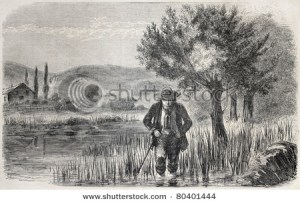
Man leech fishing in a marsh in Bretagne. 1857. Image @Shutter Stock

If ever you pass through La Brenne, you will see a man, pale and straight-haired with a woollen cap on his head, and his legs and arms naked; he walks along the borders of a marsh, among the spots left dry by the surrounding waters. This man is a leech- fisher. To see him from a distance,—his wo-begone aspect, his hollow eyes, his livid lips, his singular gestures,—you would take him for a maniac. If you observe him every now and then raising his legs and examining them one after another, you might suppose him a fool ; but he is an intelligent leech-fisher. The leeches attach themselves to his legs and feet as he moves among their haunts; he feels their bite, and gathers them as they cluster about the roots of the bulrushes and aquatic weeds, or beneath the stones covered with a green and slimy moss. He may thus collect, ten or twelve dozen in three or four hours. In summer, when the leeches retire into deep water, the fishers move about upon rafts made of twigs and rushes.”  – Excerpt taken from Curiosities of Medical Experience (1838) by John Gideon Millingen, via The Condenser: Hunting Down Good Bits

Despite the many strides that were made in medicine regarding human anatomy and diseases, the knowledge about treatments lagged behind. Lack of anesthetics made surgery an excruciating experience, and there were no antibiotics. Useful plants, such as digitalis, were discovered more by luck than by science. Bloodletting or ‘breathing a vein’ was one way in which a patient could be treated by a physician who had few options. Applying leeches often resulted  in a severe loss of blood, which was more detrimental to the patient’s condition than not. A human with a poor immune response could suffer from wound infections, diarrhea and septicemia, all influenced by the bacterium, Aeromonas veronii, carried in the leeche’s gut.

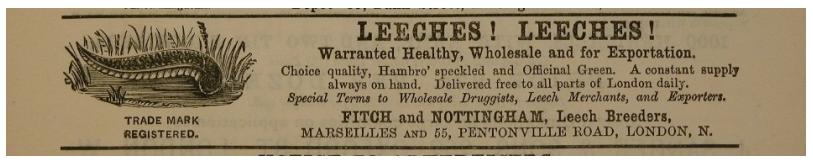
19th century leech advertisement

Regardless of adverse consequences, bloodletting has been practiced for at least 2,500 years. The earliest instruments, or lancets, were sharpened pieces of wood or stone, but it is leeches that I want to write about. (I am more repulsed by their sight than a snake’s, and had a hard time searching for an image that did not make me gag.)  The ancient Greeks believed in the humoral theory, which proposed that when the four humors, blood, phlegm, black and yellow bile in the human body were in balance, good health was guaranteed. An unbalance in these four humors led to ill health. Fast forward to the middle ages, when superstition and religion gave weight to the art of bleeding. If you recall, the earliest surgeons were barbers as well. Their leeches cured anything from headaches to gout!

Bloodletting with leeches is an ancient tradition

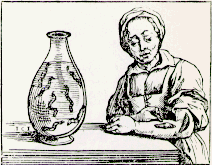
Leeches are commonly affixed by inverting a wine-glass containing as many as may be required, upon the part affected. The great disadvantage of this practice is, that some of them frequently retire to the upper part of the glass and remain at rest, defying all attempts to dislodge them, without incurring the risk of removing those that may have fastened.” – James Rawlins Johnson, A Treatise on the Medicinal Leech

Francois Broussais proposed in  his Histoire des phlegmasies ou inflammations chroniques (1808) that all disease resulted from excess build up of blood. The alleviation of this condition required heavy leeching and starvation. Leeches subsequently became the most prevalent way of treating a patient, especially in France, where tens of million of leeches were used per year, resulting in a drastic leech shortage. The British were equally enamored with this form of therapy. It is conjectured that Princess Charlotte’s death in childbirth in 1817 was exacerbated by her physician, who prescribed a rigorous course of blood letting and starvation diet during her pregnancy, weakening her before her agonizing 50+ hours of labor. (Read my article on this topic.)

In 1833, bloodletting became so popular in Europe, that the commercial trade in leeches became a major industry. France, suffering a deficiency, had to import 41.5 million leeches. The medicinal leech almost became extinct in Europe due to the extremely high demand for them. Leeches were collected in a particularly creepy way. Leech collectors would wade in leech infested waters allowing the leeches to attach themselves to the collector’s legs. In this way as many as 2,500 leeches could be gathered per day. When the numbers became insufficient, the French and Germans started the practice of leech farming. Elderly horses were used as leech feed where they would be sent into the water and would later die of blood loss. – Maggots and Leeches Make a Comeback

Oh, how I pity those elderly horses!
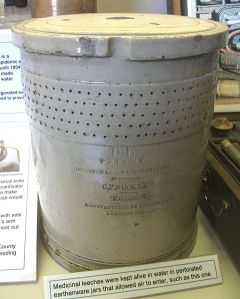
 

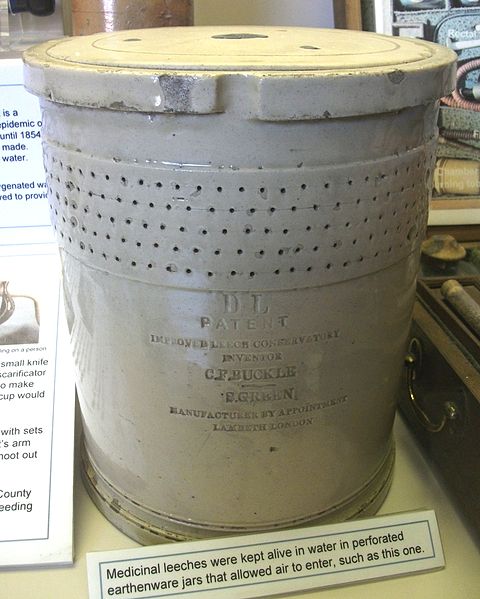
Large leech collector jar.
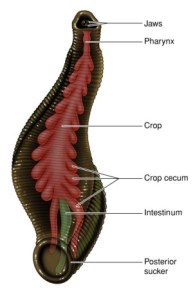
Intestinal tract of the hirudo leech

Leeches are quite extraordinary in that they have 31 brains and can gorge themselves up to five times their body weight before falling off their host. Afterward they require no feeding for another 6 months. There are over 650 known species of leeches, not all of which are bloodsuckers (some eat earthworms, for example). Placing leeches onto a patient (making sure the frontal sucker with teeth was directed to the skin) is relatively pain free, for their bite releases an anaesthetic. During feeding they secrete compounds, such as a vasodilator that dilates blood vessels and anticoagulant that prevents the blood from clotting. The worms are hermaphrodites, functioning as both the male and female sex. Even after being frozen, leeches can be coaxed back to life!  Needless to say, these creatures must provide an endless source of interest to scientists.

Early 19th century rare cobalt blue transportable leech jar. These were mostly made of clear glass. Cloth covered the everted lip to prevent escapees.

People (meaning mostly women) stood in fresh water marshes, lakes, pools, and the edges of river banks, and allowed the leeches to attach to their legs. (I shudder as I type this.) Once the leeches were gathered, they were placed in a basket, ceramic pot with breathing holes, or a reservoir.

One of these traders was known to collect, with the aid of his children, seventeen thousand five hundred leeches in the course of a few months; these he had deposited in a reservoir, where, in one night, they were all frozen en masse.” But congelation does not kill them, and they can easily be thawed into life, by melting the ice that surrounds them. Leeches, it appears, can bear much rougher usage than one might imagine: they are packed up closely in wet bags, carried on pack-saddles, and it is well known that they will attach themselves with more avidity when rubbed in a dry napkin previous to their application. Leech-gatherers are in general short-lived, and become early victims to agues, and other diseases brought on by the damp and noxious air that constantly surrounds them ; the effects of which they seek to counteract by the use of strong liquors.”  Excerpt taken from Curiosities of Medical Experience (1838) by John Gideon Millingen, via The Condenser: Hunting Down Good Bits
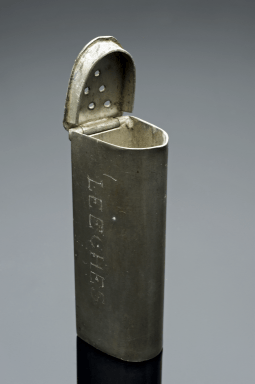
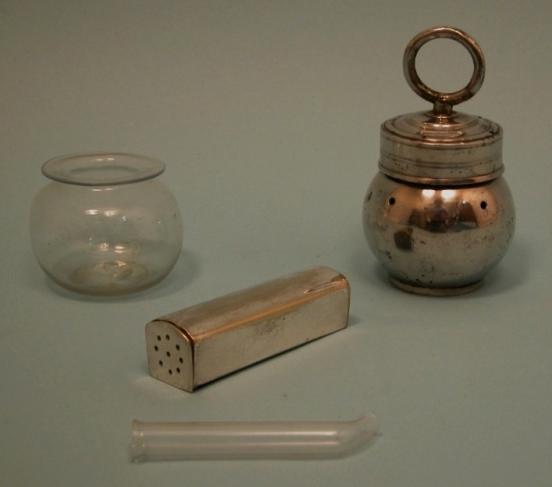
Pewter box for transporting leeches. Image @Science Museum of london

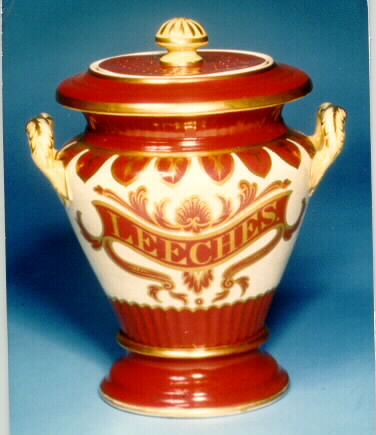
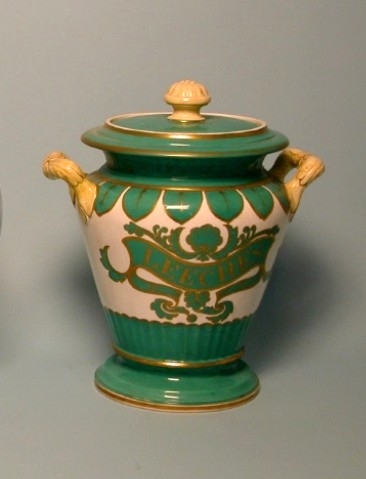
Leeches were carried in a variety of containers made of glass, silver, or pewter. Small bowls were portable, and the larger ones were probably kept in an apothecary’s shop or pharmacy. The everted lips were used to attach a cloth, which prevented the hapless creatures from escaping.

Portable leech carriers made of glass, silver and pewter. Small leech tubes directed the worm to difficult to reach places in the mouth, larynx, ear, conjunctiva, rectum and vagina, begging this question: How did one retrieve the engorged leech?

After the 1830s, the practice of leeching began to decline as medical diagnostic skills improved. Physicians realized that patients who were leeched did not often recover more fully than those who were not, and other, more beneficial treatments,  including pharmaceutical and homeopathic remedies, began to replace leeching
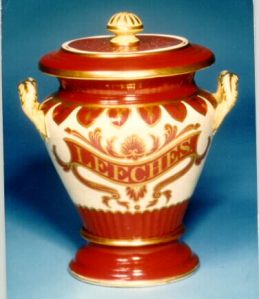
Red and cream Staffordshire leech jar

More on the Topic

Leech bowl

Read Full Post »
This summer Professor Devoney Looser will be directing a National Endowment for the Humanities Summer Seminar for College and University Teachers, “Jane Austen and Her Contemporaries.”

The seminar’s 16 participants will seek significant new insights about Jane Austen by reading her closely alongside now understudied (but once well-known) writers of her own day. The class will meet from June 18-July 20, 2012, at the University of Missouri in Columbia, MO.

Despite valuable scholarship that considers Austen alongside Sir Walter Scott, Frances Burney, Mary Wollstonecraft, Maria Edgeworth, or the so-called “big six” Romantic poets (Blake, Wordsworth, Coleridge, Shelley, Byron, and Keats), there remains a tendency to write and teach about Austen in a restricted frame of reference, in single-author studies or major author courses.
These seminars, which come with a stipend of $3,900, are designed primarily for those who teach American undergraduate students, although qualified independent scholars are also eligible to apply. Two spaces in the seminar are reserved for graduate students.

The need to deepen our claims about Austen has arisen at least in part because, in recent years, the scholarly landscape for Austen studies (and, indeed, for most eighteenth- and nineteenth-century writers) has changed radically. We will work together to make sense of when to use emerging digital technologies to attempt to answer scholarly questions and when to seek out paper-based materials, both print and manuscript.

For further details see the program website (http://nehseminar.missouri.edu)for further information about the program, to determine your eligibility, and for directions about how to apply.

The deadline for application is 1 March 2012. Please don’t hesitate to contact Dr. Looser with any questions you may have:

Devoney Looser, Professor of English
Co-Editor, Journal for Early Modern Cultural Studies
Tate Hall 114
Department of English
University of Missouri
Columbia, MO 65211
573-884-7791
FAX: 573-882-5785
looserd@missouri.edu

Read Full Post »

My regular Jane Austen readers have been patient as I succumbed to Downton Abbey fever and began to cover events 100 years after Jane Austen’s death. Customs changed during that intervening century. Take the matter of dress. While proper Regency ladies changed their outfits from morning gowns to walking gowns when they went out, and changed into dinner dress when dining, by Victorian and Edwardian times the custom of a lady changing her clothes throughout the day had turned into a fine art.  One could get by with no less than 4-5 changes per day. A woman who packed to visit a country estate was sure not to be seen in the same outfit twice. This meant that for a 4-day visit she would need at the very minimum to have her maid pack 16 changes of outfits. One can only imagine the work of a lady’s maid to keep all the clothes and unmentionables in perfect (and clean) condition. Such attention to detail required quite a bit of organization.

Morning dress, 1815. Ackermann plate. While she looked proper in her at home attire, this morning dress looks stodgy compared to the Edwardian teagown.

Corsets were worn all through the 19th century and into the early part of the 20th century. Women were constricted into these garments for most of their waking day, but there were times when they were free from these tight-laced garments.  During the early 19th century, upper class women at home would wear comfortable (but beautiful) morning gowns. Dressing gowns were also worn. Such gowns were meant to be seen by the family and close relatives only. The moment a woman expected to be seen, she would change into more proper dress.

Cora, the Countess of Grantham, lived during a time when teagowns were all the rage. These beautiful ornate gowns had the advantage of being simply cut and worn without a corset. It was possible that for just a few hours she could relax comfortably before dinner.

They were generally loose-fitting and elaborately trimmed, and gave full vent to the dressmaker’s or couturier’s skill and taste for theatricality. Tea-gowns were influenced by historical styles from eighteenth century Watteau-pleats, to renaissance hanging sleeves and empire waistlines and quite often, all of them at the same time. Never has so much love and art been invested in such an arguably unnecessary garment. All kinds of informal garments including tea jackets, peignoirs, dressing gowns, combing sacques, morning robes and dressing jackets also had their place in the leisured Edwardian lady’s wardrobe, all of them beautifully decorated and almost all of them now obsolete. 1900-1919: The Last Age of Elegance 

American dancer and actress Irene Castle wearing a teagown, 1913

It had long been the custom for a lady to entertain both male and female visitors in her boudoir. (Read my article on this topic.) During the Regency era, dressing gowns were quite plain and simple compared to teagowns.

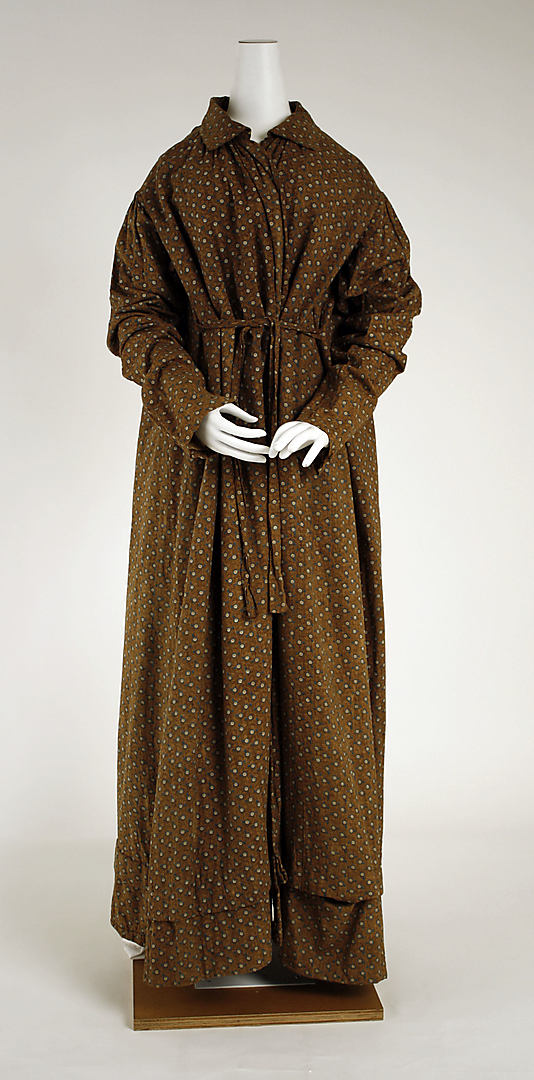
1810-23 dresssing gown. Image @Met Museum

At times the teagown gave rise to temptation, for a woman could entertain in private and not need the services of her maid:

Worn between five and seven oclock,  gave rise to the French phrase ‘cinq à sept‘. This referred to the hours when lovers were received, the only time of day when a maid wouldn’t need to be there to help you undress and therefore discover your secret. – “Style”, The World of Downton Abbey, Jessica Fellowes

Early 19th century dressing gown. Image @Met Museum

Attired in her tea-gown, a soft flowing robe of filmy chiffon or fine silk, trimmed with an abundance of lace and often free of corsetry, the hostess must have been a tempting prospect for many men. Such loose gowns afforded women great comfort, ease of access and a tremendous sense of femininity. Little wonder then that whilst hemlines rose and fell the tea-gown, which had appeared in England as early as 1875 lingered on until the 1920s. – Edwardian tea gowns, fashion era

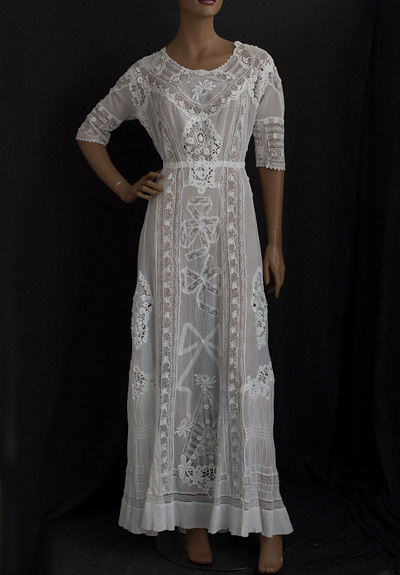
This Lingerie-style dress embellished with Irish crochet, c.1905 (below) can be seen in more detail on Vintage Texiles. Made of sheer cotton decorated with lace and ruffles, this sheer dress required a slip.

Edwardian teagown, 1905. Image @Vintage Textile

More on the topic:

Read more on the topic: Tea Gowns, Edwardian Promenade

Image of an early 19th century dressing gown at the Met Museum

Read Full Post »

We’ve heard the term, “Behind the green baize doors”, but what exactly does it mean? You hear this reference most often in regard to servants and in old books.

Baize was a sturdy green cloth attached to a swing door.  The insulating fabric prevented noises from disturbing the individuals on either side:

The ‘Green Baize Door’ was the dividing line between the two domains, and trespassing beyond meant going into foreign territory. The ‘Green Baize Door’ was a feature of almost every substantial house. It was generally an ordinary framed door onto which was tacked a green baize cloth, usually with brass tacks. It was the universal signal of the dividing line between the two halves of the house.The Bull children would not be tolerated by the servants in the domestic part of the house unless they were working under supervision. This was like walking into somebody else’s house. The servants would normally use a different route to get to the various parts of the house, and would aim to be seen as little as possible. This was not because they were considered beneath notice: on the contrary, it was so that they could do their work uninterrupted by the requirement to exchange civilities. Houses evolved so that domestic staff could go about their task without interruption, not to ensure the privacy of the residents. They had none. –Borley Rectory and the Green-Baize DoorDomestic life at Borley Rectory, by Andrew Clarke copyright 2002

Image @Chest of Books

The brass-headed tacks holding the cloth down could sometimes be arranged in a decorative design. The cloth not only deadened sound but also absorbed kitchen odors. Green baize doors became popular during the mid-Eighteenth century, so Jane Austen must have been aware of the practice, which was more and more used as the 19th century progressed. During Victorian times the practice of sound proofing doors with baize was quite common. The cloth could also be used to insulate nursery room doors, bedroom doors, and doors leading to studies or any place where sound needed to be muffled.

It was a time when housemaids were taught to turn their face to the wall if they should pass their employer on the stairs. For whose protection? one wonders. The era of Squire Allworthy and Sir Roger de Coverley had long passed, when relations between master and man were more informal. – The green baize door: social identity in Wodehouse; Part two – Allan Ramsay 

Early 19th century mahogany desk with baize lining**

Baize (or bayes), also known as a bocking flannel,  was a coarse wool or cotton material, which had a felt-like texture:

“In Europe, baize was used mainly for case, cabinet and closet linings, as well as furniture coverings. Clothing baize was used for monk and nun habits as well as soldier’s uniforms. In the North American Native market, the term baize frequently alludes to inexpensive coarse broadcloth. – Wool Trade Cloth 

Baize dates back to the 16th century, 1525 to be precise. A mid-17th century English ditty about the history of ale and beer brewing, mentions “bays”:

Hops, heresies, bays, and beer;
Came into England all in one year.

“Heresies refers to the Protestant Reformation, while bays is the Elizabethan spelling for baize. – Good English Ale 

Baize scrap from the Titanic. Image @Online Titanic Museum*

Baize was used in a number of ways, including as a protective cover for gaming tables, for the nap of the cloth increased friction, preventing cards from sliding and slowing billiard or snooker balls.  The cloth is available in a variety of naps. Roman Catholic churches used red or green baize for altar cloth protectors, and the cloth was used in museum cases and desks as well.

St. Jerome in his study

As previously mentioned, baize was also used for clothing.

“I would recommend to you the Green Baize Gown, and if that will not answer, You recollect the Bear Skin.” Letter from Abigail Adams to John Adams, 3 December 1788

The site for Knox Family Clothing mentioned mid-18th century receipts for baize and bayes,  as well as rattinet, armozeen, dowles, buff battinet, flannel, linen, silk, and velvet.

In Practical Cooking and Dinner Giving, published in 1876, Mary Foote Henderson recommends:

“Put a thick baize under the table-cloth. This is quite indispensable. It prevents noise, and the finest and handsomest table – linen looks comparatively thin and sleazy on a bare table.”  

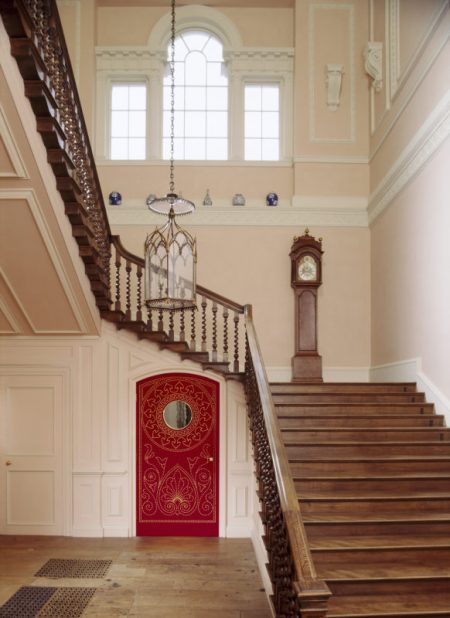
The Staircase Hall at Uppark. The red baize door leads to the servants' quarters. ©NTPL/Geoffrey Frosh

Red baize was also used as insulating material, as the decorative door at Uppark (image above) indicated. (National Treasure Hunt, National Trust Collections) In this advertisement for an 1808 Georgian house for sale, a red baize door to the inner lobby is featured. The red baize servant door providing access to the inner lobby and the kitchen, rear reception and breakfast room. 1808 house

More on the topic:

Read Full Post »

« Newer Posts - Older Posts »