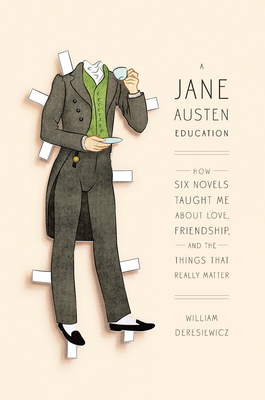
 Gentle readers, strap on your seat belts. Tony Grant from London Calling sent in his review of “A Jane Austen Education: How six novels taught me about love, friendship and the things that really matter“by William Deresiewicz. Let’s just say this is a review by a bloke about a bloke’s book. There will be no teacup or regency fan ratings this time.
Just recently a dear friend sent me a copy of A Jane Austen Education by William Deresiewicz. I had read some of the reviews written on a few of the Jane blogs and my impression from those was that it must be a fresh, slightly different approach to engaging with Jane’s works. I sort of put the idea of reading it to one side, I must admit. I thought it would be just another quirky angle on Jane. Anything with Jane’s name attached to it sells, doesn’t it? However, now having a copy here in front of me I decided, at the very least, I should have a look, delve in, and see what I thought.
The front cover was at first a mystery and slightly off putting. A paper doll cut out suited gentleman, headless, to be placed over an inanimate cardboard cut out of a Regency, or did it look more early Victorian, gentleman, presumably wearing underwear, seemed an odd choice. One dimensional, stiff, inanimate, stuck in one pose, drinking tea, ah yes, there was the Jane connection. What did all this reveal about what I was about to discover between the sheets?
The contents page revealed a nice straightforward approach. Chapter 1 Emma, Every Day Matters, Chapter 2 Pride and Prejudice, Growing Up and so on through the six published novels, each providing William with a stepping stone along his journey of self discovery and growth. And to round it all off, a nice concluding chapter “The End of the story.” Yes, a well-ordered and neatly constructed narrative was bound to follow.
By the end of the first chapter I had our William sussed. Start with the personal stuff (my life was crap-type thing) – provide an overview of the novel, characters, and plot, and then follow through by laboriously comparing his life events with the characters and events in the book. And finally, relating how it had changed him for the best. I began to feel that I was about to hunker down for a tortuous time. But things were worse than that, William was depressed. Now I’m fine with depression and especially manic depression. All the great comedians profess to be depressives. We have had and have (some of them are dead by the way) Peter Sellers, Spike Milligan and John Clease. All of them are professed manic depressives who used this depth of pain to create some of the greatest humour ever. Winston Churchill suffered from what he termed his ”black dog.” Virginia Woolf and Sylvia Plath, both incredible writers who could bare their souls and take us to places in the human psyche we would never have dreamed of, both took their lives. Life was too unbearable.
However William writes,
Well it just sat there, that realisation, like a lump in my gut – sat there for weeks. I didn’t know what to do with it, how to get rid of it, how to dig myself out the hole I just discovered I was in. But I knew I couldn’t live like that anymore.”
This passage is a build up to telling his girlfriend at the time, that he thought they should part their ways. There was no depth to their relationship apparently. This level of depression is the equivalent of having a bad cold. In the hierarchy of depressive situations, William is not going to reach into our emotional depths and inspire us with what is a very common place situation. I was hoping things would get better, but no, he droned on in this flat slightly miserable way all through the first chapter. And what did he learn from Emma?
“Even I was beginning to realise what a real relationship looked like,” he droned.
Oh I see!!!!!!! Yes, I was really beginning to see.
I was getting the idea. I really do hope William gets his full share of the kudos that Jane’s name, applied to a title, provides. I was beginning to think, what else is there? What other value?
At one stage, I must say, I thought that the analysis part of each chapter had worth, William is an English literature lecturer at a university after all, but then I got bored with that too. He is far, far too contrived. Later in the book, here is William analysing Mansfield Park, my favourite Austen novel,
“What Austen recommended to us, she urged upon her nearest and dearest, too. Love means effort and self control – for the sake of others, and thus, ultimately, for your own.”
Oh God, this is beginning to sound so profound. Life’s hard lessons learned so emphatically, and by a writer so young too.
I squirmed a few times while reading this. Yes, I did persevere. The book was compelling in a ”how can it get worse?” sort of way.
But this is the real sneaky bit. Come on William, tell us the truth. What were you thinking when you wrote this stuff ?
We had jumped each other one night the previous summer, and though we had been together for over a year we had little in common and had never much progressed beyond the sex.”
Honesty, the baring of ones soul, telling it like it is — it’s all in this book. William repeats at discrete, well-paced intervals, lightly (and apparently carelessly), how bad he feels about superficial relationships and jumping into bed for hot steamy one night stands. Any bloke down my pub would laugh at him heartily and call him a …….!!! No I really can’t write what I know my mates would say. William might sue me. This book just ain’t for blokes, let’s put it that way.
It does beg the question who this little boy lost saga is for.
By the end of the book William tells us he has found true, deep, long-lasting love. He has found out at last what it means to be “intimate.” One of the most squirm-creating moments in this whole squirm-creating edifice was earlier in the book when William asks a girlfriend in a cafe what intimacy was and if they were being intimate at that time.
The book ends: (Warning: Spoiler alert.)
That first weekend she came to Brooklyn, the visit that sealed our fate, she brought along a book, just in case there was some downtime. [I’m trying to imagine what the downtime might entail and why and how there could be downtime.] She knew I was a graduate student by that point, but she had no idea what I studied or whom I was writing my dissertation about. It was just the thing she happened to be reading at the time.
The book was Pride and Prejudice.
Reader, I married her.”
So let me get this right. In the end, after all the soul searching, all those profound life lessons it boiled down to Pride and Prejudice?
 We’ve been taken through the superficial relationships and I must admit, when I got to the end of the book, I discovered William’s photograph on the back of the fly sheet. It startled me. This bloke had superficial relationships!!!!! There has been the father who disapproved. There has been the depressive moments, mild depression by the way, boring and ordinary, that nothing but a good blow of the nose into a handkerchief wouldn’t have solved. There have been the life lessons learned. I’m sorry, I can’t get it out of my head: This young bloke has learned life’s lessons through Jane Austen already. Where does he go from there? My experience is nothing like that. Life creeps up on you imperceptibly. You adapt and grow slowly, often without noticing and sometimes you regress badly. Life and life’s lessons are nowhere near as easy to learn, as William makes out, by reading a set of novels. You can’t learn it in your head, you have to live life. Sometimes I think it’s impossibly to learn the so-called life lessons. Often we are just stuck, through no fault of our own, because we are who we are.
I am very reluctant to throw a book onto a fire, for echoes of the many evil political regimes that have done that sort of thing come to mind. What I’ll do, out of gratitude to my friend who sent me this copy, is put it on my bookshelf to gather dust. Then I’ll forget about it.
Read Full Post »












 Jane Austen's World