Feeds:
Posts
Comments

Archive for the ‘jane austen’ Category

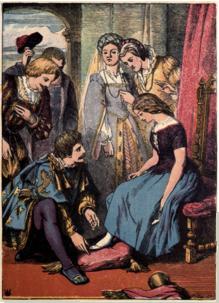
Last week I featured the book, The History of Little Goody Two-Shoes, a moralizing children’s book that Jane Austen kept all through her lifetime. As she was growing up, she was probably familiar with the Cinderella fairytale. Hundreds of versions of the folk tale from a variety of European sources exist, but the myth goes as far back as ancient Greece and China.  The story of the cinder maid and the glass slipper was popularized in 1697 by Charles Perrault in Histoires, ou Contes du Temps Passè.  

Written for the aristocratic Salons of C17th French society, Perrault’s ‘Cendrillon’ is stripped of all violent, bawdy or socially moralizing material and is instead focused primarily on entertaining. – The Origins of the Cinderella Story

The images in this post show the paper dolls based on Perrault’s tale that were popular during Jane Austen’s time.
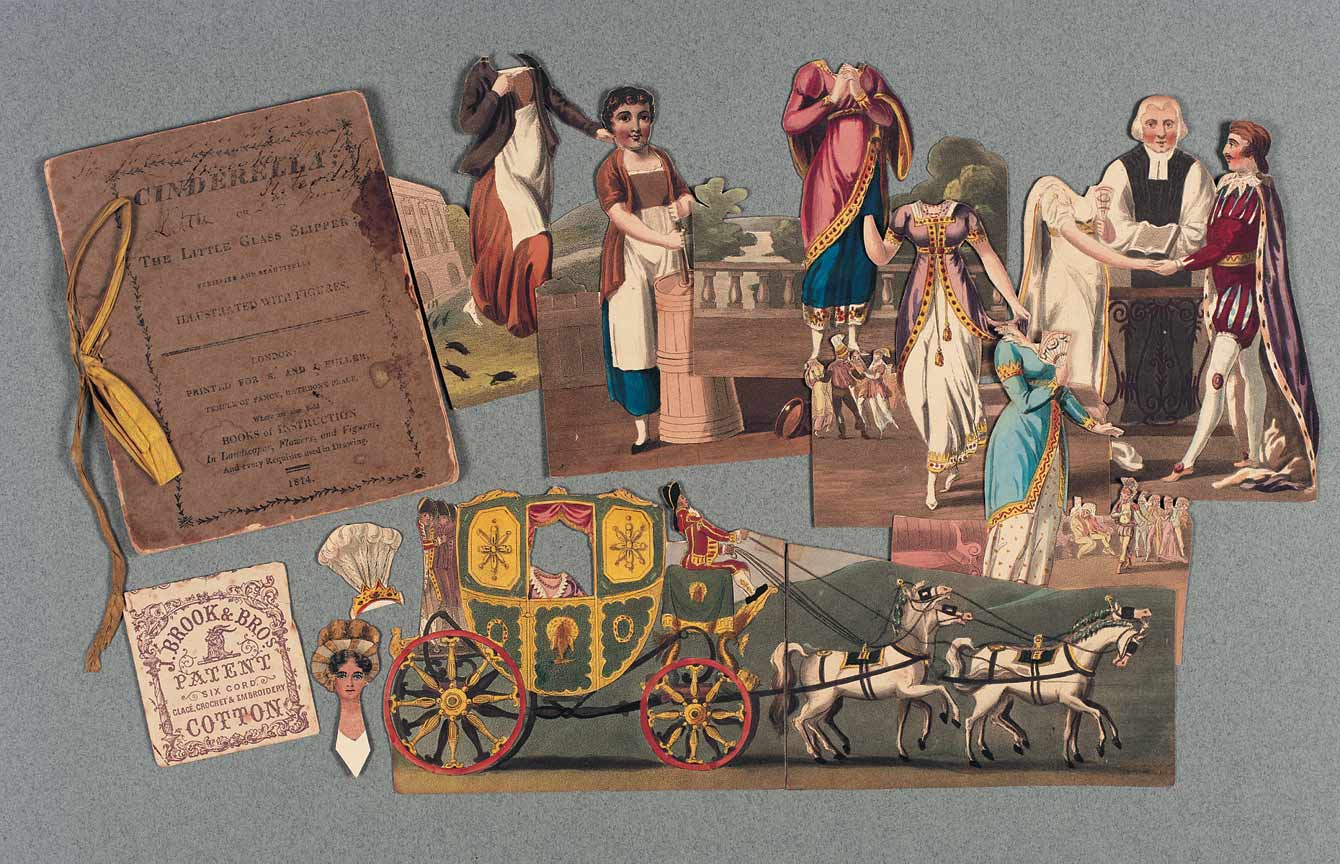
1814, Cinderella or the Glass Slipper. Image @Theriault's.

The images shown above and below are for sale at Theriault’s: The Doll Masters

Lot: 17. An 1814 English Paper Doll and Book “Cinderella” by S&J Fuller
A paper bound miniature book,5″ x 4″,recounts in “beautifully versified” form the favored fairy tale,and was designed to be read while playing with the paper dolls,vignettes and accessories that illustrate the tale,comprising six costume scenes including the wedding,and Cinderella’s coach and horses (in two sections). An inscription inside the front cover reads “To my dear little niece Constance Foley”. S&J Fuller,Temple of Fancy,Rathbone Place,London,1814. Structure and lovely delicate colors of paper dolls and scenes well preserved,coachman’s head missing,one hand missing,stain on book cover. England,1814.
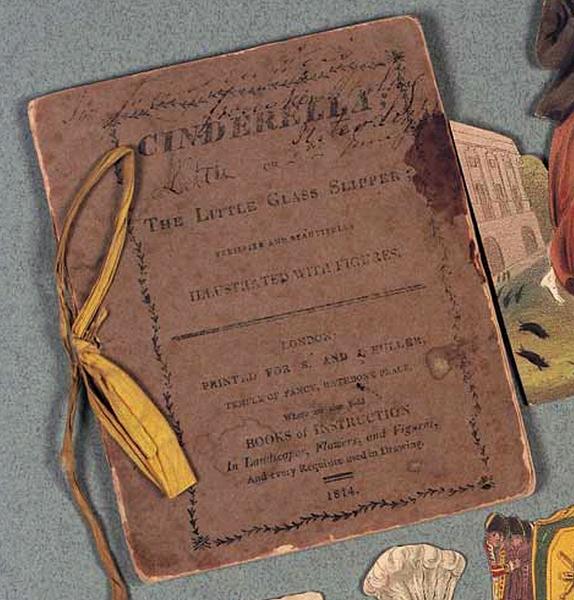
Image @Theriault's.

Around 1810, the London firm of  S. & J. Fuller published books with paper dolls. The 1814 book (or Book of Instruction, as printed on the cover) relates the Cinderella story in verse and is illustrated with cut out figures.

It is interesting to note that Cinderella’s head is removable and can be placed on various paper cut bodies. You see her in the image below walking through a town scape and churning butter. Children could arrange the characters in the paper sets, or drama sheets, and reenact the story.

While these scenic play books became increasingly popular, I imagine that they must have been very expensive and affordable only by the well-to-do.
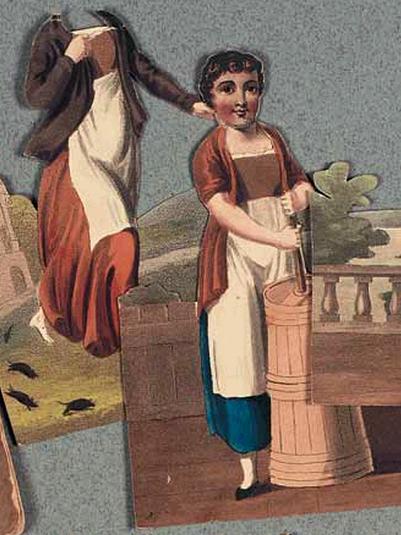
Image @Theriault's.

The image below contains fancy gowns and the marriage ceremony in which Cinderella marries her prince. Cinderella’s high-waisted costumes have a decided Renaissance influence, and the prince could have doubled for Romeo.
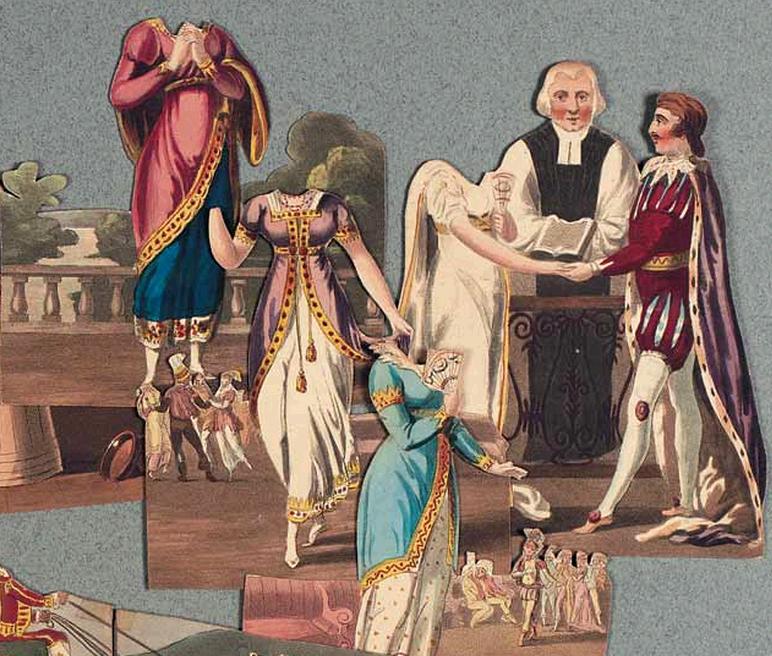
Image @Theriault's.

Cinderella’s head becomes much more refined once she hooks up with the prince, as you can see below. She is given a fashionable hat and a jeweled tiara with feathers. The head can also be placed on the figure in the carriage, when the Cinderella story has come full circle.
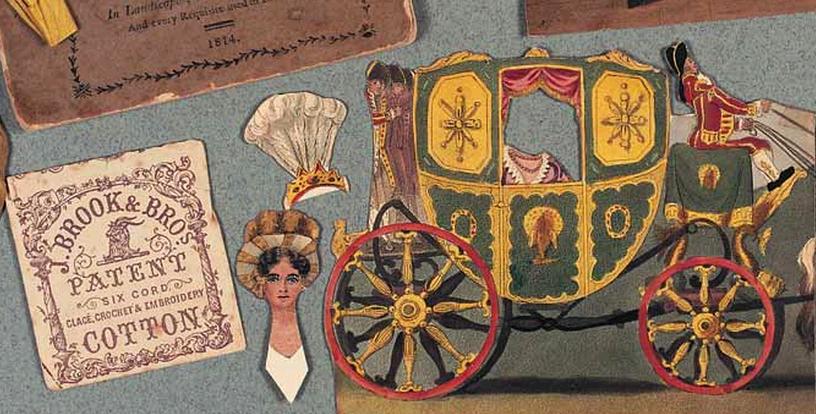
Image @Theriault's.

The beautiful versified edition of Cinderella below was donated in 1991 by Ms. Julia P. Wightman to the  The Morgan Library in New York.  Printed in 1819, the paper cut dolls seem more refined than in the 1817 version, especially Cinderella’s head, which has blond hair. Click on the open book images to read portions of the verse.
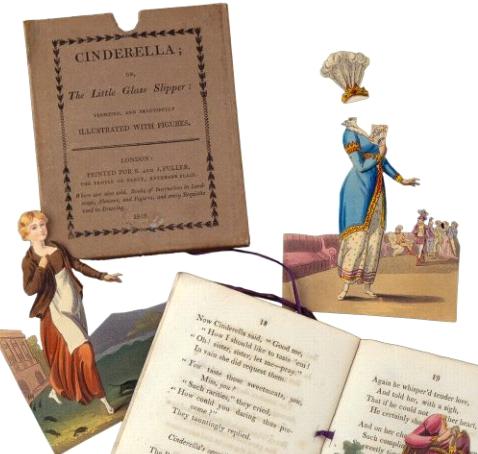
Image @Morgan Library.
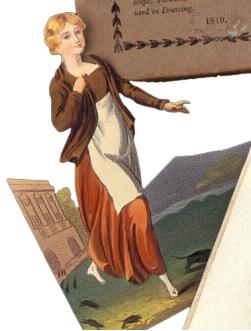
Image @Morgan Library.
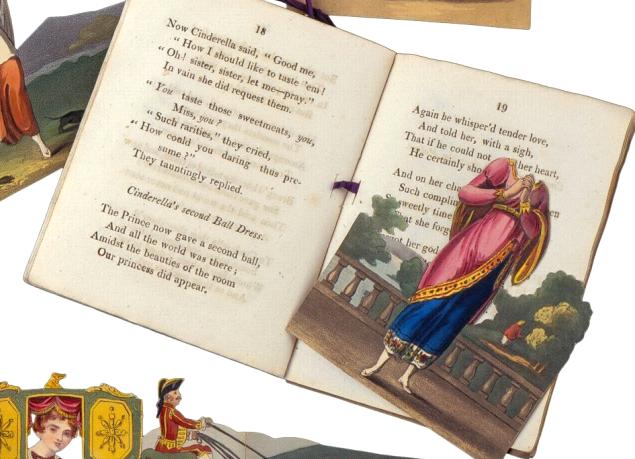
Image @Morgan Library.
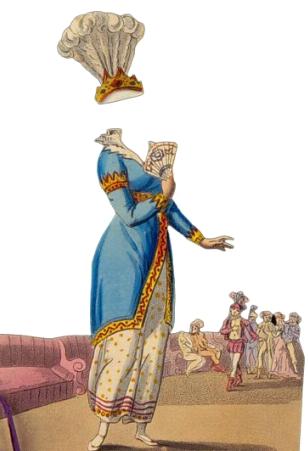
Image @Morgan Library.
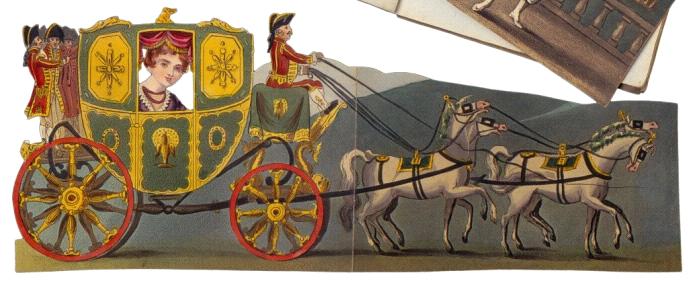
Image @Morgan Library.

The image below is from Picturing Childhood: The evolution of the illustrated children’s book.  Therieaults the Doll Master, Cinderella Paper Dolls, 1814, Published by S. and J. Fuller, London, 5 3/4 in. (14.6 cm) (approx.) Note that Cinderella’s elegant head is placed in the wedding scene. In this instance her hair is dark again..
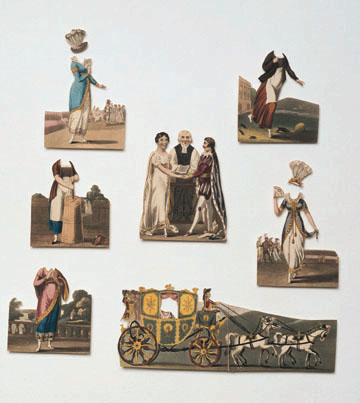
Image @Picturing Childhood

Below is a more traditional children’s book version of Cinderella. It was published in 1827 and illustrated with hand–colored woodcuts. By the mid-19th century, lithography and printing were being used routinely in book illustrations, but such drawings were still rare when this book came out.
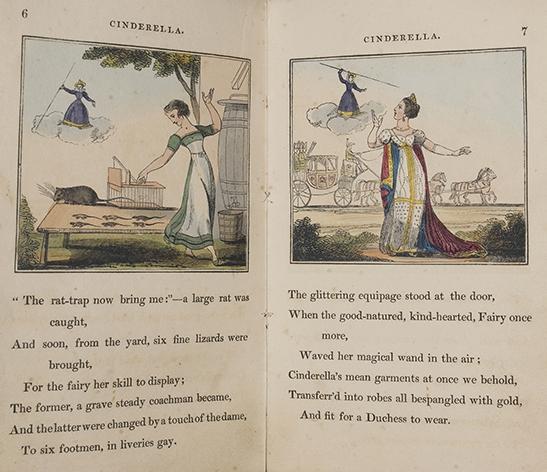
Cinderella, John Harris, London. 1827

In 1812, the Brothers Grimm wrote the Cinderella story that seems more familiar to readers today. By the end of the 19th century, over 300 versions of the Cinderella story existed in Europe. In those years:

The Fairy–Godmother seems more frightening than her later benevolent renderings, such as in Disney’s film version of the story. – Past Times: Cinderella :18th and 19th century Cinderella books.

More on the Topic:

Read Full Post »

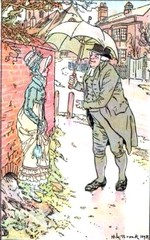
Mansfield Park, Brock. Image @Austenprose

During the 17th century, ladies used parasols for protection from the sun. A century later they were using oiled umbrellas as protection from the rain as well. By the early 19th century, the design of the umbrella had improved and its use had become widespread. After Maria’s marriage, Fanny Price was overtaken by a heavy shower close to the Parsonage and sought shelter under an oak. When the Grants spotted her, they sent out a servant, but Fanny was reluctant to come in:

A civil servant she had withstood but when Dr Grant himself went out with an umbrella there was nothing to be done but to be very much ashamed and to get into the house as fast as possible; and to poor Miss Crawford, who had just been contemplating the dismal rain in a very desponding state of mind, sighing over the ruin of all her plans of exercise for that morning, and of every chance of seeing a single creature beyond themselves for the next twenty four hours, the sound of a little bustle at the front door and the sight of Miss Price dripping with wet in the vestibule was delightful. – Jane Austen, Mansfield Park

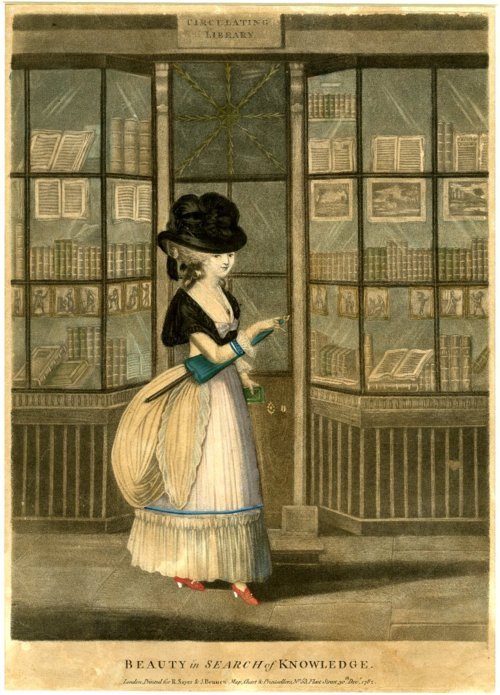
Beauty in search of knowledge, 1782. This 18th century woman carries an early version of an umbrella. These models were heavy and cumbersome. Image @Harry Elkins Widener Collection, Harvard College

A century before Mansfield Park was published (1814) men did not use umbrellas, which were regarded as women’s accessories:

A young man who borrowed one from a coffee house in a downpour in 1709 was excoriated as effeminate in a newspaper. It would have been a cumbersome model, ill-suited to being carried around. Similar heavy umbrellas were kept in churches to protect the parson during burial services. – A Brief History of the Umbrella 

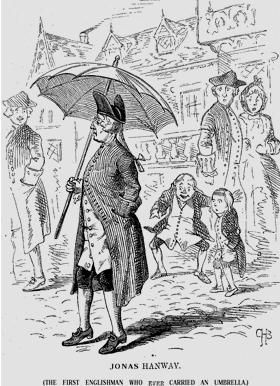
Yet the following passage from Notes and queries, Volume 54, William White (Oxford University Press, 1876,  p. 202), suggests that men began to use umbrellas earlier than Jonas Hanway, who braved ridicule from street urchins and hackney coachmen, who regarded the use of the umbrella as a threat to their livelihood:

1745 – Paid for umbrella, box and carriage.
It is not stated for whose use this was intended; most probably for the minister when officiating at funerals. This is a remarkable entry, as the introduction of umbrellas into England is attributed to a much later period. The employment of the umbrella in the streets London is said to have been by Jonas Hanway, who died in 1786; but the following passage from the Trivia of Gay, who died in 1732, shows it was in use at a much earlier period

Good housewives Defended by th’ umbrella’s oily shed,
Safe through the wet on clinking pattens tread.”

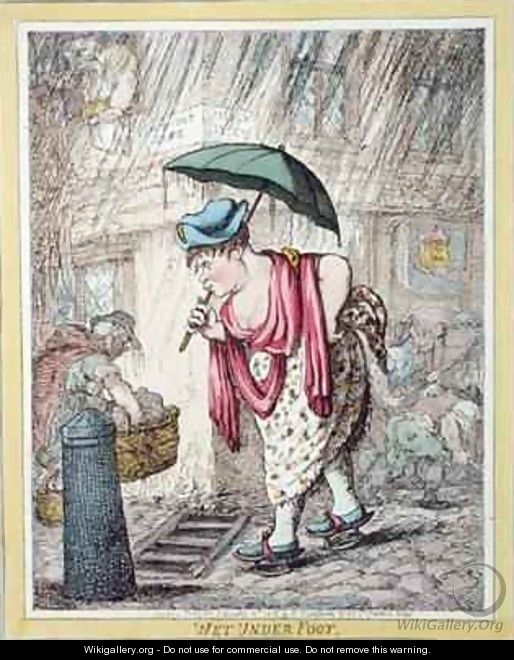
Wet under foot, James Gillray. Image @Wikigallery. The woman is wearing "clinking" pattens as well as carrying an umbrella.

In 1893, Georgiana Hill wrote this descriptive history of the umbrella in England:

Umbrellas were a recent fashion in the earlier part of the century. During the first ten years of George the Third’s reign, the only umbrellas in use were large carriage umbrellas, which required an attendant to hold them. In the country they were hardly known at all. The philanthropist, Jonas Hanway, in 1756, boldly unfurled an umbrella in the streets of London, being the first man who ventured upon such an innovation. Surely Hanway deserves to be held in grateful remembrance by the male sex for this spirited effort towards the emancipation of his brethren from the thraldom of custom. He was jeered and ridiculed by the populace, but was not to be laughed into giving up the sheltering oilskin. About twenty years later, a valiant footman named John Macdonald began to use a silk umbrella, which he had brought from Spain. The boys shouted after him: “Frenchman, why don’t you get a coach?” but he grasped his umbrella more firmly and went on his way, and in some three months time he was able to use it without exciting remark. Miss J. Gay Trivia Hutton, writing in 1779 from Derbyshire, says: “Mrs Greaves lent us their umbrella, and servant to carry it.” Miss Hutton’s brother was the person to use an umbrella in Birmingham, a Frenchman being the first.

Jonas Hanway. Image @Wikipedia. This caricature depicts how long early umbrella handles were.

The town beau, when he first carried an umbrella, was caricatured in the prints as the rain-beau holding a tiny parasol over his head. A gentleman once borrowed an umbrella from the mistress of a coffee- house in Cornhill, and after the following satirical advertisement in The Female Tatler: “The young gentleman belonging to the Custom house, that for fear of rain borrowed the umbrella from Will’s Coffee house in Cornhill, of the mistress, is hereby advertised to be dry from head to foot on the like occasion he shall be welcome to the maid’s pattens.”

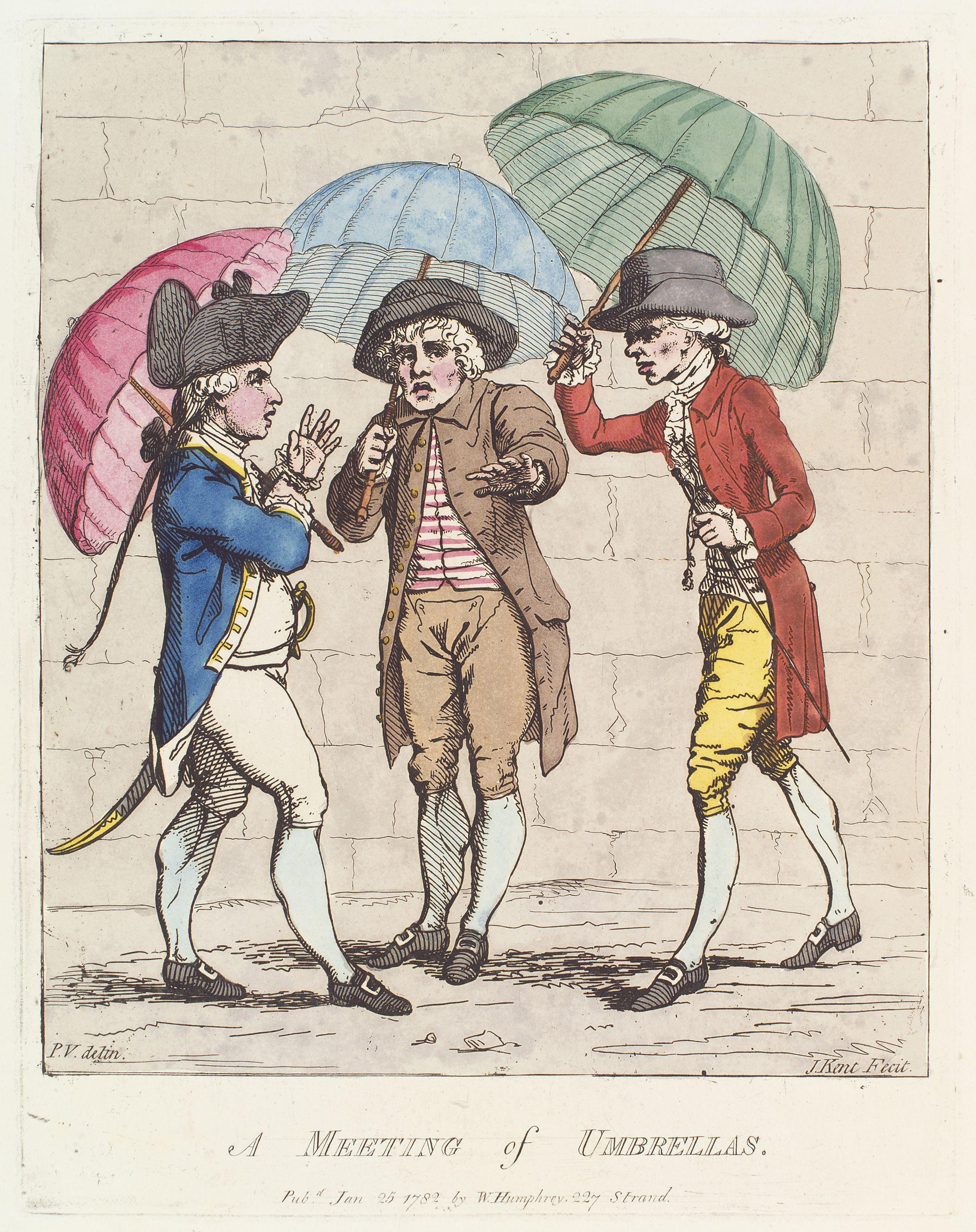
A meeting of umbrellas, James Gillray, 1782. By now, men used umbrellas as a matter of course.

An illustration of the want of umbrellas afforded in one of the caricatures of the period, showing a respectable citizen’s family from Vauxhall in a downpour of rain – the old gentleman with a handkerchief tied over his head to save his wig, and his wife’s cardinal on his to protect his best coat, while the wife herself and her daughters are tripping along in gowns turned up round their waists, and their heads enveloped in coloured handkerchiefs. In 1797 there was one umbrella in all Cambridge, and that was kept at a shop, and let out like a sedan chair ,by the hour. In London women carried umbrellas before men had taken to them, but the first umbrellas were heavy awkward machines made of oilskin or taffeta. Still, in spite of their cumbrous character, women who had to trudge along the streets on rainy days rejoiced in their shelter. With cloak and umbrella, they were able to face the dripping roofs and waterspouts, which were as much to be avoided as the rain. To the fashionable lady. who only walked in fine weather, the one important consideration was the parasol, but it was otherwise with the thrifty citizeness. Great must have been the relief and saving of clothes when the new invention came into use:

Good housewives all the winter’s rage despise,
Defended by the riding hood’s disguise;
Or underneath the umbrella’s oily shade,
Safe through the wet on clinking pattens tread.
Let Persian dames the umbrella’s ribs display,
To guard their beauties from the sunny ray;
Or sweating slaves support the shady load,
When Eastern monarchs show their state abroad;
Britain in winter only knows its aid,
To guard from chilling showers the walking maid.”
– J Gay Trivia

– A history of English dress from the Saxon period to the present day, Volume 1, By Georgiana Hill , 1893, p. 173-74.

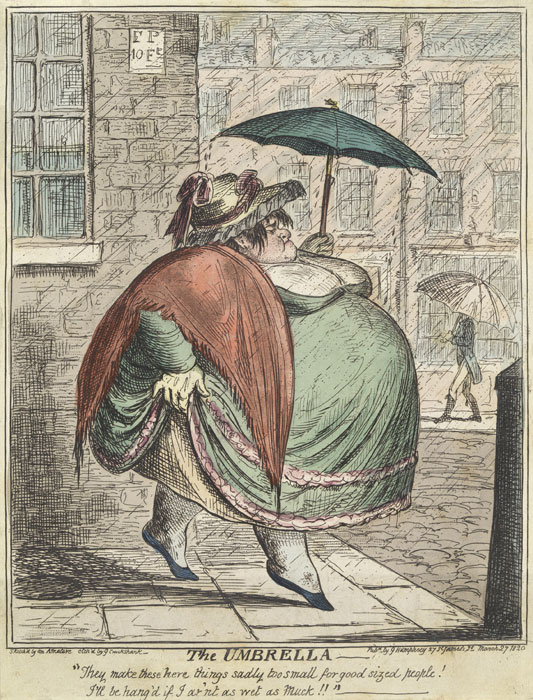
The Umbrella, 1820. This cartoon depicts how little protection these early umbrellas afforded. Cruikshank exaggerates the woman's size to demonstrate the point. Image @Art Tattler

Early umbrellas were heavy and cumbersome to use:

Early umbrellas were made of oiled silk with heavy wooden frames which made them difficult to open or close when wet. Whalebone (baleen) was also used but this still made the article heavy. It wasn’t until 1852 that Samuel Fox invented the steel ribbed umbrella claiming that he was using up stocks bought for making corsets. This made umbrellas much lighter and more portable. – Come rain or shine: historic umbrellas and parasols 

More on the topic:

Read Full Post »

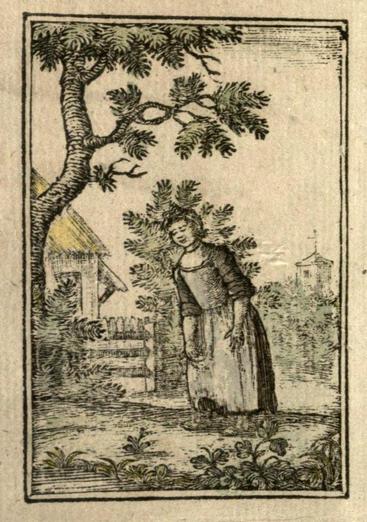
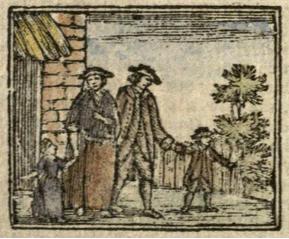
Among the possessions Jane Austen passed down after her death is a miniature book for children, The History of Goody Little Two-Shoes, whose pages were filled with moral lessons for children. During the 18th century, it was regarded as one of the most popular children’s books, and its popularity lasted into the 19th century. As you can see in the image below, Jane’s copy of the book is bound with gilt and and flowered Dutch paper boards. The frontispiece is crudely colored; the front page is inscribed with the name, ‘Jane Austen.’

Jane Austen's copy of Little Goody Two Shoes. Image @Jane Austen em Portugues

The History of Little Goody Two-Shoes was an early book for children that had a huge influence on the way that children were taught to read, from its publication in 1765 until the mid 19th century. Although its sententiousness and overbearing morality might cause hilarity today, it was in several ways a revolutionary publication in its time. – Read the rest of the passage in this link 


The History of Little Goody Two Shoes taught a moral lesson: Good behavior on earth will bring heavenly rewards.

In it, a young orphaned girl called Miss Margery Meanwell is so poor she only has half a pair of shoes. When a friend gives her an actual pair of shoes as a gift, she becomes known to the other children as Little Goody Two Shoes. Little Margery becomes not only a mentor and tutor to the children, she grows up to become a wise teacher, helping adults learn peaceful techniques for resolving quarreling and promoting tolerance. Through her acts of charity and benevolence, Miss Margery is carried from her humble station in life and becomes a lady of means. – Shoes are more than just fashion accessories 

The History of Little Goody Two-Shoes was originally published in 1765.  The text is typically attributed either to John Newbery or Oliver Goldsmith, and the illustrations by “Michael Angelo” were most likely by Richard Johnson, who used the pseudonym as author of Juvenile Sports and Pastimes, published by Newbery’s stepson Thomas Carnan. – The History of Goody Two Shoes, Rare Book Room

Image @Wikipedia

The phrase  “goody two-shoes” is often used to describe an excessively virtuous person. (Wikipedia)

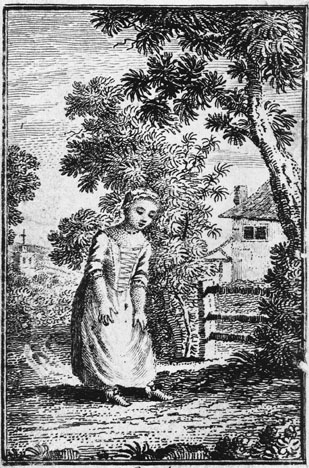
Image from a digital version of the book. This image is more refined than the one in Jane Austen's miniature book

Listen to a History of Little Goody Two Shoes: Podcast 

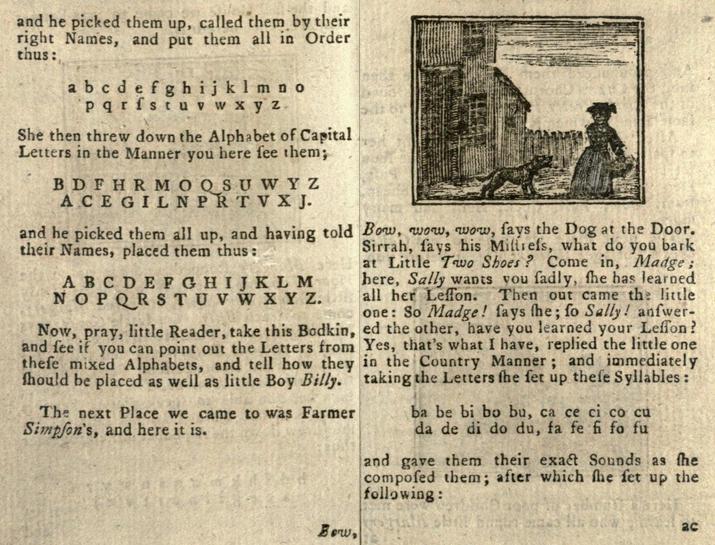
Image from a digital version of the book

Some of the reading exercises for children are evident on these two pages.

Read Full Post »

From the desk of Shelley DeWees…The Uprising.

If Elizabeth had not known better, she would have sworn he was deliberately throwing himself in her way, but she did know better. Whenever they were in company together, Darcy was usually cool and aloof, yet he chose to stare at her constantly, and with a level of intensity that had begun to make her uncomfortable. Sure such a handsome, wealthy, intelligent man, who was used to nothing but the very finest in society, could not deign to look upon a woman of her inferior station and circumstances in life unless it was to find fault; and, indeed, she knew he had found fault with her, almost from the very first moment of their acquaintance at the assembly in Meryton some weeks ago.”

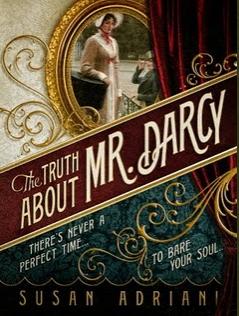
A departure from P&P while still calling itself a re-telling, The Truth About Mr. Darcy is a middle-of-the-road revisit to the beloved land of Jane’s Hertfordshire….it’s not stupendous, it’s not terrible. It starts slow. It ends slow. But the middle is a moderately interesting take on Darcy and Elizabeth’s path to matrimony, with all its major ups (money money everywhere) and smallish downs (minor disagreements followed by make-up sex).

The back of the book poses a question to Mr. Darcy. Should he tell the truth about his old nemesis George Wickham in order to protect the good citizens of Meryton from Wickham’s lies and secrets? Well, in a word, yes. He should. And does within the first two chapters, employing a moment of self-truth that would, had it occurred in the original P&P, caused all measure of heartache and sadness to be averted. What to do now? Especially since Elizabeth immediately follows suit in working out her out neurosis with prejudice right away, denying his first proposal but agreeing to a courtship that she reasons (admirably and in a drastic departure from Ms. Austen’s typical character attributes) will help her actually know this guy, this supposed husband/lover/friend/parent/guardian person she’s to spend her life attached to. Thus, the relationship begins, burgeoning passions ensue, then the wedding, and before you know it the book is over.

It’s a lovely story in all actuality, and Adriani tells it well. There seem to be a lot of modern flavors working here, including the aforementioned “let’s get to know that dude over there before agreeing to marriage” thing and the departure from the “let’s not have any sexual contact before the big day” thing. Having always suspected that many people in Regency England were guilty of violations of propriety in the name of love and/or passion, I found that rather refreshing and, frankly, long overdue in Austen spin offs. That Adriani should take a modern view of relationships and graft it onto Darcy and Elizabeth I found impressive and inspiring! Go you, Ms. Adriani! The courtship is honest and communicative, and paves the way for many heartfelt conversations and even more heartfelt turns in the sack (which were all super sexy but got to be little gratuitous by the end).

Spoiler Alert in this paragraph:

The rest of the experience in The Truth About Mr. Darcy was good-ish, not great, not horrific. There was, however, one moment where my hand went to my forehead, accompanied by an outspoken “Oh come ON!” and an exasperated sigh when Mr. Wickham’s nature was explored. Not only is he a debt-ridden scoundrel mired in controversy, he’s a near-rapist, and one sly wink away from a serial killer. Really? I mean, he’s a snotty spoiled dandy, but a rapist? It seemed like the dichotomy of good vs. bad was just a wee bit overused, both with Wickham and with Mr. Collins, whose refused proposal sparks a deluge of conceit and even revenge. In The Truth About Mr. Darcy, it seems as though you’re either a shining paradigm of virtue or the scum on the bottom rung of the ladder of humanity. A little bit of creative character development would’ve been a better choice.

Still, Susan Adriani’s debut novel is not entirely without success. It’s well written and fairly engaging, sexy, and compelling in a conventional sort of way. Those of you gentle readers whose hearts go aflutter at the notion of revisiting P&P won’t be disappointed. If you’re on the fence about these sorts of things, you might be better off skipping this one.

Be aware that this book is for mature readers only.

Read Full Post »

This post was published by Mags at Austenblog, who also graciously allowed me to publish it on this blog.

We are pleased to announce that the Gentle Readers of AustenBlog, as well as Janeites everywhere, have been invited to join a discussion of Sense and Sensibility at Classroom Salon, a free discussion platform from Carnegie Mellon University. Using this tool, one may select any section of text, make comments, answer questions, and see and respond to the comments and questions. The Salon team at Carnegie Mellon is starting to post the text of Sense and Sensibility so that you can now join fellow Janeites inside the novel. The Editrix has contributed some discussion questions as well.

A few things you should know about this Austen playground:

1. This is the latest, the greatest and the coolest, but it’s also a beta. It’s not difficult to use and there are basic instructions (which you can annotate and improve), but you’ll need to find your own way without too much guidance. An adventure!
2. The Sense and Sensibility beta is limited, so you’ll need to be one of the first fifty people to sign up. If you’re not, they’ll put you on a waitlist.
3. A new chapter will be opened for annotation about once a week.
4. If there is sufficient demand, the Salon team will start to post Jane’s other works as well.
5. The beta is completely free. It’s always possible that the University might decide to commercialize the platform at some point in the future, but the inventors are hoping to always maintain a free version.
6. Don’t worry if you’re the first or second or third commentator. Responses will breed more responses, and with lots of participation, we’ll have a rich, crowd-sourced online version of Sense and Sensibility.

How to Sign Up:

1. Go to http://www.classroomsalon.org/redirect/redirect.aspx?action=viewSalon&id=172 (new link; will take you directly to the S&S Salon)
2. Enter a name, email address and password and the registration code “Facebook Jane,” then click on Sign Up.
3. Sign in. This should take you to the Sense & Sensibility Salon.
4. Click to Join the Sense & Sensibility Salon.
5. You will receive email notification when you’ve been approved by the Salon owner. When you receive the approval, just click on the link in the email and you’re in.

Before you start annotating and engaging, you might want to have a look at the “Working with Documents in a Salon” document in the Salon. Feel free to annotate this document, as well.

Chapter 1 opens on Sunday morning, May 22 at 7 a.m., so sign up now and be the first on your block.

Happy Annotating!

NOTE: Classroom Salon works best in Firefox.

Read Full Post »

« Newer Posts - Older Posts »