Feeds:
Posts
Comments

Archive for the ‘jane austen’ Category

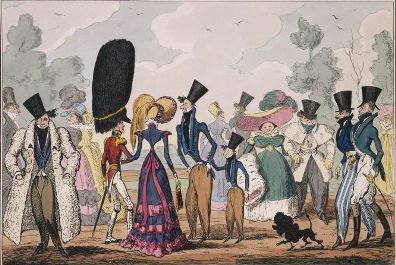
The Parks of London by Mary Elizabeth Brandon, 1868, on Dandyism.net discusses the dandies parading up and down London’s fashionable parks. After visiting that site, return to read some of my older posts about Hyde Park and the pleasure gardens.

More on the Topic:

Read Full Post »

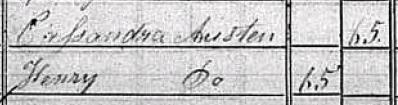
Inquiring Reader, This post is the second part of solving the mystery of Cassandra Austen’s age in the 1841 census, which reader Craig Piercey brought to my attention. A number of people became involved in the mystery of Cassandra’s age, which was 68 at the time the census was taken, but was listed as 65. To review the situation, click on this link and read the emails sent to explain the anomaly.

The first letter came from Laurel Ann of Austenprose, who had left a comment on the first post.

Vic,  I have come across many discrepancies on census enumerations. The process is part of the problem. Families were asked to fill out their own sheets and then they gave them to the enumerator who transcribed them onto the sheets of record. The original family sheets do not survive. There is always the possibility of illegible handwriting, transcription error, the family did not understand the directions or people lied about their age! It is not considered a primary source document by the government or family historians. Cassandra’s christening record would serve as a legal record of her birth. Since her father filled this out, we can be pretty certain that it is correct. It is also confirmed in family letters. By her death in 1845 it was required to report deaths to the new Registrar and would have included a doctor’s verification. That is the best explanation I can offer. The government was primarily interested in  numbers. They used the data for general ranges like the number of children under 10 or men of military age etc. The fact that exact ages are listed from 1851 onward is a bonus to family historians now, but not so much for the government then. Census records are not an exact science. I am glad you had so much interest in this puzzle. The discrepancy does appear odd to one who has not done family research.  I hope this is helpful. LA

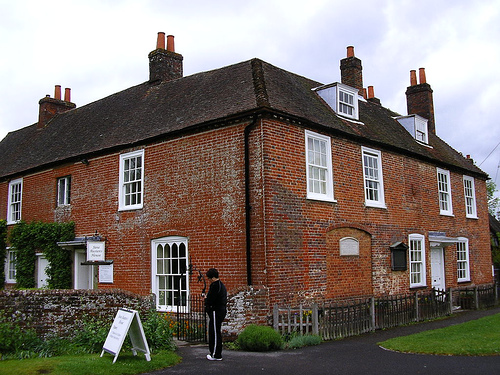
St. Nicholas Church at Chawton, taken by @sneakymagpie

Laurel Ann was not the first person to point out that the Census taker would use a general number that could be divided by five. Before I received her answer, I had written to Ray Moseley, Fundraising Administrator of Chawton House. He replied promptly:

Dear Vic,

Sarah Parry our education officer at Chawton House has replied as below. I do hope that this helps. If we can of any further help please don’t hesitate to contact me.

Ray

Cassandra and Cassandra Austen grave

Hi Ray

I think that the following might be an explanation.

This is the web page for the 1841 census on the National Archive website: http://search.ancestry.co.uk/iexec/Default.aspx?htx=List&dbid=8978&ti=5538&r=5538&o_xid=24149&o_lid=24149&offerid=0%3a21318%3a0 It makes the point about how ages were recorded on this census and notes if over 15, the ages “were usually rounded down to the nearest 5 years”.

I also had a look at Deirdre le Faye’s A Chronology of Jane Austen and her Family (Cambridge University Press 2006). The entry referring to the 1841 census reads:

“June 6, Sunday
National census this year shows CEA [Cassandra Elizabeth Austen] living at Chawton Cottage, with three maids – Mary Butter, Emily Kemp, Jane Tidman – and one manservant, William Sharp. HTA [Henry Thomas Austen] and Eleanor Jackson are also there on census night.”

Cassandra was born on 9 January 1773 and would have been 68 on the night of the census so it would have been correct, by the format of the 1841 census, to show her age as 65.

Henry would have celebrated his 70th birthday in 1841. He was born on 8 June 1771. The 1841 census was taken on 6 June – just two days before his 70th birthday. So the figures are correct as Henry would have been 69 on the night of the census so again, by the format of how to record ages in the 1841, census it would therefore have been quite correct to show his age as 65. Henry’s surname isn’t shown on the census because the mark below the “Austen” of Cassandra’s name and alongside Henry’s Christian name is the equivalent of ditto marks.

Hope this helps.

Best
Sarah

Chawton Cottage

Sarah’s explanation dovetails in with other speculations, but because she works for Chawton House as an education officer, I will take hers as the last word on the subject.

Tony Grant, London Calling, wrote Louise West at the Jane Austen’s House Museum in Chawton about the same time that I wrote Chawton House, and her reply, while supportive, did not include additional information.

Hi Vic,
I just received this today from Louise West at Chawton Cottage. Remember our exciting foray into working out Cassandra’s age? … Here you are. – Tony

Dear Tony

Many thanks for sharing with me this interesting correspondence.  I really admire all the effort that has gone into trying to solve the mystery and wish I could offer anything more illuminating but I’m afraid I’m as much in the dark as you are.  If you uncover anything definite I would be very interested to hear.

Best wishes

Louise West
Collections and Education Manager
Jane Austen’s House Museum
Chawton
Alton

So, gentle reader. This is the end of our research into this topic. I hope others have found this journey into uncovering a mystery as interesting as I have. Thank you for stopping by, and thanks to all who have answered our emails and helped, especially Laurel Ann, whose initial comments and follow-up email unlocked the mystery first.

Read Full Post »

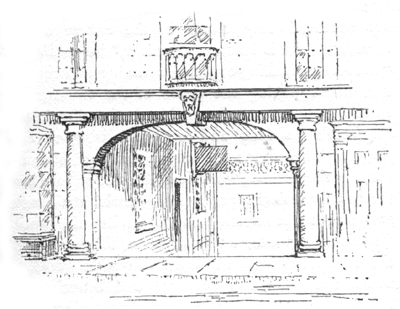
Archway opposite Union Passage, Constance Hill

Half a minute conducted them through the pump-yard to the archway, opposite Union Passage; but here they were stopped. Everybody acquainted with Bath may remember the difficulties of crossing Cheap Street at this point; it is indeed a street of so impertinent a nature, so unfortunately connected with the great London and Oxford roads, and the principal inn of the city, that a day never passes in which parties of ladies, however important their business, whether in quest of pastry, millinery, or even (as in the present case) of young men, are not detained on one side or other by carriages, horsemen, or carts. This evil had been felt and lamented, at least three times a day, by Isabella since her residence in Bath; and she was now fated to feel and lament it once more, for at the very moment of coming opposite to Union Passage, and within view of the two gentlemen who were proceeding through the crowds, and threading the gutters of that interesting alley, they were prevented crossing by the approach of a gig, driven along on bad pavement by a most knowing-looking coachman with all the vehemence that could most fitly endanger the lives of himself, his companion, and his horse.- Northanger Abbey

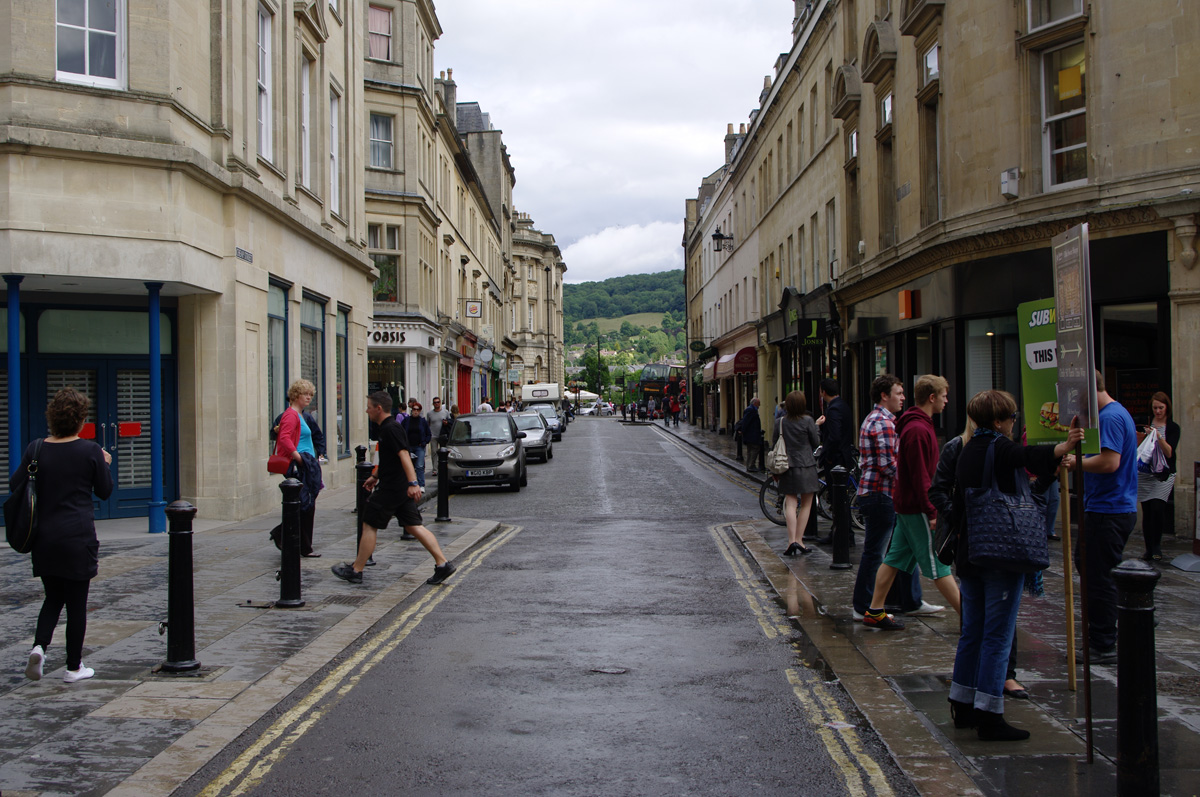
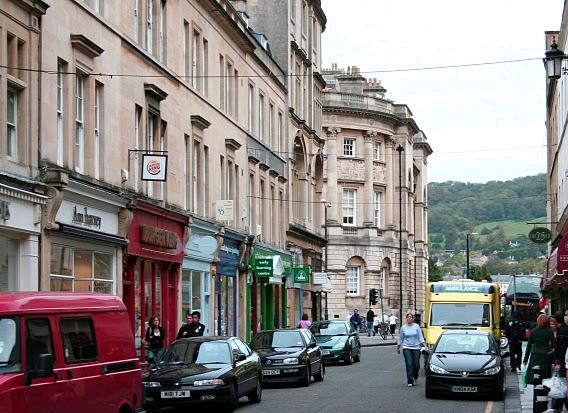
Cheap Street in 2010, Image Tony Grant

“Oh, these odious gigs!” said Isabella, looking up. “How I detest them.” But this detestation, though so just, was of short duration, for she looked again and exclaimed, “Delightful! Mr. Morland and my brother!”

Another angle of the street

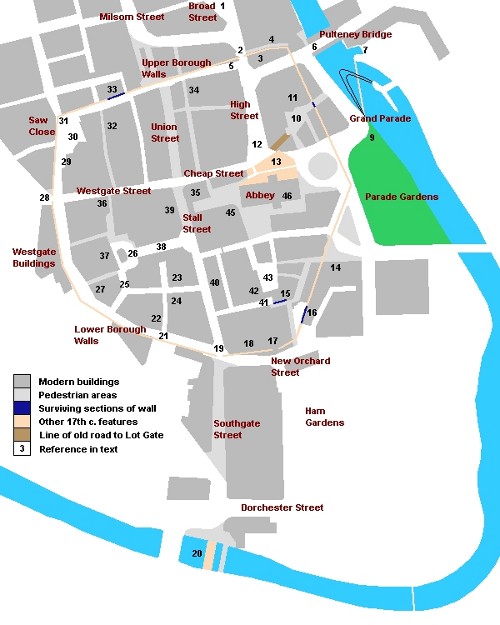
The Walking Tour of Bath provides a map that mentions many of the streets described by Jane Austen in the above passage, accompanied by images from medieval times to today.

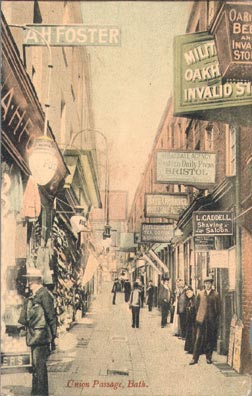
Cheap Street runs just north and parallel to the Abbey. In this turn-of-the-century post card of Union Passage, which intersects Cheap Street, one can see how drastically different Bath looked back then – many of the Georgian features are hidden under shop signs.

Union Passage in the Early 19th Century, Bath Post Cards

The Walking Tour mentions how Bath’s 18th century forefathers were concerned about preserving the nature of Bath’s gentrified renovations.

Incidentally, a friend who used to live in an 18th c. flat just round the corner in North Parade Buildings had some amusing conditions attached to the terms of his lease. He was prohibited from hanging bedding out of the window, holding public auctions and keeping livestock. One can only presume that the Georgian city fathers, having gentrified Bath at great expense, were concerned to prevent the locals spoiling things by falling back into their old peasant ways.”

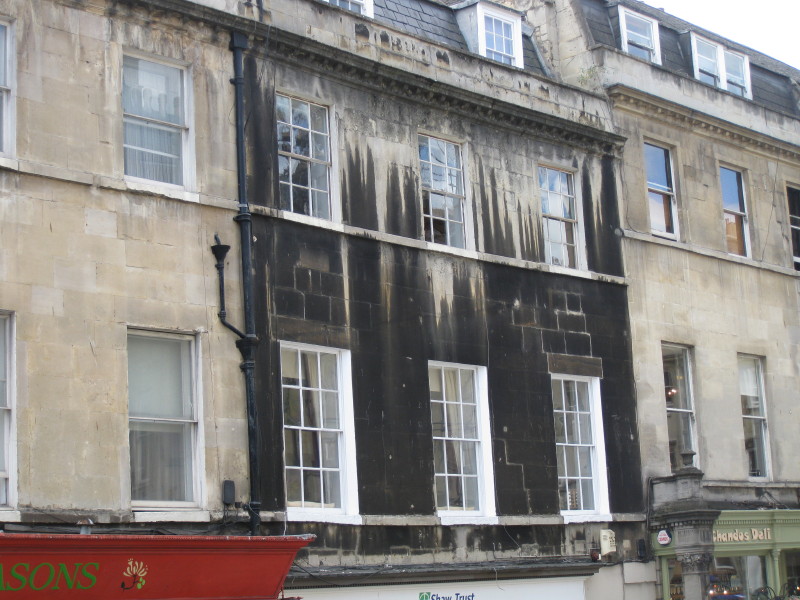
Coal soot blackened stone facades. Image Chuck and Claire Davis

The creamy colored limestone stone used in many of Bath’s architectural treasures have been used for building since the days of the Roman occupation.  The above image from European Adventure demonstrates how soot from coal fires blackened the buildings. Jane Austen was probably more familiar with these blackened facades than the creamy stones we are accustomed to viewing nowadays.

…in 1956 a clean air act was imposed. The townspeople were no longer allowed to burn coal and the buildings were painstakingly cleaned. He’s not sure why, but one building was left untouched, giving us the chance to see how they had looked.”

Today, the authentic nature of the buildings are still enforced legally. The Enforcement Policy in Bath Shopfronts Guide today requires:

Colour: No other single aspect of design has so much effect on the character of a shopfront than its colour. A good design can be completely spoilt by poor colour, or a nondescript design uplifted by the right choice of colour. Colour also has an effect on the Street Scene; out of key or aggressive colour will be damaging to everything within the field of vision.

Signs: The design and disposition of signs and the style of the lettering should always be historically credible and correct in design and detail for the design of the shopfront.

Illumination: The character of a shopfront and of the street will be altered by external illumination. This is often not acceptable, particularly where the shopfront is part of a listed building.

Appearance: Changes of a radical nature such as moving door positions are not normally acceptable. These may however be viewed more favourably if they can be shown to produce a permanent benefit such as the provision of a door to the upper floors.”

The cases described in The Bath Heritage Watchdog shows how vigilant the planning commission must be to preserve Bath’s unique heritage, and how historic preservation often clashes with business interests.

Read Full Post »

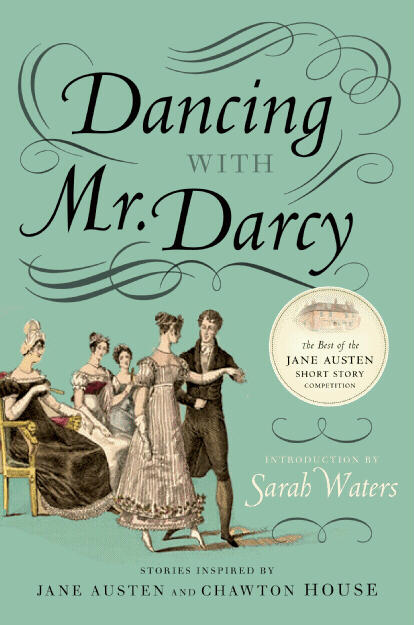
Elated readers: You have a chance of winning one of three copies of Dancing With Mr. Darcy: Stories Inspired by Jane Austen and Chawton House Library, and compiled by Sarah Waters. The book will be available in your local bookstore on October 19th!

For a chance to win, just leave your comment. Please address this topic: What kind of story about Jane Austen or her characters would you be interested in reading?

Contest ends October 20th. Names will be drawn through a random number generator.

So sorry: Only those who live in the U.S. or Canada are eligible to win. THANK YOU for participating. Contest is closed.

Read Full Post »

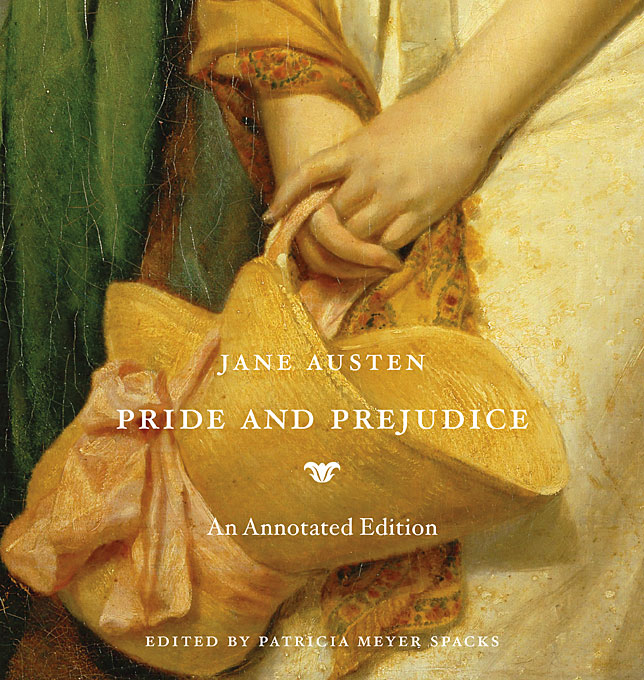
Jane Austen scholar Patricia Meyer Spacks has written many books, but none so lush and lovely as Pride and Prejudice: An Annotated Edition. Not only will this beautiful annotated edition of Jane Austen’s beloved novel look fabulous on your coffee table, but after reading it you will feel that you’ve come to understand Pride and Prejudice as you never have before.

Dr. Spacks’s definitions, descriptions, and clarifications of arcane words, Regency customs, and obscure passages add dimension to a novel that I have read over 22 times and thought I knew inside and out. But I was wrong. Take her annotation of this rather unassuming sentence in Chapter 4, for example:

With no greater events than these in the Longbourn family, and otherwise diversified by little beyond the walks to Meryton, sometimes dirty and sometimes cold, did January and February pass away.”

Dr. Spacks explains that in this instance, dirty meant muddy. Thinking of how uneventful life in a semi-rural setting must be, she adds, “Aside from the arrival of the militia and of Wickham, virtually everything of significance that has happened in the novel so far has been psychological…” She then goes on to describe the states of mind in Jane, Elizabeth, Darcy and Mr. Collins as they interact with each other.

In Chapter 2, Volume III, she introduces Michael Kramp’s idea that Mr. Darcy’s kindness to Mrs. Gardiner during Elizabeth’s and the Gardiners visit to Pemberly is evidence of the changing nature of England’s social arrangements and that “the gap between new and old money is shrinking.” (p. 307)

Dr. Spacks’s new annotated edition provides an erudite commentary on Pride and Prejudice, refers to many scholarly sources, and includes a large assortment of images. As she explained in a recent interview with me: “we looked for images that were beautiful in themselves and that illuminated some aspect of Austen’s period.”

Her 24-page introduction explores the continuing appeal of Pride and Prejudice: that it is considered safe for teaching in school and appeals to both feminists and sentimental individuals who are attracted to a romantic English past.

It has also emerged clearly as a repository for and stimulus of fantasy, and thus possibly less safe than it seems. In the film versions…Darcy, romanticized, tends to turn into a Heathcliff figure, passionate, beautiful, and overwhelmingly physical.”

A visitor to this blog recently asked how this annotation of Pride and Prejudice differed from David M. Shapard’s 2004 annotation. The Spacks volume comes in a lavishly color-illustrated, hardback edition, while Shapard’s book was published as a trade paperback. Scattered thinly throughout its pages are a few black and white illustrations. Aside from the difference in physical appearance, Spacks’s annotations are more scholarly.

Flipping through the first page of the novel, you can immediately spot the difference between the two approaches. Dr. Spacks, the Edgar F. Shannon Professor of English, Emerita at the University of Virginia, discusses the famous first sentence as material for a critical debate on the ambiguity of “want”, whereas Dr. Shapard, an 18th century expert, emphasizes the introduction of two central themes of the novel – marriage and financial considerations. These two annotations are so different, that I believe there is room on the shelves for both of them.

Jane Austen Pride and Prejudice: An Annotated Edition, edited by Patricia Meyer Spacks is a perfect gift for oneself and for a beloved friend or family member. If the $35 purchase price is a bit steep in this economic downturn, place it on your Holiday gift wish list. You will not be disappointed when you unwrap your package.

Read Full Post »
« Newer Posts - Older Posts »