Feeds:
Posts
Comments

Archive for the ‘Jane Austen’s World’ Category

Inquiring readers: Once upon a time, road travel was fraught with danger and a traveler could be held up by a highwayman at any time. Jerry Abershawe was such a man. Tony Grant (London Calling) writes about him in this post.

Not far from where I live, on the edge of Wimbledon Common where the Kingston Road passes, are some trees on the side of a small rise of ground. This part of the common is called Jerry’s Hill. It is named after the 18th-century highwayman called Jerry Abershawe, who frequented those parts and held up carriages on their way between Kingston and London. He was one of the last highwaymen.

Jerry's hill. The gibbet was near here. Image @Tony Grant

A highwayman was a thief who held up passers by, usually people travelling in carriages, at gun point or blunderbuss point, and relieved the passengers of their valuables. Some attacks on coaches were brutal and people were killed. Highwaymen weren’t all the dashing handsome masked desperados of fiction with the manners of a lord and a twinkle in the eye for a beautiful lady. “Stand and deliver!” was their traditional call. They chose lonely remote stretches of the highways to perform their dastardly deeds, but they also had to be sure they chose an area where there was regular traffic going to and fro or their despicable mission would be pointless. They chose places just outside towns and cities where there was a constant flow of people travelling. Wimbledon, then a small rural village on the outskirts of London and with a vast area of wild untamed common land around it, was an ideal spot.

Gibbet post at Tibbet's Corner. Image @Tony Grant

Jane Austen was travelling to London from Steventon in 1796 the year after Jerry Abershawe was executed. They were about the same age, 20 and 22 years old.

To Cassandra Austen Thursday 15 – Friday 16th September:

“….As to the mode of our travelling to Town, I want to go in a Stage Coach, but Frank will not let me. As You are likely to have the Williams’ & Lloyds with You next week, You would hardly find room for us then-. If anybody wants anything in Town, they must send their Commissions to Frank, as I shall merely pass thro’ it- The Tallow Chandler is Penlington, at the Crown & Beehive Charles Street, Covent garden.”

Travelling from Steventon, Jane would not have gone through Kingston upon Thames and the London Road leading out of Kingston where Jerry Abershawe plied his highwayman trade. However, you can understand Frank’s concerns for Jane using the stagecoach. A stagecoach carrying a variety of passengers, some undoubtedly wealthy, would have been a target for a highwayman.

From Steventon, the most direct route to London would have taken her through Basingstoke, Virginia Water, Staines, Richmond upon Thames, Hammersmith and on to Westminster and the centre of London. From Staines she would have been travelling on what was known as The Great West Road which lead directly to the second most important city after London, in Georgian times, Bristol, the centre of the slave trade. Some very wealthy merchants and members of the aristocracy would have travelled this road. It must have had its fair share of highway robbers. Stagecoaches on this road would most certainly have been prime targets. So Frank was right to refuse Jane her wish. But maybe the excitement and the risk appealed to Jane. She was young after all. It does not say in Jane’s letter how they did get to Town, but I presume it was in less conspicuous transport and with her brother.

Wimbledon Common showing Jerry's Hill

In 1813, Jane did travel along the London Road leading out of Kingston, Jerry Abershawe’s haunt. She did this many times from Chawton. There is no hint in her letters of any possible dangers but by the time she was living in Chawton, although the Kingston route was now her most direct route to Town, highwaymen were all but extinct. The toll roads had made highway robbery very difficult. Roads were manned every few miles and the people on them had paid to use them. This made it very difficult for highway robbers to make their escape along these routes so this crime virtually died out.

Jerry's Hill, London Road. Image @Tony Grant

To Cassandra Austen Wednesday 15 – Thursday 16 September 1813 Henrietta Street (1/2 past 8-)

Here I am, my dearest Cassandra, seated in the Breakfast, Dining, sitting room, beginning with all my might. Fanny will join me as soon as she is dressed & begin her Letter. We had a very good journey- Weather & Roads excellent – the three first stages for 1s – 6d & our only misadventure the being delayed about a quarter of an hour at Kingston for Horses, & being obliged to put up with a pr belonging to a Hackney Coach & their Coachman, which left no room on the Barouche Box for Lizzy, who was to have gone her last stage there as she did the first;- consequently we were all four within , which was a little crowd;-We arrived at quarter past 4 …”

This time there was no sense of Jane’s brothers putting their foot down and refusing this time to let her travel in what appeared to them in the past in an inappropriate mode of transport. The party Jane travelled with appeared to be Henry, Lizzy and Fanny. There was no sense of danger, just the excitement of the journey, and from Kingston on their last stage, the cramped conditions of four of them inside the barouche. (Imagine being squashed inside a barouche with Jane Austen. What a thought.)

The women would have passed the inn at the bottom of Kingston Hill, where Jerry Abershawe made his headquarters, before their barouche made the long rising trek up the hill onto Wimbledon Common, going past Jerry’s Hill, where I am sure the gibbet would still have been displayed on the right hand side of the road. There probably was no sign of the remains of Jerry Abershawe by that time though. His body had been pecked clean by the crows and his bones had been taken as souvenirs. His finger bones and toes bones were used in candleholders. Jerry Abershawe was the last person to have his body displayed like this on a gibbet.

Jerry Abershawe

Louis Jeremiah Abershawe(1773-3 August 1795), better known as Jerry Abershawe, terrorised travellers between London and Portsmouth in the later 18th century. He was born in Kingston upon Thames and at the age of 17 began his life of crime. He formed a gang, which was based at an inn on the London Road between Kingston and Wimbledon, at the bottom of Kingston Hill called the Bald Faced Stag. I am sure, as well as his primary occupation of highway robbery, Jerry Abershawe also managed to gain the odd carcase of a King’s deer from Richmond Park, which backed on to the Bald Face Stag Inn. The inn no longer exists, but there was a very large and comfortable pub and restaurant built there in the early 1900’s that, just a few years ago, was demolished for new housing built on the site.

Jerry had other places of refuge at Clerkenwell near Saffron Hill. He used a house called the Old House in West Street. Other highwaymen also used this house. Jack Sheppard and Jonathan Wild were known to have stayed there. It was a house renowned for its dark closets, trap doors, and sliding panels.

Clerkenwell

All attempts to bring Jerry Abershawe to justice failed until in January 1795, when he shot dead one of the constables sent to arrest him in Southwark and badly injured the other constable sent along too. Abershawe was arrested at a pub in Southwark called The Three Brewers. He was brought to trial at Surrey Assizes in July of 1795, and convicted and sentenced to death. On Monday 3 August 1795, Jerry Abershawe was hung on Kennington Common, a couple of miles from Wimbledon and then his body was set up on a gibbet on the hill overlooking the Kingston Road, which was more commonly known then as the London Road, next to Wimbledon Common near the scene of many of his highway robberies. It remained there for all passers by to see and be warned about the price to pay for evil ways.
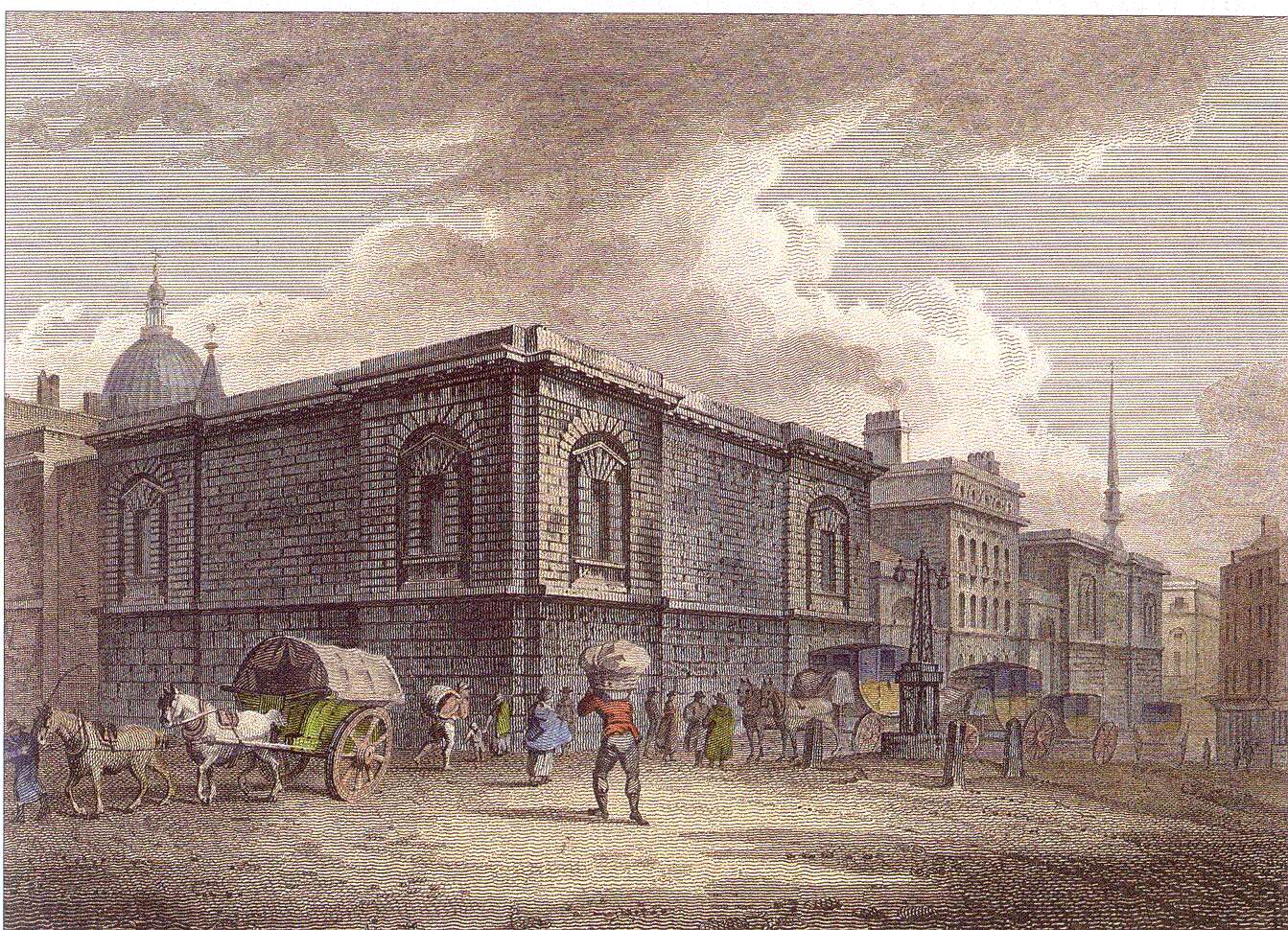
Newgate Prison

The Newgate Calendar for 1795 describes the manner of his being found guilty of murder. Newgate prison was a notorious London prison in which criminals waiting for trail would be held, and it was there that Jerry Abershawe was incarcerated before his execution.

When the judge appeared in his black cap, the emblem assumed at the time of passing sentence on convicted felons, Abershaw, with the most unbridled insolence and bravado, clapped his hat upon his head, and pulled up his breeches with a vulgar swagger; and during the whole of the ceremony, which deeply effected all present except the senseless object himself, he stared full into the face of the judge with a malicious sneer and affected contempt, and continued this conduct till he was taken, bound hand and foot from the dock, venting curses and insults on the judge and jury for having consigned him to, “murder.”

The Newgate Calendar also describes his execution on Kennington Common.

He was executed on Kennington Common, on the 3rd of August, 1795 in the presence of an immense multitude of spectators, among whom he recognised many acquaintances and confederates, to whom he bowed, nodded, and laughed with the most unfeeling indifference. He had a flower in his mouth, and his waistcoat and shin were unbuttoned, leaving his bosom open in the true style of vulgar gaiety; and talking to the mob, and venting curses on the officers, he died, as he had lived, a ruffian and a brute!”

A hanging at Tyburn 17th c.

Highwaymen especially were supposed to affect an attitude and a jocular type of behaviour called gallows humour. It seems that Jerry Abershawe went to his death displaying ribald and stentorious gallows humour.

Jerry's hill view. Image @Tony Grant

At least Jane was now safe on her journeys to London. But I wonder if she had just a small wish for the thrill of danger and would have loved to encounter Jerry on the wild wilderness of Wimbledon Common and ,”stand and deliver,” to him. If it had happened, would her novels have turned out differently in some ways?

Jane was 20 years old when Jerry died at the age of 22. Just maybe Jane would have loved the thrill of adventure on a journey with the threat of Jerry Abershawe round the next bend.

Tibbets Corner. A stylized sign commemorating Jerry Abershaw. Image @Tony Grant

Post script:

After writing this article I just couldn’t get a nagging thought out of my head.

Why and how did Jerry end up as a highway robber?

I know he was young, 22 years of age when he was caught and executed. There is no mention of family or wife or children or any sort of familial attachments. I can imagine him being brought up, an orphan, perhaps on the market streets of Kingston having to survive and live by his wits. It doesn’t take much to imagine the step into criminality to survive. He got in with the wrong lot obviously. An intelligent, bitter, hard done by, street wise kid gone wrong and obviously with a big personality. We can compare him with those who go off the tracks in our own society today. The forces for evil don’t change apparently. Obviously this is a total surmise but I feel better for it.

Tibbets Corner today - where Abershawe held up coaches. Image @Tony Grant

Read Full Post »

Mr. Darcy’s Secret is Jane Odiwe’s third Jane Austen sequel for Sourcebooks. The story picks up after the Darcys’ marriage and Elizabeth’s introduction as Lady of the Manor. Lizzy is a quick study, for it is not easy for someone to pick up on all the intricacies of managing such a great house as Pemberley, but through her natural grace she quickly gains the respect of the staff and villagers and settles into her new home – where she uncovers a secret, one that places her relationship with Darcy in emotional jeopardy.

The delightful author Jane Odiwe has done it again – created a novel using Jane Austen’s characters that leaves you turning the pages to find out how the story will end. Jane Odiwe lives in Bath and London, and travels extensively all over England. This is obvious, as she is able to single out details as only someone who is intimately acquainted with the regions can. She has also researched Jane Austen and the Regency era for many years, so that the facts ring true and are sometimes surprising, as with the ability for people during that era to marry without posting the banns in one church in Derbyshire, a legacy from the days of King Charles 1.

In so many ways, Ms. Odiwe gets the characters right, which makes reading her books so enjoyable. Take Lady Catherine de Bourgh, for instance:

Lady Catherine de Bourgh looked Mrs Darcy up and donw with such an expression of horror and contempt it was all Lizzy could do to keep her nerve. “Does your husband know that you are running around the countryside dressed as a gypsy riding in a donkey cart, Miss Bennet?” she asked in scolding tones. “What on earth can you mean by disgracing Mr Darcy in such a fashion? Have you no idea of decorum, are you insensible to the honours bestowed on you by him, that fool of a nephew of mine who has singled you out above all other women to bear his name?”

Wickham remains his dastardly self; Lydia is still immature and silly. We learn more about Darcy’s sister, Georgiana, and how she is influenced by Lizzy, with whom she falls in love, and about her backstory with her governess, a most nasty creature named Mrs Younge. Miss Caroline Bingley provides comic relief in a funny story line, as does the ever reliably silly Mrs Bennet. In short, devotees of Jane Austen sequels will not be disappointed with Jane Odiwe’s latest venture in Austen territory. Reading Mr Darcy’s Secret prompted me to ask the author a few questions, and she graciously answered them.

1. Why did you wait until your third book to write about Darcy and Elizabeth?

For me, it was just a natural progression. Initially, I hadn’t wanted to write their story because I really wanted to do something different from the books that were being published. But, after writing Lydia Bennet’s Story, and Willoughby’s Return, I wanted to set myself a real challenge. I felt absolutely compelled to write Darcy and Elizabeth’s story, and also wanted to give Georgiana a happy ending. I’m a great believer in letting things happen organically, and perhaps I wasn’t really ready to write their story until now. I wanted to do justice to the characters, and have the kind of twisting plot with humour, surprises and shocks along the way that Jane Austen liked to write herself, which I hope I’ve achieved.

2. Does living in England give you a different perspective on how Jane Austen’s environment influenced her work?  If so, how does this knowledge affect your own writing about her characters?

Perhaps it does, but if so, I think it is an unconscious perspective. This country is the place of my birth; I am English, and the feelings of connection to its people, landscape and history are very strong. It’s a part of who I am. I was a teacher, and consider myself very lucky and fortunate to have had the joy of teaching pupils from every walk of life, which means I have witnessed the behaviour and customs of a vast cross-section of society from the very poor to the very rich. I’m just an ordinary person, but I have been able to witness first-hand what it’s like to attend high society balls (a long time ago now) and enjoy 20th/21st century equivalents of the kind of experiences that Jane Austen would have done. Rather like Jane too, feeling apart from that world, not really belonging, made the observation of it all the more fun. I’ve seen a world of privilege, I’ve seen the extreme opposite, and everything in between. I think all of life’s experiences and the knowledge gained help to inform your writing, but whether this means that I am successful in writing about Jane’s characters, I will leave my readers to decide.

3. For you, which comes first? The plot or the characters? How long does it take for you to outline your book before you start writing, or do you just dive in and plot as you go along?

Now that is a tricky one, but I think it’s been different for every book. I generally think about what I’m going to write for a long time, several months usually,  before I commit any thoughts to paper, though occasionally I might jot down a few initial ideas or key words. I think the idea for Mr Darcy’s Secret was really started by thinking about what we knew about Mr Darcy, or rather, what Elizabeth did not know. It occurred to me that she really didn’t know him very well at all. Jane Austen gives us no clues about his past, and so that set me thinking.
I used to meticulously write out the plot from start to finish before I commenced writing, but I’ve discovered that for me it doesn’t really work because the characters always do their best to take me away from what I’ve originally planned. So now I have a general idea of where I want to story to go, and have an idea of the ending, but the journey is always an adventure! The characters always want to tell their own story, and I let them.

4. What research  for your book surprised you the most? Did you leave out any material that you found fascinating but couldn’t use? If so, please give an example and tell us why you decided not to use this bit of information.

The research that surprised me most was the fact there was a Gretna Green of Derbyshire. In the village of Peak Forest its church is dedicated to ‘Charles, King & Martyr’ (King Charles 1) and until an Act of Parliament was passed in 1804 its minister was able to perform marriages without having the banns read.

I really enjoyed all the research into Derbyshire which I’ve visited many times from school trips as a child to spending holidays with my sister.
There is a lovely tradition of ‘well-dressing’ which I would have liked to include, but I couldn’t fit it into the timeline or plot – unlike Jane, I decided we’d spend more time in the Lake District.

I remember as a child being disappointed not to see any of the villages we passed in Derbyshire decorated with flowers. The pagan custom started many years ago with blessing the water supply, and there is a history of making clay plaques pressed with flower petals to ornament the wells, which they still carry on today. I would have liked to have included a lot more of the folklore in the book. The area is well known for its stone circles, petrified rocks, witches and ghosts! Maybe next time…

5. Have you plotted your next novel?

I have written another novel, but I’m still tinkering with it…not quite there yet. It’s not a sequel, and it’s a bit off the wall, but I’ve really enjoyed writing it. It’s inspired by Bath, Jane Austen and Persuasion, my great passions after my family.

Oooh, you have me intrigued already! As always, Jane, it is a pleasure talking with you. I wish you much success with this book and the next, and thank you for stopping by .

Read my reviews of Jane Odiwe’s other books and interviews with the author in the following links:

Read Full Post »

Scheduled for this week are:

  • A review of Mr. Darcy’s Secret and interview with author Jane Odiwe on February 7th
  • A post by Tony Grant about the highwayman, Jerry Abershawe
  • And an interview with Darcy and Fitzwilliam author Karen V. Wasylowski on February 10th.

Stay tuned for more!

Read Full Post »

A review of Jane Goes Batty from the desk of Shelley DeWees …

Jane Austen as a protagonist might be one of the most likeable characters in literature.  She’s thoughtful, friendly, and devoted to her art, all of which are qualities you’d probably expect in the real Jane (were you lucky enough to know her).  She’s full of admirable characteristics, yes…accept that one little tiny baby hiccup of a problem…

She wants to suck your blood.

Now, she may not want to kill you unless you piss her off, or happen to be the annoying mother of a guy she’s considering a future with.  She may only want to taste you because, well, she must.  She’s got that little problem.  Not many people know about it, and those her do are among her most trusted confidantes: a lovely friend called Lucy who runs her bookshop in upstate New York and her best buddy Lord Byron, who happens to be a vampire as well.  He provides support, instruction in the ways of vampire art (how to become invisible, how to spot attraction between other people, how to create more undead chums), and is in general a source of inspiration for poor Jane who’s struggling to find meaning in a never-ending life.

The story finds her with a new hit novel, but she knows her old ones are better.  She’s getting lots of money from the new book, but not near as much as she’d be getting if she collected royalties on the others.  She’s happy with her boyfriend Walter, but can never marry him since he doesn’t know about her little problem.  She’s up.  She’s down.  She’s back.  She’s forth.  Jane is getting pulled around by all kinds of forces, many of which are entirely out of her control.  Such is life, Jane.  Such is life.

And such is the way of Jane Goes Batty, the second installment of a trilogy of novels by Michael Thomas Ford.  It’s a modern take on the life on Jane Austen, complete with her struggle to find a publisher and her wish to drink as much wine as she wants (as she said, being unmarried allows her to do just that).  The book is fun and inspiring in some senses, and probably worth your time if you’re looking for a bit of a romp through an alternate reality or simply trying to re-awaken your internal Janeite.  The book flows well and thrives on skillful construction, but seems to be saturated with an overabundance of problems.  Poor Jane the Undead has a veritable laundry list of troubles to slog through, not the least of which being an overdue sequel to her bestseller, an intolerable mother-in-law who insists she convert to Judaism, a new editor, an invasive camera crew, and the threat of a visit from another gloomy friend.  What’s a girl to do?

Jane Goes Batty is fun but simple, composed by a seasoned author whose interests are as diverse as the subject matter of his books.  Michael Thomas Ford spins a fairly interesting tale, and even though it’s nothing to write home about, you certainly won’t hate it!  Give it a shot, even if you haven’t read the first portion of the series, and see if you can lose yourself in Jane-love again.

Gentle Readers, this is Shelley de Wees’s fourth review for me and the third for Jane Austen’s World. (She has also reviewed for my other blog, Jane Austen Today.) Shelley also oversees her own blog, The Uprising, which features vegan recipes. Yum. She lives in the northern U.S. I shiver just thinking about the cold.

Read Full Post »

From Tony Grant, whose contributions to this blog are numerous: “Two years ago some of my friends wanted a weekend away so we decided on Lyme. Our wives went off to New York for the shopping. We tend to go to places more for the local beer than the literary connections, I must admit. Lyme has some very nice pubs and also we wanted somewhere where we could take a brisk walk. We thought of the Undercliff.”

The Cobb at Lyme Regis. Image @Tony Grant

It depends on the weather conditions but the Cobb at Lyme can look and behave like an evil spirited leviathan; a Moby Dick. It’s a savage beast. At other times it can be a gentle, peaceful and calm creature.

Jane Austen used the Cobb at Lyme for the setting of an integral scene in her novel, Persuasion.

The accident on The Cobb, to Louisa Musgrove, brings Anne Elliot to the fore. She is the one looked to by Captain Wentworth and the others to take charge.

John Fowles, who lived in Lyme for most of his life, used Lyme , The Cobb and The Undercliff as the settings for his novel ,The French Lieutenants Woman.Indeed these topographical elements of Lyme are like a group of brooding characters within the novel and shape the action as much as the human characters…” Read the rest of the post at Tony Grant’s blog, London Calling.

View of the Undercliff from the Cobb. Image @Tony Grant

Read Full Post »

« Newer Posts - Older Posts »