Feeds:
Posts
Comments

Archive for the ‘Jane Austen’s World’ Category

Inquiring reader: Jean at The Delightful Repast is a freelance writer who writes mostly about food, weddings, etiquette and entertaining for numerous publications. Her blog reflects her culinary heritage–an English grandmother, a Southern grandmother and a mother who could do it all. Jean’s love of reading and cooking (often done simultaneously) is definitely in her genes. She has (delightfully) offered to share her thoughts about tea in Jane Austen’s day and her recipe for Sally Lunn buns!

It came as quite a disappointment to me that day long ago when I, an avid afternoon tea aficionado, realized that afternoon tea was not part of Jane Austen’s life. (I am still taken aback by the thought as I write those words!) Tea drinking, popular at Court since the 1660’s, had by the Regency Period long since trickled down through all strata of society. Jane and her family no doubt enjoyed a nice cup of tea at least twice a day, at breakfast and in the evening after dinner.

Tea, being the magical all-purpose beverage that it is, was surely drunk at other times as well. I drink tea a minimum of four times a day. My grandmother Elizabeth (from the Lake District) drank tea several times a day, including once in the middle of the night. Her mother Mary Ann was constantly putting the kettle on. And it was Mary Ann’s grandmother Mary who was a contemporary of Jane Austen’s, though at the other end of the country.

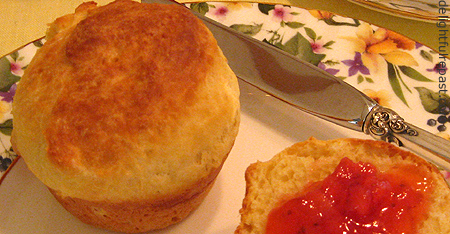
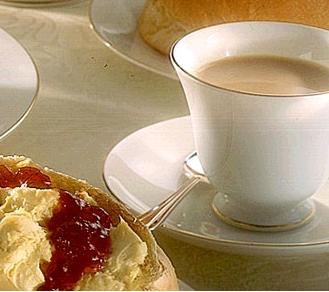
There are a number of things Jane might have had with her tea, including hot, buttered Sally Lunn buns, good with both sweet and savory toppings. Those made today in Bath are very large, perhaps six inches across and four inches high. My own version, which I’m sure Sally Lunn’s in Bath would scorn as an inadequate imitation, is much smaller. I’ve made them as large as a hamburger bun but, preferring them smaller yet, usually make them in a muffin tin.

Sally Lunn Buns
(Makes 18 )

4 packed cups (20 ounces) unbleached all-purpose flour

1/3 cup sugar

2 1/4 teaspoons (1 package) instant yeast

1 1/2 teaspoons salt

1 stick (1/2 cup) unsalted butter
4 large eggs

1 cup milk

In medium bowl (I use a 2-quart glass measure), whisk together flour, sugar, yeast and salt. In small saucepan, melt butter.

With electric mixer, beat the eggs until fluffy and pale lemon yellow, about 5 minutes. Add the milk and beat until smooth, about 1 minute. By hand with a dough whisk or wooden spoon, add the flour mixture to the egg mixture in three additions, alternating with the melted butter and beginning and ending with the flour mixture. Cover with lid or plastic wrap. Place in refrigerator for at least 24 hours and up to three days.

About 2 1/4 hours before serving time, remove dough from refrigerator. Stir down the dough, just a few strokes, with a wooden spoon. With a 1/4-cup measure or scoop sprayed with cooking spray, scoop dough into well-greased or cooking-sprayed standard muffin tins. Lightly butter a sheet of plastic wrap and place, buttered side down, over the buns. Let rise until puffy but likely not doubled in volume, about 1 3/4 hours. During last 15 minutes, preheat oven to 375 degrees.

Uncover buns. Bake at 375 degrees about 25 minutes, or until golden brown. Transfer tins to wire racks and let cool for 5 minutes. Turn the buns out of the tins onto the racks and serve warm or continue to cool before storing.

By Jean at The Delightful Repast at http://delightfulrepast.com/

Read Full Post »

Gentle Reader, next week Austenprose will begin a Pride and Prejudice extravaganza entitled, Pride and Prejudice Without Zombies. The group will be reading Jane Austen’s own words. Not some mash up. Not a sequel. And, as far as I am concerned, my favorite book of all time. When Laurel Ann asked me to contribute my thoughts during the event, I was already researching information about Mr. Jones, the apothecary who treated Jane Bennet. So, as a pre-announcement, I am publishing this post. Do obtain a copy of Pride and Prejudice and join Laurel Ann and her readers as she begins her in-depth analysis of the book on Tuesday, June 16th.

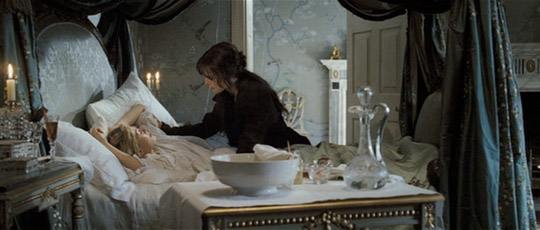
Jane is sick, Netherfield Hall, Pride and Prejudice 2005

In 1813, the year that Pride and Prejudice was finally published, apothecaries filled an important role in rural areas where physicians were scarce. When Jane Bennet fell ill at Netherfield Park, Mr. Jones, the apothecary was sent for:

Breakfast was scarcely over when a servant from Netherfield brought the following note for Elizabeth:

“My dearest Lizzy,

I find myself very unwell this morning, which, I suppose, is to be imputed to my getting wet through yesterday. My kind friends will not hear of my returning home till I am better. They insist also on my seeing Mr. Jones therefore do not be alarmed if you should hear of his having been to me and excepting a sore throat and head-ache, there is not much the matter with me.

Yours, &c.”

Unlike a physician, whose social standing ranked high, apothecaries were considered one step up from a tradesmen, and several rungs below the physician/doctor.
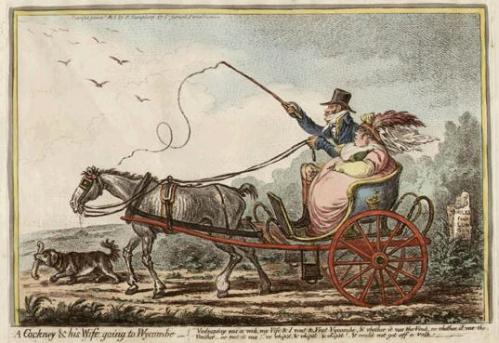

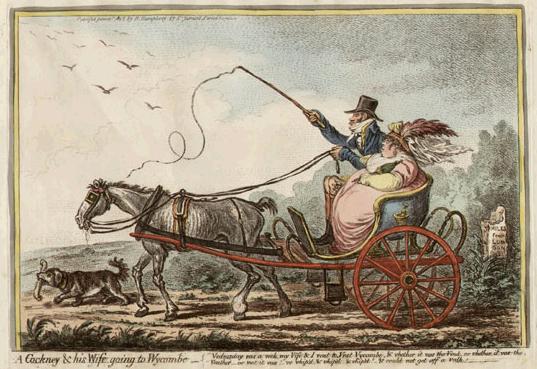
This cartoon by James Gillray suggests that the Cockney in question is an apothecary. Note the mortar and pestle symbol on the side of the carriage.

Apothecaries learned how to make drugs and poultices during their tenure as apprentices. They used their hands and labored in shops, and were often the only alternative for people who sought medical care and who could not afford a doctor’s fees. Interestingly, apothecaries were not paid for giving advice or providing medical treatment. They were paid only for the drugs they sold.
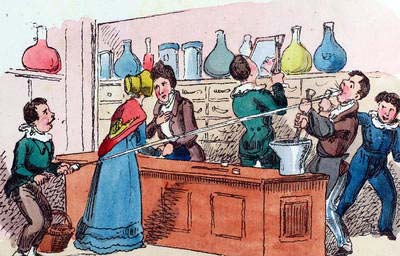
Apothecary Shop, Glasgow Looking Glass

Mr. Jones, would have traveled to Netherfield Hall and dispensed his advice without recompense. But he recommended his draughts, which enabled him to earn some money, and instructed Elizabeth on how to use them:

The apothecary came and having examined his patient said as might be supposed that she had caught a violent cold and that they must endeavor to get the better of it advised her to return to bed and promised her some draughts. The advice was followed readily for the feverish symptoms increased and her head ached acutely.

Visiting an ill Jane at Netherfield, Pride and Prejudice 2005

Mrs. Bennet’s ploy to keep Jane at Netherfield, using Mr. Jones as an excuse when Mr. Bingley inquires about Jane’s condition, worked:

“Indeed I have, Sir,” was her answer. “She is a great deal too ill to be moved. Mr. Jones says we must not think of moving her. We must trespass a little longer on your kindness.”

Mr. Bennet used Mrs. Bennet’s machinations to his advantage, demonstrating his wit even as he admonished his wife for placing Jane in danger:

“Well, my dear,” said Mr. Bennet, when Elizabeth had read the note aloud, “if your daughter should have a dangerous fit of illness, if she should die, it would be a comfort to know that it was all in pursuit of Mr. Bingley, and under your orders.”

“Oh! I am not at all afraid of her dying. People do not die of little trifling colds. She will be taken good care of. As long is she stays there, it is all very well. I would go and see her, if I could have the carriage.”

As an interesting aside, one of the 3rd Earl of Stanhope’s third daughter’s eloped with the family apothecary, prompting James Gillray to draw the cartoon, Democratic Levelling: Alliance a la Francaise, The Union of the Coronet and Clyster Pipe. (A coronet is a small crown symbolizing a peer’s status and a clyster pipe was a tube used for injections). The earl was a great proponent of liberty and revolution, but this marriage sorely tested his tolerance for equality! One wonders what Mr. Bennet might have said had Jane or Lizzie run off with Mr. Jones!
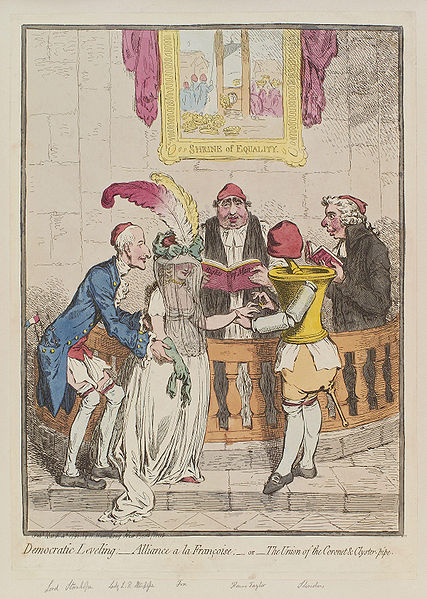
At the turn of the 19th century, the practice of medicine would benefit from rapid scientific advances brought about by methodical and well-reasoned experimentation and observations. But at the height of Thomas Rowland’s and James Gillray’s satiric powers, doctors, surgeons, and apothecaries were still targets of fun. The medical field also did not fare well with popular opinion.
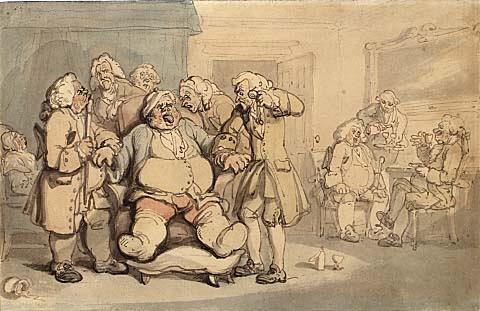
The Comforts of Bath, Rowlandson. At the end of the 18th Century, Bath had more doctors and apothecaries per number of citizens than any city in England.

The following humorous scene between a doctor and an author sums up the popular perception of a doctor’s swelled head. His miniscule knowledge about medicine does not detract from his exalted opinion of his social standing in relation to an apothecary’s. This passage emphasizes the point that the medical field took a back seat to poetry and criticism:

Doctor: I suppose, Sir, you are his apothecary.

Gent: Sir, I am his friend.

Doctor: I doubt it not. What regimen have you observed since he has been under your care? You remember, I suppose, the passage in Celsus, which says, “if the patient on the third day have an interval, suspend the medicaments at night. Let fumigations be used to corroborate the brain.” I hope you have upon no account promoted slernutation by hellebore.

Gent:  Sir, you mistake the matter quite.

Doctor: What! an apothecary tell a physician he mistakes! You pretend to dispute my prescription! Pharmacopola componant. Medicus folus prefabricat. Fumigate him, I say, this very evening, while he is relieved by an interval’

Dennis: Death, Sir, do you take my friend for an apothecary! A man of genius and learning for an apothecary! Know, Sir, that this gentleman professes, like myself, the two noblest sciences in the universe, criticism and poetry. By the immortals, he himself is author of three whole paragraphs in my Remarks, had a hand in my Public Spirit, and assisted me in my description of the furies and infernal regions in my Appius.

(The discussion continues.) Then the doctor says:

Doctor: He must use the cold bath, and be cupped on the head. The symptoms seem desperate. Avicen says: “If learning be mixed with a brain that is not of a contexture fit to receive it, the brain ferments till it be totally exhausted. We must endeavour to eradicate these indigested ideas out of the perieranium, and to restore the patient to a competent knowledge of himself. – Elegant Extracts, or Useful Entertaining Passages
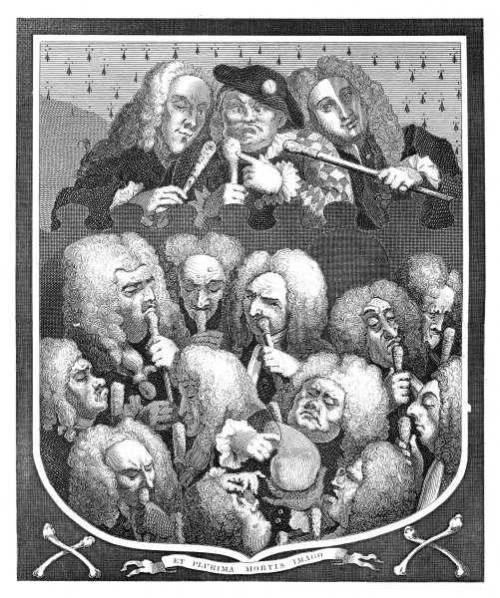
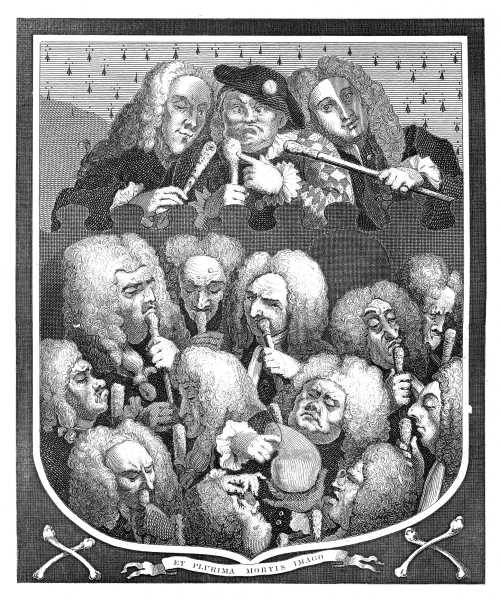
Consultation of Physicians, Hogarth

Physicians occupied the top rung of the medical social ladder because they did not “soil” their hands by treating the patient directly, as a surgeon would. They did not accept money in public (the payment would have been made discreetly). These “learned” men attended university but did not perform autopsies or dissect cadavres. Men of breeding, they merely sat back and watched the procedure from afar.
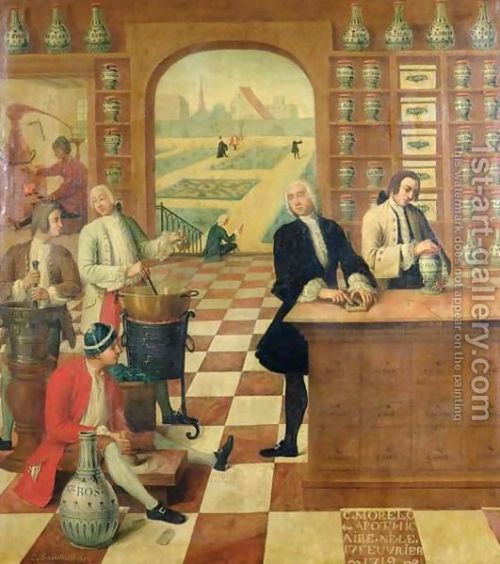
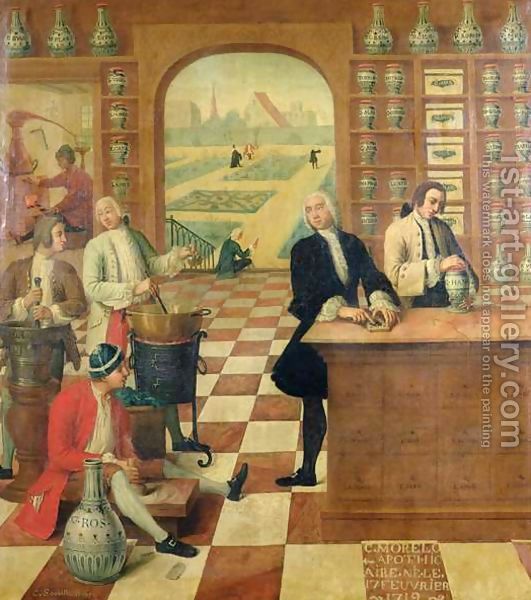
Apothecary shop, 1719

An apothecary shop during Jane Austen’s day was much like today’s drug store, where a customer could purchase drugs, herbs, poultices, panaceas, and other medicinals. In the image from 1st Art Gallery, one can see the preparations and infusions being made in an 18th century apothecary shop. Herbs grew in an adjacent garden and substances were stored in apothecary jars and drawers. Such shops also sold surgical equipment. In this link one can view an apothecary shop in Colonial Williamsburg, much as a similar shop might have looked in Meryton.
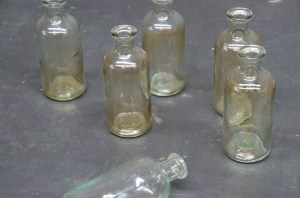
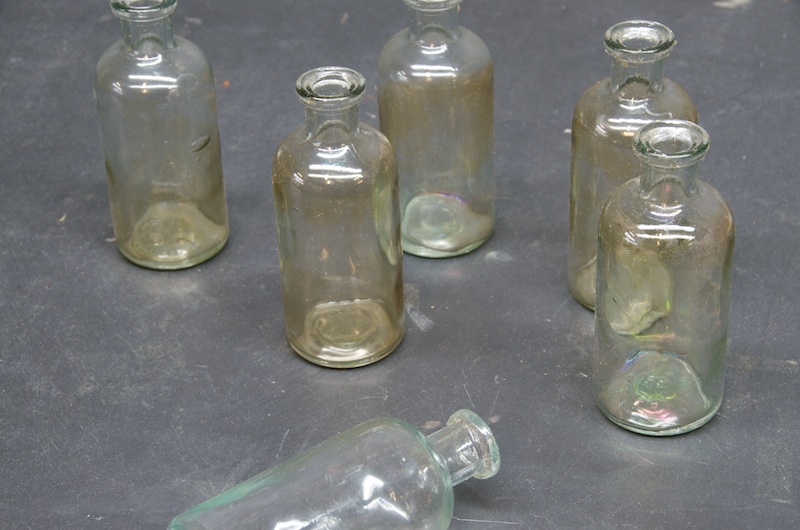
18th century apothecary bottles made with mercury glass

Apothecaries were often the only doctors available in a rural community, and they would take their supplies with them in portable apothecary box. Mr. Jones, Jane Bennet’s apothecary, must have dispensed his solutions from a similar box.
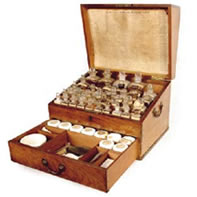
Apothecary box

By the mid-19th century, the medical field changed drastically, including the pharmaceutical field, and medications and medical practices  began to actually heal patients with predictable success. In 1895, the Pharmaceutical Journal wrote what might well be an eulogy for apothecaries:

You are all familiar in one way or another with the apothecary of the last century. A gloomy little man in a gloomy little shop with a gloomy little helper. What mystery there was surrounding every step!  His weird work with flame and flask mortar pestle and still! … These were pioneers in our profession and all honour is due them.

My further discussions about medicine in the 19th century can be found in three posts I have written on the topic:

More on the topic of medicine in Jane Austen’s day in these links:

Read Full Post »
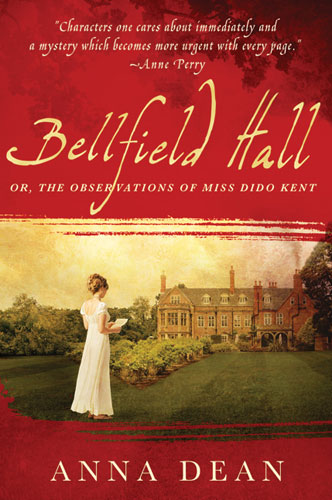
Inquiring Readers, This review by Lady Anne is about a Dido Kent mystery, part of a series of books by Anna Dean. McMillan says about its author: “Anna Dean set about crafting stories at the age of five under the impression that everyone was taught to write in order to pen books. By the time she discovered her mistake, the habit was too deeply ingrained to give up. She resides in the Lake District of England.”

Dido Kent, the heroine of Anna Dean’s new book Bellfield Hall, is that useful family member, the unmarried sister (and aunt) whose brothers add to her income so that she is not in actual want, and so they can call on her whenever they need assistance.  Dido is outspoken and curious; attractive enough not to be considered an antidote, but because she speaks her mind, has apparently frightened the young men about town enough that she has never been asked to marry.   At almost thirty she is definitely on the shelf.

In this first outing for Dido, niece Catherine has called on her aunt for assistance in a most delicate situation.  Catherine has just become engaged; it is a very good match, except that the bridegroom-to-be suddenly leaves the weekend party and writes Catherine a quelling note ending, in the most gracious albeit obscure terms, the engagement.  Catherine, who is totally surprised and distressed, asks for her aunt to come and discover what has caused this dreadful change.   To add to the worry, a woman is found dead in the shrubbery, and no one admits to knowing anything about who she may be.  And so we get a delightful country-houseparty murder mystery.

The constraints of the time – this story unfolds in September of 1805 – preclude Aunt Dido from being overt in her crime solving.  Nevertheless, she does accumulate a number of interesting clues, one of the most important of which involves the family dog.  Other peculiarities include the gatekeeper, who is a young woman with a young child, a dress of singularly unusual construction, and two sisters whose graceful accomplishments seem to vary depending upon the audience.

Much of the story is told in letters to her sister; epistolary novels are always interesting for what they tell not only in words, but in implication.  Dido’s voice is very clear, and her several false starts and stumbling efforts to discover what has happened to her niece’s intended bridegroom are explained well in the letters.

While the book has very much the flavor of the early 19th Century, several aspects of the different characters are told in a clearly 21st Century manner.  One of the houseguests, Col. Walborough, is considering marriage to a wealthy young woman; strangely, he does not seem particular about which young women.  He allows that it will mean a significant change in lifestyle for him.  He really is not referring to his military career, but rather his predilection for young men, particularly young men in service.  He cannot decide which of the two talented sisters to ask for; each has a good portion of her father’s considerable fortune settled on her.  These girls have decided that they do not wish to marry, so they have their own way of keeping suitors at bay; their parents cannot comprehend that their daughters do not wish the married state.

Dido peers, pokes, and prods, and throughout the process, says what she thinks.  She resolves the mystery and frees the young bride-groom-to-be from his terrible toils.  The mystery is good; there is just enough that is not told to keep the puzzle intriguing.

In each of Jane Austen’s books, the characters are straightforward about the economic reasons for young women to marry well.  This sometimes causes contemporary readers to consider Jane’s young heroines as mercenary, which is really not the case.  They were practical and clear-sighted.  Georgette Heyer shows the fiscal reality that young ladies of gentle birth and little means faced:  they became governesses like Ancilla Trent in The Nonesuch, or Elinor Rochdale of The Reluctant Widow, or poor Kate Malvern in Cousin Kate, whose rescue from that life by her aunt created an even worse situation.  If they tried to live by their wits, as Deb Grantham in Faro’s Daughter did, society frowned and sneered.  They were not good times for gentlewomen without income.  This reality gives Heyer a hook for her books, and the wealthy and handsome suitor, even if he is sardonic, is a welcome rescue from a life that would only become harder.

Anna Dean’s Dido Kent talks about the strictures she faces in a very contemporary fashion.  Ladies could marry money, or they could inherit money.  Lacking those options, their lives were not their own.  Dido also speaks plainly to and about the two wealthy sisters who actually can choose not to marry because they are so comfortably fixed; even they must resort to subterfuge to carry out their convictions.  At the end of this book, Dido must go to another brother’s household because “unmarried women must not expect to remain where they cannot be useful.”  Her dependent situation, however,  serves as a useful device for involvement in another mystery, and indeed, we can hope for another gently delivered tale of problems solved by Dido, in a new locality and with a different cast of characters.  We can also continue to hope that she will find someone who she feels can marry Tom Lomax, with whose family she will remain connected.  Once she accomplishes that, she perhaps will no longer be at her family’s beck and call.

Afterword: Lady Anne, who has written a number of reviews for Jane Austen’s World, is Vic’s special friend. She is often rewarded for her critiquing efforts with an outing to one of our favorite watering holes in a nearby fashion park. Whether perched on stools in an elegant bar or at an outdoor table adjacent to a bocce ball court, we can dis and gossip with the best of them. Think of Sex in the Burbs with bite. Well trod (Lady Anne is more often found sampling foods and wares in far flung places) and well shod (think of a Nordic Carrie with sensible 3″ stilettos), and you have an idea of why I find my dearest Janeite friend so appealing.

Read Full Post »

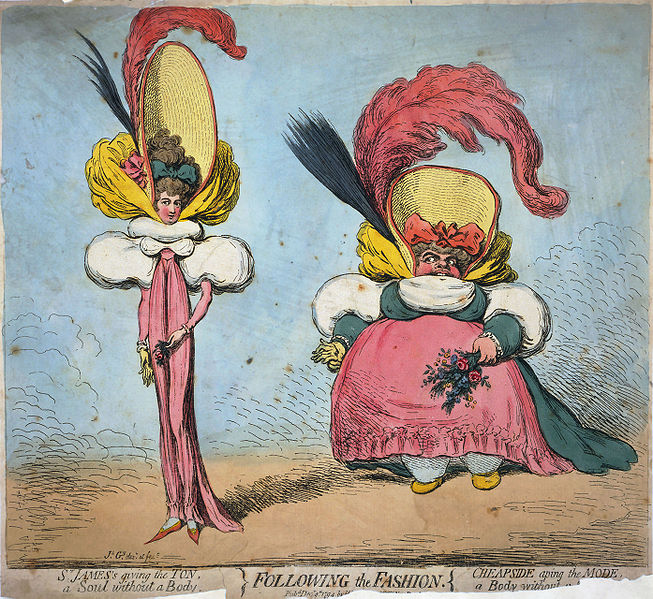
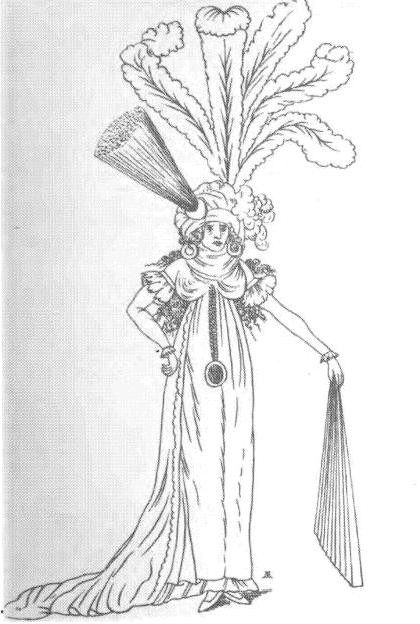
To our modern eyes, Regency empire dresses represent a charmed and romantic era. But in 1794, the high-waisted look that had so recently come into fashion aroused much ridicule, and was described as the “banishment of the body from the female form.” The Rage, or Shepherds I have Lost My Waist was a doggerel based upon a popular song of the time: “Shepherds I have lost my love – Have you seen my Anna?”

Shepherds, I have lost my waist,
Have you seen my body?
Sacrificed to modern taste,
I’m quite a hoddy doddy!
For fashion I that part forsook
Where sages place the belly;
T’is gone – and I have not a nook
For cheesecake, tart, or jelly.
Never shall I see it more,
Till common sense returning,
My body to my legs restore,
Then I shall cease from mourning.
Folly and fashion do prevail
To such extremes among the fair,
A woman’s only top and tail,
The body’s banish’d God knows where!”

The implication of the ditty was of the poor lady’s predicament. She had to refuse cakes and jelly for her dressmaker had left her with no body. Worse, her legs looked as if they started just below her breasts.


This image shows a lady wearing the latest rages: tall feathers and an enormous watch with fob suspended below a girdle without a waist.

Read Full Post »

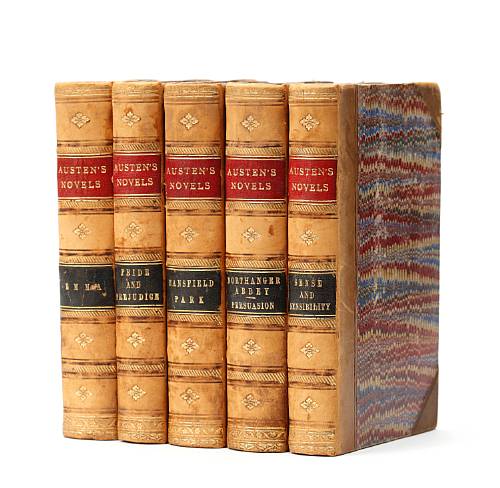
1833 Bentley edition of Jane Austen's novels

If you are thinking about getting out of the stock market and placing your money on a sure thing, consider bidding for this edition of six Jane Austen novels in 5 volumes at Bonhams. Set to be sold on June 8, with an estimate of £2,000 – 3,000, the value of this rare set is sure to  go up during the auction and for many years thereafter. The description of the Standard Novels on Bonhams’ web site states:

[Works, Bentley’s Standard Novel edition], 6 vol. in 5, 5 engraved frontispieces and additional titles, some light spotting to first and final few leaves, small corner tear to printed title “Pride and Prejudice”, without half-titles, ownership inscription of Eularia E. Burnaby (1856) on printed titles, bookplate of Henry Vincent, bookseller’s label of H.M. Gilbert, Southampton, uniform contemporary half calf, red and dark green morocco labels, extremities lightly rubbed [Gilson D1-D5], 8vo, R. Bentley, 1833 – Bonhams Website

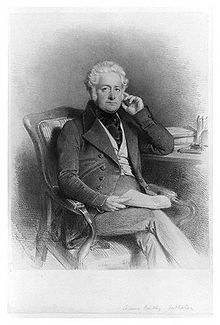
Richard Bentley (Wikimedia Commons)

The Bentley editions are notable in that no English reissue of JA’s novels is known after 1818. In 1832, Richard Bentley, publisher, purchased the remaining copyrights to Jane’s novels. (An excellent description of how Henry and Cassandra Austen sold the copyright to Richard Bentley and how little money they received for relinquishing their rights to their sister’s novels can be found in Claire Harman’s Jane’s Fame.) Bentley published all of Austen’s completed novels in 1833 in five volume sets known as the Standard Novels.  They came with illustrations that were significant for depicting scenes in early Victorian settings, not Regency settings. (One wonders how much the costume designers of the 1940 Pride and Prejudice film adaptations were influenced by these illustrations.) Bentley’s purchase marked a milestone, for from this time forward Jane Austen’s novels would always remain in print.

Illustration, Pride and Prejudice, Bentley edition (Image: Wikimedia Commons)

At the time of the Bentley reissues, Jane Austen was still regarded as a niche writer. Only a few hundred copies of her books were published and reprinted over the years. When Bentley’s copyrights expired, other printers began to publish her works, but book sales remained modest. Then came 1870. The publication of A Memoir of Jane Austen by J.E. Austen-Leigh, Jane’s nephew, sparked renewed interest in her novels. Bentley reprinted the novels as 21-5 in his Favorite Novels series (Sutherland, page 3),keeping Jane’s name in front of the public. Public demand for Jane’s novels continued to rise with the arrival of Bentley’s deluxe Steventon edition in six volumes in 1882. In 1884, Jane’s great nephew Lord Brabourne published the 2-volume set of Letters of Jane Austen. Combined with the previous publications and a largely favorable assessment of scholars and critics, Jane’s star was born.  A second wave of popularity, whose crest we are still riding, surged after the Jane Austen film adaptations of the 1990’s. It is conjectured that interest in her novels, adaptations, and sequels has peaked, but the number of readers that continue to visit this blog (and other Jane Austen blogs) and to clamor for films based on her life and novels belie that belief .

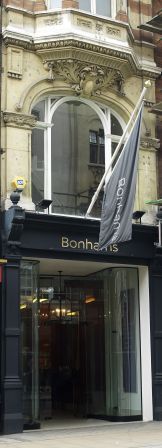
Bonhams, New Bond Street

About Bonhams LTD:

Bonhams is the world’s oldest and largest auction house still in British ownership. Thomas Dodd, an antique print dealer, and Walter Bonham, a book specialist, founded Bonhams in London in 1793.  When the auction house was launched, it was one of several similar concerns in Georgian London. The firm handled antique objects as well as fine wines. Today Bonhams is considered on of the four major auction houses in England, along with Christie’s, Sotheby’s, and Phillips, and sales take place almost daily at the firm’s New Bond Street location in Mayfair, London. (Image at right: University of Notthingham.)

For a more detailed description of Eularia E. Burnaby, whose name is inscribed inside the printed titles of this Standard Novel Edition, read Laurel Ann’s post entitled, Hey Bonhams! That Bentley Edition of Jane Austen Novels is Worth More Than You Thought!

Read Full Post »

« Newer Posts - Older Posts »