Feeds:
Posts
Comments

Archive for the ‘Jane Austen’s World’ Category

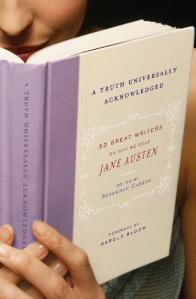
I read these words on the book flab of the excellent new compilation, A Truth Universally Acknowledged: 33 Great Writers on Why We Read Jane Austen, edited by Susannah Carson, foreword by Harold Bloom, “For so many of us a Jane Austen novel is much more than the epitome of a great read. It is a delight and a solace, a challenge and a reward, and perhaps even an obsession.” How true. Susannah Carson has culled essays from the last one hundred years of criticism and juxtaposed a few pieces by today’s essayists and novelists in a book that I found to be more satisfying than attending a master class on Jane Austen. I consider this interview with Susannah to be among the better posts on this blog. Enjoy!
33Q: What were your criteria for choosing the essays? Would you give us an example of a writer whose essay you first considered and then decided not to include in the collection?

A: There have been so many excellent essays written on Jane Austen! Most of them endeavor to clarify some aspect of the novels—the what, when, how, etc.—and these can be extraordinarily helpful. But then there are other essays which tackle what is, in my opinion, the big question: the why. Not, for instance, how can we understand the relationship between Darcy and Elizabeth in terms of gender relations, narrative technique, and cultural institutions, but why does their love continue to move us so?

David Lodge wrote an essay entitled “Jane Austen’s Novels: Form and Structure.” This is perhaps the most acute, elegant account of how the novels work. But it answers the “how” question, and so I chose to include his essay “Reading and Rereading Emma” instead, for there he is after the essential “why”.

Q. Did you have an order in mind when you arranged the essays and why?

A. Some of the essays are about one novel, some are about a couple or a few of her works, and some are about everything she wrote from the juvenilia to her unfinished novels to her letters. In the end, we decided to order them loosely: essays about a single novel appear in a series, and they are separated by two or three more general essays that are united by theme (e.g. morality, films). When I reread them through in this order, I was pleased to discover that the same thoughts would rise and fall in the smaller waves as well as throughout the length of the book. Austen’s vitalism, for instance: towards the beginning, Eudora Welty writes that Jane Austen’s novels are about “Life itself”; in the middle, later, Amy Heckerling notes that everyone is “BUSY” and Eva Brann observes that the heroines are full of “liveliness”; and in the penultimate essay, Virginia Woolf hears “the sound of laughter.”

Q: Do you agree with Benjamin Nugent’s observation that a Jane Austen novel is the “ultimate talky French movie,” because in essence nothing happens except for a series of conversations between characters?

A: I do agree. Austen’s use of dialogue is complex—she uses it to sketch character, but (as Diane Johnson notes in her essay) she rarely uses it to advance plot. And yet, at the same time, most of the climactic scenes are all about words—their use and misuse. In Pride and Prejudice, it’s Darcy’s hilariously misworded proposal; in Mansfield Park, it’s the drama surrounding drama, or the debate over whether or not to perform Lovers’ Vows; in Emma, it’s Emma’s slight of Miss Bates during the picnic at Box Hill; in Persuasion, it’s Wentworth’s letter written in counterpoint with the conversation he overhears between Anne and Harville. So words are at the center of whatever it is that they get wrong or right, whatever it is they need to learn in the course of the novel. Figuring out how words work in a social setting is, as Ben so astutely notes, part of a timeless coming-of-age process.

Q: James Collins made a number of powerful statements, saying that Jane Austen helped him clarify ethical choices and figure out a way to live his life with integrity. One of the reasons that she has credibility in his eyes is her total lack of sentimentality. C. S. Lewis comments on Austen’s hard core morality, and Amy Bloom paints a picture of a woman who sees the world around her through a clear pane of glass. These authors helped me to clarify why I am so drawn to Jane Austen. In your introduction you hope the reader will formulate an answer to the question: why do you read Jane Austen? I will reformulate your question: what was your reason for assembling this book and why are you drawn to Jane Austen?

A: It seems like there’s a whispered suspicion in our culture that Reading is dead—that we hardly ever read anymore and, when we do, we’re still not really reading. Hopefully this isn’t true, but the sublime Robertson Davies was certainly haunted by this fear when he issued his call to arms: “What I call for is a multitude of revolutionary cells, each composed of one intelligent human being and one book of substantial worth, getting down to the immensely serious business of personal exploration through personal pleasure.”

This collection of essays is intended to help people figure out how to really, really, really enjoy reading. There are different kinds of reading. There’s the light reading of a Jane Austen spin-off, and that provides a certain amount of fun. And then there’s the rich reading of a Jane Austen novel, and that provides not just quick delight but insight into how our hearts and minds work. We frequently think of reading as somehow separate from the act of living, but with the best literature—with Austen’s novels—reading becomes just as grand, if not grander, than the other bits and acts of life. So I read, and I read Austen, not only because it teaches me to think, imagine, and relate, but also because it’s a critically important and deeply indulgent pursuit.

Susannah Carson CREDIT Eric C CarterDizzy Pixel Inc SMALLERQ: Tell us a little about yourself! Your short bio on the book flap intrigues me. Unlike provincial Jane, whose life was quite circumscribed, you are truly a woman of the world.

Yes! It’s telling that Austen’s work continues to have something to say to modern women who are so very different from her in all sorts of quotidian details. I started off in much the same place, however; my first memories date from the years my family lived in Hockwold-cum-Wilton, a little village in East Anglia. We moved back to the Napa Valley when I was still small, and I grew up in the country where I could trek across the countryside to visit friends. The scope changed when I went away to college, for I found myself increasingly addicted to books: first philosophy, then literature. While I was writing an M.A. thesis for San Francisco State University on Madame de Lafayette’s La Princesse de Clèves, I fell head-over-heels in love with 17th C French novels. To read these rare novels in all their original mustiness, I moved to France. After a maîtrise at Lyon II, I did a D.E.A. (or M.Phil) at Paris III. In Paris, I lived in an apartment above a chocolaterie on the Ile St. Louis and walked around Notre Dame every day on my way to class at the Sorbonne. I then moved to New Haven to pursue a doctorate at Yale, and I’ve just returned to San Francisco to finish a dissertation on danger in French novels of the Ancien Régime.

What would Jane Austen’s life have been had she lived, read, and written today? Would she have traveled the world for her craft, or would she have been just as content with stationary flights of fancy? Would she have racked up degrees and indulged in “serious” study, or would she have stuck to her depictions of three or four families in a little village? No matter how we live it out, I think it’s inevitable that modern bluestockings somehow associate themselves with Austen: she was such an important pioneer, and it’s hard to say where we would be today had she never written.

Thank you for your insights, Susannah! It has been a pleasure talking to you. For the readers of this blog, I will post my review of the book soon.

More information about Susannah on Random House’s site: Susannah Carson is a doctoral candidate in French at Yale University. Her previous degrees include an M.Phil from the Sorbonne Paris III, as well as MAs from the Université Lyon II and San Francisco State University. She has lectured on various topics of English and French literature at Oxford, the University of Glasgow, Yale, Harvard, Concordia, and Boston University.  Order the book at this link.

Susannah’s site sits at this link:  Why Jane Austen

Read Full Post »

christineInquiring readers, Several weeks ago, Chris asked me to link to her blog. Looking at it and reading her posts, I asked her to keep me updated on her work, which she describes as a personal journey that she is doing “for the pleasure of pursuing a course of study in a structured manner, which I greatly miss from my time in graduate programs. And to have fun and explore, more deeply, the work of a writer I admire and the time period in which she lived.” Below are her thoughts, and a link to her blog, Embarking on a Course of Study, which I encourage you to visit.
Would you, if you could, spend a year entering ‘on a course of serious study’ as Marianne Dashwood vows to do at the end of Sense and Sensibility? If the answer is yes, please join me in an Austen-inspired project of that nature. Specifically, “A writer, reader, and Austen lover spends a year (or more) embarking on a course of study similar to that probably undertaken by Marianne in Sense and Sensibility, without the benefit of Colonel Brandon’s library and with room for diversions, digressions, and (hopefully) fun fieldwork.”

I’ve begun by rereading the novels (which has been both a joy and a frustration at times, and I’m sorry I waited so long to pick them up again!), and Austen’s letters. I’m contacting Austen scholars for reading suggestions and to interview them. So far the Chawton Library has been the most helpful. Sadly, JASNA, not so much.

I have my first interview with a professor at St. Mary’s College here in Maryland, who is offering a class on Austen that examines the important aspects of the time period in which they were written: poliltics, economy, social codes, etc.

I admit the fieldwork so far has been the most fun. I’ve been country dancing (a real thrill, but surprisingly hard to learn and hot/sweaty!), am working on a silk ribbon embroidery project, and am deciding between hat decorating and archery classes. I have the Jane Austen Cookbook, as well, and plan on cooking one or two items for this year’s Thanksgiving dinner. I’ve promised my family not to make pigeon, which I admit I was not sorry to give up.

The reading list is growing and my goal is to alternate the serious with the silly. So – Mrs. Richardson then Sir Walter Scott, and on like that.

I hope to attend the festival in Bath next fall, so will probably need to find a seamstress to make me something fabulous or brave the process myself. Let’s see how well I do with the silk ribbon embroidery first!

This is not a project in the vein of a PhD dissertation or an intellectual discussion, though I welcome ideas, comments, and suggestions of all kinds. I’m trying to stay as true to Marianne as I can, but also see where this path leads me, personally.

Based on my post a few weeks ago (‘The Ruins of the Patapsco Female Institute’), that could be to a class in NYC on walking in heels at ‘Miss Vera’s Finishing School for Boys Who Want to Be Girls.’

You just never know where we’ll end up!

My latest post is on Elinor vs. Marianne. Who would you rather have as a friend? Who are you most like? Would love to hear from you.

Read Full Post »

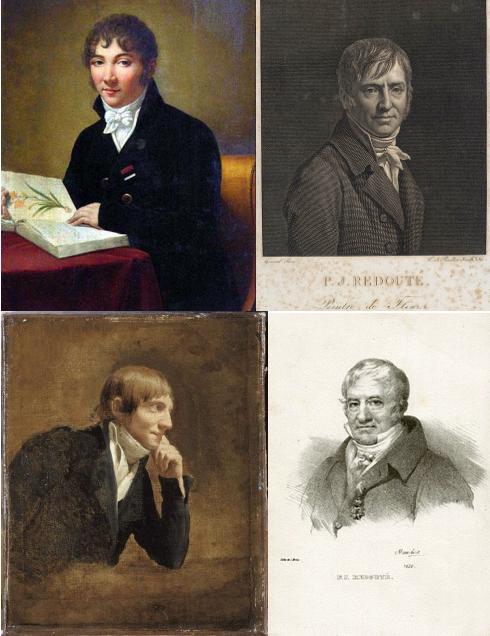
Pierre-Joseph Redouté’s flower prints are so lush and detailed that you can almost pick the flowers off the page. In the famous rose print below, a single drop of water rests exquisitely on a rose petal of the top rose. Born in a family of artists*, Pierre-Joseph became known as the premier botanical illustrator of his day (indeed, to this day). His influence spread far and wide and can be still felt in illustrations on cards, decorative boxes, books, wallpapers and prints, and calendars.

pierre-joseph-redoute

The watercolor images in this post were taken from his famous book of prints, Les Roses. Redouté, known as the “Raphael of flowers, mastered the technique of stipple engraving- in which he uses tiny dots, rather than lines, to create engraved copies of his watercolor illustrations. This new technique allowed him to make subtle variations in coloring (see the detail of the magnolia in the last image below).

4 faces of PJ Redoute

The four faces (and ages) of Pierre-Joseph Redouté

Redouté completed the three volumes of Les Roses, his best known work, between 1817 and 1824. His most popular illustrations are assembled in Les Liliacées (486 watercolors); and Les Roses (169 watercolors). Hand-colored stipple engravings, such as the magnolia sitting at the bottom of this post, were made from these watercolors. – Discovery Editions

Rosa gallica_maheka from Redoute's Les Roses 1817-1824 Huntington LibraryJosephine, wife of Napoleon Bonaparte, was known for her spectacular garden at Chateau de Malmaison, where exotic plants were cultivated. The plants, acquired from around the world, were documented by France’s leading horticulturists and botanists, and painted by Pierre-Joseph Redouté.
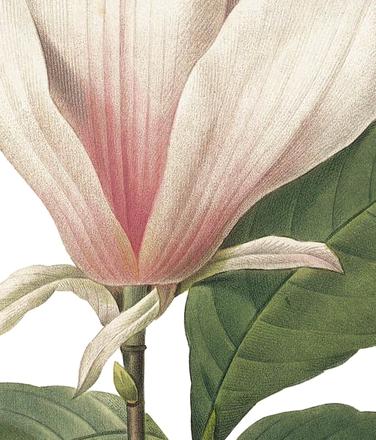
Magnolia

Detail of the magnolia engraving below.

magnolia closeup

More on this topic

Read Full Post »

Everything we now use is made [in] imitation of those models lately discovered in Italy. – Observation by an Englishman

diana sackville detail 1777

Diana Sackville, 1777

In the late 18th century, hairstyles for women took a dramatic turn from the pouffed-up and constructed hairdos of the earlier Georgian age to the simple hair styles inspired by the Greeks, Romans, and Egyptians. Curls now framed the face and chignons replaced the complicated, almost architectural concoctions that took hairdressers hours to create. Ancient statues and works of art brought back as spoils of war or as souvenirs from grand tours revealed classical hairstyles. Women began to wear simpler hairdos with long hair pulled back in chignons or simple pony tails, long curls trailing over the shoulder, and short ringlets framing the face. Hair ornaments consisted of flower wreaths, ribbons, jewelry, tiaras, and combs.

greek and roman influences

Hairstyles on statues from antiquity

Lady Caroline Lamb (lower left) sported a saucy short bob, whose influence can be seen from the portrait in the Roman mural at the Metropolitan Museum. Madame Recamier, whose hair is longer, achieves a similar effect with ringlets around her face. Her curly hair, gathered in back, allowed the ringlets to fall. At right, the Marchioness of Queenston achieved a very similar style to Madame Recamier’s, but her bandeau sat further back on her head and the ringlets framing her face were thicker.

Curly styles

Longer hair, while not as prevalent as the up-do’s, usually took the form of a long curl draped over the shoulder. At second to right, Mrs. Henry Baring wore a more casual “do”, with her locks streaming around her neck and shoulders.

long hair

The long curl

Straight, simple hairstyles with few ringlets and ordinary bangs, or a style simply parted in the middle were worn, but were not drawn or painted by artists or depicted in fashion plates as often as the curlier styles.

plain ringlet free

Fashion plates of the time show how these hairstyles looked with bonnets and hair ornaments with a (l – r) walking dress, ball gown, afternoon dress, or morning dress.

fashion plate

The hairstyles that Kate Winslet and Emma Thompson wore in Sense and Sensibility seemed to be particularly true to the period (in my opinion). Some of you may have noticed that I use Kate Winslet’s image of Marianne as my avatar.

hair styles

This image of a Roman statue (a copy of an earlier Greek statue) shows the hairstyle that would become prevalent in the later Regency/early Victorian era (1820’s to 1830’s).

marble head of a woman roman copy of greek statue

1st C. AD Roman bust

“We wore white crepe dresses trimmed with satin ribbon & the bodices & sleeves spotted with white beads. . . Thursday night, Pearl combs, necklaces, earrings, & brooches. . . Tuesday evening we had sprigged muslin. . . gold ornaments & flowers in our heads & Friday we wore yellow gauze dresses over satin, beads in our heads & pearl ornaments” – Fanny Knight Austen

Evening dresses, fronticepiece, The Mirror of Graces,, 1811

Fanny Knight wrote a vivid description of how women dressed and what sort of accessories were popular when she was a young woman. The 1811 fronticepiece to The Mirror of Graces (above) shows how simple and elegant the combination of Neoclassical hair, dress, and accessories looked.  Jewelry styles favored smaller, lighter forms of draped chains and classical motifs, which were reflected in hair ornaments. These days jewelry from the Georgian era is difficult to find, for many of the pieces were refitted or redesigned to reflect motifs of the neoclassical period. (Neoclassical Jewellery ). Ebay Guides can be extremely useful in researching information about this era, such as this one entitled,  Georgian and Regency Combs and Hair Accessories – 1800-1814. (Click here for the PDF document.)

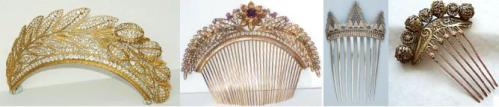
tiaras and combs

Georgian tiara and combs, early 19th c.

In addition to gold and silver hair ornaments, such as tiaras and diadems, young women wore silk ribbons, strands of pearls, feathers and other fancy hair ornaments in their hair, most notably for balls and formal occasions. These hair jewels were a visible sign of a family’s or husband’s wealth. Bonnets, hats, or turbans were also worn on social outings. The second image from the right (above) is of a George III silver comb, 1807.  “Silver combs of this type appear to have been a speciality of Birmingham, where they were produced in a small quantity and in a collectable variety of forms.” (Cinoa)

As the Regency era progressed long hair became increasingly popular and full ringlets began to appear near the side of the face. Hair ornaments for balls included jewellery, bandeaux, turbans and wreaths of grapes and towards the latter end of the Regency era flowers, turbans and ostrich feathers were seen to adorn the hair. (Overseale House)

ornaments

These days we achieve curls and ringlets with a hot curling iron. The use of hot irons in the 19th century was tricky, for hair could easily be singed. Back then, curls were made with pomade, a hair gel, and curling papers. The lost art of the paper curl describes how a person today can make a similar curl using old-fashioned techniques.

Lydia is exposed to an unregency like cut

Perdita Weeks as Lydia Bennet in Lost in Austen

The transition from the structured hairstyles of the mid-18th Century to the Regency period was not achieved without its own set of complications, as this James Gillray cartoon shows. The cartoon was drawn in the earlier Neoclassical period, when round gowns were still worn.

gillray fashion cartoon

A lady putting on her cap, Gillray, 1795

The fashion plate below shows how charming and uncomplicated, yet classic, the combination of the 1802 hairstyles and afternoon dresses are together, whereas the 1811 fronticepiece showed how rich both hair and fabric can be made to look using similar principles of fashion design.

1802 Lady's Monthly Museum afternoon dress june Payne Milliner Old Bond Street

Afternoon Dress 1802 Lady's Monthly Museum

More links on this topic:

Read Full Post »

Vendors of fruit and flowers, of milk and muffins are not agreeable visitors when they roar for a living, and the poor organ-grinder little knows, let us hope, the anguish he inflicts upon sensitive nerves. – Street Noises, The Illustrated London News, 1882

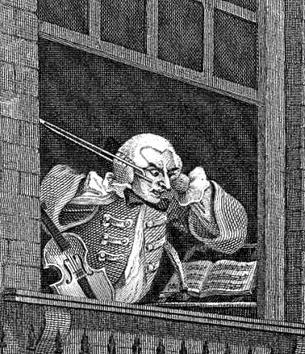
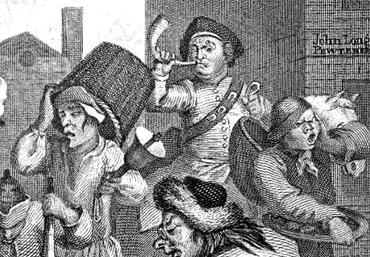
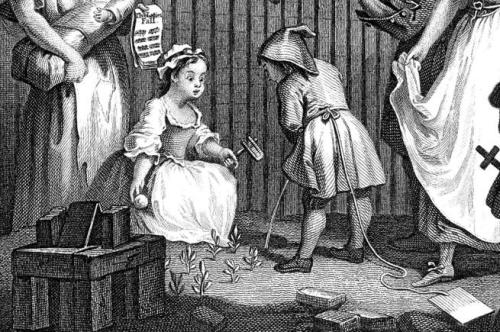
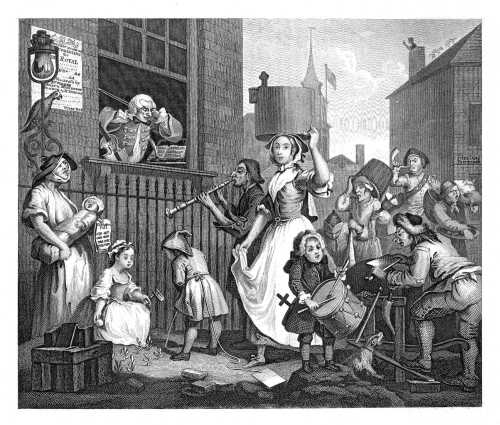
the musicianWilliam Hogarth’s famous 1741 etched engraving of ” The Enraged Musician” visually described the cacophony of sounds heard all over the city of London: the shouts of vendors, clattering of wagon wheels and clopping of horses’ hooves, impromptu concerts from street musicians, clackety-clack of ladies’ pattens (which protected delicate shoes from mud), and the clapping of hooves and bleeting of animals as drovers guided them to Smithfield Market. Laws were enacted to control these noises, but the change did not occur overnight, nor did these laws completely eliminate all irritating sounds for city dwellers. In 1841, 100 years after Hogarth engraved his famous scene, Charles Knight described London’s noises (London, Vol 1, Charles Knight, 1841):
Enraged_musician William Hogarth

In this extraordinary gathering together of the producers of the most discordant sounds we have a representation which may fairly match the dramatist’s description of street noises …

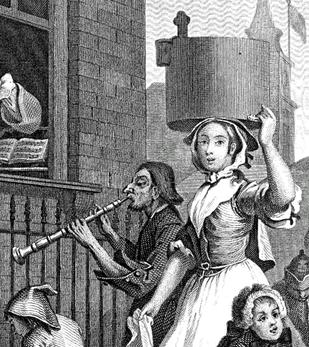
street musician and vendor

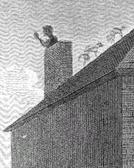
Here we have the milk maid’s scream, the mackerel seller’s shout, the sweep upon the house top, to match the fish wives and orange women; the broom men and costar mongers …

chimney boy

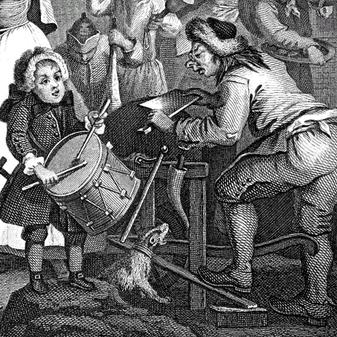
The smith, who was ominous, had no longer his forge in the busy streets of Hogarth’s time, the armourer was obsolete, but Hogarth can rival their noises with the pavior’s hammer, the sow gelder’s horn, and the knife grinder’s wheel…

drummer and knife sharperner

The waits of the city had a pension not to come near Morose’s ward, but it was out of the power of the Enraged Musician to avert the terrible discord of the blind hautboy player.

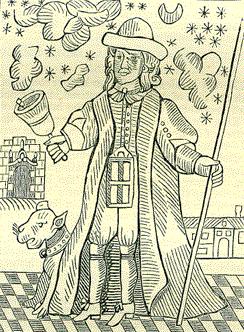
Bellman, Book of Days

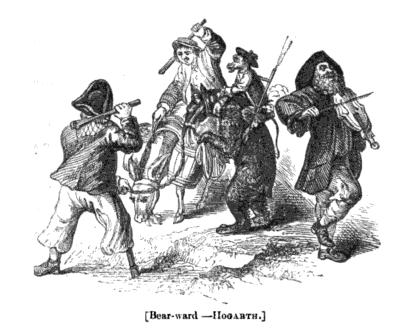
The bellman who frightened the sleepers at midnight was extinct, but modern London had acquired the dustman’s bell. The bear-ward no longer came down the street with the dogs of four parishes, nor did the fencer march with a drum to his prize …

Hogarth, Bear-Ward, Bear and Monkey

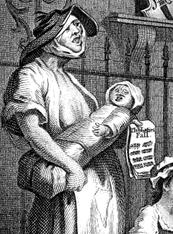
…but there was the ballad singer with her squalling child, roaring worse than bear or dog, and the drum of the little boy playing at soldiers was a more abiding nuisance than the fencer Morose, and the Enraged Musician had each the church bells to fill up the measure of discord…

crying baby

In our own days there has been legislation for the benefit of tender ears, and there are now penalties with police constables to enforce them against all persons blowing any horn or using any other noisy instrument for the purpose of calling persons together, or of announcing any show or entertainment, or for the purpose of hawking selling distributing, or collecting any article or of obtaining money or alms…

bell horn and shouts

These are the words of the Police Act of 1839, and they are stringent enough to have banished from our streets all those uncommon noises, which did something to relieve the monotony of the one endless roar of the tread of feet and the rush of wheels…

peeing in the road

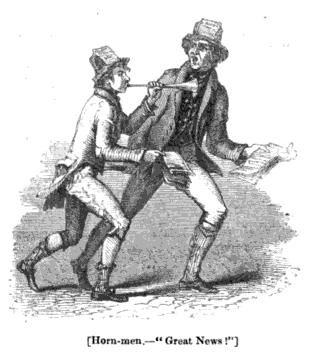
The street noise now is deafening when we are in the midst of it, but in some secluded place, such as Lincoln’s Inn Gardens, it is the ever present sullen sound of angry waves dashing upon the shingles. The horn that proclaimed extraordinary news running to and fro among peaceful squares and secluded courts was sometimes a relief…

hornmen great news

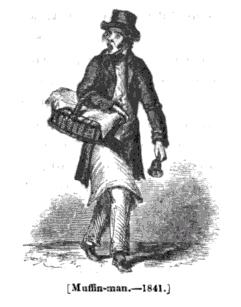
The bell of the dustman was not altogether unpleasant. In the twilight hour, when the shutters were not yet closed and the candles were not yet burnin,g the tinkle of the muffin man had something in it very soothing…

muffin man 1841

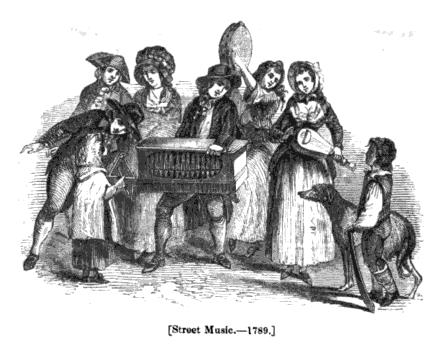
It is gone, but the legislators have still left us our street music…

street music 1789

There was talk of its abolition, but they have satisfied themselves with enacting that musicians on being warned to depart from the neighbourhood of the house of any householder by the occupier, or his servant, or by a police constable, incur a penalty of forty shillings by refusal. De la Serre, who came to England with Mary de Medici when she visited the Queen of Charles I, is enthusiastic in his praises of the street music of London In all public places … – London, Vol 1, Charles Knight, 1841

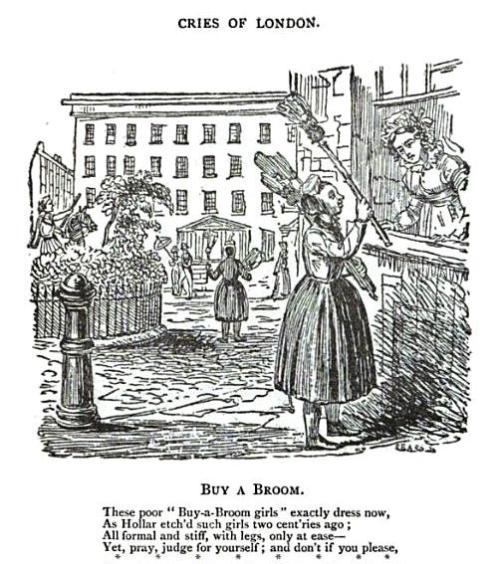
Addendum: Compared to the noises of the City, the West End’s new neighborhoods were comparatively quiet.

buy a broom 1881 cries of london

An interesting aside: To add insult to injury, one closeup of Hogarth’s etching shows a young boy relieving himself in the middle of the street. The sour smells of London added greatly to the din as well.

More on the topic:

Read Full Post »

« Newer Posts - Older Posts »