Feeds:
Posts
Comments

Archive for the ‘Jane Austen’s World’ Category

Inquiring readers,

I recently moved and, like Jane, left a home I loved. When I purchased my current slice of paradise, I found my perfect place. In addition, my new neighborhood suits my personality. Echoes of Jane Austen in Chawton Cottage!

Rachel Dodge, who writes splendid articles for this blog, wrote a wonderful post last year about moving entitled Jane Austen’s Tips on Moving House. I cannot improve on her article. I can,  however, discuss the various 18th C. methods by which the English moved their possessions – large or small. 
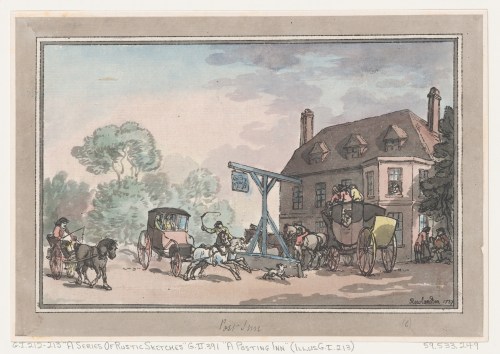
A Posting Inn Rowlandson

Thomas Rowlandson: A Posting Inn, 1787, Met Museum, public domain image

This  print shows three vehicles beside an inn – two moving, one parked:

  1. The parked vehicle is a public coach laden with passengers and drawn by four horses. The animals are being switched out for a fresh team, which, depending on the size, weight, and speed of the coach occurs every 6 – 12 hours. Switches slowed the journey’s progress and provided passengers with an opportunity to disembark and look to their personal needs. Some might choose to spend the night or enjoy a meal at the inn, much like Lydia, Kitty, Jane and Elizabeth.

“…in Hertfordshire; and, as they drew near the appointed inn where Mr. Bennet’s carriage was to meet them, they quickly perceived, in token of the coachman’s punctuality, both Kitty and Lydia looking out of a dining-room up stairs. These two girls had been above an hour in the place, happily employed in visiting an opposite milliner, watching the sentinel on guard, and dressing a salad and cucumber.” – Pride and Prejudice, Chapter 13

After welcoming their sisters, the girls triumphantly displayed a table set out with such cold meat as an inn larder usually offers, exclaiming, “Is not this nice? Is not this an agreeable surprise?” Elizabeth and Jane remained calm and collected, and murmured approval in the appropriate way. Silently Lizzie (and we readers) thought Lydia and Kitty the silliest of chits.

The Dashwood women took a public coach out of necessity after vacating Norland Park with just enough funds to live as gentlewomen in a cottage provided generously by Mrs Jenkins, a relative stranger to them.
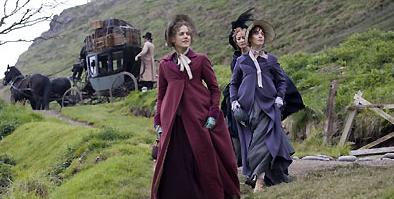
seeing-barton-cottage

The above image depicts the Dashwood women leaving the carriage and seeing Barton Cottage for the first time. Notice the luggage strapped on top of the conveyance. Their furniture, cutlery, tableware, linens and the like would most likely be delivered in a humble wagon by a male servant before or after the move. Servants were often sent ahead of time to ready the new dwelling or they might travel at the same time in a different carriage or wagon. 

Passengers sitting inside a crowded carriage carried their possessions on their laps or between their feet, especially those unfortunate enough to sit in the middle. Those sitting on top were subject to the elements, come rain or snow.

2. In the center of the print is a post chaise that is often a private carriage. It could seat from two to three passengers and was guided by a postillion astride one of two or four horses. A trunk placed in the front of the carriage and behind the horses was just big enough to carry personal effects. This private carriage was more expensive to hire than a public coach, for the vehicle’s speed was highly prized, especially by couples who eloped to Gretna Green.

3. The vehicle to the left is a humble cart pulled by a pony or donkey. Austen’s donkey carriage, also known as a donkey cart, looks elegant in comparison. (See image in link.) After a cold spell in January of 1817, Jane wrote:

‘our Donkeys are necessarily having so long a run of luxurious idleness that I suppose we shall find that they have forgotten much of their Education when we use them again.’

Austen used the vehicle for local shopping runs to Alton. The vehicle depicted by Rowlandson provided little space for purchased goods. These carts were serviceable for moving a few possessions to a location not far away and for individuals who could make frequent back and forth trips. Austen drove her cart at the breakneck speed of 4 mph in her travels to Alton, a trip that took 20 minutes one way.  

Along the road:

Before the railroads were built, beasts of burden were the “engines” used for transport on land and along man-made canals. They included horses, oxen, mules, and donkeys. Small carts were often pulled by goats or large dogs. As mentioned before, all needed food, water, shelter, and rest, an expense that poor owners could barely afford. Animals who did not receive these basic necessities, lived shortened lives. Often a beast of burden’s reward after years of service was either a trip to the knacker after it died or to a farmer to labor until they dropped from exhaustion. 
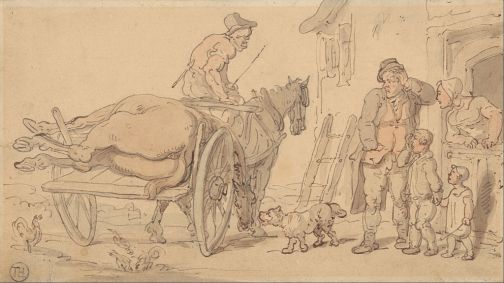
Thomas_Rowlandson_-_A_Dead_Horse_on_a_Knacker's_Cart_-_Google_Art_Project

A Dead Horse on a Knacker’s Cart. Thomas Rowlandson, Wikipedia

Even with the help of beasts of burden, moving heavy furniture and a large quantity of personal possessions was no small feat. The pace of travel was slow and often laborious. Before roads were macadamized in the early 19th century, they were in poor condition. After heavy rains, deep ruts and mud slowed vehicles down. Winter snow and ice presented additional hazards. Animals as well as passengers and drivers suffered the most in these harsh elements. 

Working animals’ lives were even more drastically reduced from their exertions of pulling heavy wagons and over loaded carriages. Mail coaches during Austen’s day were the fastest means of land transportation. A faster speed was achieved by driving the horses at top speed and changing the teams every 12 to 15 miles or about every 2 hours. These horses, urged to attain maximum speed at whatever cost, had drastically shortened working lives and lifespans.

The images below show the challenges of moving heavy wagons in snow and mud. Click on the images to enlarge.

The liverpool mail near St Albans – Robert Havell (click the link to see image, which is copyrighted. Horses are stopped with its leader fallen.)

Types of vehicles and those who used them:

Travel for the upper classes:

Income determined the conveyance in which an individual or family moved and how many household goods could be transported over a certain distance. Aristocrats and rich landowners, like Mr Darcy, experienced few impediments. The rising middle classes could also choose more comfortable and efficient means of travel. One can imagine that Mr Bingley arrived at a fully furnished Netherfield Park, having sent trusted representatives and servants ahead of time to see to the details of moving personal belongings, and hiring competent locals to perform additional labor. Keep in mind that the upper crust travelled in style, while servants, aside from valets and ladies maids, accompanied their masters’ possessions in less desirable transportation.

  • For more visual references regarding carriages for the upper classes, Deborah Barnum of Jane Austen in Vermont offers valuable posts on the topic. Click on this link: IV of a series.  

Landless gentry and aspiring social climbers make do with less elegant equipages: 

Mrs Elton, a ridiculous character in Austen’s splendid novel, Emma, assumes that her social position in Highbury is equal to Emma’s. Austen has fun with the character, who utters one absurd opinion after another. She piggy backs onto her sister’s wealth by bragging about that woman’s elegant carriage, while expressing a desire to Mr Knightley to have a donkey. He wryly suggests that she could borrow Mrs Cole’s animal, implying she could save herself the money. In reality, the Eltons must make do with what they have.
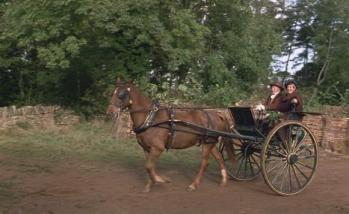
crofts curricle

Crofts arrive in a gig, Persuasion 1995. Gigs were not associated with the rich, and the Crofts drove theirs for local excursions only.

“She and her husband are provided with an unexceptionable carriage and horses that suffice for their needs, though of course they cannot be compared with her wealthy sister’s equipage, a barouche-landau….” – Diana Birchall quote in writer Sarah Elmsley‘s splendid blog.

Mr Elton, a mere vicar, served parishioners at a lower social scale than Rev Austen. While Elton received a salary and a rent-free a house, he received no tithes, which limited his income and necessitated his finding a wife with resources. He overstepped his ambition by wooing Emma Woodhouse, but settled for Augusta Elton, whose connections are murky. His marriage to Augusta increased the readers’ enjoyment of the couple’s absurdities.

Austen’s father, Rev George Austen, enjoyed an income from a variety of sources, including a 10% tithe from parishioners from two parishes who could afford to pay the amount. He also oversaw a glebe land, which he farmed. This combined income should have served him well, but his large family necessitated that he and Mrs Austen run a boy’s boarding school for profit inside Steventon Rectory. When George retired, his son James inherited his living and the house the family once occupied, but Rev Austen retained the income from the tithes of the parishes he once served. When he died, this income ceased, plunging the Austen women into financial difficulties, which resulted in their continual quest to find more affordable lodgings — until Edward Austen Knight offered Chawton Cottage to them. This last move resulted in Jane Austen’s glorious creative period in which she published five novels during her lifetime.

Rev Austen and his family moved to Bath in 1801, with only the possessions that would fit into their new home. He no longer had his extensive library or the use of a horse and carriage. The family’s many servants were reduced to a cook, manservant, and one or two maids, depending on the family’s needs. Like other families in their economic situation, they used hired carriages, such as hackney coaches, or public coaches to reach destinations beyond walking distance. During the family’s move to Bath, the goods and possessions they could not physically take with them were most likely transported by a manservant in a wagon.
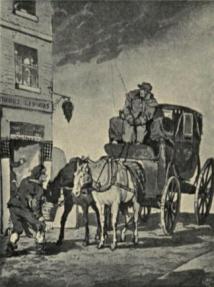
Hackney Coach 1800

Hackney Coach 1800

The 60-mile journey from Steventon to Bath took one day. A rest for the horses at an inn or hotel like the Petty France was a necessity. The following quote from Dean Cantrell describes Catherine Morland’s journey from Bath to Northanger Abbey. The Austen family must have also shared the same feelings: 

“Both carriages stop at Petty France, exactly half the thirty-mile distance from Bath to the General’s Abbey.  Catherine laments “the tediousness of a two hours’ bait” that permits “nothing to be done but to eat without being hungry, and loiter about without any thing to see” (NA, 156).  She clearly understands that it is the chaise with its “heavy and troublesome business” that requires a two-hour halt for the horses to be fed and refreshed…Fifteen miles from Bath, Petty France would have been a likely coach stop in 1801 and 1806 for Jane Austen.” – Yes, There is a Petty France, Dean Cantrell, Persuasions, 1987
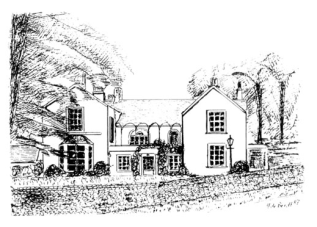
Screen Shot 2023-10-28 at 8.45.13 AM

Petty France Hotel

A sixty mile journey must have been exhausting in a public conveyance. View more images of public transportation in this Jane Austen in Vermont, post number III

People from humbler walks of life and their forms of transport:

Three Rowlandson images of a flying wagon speak volumes on how people with modest means traveled and transported their goods in wagons that look remarkably like the Conestoga wagons colonists drove across America. 

A flying wagon Rowlandson

Rowlandson, Flying Wagon, MET Museum, public domain, 1816

This Kendal Flying Machine, a wagon, is parked outside of an inn. A woman climbs up a ladder into the wagon. Three men stand at right. In Mr. Rowlandson’s England, Robert Southey described the laboriously slow progress of a flying wagon:

The English mode of travelling is excellently adapted for every thing, except for seeing the country…We met a stage-waggon, the vehicle in which baggage is transported, I could not imagine what this could be; a huge carriage upon four wheels of prodigious breadth, very wide and very long, and arched over with a cloth like a bower, at a considerable height: this monstrous machine was drawn by six large horses, whose neck-bells were heard far off as they approached; the carrier walked beside them, with a long whip upon his shoulder…these waggons are day and night upon their way, and are oddly enough called flying waggons, though of all machines they travel the slowest, slower than even a travelling funeral.” – P 23   


From Southey’s description and depiction of the flying wagon in the first Rowlandson image, one can see the differences in size and the numbers of people and the size of the loads each of these wagons could carry. Rowlandson’s first image of a flying waggon depicted a much smaller vehicle than the one shown in the rendering on P 23, which was drawn by six horses.

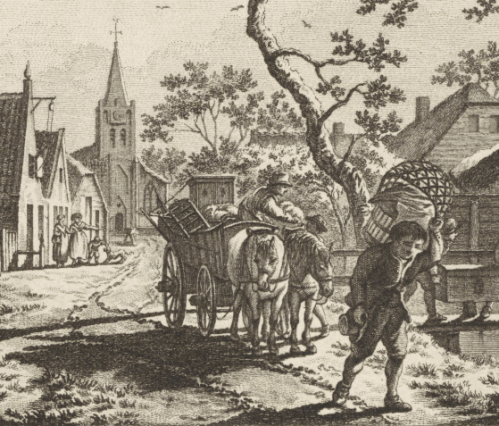
The detail below of an 1806 Dutch etching from The Rijksmuseum shows a cart laden with furniture moving through a small village. A man walking in front seems to be carrying baskets with items inside.
Screen Shot 2023-10-28 at 9.23.25 PM

As in the illustration above, affordable modes of transportation of two- or four-wheel uncovered wagons, were used by humbler people who could afford them. Examples are included in the slide show below. Notice that some images are current, since the mode of moving goods among the poor has changed little over the centuries. 
This slideshow requires JavaScript.

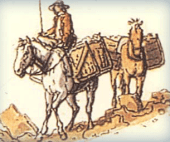
pack_horses

Detail of pack horses.

Very poor or itinerants who moved from place to place often walked, carried their personal goods in sacks, pushed them in wheelbarrows or hand carts, rode pack horses, or caught a ride by a kind stranger.

Rivers and inland waterways:

Overland transportation was not the only route people took to move to a new location. England’s streams and rivers had long been a fast, efficient means of travel.

Steam locomotives arrived 3 years before Jane Austen’s death. Before this time, transport via inland waterways and rivers provided a more comfortable and, in many instances, a faster way to move items. Ferries took people and wagons across river crossings.

A surge in canals building occurred in England in the second half of the 18th century, and by the mid-19th century these canals helped the expansion of the English Industrial Revolution. In Jane Austen’s day, most developers still struggled to make a profit building canals. Once they were introduced to connect city to city and routes within cities, these canals became an important source of transporting goods within England and were more profitable.
Horse_Drawing_Barge_on_the_Kennet_and_Avon_Canal

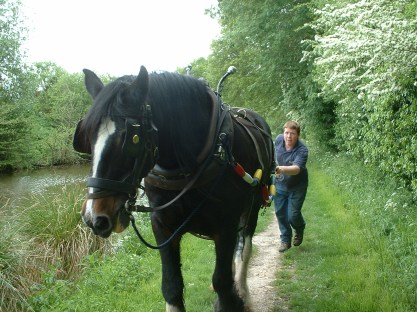
Horse drawing from a towpath on the Kennet and Avon Canal, England, Wikipedia

“A horse, towing a boat with a rope from the towpath, could pull fifty times as much cargo as it could pull in a cart or wagon on roads. In the early days of the Canal Age, from about 1740, all boats and barges were towed by horse, mule, hinny, pony or sometimes a pair of donkeys.” Wikipedia, Horse-drawn boat

Importantly, ferries, canal boats, and barges carried heavier loads: they also provided accessibility and affordability to a variety of people from different classes. 

Seaside ports:

Another popular means of transportation in England, an island nation, was via ships that sailed along and around its coastlines to various coastal ports and into major cities. 

Havell, A View of London Bridge and Custom House_-_B1977.14.18472_-_Yale_Center_for_British_Art

A View of London Bridge and Custom House, Robert Havell, Sr., Yale Center for British Art

Additional information on the topic:

Read Full Post »

By Brenda S. Cox

“Yesterday came a letter to my mother from Edward Cooper to announce, not the birth of a child, but of a living; for Mrs. Leigh has begged his acceptance of the Rectory of Hamstall-Ridware in Staffordshire, vacant by Mr. Johnson’s death. We collect from his letter that he means to reside there, in which he shows his wisdom. Staffordshire is a good way off . . .”—Jane Austen to Cassandra, Jan. 21, 1799

In 1806, Jane Austen and her family made a trip to visit their relatives in the north. They spent five weeks with her first cousin Edward Cooper, rector of Hamstall Ridware (whom I wrote about earlier). They stayed in his rectory, and must have attended the adjacent Church of St. Michael and All Angels and heard Edward Cooper preach there. The church is still much as Austen knew it, inside and out.

The Church of St. Michael and All Angels, Hamstall Ridware, where Jane Austen visited for several weeks in 1806. Photo © Brenda S. Cox, 2023

Hamstall Ridware History

Hamstall Ridware means “homestead,” or “place of the house,” by the “river ford.” It is on the River Blithe. The first word is Anglo-Saxon, the second is Celtic, indicating that the two people groups may have both been living in the area at the time it was named. Three other towns with the name Ridware (Pipe Ridware, Hill Ridware, and Mavesyn Ridware) are nearby.

The de Ridware family were the medieval “lords of the manor” for the area. The church was built, in the Norman style, around 1120 A.D, and expanded in the 14th and 15th centuries.

In the 1370s, the de Ridwares had no male heir, so the land passed to the Cotton family. A Cotton family tomb, from the time of King Henry VIII, still stands in the church. Each shield on the sides commemorates one of the children of John and Joanna Cotton. Half of each shield is their family crest, an eagle on a blue background. For the sons, the other half represents their profession. For the daughters, the other half shows the shield of their husband’s family.

This tomb from the time of King Henry VIII represents all the children of the Cotton family, the lords of the manor at the time. Photo © Brenda S. Cox, 2023

In the 1500s, the Cottons had no male heir, so the manor, Hamstall Hall, and the lands, passed to Sir Anthony Fitzherbert, the husband of the eldest daughter. 

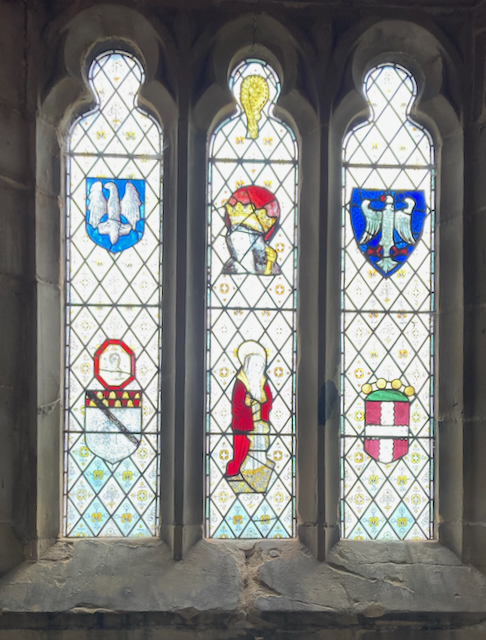
In 1601 the estate went to Sir Thomas Leigh of Stoneleigh, one of Jane Austen’s forebears. This early stained glass window, incorporating 14th century glass, commemorates all these patrons of the Hamstall Ridware church. Each family would have owned the advowson for the Hamstall Ridware church, the right to choose the rector of the church when the previous one died.

Stained glass window in Hamstall Ridware church. This window shows coats of arms of the families who have owned the manor and land of Hamstall Ridware: the de Ridwares of Hamstall on the upper right, the Cotton de Ridwares on the upper left, the Fitzherberts on the lower left, and the Leighs on the lower right. Alice Cotton, wife of Richard Cotton, appears near the top of the middle panel. Photo © Brenda S. Cox, 2023

The Leighs’ main home was at Stoneleigh Abbey (which we’ll “visit” later). The Hon. Mary Leigh of Stoneleigh Abbey was patroness of Hamstall Ridware in 1799.  When the previous rector, Mr. Johnson, died, she gave the living to her relative Edward Cooper. Before that he had been a curate, an assistant or substitute clergyman, probably with a low salary, at Harpsden. Jane and her family had visited the Coopers at Harpsden in August and September of 1799, before the Coopers moved to Hamstall Ridware in October. Edward invited them to visit Hamstall Ridware in 1801, but Jane said in a letter that they preferred to go to the seaside that summer. However, five years later, the Austens did make a long trip to visit their Leigh relations at Adlestrop, then accompanied their cousin, Rev. Thomas Leigh, who had just inherited Stoneleigh Abbey, to the abbey. From Stoneleigh they went to Hamstall Ridware, 38 miles away.

During this time, it’s possible that Jane may have seen the play Lover’s Vows, an important part of Mansfield Park. It was advertised in a village called Cheadle about an hour’s carriage ride away (Gaye King, “Visiting”).

Unfortunately, during Jane’s visit, Edward’s eight children came down with whooping cough, and Jane got it a few weeks later, after she got home (Letters, Jan. 7, 1807).

Displays in the church commemorate Jane Austen, her visit to Hamstall Ridware, the history of the church, and the Leigh family’s connections to the area. Photo © Brenda S. Cox, 2023
The church history board gives fascinating tidbits. For example, the parish register for 1715 lists the death of rector Thomas Allestree, M.A., and the induction of a new rector, Gorstelowe Monck, A.M. (same as M.A., Master of Arts); 7 baptisms (presumably of babies); 5 marriages including two to widows, and two others by license, both with one spouse from another parish; 7 burials, including Rev. Allestree (age 77) in July, his widow in December, and two babies buried shortly after their baptisms. An adjacent news article about Rev. Allestree says he wrote and memorized 500 sermons, and preached them a total of 5,000 times! Photo © Brenda S. Cox, 2023

The Rectory

The rectory (or parsonage, the house provided for the rector of the parish) where the Austens stayed is now a private home. It is now difficult to see even from the outside, but this photo shows the building before a gate was built.

The Hamstall Ridware rectory, before gates were installed. Jane Austen and her family stayed here for five weeks in 1806 with Jane’s cousin Edward Cooper. Photo © Jack Barber, 2017, used by permission.

It has been speculated that this rectory was the pattern for the Delaford rectory, where Edward and Elinor Ferrars settle in Sense and Sensibility. The layout of the Delaford estate, with “stew-ponds” (fish ponds), “a very pretty canal” (perhaps suggested by the nearby river), and “great garden walls,” also corresponds to some features of the Leighs’ estate at Hamstall Ridware.

Gaye King wrote,

“Edward had found the rectory quite large enough to accommodate his growing family. Like the fictional parsonage at Delaford it had ‘five sitting-rooms on the ground floor, and … could make up fifteen beds’ (292). So the young rector could look forward to maintaining the tradition of liberal hospitality such as that he had enjoyed at the Steventon parsonage. When Jane Austen, together with her mother and sister, did eventually spend those five weeks at Hamstall Ridware in 1806 Edward and Caroline had eight children. There were also, living in at the rectory, two maids and a governess, yet there was still ample accommodation for the guests.”

(I have since noticed that the five sitting rooms and fifteen beds were characteristics of the manor house where Col. Brandon lived, not of the parsonage! And I doubt a country parsonage would have so many sitting rooms.)

However, relatives who visited wrote that it was “a beautifully situated parsonage house on a considerable eminence, back’d with fine woods, seen at a distance from the road to this happy village,” and that the church “was a very neat old Spire Building of stone, having two side Ailes [sic] Chancel &c. and makes a magnificent appearance as a Village Church” (quoted in Deirdre Le Faye, Jane Austen: A Family Record, 157).

The Church of St. Michael and All Angels, Hamstall Ridware

The Church of St. Michael and All Angels, Hamstall Ridware, where Jane Austen’s cousin Edward Cooper was rector from 1799-1833. Photo © Brenda S. Cox, 2023

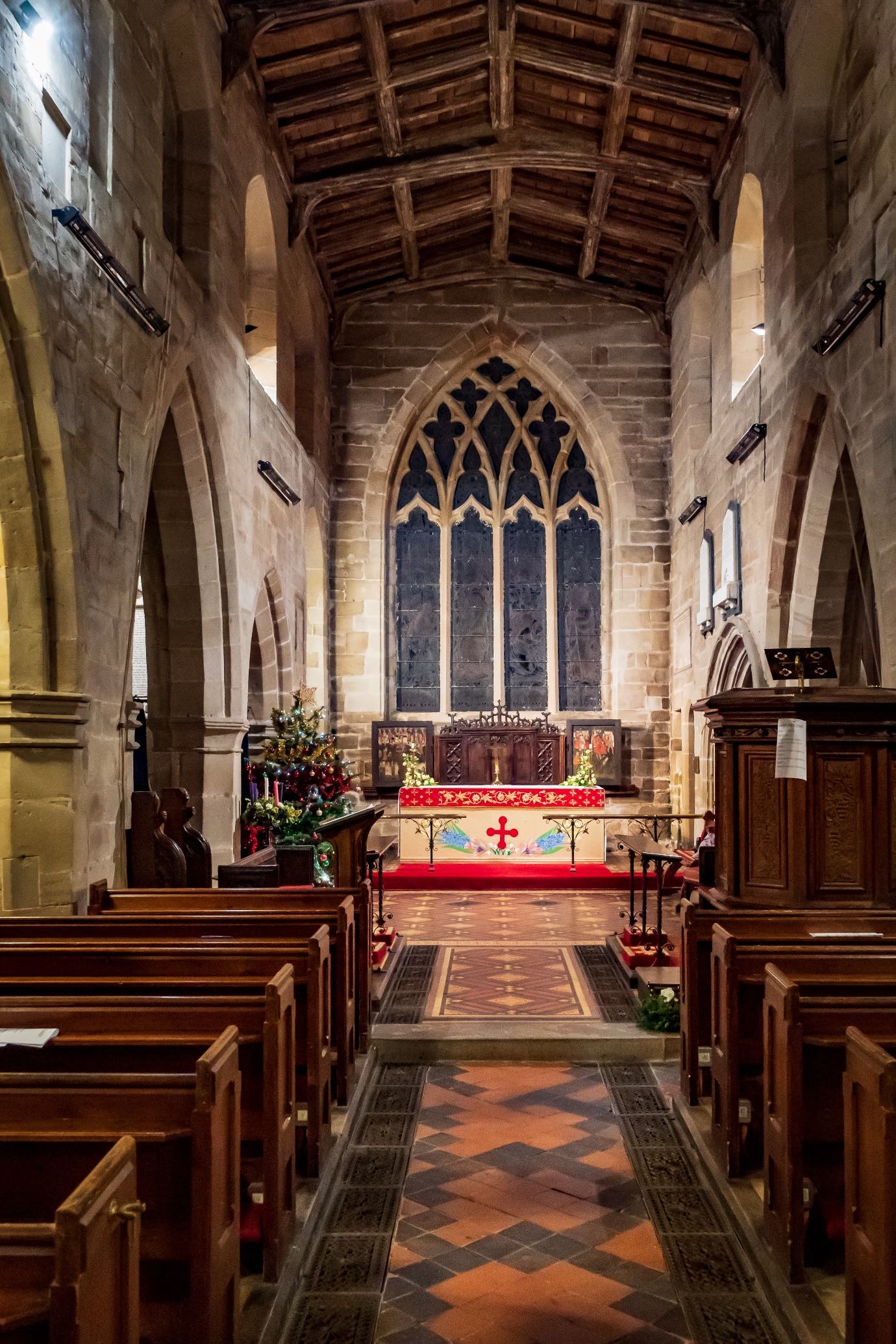
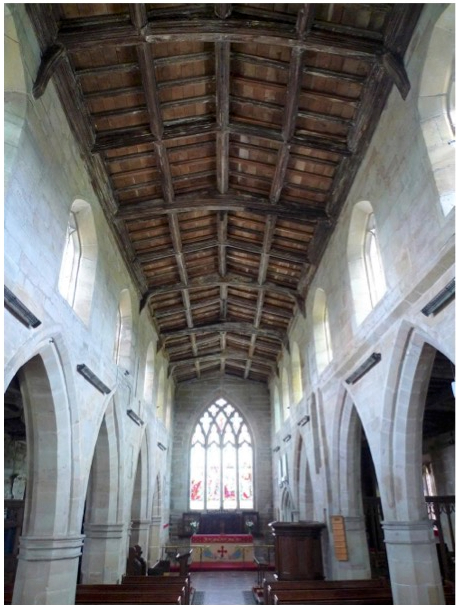
The church is large, seating 200 people, almost three times the size of Jane’s church at Steventon (which seats about 75). It has a long central aisle leading to the chancel, where the altar sits, and two side aisles. Lining both sides is a clerestory, high walls with a series of windows which let in natural light.

Central aisle of the Hamstall Ridware church. Photo courtesy of Hamstall Ridware PCC, used by permission.
Unusually, the upper section of the church has clerestory windows down the whole length of the church, lighting up the whole interior. The aisle roofs are “moulded ridge pieces and tie beams.” Photo courtesy of Hamstall Ridware PCC, used by permission.
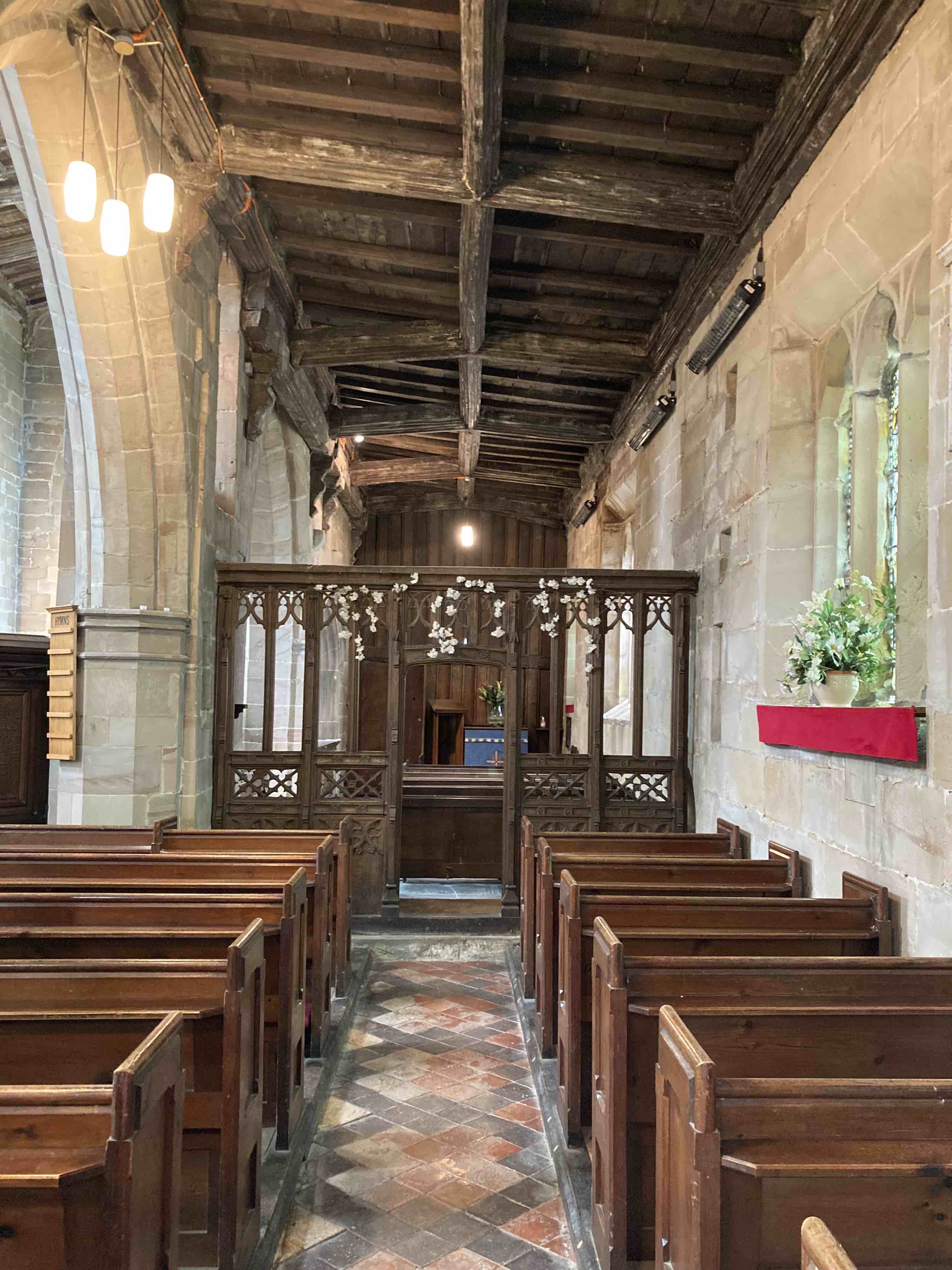
Late 15th century chapel screen on a side aisle. Photo © Brenda S. Cox, 2023

Like many churches in England before the Reformation, this church once had a rood screen separating the chancel from the nave. This was a barrier between the chancel, where the clergy celebrated mass at the altar, and the lay people worshiping in the nave. It was usually topped by a cross; the Anglo-Saxon word for cross is rood. Some churches also had a rood loft, above the screen, from which a choir would sing parts of the service. Many rood screens and lofts were destroyed during or after the Reformation, to symbolize people’s more direct access to God.

A few steps, which once led to the rood loft, still remain in one wall. Two paintings from the rood screen are now behind the main altar in a reredos (reer-ih-dahss is one pronunciation). This means a decorative panel behind the altar. These paintings are from the late 15th century, by an unknown accomplished artist, probably local.

The reredos behind the altar includes two 15th century paintings from the rood screen of the church, which was destroyed during the Reformation. The one on the left is apparently unique in England. It shows times when Christ’s blood was shed: “the circumcision, the agony in the garden, the scourging, the crown of thorns and the crucifixion,” according to the church booklet. “The right-hand panel shows the procession of the cross with St. Mary Magdalene kneeling in front of it. Both panels have been heavily scratched and scored. This was probably done at the time of the Civil War [1642-1651], when everything that had Roman Catholic associations was defaced.” Photo © Brenda S. Cox, 2023

Memorials to the Cooper Family

Edward Cooper and his family left their mark on the church. The memorial to Edward Cooper says:

In a vault near this spot, are deposited the remains of the Rev. EDWARD COOPER, who, for upwards of 30 years was rector of this parish, and for many years of the adjoining parish of Yoxall also: in both which places, (as a faithful minister of Christ, and endeared to all his parishioners,) he discharged, with unremitting zeal, the duties of his sacred office.

He was the only son of the Rev. Edward Cooper, L.L.D. vicar of Sonning Berks, &c. and prebendary of Bath and Wells; and of Jane his wife, grandaughter of Theophilus Leigh, Esq., of Addlestrop, in the county of Gloucester,

He was formerly fellow of All-Souls’ College, Oxford, as was his father also.

He departed this life, the 26th day of February, 1833, in the 63rd year of his age.

“He being dead yet speaketh”

Within the same vault also repose the remains of CAROLINE ISABELLA, his widow, only daughter of Philip Lybbe Powys, Esq. of Hardwick House in the county of Oxford,

She died on the 28th day of August, 1838, in the 63rd year of her age.

This tablet is erected by their eight surviving children, as a tribute of grateful affection, and respect, to the memory of their deeply lamented, and much beloved parents.

Memorial in Hamstall Ridware church to Edward Cooper, rector. Photo © Brenda S. Cox, 2023

As the memorial notes, Edward was also rector of a neighboring parish, Yoxall (from 1809). Like George Austen, he needed the income from two small parishes and was able to serve them both since they were close. Rev. Thomas Gisborne, another Evangelical minister, was from Yoxall. He wrote a book that Cassandra and Jane both liked, An Enquiry into the Duties of the Female Sex (letter of Aug. 30, 1805). Perhaps Edward had recommended it to them. Though we have no record of it, it’s possible Jane could have met Gisborne during her visit. He was a friend of Edward’s, and he and Henry Austen were the godfathers of one of Edward’s sons. Gisborne was also involved with Wilberforce in fighting the slave trade. (Gaye King, “Cousin” article)

On another wall is a memorial to Edward’s son and grandson. His youngest son Warren died in 1844, age 39, and Warren’s son, Edward-Warren, died as an infant in 1840.

Hamstall Ridware memorial to Edward Cooper’s son and grandson. Photo © Brenda S. Cox, 2023

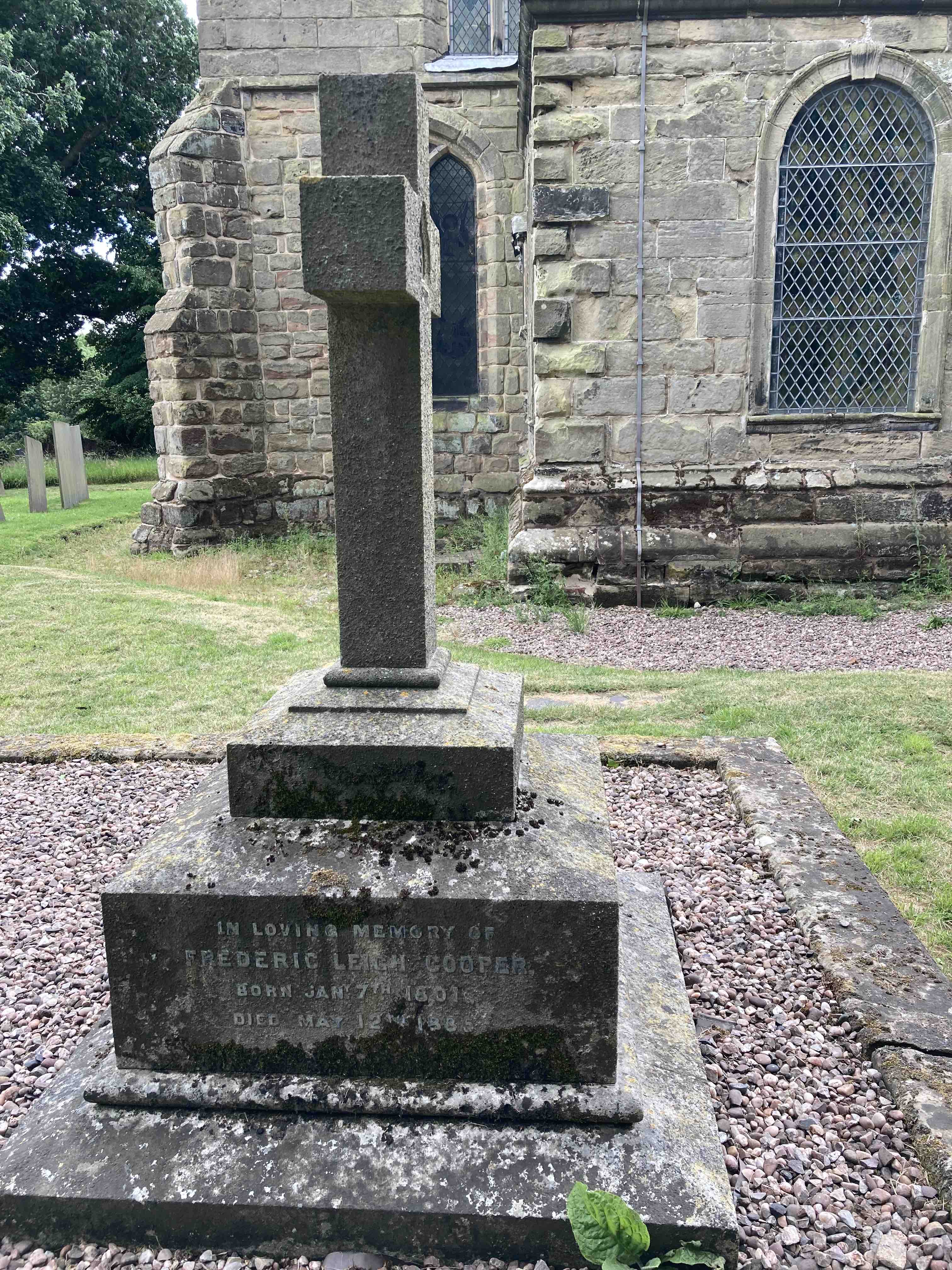
Outside, under a large cross, are the graves of Edward’s third son, Rev. H. C. Cooper, vicar of Barton-under-Needwood (5.6 miles away), who died in 1876, “in the 76th year of his age.” Also Edward’s second daughter, Cassandra Louisa, who died in 1880, “in the 84th year of her age.” The final inscription reads, “Looking for the mercy of our Lord Jesus Christ unto eternal life. Jude, v. 21”

Another side memorializes Frederic Leigh Cooper, born 1801, died 1885. This was Edward’s fifth child

This cross identifies the burial site of several of Edward Cooper’s children in the Hamstall Ridware church burial ground. Photo © Brenda S. Cox, 2023
Side view of cross with inscription to another son. Photo © Brenda S. Cox, 2023

Glebe

Green fields surround the church. Most churches in England had glebe land, farmland that provided income for the clergyman. In 1978, all glebe land was transferred to the dioceses, who administer it now. (A diocese is a group of church parishes overseen by a bishop.) Some modern locations in England still retain the name glebe. Hamstall Ridware is part of the Diocese of Lichfield, and I was told the diocese still receives income from grazing on glebe lands nearby. Glebe income today is used to pay clergy salaries and other expenses.

The Hamstall Ridware church is in the midst of green fields, some of which still provide income to the Church of England today. Photo © Brenda S. Cox, 2023

The Church Today

The Hamstall Ridware church is now part of a benefice including four parishes with one rector. In 1831, the population of the parish was 443. In 2011 it was 313.

Hamstall Hall, previous home of the Leigh family, is now mostly in ruins. But, according to the church booklet, the current Lord Leigh is still “a patron of the United Benefice of King’s Bromley, the Ridwares, and Yoxall jointly with the Bishop of Lichfield and the Dean and Chapter of Lichfield Cathedral.” (In other words, they jointly choose/approve the clergymen for the churches of the benefice.) 

Like Chawton and Steventon, Sunday services are held at the Hamstall Ridware church weekly, usually with only ten or so faithful parishioners attending. The church is large, seating 200 people, but it has little heating, and only a chemical toilet outside. However, they do get big crowds for Harvest, Christmas, and other special services, as well as lectures and concerts. And many visitors come to the church, which is open in the daytime, though apparently the door can be tricky to open.

The Church of St. Michael and All Angels is well worth a visit for Jane Austen enthusiasts. It is just over an hour’s drive, by car, from Stoneleigh Abbey. The Samuel Johnson Birthplace Museum in Lichfield is on the way.

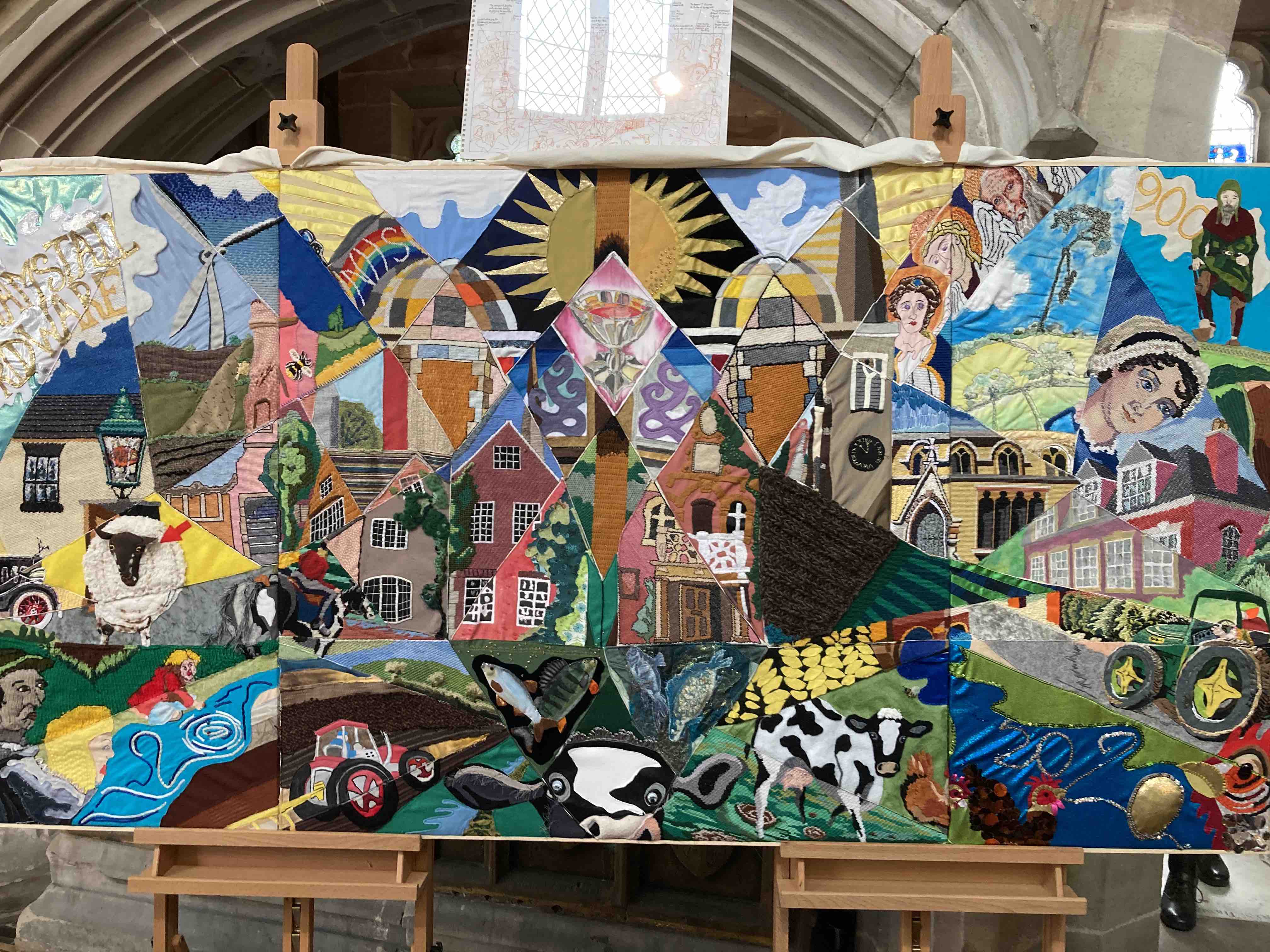
The people of the church created a tapestry depicting Hamstall Ridware through 900 years of history. Jane Austen’s face is prominent on the right side. Photo © Brenda S. Cox, 2023

For Further Exploration

This post from the Ridware Historic Society includes diary entries from Edward’s mother-in-law, during her visits to the family at Hamstall Ridware, as well as more information about the town and its people.

The church website gives some history and a schedule of services.

The historic listing tells more details of the church’s architecture.

A video showing many aspects of the church

Booklet on the church (a slightly older version than the one I used for this article)  

Photos on Flickr of Hamstall Hall, Hamstall Ridware church and Yoxall church  

Gaye King “Jane Austen’s Staffordshire Cousin: Edward Cooper and His Circle,” Persuasions 1993

Gaye King, “Visiting Edward Cooper,” Persuasions 1987

Donald Greene article, “Hamstall Ridware: A Neglected Austen Setting,” Persuasions 1985 

Posts on other Jane Austen Family Churches

Steventon

Chawton

Adlestrop and the Leigh Family

Stoneleigh Abbey Chapel

Great Bookham and Austen’s godfather, Rev. Samuel Cooke

Ashe and Jane’s Friend Mrs. Lefroy 

Deane

Brenda S. Cox is the author of Fashionable Goodness: Christianity in Jane Austen’s England. She also blogs at Faith, Science, Joy, and Jane Austen.

Read Full Post »

Letterlocking was a method used by European societies between the 15th – 18th centuries to keep messages private.  Ancient human societies found other techniques to protect their messages through the use of seals, or, as in the case of Ancient Mesopotamia, cylinder seals that were unique to each owner. These were eventually replaced with stamp seals, some of which are still used today in the form of signet rings.

Today I seek other ways to keep my public affairs private. Passwords for my online correspondence and purchases are changed frequently, and I make sure to have a secure two-step process for accessing the information along with a back up plan.

During Jane Austen’s lifetime, envelopes were not yet used. The extra weight made the expense of sending or receiving letters more expensive. Therefore, the paper was carefully folded. Often the lines were crossed, as shown in an article from this blog.  Images of Austen’s surviving letters demonstrate the method by which she folded them, as described by Jane Austen’s House .

The letter was written across the first three pages and the top and bottom thirds of the fourth page, leaving its middle third blank. With the first page uppermost, the bottom third of the letter was then folded upwards and the top third folded down so that the edges met in the middle. Then, holding the letter lengthways, the left-hand and right-hand sides were tucked inside each other. The packet was sealed with wax and the address written on the blank reverse. –  Room 5: How to Write and Fold a Letter, Jane Austen’s House

One method of letterlocking is shown in the YouTube video below.

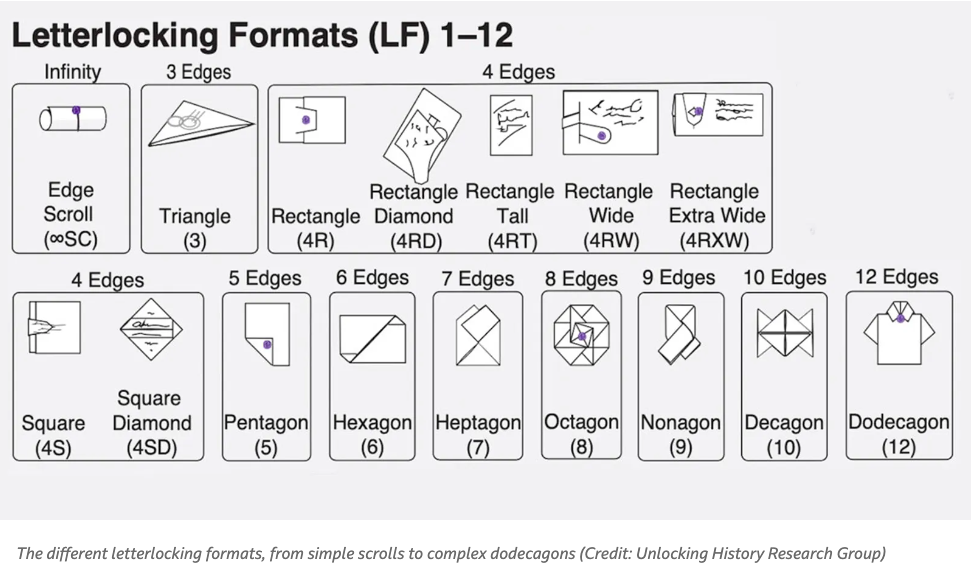
Letterlocking is the art of using specific folds and cuts in flexible paper to seal it shut for document security. Because paper was not always as common as it is today, it was much more expensive, which led to minimizing the use of paper as much as possible. At this point in history, envelopes would have been seen as excess cost, an issue that was quickly solved with letterlocking.” — Securing Ancient Secrets: The Fascinating History of Letterlocking, Ancient Origins

In a BBC article (see link below), Richard Fisher described the historic research that uncovered the secrets to letterlocking in the early 2000’s. Conservator Jana Dambrogio was the first woman allowed to work in the Vatican Secret Archives when she found a cache of documents and noticed cuts, creases and folds in the paper. Thinking they were evidence of letterlocking, she scientifically described what she observed.

Screen Shot 2023-10-17 at 1.06.18 PM

She and a colleague, Starza Smith, searched for more letterlocking samples, which they often found in old archives and museum collections. Recently they discovered a trunk containing 2,600 letters from 17th-Century Europe, of which 577 were unopened. This trove provided details of European life during the 1600s.

As a final act before her execution, Mary Queen of Scots sealed a letter she wrote to her brother-in-law with a spiral lock. He would have known her message had been intercepted if that seal arrived broken. The irony would not have been lost on a juvenile Austen, whose “History of England” included a memorable passage about the doomed queen.

Read Full Post »

Over the last few months, we’ve explored timeless romantic themes in Jane Austen’s novels that are still frequently used in today’s popular books, movies, and television shows. Thus far, we’ve covered the following themes in this series: “Enemies to Lovers” in Pride and Prejudice, the “Slow Burn” Romance in Emma“Best Friends to Lovers” in Mansfield Park“Second-Chance” Love in Persuasion, and “The Meet-Cute” in Northanger Abbey.

Last but certainly not least, this brings us to Sense and Sensibility and one of Austen’s most mature and intricate plots. Sense and Sensibility is unique in that it contains two main love stories with its sister-heroines, Elinor and Marianne Dashwood. Though Elinor is the main protagonist of the novel, Marianne’s romantic life is often front-and-center with its high drama and plot impact.

Love Triangles

In the world of storytelling, love triangles provide a potent plot device. There’s the age-old King Arthur-Guinevere-Lancelot story that’s been told again and again; the love triangle/identity mix-up in Shakespeare’s Twelfth Night; and the explosive Heathcliff-Cathy-Edgar triangle in Wuthering Heights. And this is only the tip of the iceberg. We could add dozens of other famous triangular love stories to this list.

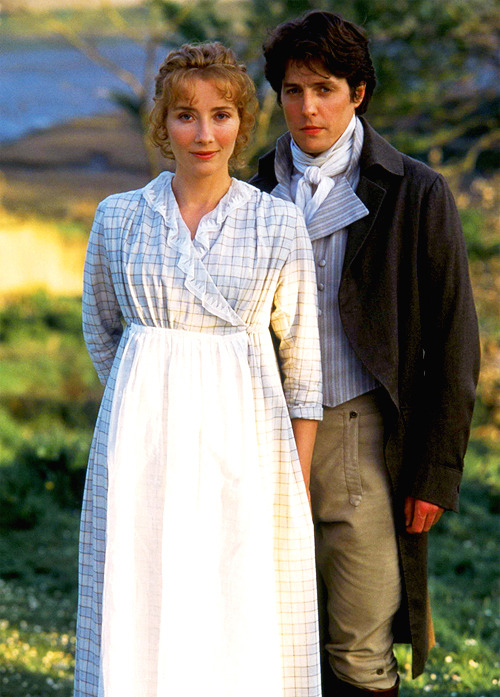
In Sense and Sensibility, Austen provides her readers with not one, but two separate love triangles to untangle between Elinor-Edward-Lucy Steele and Marianne-Willoughby-Colonel Brandon.

In each of these triangles, there is one “wrong” person standing in the way of true love with Mr./Ms. Right. For Colonel Brandon, Willoughby takes the spotlight and all of Marianne’s attention. For Elinor, Lucy stands in the way of her happiness with Edward, due to an unfortunate youthful promise made by Edward.

Falling for Mr./Ms. Wrong, Finding Mr./Ms. Right

In both of these love triangles, a character falls for Mr./Ms. Wrong first and later finds Mr./Ms. Right. Elinor and Colonel Brandon both wait in the wings and watch to see if Edward and Marianne will break free from their previous attachments. They both must wait and wonder; they both feel the pain and angst of separation; and they both know that they may never find their personal happy ending.

The only difference is, Edward and Elinor have a mutual attachment to one another, while Marianne does not develop romantic feelings toward Colonel Brandon until far later in the novel. She thinks he’s far too old for romance and “thirty-five has nothing to do with matrimony”:

Colonel Brandon is certainly younger than Mrs. Jennings, but he is old enough to be my father; and if he were ever animated enough to be in love, must have long outlived every sensation of the kind. It is too ridiculous! When is a man to be safe from such wit, if age and infirmity will not protect him?

Sense and Sensibility

Thus, Colonel Brandon must wait in the wings, ever true and ever patient, caring deeply for Marianne and wanting the best for her, even if it means watching her break her heart and health over Willoughby.

Mr. Wrong: The Problem with Willoughby

As in life, Jane Austen’s characters often have to fall for Mr./Ms. Wrong before they can appreciate Mr./Ms. Right. In some of her novels, she even uses a “red herring” to keep her readers distracted (Frank Churchill is one such example). In Sense and Sensibility, Marianne Dashwood falls for a young, dashing, handsome, attractive man who appears to be everything she’s ever hoped for in a man.

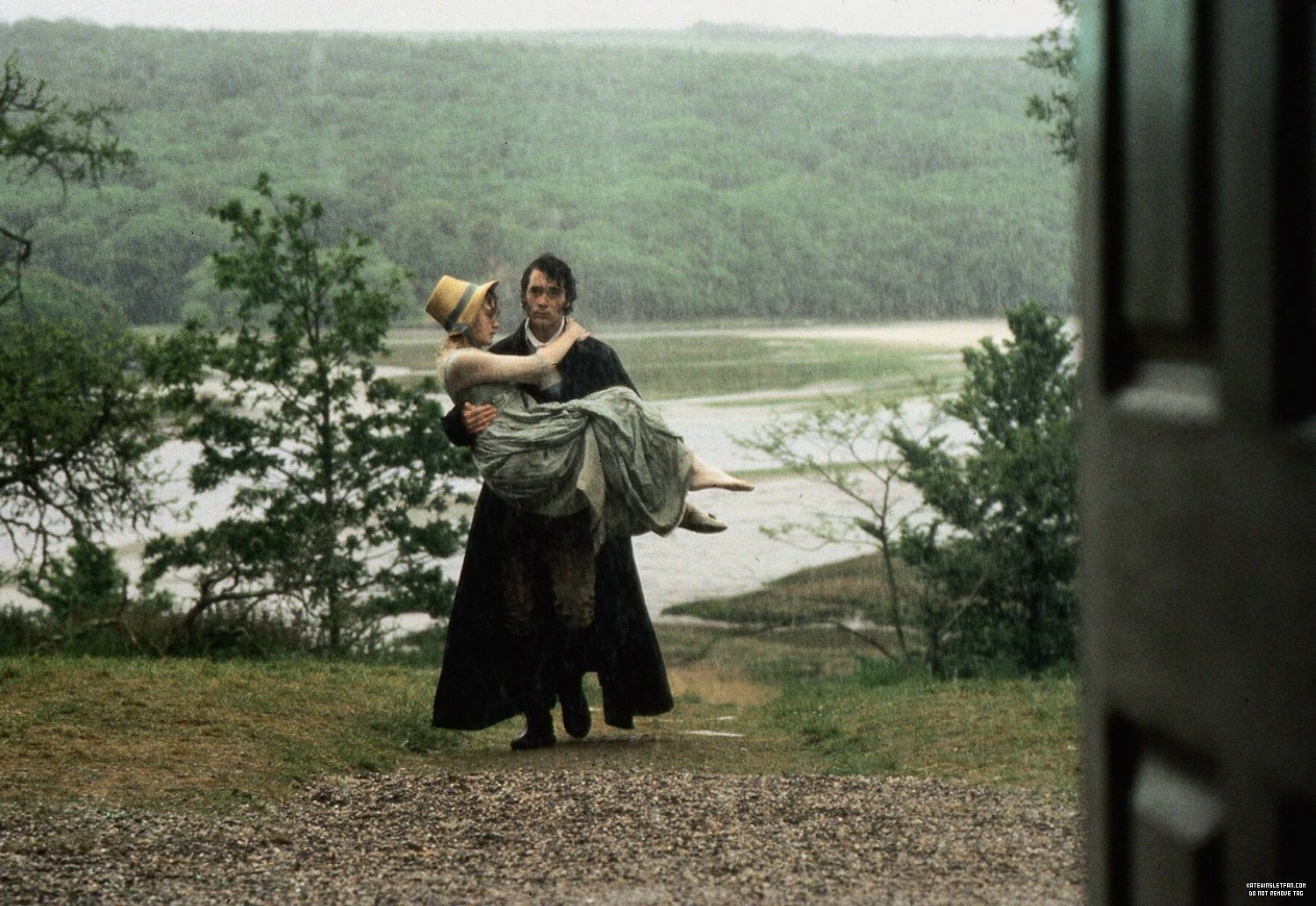
To make matters even more exciting, their “meet-cute” involves an intoxicating rescue scene where Willoughby lifts Marianne and carries her home after she falls down and is hurt. How could a young lady, especially a young romantic woman like Marianne, not fall for a strong, handsome man who literally sweeps her off her feet and carries her through the rain to safety.

The problem is, no matter how dashing, friendly, attractive, romantic, or exciting Willoughby might appear, he is not who he seems. As we later find out from Colonel Brandon, Willoughby has a checkered past and has impregnated (at least) one young woman out of wedlock, without taking any responsibility for her care, sufficiently ruining her reputation and her chances (in that time/culture) of a happy future.

But, you might ask, how could anyone have known, since the fate of Colonel Brandon’s ward was unknown to any of the Dashwoods until much later? Though no one could believe just how bad he is, Austen does provide clues about Willoughby’s character through her descriptions of his conduct. He frequently crosses lines of propriety (usually a red flag in Austen’s novels) and makes himself far too cozy and familiar with Marianne without making any firm promises.

Today, dozens of movies and books follow a similar script. We often see characters like Mr. Willoughby, Mr. Wickham, and Mr. Crawford who are just a little bit too handsome, too dashing, and too perfect to actually be Mr. Right.

Ms. Wrong: The Problem with Lucy Steele

The problem with Lucy Steele is more a matter of youthful ignorance and inexperience. Edward Ferrars is captivated by Lucy’s beauty and, due in part to forced proximity, experiences young love and makes a commitment to someone who does not match his personality, intelligence, values, or interests in life. Austen describes her as “illiterate, artful, and selfish” – certainly no match for a thoughtful, principled man like Edward.

Not surprisingly, he soon regrets committing himself to a woman like Lucy:

The youthful infatuation of nineteen would naturally blind him to every thing but her beauty and good nature; but the four succeeding years—years, which if rationally spent, give such improvement to the understanding, must have opened his eyes to her defects of education, while the same period of time, spent on her side in inferior society and more frivolous pursuits, had perhaps robbed her of that simplicity which might once have given an interesting character to her beauty.

Sense and Sensibility

And while Lucy at first only appears to be an ignorant, vapid girl without much sense, we quickly realize she is far less sweet and far more dangerous than meets the eye. She’s not in love with Edward; she merely sees him as a “way up.” We later find out that she’s a conniving “gold digger” (to use today’s terms) who is looking for any way to climb the social ladder and make the best match she can, regardless of who she hurts or what anyone thinks.

This type of female red herring shows up in many popular romantic movies and books today as well. However, in many of today’s plot lines, this type of female character tends to be some kind of shark in the business world who cares more about appearances and getting ahead than building a loving relationship and happy life with the handsome main character.

Finding Mr. (Colonel) Right

Marianne must go through heartache before she can appreciate or fall in love with Colonel Brandon. He watches and waits, hoping against hope, until she begins to blossom and heal from her broken heart. His steadiness, thoughtfulness, and gentlemanlike manner is a welcome change from the high drama and passion of her first attachment, and soon an attachment forms:

Instead of falling a sacrifice to an irresistible passion, as once she had fondly flattered herself with expecting,—instead of remaining even for ever with her mother, and finding her only pleasures in retirement and study, as afterwards in her more calm and sober judgment she had determined on,—she found herself at nineteen, submitting to new attachments, entering on new duties, placed in a new home, a wife, the mistress of a family, and the patroness of a village.

Colonel Brandon was now as happy, as all those who best loved him, believed he deserved to be;—in Marianne he was consoled for every past affliction;—her regard and her society restored his mind to animation, and his spirits to cheerfulness; and that Marianne found her own happiness in forming his, was equally the persuasion and delight of each observing friend. Marianne could never love by halves; and her whole heart became, in time, as much devoted to her husband, as it had once been to Willoughby.

Sense and Sensibility

In today’s popular movies and books, a character like Colonel Brandon is sometimes the childhood best friend or the nerdy next door neighbor that suddenly turns handsome. It’s usually a matter of the main character being blinded at first by a passionate but unhealthy relationship and then “coming to their senses” and noticing the quality person that’s been there all along.

As far as the age-gap between Brandon and Marianne (which was quite common during Austen’s day and culture), many of today’s romantic storylines, such as As Good as It Gets, Crazy Heart, and Autumn in New York, feature a May-December romance.

Finding Ms. Right

From the moment they meet, it’s clear that Elinor and Edward are perfect for one another in every way. For Edward, once he meets a woman of Elinor’s caliber, there is no question that she is far superior to Lucy Steele.

However, Edward is a man of his word and refuses to do wrong by Lucy Steele. This honorable choice only serves to make Edward more attractive, even though Elinor is pained deeply by the knowledge that he must marry an ignorant woman he does not love. Like Brandon, Elinor waits patiently, enduring much pain, until Edward is finally set free.

Dozens of movies and televisions shows use this type of plot line where the main character must come to the realization that their current relationship is all wrong and someone else is a much better fit. Sweet Home Alabama is one mainstream movie example of this type of love affair.

Love Triangles in Popular Media

More romantic comedies feature a love triangle of some kind in today’s world of romantic writing.

The following are some popular movies (and/or books) with this theme: Pretty in Pink, While You Were Sleeping, The Notebook, Beauty and the Beast, Spider-Man, The Hunger Games, Titanic, Twilight (Team Edward v. Team Jacob), My Best Friend’s Wedding, Bridget Jones’s Diary, Sabrina, Reality Bites, Gone with the Wind, Something Borrowed, Pearl Harbor, Pirates of the Caribbean, and The Princess Bride.

Some well-known television love triangles include: Dawson’s Creek, Friends, Gilmore Girls, The Office, Beverly Hills 90210, Sex & The City, How I Met Your Mother, Felicity, Outlander, The Summer I Turned Pretty, Never Have I Ever, Friday Night Lights, Lost, and Grey’s Anatomy.

Though none of these shows or movies holds a candle to Austen’s writing, it’s clear that love triangles and plot twists about finding and/or waiting for Mr./Ms. Right continue to keep audiences coming back for more.

Happily Ever After

In the end, everyone lives happily ever after. (Except, of course, those characters whom Austen deems foolish or undeserving of true happiness.) As always, Austen provides her reader’s with a satisfying ending: “Let other pens dwell on guilt and misery. I quit such odious subjects as soon as I can, impatient to restore everybody not greatly in fault themselves to tolerable comfort, and to have done with all the rest.”

As we close this pop culture series on Jane Austen and Rom Coms, I’d love to know which couples and romantic themes are your favorite(s) in her novels!


RACHEL DODGE teaches college English classes, gives talks at libraries, teas, and book clubs, and writes for Jane Austen’s World blog. She is the bestselling author of The Little Women DevotionalThe Anne of Green Gables Devotional and Praying with Jane: 31 Days Through the Prayers of Jane Austen. Now Available: The Secret Garden Devotional! You can visit Rachel online at www.RachelDodge.com.
Read Full Post »

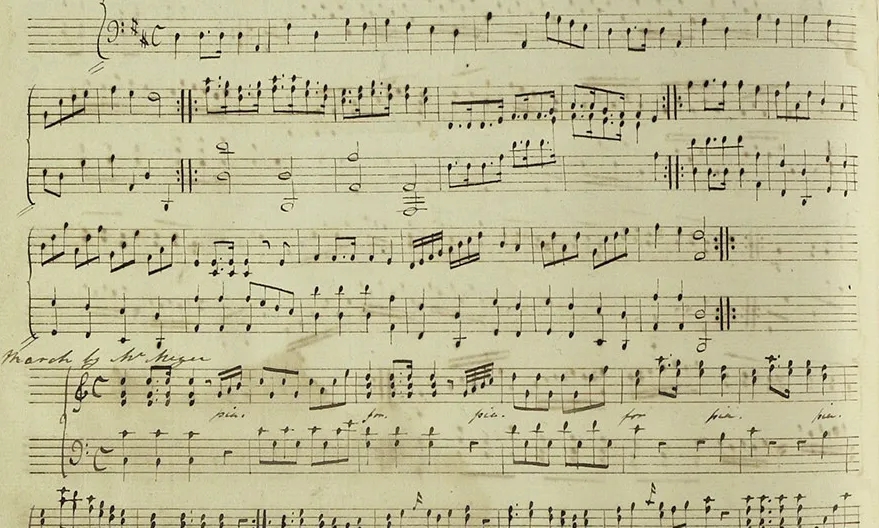
Jane Austen’s relationship with music, especially her private morning sessions on the piano forte before her family arose, was as creatively important to her as her writing. Digitized versions of the Jane Austen Music Books are stored on the Southampton UK website, where scholars, musicians, and Austen fans can peruse the music that the family liked and deemed important.

“The Austen Family Music Books is a collection of 18 albums of music containing around 600 pieces that belonged to the 19th century writer and her relations.”

Yet even with these troves of treasures, modern audiences are left to wonder:

screen_shot_2016-07-15_at_110010_am

This musical score, in Jane Austen’s handwriting, is one of nearly 600 Austen family musical treasures available in an online archive. Jane Austen Museum/Public Domain

“So what kind of music did Jane Austen like to play?

“The line between classical and popular music was very soft in that period,” [Austen scholar Professor Joan] Ray noted. “She lived 1775 to 1817. So she has a lot of popular music but, for example, she had a popular song called ‘William.’ But when music scholars really looked at the 20th and 21st centuries, they discovered it was actually based on Haydn’s Piano Concerto No. 1.”

For as much as Austen loved and collected music, and created characters in her novels who also loved music, she was light on specifics in her novels.” – Discover The Music Jane Austen Loved | Colorado Public Radio

The Colorado Public Radio site provides sample music from movie soundtracks based on Austen’s novels. Interestingly, today’s film composers have only a vague idea of the music Austen specifically liked because of the very few references she made in writing: they had to imagine which music best represented the stories in the time they were written. The 1995 film of Pride and Prejudice used music from Mozart, Haydn, and Schubert: it is still celebrated as one of the best musical scores in an Austen film.

Three Emma film musical scores

The music scorers of following three Emma film adaptations use different approaches to music to tell Austen’s tales of the young, self-important heroine. If you have access to the streaming videos or own the DVDs, you may want to listen to the music and compare how their composers move these plots forward. The scores of each film are suited to the settings and vision of the film director.

  • Emma 1996 with Gwynneth Paltrow: Rachel Portman, the female composer for the musical score, won an academy award.

“One of Rachel’s [Portman’s} most well-known film scores was for Emma (1996). Starring Gwyneth Paltrow, this film is an adaptation of the Jane Austen novel of the same name. A light and playful romantic comedy, the film needed the right music to go with it. As FF2 Contributor Sophia Jin says of Rachel’s score for Emma, “Portman’s music feels joyful and lighthearted. It is warming and brings a sense of calm and peace to the picture.” Rachel won an Academy Award for Best Musical or Comedy Score for Emma, making her the first female composer to win an Academy Award in that category.” – Composer Rachel Portman is a Mastermind of Movie Music, International Swans

YouTube video of 3 musical themes from Emma 1996

  • Emma 2009, with Romola Garai took an earthier musical approach. In this film adaptation, Highbury was depicted as a relatively unsophisticated country town outside of London. Emma danced to rustic music that could easily be played by local musicians. The costumes also had a more earthy, homemade feel.  

Emma 2009: 4 musical themes from the film – YouTube video

  • Emma 2020 mixes folksongs that were popular during Austen’s era, with classical, and modern compositions.

The score fits the beautiful, elegant vision of director Autumn de Wilde, who had only directed music videos before tackling a full length feature film.

As with today’s musical tastes, in Austen’s day the line between classical and popular music was ever shifting. She copied the music of “La Marseillaise”, the French National Anthem, and contemporary tunes and folk music that were popular in her day. The Family Music Books show the family’s preferences, but few references were made in Austen’s letters to the music she practiced daily. In her writings, she mentioned only one classical composer – Johann Baptise Cramer.  The following YouTube video features his Piano Concerto No 5 in C Minor, Opus 48.

Cramer was credited with renaming Beethoven’s final piano concerto the “Emperor”. Beethoven began composing this Concerto in 1809, while Vienna was under invasion from Napoleon’s forces for the second time.

No documentation exists that Austen heard this concerto in person. After moving to Chawton, Austen visited her brother Henry frequently in London to work on the publication of her novels. Before this period she lived in Bath after her father retired from his living in Steventon. In both cities she regularly attended recitals and concerts, and likely had a more sophisticated exposure to contemporary music, especially to the works that arrived in major cities from the European composers. 

Screen Shot 2023-09-30 at 1.47.14 PM

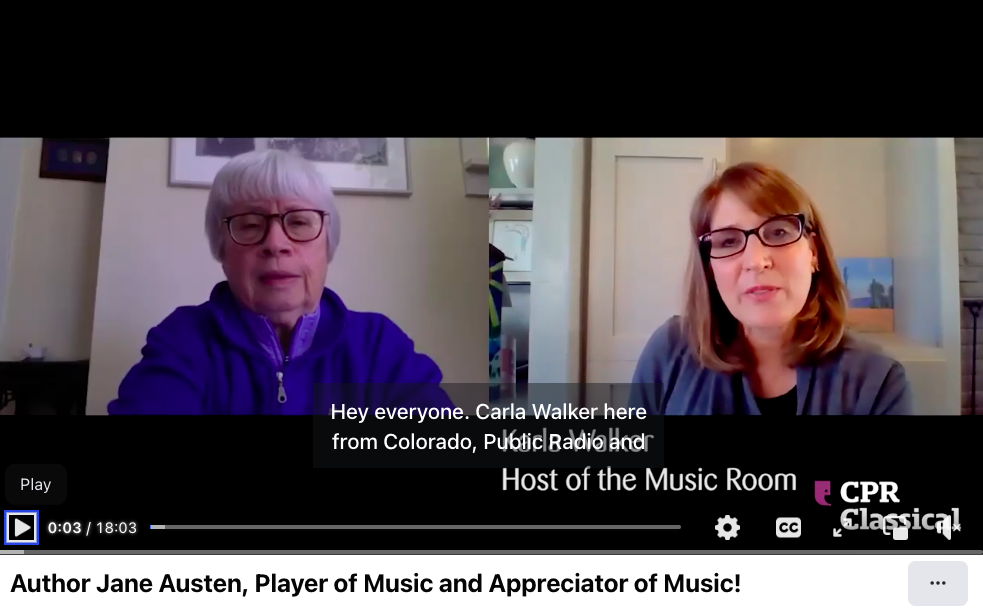
Screen shot of Joan Ray’s talk with Carla Walker, host of the Music Room, CPR Classical, Public Radio

Listen to the full discussion at this CPR https://fb.watch/no42mQ7gfS/  Video

The clue to Austen’s love for music was in her daily practice at the piano forte. Her novels also provided clues. Any young lady in her novels who lived in the upper strata of society learned to play the piano forte and/or harp and could give concerts at home events. As for Austen, her morning practices were private. She did not provide entertainment for others in a public situation as some films have suggested. Instead, Austen took quiet comfort and inspiration from her morning musicals. They added as much to her creativity as her writings.

More background information and suggested readings:

Read Full Post »

« Newer Posts - Older Posts »