Feeds:
Posts
Comments

Archive for the ‘Jane Austen’s World’ Category

Inquiring readers, 

Throughout 2025, our team – Vic Sanborn, Rachel Dodge, and Brenda Cox – will celebrate events and historical details during Jane Austen’s life (including the years just before and after).This year marks the 250th anniversary of Jane Austen’s birth on December 16th, 1775. She lived her short life during King George III’s reign. (Austen died in 1817, aged 41; the king died in 1820, aged 81.) Jane Austen Society organizations around the world will, in the next twelve months, mark this important year with their own celebrations and acknowledgments of her life and the events that influenced her talents. 

Most of us who have read about dining during the Georgian era learned about 18th C. dining etiquette largely through novels, films, and television shows that featured fabulous Aristocratic settings in high-ceilinged dining rooms, liveried servants at the ready to serve or take away plates, and tables laden with food in fine silver or porcelain dishes. 

Lady Catherine de Bourgh’s dinner for Elisabeth Bennet and Mr Collins and Charlotte. Screen shot taken by Vic Sanborn

But how was British food celebrated among the other classes? How did British empire building affect what it meant to be British in terms of food tastes? Both of these topics will be addressed in this post by 1) renowned British food historian, Ivan day, and 2) Dr Sarah Fox, senior lecturer and researcher at Edge Hill University.

1) Dining and Hospitality in Eighteenth Century English Provincial Towns and Cities

In this YouTube video, Mr Day discusses the influences that changed dining and hospitality in 18th century Britain. French foods at court in the 1690s began to spread from British aristocrats to the provinces throughout the 1700s and into the 1780’s and 90’s, when Austen was a child.

English food preferences changed in remarkable ways, which Mr Day discusses in detail. This 36 minute video offers both closed captioning and a transcript. 

A few highlights of the talk that struck me include these drawings of a provincial English meal in Cornwall that were made in the 1770s by a visiting Dutch artist. He provided a marvelous snapshot of 18th C. dining.

Provincial meal, two courses

Mr Day notes the details of these drawings, The details are remarkable. The pattens at the upper right were once worn to protect ladies’ shoes from mud. Only some vegetables were presented, with the emphasis still on eating meat. Notice the unique placement of a knife, fork and spoon to the right of the plates. A waiter holds a tray with wine glasses and points to a sideboard filled with more glasses, as well as decanters. 

Dinner table

The second drawing shows a table laden with assorted sweets: cookies, almond biscuits, oranges, butter cream, and preserved cherries. 

Dessert table

Another one of his observations intrigued me – that of an enormous English pie, labeled the Northern Country Great Pie in the video. James Lowther, the First Earl of Lonsdale House in Cumbria offered such a pie in 1763. It was the English aristocratic Christmas tradition to create this pie, meant to be eaten after dancing. Just imagine! The ball supper was served at 2 or 3 in the morning. Its size and weight of 22 stone (308 lbs.) must have been staggering, considering the list of baked animals that went into its making. This is a screenshot of half the list. 

Half the list of the animals in a ball supper pie

To view the entire list, click on this link entitled Eat the Entire Creation if You Dare, which sits on Mr Day’s blog, Food History Jottings. One can only read in awe at the amount of protein those animals contributed. These ball supper pies were not only large, but expensive, and most likely made from game hunted on the aristocrat’s land. 

At the end of his video, Mr Day showed pie molds that resulted in exquisite creations. This link to raised pie molds at MichaelFinlay.com shows a pie made by Mr Day from the Harewood mould.

Smaller, often hand-held pies were consumed by all classes, especially the working classes and travelers. By 1775, the year of Jane Austen’s birth, these portable foods had become ubiquitous. Pies were made for long distance travel. They encased meat and fruits in a variety of pastries that helped food to last longer, an important feature in an age without refrigeration. In 17th and 18th century Britain…

“…pies were devices in many senses of the word. They were used to preserve food,…and to prevent rot. Perhaps in part because of their preservative functions, pies were well-traveled, sent to friends and family members across long distances. Pies were embedded within global foodways, filled with ingredients sourced from around the planet.” – Hearse Pies and Pastry Coffins: Material Cultures of Food, Preservation, and Death in the Early Modern British World, Amanda E. Herbert &Michael Walkden, 07 Sep 2023

These portable foods had a long and varied history, starting centuries ago with the Egyptians, Greeks, and Romans. Recipes differed in each country, which did not diminish their popularity. Imagine being able to take food safely on long voyages, whether over land or sea, in an age when so many foods were consumed fresh.

The years between 1688 and 1815 were an important and exciting time for the British in terms of trade. Great Britain oversaw a sprawling empire during the Georgian era:

“Domestic industry [in England] flourished, with many workers pursuing dual occupations on a seasonal basis in industry and agriculture. English society contained a flourishing and more extensive middling sector than any other western country, including the Dutch Republic. This provided a strong platform for commerce with, and settlement in, far-flung territories.” – Symbiosis: Trade and the British Empire, Professor Kenneth Morgan, History, BBC.

Dr Sarah Fox, from Edge Hill University, examined the following topic: 

2) Britishness revisited: food and the formation of British identities in the late eighteenth century.

Trade routes and the enormous reach of the British empire over the world began to change British attitudes towards food. Dr Fox discusses this topic in detail in the YouTube video below. This presentation also has closed captioning and a transcript. In this instance, I found both features useful, since, while Dr Fox’s research is fascinating, her rapid and soft-spoken speech is hard to follow. Still, this video is a worthwhile investment of time.

During what is now regarded as the long 18th century, which spans the Georgian era that either ended in 1815 after the Napoleonic Wars, or in 1830, which marks the death of King George IV (these dates are  still under discussion), the British empire oversaw a dominant position among the major European trading empires. 

At the end of this period, traders and merchant ships enabled the British to successfully expand beyond the boundaries of their island nation. They imported goods and foods from North America and the West Indies, Africa, the Carribean, and the East Indies. Closer to home they traded with Ireland, Germany, and Russia. Maps from The Guardian show the routes taken overseas in the 18th C. with densely criss crossed lines of travel. 

King George III (‘Farmer George’)

As mentioned earlier, during her lifetime, Austen knew only one king. Her distaste of George III’s eldest son, the Prince Regent, is well known, and has been documented on this blog.

“George [III] was particularly interested and adept at farming. He felt strongly that he should use his lands to better feed the nation, and used Windsor and Kew to develop improvements in agriculture. He published his thoughts on more than one occasion, using the pseudonym ‘Ralph Robinson’.

Cropped image of King George as Farmer George, with his wife, 1785. © Historic Royal Palaces

George enlisted Sir Joseph Banks to smuggle merino sheep from Spain to breed them with British sheep. This flock of experimental sheep grazed under the Great Pagoda at Kew. 

George would walk his fields and till the soil himself, often being mistaken for an ordinary gentleman. His nickname of ‘Farmer George’ endeared him to the public”. – Quote from George III, The Complex King, Historic Royal Palaces.

As it turned out, Farmer George had a simple, old-fashioned (but knowledgable) taste in cuisine. An article from the University College London (UCL) entitled “Chicken broth & lobster among 3,000 dishes served to King George III, 3 November 2023”, in which a research group, including Dr Fox, lists the top ten foods generally consumed by King George III. It is obvious his food tastes were quite conservative. They were:

Chicken broth, Sweet tarts, Roasted capon (similar to roast chicken), Roast mutton, Asparagus, Lobster, Spinach, Artichokes,Roast chicken, andRoast beef.

It’s fascinating to hear Dr Fox list the enormous amount of research regarding foods eaten during the Long 18th through datasets accumulated from meticulous records that were kept regarding household food consumption. Records that survived are available all over the UK. Ivan Day also benefited from such record keeping, which he shared in his video. 

The typical British fare of the 18th century was not the only food ‘Farmer George’ and his family consumed. The king and queen occasionally dined on more exotic dishes during state occasions, including recipes based on French cuisine and foods brought in from the empire, such as those from the West and East Indies.

Like British pies, turtles also offered a portable solution for travelers. British sailors used turtles for fresh food. They could be transported alive in sea water and eaten when they were needed. The meat of a six pound turtle could feed quite a few men. Soon, turtles, once a preferred food for sailors, were prepared as an exotic food for aristocrats. 

In 1744, Admiral of the Fleet, George Anson, brought two 300 lb turtles as gifts, one of which was given to the Royal Society’s Dining Club. From this time on, chefs created delicious dishes and soups from imported turtle meat. In fact, famed chef Marie-Antoine Careme, who created sumptuous banquets for the Prince Regent, thought turtle soup to be quite competitive with British roast beef! Fifty years after their introduction to British cuisine, turtles became a food mainstay for the British. 

Captain George Anson, 1755, portrait by Joshua Reynolds.
Wikimedia Commons/National Portrait Gallery, London. Looking Through Art: Turtle Cuisine

Interestingly, George III, whose food tastes were traditional, ate only mock turtle soup made from a calf’s head, and had it served a mere fourteen times between 1788 and 1801. A JSTOR Daily article, Turtle Soup: From Class to Mass to Aghast, describes how turtle soup and mock turtle soup became accessible to the British middle classes. These tastes soon spread to the Continent and North America.

Meanwhile, the Prince Regent, who was more adventurous in his culinary explorations than his father, ate turtle meat at Carlton House at least once per week. He also embraced Eastern culture and built the Brighton Pavilion using Eastern motifs influenced by Eastern trade. 

According to Dr Fox, the British adapted to the unfamiliar flavors and spices from the Far East more slowly than the foods from the West Indies. In addition, these spices were expensive. Nabobs, or British men who were employed in the East India Company, returned to Great Britain with their families, along with the fortunes they made in India’. They also brought with them their love of Indian spiced food. To many, these dishes were too hot and strong in flavor for British tastes — at first. 

Print shows profile portraits of 20 men, called nabobs, who are representatives of the East India Company that have returned home with newly acquired wealth, generally through dubious or corrupt means.
Names: Holland, William, active 1782-1817, publisher. Library of Congress

In 1747, Hannah Glasse, cookbook author, published the first recipe for curry in her cookbook, The Art of Cookery Made Plain and Easy. As Dr Fox relates, Glasse included rabbit plus onions, pepper, corn, rice, coriander seeds and butter in this edition. By 1751, she had replaced the rabbit with chicken. Then added new spices that included ginger, turmeric, lemon, and cream. Both the rice and coriander were removed. Due to the turmeric, this dish resulted in a bright yellow color. The recipe, adapted for British taste, was reproduced in a variety of cookbooks practically unchanged for years afterwards. As I understand, rice was added as a side dish to the changed cuisine. Glasse’s curry recipe was mild enough to satisfy British tastes.

While George III did not eat curry at all, in 1816, the Prince Regent was served a curry dish. From this period on, the British had, through trade and royal influences, adapted their taste towards foreign foods and spices. Today, over 12,000 curry houses are spread across Britain. 

As a writer, Austen used food descriptions to characterize the people in her novels – Mr Woodhouse’s penchant for gruel; Mr Bingley’s lavish ball and a sumptuous supper meal afterwards, and Mrs Bennet’s two courses served for Mr Bingley and Mr Darcy. Her two courses most likely consisted of anywhere from 10 -25 dishes. 

One can imagine how much Elizabeth must have cringed when her mother assured Mr Collins that they were able to keep a good cook, and that her daughters had nothing to do in the kitchen, (Pride and Prejudice, Chapter 13.) Austen’s use of food in her novels was sheer genius as she introduced her readers to absurdity and reality at the table!

Additional Resources:

Ivan Day

Spotify: The British Food History Podcast: 18th Century Dining, Ivan Day, January 2023

Ivan Day is a social historian of food culture and a professional chef and confectioner.

https://open.spotify.com/episode/22BHsKHncyk2i6UXEzcIY2

Issue 30: Cooking for the Georgians — Jane Austen Literacy Foundation

18th Century Autumn Pies, All Things Georgian

Sarah Fox

How Curry Conquered Britain, a short video by the BBC.

18th Century Curry Recipe – Beamish

Trade goods from the East: Spices | The East Indies | The Places Involved | Slavery Routes

Chicken broth & lobster among 3,000 dishes served to King George III | UCL News

About  George III and George IV

The Royal Diets of George III and George IV | All Things Georgian

George III, the Complex King | Kew Palace

Regency Banquet is inspired by Antonin Carême – the original ‘celebrity chef’

About George III: Historic Royal Palaces: Kew Palace

Note:

Green sea turtles, whose popularity as a food slowly declined over the centuries, had been caught in such prolific numbers that in 1973 they were classified as endangered. 

A short history of turtles as food, starting with seafarers in the early 18th century and culminating 50 years later, as turtle soup began to be closely associated with the British empire and British Identity.  Turtle Soup: From Class to Mass to Aghast – JSTOR Daily

Read Full Post »

By Brenda S. Cox

“Immediately surrounding Mrs. Musgrove were the little Harvilles, whom she was sedulously guarding from the tyranny of the two children from the Cottage, expressly arrived to amuse them. On one side was a table, occupied by some chattering girls, cutting up silk and gold paper; and on the other were tressels and trays, bending under the weight of brawn and cold pies, where riotous boys were holding high revel; the whole completed by a roaring Christmas fire, which seemed determined to be heard, in spite of all the noise of the others. . . .

Mrs. Musgrove . . . observ[ed] with a happy glance round the room, that after all she had gone through, nothing was so likely to do her good as a little quiet cheerfulness at home. . . .

” ‘I hope I shall remember, in future,’ said Lady Russell, as soon as they were reseated in the carriage, ‘not to call at Uppercross in the Christmas holidays.’ Every body has their taste in noises as well as in other matters . . .”—Persuasion, Vol. 2, chapter 2

The Musgrove family at Christmas

Jane Austen gives us only brief glimpses of Christmas in her world. Here Mrs. Musgrove and Lady Russell think very differently about what makes a pleasant Christmas. The Musgrove family are enjoying crafts, food, a Christmas fire, and children having fun and making noise.

Family and Friends

At Christmas, people gathered with friends and family, as we still do today. In Northanger Abbey, Catherine’s brother James met Isabella Thorpe when he went to spend the Christmas holidays with Isabella’s brother. In Pride and Prejudice, Elizabeth invites the Gardiners to join her and Darcy at Pemberley for Christmas. In Sense and Sensibility, Charlotte Palmer asks the Dashwood sisters to join her at Cleveland for Christmas.

In Emma, Emma’s sister and her husband come to visit for the holidays with their children. They are busy with friends during the mornings, and Mr. Weston insists that they dine with him one eventful evening.

Mr. Elton, at least, enjoys the occasion, saying:

“This is quite the season indeed for friendly meetings. At Christmas every body invites their friends about them, and people think little of even the worst weather. I was snowed up at a friend’s house once for a week. Nothing could be pleasanter. I went for only one night, and could not get away till that very day se’nnight.”—Emma, chapter 13

Mr. Elton drinks too much and proposes to Emma, who rejects him. She is therefore very glad on Christmas day to see

“a very great deal of snow on the ground. . . .The weather was most favourable for her; though Christmas Day, she could not go to church.”—Emma, chapter 16

The snow could be dangerous. And certainly Mr. Woodhouse would find it so.

Church on Christmas Day

The clear implication, though, is that Emma would naturally have gone to church on Christmas day. Churches generally had a good turn-out on Christmas. Communion was generally offered that day (one of only three or four times a year when country churches would offer Communion, also called the Lord’s Supper). Henry Crawford in Mansfield Park assumes that Edmund Bertram will only need to preach on the major holidays when many people attended church:

“A sermon at Christmas and Easter, I suppose, will be the sum total of sacrifice.”— Mansfield Park, chapter 23

Edmund, of course, plans to live in his parish and lead services and preach there every Sunday, not just on holidays.

For each church holiday, the Book of Common Prayer, handbook of the Church of England, prescribed specific prayers and Bible readings that would be the same every year. The “collect” prayer from the 1790 Book of Common Prayer for “the Nativity of our Lord, or the birth day of CHRIST, commonly called Christmas-day” is:

“Almighty God, who hast given us thy only begotten Son to take our nature upon him, and as at this time to be born of a pure Virgin; grant that we being regenerate, and made thy children by adoption and grace, may daily be renewed by thy Holy Spirit, through the same our Lord Jesus Christ, who liveth and reigneth with thee and the same Spirit, ever one God, world without end. Amen.

Bible readings for the day were from the first chapter of the book of Hebrews and the first chapter of the book of John, both about the coming of Christ.

In a recent talk by Rachel and Andrew Knowles on “A Regency Christmas,” they pointed out that Christmas day, and the whole Christmas season, was a popular time for weddings in the churches. So perhaps that was Austen’s little joke, having Mr. Elton propose right before Christmas! Babies were also christened on that day, and Christmas was a time for ordaining new clergymen. Edmund Bertram goes to Peterborough for ordination during Christmas week. When he delays his return, Mary Crawford thinks he may be staying for “Christmas gaieties.”

Christmas Gaieties

Miss Bingley uses the same term when she writes to Jane Bennet:

“I sincerely hope your Christmas in Hertfordshire may abound in the gaieties which that season generally brings, and that your beaux will be so numerous as to prevent your feeling the loss of the three of whom we shall deprive you.”—Pride and Prejudice, chapter 21

What did those gaieties involve?

Customs that were consistent across the country were gathering with family and friends, eating a special meal, and giving gifts and money to the poor. Austen mentions a few additional traditions.

Regency Christmas celebrations usually involved a special meal with family and friends.
Farmer Giles’s Establishment, Christmas day, 1800, by William Heath, 1830. Courtesy of The Lewis Walpole Library, Yale University

Gifts

Christmas was a time for charity, for giving gifts to the poor and to those in service occupations, like the local butcher. These gifts of money were called “Christmas boxes.” According to the Knowles’s research, newspapers even published lists of what certain wealthy people were giving to the poor at Christmas. 

In families, it appears that gifts were given mainly to children. I found only one mention in Austen:

“On the following Monday, Mrs. Bennet had the pleasure of receiving her brother and his wife, who came as usual to spend the Christmas at Longbourn. . . . The first part of Mrs. Gardiner’s business on her arrival was to distribute her presents and describe the newest fashions. . . . The Gardiners stayed a week at Longbourn; and what with the Phillipses, the Lucases, and the officers, there was not a day without its engagement. Mrs. Bennet had so carefully provided for the entertainment of her brother and sister, that they did not once sit down to a family dinner.”—Pride and Prejudice, chapter 25

It’s not clear if Mrs. Gardiner brought gifts for everyone because it was Christmas, or if she was just bringing gifts because she was coming from London to the country on a visit.

Games

Many played games at Christmastime. Jane Austen wrote in a letter to Cassandra from Portsmouth, on Jan. 17, 1809 about a change in the fashions for Christmas games:

“I have just received some verses in an unknown hand, and am desired to forward them to my nephew Edward at Godmersham:

Alas! poor Brag, thou boastful game! What now avails thine empty name?

Where now thy more distinguished fame? My day is o’er, and thine the same,

For thou, like me, art thrown aside At Godmersham, this Christmas tide;

And now across the table wide Each game save brag or spec. is tried.

Such is the mild ejaculation Of tender-hearted speculation.”

Card games and dancing were popular Christmas activities.
Farmer Giles’s Establishment Christmas 1816 by William Heath, 1830. Courtesy of The Lewis Walpole Library, Yale University

Dancing

Austen’s characters dance at Christmastime. Sir Thomas Bertram holds a ball for Fanny Price during the Christmas holidays. Sir John Middleton hosts a Christmas dance, followed by a hunt the next morning:

“‘He [Willoughby] is as good a sort of fellow, I believe, as ever lived,’ repeated Sir John. ‘I remember last Christmas at a little hop at the park, he danced from eight o’clock till four, without once sitting down.’

“‘Did he indeed?’ cried Marianne with sparkling eyes, ‘and with elegance, with spirit?’

“‘Yes; and he was up again at eight to ride to covert.’”—Sense and Sensibility, chapter 9

Other Christmas Traditions

According to the Knowles, Christmas customs were different between city and country, and between various areas of the country. In some areas old customs like the Yule log and decorating with greenery were dying out, in other areas they were still going strong.

Whatever traditions your family keeps during this holiday season, may you experience much joy and deep peace.


If you want to find out more about specific Christmas customs in Austen’s England, check out any of these posts:

Regency Christmas Celebrations answers many questions about Christmas in Austen’s time, and links to posts on Father Christmas and on Christmas trees

Christmas Carols  and Christmas Carols of Yore 

Regency Christmas Tree (with links to other Christmas articles) 

Robin Redbreast 

Christmas Cartoons  

Christmas Pie 

Christmas Plum Pudding 

Christmas Games and Songs 

Christmas Evergreen Decorations  and Decorating with Holly 

Read Full Post »

We’ve arrived at December in Jane Austen’s World, dear readers! We’ve traversed Austen’s life, letters, and novels for a full year now, and it’s been a wonderful adventure.

You can find the rest of the “A Year in Jane Austen’s World” series here: JanFebMarAprilMayJuneJulyAugSept, Oct, and Nov.

Happy Birthday, Jane Austen!

To start, December is Jane Austen’s birthday month, and today, December 16th, is her birthday! Let’s stop for a moment and wish a very Happy Birthday to Jane!!

Can you imagine raising a child like Jane? I’m sure her parents had no idea that their little bundle of joy held such an incredible gift within her – a gift that would bless people around the world for generations to come. Almost 250 years after her birth, people still study and celebrate her writing every day!

December in Hampshire

As we do each month, let us now turn our attention to the lovely Hampshire countryside, the place where Jane spent most of her life, and see what it looks like this time of year. Here are the Chawton Great House gardens in December:

Chawton House in December: Photo @ChawtonHouse.

As one might assume, the weather turns cold and brisk this time of year. However, the weather in December did not keep Regency people at home as much as January-March, so many of Austen’s letters and novels feature parties, balls, and gatherings in December. Austen makes mention of December weather in her letters here:

Steventon (26 December 1798): 

“The snow came to nothing yesterday, so I did go to Deane, and returned home at nine o’clock at night in the little carriage, and without being very cold.”

Castle Square (27 December 1808):

“We have had snow on the ground here almost a week; it is now going, but Southampton must boast no longer.”

And here is a photo of Jane Austen’s House Museum all decked out for Christmas:

Jane Austen’s House, Photo: @JaneAustensHouse.

December in Jane Austen’s Letters

We have letters posted from Steventon on December 1st, 18th, 24th, and 28th in 1798; from Castle Square on December 9th and 27th in 1808; and a small mention in January 1809 of an important letter from Charles from posted from Bermuda in December 1808.

But first, perhaps one of the most important letters we have from December – Jane’s father’s letter to his sister announcing his second daughter’s entry into the world!

You have doubtless been for some time in expectation of hearing from Hampshire, and perhaps wondered a little we were in our old age grown such bad reckoners but so it was, for Cassy certainly expected to have been brought to bed a month ago: however last night the time came, and without a great deal of warning, everything was soon happily over. We have now another girl, a present plaything for her sister Cassy and a future companion. She is to be Jenny.

Tree-lined lane to St. Nicholas Church, Steventon. Photo @ Rachel Dodge.

Other odds and ends from Austen’s December letters are below, but I encourage you to read them in their entirety. Her letters are always so newsy and amusing. Several in this batch include information about her brothers away at sea. Relaying letters and news about their whereabouts and safety was of utmost importance to the entire family, as is true of every family with members serving in the military.

Steventon (1 December 1798):

  • News of Frank: “I am so good as to write to you again thus speedily, to let you know that I have just heard from Frank (Francis). He was at Cadiz, alive and well, on October 19, and had then very lately received a letter from you, written as long ago as when the ‘London’ was at St. Helen’s… Frank writes in good spirits, but says that our correspondence cannot be so easily carried on in future as it has been, as the communication between Cadiz and Lisbon is less frequent than formerly. You and my mother, therefore, must not alarm yourselves at the long intervals that may divide his letters. I address this advice to you two as being the most tender-hearted of the family.
  • A splendid dinner: “Mr. Lyford…came while we were at dinner, and partook of our elegant entertainment. I was not ashamed at asking him to sit down to table, for we had some pease-soup, a sparerib, and a pudding. He wants my mother to look yellow and to throw out a rash, but she will do neither.”
  • New baby and Jane’s opinions on ‘laying in’: “Mary does not manage matters in such a way as to make me want to lay in myself. She is not tidy enough in her appearance; she has no dressing-gown to sit up in; her curtains are all too thin, and things are not in that comfort and style about her which are necessary to make such a situation an enviable one. Elizabeth was really a pretty object with her nice clean cap put on so tidily and her dress so uniformly white and orderly.”
Regency-style meal (reproduction). Jane Austen’s House, Photo: @JaneAustensHouse.

Steventon (18 December 1798):

  • A birthday message received: “I am very much obliged to my dear little George for his message,—for his love at least; his duty, I suppose, was only in consequence of some hint of my favorable intentions towards him from his father or mother. I am sincerely rejoiced, however, that I ever was born, since it has been the means of procuring him a dish of tea. Give my best love to him…”

Steventon (24 December 1798):

  • News of both brothers in the Navy: “Admiral Gambier, in reply to my father’s application, writes as follows: As it is usual to keep young officers in small vessels, it being most proper on account of their inexperience, and it being also a situation where they are more in the way of learning their duty, your son (Charles) has been continued in the ‘Scorpion;’ but I have mentioned to the Board of Admiralty his wish to be in a frigate, and when a proper opportunity offers and it is judged that he has taken his turn in a small ship, I hope he will be removed. With regard to your son now in the ‘London’ (Francis) I am glad I can give you the assurance that his promotion is likely to take place very soon, as Lord Spencer has been so good as to say he would include him in an arrangement that he proposes making in a short time relative to some promotions in that quarter.”
  • One of Jane’s now-famous quotes: “Miss Blackford is agreeable enough. I do not want people to be very agreeable, as it saves me the trouble of liking them a great deal.
  • A Christmas-time ball: “Our ball was very thin, but by no means unpleasant. There were thirty-one people, and only eleven ladies out of the number, and but five single women in the room. Of the gentlemen present you may have some idea from the list of my partners,—Mr. Wood, G. Lefroy, Rice, a Mr. Butcher (belonging to the Temples, a sailor and not of the 11th Light Dragoons), Mr. Temple (not the horrid one of all), Mr. Wm. Orde (cousin to the Kingsclere man), Mr. John Harwood, and Mr. Calland, who appeared as usual with his hat in his hand, and stood every now and then behind Catherine and me to be talked to and abused for not dancing. We teased him, however, into it at last. I was very glad to see him again after so long a separation, and he was altogether rather the genius and flirt of the evening. He inquired after you.”

  • There were twenty dances, and I danced them all, and without any fatigue. “I was glad to find myself capable of dancing so much, and with so much satisfaction as I did; from my slender enjoyment of the Ashford balls (as assemblies for dancing) I had not thought myself equal to it, but in cold weather and with few couples I fancy I could just as well dance for a week together as for half an hour. My black cap was openly admired by Mrs. Lefroy, and secretly I imagine by everybody else in the room…”
Regency Dancing, Pride and Prejudice (1995).

Steventon (28 December 1798):

  • More Navy news: “Frank is made. He was yesterday raised to the rank of Commander, and appointed to the ‘Petterel’ sloop, now at Gibraltar. A letter from Daysh has just announced this, and as it is confirmed by a very friendly one from Mr. Mathew to the same effect, transcribing one from Admiral Gambier to the General, we have no reason to suspect the truth of it. As soon as you have cried a little for joy, you may go on, and learn further that the India House have taken Captain Austen’s petition into consideration,—this comes from Daysh,—and likewise that Lieutenant Charles John Austen is removed to the ‘Tamar’ frigate,—this comes from the Admiral. We cannot find out where the ‘Tamar’ is, but I hope we shall now see Charles here at all events.”

Castle Square (8 December 1808):

  • A December ball: “Our ball was rather more amusing than I expected. Martha liked it very much, and I did not gape till the last quarter of an hour. It was past nine before we were sent for, and not twelve when we returned. The room was tolerably full, and there were, perhaps, thirty couple of dancers. The melancholy part was to see so many dozen young women standing by without partners, and each of them with two ugly naked shoulders. It was the same room in which we danced fifteen years ago. I thought it all over, and in spite of the shame of being so much older, felt with thankfulness that I was quite as happy now as then. We paid an additional shilling for our tea, which we took as we chose in an adjoining and very comfortable room.”

Castle Square (27 December 1808):

  • A new pianoforte: “Yes, yes, we will have a pianoforte, as good a one as can be got for thirty guineas, and I will practise country dances, that we may have some amusement for our nephews and nieces, when we have the pleasure of their company.”
Regency ladies at a pianoforte.

December in Jane Austen’s Novels

There are several mentions in Austen’s novels about Christmas, but as next week’s post from Brenda will focus on Christmas scenes from the novels, we shall mostly stick to the month of December in this article with a few helpful quotes about the Christmas season:

Sense and Sensibility

  • Insight on Mr. Willoughby: “He is as good a sort of fellow, I believe, as ever lived,” repeated Sir John. “I remember last Christmas at a little hop at the park, he danced from eight o’clock till four, without once sitting down.”

Pride and Prejudice

  • A family holiday: “On the following Monday, Mrs. Bennet had the pleasure of receiving her brother and his wife, who came, as usual, to spend the Christmas at Longbourn.”

Mansfield Park

  • A special visit from William: “William determining, soon after her removal, to be a sailor, was invited to spend a week with his sister in Northamptonshire before he went to sea. Their eager affection in meeting, their exquisite delight in being together, their hours of happy mirth, and moments of serious conference, may be imagined; as well as the sanguine views and spirits of the boy even to the last, and the misery of the girl when he left her. Luckily the visit happened in the Christmas holidays, when she could directly look for comfort to her cousin Edmund; and he told her such charming things of what William was to do, and be hereafter, in consequence of his profession, as made her gradually admit that the separation might have some use.”

Emma

  • Tolerable weather: “Though now the middle of December, there had yet been no weather to prevent the young ladies from tolerably regular exercise; and on the morrow, Emma had a charitable visit to pay to a poor sick family, who lived a little way out of Highbury.”
  • The fogs of December: “The next thing wanted was to get the picture framed; and here were a few difficulties. It must be done directly; it must be done in London; the order must go through the hands of some intelligent person whose taste could be depended on; and Isabella, the usual doer of all commissions, must not be applied to, because it was December, and Mr. Woodhouse could not bear the idea of her stirring out of her house in the fogs of December.”
  • Dinner party at Randalls: “The evening before this great event (for it was a very great event that Mr. Woodhouse should dine out, on the 24th of December) had been spent by Harriet at Hartfield, and she had gone home so much indisposed with a cold, that, but for her own earnest wish of being nursed by Mrs. Goddard, Emma could not have allowed her to leave the house.”
Regency dinner party, Emma (2020).

Persuasion

  • Charles and Mary Musgrove married 16 December, Jane’s birthday: “Sir Walter had improved it by adding, for the information of himself and his family, these words, after the date of Mary’s birth—’Married, December 16, 1810, Charles, son and heir of Charles Musgrove, Esq. of Uppercross, in the county of Somerset…'”
  • Mary Musgrove bemoans the lack of December parties: “We have had a very dull Christmas; Mr and Mrs Musgrove have not had one dinner party all the holidays. I do not reckon the Hayters as anybody. The holidays, however, are over at last: I believe no children ever had such long ones. I am sure I had not.”

Northanger Abbey

  • A December visit: “Mrs. Thorpe and her daughters had scarcely begun the history of their acquaintance with Mr. James Morland, before she remembered that her eldest brother had lately formed an intimacy with a young man of his own college, of the name of Thorpe; and that he had spent the last week of the Christmas vacation with his family, near London.”
  • A long lecture on dress: “Dress is at all times a frivolous distinction, and excessive solicitude about it often destroys its own aim. Catherine knew all this very well; her great aunt had read her a lecture on the subject only the Christmas before…”

December Dates of Importance

And now for our monthly round-up of December dates of importance relating to Jane and her family. This time, there is plenty of family news, plus important publishing news and one very difficult sorrow:

Family News:

  • 16 December 1775: Jane Austen born at home in Steventon.
  • December 1786: Jane and Cassandra Austen leave Abbey School.
  • 23 December 1788: After finishing at the Royal Naval Academy, Francis Austen sails to the East Indies.
  • 27 December 1791: Edward Austen marries Elizabeth Bridges.
  • 31 December 1797: Henry Austen marries Eliza de Feuillide.
  • December 1800: Rev. Austen announces his retirement and intention to move to Bath.
  • 2 and 3 December 1802: Harris Bigg-Wither proposes to Austen and she accepts. The next day, she rejects his proposal.

Historic Dates:

  • 16 December 1773: An event occurs in the American colonies now known as the Boston Tea Party.
  • 2 December 1804: Napoleon crowns himself emperor of France.

Writing:

  • December 1815: Emma is published and dedicated to the Prince Regent.
  • December 1817: Northanger Abbey and Persuasion published together, posthumously.

Sorrows:

  • 16 December 1804: Austen’s close friend, Mrs. Anne Lefroy, is killed in a riding accident.
Boston Tea Party, engraving in W. D. Cooper’s The History of North America, London: E. Newberry, 1789.

Looking Forward to Next Year

Writing this series for the past twelve months has been a great joy. I’ve learned a lot, and I feel as though I know and understand Jane Austen and her life and time period better than before. I hope you’ve enjoyed it as well! In the new year, I look forward to a year-long celebration of the 250th anniversary of Jane Austen’s birth and all the events and books coming our way. Have a very happy Christmas!


RACHEL DODGE teaches college English classes, speaks at libraries, teas, and conferences, and writes for Jane Austen’s World blog. She is the bestselling, award-winning author of The Anne of Green Gables Devotional, The Little Women Devotional, and Praying with Jane: 31 Days Through the Prayers of Jane Austen. Her most recent book is The Secret Garden Devotional. A true kindred spirit at heart, Rachel loves books, bonnets, and ballgowns. Visit her online at www.RachelDodge.com.
Read Full Post »

Inquiring readers: We readers of Jane Austen’s novels, letters, and stories, as well as of the history of the Georgian/Regency era in England, are fairly knowledgeable about the modes of travel for the upper classes and rising middle classes – from grand carriages to fast paced curricles to the humbler donkey cart that the Austen women drove from Chawton to the nearby village of Alton (1.6 miles away). A majority of these vehicles (except perhaps for the donkey cart) were beyond the means of most of the working classes, as well as the poor. (Just one horse cost an average of £500 per year to maintain. Even Rev Austen used his horse for a variety of jobs: to visit his parishes, post letters in town, and for farm work.). So how did humbler citizens travel? What modes of transportation were affordable and available to them? 

Chawton to Alton. Google map

On Foot:

If memory serves me well (from an article I read 20 years ago), most villagers in Austen’s day moved around within an 18 mile radius (plus/minus) from where they lived. In a 2022 article (1), author Wade H. Mann discussed the distances and time people took to reach Point A to Point B. To paraphrase him, walking was the way most people used to travel, especially the poor, servants, and working people. Mann’s distances and times provide a quick perspective. For his extrapolations, he used the information he gleaned about the Bennet family in Pride and Prejudice, their walks to the village of Meryton, and the distance of Longbourn to London. In short order, he discussed:

  • Lydia’s walks to Meryton nearly every day. (Distance: 1 mile each way.) One can assume that servants who worked for the Bennets also walked those distances, if not farther, to and from their homes every morning and evening after their shifts were over. One can also imagine servants, be they male or female, being sent on frequent missions of 1 mile or more throughout the day to obtain food or medicines, and to receive packages, or deliver letters with information for merchants and notes of appreciation or invitation to close neighbors.

    (c) Dover Collections, Supplied by Art UK

  • Elizabeth’s walk of three miles to visit Jane at Netherfield Park over wet fields was easy for her strong, athletic body. She would not have been “intimidated by a six-mile [round trip] walk.” If this was the case for a gentle woman of her status, one can imagine that male or female servants and field laborers would think nothing of walking six miles one way to work. 
  • In this bucolic image of a country road in Kent, painted in 1845 by William Richard Waters, three women are shown along a dirt road. (The village is located in the far horizon.) The woman on the left is probably a servant. From their dress, the two sitting females are gentle women taking a break. Although this painting was created past Austen’s day, rural villages were still relatively unchanged. With the advent of railroads and macadam roads, long distance travel became easier for those who could afford it, but long walks were still a part of daily life during the 19th century.


Distances in Regency  England


As mentioned before, the distance between Longbourn, where the Bennets lived, and Netherfield Park, which Mr Bingley rented, was only three miles. 

On a good surface, almost everyone walks 3 to 3.5 miles per hour; ordinary people can walk 10 to 24 miles per day. Twenty-four miles is the exact distance from Longbourn to Gracechurch Street [London], so even on foot, it’s only a hard day’s walk.” (1)


According to today’s estimates, the distance from London to Bath is approximately 115 miles (plus minus 30 miles depending on the roads one travels and which fields they chose to cross). Given the above estimate, and that, depending on their age and physical ability to walk from 10 to 24 miles per day, this journey would take a walker anywhere from 11½  to 4.8 days. In our fast-paced world, such a long time would be unacceptable. 250 years ago it was not. Travelers also minded their pocketbooks in terms of their budgets for lodging. Some might even need to find employment along the way.

London to Bath, google maps

Road surfaces and weather conditions mattered

If you’ve ever walked along a dirt path in a large park, you might have stumbled across fallen limbs and trees, climbed up and down steep paths, and treaded carefully over rocky surfaces, etc. Road conditions in and around most of England’s rural villages were abysmal until the early 19th century. Macadamized roads, with their crushed stone surfaces were constructed in 1815, just 2 years before Austen’s death. During most of her life, she would have largely known the miseries of walking along and riding on dirt roads that turned into muddy quagmires on rainy days. 

Rains were frequent in this island country. Roads became so rutted that they were almost impassable in certain areas, where mud slowed horse drawn coaches and carriages, which forced riders and people to take down luggage and packages, and push the vehicles, or to walk to nearby shelters and villages. Mrs Hurst Dancing, a book that features Diana Sperling’s charming watercolours of her life during this time, shows how weather affected her family’s everyday lives.

This image shows the challenges of a muddy road with deep wagon tracks by a family embarked on an eleven mile walk. Seeing how these gentle folks struggled on an excursion of their choice, we can imagine the challenges many servants faced walking to their place of employment, having no other option. 

A walk of 11 miles in deep mud, Mrs Hurst Dancing (2), P. 60 (Image, Vic Sanborn)

Walking to Dinner at a Neighbor’s House, Mrs Hurst Dancing (2) P38. (Image: The Jane Austen Centre)

Effects of weather 

Frequent rains were not the only problem. Cold winters and deep snow provided unique challenges during the years known as The Little Ice Age (1811-20), when winters were harsher than normal. People who embarked on walking long distances needed to plan their routes in advance, which included knowing the condition of the roads (often through word of mouth or by previous experiences) and which villages could offer affordable shelters. Many itinerant laborers would have no problem sleeping in a farmer’s barn on a soft bed of hay in exchange for work. 

Snow and ice made travel extremely difficult and was often avoided unless absolutely necessary. People would hunker down indoors and wait for the snow to clear before embarking on long journeys, as conditions could change rapidly. (My favorite Emma incident is when Mr Woodhouse, dining at the Weston’s house, INSISTED on leaving a dinner party immediately at the first signs of snowflakes. The Woodhouse party left, even though dinner had barely begun. Mr Woodhouse feared being stuck in snow. Austen knew her comedic settings well, but she was also knowledgeable about the realities of travel in her time.)

Detail of a Mail Coach in a snow drift with a Coachman leaving to seek assistance, James Pollard. To view the full painting and to read a complete description of the situation, click on this link to Artware Fine Art.

Itinerant laborers and sales people

Towns and villages were largely isolated. In cosmopolitan centers, like London, residents received the latest news almost as fast as Regency travel allowed. Thus cities and major metropolitan centers had more access to most of the benefits that a well informed society offered.

Villagers were often the last to know about the latest news about fashion, music, and dance. Enter the itinerant wanderers, the purveyors of knowledge and of all things current, albeit months past the time that the citizens of Paris and London knew about them. 

Those with special talents profited the most from their peripatetic lives. A musician could offer entertainment with the latest popular ditties or teach lessons on an instrument, such as a piano forte or violin. A dance master might teach the latest steps from ‘The Continent’ that a young lady and gentleman should know.

The Dancing Lesson, Pt 3, George Cruikshank, 1825. The Art Institute of Chicago, image in the public domain.

The dancing master in the above image, was employed to teach children the steps and dance moves of the latest dances.

Talented and professional individuals – music teachers, dance instructors, tutors and the like –  often had their services enlisted beforehand, and likely travelled by stage coach or on horseback to their destinations. They would stay in a nearby village or with the family that employed them for the duration of their contract before moving on.

Other people with various skills travelled between cities and towns either looking for work, or to sell their wares. They sold items as varied as kitchen equipment in town squares or brightly colored ribbons at county fairs. Some individuals crossed the English Channel, carrying fashion books and paper dolls* to inform the populace about the latest changes in fashions. I imagine farriers and blacksmiths were in hight demand, since horses were vital. Others offered seasonal labor in exchange for a meal or a place to sleep. Some were beggars or vagabonds who scrounged for any scraps.

The sad fact was that in a land of plenty, land enclosures took away the common fields from villagers by fencing off the shared, common lands, which were vital to rural folks by providing grazing land for livestock, and offering legal ways to gather firewood or hunt game. The impact of enclosures on commoners was enormous, as their independence was taken away. Many left their villages and homes, looking for work in cities and elsewhere, making their situation worse than before. 

Beggar in early 19th C. London, John Thomas Smith, Spitalfields Life.His broom indicates that he might have been a street sweeper.

Itinerants also cadged free rides from friendly farmers and workers, or hitched a ride to the next town. They might take a seat in the back of a humble cart for a few miles, and then continue their walk. Again, a workman/woman might offer their menial services in return for a favor. 

Below are images of a variety of itinerant travellers. The first was created by the incomparable Thomas Rowlandson, of whom I am an enormous admirer.


Aerostation out at Elbows ~

or the Itinerant Aeronaut

Behold an Hero comely tall and fair!

His only Food. Phlogisticated Air!

Now on the Wings of Mighty Winds he rides!

Now torn thro’ Hedges!–Dashed in Oceans tides!


Now drooping roams about from Town to Town

Collecting Pence t’inflate his poor balloon,

Pity the Wight and something to him give,

To purchase Gas to keep his Frame alive. ~

The above copyright free image by Thomas Rowlandson is called Aerostation out at Elbows, or The Itinerant Aeronaut, 1785, Met Museum. The poem below the image is about Vincent Lunardi, an Italian balloonist, whose successful balloon ride was of short duration. Sadly he died in poverty.

Wandering musicians during the Georgian era were also known as gleemen. 

Detail of street musicians in London surrounded by a crowd, Thomas Rowlandson.

A ballad singer

A Ballad Singer, Thomas Rowlandson, 1820, from Characteristic Sketches of the Lower Orders, British Library

Wagons and carts for the common folk 

Unlike the fancy carriages and equipages of the well heeled, conveyances for the lower classes were ordinary wagons, rough hewn carts, drays, wheelbarrows, wagonettes, pushcarts, donkey or pony carts, and the like. 

This link to a Thomas Rowlandson image of country carts (1810) shows ordinary country folk setting out on a journey. These are a few details of that image:

Setting out behind the covered wagon

Loading the wagon

Larger covered wagons were also used for longer distances. This wagon, to my way of thinking, is the poor man’s stage coach.

Rowlandson, Flying Wagon, 1816, MET Museum, public domain

In Mr. Rowlandson’s England, Robert Southey described the laboriously slow progress of a flying wagon:

The English mode of travelling is excellently adapted for every thing, except for seeing the country…We met a stage-waggon, the vehicle in which baggage is transported, I could not imagine what this could be; a huge carriage upon four wheels of prodigious breadth, very wide and very long, and arched over with a cloth like a bower, at a considerable height: this monstrous machine was drawn by six large horses, whose neck-bells were heard far off as they approached; the carrier walked beside them, with a long whip upon his shoulder…these waggons are day and night upon their way, and are oddly enough called flying waggons, though of all machines they travel the slowest, slower than even a travelling funeral.” – P 23    

Thomas Rowlandson, Country Folk Leaving for the Town, 1818

Take a peek inside this link to Meisterdrucke.us of Thomas Rowlandson’s cartoon ‘Depicting Country Folk Leaving for the Town’. It’s a joyous event, with all the people setting off to…where? A country fair perhaps? The procession is obviously as slow as the Flying Wagon, for many people are walking in pairs and carrying baskets (Food for personal consumption? Produce or goods for sale or barter?).

Lastly, this image by Rowlandson of a cart carrying a dead horse to the knacker is sad in several respects. Not only has the family lost a valuable animal, but, looking at the faces of the parents, much of their livelihood as well. One can’t imagine that they can afford to purchase another horse any time soon.

A Dead Horse on a Knacker’s Cart, Thomas Rowlandson, Undated, Yale Center for British Art, Public Domain

Bricklayers Arms, an image by Thomas Rowlandson, sums up the variety of wagons and methods of transportation.

Stage Coaches

These coaches were unattainable for the very poor, but the working classes could afford an uncomfortable spot on an exposed space ‘up top’. 

A Laden Stage Coach Outside a Posting Inn

Thomas Rowlandson, Stage Coach, 1787, Met Museum, Public Domain

Given the road conditions, ‘up top’ could be a dangerous choice, as one of the images below shows. Newspaper clippings of the time mentioned the deaths of passengers thrown violently to the ground when a stage coach was involved in an accident.

Stage Coach Perils, Donna Hatch, Coach Travel in Regency England: Stage and Mail Coaches

Should everything go right on the journey, and the coach stops at a coaching inn, the unfortunate individuals ‘up top’ are then …”directed to the kitchen with the pedestrians, gypsies, itinerant labourers and soldiers. Do not expect help getting off the eight foot high coach; if you were a lady, you would not be on top in the first place, would you?” A Guide to the Georgian Coaching Inn

Transportation across water

Travellers faced many impediments as they progressed along rural roads, a major one being water. While larger cities and towns provided bridges, most villages surrounded by country lanes did not have this luxury. Passage over small streams was possible – large rocks were frequently placed at comfortable intervals to make walking easier. 

Methods of transportation across a wide and deeper stream or river included a ferry, or a pulley and rope system to tow a wood platform from one bank to the other. (3) 

This painting by Joseph Stannard dates from 1826 and shows The Ferry House Inn from the opposite riverbank. Crossing the Yare – Buckenham Ferry

John Constable, Ferry Crossing, River at East Bergholt in Essex, 1817

Barges pulled by horses and mules along towpaths provided inner- and inter-city travel along a system of interconnected canals, which sped the movement of people and goods. 

“A horse, towing a boat with a rope from the towpath, could pull fifty times as much cargo as it could pull in a cart or wagon on roads. In the early days of the Canal Age, from about 1740, all boats and barges were towed by horse, mule, hinny, pony or sometimes a pair of donkeys.” Wikipedia, Horse-drawn boat

As mentioned, ferries, canal boats, and barges carried heavier loads. These boats also provided accessibility and affordability to a variety of people from different classes.

Sources:

(1) Distance and Time In Regency England, By Wade H. Mann, author of A Most Excellent Understanding, Q&Q Publishing, Jun 8, 2022

(2) Mrs Hurst Dancing, To find more images by Diana Sperling, click on this page to the Jane Austen Centre. 

(3) Ferrymen and water men: Water Transportation and Moving in Regency England

Not quite related to this topic, but equally as fascinating are:

Read Full Post »

By Brenda S. Cox

“My idea of good company, Mr. Elliot, is the company of clever, well-informed people, who have a great deal of conversation; that is what I call good company.”–Anne Elliot, Persuasion

Every year, JASNA (the Jane Austen Society of North America) holds a wonderful Annual General Meeting. “Meeting” doesn’t sound very exciting, but JASNA AGMs are the highlight of the Jane Austen year for many of us in North America. Over a period of about five days, we get to meet with hundreds of other Janeites, enjoying plenty of “good company,” enjoying old friends and making new ones. We also get to hear plenaries from top experts in the world and breakout sessions on many fascinating topics. Plus, we enjoy fun workshops, tours, a ball, and much more.

JASNA 2024 AGM in Cleveland, Ohio

On Oct. 16-20 of this year, 660 JASNA members attended the AGM in person, including 30 students, plus 63 companions and 160 virtual participants. 20% were first-time participants. About 90% were women, about 10% men. The topic was “Austen, Annotated: Jane Austen’s Literary, Political, and Cultural Origins.”  A wide area. But right up our alley here at “Jane Austen’s World.” This conference touched on many areas of the context of Austen’s life and writings, which gave participants new insights into her novels.

Plenary Talks

The wonderful plenary talks included:

  • “‘So Potent and So Stimulative’: Jane Austen’s Reading” by Susan Allen Ford, author of What Jane Austen’s Characters Read and Why?—Ford explored with us how Austen’s reading influenced Mansfield Park. She has identified 43-51 titles that influenced that novel alone! These include Mary Brunton’s evangelical novel Self-Control and Austen’s cousin Edward Cooper’s sermons. Personally, I found this a wonderful lead-in to my own breakout session on “Jane Austen and the Evangelicals.” I’ll be reviewing Susan’s book for you before long; it’s full of great insights.
Susan Allen Ford speaks at the opening plenary of the 2024 JASNA AGM.
  • “Was Austen Political?” by Amanda Vickery, author of The Gentleman’s Daughter: Women’s Lives in Georgian England—Vickery explained to us women’s limited roles in “public business” (politics) at the time. She told us that heiresses and rich widows, like Mrs. Jennings and Lady Catherine, might influence their tenants to vote for a certain MP. They might also choose the parish clergyman, important in local government. Upper-class wives might be political hostesses, giving them influence as well. Women were also involved in the abolition movement. Jane Austen was observant and attentive, making subtle references to the movements of her day. 
  • “‘The Capital Pen of a Sister Author’: Reading Frances Burney with Jane Austen,” by Peter Sabor, editor of the Juvenilia in the Cambridge edition of Austen’s works—We learned about the Burney novels that Austen loved: Evelina, Cecilia, and Camilla, and how Austen referred to them in her letters and in Northanger Abbey. She even “subscribed” to Camilla, supporting it as a sort of eighteenth century Kickstarter backer.
  • Patricia A. Matthew, whose current work-in-progress is “‘And Freedom to the Slave’: Sugar, Gender, and the History of the Novel,” talked about women and the sugar boycott which helped get British slavery abolished. She also told us about the new “Race & Regency Lab.” George Austen’s first cousin, John Cope Freeman, owned a plantation in Jamaica. Maps of the plantation, shown on the website, provide information on the enslaved people there and the plots of land they cultivated for themselves or others.
  • “Jane Austen and the Jurassic,” by Thomas Keymer, author of Jane Austen: Writing, Society, Politics, gave a scientific plus literary slant on the time period. During our final brunch, Keymer focused on fossil discoveries at Lyme Regis, including those by Mary Anning and Elizabeth Philpot. Austen’s novels include brief references to fossils: Fanny’s amber cross was fossilized, Elizabeth Bennet plans to pick up “petrified spars,” and in Persuasion we hear of changes in the landscape at Charmouth and Pinny, which revealed fossils. Keymer posited that the real “fossils” in Persuasion are Sir Walter Elliot and Lady Dalrymple and her daughter. And, by the way, Charles Darwin knew Persuasion practically by heart, and called the captain of the Beagle a “Captain Wentworth.”
Thomas Keymer speaks on the Jane Austen and the Jurassic at the closing brunch of the JASNA 2024 AGM.

Breakout Sessions

Honestly, though, my favorite sessions were the breakouts. Five great choices were offered for each of five session times. It was so hard to decide that I paid extra to get recordings of some of them afterwards. As I mentioned, I spoke in one of them. I was opposite Dr. Ben Wiebracht and his students, who were the JASNA New Voices Speakers for this year. They spoke about their Doctor Syntax book, which I reviewed last month. I got to hear a recording of the talk, which was full of great information about this very popular author of Austen’s time.

Other highlights for me were my friend Breckyn Wood’s talk on how grammar and linguistics shaped Austen’s moral worldview, Roger Moore’s session on Jane Austen’s clergymen and their literary ancestors, Lona Manning’s discussion of charity in Emma compared to charitable heroines in other novels of the time, and Deb Barnum’s pictures of books Jane Austen owned. Linda Zionkowski spoke about the “whiners” of Austen’s novels, comparing them with a popular book on complaint, and Collins Hemingway told us about riots and insurrections of Austen’s time. I wish I could have gone to all the breakout sessions!

Fortunately, many of the plenary and breakout talks will be covered in articles in upcoming issues of Persuasions (available to all JASNA members) and Persuasions On-Line (available to everyone).

Breckyn Wood, hostess of Austen Chat, presents a breakout session on “Good Tenses Make Good Neighbours: Or, How Grammar and Linguistics Shaped Austen’s Moral World.”
Author Collins Hemingway presents a breakout session on “Riots & Insurrections: Social and Political Unrest in Austen’s Time”

Fashion, Crafts, Music, and Dance

Of course when we celebrate Jane Austen, there’s lots of “fun stuff” as well. I got to make ribbon flowers and an evening headdress. Other workshops taught how to make a corset, a handbound book, and a turban.

Workshop leader Camela Nitschke helped participants create ribbon flowers “inspired by Jane Austen’s Gardens”
A workshop participant begins creating a Regency headdress.

Dance workshops prepared us for the Ball, which was great fun.

The AGM Ball is always a highlight.

Gillian Dooley and Laura Klein gave a wonderful concert of music Jane Austen owned. In another special session, Hilary Davidson showed us what Jane Austen wore. A fashion show followed, where JASNA members wore gowns they had made. They promenaded in the order such gowns would have been worn in history, with historical background for each. A bingo game followed, and I won a copy of Hilary Davidson’s gorgeous book, Jane Austen’s Wardrobe. (Rachel reviewed that for us last year.)

JASNA members wearing their own historically accurate creations curtsey to the crowd.

Extras

Shopping: As always, the Emporium offered everything from a splendid selection of books (thank you, Jane Austen Books!), to t-shirts, gowns, headdresses, and ribbons, to handmade paper and calendars giving Austen events from the novels and letters for each day of the year. (Thank you, Wisconsin region–I love those calendars.) Looking for Christmas presents, anyone?

Church: I was delighted that this year we could attend Evensong at beautiful Trinity Cathedral nearby. Most people didn’t dress up in Regency gear for it, as it was very cold outside, but many of us worshiped together for Evensong, similar to the way Jane Austen worshiped in her Anglican churches.

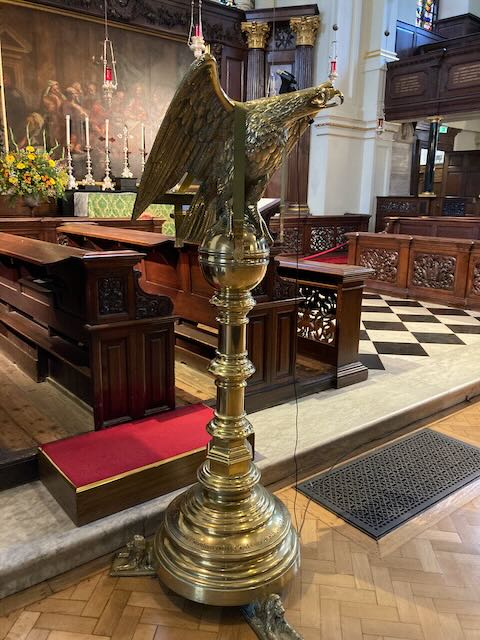
Participants who chose to go enjoyed an Evensong church service at lovely Trinity Cathedral in Cleveland. That eagle lectern on the left is much like eagle lecterns I’ve seen in several English churches Austen may have visited.

Tours and Local Events: Tours were offered to local sites, such as the Cleveland Museum of Art and downtown Cleveland. Tickets were also available for a play, concerts, and a dinner cruise.

Military: Two special sessions brought in the military. One was held outside, with Napoleon and a horse, and one was inside, a talk on the Battle of Lake Erie.

A banquet, brunch, and promenade gave us more chances to mix with other Janeites at the conference. A wide variety of other special sessions and interactive stations offered something for everyone.

One first-time participant and vendor from my region, who runs Jane Austen Treasures, said this AGM was one of her “best life experiences ever.” Another participant, who has attended many AGMs, said it is always “the most magical time,” where she feels like she is “walking around in fairyland. . . . Say hello to anybody, and you’re going to have a fantastic conversation.” A different first-timer added, “It was so fun! . . . When else can you be surrounded by so many intelligent, well-read, interesting, kind, funny, warm people?”

Next year’s JASNA AGM will be in Baltimore, Oct. 10-12, 2025. The theme is “Austen at 250: ‘No check to my genius from beginning to end.’”  We’d love to see you there!

Read Full Post »

« Newer Posts - Older Posts »