This Jane Austen blog brings Jane Austen, her novels, and the Regency Period alive through food, dress, social customs, and other 19th C. historical details related to this topic.
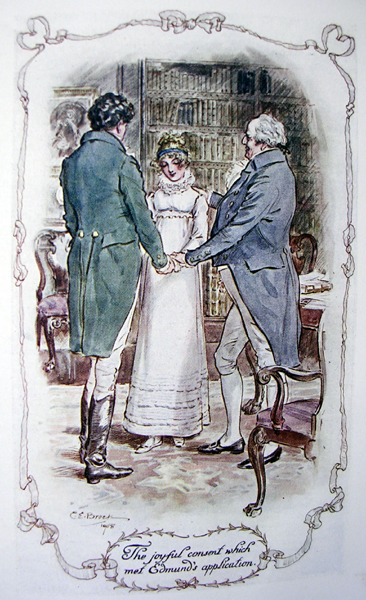
A happy ending, but we don’t see how they got there: Edmund falling in love with Fanny at the end of Mansfield Park disappoints because of the lack of details.
A major complaint that readers have about Austen is her endings. In both Sense and Sensibility and Mansfield Park, we have a sudden romance that is practically a footnote to the last chapter—Marianne marries Colonel Brandon with just, “Marianne found her own happiness in forming his,” and Fanny marries Edmund once he learns “to prefer soft light eyes to sparkling dark ones.” Northanger Abbey introduces a new character, Eleanor’s viscount, to facilitate Henry and Catherine’s marriage.
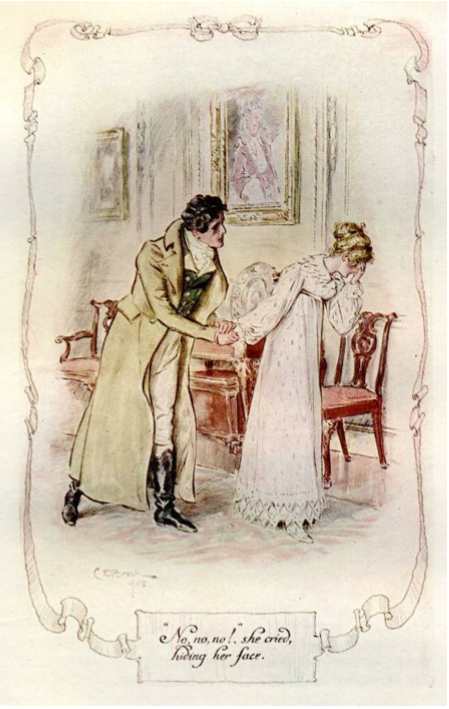
In Emma and Persuasion we do get some romantic talk (or writing) from the hero. However, in response, Emma says “just what she ought” (which is??), and Anne receives Wentworth’s look “not repulsively.” Then they talk, but we don’t hear their words.
Darcy, of course, simply tells Elizabeth his “affections and wishes are unchanged,” perhaps not willing to risk another disastrous proposal, and Elizabeth “immediately, though not very fluently, gave him to understand that her sentiments had undergone so material a change, since the period to which he alluded, as to make her receive with gratitude and pleasure his present assurances.” But what exactly did she say?
In all cases we have more author commentary than demonstrations, more of what writers call “telling” rather than “showing.”
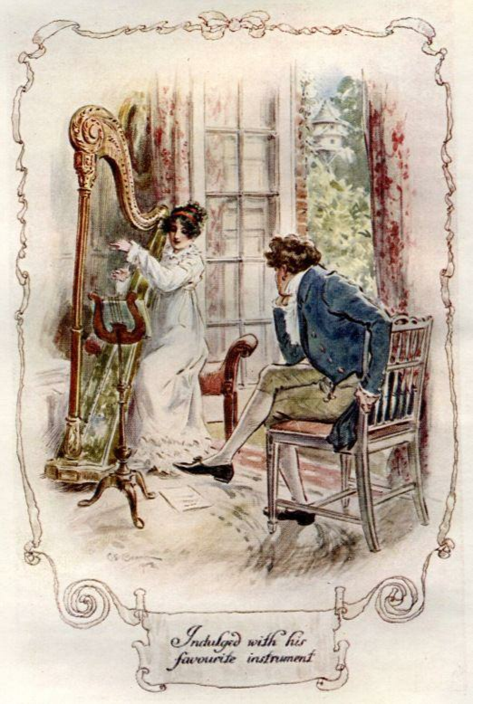
Movie-makers have had to put words to all these proposals, and fill in some blanks. For example, they show Colonel Brandon rescuing Marianne from the rain, and wooing her with music. But why didn’t Jane Austen, who gave us so many delightful conversations and events, show us all those details herself?
Jane Austen & the Price of Happiness
Jane Austen & the Price of Happiness, by Inger Brodey, explores possible reasons for Austen’s less than romantic endings.
It’s a fascinating book, and written quite accessibly. (I found only a couple of unfamiliar academic terms*; in general it’s written in everyday English.) The illustrations are fun, including cartoons, images from movies, and more.
Each chapter analyzes one of the novels, in the order they were written, so we see the development of Austen’s techniques. Brodey looks at various aspect of each novel with new insights and considers the impact of the ending. Then she looks at some popular adaptations of that novel, mostly films plus a few books. She considers how they handle the ending and whether their endings fit Austen’s goals.
Her chapter titles give you some idea of her thoughts:
Chapter 2: “Expecting Literary Justice” (Sense and Sensibility)
Chapter 3: “The Limits of Romance” (Pride and Prejudice)
Chapter 4: “The Thin Veil of Comedy” (Mansfield Park)
Chapter 5: “The Art of English Happiness” (Emma)
Chapter 6: “Resources for Solitude” (Persuasion)
Conclusion: “Coauthoring Happiness”
Brodey says that, for one thing, Austen is trying to show readers that their expectations of romantic idealism come from the sort of sensibility she satirizes. Austen disrupts those expectations. She shows us that the romantic outcomes we want, expect, and demand are not inevitable: this is fiction. Her stories are realistic, with characters operating in ordinary, everyday life, but the “happily ever afters,” the “perfect happiness,” may or may not happen in real life.
There are other reasons for Austen’s nuanced endings, which I’ll leave you to discover from Inger’s book. However, I’ll share a few highlights from the chapter on Mansfield Park, as an example of some of the many insights in the book.
“The Thin Veil of Comedy” Chapter on Mansfield Park
Readers are expected to be attracted by Mary Crawford’s charm, which hides her poor moral values.
Mansfield Park was published after the light, bright, and sparkling Pride and Prejudice. It deals with harder truths. Brodey claims Austen’s “novels alternate between the bright and witty heroines whose primary obstacles are internal, and the more understated, misunderstood, and wiser heroines whose primary obstacles are external” (p. 138). I had to think about this one, but it’s true—Catherine Morland is not witty, but she does face internal obstacles of her own credulousness and illusions; Elinor Dashwood is wise and misunderstood; Elizabeth Bennet, obviously bright and witty, needs to overcome her pride and prejudices; Fanny Price is also wise but understated and faces external challenges; Emma is again bright and witty and needs to overcome her own pride; Anne Elliot is quiet but wise.
Austen shows, especially in Mansfield Park, that charm can be dangerous. Mary Crawford is lively and charming like Elizabeth Bennet. She and her brother Henry charm Edmund, Maria, and Julia, as well as readers, just as Wickham charmed Elizabeth. However, charm without a strong moral foundation leads to disaster. Austen is challenging her readers “to love the less prepossessing characters and see beyond the false power of charm.”
Henry Crawford might have changed due to his love for Fanny, and might have earned her love, but he did not.
The final chapter of Mansfield Park tells us outcomes for many characters, who are apparently as important as Edmund and Fanny. We see the reformation of some, such as Tom Bertram and Sir Thomas Bertram. Austen reveals the sad but not completely tragic endings of those who were not willing to change, including Henry and Mary Crawford. Henry could even have had an alternate ending, with a happy marriage to Fanny, if he had been willing to persevere in his resolutions of self-improvement. Brodey says, “It somewhat diminishes [Fanny’s] marriage to Edmund to know that a marriage to Henry would not have been disastrous. Once again, Austen surprises the reader out of extravagant expectations of the novel. We get shades of gray where we hope for black and white, realism where we crave romance” (p. 148).
As in other endings, Austen intrudes in the first person, saying “My Fanny indeed at this very time, I have the satisfaction of knowing, must have been happy in spite of everything.” Austen reminds us that this is fiction and that she, as the author, is controlling the ending. She also refers to Fanny as a living human being, though. In showing her own attachment to Fanny (“my Fanny”), she “models the attachment that she believes Fanny deserves” (p. 147).
She challenges our readerly expectations of fantasy endings, including a sense that “second attachments are degrading for romantic heroines” (p. 149); shades of Marianne Dashwood! We believe that Edmund and Fanny will be happy together, even though it is Edmund’s “second attachment.” They do not need some intense eternal passion to experience happiness.
I hope these brief points pulled from one chapter might give you a little more understanding and appreciation of Mansfield Park. I encourage you to read all of Jane Austen & the Price of Happiness. I think you will find it fascinating and illuminating, as I did!
*Here’s one word I learned from this book: apophasis. It means “raising an issue by claiming not to mention it,” or, as Brodey puts it, “tell[ing] the reader what will not be told.” Austen’s endings often use this technique. For example, near the end of Mansfield Park: “But there was happiness elsewhere which no description can reach. Let no one presume to give the feelings of a young woman [Fanny] on receiving the assurance of that affection of which she has scarcely allowed herself to entertain a hope.” As Brodey says, it’s an annoying technique. But Austen has her reasons.
“My dear child, commend Dr. Grant to the deanery of Westminster or St. Paul’s, and I should be as glad of your nurseryman and poulterer as you could be.”—Mrs. Grant to Mary Crawford, Mansfield Park, chapter 22
Churches Mentioned in Mansfield Park
Four real churches are mentioned in Mansfield Park, which talks extensively about the church and clergy. I’ve written about the Garrison Chapel, where the Prices and Henry Crawford went to church. A few days ago, I posted about a church in London, St. George’s, Hanover Square, the wedding venue that Mary Crawford wants to show Fanny.
Two more real London churches are mentioned in Mansfield Park. Mrs. Grant speaks of the two most well-known churches in England, Westminster Abbey and St. Paul’s Cathedral. Mary Crawford tells her sister to greet the nurseryman (who took care of plants) and the poulterer (who provided poultry), but her sister tells her there are no such people in Mansfield. The Grants will need to move to the big city to get such help. She hopes that someone will “commend Dr. Grant to the deanery of Westminster or St. Paul’s,” so they can move to London.
The “deanery” is the office of the dean, the head clergyman of a major church.
Mrs. Grant finally gets that opportunity:
“Dr. Grant, through an interest on which he had almost ceased to form hopes, succeeded to a stall in Westminster, which, as affording an occasion for leaving Mansfield, an excuse for residence in London, and an increase of income to answer the expenses of the change, was highly acceptable to those who went and those who staid.”— Mansfield Park, chapter 48
Dr. Grant, as he had hoped, moves up in the church hierarchy to a prestigious church. He’s been the rector of a small country church at Mansfield Park. He will still receive the tithe income from that church until he dies, when Edmund will become rector. But Dr. Grant has connections to people with influence who can get him a higher church position. The church worked much like the Navy, where Henry Crawford’s uncle, the Admiral, gets William Price a promotion.
Westminster Abbey
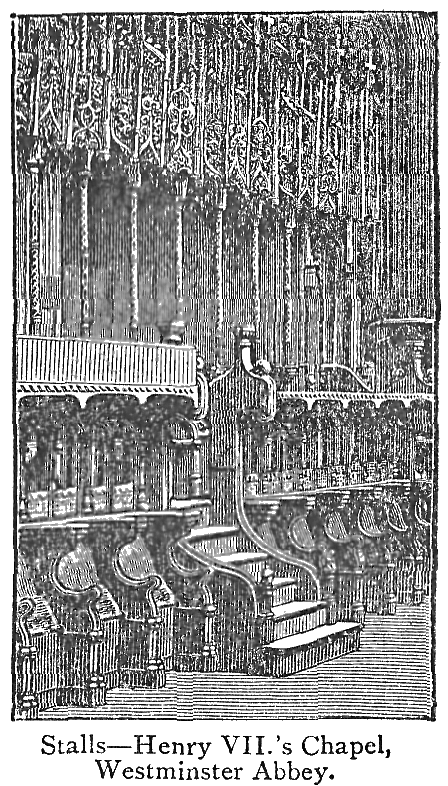
One of Dr. Grant’s friends, or more likely a friend of a friend, gets him a “stall in Westminster,” meaning a position as a prebendary. A prebendary was a church official who sat in a prebendal stall, a seat of honor in the church. The position came with income from a “prebend,” specific church possessions.
Stalls in Westminster Abbey, 1908. Image Credit: Rev. Thomas Davidson 1856-1923 (ed.), Public domain, via Wikimedia Commons
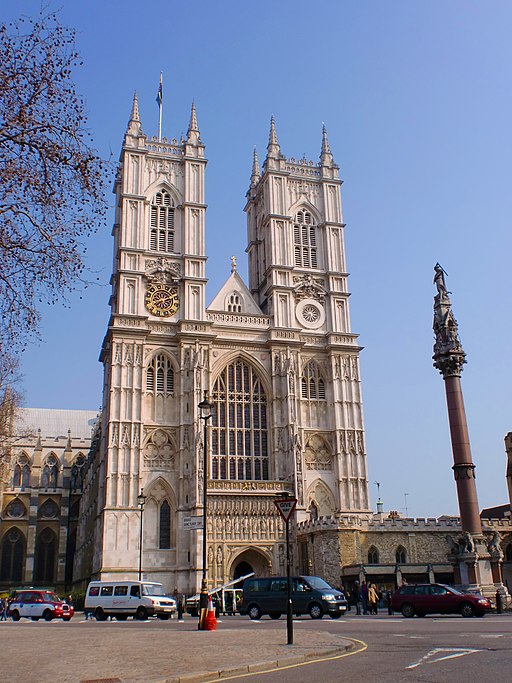
Westminster Abbey is, of course, the church in London where monarchs are crowned, as King Charles III was not long ago. All English coronations have taken place there since 1066. It is not a cathedral or a parish church. Instead it is a “Royal Peculiar,” with a dean like other large churches, but under the direct supervision of the monarch rather than a bishop or archbishop.
Westminster Abbey in London, a “Royal Peculiar” directly under the Crown. Credit: Σπάρτακος, CC BY-SA 3.0, via Wikimedia Commons
Westminster Abbey is also, of course, a place where many famous people are buried and memorialized. While Jane Austen is buried in Winchester Cathedral, there is a small plaque commemorating her in Poet’s Corner in Westminster Abbey, adjacent to Shakespeare’s memorial.
St. Paul’s Cathedral
St. Paul’s Cathedral, the other place where Dr. Grant hoped to get a position, is the cathedral of the diocese of London. (A diocese is a geographical group of parishes, led by a bishop, whose “seat” is at the cathedral for the diocese.) The history of the church reflects the history of London.
One interesting fact: women were first ordained as priests in the Church of England in 1994, and St. Paul’s first clergywoman was appointed in 1997. Now the Lord Bishop of London is a woman, installed in 2018, with her seat, of course, at St. Paul’s. She is called the Right Reverend and Right Honorable Dame Sarah Mullally, and she is a member of the House of Lords. No doubt Jane Austen would be amazed.
One more London church is mentioned in Jane Austen’s novels. In Pride and Prejudice, Lydia tells her sisters,
“We were married you know, at St. Clement’s, because Wickham’s lodgings were in that parish. And it was settled that we should all be there by eleven o’clock.”
We don’t know for sure which St. Clement’s in London Austen has in mind. An old nursery rhyme goes, “Oranges and lemons, say the bells of St. Clement’s,” and two churches claim to be the St. Clement’s in the rhyme.
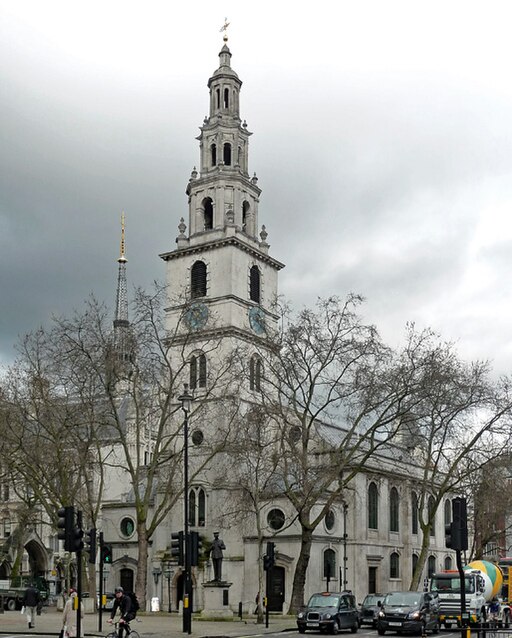
It seems most likely that Austen was referring to St. Clement Danes in the Strand, which served a large parish. The parish included areas of cheap lodgings and less savory areas, where Wickham could have afforded lodgings. It was also some distance from Gracechurch Street where the Gardiners lived, better concealing Wickham and Lydia from her family. (Source: Pat Rogers, editor of the Cambridge Pride and Prejudice.)
Another option, according to Rogers, is St. Clement’s Eastcheap on the east side of Clement’s Lane. However, this was a tiny parish only a block from Gracechurch Street, so was less likely to be the parish Wickham chose to lodge in.
The rhyme goes on to talk about not being able to pay a debt until one gets rich, at some unknown future time. Quite appropriate for Wickham, who was deep in debt but always hoping to get rich.
St. Clement Danes in the Strand, possible location for Lydia and Wickham’s wedding. Image credit: Stephen Richards / St Clement Danes, Strand / CC BY-SA 2.0
Faith in London Today
Another surprise for Jane Austen: In Mansfield Park, Edmund Bertram states, “We do not look in great cities for our best morality.” He implies that there was more virtue in the countryside and more vice in London. That was probably true in Austen’s time, according to all I have read.
However, a survey a few years ago indicated that the opposite is now true: “London is now more religious and socially conservative than the rest of Britain.” According to that survey, Londoners pray more, attend religious services more, and are more conservative on moral questions than those outside London. Also, Christian Londoners help their neighbours and give to charity more than non-religious Londoners. Of course, London is also a diverse religious environment, with people practicing various religious faiths, which are less common outside of the capital.
The London churches Austen mentions in Mansfield Park are still thriving.
Other churches mentioned by name in Jane Austen’s novels and letters
“. . . perhaps you would not mind passing through London, and seeing the inside of St. George’s, Hanover Square. Only keep your cousin Edmund from me at such a time: I should not like to be tempted.”—Mary Crawford, Mansfield Park, chapter 43
Mansfield Park includes much more discussion of the church than any other Austen novel. Not surprisingly, it also names more real churches than the other novels do.
In an earlier post we explored the Garrison Chapel, where Fanny Price and her family worship in Portsmouth. Henry Crawford attends with them on his visit. Perhaps this symbolizes his attempts to reform himself and become worthy of Fanny; attempts that ultimately fail.
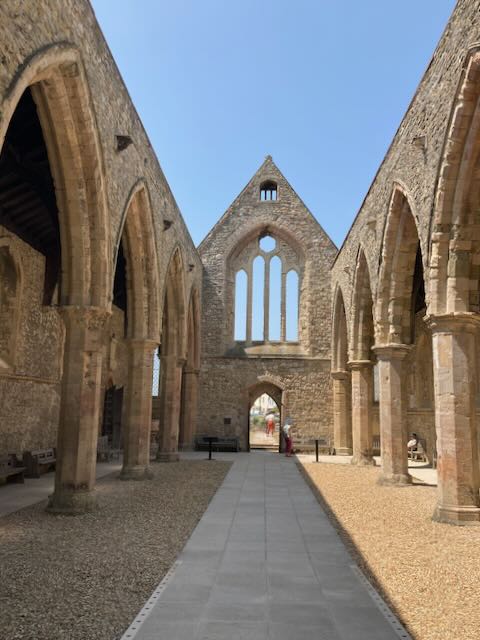
Remains of the Garrison Chapel in Portsmouth where the Prices and Henry Crawford worshiped.
Henry’s sister Mary names another real church in a letter to Fanny. She wants Fanny to let her and Henry take Fanny back to Mansfield from Portsmouth, where Fanny has been staying with her family. Fanny is unhappy and unhealthy, but will not commit the impropriety of going back to Mansfield Park before her uncle sends for her. Mary wants to take Fanny to see Henry’s estate and then pass through London on the way to Mansfield.
She suggests visiting St. George’s, Hanover Square. This was a popular church for weddings among the upper classes of London. Mary hopes Fanny will marry Henry there. At the same time, Mary says it might tempt her to marry Edmund. She doesn’t want to marry a clergyman, or a second son who will not inherit an estate, but she is attracted to Edmund.
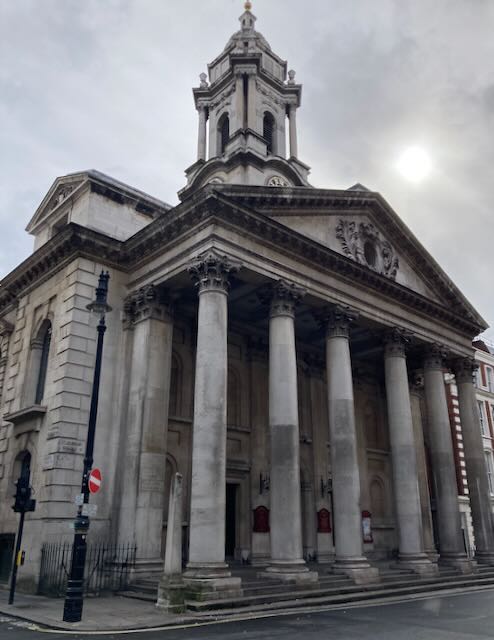
St. George’s Hanover Square exterior. According to the church website, “The classical front with six great Corinthian columns supporting a pediment represented a new trend in English Church design.”
St. George’s, Hanover Square Today
During a recent visit to London, I had the privilege of worshiping at St. George’s, Hanover Square on a Sunday morning. The service was a Sung Eucharist, a Communion service in traditional language, with beautiful singing from the choir and impressive organ music. During the service, the congregation renewed their baptismal vows.
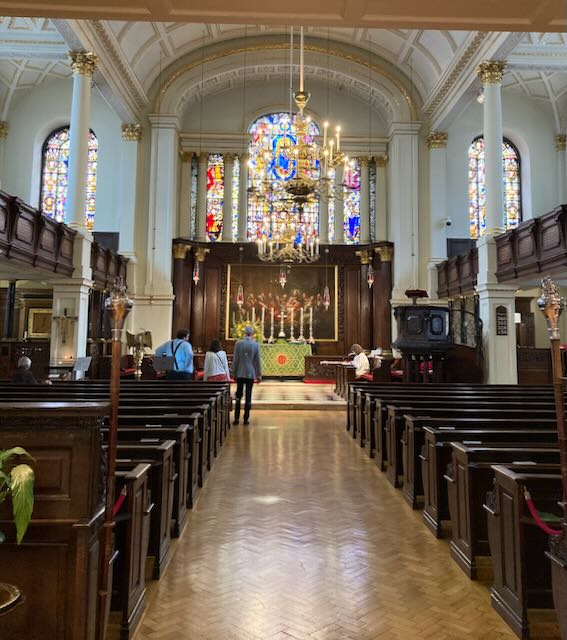
St. George’s Hanover Square interior. The painting of the Last Supper over the altar, and the surrounding carvings, were installed in 1724. The seven silver hanging lights in the church represent the seven lamps of fire burning before God’s throne, according to the book of Revelation in the Bible.
The church also offers brief midday services from the Book of Common Prayer on weekdays and several other Communion services during the week. Weekday “Morning Calm” services are held during termtime, as “a short period of reflection, contemplation, and relaxation before the challenges of the day begin.”
Nowadays the area around Hanover Square is mostly offices and businesses. I was told that most people in the current congregation live farther away, since few people live close to the church now.
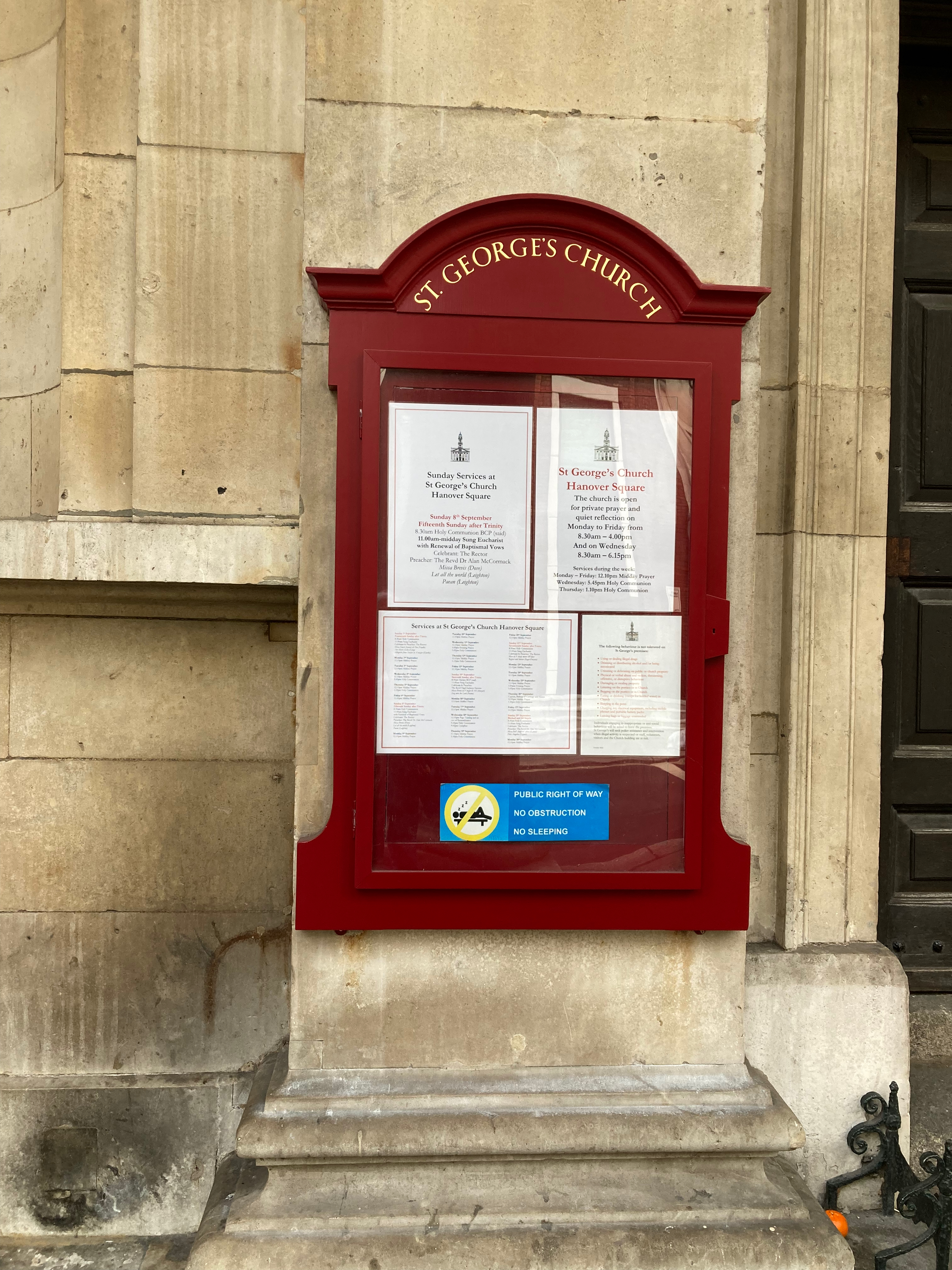
The signboard for St. George’s Hanover Square lists services, extensive opening hours, and rules such as no drugs in the church and no sleeping on pews.
Wealthy Mayfair
Hanover Square is in Mayfair. In Austen’s England, many wealthy people had large houses in Mayfair or surrounding areas. In Sense and Sensibility, the Palmers live in Hanover Square, while the Middletons, Mrs. Ferrars, and Willoughby live nearby in Mayfair. Mrs. Jennings and John and Fanny Dashwood live in Marylebone, an area just north of Mayfair. It developed when Mayfair could no longer accommodate all those who wanted fashionable, elegant housing. (Source: The Annotated Sense and Sensibility, David Shapard.)
St. George’s is the parish church of Mayfair, where the wealthy worshiped. In 1711, Parliament had passed an Act for the building of fifty new churches in and around London. The wealthy of Mayfair petitioned for a church, which was completed in 1725. The patron saint of the church is St. George, a Christian martyr of the third century who is also the patron saint of England.
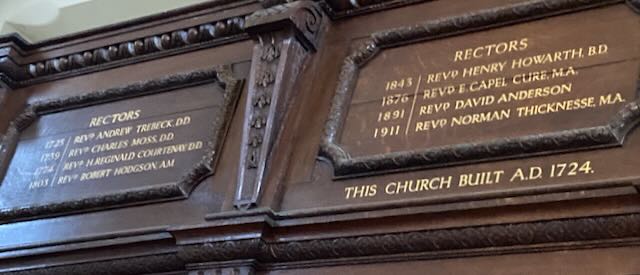
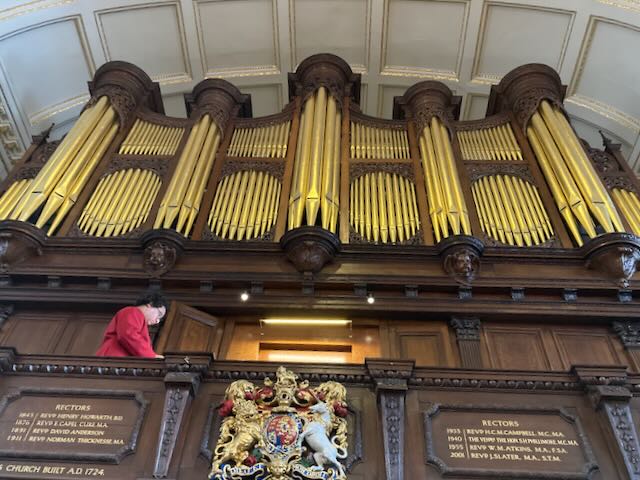
Rectors of St. George’s Hanover Square during Austen’s time and thereafter. Some held other influential church positions as well.
The parish was large, with a vestry of 101 vestrymen. These included 7 dukes, 14 earls, 7 barons, and 26 other titled people. A vestry, led by the church’s rector and churchwardens, decides matters relating to the church and the secular parish. (Mr. Knightley, Mr. Weston, Mr. Cole, and Mr. Cox are apparently on the vestry for their parish, as they are “busy over parish business” in Emma.) The St. George’s, Hanover Square vestry dealt with local issues including street lighting, refuse disposal, nightwatchmen, and a workhouse for the poor.
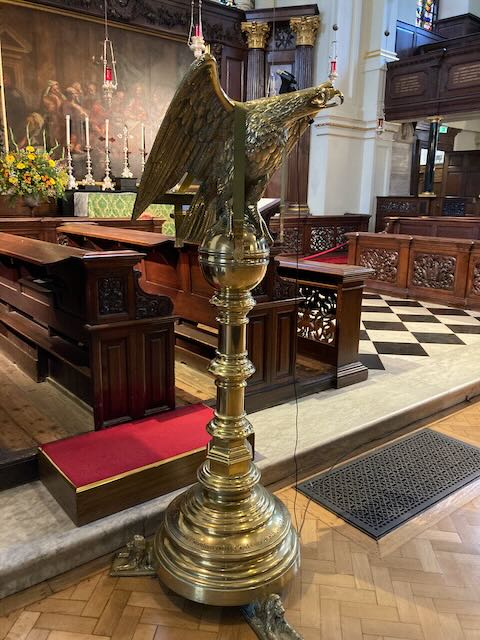
St. George’s Hanover Square eagle lectern. Many churches of Austen’s time had lecterns similar to this, where the Bible was read to the congregation. (The eagle symbolized the Word of God because supposedly it could fly directly into the sun without closing its eyes, so it was like the Bible, leading people to God with eyes open. Eagles’ wings also symbolized carrying the gospel to the ends of the earth.)
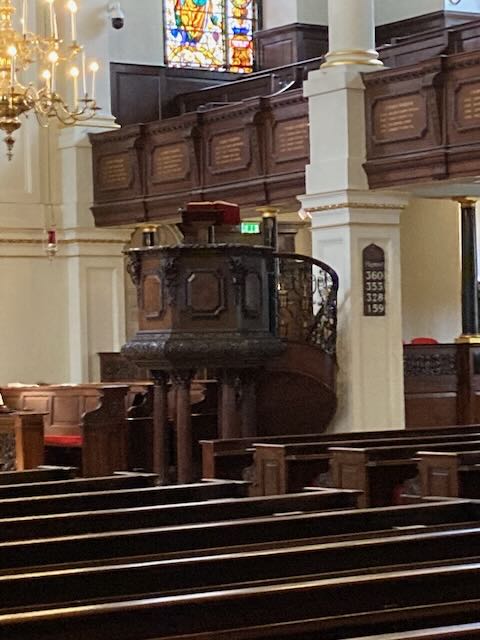
Pulpit of St. George’s, Hanover Square
Rich and Poor
While the wealthy owned mansions in the area, most spent only the winter in London, passing the rest of the year on their country estates. The back alleys behind the mansions teemed with poverty and misery year-round. In the early 1800s, the Evangelical movement began to awaken the church to the needs of the poor. St. George’s established a parish school for poor children in 1804, supported by public subscriptions. Later in the century, the church initiated and supported extensive projects to help the working classes of the area.
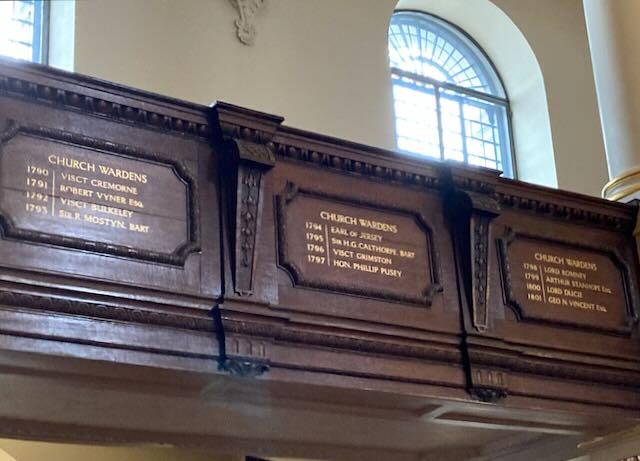
But the wealthy ran the church in Austen’s time. Around the gallery (balcony) are listed the churchwardens, year by year. Anglican churches generally have two elected churchwardens, responsible for financial accounts, movable property of the church, keeping order, and other administrative responsibilities. The churchwardens listed on St. George’s galleries for the 1700s and early 1800s sound impressive: Viscounts, Earls, Lords, Sirs, Honorables, and Esquires.
St. George’s Hanover Square balcony listing early churchwardens. Many were titled men.
Music
The composer George Friderick Handel lived about a four minute walk from the church. He helped choose the organ and organist for the new church. He had a pew there and worshiped at St. George’s until he died. He wrote the Messiah in his house nearby on Brook Street, which is now a museum.
St. George’s Hanover Square organ pipes; a new organ was installed in 1972. The original organ had 1514 pipes and three manuals (keyboards for the hands). It cost £500 in 1725.
Weddings
Since it was at the heart of the wealthy district, St. George’s, Hanover Square was the popular place for weddings of the wealthy and influential. In 1816, the church hosted 1,063 weddings! Famous people including Percy Bysshe Shelley, Benjamin Disraeli, George Eliot (Mary Lewes), and Theodore Roosevelt were married at St. George’s. Mary Crawford was likely staying near there with her wealthy London friends, and she may have attended church there. So it was the first place she thought of for her own and her brother’s weddings. It is still a popular venue for weddings, though not as much so as in Austen’s time.
On Thursday, we’ll look at the other two real churches mentioned in Mansfield Park, the two most famous churches in England. Do you know which ones they are? We’ll also consider which London church Lydia and Wickham married in!
“The Prices were just setting off for church the next day when Mr. Crawford appeared again. He came, not to stop, but to join them; he was asked to go with them to the Garrison chapel, which was exactly what he had intended, and they all walked thither together.”—Mansfield Park, chapter 42
The Garrison Chapel in Portsmouth, where the Price family and Henry Crawford worshiped.
Real Churches in Austen’s Novels
The Garrison Chapel (now called the Garrison Church) is one of a handful of specific, real churches Jane Austen mentions in her novels.
In Northanger Abbey, John Thorpe passes “Walcot Church,” St. Swithin’s on the edge of Bath. We hear about the “church-yard” in Bath, adjacent to Bath Abbey, though the Abbey is not named. Catherine Morland looks for the “well-known spire” of Salisbury Cathedral on her way home. (See “Churches, Chapels, Abbeys, and Cathedrals in Northanger Abbey”.)
In Pride and Prejudice, Wickham and Lydia get married at St. Clement’s in London, possibly St. Clement Danes in London’s city of Westminster, or St. Clement Eastcheap, near London Bridge. By the way, it’s not clear which of those is the St. Clement’s of the old nursery rhyme about London church bells, which begins “Oranges and lemons, say the bells of St. Clement’s.”
In Mansfield Park, Mary Crawford mentions St. George’s, Hanover Square (in Mayfair, London) as a place for weddings. Dr. Grant seeks a promotion to Westminster Abbey or St. Paul’s Cathedral (he gains a prebendal stall at Westminster). And the Prices attend church at the “Garrison Chapel” in Portsmouth.
All these churches can still be visited, though the Garrison Church is partly in ruins. (Have I missed any churches named in Austen’s novels? Let me know in the comments if you have noticed others!)
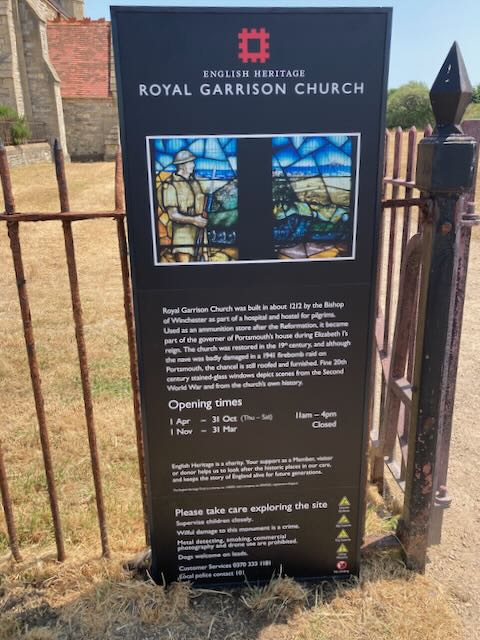
The Royal Garrison Church, now run by English Heritage, can be visited on certain days, April through October. Admission is free.
The Garrison Chapel in Portsmouth
What was the Garrison Chapel? It was called a chapel, not a church, at that time, since “church” meant the Church of England main church of a parish. There were several types of chapels. This one was an institutional chapel, connected to a certain place or group of people. It was the chapel for military troops serving in Portsmouth. Since Fanny Price’s father was a “lieutenant of marines,” this was the logical place for her family to worship.
Mansfield Park tells us, “In chapel they were obliged to divide, but Mr. Crawford took care not to be divided from the female branch.” Roger E. Moore, in Jane Austen and the Reformation, explains, “officers and sailors sit separately from civilians” (124). Presumably Fanny’s father joined his friends, his “brother loungers,” in one section, while his family, with Henry Crawford, sat in a different section.
Nave of the Garrison Church, originally a hospital, meaning a place of hospitality for the needy. Beds lined the sides. The roof was destroyed by bombing in World War II.
Origins
The Garrison Church building dates all the way back to 1212 A. D., over 800 years ago. The Bishop of Winchester founded it as a “hospital” called the “Domus Dei,” or “House of God.” It was not a place for medical care, but a place of hospitality. The poor, the ill, and people on pilgrimage could come there and find rest. Beds lined what later became the nave of the church.
Mass was said regularly in a chapel at the east end of the building. Residents would either attend services or listen from their beds if they could not stand. A priest was in charge, aided by twelve poor men or women. They helped look after visitors in exchange for bread, ale, and a place to stay.
According to Moore, the main hall was “surrounded by a complex of auxiliary buildings, including a master’s house and hall, kitchen, bakehouse, stable, and lodgings for the brothers and sisters who staffed it” (124-5). Income from nearby houses and land supported the work, just as medieval monasteries were supported by nearby properties.
Moore says that the mention of this place in Mansfield Park is significant. The “Domus Dei” (which later became the Garrison Chapel) gladly welcomed anyone who appeared there asking for entrance, regardless of social status. It is contrasted with Mansfield Park, where Mrs. Norris does not “gladly” welcome poor Fanny to the parsonage where she and her husband live. Even the Bertrams give Fanny only a small attic room, without even a fire for warmth. Moore also points out that when Fanny sees Henry in Portsmouth, she is impressed that he has been acting as a “friend to the poor and oppressed,” just as the brothers and sisters at the Domus Dei had done for many.
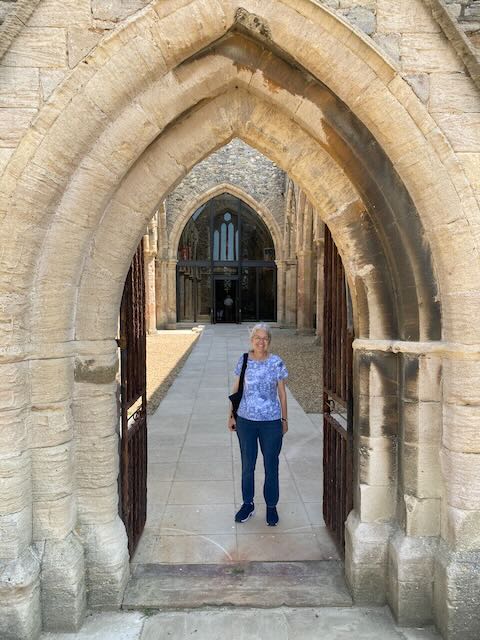
The author (Brenda Cox) at the entrance to the Garrison Church today. All visitors are welcome (at specified times), as in medieval times.
The hospital closed in 1540 when King Henry VIII suppressed the monasteries and other religious houses, including most such hospitals. Valuables were stripped from it, and the buildings were used to store munitions. Queen Elizabeth I expanded the fortifications at Portsmouth, made the large dormitory into a chapel for the garrison, and the rest of the buildings became the home of the garrison’s governor.
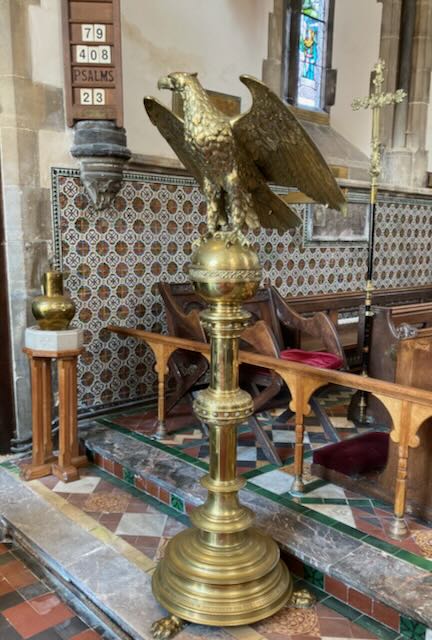
Eagle lectern in the Garrison Church, from 1801, commemorates Queen Victoria. Eagles were often used for church lecterns, which held Bibles or the Book of Common Prayer. Eagles were believed to be able to look at the sun, just as Christians look directly into God’s Word. It is also the bird believed to fly closest to heaven, symbolizing carrying God’s Word around the world. (Source: a guidebook in the church)
In 1826, the Governor’s house next to the chapel was demolished. Forty years later, restoration work began on the church (now called a church rather than a chapel), balancing “the original medieval appearance with Victorian needs and preferences,” according to a sign at the site. A new altar, pulpit, and stalls were added.
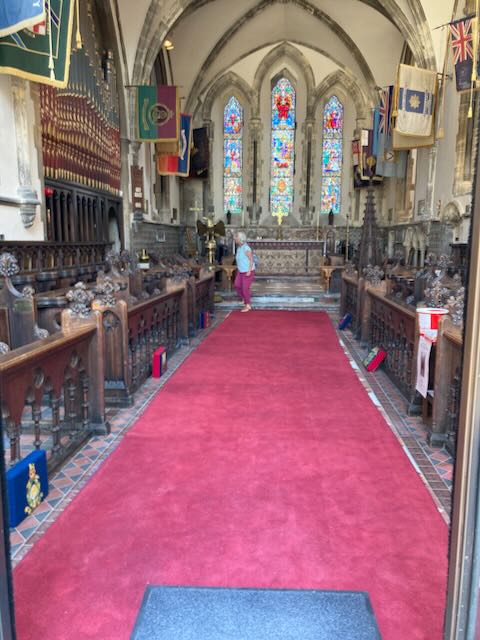
Garrison Church chancel today; furnishings are Victorian and later.
Garrison Church Today
The church was bombed in 1941, destroying much of the roof of the nave (the large hall that used to be the hospital). However, the smaller worship area, the chancel, survived and continued to be used. See this site for more about the church’s history.
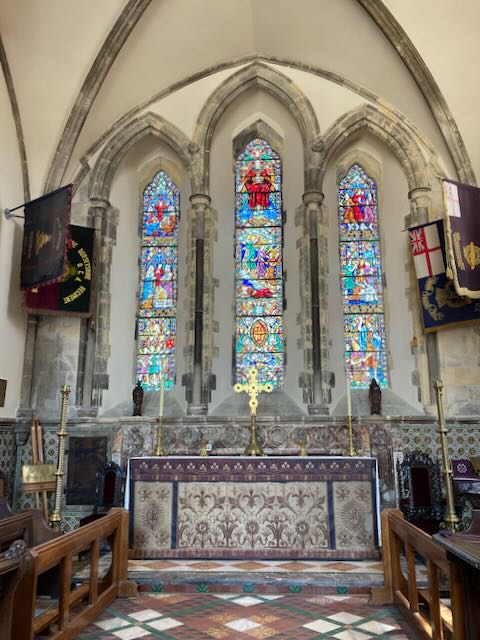
Stained glass windows with Bible themes above the altar of the Garrison Church, added in 1957.
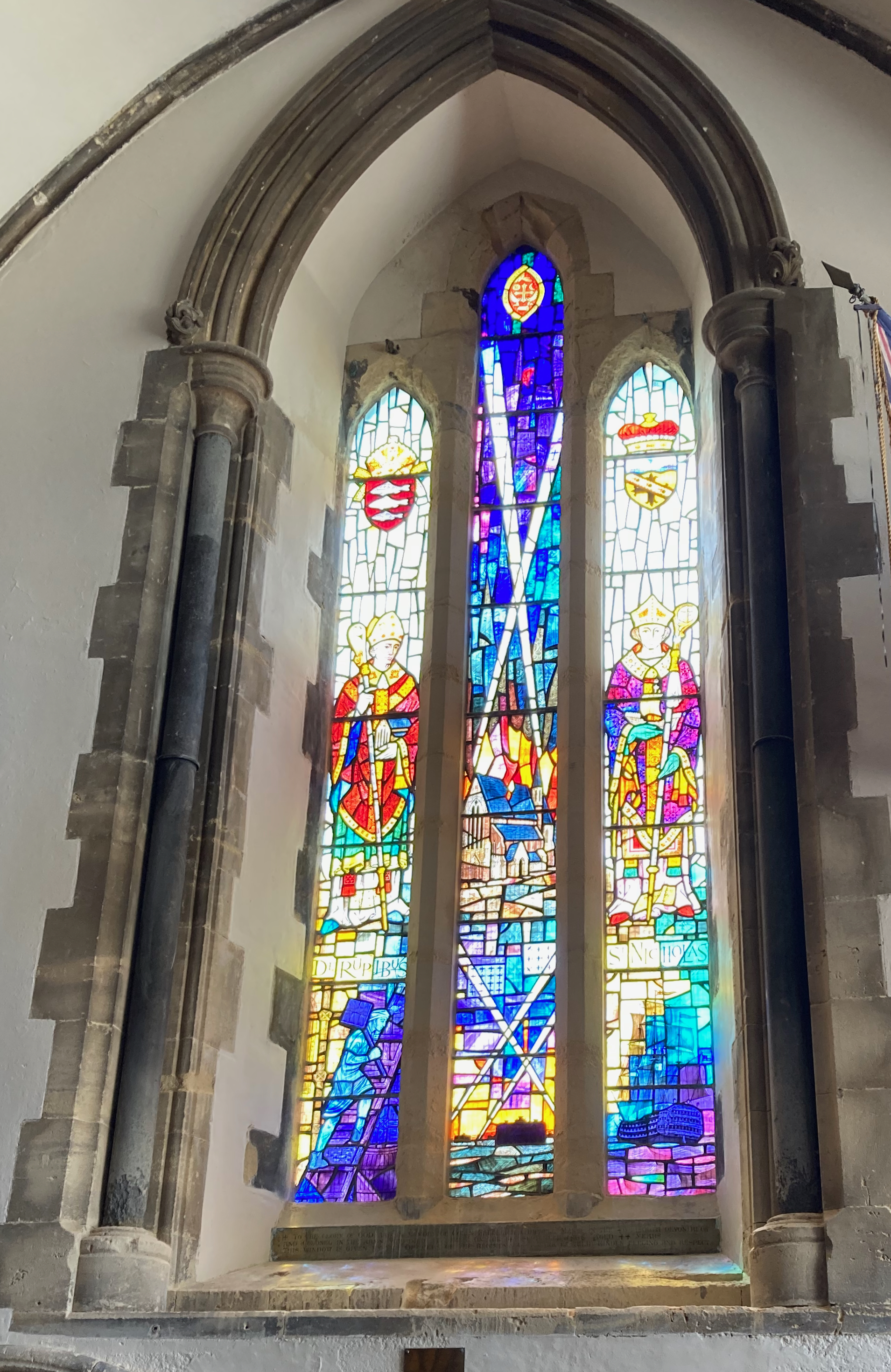
Garrison Church stained glass windows, added in 1967, depicting its history. The founder is on the left. Bombing of the church is depicted in the center. The right panel shows St. Nicholas, patron saint of the church. St. Nicholas is the patron saint of sailors, merchants, and travelers, appropriate for this port city. Vice-Admiral Lord Nelson’s coat of arms and his ship HMS Victory are above and below St. Nicholas.
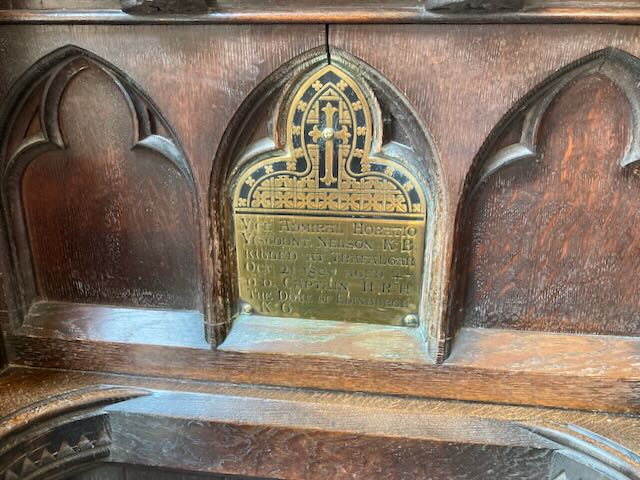
The choir stalls include memorials to soldiers killed in the Crimean War, and this one to Lord Nelson.
Apparently the church is still in use for occasional services for the military. It is open to the public on certain days and times, for free; check the website before going.
In Portsmouth Harbor you can also visit HMS Victory, Lord Nelson’s ship, which is undergoing a thorough restoration. The cruise we took of the harbor was lovely. On the same day, my friends and I also visited Netley Abbey. Nearby Southampton has a few sites related to Austen. However, we were not allowed to enter the Dolphin Hotel, where she danced. You can only see it from the street.
There’s so much history and meaning in Jane Austen’s mildest references. I’m thankful for the many people who have preserved and kept alive the places that were important to Austen and to her characters, including the Garrison Chapel.
“I had expected to find everything about the place very fine and all that, but I had no idea of its being so beautiful.” –Mrs. Cassandra Leigh Austen, Aug. 13, 1806, on a visit to Stoneleigh Abbey with her daughters Jane and Cassandra
Merry Christmas and Happy Holidays! As my gift to you, let’s take a trip to Stoneleigh Abbey together.
Jane Austen visited Stoneleigh Abbey in 1806. She and her mother and sister were visiting their cousin, Rev. Thomas Leigh, in Adlestrop when his distant cousin, the Honorable Mary Leigh, died. Rev. Thomas inherited the wealthy estate. He took his poorer relations, the Austens, with him to take possession, as a treat for them. They enjoyed it very much, as Mrs. Austen wrote in a letter. She said the house was so large that they needed signposts to find their way, and that it was not only very “fine,” but more beautiful than she had imagined. Catherine Morland, similarly, when she saw Northanger Abbey, “was struck . . . beyond her expectation, by the grandeur of the abbey.”
Based on income, Stoneleigh Abbey was an even grander place than Pemberley or Sotherton (the Rushworth estate in Mansfield Park) would have been. Austen tells us that Darcy’s income was £10,000 a year and Mr. Rushworth’s was £12,000 a year. But the income of the Leighs of Stoneleigh Abbey, in Jane Austen’s time, was even higher, at £17,000 a year, which Victoria Huxley says was “perhaps the annual equivalent of a million pounds in today’s values” (p. 9). (We were told when touring Chatsworth that the income there in Austen’s time was about £30,000, three times Darcy’s income; I haven’t found confirmation of that number anywhere, though.)
Today, ideally you need a car or a tour bus to get you to Stoneleigh Abbey. It is about an hour’s drive north of Oxford or about 40 minutes southeast from Birmingham. If you want to take public transport, it looks like you’ll have a half-hour’s walk at the end of your journey.
I went with the JASNA Summer Tour. We saw the Adlestrop church the same day; it’s only about an hour’s drive away.
Stoneleigh Abbey, like Austen’s fictional Northanger Abbey, is a mix of older monastic buildings and newer buildings. (Newer in Austen’s time, at least.) Let’s take a trip through it, with some quotes from Austen’s novels.
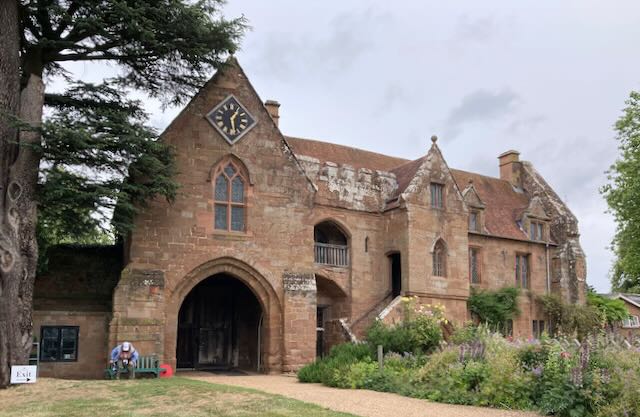
The red sandstone gatehouse, where you buy entry tickets, is from the 14th century, a remnant of the original Cistercian monastery. At this gatehouse, built in 1346 by Abbot Robert de Hoeckle, the poor received alms and travelers found hospitality.
So low did the building stand, that she found herself passing through the great gates of the lodge into the very grounds of Northanger, without having discerned even an antique chimney. . . . To pass between lodges of a modern appearance, to find herself with such ease in the very precincts of the abbey, and driven so rapidly along a smooth, level road of fine gravel, without obstacle, alarm, or solemnity of any kind, struck her as odd and inconsistent.–Catherine Morland, Northanger Abbey
Now we are coming to the lodge-gates; but we have nearly a mile through the park still.–Maria Bertram, Mansfield Park
The tour did not take us into this north wing. But you can still see arches on the walls, from the original monastery church. They are now bricked over. A cloister and medieval stained glass windows remain in the older buildings.
Another building from the old monastery. Stoneleigh Abbey was a small Cistercian monastery from 1155 until Henry VIII dissolved the monasteries in 1536. The Leigh family bought it in 1561. Catherine Morland was disappointed not to stay in such a building at Northanger Abbey.
[Catherine] was hardly more assured than before, of Northanger Abbey having been a richly endowed convent at the time of the Reformation, of its having fallen into the hands of an ancestor of the Tilneys on its dissolution–Northanger Abbey
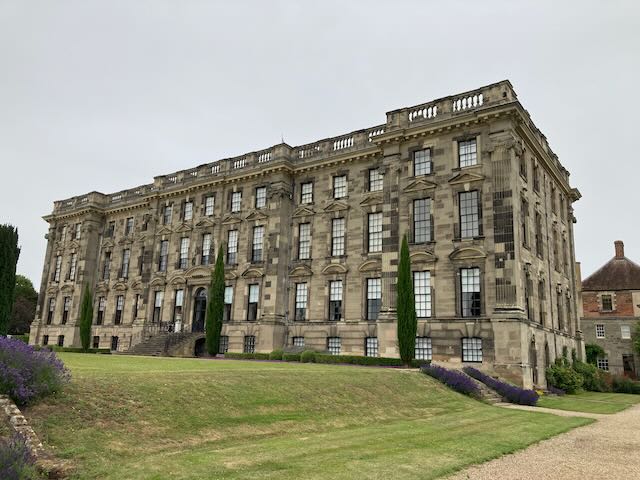
The baroque West Wing is the most impressive building, built in the 1720s by Edward, the third baron Leigh. He married a rich heiress. After his Grand Tour on the continent, he was inspired to create his own Italian-style palace. Mrs. Austen wrote that there are 45 windows in the front.
She was struck, however, beyond her expectation, by the grandeur of the abbey, as she saw it for the first time from the lawn.–Catherine Morland, Northanger Abbey
Even Fanny had something to say in admiration. . . . Her eye was eagerly taking in everything within her reach; . . . being at some pains to get a view of the house, and observing that “it was a sort of building which she could not look at but with respect”–Mansfield Park
Architect Francis Smith designed the Stoneleigh Abbey West Wing, which cost £3,300. The older abbey buildings became servants’ quarters.
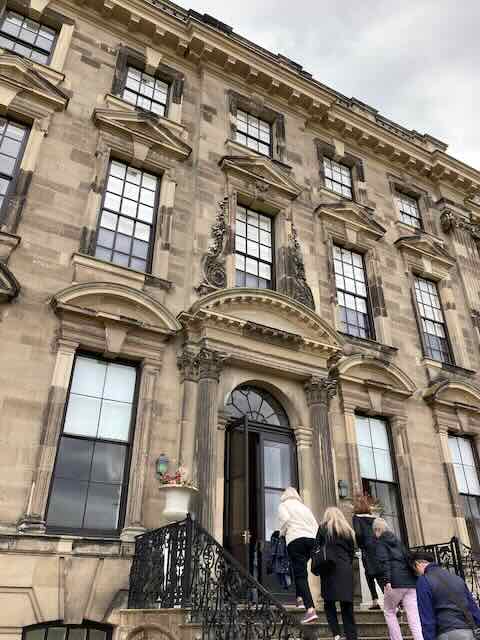
A flight of stairs leads up to the main entry to Stoneleigh Abbey, West wing
Miss Bertram could now speak with decided information of what she had known nothing about when Mr. Rushworth had asked her opinion; and her spirits were in as happy a flutter as vanity and pride could furnish, when they drove up to the spacious stone steps before the principal entrance.–Mansfield Park
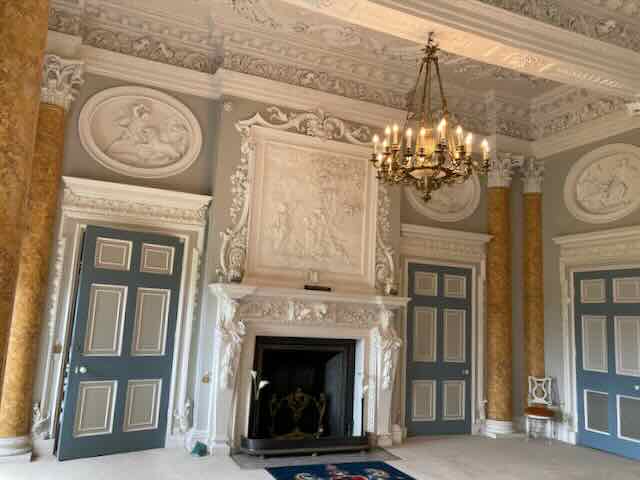
One end of the impressive “saloon” (salon, entry room) of Stoneleigh Abbey. Plaster decorations show myths of the Greek hero Hercules. Edward, the fifth Lord Leigh, decorated this room in the 1760s while doing vast “improvements” to his manor.
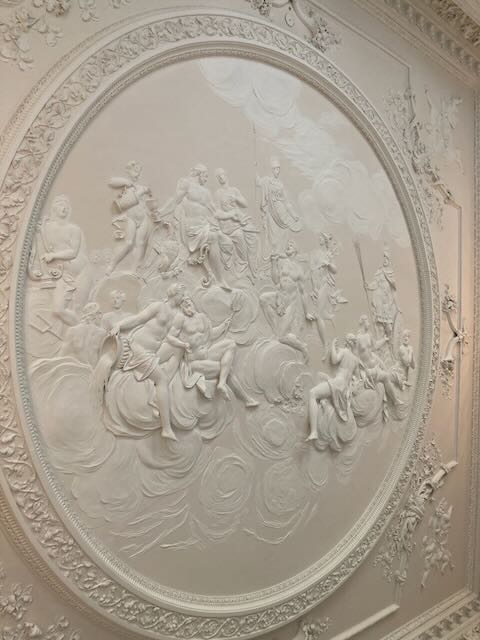
Ceiling plasterwork in the Stoneleigh Abbey saloon showing Hercules joining the gods. Ironically, Hercules suffered from bouts of madness, as did Edward Leigh himself.
An abbey! Yes, it was delightful to be really in an abbey! But she doubted, as she looked round the room, whether anything within her observation would have given her the consciousness. The furniture was in all the profusion and elegance of modern taste.–Catherine Morland, Northanger Abbey
The whole party rose accordingly, and under Mrs. Rushworth’s guidance were shewn through a number of rooms, all lofty, and many large, and amply furnished in the taste of fifty years back, with shining floors, solid mahogany, rich damask, marble, gilding, and carving, each handsome in its way.–Mansfield Park
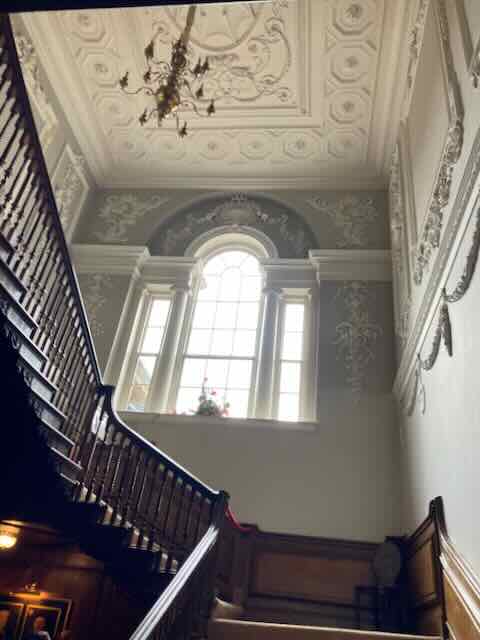
The main staircase of Stoneleigh Abbey, one of three staircases Jane Austen’s mother mentions.
They returned to the hall, that the chief staircase might be ascended, and the beauty of its wood, and ornaments of rich carving might be pointed out.–Northanger Abbey
The lower part of the house had been now entirely shewn, and Mrs. Rushworth, never weary in the cause, would have proceeded towards the principal staircase, and taken them through all the rooms above, if her son had not interposed with a doubt of there being time enough.–Mansfield Park
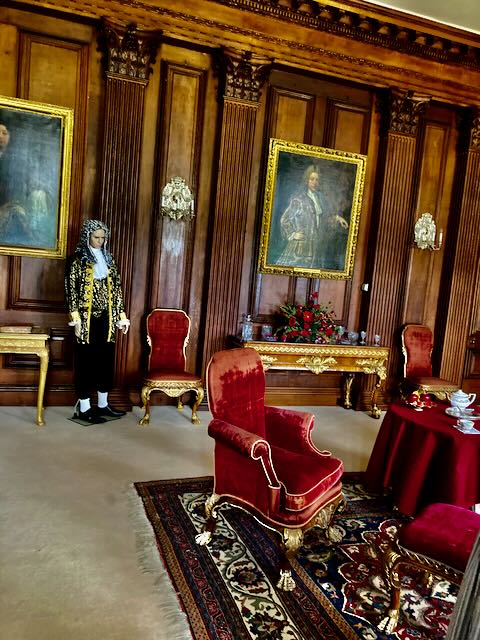
The drawing room of Stoneleigh Abbey. After dinner, the ladies would “withdraw” to the “withdrawing room,” later called the drawing room. The gentlemen would join them after a time.
The general leads Catherine “into a room magnificent both in size and furniture—the real drawing-room, used only with company of consequence. It was very noble—very grand—very charming!—was all that Catherine had to say, for her indiscriminating eye scarcely discerned the colour of the satin; and all minuteness of praise, all praise that had much meaning, was supplied by the general: the costliness or elegance of any room’s fitting-up could be nothing to her; she cared for no furniture of a more modern date than the fifteenth century.”–Northanger Abbey
The drawing room clock, from 1786, plays carillon music on the hour. Stoneleigh Abbey
“Till midnight, she supposed it would be in vain to watch; but then, when the clock had struck twelve, and all was quiet, she would, if not quite appalled by darkness, steal out and look once more. The clock struck twelve—and Catherine had been half an hour asleep.”–Northanger Abbey
Stoneleigh Abbey card room fireplace, with plates of “the prettiest English china,” hand painted by ladies of the family.
The fireplace, where she had expected the ample width and ponderous carving of former times, was contracted to a Rumford, with slabs of plain though handsome marble, and ornaments over it of the prettiest English china.–Northanger Abbey
A Rumford was an invention that made fireplaces more efficient. They are still used today.
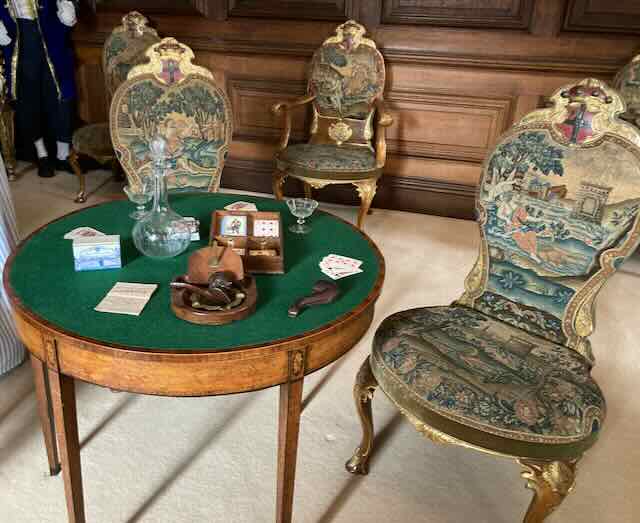
Stoneleigh Abbey card room, set up for a game of cards.
Mr. Elton had retreated into the card-room, looking (Emma trusted) very foolish.–Emma
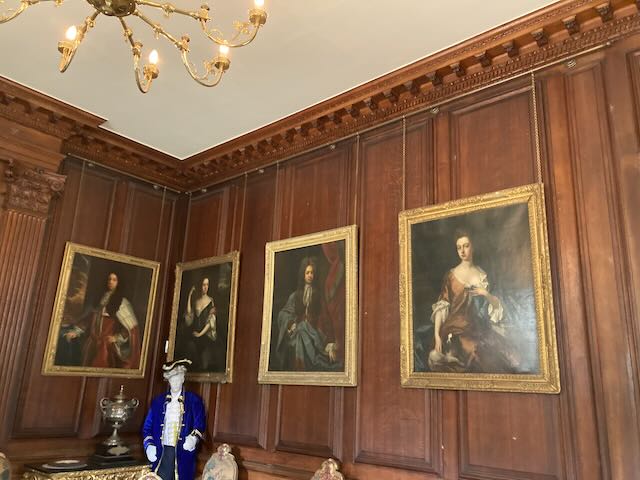
Portraits in the Card Room. All the rooms we saw were lined with family portraits.
Of pictures there were abundance, and some few good, but the larger part were family portraits, no longer anything to anybody but Mrs. Rushworth–Mansfield Park
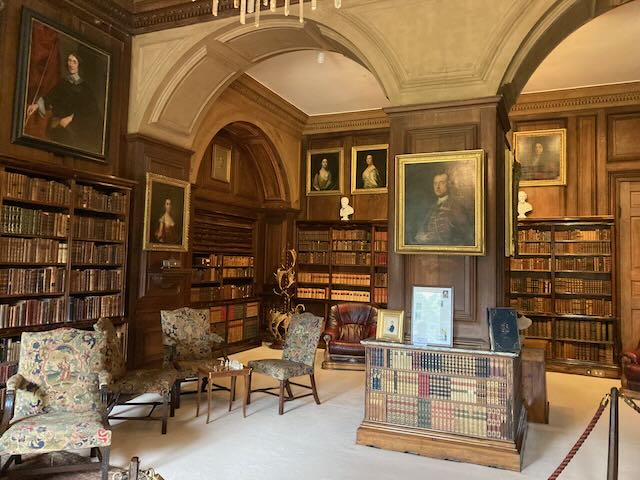
Edward, fifth Lord Leigh, bequeathed most of his extensive library to his alma mater, Oriel College at Oxford. These included “outstanding works on architecture and music, his scientific instruments, maps and prints.” (Jane Austen & Adlestrop, 22).
The library of Stoneleigh Abbey was replenished by later heirs.
Marianne, who had the knack of finding her way in every house to the library, however it might be avoided by the family in general, soon procured herself a book.–Sense and Sensibility
Ready to play chess in the library, Stoneleigh Abbey
“What a delightful library you have at Pemberley, Mr. Darcy!”
“It ought to be good,” he replied, “it has been the work of many generations.”
“And then you have added so much to it yourself, you are always buying books.”
“I cannot comprehend the neglect of a family library in such days as these.”–Miss Bingley and Mr. Darcy, Pride and Prejudice
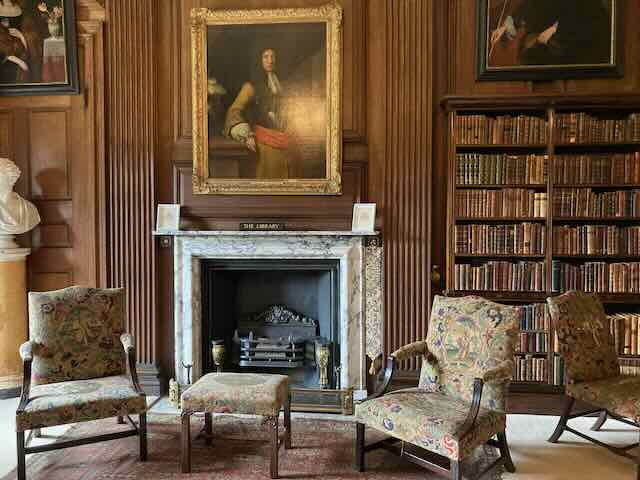
Stoneleigh Abbey library
After tea, Mr. Bennet retired to the library, as was his custom–Pride and Prejudice
Ladies’ dressing table, Stoneleigh Abbey
“My mother is tolerably well, I trust; though her spirits are greatly shaken. She is up stairs and will have great satisfaction in seeing you all. She does not yet leave her dressing-room.”–Jane Bennet, Pride and Prejudice
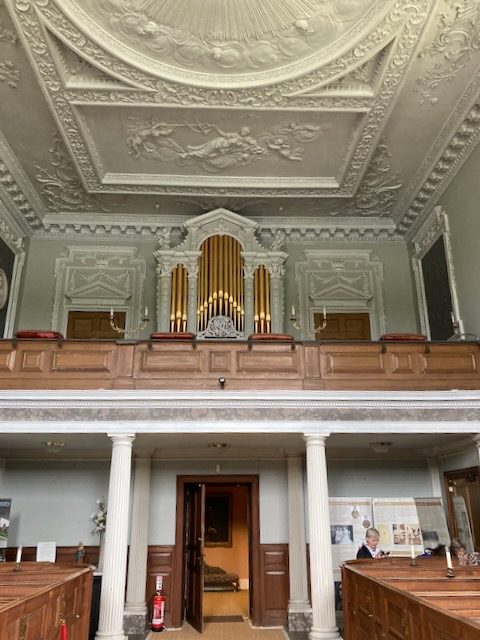
The chapel at Stoneleigh Abbey is considered to be the model for the chapel at Sotherton in MansfieldPark. Crimson cushions appear over the balcony ledge, as in Mansfield Park. Rev. Thomas Leigh read prayers (led a worship service) in the chapel twice a day, with morning prayers at 9 A.M.
Fanny’s imagination had prepared her for something grander than a mere spacious, oblong room, fitted up for the purpose of devotion: with nothing more striking or more solemn than the profusion of mahogany, and the crimson velvet cushions appearing over the ledge of the family gallery above. “I am disappointed,” said she, in a low voice, to Edmund. “This is not my idea of a chapel. There is nothing awful here, nothing melancholy, nothing grand.” . . .
Mrs. Rushworth began her relation. “This chapel was fitted up as you see it, in James the Second’s time. Before that period, as I understand, the pews were only wainscot; and there is some reason to think that the linings and cushions of the pulpit and family seat were only purple cloth; but this is not quite certain. It is a handsome chapel, and was formerly in constant use both morning and evening. Prayers were always read in it by the domestic chaplain, within the memory of many; but the late Mr. Rushworth left it off.” . . .
“It is a pity,” cried Fanny, “that the custom should have been discontinued. It was a valuable part of former times. There is something in a chapel and chaplain so much in character with a great house, with one’s ideas of what such a household should be! A whole family assembling regularly for the purpose of prayer is fine!”–Mansfield Park
Queen Victoria’s bedroom at Stoneleigh Abbey. In 1858, Queen Victoria stayed for two nights at the Abbey, in a suite of five rooms. The furniture was painted white and gold, according to the Queen’s preference.
In a house so furnished, and so guarded, she could have nothing to explore or to suffer, and might go to her bedroom as securely as if it had been her own chamber at Fullerton.–Catherine Morland, Northanger Abbey
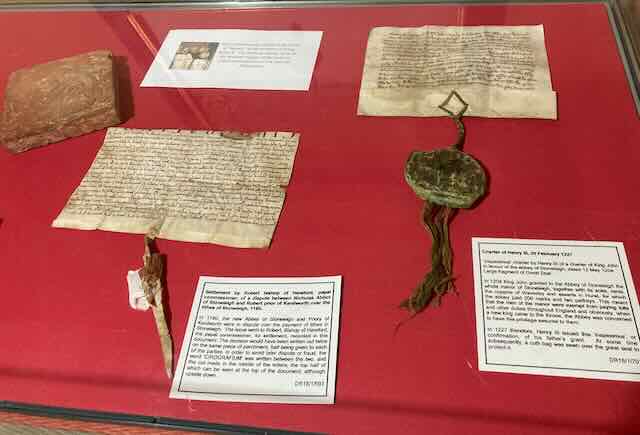
Further rooms at Stoneleigh Abbey display historical relics, such as the monks’ charters and seals.
Northanger turned up an abbey, and she was to be its inhabitant. Its long, damp passages, its narrow cells and ruined chapel, were to be within her daily reach, and she could not entirely subdue the hope of some traditional legends, some awful memorials of an injured and ill-fated nun.–Catherine Morland, Northanger Abbey
Humphry Repton was hired to improve Stoneleigh Abbey and its surroundings. His Red Book, showing before and after pictures, still exists.
Repton moved the river toward Stoneleigh Abbey so you could see the house reflected in the water.
“Smith’s place is the admiration of all the country; and it was a mere nothing before Repton took it in hand. I think I shall have Repton.”–Mr. Rushworth, Mansfield Park
A ha-ha (see below) at Stoneleigh Abbey gives an uninterrupted view across the fields.
From the other side of Stoneleigh Abbey’s hedge of lavender shown above, you can see the wall that kept animals from trespassing to the area around the house. A ha-ha is a walled ditch dug to act as a fence without disrupting the view.
A few steps farther brought them out at the bottom of the very walk they had been talking of; and standing back, well shaded and sheltered, and looking over a ha-ha into the park, was a comfortable-sized bench, on which they all sat down. . . .
“You will hurt yourself, Miss Bertram,” [Fanny Price] cried; “you will certainly hurt yourself against those spikes; you will tear your gown; you will be in danger of slipping into the ha-ha.”–Mansfield Park
In 1946, Stoneleigh Abbey became “one of the first stately homes to open its doors to the public” (Stoneleigh Abbey, 18). A fire destroyed much of it in 1960, though most of the furniture and paintings were rescued. In 1996, a trust was set up to restore it, at a cost of £12 million. They did an amazing job. Restoration was also done on the grounds and the lake. The restoration work sought to improve the habitats of bats, otters, kingfishers, and other species
Restorers also worked on conserving water management structures such as these locks.
We exit back through the Stoneleigh Abbey gatehouse, having enjoyed a beautiful day.
I hope you have enjoyed our visit to Stoneleigh Abbey with Jane Austen’s characters, and that you can see it in person some day! This year, the Abbey celebrated Christmas with a Christmas fair and a series of concerts, including carols in the chapel. If you have been to Stoneleigh Abbey, please tell us about your impressions!
Fashionable Goodness: Christianity in Jane Austen's England is now available! By JAW contributor Brenda S. Cox. See Review. Available from Amazon and Jane Austen Books.
Available through December 31st, 2025. Click on image for details, and share this poster with other teachers and students!
The Obituary of Charlotte Collins by Andrew Capes
Click on image to read the story.
Comments
“My idea of good company…is the company of clever, well-informed people, who have a great deal of conversation.” – Jane Austen, Persuasion
Gentle readers: Please feel free to post your comments and continue the conversation! Due to SPAM, we will no longer accept comments on posts after 30 days of publication. In some instances, links will be removed from comments as well.
Administrators and Contributors
Vic Sanborn, founder of this blog, is supported by a team of talented and knowledgeable writers about Jane Austen and the Regency era. They are:
Tony Grant, who now contributes his photos from London and England
Click on their names to enter their own blogs.
In addition, we thank the many experts and authors who frequently contribute their posts and opinions, and who continue to do so freely or at our request.
Click here to enter the page. Topics include Regency fashion, historic foods, Jane Austen societies, British sites, related topics. Click on image.
May we suggest?
Hello, my name is Vic and I live in Maryland, USA. I have adored Jane Austen almost all of my life. I am a proud lifetime member of the Jane Austen Society of North America. This blog is a personal blog written and edited by me and my team. We do not accept any form of cash advertising, sponsorship, or paid topic insertions. However, we do accept and keep books and CDs to review.
If you would like to share a new site, or point out an error, please email us. (Yes, we are fallible. We'll own up to our mistakes and will make the corrections with a polite smile on our faces.) Write us at
Thank you for visiting this blog. Your comments and suggestions are most welcome.
Project Gutenberg: eBook of Stage-coach and Mail in Days of Yore, Volume 2 (of 2), by Charles G. Harper
STAGE-COACH AND MAIL IN DAYS OF YORE: A PICTURESQUE HISTORY
OF THE COACHING AGE, VOL. II, By CHARLES G. HARPER. 1903. Click on this link.





















 Jane Austen's World