Feeds:
Posts
Comments

Archive for the ‘Regency Customs’ Category

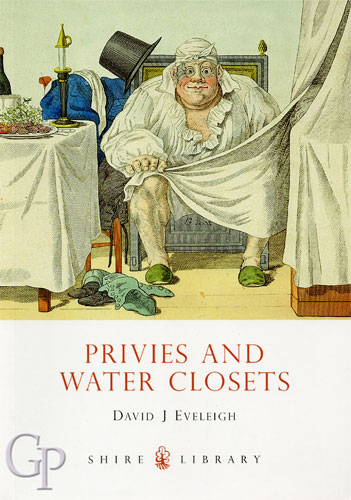
I have reviewed several Shire Library books this past year and have yet to be disappointed. Case in point, Privies and Water Closets by David J. Eveleigh, an excellent small book on the history of fixed and portable sanitation and waste management. I have discovered that this topic is of everlasting curiosity and many of my readers have asked questions similar to the following: How well  did our ancestors manage without indoor bathrooms or running water? This book largely answers the question.

Starting with the 17th and 18th centuries, Mr. Everleigh traces the history of sanitation and the problems our ancestors had in handling waste sewage. While the topic may not seem glamorous, it is hugely fascinating, for sanitation management was intricately connected to the safety of a community’s water supply and the populace’s overall health and well-being. He classified the earliest sanitation methods as either portable or fixed.

Portable Solutions

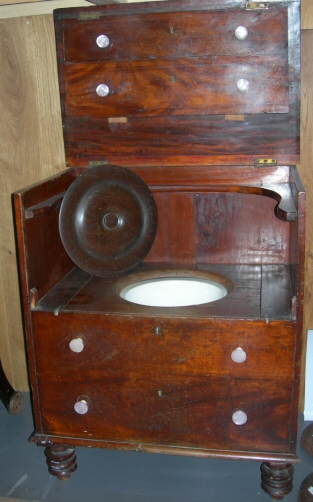
Chamber pots were the easiest method of sanitation. Placed under beds, or a commode or closet stool, the contents could be easily emptied into a covered slop pail and carried outside. In the 17th and 18th century small rooms or closets were introduced that adjoined the bedrooms. These areas were outfitted with a comfortable commode, under which a pan would be placed.

16th century water closet

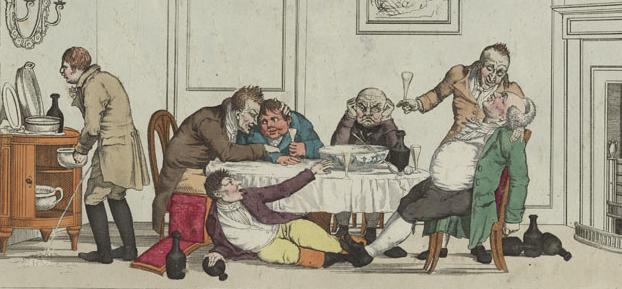
The wealthy did not handle the chamber pots, leaving the servants to clean up after them.  Chamber pots were not always so well situated, as the image below shows (p. 8).

L'apres Dinee des Anglais

English gentlemen, known for their prodigious drinking habits, were wont to relieve themselves where they were – in the dining room, for instance, or in a common room of a public inn – where they did not always aim straight and true (as the young man at left), much to the chagrin and disbelief of French travelers, some of whom wrote about this unsanitary habit.

Fixed Solutions

The privy was a fixed out house (or necessary house or house of office), with no water supply or drain and usually located some distance away from the house. A fixed wooden seat with a rounded hole was placed directly over the cesspit or “void.” Occasionally privies were attached to the side of a building, projecting out from a top floor, or reached through on outdoor entry on the ground floor of a service wing. More often than not they were placed at some distance from the main house at the far end of a garden or yard, where its contents could be used to “enrich” flower and vegetable beds.

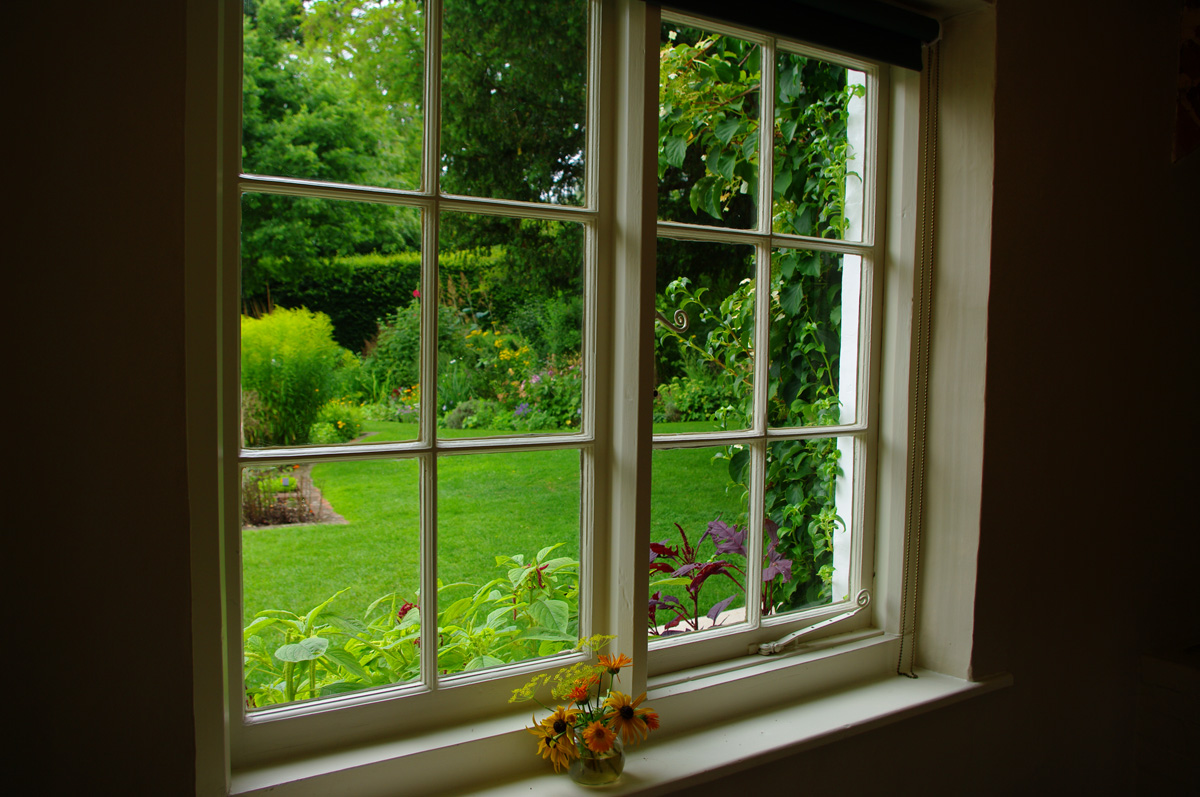
Earth closet contents were put on the garden, Chawton Cottage. Photo courtesy Tony Grant**

In cities, neighboring privies were placed side by side in yards and drained into a common cesspool located under an alley that ran between the row of cottages or townhouses. In rich to middle class households, nightsoilmen would be paid to cart the waste away when the household was sleeping. This service was quite expensive, and quite often neglected in poorer districts where the lower classes could not (and landlords would not) hire these men until the cesspools were filled to overflowing.

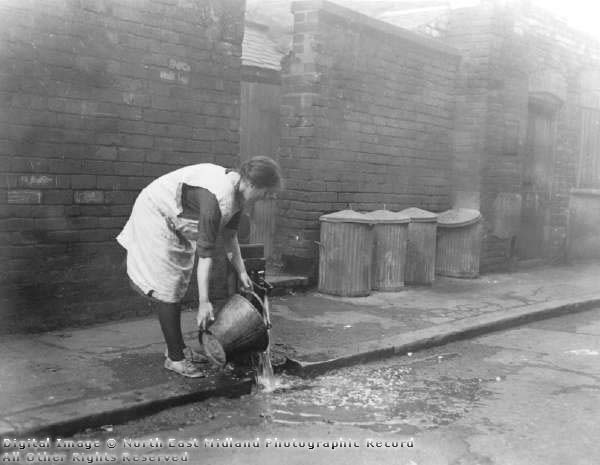
A woman obtains water from a well situated near garbage cans and outdoor privies, which can be seen through the opening in the wall. (Image taken in 1931!)***

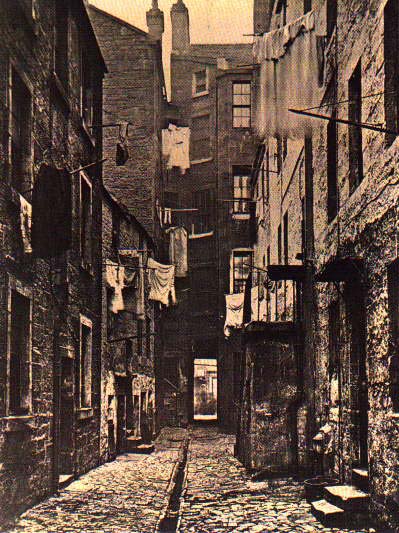
Lack of sanitation led to diseases like typhoid, dysentery, and cholera. It was common in the slum districts for cess pools to be left unlined or partially finished, allowing liquid sewage to seep into and contaminate a nearby well, cistern, or other common form of water supply. In cities the public privy was often the only “necessary” available and was shared by a number of households, sometimes as many as sixty-five. The crowding and lack of maintenance and emptying of wastes led to disease and death.

Alley with open sewer drain and privies for the surrounding houses

In Privies and Waterclosets, Mr. Eveleigh traces the improvements in street sewers, indoor plumbing and running water, and sanitary habits throughout the nineteenth century, especially after the second great cholera epidemic in Bermondsey, London in 1849, which killed 13,000 and was the result of water contaminated by raw sewage.

While the book consists of only 64 pages, authors of historical novels will find it a fascinating and welcome addition to their research library. I give this book three out of three Regency fans.

Pages: 64
Published: 2008, Shire Library 479, Shire Publications, UK
150mm x 210mm, soft cover, indexed, new
ISBN 978-0-7478-0702-5

Additional links:

*Image of water closet: Abertillery and District Museum

**Image of Chawton Cottage garden, Tony Grant, London Calling – Personal Hygiene in Jane Austen’s Day

***Image of woman at well, North East Midland Photographic Record, The University of Nottingham, 1931 (This is a correction.)

Read Full Post »

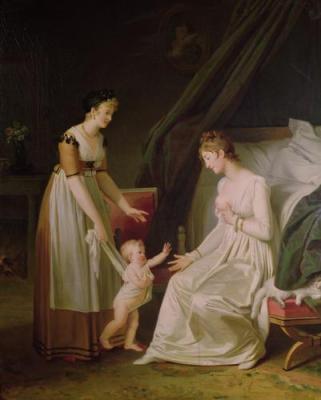
Breastfeeding mother, Marguerite Gerard

French artists Marguerite Gerard (1761-1837) painted this domestic scene of a mother about to breast feed her child.  The subject is unusual in that breasfeeding one’s baby was unfashionable for aristocratic and upper classes,  and the act had become associated with the poor and lower classes.

Generally, wet nurses were paid to feed the babies of the wealthy. Much thought and care went into their selection, and their milk was examined for texture, color, viscosity, and taste. Some thought that aspects of a wet nurse’s personality could be passed through her milk, and therefore her character had to be impeccable. Cassandra Austen, Jane Austen’s mother, sent all her children to the nearby village of Deane to be nursed in their infancy.  Although Cassandra Austen visited her babies daily, they did not return to the family fold until they were around 18 months of age.

The popularity of wet nurses stemmed from the fact that royalty often wanted large families. Wet nurses were hired to feed the newborn so that the royal mother would soon regain fertility and become pregnant again. When royals stopped breastfeeding their children, other women from wealthy families soon followed suit and began to farm their babies out to wet nurses.  This practiced continued until the end of the 19th century, when it largely died out.

Read Full Post »

Inquiring Readers: This is the second of four posts to Pride and Prejudice Without Zombies, Austenprose’s main event for June/July – or an in-depth reading of Pride and Prejudice. My first post discussed Dressing for the Netherfield Ball. This post discusses the dances and etiquette of balls in Jane Austen’s era. Warning: the film adaptations get many dance details wrong.
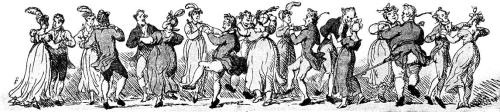
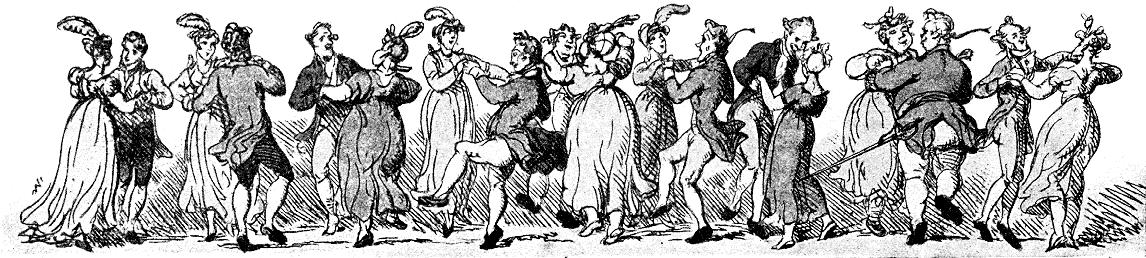
Dancers, Rowlandson, 1790's

So, he enquired who she was, and got introduced, and asked her for the two next. Then, the two third he danced with Miss King, and the two fourth with Maria Lucas, and the two fifth with Jane again, and the two sixth with Lizzy, and the Boulanger …” Mrs Bennet about Mr. Bingley at The Netherfield Ball.

The English ballroom and assembly room was the courting field upon which gentlemen and ladies on the marriage mart could finally touch one another and spend some time conversing during their long sets or ogle each other without seeming to be too forward or brash. Dancing was such an important social event during the Georgian and Regency eras that girls and boys practiced complicated dance steps with dancing masters and learned to memorize the rules of ballroom etiquette.

The Five Positions of Dancing, Wilson, 1811

Balls were regarded as social experiences, and gentlemen were tasked to dance with as many ladies as they could. This is one reason why Mr. Darcy’s behavior was considered rude at the Meryton Ball- there were several ladies, as Elizabeth pointed out to him and Colonel Fitzwilliam at Rosings, who had to sit out the dance.

“He danced only four dances, though gentlemen were scarce; and, to my certain knowledge, more than one young lady was sitting down in want of a partner.”

Mr. Bingley, on the other hand, danced every dance and thus behaved as a gentleman should.

Ladies had to wait passively for a partner to approach them and when they were, they were then obliged to accept the invitation. One reason why Elizabeth was so vexed when Mr. Collins, who had solicited her for the first two dances at the Netherfield Ball, was that she’d intended to reserve them for Mr. Wickham. Had she refused Mr. Collins, she would have been considered not only rude, but she would have forced to sit out the dances for the rest of the evening.
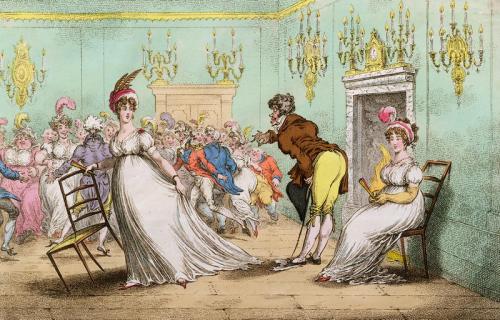
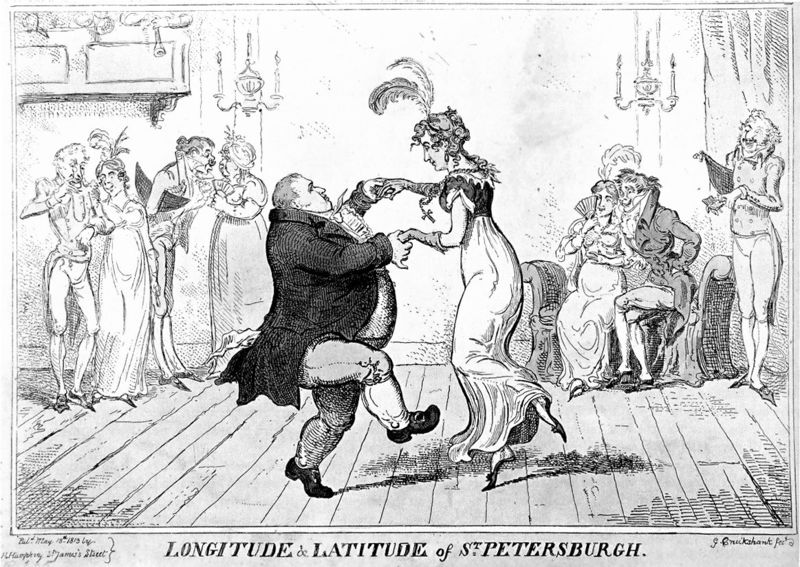
A Broad Hint of Not Meaning to Dance, Gillray, 1804

The only acceptable excuse in refusing a dance was when a lady had already promised the next set to another, or if she had grown tired and was sitting out the dance. Elizabeth could offer neither excuses at the start of the ball, and thus was forced to partner with Mr. Collins.

At a ball, a lady’s dress and deportment were designed to exhibit her best qualities:

As dancing is the accomplishment most calculated to display a fine form, elegant taste, and graceful carriage to advantage, so towards it our regards must be particularly turned: and we shall find that when Beauty in all her power is to be set forth, she cannot choose a more effective exhibition – The Mirror of Graces, 1811

Real Life in London

It was also extremely important for a gentleman to dance well, for such a talent reflected upon his character and abilities. Lizzie’s dances with Mr. Collins were causes of mortification and distress.

Mr. Collins slightly out of step

“Mr. Collins, awkward and solemn, apologising instead of attending, and often moving wrong without being aware of it, gave her all the shame and misery which a disagreeable partner for a couple of dances can give. The moment of her release from him was exstacy.”

A gentleman could not ask a lady to dance if they had not been introduced. This point was well made in Northanger Abbey, when Catherine Morland had to sit out the dances in the Upper Rooms in Bath, for Mrs. Allen and she did not know a single soul. Mrs Allen kept sighing throughout the evening, “I wish you could dance, my dear, — I wish you could get a partner.” Mr. Tilney was introduced by Mr. King, the Master of Ceremonies in the Lower Rooms, to Catherine, who could then dance with him. At Rosings, when Mr. Darcy explained to Lizzie that he danced only four dances at the Meryton Assembly ball because he knew only the ladies in his own party, she scoffed and retorted: “True; and nobody can ever be introduced in a ball room.”

Because a ball was considered a social experience, a couple could (at the most) dance only two sets (each set consisted of two dances), which generally lasted from 20-30 minutes per dance. Thus, a couple in love had an opportunity of spending as much as an hour together for each set.

A gentleman, whether single or married, was expected to approach the ladies who wished to dance. Given the etiquette of the day, Mr. Elton’s refusal to dance with poor Harriet at the Crown Ball in Emma was rude in the extreme, but Mr. Knightley performed his gentlemanly duty by asking that young lady to dance (and winning her heart in the process).

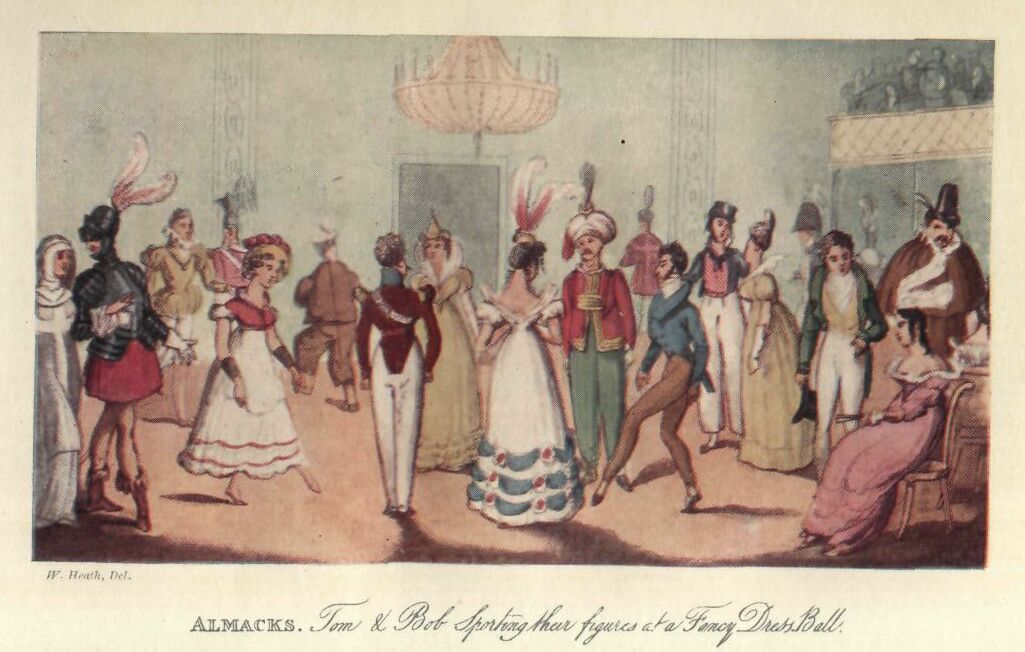
A lively dance at Almack's

Regency dances were extremely lively. The dancers were young, generally from 18-30 years of age, and they did NOT slide or glide sedately, as some recent film adaptations seem to suggest. They performed agile dance steps and exerted themselves in vigorous movements which included hopping, jumping, skipping, and clapping hands.

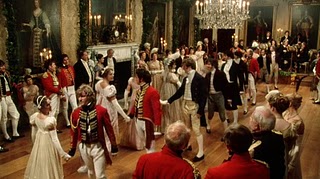
Depending on the dance formation and steps, a gentleman was allowed to touch a lady and hold her hand (and vice versa, as shown in the example of Mansfield Park 1999 above and in the image below).

Allemande

The couple had many opportunities to converse or catch their breaths when they waited for others to finish working their way down a dance progression.  The ability to carry out a conversation was considered very important, as Lizzie pointedly reminded Mr. Darcy:
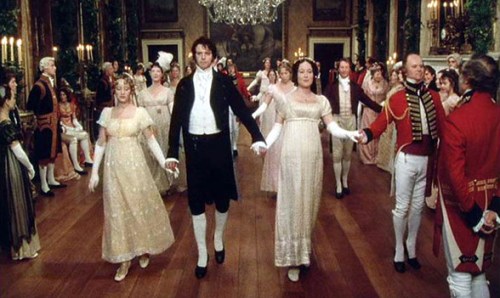
“Elizabeth … took her place in the set, amazed at the dignity to which she was arrived in being allowed to stand opposite to Mr. Darcy, and reading in her neighbours’ looks their equal amazement in beholding it. They stood for some time without speaking a word; and she began to imagine that their silence was to last through the two dances, and at first was resolved not to break it; till suddenly fancying that it would be the greater punishment to her partner to oblige him to talk, she made some slight observation on the dance. He replied, and was again silent. After a pause of some minutes, she addressed him a second time with:

“It is your turn to say something now, Mr. Darcy.—I talked about the dance, and you ought to make some kind of remark on the size of the room, or the number of couples.”

He smiled, and assured her that whatever she wished him to say should be said.

“Very well.—That reply will do for the present.—Perhaps by and by I may observe that private balls are much pleasanter than public ones.—But now we may be silent.”

“Do you talk by rule then, while you are dancing?”

“Sometimes. One must speak a little, you know. It would look odd to be entirely silent for half an hour together, and yet for the advantage of some, conversation ought to be so arranged as that they may have the trouble of saying as little as as possible.”

The dances that would have been danced at the Nethefield Ball were:

The English Country Dance

The characteristic of an English country dance is that of gay simplicity. The steps should be few and easy, and the corresponding motion of the arms and body unaffected, modest , and graceful. – The Mirror of Graces, 1811

Country dances consisted of long lines of dances in which the couples performed figures as they progressed down the line.

When a dancer was too tired to do steps, she would have been considered no longer dancing at all, as with Fanny in Chapter 28 of Mansfield Park:

“Sir Thomas, having seen her walk rather than dance down the shortening set, breathless, and with her hand at her side, gave his orders for her sitting down entirely.”

Rather than everyone starting at once, dances would have called and led off by a single couple at the top; as that couple progressed down the set other couples would begin to dance, then lead off in turn as they reached the top, until all the dancers were moving. Jane Austen occasionally got to lead a dance, as she mentioned in a letter of November 20, 1800, to her sister Cassandra:

“My partners were the two St. Johns, Hooper, Holder, and very prodigious Mr. Mathew, with whom I called the last, and whom I liked the best of my little stock.”

This could lead to very long dances indeed (half an hour to an hour) if there were many couples in a set” – What Did Jane Austen Dance?

The Cotillion
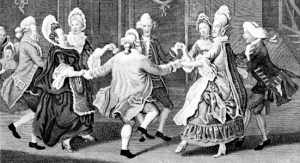

The cotillion was based on the 18th-century French contradanse and was popular through the first two decades of the 19th century. It was performed in a square formation by eight dancers, who performed the figure of the dance alternately with ten changes.

The rapid changes of the cotillion are admirably calculated for the display of elegant gayety, and I hope that their animated evolvements will long continue a favourite accomplishment and amusement with our youthful fair. – The Mirror of Graces

The minuet.

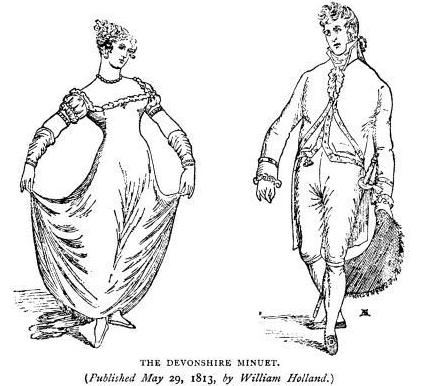
The Devonshire Minuet

This dance had grown almost out of fashion by the time A Lady of Distinction wrote The Mirror of Graces, and it is conjectured that Jane Austen must have danced it in her lifetime.

Boulanger

Boulangers, or circular dances, were performed at the end of the evening, when the couples were tired. Jane Austen danced the boulanger, which she mentioned in a letter to Cassandra in 1796: “We dined at Goodnestone, and in the evening danced two country-dances and the Boulangeries.”
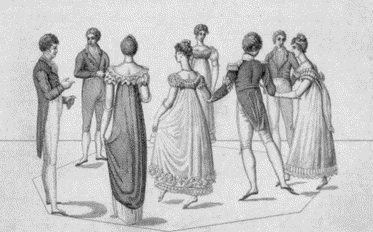
Quadrille

Note: the Quadrille and the waltz would not have been danced at the Netherfield Ball. Jane did mention the quadrille in a letter to Fanny Knight, which was dated 1816. And the waltz would not have been regarded an acceptable dance in 1813. It is doubted that Jane ever waltzed. The reel might have been danced at the Meryton Assembly, or at a private dance given by Colonel Foster and his wife, for instance, but it would probably not have been featured at the Netherfield Ball at the same time as a country dance.

Second Note: The movies have it all wrong. According to the author of this post on Capering and Kickery, “Real Regency Dancers Are Au Courant

Along with the peculiar notion that dance figures from the 17th century are useful for the early 19th century comes the even more peculiar notion that entire dances of that era are appropriate. Regency-era dancers were not interested in doing the dances of their great-great-great-great-great-great-great grandparents, any more than today’s teenagers are. Dances like “Hole in the Wall” and “Mr. Beveridge’s Maggot” were written in the late 17th century. Their music is completely inappropriate for the Regency era. Their style is inappropriate. Their steps are inappropriate. There is no sense in which these dances belong in the Regency era. Loving obsessions with these dances make me want to cry at the sheer ignorance being promulgated by the people who keep putting these dances in movies.”

More on the Topic

Read Full Post »
Inquiring reader: Jean at The Delightful Repast is a freelance writer who writes mostly about food, weddings, etiquette and entertaining for numerous publications. Her blog reflects her culinary heritage–an English grandmother, a Southern grandmother and a mother who could do it all. Jean’s love of reading and cooking (often done simultaneously) is definitely in her genes. She has (delightfully) offered to share her thoughts about tea in Jane Austen’s day and her recipe for Sally Lunn buns!

It came as quite a disappointment to me that day long ago when I, an avid afternoon tea aficionado, realized that afternoon tea was not part of Jane Austen’s life. (I am still taken aback by the thought as I write those words!) Tea drinking, popular at Court since the 1660’s, had by the Regency Period long since trickled down through all strata of society. Jane and her family no doubt enjoyed a nice cup of tea at least twice a day, at breakfast and in the evening after dinner.

Tea, being the magical all-purpose beverage that it is, was surely drunk at other times as well. I drink tea a minimum of four times a day. My grandmother Elizabeth (from the Lake District) drank tea several times a day, including once in the middle of the night. Her mother Mary Ann was constantly putting the kettle on. And it was Mary Ann’s grandmother Mary who was a contemporary of Jane Austen’s, though at the other end of the country.

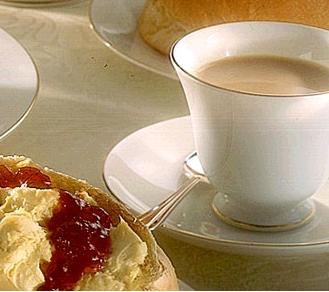
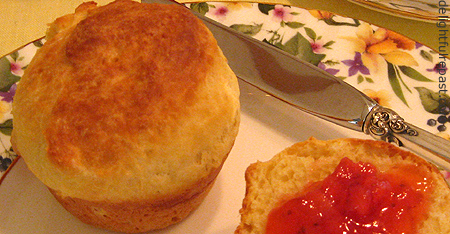
There are a number of things Jane might have had with her tea, including hot, buttered Sally Lunn buns, good with both sweet and savory toppings. Those made today in Bath are very large, perhaps six inches across and four inches high. My own version, which I’m sure Sally Lunn’s in Bath would scorn as an inadequate imitation, is much smaller. I’ve made them as large as a hamburger bun but, preferring them smaller yet, usually make them in a muffin tin.

Sally Lunn Buns
(Makes 18 )

4 packed cups (20 ounces) unbleached all-purpose flour

1/3 cup sugar

2 1/4 teaspoons (1 package) instant yeast

1 1/2 teaspoons salt

1 stick (1/2 cup) unsalted butter
4 large eggs

1 cup milk

In medium bowl (I use a 2-quart glass measure), whisk together flour, sugar, yeast and salt. In small saucepan, melt butter.

With electric mixer, beat the eggs until fluffy and pale lemon yellow, about 5 minutes. Add the milk and beat until smooth, about 1 minute. By hand with a dough whisk or wooden spoon, add the flour mixture to the egg mixture in three additions, alternating with the melted butter and beginning and ending with the flour mixture. Cover with lid or plastic wrap. Place in refrigerator for at least 24 hours and up to three days.

About 2 1/4 hours before serving time, remove dough from refrigerator. Stir down the dough, just a few strokes, with a wooden spoon. With a 1/4-cup measure or scoop sprayed with cooking spray, scoop dough into well-greased or cooking-sprayed standard muffin tins. Lightly butter a sheet of plastic wrap and place, buttered side down, over the buns. Let rise until puffy but likely not doubled in volume, about 1 3/4 hours. During last 15 minutes, preheat oven to 375 degrees.

Uncover buns. Bake at 375 degrees about 25 minutes, or until golden brown. Transfer tins to wire racks and let cool for 5 minutes. Turn the buns out of the tins onto the racks and serve warm or continue to cool before storing.

By Jean at The Delightful Repast at http://delightfulrepast.com/

Read Full Post »

Gentle Reader, next week Austenprose will begin a Pride and Prejudice extravaganza entitled, Pride and Prejudice Without Zombies. The group will be reading Jane Austen’s own words. Not some mash up. Not a sequel. And, as far as I am concerned, my favorite book of all time. When Laurel Ann asked me to contribute my thoughts during the event, I was already researching information about Mr. Jones, the apothecary who treated Jane Bennet. So, as a pre-announcement, I am publishing this post. Do obtain a copy of Pride and Prejudice and join Laurel Ann and her readers as she begins her in-depth analysis of the book on Tuesday, June 16th.

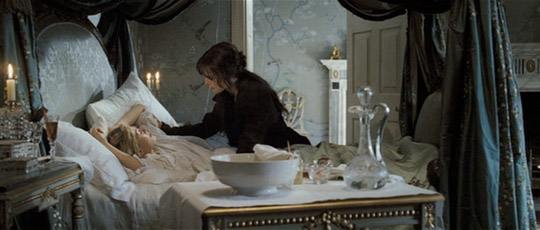
Jane is sick, Netherfield Hall, Pride and Prejudice 2005

In 1813, the year that Pride and Prejudice was finally published, apothecaries filled an important role in rural areas where physicians were scarce. When Jane Bennet fell ill at Netherfield Park, Mr. Jones, the apothecary was sent for:

Breakfast was scarcely over when a servant from Netherfield brought the following note for Elizabeth:

“My dearest Lizzy,

I find myself very unwell this morning, which, I suppose, is to be imputed to my getting wet through yesterday. My kind friends will not hear of my returning home till I am better. They insist also on my seeing Mr. Jones therefore do not be alarmed if you should hear of his having been to me and excepting a sore throat and head-ache, there is not much the matter with me.

Yours, &c.”

Unlike a physician, whose social standing ranked high, apothecaries were considered one step up from a tradesmen, and several rungs below the physician/doctor.


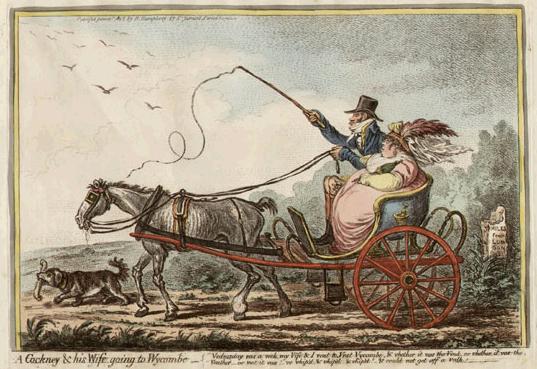
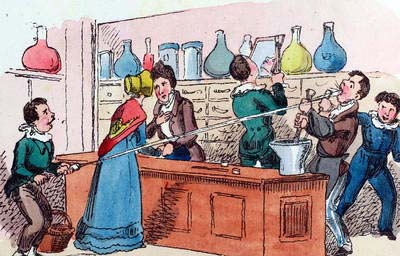
This cartoon by James Gillray suggests that the Cockney in question is an apothecary. Note the mortar and pestle symbol on the side of the carriage.

Apothecaries learned how to make drugs and poultices during their tenure as apprentices. They used their hands and labored in shops, and were often the only alternative for people who sought medical care and who could not afford a doctor’s fees. Interestingly, apothecaries were not paid for giving advice or providing medical treatment. They were paid only for the drugs they sold.

Apothecary Shop, Glasgow Looking Glass

Mr. Jones, would have traveled to Netherfield Hall and dispensed his advice without recompense. But he recommended his draughts, which enabled him to earn some money, and instructed Elizabeth on how to use them:

The apothecary came and having examined his patient said as might be supposed that she had caught a violent cold and that they must endeavor to get the better of it advised her to return to bed and promised her some draughts. The advice was followed readily for the feverish symptoms increased and her head ached acutely.

Visiting an ill Jane at Netherfield, Pride and Prejudice 2005

Mrs. Bennet’s ploy to keep Jane at Netherfield, using Mr. Jones as an excuse when Mr. Bingley inquires about Jane’s condition, worked:

“Indeed I have, Sir,” was her answer. “She is a great deal too ill to be moved. Mr. Jones says we must not think of moving her. We must trespass a little longer on your kindness.”

Mr. Bennet used Mrs. Bennet’s machinations to his advantage, demonstrating his wit even as he admonished his wife for placing Jane in danger:

“Well, my dear,” said Mr. Bennet, when Elizabeth had read the note aloud, “if your daughter should have a dangerous fit of illness, if she should die, it would be a comfort to know that it was all in pursuit of Mr. Bingley, and under your orders.”

“Oh! I am not at all afraid of her dying. People do not die of little trifling colds. She will be taken good care of. As long is she stays there, it is all very well. I would go and see her, if I could have the carriage.”

As an interesting aside, one of the 3rd Earl of Stanhope’s third daughter’s eloped with the family apothecary, prompting James Gillray to draw the cartoon, Democratic Levelling: Alliance a la Francaise, The Union of the Coronet and Clyster Pipe. (A coronet is a small crown symbolizing a peer’s status and a clyster pipe was a tube used for injections). The earl was a great proponent of liberty and revolution, but this marriage sorely tested his tolerance for equality! One wonders what Mr. Bennet might have said had Jane or Lizzie run off with Mr. Jones!

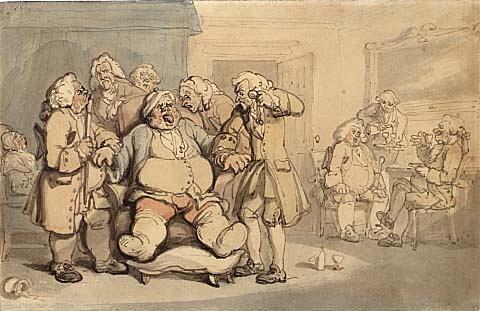
At the turn of the 19th century, the practice of medicine would benefit from rapid scientific advances brought about by methodical and well-reasoned experimentation and observations. But at the height of Thomas Rowland’s and James Gillray’s satiric powers, doctors, surgeons, and apothecaries were still targets of fun. The medical field also did not fare well with popular opinion.

The Comforts of Bath, Rowlandson. At the end of the 18th Century, Bath had more doctors and apothecaries per number of citizens than any city in England.

The following humorous scene between a doctor and an author sums up the popular perception of a doctor’s swelled head. His miniscule knowledge about medicine does not detract from his exalted opinion of his social standing in relation to an apothecary’s. This passage emphasizes the point that the medical field took a back seat to poetry and criticism:

Doctor: I suppose, Sir, you are his apothecary.

Gent: Sir, I am his friend.

Doctor: I doubt it not. What regimen have you observed since he has been under your care? You remember, I suppose, the passage in Celsus, which says, “if the patient on the third day have an interval, suspend the medicaments at night. Let fumigations be used to corroborate the brain.” I hope you have upon no account promoted slernutation by hellebore.

Gent:  Sir, you mistake the matter quite.

Doctor: What! an apothecary tell a physician he mistakes! You pretend to dispute my prescription! Pharmacopola componant. Medicus folus prefabricat. Fumigate him, I say, this very evening, while he is relieved by an interval’

Dennis: Death, Sir, do you take my friend for an apothecary! A man of genius and learning for an apothecary! Know, Sir, that this gentleman professes, like myself, the two noblest sciences in the universe, criticism and poetry. By the immortals, he himself is author of three whole paragraphs in my Remarks, had a hand in my Public Spirit, and assisted me in my description of the furies and infernal regions in my Appius.

(The discussion continues.) Then the doctor says:

Doctor: He must use the cold bath, and be cupped on the head. The symptoms seem desperate. Avicen says: “If learning be mixed with a brain that is not of a contexture fit to receive it, the brain ferments till it be totally exhausted. We must endeavour to eradicate these indigested ideas out of the perieranium, and to restore the patient to a competent knowledge of himself. – Elegant Extracts, or Useful Entertaining Passages

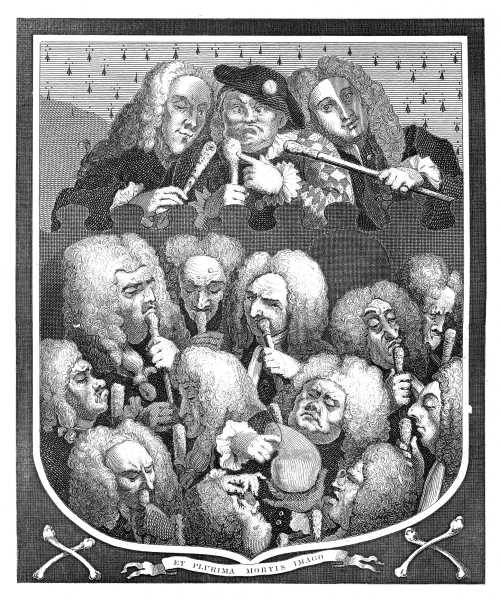
Consultation of Physicians, Hogarth

Physicians occupied the top rung of the medical social ladder because they did not “soil” their hands by treating the patient directly, as a surgeon would. They did not accept money in public (the payment would have been made discreetly). These “learned” men attended university but did not perform autopsies or dissect cadavres. Men of breeding, they merely sat back and watched the procedure from afar.

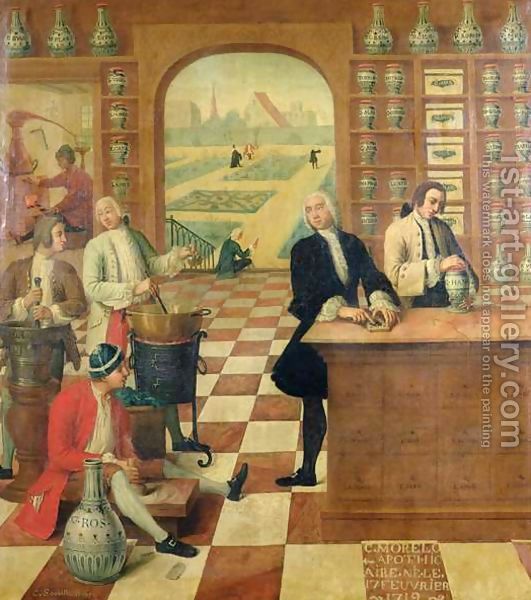
Apothecary shop, 1719

An apothecary shop during Jane Austen’s day was much like today’s drug store, where a customer could purchase drugs, herbs, poultices, panaceas, and other medicinals. In the image from 1st Art Gallery, one can see the preparations and infusions being made in an 18th century apothecary shop. Herbs grew in an adjacent garden and substances were stored in apothecary jars and drawers. Such shops also sold surgical equipment. In this link one can view an apothecary shop in Colonial Williamsburg, much as a similar shop might have looked in Meryton.

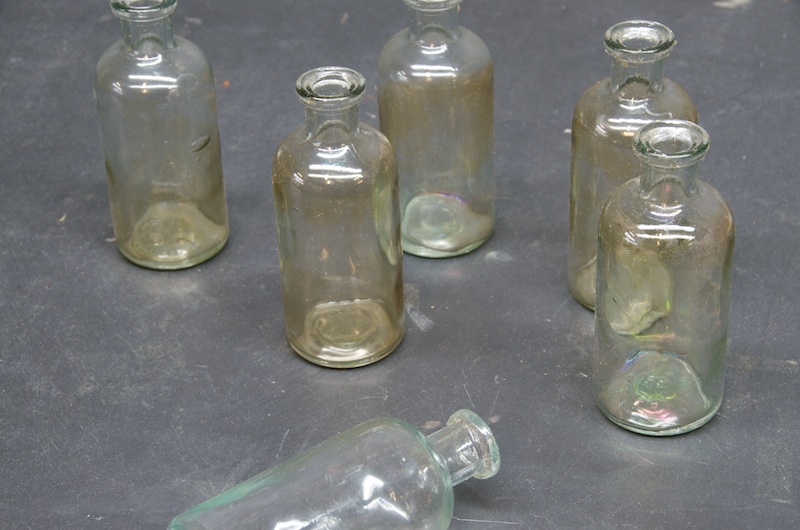
18th century apothecary bottles made with mercury glass

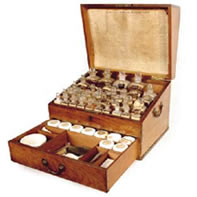
Apothecaries were often the only doctors available in a rural community, and they would take their supplies with them in portable apothecary box. Mr. Jones, Jane Bennet’s apothecary, must have dispensed his solutions from a similar box.

Apothecary box

By the mid-19th century, the medical field changed drastically, including the pharmaceutical field, and medications and medical practices  began to actually heal patients with predictable success. In 1895, the Pharmaceutical Journal wrote what might well be an eulogy for apothecaries:

You are all familiar in one way or another with the apothecary of the last century. A gloomy little man in a gloomy little shop with a gloomy little helper. What mystery there was surrounding every step!  His weird work with flame and flask mortar pestle and still! … These were pioneers in our profession and all honour is due them.

My further discussions about medicine in the 19th century can be found in three posts I have written on the topic:

More on the topic of medicine in Jane Austen’s day in these links:

Read Full Post »

« Newer Posts - Older Posts »