Feeds:
Posts
Comments

Archive for the ‘Regency letters’ Category

Hello, dear readers! This month, I’m featuring this new edition of Pride and Prejudice, a Handwritten Classics edition. This is a luxurious collector’s edition in two volumes, featuring Austen’s complete novel. Inside, you’ll find a collection of characters’ letters and papers, written and folded by hand.

This new collector’s edition offers a luxurious cloth binding, deluxe paper, and new printed ephemera that lend an additional dimension to the reading experience. Examples include a newspaper clipping announcing that Netherfield Park is available to let, an invitation to the ball at Netherfield, an illustrated guide to Pemberley, Darcy and Elizabeth’s marriage license, and so forth.

Order Your Copy Here

About the Book

This collector’s edition invites fans inside the world of Jane Austen’s Elizabeth Bennet. A deluxe, cloth-bound, two-volume set includes gorgeous replicas of the characters’ letters, plus all-new mementos, such as the Darcys’ marriage certificate and an invitation to the ball at Netherfield.

Heller’s specially curated edition, first published in 2020, brought these epistles to life and became a fan favorite. Pockets throughout the novel contain handwritten replicas of nineteen letters, from Mr. Collins’s unctuous letter of introduction to Jane’s urgent missive announcing Lydia’s elopement. Readers can pull out each piece, peruse its contents, and feel transported to the breakfast table at Longbourn.

Heller’s research notes shed fascinating light on how she imbued each letter with the character’s unique personality and recreated historical postage marks. Delve deeper into the history with guest essays by Philip Palmer, curator and department head at the Morgan Library & Museum, and Dr. Juliette Wells, curator of the Morgan’s 2025 exhibition of Austen’s own letters, A Lively Mind: Jane Austen at 250. For anyone who loves Austen, and for anyone who still cherishes the joy of letter writing or collects printed memorabilia, this book offers an immersive experience of a favorite story.

You can revisit Austen’s original text and experience it in a unique way with physical ephemera that links you directly to the world of Elizabeth Bennet and Mr. Darcy. From the masterful calligraphy and the painstaking attention to historical detail to the hand-folding of the letters and other paper memorabilia—this book is an object made by fans for fans.

The novel is presented in two volumes, cloth-bound, foil-stamped, and housed in an elegant slipcase. It offers an exceptional reading experience, stands apart on the shelf, and makes for a truly lovely gift and keepsake. 

Barbara Heller

Barbara Heller is a set decorator for film and television, including The Americans and When They See Us, and a writer and director of award-winning short films that have screened at festivals around the world (Cannes, Berlin, Sundance). She graduated from Brown University with a degree in English Literature. Her previous books include special editions of Pride and PrejudiceLittle WomenPersuasion, and Anne of Green Gables. You can read about her work and visit her online HERE.

How the Series Began

Heller, an avid Austen fan, shares about creating this series of handwritten editions of classic books and how it all started:

“I was re-reading Pride and Prejudice for the gazillionth time, savoring my favorite passages in Mrs. Gardiner’s “long, kind, satisfactory” letter to Elizabeth, when a sudden desire to have that letter in my hand came over me. To hold the very letter that Elizabeth Bennet once received – ink faded, paper yellowed – would be utterly satisfying. In truth, I wanted to possess the originals of all the letters in Pride and Prejudice. A vision of myself at a flea market, happening upon the letters, was so real that I experienced the twin electric thrills of discovery and possession. I became determined to transform reverie into reality.

“[It took] three fascinating years during which I examined hundreds of letters written in early 19th century England; dove deep into their cryptic postal marks; agonized mightily over each character’s handwriting, and met the talented scribes who could write a period hand.

“I was extraordinarily lucky to find a home amongst the Austen lovers at Chronicle Books. In this special edition, each letter is tucked inside a glassine envelope bound at the appropriate place in the novel. I have now read the letters so many times I practically have them memorized; and yet, with every re-read, I still get caught up in the story, discover something new, and marvel at (and feel grateful for) the genius of Jane Austen.”

Jane Austen Book Collecting

I personally think this is an edition for serious book collectors and Jane Austen collectors. The price point is high, but it’s currently on sale right now on Amazon (subject to change). It would make a lovely gift or a fun splurge for yourself. It is truly an immersive experience.

As I thought about how I would use this book, I think it would make a wonderful display at a Jane Austen party, book club, program, or exhibit. I can imagine gathering a group of Austen friends together to dress up, have tea, and read the letters and papers out loud together.

As we step into Fall over the next few months, I look forward to sharing several new books that are releasing this year in celebration of Jane Austen’s 250th! I hope you’ve found a few books to add to your shelves along the way.


RACHEL DODGE teaches writing classes, speaks at libraries, teas, and conferences, and writes for Jane Austen’s World blog. She is the bestselling, award-winning author of The Anne of Green Gables DevotionalThe Little Women DevotionalThe Secret Garden Devotional, and Praying with Jane: 31 Days Through the Prayers of Jane Austen. A true kindred spirit at heart, Rachel loves books, bonnets, and ballgowns. Visit her online at www.RachelDodge.com.
Read Full Post »

Inquiring readers: In early October, Prof Elaine Chalus, Historian of 18-19C British gender, politics & society, sent a link to eight sessions of the Bath 250, A Virtual Conference, The 250th Anniversary of the New Assembly Rooms of Bath, given on 29th & 30th September 2021. My first recap was of Professor Steve Poole’s presentation about Bath’s sedan chairmen.  

This second summation is of Rachel Bynoth’s discussion, entitled “The Marriage Market Reassessed: Female Emotional Experiences of Eighteenth-Century Bath Through Letters,” and focuses on the relationship between Bess Canning and her mother Mehitable (Hitty) Canning, the wife of Stratford Canning. (See a short synopsis of the family tree and their history at the end of the recap). Bynoth’s discussion also touched on another mother and daughter, whose letter exchanges are not discussed in this post.

About the Marriage Mart

Most of us who know about the 18th-19th century habits and rituals of courtship in Bath have acquired our awareness from reading  history books, articles, and blogs, as well as contemporary works of fiction. Unlike academics, however, most of us haven’t spent years seeking original sources and hunting dusty books in far corners of libraries and second-hand bookstores.  Conferences, such as ‘Bath 250’, present research from those sources. Bynoth’s primary approach to her topic are two key words in her title – emotional experiences. Through their letters, Bynoth follows both Bess’s experience as she attends the parties and balls and avails herself of Bath’s social life, and her mother’s increasing anxiety about her eventual success at attracting a husband during a time of England’s involvement in the Revolutionary War and Napoleonic Wars, when men were in short supply.

Canning-118

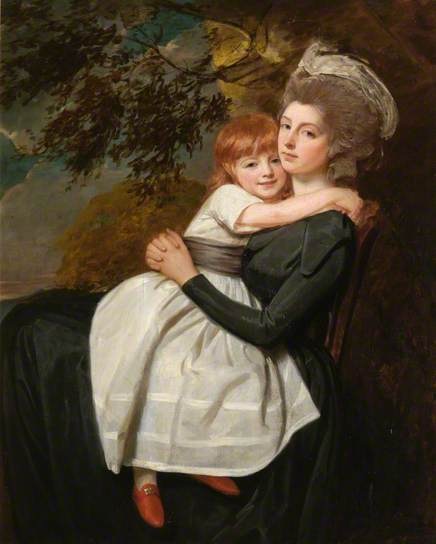
Mrs Stratford Canning with her daughter Elizabeth, by George Romney, National Trust for Scotland, Fyvie Castle

In Bynoth’s workshop discussion, she first mentions 16-year-old Bess Canning’s letter to her mother in her first social season in 1792. (Jane Austen was 17 at this time. She wrote Susan/Northanger Abbey at 23-24 years of age, after her first visit to Bath in 1797.)

Hitty replies to Bess:

“I am much pleased with your daily occupations + am glad you are improving your knowledge of housekeeping – it is a very necessary Qualification, for all young Women, but especially such as have small Fortunes – I trust in God my dear Bess with a little care and management; we shall all do very well – but we must act with great Circumspection, for many eyes are upon us + all our actions will be well scrutinized.” – quote from a slide by Rachel Bynoth in her presentation. – Rachel Bynoth

One senses the mother’s love in this missive. Nevertheless, Bynoth points out an underlying anxious tone in their future correspondence, for Hitty, a widow, and separated from her daughter in Bath, must rely on the Leighs, Bess’s chaperones, to supervise her according to her standards. The Leighs understood their responsibilities perfectly. In comparison to the Allens (Northanger Abbey), Bess’s real life chaperones “procured a partner for Bess for almost every ball, thus allowing her to dance.” – Smith, Rachel, “Proceedings of the History of Bath Research Group”, No. 5, 2016-17, pp.27-28.

It was important to Hitty that Bess was perceived as fashionable and erudite, ie. grammatically correct in letters. Her husband, Stratford Canning had died in 1787, five years before her daughter’s debut into society.  One can only imagine a widow’s anxiety for her daughter, especially one with five children to raise. Her letter to Bess commented 

“upon her grammar and spelling frequently. Hitty also criticised her daughter’s attention to her letter-writing, stating that she needed to pay more attention to her form and language in order to improve and insisted that their frequent correspondence would aid her development. This repetition of writing … [came] out of Hitty’s desire for her daughter to avoid the stereotype: that women could not spell or correctly apply the rules of grammar. This was especially important as Hitty moved in upper class circles: her intimate friend was Mrs Sheridan who was close friends with the Devonshire House set. Bess’s actions as a connected young woman would be commented upon and Bess’s trips to Bath in 1792/3 and 1798 highlighted this.” – Rachel Smith, Proceedings 

Mother and daughter corresponded regularly when apart, often every two days, and thus Hitty’s influence on her daughter kept Bess mindful and respectful of her mama’s wishes.

“Hitty’s letters to Bess in Bath show the importance of communication in order to fit in with fashionable society. Hitty’s letter, which asks Bess to report whether she had combed the powder out of her hair, tells one in real terms, how the powder tax affected people as well as demonstrates Hitty’s continuing societal education. This comment, and Bess’s subsequent reply detailing that she now had ‘red’ locks, also proves the significance of the ‘see and been seen’ aspect of society, where Bess would be judged as unfashionable with powdered hair.” – Rachel Smith, Proceedings

One can imagine the pressure Bess must have felt from her mother. At this time in 1792/93, Bess was a young lady new to the conventions of the marriage mart. According to Bynoth, her initial letters to her mother were optimistic and enthusiastic, and not without a little chagrin at Hitty’s attempt to micromanage her from afar. When she wrote about her concern about her progress, Bess, now 17, replied referring to a Bath newspaper account, 

“You may … fully satisfy your curiosity and [it] will convince you that my beauty, elegance, grace and uncommon wit is not to be surpassed.” – Bynoth

This answer should remind today’s readers of the cheeky and testy retorts any teenage girl would send her parents when enjoying the sights and sounds of a resort town. While her parent was becoming increasingly anxious, Bess still held hope in finding a beau.

By 1798, when Bess was 22 years of age and still seeking a husband in Bath, she no longer had all the time in the world by Georgian standards to attract a husband. Recall that Jane Austen visited Bath for the first time in 1797, when she was of a similar age. The author’s descriptions of Bath in NA, written shortly after her experiences, help us to understand the social whirl that both Bess and Jane experienced and the anxiety they must have felt in not satisfying family expectations. 

During this time, suitable men had come in even shorter supply due to the wars and so the ladies and their mammas were bound to be even more disappointed at the lack of suitors. 

“During these wars the shortage of men of marriageable age became particularly acute by the 19th century. Those that were eligible were often overseas, continuing the fights. This made finding a marriage partner even more anxiety inducing and harder.” – Bynoth

One can imagine the pressure on both the mother and the daughter. As her mother hyperventilated in print, Bess attempted to assuage her worries in another letter:

“… pray feel no anxieties about me. Mrs Leigh considers of everything for me & takes as much care & looks after me just as if I were her own. I make no doubt all will go on exactly as you could wish … Do not suffer the least apprehension about my dress & so forth … I must make Hay while the Sun shines if possible & I would have you to know I never looked half so well.“ – Bynoth 

The squeeze was on. While Hitty became increasingly anxious, Bess remained optimistic, but as time passed she too began to notice the lack of suitors. 

Scarcity of Suitors

As Bess’s stay lengthened, she wrote in a more somber tone:

“the girls ought to all pray for peace there. T’ill that much desired blessing arrives, it is in vain for them to crop and dress and go to public places … on hearing of the terrible scarcity of Beaus at Bath.”

Bess then wrote to her mother that the social gatherings consisted of more women and no men, and expressed her boredom and anxiety. For want of something better to do she was forced to “flirt a little with Lady Marianne’s son.”

While Hitty still seemed to feel more anxiety than Bess about her prospects for the future, her daughter expressed an interesting phrase: “Not that I wish to be melancholic, just now.”

Bynoth’s summarizing statement about Bess Canning’s situation sums it up perfectly: 

“Concerning finding a suitable husband or just securing a match, it seems to be less actually trying to find a suitable husband than trying to find a husband at all.”

Conclusion:

After seven more years, Bess did indeed find a beau suited to her station and, we hope, her mother’s wishes for a happy future. She married George Henry Barnett of Glympton Park  on 14th December 1805. This short biographical sketch places her squarely in an advantageous economical position as a wife:

“Despite occasional difficulties caused by wars and the business cycle, two generations of banking, together with other business directorships and socially advantageous marriages (his wife was a first cousin of George Canning, briefly the Prime Minister in 1827), made George Henry Barnett a wealthy man, worth £120,000 at his death in 1871. Both his surviving sons, Henry Barnett (1815-96) and Charles George Barnett (1816-96) followed him into the bank, and remained partners until its final absorption into Lloyds in 1884.” – Landed Families of Britain and Ireland

One assumes Bess achieved her destiny as a wife and mother in Hitty’s eyes. May we all hope she found peace and happiness in the marriage and as a mother as well. Bess died in 1838 at 61, while George Henry died to a ripe and elderly age in 1871. 

Additional links:

Read Full Post »

Captain Wentworth’s letter to Anne Elliot at the end of Jane Austen’s Persuasion has long been heralded as one of the most romantic letters—and moments—in English literature. But does Wentworth’s letter live up to today’s standards of a really well-written love letter?

If you look up how to write the perfect love letter on the Internet, quite a lot of interesting information comes up. One article that might be of particular interest to a man like Captain Wentworth is this one: “How to Write a Love Letter” by Brett and Kate McKay from the web site, The Art of Manliness.

First, the article states that, “A handwritten letter is something tangible that we touch and hold and then pass to another to touch and hold. And they are preserved and cherished in a way that text messages or email never will be.” Captain Wentworth’s letter certainly meets this criteria. He writes his letter to Anne by hand, folds the paper “hastily,” and writes a “hardly legible” direction “to ‘Miss A. E.— ’” on the outside. (As to whether his letter will be preserved and cherished, I’ll leave that up to your excellent imaginations.)

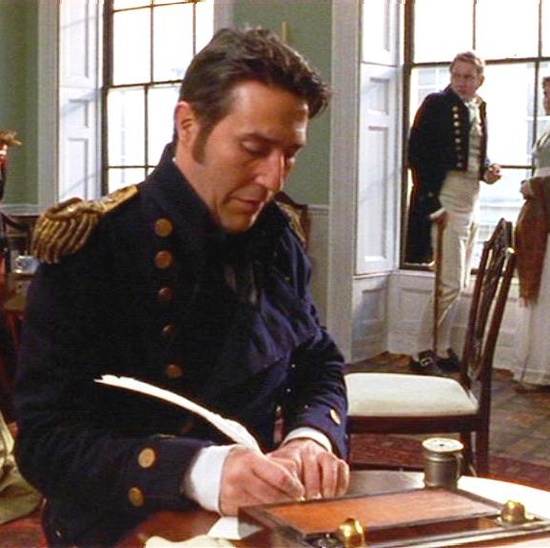
Captain Wentworth pens his letter.

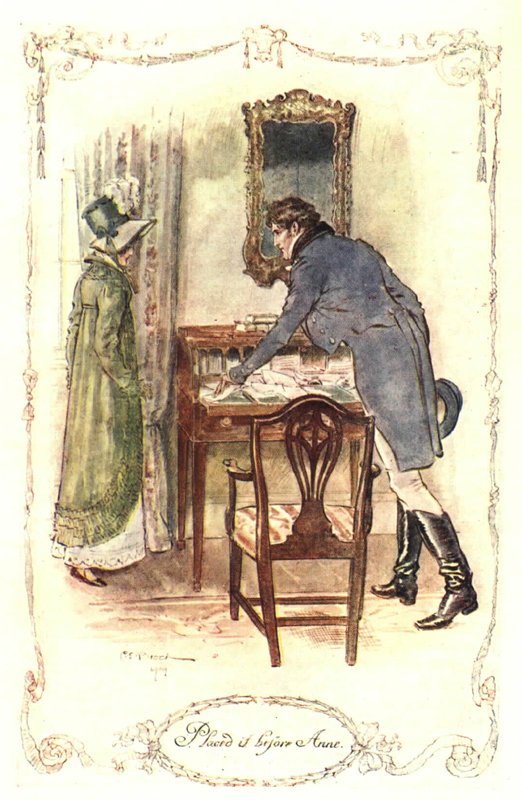
Next, there is the mode of delivery. For lovers who are separated by miles, an envelope and a stamp do the job nicely. Others might choose to leave their letters under a door mat, on a bedside table, or beside a dinner plate. As for Wentworth, he prefers the rather intense (and covert) personal delivery system for his letter to Anne:

[Wentworth] drew out a letter from under the scattered paper, placed it before Anne with eyes of glowing entreaty fixed on her for a time, and hastily collecting his gloves, was again out of the room, almost before Mrs Musgrove was aware of his being in it: the work of an instant!

Jane Austen’s Persuasion
“Placed it before Anne.” Illustration by C.E. Brock, 1909.

Finally, we must consider the contents of the letter. Wentworth hastily writes his letter at a writing table as he listens in on Anne and Captain Harville’s conversation about love and constancy. But does his hurried letter check all the boxes of a first-rate love letter?

The Art of Manliness suggests that every good love letter much include six major elements. Let’s go through the checklist and find out if Wentworth’s letter to Anne makes the grade:

Six Keys to a Good Love Letter

1. Start off by stating the purpose of your letter. Captain Wentworth certainly doesn’t waste any time getting to the point and stating his purpose. There is no question that this is a passionate love letter right from the start:

“I can listen no longer in silence. I must speak to you by such means as are within my reach. You pierce my soul. I am half agony, half hope. Tell me not that I am too late, that such precious feelings are gone for ever. I offer myself to you again with a heart even more your own than when you almost broke it, eight years and a half ago.”

2. Recall a romantic memory. Though their past is painful, Wentworth lets Anne know that his memories of her—and his love for her—have never faded, no matter what has happened between them or what he has tried to do to heal and forget her:

“Dare not say that man forgets sooner than woman, that his love has an earlier death. I have loved none but you. Unjust I may have been, weak and resentful I have been, but never inconstant.”

3. Tell her all the things you love about her. For Captain Wentworth, every word out of Anne’s mouth is like water to his thirsty soul. He knows her voice better than anyone else and hangs on her every word:

“I can hardly write. I am every instant hearing something which overpowers me. You sink your voice, but I can distinguish the tones of that voice when they would be lost on others. Too good, too excellent creature! You do us justice, indeed.”

4. Tell her how your life has changed since meeting her. Wentworth could probably write a whole book about this (indeed, Austen did), but his letter checks this box in a rather dramatic way as he reveals that Anne is the only thing he cares about and that she is the sole focus of all his thoughts and plans:

“You alone have brought me to Bath. For you alone, I think and plan. Have you not seen this? Can you fail to have understood my wishes? I had not waited even these ten days, could I have read your feelings, as I think you must have penetrated mine.”

5. Reaffirm your love and commitment. Wentworth declares his love several times in this letter and has no trouble expressing his commitment to Anne. He clearly asks for her hand in marriage:

“I offer myself to you again with a heart even more your own than when you almost broke it, eight years and a half ago.” He declares his love in absolute terms: “I have loved none but you.” And after listening to her conversation with Captain Harville, he closes his letter with another affirmation of his fervent and undying love for her:

“You do believe that there is true attachment and constancy among men. Believe it to be most fervent, most undeviating, in F. W.”

6. End with a line that sums up your love. One might actually think Captain Wentworth was a contributing writer for The Art of Manliness because he accomplishes this task with an eloquent post script, asking for one word or look from Anne to seal his fate:

“I must go, uncertain of my fate; but I shall return hither, or follow your party, as soon as possible. A word, a look, will be enough to decide whether I enter your father’s house this evening or never.”

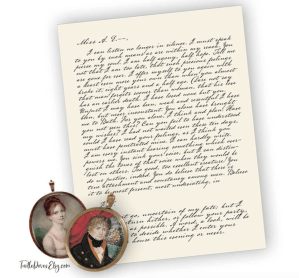
Captain Wentworth’s Letter by TurtleDoves.

The Right Response

Wentworth’s letter certainly seems to satisfy the most important aspects of an eloquent love letter, but the true test of any romantic letter is the addressee’s response. For that, we must go to Anne herself for her reaction to the letter:

Such a letter was not to be soon recovered from. Half an hour’s solitude and reflection might have tranquillized her; but the ten minutes only which now passed before she was interrupted, with all the restraints of her situation, could do nothing towards tranquillity. Every moment rather brought fresh agitation. It was overpowering happiness.

Jane Austen’s Persuasion

Indeed, Wentworth’s letter is a complete success. When they meet in the street, Anne returns his pointed look and the “cheeks which had been pale now glowed, and the movements which had hesitated were decided.” There, in the street, they exchange “again those feelings and those promises which had once before seemed to secure everything, but which had been followed by so many, many years of division and estrangement.”

Truly, “such a letter” is not to be “soon recovered from.” By Anne or by us.

The sky’s the limit with letter writing. And love letters are never to be outdone by “newsy,” handwritten letters that fly back and forth between friends. But if you do write a love letter, make sure you take some pointers from Captain Wentworth.

For more information about the digitized version of Captain Wentworth’s Letter by TurtleDoves on Etsy (pictured above), click HERE.

Works Cited:

Austen, Jane. “Persuasion.” The Project Gutenberg E-Text of Persuasion, by Jane Austen, 2019, http://www.gutenberg.org/files/105/105-h/105-h.htm.

McKay, Brett and Kate. “30 Days to a Better Man Day 28: Write a Love Letter.” The Art of Manliness, 2 Oct. 2020, http://www.artofmanliness.com/articles/30-days-to-a-better-man-day-28-write-a-love-letter/.

RACHEL DODGE teaches college English classes, gives talks at libraries, teas, and book clubs, and writes for Jane Austen’s World and Jane Austen’s Regency World. She is the author of Praying with Jane: 31 Days Through the Prayers of Jane Austen and The Anne of Green Gables Devotional: A Chapter-By-Chapter Companion for Kindred Spirits. You can visit Rachel online at www.RachelDodge.com.
Read Full Post »

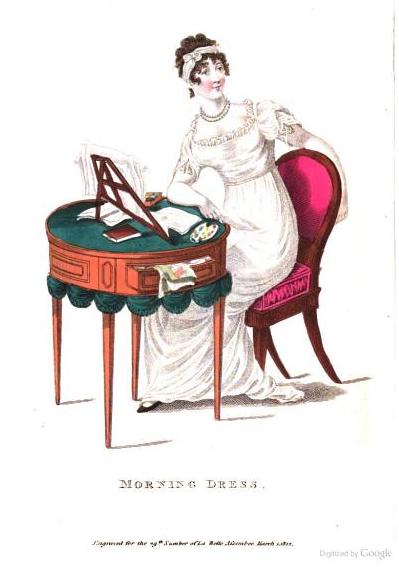
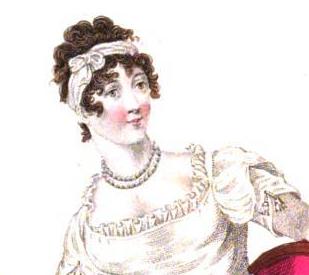
What did ladies do in the morning 200 years ago? Why, write letters and draw and paint, of course. A genteel lady knew all three arts and achieved them with varying skills. This delightful La Belle Assemblee print details how a well-dressed woman would look at her work table. This young Regency miss works like me, btw: with everything out and cluttering surfaces.

Morning Dress, March 1812, La Belle Assemblee

First, a description of the outfit:

MORNING or HOME COSTUME: A white cambric frock with a demi train, short sleeves fastened up in front with cordon and tassels, a necklace formed of two rows of opal; the hair dressed in full curls, and confined by a demi turban of very fine muslin tied on the right side with a small bow; silk stockings with lace clocks richly brocaded; and plain black kid slippers.”

Detail of hair and bodice, La Belle Assemblee, March 1812. Note the lovely bandeau, the ringlets framing the face, and the relatively high neckline with ruff.

The magazine goes on to say that embroidery on all gowns, whether for domestic parties or home attire, seems very prevalent. Embroidery on evening gowns made of costly materials is frequently of gold and silver. India muslins are again coming much into wear and were very decently priced:

for the information of our Fashionable Readers, we have observed, at the house of Millard, in the City, some of the choicest production of the East Indies from the Company’s recent Sale of Bengal Muslins, &c. Their beauty is exquisite…”

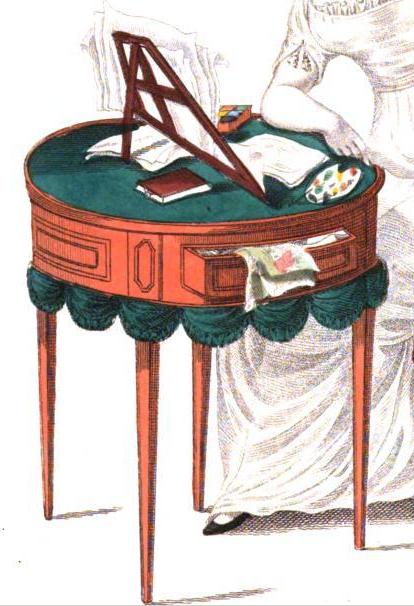
Detail of ladies round worktable with drawer. La Belle Assemblee, March 1812. This one most likely had a top and decorative swaths made of green baize, which prevented sliding.

These small and elegant worktables were portable and could be easily carried near a light source or fireplace, or stashed against a wall when company came. They varied, some coming with a variety of compartments – some hidden – that contained writing and painting supplies. Many had book stands for reading, others had drawers that contained paper or embroidery threads and sewing supplies.

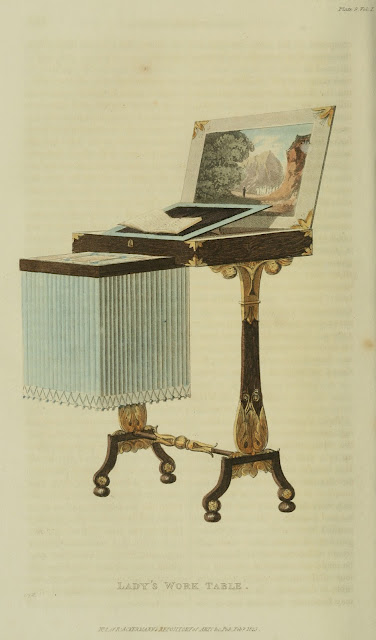
Ackermanns Lady’s work table, 1823. Image from EK Duncan

This work table was “equally adapted to the boudoir and drawing-room, and answers the purpose of a drawing-table as well as a work-table, and a desk for writing and reading.”

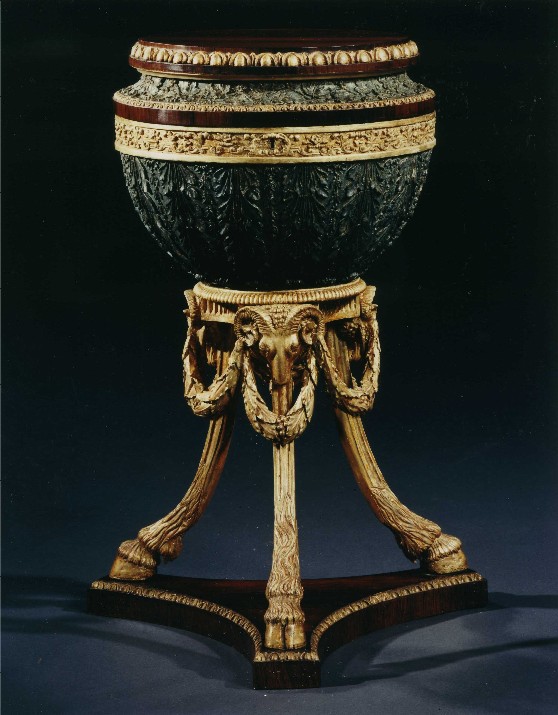
This was a very elegant and expensive work table for a rich lady.

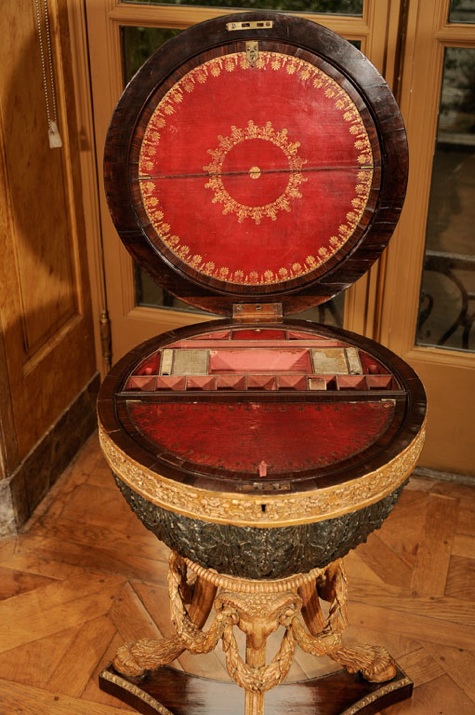
This English work table, circa 1815, is a curious fusion of the refined neoclassicism of Robert Adam and the exotic eclecticism which emerged during the Regency period.  The finely carved tri-form giltwood stand, based on a Roman form, is typical of Adam’s adaptation of the antique. – Carlton Hobbs Work Table

… it was also a Regency characteristic to employ finely tooled scarlet leather, such as that fitted to the interior of this piece.”

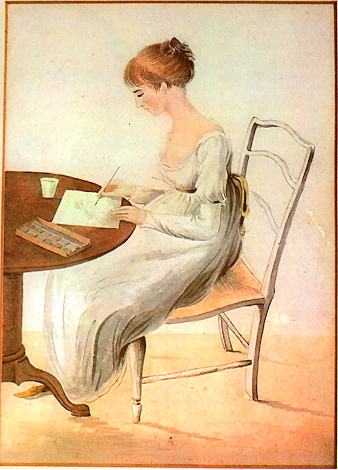
Jane Austen’s niece, Fanny Knight, paints watercolors on a regular table.

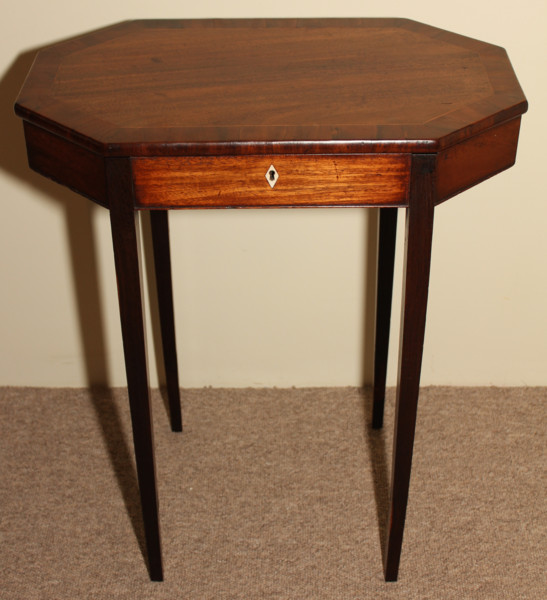
This rather plain octagonal worktable has four legs instead of the pedestal on Fanny Knight’s table.

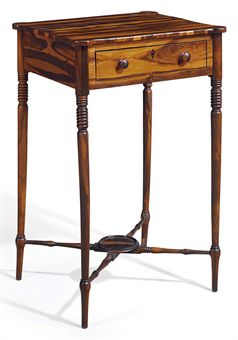
As you can see, work tables varied in design and construction. This simpler and smaller cocuswood work table suited a lady’s purpose as well as a fancier one, but it has fewer compartments.

This plain worktable with a single drawer is an:

Early 19th century regency cocuswood work table with a rectangular top and single drawer.The turned legs are joined by a turned stretcher with circular platform, with paper label to underside inscribed purchased by ABM.

A few months ago I featured a short video of an 18th century French mechanical worktable, which showed how the hidden mechanisms worked and how easily the table could be moved from place to place. Click on this link to view it.

Note: The blue links are mine: the green links are ads placed here by WordPress. I make no money from this blog.

Read Full Post »

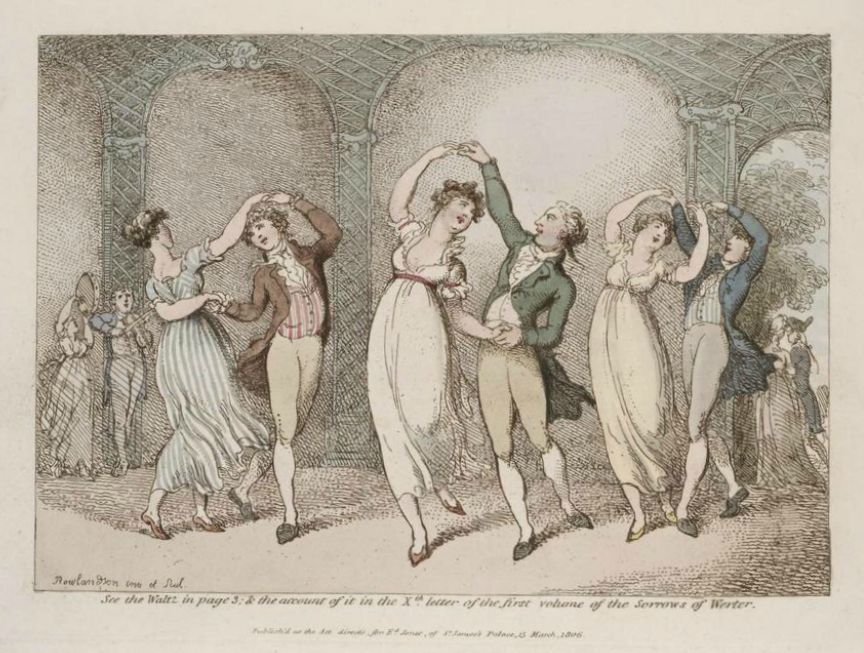
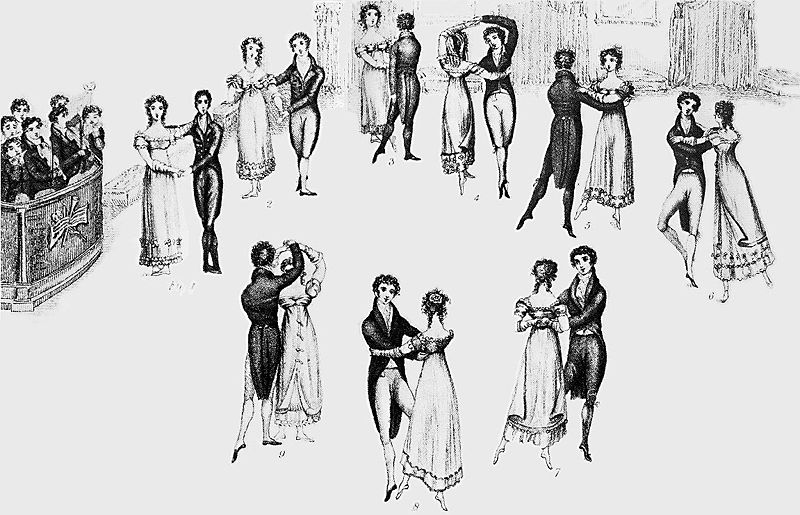
When Lady Caroline Lamb met Byron in 1812, the waltz was starting to gain traction with the more progressive elements of Society. This couples dance was considered rather racy in an age when stately group English country dances were the primary offerings at Almack’s.

Thomas Rowlandson’s image of the waltz in 1806

The vivacious and racy Lady Caroline Lamb met Lord Byron in 1812. She recalled that time in a letter she wrote 12 years later:

Devonshire House at that time was closed from my uncles death for one year – at Melbourne House where I lived the Waltzes and Quadrilles were being daily practised – Lady Jersey, Lady Cowper, the Duke of Devonshire, Miss Milbank, and a number of foreigners coming here to learn…

You may imagine what forty or fifty people dancing from 12 in the morning until near dinner time all young gay & noisy were.
In the evenings we either had opposition suppers or went out to Balls and routs – Such was the life I then led when Moore and Rogers introduced Lord Byron to me… Caroline Lamb, 1824, in a letter to Captain Thomas Medwin

It is interesting to note that Caroline mentions Lady Jersey and Lady Cowper, two of the patronesses of Almack’s, where the waltz was banned. Eventually, however, the ultra exclusive Almack’s would cave in, and by 1814 the waltz was finally sanctioned. Young ladies would still need approval before a gentleman could clasp his arm around her waist, but the doors had been opened beyond the confines of the upper classes.

La Walze, Le Bon Genre, 1810. This caricature has a feeling of decadence.

By 1815, when Jane Austen’s Emma was published, the waltz has become so respectable that it would be danced in Highbury at the home of the Coles.

Mrs Weston, capital in her country-dances, was seated, and beginning an irresistible waltz; and Frank Churchill, coming up with most becoming gallantry to Emma, had secured her hand, and led her up to the top.” – Emma

The waltz looks gentrified in this 1816 illustration.

More on the topic:

Read Full Post »

Older Posts »