This Jane Austen blog brings Jane Austen, her novels, and the Regency Period alive through food, dress, social customs, and other 19th C. historical details related to this topic.
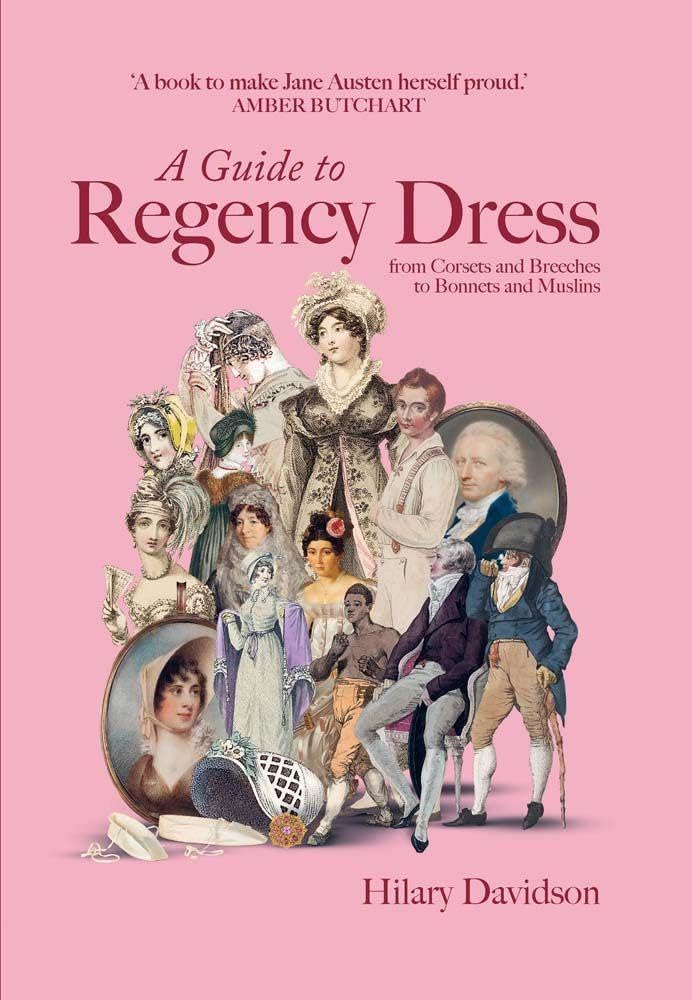
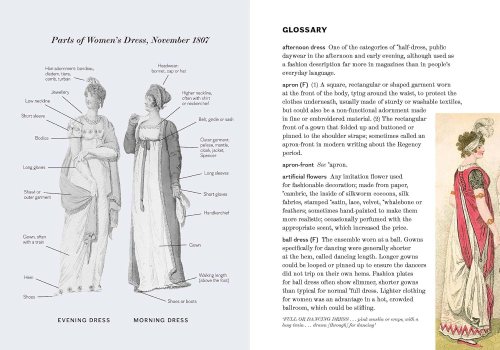
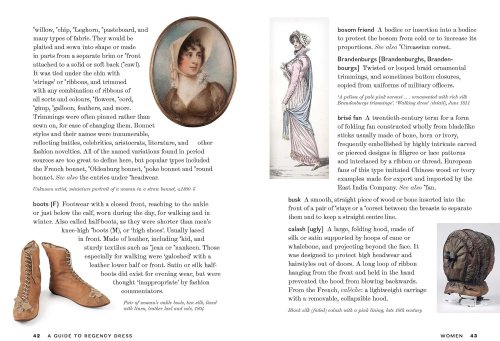
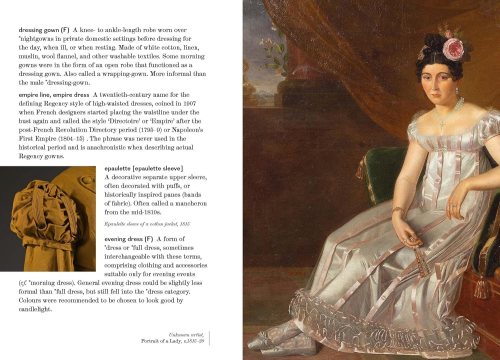
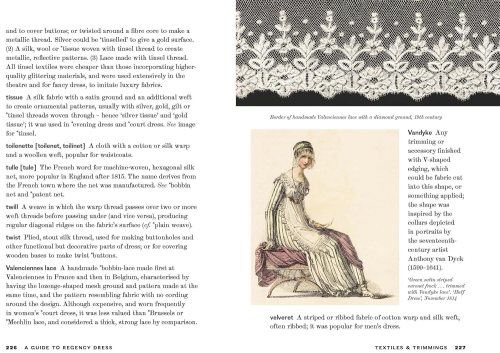
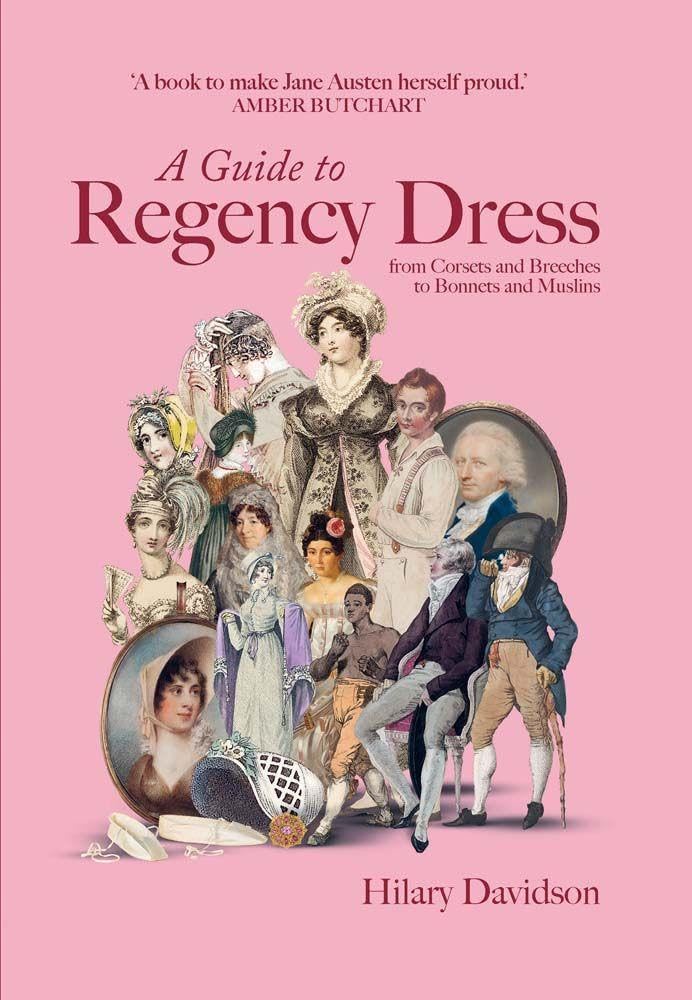
This is one of my favorite new books of the past year, and I plan to use it as I read and research Austen’s novels and watch the film adaptations. Davidson provides a comprehensive glossary of terms related to fashion and clothing during Austen’s time, included beautiful photography to help illustrate various items. Seeing everything in one place makes this a Jane Austen fashion dictionary and encyclopedia that is both fascinating and beautiful. What might normally take me hours to research for one of my articles, I can now find easily in one place.
I particularly enjoyed the way the book is broken up into sections, with a detailed glossary in each section. The sections include Women, Men, Hair and Beauty, Jewellry (sic), and Textiles and Trimmings. Each section includes information and a full glossary with exquisite, full-color photos and illustrations. I enjoyed reading about the differences between items such as women’s stockings and men’s stockings. Women are often the focal point of Regency dress, but men’s clothing and dress is just as interesting. As a writer, I also appreciated Richardson’s extensive bibliography at the end of the book.
You can peruse this book anytime you want to learn more about dress in Austen’s day or find inspiration for your next Regency tea party, event, or ball!
An accessible, fun, yet authoritative guide to male and female Regency fashion: Celebrated dress historian Hilary Davidson brings together nearly 20 years of research on Regency fashion in an illustrated guide for the first time. All the elements of the Regency wardrobe of both men and women―from coats, gowns and undergarments to shoes, accessories, beauty, hair and jewellery―are assembled, along with their textiles and trimmings.
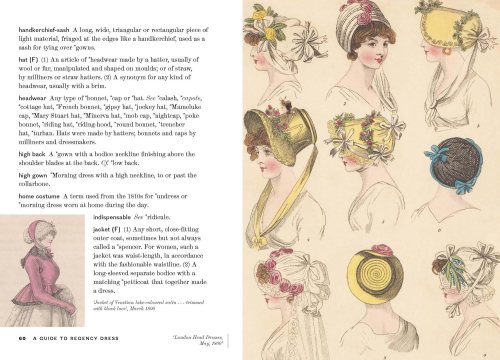
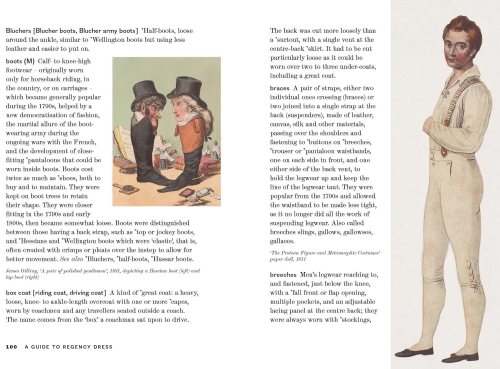
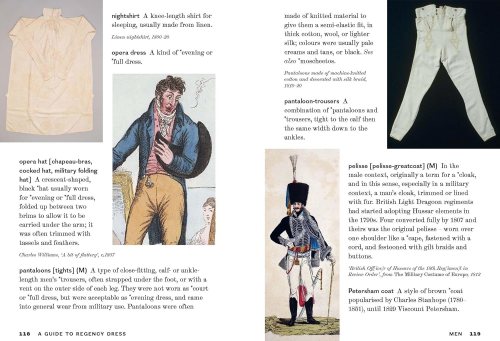
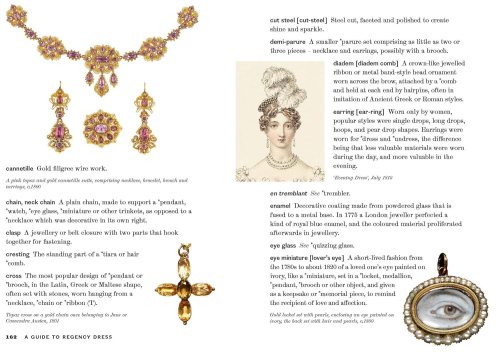
A Guide to Regency Dress is an essential companion to navigate the fashion world of Jane Austen or re-create the Regency look. Here’s a look inside the book:
About the Author
Hilary Davidson is a dress, textiles, and fashion historian and curator. Hilary trained as a bespoke shoemaker in her native Australia before completing a Masters in the History of Textiles and Dress at Winchester School of Art (University of Southampton) in 2004. As a skilled and meticulous hand-sewer, she has created replica clothing projects for a number of museums, including a ground-breaking replication of Jane Austen’s pelisse.
In 2007, Hilary became curator of fashion and decorative arts at the Museum of London. She also worked on the AHRC 5-star rated Early Modern Dress and Textiles Network (2007-2009) and from 2011 has appeared as an expert on a number of BBC historical television programs, and as a frequent radio guest speaker in London and Sydney. From 2012, Hilary worked between Sydney and London as a freelance curator, historian, broadcaster, teacher, lecturer, consultant and designer, while working on a PhD in Archaeology at La Trobe University, Melbourne. In 2022, she moved to New York City to take up the role of Associate Professor and Chair of the MA Fashion and Textile Studies: History, Theory, Museum Practice at the Fashion Institute of Technology.
Hilary has taught and lectured extensively at the University of Southampton, Central St Martins, the University of Cambridge, the University of Glasgow, New York University London, The American University Paris, Fashion Design Studio TAFE Sydney and the National Institute of Dramatic Art, Sydney. Her previous books include Dress in the Age of Jane Austen (2019) and Jane Austen’s Wardrobe (2023).
Final Thoughts
When I attended my first JASNA AGM many years ago, I wore a beautiful Regency dress my mother sewed for me to the banquet and ball. I received a lot of compliments, but I only had a dress. Since then, I’ve slowly added to my “Jane Austen closet” with various accessories. Now that I have this book, I can continue to expand my collection until I can dress in Regency clothing from head to toe.
I could easily spend hours researching the fashion and textiles of Jane Austen’s era, and I hope others of you will find this new resource as fascinating as I do!
“As soon as he can light upon a bishop, he will be ordained. I wonder what curacy he will get!”–Anne Steele, about Edward Ferrars in Sense and Sensibility.
A few days ago, I told you about a fascinating new book on Henry Austen. The author is a retired Church of England bishop, living in Farnham, where Henry Austen served as perpetual curate of the parish church. (A perpetual curate was a curate, substituting for the rector or vicar holding the living of that church. “Perpetual” meant that he could not be fired; he could keep his job for life, just as a rector or vicar did. However, his salary was still only a portion of the tithes that supported the main, absentee clergyman.)
I asked the Right Reverend Dr. Christopher Herbert, who is now a Visiting Professor of Christian Ethics at Surrey University, about his journey in writing this book.
Jane Austen’s Favourite Brother, Henry, was written by an Anglican bishop, Christopher Herbert
Rev. Herbert: In retirement I live in Farnham, Surrey, only a few miles from Chawton. I am the Patron of the Farnham Castle Trust; Farnham Castle was once one of the major homes/palaces of the Bishops of Winchester. At a Trustees’ meeting, discussing how to attract more visitors to the Castle and Farnham, I wondered if there might be some connection with Chawton and Jane Austen. The other Trustees did not know of any, but a friend pointed out an article in the Farnham Herald mentioning a man called Henry Austen christening a baby in the parish church of St Andrew’s. [JAW: This story opens Herbert’s book.]
I followed this up, checking the Parish Registers at the Surrey History Centre, and found many signatures in Henry’s hand—and of course, he was Jane’s brother. I was fascinated. Who was he? How did he become a Perpetual Curate in Farnham? What was his story?
At that point, all that I had were his dates of birth and death, and a few insights from Wikipedia. I had no intention of writing a book about him, but the more I researched his life, the more intriguing Henry became. By the way, my book’s publication in the 250th Anniversary Year was pure chance. I had no idea that was coming up when I raised my initial question!
JAW: How long did it take you to research and write the book? What were some of the most interesting sources you found?
I took well over two years to research and write the book. That might seem a short period of time. However, in my earlier work as a diocesan bishop, with over 400 churches in my diocese, plus membership of the House of Lords and other national and international responsibilities, I was accustomed to working very rapidly to fulfil all my duties. I also read for [pursued/studied for] an MPhil [Master of Philosophy] and a PhD in Medieval Art History at the University of Leicester whilst I was a bishop, and again, had been able to read and digest and write rapidly. So, I had some of the requisite research skills, and I loved the research process—that joy of discovering new and unexpected jewels.
My most useful primary sources were obtained from the Hampshire County Record Office where I was able to trawl through a great deal of original material, plus similar material such as the Parish Registers of St Andrew’s, Farnham, at the Surrey History Centre.
For secondary sources, I read biographies of Jane Austen by people such as Claire Tomalin, and David Cecil, and accessed the huge online resources of JASNA, etc. I was helped greatly by the staff at Jane Austen’s House, Chawton, and, of course, re-read all of Jane’s novels, plus the utterly invaluable edited version of Jane’s letters by Deirdre Le Faye and invaluable and scholarly papers by people such as yourself [Brenda Cox], John Avery Jones, et al.
Of course, as is often and frustratingly the case, after my book had been published, I came across some more primary material at Winchester College. The researcher’s life, as you know, is littered with ‘if onlys’. [I encouraged him to find a place online to publish his further research.]
Amongst the most interesting material were the Parish Registers of Bentley and Farnham. Those gave me enlightening insights about the lives of Henry and his parishioners.
JAW: What did you learn about Henry that interested you the most?
Apart from my obvious personal affinity with Henry as a clergyman, it was his time as a dealer in Army Commissions, a Banker, and a Tax Collector which I loved researching. I am not an economic historian and so my research in this area was very challenging. I would need to re-train in economic history to begin to fully understand every detail. This was the most difficult part to write, trying to get my head around the economic and financial landscape within which Henry worked.
Beneath all the top-layer elements of his life, I enjoyed delving beneath the wealthy surface and speculating on Henry’s motivations and methods of work. Walking the streets of London and investigating where he lived during this phase of his life was hugely enjoyable.
Following Henry through his banking downfall and his approach to his bishop to discuss the possibility of ordination required a great deal of ‘inner work’ on my part to comprehend how and why that happened. I have interviewed hundreds of ordinands in my life. It was fascinating trying to get into the mindset of Henry’s bishop, Bishop Brownlow North, who lived in very different times to my own. Like Henry, Bishop North worked with different cultural assumptions than ours. It is such a challenge to try to stretch one’s sympathetic imagination into another era.
By contrast, and bathetically*, it was the fact of Henry having almost 1,000 bottles of wine in his cellars which sticks in my mind!
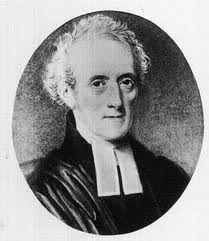
Henry Austen as a Clergyman later in life. Public domain via wikimedia.
JAW: What was something interesting you learned about Jane Austen herself in writing the book?
Oddly, it was spending time exploring Steventon and realising how isolated the Rectory and the village were in the late 18th and early 19th centuries. I had, of course, been to Jane Austen’s House in Chawton a number of times, but in my mind’s eye I had imagined Steventon as a quintessential English Village: village green, church, a few farmsteads, a pub, and even, perhaps, a game of cricket. That idea was completely shattered when I visited Steventon. The cultural life inside the Rectory must have been a great contrast to the isolated, scattered cottages of the poor inhabitants of the village.
My understanding of the life of Cassandra Austen (Leigh) [Jane’s mother] grew as I thought of her coping with her own children plus the students boarding with them—all that food, oversight of the washing of bedding and getting it dry, all that hullabaloo inside the house during term-time. When did she have a moment to herself? I began to wonder, as Jane watched her mother, how much Jane recognised the sheer logistical task her mother undertook to keep the ship happy, afloat and moving in the right direction.
This was the most fun part of the book to write, showing the inside of Steventon Rectory with all the liveliness and learning of Jane, Henry, and their siblings.
And, of course, Jane’s letters are an absolute delight. If only there were more…if only…
JAW: If you were able to meet Henry Austen personally, what do you think you would like about him? What would you want to ask him? What parts of his character might you find difficult or less pleasant?
I would enjoy his sense of humour, his generosity towards, and affection for, Jane, and his affection for Liza [his wife Eliza] and her son, Hastings. Not being a risk taker myself, I would love to hear about his own understanding of the nature of financial risk and entrepreneurship. When did he see the storm clouds brewing? Was ordination always at the back of his mind? Was it a kind of attempt to ‘give back’ to society, having enjoyed and then lost the fruits of worldly success?
I would find his undoubted attraction to the aristocratic level of society difficult, but I fully recognise that it was the 18th/early 19th century way. And when he was Perpetual Curate, I suspect I would have found his lack of awareness of the Farnham Workhouse very difficult. However, in fairness, I must add that it might simply be lack of evidence which leads me to suppose that he was not at his best with the poor and impoverished. So much information has been lost. I could be entirely wrong.
JAW: Why do you think he was Jane’s favourite Brother?
I will say the idea for the title of the book was not mine, it was my publisher’s, but I am entirely happy with it. Why was Henry Jane’s favourite? He was obviously very close to her and looked to her for help whenever he hit a difficult or tragic patch in his life. They shared the same sense of humour, the same love of the quirks of society, the same interest in humanity. And it was Henry who went out of his way to ensure that her books were published. Besides, who but a favourite brother would actually volunteer to read Proofs!?
JAW: What would you like to tell potential readers about your book?
I hope that if they love Jane Austen, my book will reveal some lesser-known aspects of Regency society which might enhance their understanding of Jane and her novels. In brief, context really matters. But, most importantly of all, if my book leads to people reading or re-reading Jane, my hopes will have been more than fulfilled.
JAW: Thanks very much, Christopher! I loved Jane Austen’s Favourite Brother, Henry, and I think our readers will also.
Jane Austen’s Favourite Brother, Henry, by Christopher Herbert, is now available from the publisher, Pen & Sword, and from Amazon in the US and in the UK in hardcover. The Kindle version will be released September 30, 2025.
“I had a letter from him [Henry], in which he desired to hear from me very soon—His to me was most affectionate and kind, as well as entertaining;—but there is no merit in that, he cannot help being amusing.”—Jane to Cassandra, April 8, 1805
“Henry at White’s! Oh, what a Henry!”—Jane to Cassandra, June 23, 1814 (when Henry attended an exclusive high class gathering celebrating Napoleon’s defeat)
Jane Austen’s Favourite Brother, Henry, by Christopher Herbert, gives an in-depth view of Henry Austen’s life, beliefs, and connections with Jane and her novels.
What a Henry
Henry Austen was apparently a lot of fun, and Jane loved her brother dearly. He was also quite versatile. At various times he was:
an Oxford student who produced a periodical called The Loiterer with his brother James,
paymaster and adjutant in the Oxford Militia,
army agent,
banker (of a bank that eventually failed),
receiver general of taxes,
Jane Austen’s own literary agent,
clergyman of several parishes,
chaplain of the British Embassy in Berlin, and
husband of Eliza de Feuillide and later of Eleanor Jackson (niece of Rev. Papillon of Chawton).
I loved that Herbert gives lots of cultural details in going through Henry’s life. For example, in the chapter on Henry’s birth, we learn about childbirth practices at the time. During pregnancy, his mother Cassandra Austen, rather than buying special maternity clothes as we do today, would have widened her stomacher, used aprons to cover gaps in clothing, and loosened side lacings. A “churching” service would celebrate her survival of the very dangerous process of giving birth. Philadelphia Hancock, her sister-in-law, may have been there to help the mother before, during, and after the delivery.
The author speculates on what the children growing up in the the rectory may have read, who taught them to read and write, and where they obtained their books.
Current events and ideas are woven in alongside stories of Henry and Jane growing up. The balloon ascent of 1784 is described by quoting a magazine article of the time. We hear about battles, steam power, improvements and enclosures, and the Wesleyan revival which began at Oxford. We see how the ideas of contemporary writers such as John Locke, focusing on reason in understanding God and society, may have affected Jane Austen’s ideas of church and clergy in Mansfield Park, as well as her prayers.
Henry Austen as a Clergyman later in his life. Public domain via wikimedia.
Work and Money
An in-depth discussion explains Henry’s various jobs and what they involved. We see how his bank throve, launching Henry into upper ranks of society, and then failed. The author obviously did quite extensive research to dig this all up, and it was interesting to learn, for example, what exactly an army agent was. (For me, there was a little too much detail, since I’m not interested in finance; however, other readers may find this the most illuminating part!) It seems Henry had some financial dealings which were at least ill-advised, and possibly questionable.
Henry as Clergyman
After his bank failed, Henry reverted to earlier plans and was ordained as a clergyman. In Henry’s one extant sermon, he attacks pride and prejudices. Herbert says Henry is encouraging his congregation toward giving Catholics political rights, a major issue of that time. (See also “Sermons by Jane Austen’s Family.”) Herbert explores what Henry may have believed, also drawing from statements in Mansfield Park.
He also points out that Henry’s pastoral workload was much greater than that of Mr. Elton or other Austen clergymen. In one year, Henry performed 149 christenings, 34 weddings, and 105 funerals! All for very little income. He also had to deal with a new workhouse and other issues related to the poor of his parishes. Henry’s journey as a clergyman, his income and how he spent it, are further explored, as well as his anti-slavery work.
Jane Austen’s Novels
The author skillfully connects concepts to passages in Austen’s novels. He also explains Henry’s role in getting her novels published. He concludes that there are still some questions about Henry’s life. But we do know that:
“without Henry’s determined and passionate commitment in getting Jane’s novels published, our lives, and the life of the world, would be so much the poorer.”
Amen!
On Thursday I will post an interview with the author, who is uniquely qualified to write this book. He is a former bishop of the Church of England, now living in Farnham where Henry Austen served as perpetual curate in the parish church. Farnham Palace, where the Right Revd. Dr. Herbert is a patron, was a home of the Bishops of Winchester.
I recommend this book to anyone who wants to learn more about Austen’s family and her world.
Jane Austen’s Favourite Brother, Henry, by Christopher Herbert, is now available from the publisher, Pen & Sword, and from Amazon in the US and in the UK in hardcover. The Kindle version will be released September 30, 2025.
One of the most beautiful new books available for Jane Austen fans this year is the Jane Austen: Visual Encyclopedia by French authors Claire Saim and Gwen Giret. With sumptuous artwork throughout and gorgeous illustrations by Sophie Koechlin, this is one of the most extensive catalogs of the Jane Austen fandom I’ve seen in recent years.
It’s a showstopper and conversation-starter that you’ll want to keep on your coffee table indefinitely. While the sticker price is a bit steep (currently on sale on Amazon), this beautiful book is an investment many Jane Austen fans and book collectors will want to make.
As I explored this gorgeous new collectible book, I felt as though I was immersed in the entire world of Austen’s life, novels, and film adaptations. It’s a rich compilation of all-things-Austen for the dedicated Austen fan. It’s a one-stop book for everything you could ever hope to know about Austen, and it’s rare to see so many photos, articles, and illustrations in one place. It is not a scholarly book or a research tool, as it sticks more to the more popular aspects of Austen’s legacy, but it is delightful all the same.
Most of all, this book provides an expansive introduction to the enduring popularity of Jane Austen. It makes a wonderful gift for new Austen fans who have recently discovered the films or books. For fans of the film adaptations, it has many interesting tidbits about the various films throughout.
This is the book I would have wanted to read in college or in my grad school years when my Austen addiction truly took hold of me. I read dozens of books about her and watched as many documentaries as I could find during my early “Jane years,” but this has everything in one place.
Lastly, I cannot say enough about the actual look and feel of this book. When it arrived, wrapped in plastic, I was impressed. Once I opened it, it was even more stunning than I expected. It has a nice heavy feel to it, but you can still hold it comfortably in your lap, unlike larger coffee-table books. It’s definitely a book people will pick up if they see it displayed, which is what I’m planning to do!
Book Description
From her beloved family and her romantic escapades to her literary adventures and her enduring popular culture influence, experience the life and legacy of Jane Austen in this full-colour, beautifully illustrated, definitive 312-page encyclopedia.
Bursting with over 200 photographs and illustrations, explore Jane Austen’s work, which consists of six completed novels, two incomplete novels, letters and early writings. From the written word to the screen, from adaptations to secrets and filming locations, this book invites you on a fascinating journey of discovery through Austen’s writing.
Want to walk in the footsteps of Jane Austen, dressing in Regency style or simply enjoying a delicious afternoon tea? This coffee-table book features a beautiful gold-foiled cover and is perfect gift for fans of Jane Austen, her works and their enduring legacy.
Book Outline:
PART 1: Jane Austen, a woman of her time
Essays on Jane Austen, her family, friends and potential lovers
Illustrations and photos from across Jane’s beloved England
Researchers discuss Jane Austen’s appearance
PART II: The world of Jane Austen
A complete chronology of Jane Austen’s work
The historical and fictional backgrounds to iconic characters such as Elizabeth Bennet, the Dashwoods, and Mr Darcy
Filming locations and production secrets from over 30 adaptations
The unfinished novels and how they were eventually published
Expert analysis of early works and other writings
PART III: Jane Austen’s legacy
A comprehensive guide to the best Austen festivals
Details on the famous museums and collections dedicated to Jane Austen
From postage stamps to Funko-Pops Jane’s indelible influence
About the Authors
This book was lovingly compiled by Claire Saim and Gwen Giret (French authors), Sophie Koechlin (illustrator, French writer, painter & designer, and Hermès scarf designer), Lizzie Dunford (contributor and current Director at Jane Austen’s House Museum), and Helen Moss (translator).
Claire Saim, deeply in love with everything English, from literature to history and culture – including scones, obviously – she has been a devoted Janeite for many years. Always looking around Paris in search of whatever could be a reminder of her dear Great Britain, she shares her adventures on Instagram @jane_austen_france_. Based in France.
Gwen Giret, Jane Austen is a long-time passion of hers which led her to create a blog titled Jane Austen and her world. Her favourite things include travelling through the Pride and Prejudice author’s footsteps, reading all about Captain Wentworth and eating tons of clotted cream. Based in France.
Book Interior
If you’d like to take a tour of the interior of the book, you can watch this lovely video posted by the Jane Austen Centre:
Celebrating 250 Years of Jane
This book is a true testament to Austen’s timelessness and enduring legacy. Her life and work only become more popular with each passing year. It’s a comfort for many Austen fans to read about her life or sit down with one of her novels and slip into her world.
As we work our way through the many new books released and releasing in honor of Jane Austen’s 250th year, there is so much more to come! We have books to read and new shows to watch. What could be more delightful than a Year of Austen in books and on screen?
It’s “Heart Day,” and those of us here at JAW are dreaming of what it might be like to celebrate Valentine’s Day in the Regency Era with Jane and her best and silliest characters.
Valentine’s Day has a long history, and it dates back far beyond Jane Austen’s lifetime. For those interested in learning more about the history of Valentine’s Day or what Valentine’s Day looked like during the Regency era, here are several articles to peruse, most by our Vic:
History of Valentine’s Day: Initially, Valentines were usually handmade and given anonymously. During the 1800s much larger hand-painted copperplates molded in the shape of hearts replaced paper e-cards. You can read more HERE.
Ophelia’s Valentine’s Song: Jane Austen would certainly have known Ophelia’s Song, written by William Shakespeare in the 16th century. You can read it HERE.
Valentine’s Day in Jane Austen’s Day: By the middle of the eighteenth century, it was common for friends and lovers in all social classes to exchange small tokens of affection or handwritten notes. You can read about it HERE.
Valentine puzzle purse, February 14, 1816. Image by Nancy Rosin.
Be Mine, Austen Edition
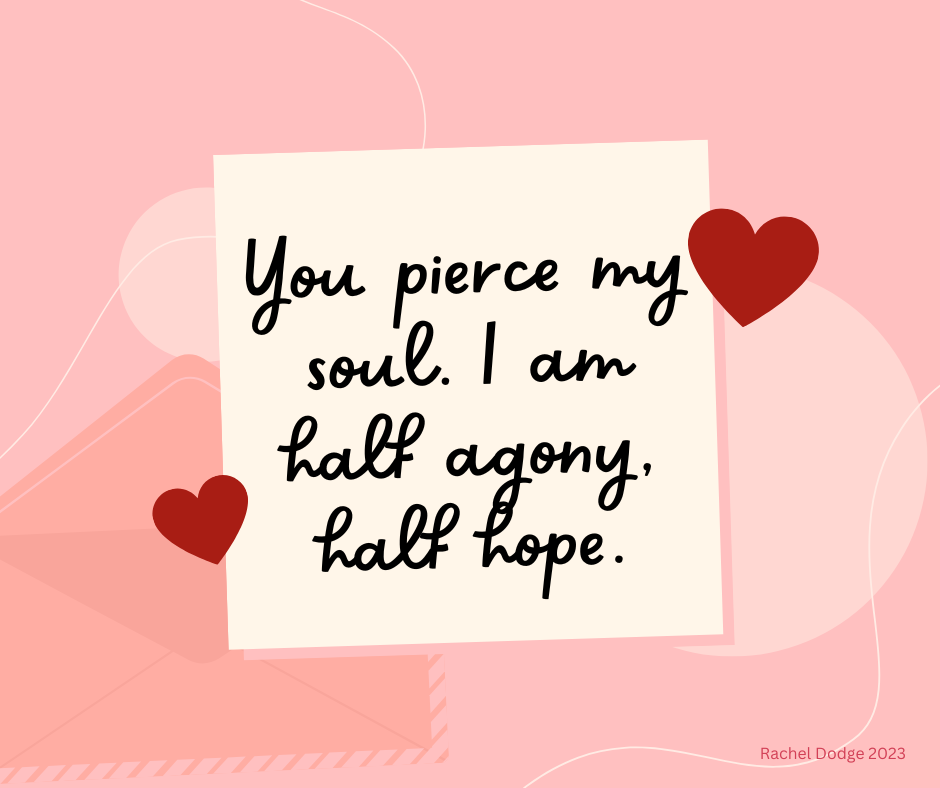
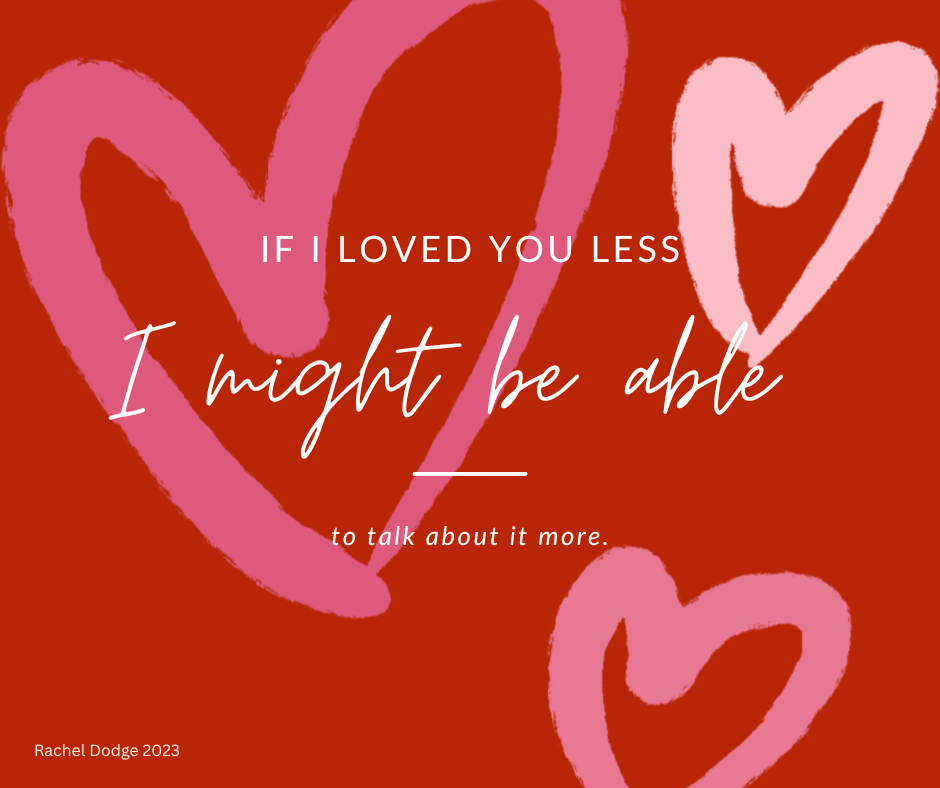
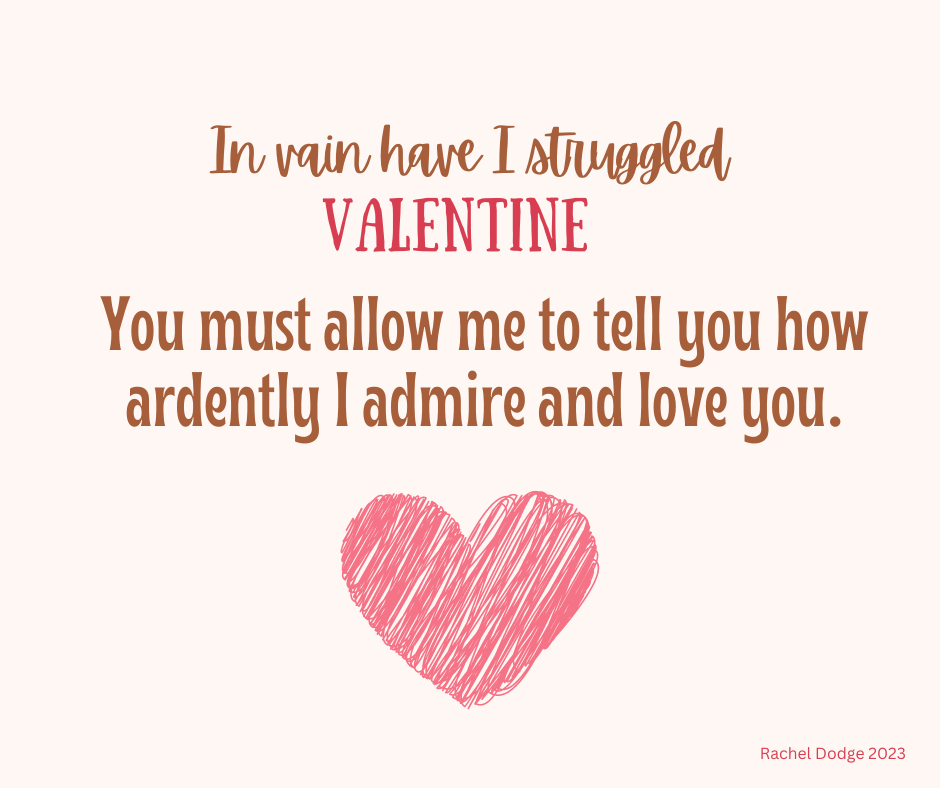
And now for a reprise of a set of Austen-Themed Valentine’s created for your enjoyment! Perhaps you’ll send a few to a friend and have a good laugh together over Austen’s sense of humor:
True Romantics
And finally, a few beautiful quotes from Austen’s best literary moments for the true romantics among us. These are absolutely swoon-worthy and worth sending to a special someone:
A very Happy Valentine’s Day to you, from all of us here at Jane Austen’s World! May your day be filled with love, laughter, and good books!
Fashionable Goodness: Christianity in Jane Austen's England is now available! By JAW contributor Brenda S. Cox. See Review. Available from Amazon and Jane Austen Books.
Available through December 31st, 2025. Click on image for details, and share this poster with other teachers and students!
The Obituary of Charlotte Collins by Andrew Capes
Click on image to read the story.
Comments
“My idea of good company…is the company of clever, well-informed people, who have a great deal of conversation.” – Jane Austen, Persuasion
Gentle readers: Please feel free to post your comments and continue the conversation! Due to SPAM, we will no longer accept comments on posts after 30 days of publication. In some instances, links will be removed from comments as well.
Administrators and Contributors
Vic Sanborn, founder of this blog, is supported by a team of talented and knowledgeable writers about Jane Austen and the Regency era. They are:
Tony Grant, who now contributes his photos from London and England
Click on their names to enter their own blogs.
In addition, we thank the many experts and authors who frequently contribute their posts and opinions, and who continue to do so freely or at our request.
Click here to enter the page. Topics include Regency fashion, historic foods, Jane Austen societies, British sites, related topics. Click on image.
May we suggest?
Hello, my name is Vic and I live in Maryland, USA. I have adored Jane Austen almost all of my life. I am a proud lifetime member of the Jane Austen Society of North America. This blog is a personal blog written and edited by me and my team. We do not accept any form of cash advertising, sponsorship, or paid topic insertions. However, we do accept and keep books and CDs to review.
If you would like to share a new site, or point out an error, please email us. (Yes, we are fallible. We'll own up to our mistakes and will make the corrections with a polite smile on our faces.) Write us at
Thank you for visiting this blog. Your comments and suggestions are most welcome.
Project Gutenberg: eBook of Stage-coach and Mail in Days of Yore, Volume 2 (of 2), by Charles G. Harper
STAGE-COACH AND MAIL IN DAYS OF YORE: A PICTURESQUE HISTORY
OF THE COACHING AGE, VOL. II, By CHARLES G. HARPER. 1903. Click on this link.
















 Jane Austen's World