Feeds:
Posts
Comments

Archive for the ‘Regency Life’ Category

Some books are so useful they are hard to pass up. Several months ago, I received the Kindle edition of Behind Jane Austen’s Door by Jennifer Forest, author of the delightful Jane Austen’s Sewing Box. Behind Jane Austen’s Door takes you on a tour of a Regency house, room by room – the entrance hall, drawing room, dining room, breakfast room, dressing room, bedroom, and kitchen – to
explore the challenges and lives of Jane Austen’s women. Included is an appendix that provides a quick overview of the Regency era.

More accessible in tone and organization than the excellent Behind Closed Doors by Amanda Vickery and If Walls Could Talk by Lucy Worsley, which cover similar but more comprehensive territory, this book can be used as a quick reference by people who want immediate access to the purposes and functions of the rooms in a Georgian household. What distinguishes this book is its close association to Jane Austen and her novels (much like Jennifer Kloestler’s book, Georgette Heyer’s Regency World, is associated with that author).

In these large houses [such as Pemberley], the women didn’t need to use the drawing room during the day. There were other rooms for use; they had their own office and other smaller parlors. The drawing rooms, and yes there could be more than one drawing room, in these big houses were just for receiving the morning visitors and for evening entertainment.

One gains close glimpses of a rich family as well as one of more modest means, such as the household that Jane Austen’s mother oversaw.

She works with the cook in preparing menus, sourcing food and caring for the vegetables, dairy and chickens. On washing day, she and her daughters work alongside the servants to get all the laundry completed: it was just so time consuming in the days before washing machines! A gentlewoman had to monitor the budget, find supplies and pay the bills for all those expenses, including the tea and wine. 

While much of the territory that Jennifer covered seemed familiar, it is arranged in such a pleasant and easy to use format that new authors to the Jane Austen genre or Regency romance will find it very useful, especially Jane Austen fans.

Jane Austen’s own mother used her dressing room at Steventon as a second sitting space, more casual and private than the drawing room. After five weeks of illness, Mrs Austen’s return to health allows a resumption of tea in the dressing room. “My mother made her entree into the dressing-room through crowds of admiring spectators yesterday afternoon, and we all drank tea together for the first time in five weeks … We live entirely in the dressing-room now, which I like very much; I always feel so much more elegant in it than in the parlour.” Letter from Jane Austen to Cassandra Austen, Sunday 2 December 1798.

Oh, there will be people who say that they already know this information and that the book provides nothing really new, but readers who are just discovering Jane Austen and the Regency world will think otherwise. I, for one, am happy to have another source to turn to when checking my facts about meal times and the precise function of certain rooms and furniture. The book, which is a quick read, is available in e-book format. I found this quite convenient, for I can access it on all my mobile devices and computers. Also, at $2.99 for the Kindle version, it is quite a bargain. I give it four out of five Regency teacups!
About the Author
Jennifer Forest has a Bachelor of Arts and a Graduate Diploma in Cultural Heritage Management. Jennifer is a museum curator with a love of beautiful old historic buildings. She lives in Australia, a country built by Regency England.

Blog: Behind Jane Austen’s Door

Print Length: 51 pages
Sold by: Amazon Digital Services
Language: English
ASIN: B006YITPAS
Text-to-Speech: Enabled
X-Ray: Not Enabled
Lending: Enabled

Read Full Post »

This historical tidbit comes from a page designed by J.R. Burrows & Company, Historical-Design Merchants about historic carpet cleaning methods. One sees in films carpets being hung outside on a line and beaten with carpet beaters made of cane.

Elinor beats the carpet. Sense and Sensibility 2008

Some carpets were fitted and hard to remove. In such instances, druggets, or hard-wearing canvas cloths, came to the rescue.

The Young Trio, by E.V. Rippingille, 1829. Image @Bristol City Museum & Art Gallery.

One of the most common strategies of keeping carpets clean in the early nineteenth century was to use druggets, heavy woolen goods spread under tables to protect carpet from spills. They are sometimes called crumb cloths. In addition to dining rooms they were used in other areas of heavy wear. E.V. Rippingille painted The Young Trio in 1829 showing a drugget protecting carpet in a parlor where children are at play. – Historic Carpet Cleaning Methods in the Nineteenth and Twentieth Centuries

You can clearly see the drugget underneath the table in this classic print.

The Dinner-Locust; or Advantages of a Keen Scent’, Charles Hunt after E. F. Lambert, c.1823; hand coloured etching and aquatint. Image @The Geffrye Museum of the Home

Read more at these links:

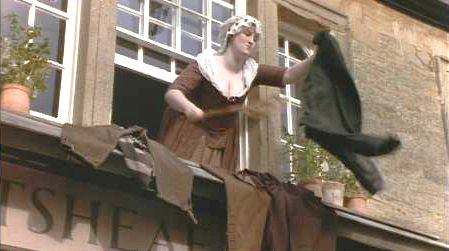
A maid shakes a small carpet or a drugget from a second story window, as well as some trousers. If I recall, one of the actors walked through the door below her as she shook the cloth. Such scenes must have been common then. Sense and Sensibility, 1996.

Read Full Post »

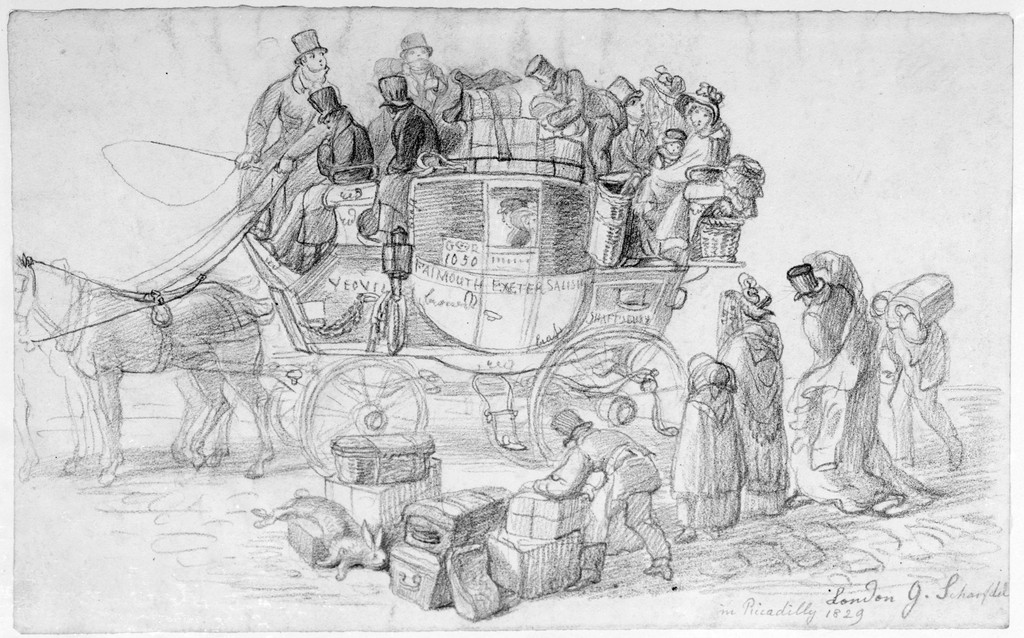
They say a picture is worth a thousand words, and how true it is in this instance. George Scharf the elder, a popular genre painter of the early 19th century, was also a prolific drawer of ordinary scenes in his adopted city of London. One can study his drawing of the Mail Coach Bound for the West County, 1829, endlessly, imagining many tales while thinking back on the history of coach travel. This mail coach is being readied at the Gloucester Coffee House on Piccadilly, where so many mail coaches left at night. The horses are waiting to pull this heavily laden wagon. They will pull it for 15 miles before they will need to be changed. Even with improved roads, the coach will not be going much faster than 7-8 miles per hour. Scharf drew this scene in 1829, a year before the first passenger train would be introduced. By the mid-18th century this scene in Piccadilly would have changed dramatically.

West country mail coach leaving Piccadilly, George Scharf, 1829. Click on image to view a larger version.

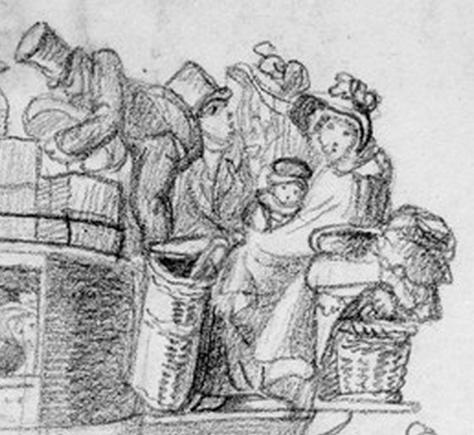
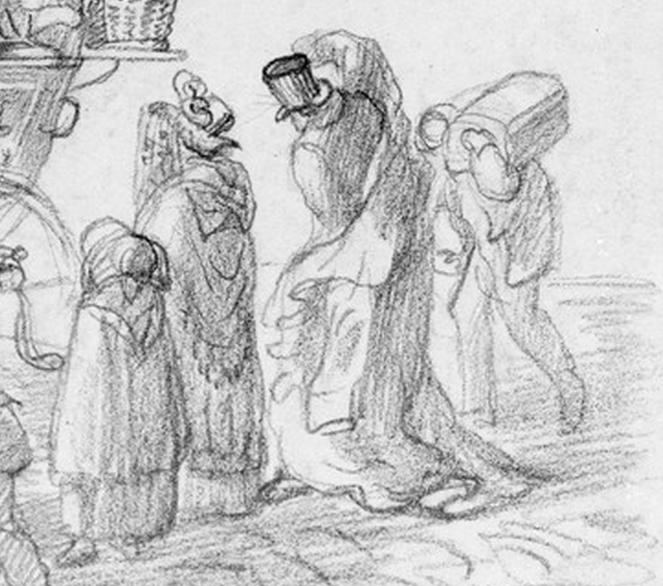
I count 9 people on top the wagon, one passenger sitting next to the coachman, seven on top of the wagon (one is definitely a porter), and two passengers inside.  I imagine there are two more people seated inside that we cannot see, for the interior holds four passengers, and that the gentleman putting on the great coat is waiting for the porters to finish loading the packages before he takes his seat on top of the coach. The woman and child standing next to him must be waiting to see him off, for, if the rest of the mail bags, packages, and luggage are to be loaded, there won’t be room for them as well. If they are waiting to board, then I pity the four horses who will be pulling 13 people along with the mail.

Travel was quite costly back then.

Costs of travel:  [estimates for 1800]

  • Stage Coach:  2-3 pence / mile = 1.25 pounds from London to Bath / half-price if up top / outside [but remember the average income was about £30 / year
  • Hired post-chaise =  estimate about £1 / mile [i.e @1 shilling / horse / mile, to include the postillion] – Jane Austen in Vermont

For a family living on  £25 – £30 per year, such costs were prohibitive. The cheapest seats were on top and on the outside. One can see a woman holding her child wedged between straw baskets. Should the coach take a turn too fast or be involved in an accident, she and her babe could be flung off the vehicle or trapped underneath should it overturn. At best, they felt the wind and rain and arrived at their destination disheveled and covered in road dust if the weather was dry, or soaking wet with rain. One shudders at the thought of what it felt like to be an outdoor passenger in the winter.

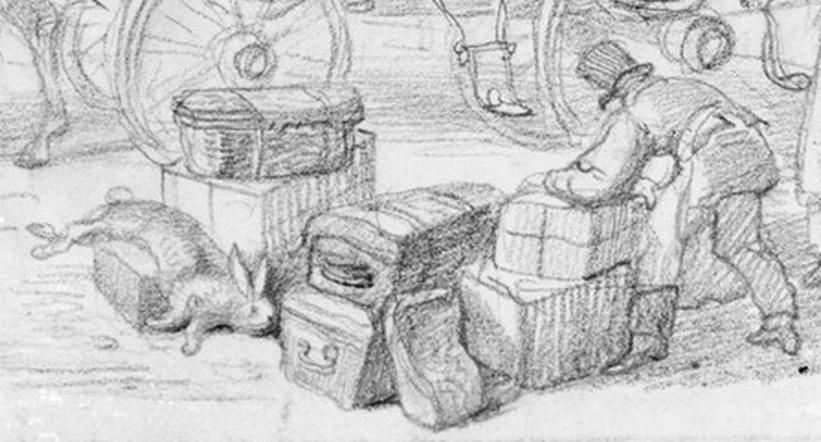
Mail coaches were designed to carry the mail, not to carry passengers comfortably. A close look at Scharf’s image reveals this to be so. There is no wiggle room to speak of. Since travel was expensive and laborious, those who undertook the journey usually arrived in London with lists of things to purchase for friends and family. Jane Austen certainly did, and one can assume that her brother Henry, who lived in London, arrived laden with special requests when he visited his family. The packages being loaded are quite bulky. It is easy to imagine that they contain the ribbons, muslins, china ware, shoes, hats, teas, chocolate, and other assorted items that were special ordered back home. One even sees a recently slaughtered hare among the packages.

One wonders how many more pieces of luggage the mail coach could possibly take on. The packages must be heavy for the porter walking towards the coach is bent over. The male passenger’s great coat and hat are typical of men’s outer wear at the time. As I study the detail below, I am becoming more convinced that the woman and girl are waiting to board. She is wearing a veil, to protect her face from dust, no doubt, and both are covered in layers of outer wear, including a shawl over a cloak. Even so, the ride for exposed passengers would be cold. From the clothes, one can only assume that it is winter.

Mail coaches, while more expensive to ride, were faster than private stage coaches, more stable, and less laden with passengers.

The coach was faster and, in general, less crowded and cleaner. Crowding was a common problem with private stage coaches, which led to them overturning; the limits on numbers of passengers and luggage prevented this occurring on the mail coaches. Travel on the mail coach was nearly always at night; as the roads were less busy the coach could make better speed. – Wikipedia

[William] Hazlitt has thus described, in his own graphic manner, the scene presented on the starting of the old mail-coaches:—”The finest sight in the metropolis,” he writes, “is the setting off of the mailcoaches from Piccadilly. The horses paw the ground and are impatient to be gone, as if conscious of the precious burden they convey. There is a peculiar secrecy and dispatch, significant and full of meaning, in all the proceedings concerning them. Even the outside passengers have an erect and supercilious air, as if proof against the accidents of the journey; in fact, it seems indifferent whether they are to encounter the summer’s heat or the winter’s cold, since they are borne through the air on a winged chariot. The mail-carts drive up and the transfer of packages is made, and at a given signal off they start, bearing the irrevocable scrolls that give wings to thought, and that bind or sever hearts for ever. How we hate the Putney and Brentford stages that draw up when they are gone! Some persons think the sublimest object in nature is a ship launched on the bosom of the ocean; but give me for my private satisfaction the mail-coaches that pour down Piccadilly of an evening, tear up the pavement, and devour the way before them to the Land’s End.” – British History Online

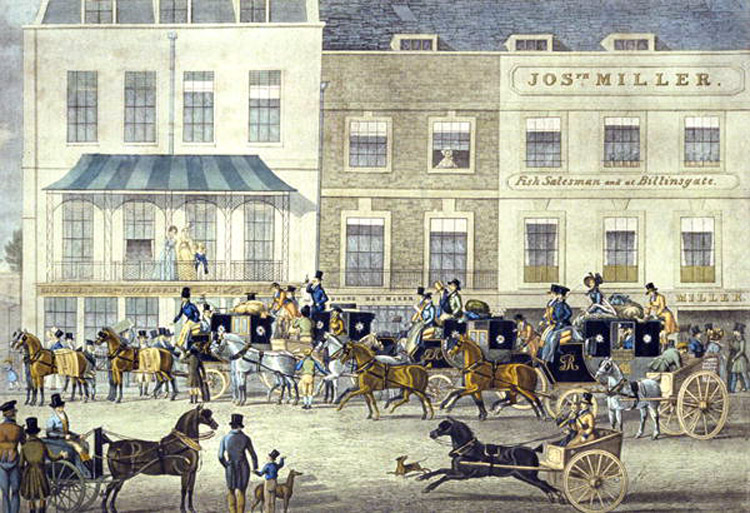
Pollard, Gloucester Coffee House, Piccadilly, 1828

As I said at the beginning, this image is fraught with meaning. I wonder if, when he was sketching this scene,  Scharf knew he was recording the great coaching era at its peak.

Read Full Post »

When Lady Caroline Lamb met Byron in 1812, the waltz was starting to gain traction with the more progressive elements of Society. This couples dance was considered rather racy in an age when stately group English country dances were the primary offerings at Almack’s.

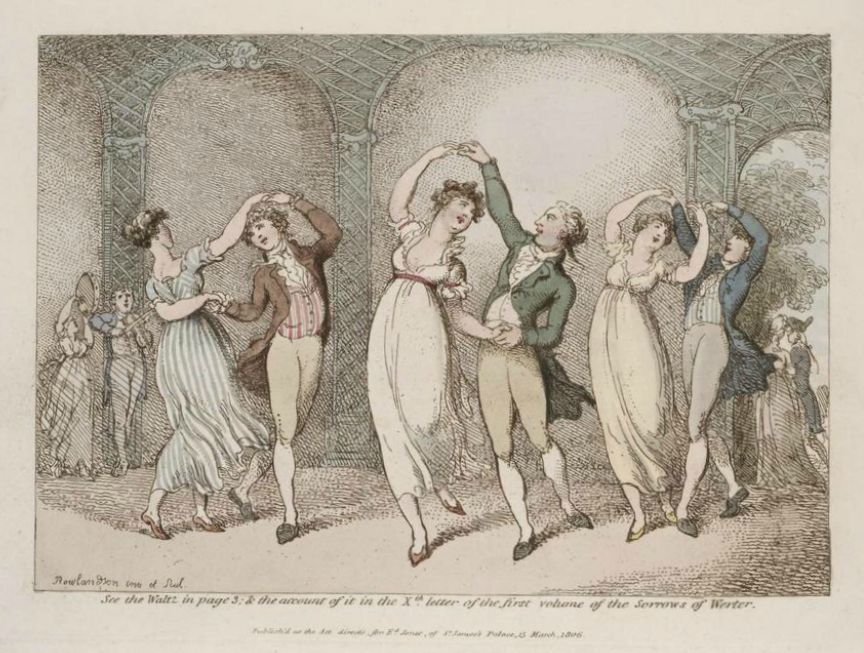
Thomas Rowlandson’s image of the waltz in 1806

The vivacious and racy Lady Caroline Lamb met Lord Byron in 1812. She recalled that time in a letter she wrote 12 years later:

Devonshire House at that time was closed from my uncles death for one year – at Melbourne House where I lived the Waltzes and Quadrilles were being daily practised – Lady Jersey, Lady Cowper, the Duke of Devonshire, Miss Milbank, and a number of foreigners coming here to learn…

You may imagine what forty or fifty people dancing from 12 in the morning until near dinner time all young gay & noisy were.
In the evenings we either had opposition suppers or went out to Balls and routs – Such was the life I then led when Moore and Rogers introduced Lord Byron to me… Caroline Lamb, 1824, in a letter to Captain Thomas Medwin

It is interesting to note that Caroline mentions Lady Jersey and Lady Cowper, two of the patronesses of Almack’s, where the waltz was banned. Eventually, however, the ultra exclusive Almack’s would cave in, and by 1814 the waltz was finally sanctioned. Young ladies would still need approval before a gentleman could clasp his arm around her waist, but the doors had been opened beyond the confines of the upper classes.

La Walze, Le Bon Genre, 1810. This caricature has a feeling of decadence.

By 1815, when Jane Austen’s Emma was published, the waltz has become so respectable that it would be danced in Highbury at the home of the Coles.

Mrs Weston, capital in her country-dances, was seated, and beginning an irresistible waltz; and Frank Churchill, coming up with most becoming gallantry to Emma, had secured her hand, and led her up to the top.” – Emma

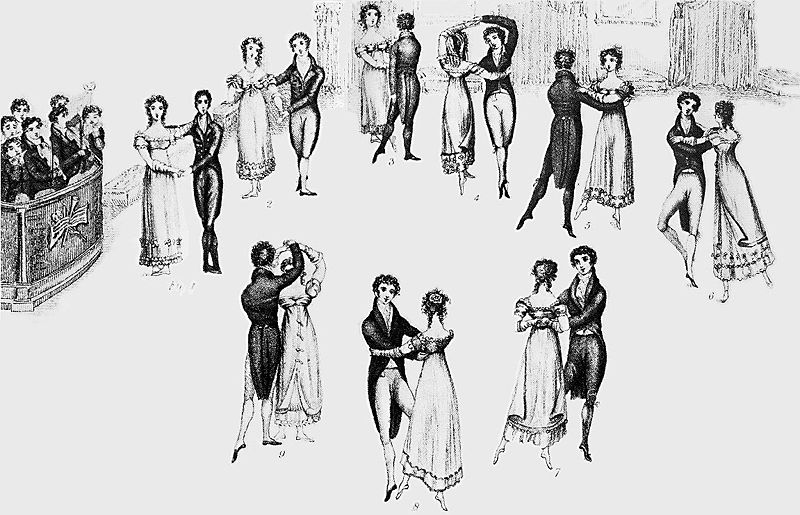
The waltz looks gentrified in this 1816 illustration.

More on the topic:

Read Full Post »

Since the 18th century, satirists have had a fun time mocking dandies. In Hogarth to Cruickshank: social change in graphic satire, 1967, (Walker Publishing)  Mary Dorothy George classified 3 different kinds of print-shop dandies: 1.) the notorious dandy, 2) the effeminate dandy, and 3) dandies who were slavish in their imitation of  Beau Brummel.

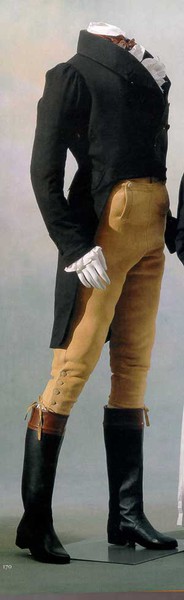
Buckskin breeches, clawhammer coat, and riding boots. This ensemble from the Kyoto Costume Institute could well have been worn by Mr. Darcy as he toured the grounds of Pemberley.

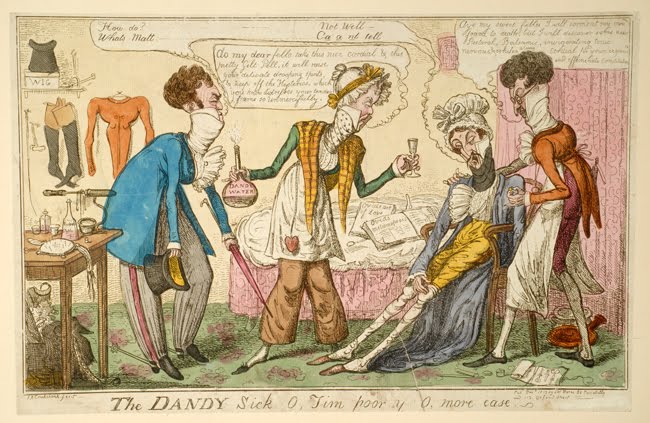
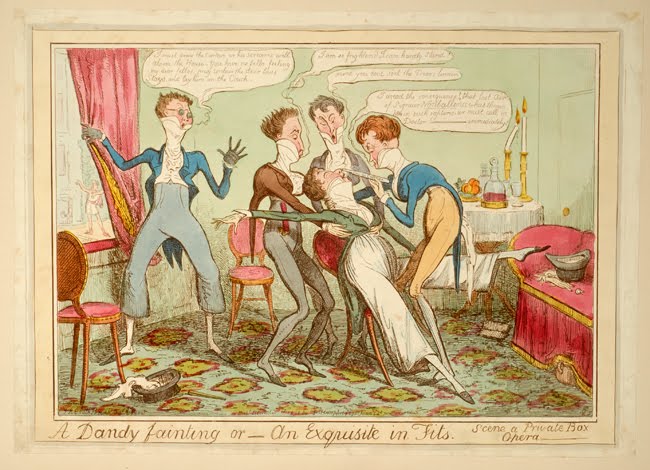
I would add to those categories two more distinctions: the powerful dandy and the ridiculous dandy, or one who, from behavior or social standing, is a wholly ridiculous and insignificant creature. The latter exquisites, along with the slavish imitators and effeminate dandies, were fodder for cartoonists, especially Robert and Isaac Cruikshank, who took great glee in lampooning them in a series of hand colored engravings.

This exquisite was a wholly ridiculous creature, a true fashion victim.

According to Jane Rendell in a Pursuit of Pleasure, the word dandy may have originated from “jack-a-dandy”, a Scottish description of a person dressing up at a fair. The word dates back to the late 18th century/early 19th centuries. In the Dictionary of the Vulgar Tongue, published in 1788, Francis Grose describes the dandy:

Dandy.  That’s the dandy;  i.e. the ton, the clever thing

Dandy.  grey Russet. A dirty brown. His coat’s dandy grey russet the colour of the Devil’s nutting bag.

Dandy. Prat. An insignificant or trifling fellow.

An effeminate dandy required a great deal of care. Cruikshank.

Much later, the word “dandy” is used to describe “Satinist” – Obs. rare”1, [f. Satin sb. + -ist.] A wearer of satin, a dandy. A new English dictionary on historical principles: founded mainly on the materials collected by the Philological Society, Volume 8, Part 2, 1914.

Beau Brummel’s influence in modifying men’s behavior and dress ranged far and wide, influencing the Prince Regent and his set.

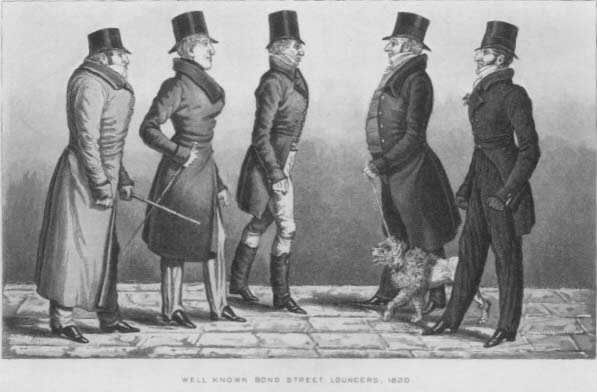
Prinny’s set, or the Prince Regent’s friends, consisted of the Earl of Sefton, the Duke of Devonshire, Lord Manners, “Poodle” Bing, and the Duke of Beaufort, serious dandies all. Somber and rich, these men epitomized the powerful, restrained dandy. Image @The Georgian Index

In Jane Austen and Representations of Regency England, Issue 33; Issue 61, Roger Sales identifies Henry Crawford and Tom Bertram of Mansfield Park as dandies: Tom because he is the quintessential Regency sports man, as well as rich and handsome; Henry, because of his mode of address, which shows a haughty attitude towards rural workers, and because he fashions his conversation “into exquisity little mirrors to reflect his own sense of superiority.” Henry makes elegant bows and frequently mocks others. His manners, like Beau Brummel’s, verge frequently on insolence – his stance is one of ennui and superiority at the same time. While Henry is not as handsome as Tom, he commands a room with his personality. I would classify Tom and Henry as notorious dandies, for both pushed the limits of what was considered proper behavior. The more modest Edmund Bertram would never behave like either man.

Hessian boots

John Thorpe of Northanger Abbey belongs in the category of the ridiculous dandy. He drives a gig, but imagines it to rival a phaeton, which is like comparing a toyota corrolla to a sleek jaguar. John uses cant, and one imagines that his clothes are too loud and his shirt points too high.

Great coat with numerous capes, a favorite menswear item described by romance writers.

As for Mr. Darcy, his looks and dress are effortlessly elegant. He doesn’t try to impress; he simply is a superior man. His arrogance, which Elizabeth Bennet found so off putting at first, comes naturally, for he is placed securely high in society. His inheritance and the cares, responsibilities and duties that great wealth bring exemplify the qualities of a gentleman who is a cut above the rest.  Beau Brummel, I imagine, would have found very little fault with Mr. Darcy.

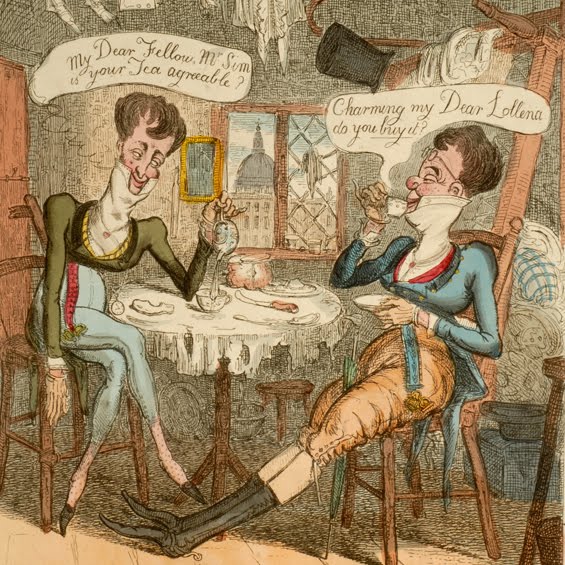
Two dandies by Cruikshank dresssed to the nines. While exquisitely rigged out, they take tea in a mean hovel of a room. Note the ragged curtains and table cloth, the dishes on the floor and the wash hanging on the line overhead.

While the term dandy has come to mean many things, among my favorite cartoons of the Regency era are those that make sport of them. These caricatures must have been popular then, and are irresistible to view now.

A Dandy Fainting, or an Exquisite in Fits, Cruikshank. This scene at a private box at the opera gives one a sense of how similar it is to today’s private boxes at a stadium. Note the table with food and drink; the couch, and the curtain that allowed for privacy.

Read Full Post »

« Newer Posts - Older Posts »