Feeds:
Posts
Comments

Archive for the ‘Regency Life’ Category

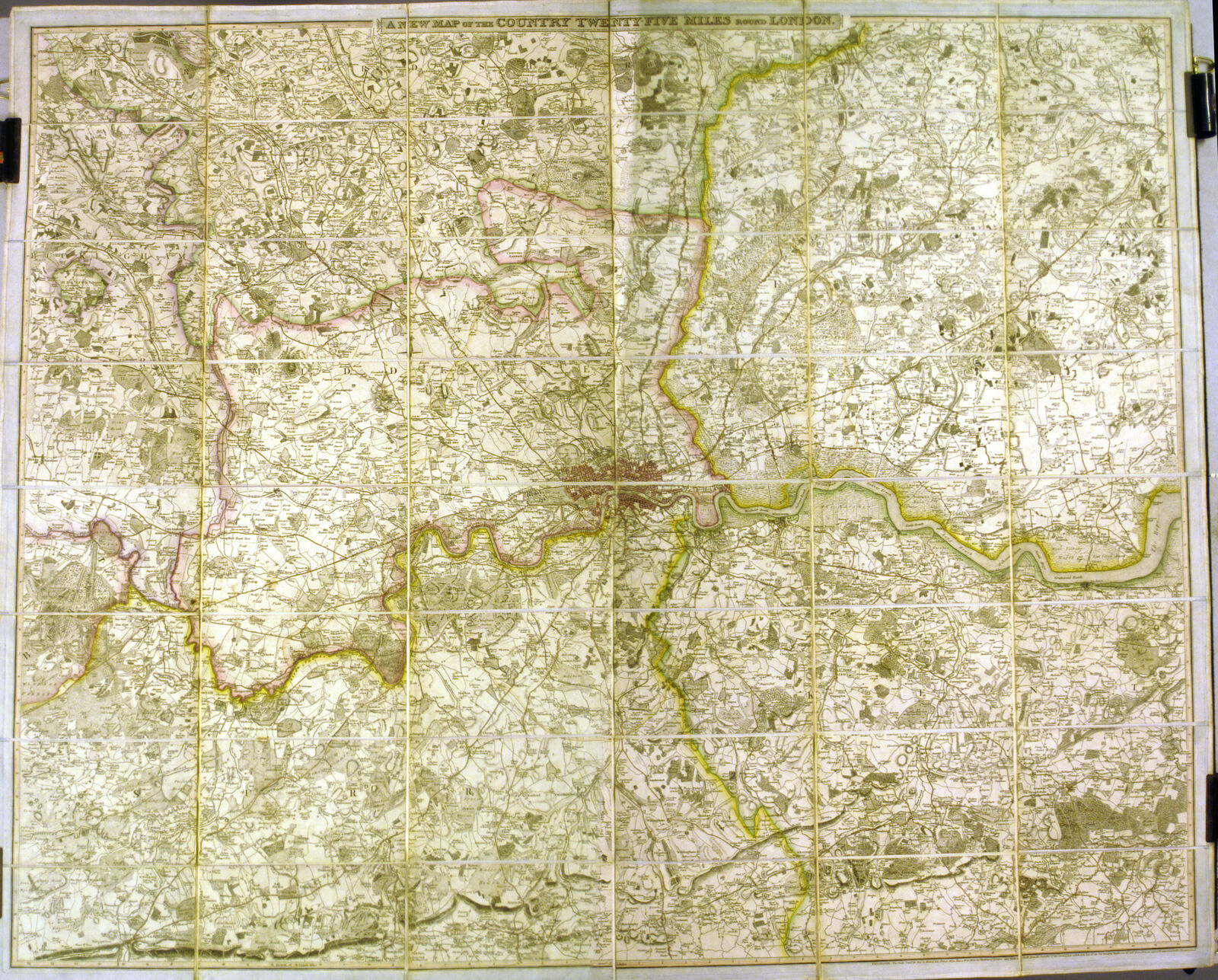
Inquiring readers, I had read about the closeness of rural areas near London during Jane Austen’s day. This image of Tottenham Court Road from the 1812 edition of Ackermann’s Repository shows the countryside beyond the toll gate. One imagines that Jane Austen was accustomed to such vistas when she visited her brother Henry in London. One moment she would be traveling through the countryside, the next moment she would be entering a teeming metropolis (Click here to see map):

In the first years of the eighteenth century, pastures and open meadows began by Bloomsbury Square and Queens Square; the buildings of Lincoln’s Inn, Leicester Square and Covent Garden were surrounded by fields, while acres of pasture and meadow still survived in the northern and eastern suburbs outside the walls. Wigmore Row and Henrietta Street led directly into fields, while Brick Lane stopped abruptly in meadows.“World’s End” beside Stepney Green was a thoroughly rural spot, while Hyde Park was essentially part of the open countryside pressing upon the western areas of the city. Camden Town was well-known for its “rural lanes, hedgeside roads and lovely fields”where Londoners sought “quietude and fresh air.” – Extract from “LONDON The Biography”, by Peter Ackroyd. Published by Vintage, 2001


The contemporary description of this view of St.James Chapel is telling:

The edifice selected for the subject of our view in the metropolis, for the present number, is the chapel of ease, situated near the turnpike in Tottenham-court-road, belonging to the church of St. James, Piccadilly. It was erected after a design of the celebrated architect, Mr. James Wyatt.

The contiguous parsonage-house on one side, and a school on the other, together with the plantations in the area between the front railing and the buildings, give great additional consequence to the appearance of the whole…

The vicinity of this chapel has recently witnessed one of those transformations of fields into houses, produced in every direction around the metropolis as if by the effect of enchantment. A prodigious street has just sprung up on the left-hand side, in continuation of Tottenham-court-road; and thus London has proceeded another good stage in its progress to Kentish Town. – St. James Chapel, Tottenham Court Road, 1812, Ackermann’s Repository

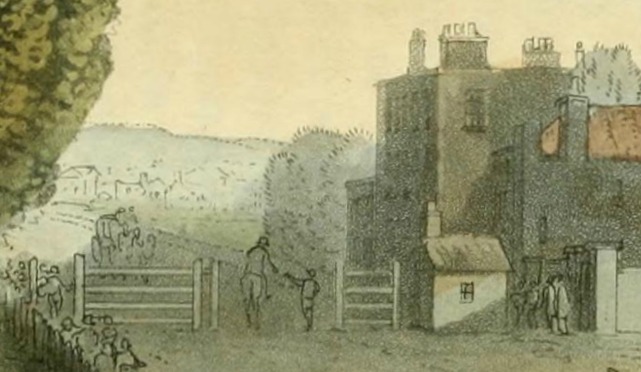
Detail of the turnpike. The toll keeper is collecting money from a man on horseback. Notice the small toll house, and the rural scene beyond.

The great age of toll gates and turnpikes was the 18th Century. In the latter part of the previous century, turnpikes were established and run by trusts. They could only be set up through Acts of Parliament, the first of which was passed in 1663. The idea was that the trusts would take over responsibility from parishes to maintain major trunk roads. They would collect the tolls, manage the finances and fulfil their obligation to use those funds to maintain the roads – Toll gates and turnpikes, London Historian’s Blog

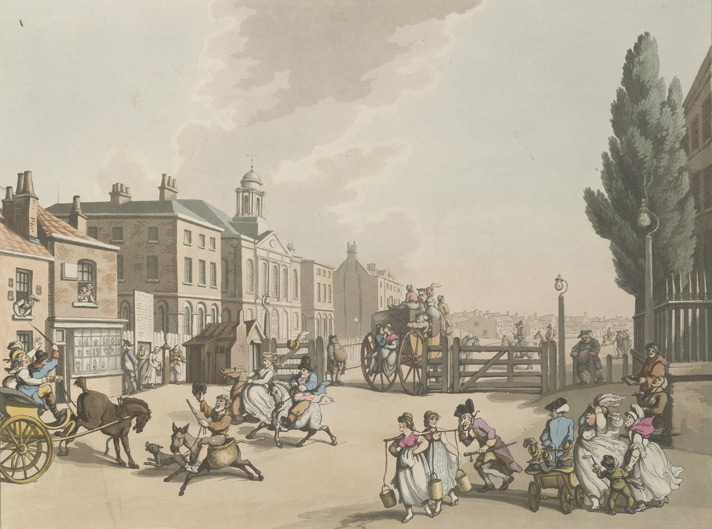
Entrance, Tottenham Court turnpike by Rowlandson. Image @ Europeana

Rowlandson’s image shows another view of the turnpike. Pedestrians continued without hindrance via the side openings (except for the obese man, who seems to be stuck), but people on horseback and vehicles slowed to pay a toll in the gated center. Note Rowlandson’s detail of an old lecherous man ogling the two milk maids.

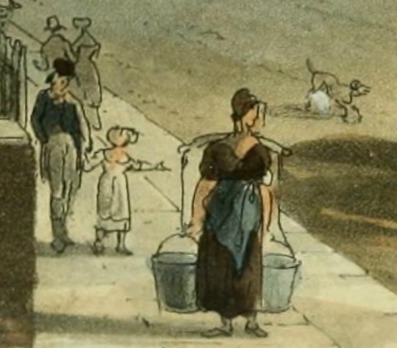
One milkmaid recorded her daily route and the results are astonishing: 19 miles.  Milkmaids are famous for their pretty skin, and this was largely because many of them had acquired immunity to smallpox through milking duties.  As milk delivery was a daily occurrence, many milkmaids ran slates for their customers, proving they were to some extent both literate and numerate, and also hard enough to call in a debt. – The Cries of Georgian London

Milk maids provided fresh drinks to customers. This one has just passed through the toll gate and has a long day's walk and work ahead of her.

“The cry of ‘Milk’ or the rattle of the milk-pail, will never cease to be heard in our streets. There can be no reservoirs of milk, no pipes through which it flows into the houses. The more extensive the great capital becomes, the more active must be the individual exertion to carry about this article of food. The old cry was ‘Any milk here !’ and it was sometimes mingled with the sound of ‘Fresh cheese and cream;’ and it then passed into ‘Milk, maids below;’ and it was then shortened into ‘Milk below;’ and was finally corrupted into ‘Mio’ which some wag interpreted into mieau—demi-eau—half water.”  – Buying Bread and Milk in 18th and 19th Century London, Susannah Ives

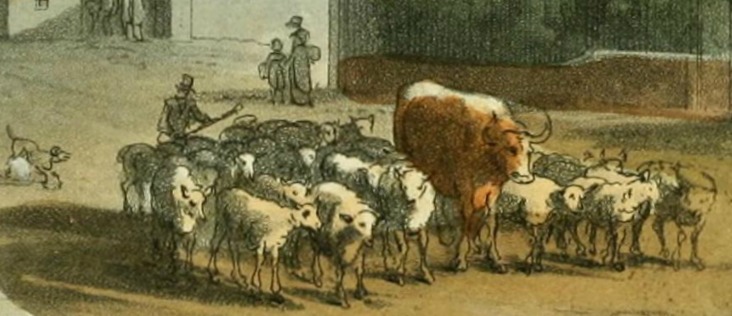
Detail of cattle being driven to market. One imagine that the streets were filled with dung and the smells of the animals, most of whom must have been frightened of the big city's sights and sounds.

This detail of sheep and an oxen being driven through the streets to market was a common sight. The people in this great metropolis had to be fed. In just a few hours these hapless animals will find themselves in the noisy, tumultuous, and bewildering environment of Smithfield Market, for instance. Without refrigeration, their meat would be sold, consumed or prepared within hours of their slaughter.

Cattle were driven through the streets until the mid 19th century. In an article for Household Words in March 1851 Dickens, with characteristic sarcasm, describes the environmental impact of having live cattle markets and slaughterhouses in the city:

“In half a quarter of a mile`s length of Whitechapel, at one time, there shall be six hundred newly slaughtered oxen hanging up, and seven hundred sheep but, the more the merrier proof of prosperity. Hard by Snow Hill and Warwick Lane, you shall see the little children, inured to sights of brutality from their birth, trotting along the alleys, mingled with troops of horribly busy pigs, up to their ankles in blood but it makes the young rascals hardy.” – Dickens’ London

Read Full Post »

Image recently added to @Wikimedia Commons

Prostitutes were regarded with mixed feelings in the 18th century. An awareness of the vulnerability of women who had few economic options for making their way in the world owed much to the sentimental view taken of prostitutes. Ladies of pleasure were generally born into poverty and had little education or work skills. The sentimental prostitute narrative, which was common at the time, rarely condemned these women. These narratives, whether in print or on canvas, tell the story of a prostitute’s career and sexual fall, and generally end their tales in two ways: happily, through her marriage or finding acceptable employment, or tragically with her death.

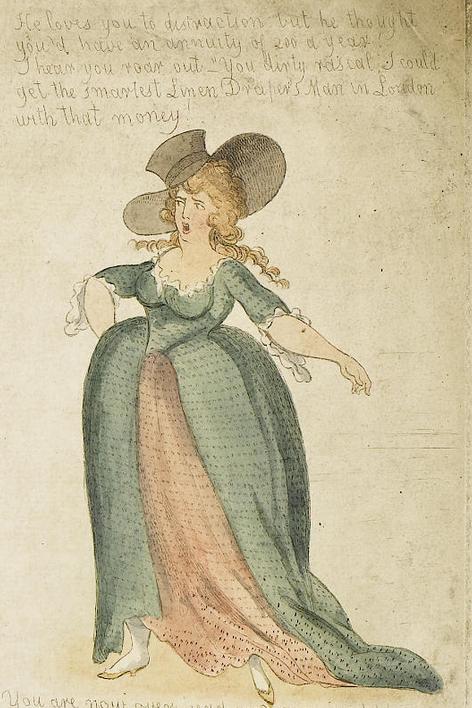
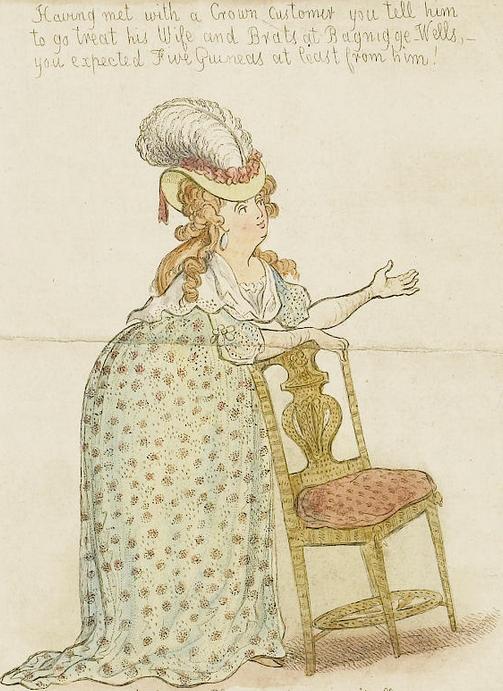
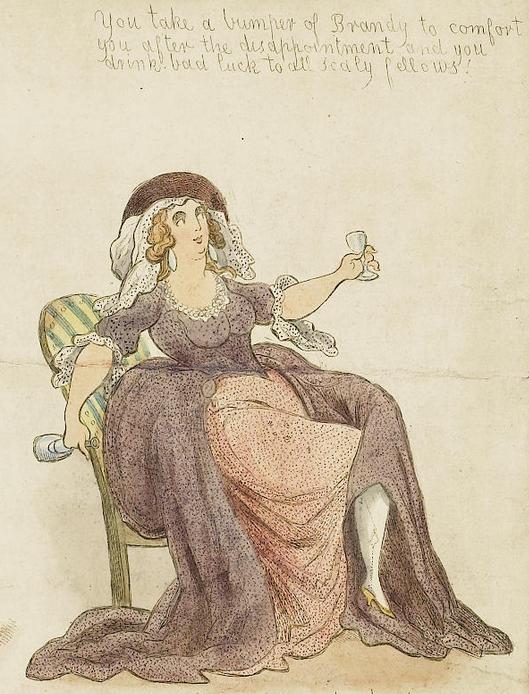
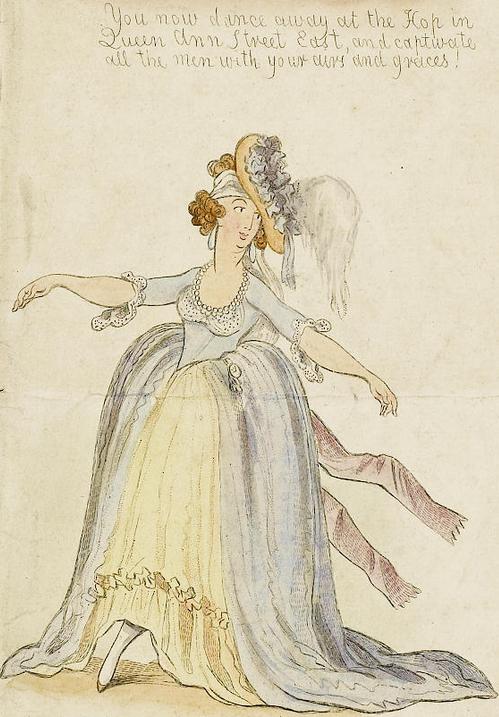
The Progress of a Woman of Pleasure was drawn by Richard Newton, a young artist who died at 21 in 1798, two years after making this illustration. The “Progress” formula, which Newton used for a variety of prints, is a familiar one to those who have viewed William Hogarth’s The Rake’s Progress, Marriage a la Mode, Industry and Idleness and A Harlot’s Progress. Progress series demonstrate in a progression of satirical paintings and prints how lives were transformed by temptation, bad luck and poor choices.

A closer look at Progress of a Woman of Pleasure reveals Newton’s sentimental take of the prostitute theme, as well as details about the life of an 18th Century lady of  ill repute. For many 18th century prostitutes, their occupation was transitional, meant to economically tide them over a particularly bad hump in their lives. Many eventually married or found another occupation.
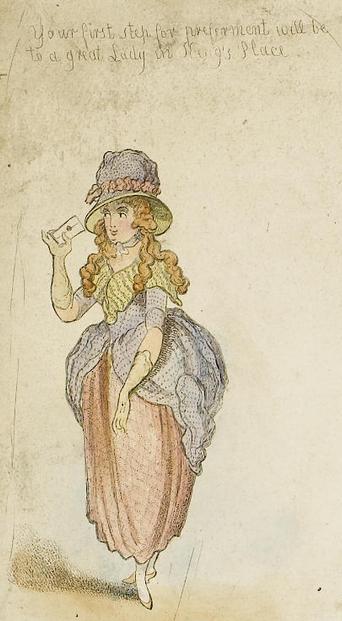
Your first step for preferment will be to a great lady in King's Place.

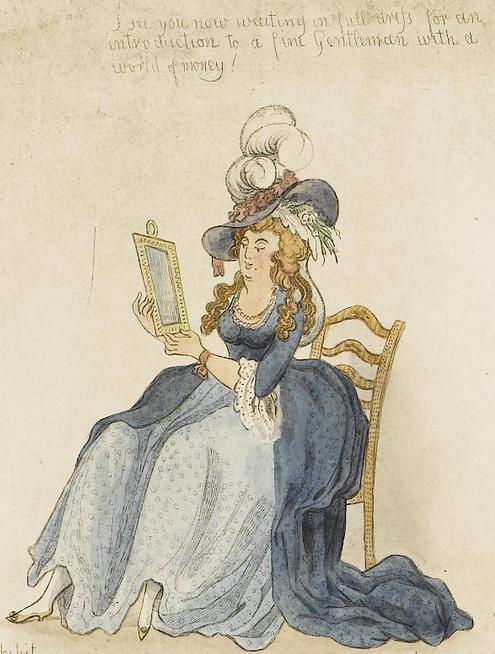
“A great lady in King’s Place” refers to Charlotte Hayes, who ran a high-class brothel in King’s-Place off Pall Mall. Gentlemen of the upper classes frequented this brothel located in london’s tony west end. With the use of the term ‘preferment’,  Newton makes it obvious that this woman has set her sights high. Her clothes are rather simple and plain as compared to the second scene below.

We see you now waiting in full dress for an introduction to a fine gentleman with a world of money!

London was a notorious hot bed for prostitutes. Fully one in five women in London (50,000) worked as ladies of the night. Many of them worked alone, plying their trade on the streets, in their own rooms, or in brothels. One foreign traveler was amazed at the variety of ways a man could have a woman:

…dressed, bound up, hitched up, tight-laced, loose, painted, done up or raw, scented, in silk or wool, with or without sugar. – Daily Life in 18th Century England, Kirsten Olsen, p. 49

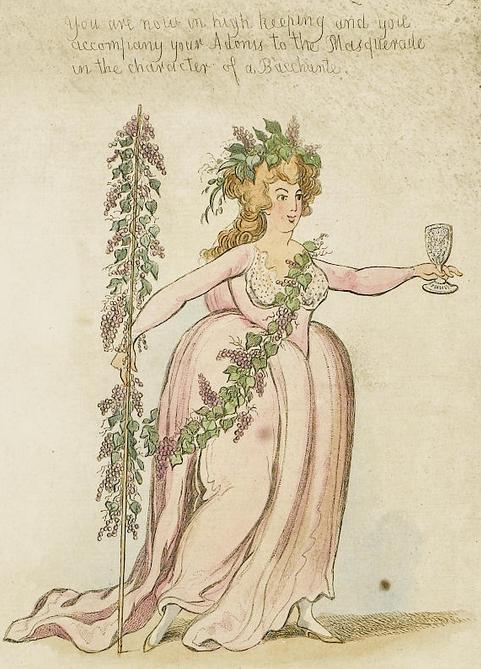
You are now in high keeping and you accompany your Adonis to the Masquerade in the character of a Bacchante.

Masquerades were wildly popular in 18th century London. Hidden behind masks and disguised in costumes, people from varying social classes freely intermingled at these events, where licentious behavior was common. Prostitutes attended these events in order to attract customers, or, as in this instance, were brought there by their benefactors.
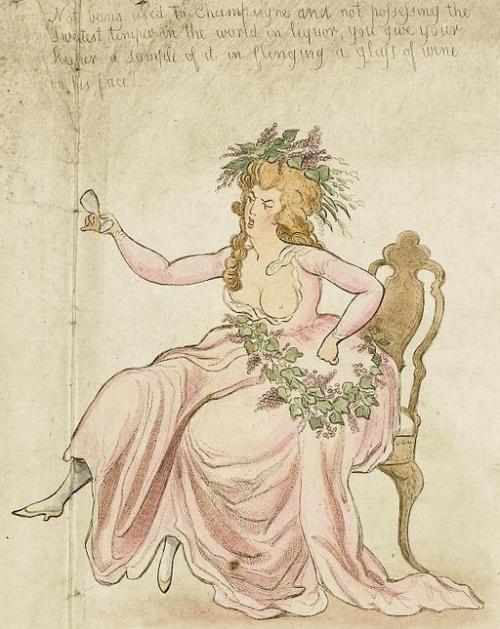
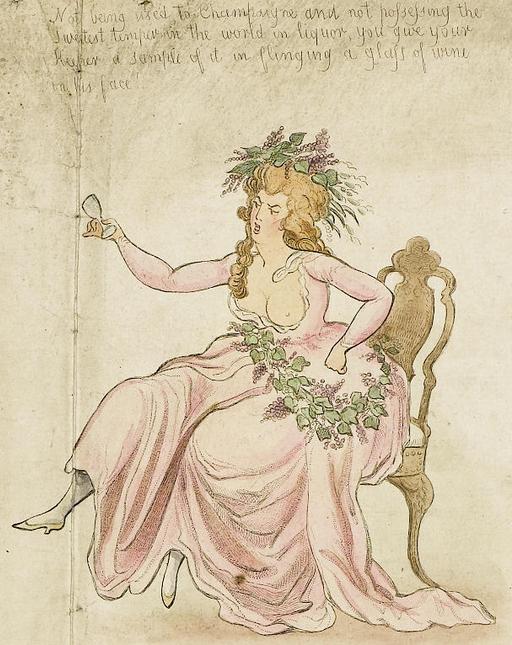
Not being used to champagne and not possessing the sweetest temper in the world in liquor, you give your keeper a sample of it by flinging a glass of wine to his face.

As this courtesan finds out the hard way, she is with her companion for only as long as she is useful to him. In this instance, her outrageous behavior causes him to cast her off.  The aim of the successful prostitute/mistress/courtesan was to find a benefactor from the highest echelons of society and to make a long-lasting arrangement that created a financially fruitful association for her. For the number of women who rose in the ranks of serving as mistress to important men, there was an equal number that had no place to go but down. The idea was to extend your association for as long as possible and retire in comfort.

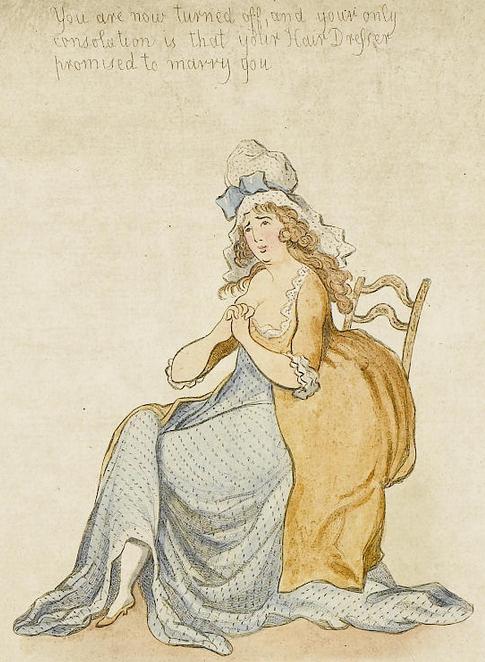
You are now turned off and your only consolation is that your hair dresser promised to marry you.

Newton’s prostitute must have been a pretty woman indeed if the hair dresser was willing to marry her. The attitude towards prostitutes in the 18th century was more forgiving that it would be in the 19th century, and a former courtesan could still attain a certain level of social acceptance. At this stage, Newton could have ended his sentimental “Progress” with a happy ending and shown our heroine as being reformed and leading a happy life. Note how simple and plain her dress is compared to the previous three drawings.

He loves you to distraction but he thought you'd have an annuity of 200 a year! I hear you roar out -- "You dirty rascal! I could get the smartest linen draper's man in London with that money."

Newton’s prostitute was not only a bit dim, but her huge ego stood in the way of her success. Two hundred a year was a huge sum of money for that day and age. A single gentleman in London could live very comfortably on that sum, although it would not allow him to keep a horse in Town. Nevertheless, such an amount would have been considered staggering for a prostitute and her working class husband. Newton’s contemporary audience would have understood this. Note how much more social caché a draper’s man had over a mere hair dresser! (Well, at least for a woman of her station. A lady wouldn’t have bothered to tell the difference, I’m sure.)

Our prostitute’s  pride ruins any chance of happiness she might have found as a respectable married woman. This up and down course of events is not unusual. Many prostitutes in their (generally) short careers went from rags to riches and back to rags and riches again. The cycle, in Newton’s instance, is ever downward.
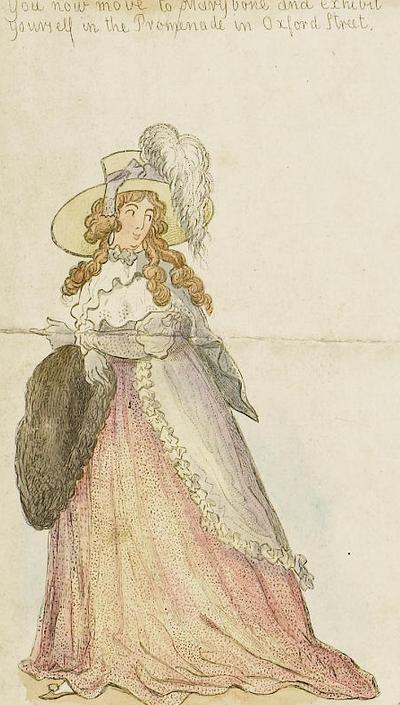
You move to Marybone and exhibit yourself in the Promenade in Oxford Street.

Marylebone was once a Georgian estate in London that was developed into housing tracts. By 1792-99, Richard Horwood’s map showed that the area from Oxford Street to the Marylebone Road was covered with houses. (The Heart of Marylebone.) Prostitutes were scattered throughout London, including the “Marybone” area (as many as 30,000 in Marylebone alone by one count):

They tended to gather in areas with looser police control; when the police became stricter in the City of London in the eighteenth century, the prostitutes gravitated toward the west and east ends of the city; when police control loosened in the early nineteenth century, they returned to the City. Prostitutes also tended to congregate in areas with cheap lodging houses and lots of men. St. Giles and St. James, home to many cheap boardinghouses, were popular with prostitutes in Westminster; the Docks, where many sailors disembarked, was popular on the east side of the city. – Prostitutes in 18th-Century London

It is interesting to note that William Holland, the artist’s publisher, had his shop on 50 Oxford Street.
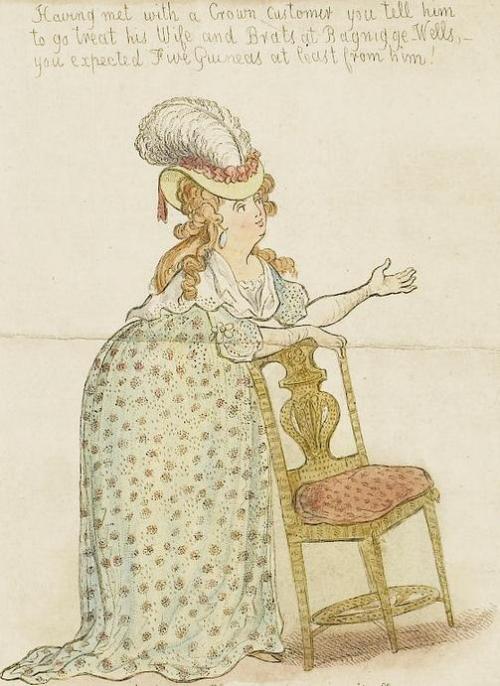
Having met with a Crown Customer, you tell him to go treat his Wife and Brats at Bagnigge Wells, you expected Five Guineas at least from him.

Bagnigge Wells no longer exists. It was a spa for the “middling sort”, located on the River Fleet near St. Pancras. The River Fleet is now one of London’s underground rivers. The guinea’s value was more than a pound. The coin itself was valuable, for it was made of gold and the value of a 5 guinea piece fluctuated during the 18th century. A crown was a silver coin worth five shillings, considerably less than a five guinea piece.
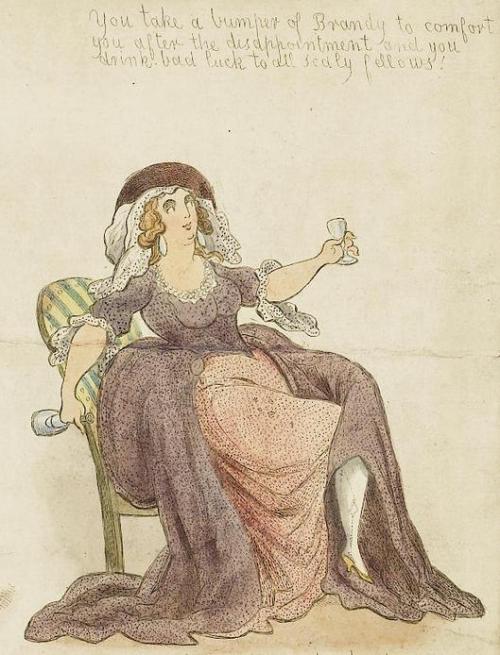
You take a bumper of Brandy to comfort you after the disappointment and you drink bad luck to all scaly fellows.

We already know that our prostitute does not take to drink well. She now turns to brandy. A bumper of brandy is no small amount, as you can see from the bottle in her hand. The Book of Scottish Anecdotes contains this little tale:

While Burns was at Moffat once with Clark the composer, the poet called for a bumper of brandy. “Oh, not a bumper,” said the musician. “I prefer two small glasses.”

“Two glasses?” cried Burns; “Why, you are like the lass in Kyle, who said she would rather be kissed twice bare-headed than once with her bonnet on.” – p81.

Scaly fellows were the lowest of the low. Also note the clocks (embroidery) on the prostitute’s stockings, which were quite fashionable in her day.

Harris’s List of Covent Garden Ladies contained a description of Miss Devonshire on Queen Anne Street. At this point, our lady of pleasure has gravitated towards a tavern on a street near Marlebone .

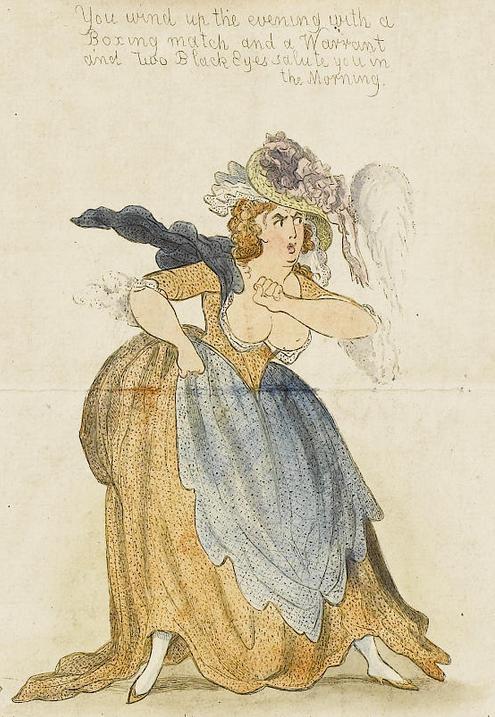
You wind up the evening with a boxing match and a Warrant and two Black Eyes salute you in the Morning.

Due to her inability to hold her temper, our lady’s downhill slide is guaranteed. Richard Newton was known for his drawings of bare-breasted ladies. It could not have been hard to tug a woman’s chemise down over her bosom in those days.
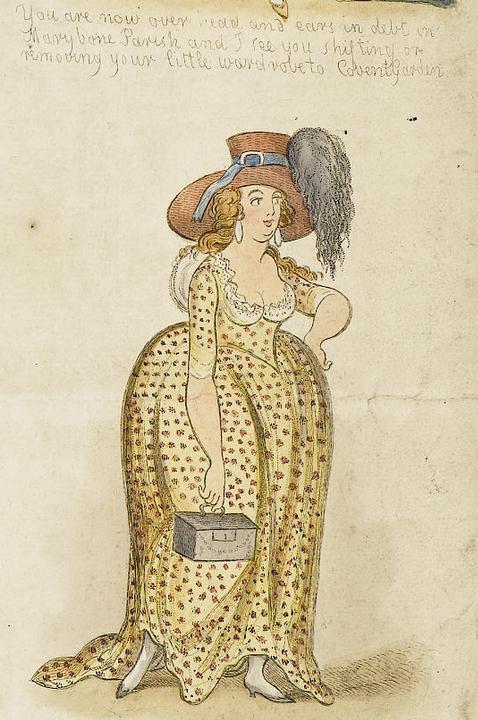
You are now over head and ears in debt in Marybone Parish and I see you shifting and removing your little wardrobe to Covent Garden.

Our lady of pleasure has moved from the West End to Covent Garden.

By the middle of the 18th century Covent Garden was full of seedy lodging houses and an astonishing number of Turkish baths, many of which were brothels.

Sir John Fielding, the magistrate, called Covent Garden ‘the great square of Venus’. He said, ‘One would imagine that all the prostitutes in the kingdom had picked upon the rendezvous’. – Prostitution in Maritime London

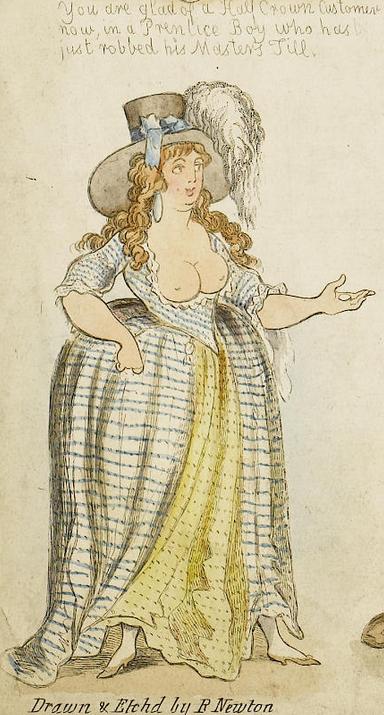
You are glad of a half-crown customer now, in a Prentice Boy who has just robbed his master's till.

And so our prostitute has fallen further. She is attracting customers of a lower sort, such as an apprentice who has taken to thievery to afford her wares. It is obvious that she no longer holds herself out for the highest bidder.

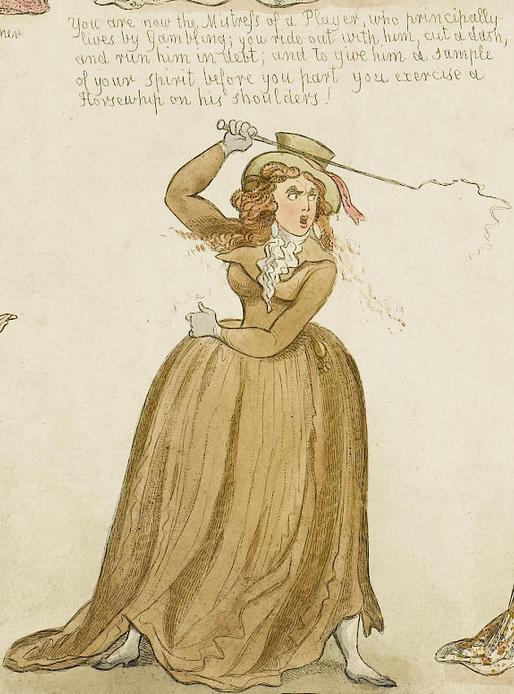
You are now the mistress of a Player, who principally lives by Gambling; you ride out with him, cut a dash, and run him in debt; and to give him a sample of your spirit before you part you exercise a Horsewhip on his shoulders.

Our lady of pleasure is on a slight uptick again, having become the mistress to a gambler. Riding outfits, made by tailors, were quite expensive. To cut a dash was to make a fine figure and to look quite smart. One assumes that the gambler took his mistress horse back riding in London’s Hyde Park, which meant that he kept her in fancy digs until his luck ran out. Once again, our lady of the night shows poor judgment and gives him a physical memory of her temper, flogging him with her riding whip.

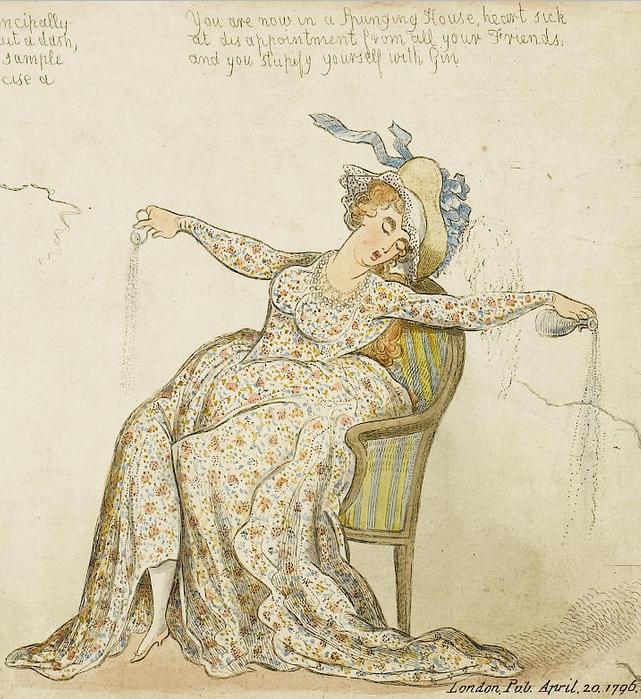
You are now in a Sponging House, heart sick at disappointment from all your Friends, and you stupefy yourself with Gin.

One can only imagine that this prostitute is reaping what she sowed, and that she made quite a few enemies when her luck ran high. Now that she is in debt herself, she has no one to turn to.

The normal process was for the debtor to be arrested by a bailiff or sheriff’s officer, and then taken to what was called a sponging-house, usually the officer’s own house. There, the debtor would be persuaded that they should pay their debts, otherwise, they faced a court appearance, and a debtors’ prison. – The Real Little Dorrit

Gin was also known as blue ruin. Before 1734 it was the drink of choice for poor people.

Along with promiscuous and adulterous behavior, gin became associated with prostitution, an issue that ranked high on the agenda of moral reformers. The association between gin and prostitution came about because gin-shops were public places that brought prostitute and customer together. It is important to note however that gin-shops were simply places where ordinary people gathered in a city where there were few other social spaces. As such, gin-shops were perhaps unfairly associated with prostitution in the sense that prostitution occurs where people happen to frequently gather. – The Gin Craze
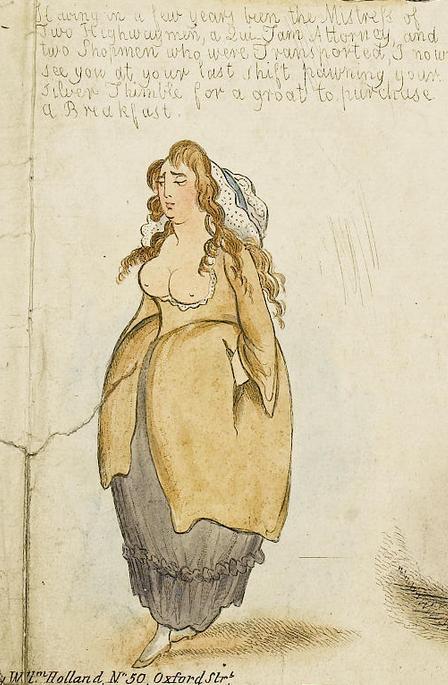
Having in two years been the mistress of a Two Highwaymen, a Qui Tam Attorney, Two Shopmen who were Transported, I now see you at your last shift, pawning your silver thimble for a groat to purchase your breakfast.

Our whore is so down on her luck, she’ll take any man as a customer, even criminals. Her two shopmen have been transported, to Australia no doubt.  She’s most likely working in back alleys and near the ports of London. Her jewelry is gone and her clothes are old-fashioned rags. Selling her thimble, an important item for sewing, for food means that she has no resources left.  I know little about ‘qui tam’ attorneys except to say that their practice had fallen into disrepute in England by the 19th century.

A groat was worth only four pence in the 1700s.

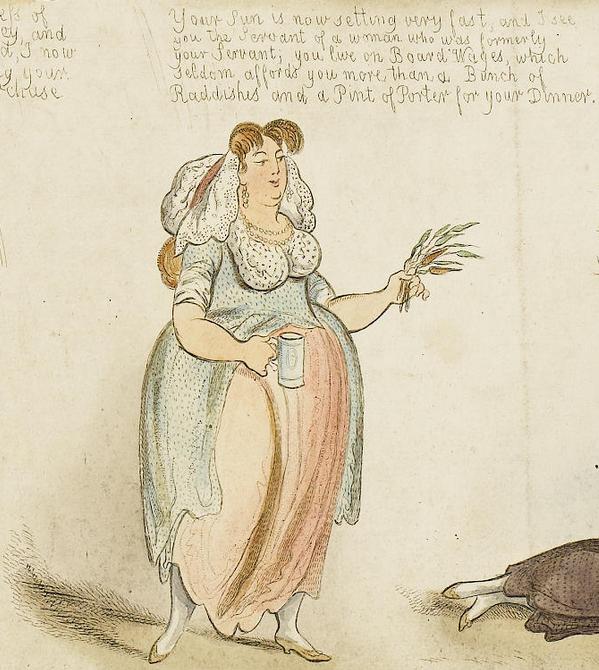
Your sun is now setting very fast, and I see you the servant of a woman who was formerly your Servant, you live on Board Wages, which seldom affords you more than a Bunch of Radishes and a Pint of Porter for your dinner.

Board wages mean that our prostitute worked very hard to earn enough money for her room, but had barely enough left over for food. Porter during this time was a strong dark beer. It was a good thing that she could afford alcohol, for I imagine that the wells in her neighborhood were contaminated with fecal matter. Water was a dangerous substance in the poorer sections of London. This prostitute’s narrative provides a cautionary tale for viewers. Her actions caused her downfall; her inability to hold her temper or her drink led to her ruin.

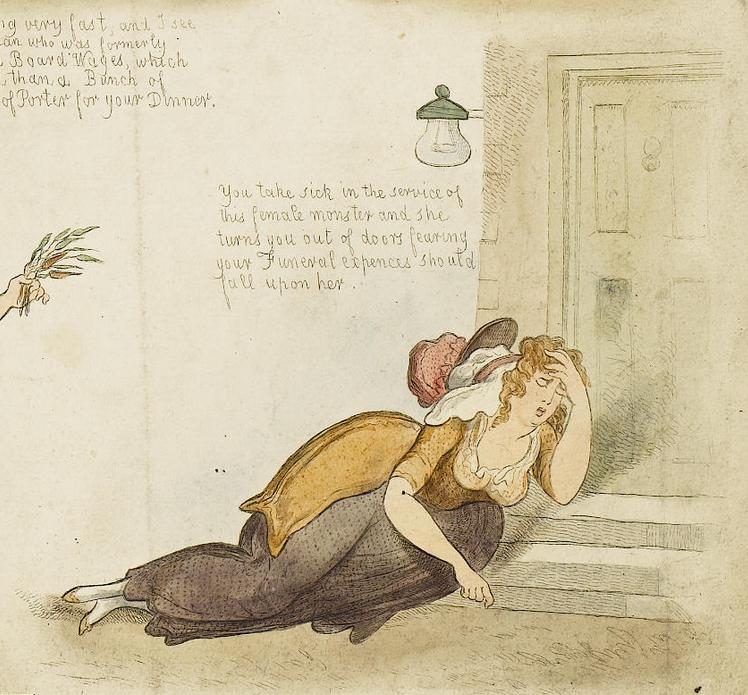
Our “heroine” falls sick and dies outdoors, to be buried in a potter’s field. Nothing could have been said more clearly about this unfortunate woman’s social worthlessness than her degrading end: No one, not even her former servant, now mistress, is willing to put up a single pence for her funeral.
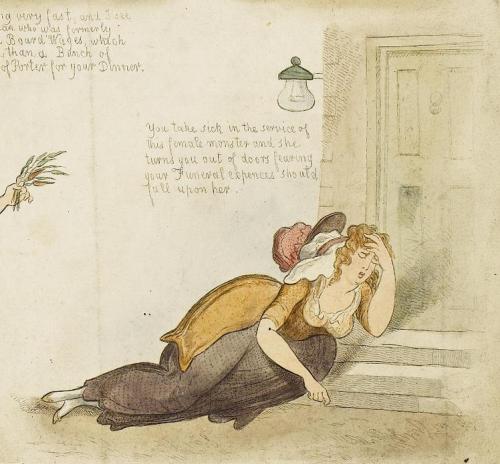
You take sick in the service of this female monster and she turns you out of doors fearing your Funeral expenses should fall upon her.

More on the topic:

Read Full Post »

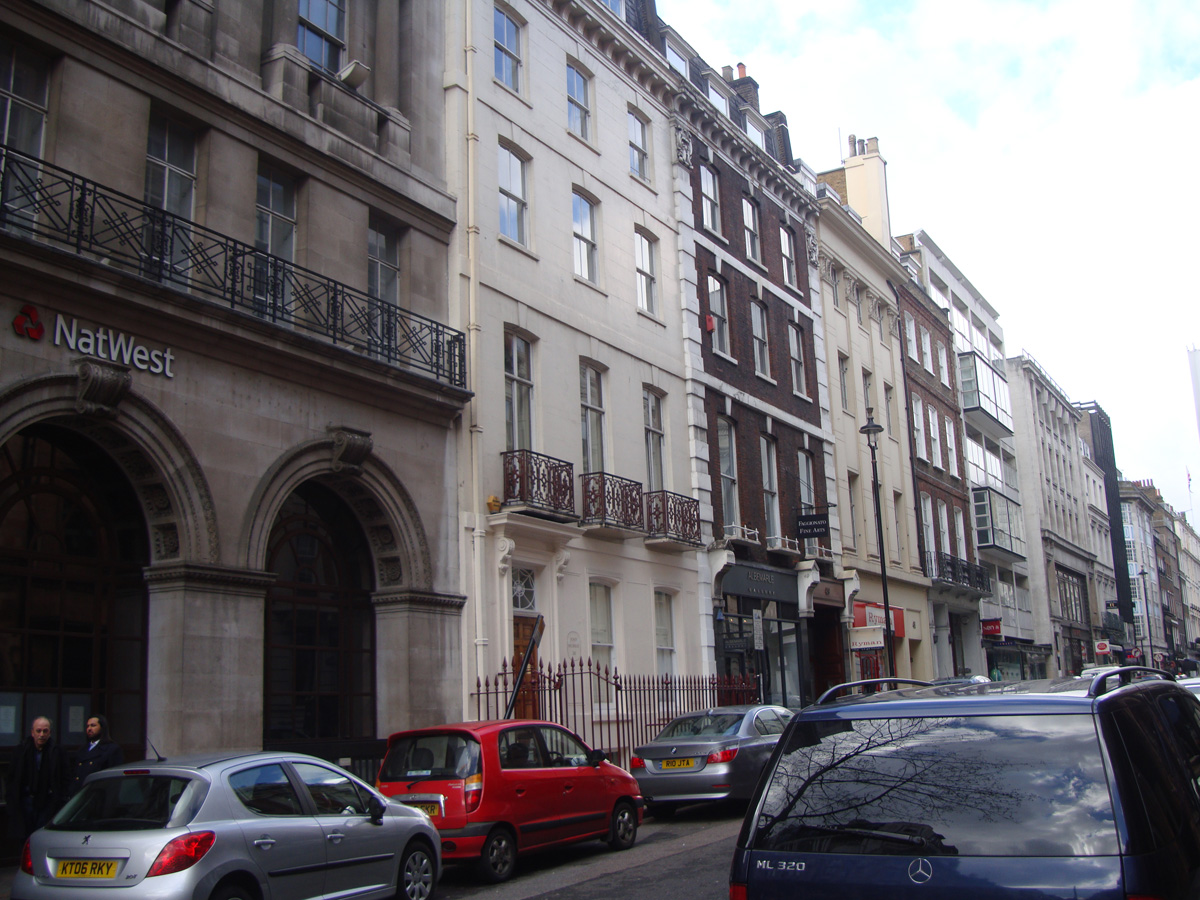
Inquiring readers:  Once again, Tony Grant, who lives in London, has written his unique insights about historical events in that great city. This week he concentrates on John Murray, the publisher of four of Jane Austen’s six completed novels. Tony’s contributions to this blog are unique in that he includes his photographs of modern London and mingles them with more traditional illustrations. Read Tony’s blog, London Calling, at this link.

Image @Wikimedia Commons

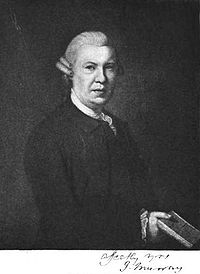
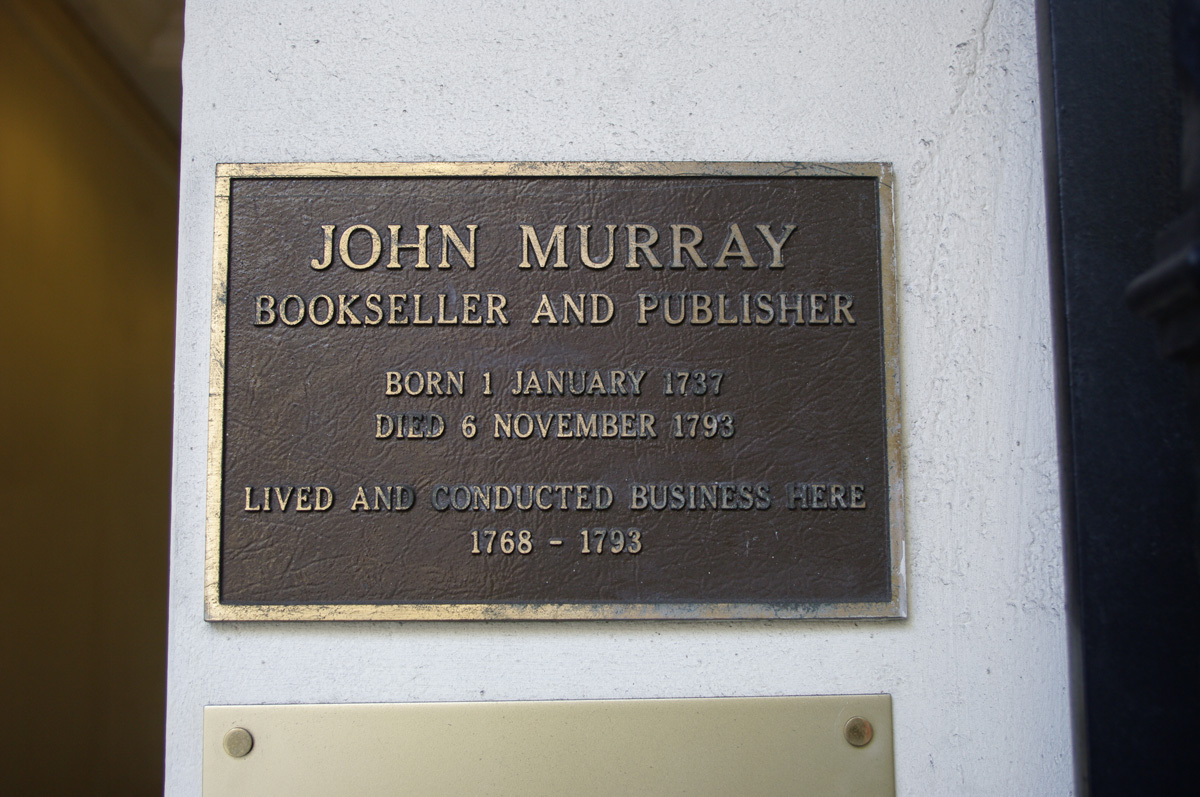
John Murray
Bookseller and Publisher
Born 1st January 1737
Died 6th November 1793
Lived and conducted business here.
1768 – 1793

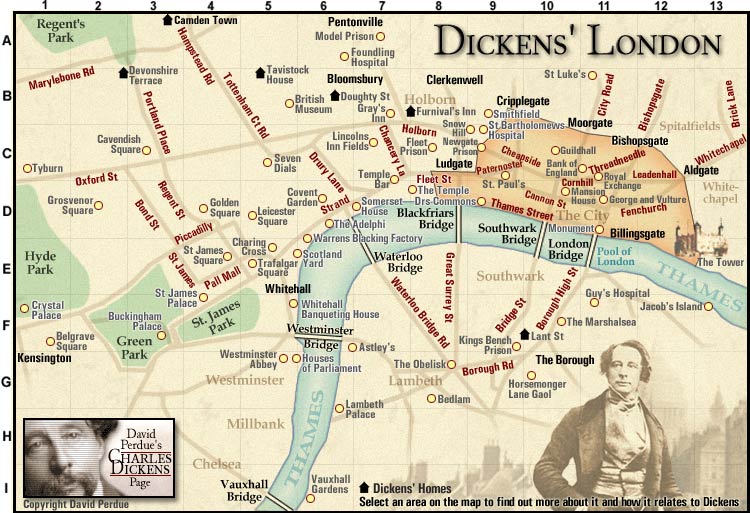
On Tuesday 13th March, my son Sam and I had a day out in central London. My brother Michael, who lives in Grenaa on Jutland, is over here with thirty students. Michael teaches mathematics in a further education college in Grenaa. He has lived in Denmark for over thirty years. A couple of weeks ago he phoned me and asked if I could do a Dickens tour of London for his students. On Tuesday Sam and I walked the route I will take Michael’s students. A Dickens walk is difficult. There are so many places in London that have strong links with Dickens.

Image @Wiki Spaces. Click on site.

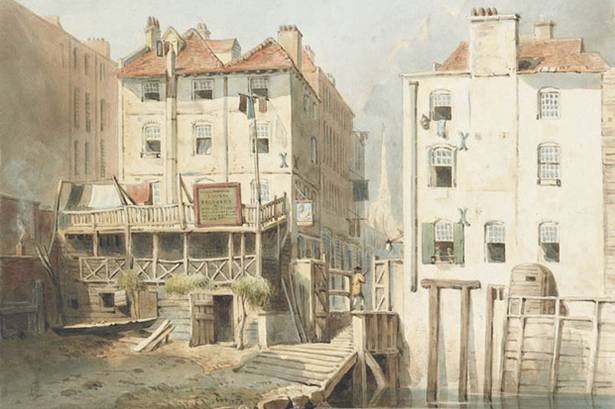
It is more about what to leave out than what to include. Connecting them all in a walk that will take just over an hour would be impossible. I looked carefully at a map of London to see what places could be linked most appropriately. I think I have chosen a rout that includes many of the main sites connected with Dickens working life in London. I have decided to begin at Hungerford Bridge the site of Hungerford Steps and Warren’s Blacking Factory where Charles Dickens worked as a young child sticking labels on bottles of black polish.

The Blacking Factory where Dickens worked. Image @The Mirror. Click here to see more.

The walk will be along The Strand, past The Adelphi Theatre, to Wellington Street, the Lyric Theatre and then on to Covent Garden before walking on to The Old Curiosity Shop, Lincolns Inn , Chancery Lane, Holborn High Street, past Grays Inn and finally ending at 48 Doughty Street, one of the houses Dicken’s lived in and now The Dickens Museum. Sam and I felt very pleased with ourselves. The walk flowed nicely, punctuated with plenty of Dicken’s sites and the timing was about right. We retraced ours steps, this time continuing down Chancery Lane to the Strand and turning left until we got to Ye Olde Cheshire Cheese, in Fleet Street.

Fleet Street and The Royal Courts of Justice. Image @Tony Grant

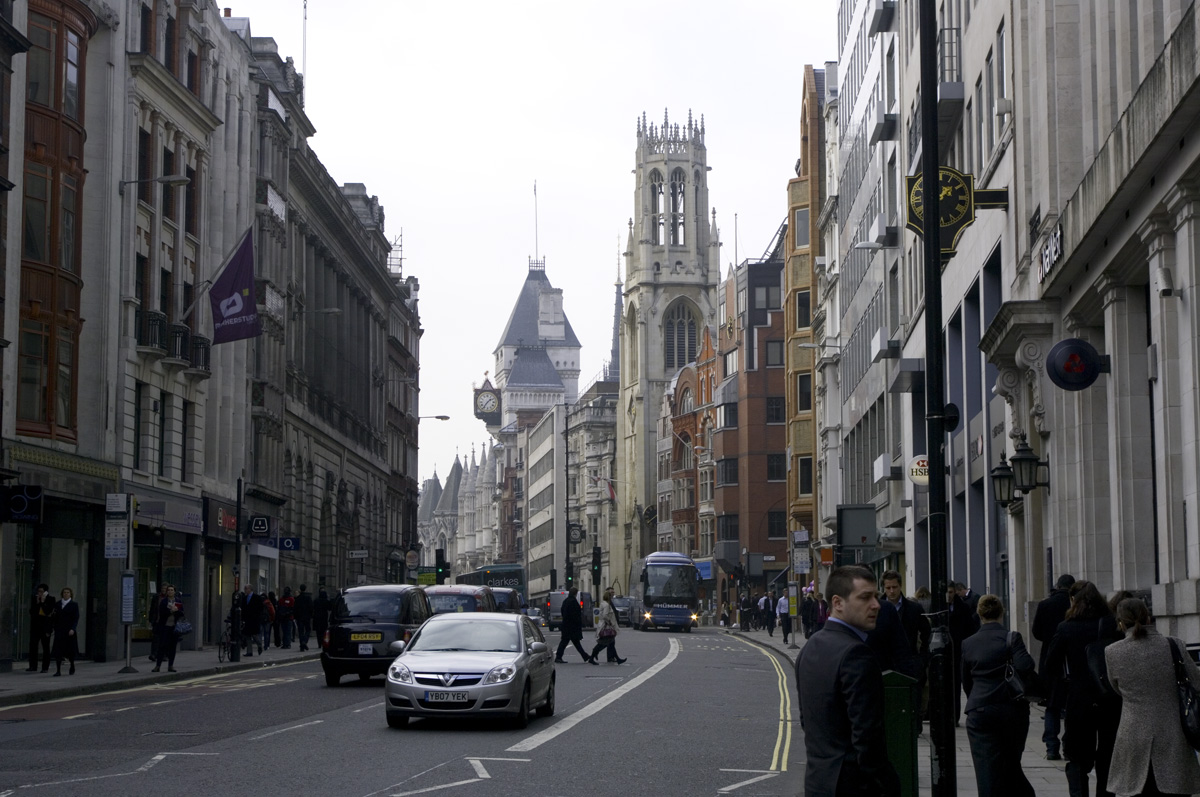
Dickens, some of his characters and many other writers and famous people have graced these premises. After a pub lunch in the cellared depths of this ancient establishment we tracked back along Fleet Street towards The Royal Courts of Justice. I just happened to glimpse a small plaque attached to a pillar to one side of a narrow alleyway leading to a small courtyard behind. It read:

Image @Tony Grant

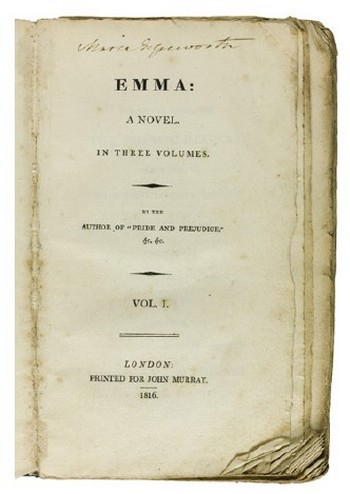
I stopped in my tracks. I thought this must be Jane Austen’s publisher. However the dates did not tally. Jane’s first novel, published by John Murray, was Emma in 1815, long after the final date of death on the plaque. I took photographs of the plaque and courtyard at the end of the alleyway and pictures of Fleet Street, running along outside. When I got home I researched John Murray and found the John Murray publishing firm website.

THIS IS A SHORT HISTORY OF THE PUBLISHING FIRM OF JOHN MURRAY.

The first John Murray, who lived from 1737 to 1793, started his working life as a Lieutenant in the Marines. Life as a marine officer in the 18th century was spent on board naval men of war and consisted of travelling the world to defend the British Empire. It wasn’t a particularly well paid or thought of profession. In Mansfield Park , Fanny’s mother, Frances , the younger Ward sister,

British marine, 1775. Image @Mock Attack

…….married, in the common phrase, to disoblige her family, and by fixing on a Lieutenant of Marines, without education, fortune, or connections, did it very thoroughly.”

John Murray must have had a natural inclination towards business and when he acquired a publishing and bookselling business in Fleet Street in 1768 he made it into a successful business now passed down through the generations. The fact that he acquired a publishing business must mean that it was left to him, perhaps in a will. As a lieutenant of marines it is doubtful he would have had the finances to buy it and it seems a strange choice of business for somebody with his background. He must have acquired it through inheritance and an accident of fate.

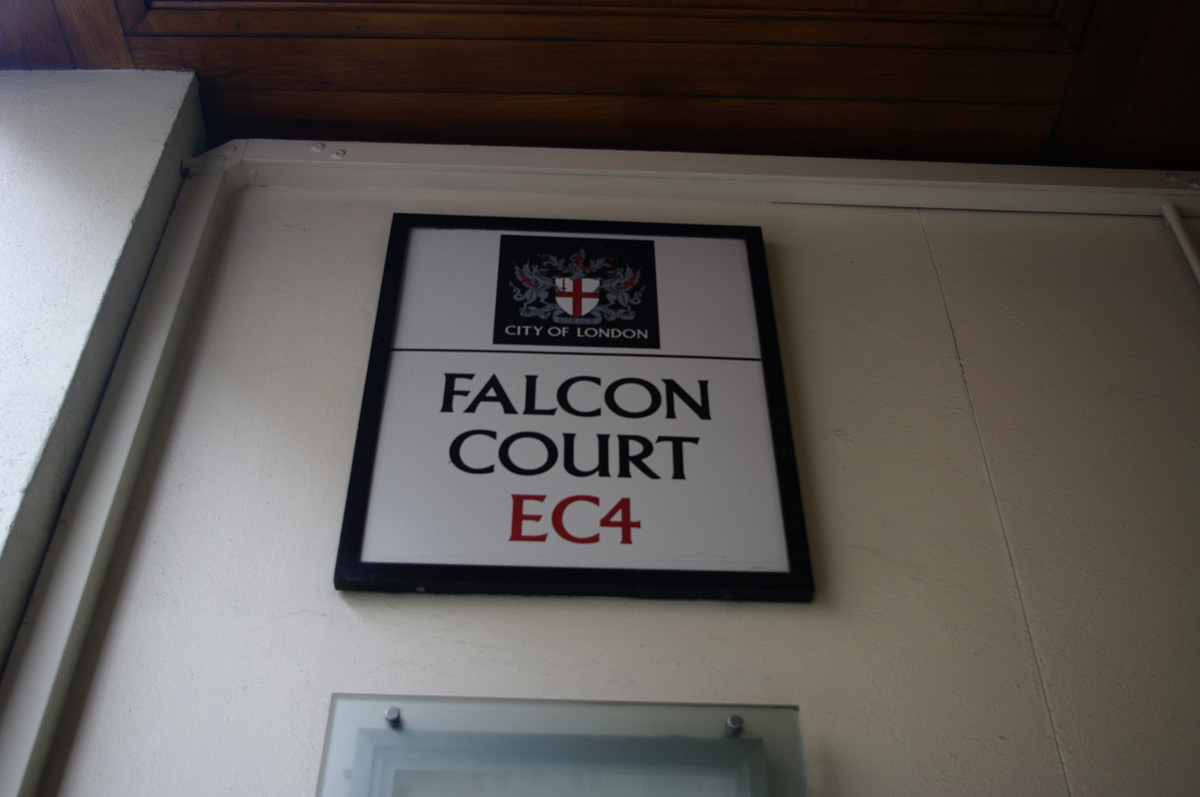
The John Murray office was in Falcon Court. Image @Tony Grant

As an indication of his business acumen he was one of the first publishers to actually consider the quality of the writing he published. He also used his many contacts to help sell large quantities of his books. He was a canny businessman though and hedged his bets by also selling game, which would have included deer, pheasants and rabbits; the produce of country sports. He had a go at selling paste jewels and lottery tickets too.

John Murray (or MacMurray, as the name was originally spelt), having bought the stock and goodwill of William Sandley, who had turned banker, began at the ‘Falcon,’ otherwise No. 32 Fleet Street, that remarkable and prosperous career which has culminated in the great publishing house of Murray. In Smiles’ book on the Murrays will be found an exhaustive account of the inception, by Lieutenant MacMurray, of this great firm. – Fleet Street and the Press

Image @Tony Grant

He was astute enough to go with what was most profitable. Books worked for him though. I suppose if the selling of game, he was virtually a butcher as well as a bookseller, paste jewellery or the selling of lottery tickets had provided more income for him the publishing side may well have not contiued and Jane would not have had her publisher in the next John Murray but may well have been buying venison from him instead.

Image @Tony Grant

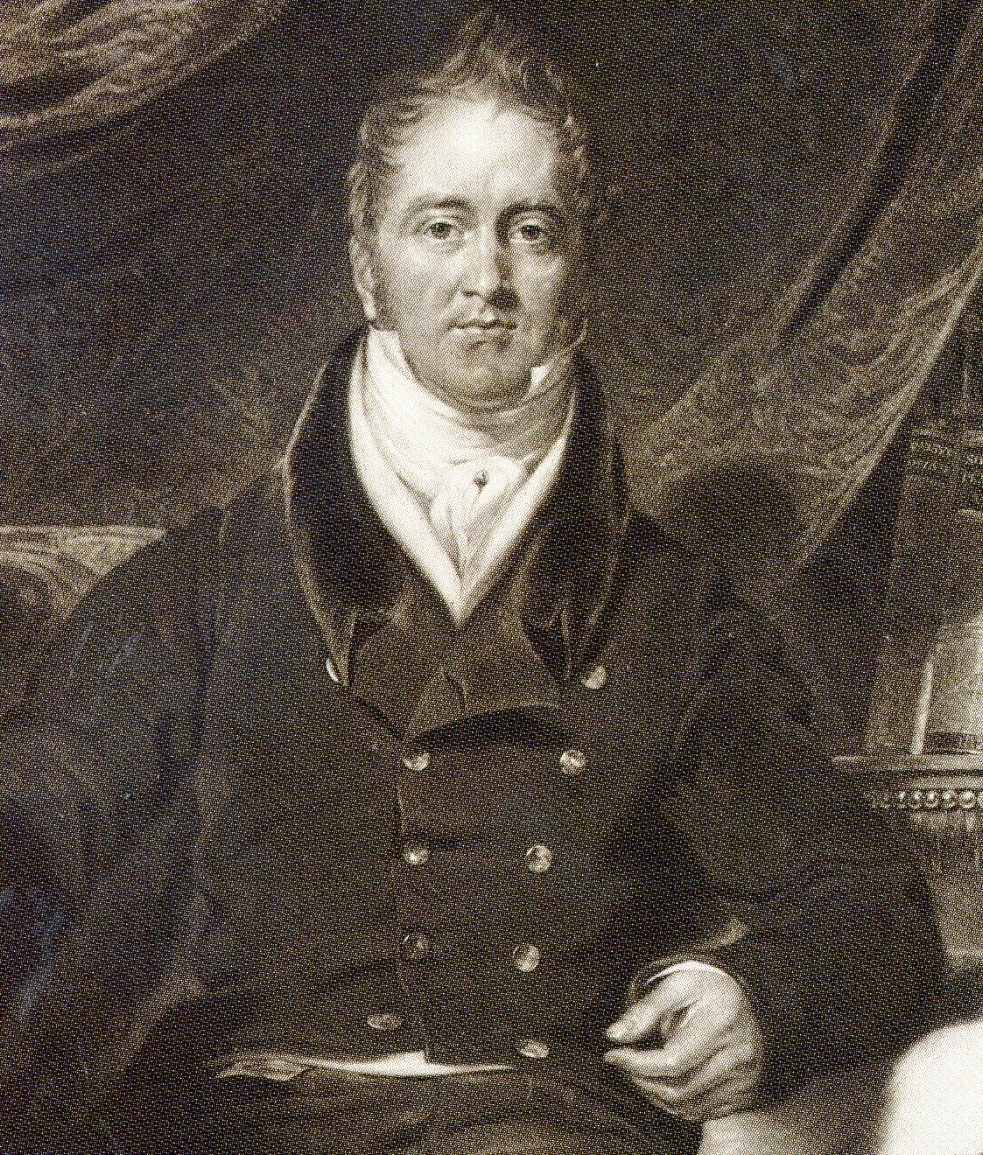
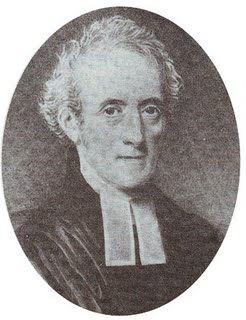
John Murray II. Image @Austenonly. (Published with permission from Julie Wakefield.)

John Murray’s son John Murray II began to develop the business. He was successful at signing Walter Scott who helped him, among others, such as the secretaries of the admiralty, John Wilson Croker and Sir John Barrow and writers such as Robert Southey and Charles Lamb to publish The Quarterly Review. This journal continued until 1967. In 2007 it was revived. The concept behind it is

to draw upon a wide range of opinions to provide counter-intuitive writing for people who like to think, and to enhance literary, philosophical and political debate.”

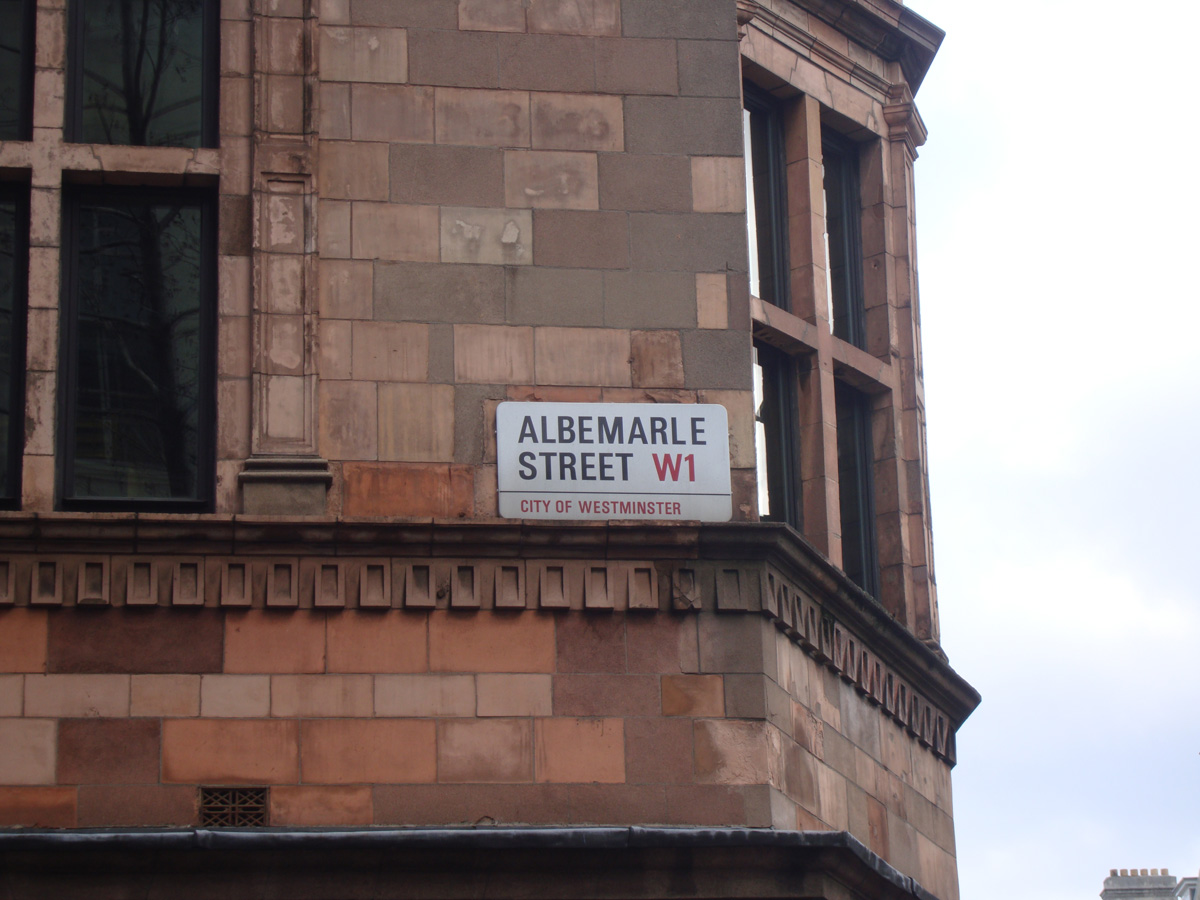
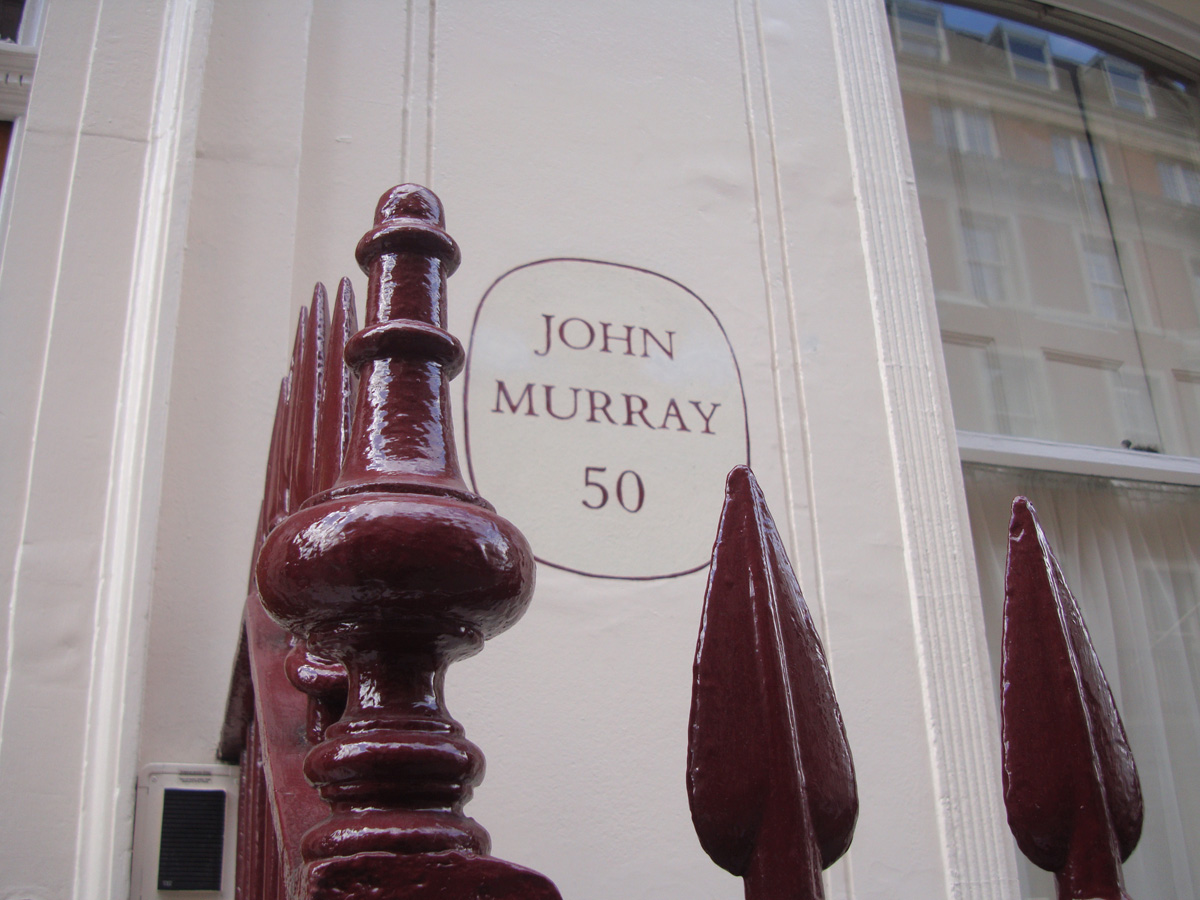
50 Albemarle Street. Image @Tony Grant

In it’s early years it tried to counter social reforms. It was rather conservative in it’s views but it did back the abolition of slavery although advocating a slow approach to the process.

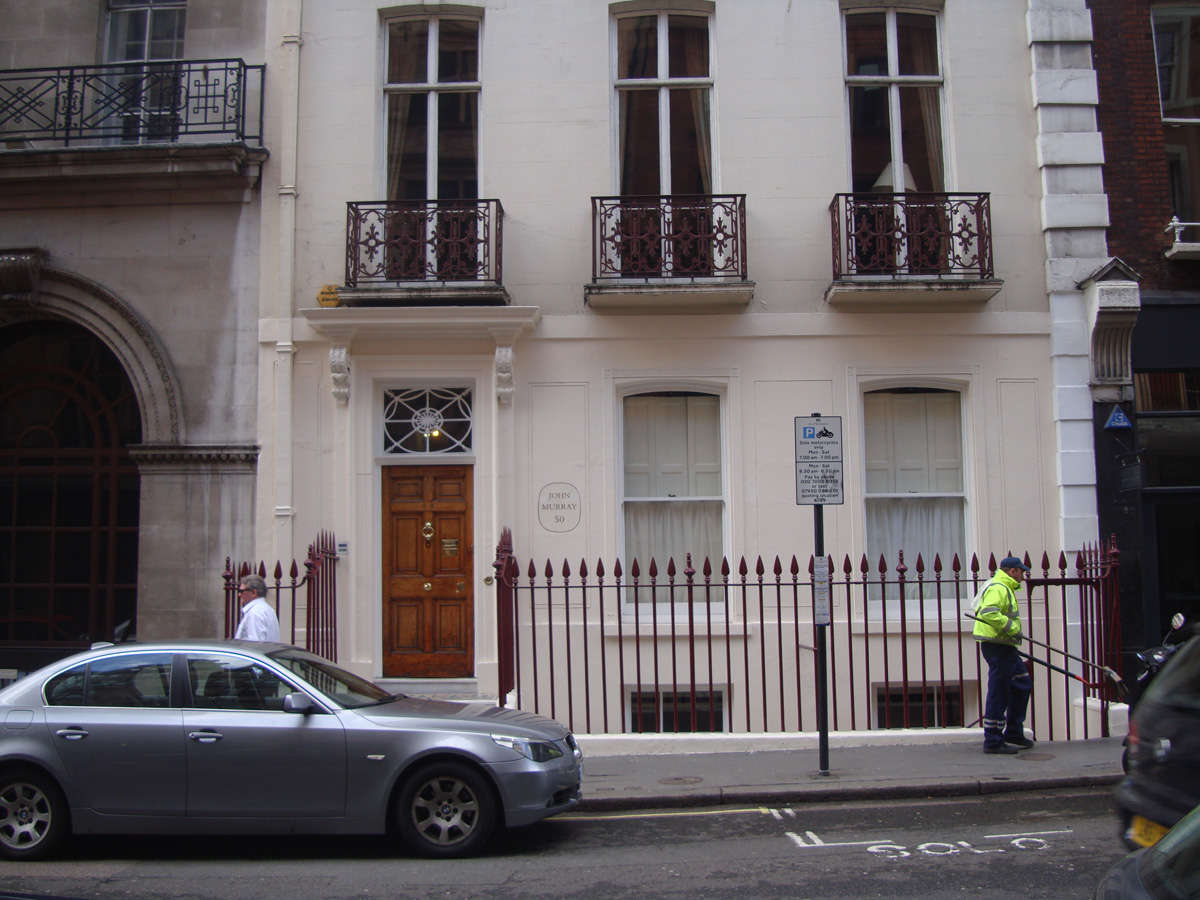
50 Albemarle Street. Image @Tony Grant

In 1812, John Murray II published Childe Harold by Byron and it was a great success. This gave Murray the confidence to mortgage some of his copyrights and purchase 50 Albemarle Street, which has remained the home of the publishing firm for the last two hundred years.

Albemarle Street. Image @Tony Grant

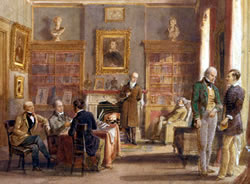
John Murray drawing room. Image @Playwright in the cages

The drawing room in Albemarle Street has been the meeting place for some of the most famous writers in English history. By 1815, and after the Battle of Waterloo, everybody wanted to be published by John Murray. It seems therefore that Henry Austen, Jane’s banker brother, must have had no little influence in obtaining Murray as his sister’s publisher. She was an unknown country girl. Why should he take her on? On the other hand he might have had great literary sense and was in the habit of reading unsolicited scripts.

Jane Austen's brother, Henry.

Jane herself was very business like with John Murray. She wrote to him on Monday 11th December 1815 from Hans Place, Henry’s house in London:

Dear Sir,

As I find that Emma is advertised for publication as early as Saturday next, I think it best to lose no time in settling all that remains to be settled on the subject, & adopt this method of doing so, as involving the smallest tax on your time.

In the first place, I beg you to understand that I leave the terms on which the Trade should be supplied with the work, entirely to your judgement entreating you to be guided in every such arrangement by your own experience of what is most likely to clear off the Edition rapidly, I shall be satisfied with whatever you feel to be the best.-“

She appears to be quite the pragmatist. It is significant to note that Murray would publish four of her six completed novels: Emma and Mansfield Park while she was alive, and Persuasion and Northanger Abbey after her death.

Image @Austenprose. Click on link to read post.

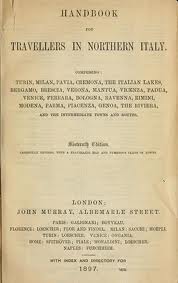
In the nineteenth century, the John Murray firm began publishing a series of travel books called the Murray Handbooks, which were authored by many of the great explorers of the time. The men included Sir John Franklin, who, in 1847, died exploring the North West Passage. He had also spent many years mapping the coast line of Canada. Murray also published David Livingstone, the explorer of the heart of Africa; Sir John Barrow, who wrote about South Africa; Heinrich Schlieman, the excavator and discoverer of Troy; and Isabella Bird, who visited north America and the pacific Islands. Her trips were financed by her father to help her counteract depression and backache. Both symptoms were cured in her travels: John Murray published “The Englishwoman in America,” and “Six Months in The Sandwich Islands,” both written by her about her travels.

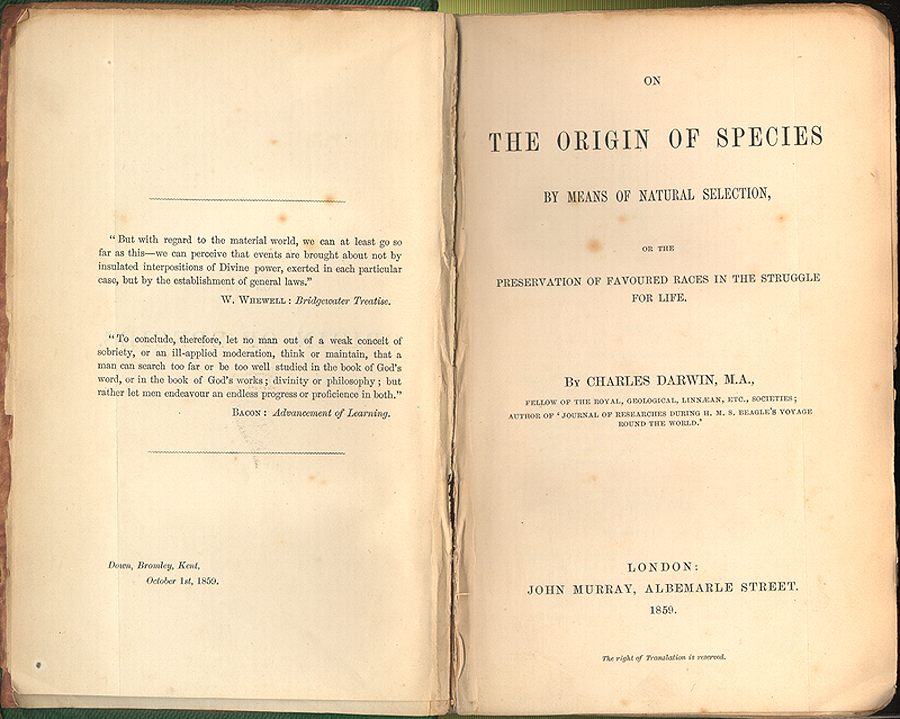
Scientists and inventors chose to be published through John Murray. They included Charles Babbage, Malthus and Lyell who wrote in 1830 “Principles of Geology,” which later inspired Charles Darwin. In 1859, the firm published Charles Darwin’s The Origin of Species, and Samuel Smiles’ Self Help.

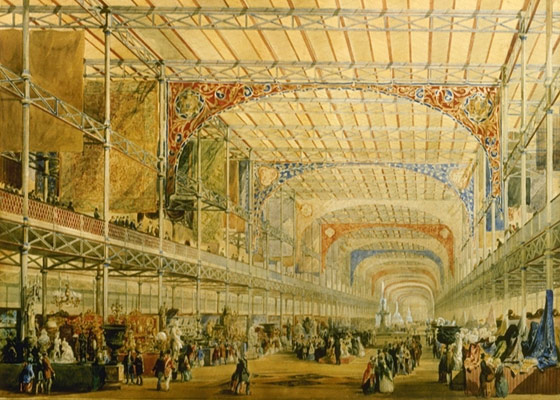
John Murray III was one of the official publishers of the Great Exhibition held in Hyde park in 1851. This exhibition promoted the industrial, economic, and military might of the Empire, although all nations were invited to contribute exhibits.

Great Exhibition

The proceeds form the exhibition were later used to create, The Albert Hall, The Science Museum, The Natural History Museum, and The Victoria and Albert museum. This area of London today is still called “Albertropolis,” because Prince Albert, Queen Victoria’s husband, sponsored The Great Exhibition and the forming of the Kensington Museums. John Murray faced some opposition from some quarters when he published Queen Victoria’s letters after she died.

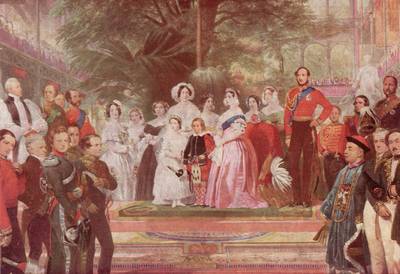
Prince Albert and Queen Victoria announce the opening of the Great Exhibition. Image @Getty Images.

In 1917 John Murray bought the rival publisher Smith Elder, and so added Sir Arthur Conan Doyle to their list.

John Murray, IV. Image @John Murray Archive

In the 1930’s John Murray IV entered the firm and built up an impressive list of twentieth century writers including John Betjamin, Osbert Lancaster and Freya Stark amongst others.

In 2002 John Murray was sold to Hodder Headline, which in turn became part of Hachette UK. The company continues to publish and prosper continuing with new ideas and new authors in all fields.

As a footnote, if there is anybody reading this thinking that they would like to be published by John Murray they have a note on their website:

Submissions

Owing to the amount of time devoted to assessing solicited or commissioned work John Murray is no longer able to accept any unsolicited manuscripts or synopses, or to enter into any correspondence about them. The best way to go about getting published is to find a literary agent, who can give you advice about your work and who will know the best publishers for the kind of book you are writing.

You can find a list of literary agents in the Writers’ and Artists’ Yearbook, published by A&C Black, or in The Writer’s Handbook or From Pitch to Publication by Carole Blake, both published by Pan.

Read Full Post »

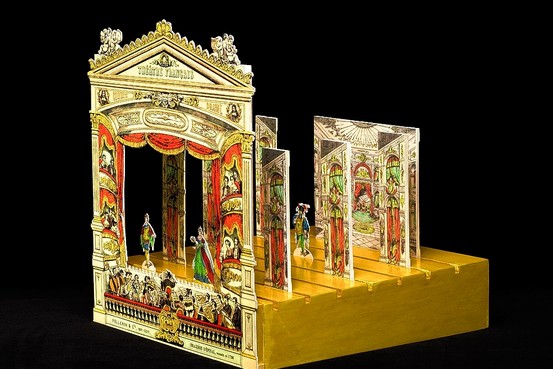
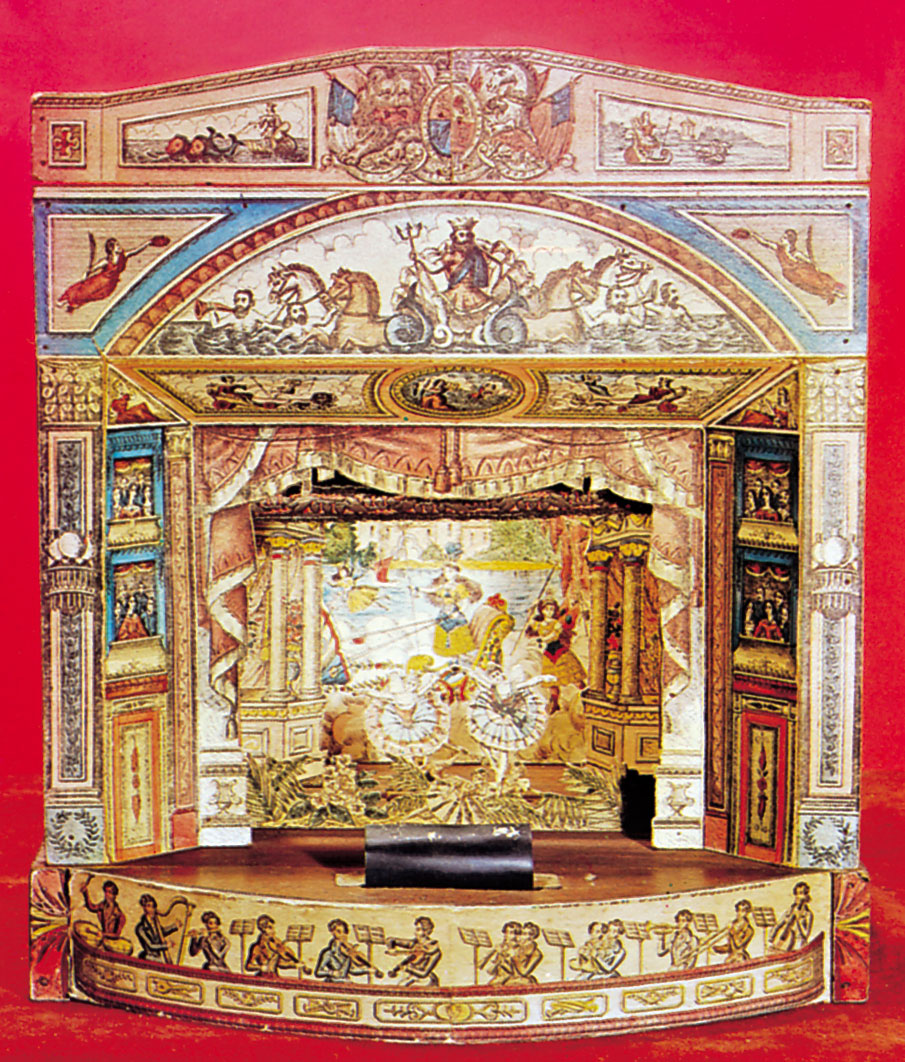
It is hard to imagine what entertainment was like in the days before the 21st century, yet people have always devised ways to spend their leisure time in pleasant company doing amusing things. In the evening, Jane Austen and her family spent many hours entertaining each other. One popular form of entertainment that the older Austen siblings would have known about was the Toy Theatre, or a juvenile form of miniature theater.

Toy Theatre. Image @Tea at Triannon

This entertainment appeared in the early 1800s, and coincided with the popularity of theater and the rise of the print trade. One can imagine that Aunt Jane was well aware of toy theatres when she spent time with her nephews, for this new toy largely attracted boys.

By 1811 William West of London was printing sheets of stage characters for purchasers to colour, paste on cardboard and cut out, though others treasured them as individual portraits. Single prints in black ink on white paper were called “penny plains” while those with color added by the seller were the “twopence coloured.” West’s first subject was Joseph Grimaldi in “Mother Goose,” a role that brought him fame and lifelong success on the stage. – NYPL Digital Gallery

Miniature theaters became fashionable all over Europe, and their tiny elaborate sets mimicked the grand theaters of London, Paris and other world stages. The sets remained popular throughout the 19th century and into the early 20th century, offering children an opportunity to exercise their imaginations and their acting chops. Some children, I imagine, concentrated on honing their acting skills, while others probably enjoyed their roles as directors or scene designers more. New plays were published in the first half of the 19th century.

After the 1860’s no new plays were published but much of the old repertoire was kept in print by a dwindling number of theatrical print publishers and the tradition continued unbroken until 1944 when Miss Louisa Pollock,shut up her father’s famous shop in Hoxton for ever and sold the contents as a going concern. – Toy Theatre Gallery: History

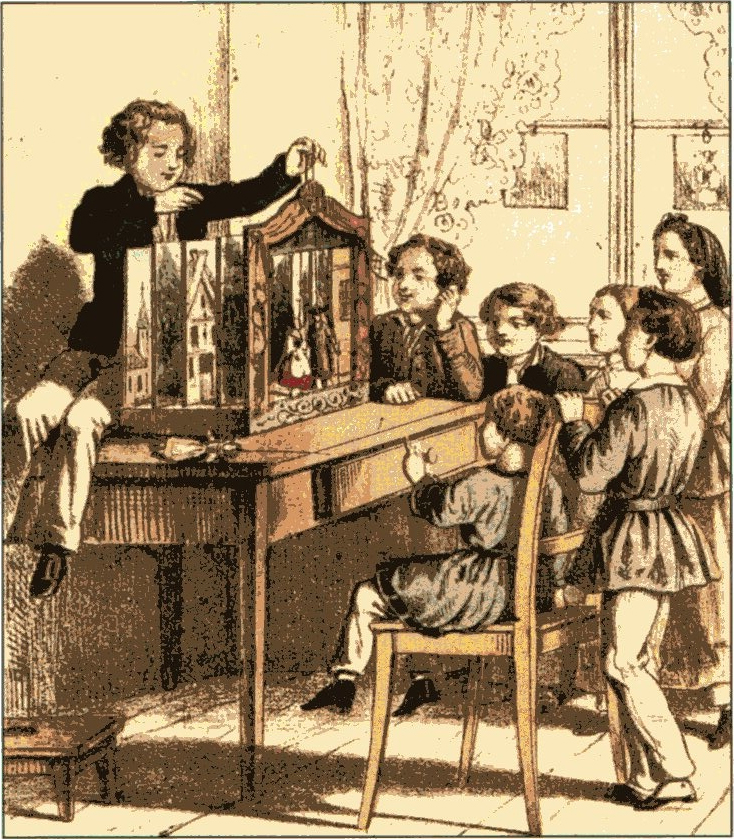
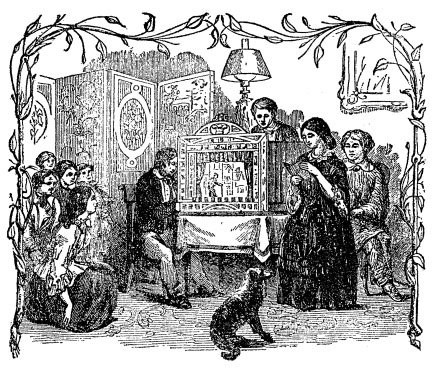
From Mansfield Park the reader gains a sense of how seriously family theatricals were regarded. In the novel, the men were definitely in control of the enterprise, with the women acquiescing to their direction (the only exception being Fanny). While Jane Austen described a real play, Lover’s Vows, with large, almost life-like sets in Sir Thomas Bertram’s study, wood toy theatres that sat on a tabletop would be taken equally seriously. The children must have spent hours preparing for a performance, arranging sets, learning lines, and dressing and moving their characters before they felt comfortable opening a new play in front of an indulgent and forgiving family.

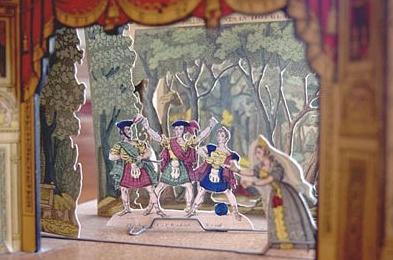
English Toy Theatre, 1850. Pollock's Museum. Image @Brittanica

Created from printed paper glued to cardboard and then mounted on wooden frames, these theaters could be quite intricate in design. They offered a proscenium, scenery, cut-out characters with codified attitudes and gestures, and a booklet that contained stage and scene directions and dialogue for the actors. Almost all of them depict an orchestra: The clothes worn by the musicians give a good indication of when the theatre was designed.

Early toy theatre prints were made from engraved copper plates, the engravings often from sketches made at the theatre on the night. Sets, costumes, and even the actors’ likenesses were copied, and could often be recognised. – Miniature Theatre: Curator’s Choice

Image @Victoriana

The plays were not necessarily derived from children’s stories: They were adapted from operas, melodramas, history, novels, and pantomimes. Works from Shakespeare, Cervantes, Mozart, and Beethoven were included. Hans Christian Anderson was also an inspiration.

Children could choose “Three-Fingered Jack, the Terror of Jamaica” or “Hamlet” or another of the nearly 300 “juvenile dramas” printed in England between 1811 and 1860. – Dramas to Cut, Color, and Produce

The involvement of publishers was enormous, but Pollock’s toy theatres were probably the most famous in Great Britain.

England had over 50 publishers, Germany 54, Spain 14, France 13, Denmark 10, Austria 9, and the United States 5. All of these versions to some degree were derived from the ability to mass produce the printed image, initially from engraved copper plates, followed by color lithography in the mid-19th century. – A Child’s View: 19th Century Paper Theaters

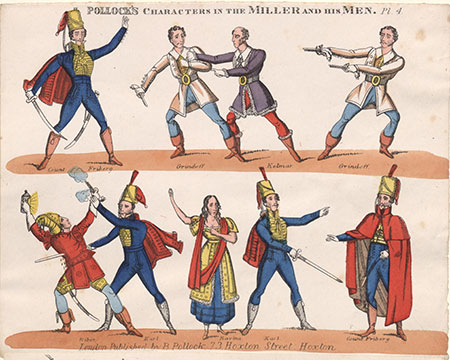
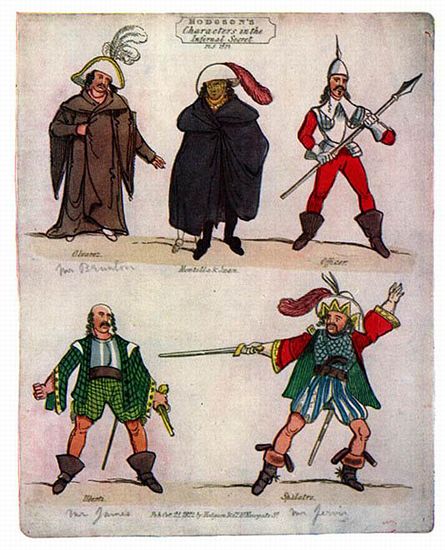
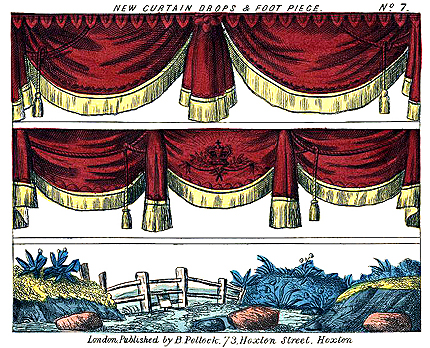
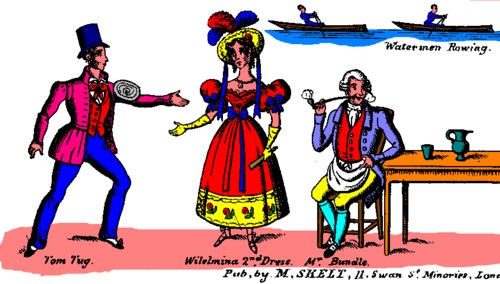
Many printed sheets of cut- out characters survive to this day, both colored and in black and white.

In 1811 William West produces a sheet of the principal characters from the first production on the London stage of ‘Mother Goose’, with Joseph Grimaldi in one of his most celebrated roles of Clown. The popularity of this role led to the publication of sets of sheets of characters, scenery and props, also elaborate prosceniums, the designs based on those of popular London theatres. Books of words, abridged versions of the most popular melodramas and pantomimes to be seen on the London stage.

From this time the popularity of the toy theatre, also known as the ‘Juvenile Drama’, saw the rapid growth in the number of publishers producing versions of plays, with the drawings for the engravings made by such leading artists as Georg e Cruickshank and William Blake. The legacy of the 19th century toy theatre is that of the most complete documentation of the costumes, scenery, and the performance style of the actors of the London Theatres of the period. – The World Through Wooden Eyes: A Penny Plain and Two Pence Coloured

Paper backdrops image @Birds of Ohio

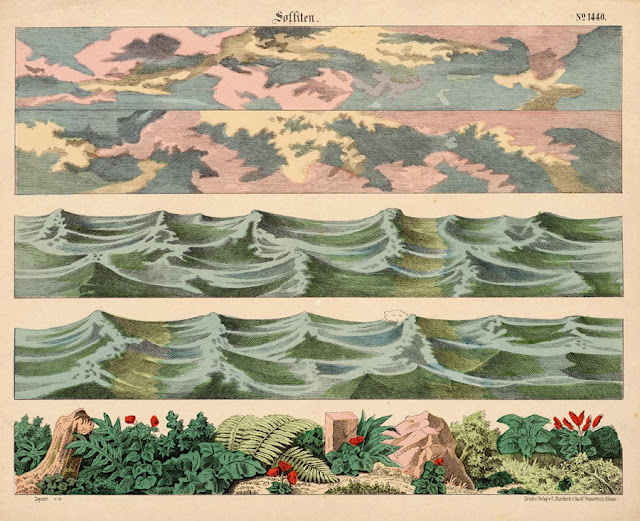
These backdrops for miniature theaters on Birds of Ohio show how much detail the sets provided.

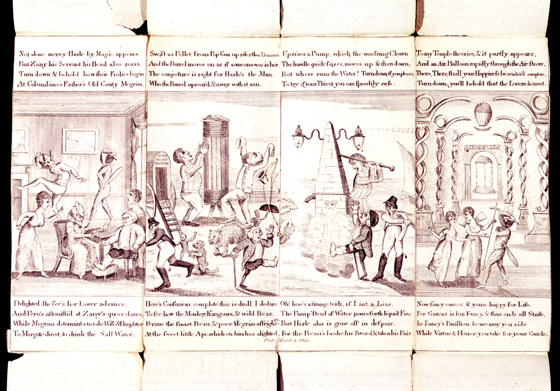
Below is a very rare example from the V&A shows a souvenir from a play  first performed at the Theatre Royal, Covent Garden  in 1800 called Harlequin’s Tour or the Dominion of  Fancy. While the souvenir survives, the dialogue for the play does not.

Souvenir, 1800. Image @Victoria & Albert Museum

In a June 2011 The Telegraph article, Sir Roy Strong, former director of the V&A museum and National Portrait Gallery, recalls his toy theatre with great affection:

Image @The Telegraph

This toy theatre … reminds me of one enormously happy period of my childhood. It was given to me after the war and purchased at Benjamin Pollock’s Toyshop, originally in the East End of London [now in Covent Garden]. I played with all the cut–out cardboard figures and scenery, and still have all my toy theatre plays, which are 19th–century dramas, romances and pantomimes. The theatre sits in the archive room and I love it. It’s been with me everywhere.

More on the topic:

Modern characters for The Waterman.

Read Full Post »

Jane Austen fans are familiar with the high-waisted muslin dresses popular during her adulthood. How many are aware that machine-made net or gauze became a “hot” item from 1810 and on?

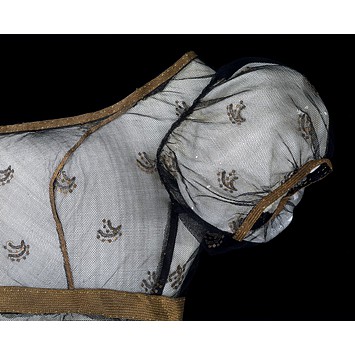
Evening dress with gauze overlay

“Net dresses were very fashionable and their popularity was spurred by new inventions. The development of machine-made net in the late 18th and early 19th centuries meant that gauzy lace effects were increasingly affordable either as trimmings or garments. The bobbin-net machine was patented by the Englishman John Heathcoat in 1808 and produced a superior net identical to the twist-net grounds of hand-made bobbin lace. It was so successful that women in the highest ranks of society, including the Emperor Napoleon’s first wife, Josephine, wore machine-net dresses. Initially, however, all machine nets were plain and had to be embroidered by hand.” – Victoria and Albert

Detail of an evening dress with net lace. Image @Victoria & Albert Collection

Machine-made bobbin net was first made in France in 1818. Until this date, lace as it was made was known as old lace. After that date, lace is categorized as being modern.

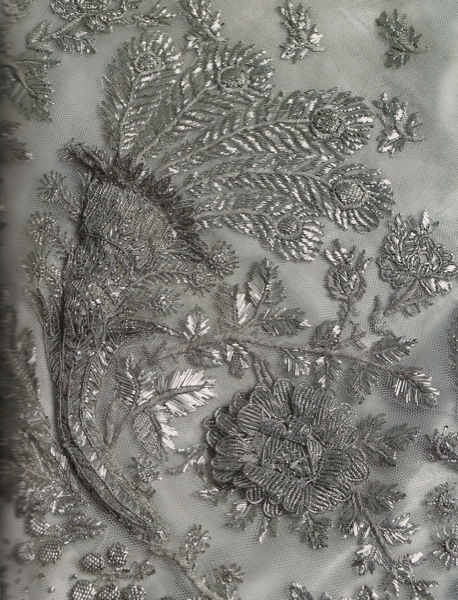
Silver embroidery on net on Empress Josephine's court gown. Image @Madame Guillotine

Machine made lace made an appearance around 1760. The nets and tulles became immediately popular. Their arrival spurred the production of other silk lace cloths, which led to a general rise in popularity of the silk lace trade – until a machine was invented that could produce silk net lace as well.

Evening dress with net overlay, 1817-1818, V&A Museum

In the 18th century the hand-made net was very expensive and was made of the finest thread from Antwerp: in 1790 this cost £70 per pound, sometimes more. At that time the mode of payment was decidedly primitive: the lace ground was spread out on the counter and the cottage worker covered it with shillings from the till of the shopman. As many coins as she could place on her work she took away with her as wages for her labour. It is no wonder that a Honiton lace veil before the invention of machine-made net often cost a hundred guineas. Heathcoat’s invention of a machine for making net dealt a crushing blow to the pillow-made net workers. The result is easily guessed. After suffering great depression for twenty years the art of hand-made net became nearly extinct, and when an order for a marriage veil of hand-made net was given, it was with the greatest difficulty that workers could be found to make it. The net alone for such a veil would cost £30. – A history of hand-made lace: Dealing with the origin of lace, the growth of the great lace centres, the mode of manufactures, the methods of distinguishing and the care of various kinds of lace, Emily Jackson, p. 170

Hem of 1817_1818 Evening Dress with net overlay, V&A Museum

The most popular European centers for lace making were located in France, the region known as Belgium today, Ireland, England,and Italy.

During the French Revolution the French textile industry had suffered and unlike in England, use of textile machinery had been non-existent.  Emperor Napoleon stopped the import of English textiles and he revived the Valenciennes lace industry so that fine fabrics like tulle and batiste could be made there. – Regency Fashion History

Black net over gold gown, 1818. Image @Defunct Fashion

Between 1806-1810, net gowns embroidered with chenille embroidery became popular. Profits rose for the manufacturers as the price for the cloth plummeted.

In 1809 Heathcoat took a patent for his bobbin net machine. But the profits realised by the manufacturers of lace were very great, and the use of the machines rapidly extended; while the price of the article was reduced from five pounds the square yard to about five pence in the course of twenty-five years. – John Heathcoat and the Bobbin Net Machine, Samuel Smiles (1859)

By 1813, the bobbinet machine had been perfected. After 1815, gauze was used over satin evening dresses, with the fabric gathered at the back. By 1816, crepe, net and tulle were worn over evening wear made of satin, silks, velvets, kerseymere, satin, lame, and both plain and shot sarcenet.

La Belle Assemblee Court and Fashionable Magazine contains this description of a lady’s dress in Her Majesty’s Drawing Room in January 1818:

Hon. Lady Codrington.—Net draperies, magnificently embroidered in gold  lama, in bouquets and sprigs, over a petticoat of white satin, with blond lace at the bottom, headed with a rouleau of gold lama; train of crimson velvet, trimmed with gold lama and blond lace. Head-dress gold lama toque, with ostrich plume, and diamonds.

1818 Evening Dress, June. La Belle Assemblée. ENGLISH. No. 1.—Evening Dress. Round dress of embossed gauze over white satin, with coriage of peach-coloured satin, elegantly ornamented with rouleau medallions and palm leaves of white satin. Mary Queen of Scots hat, ornamented with pearls, and surmounted by a full plume of white feathers. Negligé necklace of fine pearls, and gold chain beneath, with an eyeglass suspended. White satin shoes, aud white kid gloves.

Not every lady of that era was obsessed over bobbin net lace or tulle. Many began to publicly and proudly favor the old hand made lace.

…both in England and on the Continent and at Almack’s, the Assembly Rooms at Bath and Tunbridge Well, the chaperons would gossip of their lappets of Alencon or Brussels. Numerous were the anecdotes as to how this treasure or that had turned up having escaped the doom the rag-bag, which alas! was the fate of so much old lace during the muslin and net period. – Emily Jackson, A History of Hand-made Lace, 1900, p 48.

Machine made lace dealt a great blow to the industry of hand-made fabrics. In Tiverton in 1822, where once 2,400 lace makers worked, only 300 lace makers were still employed.

Evening dress with net overlay, 1818. Image @Old Rags

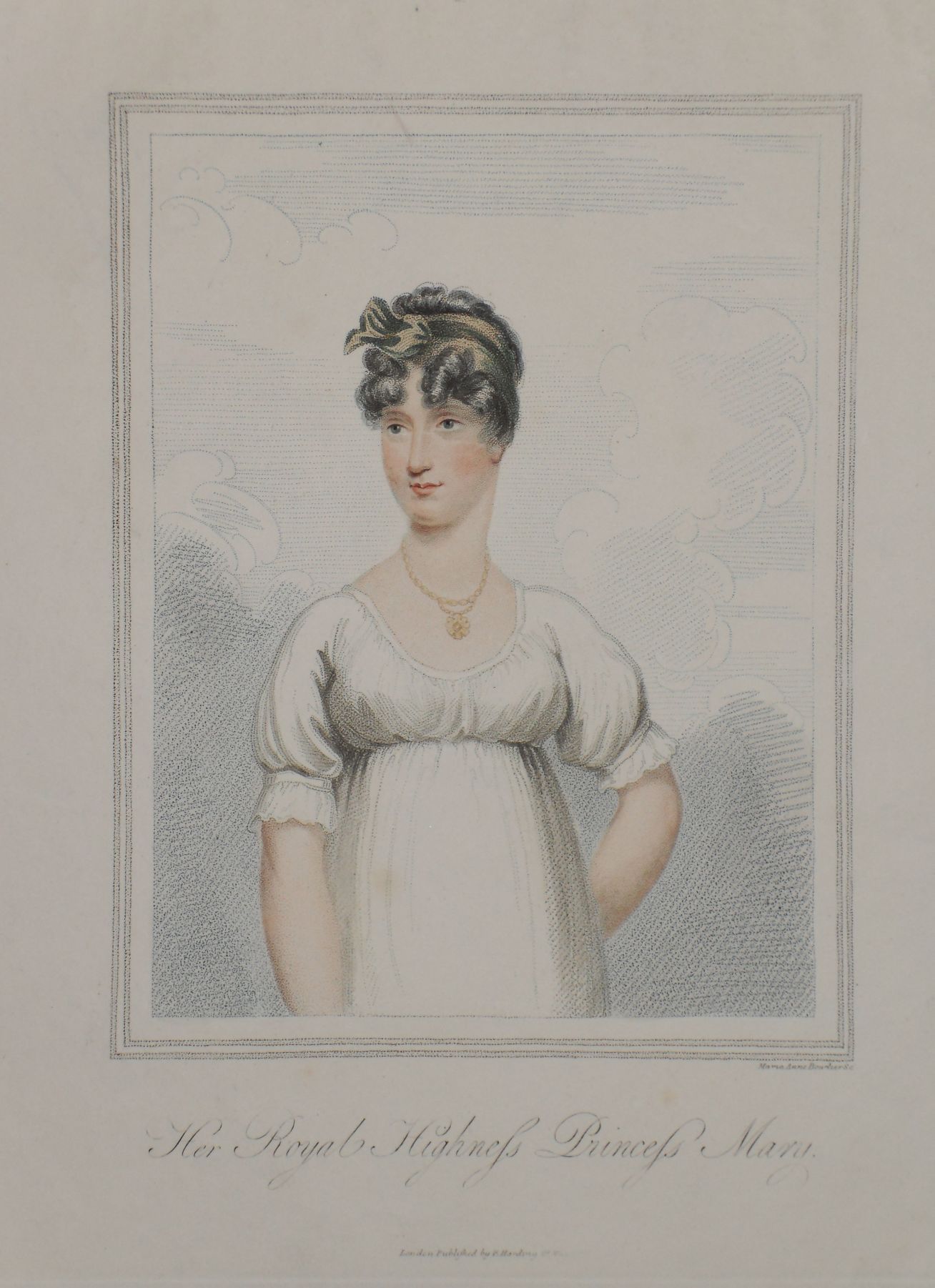
The Duchess of Gloucester was one of the few whose affections never swerved from her love of the old rich points towards blondes and muslins, and her collection was one of the finest in Europe. Lady Blessington, too, loved costly lace, and, at her death, left several huge chests full of it. Gradually lace began to be worn again, but it was as it were ignorantly put on, worn simply because it was again the fashion to wear lace, and lace must therefore be worn; the knowledge of its history, worth, and beauty was lacking…  – Emily Jackson, A History of Hand-made Lace, 1900, p 48.

Princess Mary, Duchess of Gloucester (Daughter of King George III) Image @Justin F. Skrebowski

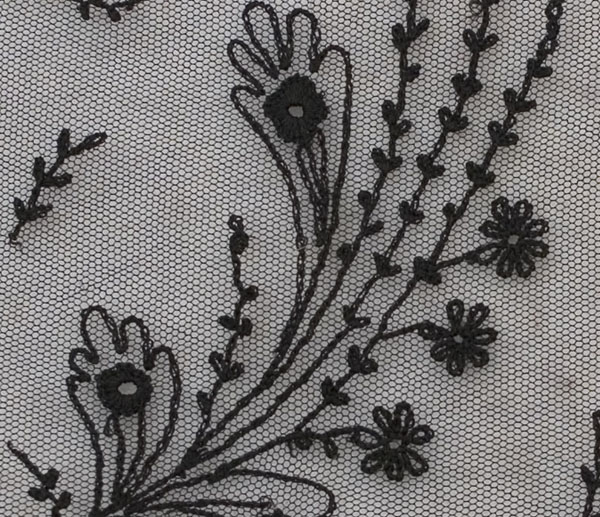
Sprigs beautified the machine-made net. It is said that Queen Charlotte introduced applique on net to support the machine net industry. Honiton appliques consisted of white linen thread sprigs mounted on the net, but black  silk sprigs were applied as well. The black silk cost twice as much as the linen threads and soon went out of fashion.

The trade of lace making remained for several generations in some families, thus in 1871 an old lace maker was discovered at Honiton, whose turn or wheel for winding cotton had the date 1678 rudely carved on its foot –Old lace, a handbook for collectors: an account of the difference styles of lace, their history, characteristics & manufacture, Margaret Jourdain, 1908, p94-95

Detail of early 19th c. tamboured net shawl. Image @Vintage Textiles

Sources:

Read Full Post »
« Newer Posts - Older Posts »