This Jane Austen blog brings Jane Austen, her novels, and the Regency Period alive through food, dress, social customs, and other 19th C. historical details related to this topic.
My blog has been silent again. Just as my schedule was letting up a bit, my father fell ill. In Jane Austen’s time, extended families lived in one village and often under the same roof. Healthy family members or friends took care of the sick, elderly, and very young. In this age, when sons and daughters and siblings live far apart, taking care of a loved one is not as convenient. I took time off from work, more to help my 88 year-old mother than my father, who was in the hospital, and to take some stress off my brother, who was starting a challenging and demanding new assignment. We thought Dad had suffered a stroke. In the 18th century, his condition would have been described as apoplexy, or “paralysis caused by stroke. Sudden deprivation of all the internal and external sensation and of all motion unless of the heart and thorax.” ( Glossary of Old Medical Terms Used in the 18th and 19th Centuries)
As he came out of a restaurant bathroom, my dad forgot to walk. I happened to be there, worried that he was taking so long. He began to slur his words and hallucinated that his father, who has been dead for 40 years, was joining us for dinner. We rushed him to the emergency room, where he wound up in good hands, receiving excellent diagnostic care. After four days of tests, he was transferred to a rehab hospital for the elderly to receive 10 days of speech therapy, physical therapy, and occupational therapy.
Stroke (apoplexy) satirical art work. 1822 copy of a Charles Aubry original. Click here to go to Fine Art America to read the details.
Back in the old days, those who suffered apoplexy or stroke were not so lucky. Many died within hours of the event, if not a few weeks later. Blood letting was one cure that was thought to be effective, although in most cases the practice was harmful and weakened the patient.
Some of those who survived successive attacks, especially the young, were mistaken for being mad. Romance author, Laura Kinsale, has written a remarkable book entitled Flowers From the Storm, in which a hedonistic and haughty duke is placed by his family into a mental institution after a major stroke. His sudden inability to communicate and lack of physical control is described in detail by this talented author in a story that, 15 years after I first read it, still stands out in my mind. I imagine the fate that this fictional Duke suffered was shared by many actual people of that era.
In our case, Dad benefited from modern medicine. An MRI showed previous minor strokes, but a CAT scan proved that this was not the reason for his illness. Dad’s illness was a “neurological event” that has been attributed to the progression of his Parkinson’s disease, once known as shaking palsy; the effects of a new medication, which made him hallucinate; the poisonous interaction among the 16 some medications he was taking per day; the slow advancement of his dementia; lack of exercise; and simply old age.
Two hundred years ago, I would have lived close enough to my parents to help on a daily basis. These days, Dad will be depending on home visits from medical personnel and the loving attentions of his wife.
Inquiring readers, dear friend Tony Grant (London Calling) has written an article to help jump start my re-entry into blogging. I love this post, for I am a huge Kelly Clarkson fan, and I was happily astounded to learn that she was a Janeite. Who knew that the simple girl from Texas with the huge voice would make it so big in the music industry that one day she would outbid a host of collectors for Jane Austen’s cabochon blue stone ring? Since her winning bid, the ring has lived in limbo, as Tony’s tale will recount, but now it is safely in British hands again, thanks to a committed group of people.
Kelly’s other association with Jane Austen is peripheral. She sang a song for the hit movie, Love Actually, in which a number of actors who starred in Jane Austen films appeared: Colin Firth, Emma Thompson, Keira Knightley, Hugh Grant, and Alan Rickman. I have placed the YouTube video at the bottom of this post. Meanwhile, I hope you enjoy Tony’s tale.
It is possible that you might have heard about a certain ring that hit the headlines worldwide recently.
American singer Kelly Clarkson, a 31 year old singer from Fort Worth Texas, bought a small gold ring with a smooth turquoise stone set in it at Sotheby’s Auction for around £150, 000. The news hit the headlines because this ring had been the property of Jane Austen. British government officials, the Jane Austen Society and readers of Jane Austen across the known world were aghast.
A number of issues came to the fore. First, a ring, which is of British national importance, because of its provenance, was about to be taken out of Britain; secondly it was going to a pop star, who although she professed her love of Jane Austen, was really just buying it, because she could. A holding order was placed on the ring by the British Government preventing it leaving the country. A few months were given for a British buyer to raise the funds to purchase it back from Miss Clarkson.
Chawton Cottage houses the Jane Austen House Museum.
Chawton Cottage , the home of Jane Austen for the last eight years of her life, came forward to raise the necessary money. An anonymous benefactor provided most of the funds required within a short space of time and petitions and activity, amongst American, Australian and British Janeites secured the rest. Susannah Fullerton took the lead in Australia and Maggie Sullivan sent out a rallying call in America and Chawton House made clear their aim over here. Janeites from around the world contributed money on the site set up by Chawton Cottage and Kelly Clarkson graciously sold it to Chawton Cottage. The ring will now have associations to Jane Austen, as well as to Miss Clarkson. The whole of the Jane Austen community will feel that they have a part of it because of their contributions. It will truly become a ring owned and loved by all. It has now gained another dramatic layer of history and meaning.
The ring will be on display at Chawton Cottage alongside other pieces of Jewellery, the topaz crosses brought back from a voyage by the Austen’s younger brother, Charles and also a beaded bracelet, also owned by Jane, for all visitors to see.
The Arts Council’s reviewing committee secretary states,
The expert adviser had provided a written submission stating that the gold ring (width 17.5 mm; height 8 mm) set with a turquoise was probably made in the eighteenth century, possibly about 1760-80. In excellent condition, the ring sat in a later nineteenth-century case bearing the name of T. West, Goldsmith of Ludgate Street, London and was accompanied by papers documenting the history of the ring within the family of Jane Austen.”
The gold circle of the ring is 9 carat gold which is rather low in pure gold content and so denotes the ring as being an ordinary piece. The highest carat possible is 23 carat, which is almost 100% gold. It has been assessed because of its design and construction as being made between 1760 and 1780. The ends of the hoop of the ring curve round underneath the bezel. Taken with the thin hoop and simple oval bezel this suggest its date. Jane was born in 1775 so it is evident that the ring was not made for her originally. The provenance of the ring is based solely on letters and documents within the Austen family and only go back to Jane‘s ownership. After her death it went to Cassandra and then passed down through the family. Could it possibly have got to Jane in the same way? A relative dying and passing it on to Jane as a keepsake. It is something that Jane obviously wanted to keep. It’s simplicity and effectiveness would have appealed to her. On her finger it would have had a lustre under candlelight. It would have been something that other people would have noticed at any gathering such as a ball or family event such as Christmas.
Gold itself was not an easy commodity to come by between 1760 and 1780. The American war of Independence which waged between 1775 and 1783 made Gold a rare commodity. It was a vital constituent of the wealth of the nation. Britain had to pay for the War. Much gold came to Britain from Brazil in the 18th century, but because of the European war against France and the War against the colonies in North America getting gold here from South America was not an easy business. Transport ships could be captured or sunk. It pushed the price of gold up. Even 9 carat gold must have been expensive and hard to come by at the time. There were some gold mines in Britain , at Dollgethlau in Wales, in the low border hills of Scotland and in Cornwall at the Treore mine near Wadebridge, the Carlson veins at Hopes Nose Mine and within the copper veins of Bampfylde, North Molton. The Romans first discovered gold in Wales so there is a long history of gold mining in Britain. It would be good to imagine that the gold in Jane’s ring came from one of the mines in Cornwall. She loved the West Country and had family holidays in Lyme, Sidmouth and Colyton.
There is a turquoise gem set in the ring. Turquoise is meant to be a bringer of good luck. It has been found in the tombs and on the artifacts of many Egyptian Pharaohs and important people. It can change colour under certain circumstances. Turquoise is found all over the world. It is associated with copper mining and indeed Cornwall, where copper has been mined it is also associated with turquoise. Because of the geopolitical state of the world in the 1770’s onward, Cornwall, like the gold in Jane’s ring, is the most likely source of the turquoise. It has also been suggested that the turquoise stone in Jane’s ring might be a special variant called Ondontolite. Ondontolite is also called bone or fossil turquoise. It is a gem formed by the infiltration of surrounding minerals into fossil bones. This would fit with the turquoise stone in Jane’s ring because, Dorset and the West Country have rich fossil deposits.
Jane’s ring is therefore connected to wars, national financial need, geology, the mining industry and mining communities and the lives of their inhabitants, which were being developed exponentially with the coming of the Industrial Revolution, social status, personal attractiveness, social occasions and mystical meaning. A designer designed it and a craftsman made it and a shopkeeper sold it. It is one symbol of economic and social endeavour within an historical context.
In the novels rings and jewellery have their importance and meaning. In Pride and Prejudice, Lydia describes how her carriage overtakes the curricle of William Goulding and she lowers the window and lets her ring be seen. Isabella Thorpe in Northanger Abbey looks forward to the day that friends and neighbours will envy her her, “exhibition of hoop rings on her fingers.” These two examples are of characters who show vanity and self-importance but in Mansfield Park, Fanny Price, who receives the present of a small cross from her brother William, is at pains to find just the right simple chain to wear it with and show off her brothers generosity. William cannot afford the chain to go with the cross and Edmund eventually comes to Fanny’s rescue with just the right sort of simple chain for her to wear. The jewellery in the novels seem to portray elements of character. They show Jane Austen’s understanding of the use of jewellery. This adds to the importance of the turquoise ring that Chawton Cottage have managed to now acquire.
In the Arts Council assessment of the ring, in the part where they describe the provenance of the ring, they describe documentary evidence for it belonging to Jane and various members of her family through the generations. The report sets out the ownership of the ring after Jane’s death. The other point to be made is the report in the news that the ring is, ” a never seen before ring owned by the novelist Jane Austen.”
The family for generations have kept the ring to themselves. Jane is one of the most pored over, read about and speculated upon authors in history. The family appeared to want to keep something of her just to themselves, their own private bit of her.
Letter to the next recipient of the ring.
One member of the family in each generation was given guardianship over the ring. So what was special about the keepers of the ring? After Jane’s death Cassandra owned it. She passed it on to her sister in law Eleanor Austen, the second wife of Henry Austen, “as soon as she knew I was engaged to your uncle.” Henry had been Jane’s favourite brother and it was he, whilst a banker living in London, who had arranged for her novels to be published. Eleanor passed it on to Caroline Mary Craven Austen, the daughter of Jane’s brother James. Caroline Austen passed it on to her niece Mary Austen Leigh who passed it on in turn to her niece Mary Dorothy Austen Leigh. Mary Dorothy Austen Leigh then passed it on to her sister Winifred Jenkyns in 1962. Apart from the obvious observation that the ring passed along the female line what else can we deduce? The ring was adapted for the use of somebody with a smaller finger than the original owner. A bar of gold, called a stretcher, has been fitted at a later date, probably by the company T West Goldsmiths of Ludgate Hill which is named on the inside of the box holding the ring. It seems that the ring was worn and not just kept as a memento. This might suggest things about the owner in each generation. A memorial ring, which this is, especially after Jane’s death and passed on through the family, commemorates Jane through generations. The wearer and owner could almost be seen as a surrogate Jane to the family in each generation. It is unlike a memento, such as a piece of furniture or a vase, which is set at a distance from people to be viewed. This ring has a different connection. It was worn on occasions. One wonders what occasions the Austen ancestor in each generation would wear it? When you wear an item belonging to somebody you take on aspects of that person. It’s not just the touching of the object which makes a connection with that person and the past but it is also the using it as they would have used it. They almost, in a way, become that person. A little like an actor wearing a costume,however in a case like this, wearing Jane’s ring would have been much more personal and evocative than merely playing a part.
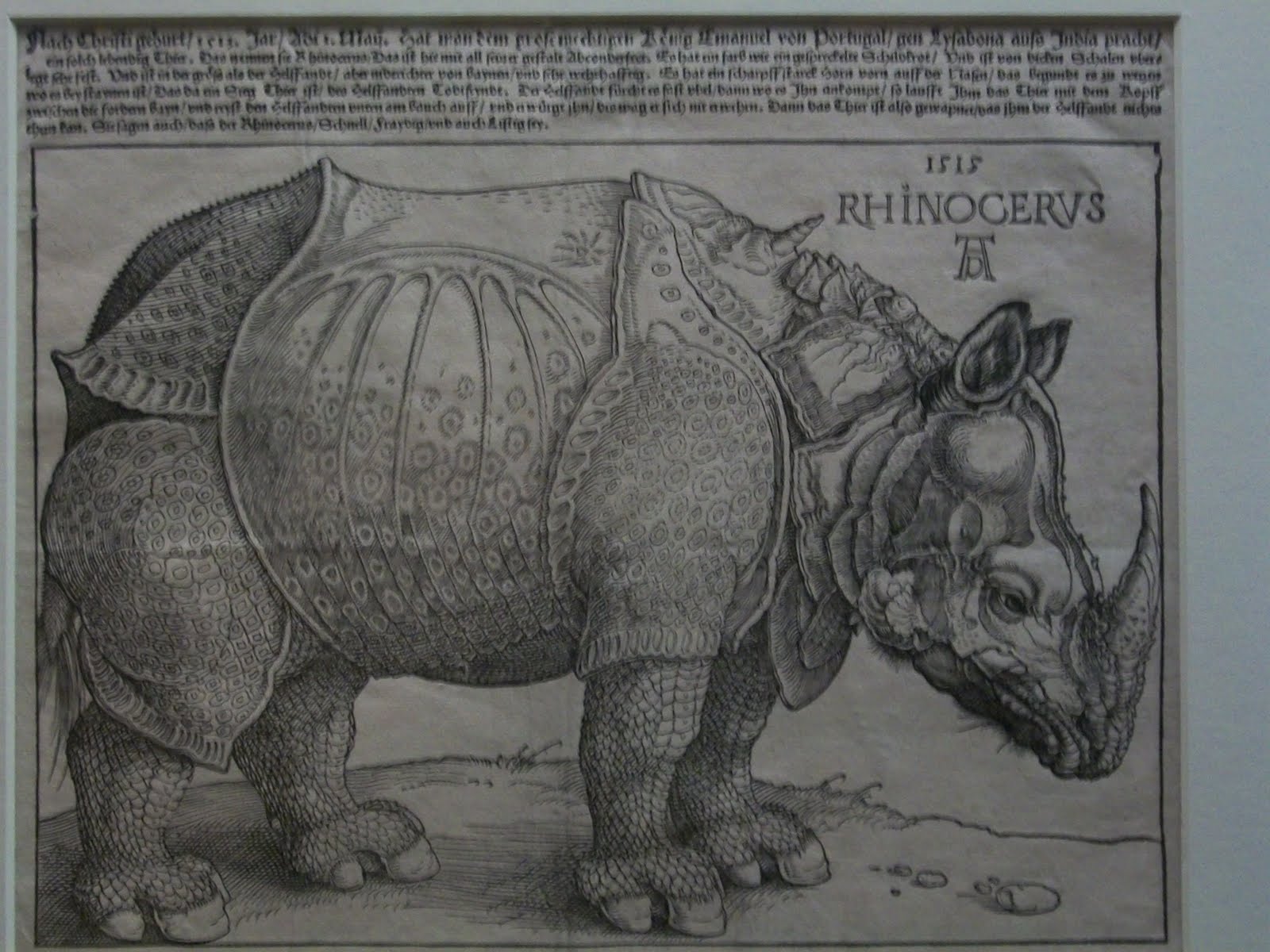
Durer’s image of a rhino
Neil MacGregor, the director of The British Museum, wrote and published “A History of The World in 1000 Objects,” in 2010 and broadcast his readings of the book on BBC radio 4. In his description of the first of his 100 objects, the Mummy of Hornedjitef (circa 240BC), an object taken out of chronological order in MacGregors 100 objects, he uses it as an illustration of how knowledge develops. The interpretation of the mummy has changed as more research has been possible. The Mummy is a vivid example of the work of the academic. Neil MacGregor states that the work of an Archaeologist or Historian is to gather the evidence and make the best of the evidence they can. This changes over time as more evidence emerges but the archaeologist can only do his best with what he has. MacGregor gives Durers portrait of a rhinoceros, drawn in 1515, as an example. Durer had never seen a rhinoceros. He drew his portrait from first hand witness accounts. He did his best with what evidence he had. The drawing is completely wrong. I have used the evidence I have got for Jane’s ring and gathered other evidence to answer questions as they occurred, from various sources but I, like Durer, don’t really know.
Clarkson, had almost the last word. This was her reaction to Chawton Cottage buying the ring from her,
“The ring is a beautiful national treasure and I am happy to know that so many Jane Austen fans will get to see it at Jane Austen’s House Museum.”
Chawton actually had the last word. They hoped for a long and fruitful relationship with Kelly and hoped she would visit the ring at the cottage.
Kelly Clarkson wears a facsimile of Jane Austen’s ring at a concert. Image @Mirror News
Everybody appears to be friends!!!
Here’s Kelly’s song in Love Actually, The Trouble With Love Is, with scenes from the film
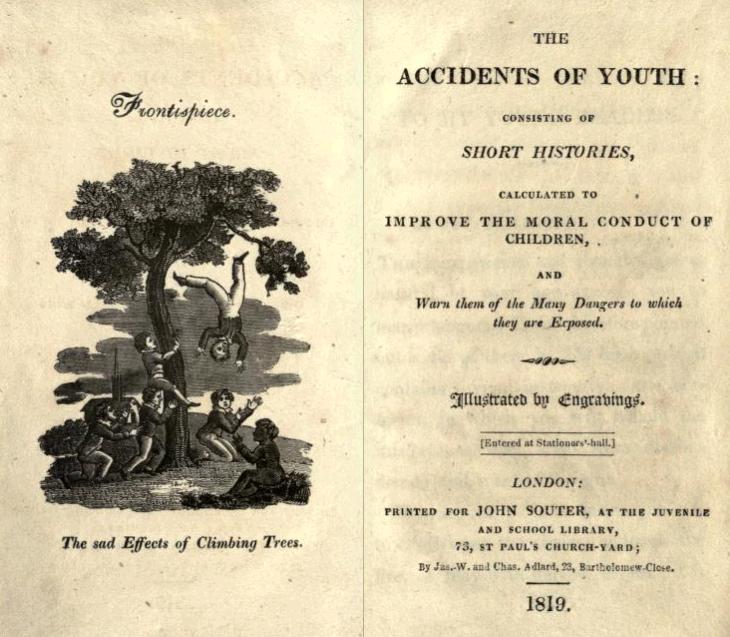
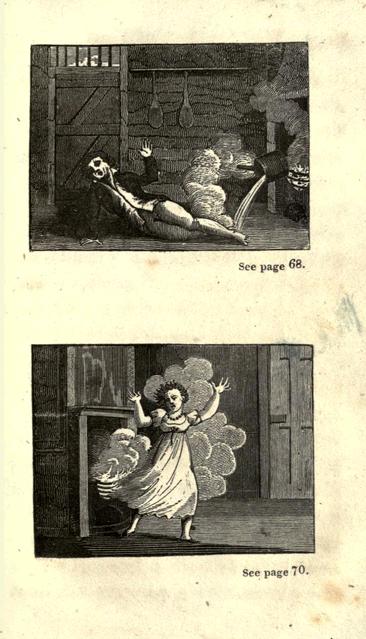
The History of Goody Little Two Shoes was one of the moral lesson books that Jane Austen owned as a child. These seem to have been popular in the Georgian era. Another book with moral lessons came out two years after her death. Entitled The Accidents of Youth,its tales were meant to warn children of risky behaviors and improve their moral conduct. The tales would have been scary enough to make me think twice as a child. I love the Internet Archive, which allows you to read the books virtually intact, with illustrations and original font type. The only thing you can’t do is hold the book or feel the thickness of the pages.
Fronticepiece of The Accidents of Youth, 1819
Interestingly, these accidents beset children today, especially those left to their own devices in the countryside.
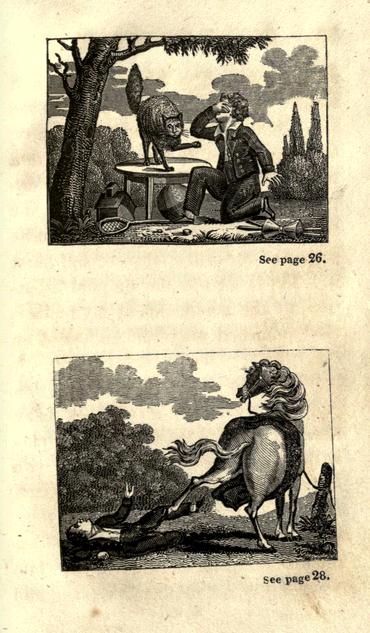
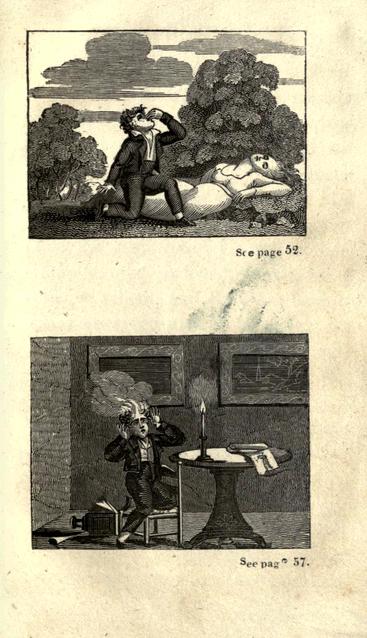
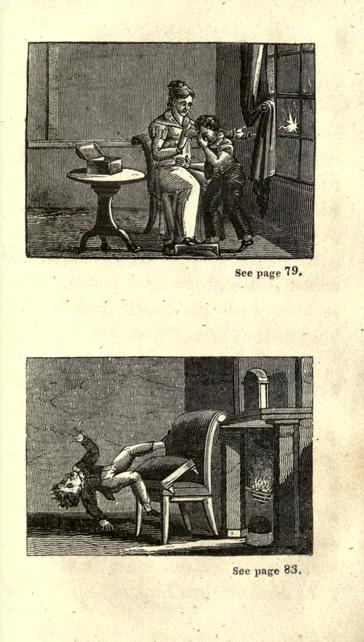
One young man aims at a bird with a slingshot and kills his mother, a horrific tale. Another’s hair is set on fire by a candle.
Kitchen accidents were quite common. After death from childbirth, kitchen fires killed more women than other accidents combined. In these stories children are warned of the dangers of hot kettles and catching one’s clothes on fire from coming too close to a fireplace. In the first image, a cast iron pot, hanging directly over the fire on an iron hook tips over, burning the child. Billowing skirts caught fire in fireplaces, as the second image attests.
The final image in this post shows the danger of a broken glass window and a young boy falling from furniture that he had rearranged at play. Another, earlier book entitled The Blossoms of Morality and published in 1806, concentrates on the instruction of young ladies and gentlemen”. The stories include “Juvenile tyranny conquered” and “The melancholy effects of pride”. One can imagine that, after reading Fordyce’s Sermons to his young children, Mr. Collins would have picked up these books to read to his children.
I wonder how long the concentration of today’s youth would have lasted when listening to these morality tales. One nanosecond? I think not.
Nobody could catch cold by the sea; nobody wanted appetite by the sea; nobody wanted spirits; nobody wanted strength. Sea air was healing, softening, relaxing — fortifying and bracing — seemingly just as was wanted — sometimes one, sometimes the other. If the sea breeze failed, the seabath was the certain corrective; and where bathing disagreed, the sea air alone was evidently designed by nature for the cure.” ― Jane Austen, Sanditon
Inquiring readers, I have spent this week at the seaside with my extended family, an unusual occurrence for us, but one that a Regency traveler would have easily understood. The great grandparents are resting in a cool spot, while grandparents and parents have taken the grandchildren and great grandchildren to the beach. A lady’s companion and an auntie (me) are also in attendance, doing what is required to maintain family unity, feed the masses, and provide comfort and mobility for the elders.
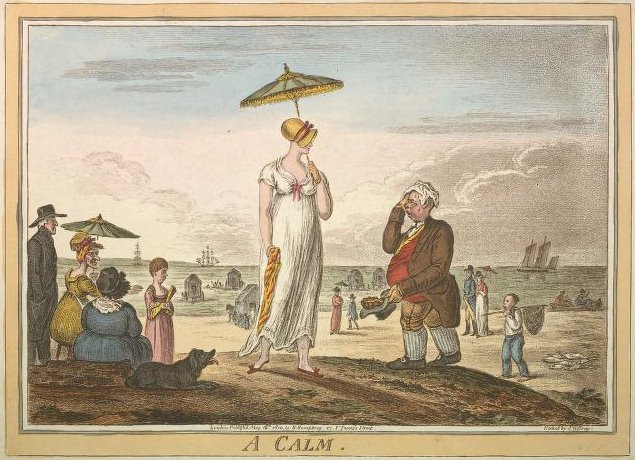
A Calm, James Gillray, 1810
Life near the sea shore today is different than depicted in this 19th century image by James Gillray. Or is it really? We still come to the beach to relax and holiday with friends and family, and to enjoy the bracing sea air and the entertainments that are available for the entire family. While modern sea-goers are more scantily dressed, we still enjoy sitting on the beach, swimming in the sea, walking along the seashore, watching ships or dolphins pass by, eating fresh seafood, reading the latest best sellers, and ogling others.
While we no longer swim behind bathing machines that have been pulled into the waters by sturdy horses, we use other equipment to make our swims more enjoyable – floats and surf boards or paddle boards. Like the women in the image, many of us wear hats for protection from the sun and sit under beach umbrellas. We comb the sands for shells and the waters for clams and crabs.
My family frequently vacations at Bethany Beach in Delaware, where my brother owns a vacation house. Each year, new vacation resorts seem to spring up on what once were cornfields and farmlands. If it weren’t for my GPS system, I would get lost, for so many of the landmarks I once knew are disappearing. It was much the same in Jane Austen’s day, when fashionable sea resorts also sprang up to satisfy the masses. London became a convenient day’s ride from the coast as roads improved, and the benefits of fresh air and sea water were appreciated for invalids and healthy alike. In this passage from Sanditon, Mr. Parker’s and Mr. Heywood’s topic of discussion is similar to the one I had with my family as we lamented the increasingly crowded conditions and traffic jams, even as we confessed our addiction to the sea:
“Yes, I have heard of Sanditon,” replied Mr. Heywood. “Every five years, one hears of some new place or other starting up by the sea and growing the fashion. How they can half of them be filled is the wonder! Where people can be found with money and time to go to them! Bad things for a country, sure to raise the price of provisions and make the poor good for nothing, as I daresay you find, Sir.”
“Not at all, Sir, not at all,” cried Mr. Parker eagerly. “Quite the contrary, I assure you. A common idea, but a mistaken one. It may apply to your large, overgrown places like Brighton or Worthing or Eastbourne, but not to a small village like Sanditon, precluded by its size from experiencing any of the veils of civilization; while the growth of the place, the buildings, the nursery grounds, the demand for everything, and the sure resort of the very best company, those regular, steady, private families of thorough gentility and character who are a blessing everywhere, excite the industry of the poor and diffuse comfort and improvement among them of every sort. No, Sir, I assure you, Sanditon is not a place …”
“I do not mean to take exception to any place in particular,” answered Mr. Heywood. “I only think our coast is too full of them altogether. But we had not better try to get you …”
“Our coast is abundant enough. It demands no more. Everybody’s taste and everybody’s finances may be suited. And those good people who are trying to add to the number are, in my opinion, excessively absurd and must soon find themselves the dupes of their own fallacious calculations. Such a place as Sanditon, Sir, I may say, was wanted, was called for. Nature had marked it out , had spoken in most intelligible characters. The finest, purest sea breeze on the coast, acknowledged to be so, excellent bathing, fine hard sand, deep water ten yards from the shore, no mud, no weeds, no slimy rocks. Never was there a place more palpably designed by nature for the resort of the invalid, the very spot that thousands seemed in need of! The most desirable distance from London! One complete, measured mile nearer than Eastbourne, Only conceive, Sir, the advantage of saving a whole mile in a long journey. But Brinshore , Sir, which I daresay you have in your eye, the attempts of two or three speculating people about Brinshore this last year to raise that paltry hamlet, lying as it does between a stagnant march, a bleak moor, and the constant effluvia of a ridge of putrefying seaweed, can end in nothing but their own disappointment. “
Alas, our sojourn at the beach has ended. We must pack up our belongings and return to our daily routines. Would that vacation had lasted a week longer!
One of the benefits of gathering images for Pinterest is that one’s awareness of the minute differences in fashions from year to year improves. Daily exposure to thousands of fashion images from the Georgian era have taught me to notice the nuances of style and line. These images are one-sided, since very few articles of clothing from the lower classes survive. With rare exceptions, most museum quality fashions were made for the wealthy, and one must keep in mind when studying these images that fashions for the upper classes were vastly different from those of the working poor or laboring classes. Men’s trousers are a perfect example of class distinction.
In this caricature, you can see a contemporary rendering of short, loose trousers; formal breeches; and a form-fitting pantaloon.
By the turn of the 19th century, breeches, pantaloons and trousers worn by all men were sewn with a flap in front called a fall front. This flap was universally held in place by two or three buttons at the top. No belts were worn. Instead, breeches, pantaloons and trousers were held up by tight-fitting waists, which were adjusted by gusset ties in back of the waist. Seats were baggy to allow a man to rise comfortably from a sitting position. As waists rose to the belly button after 1810, suspenders were used to hold the garment up.
Trousers with top flap open
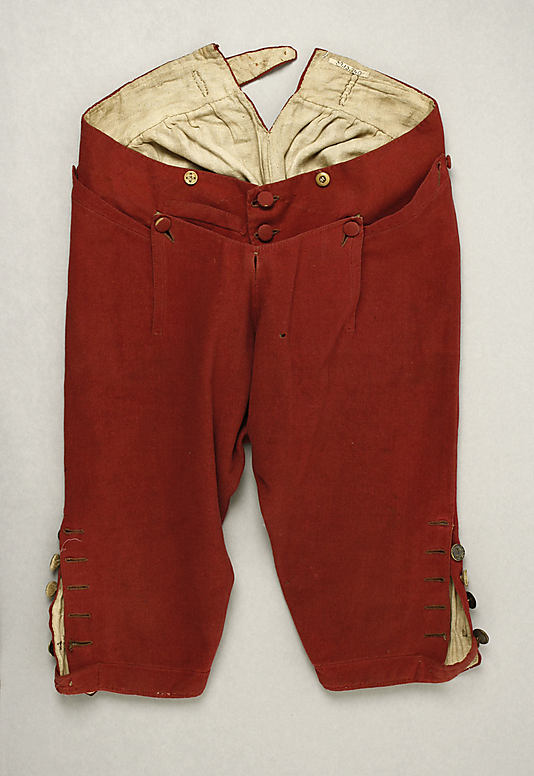
Breeches with flap front closed. Image @Met Museum
Breeches silk – 18th century – part of a wedding suit. From the Ham House collection, Surrey. Image @National Trust. Note that the front flap has only two buttons.
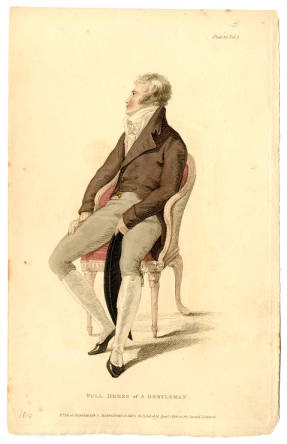
Breeches, or short pants worn just below the knee, were popular during the 18th century. During the Regency era, they were worn largely as evening wear or at court, a practice that was to continue until the mid-century.
Detail of buttons at the knee. Breeches image @Met Museum
By the 1820s, breeches had fallen out of favor for day wear and were considered either too old-fashioned or effeminate a garment. As the 19th century progressed only liveried male servants, most specifically footmen, continued to wear breeches.
Full Dress of a Gentleman, 1810. @Costume Institute of Fashion Plates, Met Museum
In their heyday, breeches were made from a variety of materials. For the upper classes, buckskin breeches were considered to be proper casual attire for mornings or life in the country. Silk breeches were reserved for the evening and more formal occasions. White stockings were worn with white breeches, and black or white stockings with black breeches. Tradesmen and hunters wore breeches made of leather or coarse cloth.
Country or morning attire of buckskin breeches, clawhammer coat, and riding boots.
Around the 1790s, the tail coat changed and breeches began to be lengthened below the knees to accommodate the longer tails, gradually giving way to slimmer fitting, longer pants, or pantaloons, that ended at the ankle. Pantaloons were close-fitting and sometimes buttoned all the way down the leg. Fabrics were knitted or, like kerseymere and nankin, cut on the bias, so that the garment would hug the leg.
1809 image of man wearing pantaloons. Image @Republic of Pemberley
These slim pants were often worn with Hessian boots. To help maintain a smooth look, some pantaloons had a fabric loop that went under the foot, as in the image below. Gusset ties are evident in this image.
Pantaloons were recommended for men whose legs were both slim and muscular. The idea was to show off a good leg. If men possessed deficiencies in musculature, a slight degree of stuffing was recommended, although padding, it was assumed, would be used with the greatest care and circumspection. Interestingly, stockings worn under pantaloons were kept in place by the tightness of the design and fabric.
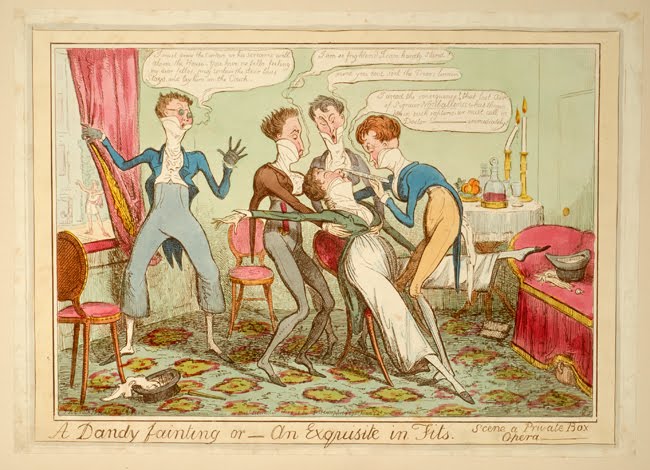
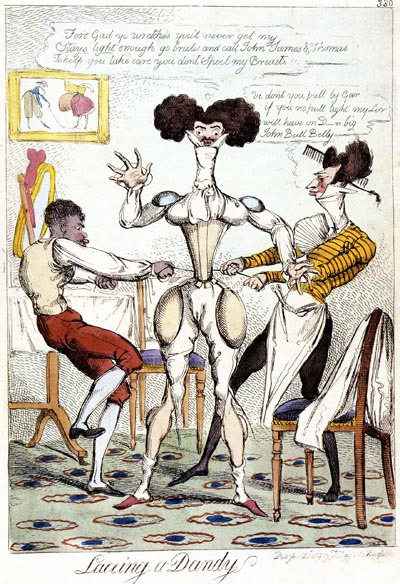
Some dandies added padding to attain the ideal 1819 male figure.
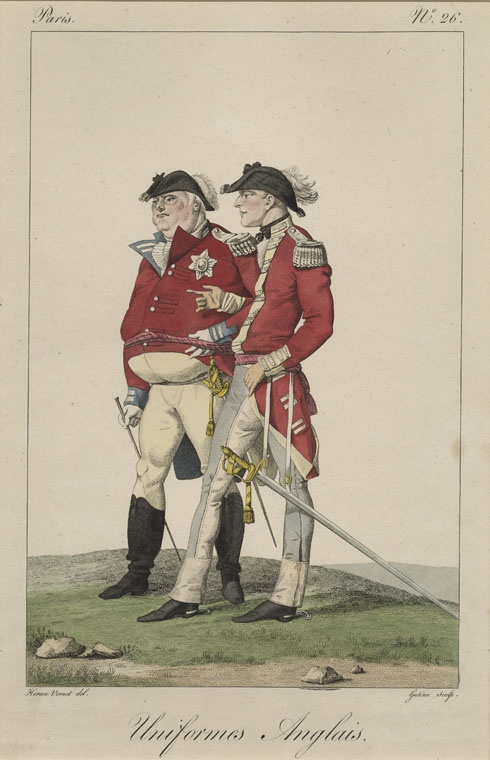
Caricaturists had a field day with men whose physiques looked outlandish in pantaloons.
French illustration of British gentlemen. Note the unflattering way that pantaloons hug the figure on the left.
This detail of a public domain image from the Metropolitan Museum of Art shows a Regency dandy who cuts a fine figure in his pantaloons. No stuffing or corsets needed here.
A fine figure of a man
Overalls were a form of extended breeches used largely by military men, but first worn by men in the American frontier. They covered the leg, stockings, and buttoned over shoes, much like spats. They were a practically garment for traveling and walking over rugged terrain, and were quickly adopted by the British army.
Overall, 1793. Image @Met Museum
Capt. John Clayton Cowell, 1st Battalion, 1st (or the Royal) Reg’t of Foot, ca. 1796
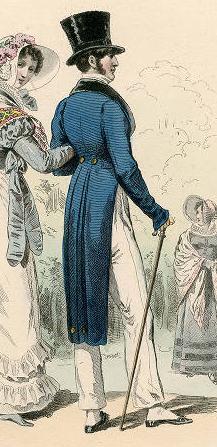
Trousers were first worn by sailors and working men before 1800, and were adopted by the fashionable set around 1810.
Scene in Hyde Park in 1817 shows a combination of trousers and pantaloon worn by the soldier.
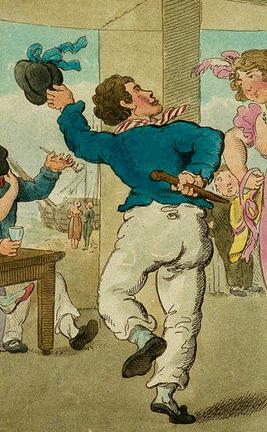
Originally known as “slops”, trousers were loose-fitting and ended at the ankle. As trousers were adopted, long stockings with decorative clocks were replaced by half-hose, all but destroying the stocking industry, which had thrived since breeches had become fashionable.
A sailor’s slops ended at the ankle. Detail of Rowlandson’s “Wapping”, ca. 1807
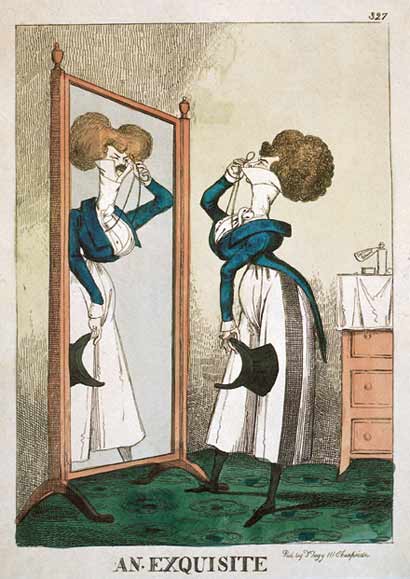
Caricatures had a field day showing dandy’s in short wide-legged trousers, as in the image below.
An exquisite wearing wide legged trousers with a high waist that came up to the navel.
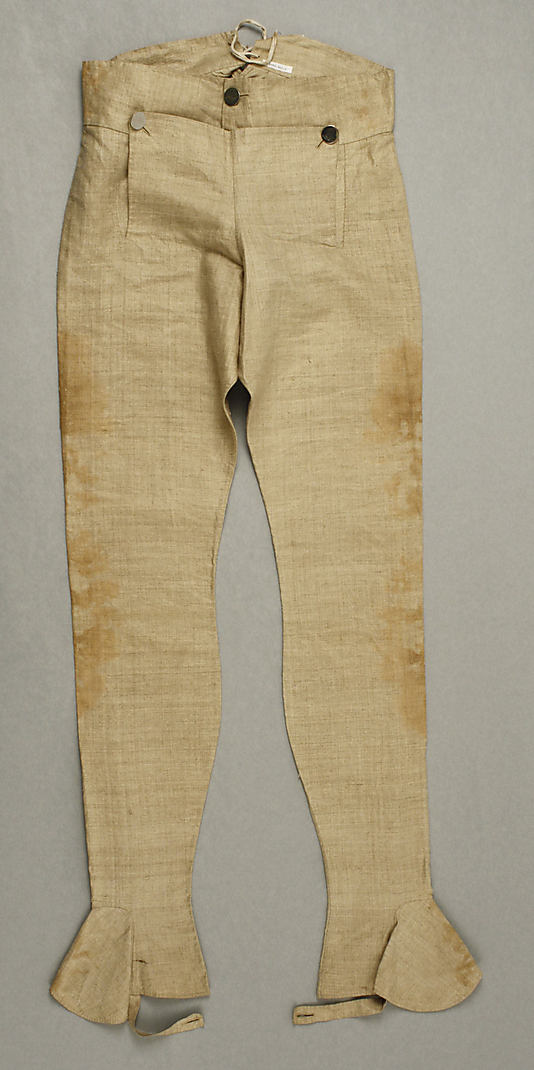
Closer fitting trousers were slit up the seam for a few inches above the ankle. This allowed the foot to get through the pant leg. (Breeches and pantaloons were buttoned on the side.) Early in the 19th century, they were appropriate only for day wear.
cotton trousers from 1800, Image @Met Museum, with slits up the seams.
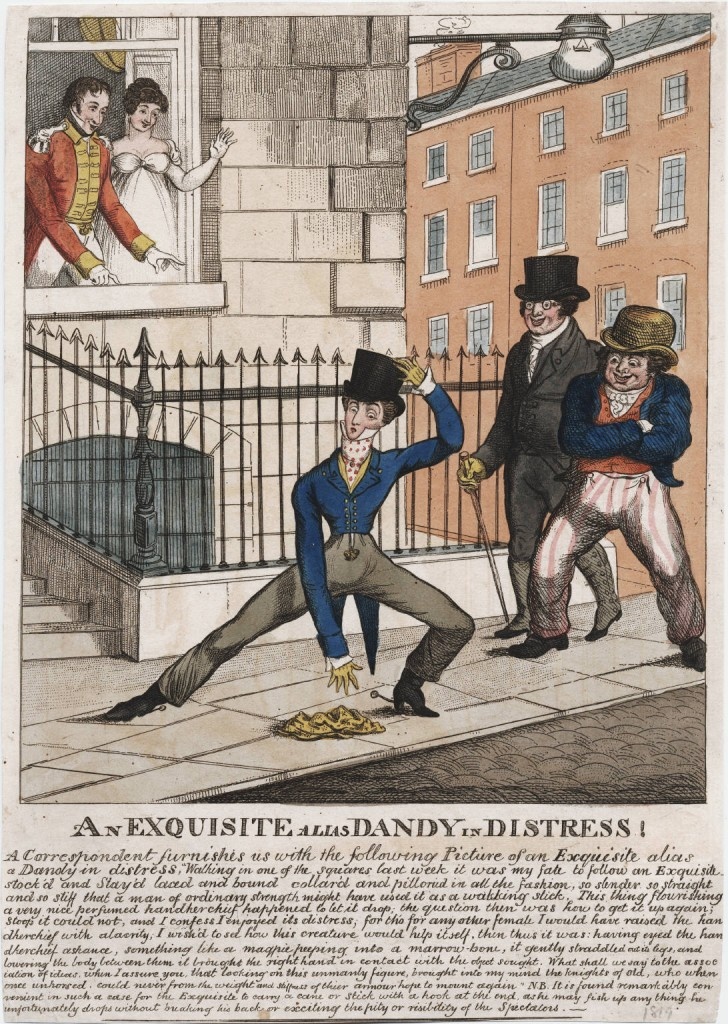
Tight trousers create a dilemma for this dandy, who cannot pick up his handkerchief. Notice the very high waist.
Trousers with a fall front, 1820. Image @Augusta Auctions
Trousers were made of wool, linen or cotton. They could also be strapped.
The Marquis of Worcester walks in profile with his half-clipped poodle. He wears top-hat, double-breasted tail-coat with a rose in his buttonhole, and strapped trousers. Jan 1 1823. Image@ British Museum
By the 1840s, they had replaced pantaloons. The waist is high in the above trousers, which were probably kept up with suspenders.
The well trousered gentleman, ca. 1830s-40s.
Knee pants with black silk stockings were an essential evening accessory until 1850s when long trousers finally took over. Up until the 1850s, the tie could be black or white, but by the ’60s, white or off-white was the most common choice.
1850’s ballroom scene.
In the 1850s long trousers finally replaced breeches for appropriate evening attire.
Fashionable Goodness: Christianity in Jane Austen's England is now available! By JAW contributor Brenda S. Cox. See Review. Available from Amazon and Jane Austen Books.
Available through December 31st, 2025. Click on image for details, and share this poster with other teachers and students!
The Obituary of Charlotte Collins by Andrew Capes
Click on image to read the story.
Comments
“My idea of good company…is the company of clever, well-informed people, who have a great deal of conversation.” – Jane Austen, Persuasion
Gentle readers: Please feel free to post your comments and continue the conversation! Due to SPAM, we will no longer accept comments on posts after 30 days of publication. In some instances, links will be removed from comments as well.
Administrators and Contributors
Vic Sanborn, founder of this blog, is supported by a team of talented and knowledgeable writers about Jane Austen and the Regency era. They are:
Tony Grant, who now contributes his photos from London and England
Click on their names to enter their own blogs.
In addition, we thank the many experts and authors who frequently contribute their posts and opinions, and who continue to do so freely or at our request.
Click here to enter the page. Topics include Regency fashion, historic foods, Jane Austen societies, British sites, related topics. Click on image.
May we suggest?
Hello, my name is Vic and I live in Maryland, USA. I have adored Jane Austen almost all of my life. I am a proud lifetime member of the Jane Austen Society of North America. This blog is a personal blog written and edited by me and my team. We do not accept any form of cash advertising, sponsorship, or paid topic insertions. However, we do accept and keep books and CDs to review.
If you would like to share a new site, or point out an error, please email us. (Yes, we are fallible. We'll own up to our mistakes and will make the corrections with a polite smile on our faces.) Write us at
Thank you for visiting this blog. Your comments and suggestions are most welcome.
Project Gutenberg: eBook of Stage-coach and Mail in Days of Yore, Volume 2 (of 2), by Charles G. Harper
STAGE-COACH AND MAIL IN DAYS OF YORE: A PICTURESQUE HISTORY
OF THE COACHING AGE, VOL. II, By CHARLES G. HARPER. 1903. Click on this link.























 Jane Austen's World