Feeds:
Posts
Comments

Archive for the ‘Regency society’ Category

As a blogger who is curious about all things in Jane Austen’s world and customs in her past that might have influenced her, I am still amazed at how one tiny clue points to another until I land on a series of sites that open up a whole new topic. While history foodies probably know about the elaborate lengths that pastry chefs took to please their patrons, the visual results of a full banquet are simply astounding. I can only assume that Georgian taste buds were equally pleased.
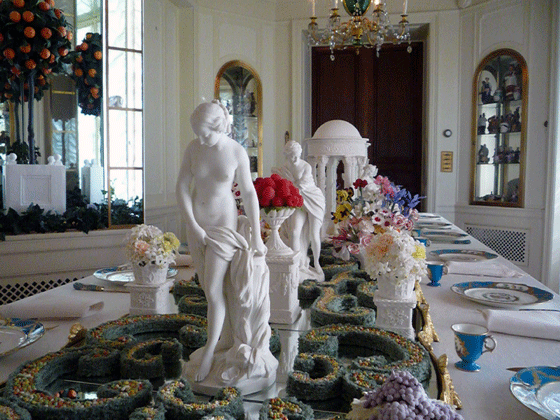
Modern chef and historian, Ivan Day, recreated a feast from the past using sugar structures and porcelain figures to arrange a fanciful garden centerpieces for the table.

I already knew about The Prince Regent’s elaborate 1811 dinner at Carlton House, which was described as thus:

“Along the centre of the table about six inches above the surface, a canal of pure water continued flowing from a silver fountain beautifully constructed at the head of the table. Its banks were covered with green moss aquatic flowers; gold and silver fish swam and sported through the bubbling current, which produced a pleasing murmur where it fell, and formed a cascade at the outlet.” – The Gentleman’s Magazine, describing the Prince Regent’s fete at Carlton House, June 19, 1811 in honor of the exiled French royal family.
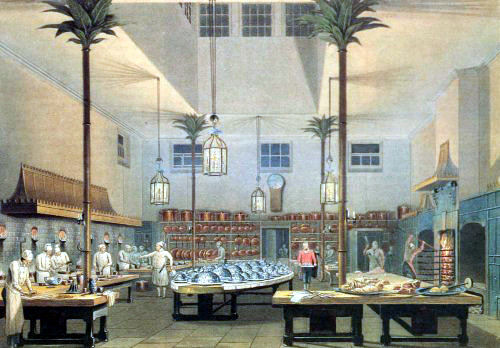
The great kitchen at the Prince Regent’s Pavilion at Brighton could accommodate creating dishes for huge and fanciful banquets.

So great was the interest that the doors of Carlton House were opened for three days in a row. But instead of satisfying the curiosity of the masses, the result was ever-increasing crowds. Chaos ensued.

‘The condescension of the Prince in extending the permission to view the arrangements for the late fete at Carlton House has nearly been attended with fatal consequences,’ reported one newspaper. Read more: http://www.dailymail.co.uk/news/article-1039063/As-Queen-opens-Palace-Ballroom-public-story-decadent-royal-banquet-ever.html#ixzz1s7ijkAEv

Detail of the design for an elaborate garden centerpiece. These engravings were showcased in Le Cannameliste Français by famed confectionary chef, Joseph Gilliers, in the mid-18th century. View the entire centerpiece here: Click on this link.

The banquet featured a recreation of a landscape at its center. Such a method of decorating a table was not new, especially when it came to desserts. Elaborate set pieces with architectural French influence were created for tables using spun sugar and Sevres bisque figures to create fantasy landscapes. Before the Napoleonic Wars, travel over the English Channel between British and French courtiers and diplomats was common, and thus the French chef’s custom of creating these elaborate centerpieces became well-known in England. Upper class households vied for highly paid (and desired) French chefs, and by the 1820s these gentlemen had by and large invaded British upper class kitchens. Their ability to create dishes that feasted both the eyes and the stomach was unrivaled.
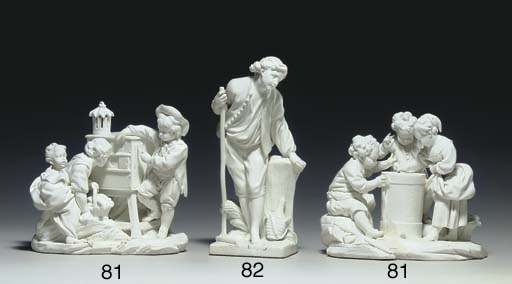
 SEVRES BISCUIT FIGURES CIRCA 1755, Modeled after François Boucher. Image @Christies.

This was an era when confectionary was considered as much a branch of the decorative arts as of cuisine, and porcelain for the table represented prestige as well as a demonstration of power. The combination of French chef, porcelain, and fanciful confectionary desserts served as symbols of prestige and wealth, for no ordinary household could offer such an extravagant display of food and panoply. (View this porcelain table centerpiece set.)
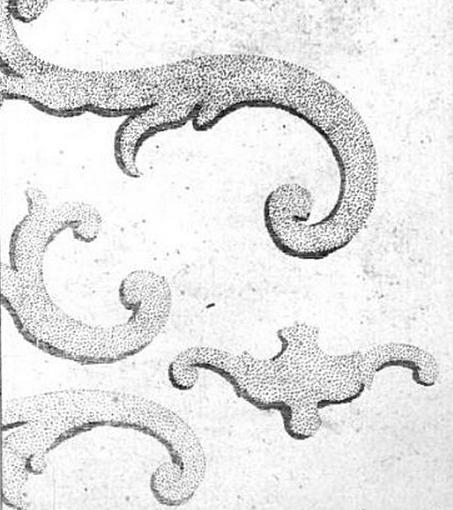
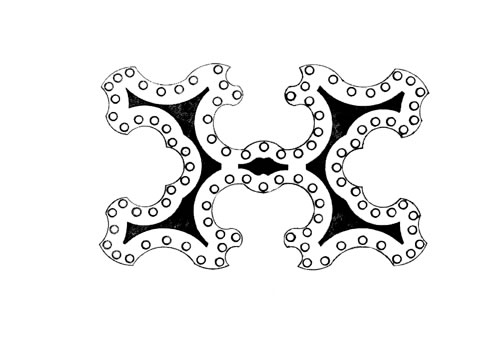
Detail of Gilliers’ templates for cut outs.

Most of the images of the banquets and figurines are copyrighted. I encourage you to click on the links to view the spectacular results of sugar and porcelain table centerpieces that mimic gardens, sculptures, and figures based on famous paintings. The fanciful recreation included redesigning tables as well.
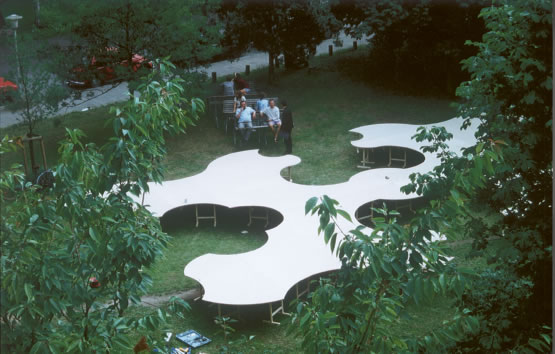
Modern version of Gilliers table. Image @Simon Beer.
Gilliers’ 1751 sketch of the table, plus seating.
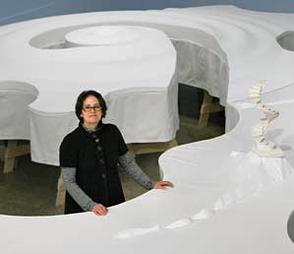
Amy Hauft, VCU sculpture department. Confectioner Joseph Gilliers conceived his 100-seat rococo fantasy for the serving of a single course — dessert — in a garden setting. The centerpiece atop the tailored white tablecloth was to be a sculpture made of sugar paste fortified with dried sturgeon bladder. There is no record that this table was ever built by Gilliers. Image@Richmond Times Dispatch

More on this fascinating topic:

Ivan Day’s  pavilion made from a “pastillage sugar paste for an exhibition at the Met in NYC two years ago. They were exact replicas of ones made for Maria Theresa, the Empress of Austria in 1740. “
Read Full Post »

Elegancy and Decadence: The Age of the Regency is a BBC production hosted by Lucy Worsley, the author of If Walls Could Talk: An Intimate History of the Home. The video is one hour long. So, sit back and enjoy.

Read Full Post »

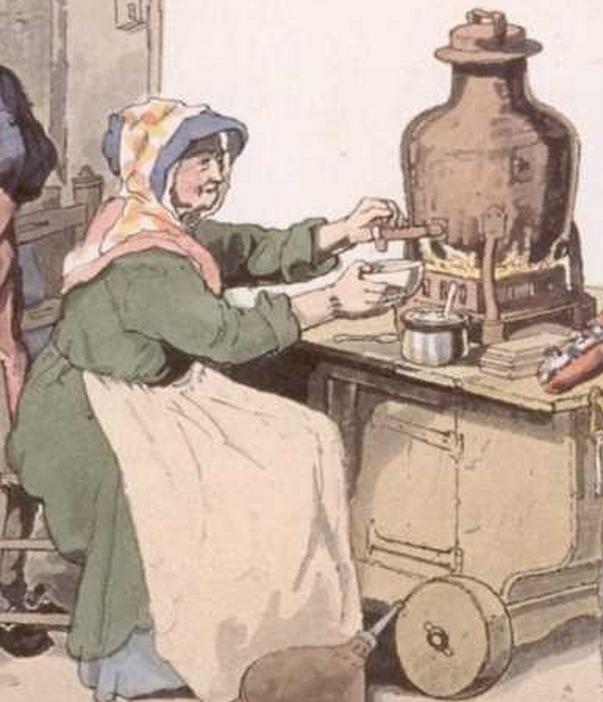
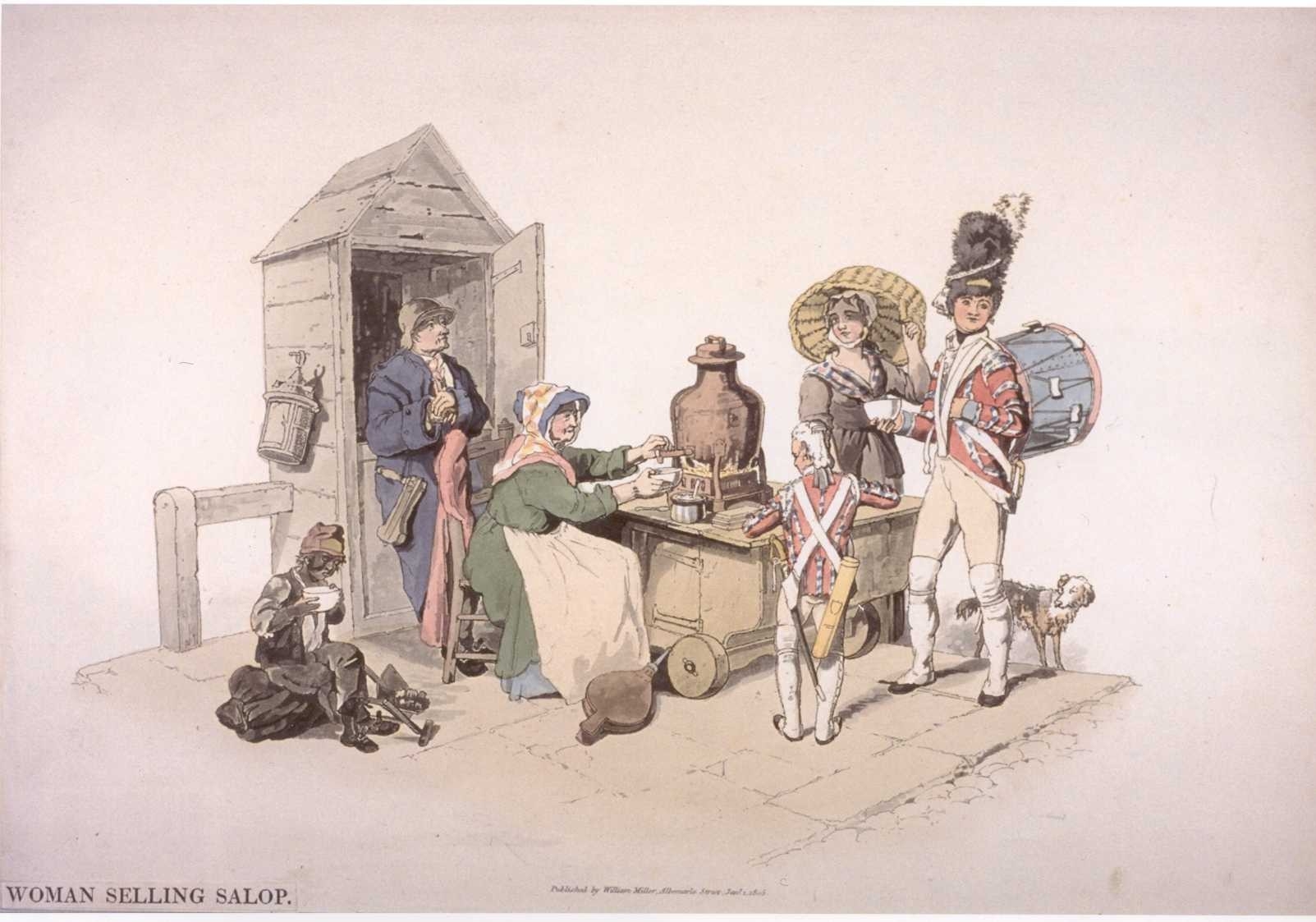
This 1808 image of an old vendor woman selling salop in London seems simple at first glance. Created by William H Pyne for The Costumes of Great Britain (one of 60 beautifully produced hand-colored drawings), the image shows the vendor surrounded by customers waiting for a warm drink, which she pours fresh and hot into white bowls from a samovar (still). One wonders if the sight was common enough for Jane Austen to have observed it during her visits to her brother Henry in London, or if she purchased the drink or had tasted it. This description shows how even a whiff of  salop caused the writer to wax eloquently about the drink, which he had liked long ago:

Suddenly we came upon a still, whence arose the steam of Early Purl, or Salop, flattering our senses. Ye Gods ! what a breakfast ! In vain a cautious scepticism suggests that the liquid was one which my palate would now shudderingly reject; perhaps so; I did not reject it then; and in memory the flavour is beatified. I feel its diffusive warmth stealing through me. I taste its unaccustomed and exquisite flavour. Tea is great, coffee greater ; chocolate, properly made, is for epicures; but these are thin and characterless compared with the salop swallowed in 1826. That was nectar, and the Hebe who poured it out was not a blear-eyed old woman, though to vulgar vision she may have presented some such aspect. – Unctuous Memories, The Cornhill Magazine, 1863 p. 613-617

The problem is not with the drawing; it is with the definition of salop, which is variously spelled salop, salep, saloop, and even sahlib. Experts have offered several explanations and recipes of the drink. I examined three sources, all of which offer different ingredients. Even dictionaries from the 19th century cannot agree with the precise meaning of the drink that was commonly served in coffee houses and stalls and on the streets of London. We can, however, agree on a few observations. A night watchman stands behind the vendor and her mobile table. Thus, salop was a typical nightly drink of Londoners.

Sold between midnight and 6-7 o’clock in the morning for some it was the probate cure of a hang-over while the early birds drank it for invigoration and warming up. (Luder H. Niemeyer)

Detail of the chimney sweep drinking salop

Salop was definitely popular during the first part of the 19th century.

Charles Lamb, in his essay upon Chimney Sweeps, mentions the public house of Mr. Reed, on Fleet street in London, as a place where Sassafras tea (and Salop) were still served daily to customers in his time, about 1823.

The hot mixture was affordable even for the lowly chimney sweep, who is seen drinking from a bowl. But how was the drink made? The Hobson-Jobson: The Anglo-Indian Dictionary, first published in 1886,  says that salop was derived from the tubers of various species of orchis found around Europe. It had the reputation of being a restorative and highly nutritious, and a decoction of the substance, spiced and sweetened, was thought to make an agreeable drink for invalids. – p. 784.

The tea woman sitting behind her street booth – a mobile table with samovar – amidst varied customers, just filling another cup of her much demanded herb-tea. Aquatint printed in color and colored by hand for William Miller in London. 1805.

Hobson-Jobson went on to say that in 1889 a correspondent wrote that the term could also be applied to an infusion of the sassafras bark or wood. Sassafras was imported from the colonies; it did not grow in Europe.

There is also the question of what time of day people preferred to drink salop.  In 1850, a source stated that sassafras tea, flavoured with milk and sugar, was sold at daybreak in the streets of London as saloop. In 1882, The St. James’s Gazette said:

Here we knock against an ambulant salep-shop (a kind of tea that people drink on winter mornings); there against roaming oil, salt, or water-vendors, bakers carrying brown bread on wooden trays, pedlars with cakes, fellows offering dainty little bits of meat to the knowing purchaser.”

From the description, one gets the true flavor of an early morning street scene – its sights, smells, and sounds . One also gains the sense that salop was sold much like coffee today – that there was a preferred time to drink it, but that it could be obtained at all hours. But what about the recipe? Was it made with Sassafras bark or with orchis root?

Gourmet Britain says it was made with orchis root, and provides the reader with a history and recipe.  Soupabooks mentions that it was made of dried sassafras bark and offers this recipe:

To make Salop

Put a Tea spoonfull of  Salop to a Pint of Water, with 3 or 4 Blades of Mace, & some Lemmon Peel cut very thin. Boyl it, & Mill it as you do Chocolate, Sweeten it to your Taste; add some grated Nutmeg, & juice of Lemon to make it Palateable. — Mrs. B.P. Benet, Lathrop Lodge, Swindon, Wilts. From her Book of Recipes from about 1796.

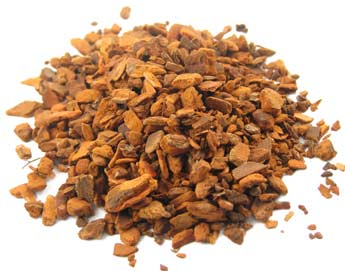
Note that Mrs. B.P. Benet does not describe the Salop, but simply assumes that the reader will know what ingredient to purchase. The salop made with sassafras bark would have a slight taste of licorice.

Early American settlers learned from American Indians how to brew sassafras tea from the root bark and drank it has an herbal remedy. Later they made sassafras the original root in root beer and used it as an important ingredient in Sasparilla, a different but related beverage. Those first Sassafras supporters didn’t know how or why it tasted so good, but a few hundred years later, we do. Sassafras root contains an essential oil called safrole which imparts that characteristic licorice flavor.

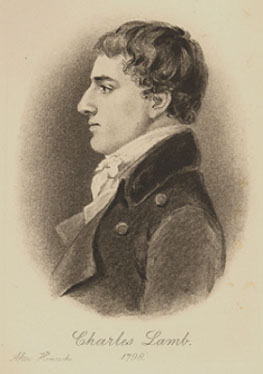
Charles Lamb. Image @NNDB

Charles Lamb in his essay about Chimney Sweeps corroborates the sassafras root ingredient:

There is a composition, the groundwork of which I have understood to be the sweet wood yclept sassafras. This wood boiled down to a kind of tea, and tempered with an infusion of milk and sugar, hath to some tastes a delicacy beyond the China luxury. I know not how thy palate may relish it, I have never ventured to dip my own particular lip in a basin, a cautious premonition to the olfactories constantly whispering to me, that my stomach must infallibly, with all due courtesy, decline it. Yet I have seen palates otherwise not uninstructed in dietetical elegancies, sup it up with avidity. This is salop—the precocious herbwoman’s darling—the delight of the early gardener who transports his smoking cabbages from Hammersmith to Covent Garden’s famed piazzas—the delight, and oh ! I fear too often the envy of the unpennied sweep.” – Unctuous Memories, The Cornhill Magazine, 1863 p. 613-617

To complicate matters even more, I found this description of salop:  “The tea produced from the male root of the Ragged Robin, so-called salop, was the typical nightly drink of Londoners.” (Luder H. Niemeyer) Ragged Robin seems to be the common name for the cuckooflower lychnis, which is a perennial that has very hardy, fibrous roots. Since Ragged Robin was not mentioned in other encyclopedias, descriptions, or dictionaries that I consulted, I will discount this ingredient from the discussion.

Sassafras root bark. Image @ Vermont Fiddle Heads

The following is a sampling of definitions of Salop, Salep, or Saloop from various dictionaries:

  • an aromatic drink prepared from sassafras bark and other ingredients. – Online Encyclopedia
  •  salop (or saloop, a hot starchy drink made with an infusion of dried salep, or orchid tubers) – Science and Society Picture Library
  • An aromatic drink prepared from sassafras bark and other ingredients , at one time much used in London . – – J . Smith ( Dict . Econ . “Saloop” is a common misspelling or typo for: Salop. – Webster’s Online Dictionary
  • saloop/seuh loohp”/, n.: a hot drink prepared originally from salep but later from sassafras, together with milk and sugar. [1705-15; var. of SALEP] – Collaborative International Dictionary
  • Salep, sal′ep, n. the dried tubers of Orchis mascula: the food prepared from it.—Also Sal′op. [Ar.Salep from Arabic: سحلب saḥlab‎, is a flour made from grinding the dried tubers of the orchid genus Orchis (including species Orchis mascula and Orchis militaris). These tubers contain a nutritious starch-like polysaccharide called glucomannan. Salep flour is consumed today in beverages and desserts, in places that were formerly part of the Ottoman Turkish Empire. The term salep may also refer to any beverage made with the salep flour. – Wikipedia

So which ingredient did Pyne’s old female vendor use to make her salop? Orchis tubers, which were found in Europe, or dried Sassafras bark,which had to be imported? In any case, one shudders at the thought of the bowls that the vendor used to pour the drink in for her customers. I see no water jug near at hand to rinse the bowls after each use. Heaven knows how many germs were spread around via these used dishes, which could not be tossed aside or washed easily.

About The Costumes of Great Britain: Between 1800 and 1818, London publishers William Miller, T. M’Lean, and William Bulmer published a series of color plate books, including one that featured 60 color plates of Britain’s working classes just as the Industrial Revolution began to take off.  William H Pyne (1769-1843) was commissioned to write and illustrate the book by the publisher, William Miller. The first edition was printed in 1804, but the edition from which this coloured plate was taken was published in 1808. – Science and Society

More on the topic:

Read Full Post »

Recently I commented on a morning gown whose influences were largely from British history. In this April 1812 Ackermann fashion plate, the pink ball gown is indicative of the impact of trade and foreign travel in eastern lands and the advances of the Industrial Revolution on fashion. A young lady attending the ball would have (in her mind) come as a strong exotic eastern woman, resplendent in her turban, peasant bodice, and other rich oriental details.

Click on this fashion plate to enlarge it.

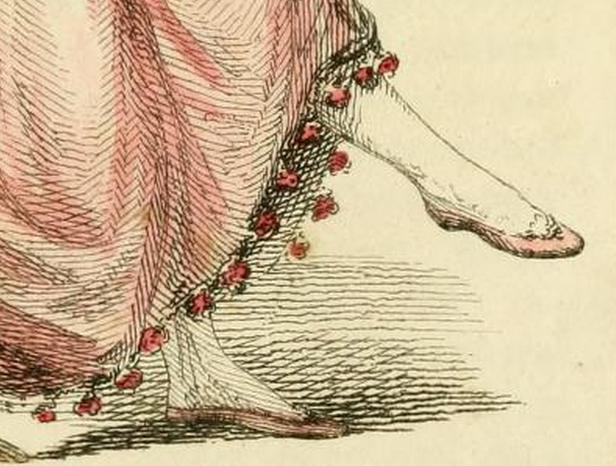
Ball Dress: a round Circassian robe of pink carpe , or gossamer net, over a white satin slip, fringed full at the feet; a peasant’s bodice of pink satin or velvet, laced in front with silver, and decorated with the same ornament. Spanish slash sleeve, embellished with white crape foldings, and finished at its terminations with bands of silver. A Spartan or Calypso helmet cap of pink frosted crape, with silver bandeaus, and embellished with tassels, and rosets to correspond. A rich neck-chain and ear-rings of Oriental gold. Fan of carved ivory. Slippers of pink kid, with correspondent clasps; and gloves of white kid: an occasional square veil of Mechlin lace.”

Detail of the Spartan or Calypso helmet cap, mechlin lace, fan, peasant bodice, and Limerick gloves.

Eastern Turkish influence includes those of Circassian women, whose reputation dates back to the Ottoman Empire and the Sultan’s harem. Circassians became a common symbol of orientalism during the Romantic era. In Europe and America

 Circassians were regularly characterised as the ideal of feminine beauty in poetry, novels, and art. Cosmetic products were advertised, from the 18th century on, using the word “Circassian” in the title, or claiming that the product was based on substances used by the women of Circassia.- Wikipedia

The gossamer net represented the advances made in machine made lace during the late 18th and early 19th centuries. (Click here to read my article about net lace.)

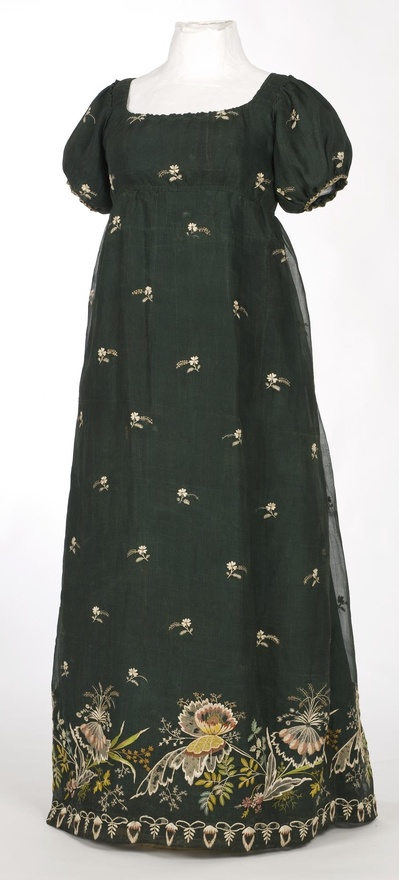
Early 19th century dress made with embroidered black net.

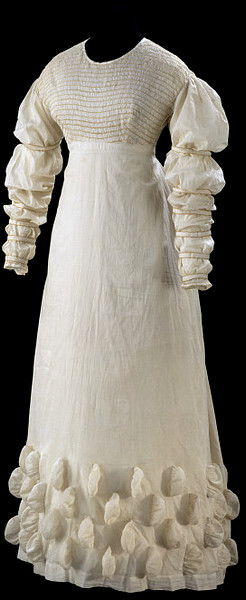
 The white crape foldings in the Spanish slash sleeves remind me of the puffs in the hem of this early 19th century gown.

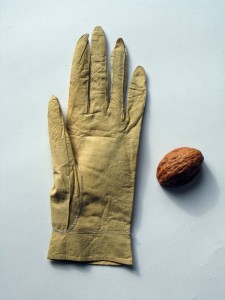
Limerick gloves were “a celebrated style of glove that became popular throughout England and Ireland during the late 18th, early 19th century. Commonly referred to as ‘chicken-skins’, the gloves were renowned for their exquisite texture. They were made from a thin strong leather derived from the skin of unborn calves and sold encased in a walnut shell.”

Limerick glove. Image @The Museum of Leathercraft.

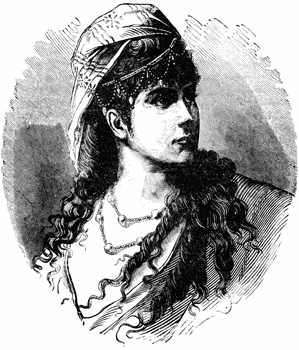
Circassian women were regarded as strong, beautiful, and exotic, which is how the woman wearing the ball dress depicted in the Ackermann fashion plate must have felt.

Circassian woman. Image @Clipart, etc.

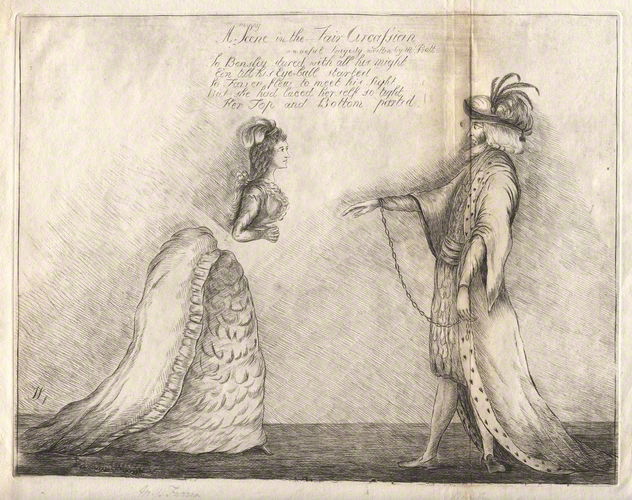
The circassian robe, or an outer garment used in ceremonial occasions, is not as evident in the fashion plate as in the dress below, where it flows over the gown’s train.

Eliza Farren in 'A Scene in the Fair Circassian' with Robert Bensley by James Sayers. Etching ca. 1781 from the National Portrait Gallery NPG D9544

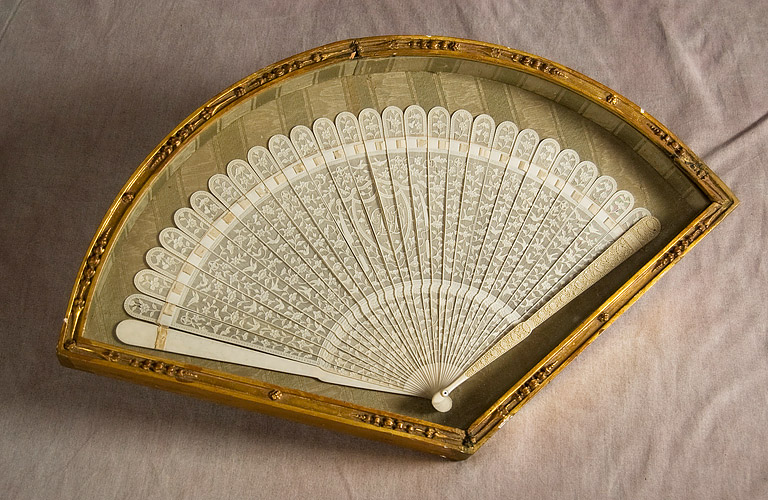
Rich lace, tassels, and an ivory fan completed our fashionable lady’s the ensemble.

Decorative imported ivory fan. Image @Independence Seaport Museum.

Detail of the hem.

More about the ball gown’s fashion influences:

Read Full Post »

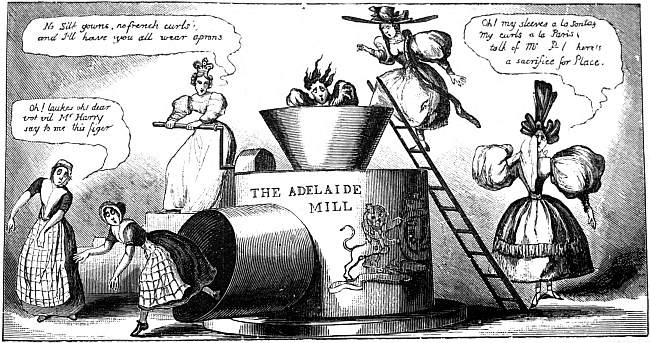
Caricature by Robert Seymour, 1830

After the death of Princess Charlotte in childbirth in 1817, the British Royal family was left without a legitimate heir to the throne. Since their marriage, King George IV had felt an overpowering physical and mental aversion to Queen Caroline, his consort, and the possibility of his begetting another child on her was less than zero.

None of the King’s brothers were married. The Dukes of York, Clarence, Kent, Cumberland, Sussex, and Cambridge all began to court potential brides in earnest.

In 1818 William Henry, Duke of Clarence, who would reign as King William IV, abandoned his 20-year relationship with Mrs. Jordan, with whom he had ten children, to marry Adelaide of Saxe-Meiningen, a rather plain lady half his age. In short time the strong-willed duchess managed to take her husband’s finances in hand and pay off his debts through economical living. Parliament voted to increase his allowance, which the Duke, who was angling for more, finally accepted.

William was crowned King in 1830. By all accounts he was faithful to his queen. They lived a sober, almost boring life,  but, sadly, their two infant children did not survive. Queen Adelaide’s strong influence throughout her marriage can be seen in this illustration.This cartoon of the Adelaide Mill, drawn by English caricaturist, Robert Seymour, shows Adelaide decreeing that the court domestics must dress more humbly:

From other contemporary pictorial skits by Seymour we learn that various changes were made in the royal establishment, and the new queen seems to have addressed herself specially to a reform in the dresses of the court domestics. On the 1st of October, 1830, Seymour represents her grinding an enormous machine, called the “Adelaide Mill,” into which the women servants, dressed in the outrageous head-gear and leg-of-mutton sleeves of the period, are perforce ascending, and issuing from the other side attired in plain and more suitable apparel. “No silk gowns,” says Her Majesty as she turns the handle. “No French curls; and I’ll have you all wear aprons.” The new queen seems also to have shown a disposition to encourage native manufactures and produce at the expense of French and continental importations. These changes were not particularly pleasing to the Conservative lady patronesses of Almack’s, who were celebrated at this time for their capricious exclusiveness. One of Robert Seymour’s satires, bearing date the 1st of November, 1830, shows us a conference of these haughty dames, who seriously discuss the propriety of admitting some lady (probably the queen) who proposed appearing at one of the balls “in some vulgar stuff made by the canaille at a place called Kittlefields” [Spitalfields].” – English Caricaturists and Graphic Humourists of the Nineteenth Century. How they Illustrated and Interpreted their Times, by Graham Everitt

The death of King William IV in 1837 led to the long and successful reign of Queen Victoria, daughter of Prince Edward, Duke of Kent.

Learn more about Mrs Jordan in this link: The Delectable Dora Jordan

Read Full Post »

« Newer Posts - Older Posts »