Gentle Reader, next week Austenprose will begin a Pride and Prejudice extravaganza entitled, Pride and Prejudice Without Zombies. The group will be reading Jane Austen’s own words. Not some mash up. Not a sequel. And, as far as I am concerned, my favorite book of all time. When Laurel Ann asked me to contribute my thoughts during the event, I was already researching information about Mr. Jones, the apothecary who treated Jane Bennet. So, as a pre-announcement, I am publishing this post. Do obtain a copy of Pride and Prejudice and join Laurel Ann and her readers as she begins her in-depth analysis of the book on Tuesday, June 16th.

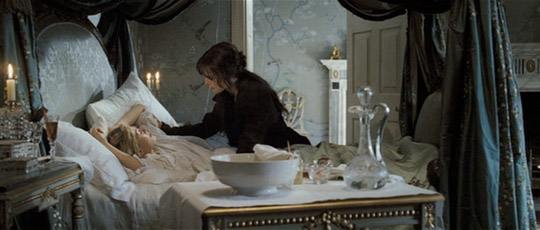
Jane is sick, Netherfield Hall, Pride and Prejudice 2005
In 1813, the year that Pride and Prejudice was finally published, apothecaries filled an important role in rural areas where physicians were scarce. When Jane Bennet fell ill at Netherfield Park, Mr. Jones, the apothecary was sent for:
Breakfast was scarcely over when a servant from Netherfield brought the following note for Elizabeth:
“My dearest Lizzy,
I find myself very unwell this morning, which, I suppose, is to be imputed to my getting wet through yesterday. My kind friends will not hear of my returning home till I am better. They insist also on my seeing Mr. Jones therefore do not be alarmed if you should hear of his having been to me and excepting a sore throat and head-ache, there is not much the matter with me.
Yours, &c.”
Unlike a physician, whose social standing ranked high, apothecaries were considered one step up from a tradesmen, and several rungs below the physician/doctor.
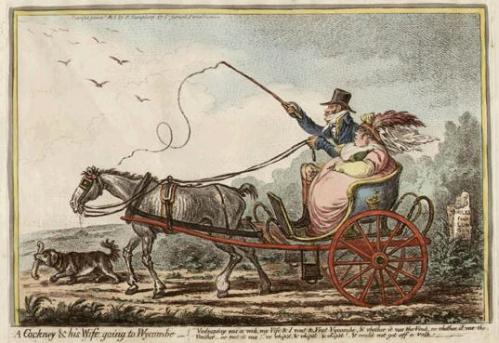
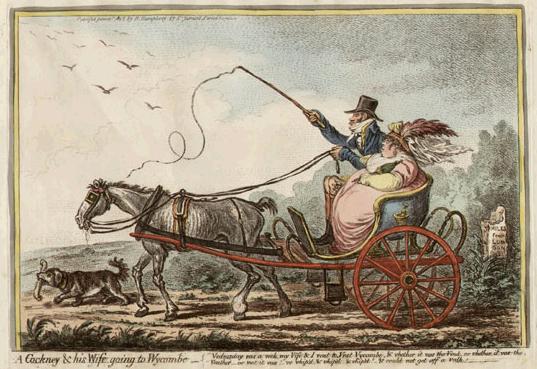
This cartoon by James Gillray suggests that the Cockney in question is an apothecary. Note the mortar and pestle symbol on the side of the carriage.
Apothecaries learned how to make drugs and poultices during their tenure as apprentices. They used their hands and labored in shops, and were often the only alternative for people who sought medical care and who could not afford a doctor’s fees. Interestingly, apothecaries were not paid for giving advice or providing medical treatment. They were paid only for the drugs they sold.
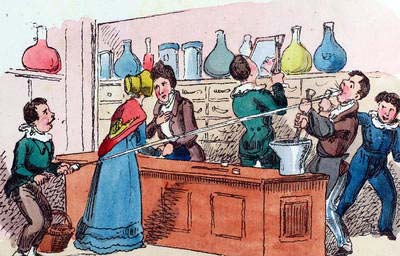
Apothecary Shop, Glasgow Looking Glass
Mr. Jones, would have traveled to Netherfield Hall and dispensed his advice without recompense. But he recommended his draughts, which enabled him to earn some money, and instructed Elizabeth on how to use them:
The apothecary came and having examined his patient said as might be supposed that she had caught a violent cold and that they must endeavor to get the better of it advised her to return to bed and promised her some draughts. The advice was followed readily for the feverish symptoms increased and her head ached acutely.

Visiting an ill Jane at Netherfield, Pride and Prejudice 2005
Mrs. Bennet’s ploy to keep Jane at Netherfield, using Mr. Jones as an excuse when Mr. Bingley inquires about Jane’s condition, worked:
“Indeed I have, Sir,” was her answer. “She is a great deal too ill to be moved. Mr. Jones says we must not think of moving her. We must trespass a little longer on your kindness.”
Mr. Bennet used Mrs. Bennet’s machinations to his advantage, demonstrating his wit even as he admonished his wife for placing Jane in danger:
“Well, my dear,” said Mr. Bennet, when Elizabeth had read the note aloud, “if your daughter should have a dangerous fit of illness, if she should die, it would be a comfort to know that it was all in pursuit of Mr. Bingley, and under your orders.”
“Oh! I am not at all afraid of her dying. People do not die of little trifling colds. She will be taken good care of. As long is she stays there, it is all very well. I would go and see her, if I could have the carriage.”
As an interesting aside, one of the 3rd Earl of Stanhope’s third daughter’s eloped with the family apothecary, prompting James Gillray to draw the cartoon, Democratic Levelling: Alliance a la Francaise, The Union of the Coronet and Clyster Pipe. (A coronet is a small crown symbolizing a peer’s status and a clyster pipe was a tube used for injections). The earl was a great proponent of liberty and revolution, but this marriage sorely tested his tolerance for equality! One wonders what Mr. Bennet might have said had Jane or Lizzie run off with Mr. Jones!
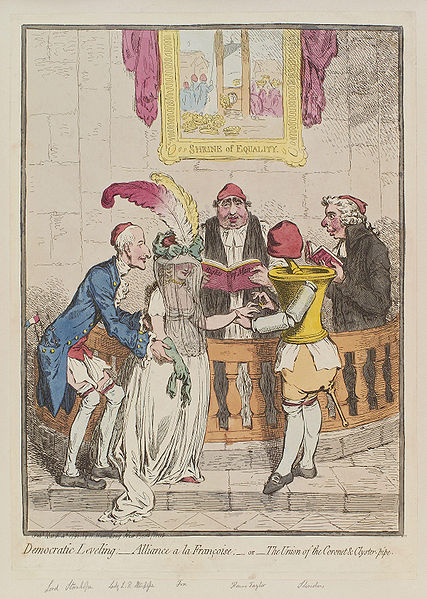
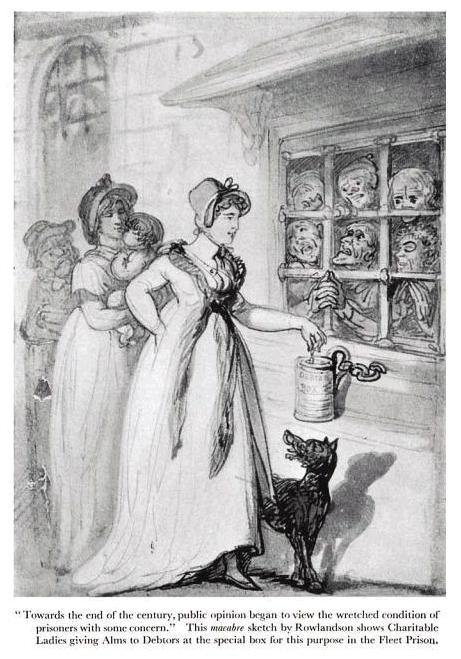
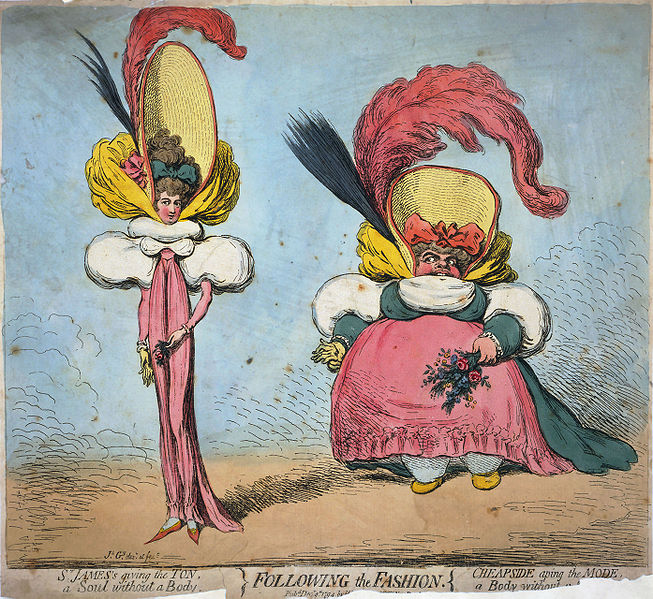
At the turn of the 19th century, the practice of medicine would benefit from rapid scientific advances brought about by methodical and well-reasoned experimentation and observations. But at the height of Thomas Rowland’s and James Gillray’s satiric powers, doctors, surgeons, and apothecaries were still targets of fun. The medical field also did not fare well with popular opinion.
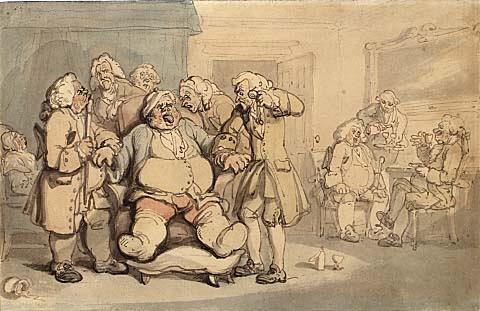
The Comforts of Bath, Rowlandson. At the end of the 18th Century, Bath had more doctors and apothecaries per number of citizens than any city in England.
The following humorous scene between a doctor and an author sums up the popular perception of a doctor’s swelled head. His miniscule knowledge about medicine does not detract from his exalted opinion of his social standing in relation to an apothecary’s. This passage emphasizes the point that the medical field took a back seat to poetry and criticism:
Doctor: I suppose, Sir, you are his apothecary.
Gent: Sir, I am his friend.
Doctor: I doubt it not. What regimen have you observed since he has been under your care? You remember, I suppose, the passage in Celsus, which says, “if the patient on the third day have an interval, suspend the medicaments at night. Let fumigations be used to corroborate the brain.” I hope you have upon no account promoted slernutation by hellebore.
Gent: Sir, you mistake the matter quite.
Doctor: What! an apothecary tell a physician he mistakes! You pretend to dispute my prescription! Pharmacopola componant. Medicus folus prefabricat. Fumigate him, I say, this very evening, while he is relieved by an interval’
Dennis: Death, Sir, do you take my friend for an apothecary! A man of genius and learning for an apothecary! Know, Sir, that this gentleman professes, like myself, the two noblest sciences in the universe, criticism and poetry. By the immortals, he himself is author of three whole paragraphs in my Remarks, had a hand in my Public Spirit, and assisted me in my description of the furies and infernal regions in my Appius.
(The discussion continues.) Then the doctor says:
Doctor: He must use the cold bath, and be cupped on the head. The symptoms seem desperate. Avicen says: “If learning be mixed with a brain that is not of a contexture fit to receive it, the brain ferments till it be totally exhausted. We must endeavour to eradicate these indigested ideas out of the perieranium, and to restore the patient to a competent knowledge of himself. – Elegant Extracts, or Useful Entertaining Passages
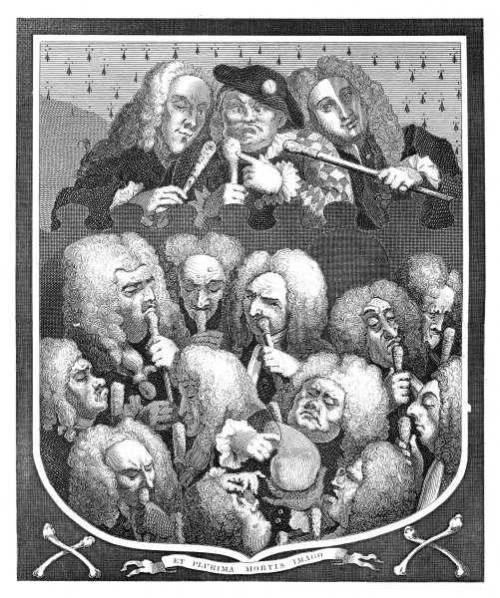
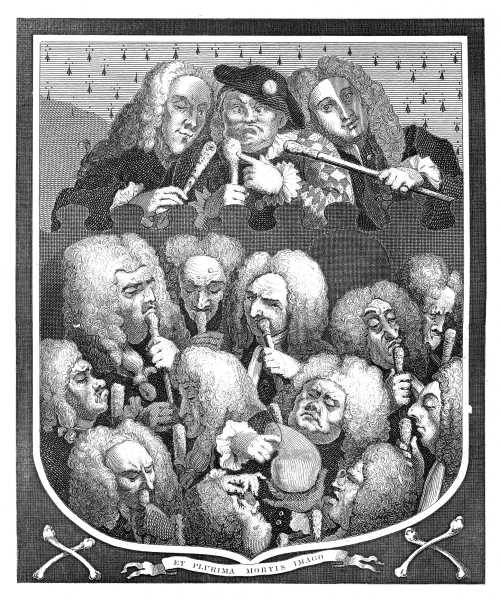
Consultation of Physicians, Hogarth
Physicians occupied the top rung of the medical social ladder because they did not “soil” their hands by treating the patient directly, as a surgeon would. They did not accept money in public (the payment would have been made discreetly). These “learned” men attended university but did not perform autopsies or dissect cadavres. Men of breeding, they merely sat back and watched the procedure from afar.
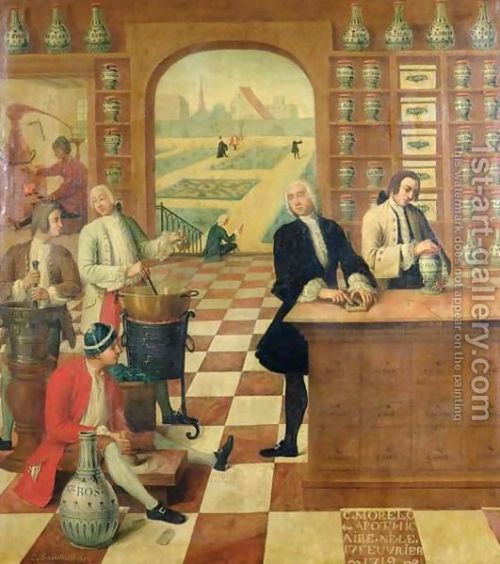
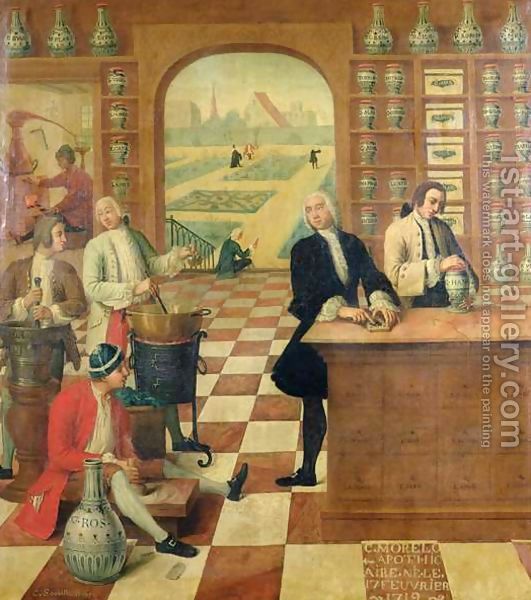
Apothecary shop, 1719
An apothecary shop during Jane Austen’s day was much like today’s drug store, where a customer could purchase drugs, herbs, poultices, panaceas, and other medicinals. In the image from 1st Art Gallery, one can see the preparations and infusions being made in an 18th century apothecary shop. Herbs grew in an adjacent garden and substances were stored in apothecary jars and drawers. Such shops also sold surgical equipment. In this link one can view an apothecary shop in Colonial Williamsburg, much as a similar shop might have looked in Meryton.
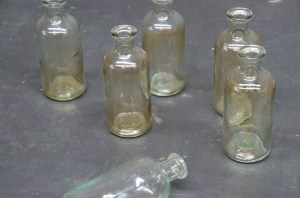
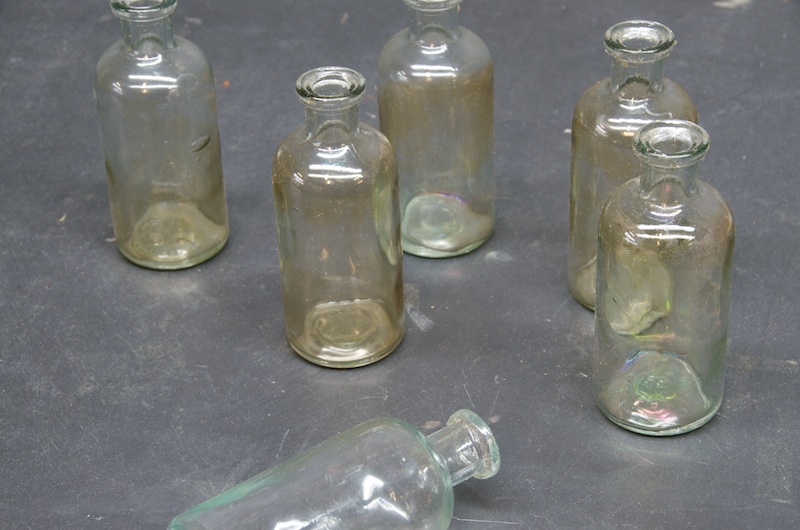
18th century apothecary bottles made with mercury glass
Apothecaries were often the only doctors available in a rural community, and they would take their supplies with them in portable apothecary box. Mr. Jones, Jane Bennet’s apothecary, must have dispensed his solutions from a similar box.
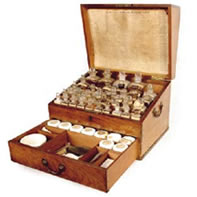
Apothecary box
By the mid-19th century, the medical field changed drastically, including the pharmaceutical field, and medications and medical practices began to actually heal patients with predictable success. In 1895, the Pharmaceutical Journal wrote what might well be an eulogy for apothecaries:
You are all familiar in one way or another with the apothecary of the last century. A gloomy little man in a gloomy little shop with a gloomy little helper. What mystery there was surrounding every step! His weird work with flame and flask mortar pestle and still! … These were pioneers in our profession and all honour is due them.
My further discussions about medicine in the 19th century can be found in three posts I have written on the topic:
More on the topic of medicine in Jane Austen’s day in these links:
Read Full Post »












 Jane Austen's World
