The Antique Prints Blog offers a wonderful post about Ackermann’s Print Shop with excellent illustrations. I will definitely be visiting this site often!
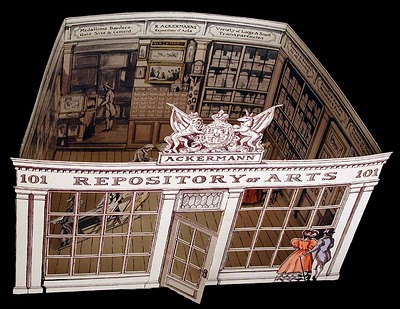
Ackermann Shop Interior: Image from Antique Print Blog
Posted in jane austen, Jane Austen's World, Regency Art, Regency World, tagged Ackermann Print Shop, Antique Print Shop, Seen over the ether on March 30, 2010| 4 Comments »
The Antique Prints Blog offers a wonderful post about Ackermann’s Print Shop with excellent illustrations. I will definitely be visiting this site often!
Ackermann Shop Interior: Image from Antique Print Blog
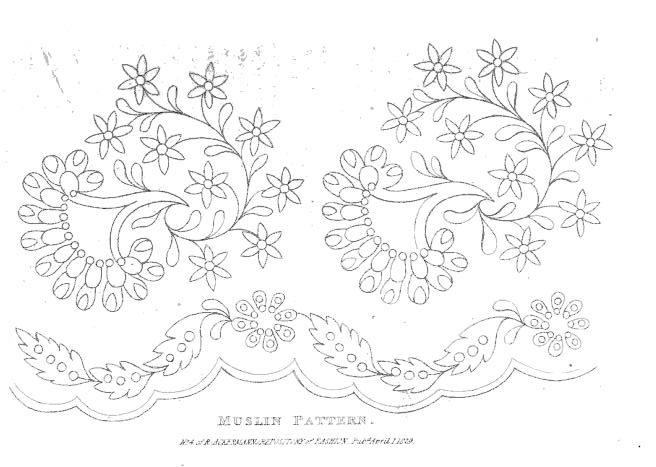
Posted in jane austen, Jane Austen's World, Regency Life, Regency Period, Regency style, Regency World, tagged Ackermann sewing patterns, embroidery patterns, muslin sewing patterns, regency muslin on March 27, 2010| 7 Comments »
Gentle reader – a few weeks ago someone asked me how the beautiful muslin patterns that Ackermann’s Repository of Fashions offered in its magazines could be transferred. This 19th century Enclyclopedia from Project Gutenberg offers practical suggestions. Among them are:

Tracing patterns against a window pane.—In order to copy a pattern in this way, the first step is to tack or pin the piece of stuff or paper on which the copy is to be made upon the pattern. In the case of a small pattern, the tacking or pinning may be dispensed with and the two sheets held firmly pressed against the window pane with the left hand, whilst the right hand does the tracing, but even then it is safer to pin or gum the four corners of the two sheets together, in case of interruption, as it is difficult to fit them together again exactly.
The tracing may be done with a pencil, or better still, with a brush dipped in Indian ink or water-colour paint.
The process of tracing is easy enough, so long as the hand does not get tired but as this generally comes to pass very soon it is best, if the pattern be a large and complicated one, to stick the sheets to the pane with strong gum or suspend them on a string, fastened across the pane by pins stuck into the window frame on either side.

To copy with oiled paper.—Another rather expeditious mode of transferring patterns on to thin and more especially smooth glossy stuffs, is by means of a special kind of tinted paper, called autographic paper, which is impregnated with a coloured oily substance and is to be had at any stationer’s shop. This you place between the pattern and the stuff, having previously fastened the stuff, perfectly straight by the line of the thread, to a board, with drawing-pins. When you have fitted the two papers likewise exactly together, you go over all the lines of the pattern with a blunt pencil, or with, what is better still, the point of a bone crochet needle or the edge of a folder. You must be careful not to press so heavily upon the pattern paper as to tear it; by the pressure exercised on the two sheets of paper, the oily substance of the blue paper discharges itself on to the stuff, so that when it is removed all the lines you have traced are imprinted upon the stuff.
This blue tracing paper is however only available for the reproduction of patterns on washing stuffs, as satin and all other silky textures are discoloured by it.

To pounce patterns upon stuffs.—The modes of copying, hitherto described, cannot be indiscriminately used for all kinds of stuff; for cloth, velvet and plush, for instance, they are not available and pouncing is the only way that answers.
The patterns, after having been transferred to straw or parchment paper, have to be pricked through. To do this you lay the paper upon cloth or felt and prick out all the lines of the drawing, making the holes, which should be clear and round, all exactly the same distance apart.
The closer and more complicated the pattern is, the finer and closer the holes should be. Every line of the outline must be carefully pricked out.
If the paper be sufficiently thin, several pouncings can be pricked at the same time, and a symmetrical design can be folded together into four and all pricked at once.
Posted in Architecture, jane austen, Regency Life, Regency London, Regency World, tagged Bookseller in London, Chambers Book of Days, Robert Chambers, The Book of Days on March 24, 2010|
Robert Chamber’s Book of Days was written in 1869. It is organized according to the days of the calendar and serves up history in the way that our ancestors saw it. I have found it to be a treasure of information about late Regency and Victorian London. Click here to read about the book. Below sits an excerpt from the book about the last remaining shop sign in situ over a bookseller shop. Once upon a time, such signs hung over every shop in London, some so precarious that they threatened passersby below.
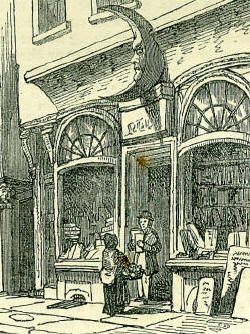
Bookseller, Chambers Book of Days
In Holywell-street, Strand, is the last remaining shop sign in situ, being a boldly-sculptured half-moon, gilt, and exhibiting the old conventional face in the centre. Some twenty years ago it was a mercer’s shop, and the bills made out for customers were ‘adorned with a picture’ of this sign. It is now a bookseller’s, and the lower part of the windows have been altered into the older form of open shop. A court beside it leads into the great thoroughfare; and the corner-post is decorated with a boldly-carved lion’s head and paws, acting as a corbel to support a still older house beside it. This street altogether is a good, and now an almost unique specimen of those which once were the usual style of London business localities, crowded, tortuous, and ill-ventilated, having shops closely and inconveniently packed, but which custom had made familiar and inoffensive to all; while the old traders, who delighted in ‘old styles,’ looked on improvements with absolute horror, as ‘a new-fashioned way’ to bankruptcy. March 9th entry
Posted in art, jane austen, Jane Austen's World, Regency Life, Regency style, Regency World, tagged Jane Austen's image, John Russell, Mrs Robert Shurlock 1801 on March 23, 2010| 7 Comments »

Jane Austen was born in 1775, the same year as Mrs. Robert Shurlock (born Henrietta Ann Jane Russell). Had Jane married and given birth to a child in 1801, would she have presented as charming a picture as Mrs. Shurlock and her daughter Ann? Both women would have been twenty-six years of age at the time. From this description of Jane, Mrs. Shurlock could well have been a relative, for according to her nephew James Austen-Leigh, his aunt Jane had:
“ full round cheeks, with mouth and nose small and well formed, light hazel eyes, and brown hair forming natural curls close round her face.”
John Russell, the painter and sitter’s father, was known for his skills with pastels, as this image from the Metropolitan Museum of Art clearly demonstrates. Henrietta took lessons from her father and became a talented artist in her own right.
Posted in Fashions, Holiday, jane austen, Jane Austen Novels, Jane Austen's World, Regency Customs, Regency Life, Regency style, Regency Travel, Regency World, tagged Poetical Sketches of Scarborough, Regency sea bathing, Regency seaside fashions, Sanditon on March 20, 2010| 3 Comments »
I’m a little late for the party, but a full day still remains until Laurel Ann at Austenprose finishes her in-depth tour of Sanditon, Jane Austen’s last, unfinished novel. Click on this page to catch up on all the links and comments and guest posts.
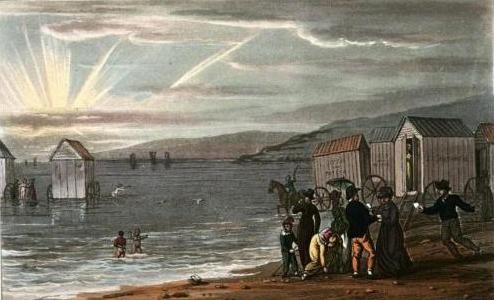
Sea Bathing in Scarborough, 1813
Read more about the seaside and seaside fashions on this blog to round out your knowledge of how the Regency folks enjoyed their seaside excursions:
Poetical Sketches of Scarborough, 1813, is a digitized book about the seaside resort of Scarborough, including color plates.
2025 AGM in Baltimore

RECOMMENDED BOOKS AND RESOURCES



Available through December 31st, 2025. Click on image for details, and share this poster with other teachers and students!


Click on image to read the story.

Gentle readers: Please feel free to post your comments and continue the conversation! Due to SPAM, we will no longer accept comments on posts after 30 days of publication. In some instances, links will be removed from comments as well.


If you would like to share a new site, or point out an error, please email us. (Yes, we are fallible. We'll own up to our mistakes and will make the corrections with a polite smile on our faces.) Write us at

Thank you for visiting this blog. Your comments and suggestions are most welcome.
STAGE-COACH AND MAIL IN DAYS OF YORE: A PICTURESQUE HISTORY
OF THE COACHING AGE, VOL. II, By CHARLES G. HARPER. 1903. Click on this link.

Disclaimer: Our team makes no profit from this blog. We may receive books (physical or digitized) for review purposes.
Copyright Statement: © Jane Austen's World blog, 2009-2024. Unauthorized use and/or duplication of this material without express and written permission from this blog’s author and/or owners is strictly prohibited. Excerpts and links may be used, provided that full and clear credit is given to Jane Austen's World with appropriate and specific direction to the original content.
 Jane Austen's World