Feeds:
Posts
Comments

Archive for the ‘Regency World’ Category

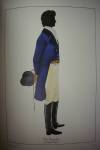
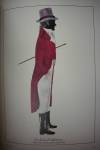
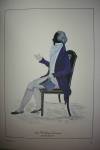
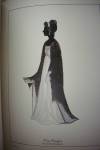
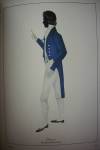
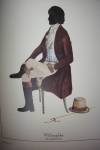
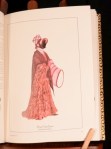
Shades from Jane Austen by Honoria Marsh was published in 1975-1976 in a series of limited editions. I saw this rare work at the silent auction table at the 2012 JASNA AGM meeting in NYC. There were many beautiful items, but this one was a standout with its colored illustrations, mostly silhouettes, and a few reproductions of Jane Austen’s writings. Bidding began at $50.00, but at the time I approached the table the price had gone up to $150.00, a bit beyond my price range but still less than the book attracts in online bookstores. The price reflects the book’s rarity, for only a few copies are available. I had seen a few illustrations before, but not the originals … until now.

The video shows a number of illustrations from the book not seen in this post. The portrayals of Jane Austen’s characters were painted by the author from life. Her sitters were either friends and acquaintances, or Jane Austen’s descendants or people associated with her! You can read their names below the title of the characters.

Part one of the book includes ‘Jane Austen’s Family in Silhouette’, a table showing Jane Austen’s Family and Chronology of Events During her Lifetime’ (written by Peggy Hickman), and Jane Austen’s family tree.

Part two includes an introduction and a discussion of Sense and Sensibility, Pride and Prejudice, Mansfield Park, Emma, Northanger Abbey and Persuasion.

Silhouette of Mrs. Gardiner

Alas, I do not know who successfully bid for the book in the silent auction or what it went for. Does anyone know?

Read Full Post »

Before Jane Austen and her sister, Cassandra, and mother moved into Chawton Cottage, they lived in a “commodious oldfashioned house in a corner of Castle Square” in Southampton. In his Memoir of his aunt, James Edward Austen-Leigh writes this charming, although bittersweet description:

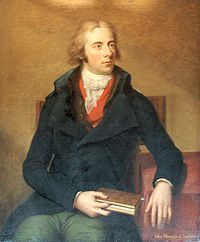
John Petty, 2nd Marquess of Lansdowne

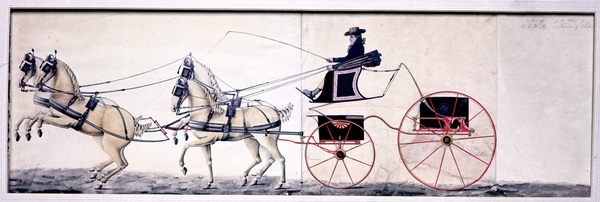
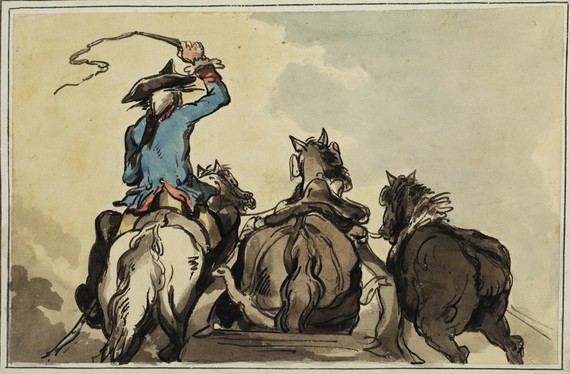
At that time Castle Square was occupied by a fantastic edifice, too large for the space in which it stood, though too small to accord well with its castellated style, erected by the second Marquis of Lansdowne, half-brother to the well-known statesman, who succeeded him in the title. The Marchioness had a light phaeton, drawn by six, and sometimes by eight little ponies, each pair decreasing in size, and becoming lighter in colour, through all the grades of dark brown, light brown, bay, and chestnut, as it was placed farther away from the carriage. The two leading pairs were managed by two boyish postilions, the two pairs nearest to the carriage were driven in hand. It was a delight to me to look down from the window and see this fairy equipage put together; for the premises of this castle were so contracted that the whole process went on in the little space that remained of the open square. Like other fairy works, however, it all proved evanescent. Not only carriage and ponies, but castle itself, soon vanished away, ‘like the baseless fabric of a vision’. On the death of the Marquis in 1809, the castle was pulled down. Few probably remember its existence; and anyone who might visit the place now would wonder how it ever could have stood there. – A Memoir of Jane Austen

George IV’s spider phaeton (1790) Click on image to view a larger version.

Postillion by Thomas Rowlandson (18th century – 19th century)

Read Full Post »

A Dance with Jane Austen: How a Novelist and her Characters went to the Ball, Susannah Fullterton

“Ah”, I said, when I saw Susannah Fullerton’s book in my mail box. “Here’s just the book I need.” Some of the biggest gaps in my Austen reference library concern dance and music. Whenever I wanted to find out more about the social customs of balls and dancing, how ladies and gentleman conducted themselves, the food served at supper balls, the etiquette of a gentleman’s introduction to a lady before he could dance with her, precisely when the waltz became acceptable not only among the racy upper crust but with villagers in the hinterlands as well, and the difference between private balls and public balls, I had to consult a variety of books. This was time-consuming, and a bit frustrating, for there were variations in details that each source offered.

And now Susannah Fullerton has come to my rescue! Readers who have visited the Jane Austen Society of Australia (an excellent site) know that Ms. Fullerton is its president, and that she has written a previous book, Jane Austen and Crime. A Dance With Jane Austen is a compact illustrated book crammed with information, but written in a relaxed and accessible style. Topics include: Learning to dance, Dressing for the dance, Getting to and from a ball, Assembly balls, Private balls, Etiquette of the ballroom, Men in the ballroom, Dancing and music, ‘They sat down to supper’, Conversation and courtship, The shade of a departed ball, and Dance in Jane Austen films.

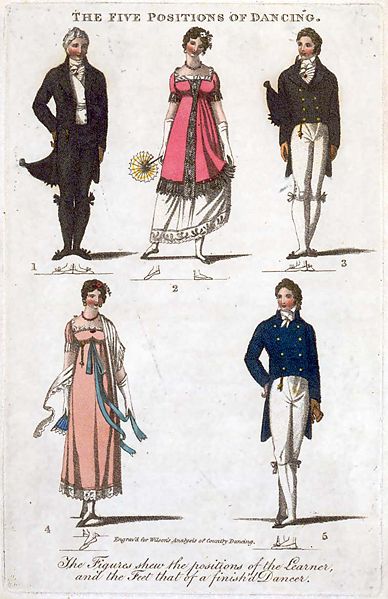
Ms. Fullerton culls information from Austen’s letters, novels, and historic texts, such as The Complete System of English Country Dancing, by Mr. Wilson, a dancing master of some renown and decided opinions. She also describes how Beau Nash, the influential master of ceremonies and taste maker in Bath, laid down a set of rules for Society to follow. Nash single-handedly changed a small, sleepy city into THE playground for the smart set with his dictums and innovations, which lasted well beyond his death.

The Five Positions of Dancing, Wilson, 1811

Jane Austen was no stranger to Bath’s public assemblies, or to dancing in private settings. She loved to dance and rarely said no when a man approached her for a set. Jane danced as often as she could, wryly observing to her sister when she was in her thirties and when partners became scarcer: “You will not expect to hear that I was asked to dance, but I was.”

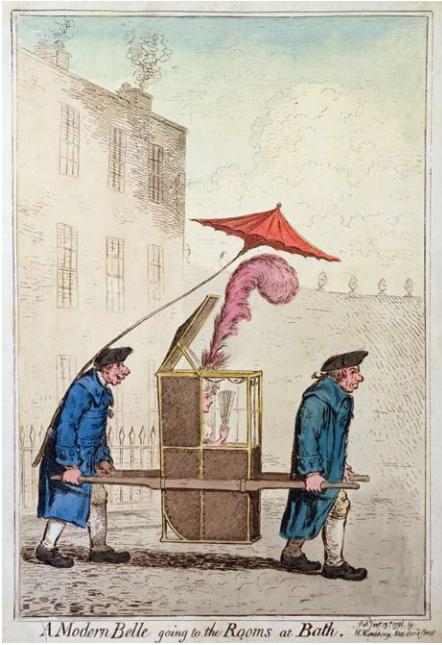
Getting to a ball might be problematic for those who had no means to keep horses or carriages. It made little sense to walk miles in fancy garb over dirt roads to a social event, and so arrangements needed to be made for those who were going to a dance to piggy-back with individuals who were willing to take them. This meant arriving and leaving a dance on someone else’s schedule. Catherine Morland did not walk to the Assembly Rooms, but took a sedan chair, for private carriages were seldom used within Bath proper. Her journey from “Great Pulteney Street to the Upper Rooms would have cost her between one shilling and six pence and two shillings (one way) – an expensive luxury at the time.”

A Modern Belle Going to the Rooms at Bath, Gillray caricature

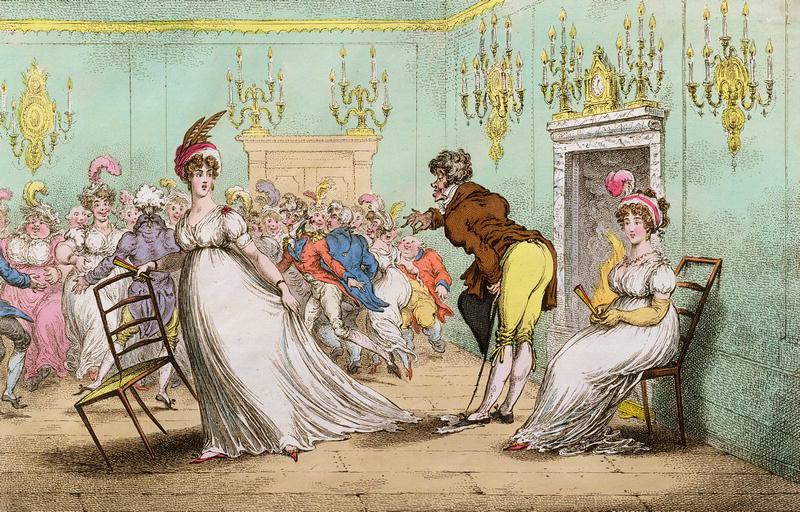
The dancing ritual was one of courtship, and Jane Austen took full advantage of a ball to set the stage for character development. In each novel she takes a different approach. Lizzie and Darcy tense relationship began at the Meryton Assembly Ball, a situation that was not helped at the private ball at the Lucas’s house nor at the Netherfield Ball, where Lizzie’s family behaved abominably. The dances in Mansfield Park serve to show how selfish the characters are, and to point out Fanny’s isolation from the neighbors. Dancing masters taught children to dance properly, and they received further practice at children’s balls, but Fanny had few opportunities for practice, and she felt tense when she was prominently displayed at her birthday ball. Jane Austen masterfully used the dances in Emma to show how Emma never quite loses sight of Mr. Knightley even as she dances with Frank Churchill, and one gets a good sense of the frustration Catherine Morland feels at not being able to dance at her very first ball in Bath, for there was no one to introduce her and Mrs. Allen properly, or the utter irritation she feels when John Thorpe ruins her well-laid plans to dance with Mr. Tilney at a later assembly ball. Austen also uses balls to demonstrate how outrageous Marianne Dashwood’s behavior is towards Willoughby, breaking many rules of etiquette and decorum.

A Broad Hint of Not Meaning to Dance, James Gillray, published by Hannah Humphreys

Ms. Fullerton sets aside a few pages to discuss dances in films. These elaborately staged scenes are highly popular with film buffs. The costumes are beautiful, as is the music, and the settings are often quite lavish. But be aware that most of the dances and music are often inaccurate and chosen for cinematic effect. (As an aside, I was glad to note that Susannah’s take on Pride and Prejudice 1940 was similar to mine.)

Susannah Fullerton

Insights such as these make this book a sheer pleasure to read. A Dance with Jane Austen will be a valuable addition on the book shelves of any Regency author, Janeite, and history buff. As Susannah Fullterton says about her book:

Dances in the Regency era were almost the only opportunity young men and women had to be on their own without a chaperone right next to them, and dancing provided the exciting chance of physical touch. ..Dances were long – one often spent 30 minutes with the same partner – so there was plenty of opportunity for flirtation, amorous glances, and pressing of hands. After the dance was over, there was all the pleasure of gossip about everything that had happened.”

A Dance with Jane Austen will be available in October. Readers who are lucky enough to go to the Jane Austen Society Annual General Meeting in New York in a few weeks will have the opportunity to meet Ms. Fullerton! I give this book 5 out of 5 Regency tea cups.

Preorder the book at this Amazon.com link or at Frances Lincoln Publishers
Hardcover: 144 pages
Publisher: Frances Lincoln (October 16, 2012)
Language: English
ISBN-10: 0711232458
ISBN-13: 978-0711232457

Please note: The blue links are mine; other links are supplied by WordPress. I do not make money from my blog. I do, however, receive books from publishers to review.

Read Full Post »

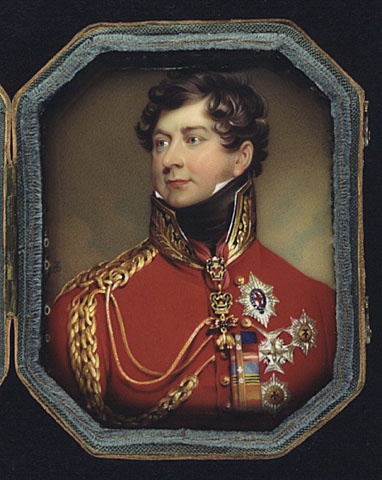
The period between 1811 and 1820 is known in British history as the Regency. In 1811 King George III was deemed unfit to rule and his son, the Prince Regent, ruled in his place. On his father’s death in 1820, the Prince was crowned King George IV. Coincidentally, Jane Austen’s novels were published between 1811 and 1818 and her writing has come to define how we imagine life was lived in the Regency era.
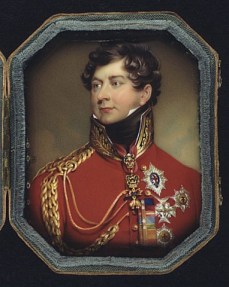
Miniature of the Prince Regent, Courtesy of the library archives of Canada

Yet so successful has Jane Austen been in implanting images in her readers’ minds that there is a danger that we begin to accept fiction as fact, to confuse the lives of her heroines with her own life, to interpret the lives of the few as being the lives of the many. And in that process there is also the risk that we lose sight of her skill and imagination as a writer. She was without doubt a keen observer, but the settings and people she describes, come as much from her imagination as from what she saw or experienced.

Company at play, the Comforts of Bath, Thomas Rowlandson

Jane chose to set two of her novels (Northanger Abbey and Persuasion) in Bath. She lived in the city between 1801 and 1806 and it’s still possible to retrace her footsteps, to see some of what she saw. The pattern of roads is largely unchanged in the older part of the city. Many of the places she would have frequented are still there; The Royal Crescent, The Circus, Queen Square, Milsom Street, Pulteney Bridge, the Upper Assembly Rooms, the Pump Rooms, the Guildhall, and Sydney Gardens, to name but a few.
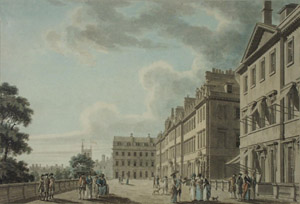
South Parade, Bath, Thomas malton, 1775 (the year of Jane Austen’s birth).

It is easy to imagine these places as she depicts them in her novels, yet it is almost impossible to separate fact from fiction. For example, in “Northanger Abbey” we read;

They arrived in Bath. Catherine was all eager delight; – her eyes were here, there, everywhere, as they approached its fine and striking environs, and afterwards drove through those streets which conducted them to the hotel. She was come to be happy, and she felt happy already.”

Yet Jane also records on moving to Bath, her own “first impression” of the city, in a letter to her sister, Cassandra, on May 5th 1801;

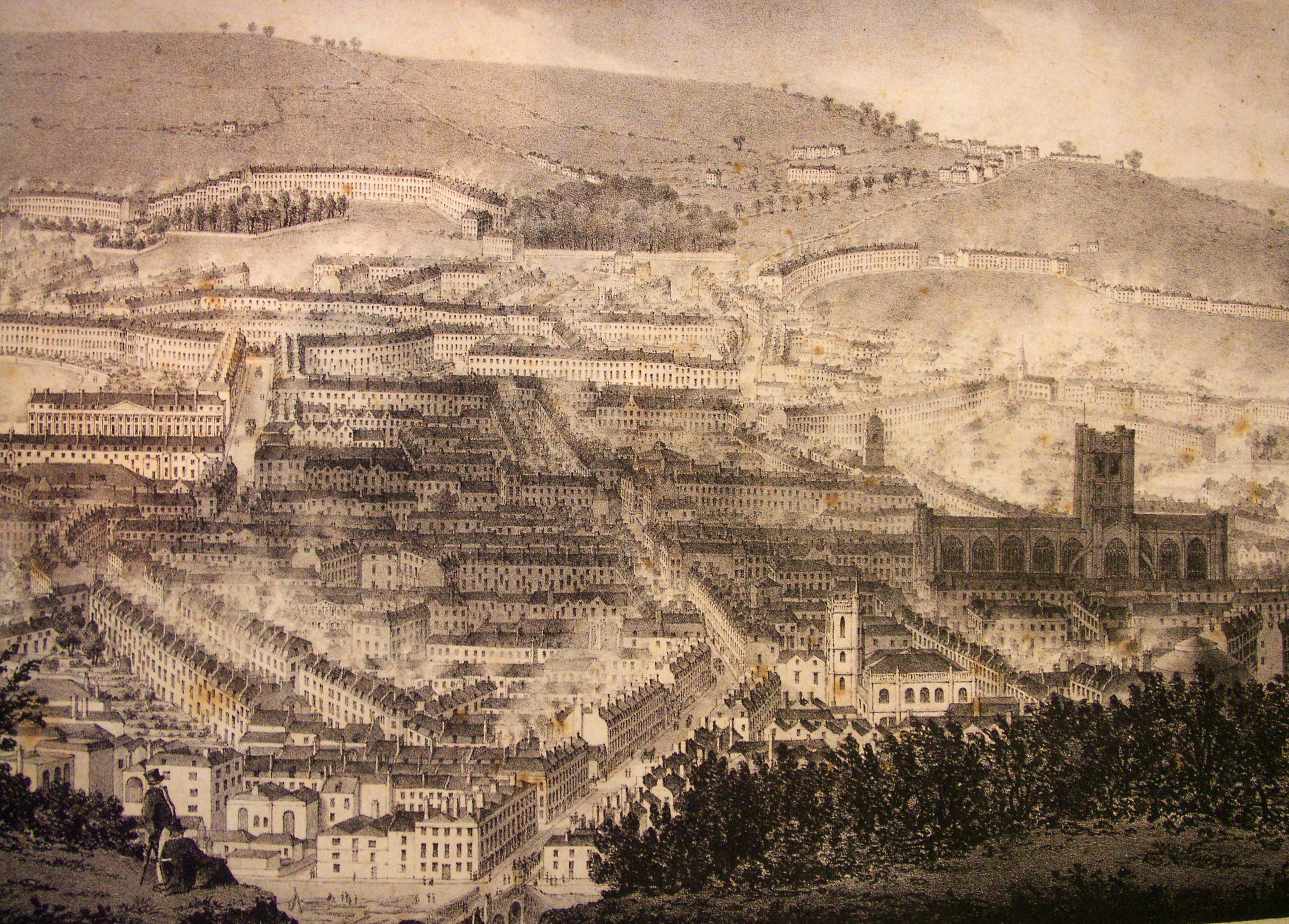
The first view of Bath in fine weather does not answer my expectations; I think I see more distinctly through rain. The sun was got behind everything, and the appearance of the place from the top of Kingsdown was all vapour, shadow, smoke, and confusion.”
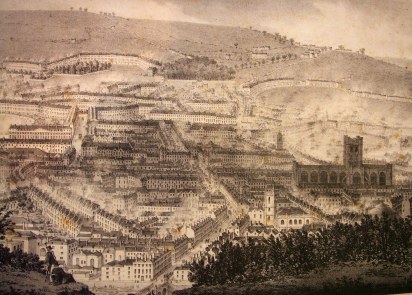
Panoramic view of Bath from Beechen Cliff, 1824

Again in “Northanger Abbey” she describes a formal ball held in the Upper Assembly Rooms;

The season was full, the room crowded, and the two ladies squeezed in as well as they could. As for Mr Allen, he repaired directly to the card-room, and left them to enjoy a mob by themselves. With more care for the safety of her new gown than for the comfort of her protégé, Mrs Allen made her way through the throng of men by the door, as swiftly as the necessary caution would allow; Catherine, however, kept close at her side, and linked her arm too firmly within her friend’s to be torn asunder by any common effort of a struggling assembly.”
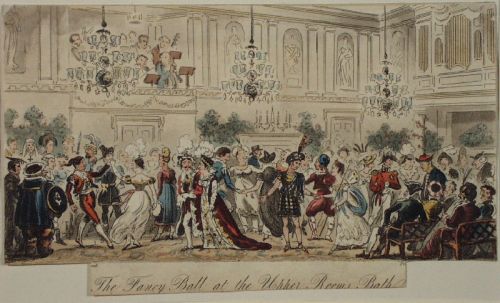
Fancy Ball at the Upper Rooms, Bath, Thomas Rowlandson

Yet her own experience was somewhat different, as she reports in letter to her sister on May 12th 1801;

By nine o’clock my uncle, aunt, and I entered the rooms, and linked Miss Winstone on to us. Before tea it was rather a dull affair; but then the before tea did not last long, for there was only one dance, danced by four couple. Think of four couple, surrounded by about an hundred people, dancing in the Upper Rooms at Bath.

After tea we cheered up; the breaking up of private parties sent some scores more to the ball, and though it was shockingly and inhumanly thin for this place, there were people enough, I suppose, to have made five or six very pretty Basingstoke assemblies.”

They say you should write about what you know and Jane Austen certainly knew about people, but was her life really comparable to those of her heroines? She attended dinner parties, suppers, formal balls and had some insight into high-society. Yet that society was very stratified with rigid conventions and social etiquette. Those rules defined who was on a level with whom, and Jane was certainly not part of its upper echelons. She was part of that “society” but in truth she was fairly low down in the “pecking order.” Her Uncle and Aunt were wealthy and lived in the Paragon. They might have provided her with opportunities to glimpse their way of life, but they do not seem to have been over-generous to Jane or her family.

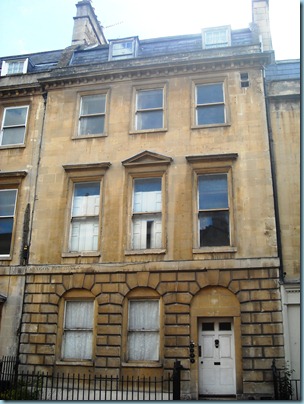
Number 1, Paragon, where the Leigh-Perrots lived. Image @Austenised

When Jane’s family moved to Bath they leased a house at 4, Sydney Place. It was a fine house in a good area, near the popular Sydney Gardens, but it was not a prestigious address in comparison with other parts of the city. And when the lease ended they moved to a house in Green Park Buildings. This was an area the family had dismissed when they first moved to the city and it’s easy to see why from Jane’s description;

Our views on G. P. (Green Park) Buildings seem all at an end; the observation of the damps still remaining in the offices of an house which has been only vacated a week, with reports of discontented families and putrid fevers, has given the coup de grace. We have now nothing in view. When you arrive, we will at least have the pleasure of examining some of these putrefying houses again; they are so very desirable in size and situation, that there is some satisfaction in spending ten minutes within them.”

Before leaving Bath the family also lived for a while in 25, Gay Street. (The Jane Austen Centre is nearby at 40 Gay Street). It was a “good address” but by then, after the death of Jane’s father, they were reduced to “taking rooms” as boarders rather than occupying a house as tenants. By then the family were largely dependent on the charity of relatives.
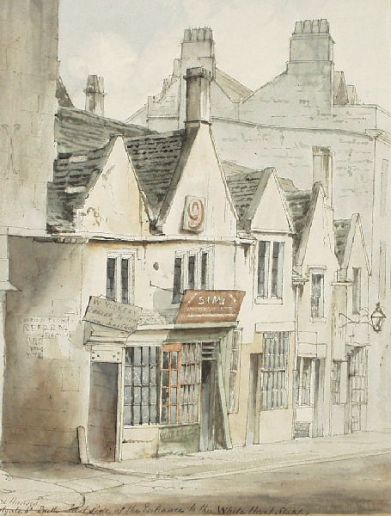
Old Houses. Westgate Street , Bath, Thomas Elliot Rosenberg, 1820. Image @Victoria Art Gallery, Bath

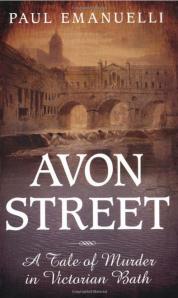
It’s obvious too that Jane was well aware of the plight of the genteel poor. In “Persuasion” Sir Walter Elliot refers to Westgate Buildings as, “Everything that revolts other people, low company, paltry rooms, foul air, disgusting associations.” Westgate Buildings was by no means the worst of streets but it was situated on the border of the Avon Street slum area. My own novel “Avon Street” has an opening scene in Westgate Buildings and explores the darker aspects of the City.
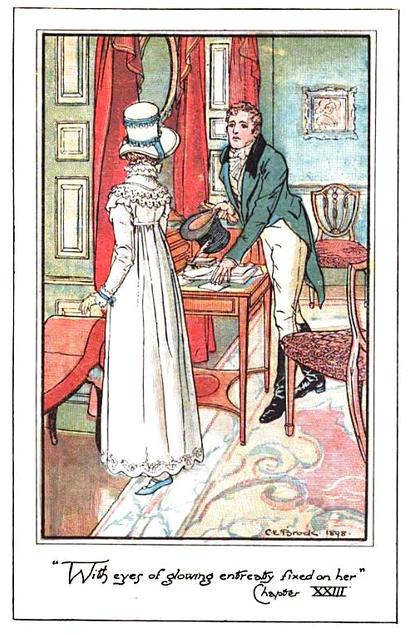
Brock illustration of Captain Wentworth entreating Anne Elliot to read his letter, Persuasion.

Opinion is divided on whether or not Jane Austen actually liked Bath, but she certainly knew how to use it as a setting. Jane Austen created an image of Regency life which still survives today. That is a testament to her imagination and skill as a writer. She chose to depict a way of life in her novels that did not always reflect her own everyday experience. Indeed it was not representative of the lives of most, yet it pleased her readers then and still pleases them today.

Inquiring readers: Paul Emanuelli, author of Avon Street (click here to view the book and order it), has contributed a post for this blog before about the City of Bath as a Character and Law & Order and Jane Austen’s Aunt, and Food – To Die For: Food Preparation in the Georgian EraHe has graciously sent in an article about crime and an incident involving Jane Austen’s aunt, Mrs James Leigh-Perrot. Paul writes about Bath in his own blog, unpublishedwriterblog. It is well worth a visit!
  • Paperback: 320 pages
  • Publisher: The History Press (March 28, 2012)
  • Language: English
  • ISBN-10: 0752465546
  • ISBN-13: 978-0752465548

Read Full Post »

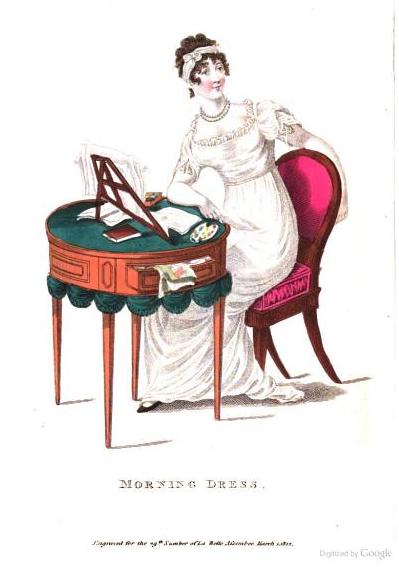
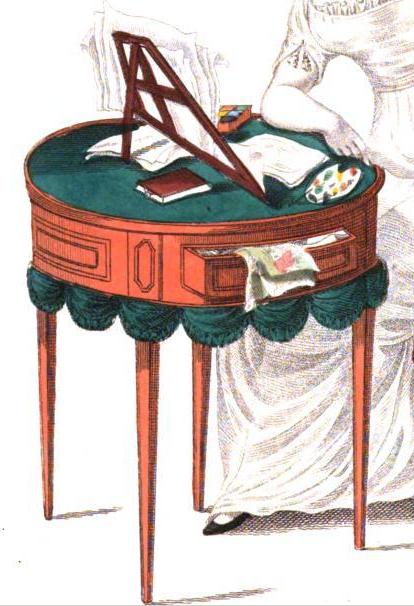
What did ladies do in the morning 200 years ago? Why, write letters and draw and paint, of course. A genteel lady knew all three arts and achieved them with varying skills. This delightful La Belle Assemblee print details how a well-dressed woman would look at her work table. This young Regency miss works like me, btw: with everything out and cluttering surfaces.

Morning Dress, March 1812, La Belle Assemblee

First, a description of the outfit:

MORNING or HOME COSTUME: A white cambric frock with a demi train, short sleeves fastened up in front with cordon and tassels, a necklace formed of two rows of opal; the hair dressed in full curls, and confined by a demi turban of very fine muslin tied on the right side with a small bow; silk stockings with lace clocks richly brocaded; and plain black kid slippers.”

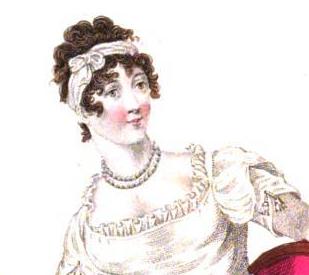
Detail of hair and bodice, La Belle Assemblee, March 1812. Note the lovely bandeau, the ringlets framing the face, and the relatively high neckline with ruff.

The magazine goes on to say that embroidery on all gowns, whether for domestic parties or home attire, seems very prevalent. Embroidery on evening gowns made of costly materials is frequently of gold and silver. India muslins are again coming much into wear and were very decently priced:

for the information of our Fashionable Readers, we have observed, at the house of Millard, in the City, some of the choicest production of the East Indies from the Company’s recent Sale of Bengal Muslins, &c. Their beauty is exquisite…”

Detail of ladies round worktable with drawer. La Belle Assemblee, March 1812. This one most likely had a top and decorative swaths made of green baize, which prevented sliding.

These small and elegant worktables were portable and could be easily carried near a light source or fireplace, or stashed against a wall when company came. They varied, some coming with a variety of compartments – some hidden – that contained writing and painting supplies. Many had book stands for reading, others had drawers that contained paper or embroidery threads and sewing supplies.

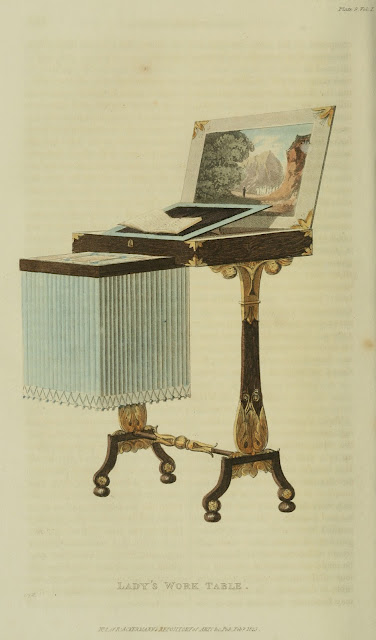
Ackermanns Lady’s work table, 1823. Image from EK Duncan

This work table was “equally adapted to the boudoir and drawing-room, and answers the purpose of a drawing-table as well as a work-table, and a desk for writing and reading.”

This was a very elegant and expensive work table for a rich lady.

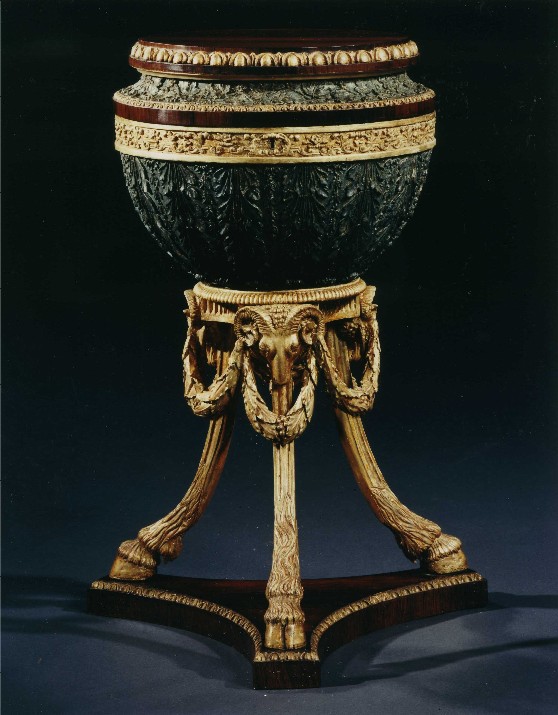
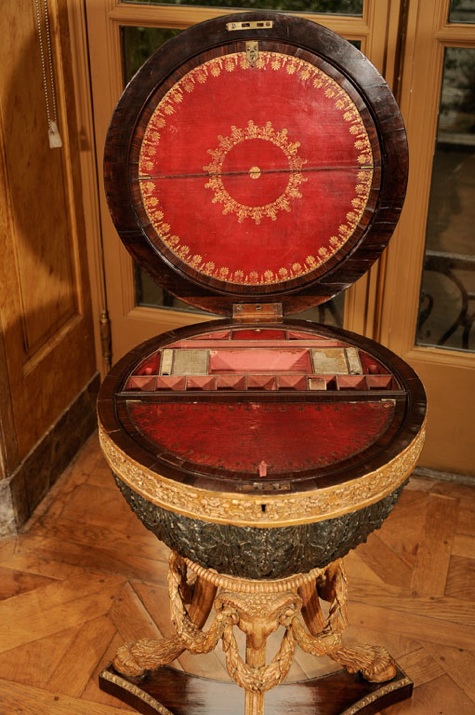
This English work table, circa 1815, is a curious fusion of the refined neoclassicism of Robert Adam and the exotic eclecticism which emerged during the Regency period.  The finely carved tri-form giltwood stand, based on a Roman form, is typical of Adam’s adaptation of the antique. – Carlton Hobbs Work Table

… it was also a Regency characteristic to employ finely tooled scarlet leather, such as that fitted to the interior of this piece.”

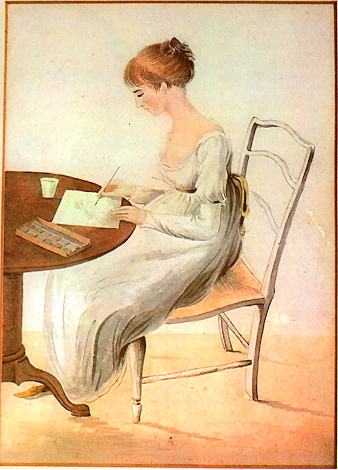
Jane Austen’s niece, Fanny Knight, paints watercolors on a regular table.

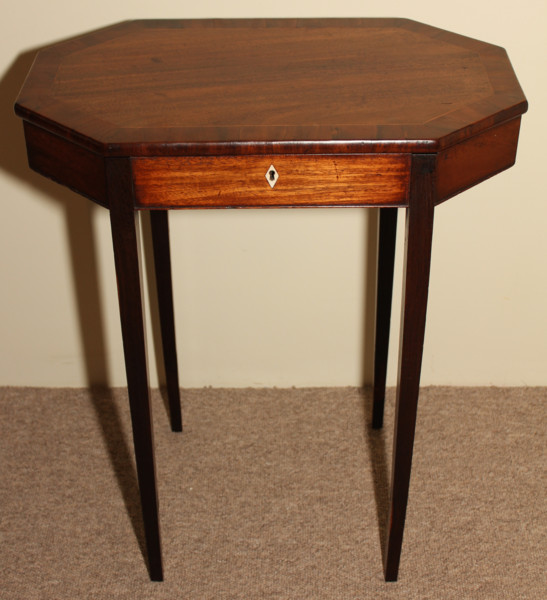
This rather plain octagonal worktable has four legs instead of the pedestal on Fanny Knight’s table.

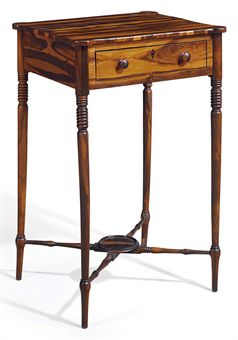
As you can see, work tables varied in design and construction. This simpler and smaller cocuswood work table suited a lady’s purpose as well as a fancier one, but it has fewer compartments.

This plain worktable with a single drawer is an:

Early 19th century regency cocuswood work table with a rectangular top and single drawer.The turned legs are joined by a turned stretcher with circular platform, with paper label to underside inscribed purchased by ABM.

A few months ago I featured a short video of an 18th century French mechanical worktable, which showed how the hidden mechanisms worked and how easily the table could be moved from place to place. Click on this link to view it.

Note: The blue links are mine: the green links are ads placed here by WordPress. I make no money from this blog.

Read Full Post »

« Newer Posts - Older Posts »